
Leaves on a StreamEmotional Fitness · ~3 min
About this template · Updated September 2026
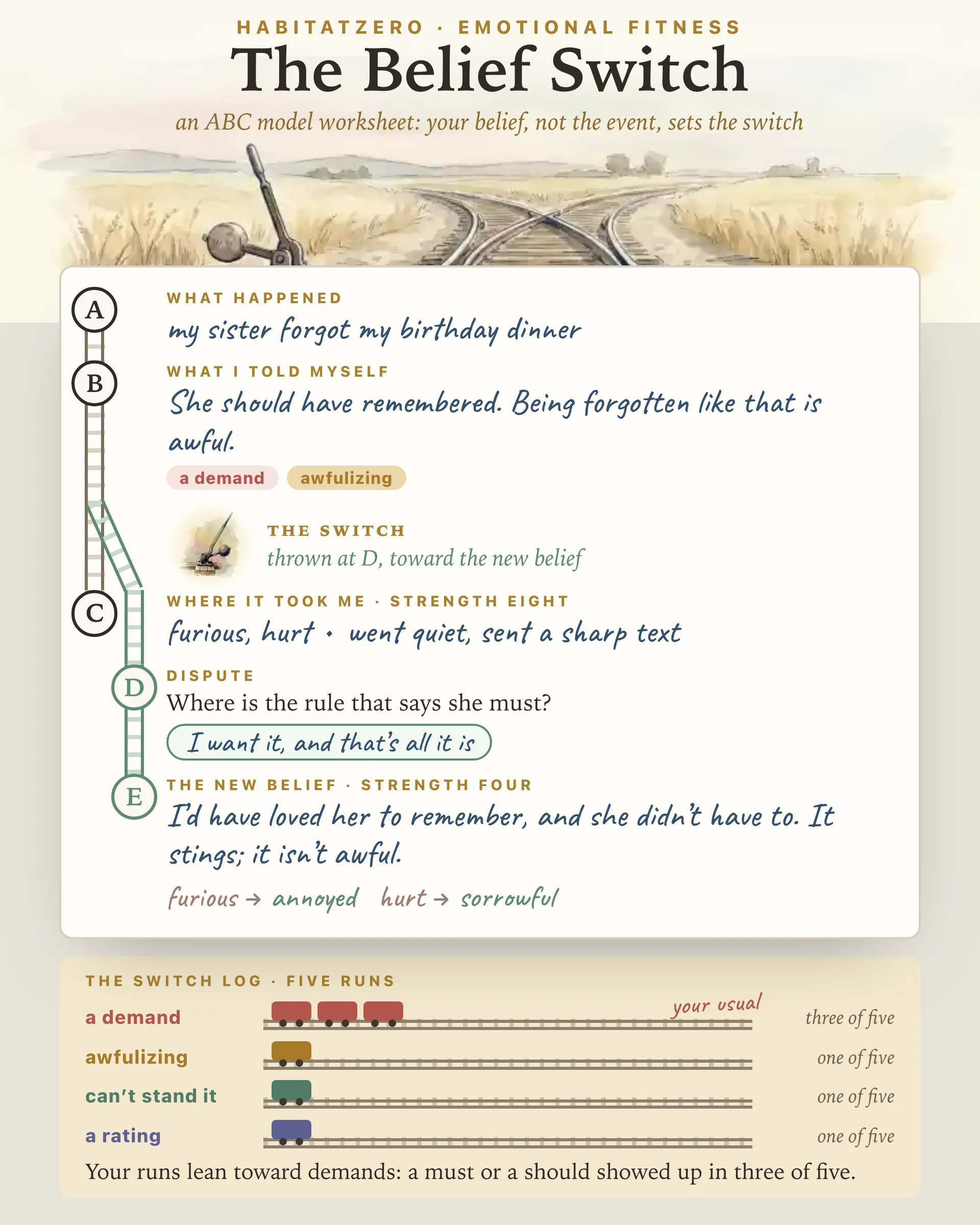
The ABC model comes from Albert Ellis, the psychologist who developed rational emotive behavior therapy in the mid-1950s, and the Albert Ellis Institute in New York still trains therapists in the method. For decades it went by rational-emotive therapy, until Ellis renamed it in the 1990s and put behavior into the title. This worksheet is our own practice tool built on his published model. The Institute has not reviewed or endorsed it, and we have no ties to it.
Most of us explain a bad moment in two steps: my manager moved the meeting, so I was furious. Ellis argued that a step is missing. Between the activating event (A) and the consequence (C), in what you feel and do next, sits the belief (B) you hold about the event. One colleague finds the change mildly annoying; another decides it should never have happened and that he can't stand it. Same A, two different Cs, and the difference lives at B.
The map carries a hopeful point. You usually cannot undo A, and you cannot order C to stop, but B is within reach.
Ellis called the damaging beliefs irrational, meaning rigid and out of step with reality, not stupid.
Ellis treated demands as the root. Look under awfulizing or a harsh verdict and you will usually find a must holding it up. Each of the four has a flexible cousin: a strong preference instead of a demand, bad instead of awful, hard but bearable instead of unbearable, and a person who is more than one act.
D stands for disputing: questioning the belief the way a good editor questions a sentence. Where is the rule that says it must? Does wanting something badly make it necessary? Where does holding this belief get you? E is the effective new belief that comes out the other side, honest rather than cheerful: I would have liked it, it didn't have to happen, and it stings without being a catastrophe.
E is not meant to make you calm. After a bad event a negative feeling fits, and the goal is a healthy one in place of an unhealthy one: concern where there was anxiety, sadness rather than depression, annoyance in place of fury, remorse instead of guilt, disappointment where shame used to be.
The sheet is a stretch of railroad track. A and B sit on the main line, and B is the switch that sends you down to C, where you tap what you felt and did and rate its strength. D and E sit on a second line branching off at the switch. Mark the kind of belief at B and matching questions appear at D, each with honest answers, including one that admits the belief still holds. The first answer that lands throws the painted lever and opens the line to E, which pairs each feeling with its healthier counterpart and asks for a second rating.
Marks and answers belong to the words they were given for: add to B and they stay, reword it and they clear.
Each logged run parks one car on the siding of every kind of belief it carried. After three runs, the switch log names the belief that keeps setting your switch and the question that fits it.
A 2018 meta-analysis of 84 articles found a medium effect on outcomes when REBT was compared with other interventions, plus a drop in irrational beliefs, and called it a sound intervention while flagging limits in the existing studies. A separate meta-analysis pooled 100 samples and found irrational beliefs moderately linked with anxiety, depression, anger and guilt. That second finding is an association, so it does not prove the beliefs cause the distress.
Neither review tested a worksheet like this one on its own, so treat the page as practice for one skill: hearing the must inside a sentence and loosening it.
Run it soon after a moment that hit harder than it deserved, or at the end of a day for the one that stuck, and log a handful over two weeks so the pattern can show. If the same belief keeps knocking you down, or low mood and worry are settling in, an REBT or CBT therapist can dispute it alongside you. If a belief like I'm worthless has turned into thoughts of not wanting to be here, put the worksheet down and call or text 988 in the US, or your local emergency number, to reach someone now.
If a thought twists the facts rather than making demands of them, The Three-Column Technique names the distortion. To follow a belief further down to the one underneath, try The Downward Arrow, and to weigh a thought against the evidence, use the Thought Record Journal.
It is the core map of rational emotive behavior therapy, which Albert Ellis developed in the mid-1950s as one of the earliest cognitive behavioral therapies. A is the activating event, B is the belief you hold about it, and C is the consequence in what you feel and do. Its central claim is that B, far more than A, decides C.
A: your sister forgets your birthday dinner. B: she should have remembered, and being forgotten is awful. C: you feel hurt and furious and go quiet. The ABCDE version keeps going. D asks where the rule is that says she must remember, and E might be: I would have loved her to, she did not have to, and it stings without being awful.
Demands, the musts and shoulds you lay on yourself, other people or the world. Awfulizing, which ranks a bad event as the worst thing possible. Low frustration tolerance, the sense that you cannot stand it. Global rating, which sums up a whole person from one act. Ellis treated demands as the root the other three grow from.
No. It is an independent practice tool built on the model Ellis published, and neither the Albert Ellis Institute nor anyone connected with Ellis has reviewed, approved or sponsored it. To learn the method from its source, the Institute in New York trains REBT therapists and lists them.
The page shows a finished run on the track that you can look through. To log your own runs and let the switch log find your pattern over a few weeks, personalize the sheet in HabitatZero, which costs nothing.
By the team behind Fabulous, the science-based self-care app used by over 30 million people.


