
The Overwhelm Recovery ProtocolWellness & Routines · ~5 min
About this template · Updated September 2026
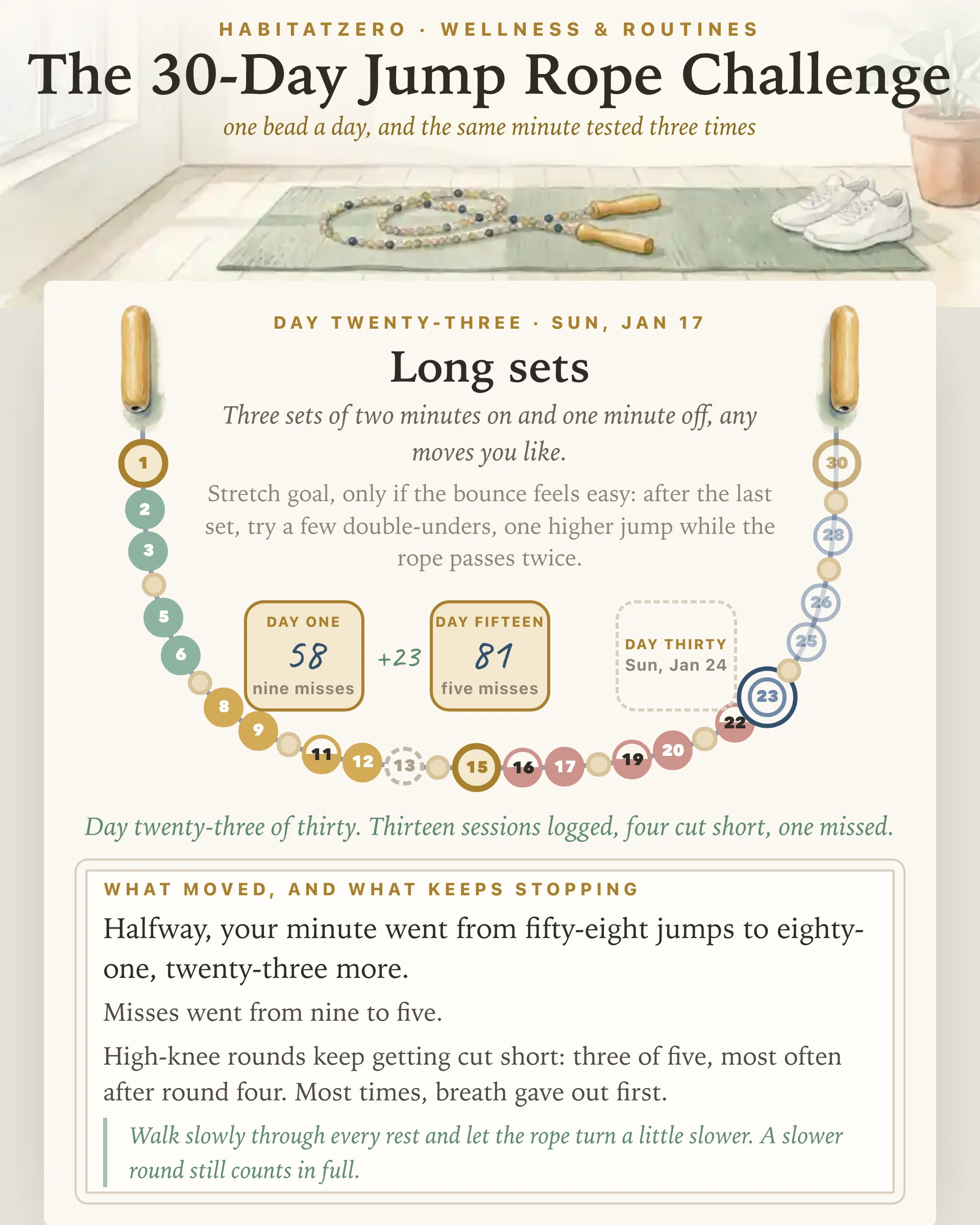
A jump rope costs little, fits in a drawer, and gets your heart rate up in the space between a couch and a coffee table. It also punishes an eager start, because your calves and shins absorb every landing. This challenge runs the other way. It opens with rounds shorter than a minute, lengthens them slowly, puts rest days where the landings need them, and measures the change with one repeated minute.
Every day is one bead on the rope, and day one is a test. The first week is bounce rounds: six rounds of twenty seconds with forty seconds of rest between them, about two minutes of real jumping. Week two brings in the alternate-foot step over eight rounds of thirty seconds on and thirty off. Week three swaps in high knees at forty-five seconds a round, and week four stretches into long sets, three blocks of two minutes with a minute to breathe between them. Nine rest days are spread across the month, including the day before each retest. Double-unders stay optional: a stretch goal for the long-set days, once the bounce feels easy.
The shape follows standard exercise advice. The Physical Activity Guidelines for Americans count jumping rope as vigorous activity and tell inactive people to start low and go slow, beginning with lighter activity and building up how often and how long they move. The American College of Sports Medicine's position stand on exercise prescription makes the same case: a gradual rise in intensity and volume may lower the risks of exercise. The seconds and rounds here are a rule of thumb for a healthy beginner, so if a day asks too much, stop early and log it that way.
On days one, fifteen and thirty you do the same thing. Warm up for two minutes with easy bounces, then jump a basic bounce for one minute at a pace you can hold. Count every jump. When the rope catches your feet, restart and keep counting, and keep a separate tally of the misses. The built-in timer gives you five seconds to get set and a tone you can mute when the minute ends. Test on the same floor with the same rope each time, or the three numbers stop comparing.
Logging the first test starts the calendar, and every later day belongs to its own date. If day thirty gets away from you, the last test stays open for two more days and the sheet notes when you took it.
Each session takes one tap: all rounds done, cut short, or stopped because it hurt. Cut short asks how many rounds you finished and, if you want, what stopped you: breath, calves, tripping or time. After the halfway test it tells you how far your count has moved, and after day thirty it splits the gain between the month's two halves. Once one kind of session has ended early twice, it names that kind, with the round where it usually stops and the usual reason. A high-knee day that keeps stalling at round four for breath calls for slower turns and walking rests, not more grit.
Pain is handled differently from tiredness. A session stopped for pain turns the next session day into rest, and a second one takes the rope down, because pain that returns is something to get checked rather than jumped through.
Jump rope has a small but real research base. A 2022 systematic review and meta-analysis pooled twenty-one controlled trials with about a thousand participants and found small to moderate improvements in resting heart rate, body fat, endurance, strength, jumping and sprinting, with no clear effect on blood pressure or bone mass. In eighteen of those trials the average participant was under eighteen, and every program lasted six weeks or more. For adults, an eight-week trial in young adults found that two-minute rope intervals three times a week raised aerobic fitness about as much as longer steady sessions, while body composition stayed the same.
So thirty days is shorter than any program in that review. Treat the month as a start, and trust your own retest over any promise of a transformed body.
Jumping is impact, and the guidelines' own safety advice applies: build up gradually, use gear suited to the activity, and stay in touch with a health care provider if you live with a chronic condition or are pregnant. In practice that means supportive athletic shoes, a rope that reaches about your armpits when you stand on its middle, and a floor with some give, such as wood or a rubber mat rather than concrete. With joint problems, a heart condition or a pregnancy, ask your clinician before the first test, and stop for sharp pain or any pain that changes the way you land. If the rope is new to you, The Jump Rope Ladder teaches the basic bounce one rung at a time and tells you when you are ready for day one.
The month suits a fresh start in January or a gap between other training plans. On rest days, The Daily Stretch Mat gives your calves some care without more impact. When the thirty days end, The HIIT Timer lets you set rope intervals of your own, and The 30-Day Push-Up Challenge makes a good second month for your upper body.
It opens with a one-minute test, then gives every day a job: bounce rounds in the first week, alternate-foot rounds in the second, high knees in the third and long sets in the fourth, with nine rest days spread between them. The same test comes back on days fifteen and thirty so you can compare.
Less than you might expect. Week one here adds up to two minutes of actual jumping, split into twenty-second rounds, and the longest days in week four reach six minutes. Short bouts with rest between them give your calves and shins time to get used to the landings while your breathing catches up.
Expect a higher one-minute count and fewer misses sooner than a different-looking body. In a 2022 review, the controlled trials of jump rope training all ran six weeks or longer and found small to moderate fitness gains, so thirty days is a beginning, and your day-thirty retest is the fairest measure of it.
Treat them as a stretch goal for the long-set days, and only once the basic bounce feels easy. Jump a little higher than usual and snap the rope faster from your wrists so it passes under you twice. Try single double-unders with plain bounces between them before you string two together.
The page shows a sample month you can look through. Logging your own sessions, running the round timer and keeping the rope from one day to the next happen in HabitatZero, which is free to use.
By the team behind Fabulous, the science-based self-care app used by over 30 million people.


