
The Overwhelm Recovery ProtocolWellness & Routines · ~5 min
About this template · Updated November 2026
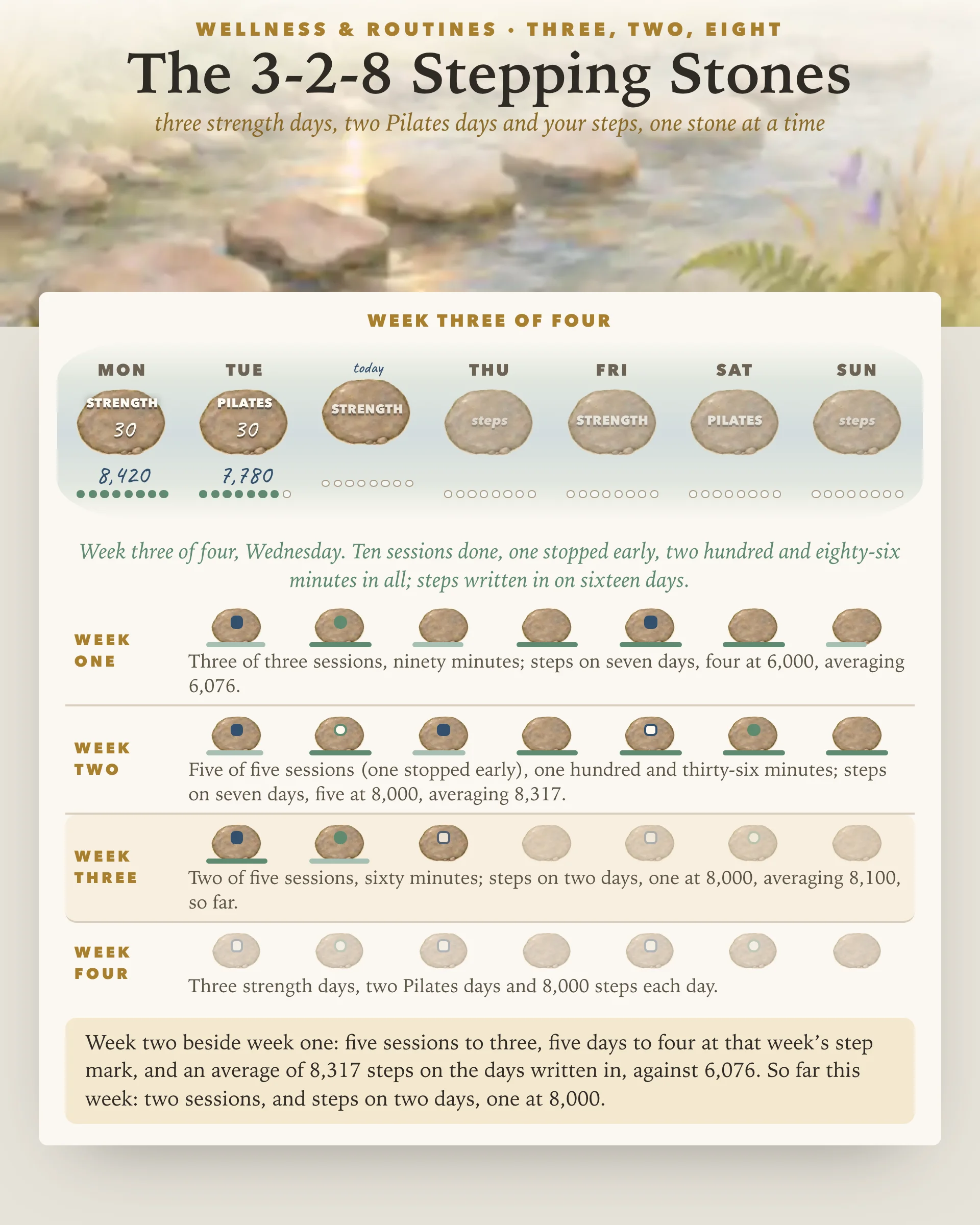
The 3-2-8 method is a weekly pattern that spread through short videos and posts: three days of strength work, two days of Pilates or other gentle mobility, and about 8,000 steps every day. People share their own versions of it, and we found no trial that tests it. What it offers is a shape for a week that is easy to remember, and this page turns that shape into seven stepping stones you can arrange, follow and fill in.
Each week is a row of seven stones across a stream. Three carry strength, two carry Pilates, and every stone has pebbles for steps. Move the tokens to suit your days, with one rule: no strength stone sits beside another, day seven and day one included, so the same muscles get a day off.
When a day comes, the page hands you its session:
Every move has an easier way, one tap away while the clock runs. The clock keeps real time, even on a phone that locks mid-set. A part counts only when its whole time runs; skip it and the skipped time is left out, end early and only whole minutes go on the stone.
Steps you write in yourself, on the day or the morning after, and each thousand fills a pebble.
If strength work or long daily walks are new to you, keep the gentle first week: two strength days, one Pilates day and a mark of 6,000 steps. The middle strength stone and the second Pilates stone sit out until week two, when the full pattern begins. Use the easier way for any move as long as you need it.
The pattern fits the US physical activity guidelines. The team at the Department of Health and Human Services that summarized the 2018 guidelines asks adults for at least 150 minutes a week of moderate activity and for muscle-strengthening work on two or more days. Three strength sessions clear the second part, and walking at a pace that raises your breathing counts toward the first.
The 8,000 comes closest to a pooled study by an international group of researchers, who gathered fifteen cohorts of 47,471 adults who had worn step counters for about a week and then followed them for a median of seven years. More steps went with a lower risk of death, up to a point: the drop leveled off at around 6,000 to 8,000 daily steps for people sixty and older, and around 8,000 to 10,000 for younger adults. It is an observational study, so it cannot prove the steps caused the difference. Steps were counted once, at the start, all in high-income countries, and the evidence that a faster pace mattered beyond total steps was inconsistent.
On strength, a review by researchers in Japan pooled sixteen cohort studies of muscle-strengthening activity and found it went with a ten to seventeen percent lower risk of death, heart disease, cancer and diabetes. The lowest risk sat at around thirty to sixty minutes a week. The full 3-2-8 week holds about ninety minutes of strength sessions, warm-ups included, and the authors say the effect of more than an hour is unclear, so a third day is your choice, not something the evidence asks for.
None of this shows that the 3-2-8 method changes your weight, tones a body part or reshapes anything. Movement helps alongside eating, sleep and time, and the useful question here is whether this week is one you can keep.
If you have a heart or blood pressure condition, joint or back pain, a recent injury or surgery, or you are pregnant, ask a doctor or physical therapist before you start. Stop any move that hurts, and keep a sturdy chair or counter within reach for the standing ones.
A painted treadmill console logs incline, speed and minutes on one machine. The 7,000-Step Tune builds your daily steps slowly over six weeks. The Pilates Sampler teaches twelve mat moves on their own, and The Music Box Barre is a full class at a counter. This page puts strength, Pilates and steps on one week and keeps the rest days honest.
Set out the stones on day one, open the page for each session, and write in your steps before bed. Each finished week is set beside the one before, so the only comparison is with yourself.
It is a weekly pattern shared widely online: three days of strength work, two days of Pilates or other low-impact mobility, and about 8,000 steps every day. It is a common plan rather than a program with its own trial, and you can arrange the days to fit your week.
No study has tested this exact week. Its parts line up with the US activity guidelines, which ask adults for muscle work on two or more days and at least 150 minutes of moderate activity a week, and large step studies tie more daily steps to lower risk of death up to a point. It promises nothing about weight or shape on its own; eating, sleep and time matter as much.
Keep a day between strength days so the same muscles get a rest, and put the two Pilates days in the gaps. A common layout is strength on days one, three and five, Pilates on days two and six, and day seven for steps alone. Steps go in every day.
It is a round number near where a pooled study of fifteen groups of adults saw the drop in risk level off: around 6,000 to 8,000 steps for people over sixty and 8,000 to 10,000 for younger adults. The study watched people over time and cannot show the steps caused the difference.
Yes, with a slower first week. The gentle start here asks for two strength days, one Pilates day and 6,000 steps, every move has an easier way, and the full pattern begins in week two. Check with a doctor first if you have a heart condition, joint pain or a recent injury.
By the team behind Fabulous, the science-based self-care app used by over 30 million people.


