
The Overwhelm Recovery ProtocolWellness & Routines · ~5 min
About this template · Updated November 2026
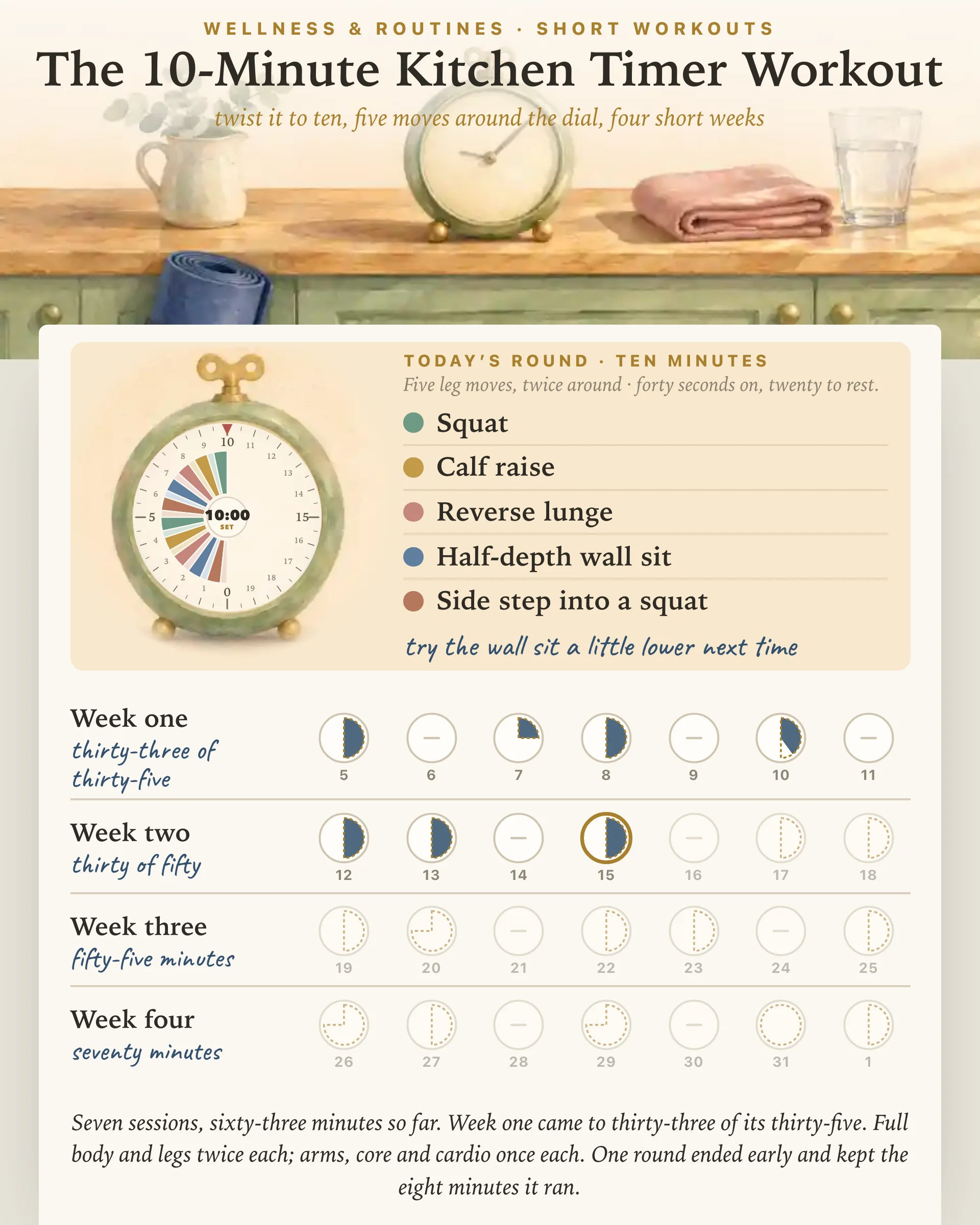
Most days don't have a spare hour, but nearly all of them have ten minutes: the stretch while the kettle heats, the gap before a call, the last spin of the laundry. This page turns that gap into a workout with the plainest tool in the house, a wind-up kitchen timer. You twist it to five, ten, fifteen or twenty minutes, follow five moves around its dial, and let every minute you finish fill a four-week plan.
The committee behind the 2018 US activity guidelines asked whether movement only counts in blocks of ten minutes or more. Its systematic review of bout length found activity of any duration linked with better health, including a lower risk of dying early. Those links came from cohort and cross-sectional studies, though, and the randomized trials it found had only tested bouts of ten minutes or longer, so the review shows an association rather than proof.
The resulting Physical Activity Guidelines for Americans set the weekly target at 150 to 300 minutes of moderate activity plus muscle strengthening on two or more days, and they note that the people doing the least gain the most from even modest increases. Ten minutes a day won't reach 150 on its own, and nothing here pretends it will. It is a start you can repeat, and the plan is built on repeating it.
Short sessions can also be hard ones. In a twelve-week trial at McMaster University, ten-minute sessions holding one minute of all-out cycling raised fitness and insulin sensitivity about as much as fifty-minute steady rides. The volunteers were twenty-five sedentary young men on exercise bikes, so the trial says little about squats in a living room, but it does suggest that effort, not only time, shapes what a short session gives back. That is why this timer has levels.
Twist the timer to a length; a gold dot marks what the plan asks for today. Then choose a focus (full body, legs, arms, core or cardio) and a level. Each focus gives a round of five moves, and the level picks each move's version and how every minute splits: gentle is thirty seconds of work and thirty of rest with no jumping, steady is forty and twenty, and strong is forty-five and fifteen with a few hops. Ten minutes goes around the round twice, fifteen three times and twenty four times. Swap any move that doesn't suit you.
The face runs from zero to twenty and draws the whole session before you start. Every minute is a slice in its move's color, deep for work and pale for rest, so turning the level up visibly reshapes the dial. Press start, take a ten-second count to get in place, and the dial turns back toward zero the way a real kitchen timer does, naming the move under the pointer and the one after it. You can pause, skip ahead or end early.
The timer reads the clock instead of counting its own beats, so a phone that locks halfway through still knows where you are. It also keeps only what you did. A round you finish logs its full length. A round you end early or skip through keeps the whole minutes you actually moved, and anything under a minute keeps nothing.
Below the timer, each day of the plan has a small dial of its own, full at twenty minutes. The dashed slice is what the plan asks for; the inked slice is what you did. The weeks build from thirty-five minutes over four days to seventy in week four, with two fifteens and a twenty. Each week shows its total against its target, and a short reading counts your sessions and notices which focus hasn't had a turn.
Moved without the timer? Add the minutes by hand on the day you did them. Three sessions a day is the most the log keeps, and removing one takes two taps, so a stray finger can't wipe out a morning's work.
Start gentle, even if it feels easy, and move up once the last minute of a round still feels comfortable. Tie the session to something you already do every day, like the kettle, the walk home from school drop-off or the end of the workday. A short round hooked onto a habit outlasts a long one that waits for a free afternoon.
Every standing move has a version that holds on to something, and anything done on one foot belongs next to a sturdy chair or counter. If you have had a fall, dizziness, a joint replacement, a heart condition or pain that hasn't settled, talk with your doctor before you begin, and stop any move that hurts.
If you would rather learn one fixed circuit by heart, the twelve-move card circuit turns forty-second cards one after another. If jumping is off the table for a while, the stepping-stone plan keeps both feet on the ground for four weeks. And when strong rounds start to feel ordinary, the painted gym clock for hard intervals pushes the work and rest splits further. And when ten minutes becomes a habit, The Lace-Up Home Workout Plan runs four weeks of six-move circuits for a small room, a hallway or a yard.
For someone who does little exercise now, it is a real start. The US guidelines note that the least active people gain the most from even modest increases, and the review behind them found short bouts still linked with better health. Ten minutes on most days also leaves room to build toward the weekly totals the guidelines set.
On this timer, the same five moves, repeated. Fifteen minutes goes around the round three times and twenty goes around four times, so a longer session asks you to repeat moves you already know rather than learn new ones.
One lap of five moves, about a minute each. It suits a rest day, a rushed morning or the first week back after a break, and the five minutes still fill a slice of that day's dial when you finish them.
Most people can, as long as the level suits the day. Gentle rounds never jump and half of each minute is rest, so they sit easily beside walking or other exercise. Keep at least one easier day a week if you use strong rounds, and stop any move that hurts.
No. A sturdy chair, a clear stretch of wall and a kitchen counter cover every gentle and steady version, and two full water bottles stand in for weights on the arm rounds.
By the team behind Fabulous, the science-based self-care app used by over 30 million people.


