Chronic Testicular Pain: Causes and Treatment
394. Testicular Pain and Stage 4 Breast Cancer
The brief
Urologist Dr. Susan McDonald explains why chronic testicular pain is common but routinely dismissed, and how a careful surgery can cure it. She also describes being diagnosed with stage 4 de novo breast cancer while working as a surgeon, and how her hospital employer tied her health insurance to full-time status during treatment.
A testicular mass that can be felt by hand is almost always painless. That is the fact that kills people. A testicle that only hurts, with no lump at all, is almost never dangerous. It is just miserable and poorly understood. That paradox, harmless things that hurt and deadly things that do not, sits at the center of this conversation between host and urologist Dr. Kelly Casperson and her guest, Dr. Susan McDonald, a urologist who specializes in male reconstruction and in the chronic pelvic and testicular pain most doctors would rather not treat.
Pain with no obvious cause shows up constantly in urology clinics. McDonald puts a number on it: roughly 5% of all urologic consultations, about one in twenty visits, is driven by testicle or pelvic pain (04:52). That is a lot of appointments for a problem most training programs barely cover. McDonald argues the avoidance is partly structural and partly psychological. Surgeons, she says, are drawn to the field because they like problems with clean endings.
"Surgeons become surgeons because they're people who like a problem, a surgery, and a better patient. Like, a discrete solution." Dr. Susan McDonald, [05:45]
Chronic pain does not offer that. It is not a kidney stone McDonald can remove in an afternoon and watch a patient walk out relieved. It lingers, it resists imaging, and it tests a surgeon's entire professional identity.
What the Scan Cannot See
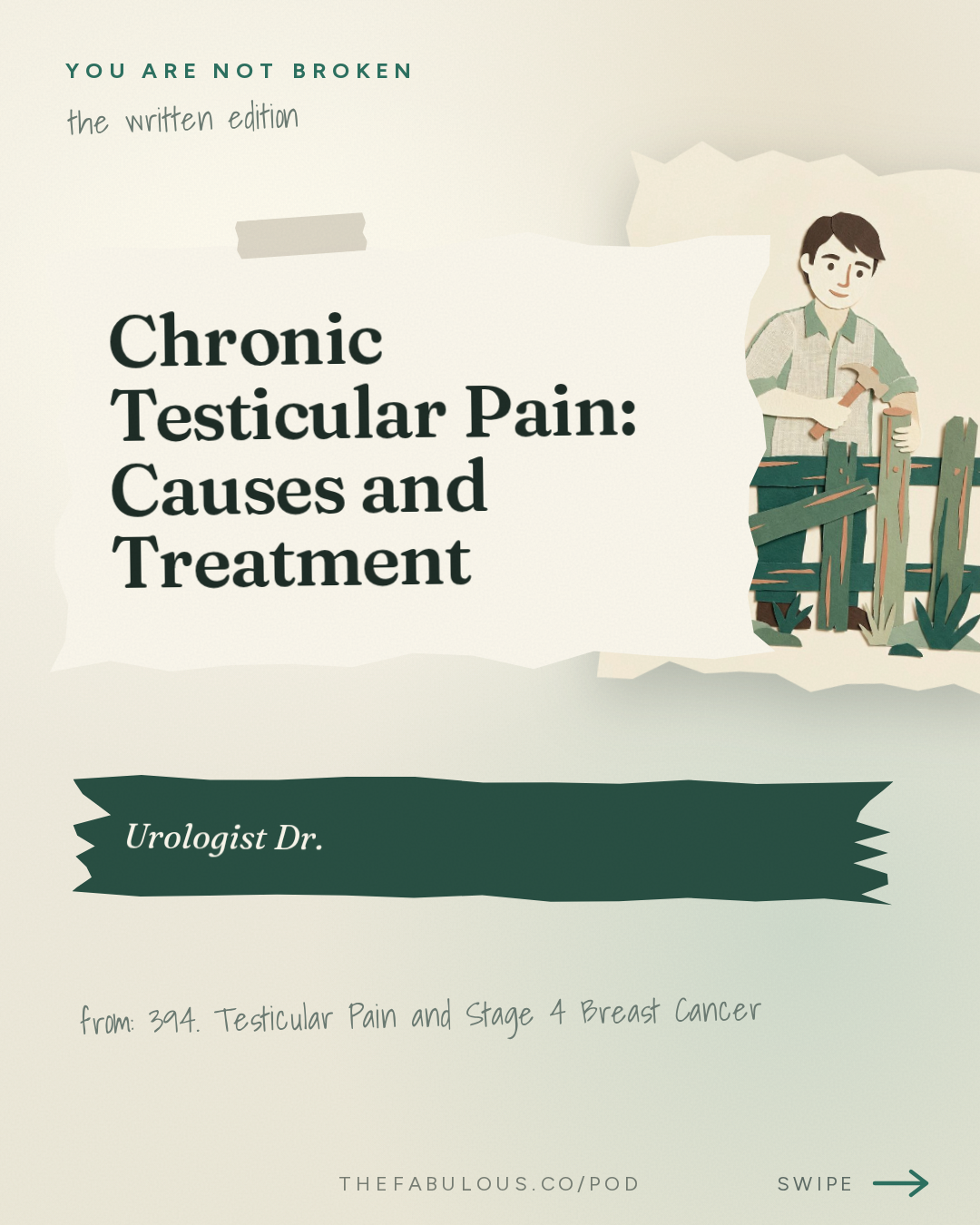
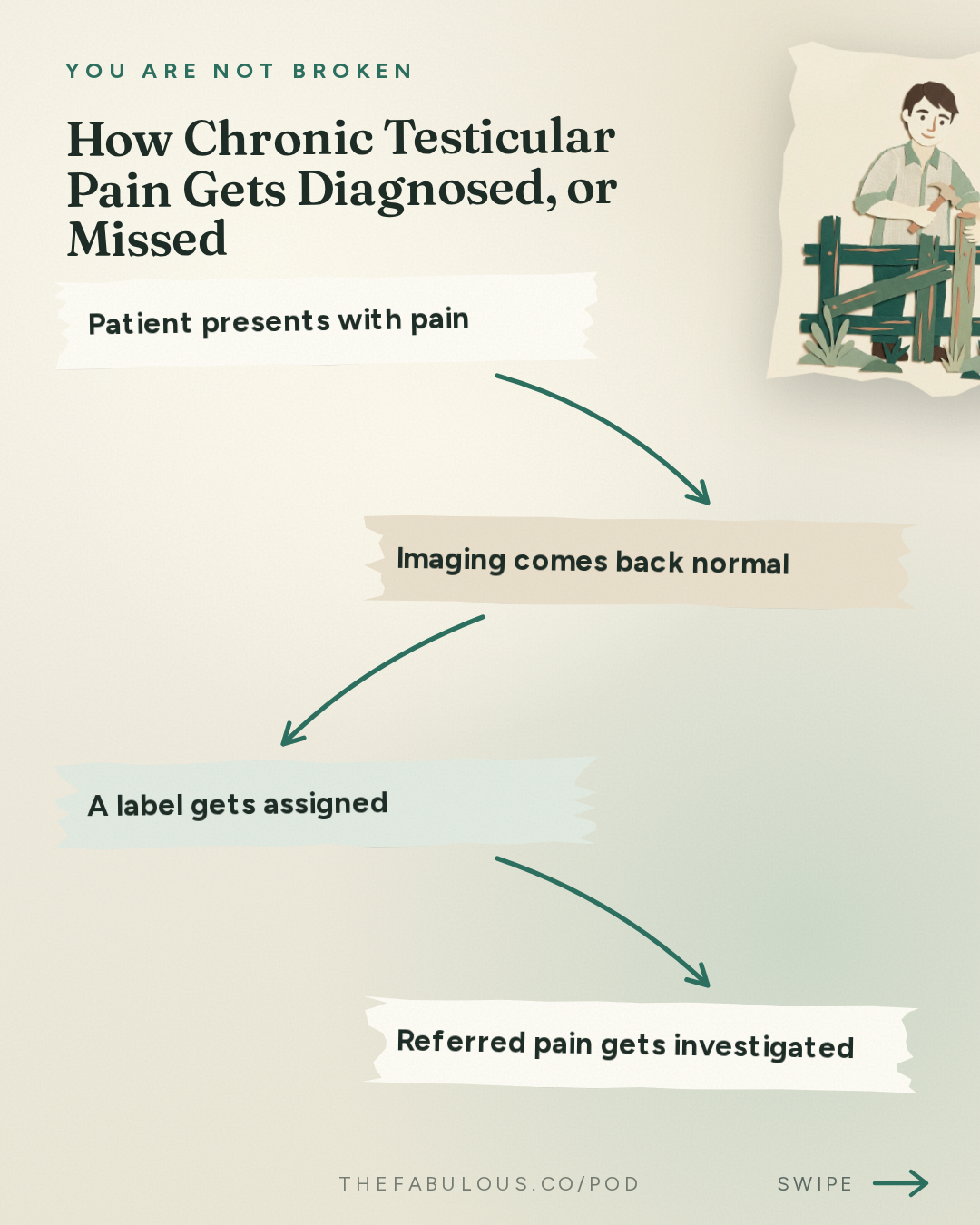
McDonald's father ran a mechanic shop, and she uses that memory to explain why a normal scan does not mean nothing is wrong. An ultrasound, a CT scan, and an MRI are all pictures. Popping the hood of a car that will not start and taking a photo tells a mechanic nothing about why the engine is dead (07:35). The same logic applies to a testicle. A normal ultrasound rules out a mass. It does not rule out pain, because pain is a function, not a structure, and medicine does not have a functional scan for it. "Testicular cancer, like a mass, is typically painless, almost always painless. That's what will kill you. Testicular pain, what you feel, is really annoying, but it's not deadly," McDonald says (08:14).
What happens next is a kind of institutional shortcut. Doctors need a billing code, so patients with completely normal exams routinely get labeled with epididymal orchitis, medical language for a testicle infection that is not actually present (10:10). McDonald calls these labels heavy bricks.
"I call it heavy bricks in a backpack because people start walking around with heavy bricks in a backpack because some clinician with, you know, power and expertise gave them a brick." Dr. Susan McDonald, [11:08]
Nobody tells patients they are allowed to set a brick down once a diagnosis stops fitting. The label sticks, the backpack gets heavier, and the patient starts to look, to every doctor after that, like someone with a chronic infection rather than someone whose pain was never properly investigated.
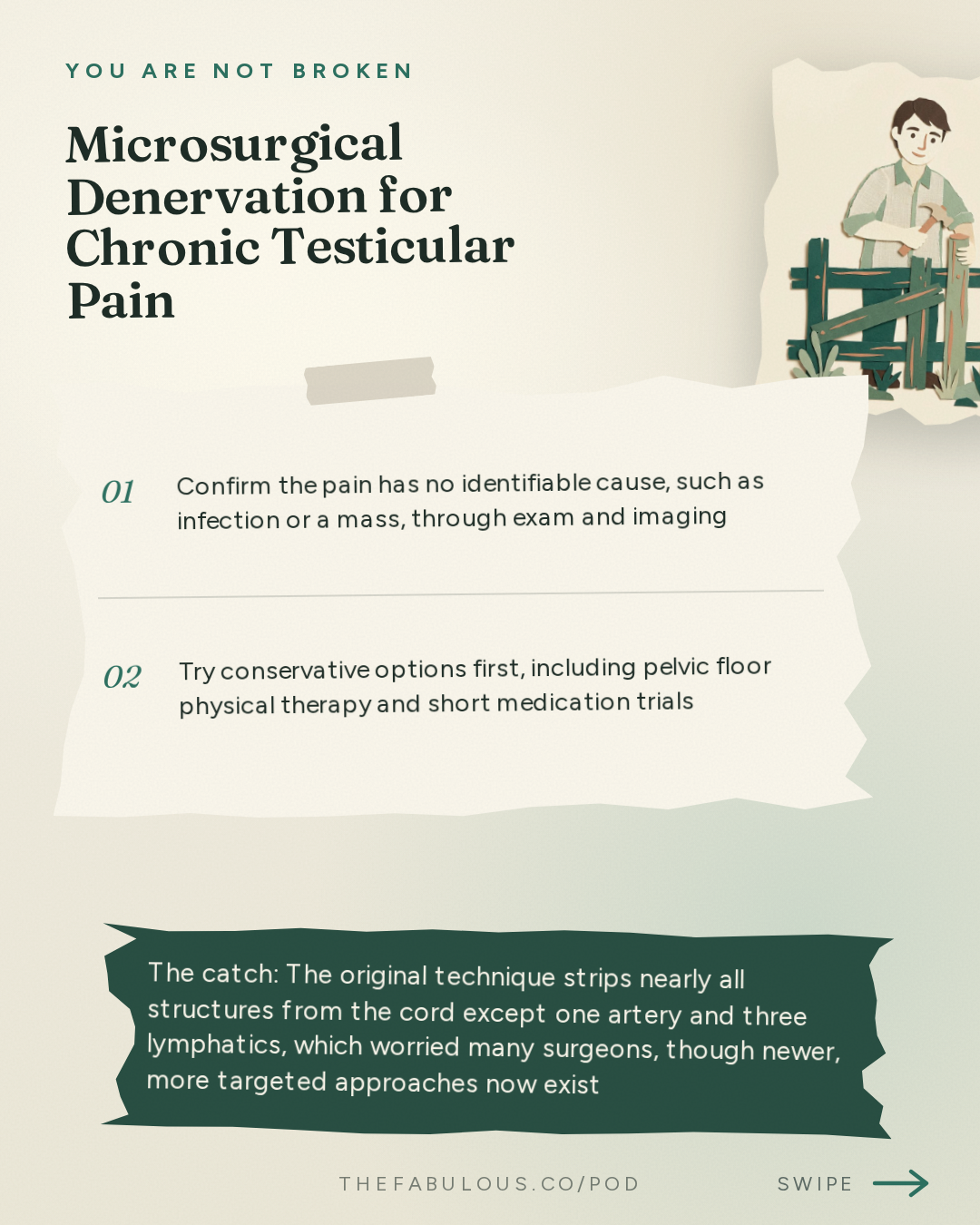
Part of the fix, when it works, is strikingly concrete. In fellowship, McDonald learned a procedure called microsurgical denervation of the spermatic cord, which uses an operating microscope to strip the nerve-carrying structures off the cord that runs from the abdomen to the testicle, leaving the testicle unable to sense pain (19:36). Published studies define success as a 50% reduction in pain. McDonald's early patients, people who had lived with pain rated seven out of ten for a decade, often became completely pain-free (20:03). She is careful to note that the surgery only works in carefully chosen patients, and that even those who land at the 50% mark generally say, without hesitation, that they would do it again.
The other piece of McDonald's practice sits at the overlap of three specialties: sexual medicine, voiding problems, and testicle pain. In the middle of that overlap is pelvic floor dysfunction, a condition where the muscles supporting the pelvis become too tense rather than too weak. The standard advice for pelvic problems, Kegel exercises, actually makes this worse, because Kegels tighten muscles that are already overtight (22:38). The fix is relaxation and pelvic floor physical therapy, a resource McDonald says she sought out and built relationships with before she even took a faculty job.
When the Doctor Becomes the Patient
Midway through the conversation, the subject changes the way life sometimes does without warning. Eight years into practice, at what she calls the top of her game, McDonald was diagnosed with stage 4 breast cancer. It was de novo, meaning the cancer was already stage 4 at the moment of diagnosis rather than progressing there from an earlier stage, it was bilateral, and it arrived with no family history (32:04). Only about 7% of breast cancer patients are diagnosed stage 4 de novo, and the share is far smaller among premenopausal women in their thirties and forties, McDonald's group (32:55).
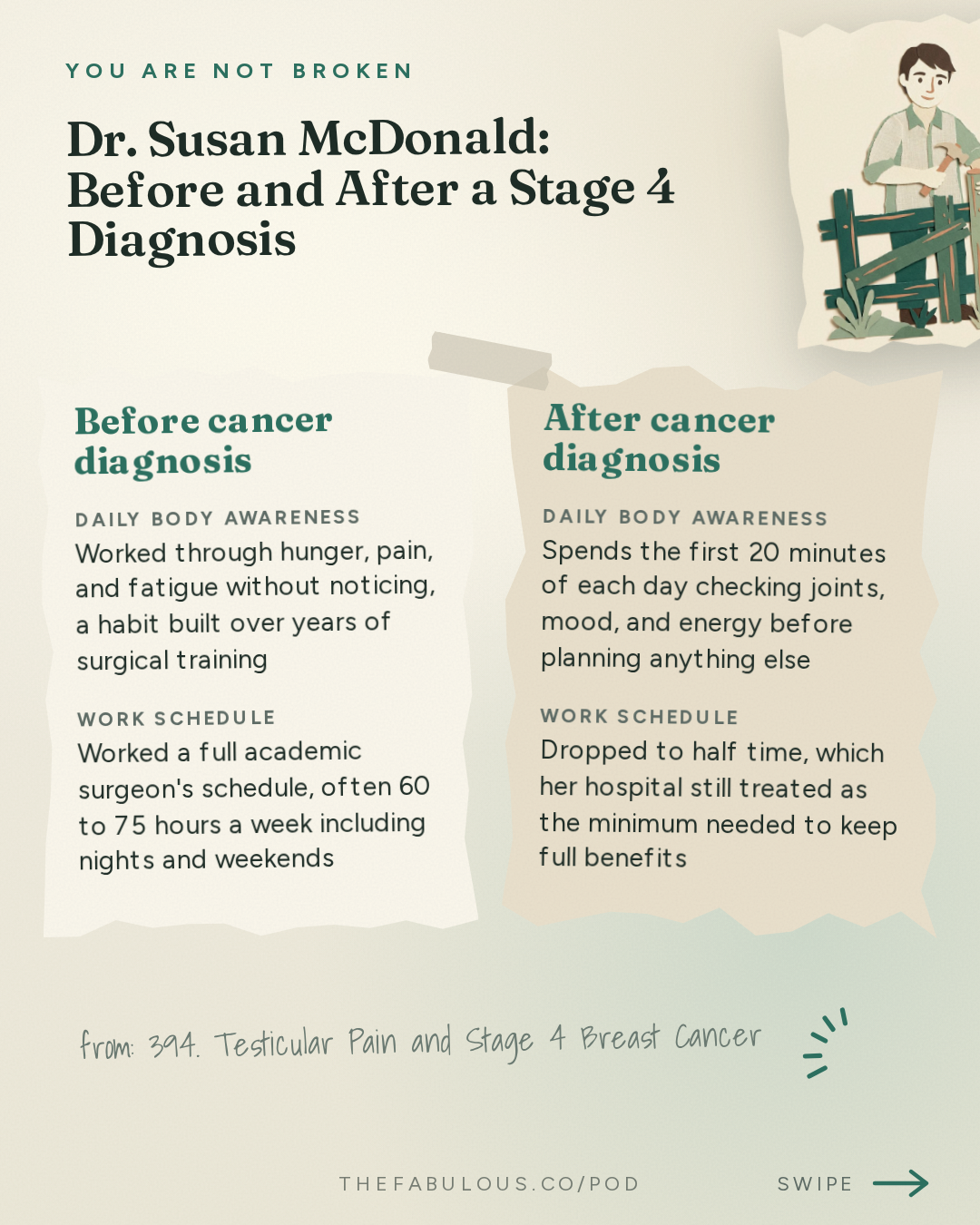
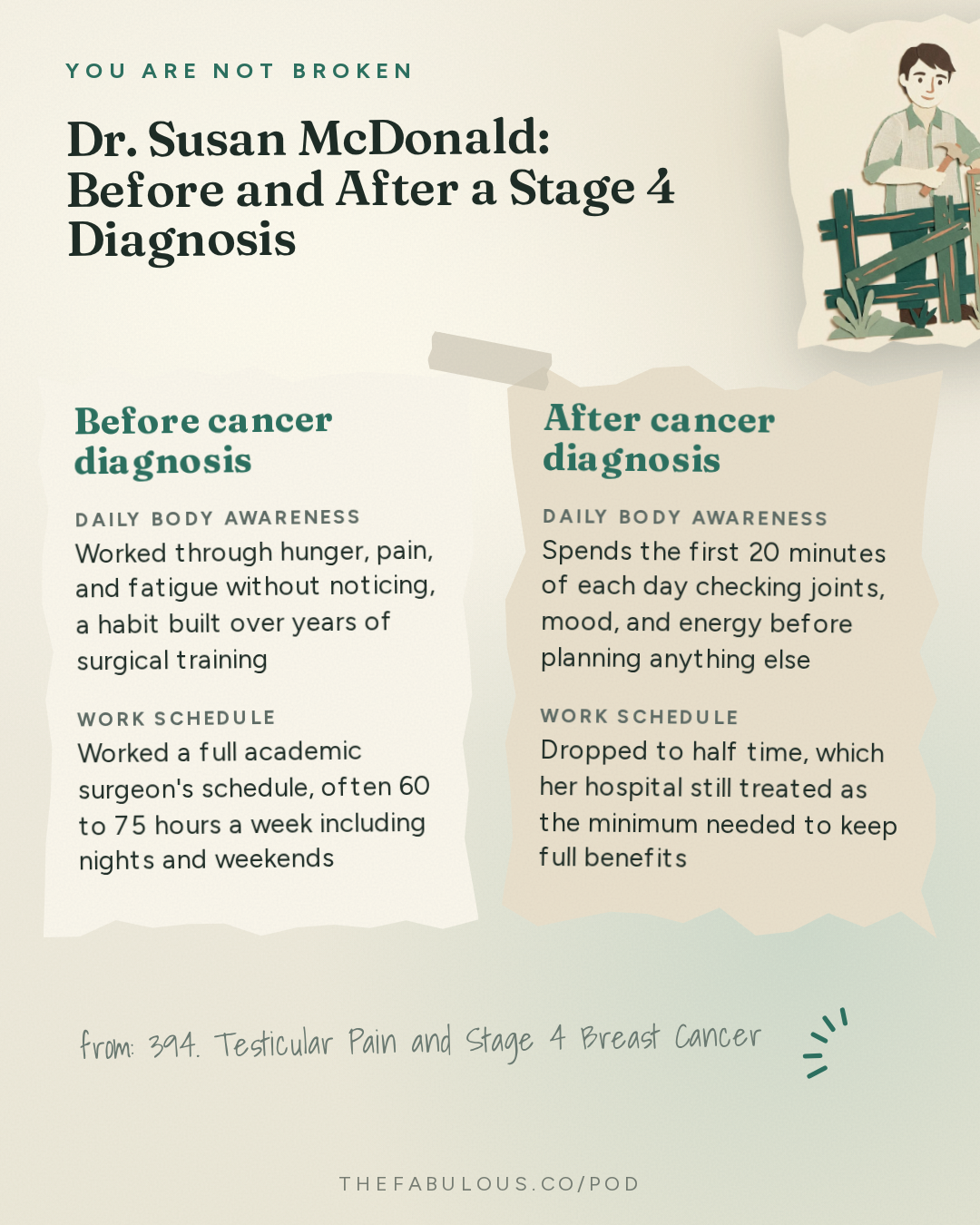
She had missed the mass herself. She had also, without noticing, trained her own body not to feel hungry while experimenting with intermittent fasting. After her diagnosis, it took six months of treatment before real hunger returned (37:04). In hindsight, the vanishing appetite was an early warning sign she had mistaken for a lifestyle win. The injury that finally sent her for scans, a fractured shoulder blade, had been nagging her for a year by her husband's account, though she only remembered a few weeks of it (39:13). McDonald connects all of this to a habit she says is built into surgical training.
"As surgeons, we are pathologically conditioned to ignore our bodies." Dr. Susan McDonald, [38:44]
She describes learning, over years of residency, how to carb-load before a long surgery, bank sleep ahead of a hard week, and use caffeine to push through exhaustion. The same skills that make a surgeon reliable in the operating room are the ones that let a serious illness go unnoticed for a year.
Recovery forced a second education, this one in the business of medicine. As an academic surgeon, McDonald could not sustain a full workweek during chemotherapy, so she asked to drop below 50% time. Her hospital employer never gave her a clear definition of what full-time meant for a surgeon in the first place, and when she asked what would happen if she worked less than half-time, human resources told her she would lose employer-sponsored insurance and would need to buy COBRA, continuation coverage purchased directly from the plan, at a cost of $24,000 a year for up to eighteen months (51:03). She hired a lawyer. The hospital held its position.
"I achieved all my dreams, and none of it mattered in the end." Dr. Susan McDonald, [52:15]
She left academic medicine and now works as chief medical officer at VidScrip, a company that makes short patient-education videos, while building a speaking career on cancer resilience and pelvic pain awareness.
The conversation closes on smaller, stranger victories. McDonald's palliative care doctor, Christina Newport, suggested tart cherry juice for the night sweats brought on by hormone-suppressing treatment. McDonald tried it out of desperation and found that a single eight-ounce glass, even a cheaper tart cherry lemonade bought in a pinch at an organic grocer in a resort area after she could not find tart cherry juice at the airport, cut her hot flashes by roughly 80% (57:33). She does not know the mechanism. She now drinks it daily in a morning smoothie and plans to plant tart cherry trees on her property.
The two threads of the episode, testicle pain nobody wants to treat and a cancer diagnosis nobody wanted to believe, share a spine. Both are stories about bodies sending signals that the systems around them are built to miss: a scan that cannot show pain, a schedule that cannot show exhaustion, a billing code that cannot show uncertainty. McDonald's advice, for patients and for herself, is the same in both cases. Notice the signal before it hardens into a diagnosis, or a loss, that cannot be undone.
Ask this episode anything
Pod's AI answers from the episode itself, with the minute mark so you can hear it yourself.
Or start with one of these
Ask this episode
Pod's AI listens to the whole episode to answer, and points you to the minute it comes from.
The rest of this answer, and any question after it
Answers come from the episode itself, never from a summary of it.
ContinueKey takeaways
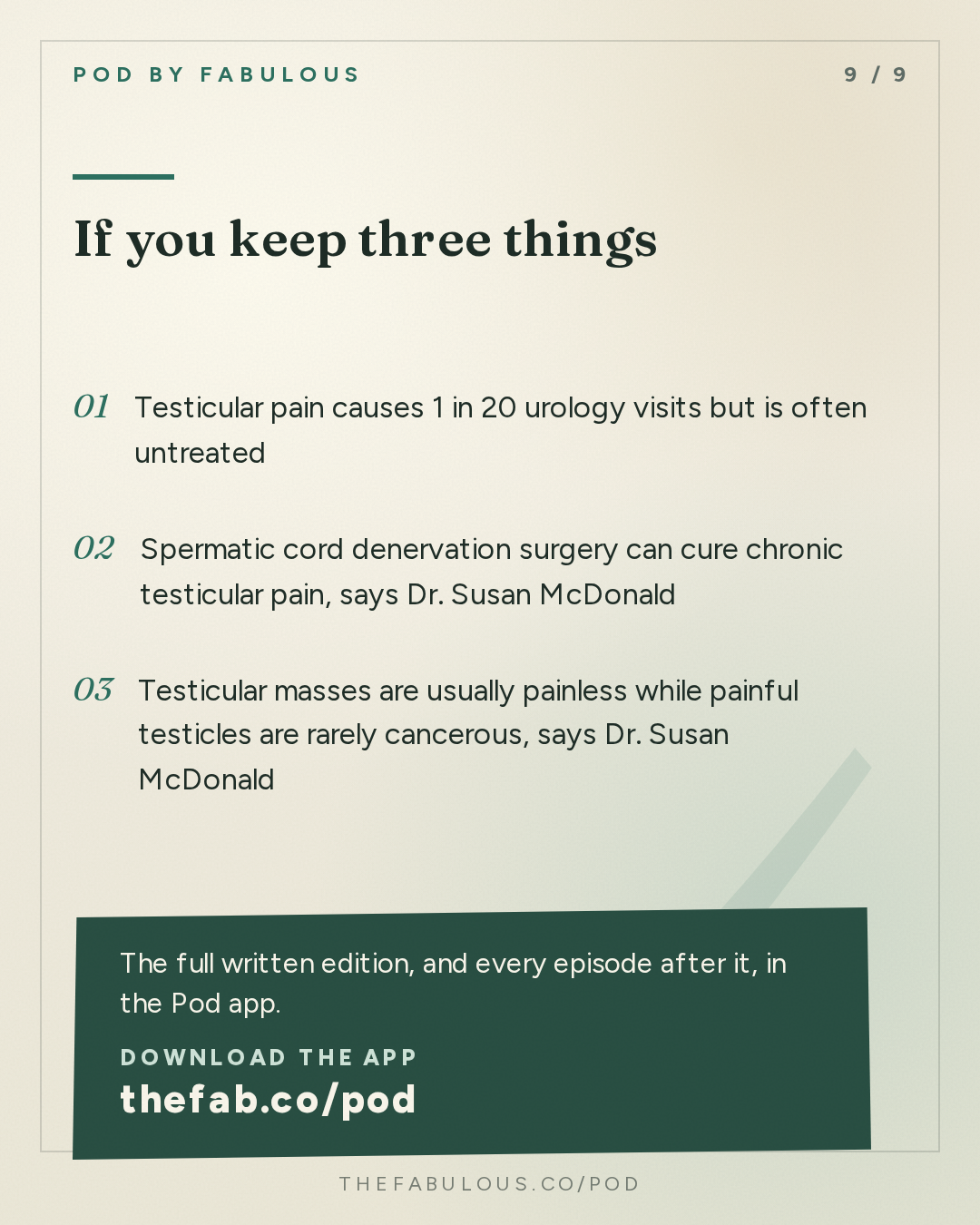
- Testicular pain causes 1 in 20 urology visits but is often untreated
- Spermatic cord denervation surgery can cure chronic testicular pain, says Dr. Susan McDonald
- Testicular masses are usually painless while painful testicles are rarely cancerous, says Dr. Susan McDonald
- Only 7% of breast cancer cases are stage 4 at first diagnosis, called de novo stage 4 disease
- Working under 50% time cost Dr. Susan McDonald her insurance, requiring $24,000 a year in COBRA
The episode in cards

By the numbers
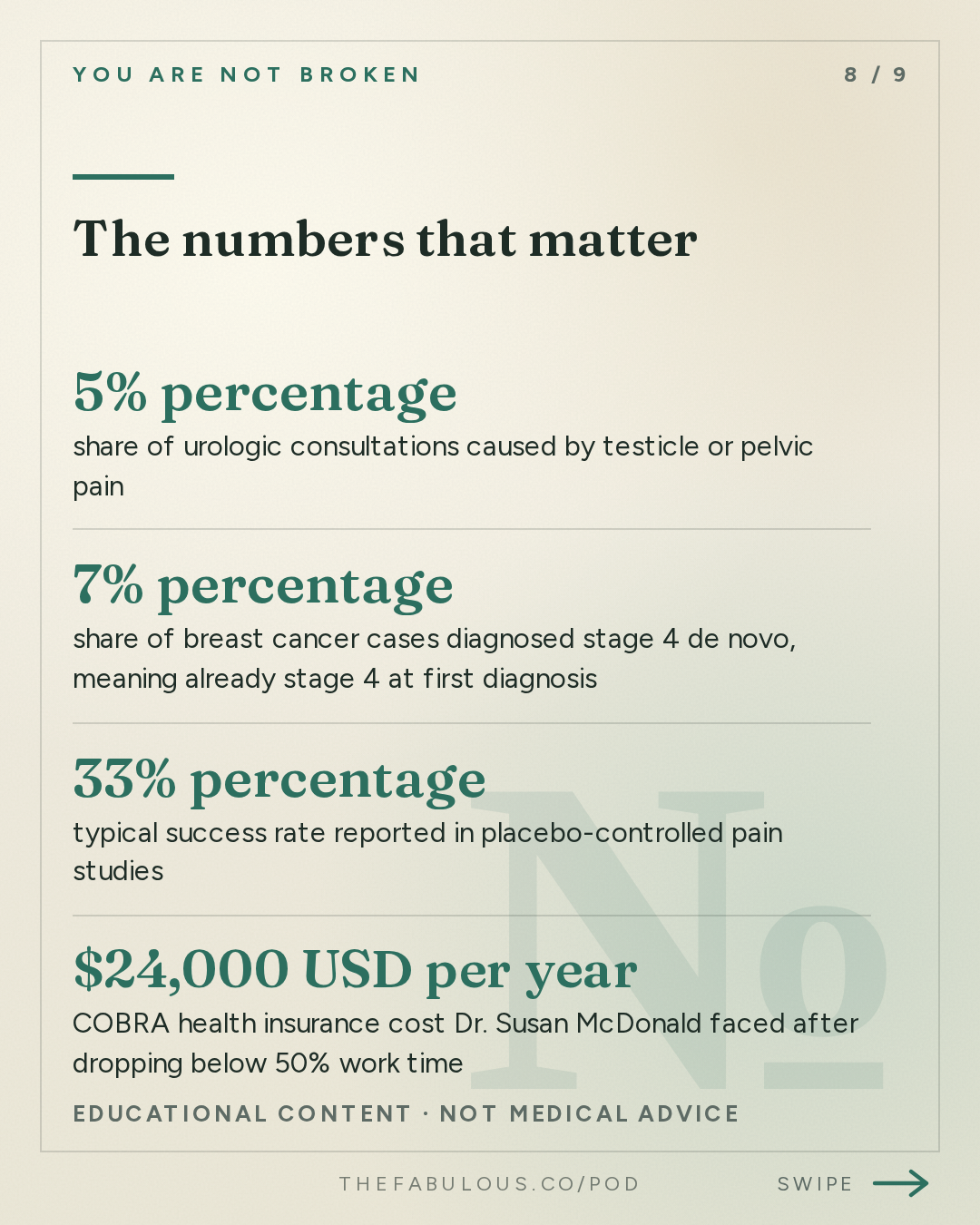
- 5% percentage share of urologic consultations caused by testicle or pelvic pain
- 7% percentage share of breast cancer cases diagnosed stage 4 de novo, meaning already stage 4 at first diagnosis
- 33% percentage typical success rate reported in placebo-controlled pain studies
- $24,000 USD per year COBRA health insurance cost Dr. Susan McDonald faced after dropping below 50% work time
- 80% percentage reduction in Dr. Susan McDonald's hot flashes after drinking tart cherry juice daily
In their words
“Surgeons become surgeons because they're people who like a problem, a surgery, and a better patient. Like, a discrete solution.”
“Testicular cancer, like a mass, is typically painless, almost always painless. That's what will kill you. Testicular pain, what you feel, is really annoying, but it's not deadly.”
“I call it heavy bricks in a backpack because people start walking around with heavy bricks in a backpack because some clinician with, you know, power and expertise gave them a brick.”
“As surgeons, we are pathologically conditioned to ignore our bodies.”
“I achieved all my dreams, and none of it mattered in the end.”
Protocols
-
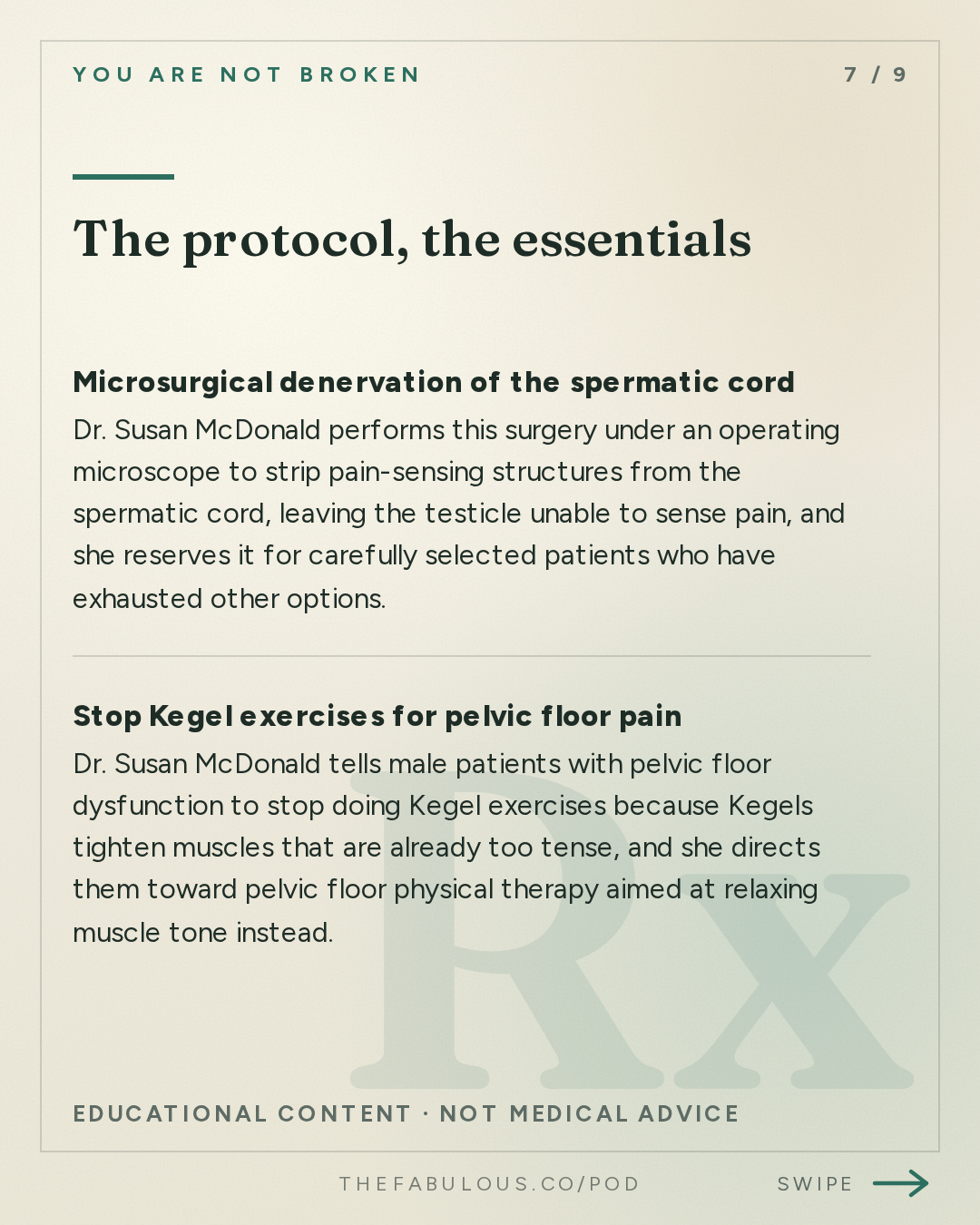
Microsurgical denervation of the spermatic cord
Dr. Susan McDonald performs this surgery under an operating microscope to strip pain-sensing structures from the spermatic cord, leaving the testicle unable to sense pain, and she reserves it for carefully selected patients who have exhausted other options.
One-time surgical procedure
-
Stop Kegel exercises for pelvic floor pain
Dr. Susan McDonald tells male patients with pelvic floor dysfunction to stop doing Kegel exercises because Kegels tighten muscles that are already too tense, and she directs them toward pelvic floor physical therapy aimed at relaxing muscle tone instead.
Ongoing, until tone improves
-
Daily tart cherry juice for hot flashes
Dr. Susan McDonald drinks about eight ounces of tart cherry juice, or a cheaper tart cherry juice blend, each day, usually mixed into a morning smoothie, after her palliative care doctor Christina Newport recommended it for treatment-related night sweats.
Daily
-
One-time antibiotic trial for unexplained pelvic pain
Dr. Kelly Casperson says clinicians can try a single course of antibiotics for pelvic pain even without confirmed infection, since some antibiotics reduce inflammation and others simply produce a placebo response, but she cautions this is not a sustainable repeated treatment because antibiotics carry their own side-effect risks.
One-time trial, not repeated
Questions this episode answers
What causes chronic testicular pain?
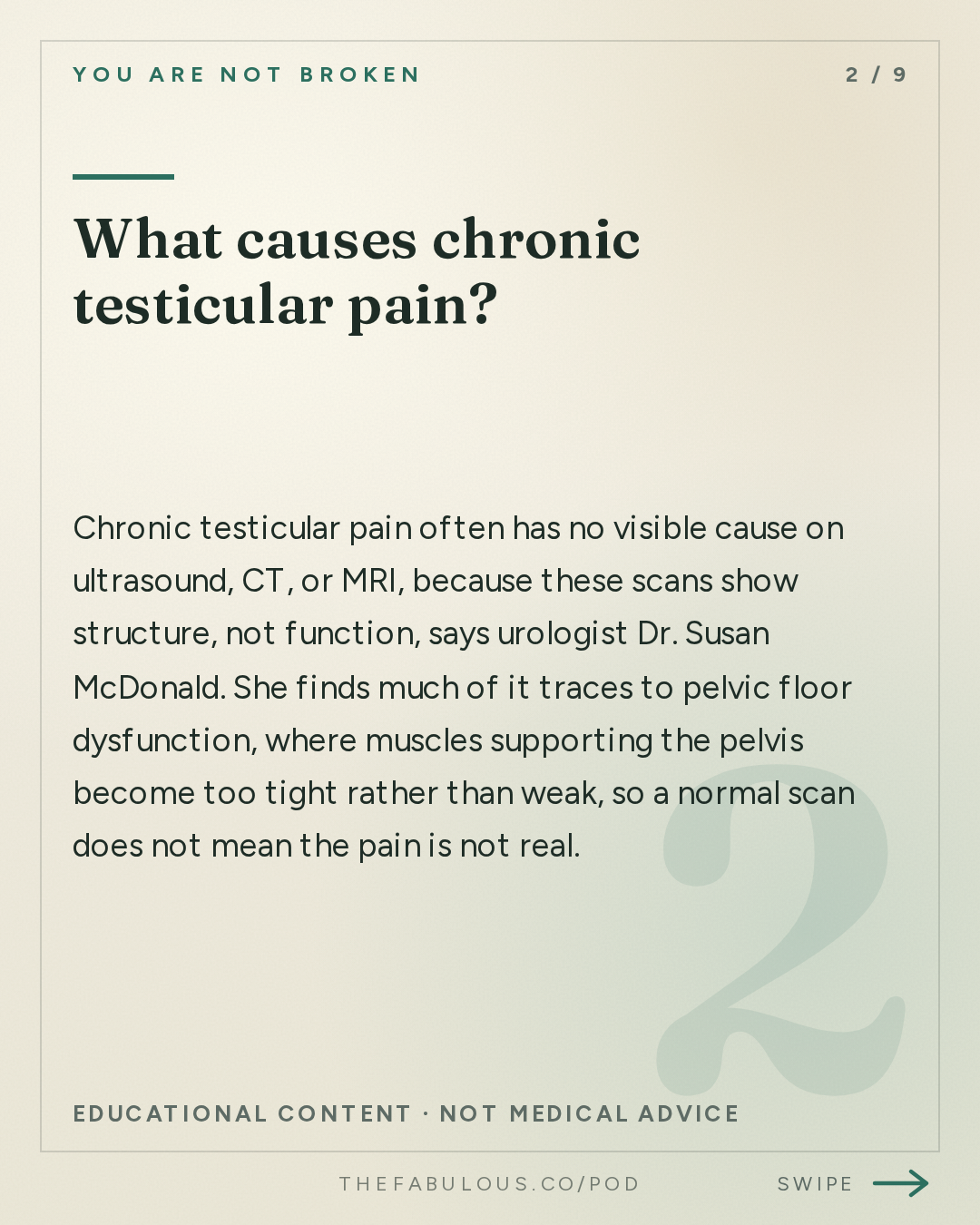
Chronic testicular pain often has no visible cause on ultrasound, CT, or MRI, because these scans show structure, not function, says urologist Dr. Susan McDonald (07:35). She finds much of it traces to pelvic floor dysfunction, where muscles supporting the pelvis become too tight rather than weak (21:56), so a normal scan does not mean the pain is not real.
Can surgery cure chronic testicular pain?
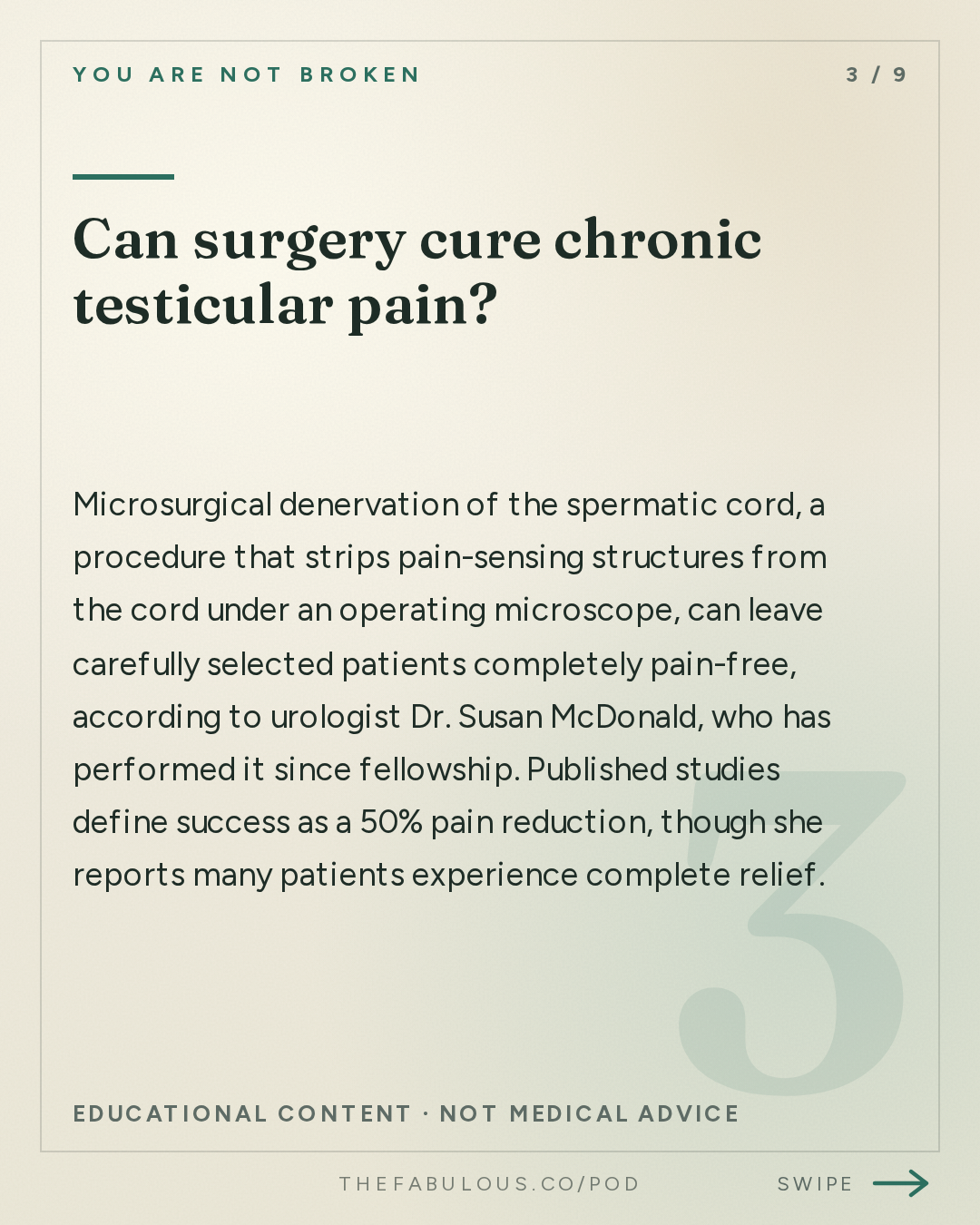
Microsurgical denervation of the spermatic cord, a procedure that strips pain-sensing structures from the cord under an operating microscope, can leave carefully selected patients completely pain-free, according to urologist Dr. Susan McDonald, who has performed it since fellowship (19:36). Published studies define success as a 50% pain reduction, though she reports many patients experience complete relief (20:03).
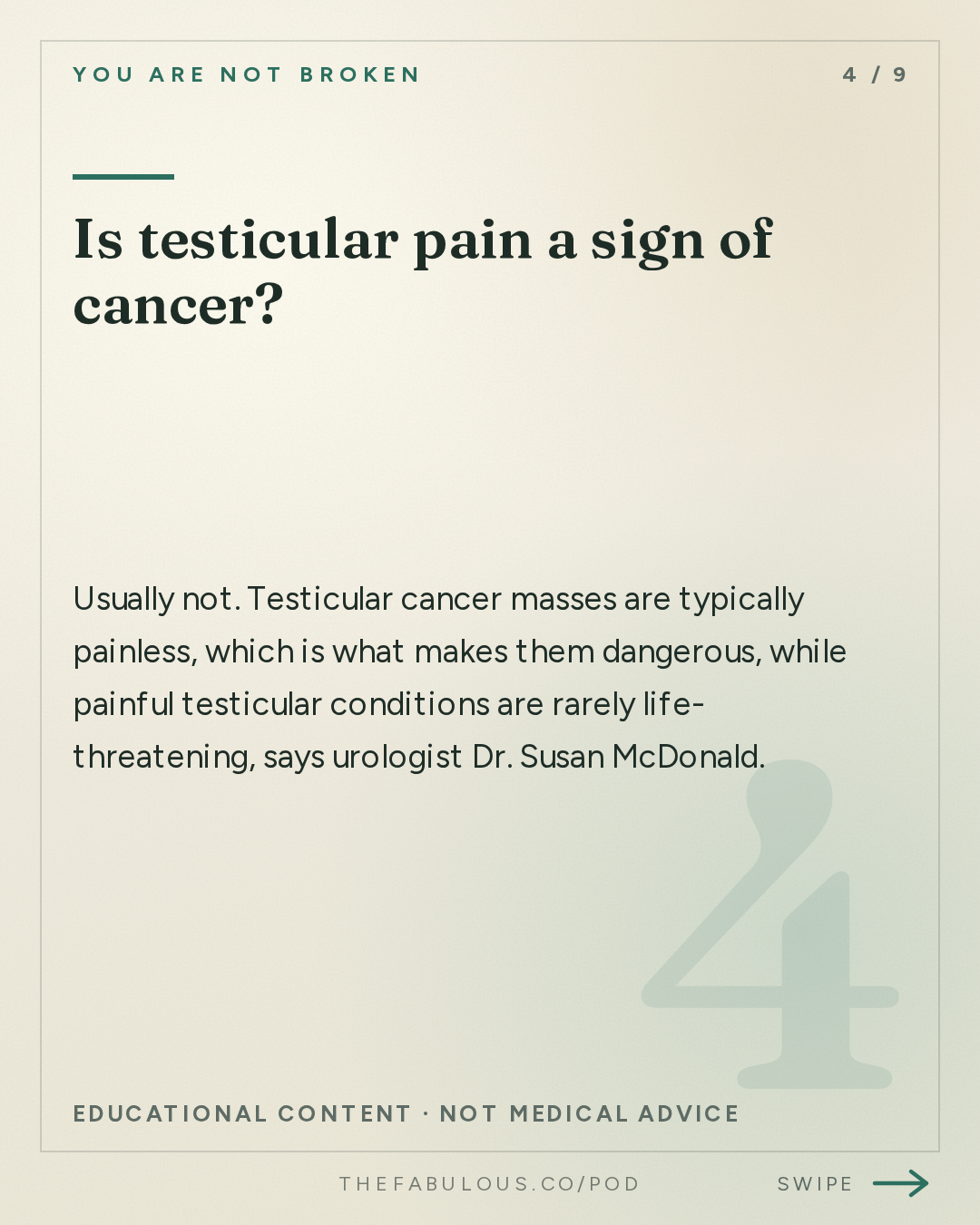
Is testicular pain a sign of cancer?
Usually not. Testicular cancer masses are typically painless, which is what makes them dangerous, while painful testicular conditions are rarely life-threatening, says urologist Dr. Susan McDonald (08:14).
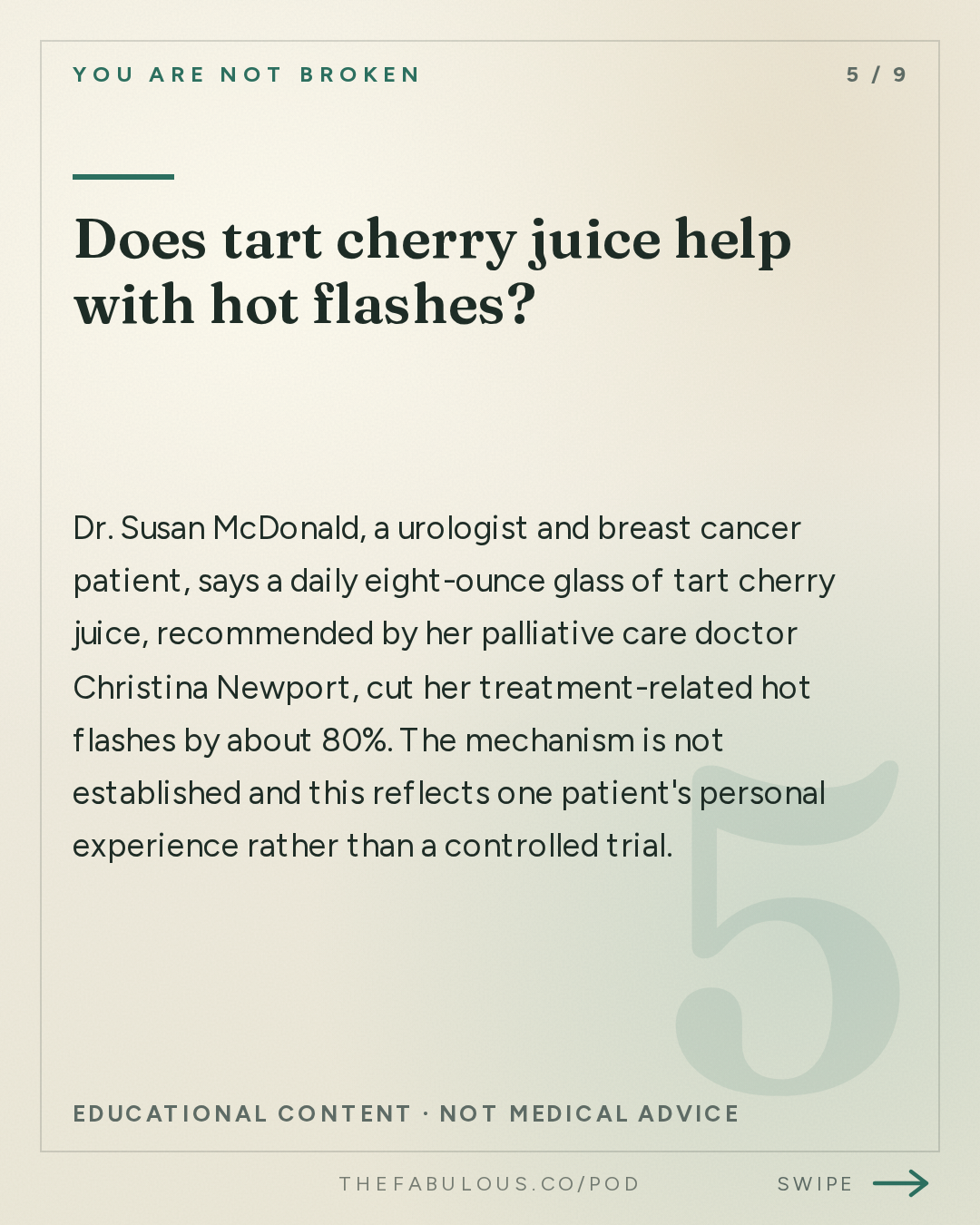
Does tart cherry juice help with hot flashes?
Dr. Susan McDonald, a urologist and breast cancer patient, says a daily eight-ounce glass of tart cherry juice, recommended by her palliative care doctor Christina Newport, cut her treatment-related hot flashes by about 80% (57:33). The mechanism is not established and this reflects one patient's personal experience rather than a controlled trial.
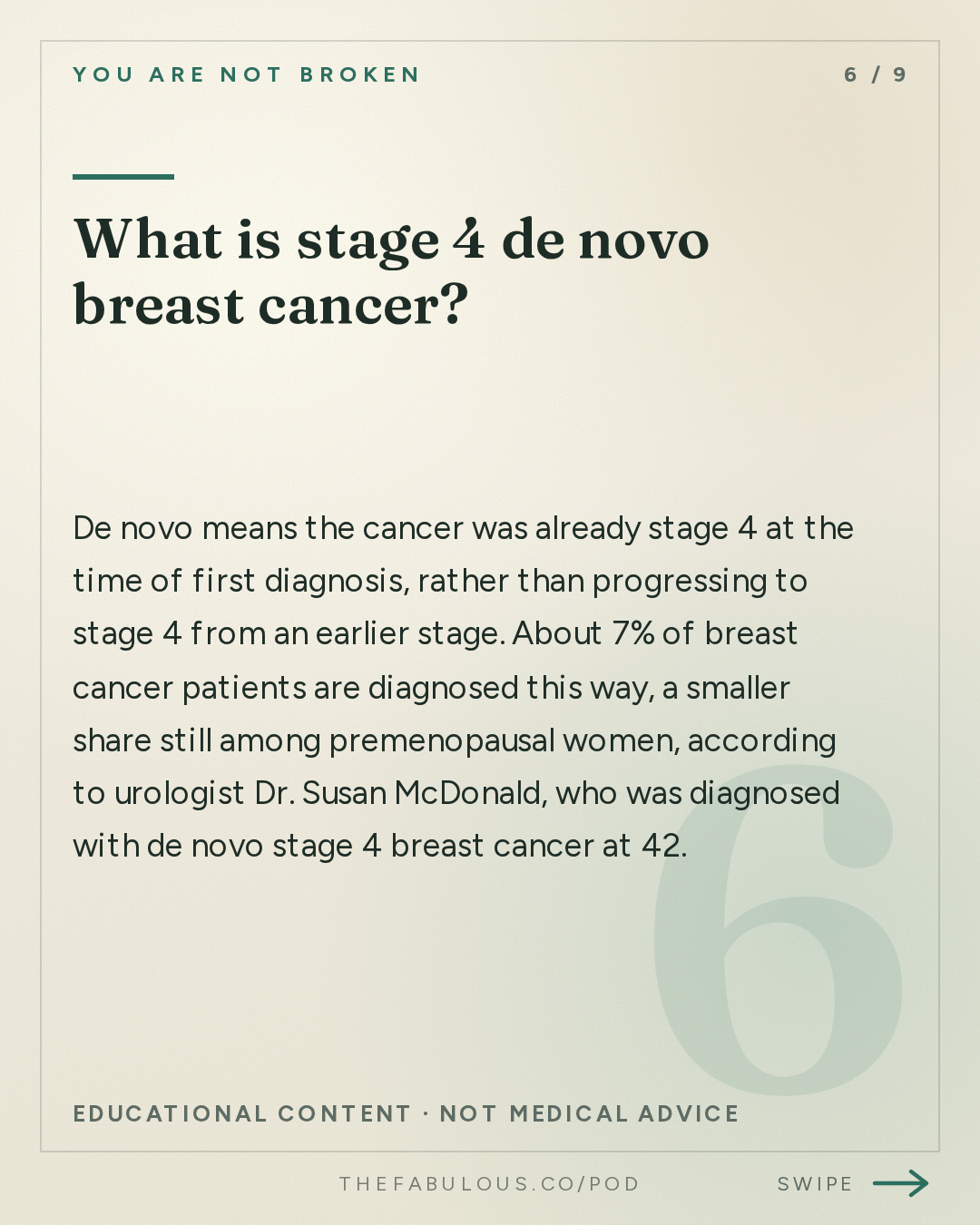
What is stage 4 de novo breast cancer?
De novo means the cancer was already stage 4 at the time of first diagnosis, rather than progressing to stage 4 from an earlier stage. About 7% of breast cancer patients are diagnosed this way, a smaller share still among premenopausal women, according to urologist Dr. Susan McDonald, who was diagnosed with de novo stage 4 breast cancer at 42 (32:55).
Why do Kegel exercises make pelvic pain worse in men?
Kegel exercises tighten pelvic floor muscles, but Dr. Susan McDonald says many men with chronic pelvic pain already have overly tense pelvic muscles, so Kegels worsen rather than relieve the problem (22:38). She recommends pelvic floor physical therapy aimed at relaxing muscle tone instead.
The full read, in cards
Go deeper
- AUA guidelines on genitourinary syndrome of menopause — guidelines Dr. Susan McDonald cites to show vaginal estrogen is medically necessary despite insurance denials
- Original spermatic cord denervation technique article — describes stripping the spermatic cord down to one artery and three lymphatics, the basis of McDonald's early surgical approach
- Cure Today video series — short videos explaining cancer basics like grade and stage, which McDonald now contributes to
- Pelvic Health and Rehabilitation Center YouTube channel — pelvic floor physical therapy education videos McDonald recommends to patients
Mentioned
Dr. Susan McDonald · Dr. Kelly Casperson · Emory · VidScrip · Dr. Christina Newport · Society of Women in Urology · Cure Today · Stephanie Pendergrass · Reena Malik · Pelvic Health and Rehabilitation Center
More from this show and category
Building Muscle in Midlife: Hormones Explained
Heavy resistance training, not cardio, rebuilds muscle lost in perimenopause, say physicians Kelly Casperson and Rebeccah Hertel. They cite data showing testosterone cuts hip fracture risk in women by about 50%, estrogen patches can help bone density well past age 60, and widely used lab ranges and 1990s-era studies understate hormone therapy's safety.
Menopause Advocacy and Policy Reform Guide
Lawyer Jennifer Weiss-Wolf compares menopause advocacy to a choose-your-own-adventure book: everyone brings different skills. She traces today's momentum back to 1992's 'Year of the Woman' and the 2002 Women's Health Initiative backlash, and warns that US law still has no explicit protection against menopause discrimination at work (36:59), so she tells people to write to legislators and file FDA comments instead of venting online (17:49).
Vaginal Estrogen for UTI Prevention
Urologist Dr. Kelly Casperson explains that genitourinary syndrome of menopause (GSM) affects 50% to 90% of postmenopausal women. Vaginal estrogen cuts recurrent urinary tract infections by half, lowers hospitalization and death risk, and is safe for most breast cancer survivors, yet only 9% of women diagnosed with GSM get a prescription.

Pelvic Floor Health and Menopause: Daily Habits
Pelvic floor therapist Sarah Reardon says menopause pelvic problems need two fixes: estrogen for tissue, muscle training for strength. She covers power peeing, Squatty Potties, pessaries, GSM, vaginismus, and why the $5 billion vaginal rejuvenation industry skips the muscle work that actually prevents prolapse and leakage.
