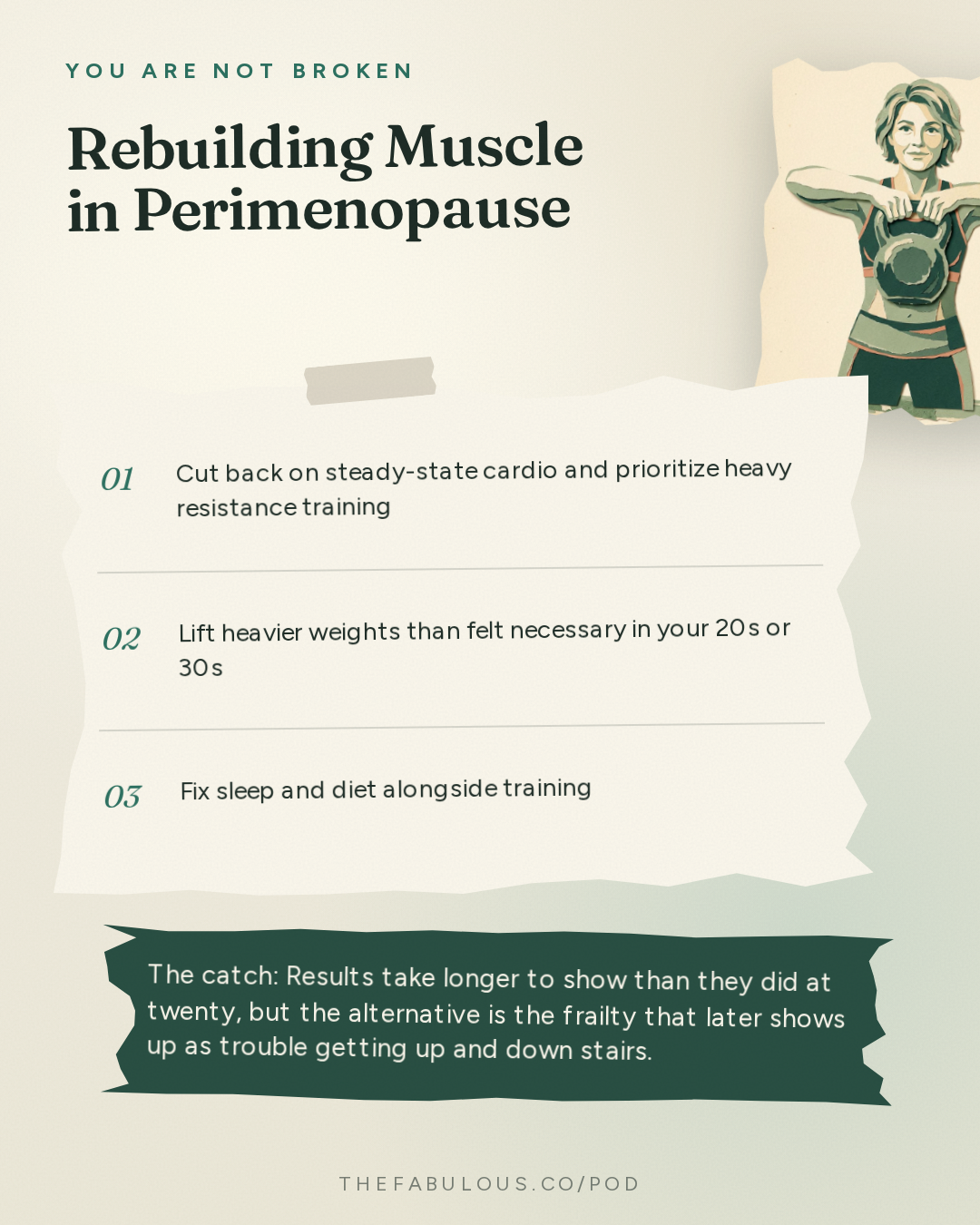
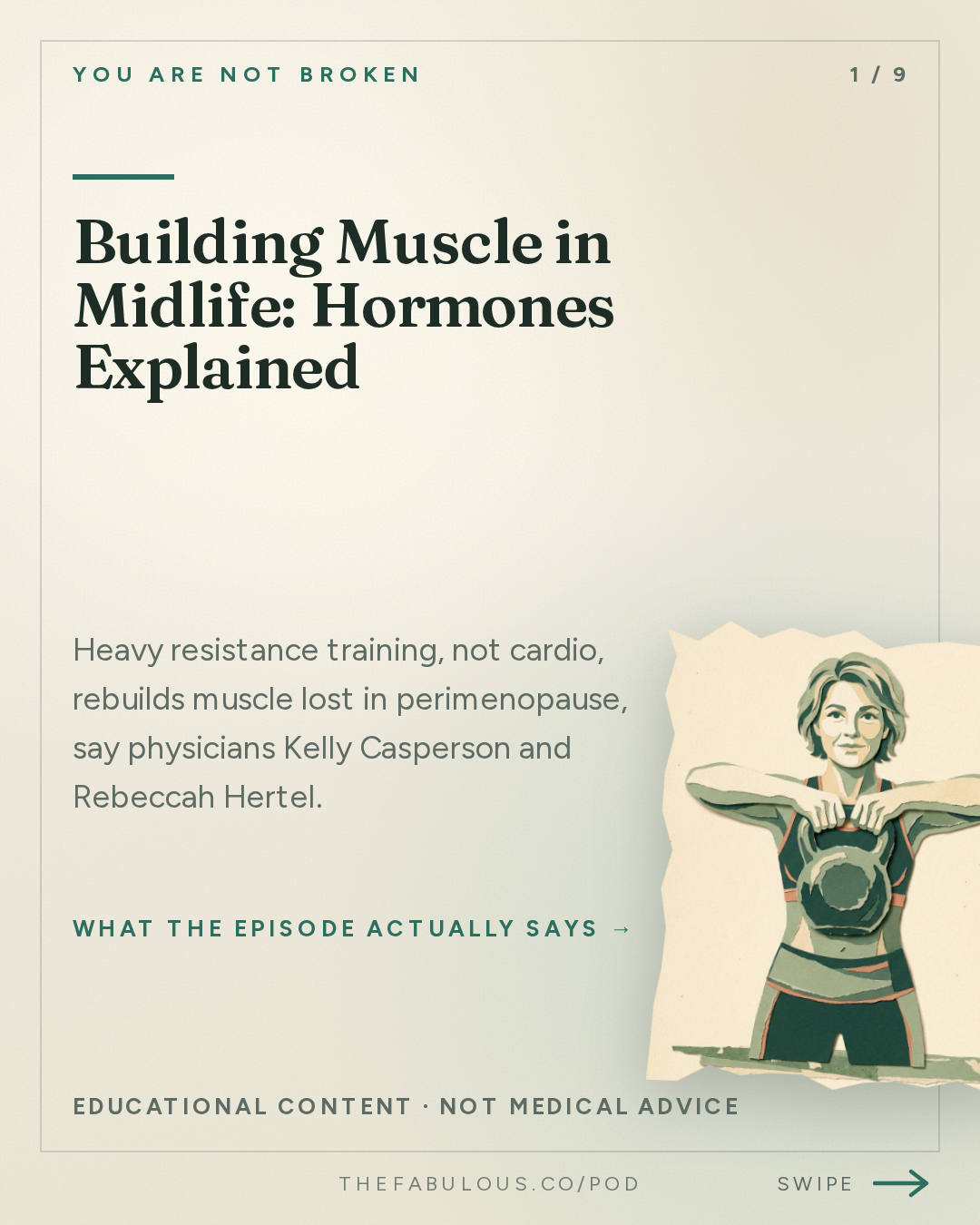
Building Muscle in Midlife: Hormones Explained
393. Stronger in Midlife: Muscle, Hormones, and Longevity for Women
The brief
Heavy resistance training, not cardio, rebuilds muscle lost in perimenopause, say physicians Kelly Casperson and Rebeccah Hertel. They cite data showing testosterone cuts hip fracture risk in women by about 50%, estrogen patches can help bone density well past age 60, and widely used lab ranges and 1990s-era studies understate hormone therapy's safety.
Dr. Rebeccah Hertel, a family medicine physician trained as a DO (doctor of osteopathy), once fixed a stiff neck for Dr. Kelly Casperson in a hotel gym, mid-workout, using a technique called HVLA, or high-velocity, low-amplitude thrust (04:09). It took almost no force. Hertel found the right fulcrum, applied a small push, and the problem was gone. That small scene sets up the whole episode: the body, even in midlife, responds to the right input applied correctly. The trouble is that most of medicine still treats midlife women's bodies as a mystery to be managed rather than a system that can be rebuilt.
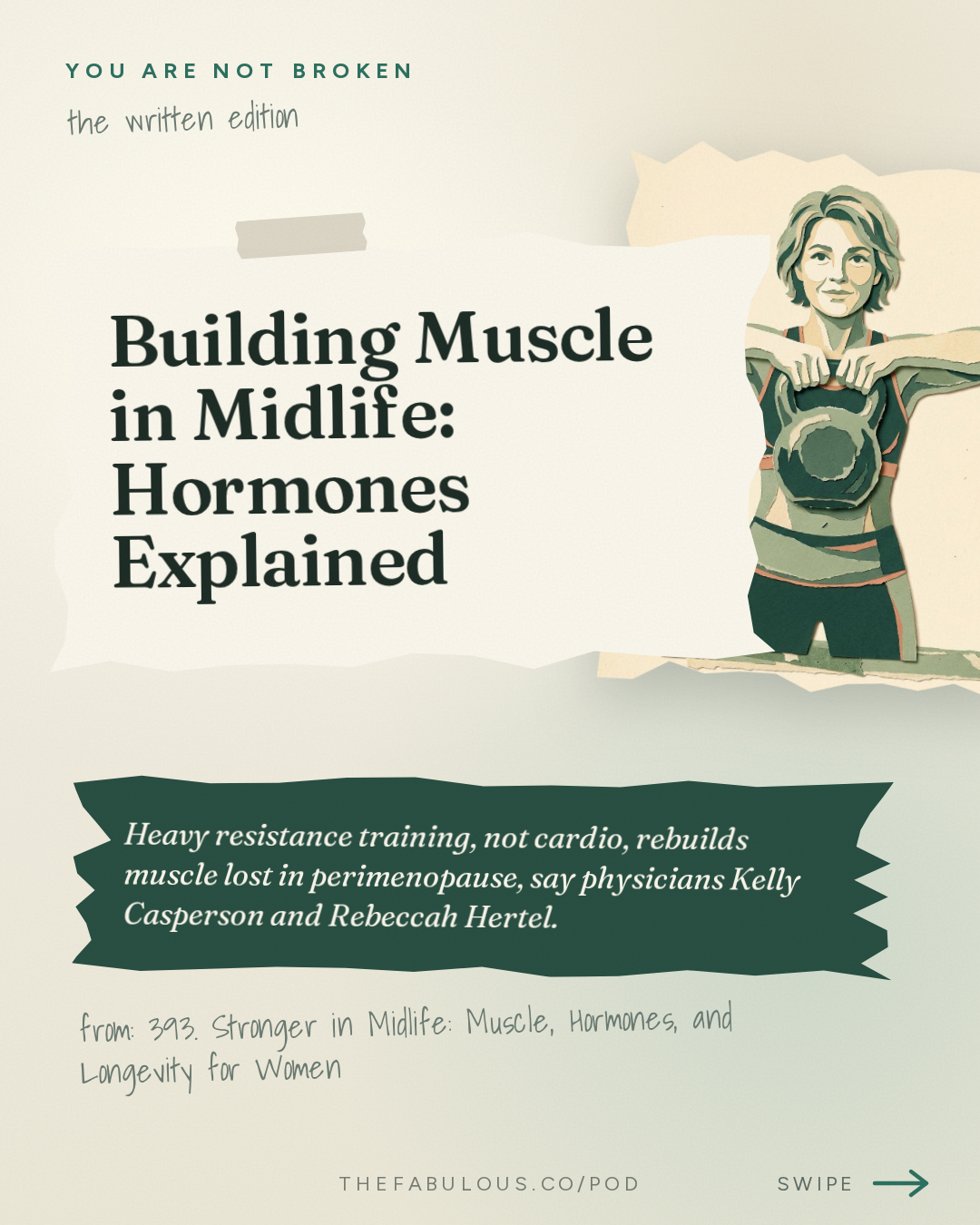
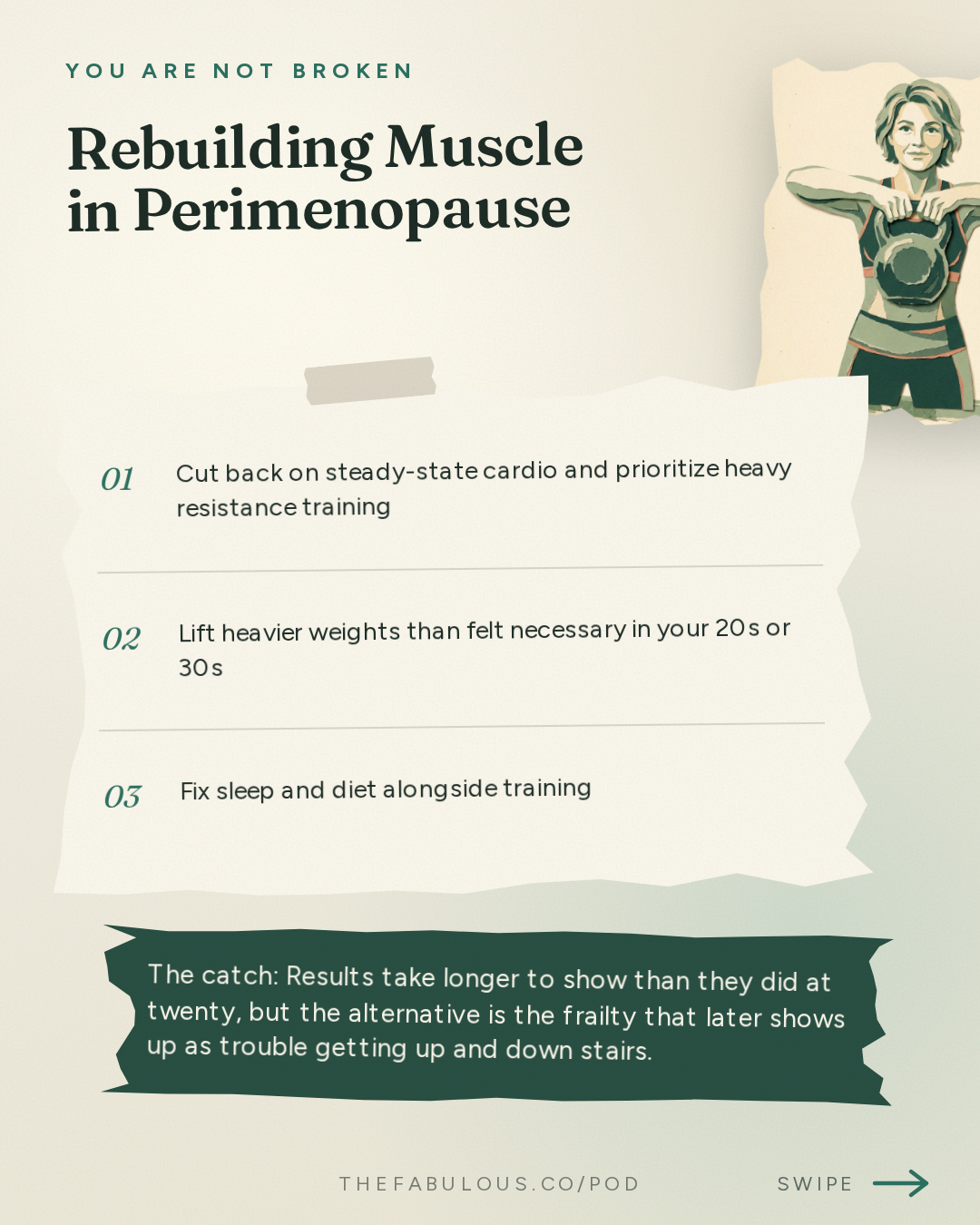
Hertel knows this from her own body. Around age 40, she told Casperson, she felt like she woke up one day and her muscle definition was simply gone. There was fluid retention in her legs. The circuit training that had kept her toned for years stopped working (12:37). What fixed it wasn't more effort of the same kind. It was less cardio, heavier weights than she had ever lifted, and better sleep and diet (13:36). She started hormone therapy around the same time, in her mid-40s, which she says helped too, but the training change came first and mattered on its own.
This is the quiet thesis running through the conversation: midlife bodies need different inputs, and most women are never told what those inputs are. Casperson pushes the point further with an analogy from dentistry. Orthodontists, periodontists, and dentists built an entire culture around prevention, straightening teeth decades before a problem shows up. Mainstream medicine, she argues, treats prevention almost as a dirty word, telling patients not to bother with a bone density scan before 65, as if the goal is to wait for suffering rather than head it off (15:12).
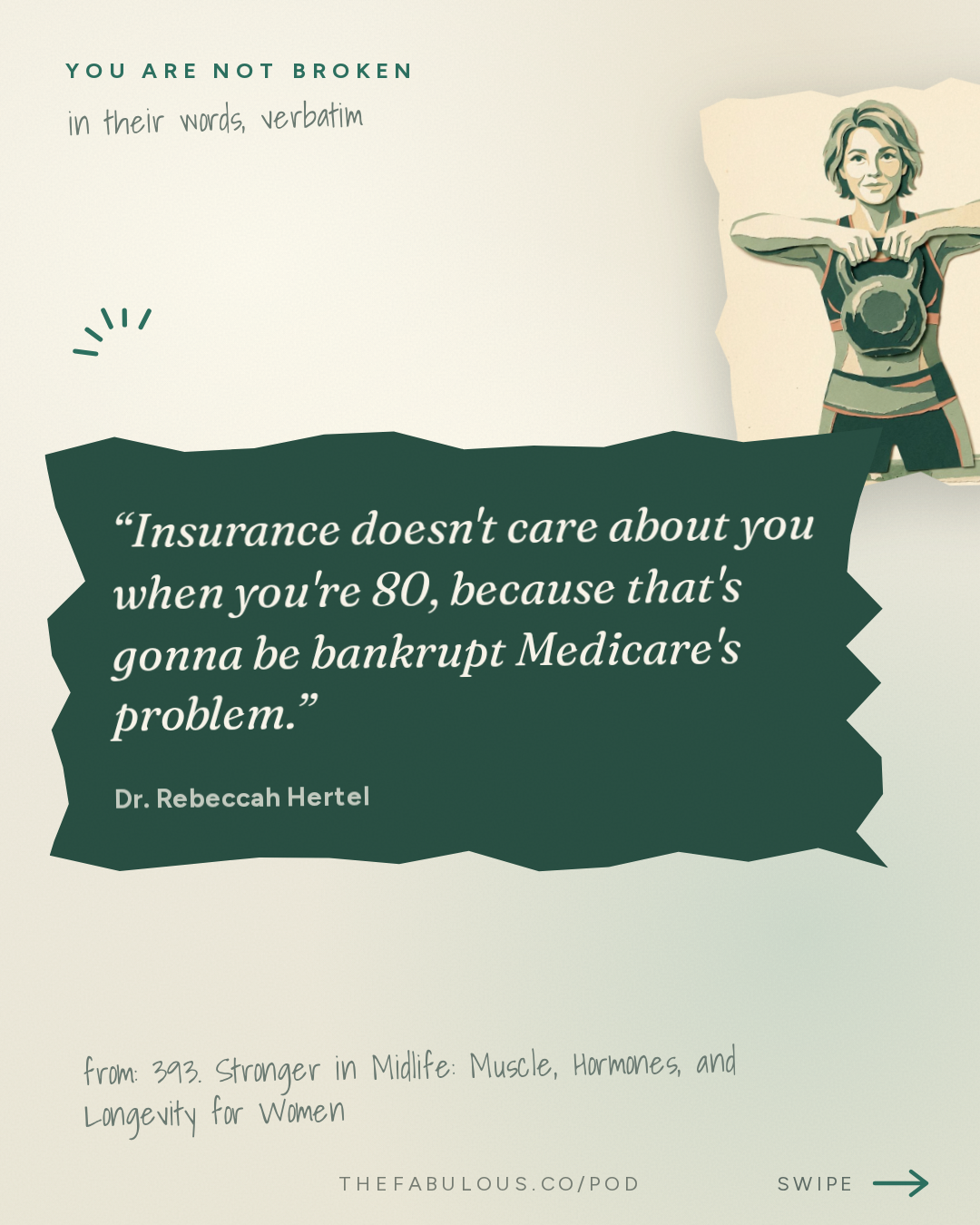
Insurance doesn't care about you when you're 80, because that's gonna be bankrupt Medicare's problem. (19:16)
The economics explain some of the resistance. The average American keeps the same health insurance for about four years, so insurers have little financial reason to pay for anything that pays off decades later (18:51). That mismatch between who pays now and who benefits later is, Casperson and Hertel argue, a big reason supplements and out-of-pocket prevention are booming while mainstream medicine lags.
Nowhere is the cost of that lag clearer than in hip fractures. One in two women over 50 will have a fracture of some kind. Sixty percent of hip fractures happen in women, and 25 to 30 percent of people who break a hip do not survive the first year afterward (22:35). Hertel says almost none of her patients have ever heard these numbers before she tells them. The prevention work, she notes, has to start decades earlier, in a woman's 20s and 30s, not after the first fall.
The Hormone Math
Getting the timing and dosing of hormone therapy right turns out to be its own kind of puzzle. A premenopausal, cycling woman might feel completely normal with an estradiol level of 150 to 200 picograms per milliliter. A woman many years past menopause can feel sick on a dose that only gets her to a fraction of that (24:38). Casperson's own clinical marker, not a published guideline but her working rule of thumb, is that bone loss often starts once estradiol drops below about 40 pg/mL, with 30 pg/mL generally considered the post-menopausal range (26:05). That is why she checks estradiol quarterly during perimenopause, trying to catch a woman before she falls into post-menopausal territory rather than waiting until symptoms force the question.
For women further from their last period, both physicians preach starting low and going slow, often with a 0.025 milligram estradiol patch, sometimes lower, because jumping in with a stronger dose like 0.0375 can make a sensitive patient feel so unwell that she quits hormone therapy altogether and warns her friends off it too (24:16). The practical picture is complicated further by generic drugs. A 0.05 milligram patch from one manufacturer and a 0.05 milligram patch from another can produce very different absorption, despite carrying the same labeled dose, a problem both doctors say they have seen firsthand with ongoing patch shortages (33:51).
Testosterone gets its own close look, mostly because Casperson is frustrated by how often she hears that there is no data on it. There is. A 2026 retrospective analysis in the Journal of the American Academy of Orthopedic Surgeons found that testosterone replacement therapy was associated with a 40 percent lower incidence of hip fracture in men and a 50 percent lower incidence in women, with women on the therapy about 1.9 times less likely to break a hip (52:48). A separate randomized, placebo-controlled trial published in JAMA found that women in their 70s given testosterone after a hip fracture had, at six months, less visceral fat and a 50 percent lower risk of needing a cane or walker, a marker tied directly to living independently (53:11).
Don't tell me there's no data. I'm so fucking sick of there's no data. (52:48)
The two physicians also take apart the research that midlife hormone caution is usually built on. The Women's Health Initiative, or WHI, the large federal study behind most of the current hesitation, used an oral synthetic hormone formulation that is rarely prescribed today. Its 20-year follow-up found no increased risk of heart disease or stroke within 20 years of menopause, a point the original headlines missed (69:16). The HERS and HERS2 trials, published starting in 1998, followed women averaging 67 years old who already had heart disease, comparing oral Prempro to placebo. After an average follow-up of 4.1 years, there was no increased risk of heart disease, death, or cancer compared to placebo. An open-label extension, HERS2, followed the same women to an average age of 73 and still found no difference from placebo (74:36). In other words, the data most often cited to justify withholding hormone therapy from women over 60 does not actually show the harm it is used to argue against.
What the Labs Don't Know
If the research is messier than the headlines suggest, so are the lab numbers doctors use day to day. Casperson says she emailed Quest Diagnostics asking for the reference papers behind its testosterone ranges for women. The answer: there were none. The range was built in-house, not from published research on what testosterone levels actually look like in healthy women (80:10). That matters because a testosterone result marked "high" in red on a lab report can trigger a doctor to stop a treatment that is actually working well for a patient.
Blood levels are also noisier than most people assume. Casperson describes a friend who had her testosterone drawn three times in one sitting, at the same time of day, and got results that varied by about 20 percent (82:11). That is why she leans on a plant analogy she has used with patients for years.
Think of the lab values as the soil. How's the plant doing, right? (83:22)
Soil can be slightly dry or slightly wet on any given Tuesday without harming the plant, she explains. It is the pattern over time, not a single number, that matters. The same logic, she argues, should apply to how doctors read a single testosterone or estradiol level.
None of this is only about numbers on a page. Casperson tells the story of a patient who asked whether a couple of extra years of life were even worth the effort, since 74 versus 68 did not sound like much. A colleague's answer stuck with her: modern medicine will keep a person alive regardless, but that life might not be one worth living.
You don't get it. Modern medicine will keep you alive, and that quality of life might suck. (49:34)
That is the real argument underneath all the lab values and study citations: the goal was never just a longer life, it was a stronger, more capable one. Casperson puts the mindset question in simpler terms, borrowing a line she cannot quite place the author of.
Whether you think you can or you can't, you are right. (59:09)
Six months of heavier lifting to gain a few pounds of muscle sounds slow against a culture built on same-day delivery. But the alternative, both doctors point out, is the version of aging where a person cannot get up the bleacher steps without sliding down on their hands. That is the trade the conversation keeps circling back to: slow, deliberate, well-dosed effort now, against a frailty that arrives quietly and all at once later.
Ask this episode anything
Pod's AI answers from the episode itself, with the minute mark so you can hear it yourself.
Or start with one of these
Ask this episode
Pod's AI listens to the whole episode to answer, and points you to the minute it comes from.
The rest of this answer, and any question after it
Answers come from the episode itself, never from a summary of it.
ContinueKey takeaways
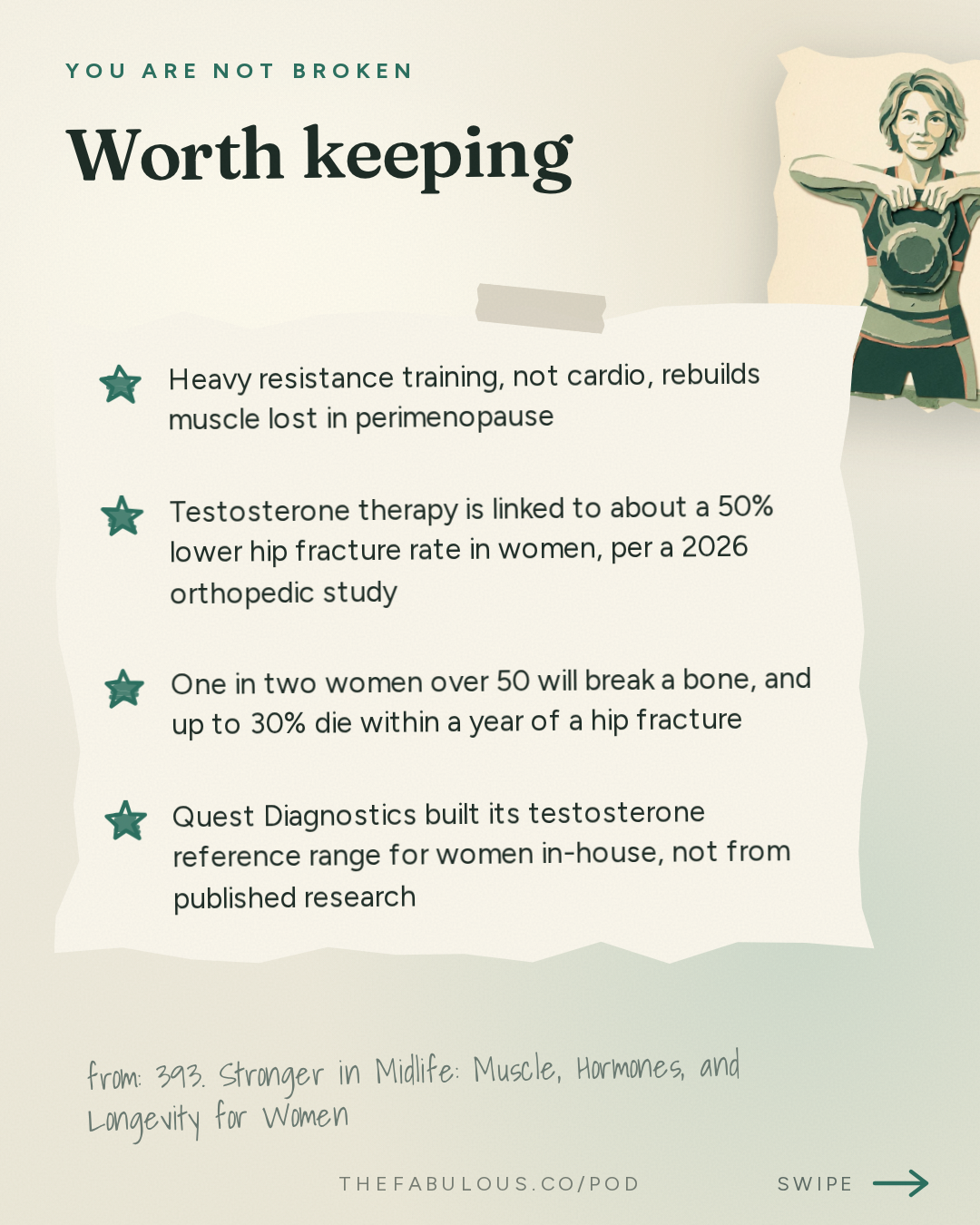
- Heavy resistance training, not cardio, rebuilds muscle lost in perimenopause
- Testosterone therapy is linked to about a 50% lower hip fracture rate in women, per a 2026 orthopedic study
- One in two women over 50 will break a bone, and up to 30% die within a year of a hip fracture
- Quest Diagnostics built its testosterone reference range for women in-house, not from published research
- A 20-year follow-up of the Women's Health Initiative study found no added heart or stroke risk from hormone therapy
The episode in cards

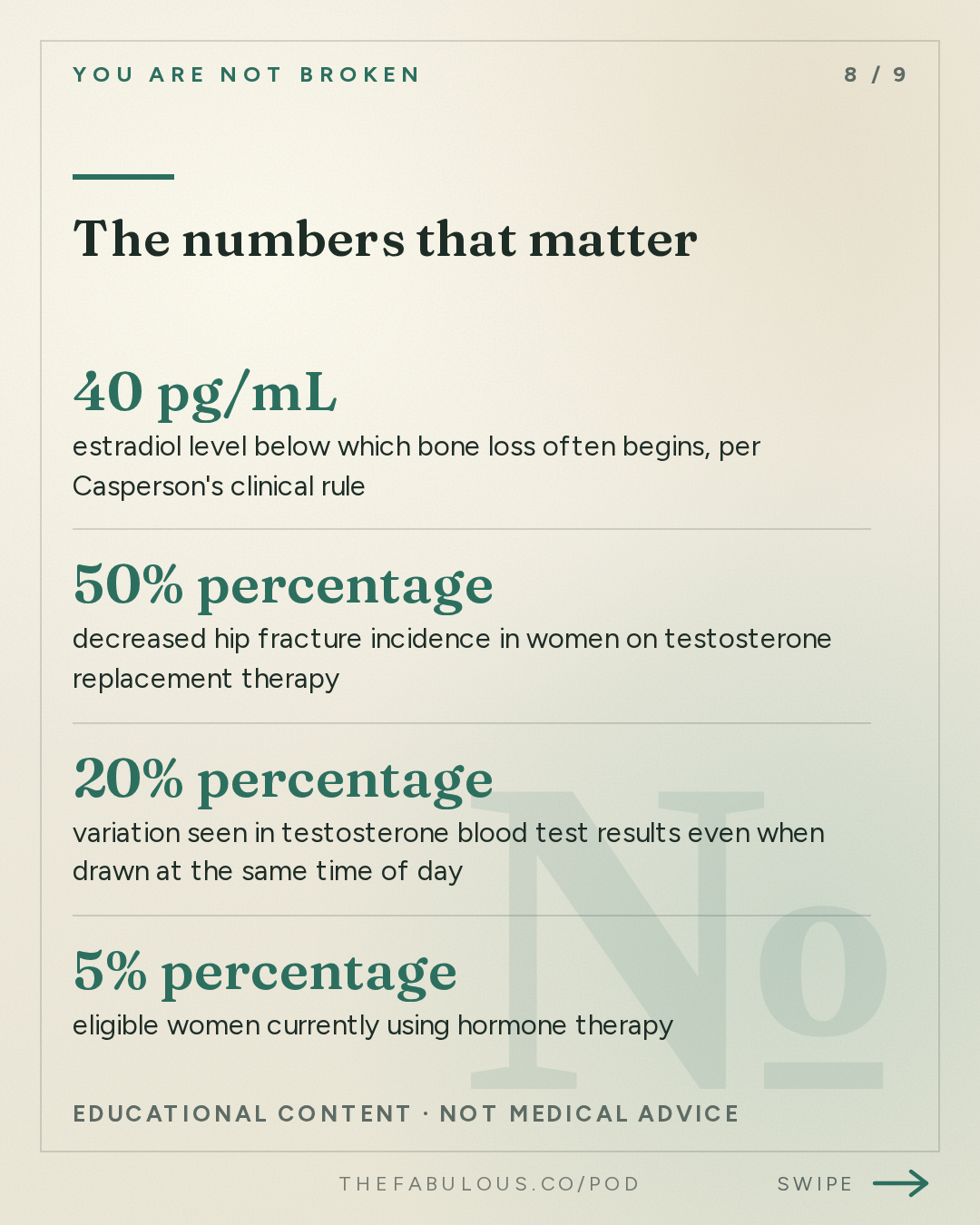
By the numbers
- 40 pg/mL estradiol level below which bone loss often begins, per Casperson's clinical rule
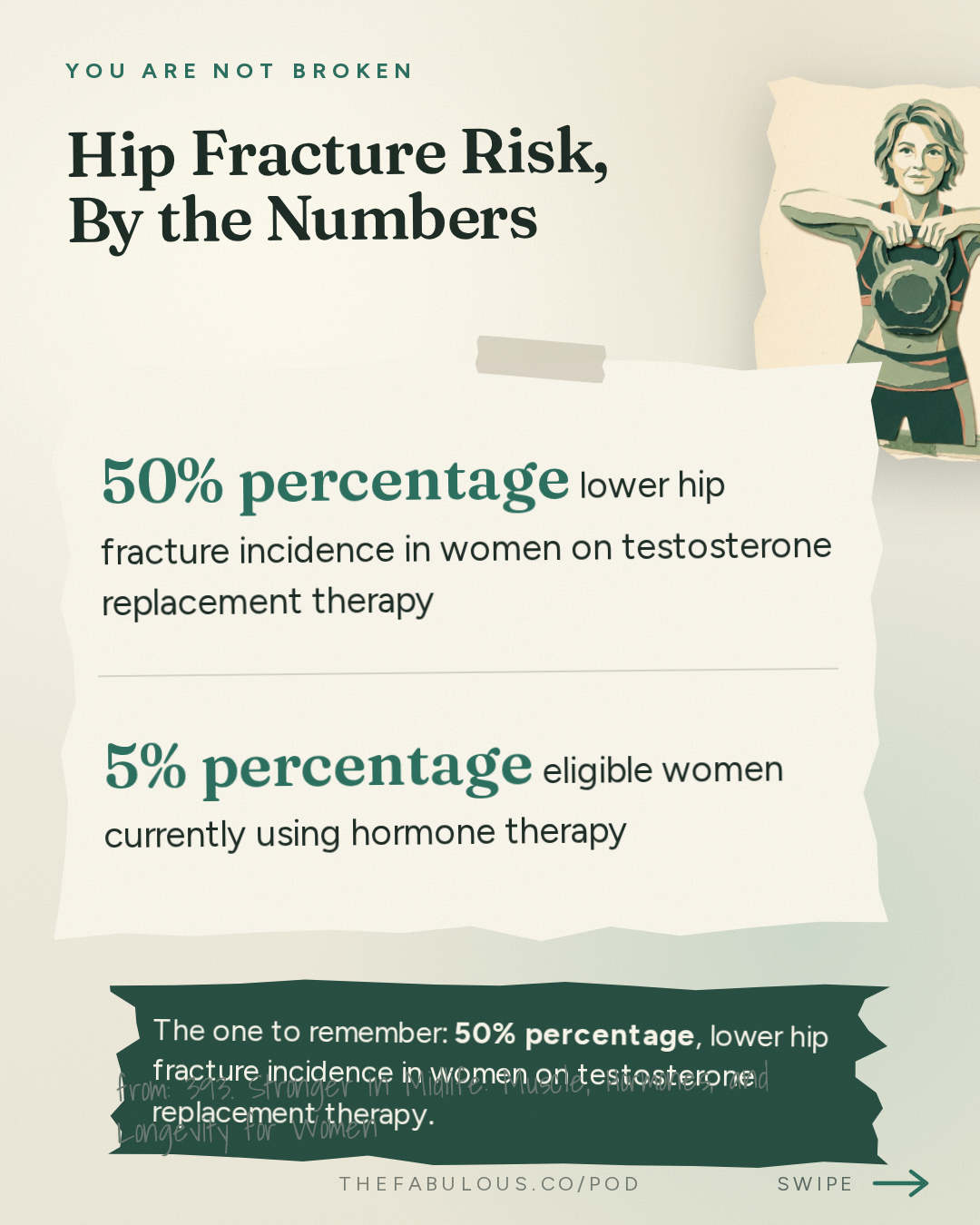
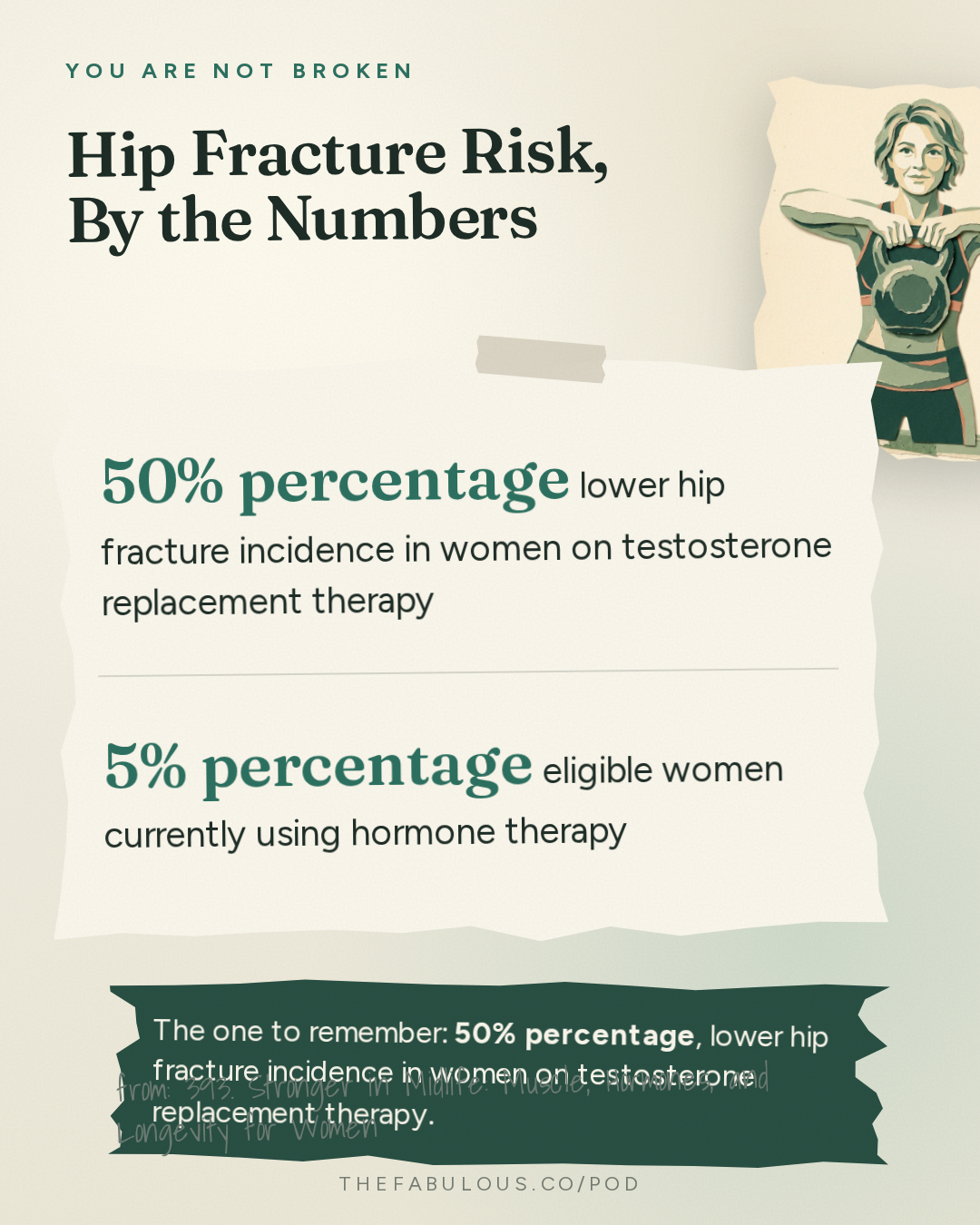
- 50% percentage decreased hip fracture incidence in women on testosterone replacement therapy
- 20% percentage variation seen in testosterone blood test results even when drawn at the same time of day
- 5% percentage eligible women currently using hormone therapy
In their words
“Insurance doesn't care about you when you're 80, because that's gonna be bankrupt Medicare's problem.”
“Don't tell me there's no data. I'm so fucking sick of there's no data.”
“You don't get it. Modern medicine will keep you alive, and that quality of life might suck.”
“Whether you think you can or you can't, you are right.”
Protocols
-
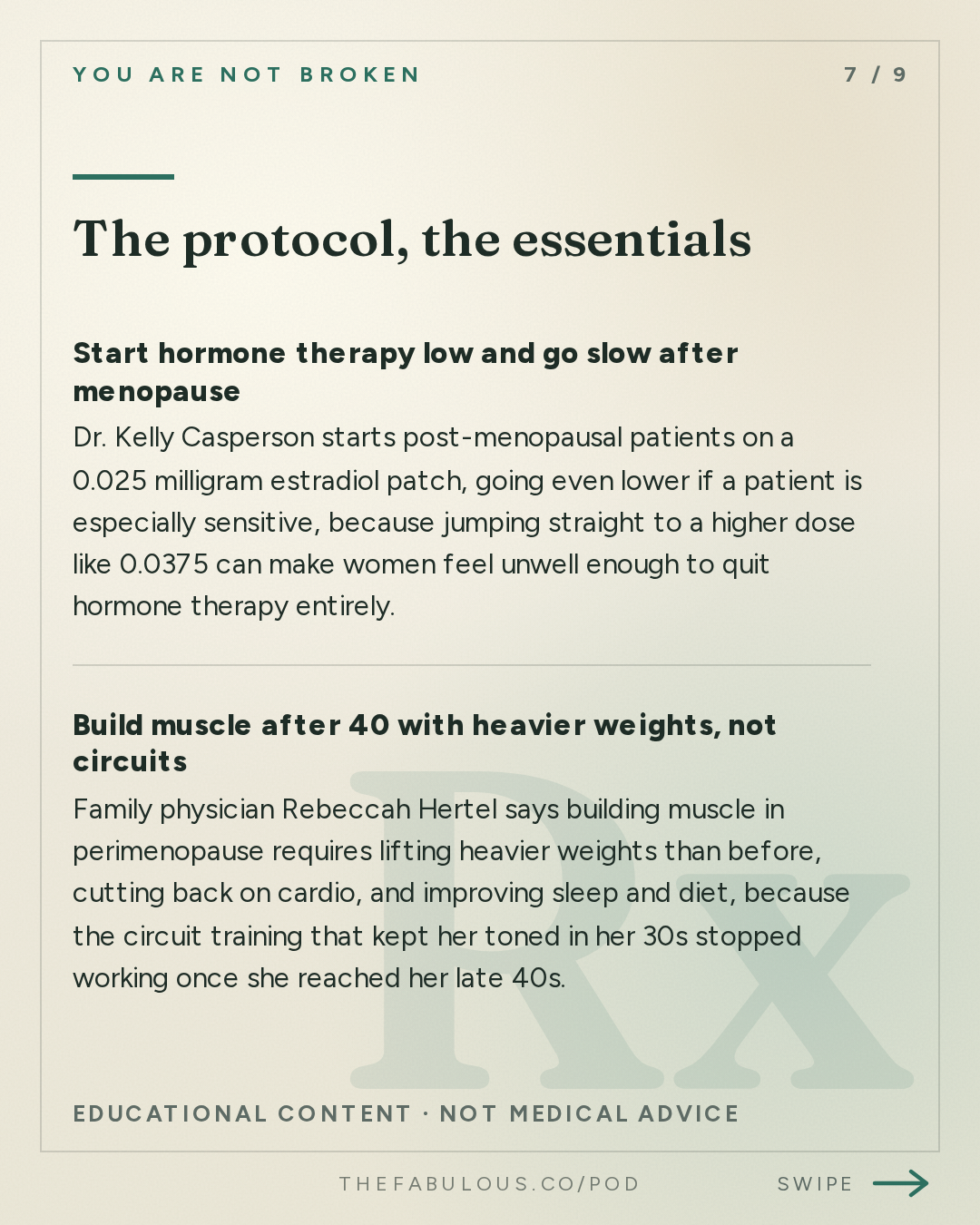
Start hormone therapy low and go slow after menopause
Dr. Kelly Casperson starts post-menopausal patients on a 0.025 milligram estradiol patch, going even lower if a patient is especially sensitive, because jumping straight to a higher dose like 0.0375 can make women feel unwell enough to quit hormone therapy entirely.
ongoing, adjusted based on symptoms and follow-up labs
-
Build muscle after 40 with heavier weights, not circuits
Family physician Rebeccah Hertel says building muscle in perimenopause requires lifting heavier weights than before, cutting back on cardio, and improving sleep and diet, because the circuit training that kept her toned in her 30s stopped working once she reached her late 40s.
ongoing strength training, with cardio reduced in favor of heavier lifting
-
Build protein and strength habits before starting a GLP-1
Dr. Kelly Casperson recommends knowing daily protein intake and lifting weights at least twice a week before starting a GLP-1 weight-loss medication, because blunting hunger without those habits already in place raises the risk of losing muscle and bone along with fat.
established before starting medication, then continued throughout treatment
-
Protect the brain by protecting sleep, muscle, and blood pressure
Dr. Kelly Casperson says dementia prevention comes down to optimizing sleep, maintaining muscle mass, and controlling high blood pressure, and argues that guidelines against using hormone therapy for dementia prevention ignore how much those three factors overlap with hormone health.
ongoing, lifelong
Questions this episode answers
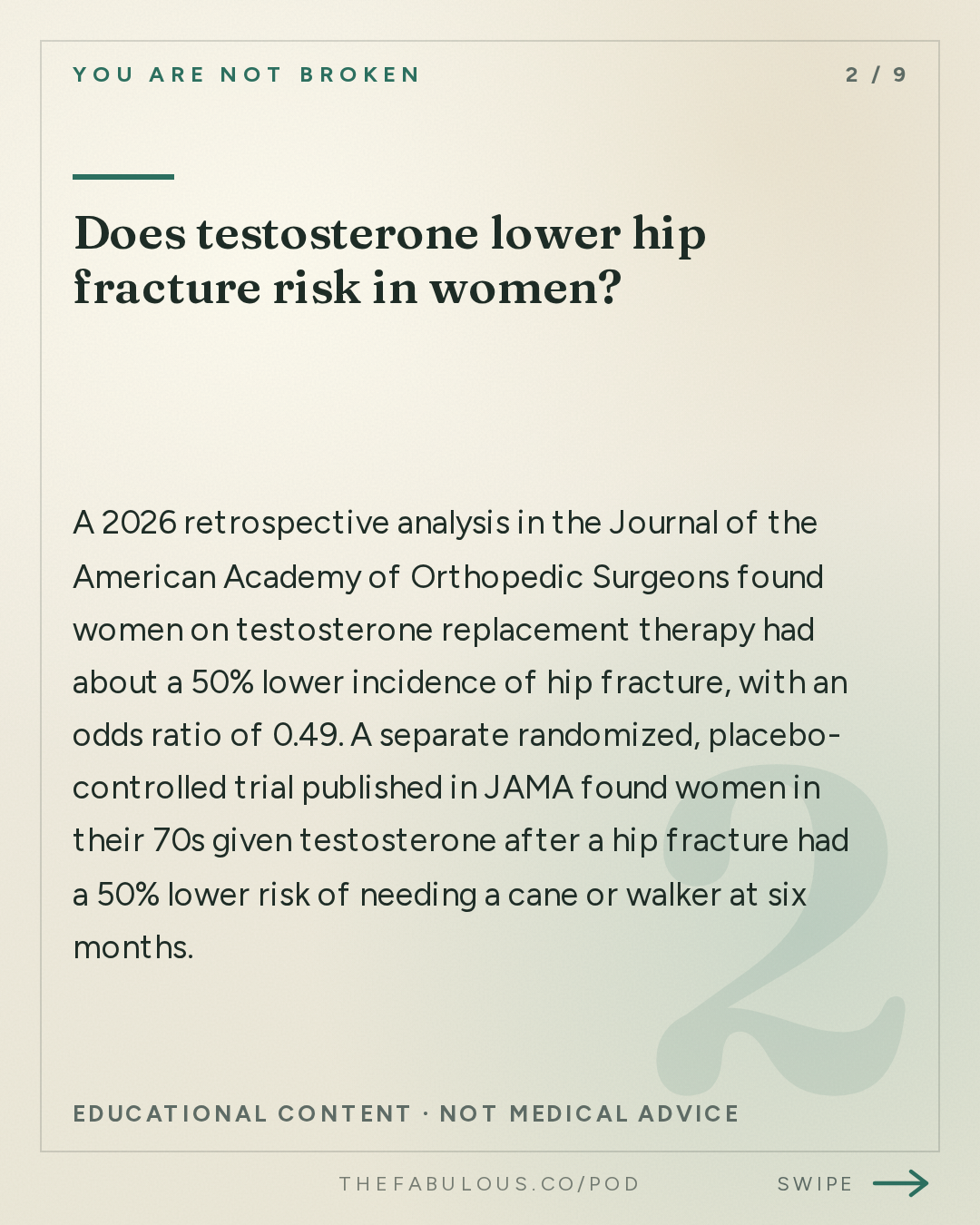
Does testosterone lower hip fracture risk in women?
A 2026 retrospective analysis in the Journal of the American Academy of Orthopedic Surgeons found women on testosterone replacement therapy had about a 50% lower incidence of hip fracture, with an odds ratio of 0.49 (52:48). A separate randomized, placebo-controlled trial published in JAMA found women in their 70s given testosterone after a hip fracture had a 50% lower risk of needing a cane or walker at six months (53:11).
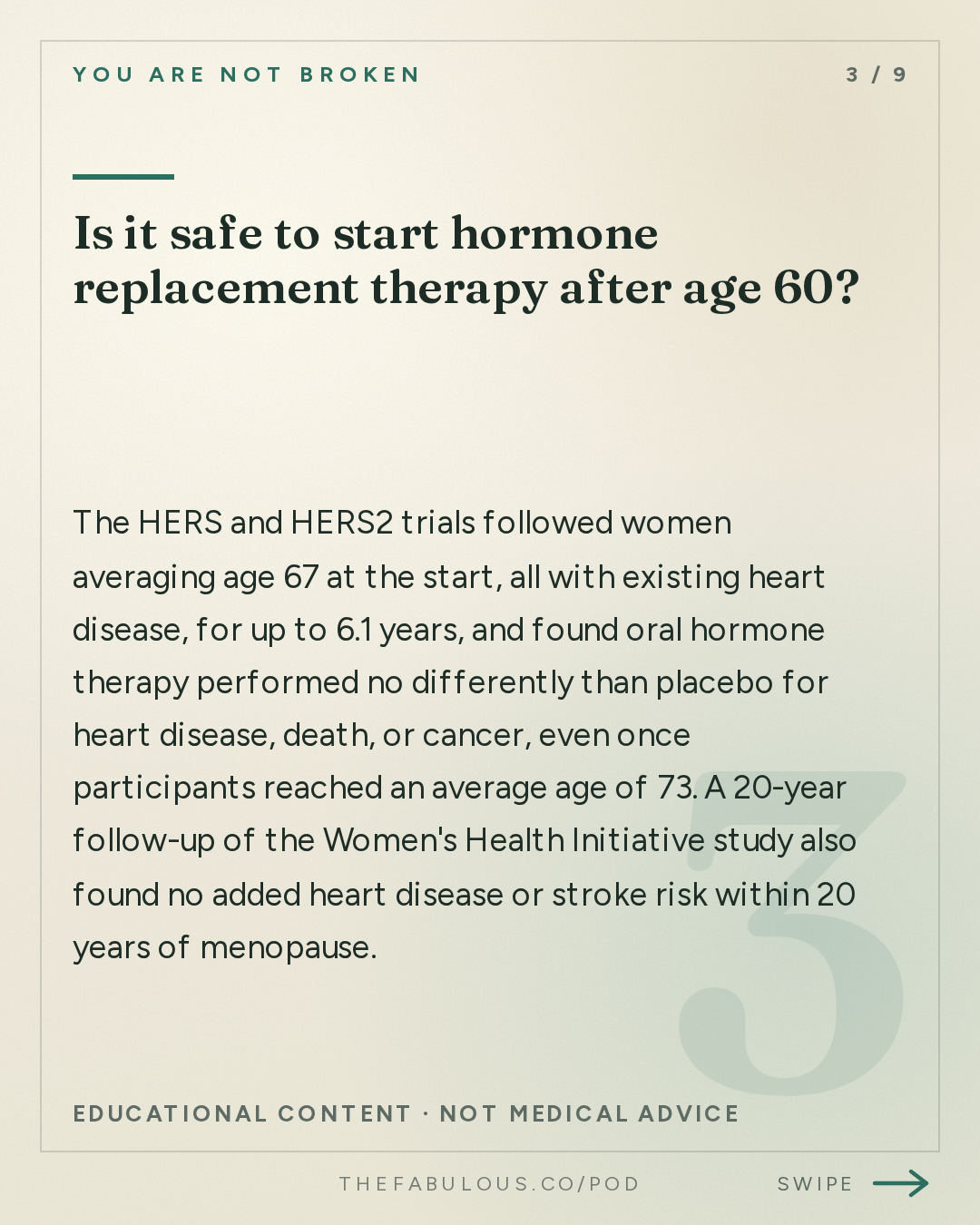
Is it safe to start hormone replacement therapy after age 60?
The HERS and HERS2 trials followed women averaging age 67 at the start, all with existing heart disease, for up to 6.1 years, and found oral hormone therapy performed no differently than placebo for heart disease, death, or cancer, even once participants reached an average age of 73 (74:36). A 20-year follow-up of the Women's Health Initiative study also found no added heart disease or stroke risk within 20 years of menopause (69:16).
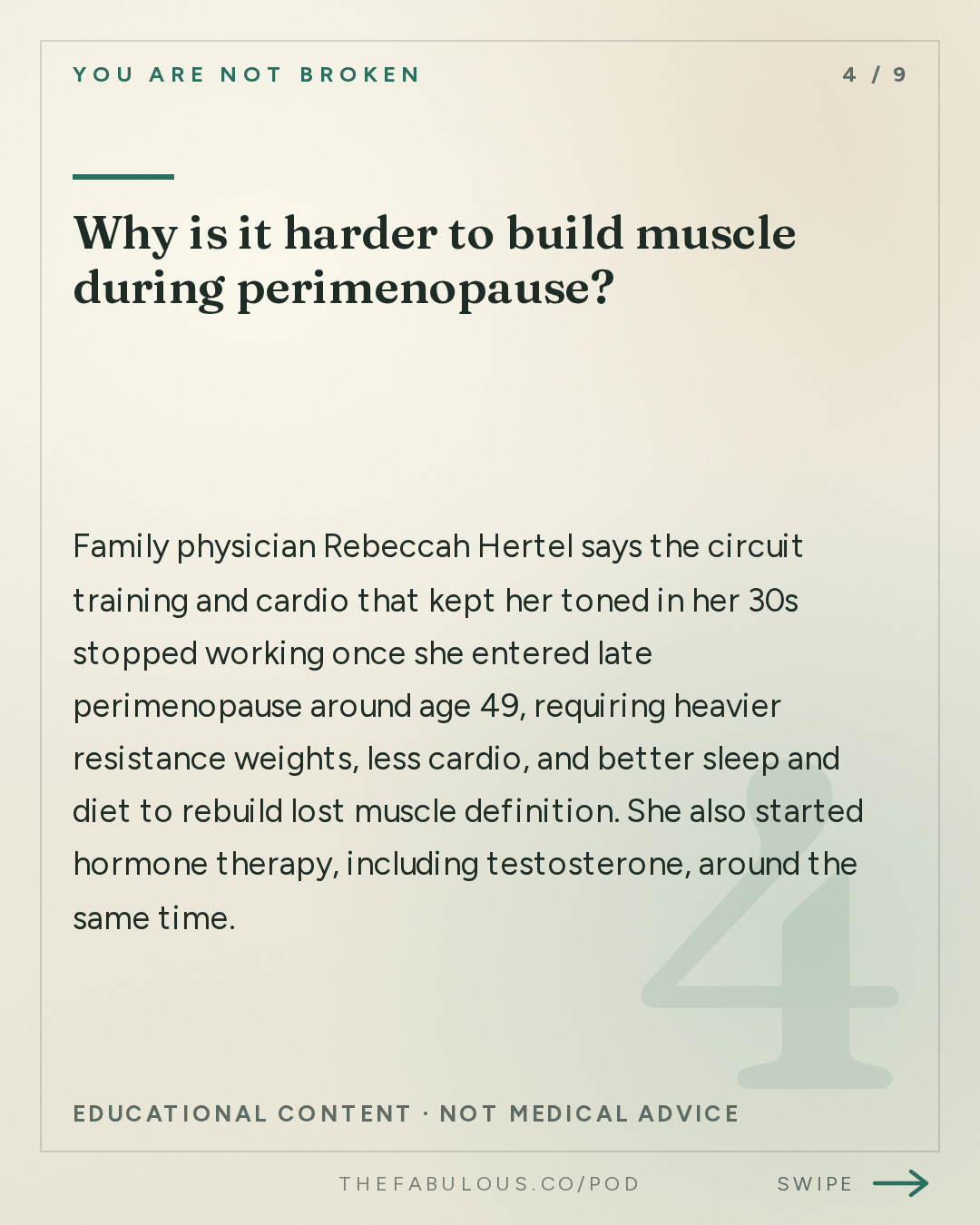
Why is it harder to build muscle during perimenopause?
Family physician Rebeccah Hertel says the circuit training and cardio that kept her toned in her 30s stopped working once she entered late perimenopause around age 49, requiring heavier resistance weights, less cardio, and better sleep and diet to rebuild lost muscle definition (12:37). She also started hormone therapy, including testosterone, around the same time (13:17).
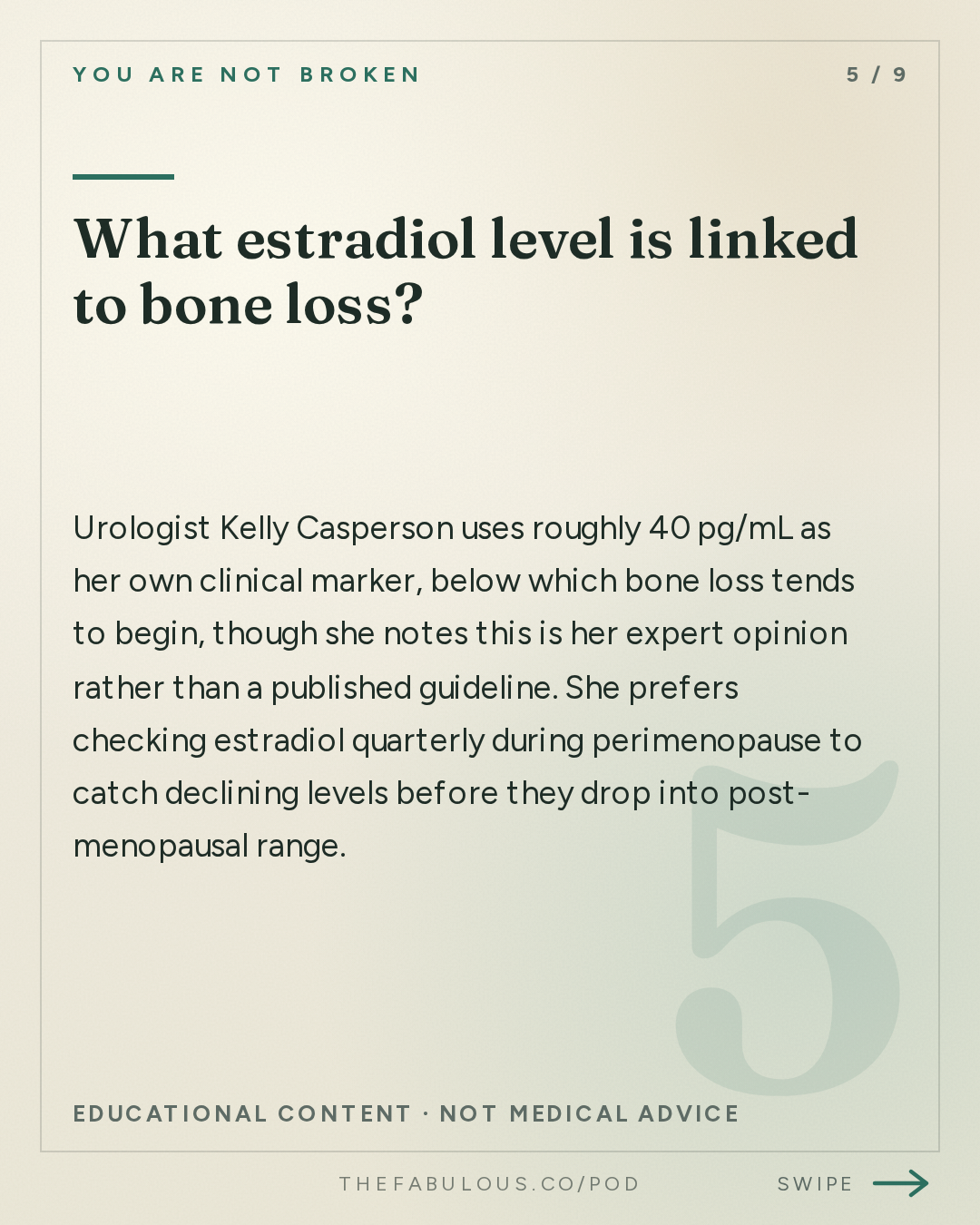
What estradiol level is linked to bone loss?
Urologist Kelly Casperson uses roughly 40 pg/mL as her own clinical marker, below which bone loss tends to begin, though she notes this is her expert opinion rather than a published guideline (26:05). She prefers checking estradiol quarterly during perimenopause to catch declining levels before they drop into post-menopausal range (25:43).
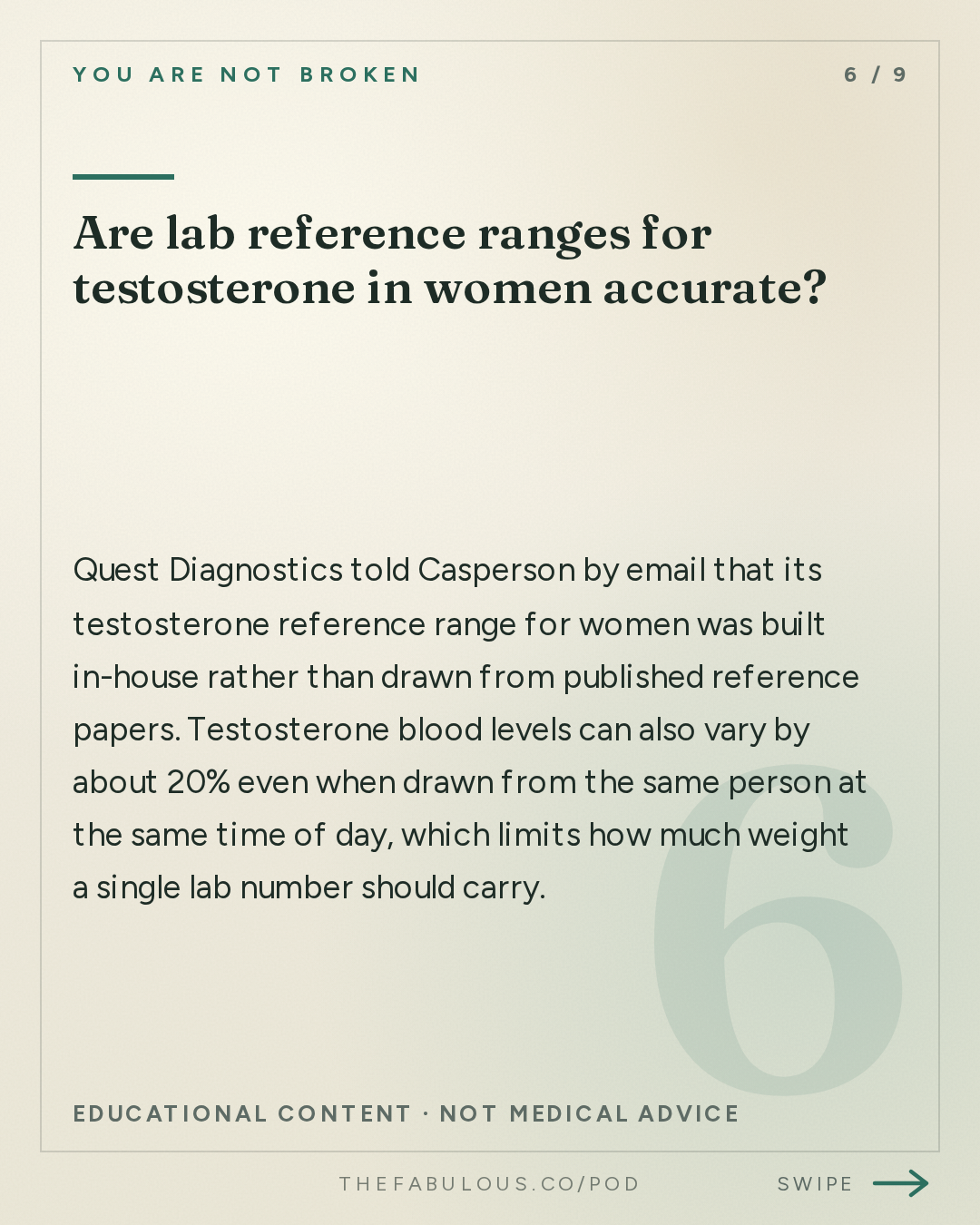
Are lab reference ranges for testosterone in women accurate?
Quest Diagnostics told Casperson by email that its testosterone reference range for women was built in-house rather than drawn from published reference papers (80:10). Testosterone blood levels can also vary by about 20% even when drawn from the same person at the same time of day, which limits how much weight a single lab number should carry (82:11).
The full read, in cards
Go deeper
- Journal of the American Academy of Orthopedic Surgeons retrospective analysis (2026) — Found testosterone replacement therapy linked to a 40% lower hip fracture risk in men and a 50% lower risk in women
- JAMA randomized placebo-controlled trial on testosterone after hip fracture — Found women in their 70s given testosterone after hip fracture had a 50% lower risk of needing a cane or walker at six months
- Women's Health Initiative (WHI) — A 20-year follow-up found no increased heart disease or stroke risk from hormone therapy within 20 years of menopause
- HERS and HERS2 trials — Found oral hormone therapy performed no differently than placebo for heart disease, death, or cancer in women with existing heart disease, followed to average age 73
Mentioned
Dr. Kelly Casperson · Dr. Rebeccah Hertel · The Menopause Society · ISSWSH · InBody · Women's Health Initiative (WHI) · HERS Study · Quest Labs · Femring · JAMA · US Preventive Services Task Force
More from this show and category
Menopause Advocacy and Policy Reform Guide
Lawyer Jennifer Weiss-Wolf compares menopause advocacy to a choose-your-own-adventure book: everyone brings different skills. She traces today's momentum back to 1992's 'Year of the Woman' and the 2002 Women's Health Initiative backlash, and warns that US law still has no explicit protection against menopause discrimination at work (36:59), so she tells people to write to legislators and file FDA comments instead of venting online (17:49).
Vaginal Estrogen for UTI Prevention
Urologist Dr. Kelly Casperson explains that genitourinary syndrome of menopause (GSM) affects 50% to 90% of postmenopausal women. Vaginal estrogen cuts recurrent urinary tract infections by half, lowers hospitalization and death risk, and is safe for most breast cancer survivors, yet only 9% of women diagnosed with GSM get a prescription.

How Much Protein Do You Really Need?
The standard protein recommendation of 0.8 grams per kilogram prevents deficiency, not optimal health. Researchers at Protein Summit 3.0 debated a higher range, 1.1 to 1.6 grams per kilogram, for better metabolic outcomes, noting needs shift by age, activity, and health status (07:15).

Neuralink Trials for Quadriplegia: What Comes First
Neuralink's head neurosurgeon Matt MacDougall explains that the implant's first job is letting quadriplegic patients move a cursor and type by thought alone, not reconnect limbs. He also covers the robotic surgery that makes this possible, the safety case made in pigs and monkeys, and his own subdermal RFID chip.
