Resistance Training Over 40: Jeff Cavaliere's Rules
#414 ‒ Resistance training as we age: optimizing exercise selection and training intensity for muscle growth, function, and injury risk management | Jeff Cavaliere, M.S.P.T., C.S.C.S.
▶ Listen to the full episode More from The Peter Attia Drive
The brief
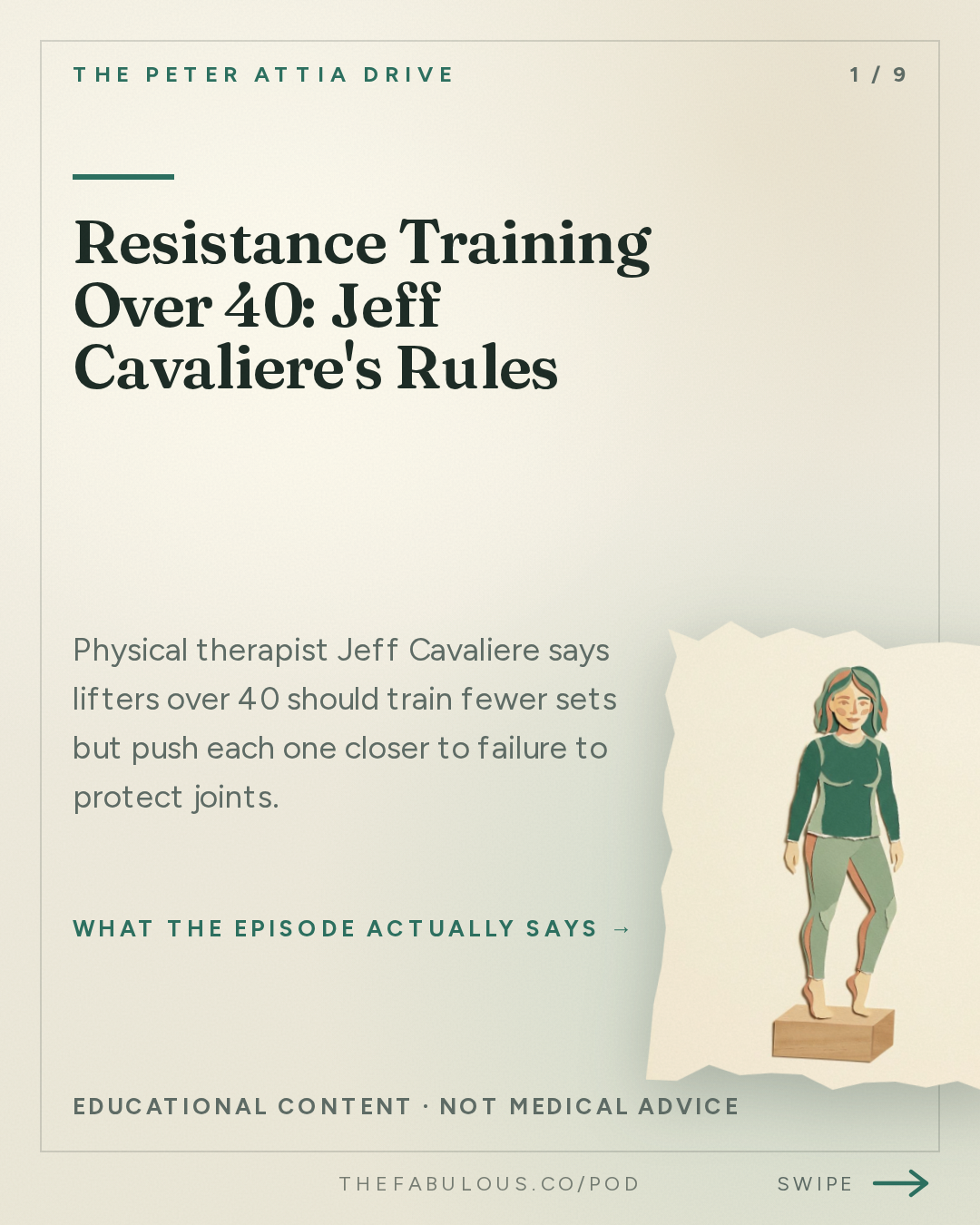
Physical therapist Jeff Cavaliere says lifters over 40 should train fewer sets but push each one closer to failure to protect joints. He calls low-effort, high-fatigue sets 'junk volume,' and gives fixes like a 30-degree incline press, overhead tricep stretches, and a 4-second calf-raise pause.
In 2007, in the outfield at a Mets spring training game, an all-star outfielder handed Jeff Cavaliere a baseball and a dare. Cavaliere, then the team's head physical therapist, had just said the throw from right field to third base didn't look that far. For $1,000, the outfielder told him, prove it. Cavaliere wound up and threw with everything he had. The ball landed somewhere near second base and rolled, pathetically, toward third (15:04). He felt what he calls a zipper-like pain in his shoulder. He had torn his labrum and half of his supraspinatus, one of the four rotator cuff muscles, on a single overthrown pitch, for a bet, to avoid looking foolish in front of professional athletes (12:40).
That injury never got surgically repaired, and in a roundabout way, it is the seed of everything Cavaliere teaches now. He is a physical therapist, a former head physical therapist for the New York Mets, and the founder of ATHLEAN-X, a YouTube fitness platform with nearly 15 million subscribers built from close to 1,700 videos (04:42, 07:12). On Peter Attia's podcast, Cavaliere lays out, muscle by muscle, how he thinks people should lift as they move through the transition from their forties into their fifties and sixties, when the body stops forgiving sloppy training the way it once did.
The Case Against Junk Volume
Cavaliere's central claim sounds almost backward: lifting less, not more, is how an aging body keeps making gains without breaking down. He has a name for the sets that don't count: junk volume, meaning repetitions performed with so little real effort that they add wear to a joint without adding anything to a muscle (37:03). His fix is to let total volume fall while the intensity of every remaining set rises.
"I want volume to come down. I want productive repetitions to go up. I want repetitions to actually mean something." — Jeff Cavaliere [36:35]
To make that concrete, Cavaliere leans on a scale called reps in reserve, or RIR, which measures how many more repetitions a lifter could grind out before a muscle truly gives up. Zero RIR means the set has gone to real mechanical failure: the weight will not move again (37:23). One or two RIR means a rep or two was left in the tank. Anything past three or four reps in reserve, he says, is often just junk volume dressed up as a workout (38:08). The catch, he admits, is that most lifters, even some trainers, don't have an accurate internal gauge for what failure actually feels like, and tend to undershoot their real capacity by a rep or two without realizing it (38:33).
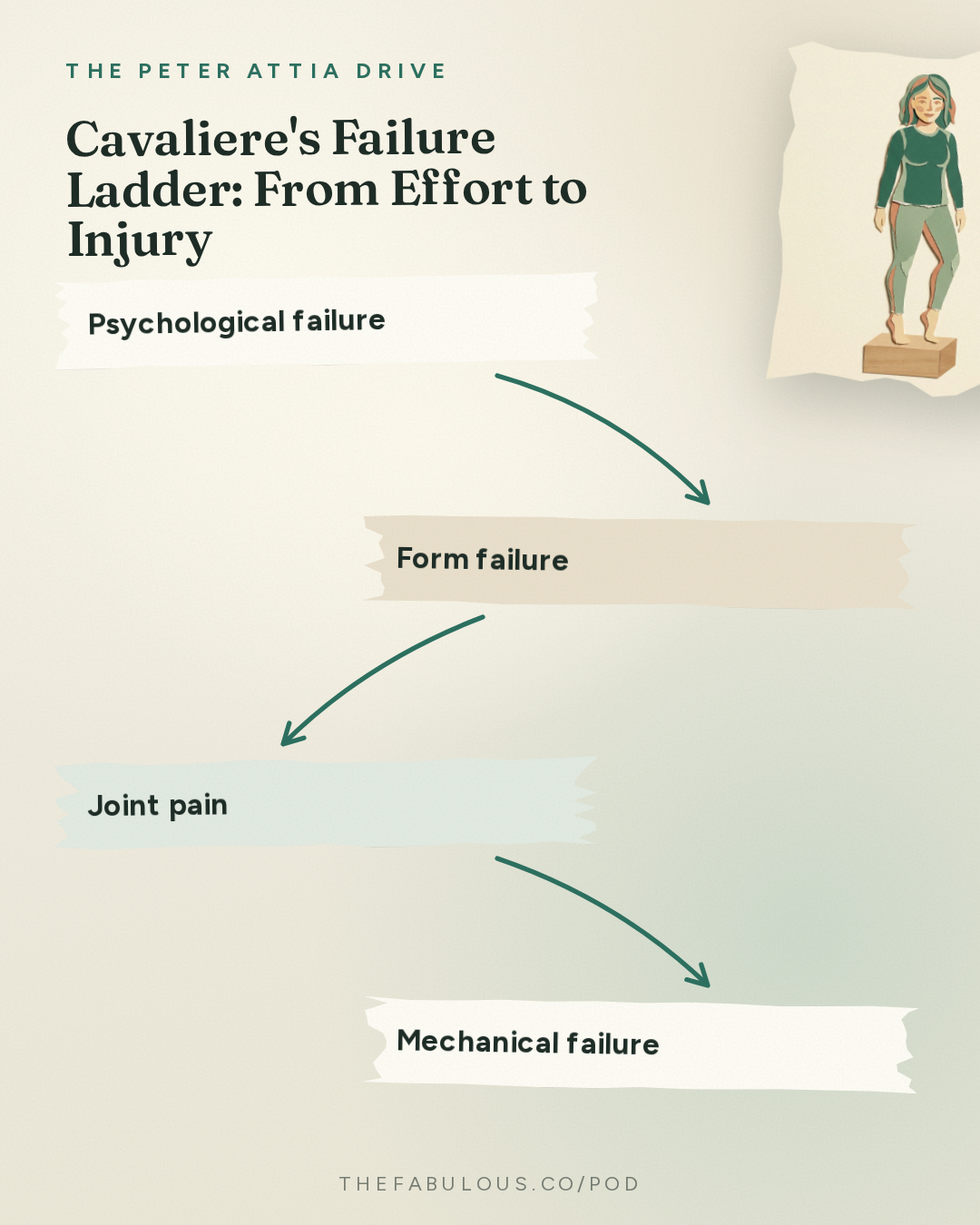
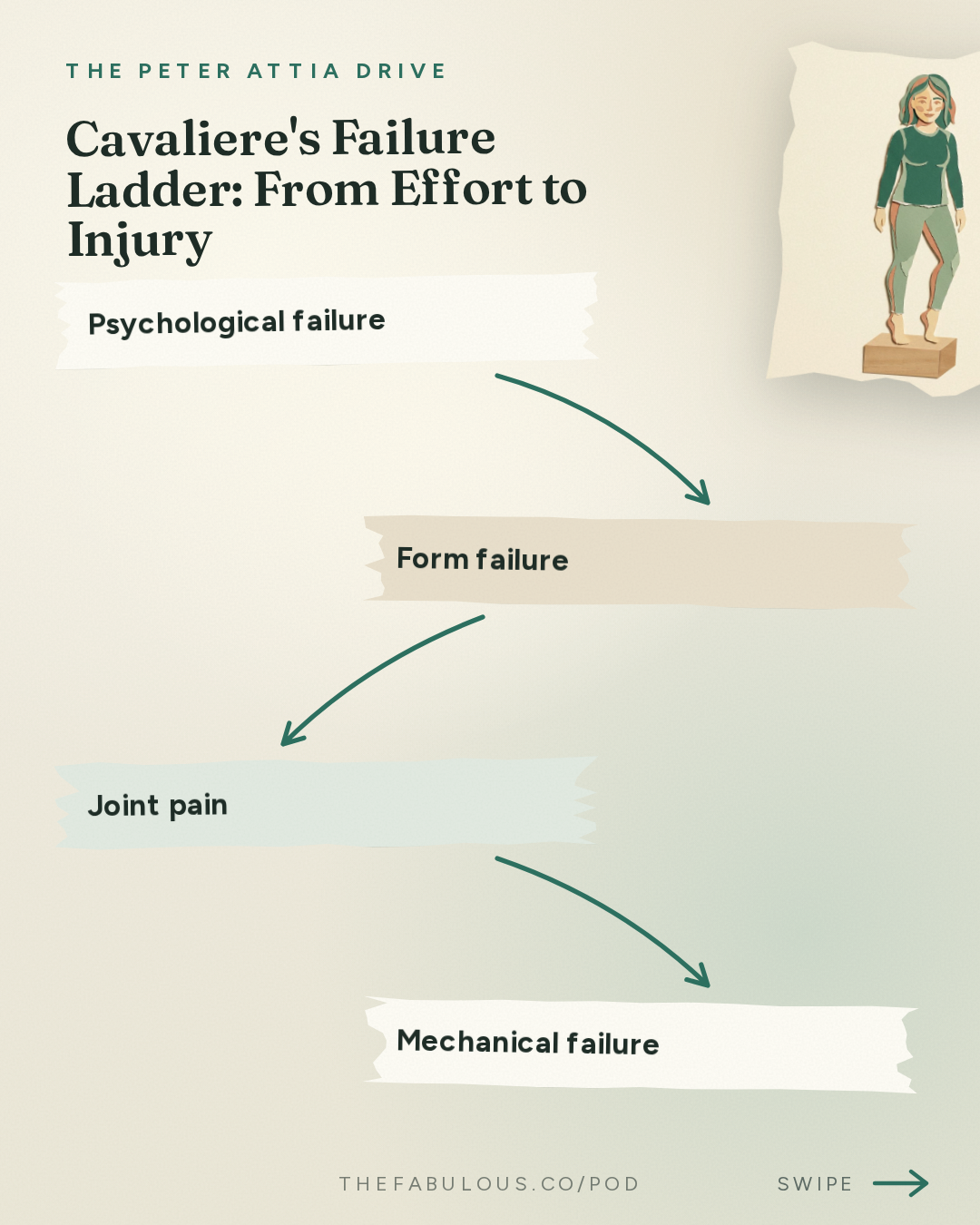
Pushing toward failure, though, isn't one clean line. Cavaliere breaks the approach to failure into stages. First comes psychological failure, where another rep simply feels too uncomfortable to attempt, even though the muscle could still contract again (39:01). Push past that and a lifter hits form failure, where the tempo slows and the body loosens slightly, which Cavaliere says is fine as long as the lift stays stable (39:21). What is never fine, in his view, is joint pain, which he treats as an immediate stop signal, because at that point the joint, not the muscle, is absorbing the load (40:00). Only after clearing those checkpoints does a lifter reach the real target: mechanical failure, the point the weight genuinely cannot move.
This same logic shapes how Cavaliere talks about training around injury rather than around it entirely. He rejects the idea that a sore joint means a shutdown of the whole program.
"If you thought of an injury to a certain joint or a painful exercise like this overhead press, it shouldn't be looked at as a city shutdown. It's just a single road closure for now." — Jeff Cavaliere [55:41]
Rest, in his telling, is only half of recovery. The other half is mechanical stress, applied carefully, to the tissue itself. "The fastest way to slow recovery from an injury is to not do something for it," he says (146:34). That principle, worked out on his own flat feet, torn labrum, and 50-percent rotator cuff tear, is what sends him looking for substitute exercises rather than blanket avoidance whenever something hurts.
Muscle by Muscle, Joint by Joint
Much of the conversation is a tour of the body, with Cavaliere offering a specific fix for each region. For shoulders, he argues the vertical press, done with dumbbells or a landmine (a barbell wedged into a corner and pressed up and away from the body), should anchor training because it moves all three heads of the deltoid through a full range of motion at once (50:16, 53:33). For triceps, he zeroes in on the long head, the only one of the tricep's three heads that crosses the shoulder joint, which grows best when stretched, meaning the arm angled back past vertical, roughly 120 degrees from the body, toward the ear, in a lying barbell extension (73:05, 74:13). For the chest, he favors an incline press set at about 30 degrees rather than a steeper angle, which he says shifts too much stress onto the front shoulder instead of the upper chest most lifters are actually weak in (101:50). Across all of these, he returns to one line.
"Tension is the language that muscles speak, not necessarily the weight." — Jeff Cavaliere [80:34]
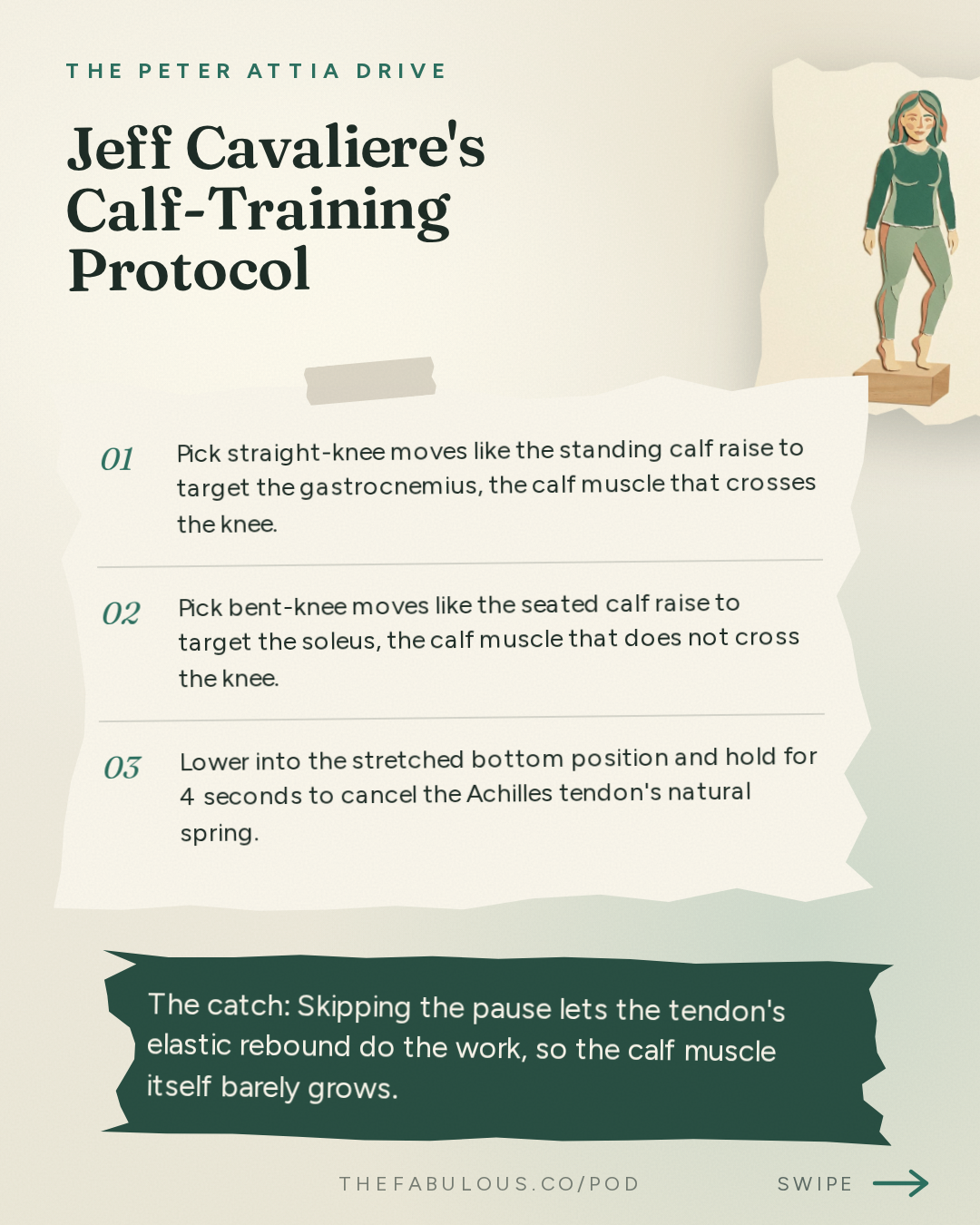
For the back, Cavaliere says elbow position is the whole story: elbows held tight to the body in a row recruit the lats, while elbows allowed to drift out recruit the upper back and rear delts instead (114:17, 120:35). Lifters whose lower back fatigues before their lats, he says, should use a chest-supported row while they build lower back strength separately, through exercises like hyperextensions and the Superman. His favorite upper-back move is the face pull, done with two ropes rather than one so the hands can travel far enough apart to force real external rotation at the top (119:10). For calves, he recommends pausing for four seconds at the stretched bottom of a raise before rising slowly, which cancels out the Achilles tendon's natural elastic spring and forces the calf muscle itself, rather than the tendon, to do the work (137:59).
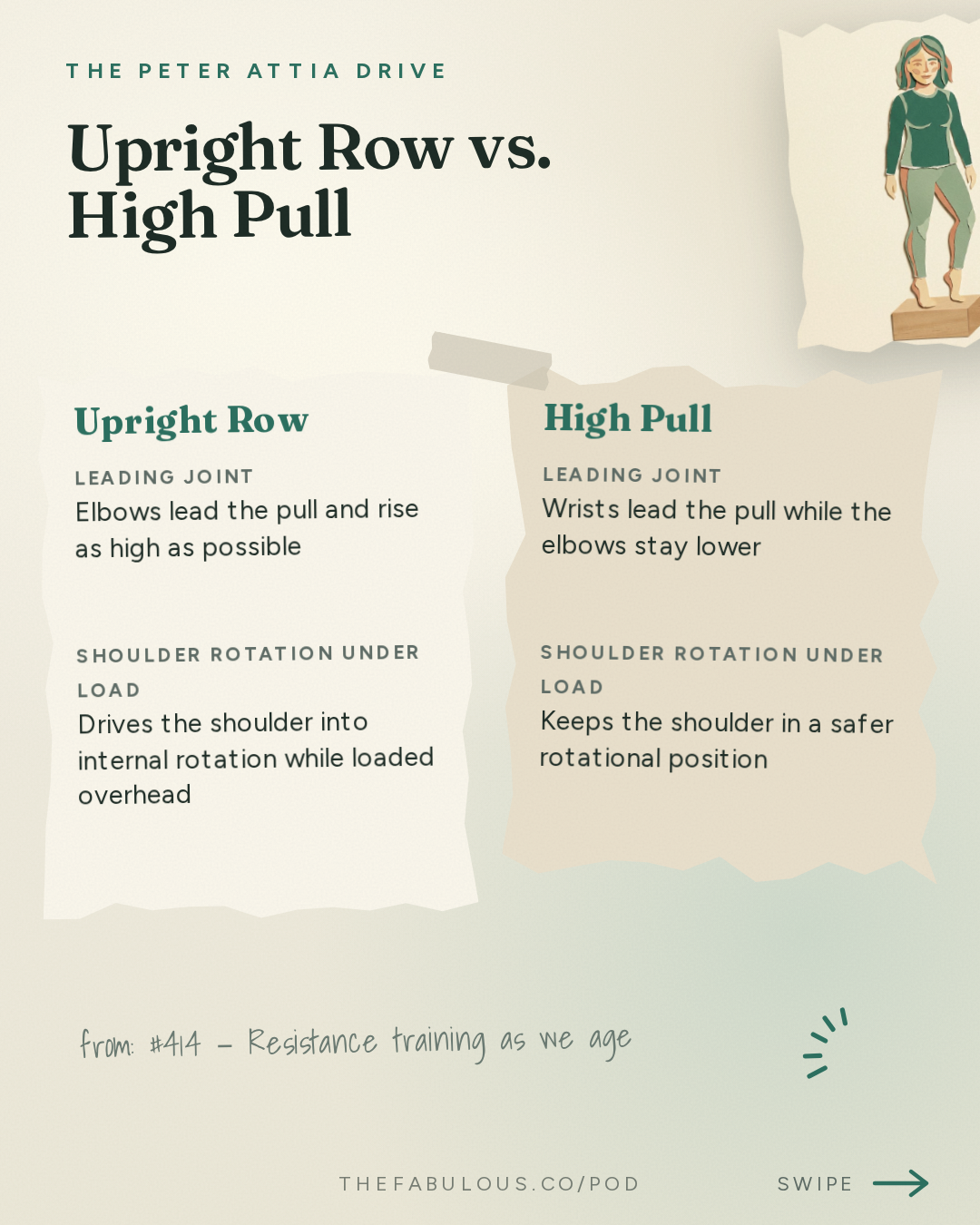
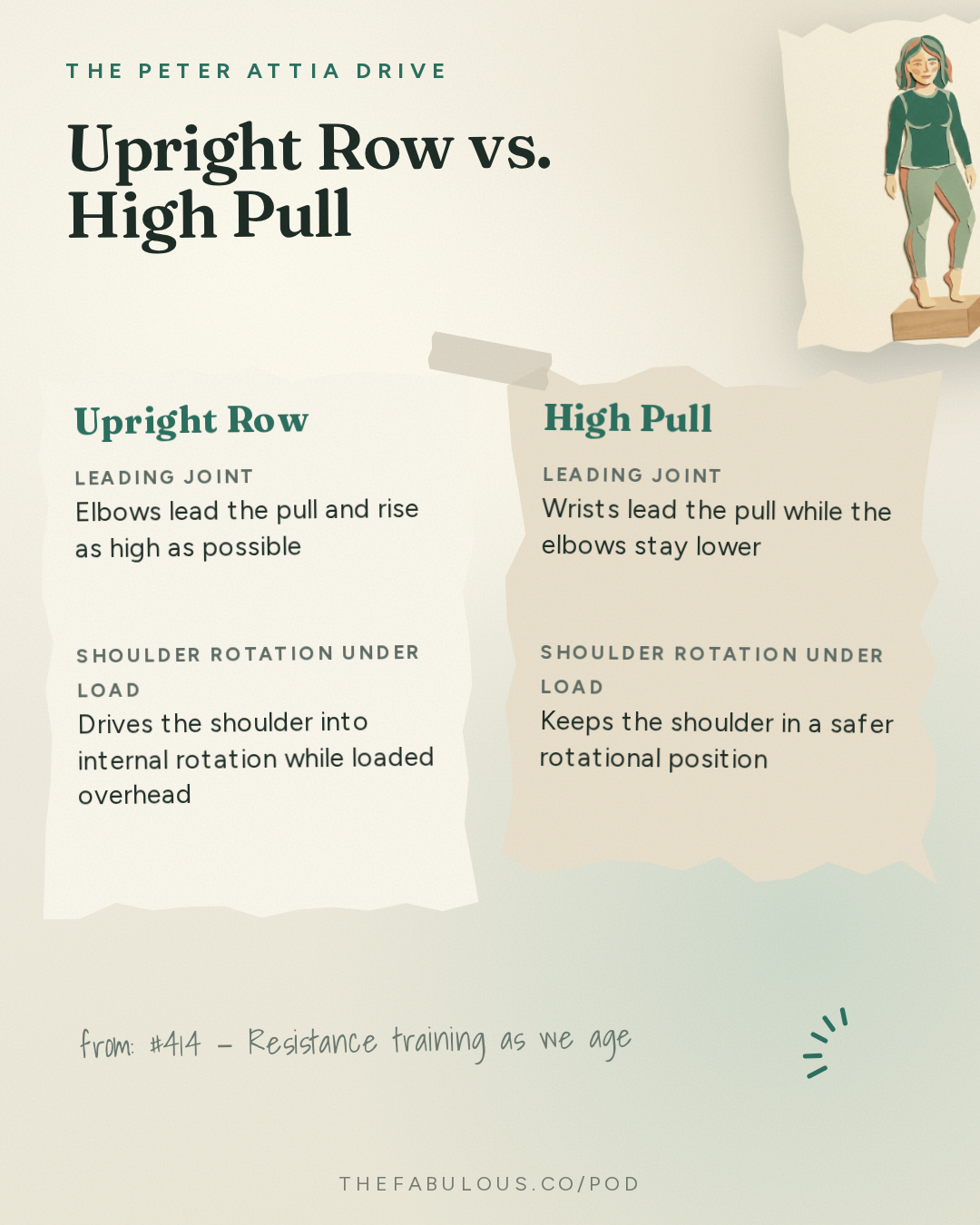
Cavaliere also keeps what he calls an iron graveyard, a short list of exercises he thinks carry too much risk for the benefit they offer. His least favorite is the upright row, which he says drives the shoulder into internal rotation while loaded and elevated overhead, a setup for impingement (142:11). His fix is almost absurdly small: lead the pull with the wrists instead of the elbows, which keeps the same trap and shoulder stimulus while removing the rotation risk entirely (142:52). The flat-bench dumbbell fly and the dumbbell side bend make his list too, each for the same reason: a safer substitute exists that gives most of the benefit without the downside.
None of this, Cavaliere is careful to say, is really about chasing a perfect physique. It traces back to a simpler idea he raises early in the conversation, borrowed loosely from how he thinks about Tom Brady's long career: that consistency, not intensity on any single day, is what lets a person keep training into their sixties, seventies, and beyond. The shoulder he wrecked chasing a $1,000 dare no longer hurts most days. He still trains it anyway, just differently, and that difference, worked out joint by joint over two decades, is the entire argument of this episode.
Ask this episode anything
Pod's AI answers from the episode itself, with the minute mark so you can hear it yourself.
Or start with one of these
Ask this episode
Pod's AI listens to the whole episode to answer, and points you to the minute it comes from.
The rest of this answer, and any question after it
Answers come from the episode itself, never from a summary of it.
ContinueKey takeaways
- Cutting training volume while raising intensity protects aging joints
- Jeff Cavaliere, a physical therapist, trains near failure but stops immediately at joint pain
- The tricep's long head grows best when stretched overhead, says Cavaliere
- Cavaliere swaps the upright row for a wrist-led high pull to cut shoulder impingement risk
- A 4-second pause at the bottom of a calf raise forces the calf muscle to work, not the Achilles tendon
The episode in cards

By the numbers
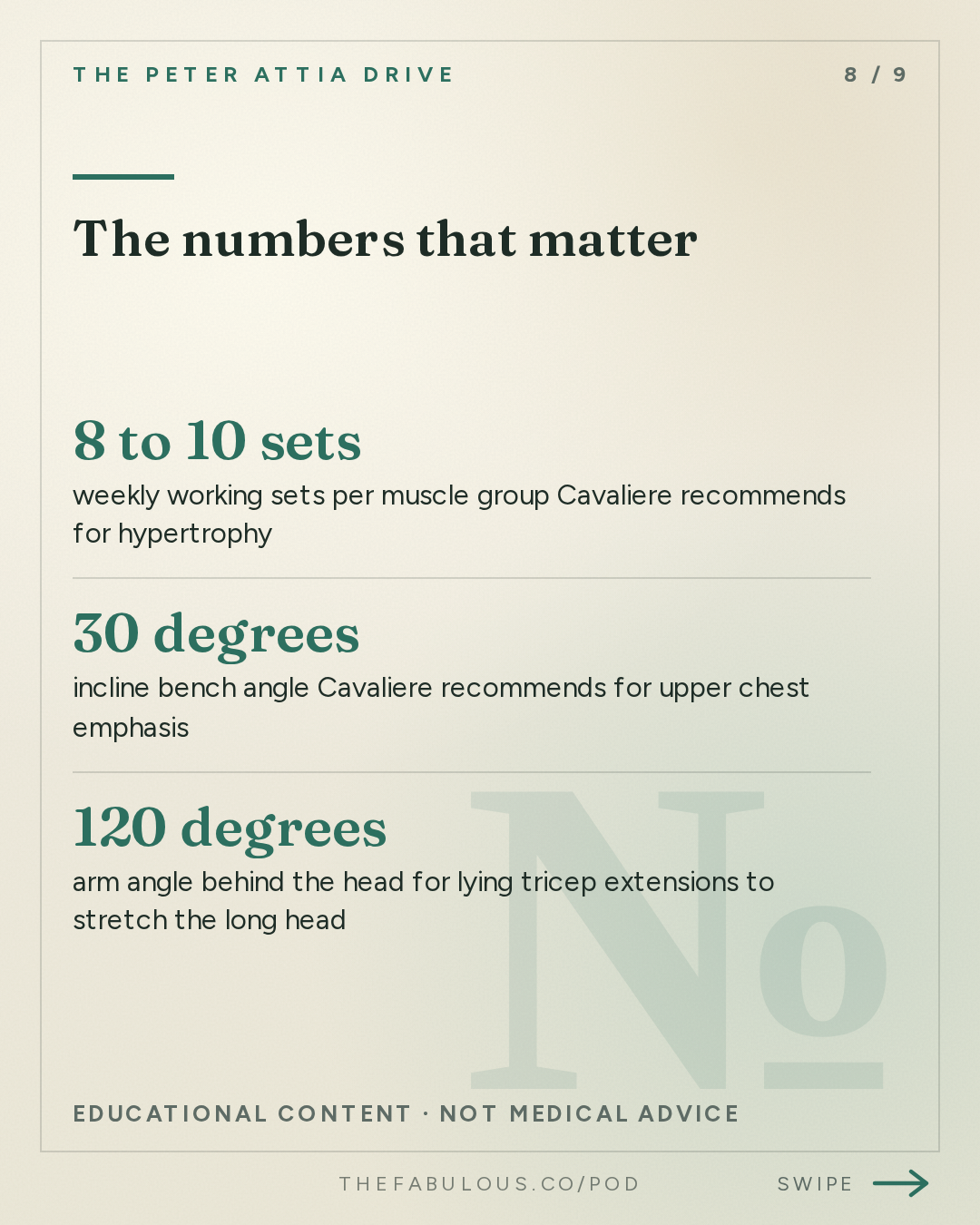
- 8 to 10 sets weekly working sets per muscle group Cavaliere recommends for hypertrophy
- 30 degrees incline bench angle Cavaliere recommends for upper chest emphasis
- 120 degrees arm angle behind the head for lying tricep extensions to stretch the long head
In their words
“I want volume to come down. I want productive repetitions to go up. I want repetitions to actually mean something.”
“Tension is the language that muscles speak, not necessarily the, the weight”
“If you thought of an injury to a certain joint or a painful exercise like this overhead press, it shouldn't be looked at as a city shutdown. It's just a single road closure for now.”
“The fastest way to slow recovery from an injury is to not do something for it.”
Protocols
-
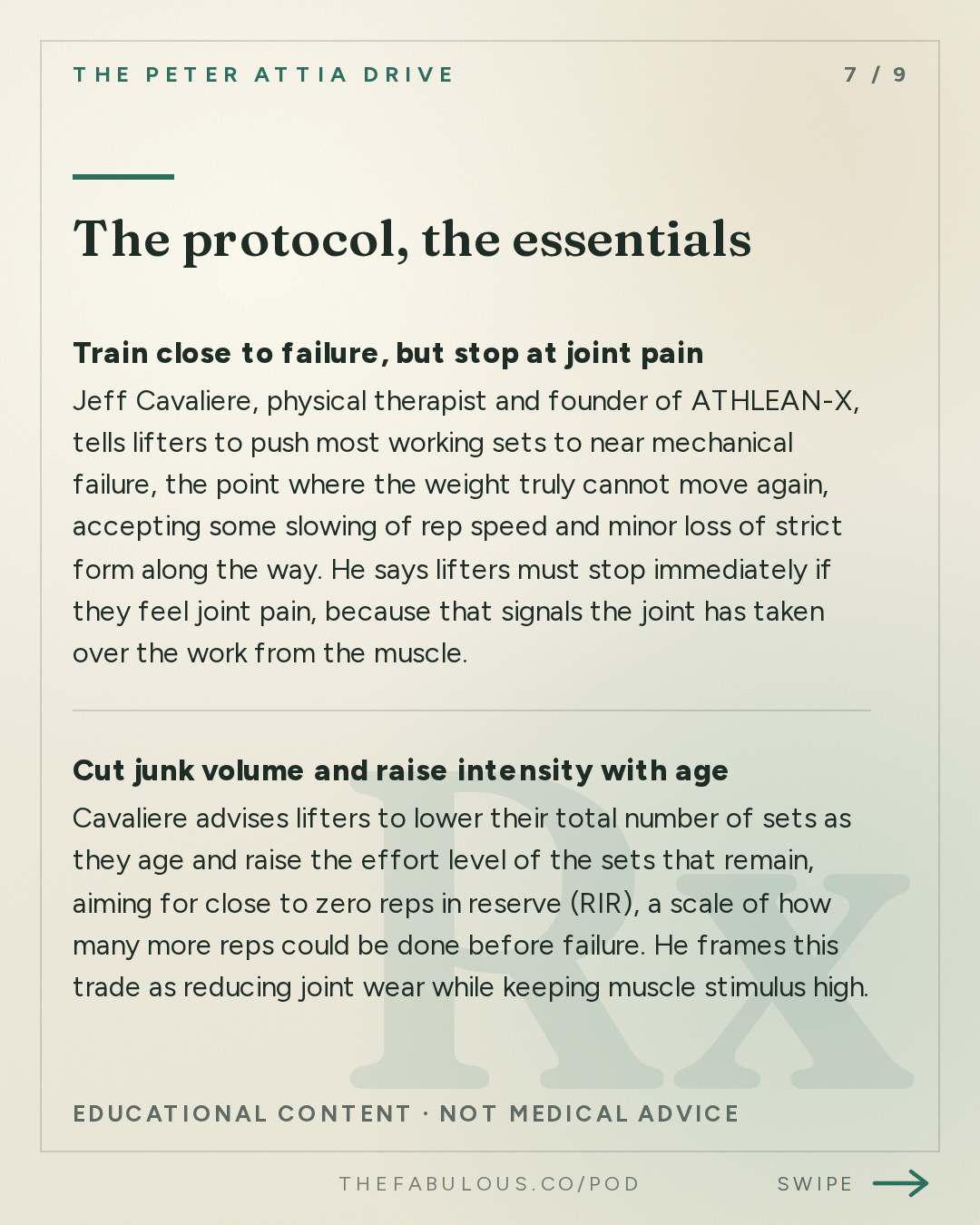
Train close to failure, but stop at joint pain
Jeff Cavaliere, physical therapist and founder of ATHLEAN-X, tells lifters to push most working sets to near mechanical failure, the point where the weight truly cannot move again, accepting some slowing of rep speed and minor loss of strict form along the way. He says lifters must stop immediately if they feel joint pain, because that signals the joint has taken over the work from the muscle.
Most working sets, each session
-
Cut junk volume and raise intensity with age
Cavaliere advises lifters to lower their total number of sets as they age and raise the effort level of the sets that remain, aiming for close to zero reps in reserve (RIR), a scale of how many more reps could be done before failure. He frames this trade as reducing joint wear while keeping muscle stimulus high.
Ongoing, adjusted as training age increases
-
Stretch the tricep's long head
Cavaliere recommends a lying barbell tricep extension as the main tricep exercise, with the arms brought back past vertical toward the ears, roughly 120 degrees from the body, to fully stretch the long head of the tricep, the only one of the three tricep heads that crosses the shoulder joint. He says this position lets the back muscles help finish the lift near failure.
As the primary compound tricep movement, each arm session
-
Pause at the bottom of every calf raise
Cavaliere instructs lifters to lower into the stretched bottom position of a calf raise and hold for 4 seconds before rising slowly, which removes the Achilles tendon's natural spring and forces the calf muscle to do the work. He recommends training calves 2 to 4 times a week, since they handle load continuously throughout the day.
2 to 4 times per week
-
Replace the upright row with a wrist-led high pull
Cavaliere advises lifters to swap the upright row for a high pull by leading the movement with the wrists instead of the elbows and keeping the elbows from rising above shoulder height. He says this avoids driving the shoulder into internal rotation under load while keeping the same trap and shoulder stimulus.
Substitute whenever training traps or shoulders
Questions this episode answers
What is junk volume in weightlifting and why should older lifters avoid it?
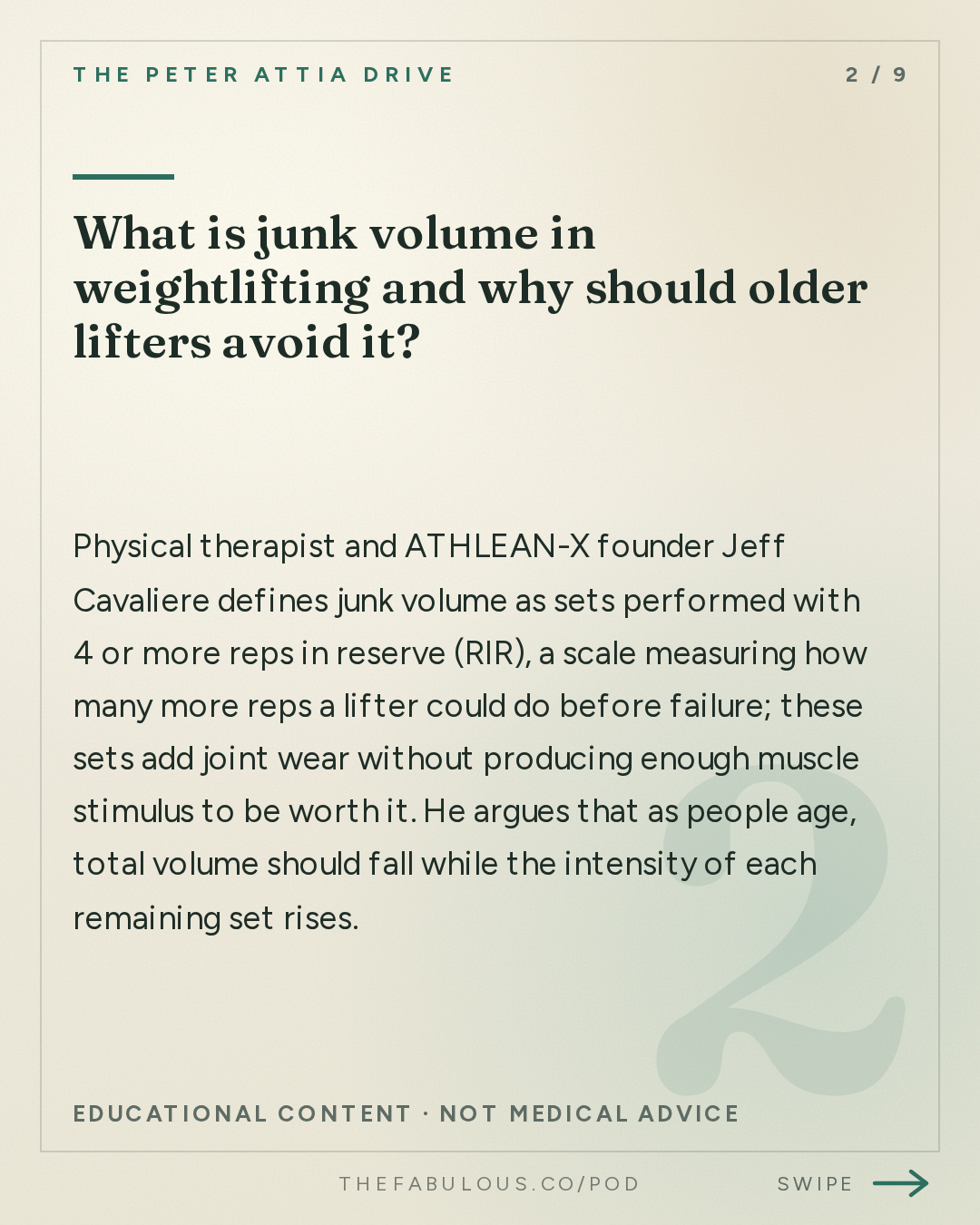
Physical therapist and ATHLEAN-X founder Jeff Cavaliere defines junk volume as sets performed with 4 or more reps in reserve (RIR), a scale measuring how many more reps a lifter could do before failure; these sets add joint wear without producing enough muscle stimulus to be worth it (37:03). He argues that as people age, total volume should fall while the intensity of each remaining set rises (36:35).
How many sets per muscle group are needed for muscle growth?
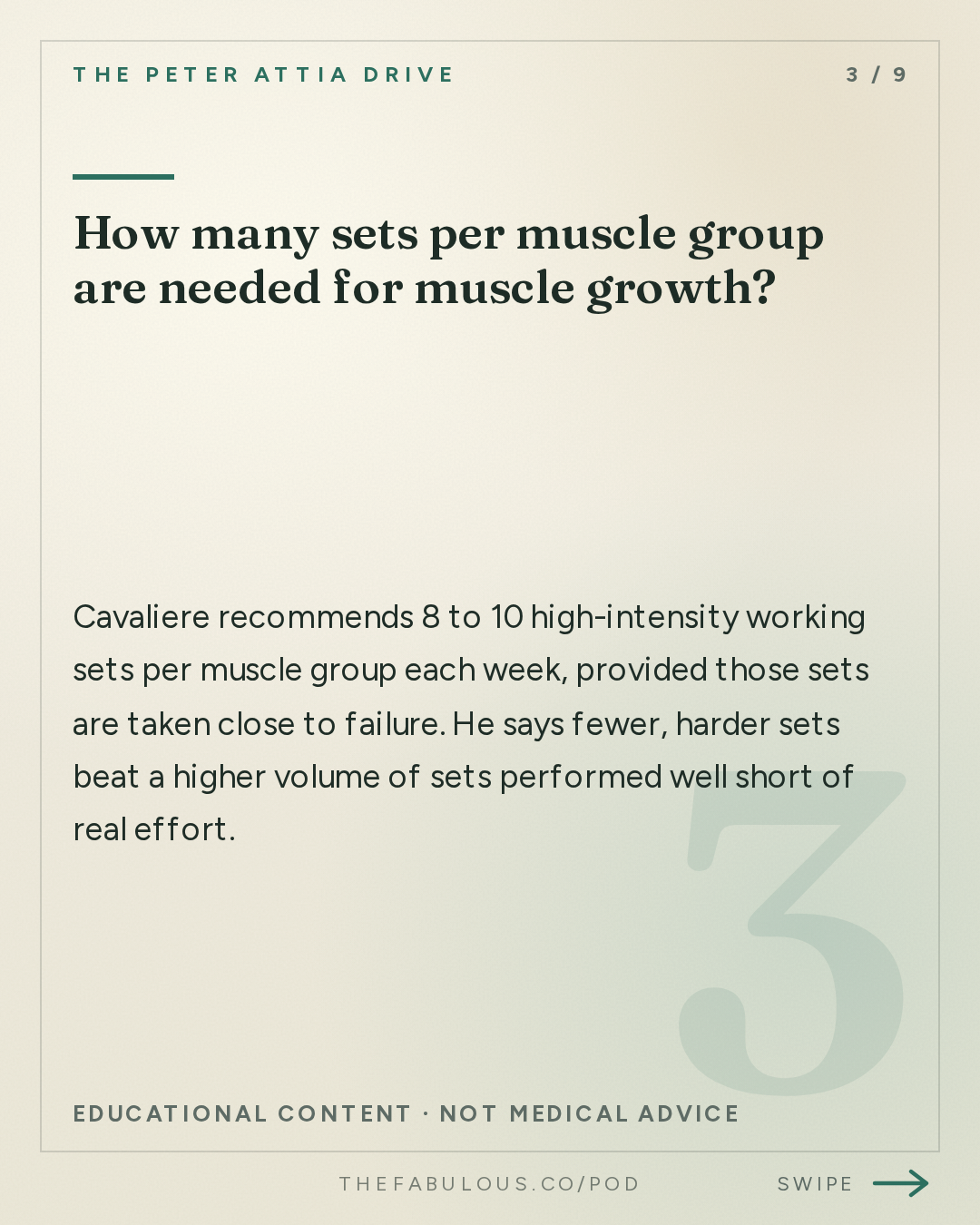
Cavaliere recommends 8 to 10 high-intensity working sets per muscle group each week, provided those sets are taken close to failure (70:36). He says fewer, harder sets beat a higher volume of sets performed well short of real effort.
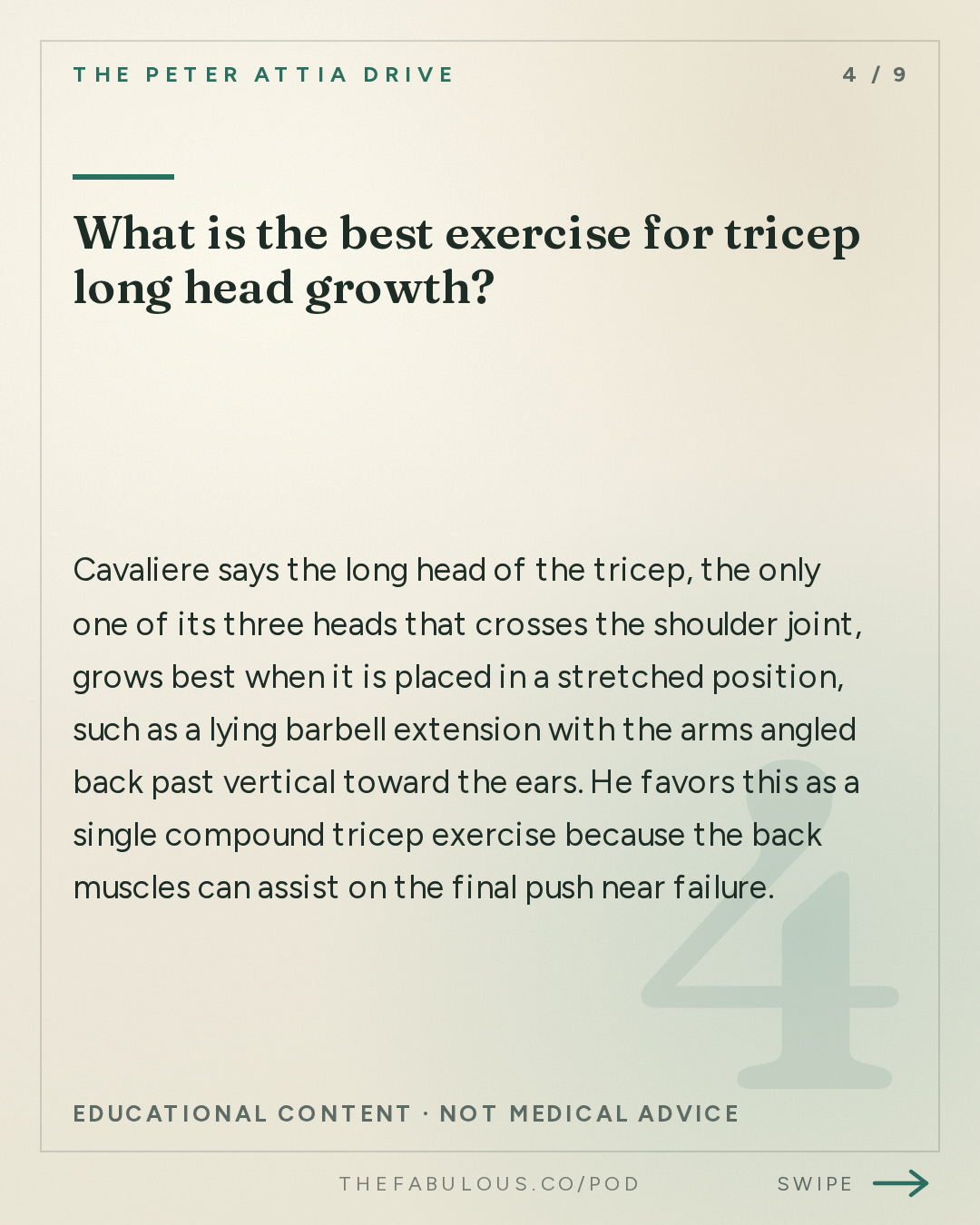
What is the best exercise for tricep long head growth?
Cavaliere says the long head of the tricep, the only one of its three heads that crosses the shoulder joint, grows best when it is placed in a stretched position, such as a lying barbell extension with the arms angled back past vertical toward the ears (73:05, 74:13). He favors this as a single compound tricep exercise because the back muscles can assist on the final push near failure.
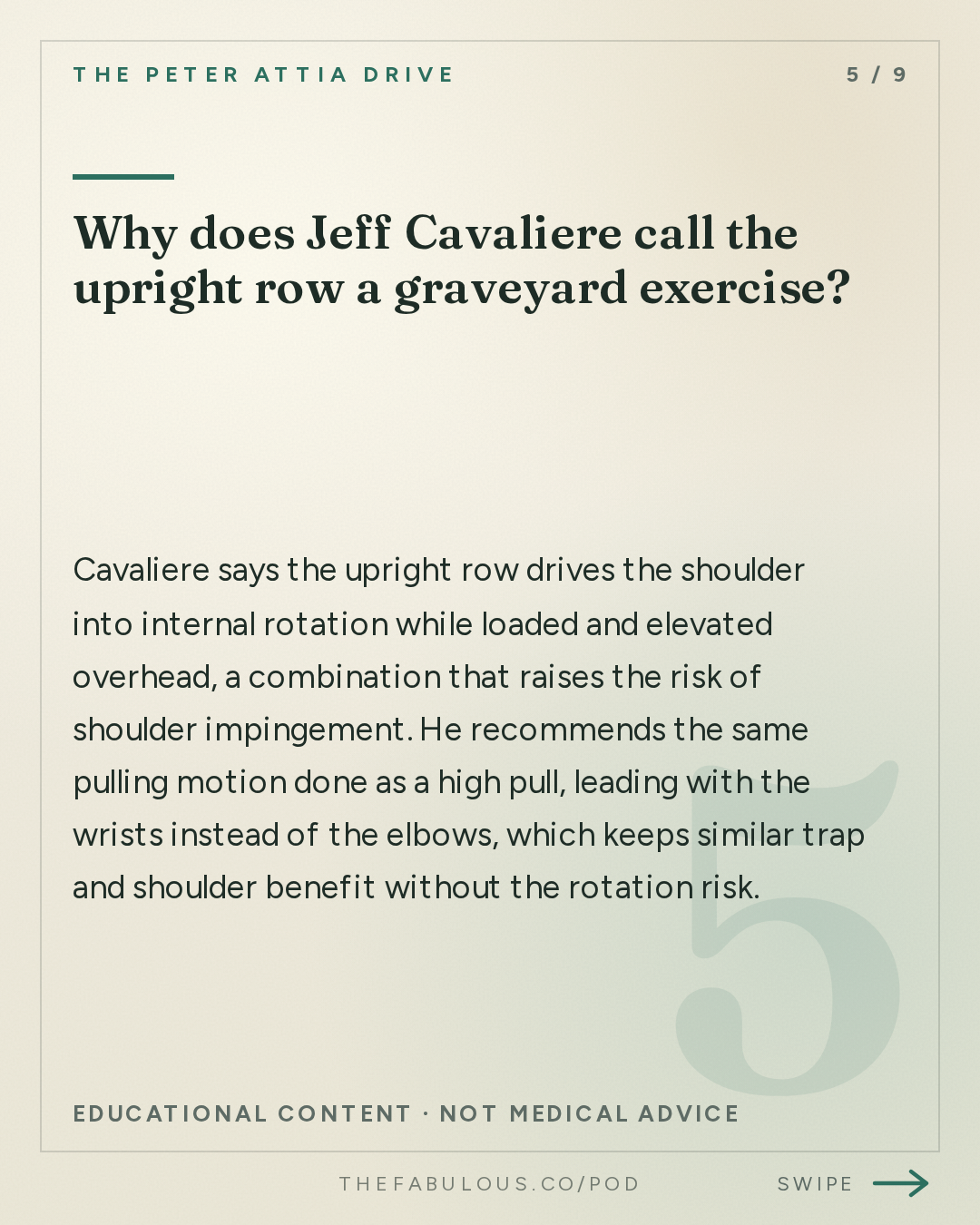
Why does Jeff Cavaliere call the upright row a graveyard exercise?
Cavaliere says the upright row drives the shoulder into internal rotation while loaded and elevated overhead, a combination that raises the risk of shoulder impingement (142:11). He recommends the same pulling motion done as a high pull, leading with the wrists instead of the elbows, which keeps similar trap and shoulder benefit without the rotation risk (142:52).
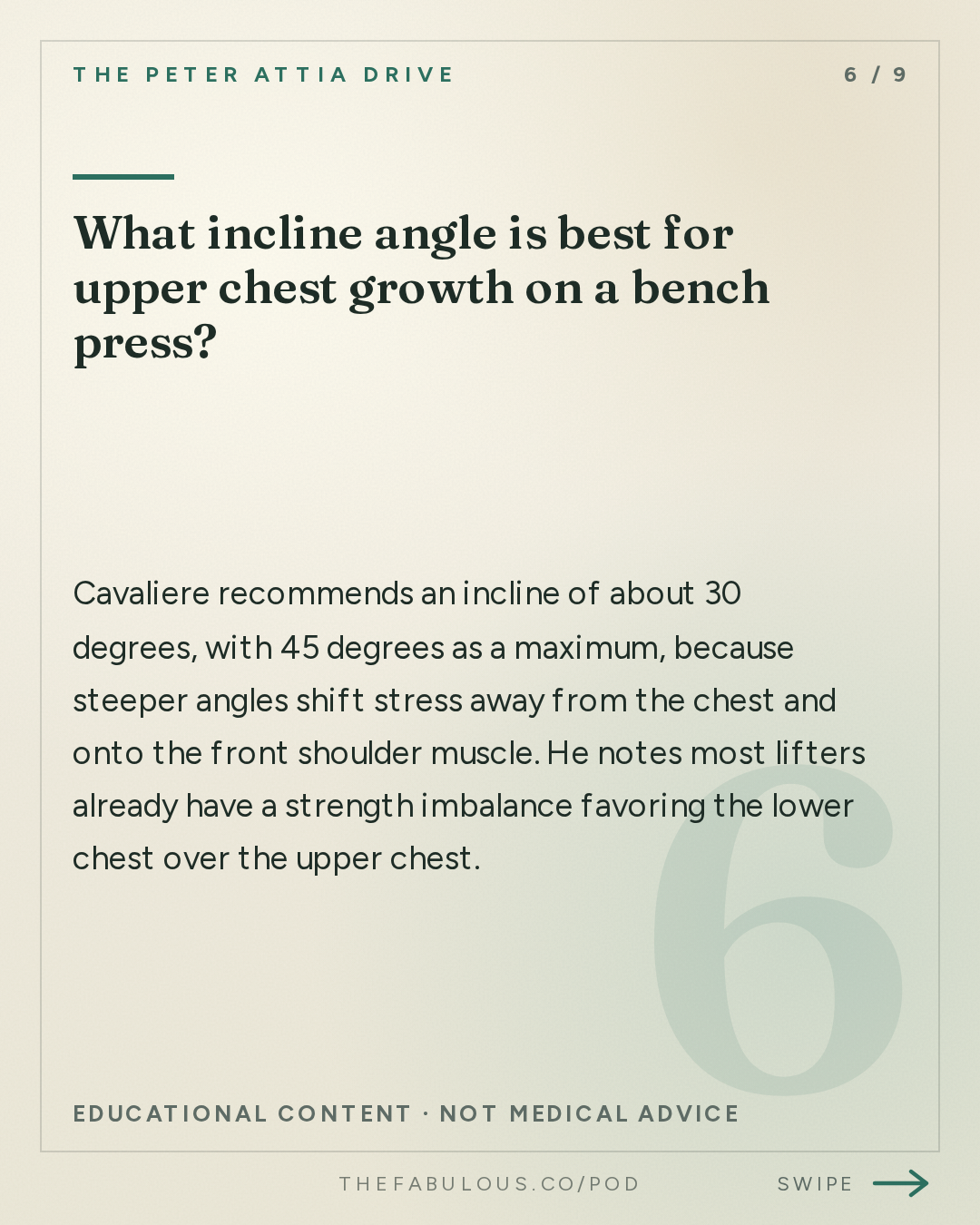
What incline angle is best for upper chest growth on a bench press?
Cavaliere recommends an incline of about 30 degrees, with 45 degrees as a maximum, because steeper angles shift stress away from the chest and onto the front shoulder muscle (101:50). He notes most lifters already have a strength imbalance favoring the lower chest over the upper chest.
How should calf training change to actually build muscle?
Cavaliere advises pausing for 4 seconds at the bottom of a calf raise before rising slowly, which removes the Achilles tendon's natural elastic spring and forces the calf muscle itself to do the work (137:59). He also recommends training calves 2 to 4 times a week rather than once, since they handle load continuously throughout the day (140:44).
The full read, in cards
Mentioned
Jeff Cavaliere · ATHLEAN-X · New York Mets · Tom Brady · Bo Jackson · Dorian Yates · Lee Haney · Voltra
More from this show and category
Lisa Feldman Barrett's Predictive Brain Theory
Neuroscientist Lisa Feldman Barrett says the brain predicts, not reacts, building emotion from memory and the body's needs. She shows there are no objective biomarkers for specific emotions, and that averages in group studies mask the real variation between individuals. Her framework reframes stress as a metabolic prediction and suggests practiced skills, like awe, can build control over emotional response.
Siddhartha Mukherjee on Cancer's New Science
Oncologist Siddhartha Mukherjee tells Peter Attia that cancer's old "bad luck" story is being replaced by a more precise one: inflammation acts as the trigger that wakes dormant, mutation-carrying "sleeper cells" into tumors, which reframes prevention, treatment, and how we think about aging itself.
Why Peter Attia Changed His Mind on Keto
Peter Attia now says keto works by curbing energy intake, not lowering insulin, while he still requires 1.4 g/kg of protein (09:42, 11:44). He also walks back his extended fasting protocol, once seven to ten days quarterly, after weighing autophagy evidence against the practical cost (12:36, 15:09).
Preeclampsia and Long-Term Heart Risk Explained
Pregnancy stresses the heart, kidneys, and metabolism so hard that its complications predict a woman's cardiovascular and diabetes risk decades later. Maternal-fetal medicine specialist Kathryn Gray explains how plasma volume surges 50%, how preeclampsia's placental biology works, and why half of gestational diabetes cases become type 2 diabetes.
