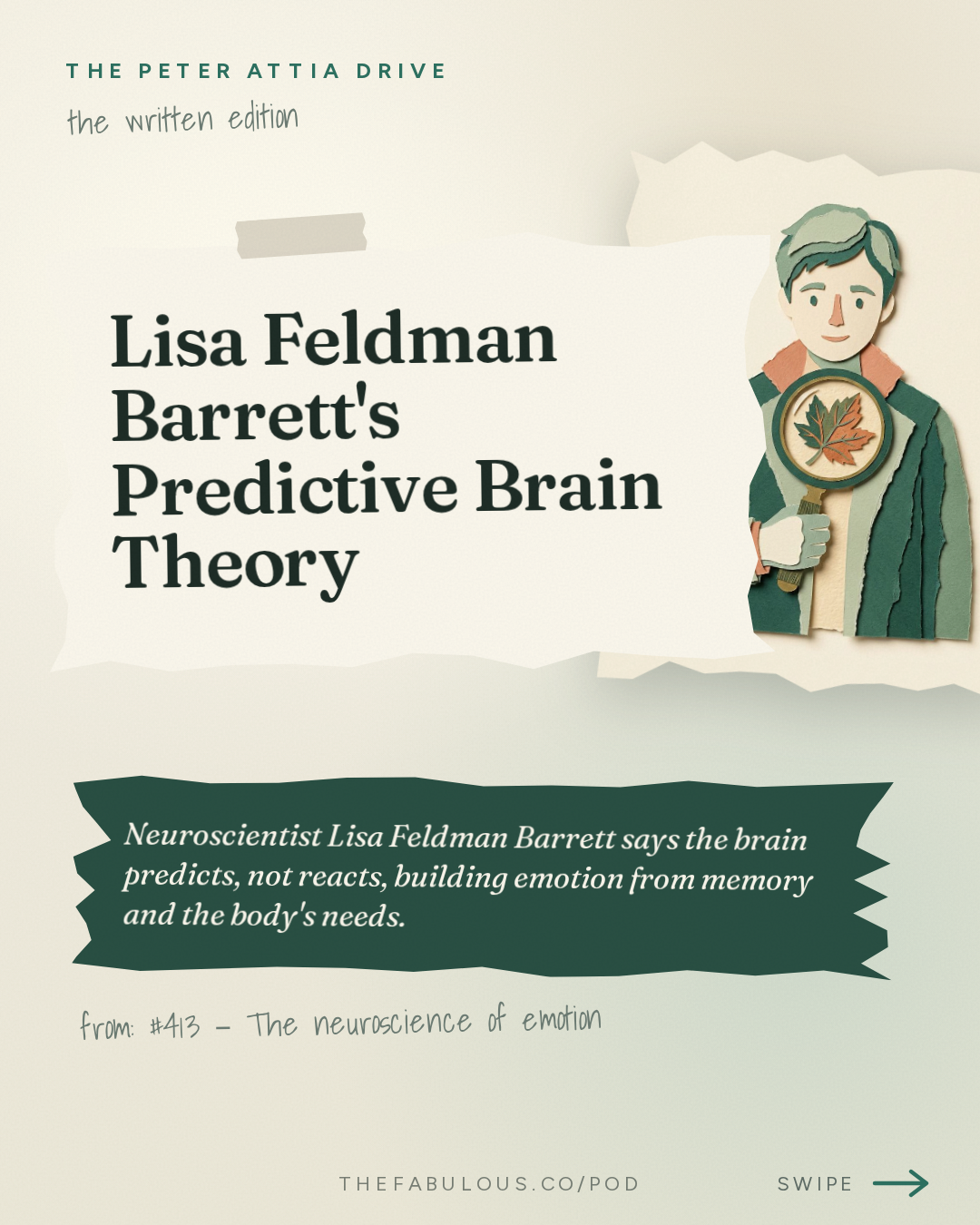
Lisa Feldman Barrett's Predictive Brain Theory
#413 ‒ The neuroscience of emotion: challenging conventional theories of emotion, how the brain predicts and constructs our experiences, and gaining greater control over how we feel | Lisa Feldman Barrett, Ph.D.
▶ Listen to the full episode More from The Peter Attia Drive
The brief
Neuroscientist Lisa Feldman Barrett says the brain predicts, not reacts, building emotion from memory and the body's needs. She shows there are no objective biomarkers for specific emotions, and that averages in group studies mask the real variation between individuals. Her framework reframes stress as a metabolic prediction and suggests practiced skills, like awe, can build control over emotional response.
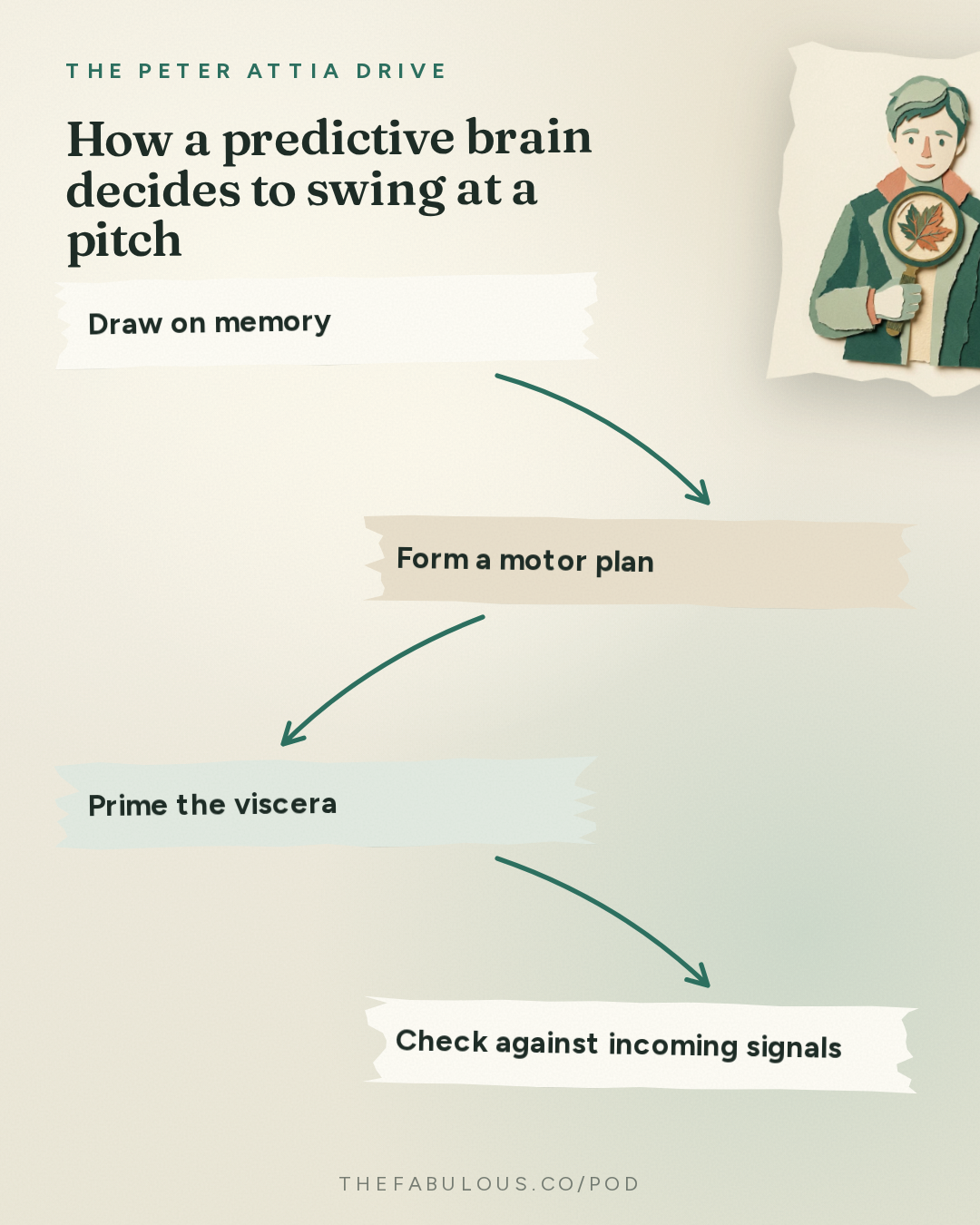
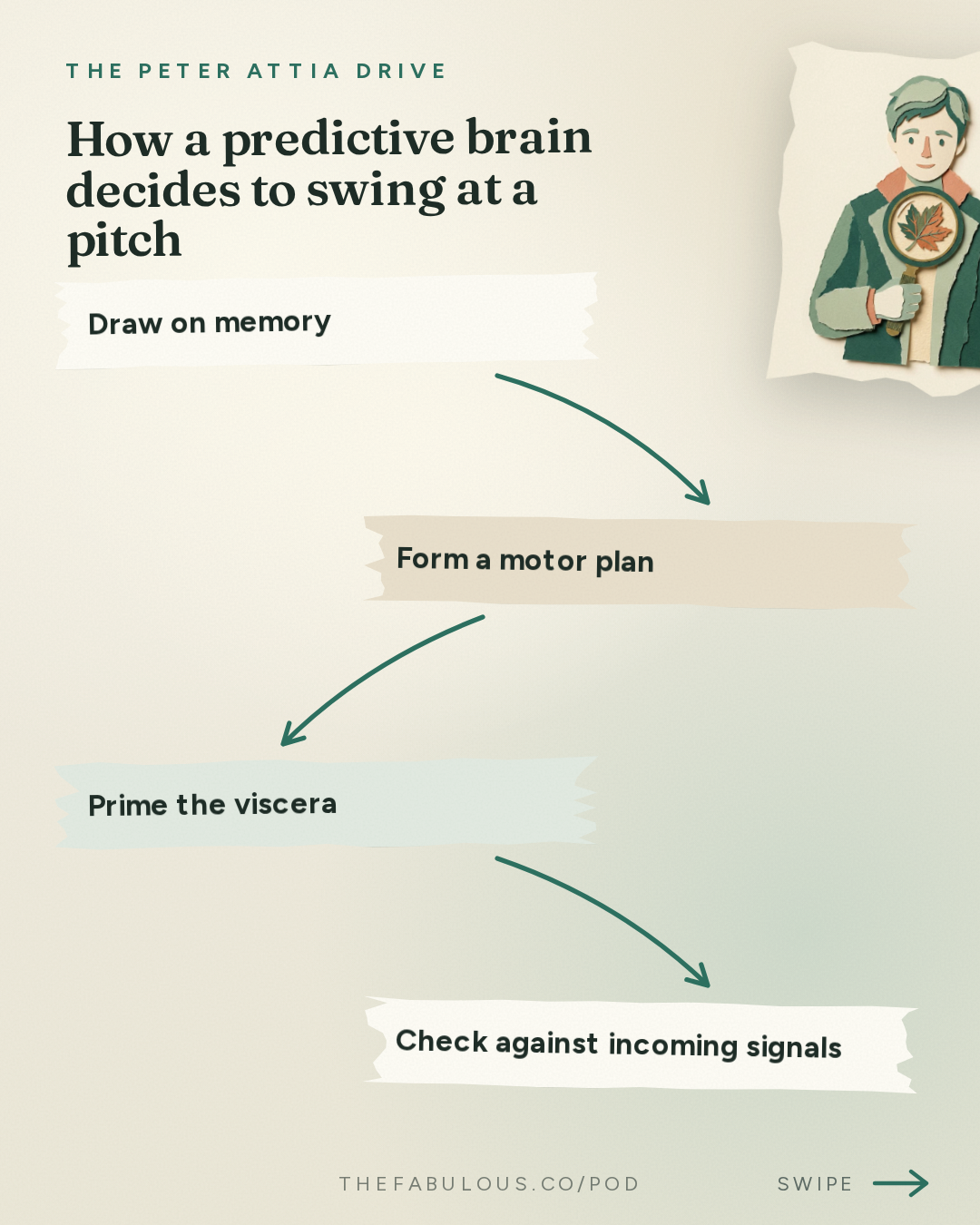
A Major League fastball crosses home plate in under half a second. A batter who waits to see the ball cannot possibly swing in time (92:03). And yet hitters connect, night after night. The reason, says psychologist and neuroscientist Lisa Feldman Barrett, is that the batter's brain is not reacting to the pitch at all. It is predicting where the ball will be, based on the pitcher's tendencies, the temperature, the wind, how much he ate and how much sleep he got, and that is where he swings (92:29). For Barrett, a university distinguished professor at Northeastern University who also holds appointments at Massachusetts General Hospital and Harvard Medical School, that small, strange fact about baseball is a window into how every brain works, and it is the foundation of a theory that upends what most people assume about feelings.
Barrett did not set out to overturn a field. In graduate school she was training to be a clinical psychologist and needed to measure emotion for an unrelated study, so she did what researchers usually do: she asked people how they felt, using standard scales for anxiety and depression. Over three years, trying to replicate a published effect about the self, she failed eight separate times (05:21). Her first instinct was that she was not cut out for research. Then she looked closer. She was not replicating the published work, but she was replicating herself, over and over.
"Usually in graduate school, what you do is you take a published research study... and you try to replicate it just so that you can show that you know how to do an experiment." — Lisa Feldman Barrett [04:51]
That mismatch sent her digging into a question that, by her account, the field of emotion research had been quietly dodging for a century: can you actually measure an emotion objectively, from the outside, without asking someone how they feel? Her answer, built over two decades and fieldwork with groups including Namibia's Himba and Tanzania's Hadza hunter-gatherers (43:07), is no.
The Myth of the Fingerprint Emotion
The common assumption, Barrett says, is that anger, fear, and sadness are hardwired circuits that produce the same signature every time: a scowl for anger, a spike in amygdala activity for fear. The data don't cooperate. Meta-analyses of thousands of people show adults in Western, urban settings scowl only about 35 percent of the time when they are angry (16:25). That means scowling is wrong more than it's right as a marker of anger, and the amygdala, a brain structure long tied to fear, shows increased activity during fear episodes only about 30 percent of the time (17:07). "There are no actually objective measures," Barrett says of emotion, a claim she says took her roughly twenty years and three rounds of retraining, in facial coding, physiology, and neuroscience, to feel confident making (37:45).
Part of the problem, she argues, is how science handles variation. Researchers typically average across large groups and treat the leftover differences as noise to be minimized. But an average is a statistical description of a crowd, not a prediction about any one person in it.
"Averages or statistical summaries hide meaningful variance that is important in everyday life." — Lisa Feldman Barrett [33:47]
She makes the point concrete with her own body. Diagnosed with Hashimoto's disease, an autoimmune condition that destroys the thyroid, she was told by her endocrinologist to simply wait for her thyroid to fail before starting replacement hormone. Instead she found small studies suggesting low-dose levothyroxine could arrest the damage in some patients, even though no large trial proved it worked for everyone. She tried it. The nodules in her thyroid shrank. It did not prove anything universally, she's careful to note, but it illustrated her larger argument: when you flatten variation into an average, you can miss the exact pattern that applies to the person in front of you.
The same logic applies to infectious disease, her favorite non-emotion example. In a cluster of controlled studies, researchers gave people in isolated hotel rooms an identical dose of a cold virus and tracked everything about their sleep, diet, and physiology. Only 20 to 40 percent of participants developed symptoms (26:57). A virus is necessary to get sick, but it is not sufficient. The same complexity, Barrett says, runs through emotion: there is no single trigger, only a tangle of contributing factors that a simple biomarker can't capture.
Stress as a Prediction, Not a Reaction
If emotion isn't a fixed circuit lighting up in response to the world, what is the brain actually doing? Barrett's answer starts with a claim about the brain's real job: it isn't primarily there to think. It's there to run the body.
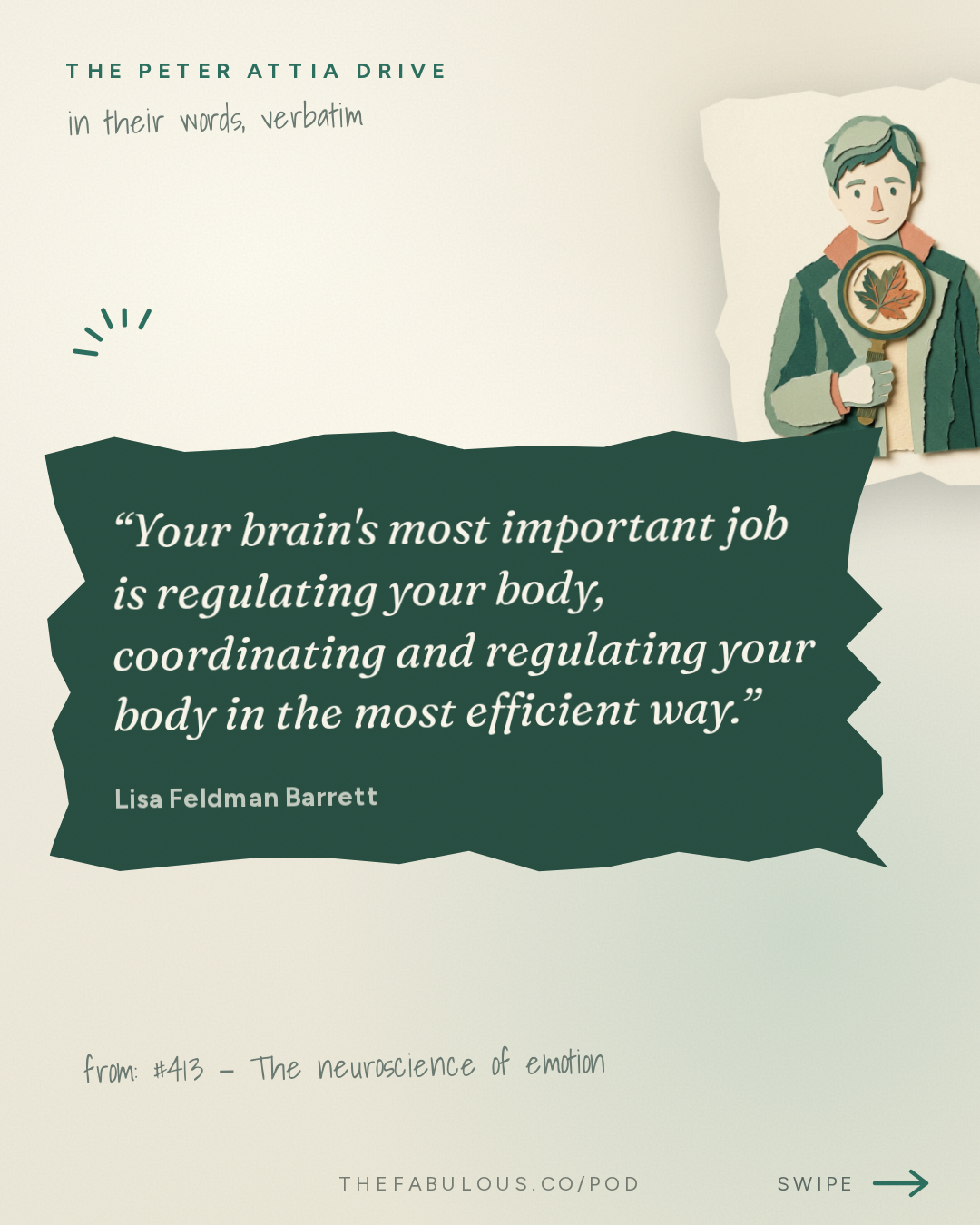
"Your brain's most important job is regulating your body, coordinating and regulating your body in the most efficient way." — Lisa Feldman Barrett [51:23]
The evidence for this shows up in brain wiring itself. Primary visual cortex, the part of the brain named for processing sight, gets only a small fraction of its synapses from the eyes by way of the thalamus. Ninety-five percent of its synapses arrive from other parts of the brain (80:01). In other words, most of what visual cortex is doing isn't receiving images from the world, it's broadcasting predictions about what it expects to see, built from memory. In one striking experiment, researchers destroyed the retinas of mice so no light could reach the brain. Visual cortex activity dropped for 24 hours, then returned to normal levels, now driven by movement signals rather than light (81:50).
This predictive wiring, Barrett says, explains why the brain often doesn't react so much as confirm or correct itself.
"You don't react to shit in the world. Stuff in the world is there to confirm your predictions or correct them, not to react for the most part." — Lisa Feldman Barrett [90:38]
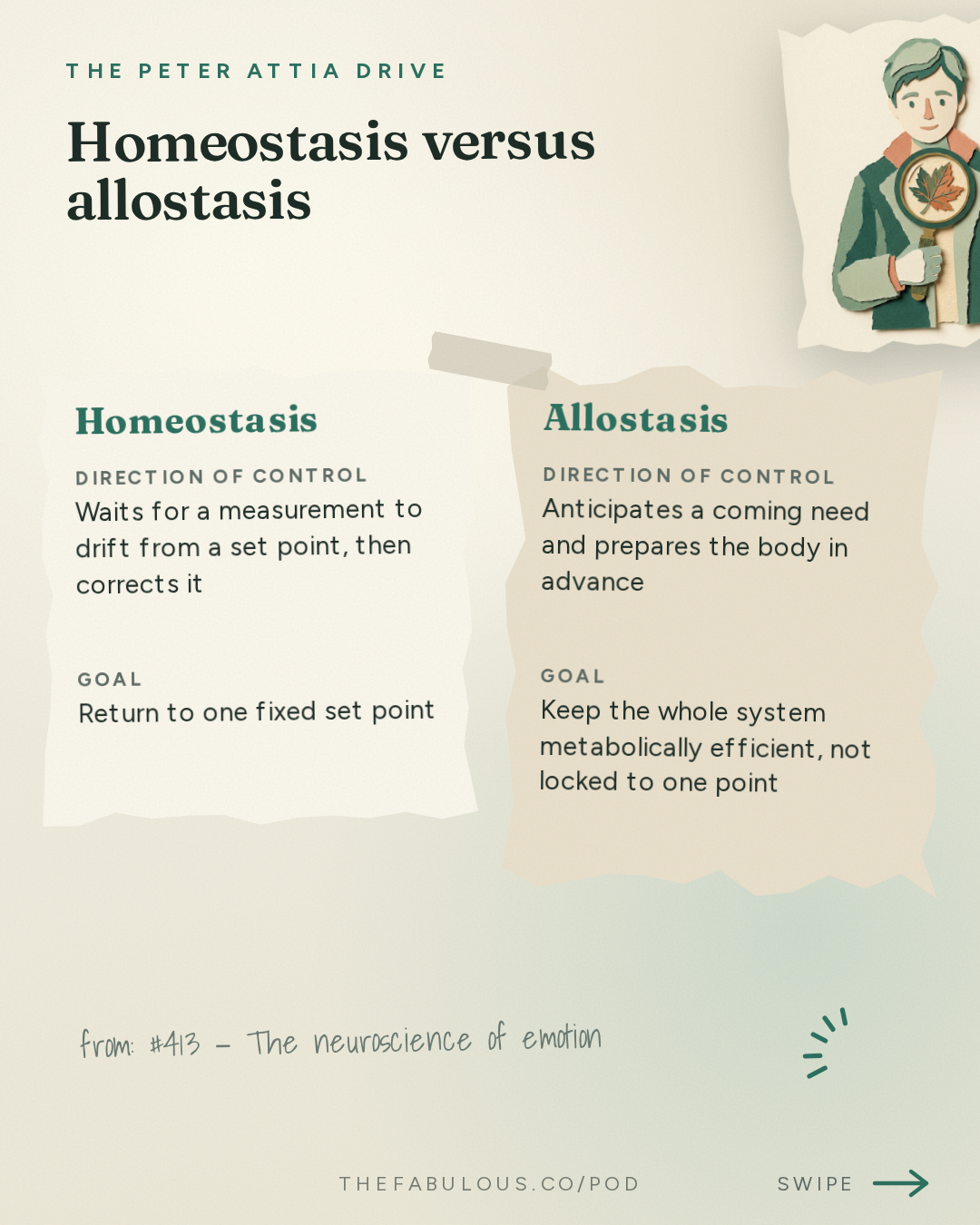
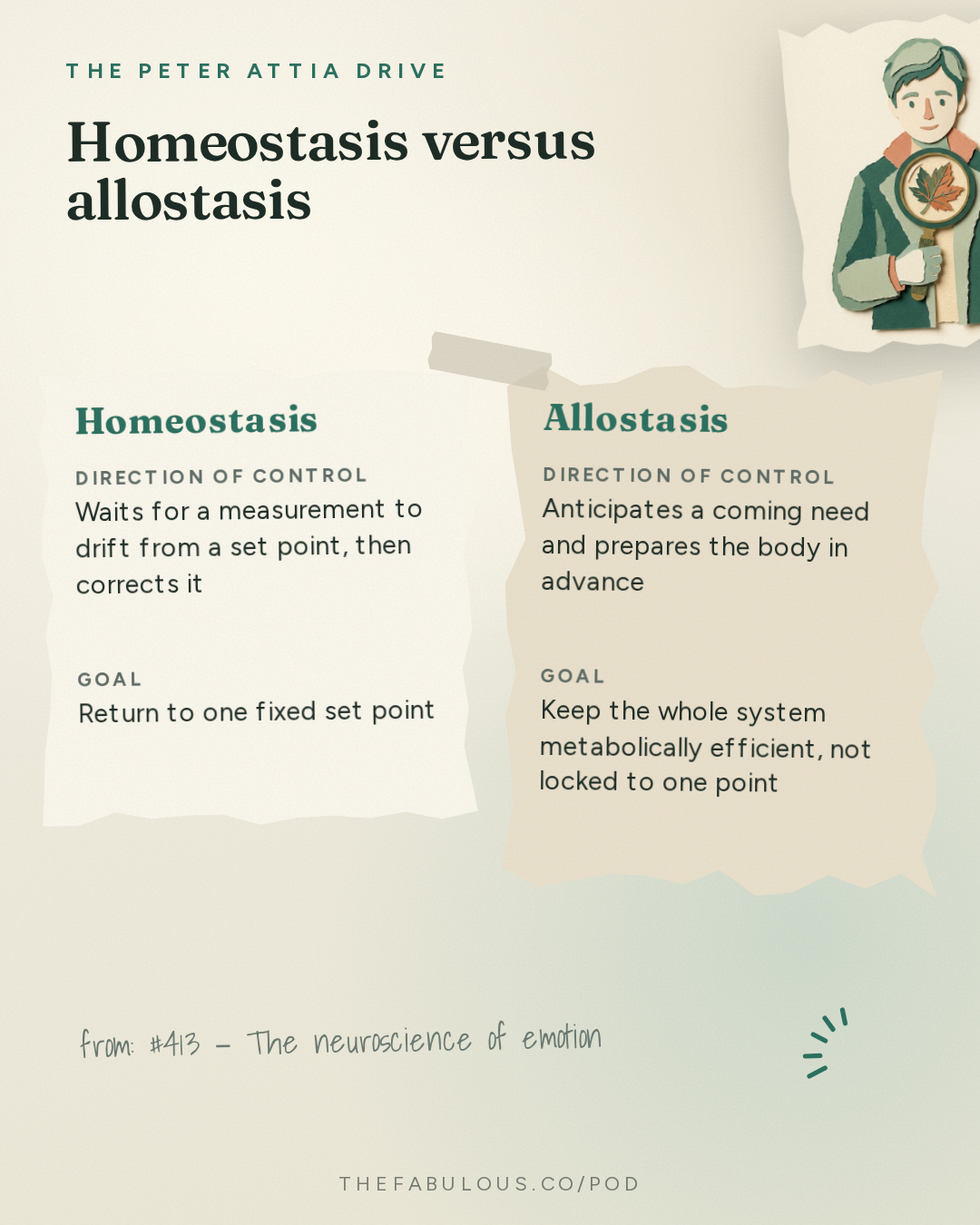
It also reframes stress. Barrett draws a sharp line between homeostasis, the reactive process of noticing the body has drifted from a set point and correcting it, and allostasis, a term coined by physiologist Peter Sterling that describes the brain anticipating a metabolic need and preparing the body before it arises (113:28, 115:16). Cortisol, often called a stress hormone, is really a glucocorticoid involved in glucose metabolism; the surge that gets a person out of bed in the morning exists because the brain is predicting an energy cost that hasn't happened yet (112:16). Chronic stress, in this framework, is less a storm of fight-or-flight circuits (which, Barrett notes, don't actually exist as discrete brain structures) and more a long-running metabolic deficit: a body that keeps spending more than it replenishes, whether from trauma, uncertainty, or just the accumulated cost of modern life, news feeds included (123:28).
Barrett also stresses that nobody manages this budget alone. Brains co-regulate each other, most dramatically between parents and infants but really throughout life.
"The best thing for your nervous system, Peter, is another human, and the worst thing for your nervous system is also another human." — Lisa Feldman Barrett [118:19]
Losing someone, in this light, isn't only an emotional event. It's the literal loss of a regulatory partner, someone whose presence used to lower the metabolic cost of daily life (142:52). It's why Barrett frames grief recovery not as finding grand meaning in a death but as practical, physiological repair: people who recall specific, positive memories of time spent with the person they lost tend to recover faster from acute grief, often within a year or two, according to research by psychologist George Bonanno (145:09).
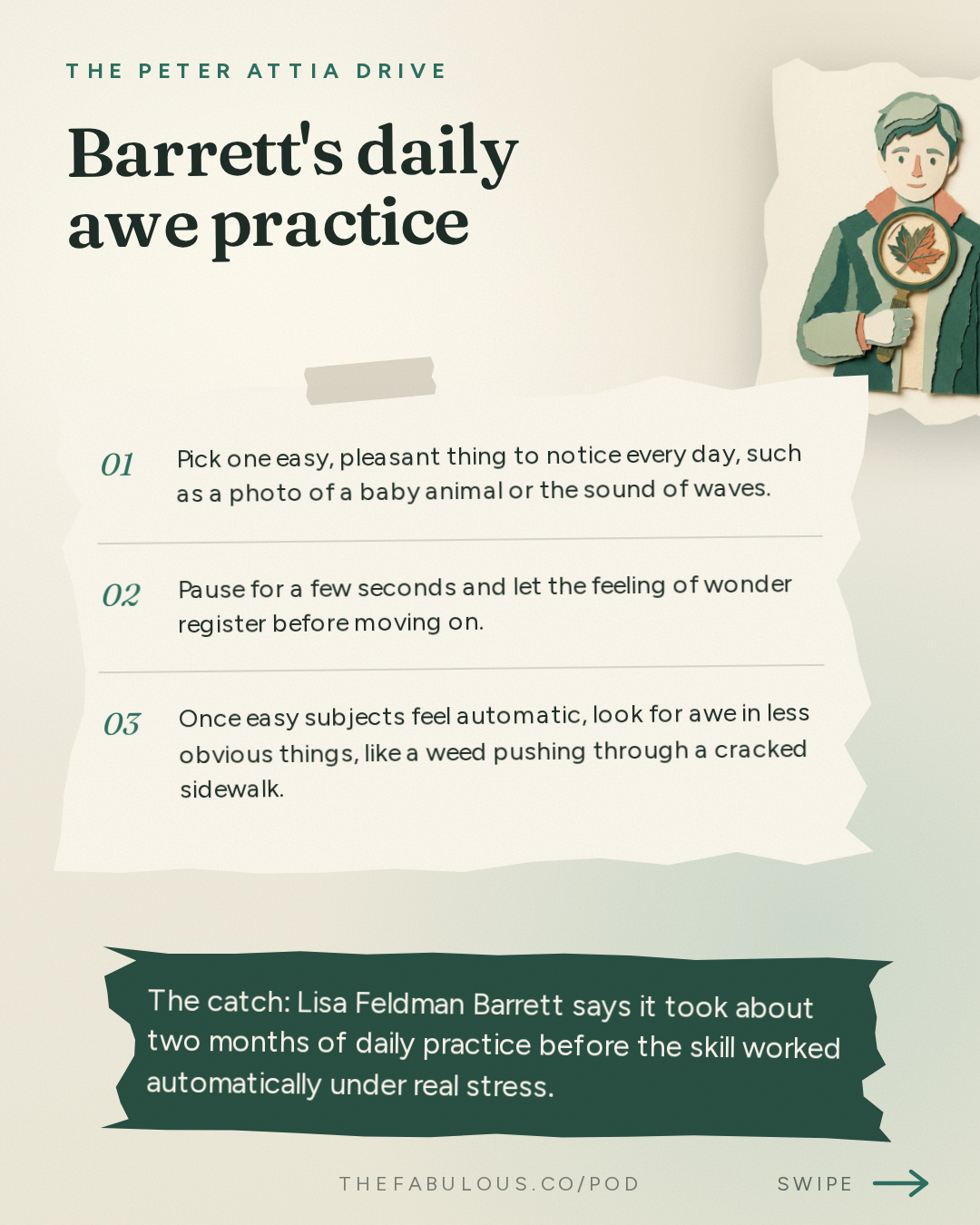
None of this, Barrett insists, means people are powerless. She describes training herself, skeptically at first, to notice small moments of awe each day: a billboard photo of a baby orangutan, the sound of waves, eventually even a weed pushing through a cracked sidewalk (134:13, 134:42). After about two months of daily practice, she could call on that same skill in genuinely stressful moments, a frozen laptop before an important call, a sleep-deprived morning with a cranky child (135:19, 137:07). The point isn't positivity as decoration. It's that emotional control, like a swing or a golf stroke, has to be built through repetition before it's available under pressure.
That circles back to memory, which Barrett says is not a filing cabinet but a live reconstruction.
"Memories are not like files in a file drawer. They are not veridical." — Lisa Feldman Barrett [150:56]
Every prediction the brain makes, about a pitch, a stranger's scowl, a missing loved one, is built from fragments of the past reassembled for the present moment. That is a less tidy story than the one most people grew up with, in which fear, anger, and joy sit in the brain like switches waiting to be flipped. But it's a more useful one. If emotions are built rather than triggered, then the materials, memory, attention, practiced movement, are things a person can actually work with.
Ask this episode anything
Pod's AI answers from the episode itself, with the minute mark so you can hear it yourself.
Or start with one of these
Ask this episode
Pod's AI listens to the whole episode to answer, and points you to the minute it comes from.
The rest of this answer, and any question after it
Answers come from the episode itself, never from a summary of it.
ContinueKey takeaways
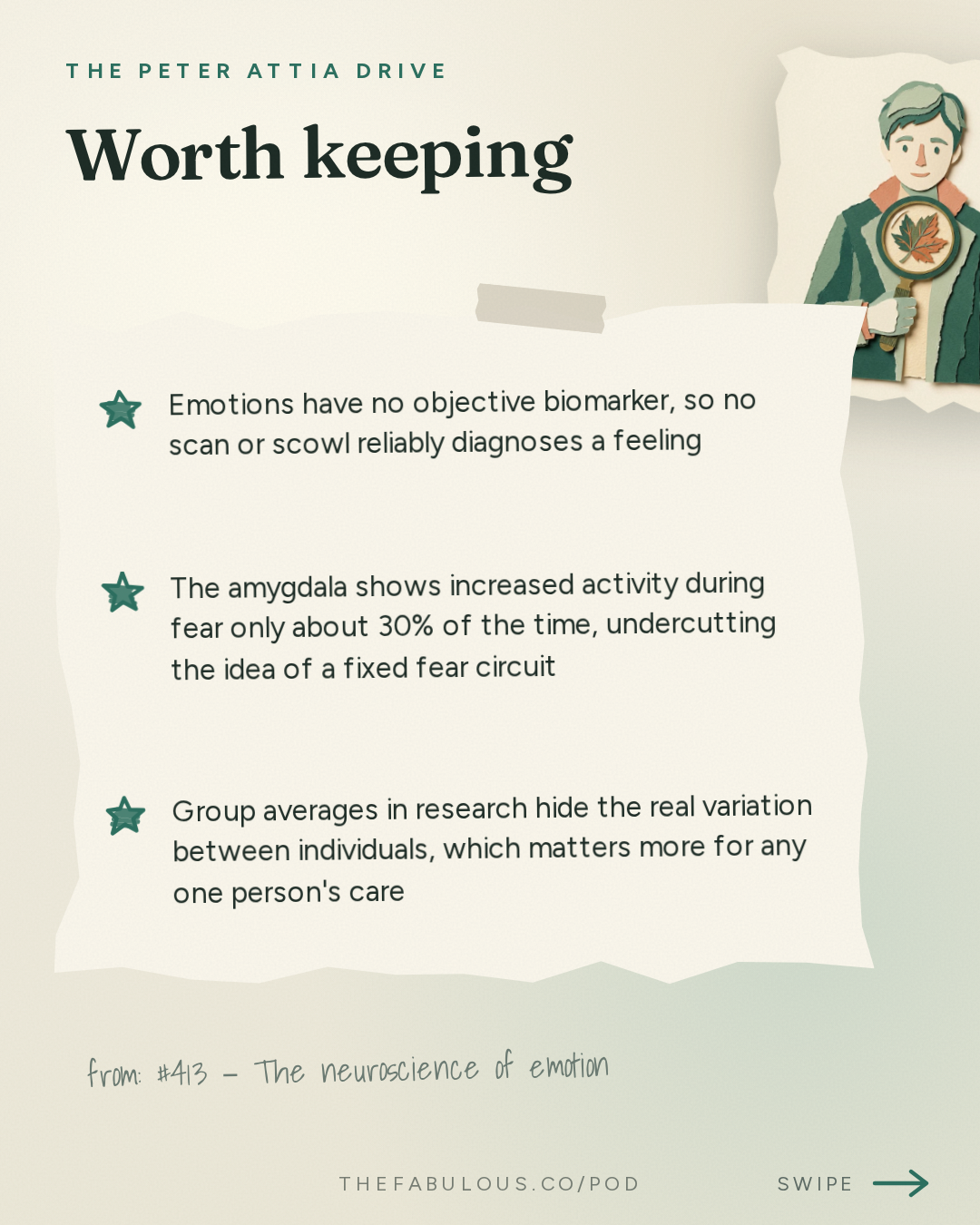
- Emotions have no objective biomarker, so no scan or scowl reliably diagnoses a feeling
- The amygdala shows increased activity during fear only about 30% of the time, undercutting the idea of a fixed fear circuit
- Group averages in research hide the real variation between individuals, which matters more for any one person's care
- Allostasis means the brain prepares the body for a need before it arises, unlike reactive homeostasis which corrects after the fact
- Daily awe practice took Lisa Feldman Barrett about two months to turn into an automatic tool for real stressful moments
The episode in cards

By the numbers
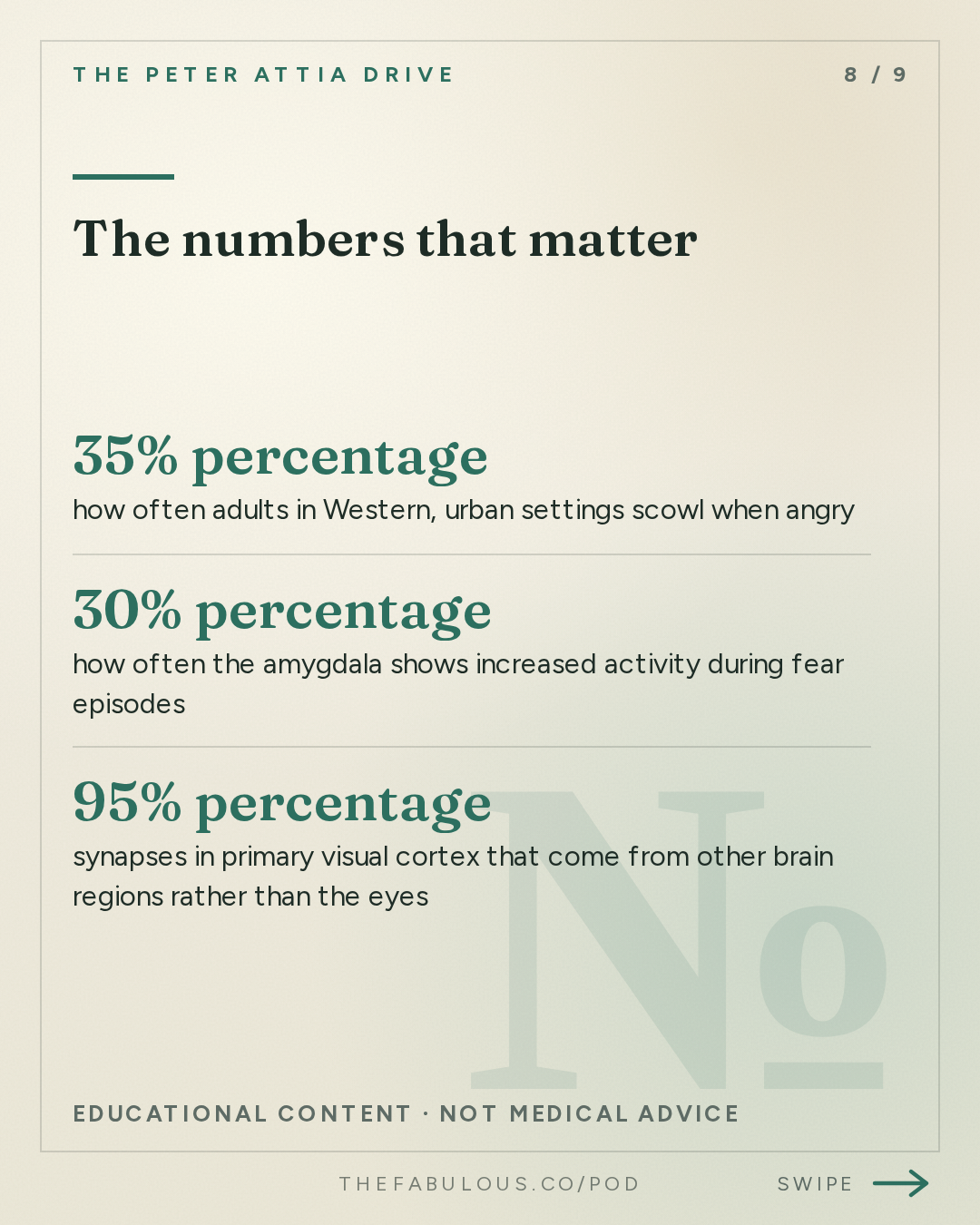
- 35% percentage how often adults in Western, urban settings scowl when angry
- 30% percentage how often the amygdala shows increased activity during fear episodes
- 95% percentage synapses in primary visual cortex that come from other brain regions rather than the eyes
In their words
“Your brain's most important job is regulating your body, coordinating and regulating your body in the most efficient way.”
“You don't react to shit in the world. Stuff in the world is there to confirm your predictions or correct them, n- not to react for the most part.”
“Homeostasis is reactive. Allostasis is predictive.”
“The best thing for your nervous system, Peter, is another human, and the worst thing for your nervous system is also another human.”
Protocols
-
Build an awe practice to gain emotional control
Lisa Feldman Barrett starts by picking one easy, pleasant thing to notice each day, such as a billboard photo of a baby animal or the sound of waves, and pausing a few seconds to let herself feel wonder at it. Once that feels automatic, she moves to less obvious subjects, like a weed growing out of a cracked sidewalk, and eventually applies the same skill in genuinely stressful moments, such as a frozen laptop before an important call. She cautions that this kind of control looks different than expected and takes real practice to show up when it is actually needed.
Daily, for about two months before it becomes usable under stress
-
Use opposite action to break a stress-driven isolation habit
Peter Attia reports that his default response to being upset is to isolate from everyone, including his family, so he forces himself to do the opposite: get up and go play soccer or baseball with his son instead of withdrawing. Lisa Feldman Barrett explains the mechanism behind why this works: every thought and feeling follows from a motor plan, so changing the movement first changes the feeling rather than the other way around.
As needed, in moments of acute stress
Questions this episode answers
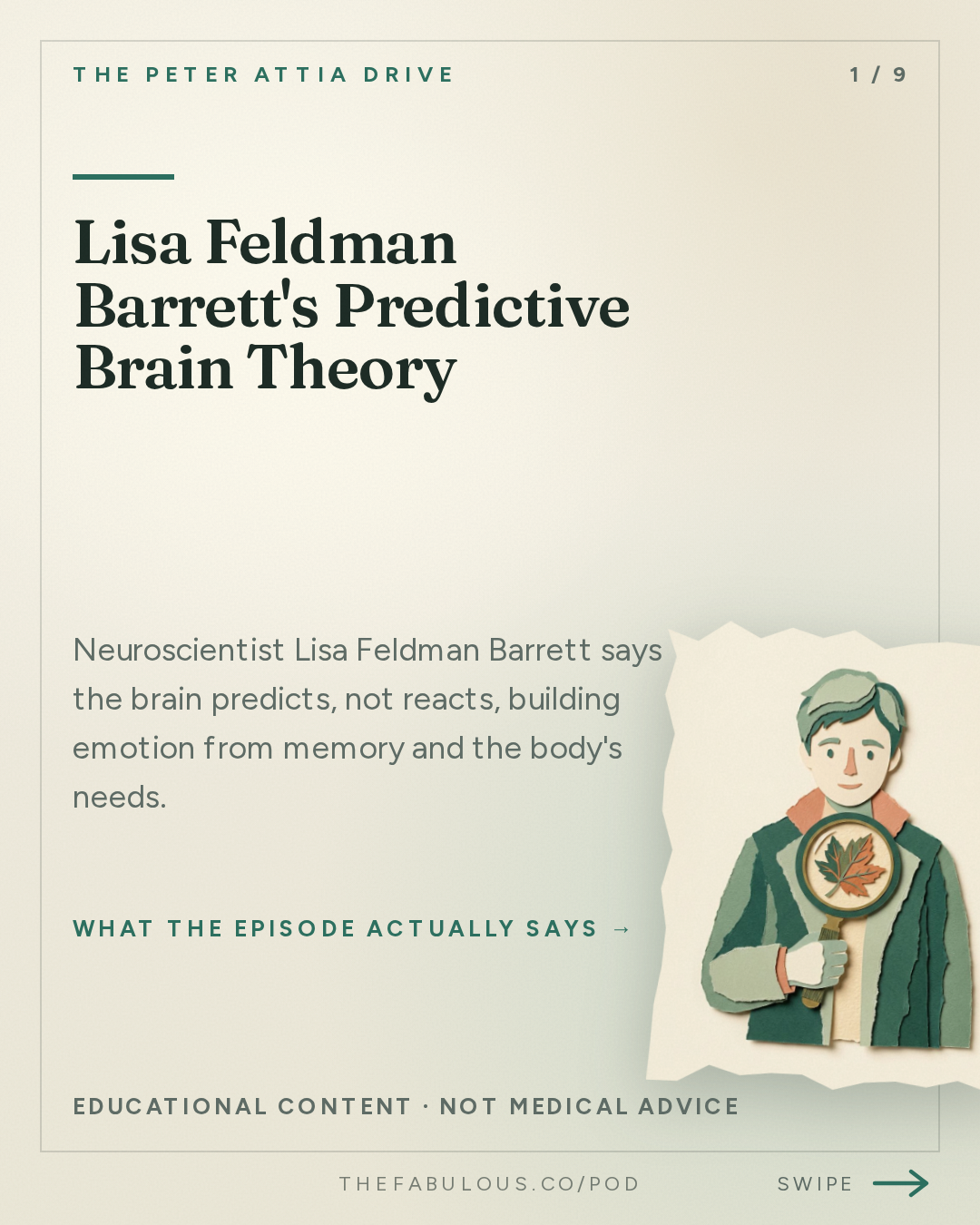
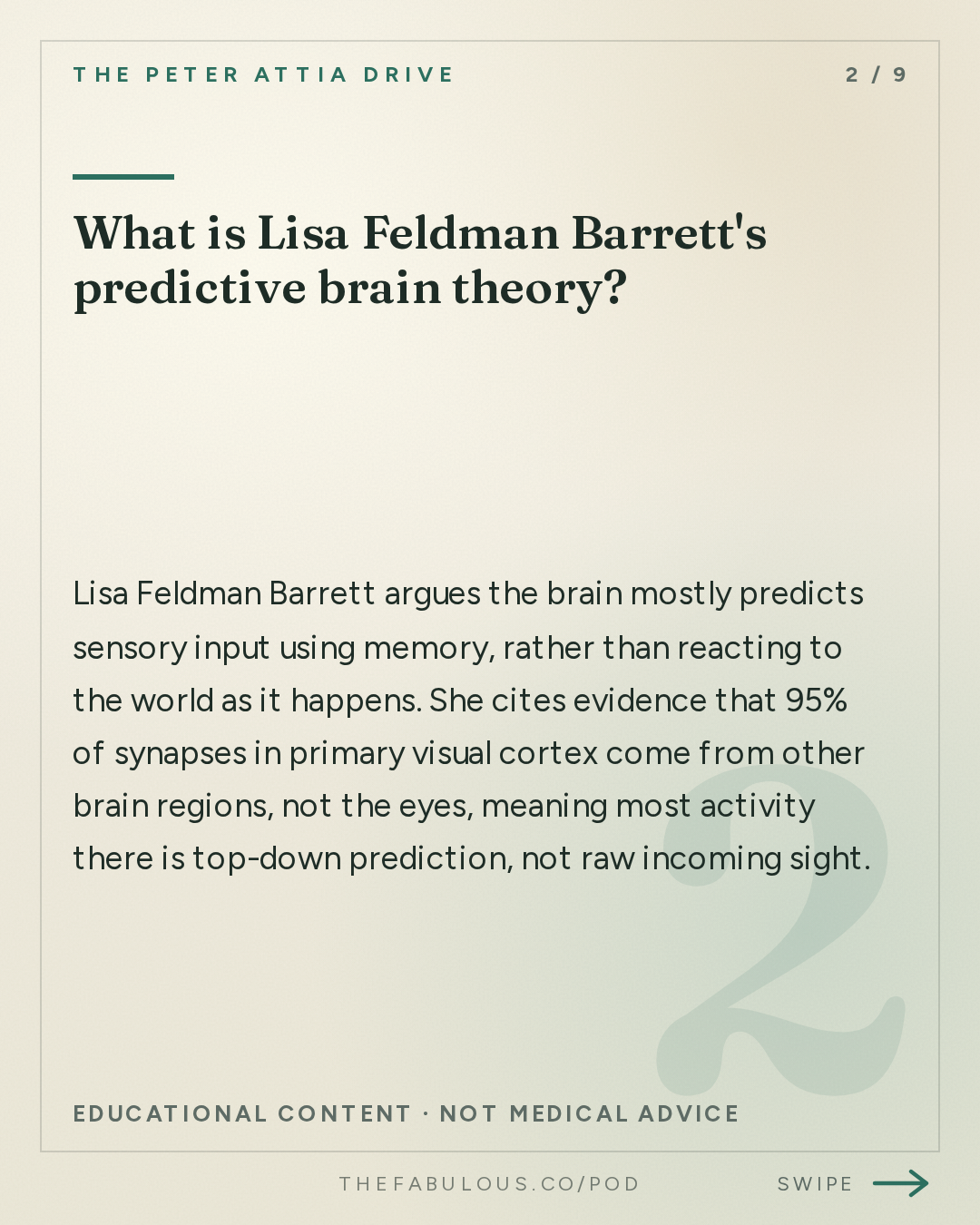
What is Lisa Feldman Barrett's predictive brain theory?
Lisa Feldman Barrett argues the brain mostly predicts sensory input using memory, rather than reacting to the world as it happens. She cites evidence that 95% of synapses in primary visual cortex come from other brain regions, not the eyes, meaning most activity there is top-down prediction, not raw incoming sight (80:01).
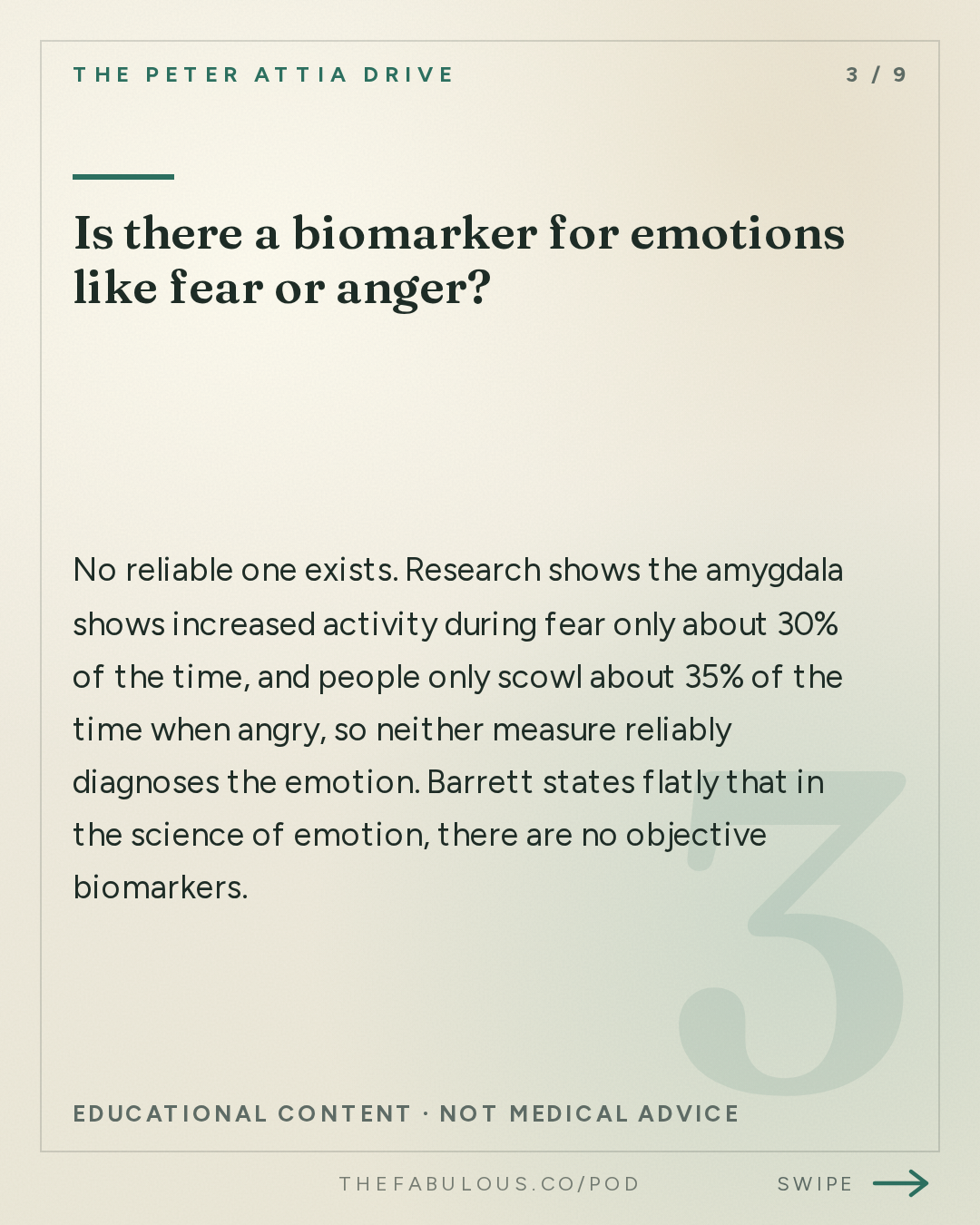
Is there a biomarker for emotions like fear or anger?
No reliable one exists. Research shows the amygdala shows increased activity during fear only about 30% of the time, and people only scowl about 35% of the time when angry, so neither measure reliably diagnoses the emotion (17:07, 16:25). Barrett states flatly that in the science of emotion, there are no objective biomarkers (37:45).
What is the difference between allostasis and homeostasis?
Homeostasis is reactive: the body drifts from a set point and then corrects it. Allostasis, a term from physiologist Peter Sterling, is predictive: the brain anticipates a coming metabolic need and adjusts the body in advance, which is why a cortisol surge appears before getting out of bed rather than after (113:28, 112:16).
What is body budgeting in neuroscience?
Body budgeting is Lisa Feldman Barrett's term for the brain's core job: regulating metabolism and coordinating the body's systems, which she says underlies thinking, feeling, and remembering (51:50). She adds that humans co-regulate each other's nervous systems, so losing a close relationship removes part of a person's budgeting support (118:19, 142:52).
How does practicing awe help with stress, according to Lisa Feldman Barrett?
Barrett describes training herself to notice small moments of wonder daily, starting with easy subjects like a photo of a baby animal and progressing to harder ones like a weed in a sidewalk crack. After about two months of daily practice, she could call on the same skill during real stressful moments, suggesting emotional control is a built skill rather than an instant switch (134:13, 137:07).
The full read, in cards
Go deeper
- How Emotions Are Made — Lisa Feldman Barrett's book laying out her theory of constructed emotion
- Seven and a Half Lessons About the Brain — Barrett's companion book on how the brain functions day to day
- Nature Reviews Neuroscience paper with Earl Miller — Summarizes evidence that most brain synapses carry predictive, top-down signals rather than raw sensory input
- Principles of Neural Design — Shows the energy constraints that make prediction, not reaction, the only viable way a nervous system could work
- Controlled viral exposure study — Found only 20% to 40% of people exposed to an identical viral dose developed symptoms, showing a virus is necessary but not sufficient to cause illness
- George Bonanno's grief research — Found many people recover from acute grief without prolonged, complicated suffering within about a year or two
Mentioned
Lisa Feldman Barrett · Peter Attia · Earl Miller · Barbara Finley · Peter Sterling · George Bonanno · Northeastern University · How Emotions Are Made · Seven and a Half Lessons About the Brain · Principles of Neural Design · Himba · Hadza · Allostasis
More from this show and category
Siddhartha Mukherjee on Cancer's New Science
Oncologist Siddhartha Mukherjee tells Peter Attia that cancer's old "bad luck" story is being replaced by a more precise one: inflammation acts as the trigger that wakes dormant, mutation-carrying "sleeper cells" into tumors, which reframes prevention, treatment, and how we think about aging itself.
Why Peter Attia Changed His Mind on Keto
Peter Attia now says keto works by curbing energy intake, not lowering insulin, while he still requires 1.4 g/kg of protein (09:42, 11:44). He also walks back his extended fasting protocol, once seven to ten days quarterly, after weighing autophagy evidence against the practical cost (12:36, 15:09).
Preeclampsia and Long-Term Heart Risk Explained
Pregnancy stresses the heart, kidneys, and metabolism so hard that its complications predict a woman's cardiovascular and diabetes risk decades later. Maternal-fetal medicine specialist Kathryn Gray explains how plasma volume surges 50%, how preeclampsia's placental biology works, and why half of gestational diabetes cases become type 2 diabetes.
Lloyd Klickstein on How New Drugs Get Made
Physician-scientist Lloyd Klickstein maps the full arc of drug development, from spotting an unmet need to FDA approval, using the muscle drug bimagrumab as his case study. Paired with semaglutide, it cut body fat by 45.7% over 72 weeks (125:28), rivaling bariatric surgery, while exposing the economics of patents, manufacturing, and phase one risk.
