
Cold Water Immersion vs Cryotherapy: What Works
Cold therapy: pros, cons, and its impact on longevity (AMA #47 rebroadcast)
▶ Listen to the full episode More from The Peter Attia Drive
The brief
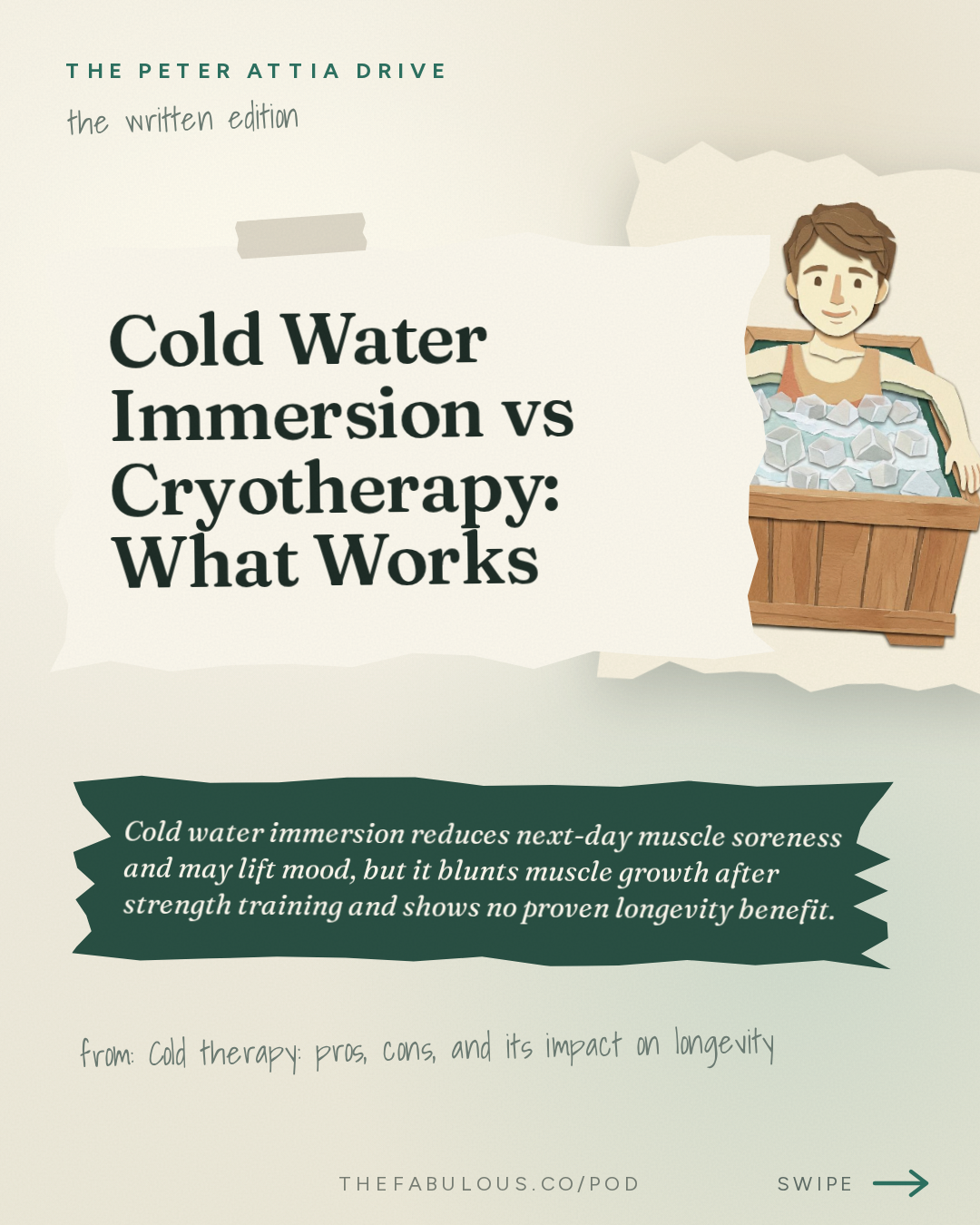
Cold water immersion reduces next-day muscle soreness and may lift mood, but it blunts muscle growth after strength training and shows no proven longevity benefit. Peter Attia reviews meta-analyses finding cold water immersion beats whole body cryotherapy for recovery, raises norepinephrine over 500% in one study, and cuts post-workout protein uptake into muscle by 24% (50:21).
Off the coast of Japan, there are divers who spend their working lives in cold water, and the story goes that they almost never catch colds. It is the kind of anecdote that gets repeated as proof that cold builds a hardier body. Peter Attia brings up these divers near the end of this AMA rebroadcast (56:51), and then does something more useful than repeating the folklore: he explains why it proves less than it seems to. The divers do not simply sit in cold water. They swim in it, for hours, every working day of their lives. Exercise and cold exposure are tangled together in that story, and nobody has pulled the two apart.
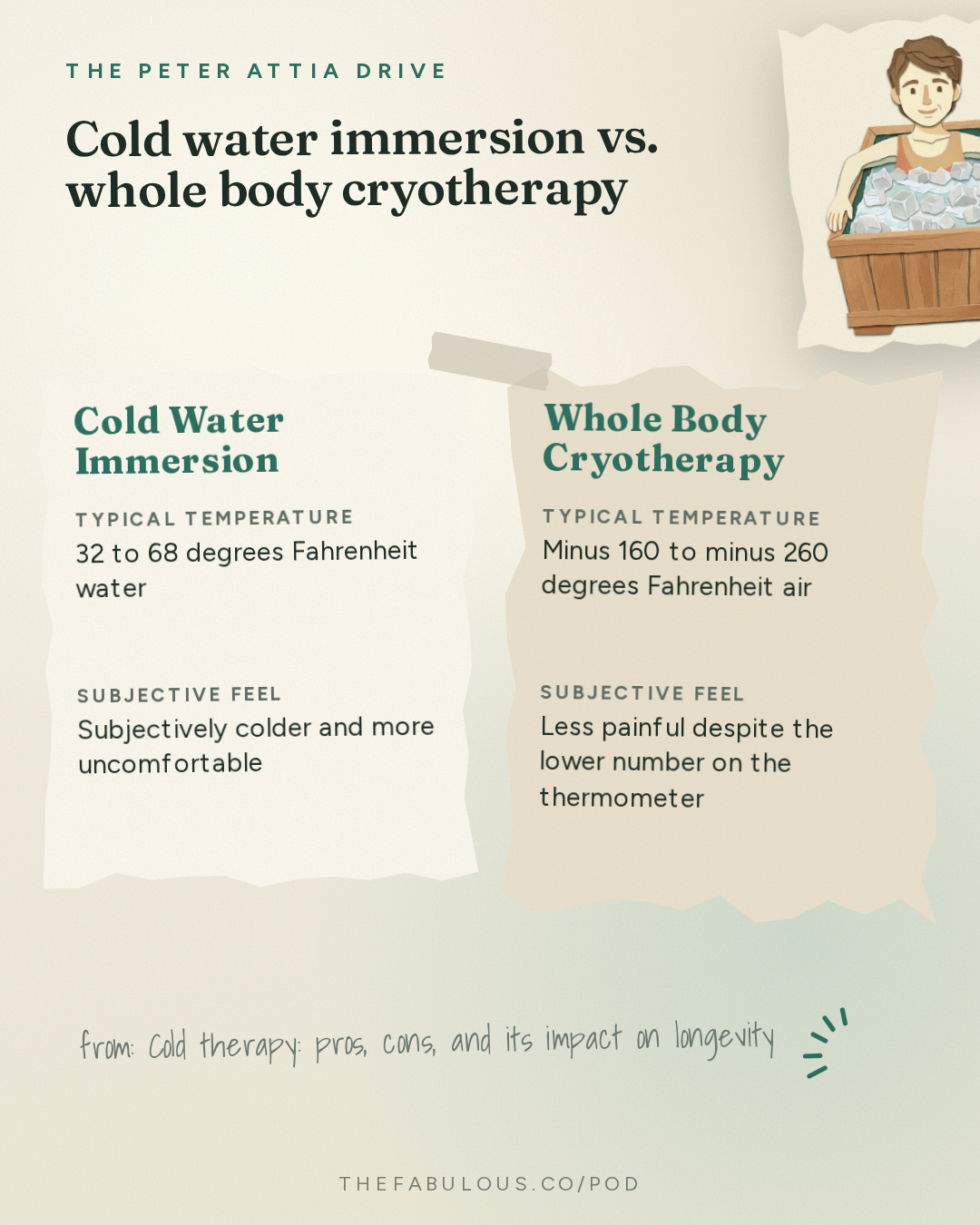
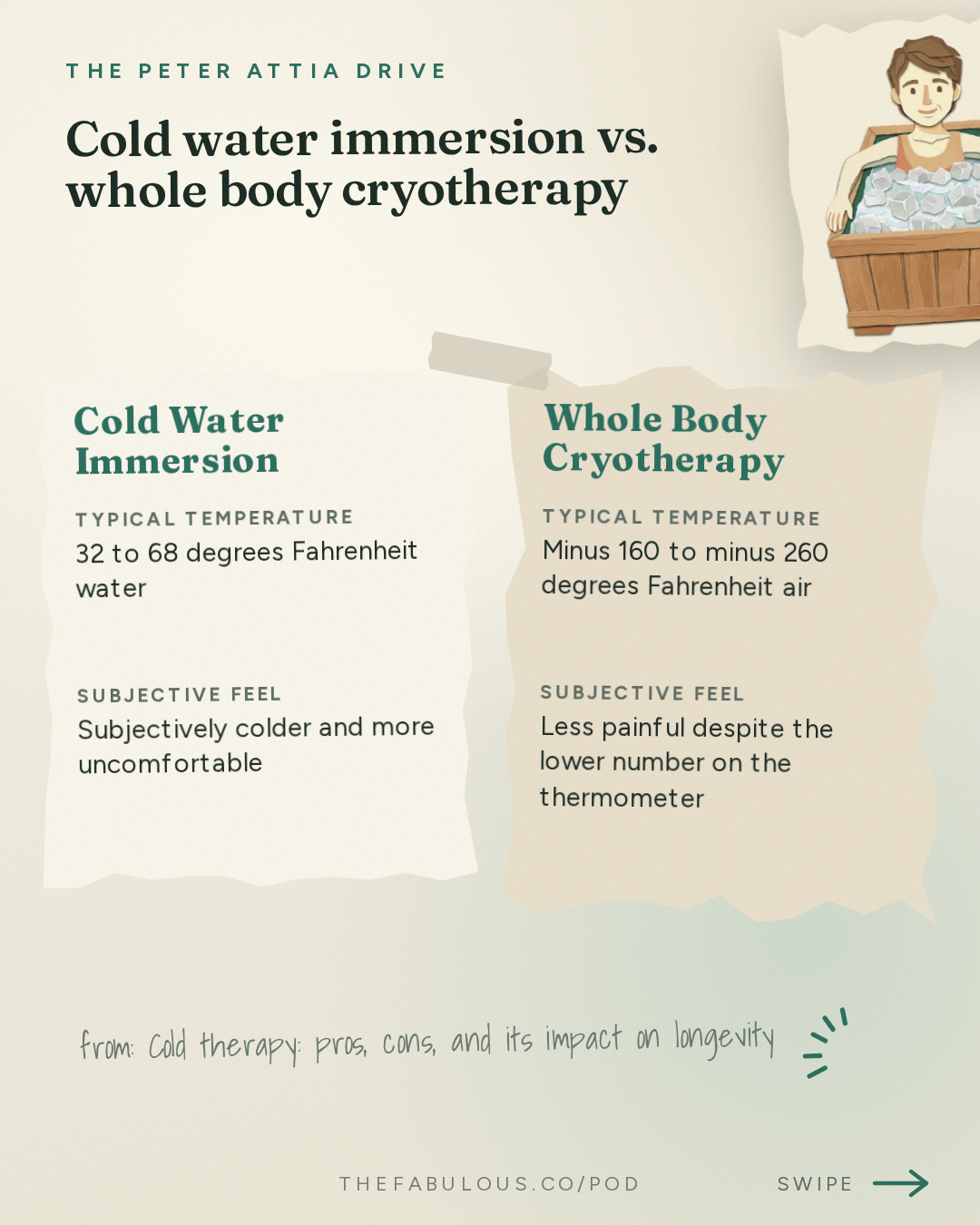
That untangling is really the whole episode. Attia, working through listener questions with a colleague identified in the recording only as Nick, spends an hour sorting cold water immersion (CWI, sitting in cold water) from whole body cryotherapy (WBC, standing in a tube of extremely cold nitrogen gas for about three minutes at temperatures between minus 160 and minus 260 degrees Fahrenheit, 09:09). The distinction matters because the two feel nothing alike. Cryotherapy sounds more extreme on a thermometer, but Attia says cold water immersion is "much subjectively colder" (10:20), because water conducts heat away from the body far faster than gas does.
Before any findings, Attia pauses to explain the tool that makes sense of them: the standardized mean difference, or SMD, a number that compares the gap between two group averages against how spread out the data are within each group. It has no units. A score of 0.2 counts as a small effect, 0.5 as moderate, and 0.8 or higher as large (14:48). The caveat he offers first is really the thesis of the whole hour.
"A meta-analysis can only be as good as the sum of its parts, and if its parts are very heterogeneous, then your analyses are somewhat limited." — Peter Attia [08:37]
With that warning in place, the clearest signal in the data concerns delayed onset muscle soreness, or DOMS, the ache that shows up a day after a hard workout. A 2022 meta-analysis of 52 studies found that cold water immersion taken within 15 minutes of intense exercise produced a large reduction in soreness 24 hours later, with an SMD of minus 0.89 (17:55), alongside smaller gains in muscular power and perceived recovery. Comparisons between cold water immersion and whole body cryotherapy are thinner and inconsistent: one study found no difference after downhill running, another found cryotherapy reduced perceived stress better in runners, and a third found cold water immersion won on recovery speed after hamstring exercises (19:23). Attia's read is that cold water immersion edges ahead on evidence, and wins decisively on practicality, since a bathtub and a bag of ice do the job that an industrial nitrogen chamber otherwise does.
A mood lever with a hidden mechanism
The segment on mood is the most speculative and, for that reason, the most interesting. A small study from around 2000 put ten young men in 57 degree Fahrenheit water up to the shoulders for an hour and tracked their blood chemistry. Plasma norepinephrine, a stress hormone and neurotransmitter, rose more than 500 percent from baseline, and dopamine rose 250 percent (23:27); epinephrine barely moved. Because these are objective blood measurements rather than self-reports, researchers can run real placebo-controlled comparisons, something that is nearly impossible once a study asks people how cold water made them feel. A separate randomized trial gave one group ten sessions of true whole body cryotherapy and a control group ten sessions in a cold chamber that was cold but not cryogenic, and found a statistically significant improvement in depression scores, measured with two validated instruments, the Beck Depression Inventory II and the HAMD-17, favoring the cryotherapy group (27:24). Attia is careful not to oversell this: it is one small trial layered on one small biochemistry study, with a plausible but unproven mechanism involving norepinephrine's effects in the brain. Still, he treats it as the use case he personally values most.
Two popular claims do not survive the review. The first is that cold exposure activates brown adipose tissue (BAT), a metabolically active, mitochondria-dense type of fat that burns energy to generate heat without shivering, and that this makes cold plunging a weight-loss tool. Attia describes watching this activation happen on a thermal camera while filming in Norway for the Netflix series Limitless with actor Chris Hemsworth (35:58), but the quantity of energy involved in adults is small enough to be, in his words, "a rounding error" (38:21) rather than a meaningful dial for fat loss. The second claim concerns longevity itself. Unlike sauna, where Attia has described geroprotective, or anti-aging, evidence tied to cardiovascular outcomes, he says a careful review of the cold literature, including a 2022 review study, turned up no comparable signal (55:19). That review also lumped cold water swimmers in with people doing plain cold immersion, which muddies the metabolic benefits it did find, since exercise and cold are once again tangled together.
The cost that lifters should know about
The clearest downside in the whole episode concerns strength training. A 2015 randomized controlled trial put 24 young men through a 12-week lower-body strength program; half did cold water immersion, legs submerged to the waist at 50 degrees Fahrenheit for 10 minutes after each session, the rest did nothing. Both groups gained strength, but the cold water group gained less: roughly 133 kilograms added to leg press strength versus about 200 kilograms in the control group (46:53). A follow-up study using muscle biopsies found that cold water immersion blunted the normal post-exercise rise in satellite cells, the stem cells that drive muscle repair and growth (48:11). A third, more elegant study had each man put one leg in 46 degree water and the other in an 86 degree bath after exercise, then fed everyone a radiolabeled protein drink to track where the amino acids went. The cold leg incorporated 24 percent less of that labeled protein into new muscle tissue than the warm leg (50:21). Interestingly, a separate study found no measurable difference in circulating inflammatory markers like C-reactive protein or interleukin-6 between cold and active recovery (53:15), which suggests the blunting effect is not simply about dampening inflammation; something more specific to protein synthesis signaling appears to be at work. Attia's summary is direct.
"If your absolute objective is maximum hypertrophy, cold water therapy may not make sense, at least in the day or so after heavy resistance training." — Peter Attia [51:09]
Taken together, the picture that emerges is of a tool with a narrow, well-supported job and a lot of surrounding noise. Attia's own working summary lands here:
"I think there's really pretty clear signal that cold has somewhere between small and medium effects on the reduction of DOMS." — Peter Attia [63:45]
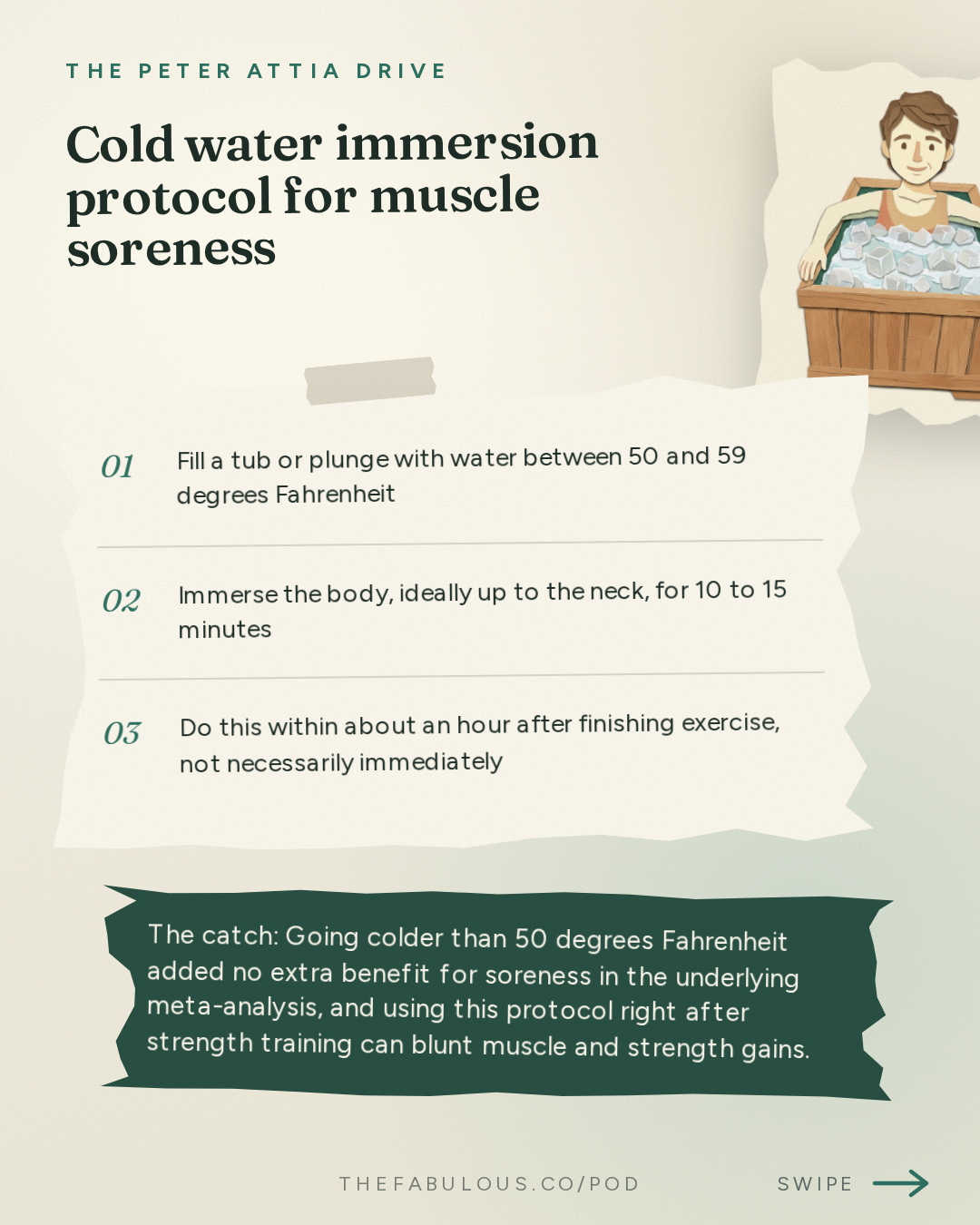
For soreness, the best available meta-analysis points to 10 to 15 minutes in water between 50 and 59 degrees Fahrenheit, taken within about an hour of finishing exercise; going colder than 50 degrees added nothing further (59:20). For mood, there is no agreed protocol, only a hunch, informed by that one 57 degree, 60-minute study, that shorter and colder exposures might deliver a similar lift at a fraction of the time commitment. What the episode refuses to offer is a single, satisfying number that cold exposure adds years to a life. Attia says as much, and adds a broader complaint: that a single phase III drug trial costs more than it would take to answer every open question about temperature and the body, and yet that money never seems to go where the questions are. Until it does, cold water remains what this hour leaves it as: a genuinely useful recovery tool, a plausible but unproven mood lever, and, for anyone chasing muscle size or strength, something to use with a little more caution than the plunge-every-day enthusiasts suggest.
Ask this episode anything
Pod's AI answers from the episode itself, with the minute mark so you can hear it yourself.
Or start with one of these
Ask this episode
Pod's AI listens to the whole episode to answer, and points you to the minute it comes from.
The rest of this answer, and any question after it
Answers come from the episode itself, never from a summary of it.
ContinueKey takeaways
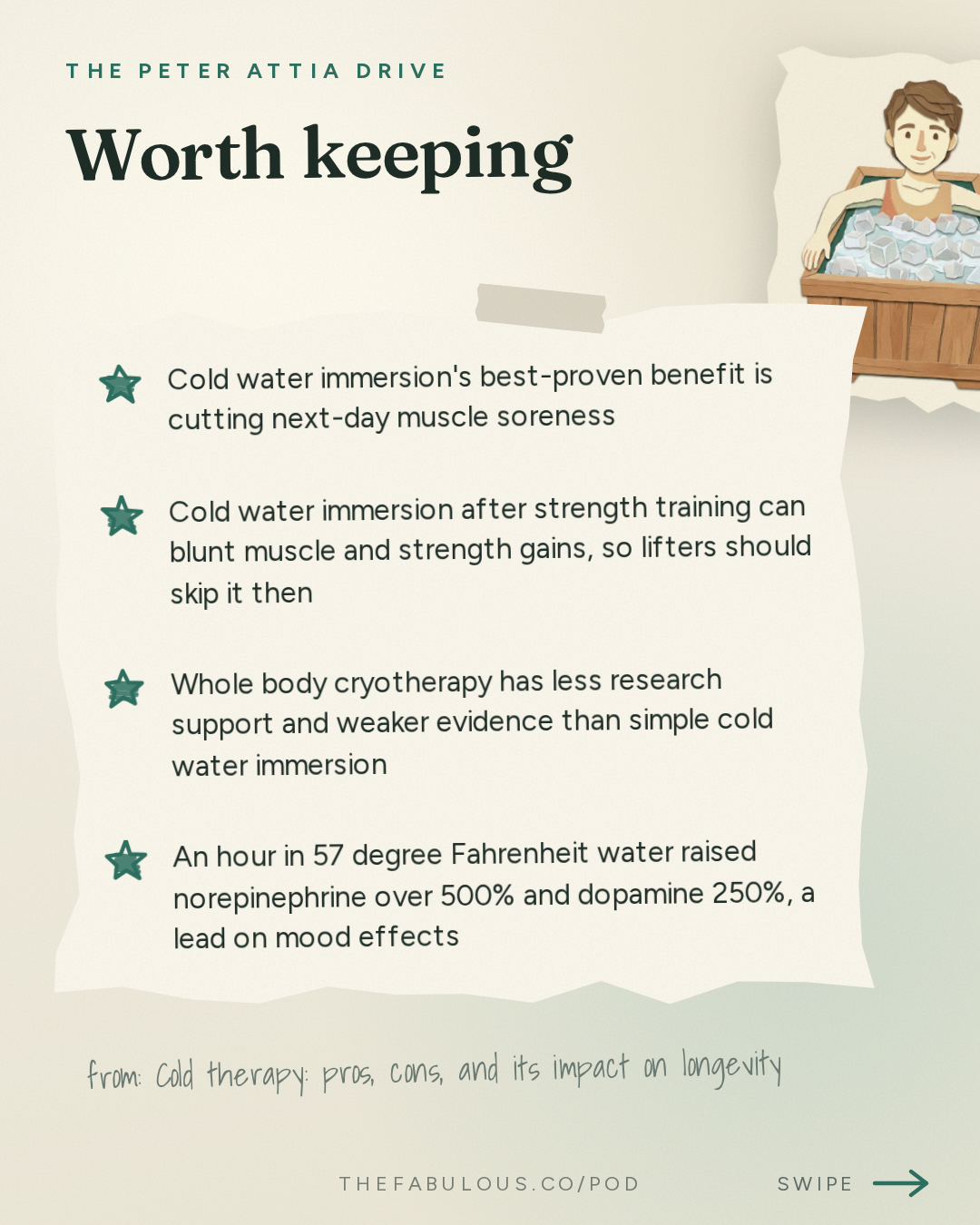
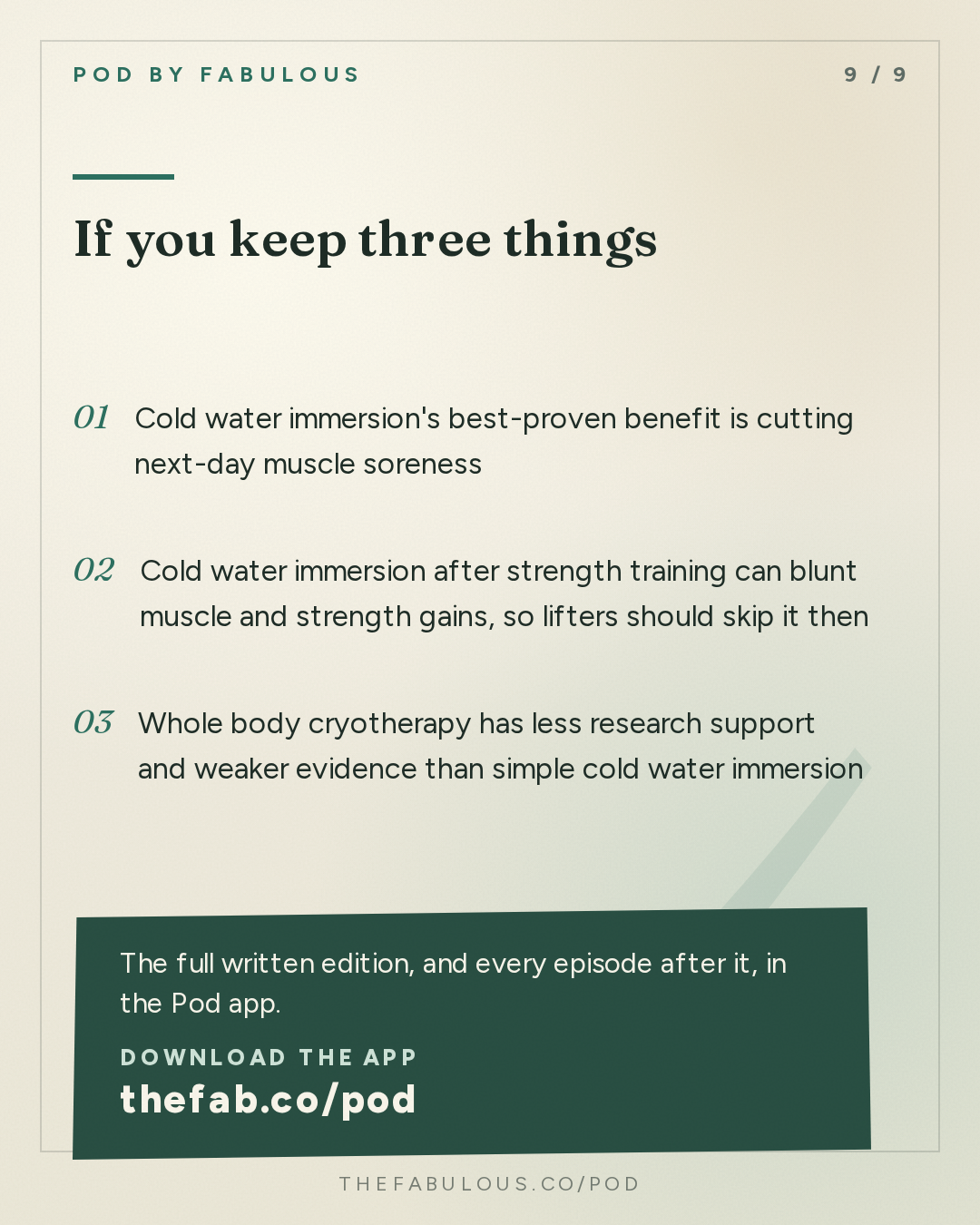
- Cold water immersion's best-proven benefit is cutting next-day muscle soreness
- Cold water immersion after strength training can blunt muscle and strength gains, so lifters should skip it then
- Whole body cryotherapy has less research support and weaker evidence than simple cold water immersion
- An hour in 57 degree Fahrenheit water raised norepinephrine over 500% and dopamine 250%, a lead on mood effects
- No study shows cold exposure meaningfully extends lifespan or protects against aging, unlike sauna
The episode in cards
By the numbers
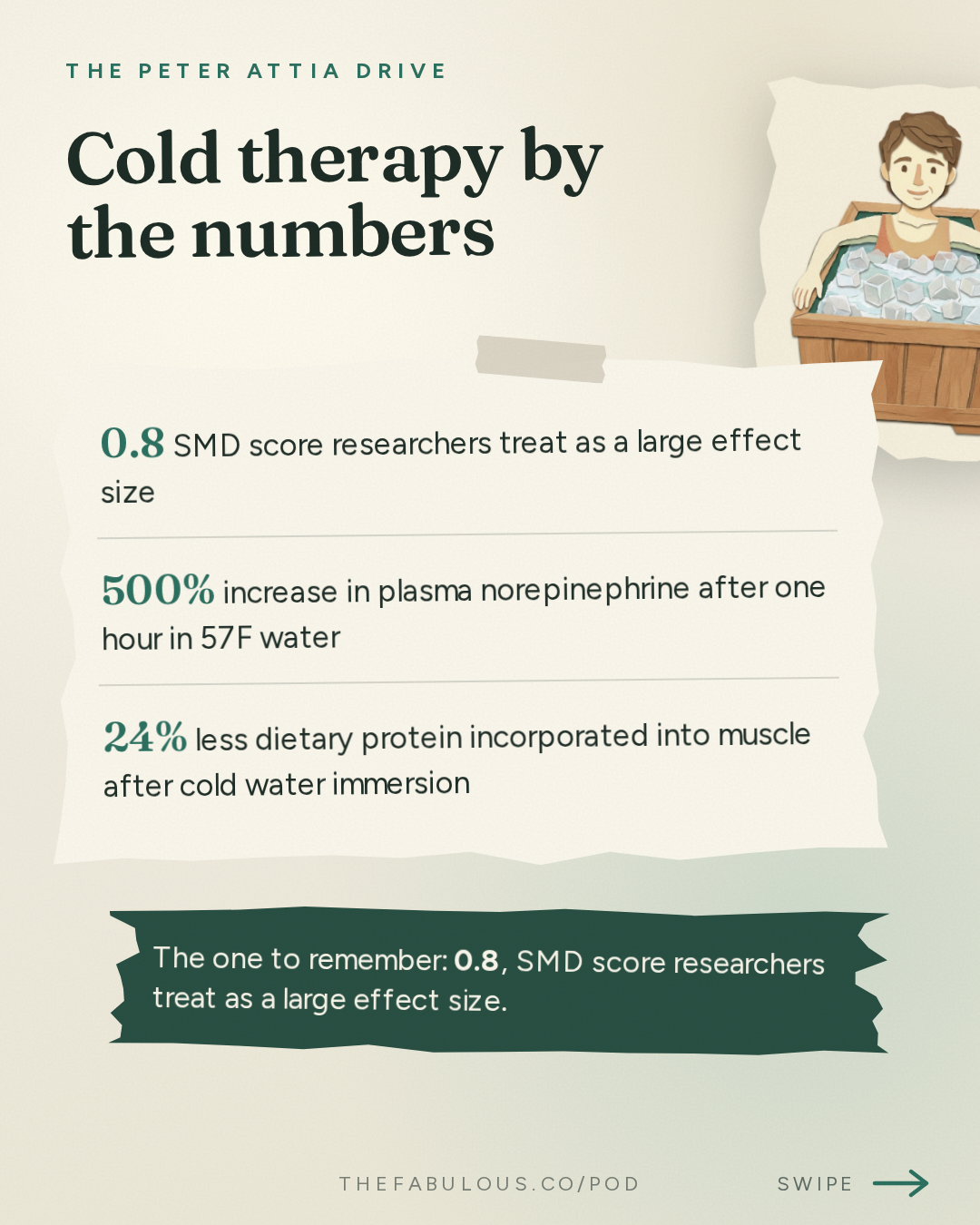
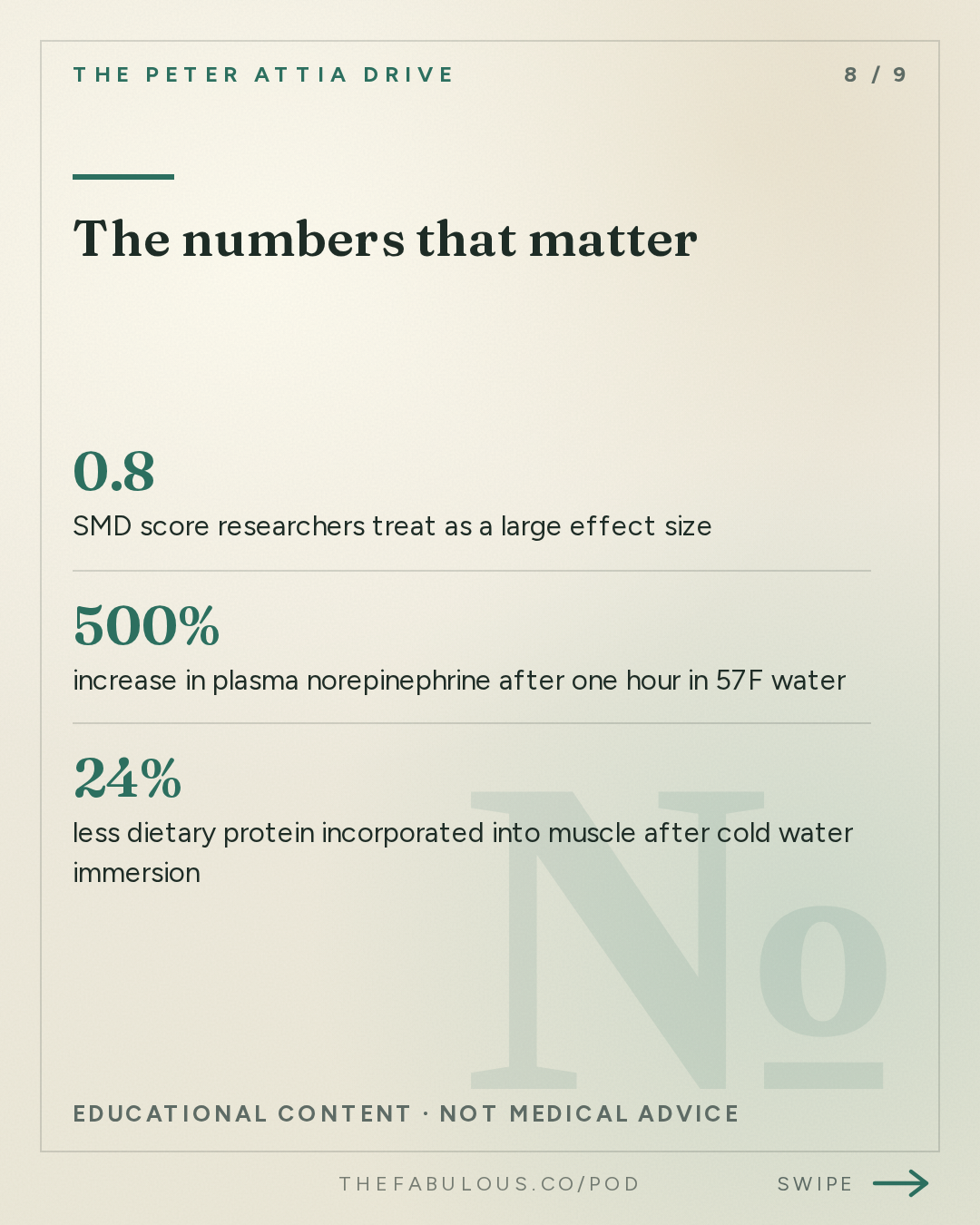
- 0.8 SMD score researchers treat as a large effect size
- 500% percent increase in plasma norepinephrine after one hour in 57F water
- 24% percent less dietary protein incorporated into muscle after cold water immersion
In their words
“If your absolute objective is maximum hypertrophy, cold water therapy may not make sense, uh, at least in the day or so after heavy resistance training”
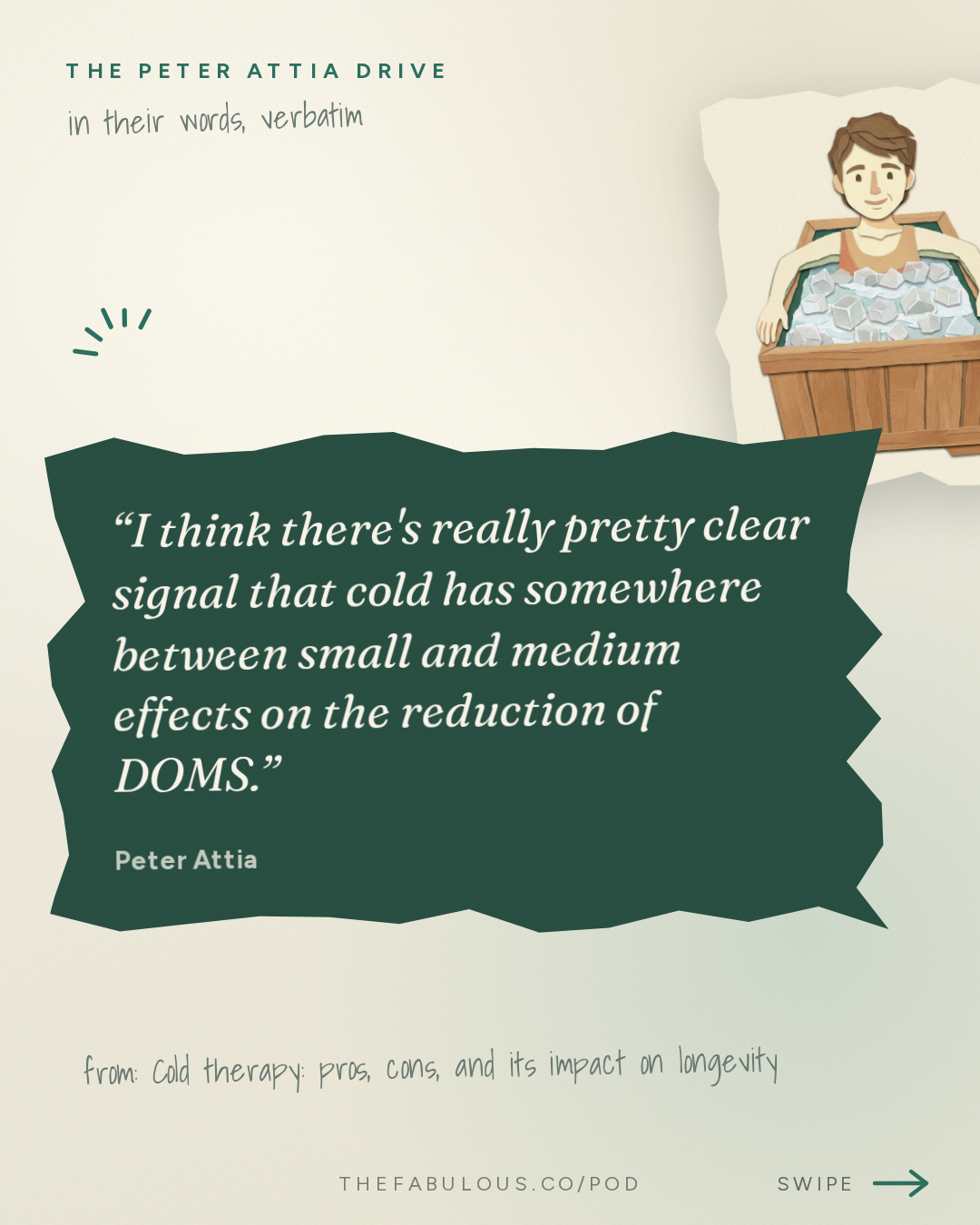
“I think there's really pretty clear signal that cold has somewhere between small and medium effects on the reduction of DOMS.”
Protocols
-
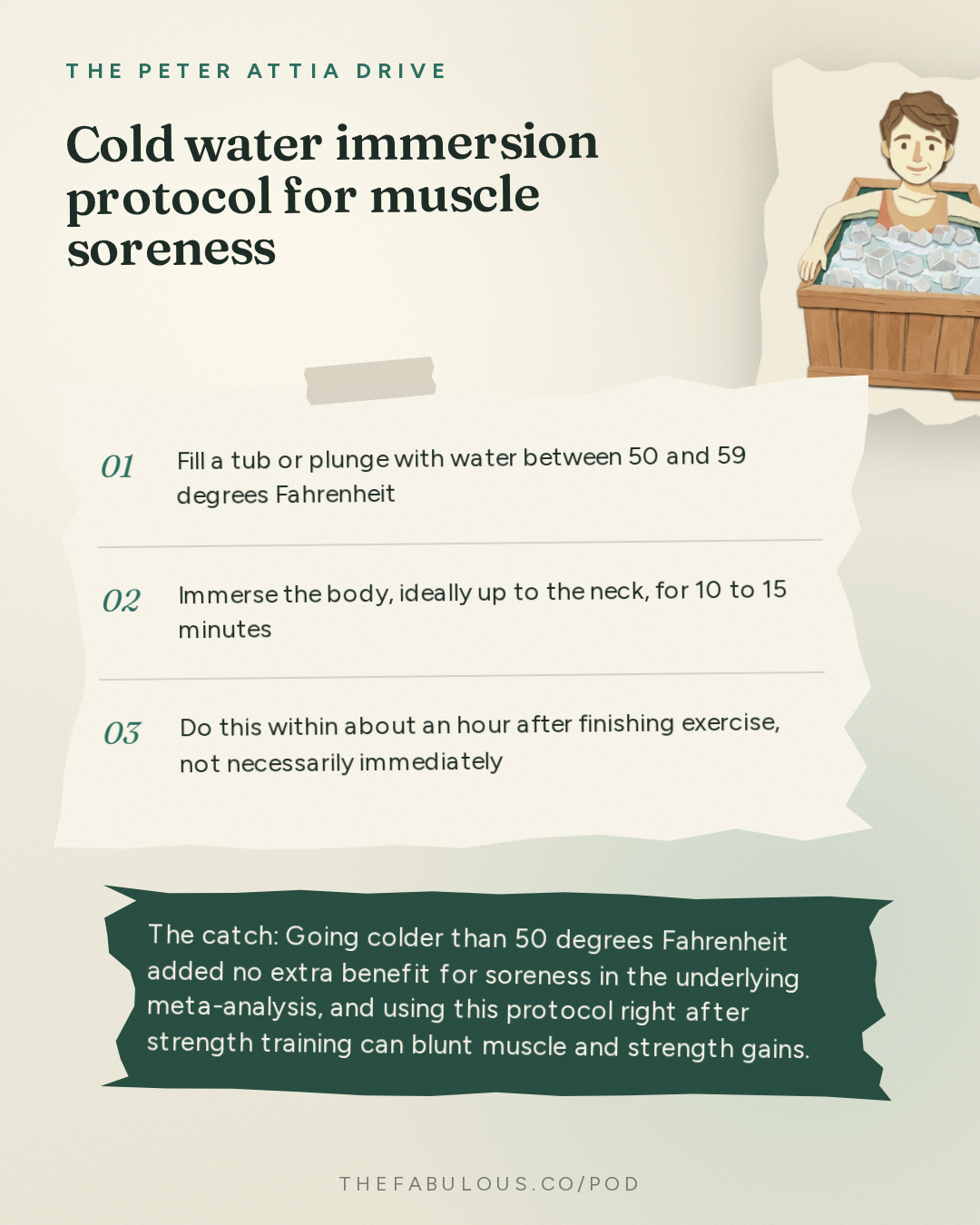
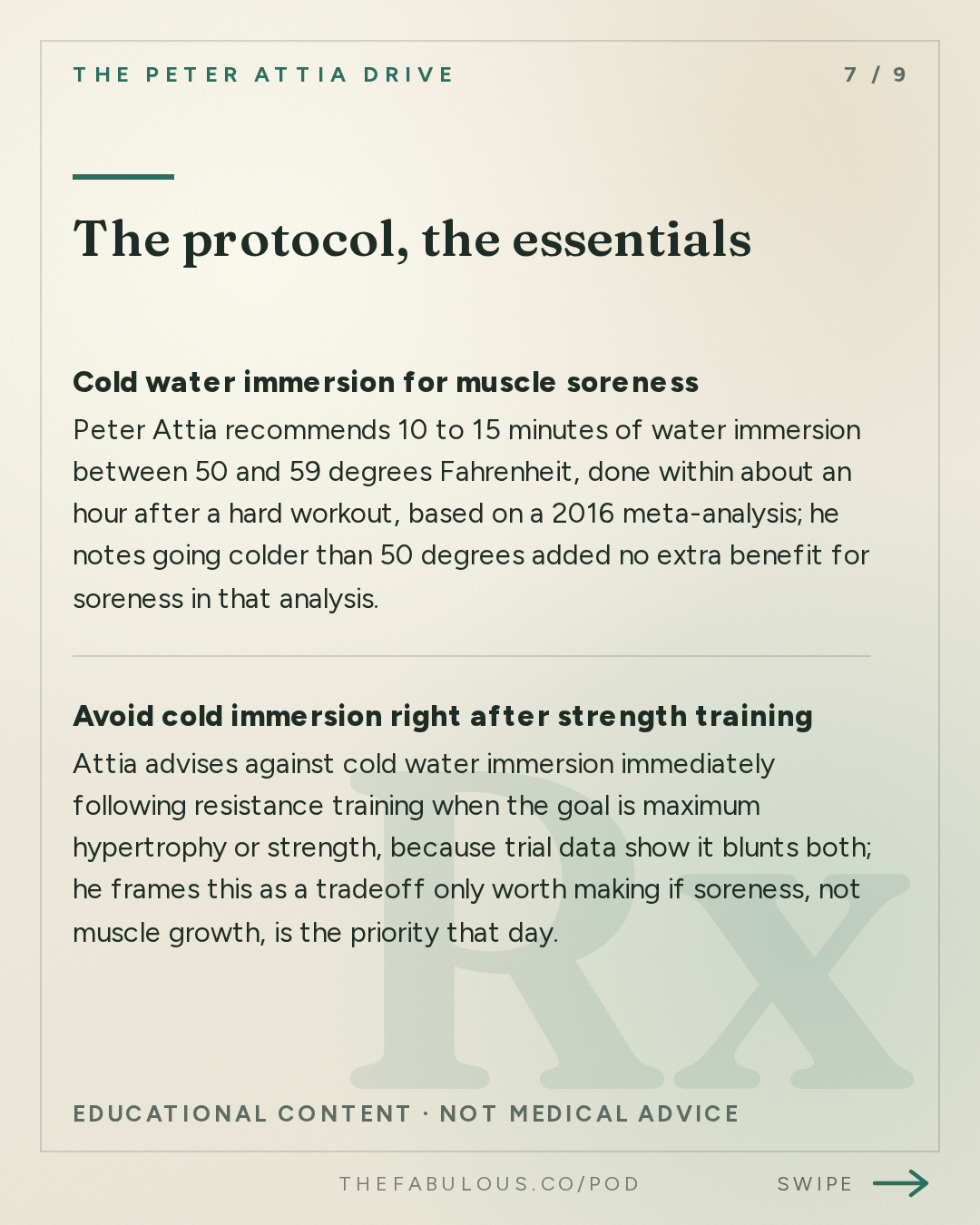
Cold water immersion for muscle soreness
Peter Attia recommends 10 to 15 minutes of water immersion between 50 and 59 degrees Fahrenheit, done within about an hour after a hard workout, based on a 2016 meta-analysis; he notes going colder than 50 degrees added no extra benefit for soreness in that analysis.
after workouts where soreness reduction is the goal
-
Avoid cold immersion right after strength training
Attia advises against cold water immersion immediately following resistance training when the goal is maximum hypertrophy or strength, because trial data show it blunts both; he frames this as a tradeoff only worth making if soreness, not muscle growth, is the priority that day.
skip after heavy resistance sessions
-
Sauna protocol used as a benchmark
Attia follows a sauna schedule drawn from Finnish cohort studies: at least four sessions a week, each at least 20 minutes long, at a minimum of 179 degrees Fahrenheit; he calls this the least-bad protocol available rather than a proven optimum.
at least 4 times per week
-
Cold exposure for mood
Attia personally uses brief, very cold exposure, such as a short cold shower or plunge, instead of the 60-minute, 57 degree immersion used in research, because he judges the short version realistic enough to sustain daily while still chasing the mood effect.
daily, a few minutes
Questions this episode answers
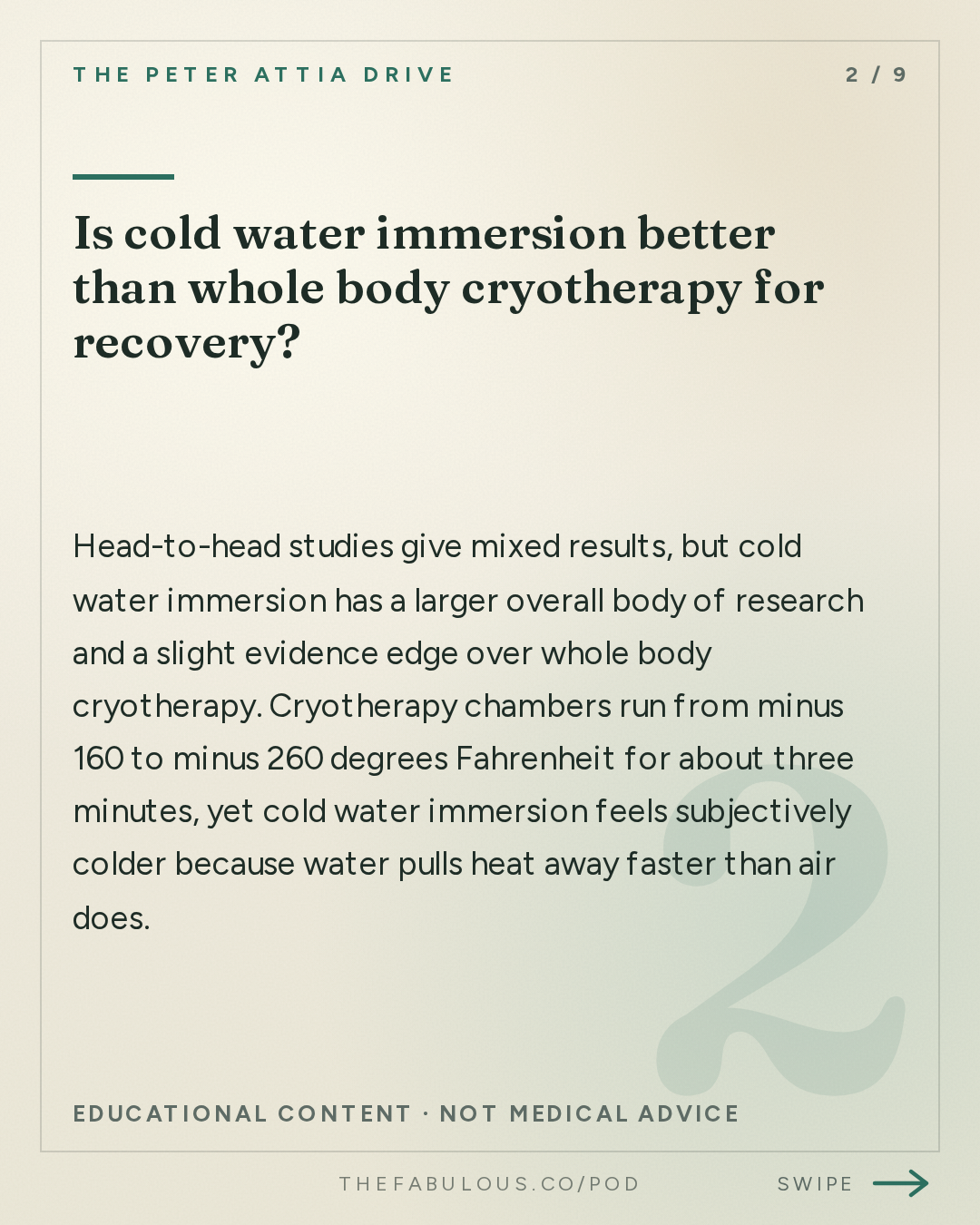
Is cold water immersion better than whole body cryotherapy for recovery?
Head-to-head studies give mixed results, but cold water immersion has a larger overall body of research and a slight evidence edge over whole body cryotherapy (21:09). Cryotherapy chambers run from minus 160 to minus 260 degrees Fahrenheit for about three minutes (09:09), yet cold water immersion feels subjectively colder because water pulls heat away faster than air does (10:20).
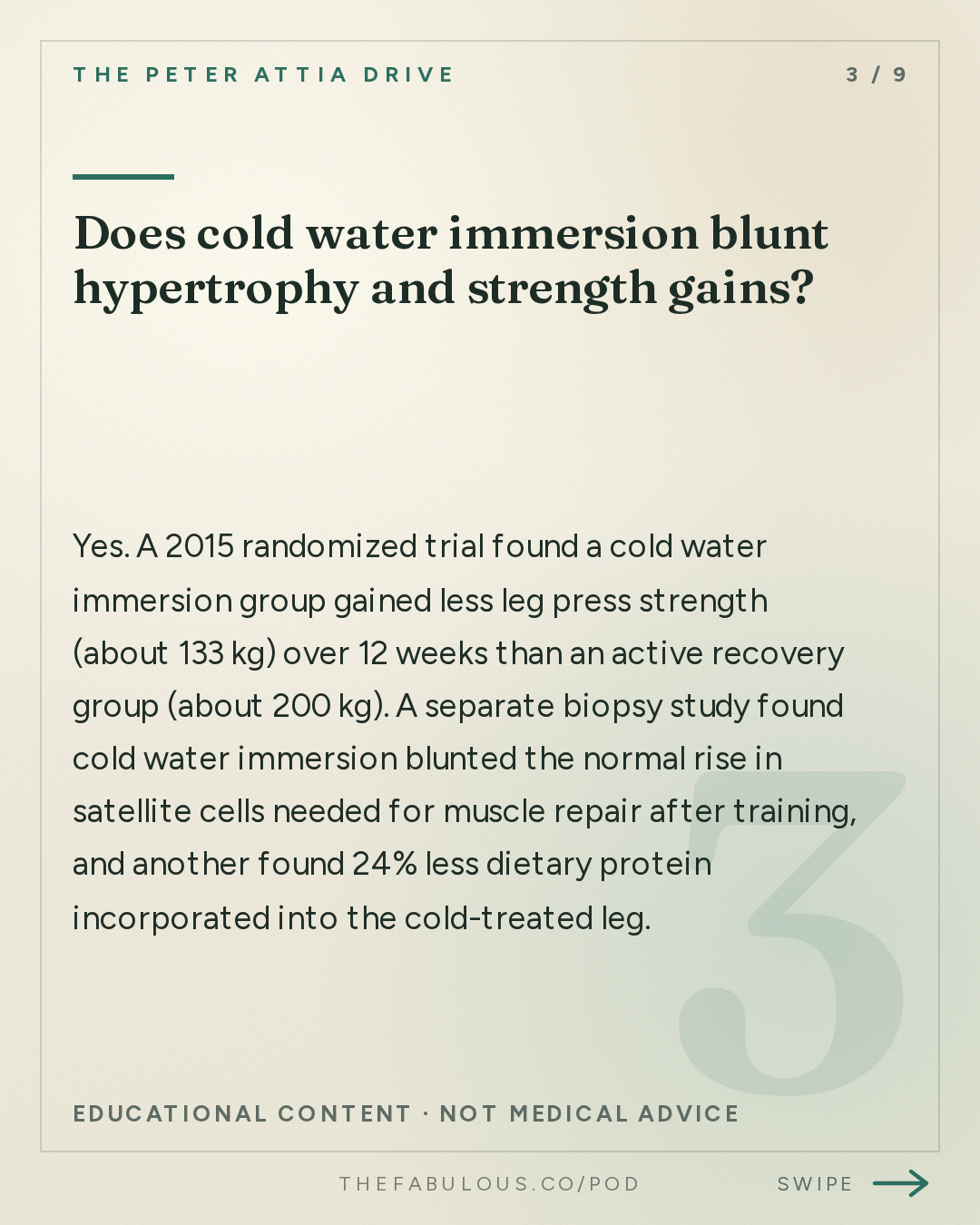
Does cold water immersion blunt hypertrophy and strength gains?
Yes. A 2015 randomized trial found a cold water immersion group gained less leg press strength (about 133 kg) over 12 weeks than an active recovery group (about 200 kg) (46:53). A separate biopsy study found cold water immersion blunted the normal rise in satellite cells needed for muscle repair after training (48:11), and another found 24% less dietary protein incorporated into the cold-treated leg (50:21).
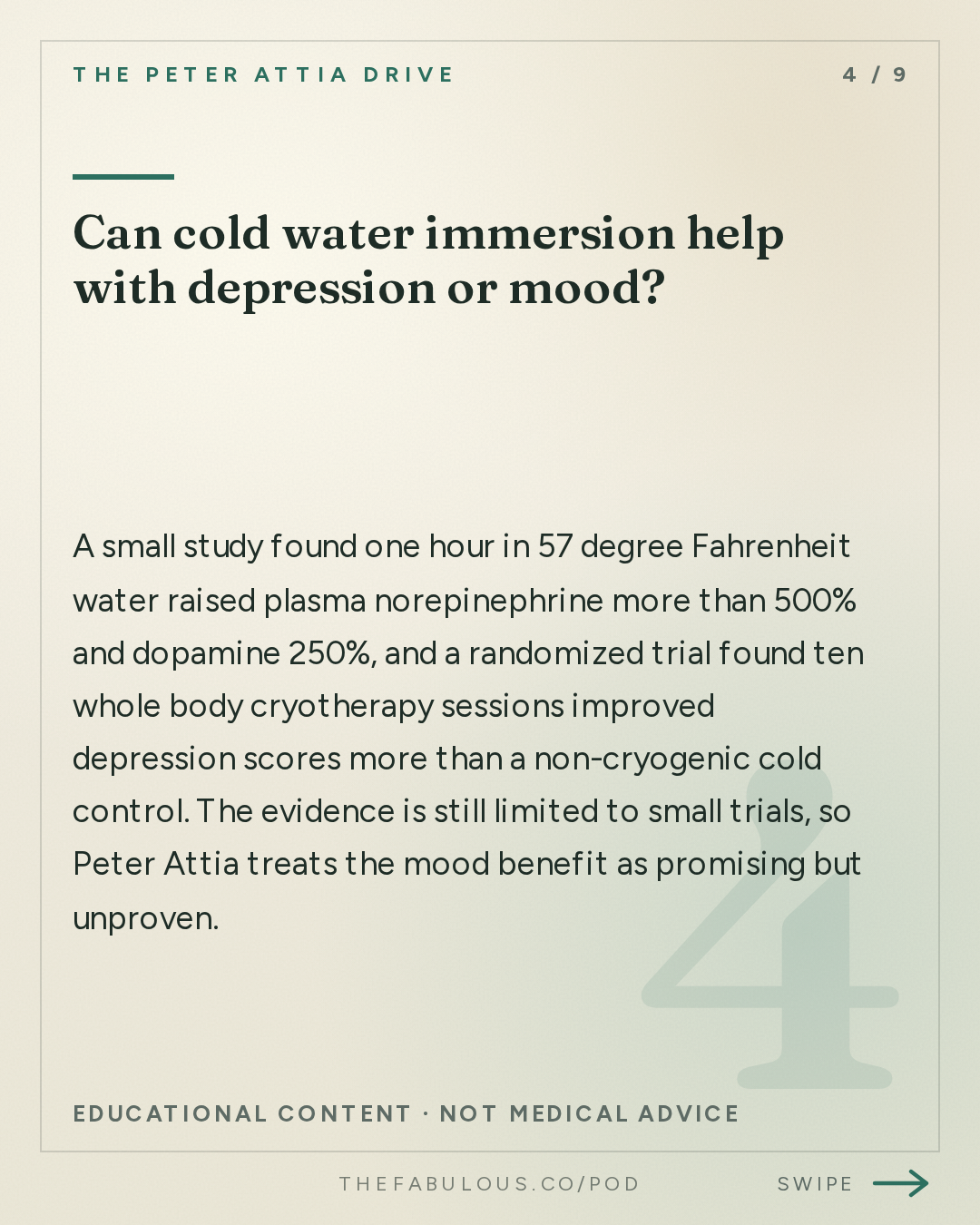
Can cold water immersion help with depression or mood?
A small study found one hour in 57 degree Fahrenheit water raised plasma norepinephrine more than 500% and dopamine 250% (23:27), and a randomized trial found ten whole body cryotherapy sessions improved depression scores more than a non-cryogenic cold control (27:24). The evidence is still limited to small trials, so Peter Attia treats the mood benefit as promising but unproven (24:29).
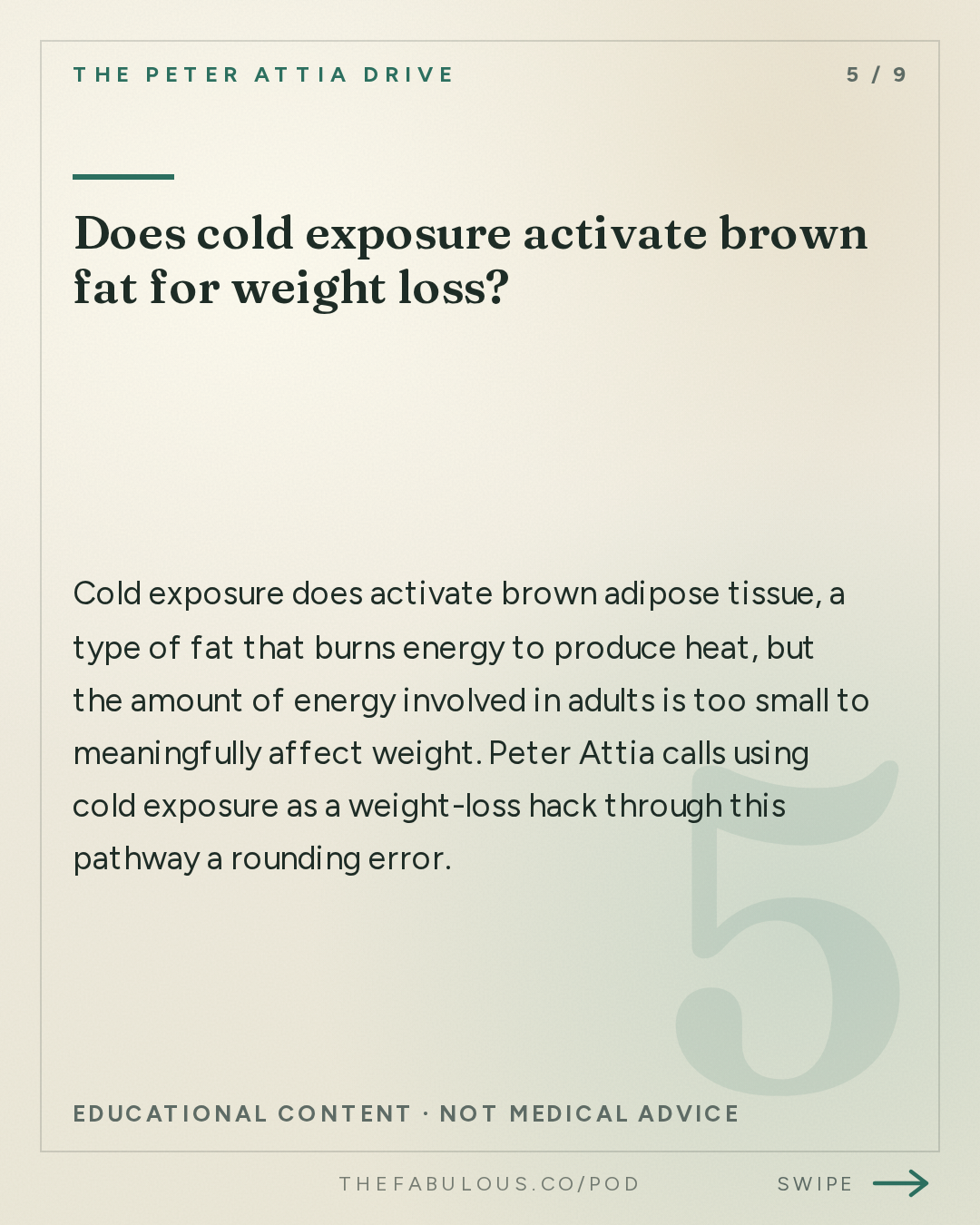
Does cold exposure activate brown fat for weight loss?
Cold exposure does activate brown adipose tissue, a type of fat that burns energy to produce heat, but the amount of energy involved in adults is too small to meaningfully affect weight (38:21). Peter Attia calls using cold exposure as a weight-loss hack through this pathway a rounding error (39:27).
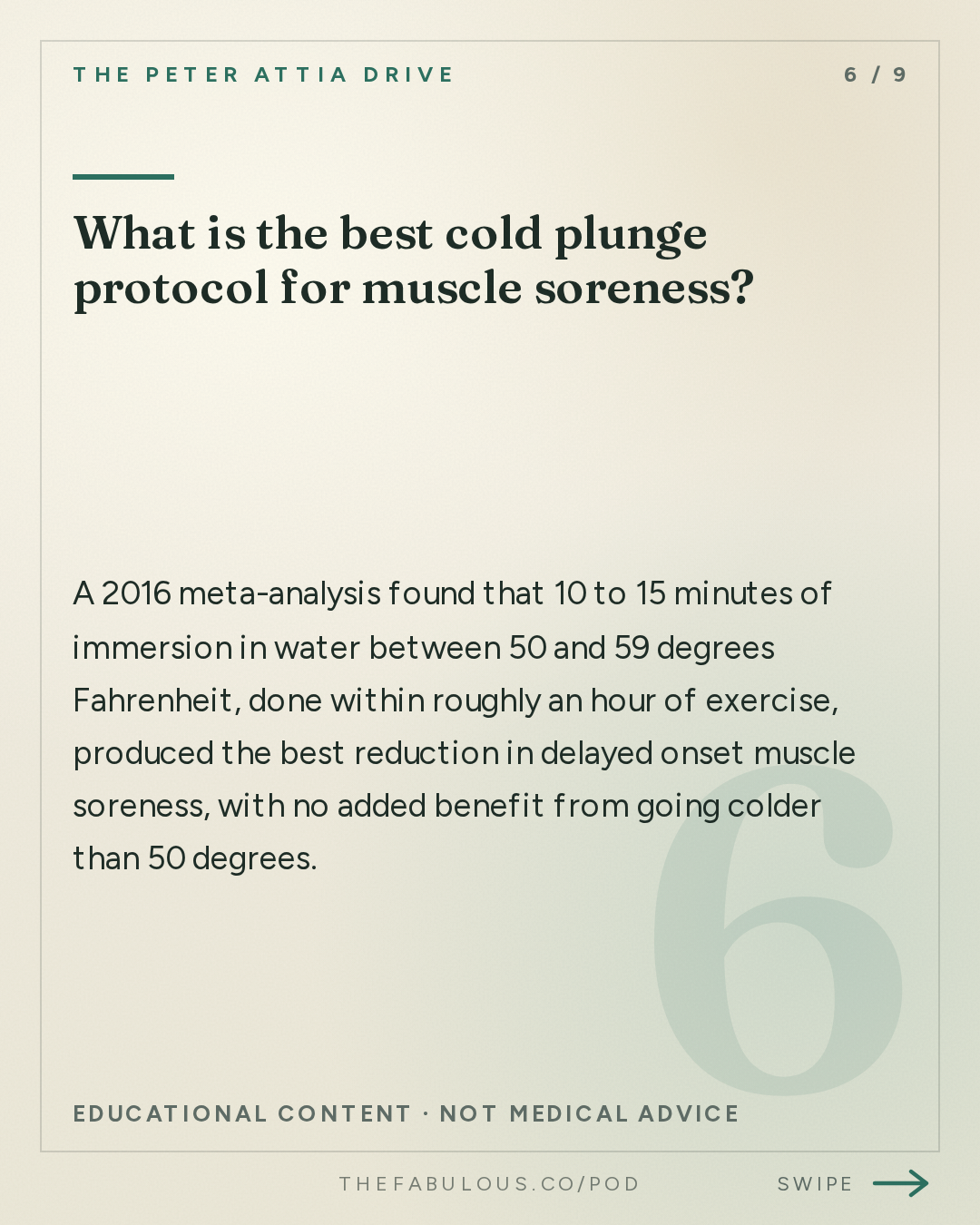
What is the best cold plunge protocol for muscle soreness?
A 2016 meta-analysis found that 10 to 15 minutes of immersion in water between 50 and 59 degrees Fahrenheit, done within roughly an hour of exercise, produced the best reduction in delayed onset muscle soreness, with no added benefit from going colder than 50 degrees (59:20).
The full read, in cards
Go deeper
- 2022 meta-analysis of cold water immersion after exercise (52 studies) — found a large reduction in muscle soreness (SMD -0.89) and small gains in power and perceived recovery
- 2000 study on cold water immersion and catecholamines in young men — found one hour in 57F water raised plasma norepinephrine over 500% and dopamine 250%
- Randomized controlled trial of whole body cryotherapy for depression — found a significantly bigger improvement in depression scores versus a non-cryogenic cold control group
- 2015 RCT of cold water immersion during a 12-week strength program — found the cold water immersion group gained less leg press strength (133 kg) than active recovery controls (200 kg)
- 2016 meta-analysis of cold water immersion temperature and duration for DOMS — identified 50 to 59F for 10 to 15 minutes as the most effective window for reducing soreness
Mentioned
Standardized Mean Difference (SMD) · Beck Depression Inventory II · HAMD-17 · Brown Adipose Tissue (BAT) · Limitless · Chris Hemsworth
More from this show and category
Peter Attia's Guide to Reading Your Lab Results
Peter Attia argues that standard blood work answers only a quarter to a third of the question people actually bring to it: am I healthy? He reframes health as lifespan times healthspan and shows why a single lab number, without context or repetition, can mislead rather than clarify (05:29, 07:31).
Resistance Training Over 40: Jeff Cavaliere's Rules
Physical therapist Jeff Cavaliere says lifters over 40 should train fewer sets but push each one closer to failure to protect joints. He calls low-effort, high-fatigue sets 'junk volume,' and gives fixes like a 30-degree incline press, overhead tricep stretches, and a 4-second calf-raise pause.
Lisa Feldman Barrett's Predictive Brain Theory
Neuroscientist Lisa Feldman Barrett says the brain predicts, not reacts, building emotion from memory and the body's needs. She shows there are no objective biomarkers for specific emotions, and that averages in group studies mask the real variation between individuals. Her framework reframes stress as a metabolic prediction and suggests practiced skills, like awe, can build control over emotional response.
Siddhartha Mukherjee on Cancer's New Science
Oncologist Siddhartha Mukherjee tells Peter Attia that cancer's old "bad luck" story is being replaced by a more precise one: inflammation acts as the trigger that wakes dormant, mutation-carrying "sleeper cells" into tumors, which reframes prevention, treatment, and how we think about aging itself.
