
Nicole Bernard Dawes: Late July Snacks Story
Late July Snacks: Nicole Bernard Dawes. Crackers and Cookies were Failing… Tortilla Chips Saved Them
The brief
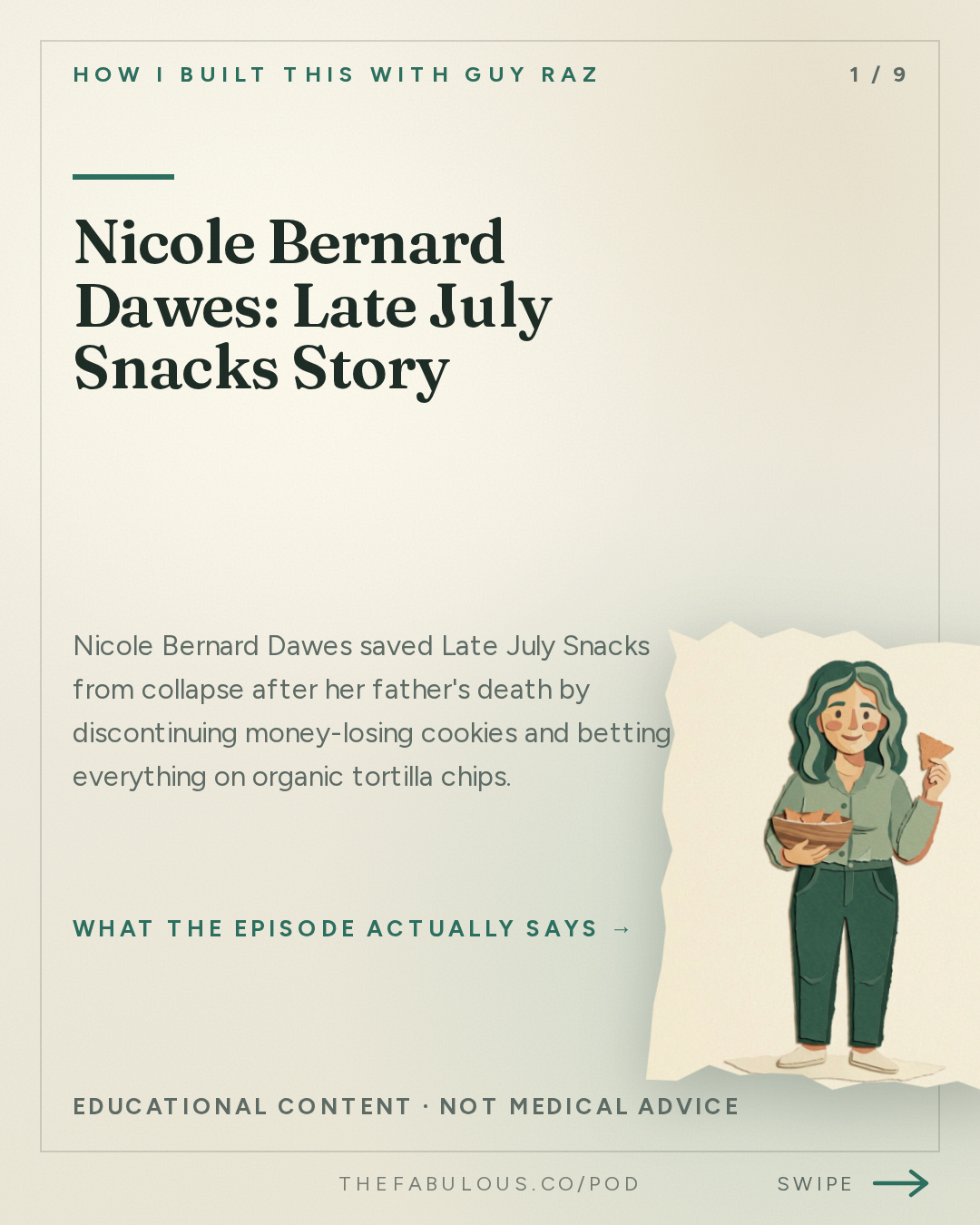
Nicole Bernard Dawes saved Late July Snacks from collapse after her father's death by discontinuing money-losing cookies and betting everything on organic tortilla chips. The pivot took the company from $8 million to $100 million in sales within three years, before Campbell's absorbed it through a 2018 merger.
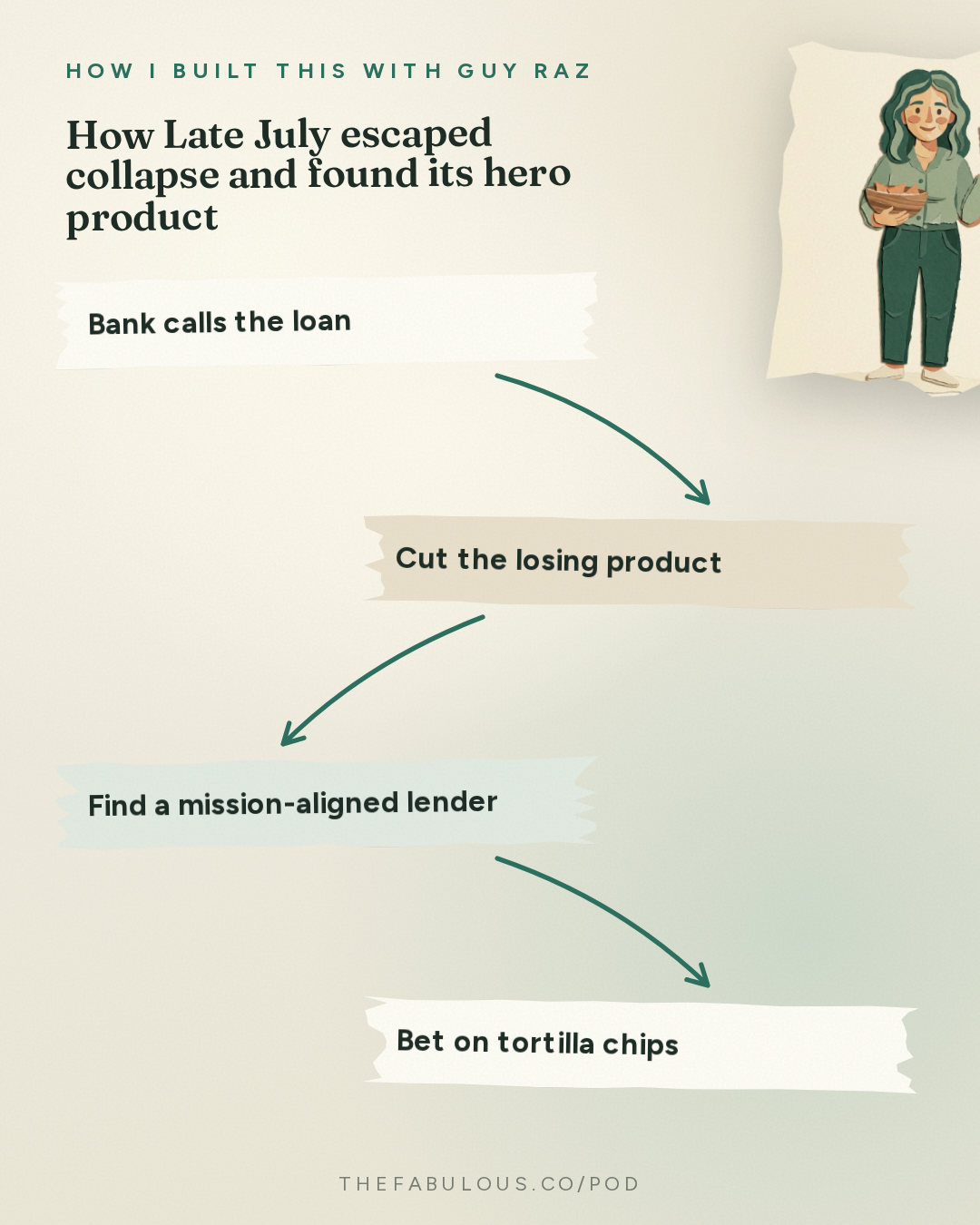
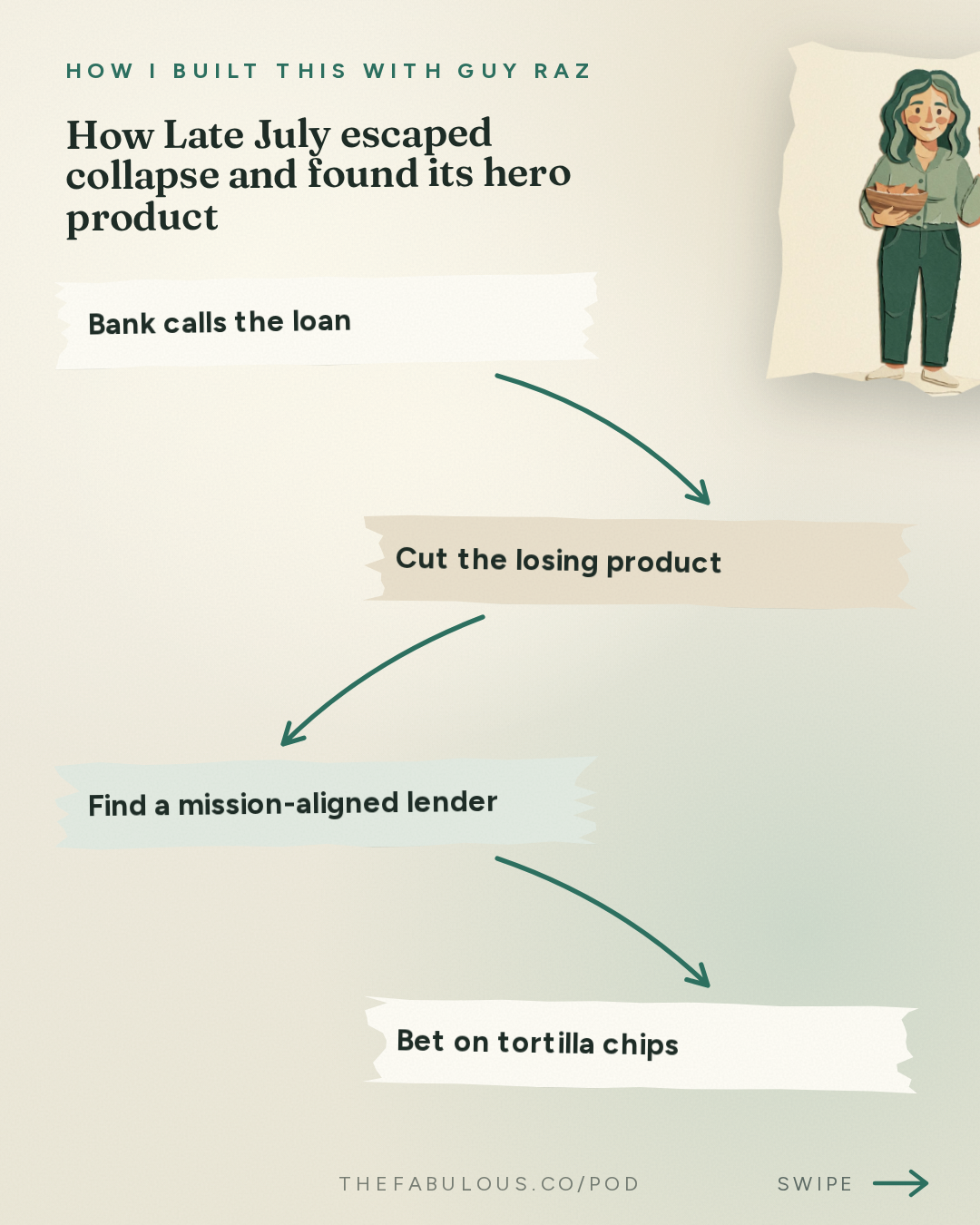
Three weeks after Nicole Bernard Dawes buried her father, a letter arrived that had nothing to do with grief and everything to do with fine print. Late July, the organic snack company she had built with him, carried a $3.5 million equipment loan tied to a facility deal with a strategic investor. Buried in that loan agreement was a clause common to many LLC loans: if a member of the company dies, the loan can be called into default. Her father, Steve Bernard, was a member. The bank gave her 30 or 60 days to cure a default that, as she put it, was simply not curable (46:43). This is the kind of detail that never shows up in a founder's origin story until it nearly ends one.
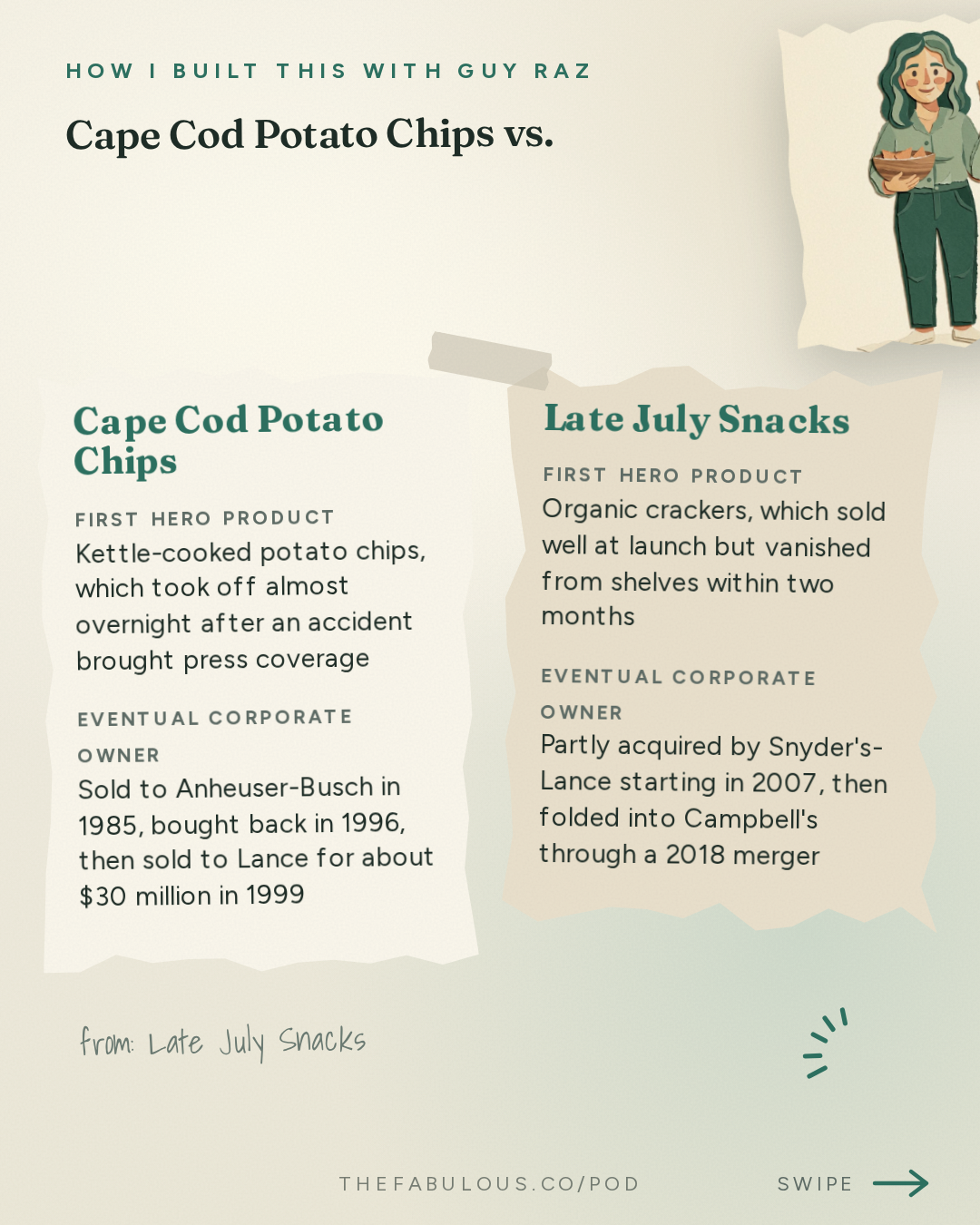
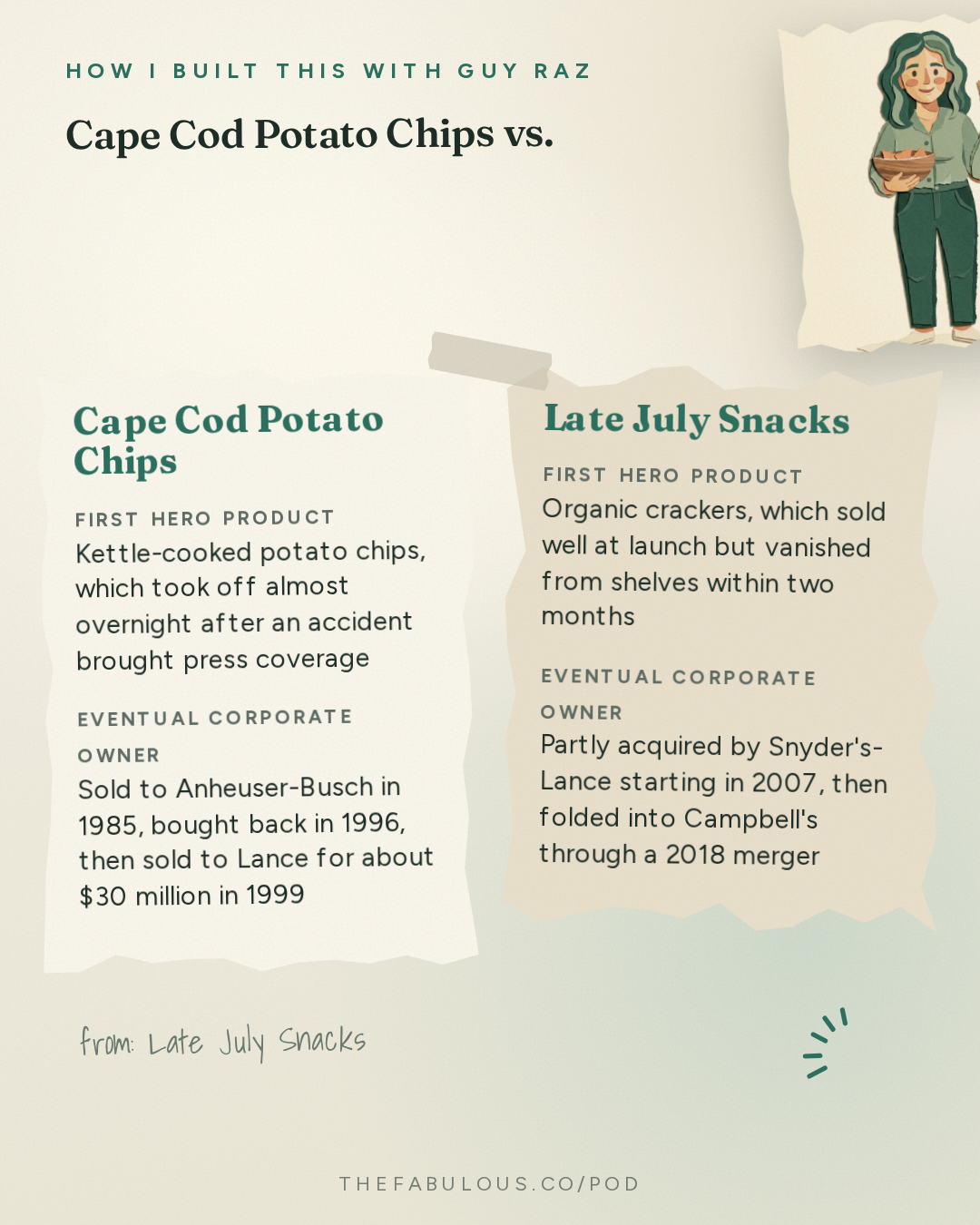
The company that clause threatened had deep roots. Steve Bernard started Cape Cod Potato Chips in a tiny Hyannis storefront in the early 1980s, after reading a Parade magazine article about tourists lining up for old-fashioned kettle-cooked chips in Hawaii (06:38). The chips tasted great, but almost nobody knew the shop existed, and the business nearly failed in its first year (07:43). Then a driver having a heart attack crashed his car through the glass front of the store. The wreck made the local paper, the insurance payout covered the winter, and by the next tourist season the brand had momentum it never had before (08:06). Bernard sold Cape Cod to Anheuser-Busch in 1985, bought it back for under $3 million in 1996 when the beer company divested its snack division (14:32), and sold it again in 1999 to a company called Lance for about $30 million (18:54).
Nicole Bernard Dawes grew up inside that factory, sorting chips before she could ride a bike. When her father sold Cape Cod the second time, she was starting her own career and decided she wanted to build something of her own. She landed on organic crackers almost by accident, standing in a health food store's cracker aisle while pregnant, noticing that the whole center of the store still looked frozen in the 1970s while the produce section had modernized around it (22:04). Late July launched at a 2003 trade show in Baltimore and left, in her words, a national brand (27:18). It was also one of the first companies to launch with the entire line carrying the brand-new USDA organic seal, created that same year under the Organic Food Production Act (23:40). Then, about two months later, the orders stopped. Retailers excited about the idea of organic had ordered ahead of their own customers' demand, and when that demand didn't materialize, sales simply disappeared (28:56).
What Dawes hadn't accounted for was velocity, the industry term for how fast a product actually moves off the shelf. Crackers, it turned out, are an occasional-use item, something you buy for guests or cheese, while a bag of chips tends to get opened and finished. She estimated that customers go through roughly ten bags of chips for every box of crackers sold (35:17). Her whole strategy had assumed crackers would sell like chips. They didn't. Her guiding philosophy, though, never wavered.
"I have built my entire career out of making organic and natural products, healthy, organic, natural products taste like conventional ones." — Nicole Bernard Dawes [36:15]
The debt that almost ended it
By 2008, Late July was doing about $8 million in sales, still without a true breakout product. The company had also launched a line of organic sandwich cookies, made with real dark chocolate and Madagascar vanilla, that Dawes loved but that cost too much to produce profitably (40:52). As the financial crisis hit, she and her husband decided the $2 million in cookie sales had to go (43:39). At almost the same moment, her father was diagnosed with terminal pancreatic cancer. He died in March 2009, at 61 (47:32). At his wake, a group of small individual investors tried to organize a shareholders meeting to ask whether the company could survive without him (45:33). Three weeks later came the loan default letter.
Dawes says the experience taught her a lesson she now repeats to every founder she meets.
"I tell everyone I talk to, like, if you get debt, get keyman insurance." — Nicole Bernard Dawes [47:10]
Keyman insurance is a policy that pays out if a critical member of a business dies, money that can be used to cover exactly the kind of debt trigger Dawes hit. She didn't have it. Instead, she talked the bank into more time, then used a trade show panel appearance to tell her company's story to whoever would listen. A writer named Meg Hirshberg happened to be in the audience, working on a piece for Inc. magazine, and called her husband, Gary Hirshberg, the founder of the yogurt company Stonyfield Farms, mid-conversation to say he had to meet Dawes (51:34). Gary Hirshberg became an investor and mentor. Around the same time, Dawes connected with RSF Finance, a San Francisco lender that funds mission-driven businesses, which agreed to take over the defaulted debt (52:32).
Betting the company on a snack aisle newcomer
With the company's future no longer measured in weeks, Dawes turned to the product that would define Late July's second act: organic tortilla chips. The choice wasn't random. Tortilla chips are naturally gluten-free and nut-free, which mattered because her younger son had just been diagnosed with a life-threatening peanut allergy the same week as her father's wake, while Late July's best-selling product at the time was a peanut butter cracker (49:16). Moving into chips also meant competing in a completely different, more crowded part of the grocery store, one where a rival salesperson was already telling buyers that Late July, under Dawes, was finished (58:06).
The turning point came in a single sales meeting at Stop & Shop, the New England grocery chain. Dawes, who had rarely handled sales herself, was so nervous she read her pitch word for word instead of listening to the buyer. At the end, out of options, she simply asked him to tell her right then whether the answer was yes. He said yes (63:06). That single account unlocked the distribution deal she needed, and within three years Late July grew from roughly $8 million in sales to $100 million, still run by a lean staff of about 27 people (68:29).
That growth attracted more attention from Snyder's-Lance, the company that had bought a 19% stake in Late July back in 2007 in exchange for manufacturing help (41:33). Dawes had liked working with a strategic investor rather than a venture capital firm precisely because strategic investors tend to have longer time horizons and less pressure for a quick exit (42:27). But she also learned, in hindsight, a harder truth.
"Whenever you take a strategic investment, whether or not you intend to sell them the business, you should expect that to be the outcome." — Nicole Bernard Dawes [42:49]
In 2014, Snyder's-Lance increased its stake to 80%, largely so early individual investors, including Dawes's widowed mother, could finally get a return (69:43). Four years later, Campbell's acquired Snyder's-Lance outright. Late July's contract had a clause letting Dawes buy the brand back if Snyder's-Lance was ever sold, but the deal was structured as a merger, not a sale, so the clause never applied (73:51). Fighting it would have meant years of costly litigation over a brand she still loved, so she let it go.
Dawes had already started planning her next company before the Campbell's deal closed: Nixie, an organic sparkling water and soda brand she self-funded, deliberately avoiding outside investors until she understood her own product velocity (81:03). Nixie launched just before the pandemic, a timing she expected to be disastrous but that turned out to level the playing field, since every competitor was struggling with the same disruptions at once (82:30). Looking back across three companies and one family's worth of near-collapses, Dawes draws a clean line between the parts of success she can credit to circumstance and the parts she can't.
"Once you go take that next step and, like, why didn't it fail, that's where the luck starts to fizzle out and the hard work picks up." — Nicole Bernard Dawes [88:48]
Her father's chip company and her own cracker-turned-tortilla-chip company now sit in the same corporate portfolio, a coincidence she still notices every time she walks a grocery aisle. It is not the outcome either of them planned for. It is the one that survived.
Ask this episode anything
Pod's AI answers from the episode itself, with the minute mark so you can hear it yourself.
Or start with one of these
Ask this episode
Pod's AI listens to the whole episode to answer, and points you to the minute it comes from.
The rest of this answer, and any question after it
Answers come from the episode itself, never from a summary of it.
ContinueKey takeaways
- A 'death of a member' loan clause put Late July into default weeks after founder Steve Bernard died
- Crackers sell at roughly one-tenth the speed of potato chips, which is why Late July's cracker line stalled
- Nicole Bernard Dawes pivoted to organic tortilla chips because they are naturally gluten-free and nut-free
- Late July grew from $8 million to $100 million in sales within three years of the tortilla chip launch
- Campbell's absorbed Late July through a 2018 merger with Snyder's-Lance, which voided a buyback clause meant to protect the brand from a sale
The episode in cards
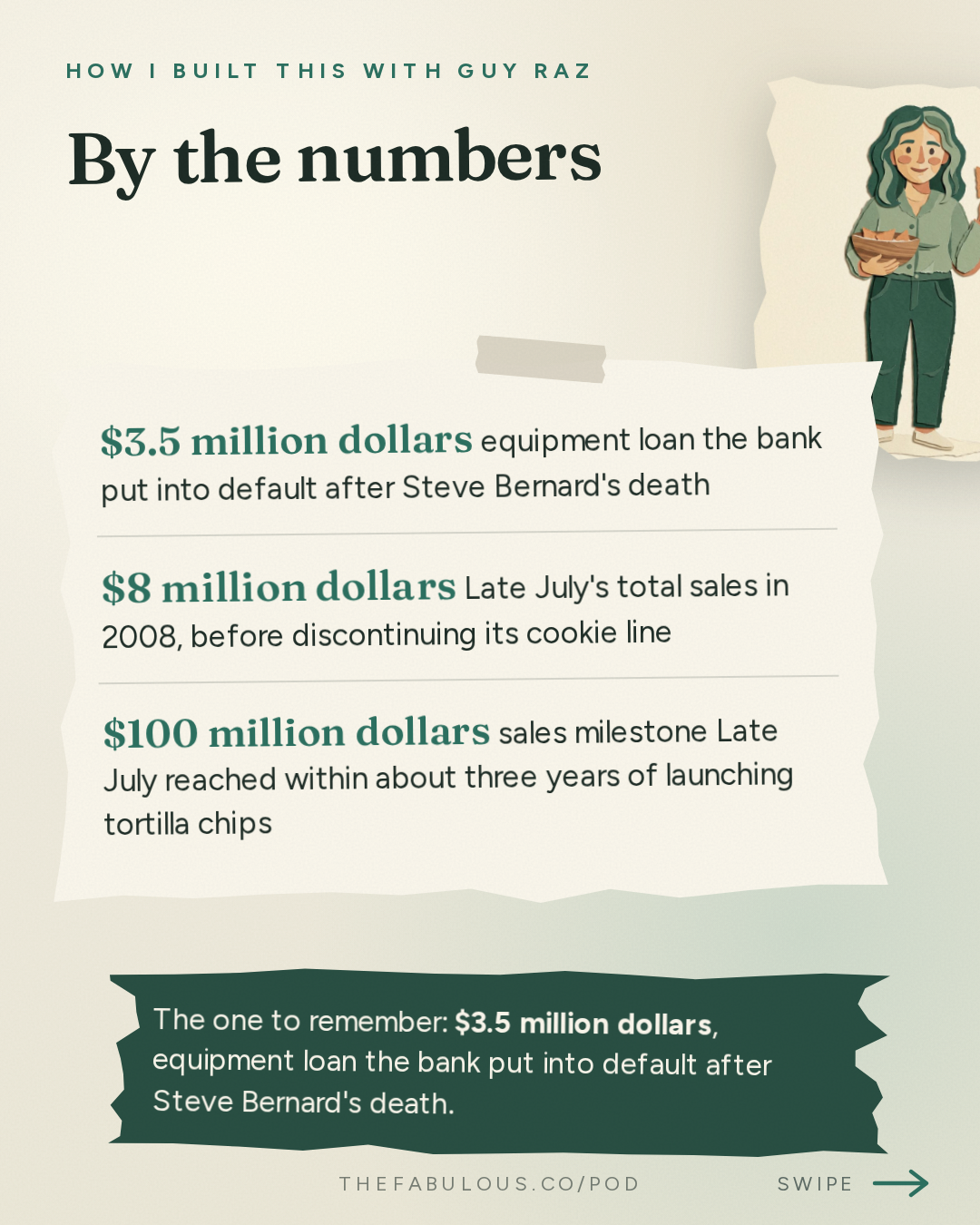
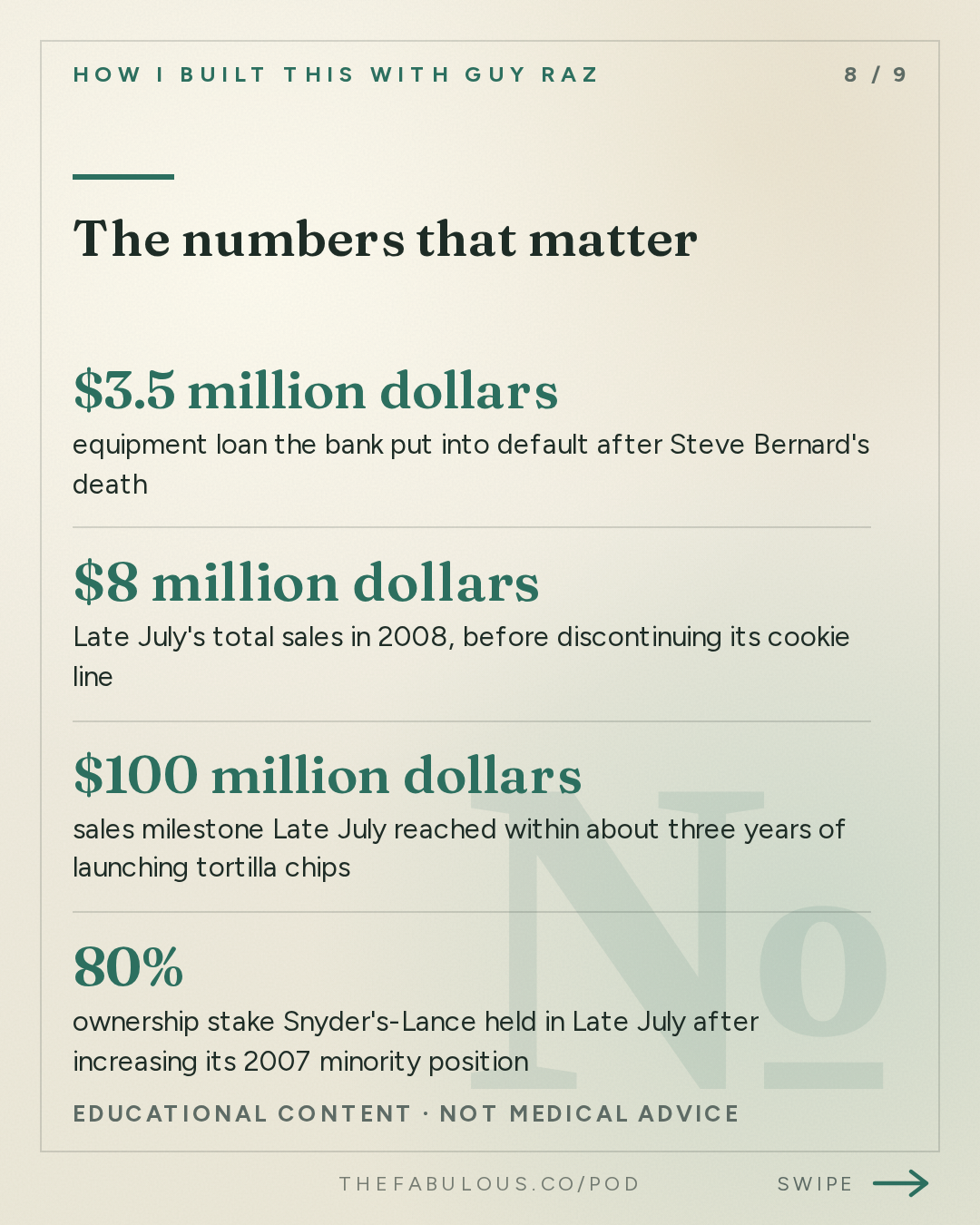
By the numbers
- $3.5 million dollars equipment loan the bank put into default after Steve Bernard's death
- $8 million dollars Late July's total sales in 2008, before discontinuing its cookie line
- $100 million dollars sales milestone Late July reached within about three years of launching tortilla chips
- 80% percent ownership stake Snyder's-Lance held in Late July after increasing its 2007 minority position
In their words
“I have built my entire career out of making organic and natural products, healthy, organic, natural products taste like conventional ones.”
“I mean, I tell everyone I talk to, like, if you get debt, get keyman insurance.”
“Whenever you take a strategic investment, whether or not you intend to sell them the business, you should expect that to be the outcome.”
“Getting out of a snack business and starting a beverage business is maybe one of the stupidest things that you can do. You went from the second hardest category to the first hardest category”
Protocols
-
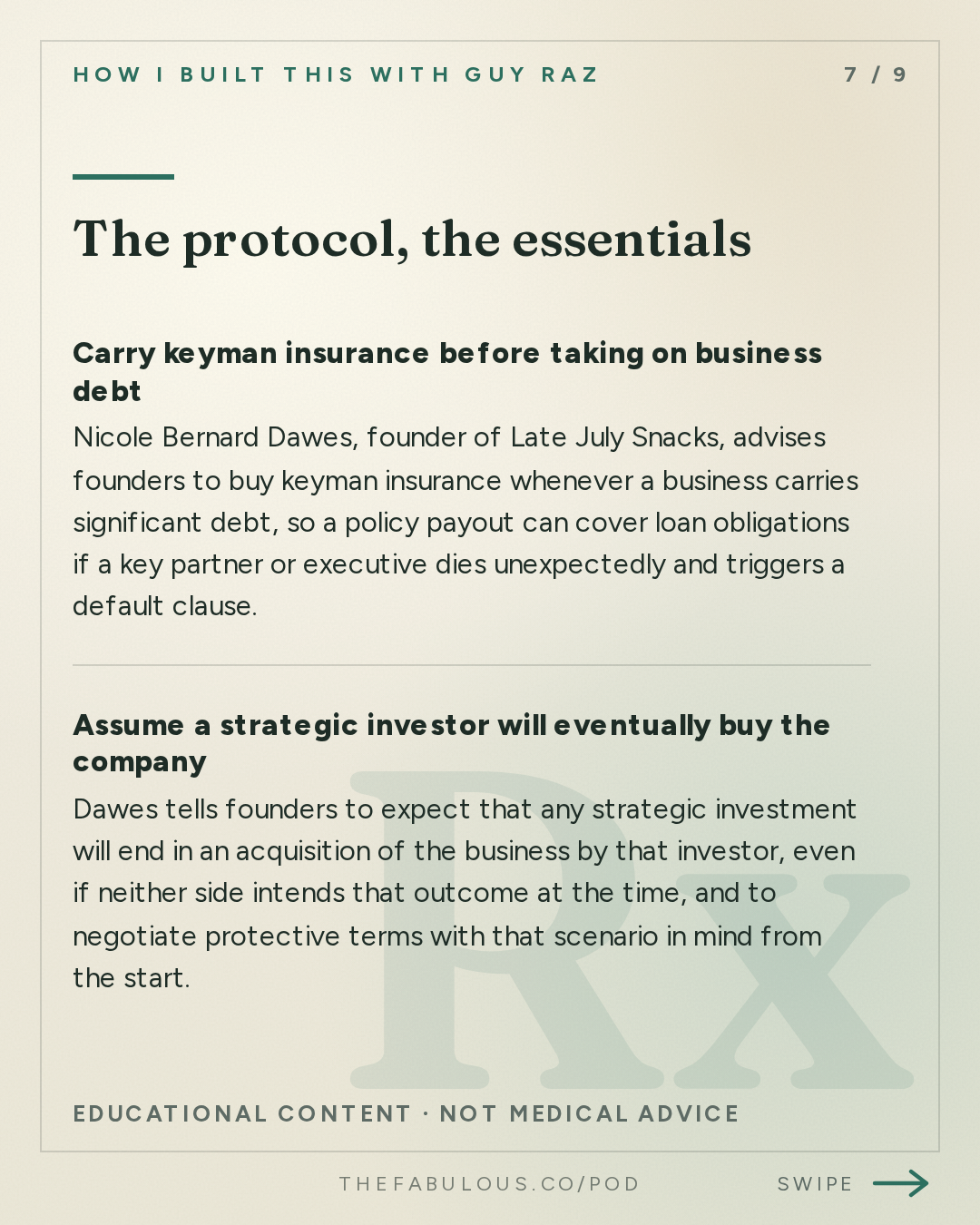
Carry keyman insurance before taking on business debt
Nicole Bernard Dawes, founder of Late July Snacks, advises founders to buy keyman insurance whenever a business carries significant debt, so a policy payout can cover loan obligations if a key partner or executive dies unexpectedly and triggers a default clause.
Put in place once, before or when taking on debt
-
Assume a strategic investor will eventually buy the company
Dawes tells founders to expect that any strategic investment will end in an acquisition of the business by that investor, even if neither side intends that outcome at the time, and to negotiate protective terms with that scenario in mind from the start.
Applied once, during investment negotiations
-
Make mistakes fast and small
Dawes recommends that founders test new products or pivots in ways that surface failures quickly and cheaply, rather than betting the entire company on an unproven idea without smaller trial steps first.
Ongoing, applied with each new product decision
Questions this episode answers
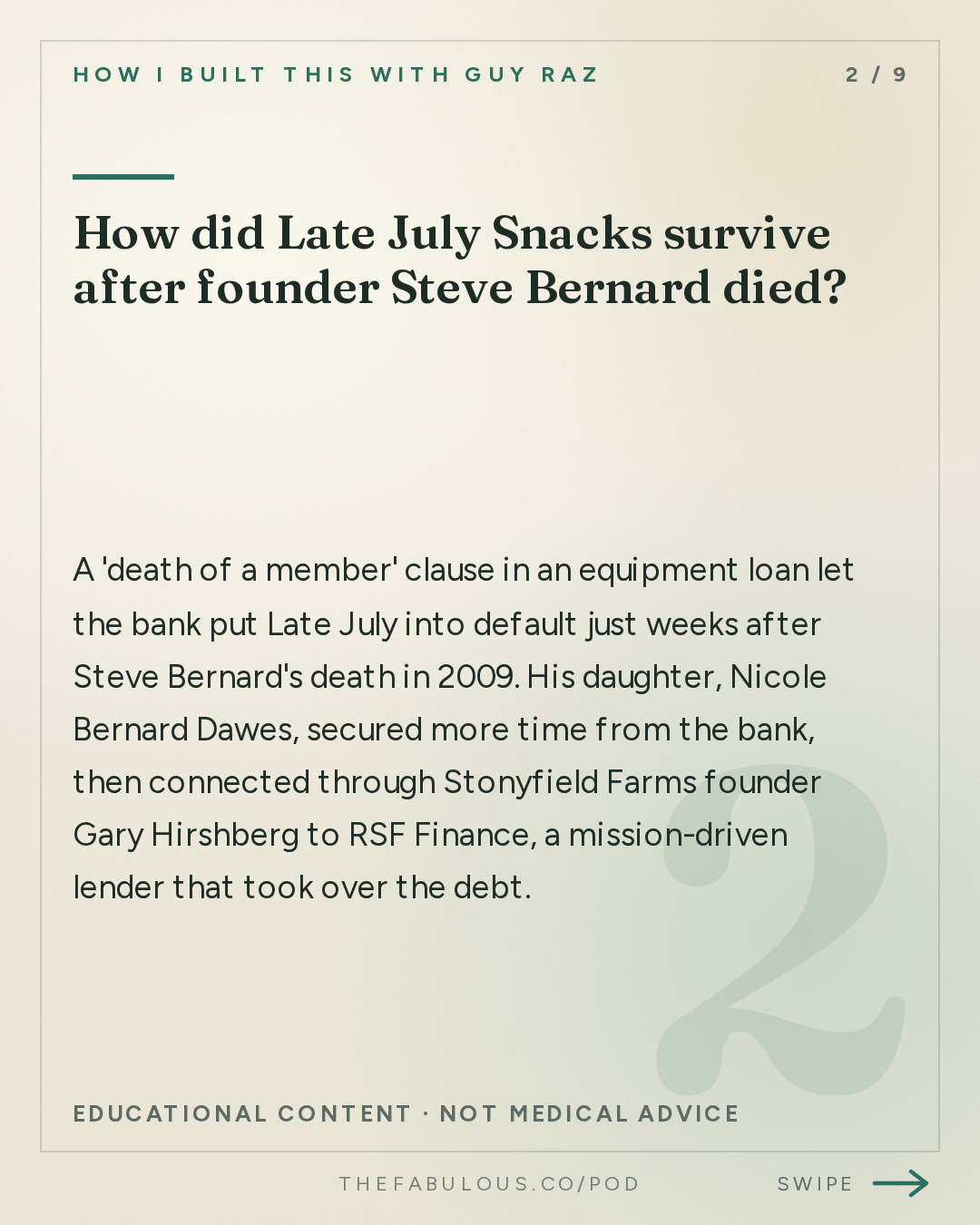
How did Late July Snacks survive after founder Steve Bernard died?
A 'death of a member' clause in an equipment loan let the bank put Late July into default just weeks after Steve Bernard's death in 2009 (46:43). His daughter, Nicole Bernard Dawes, secured more time from the bank, then connected through Stonyfield Farms founder Gary Hirshberg to RSF Finance, a mission-driven lender that took over the debt (52:32).
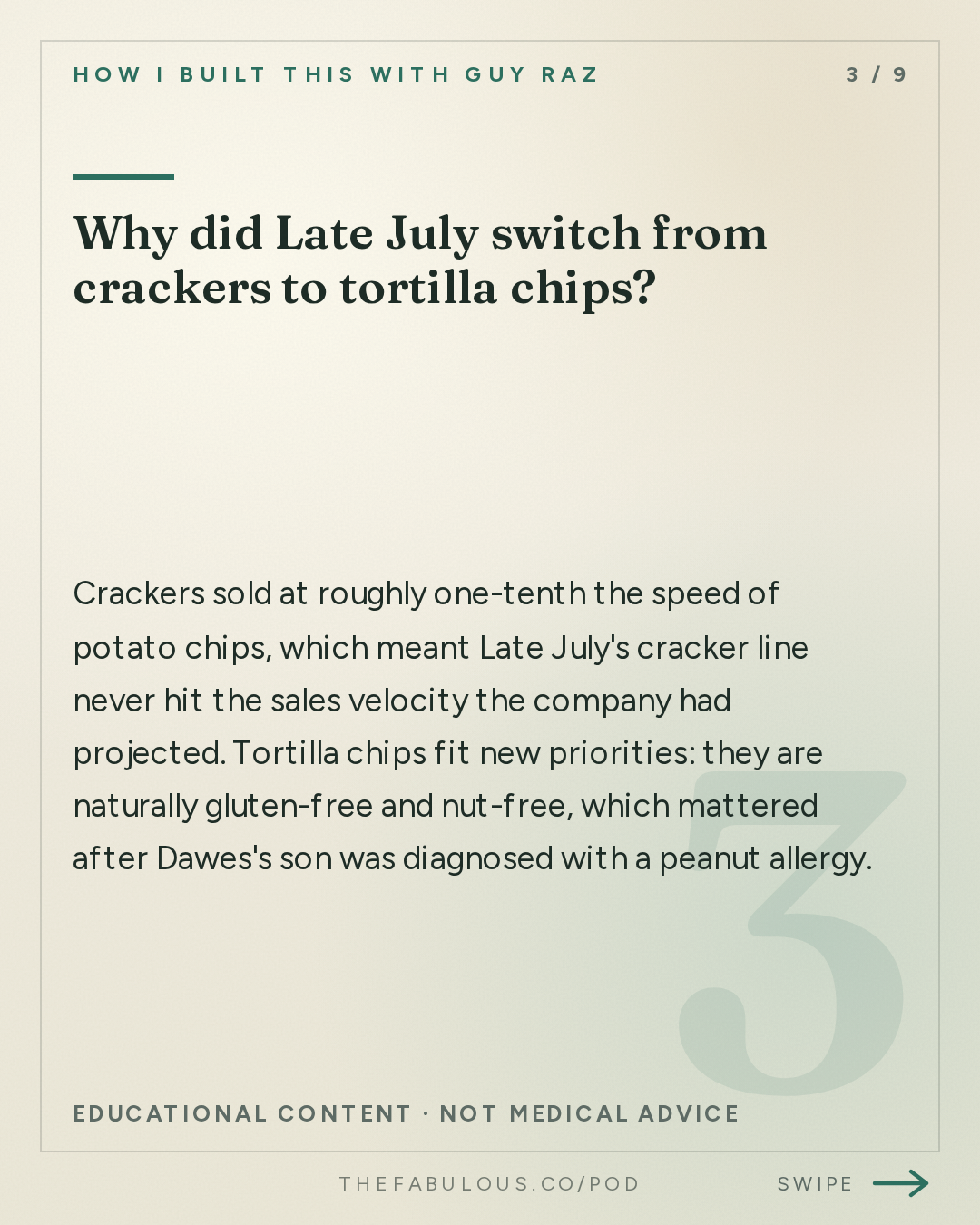
Why did Late July switch from crackers to tortilla chips?
Crackers sold at roughly one-tenth the speed of potato chips, which meant Late July's cracker line never hit the sales velocity the company had projected (35:17). Tortilla chips fit new priorities: they are naturally gluten-free and nut-free, which mattered after Dawes's son was diagnosed with a peanut allergy (54:07).
Who bought Late July Snacks?
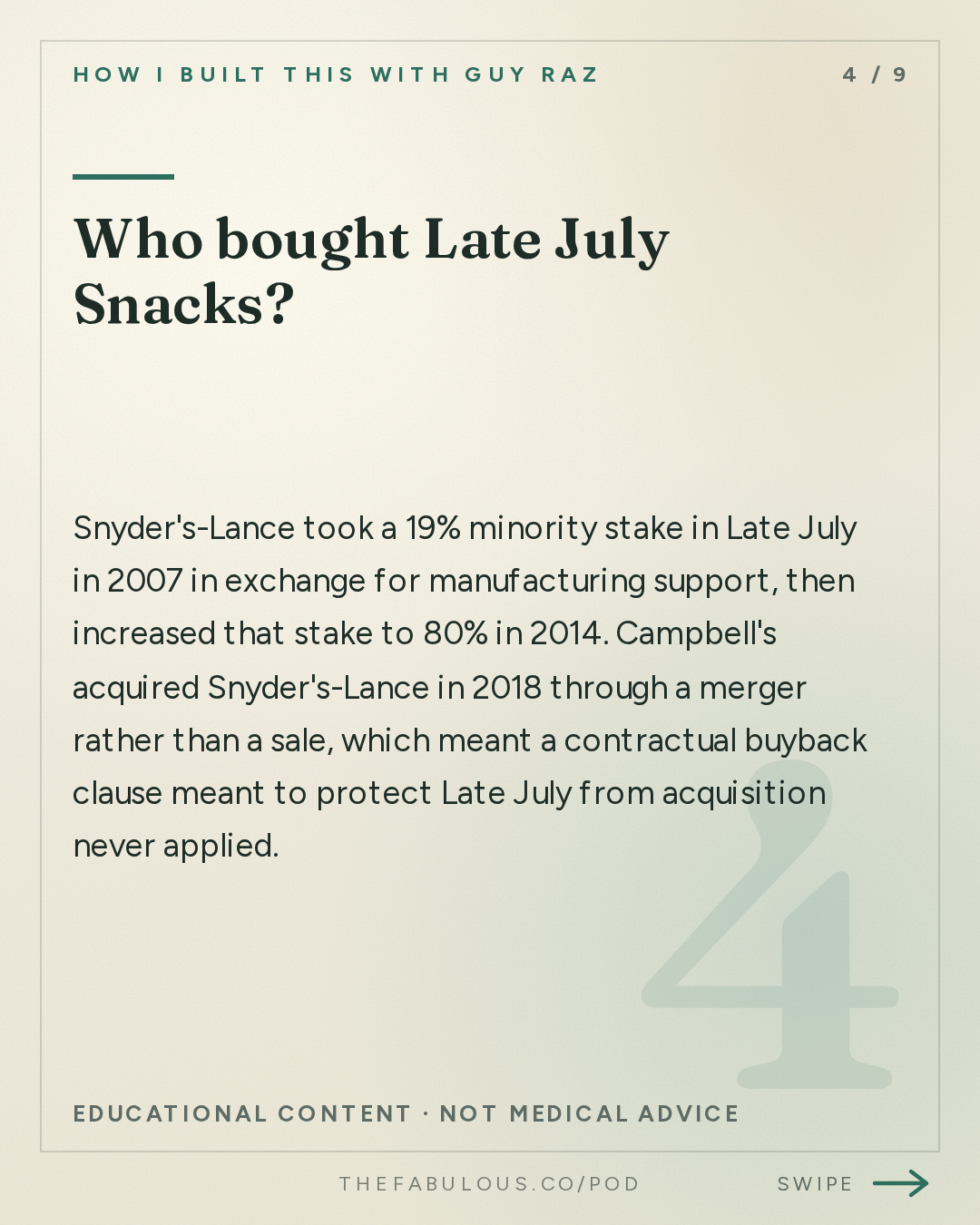
Snyder's-Lance took a 19% minority stake in Late July in 2007 in exchange for manufacturing support (41:33), then increased that stake to 80% in 2014 (69:43). Campbell's acquired Snyder's-Lance in 2018 through a merger rather than a sale, which meant a contractual buyback clause meant to protect Late July from acquisition never applied (73:51).
What is a 'death of a member' clause in a business loan?
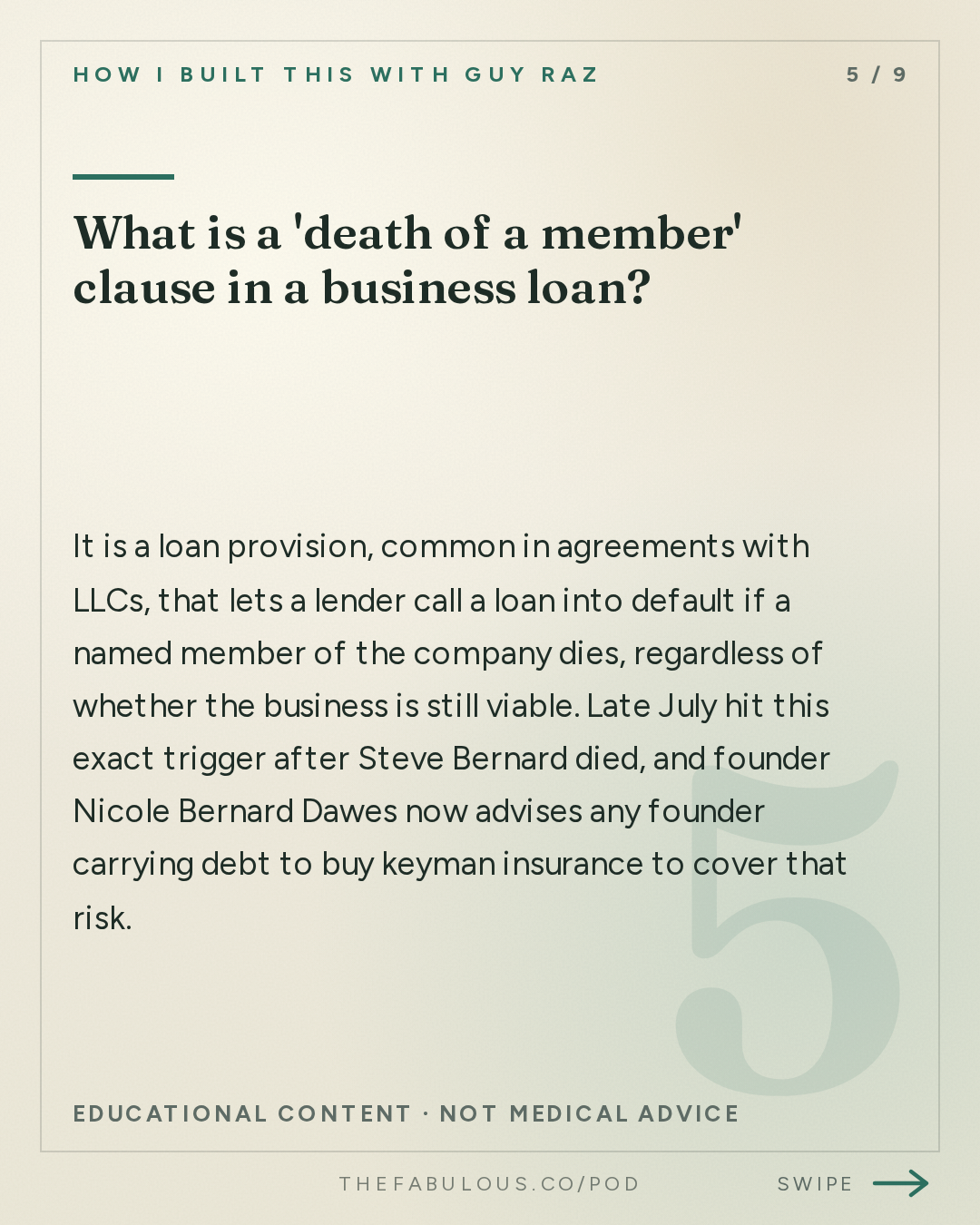
It is a loan provision, common in agreements with LLCs, that lets a lender call a loan into default if a named member of the company dies, regardless of whether the business is still viable. Late July hit this exact trigger after Steve Bernard died, and founder Nicole Bernard Dawes now advises any founder carrying debt to buy keyman insurance to cover that risk (47:10).
What happened to Cape Cod Potato Chips over the years?
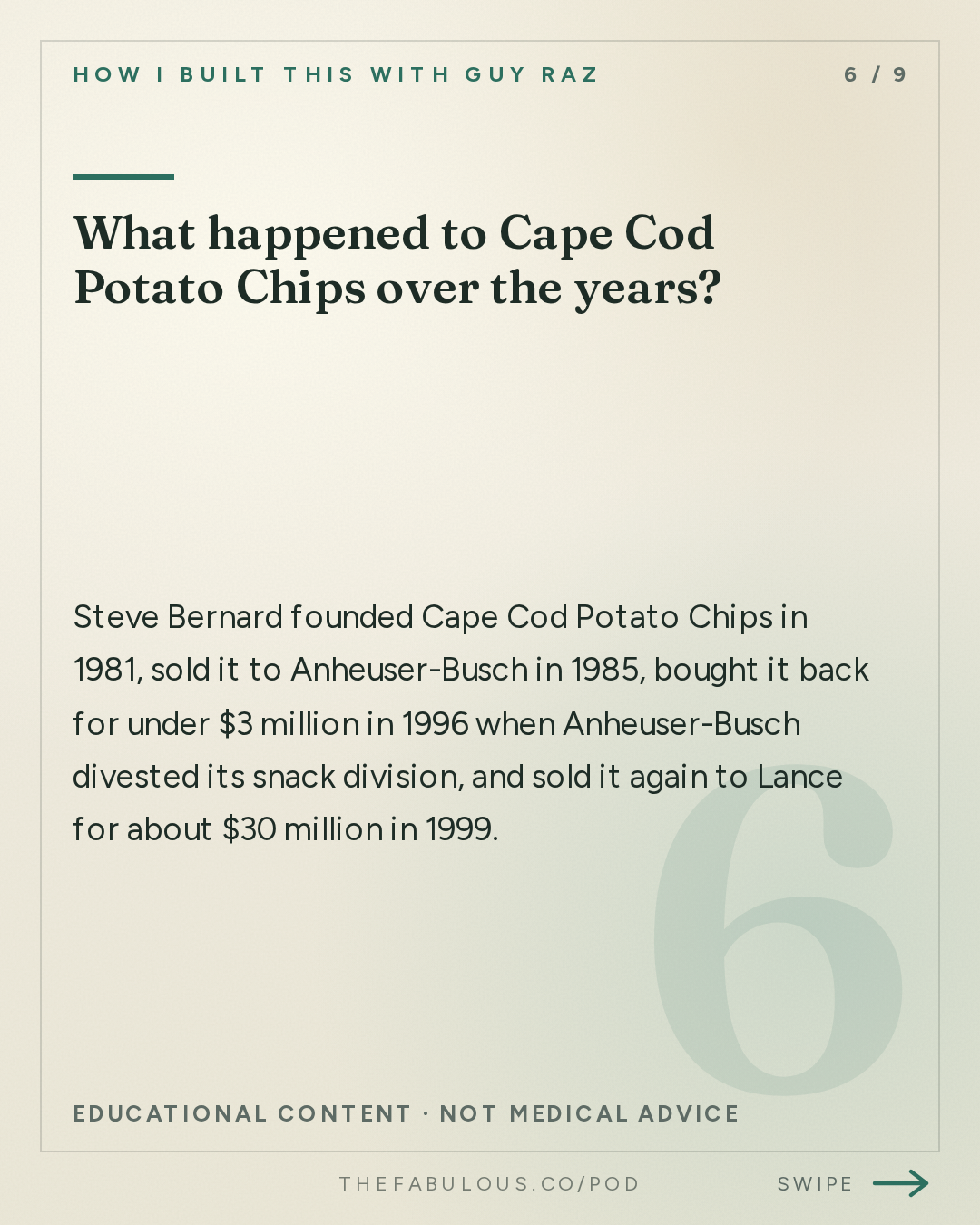
Steve Bernard founded Cape Cod Potato Chips in 1981, sold it to Anheuser-Busch in 1985, bought it back for under $3 million in 1996 when Anheuser-Busch divested its snack division (14:32), and sold it again to Lance for about $30 million in 1999 (18:54).
The full read, in cards
Go deeper
- Parade magazine article on Hawaiian-style potato chips — Read by Steve Bernard, it inspired him to start making kettle-cooked chips on Cape Cod
- Organic Food Production Act — Created the USDA organic seal the same year Late July launched, letting it become one of the first brands to carry the seal on its entire line
Mentioned
Nicole Bernard Dawes · Steve Bernard · Cape Cod Potato Chips · Late July Snacks · Campbell's · Nixie Beverage Company · Snyder's-Lance · Gary Hirshberg · Meg Hirshberg · RSF Finance · Stonyfield Farms · Anheuser-Busch · Whole Foods · Stop & Shop
More from this show and category
Sweet Loren's Cookie Dough Success Story
Loren Castle turned a cookie stand at Brooklyn's Smorgasburg market into Sweet Loren's, a cookie dough brand now in more than 30,000 stores. After surviving Hodgkin's lymphoma at 22, she built the business slowly, then rebuilt it entirely around allergen-free recipes once customer demand made clear that was the real opportunity, reaching profitability in 2018.
CPG Brand: Moving From D2C to Retail
SmartSweets founder Tara Bosch, who sold a majority stake for $360 million, coaches four founders on moving from D2C to grocery retail. She covers wholesale-versus-direct splits, reformulating sugar and allulose, niche marketing for a swimwear brand, and when to pivot an experience-subscription box.
The History of Alamo Drafthouse Cinema
Tim and Karrie League, two Rice University graduates with an engineering job and a microbiology PhD between them, opened a failed art house theater in Bakersfield in 1993, then rebuilt the idea inside an Austin parking garage in 1997 and grew it into Alamo Drafthouse Cinema, a dine-in chain that survived a lawsuit, a Me Too reckoning, and COVID bankruptcy before Sony Pictures Entertainment bought it in 2023.
Nick Green's Advice for Scaling Niche Brands
Thrive Market CEO Nick Green coaches three founders to scale through focus, not features, on How I Built This's Advice Line. He tells a concert-wear designer to cut SKUs, a coffee founder to fund growth with subscriptions instead of outside cash, and an ALS app founder to court clinicians and caregivers, not patients, for awareness.
