Disney's Business History: Flywheel to Streaming
Disney: The Renaissance and the Empire
The brief
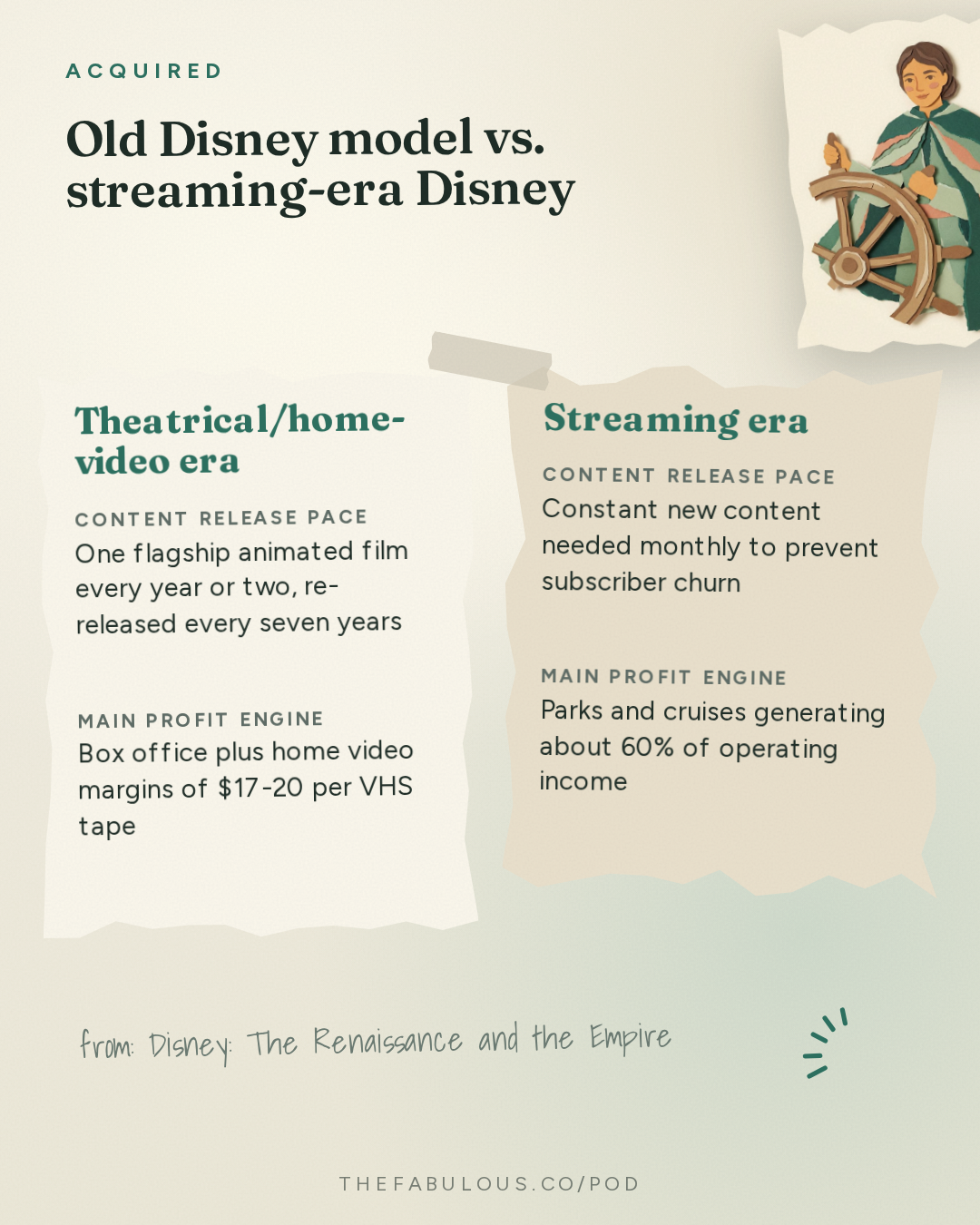
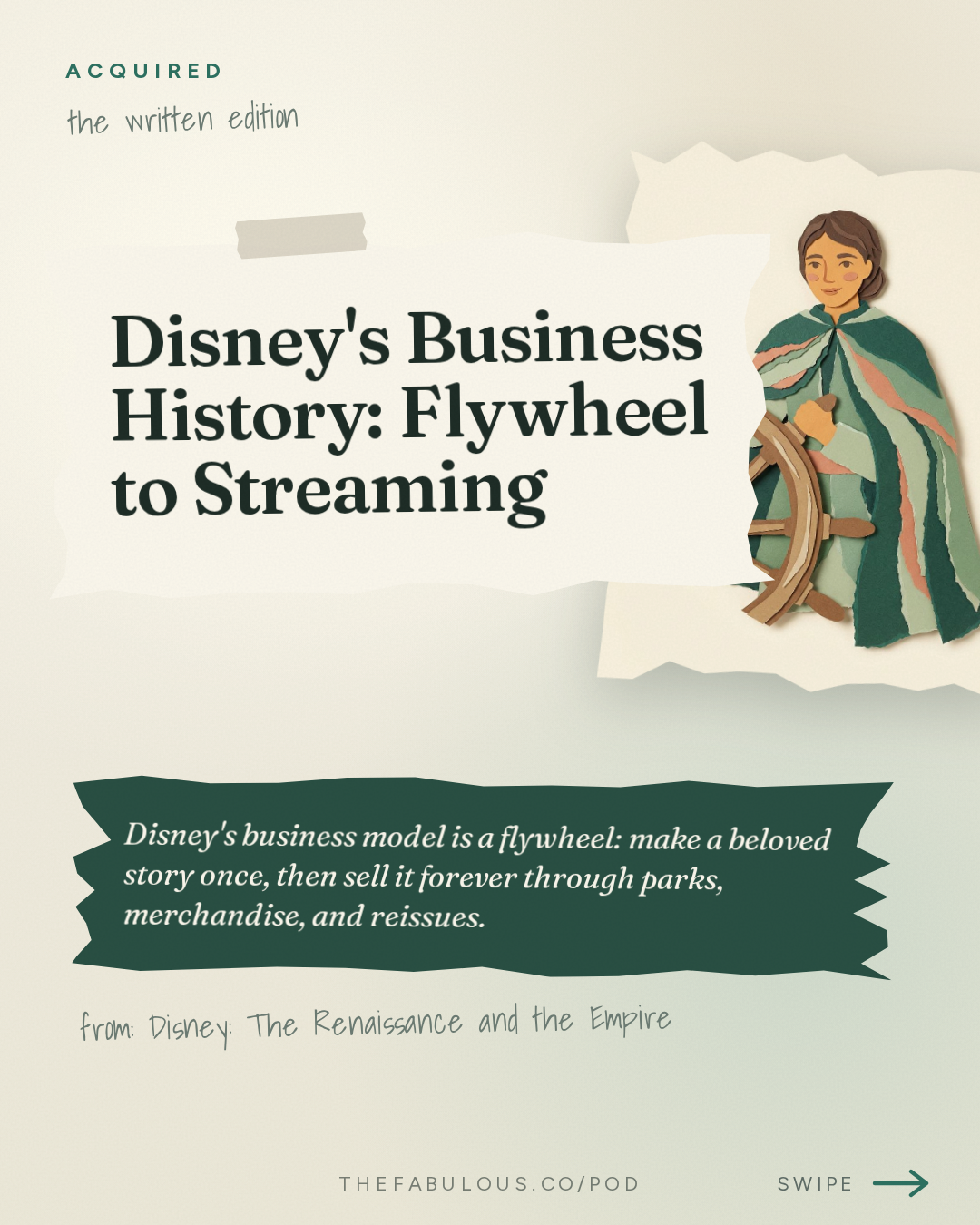
Disney's business model is a flywheel: make a beloved story once, then sell it forever through parks, merchandise, and reissues. This episode traces how Michael Eisner and Bob Iger rebuilt that flywheel twice, first with animation and ESPN, then with Pixar, Marvel, and streaming, and asks whether the flywheel still turns.
In 1984, parking at Walt Disney World cost a dollar. It had cost a dollar for years, because raising it felt like a betrayal of Walt's promise that the park would stay affordable. That same year, the company's parks and consumer products earned it a quarter billion dollars in profit. Its film and television business, the very thing the public thought of as Disney, earned two million dollars (08:14). The studio that made Snow White and Cinderella was, for practical purposes, broke. Corporate raiders circled. The board diluted its own stock by 25 percent just to hand control to a friendly Texas oil family rather than lose the company outright.
That crisis is the hinge of this story, because it forces a question Disney would face again and again over the next four decades: what do you do when the thing that made you special stops paying the bills? The company's answer, twice, was to bring in outsiders who did not love Disney the way insiders did, and let them rebuild the flywheel from parts that still worked.
The first rescue came from Paramount. Michael Eisner and Frank Wells arrived in September 1984, followed quickly by Eisner's deputy, Jeffrey Katzenberg. None of them had grown up on Disney movies. What they brought instead was a Paramount philosophy called singles and doubles: cheap, script-driven films instead of expensive star vehicles. Eisner's leaked internal memo captured the logic bluntly.
"We have no obligation to make art. We have no obligation to make history. We have no obligation to make a statement. But to make money, it is often important to make history, to make art, or to make some significant statement." - Michael Eisner [15:01]
That logic, oddly, matched Walt's own instinct that story comes before spectacle. Applied to animation, it produced the run now called the Disney Renaissance. The real authors of that revival were not executives but a songwriter named Howard Ashman and composer Alan Menken, recruited by Katzenberg. Ashman's insight was structural: treat animated films as Broadway musicals, built around a clear song of longing early in the story, so the audience knows exactly what the hero wants. That idea, applied to The Little Mermaid in 1989, then Beauty and the Beast, Aladdin, and The Lion King, rebuilt Disney's core business from the ground up. The Lion King alone grossed 750 million dollars at the box office on a 45 million dollar budget, becoming the most successful traditionally hand-drawn animated film ever made (33:23).
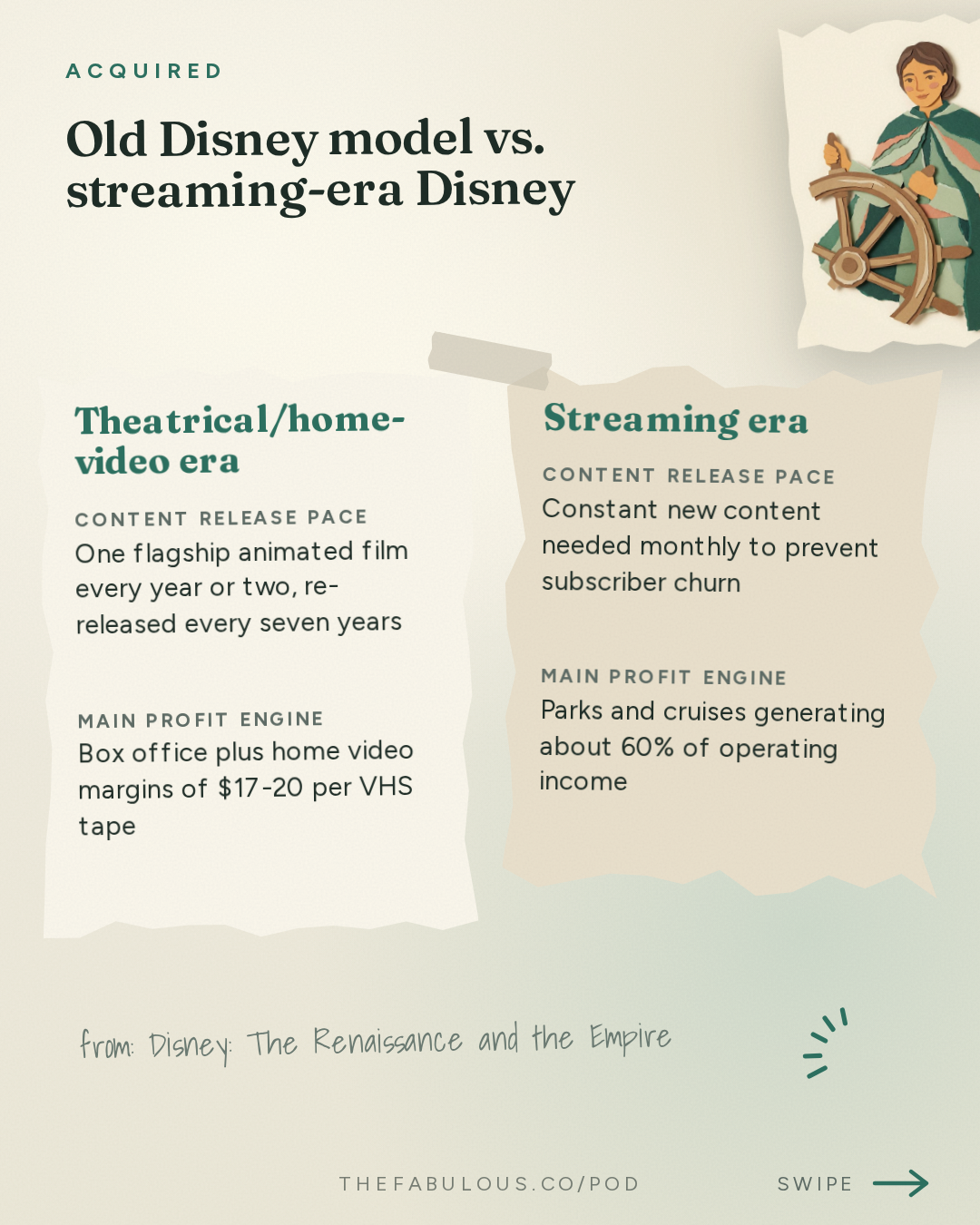
What made the era genuinely historic, though, was not the films but what Disney did with them afterward. Home video, once dismissed by the Disney family as heresy, turned out to carry 17 to 20 dollars of pure profit per VHS tape (40:53). The Lion King sold 32 million tapes, the best-selling videocassette ever, worth roughly a billion dollars in sales at margins near 50 percent (42:13). Then came Broadway. The Lion King musical, still running three decades later across multiple cities and a touring company, has grossed more than 11 billion dollars in total revenue (45:50), which the hosts note may make it the single highest-grossing piece of entertainment in any medium, film included.
"Lion King the musical is the highest grossing piece of entertainment ever created in history. Of any medium, the highest grossing is a Broadway musical?" - Ben Gilbert [46:20]
The Accident That Paid for Everything
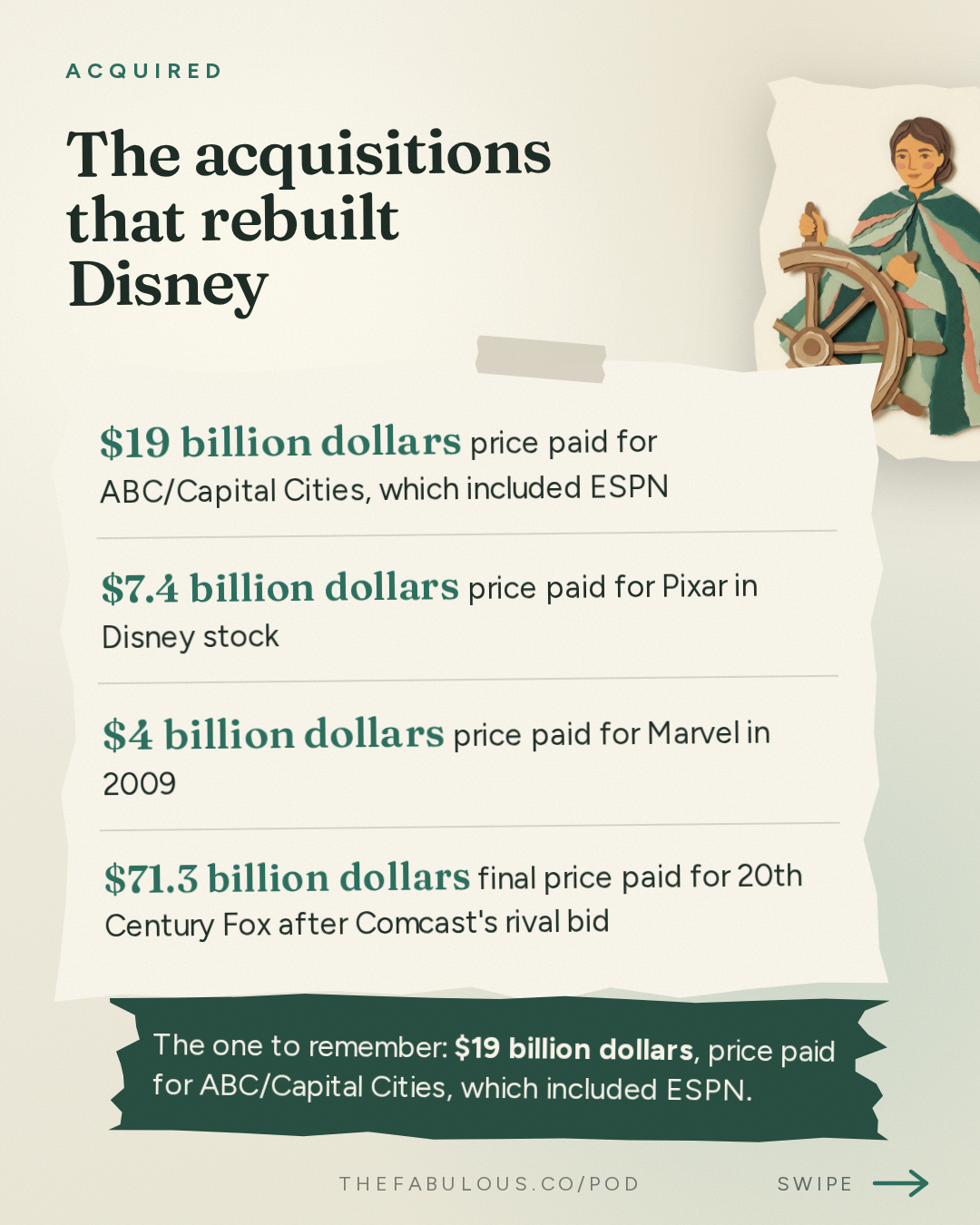
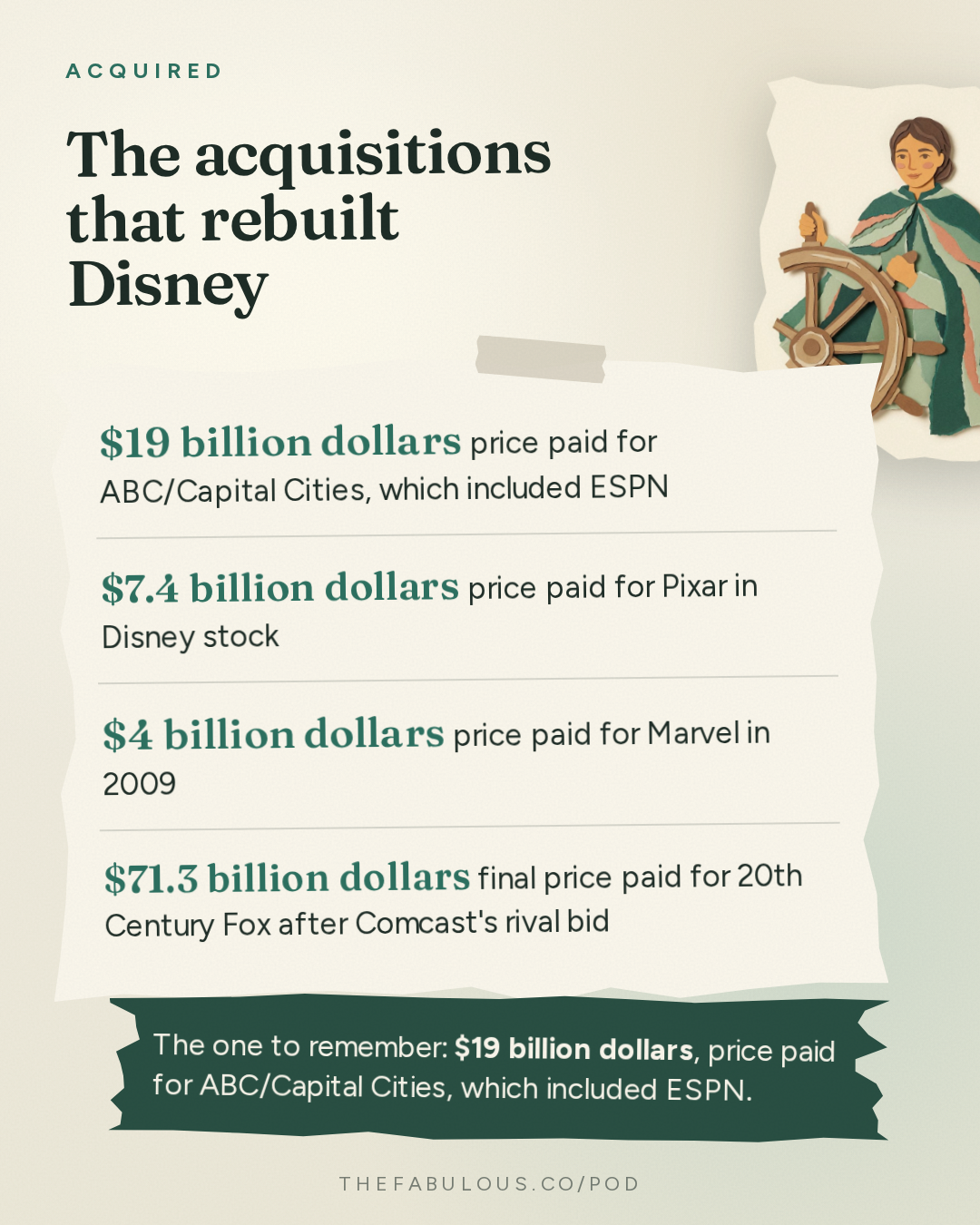
None of this explains where most of Disney's money actually came from for the next two decades. That answer arrived almost by accident, buried inside a 1996 acquisition of ABC and its parent, Capital Cities, for 19 billion dollars (63:51). ABC came with a cable sports channel that nobody involved thought would matter much. "Nobody would've told you when that deal was being made that ESPN was gonna turn out to be the weightlifter of the group," as Roy E. Disney later put it (71:15).
ESPN's real innovation was not sports coverage. It was a business model: charging cable operators a monthly fee per subscriber, whether or not that subscriber ever watched a game, because live sports gave ESPN leverage to threaten blackouts. That fee climbed from pennies to an average of 9.42 dollars per subscriber per month (70:09), an amount cable operators paid essentially by contract, regardless of ratings. Between 2008 and 2011, Disney's cable networks, three-quarters of that segment being ESPN, generated 60 percent of the entire company's operating income (76:31). ESPN did not just make Disney money. It quietly became the company's financial spine, funding parks expansion and, later, some of the biggest acquisitions in entertainment history.
That spine was tested hard in the 2000s. Frank Wells died in a helicopter crash in 1994. Eisner had emergency heart surgery months later. Katzenberg, denied the promotion he believed he'd been promised, quit and started a rival studio, DreamWorks. Disney Animation, without Ashman or Katzenberg, drifted through a string of forgettable films. Roy E. Disney resigned from the board in 2003 and launched a public campaign, savedisney.com, that culminated in 43 percent of shareholders voting to withhold support for Eisner as CEO. Eisner announced his exit, and Bob Iger, then the company's president, won the succession by proposing three priorities: make the highest quality content, embrace new technology instead of fighting it, and expand into global markets like China and India.
Saving Two Companies
Iger's first and most consequential move was Pixar. By the time he became CEO in 2005, Pixar, an animation studio spun out of Lucasfilm and bought by Steve Jobs for five million dollars in 1986 (121:26), had beaten Disney at its own game. Toy Story, Finding Nemo, and The Incredibles were outgrossing anything coming out of Burbank, and the relationship between Jobs and Eisner had collapsed entirely over contract terms. Iger's insight, watching a Hong Kong Disneyland parade stuffed with Pixar characters and almost none of Disney's own recent creations, was that Disney Animation could not be fixed from the inside. It needed to be run by the people who already knew how.
Disney paid 7.4 billion dollars in stock for Pixar in 2006 (157:09), making Jobs the company's largest individual shareholder. On the morning of the announcement, Jobs pulled Iger aside and told him privately that his cancer had returned, before giving him thirty minutes to back out of the deal if he wanted. He didn't. Years later, at a dinner not long before Jobs died, he raised a toast to Iger.
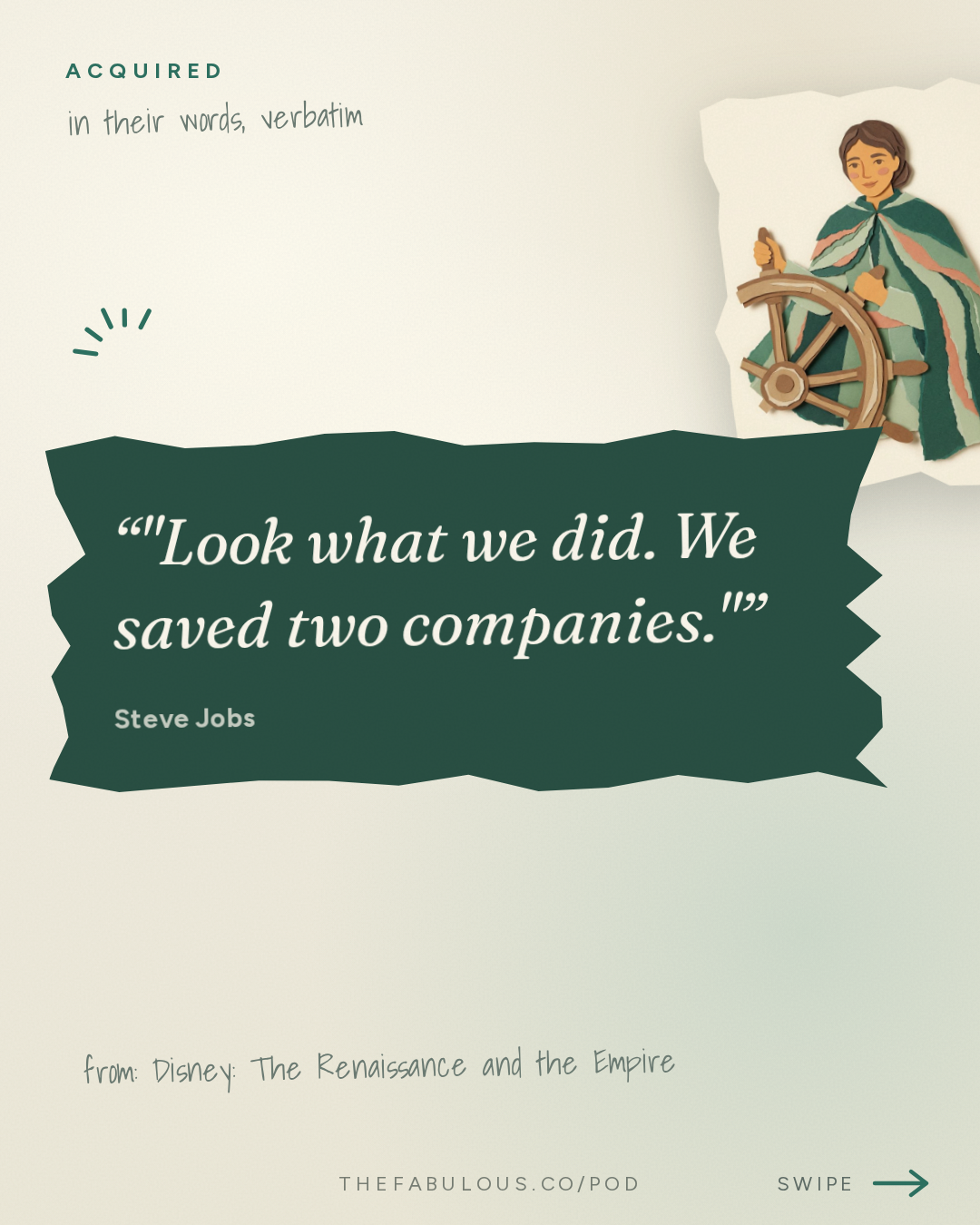
"Look what we did. We saved two companies." - Steve Jobs [162:47]
He meant it literally. Pixar's own leadership never wanted to build a competing empire; they wanted to keep making films in Emeryville, undisturbed. Disney needed Pixar's creative discipline. Neither company could have gotten what it needed alone. The same instinct, buy a differentiated storytelling engine and let it run largely independently, drove the acquisitions of Marvel for 4 billion dollars in 2009 and Lucasfilm for 4 billion dollars in 2012, both funded largely out of a few years of ESPN's cable profits. The costliest and most complicated deal was 20th Century Fox, which Disney initially agreed to buy for 52 billion dollars before a rival bid from Comcast pushed the final price to 71.3 billion dollars (196:07), acquired specifically to bulk up content ahead of a streaming launch.
That launch, Disney+, is where the flywheel meets its hardest test. It signed up 10 million subscribers in its first 24 hours (199:55), an extraordinary debut. But streaming inverted Disney's entire economic logic. The old model made one great, expensive thing rarely, then re-sold it for decades through theaters, video, and parks. Streaming demands a constant supply of new content to prevent subscribers from canceling. Disney has now spent 13 billion dollars building that pipeline (239:55), and theatrical releases, once the company's whole identity, now account for just 3 percent of total revenue (238:25). Parks and cruises, not movies, generate roughly 10 billion dollars in operating profit and about 60 percent of the company's total operating income today (50:01). The characters still matter enormously. It is just no longer clear that movies are how most people meet them first.
What the whole history argues, across raiders, renaissances, an accidental sports network, and two outsider rescues, is that Disney's flywheel has never been self-sustaining. It has always needed someone willing to notice which part of the business had quietly become the engine, and to feed it accordingly. Eisner found that engine in animation, then in ESPN almost by luck. Iger found it in Pixar, then in parks. The next person to run Disney will need to find it again, because the parts that used to spin on their own no longer do.
Ask this episode anything
Pod's AI answers from the episode itself, with the minute mark so you can hear it yourself.
Or start with one of these
Ask this episode
Pod's AI listens to the whole episode to answer, and points you to the minute it comes from.
The rest of this answer, and any question after it
Answers come from the episode itself, never from a summary of it.
ContinueKey takeaways
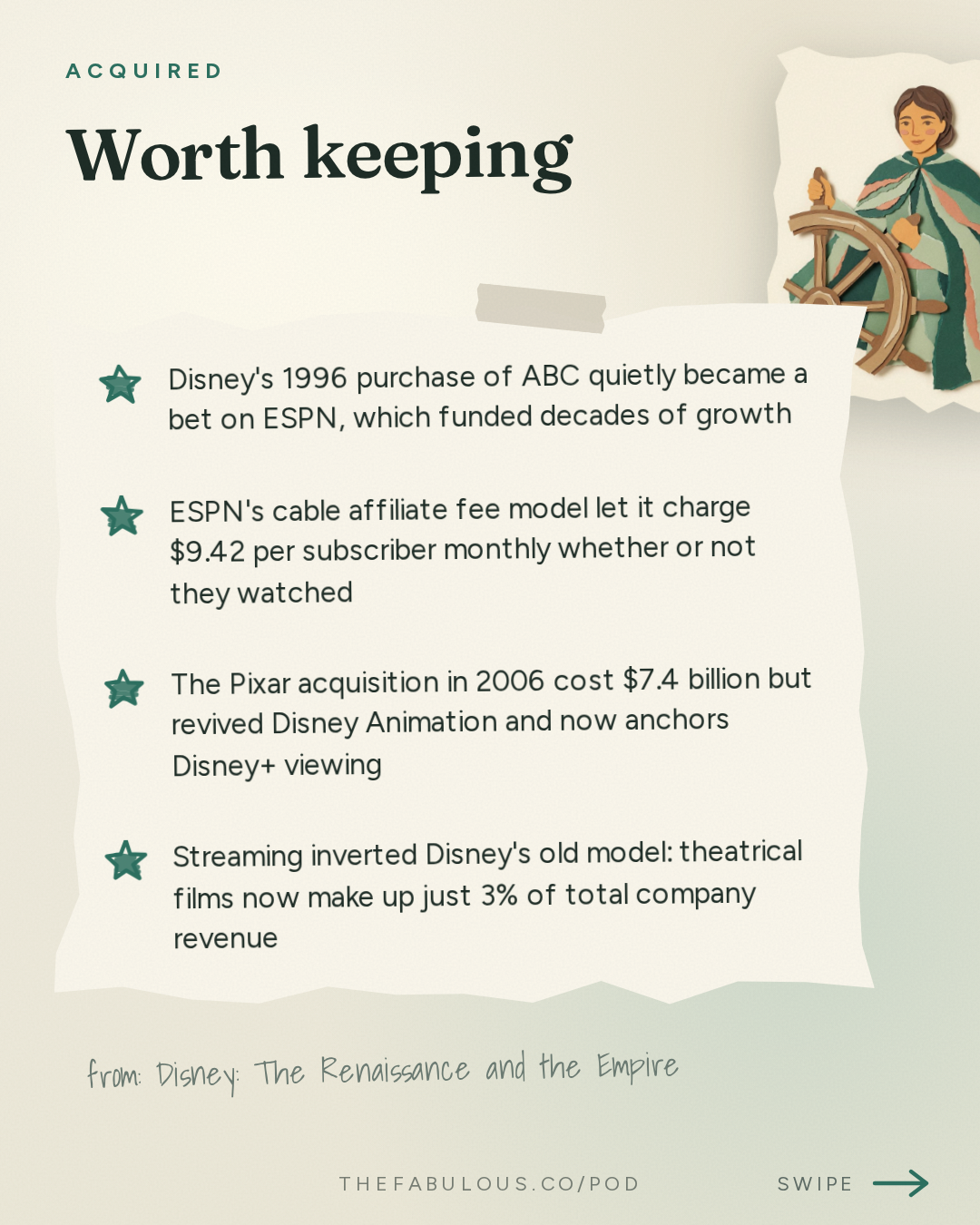
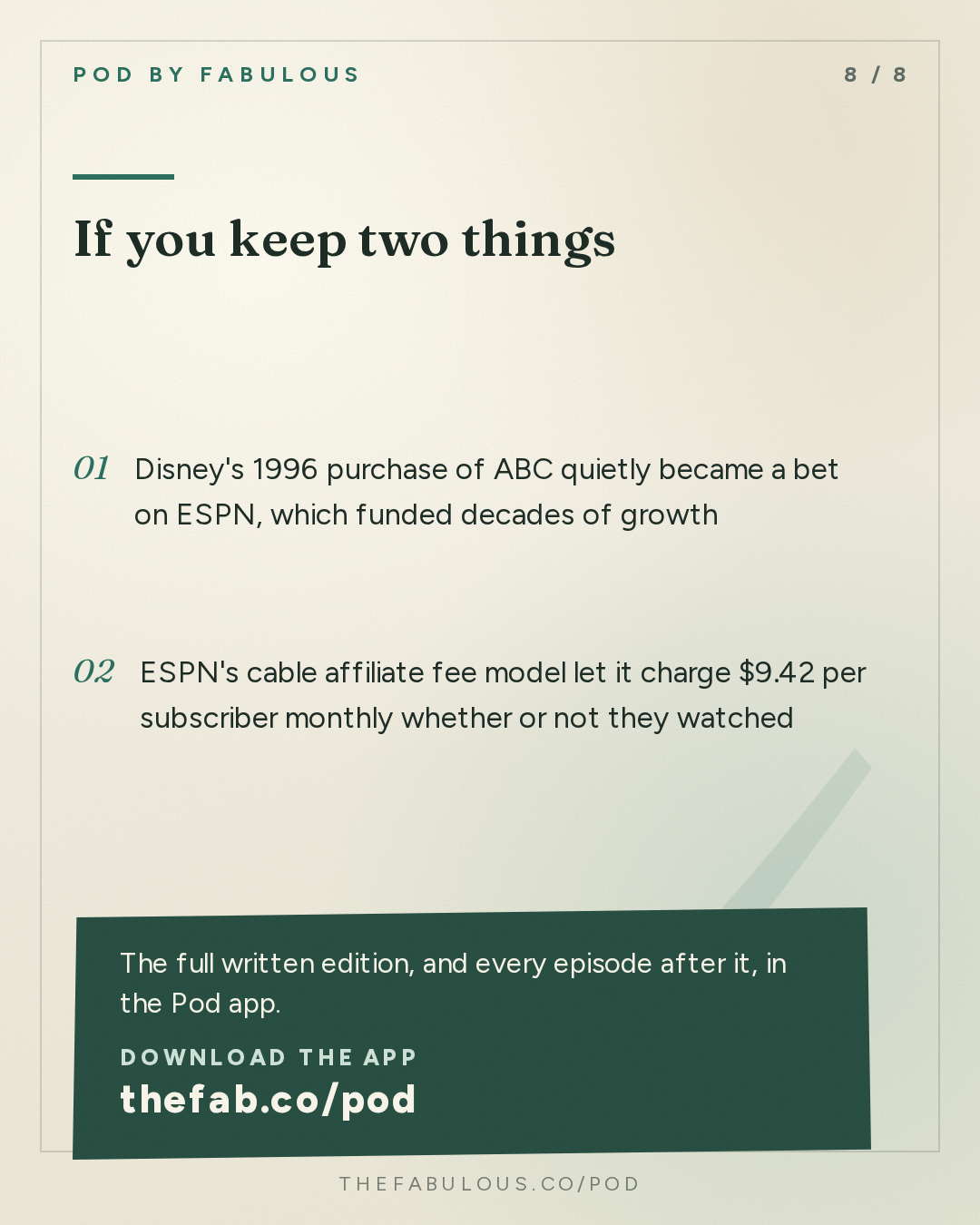
- Disney's 1996 purchase of ABC quietly became a bet on ESPN, which funded decades of growth
- ESPN's cable affiliate fee model let it charge $9.42 per subscriber monthly whether or not they watched (70:09)
- The Pixar acquisition in 2006 cost $7.4 billion but revived Disney Animation and now anchors Disney+ viewing
- Streaming inverted Disney's old model: theatrical films now make up just 3% of total company revenue (238:25)
- Parks and cruises, not movies, now generate about 60% of Disney's operating income (50:01)
The episode in cards
By the numbers
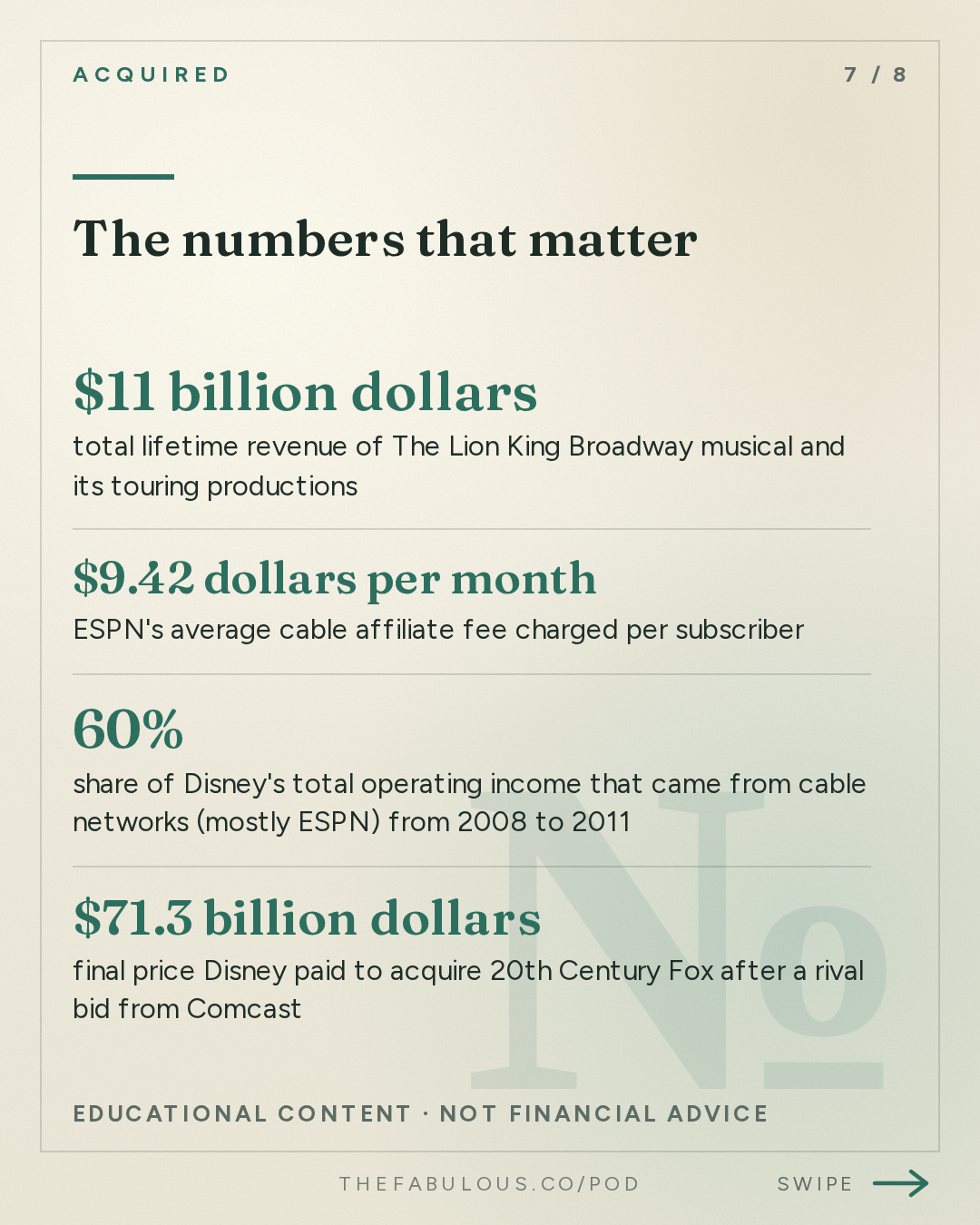
- $11 billion dollars total lifetime revenue of The Lion King Broadway musical and its touring productions
- $9.42 dollars per month ESPN's average cable affiliate fee charged per subscriber
- 60% share of Disney's total operating income that came from cable networks (mostly ESPN) from 2008 to 2011
- $71.3 billion dollars final price Disney paid to acquire 20th Century Fox after a rival bid from Comcast
- $7.4 billion dollars price Disney paid in stock to acquire Pixar in 2006
- 3% share of Disney's total revenue that now comes from theatrical film distribution
In their words
“We have no obligation to make art. We have no obligation to make history. We have no obligation to make a statement. But to make money, it is often important to make history, to make art, or to make some significant statement.”
“"I thought about it and I feel I have an obligation to tell you before we announce the deal, and I wanna give you an option to back out if you want, knowing that I'm about to become your largest shareholder, and I don't know”
“"Look what we did. We saved two companies."”
Questions this episode answers
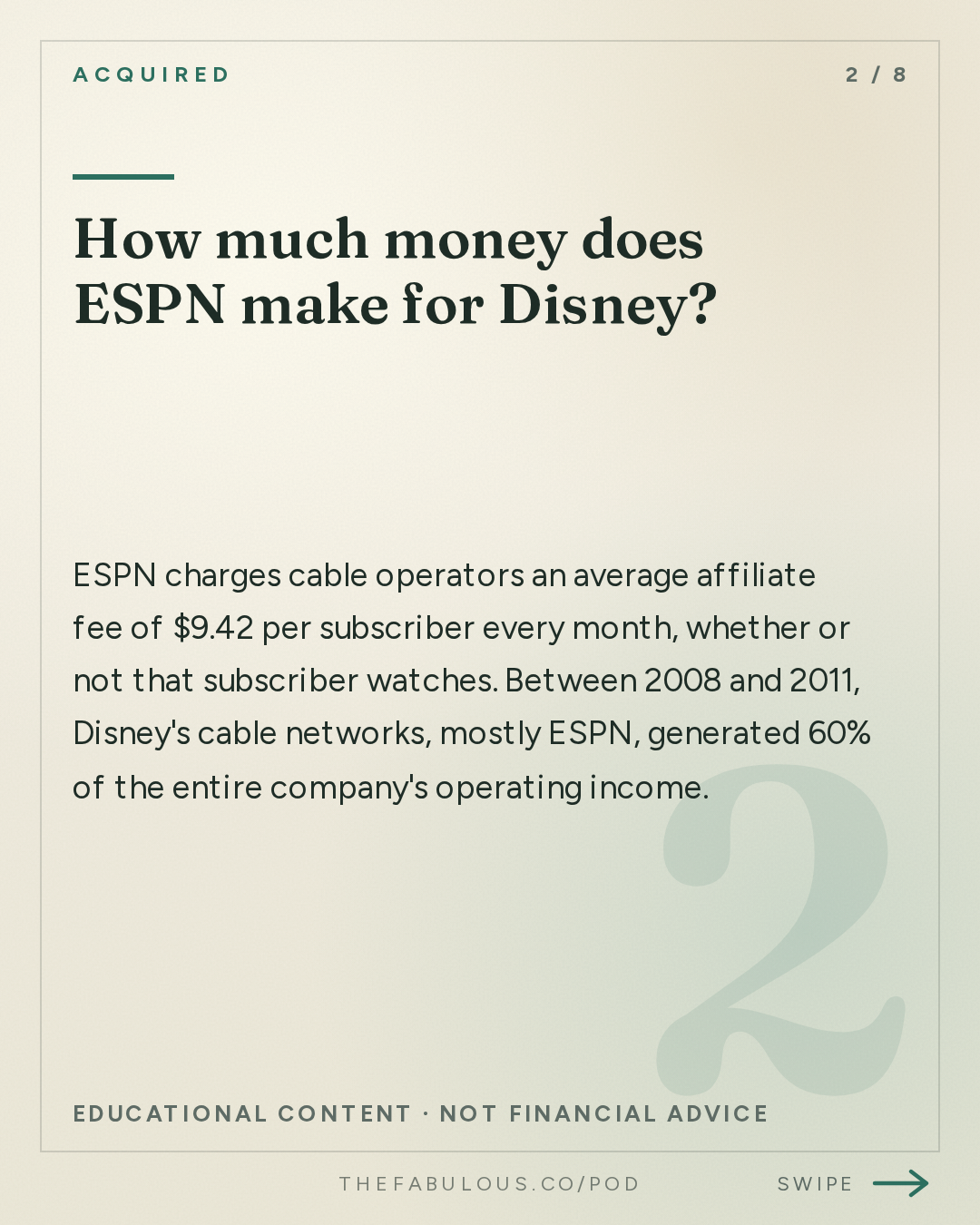
How much money does ESPN make for Disney?
ESPN charges cable operators an average affiliate fee of $9.42 per subscriber every month, whether or not that subscriber watches (70:09). Between 2008 and 2011, Disney's cable networks, mostly ESPN, generated 60% of the entire company's operating income (76:31).
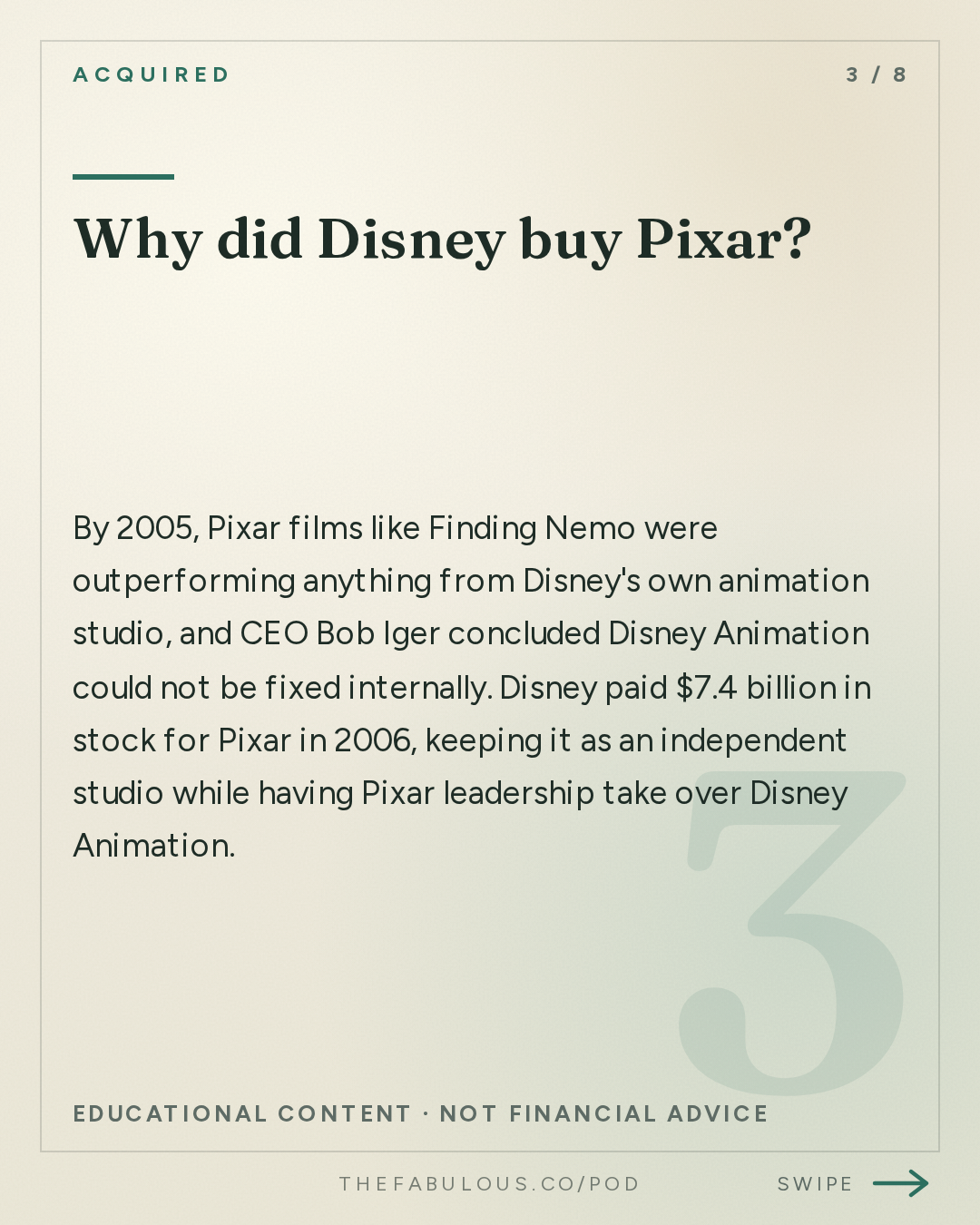
Why did Disney buy Pixar?
By 2005, Pixar films like Finding Nemo were outperforming anything from Disney's own animation studio, and CEO Bob Iger concluded Disney Animation could not be fixed internally. Disney paid $7.4 billion in stock for Pixar in 2006, keeping it as an independent studio while having Pixar leadership take over Disney Animation (157:09).
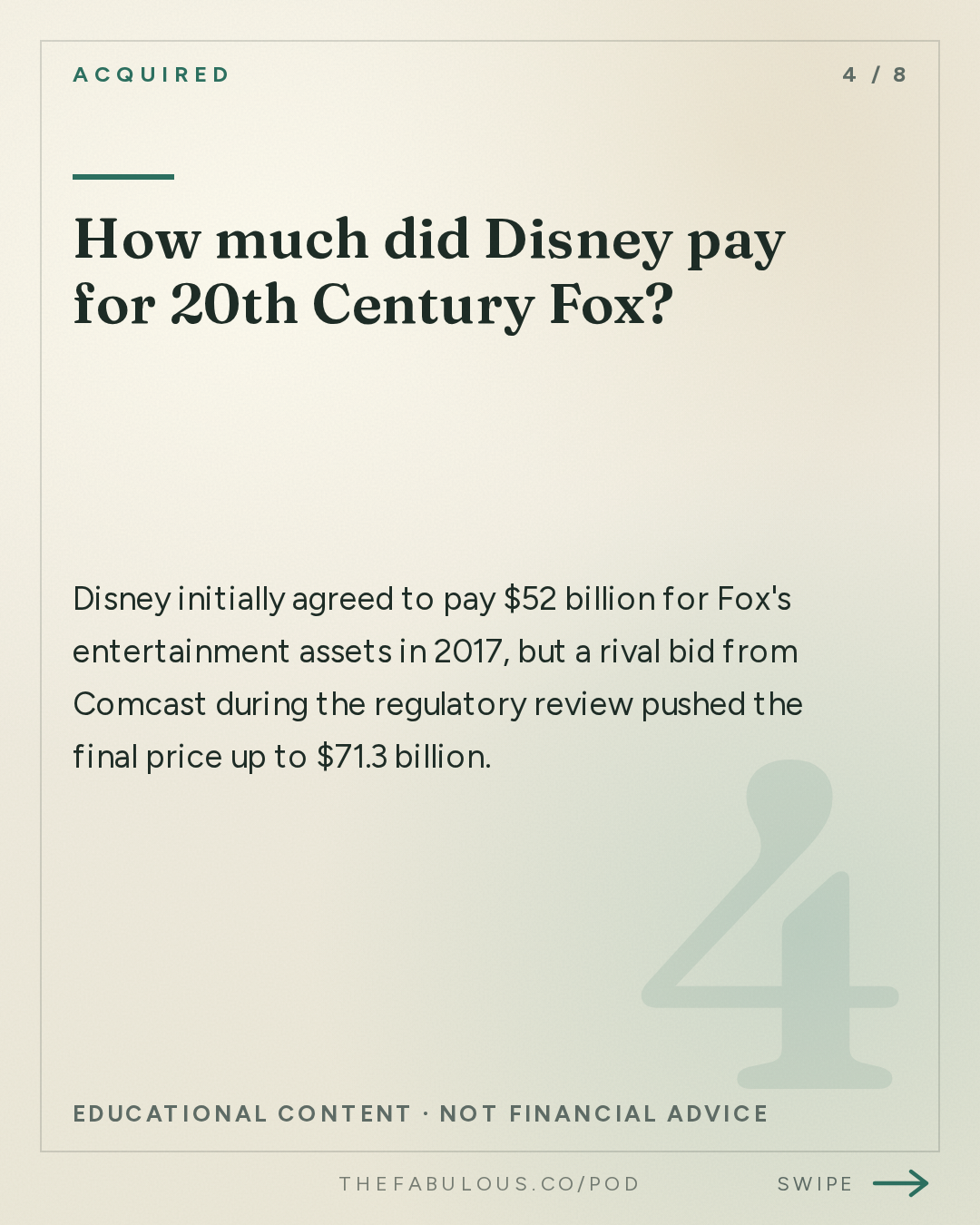
How much did Disney pay for 20th Century Fox?
Disney initially agreed to pay $52 billion for Fox's entertainment assets in 2017, but a rival bid from Comcast during the regulatory review pushed the final price up to $71.3 billion (196:07).
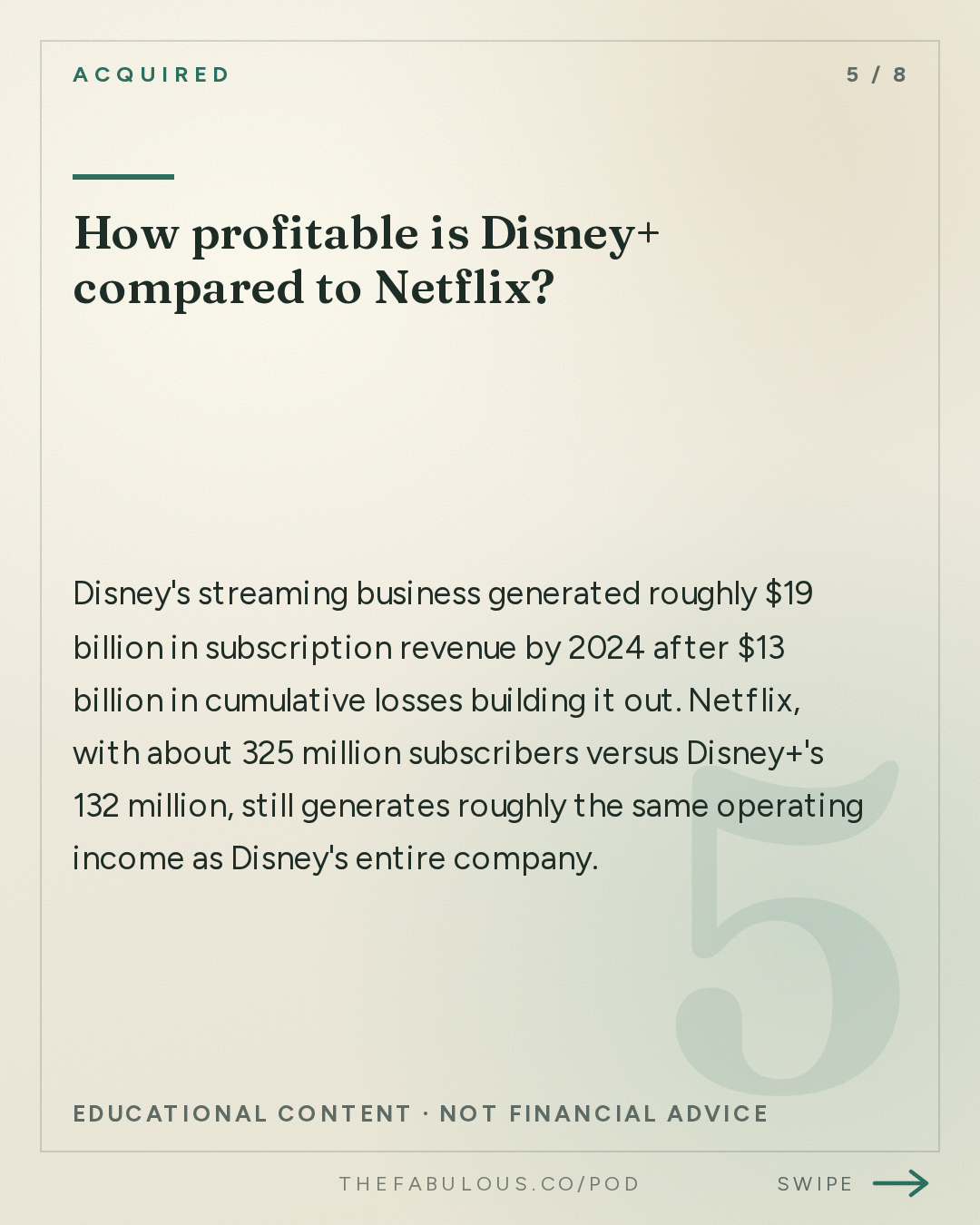
How profitable is Disney+ compared to Netflix?
Disney's streaming business generated roughly $19 billion in subscription revenue by 2024 (231:32) after $13 billion in cumulative losses building it out. Netflix, with about 325 million subscribers versus Disney+'s 132 million, still generates roughly the same operating income as Disney's entire company (230:56).
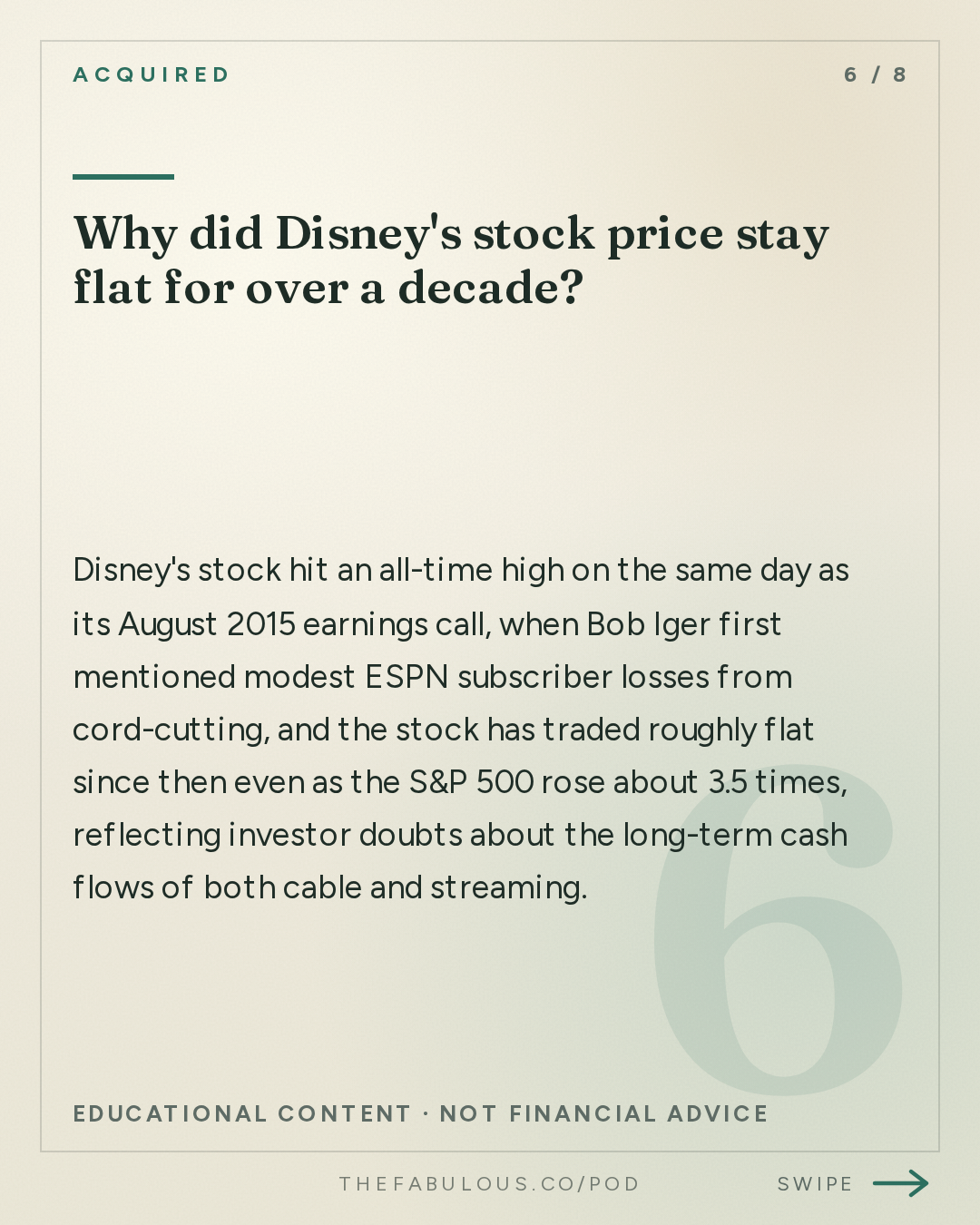
Why did Disney's stock price stay flat for over a decade?
Disney's stock hit an all-time high on the same day as its August 2015 earnings call, when Bob Iger first mentioned modest ESPN subscriber losses from cord-cutting, and the stock has traded roughly flat since then even as the S&P 500 rose about 3.5 times, reflecting investor doubts about the long-term cash flows of both cable and streaming.
The full read, in cards
Go deeper
- Ride of a Lifetime — Bob Iger's memoir, quoted for the resignation letter, the Jobs phone call, and the cancer disclosure before the Pixar deal
Mentioned
Michael Eisner · Bob Iger · Steve Jobs · Jeffrey Katzenberg · Frank Wells · Roy E. Disney · Howard Ashman · The Lion King · Pixar · ESPN · 20th Century Fox · BAMTech
More from this show and category
The Business Economics Behind Seinfeld
A 1970s FCC rule let two broke comedians own 15% each of a show NBC almost didn't air, and refusing to resolve any plot or character arc made it endlessly rewatchable and endlessly resellable. Seinfeld has now generated an estimated $7 billion on a $250 million production cost, and still draws 72 million US viewers a year.
Home Depot's Business History and Strategy
Home Depot turned a 1978 firing into a $350 billion retailer by inventing the warehouse home-improvement store, arming clerks with trade skills, and paying workers in stock. A GE-style efficiency push nearly wrecked that culture before a quiet successor restored it and built the e-commerce backbone that saved the company during COVID.
Walt Disney's IP Flywheel Business Model Explained
Walt Disney built the first intellectual property flywheel: create beloved animated characters, saturate distribution, then feed merchandise, TV, and theme parks off that IP without cannibalizing it. After a devastating 1928 betrayal cost him Oswald the Rabbit, Disney invented Mickey Mouse and never let a distributor own his characters again.

Low-Frequency Investing: The 2.9-Decision Portfolio
A retail investor who made only 2.9 decisions a year beat the S&P 500 in 11 of 11 years, averaging 21.8% annual returns versus 13.5%. The hosts run his brokerage history through the AI assistant Claude, then widen out to Jack Dorsey's 140-reason pre-mortem, Mark Zuckerberg's talent-density bet, Elon Musk's 24-hour rebuilding rule, and a four-step method called DARE for panic and fear.
