
Low-Frequency Investing: The 2.9-Decision Portfolio
We put a multimillionaire’s portfolio into Claude (the results shocked us)
The brief
A retail investor who made only 2.9 decisions a year beat the S&P 500 in 11 of 11 years, averaging 21.8% annual returns versus 13.5%. The hosts run his brokerage history through the AI assistant Claude, then widen out to Jack Dorsey's 140-reason pre-mortem, Mark Zuckerberg's talent-density bet, Elon Musk's 24-hour rebuilding rule, and a four-step method called DARE for panic and fear.
A man at a gathering for entrepreneurs called Hampton once told one of the hosts of this show that he sold his company for eight figures and now invests for a living. Curious, the host asked to see the brokerage account on the spot (00:57). What came back, once the twelve years of trades were fed into the AI assistant Claude, was not a story about picking winners. It was a story about almost never picking anything at all.
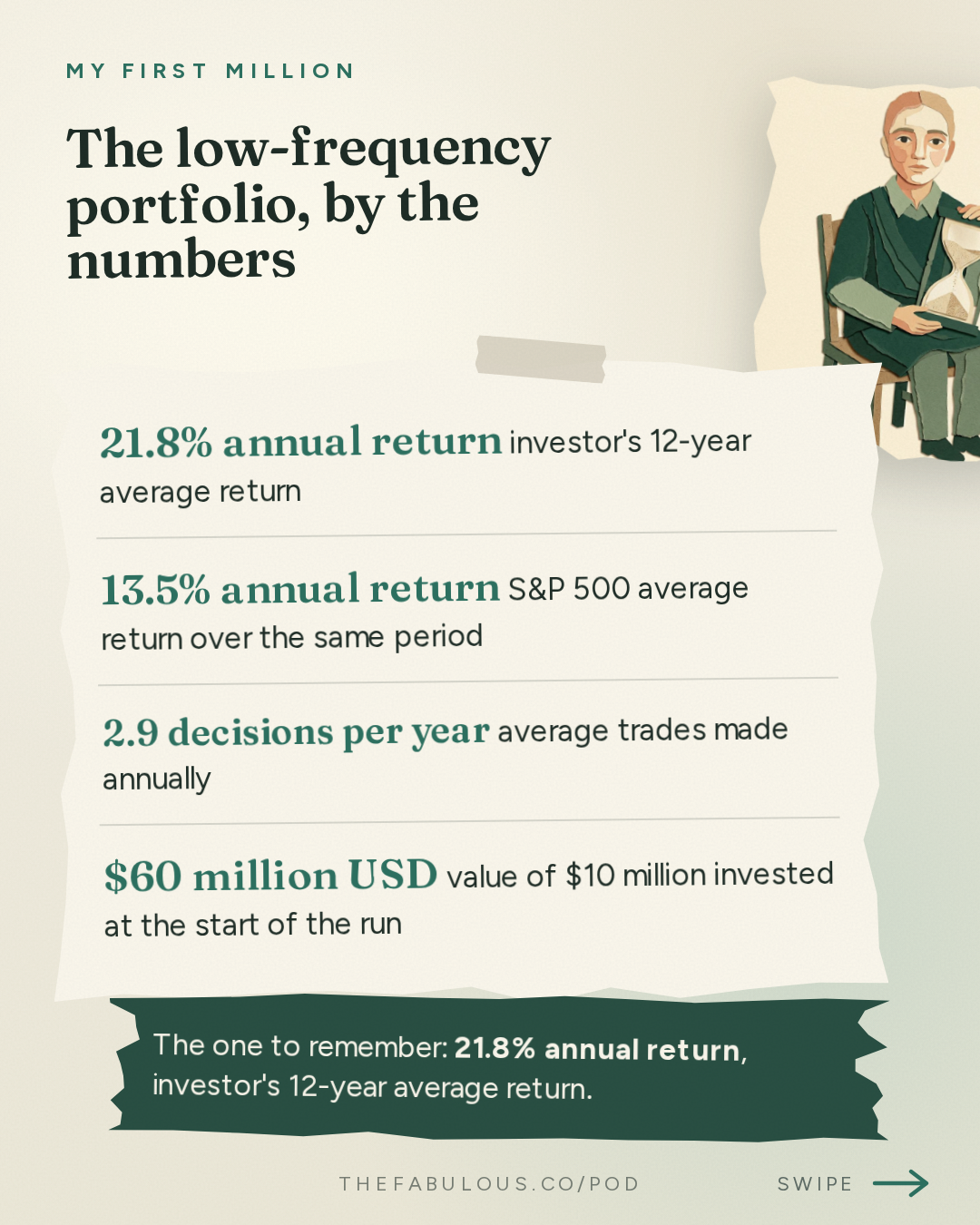
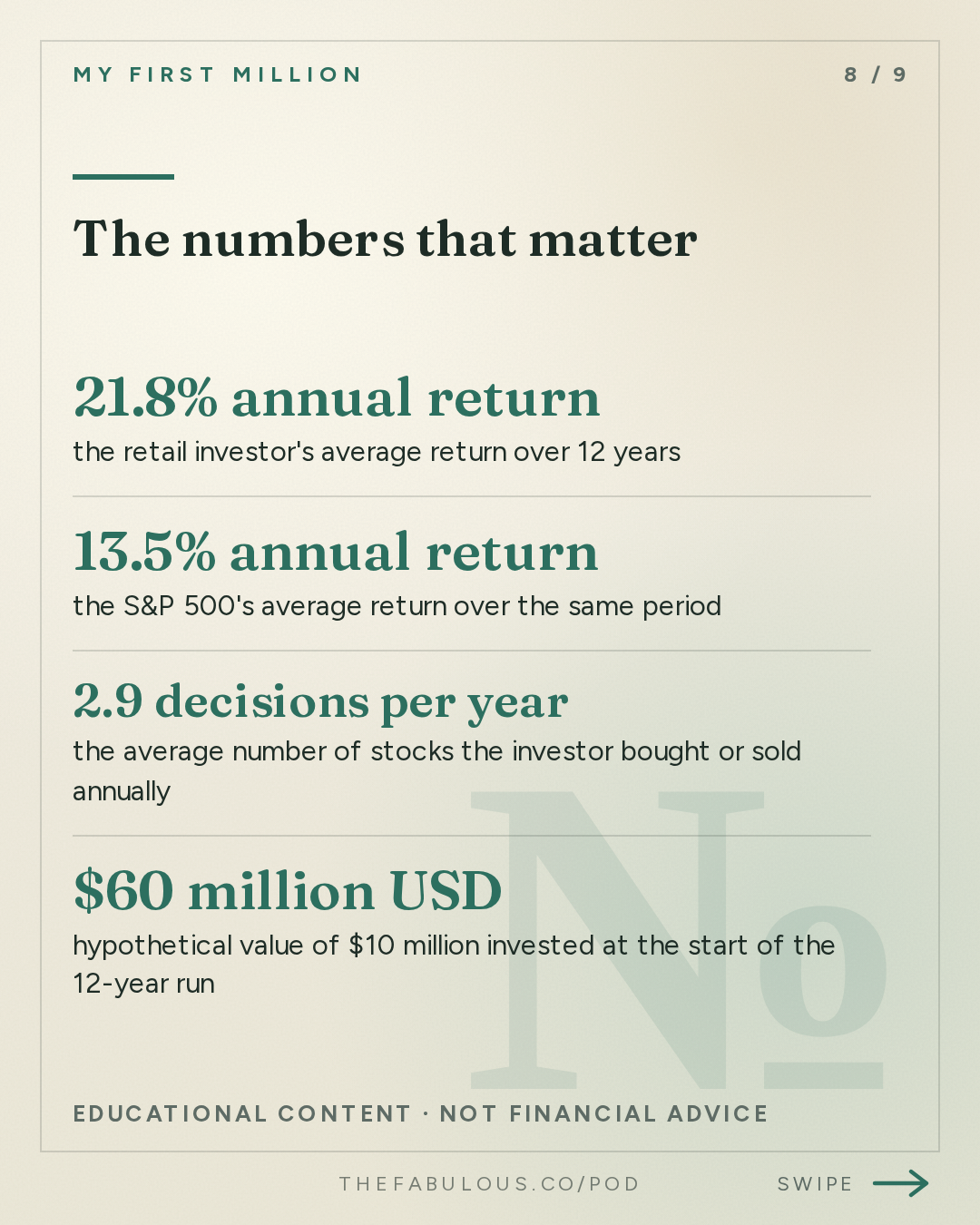
The investor had owned around fifteen stocks over a decade, give or take five. But across those twelve years he made an average of just 2.9 decisions annually, where a decision means a single stock bought or sold (01:14). In three of those years he made zero trades. His busiest year, six. The result: a 21.8% average annual return against 13.5% for the S&P 500, and he beat the market in eleven of eleven years, losing only in 2022 (01:59). Run the arithmetic forward and ten million dollars invested at the start would have grown to roughly sixty million (02:27).
"He only made 2.9 decisions a year. And we put together this cool graph, and there were some years, I believe, three out of the last ten years, he made zero decisions." — Sam Parr [01:39]
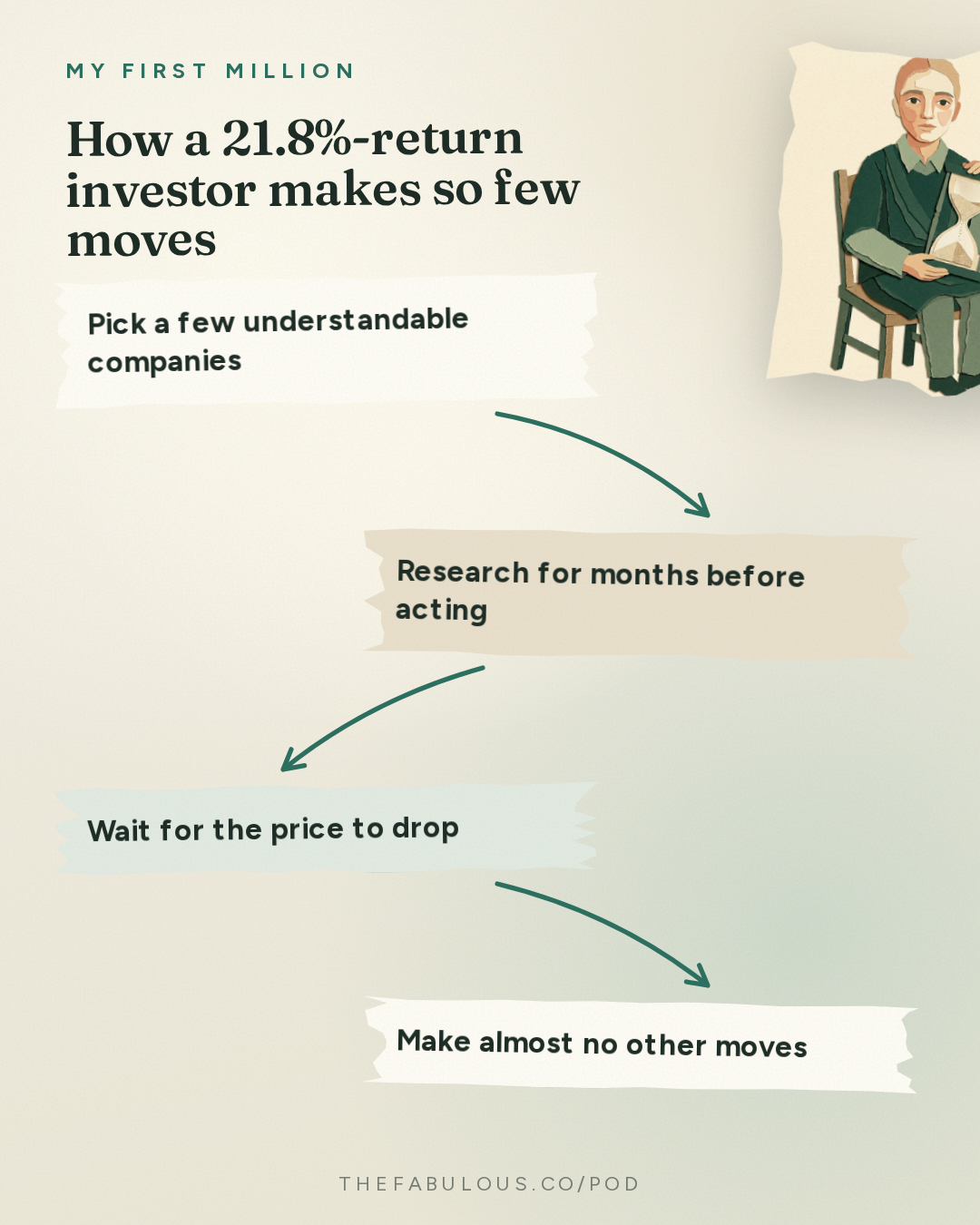
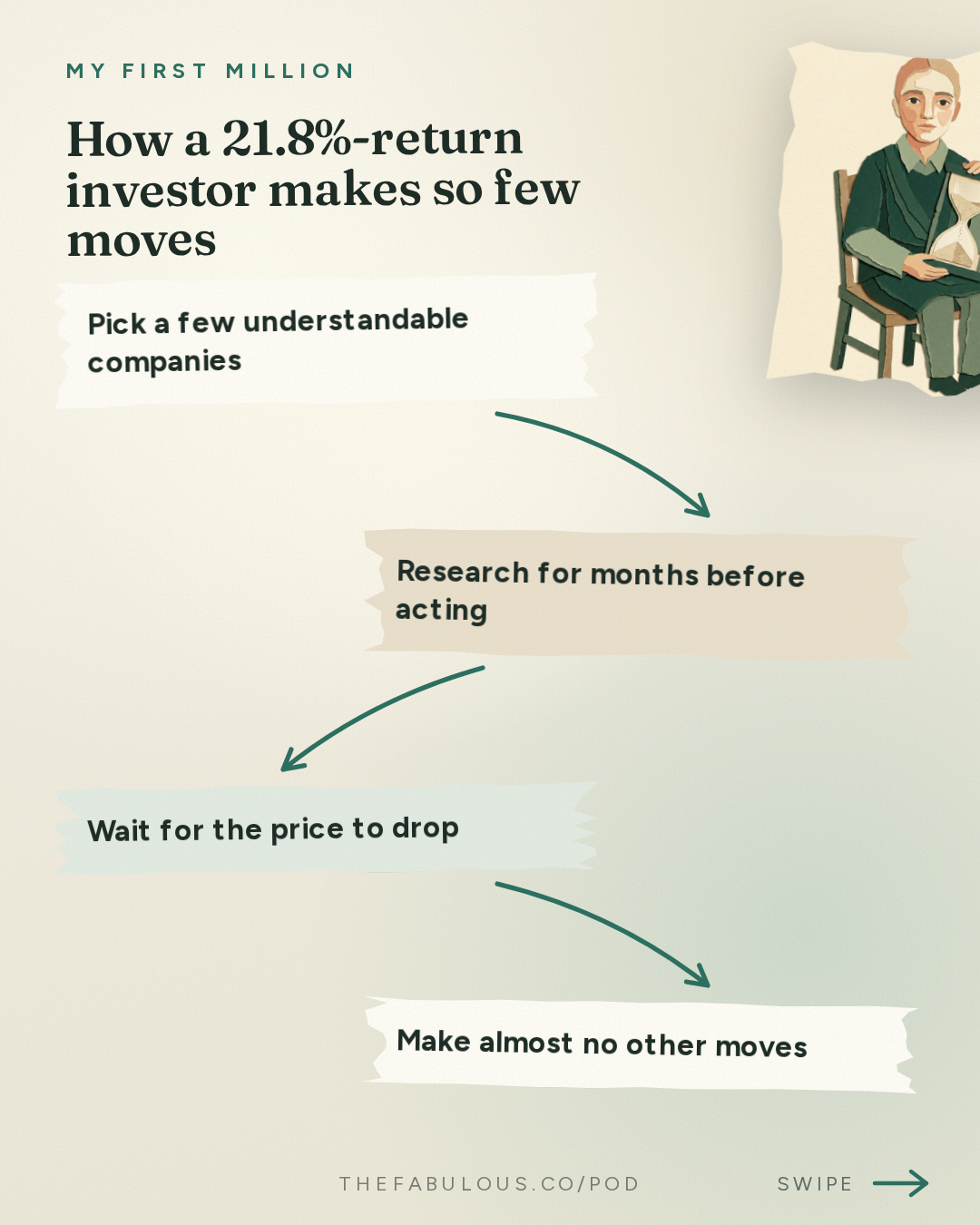
Asked how he actually spends his time, the investor said he studies a few companies he can truly understand, keeps detailed notes, and waits. He researched one company for about six months before COVID, decided he liked it but thought it was priced too high, and kept writing notes until the market made it cheap. Then he bought it that same day (04:02). Warren Buffett has described his own approach in similar terms: lethargy bordering on sloth (05:10). The common thread among people who are good at this, the hosts argue, is that they know their circle of competence, meaning the narrow set of things they genuinely understand, and they decline everything outside it without treating the refusal as a verdict on the opportunity itself (07:55).
The other habit worth borrowing is the pre-mortem: writing down, before starting anything, every way it could fail. Jack Dorsey, who helped create Twitter, reportedly wrote a list titled "140 Reasons Why Square Will Fail" before launching the payments company Square, specifically to avoid getting high on his own reputation (09:16). The point of a pre-mortem is not to retreat from the risks. It is to build something that can survive them.
Judged by the Wins, Not the Losses
Investing punishes mistakes. Entrepreneurship, at its upper reaches, barely counts them. Discussing Mark Zuckerberg's recent media tour, in which Meta's founder has been candid about the roughly sixty billion dollars spent on the VR push once called the metaverse, about ten times what was spent developing the original iPhone, with little to show for it in adoption (13:32), one host pointed to Zuckerberg's own explanation of how he thinks about failure.
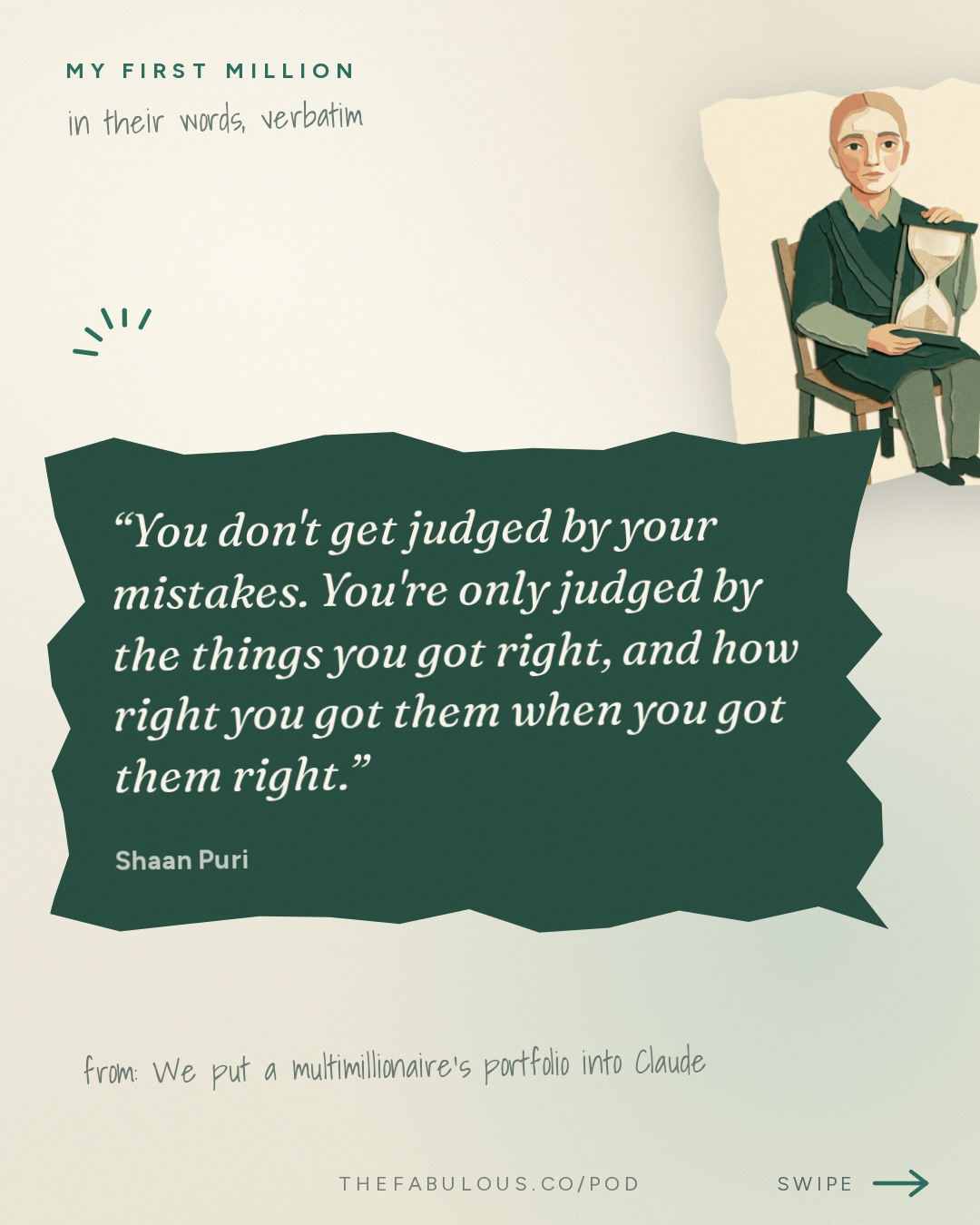
"You don't get judged by your mistakes. You're only judged by the things you got right, and how right you got them when you got them right." — Shaan Puri, recounting Mark Zuckerberg [13:55]
That logic explains Zuckerberg's pursuit of Alex Wang, the young founder of Scale AI, a data-labeling company that AI labs rely on to train their models, which Meta valued at around fourteen billion dollars before buying a large stake and bringing Wang aboard (15:25). Zuckerberg's stated reasoning was not that Wang is the smartest person in any room. It was Wang's strategic clarity and his conviction that winning in AI requires talent density: a small team of twenty to two hundred elite people who can hold the whole problem in their heads, rather than two thousand merely smart ones spread thin (16:05).
There is a psychological wrinkle here worth naming. The Dunning-Kruger effect describes how confidence about a subject often peaks early, right after someone learns just enough to feel capable, and then dips as real expertise reveals how much remains unknown (19:46). The most accomplished people the hosts have met tend to undersell their own competence and over-ask for other people's opinions, which looks like humility but functions as information-gathering.
That same conversation turned to a simpler question: what game is a person actually playing. Most people, even driven and successful ones, have never named it (22:55). The book The Score argues that the game chosen decides what someone wants and who they have to become to get it: charades rewards expressiveness, a lying game like Mafia rewards deception, and the same logic quietly reshapes a career (26:14).
Rehearsing the Thing You Fear
A story, possibly embellished, about Elon Musk circulated at a dinner where he was asked what he would do if both Tesla and SpaceX failed and he lost every dollar. His answer: move into the cheapest apartment he could find, buy a computer, and start building something new within twenty-four hours, not a week later (29:50). He reportedly said the loss of money would not bother him, but he would allow himself exactly one night of devastation over losing the companies before returning to work (29:31).
"The thing finds you. You just have to be building when it arrives." — Shaan Puri, recounting Elon Musk's view [30:08]
Napoleon Bonaparte, asked for his next plan, reportedly answered that he acts, and the plan emerges from the action (31:06). The through-line from investing patience to entrepreneurial motion is the same discipline aimed in opposite directions: know when to sit still, and know when stillness is just fear wearing the costume of caution.
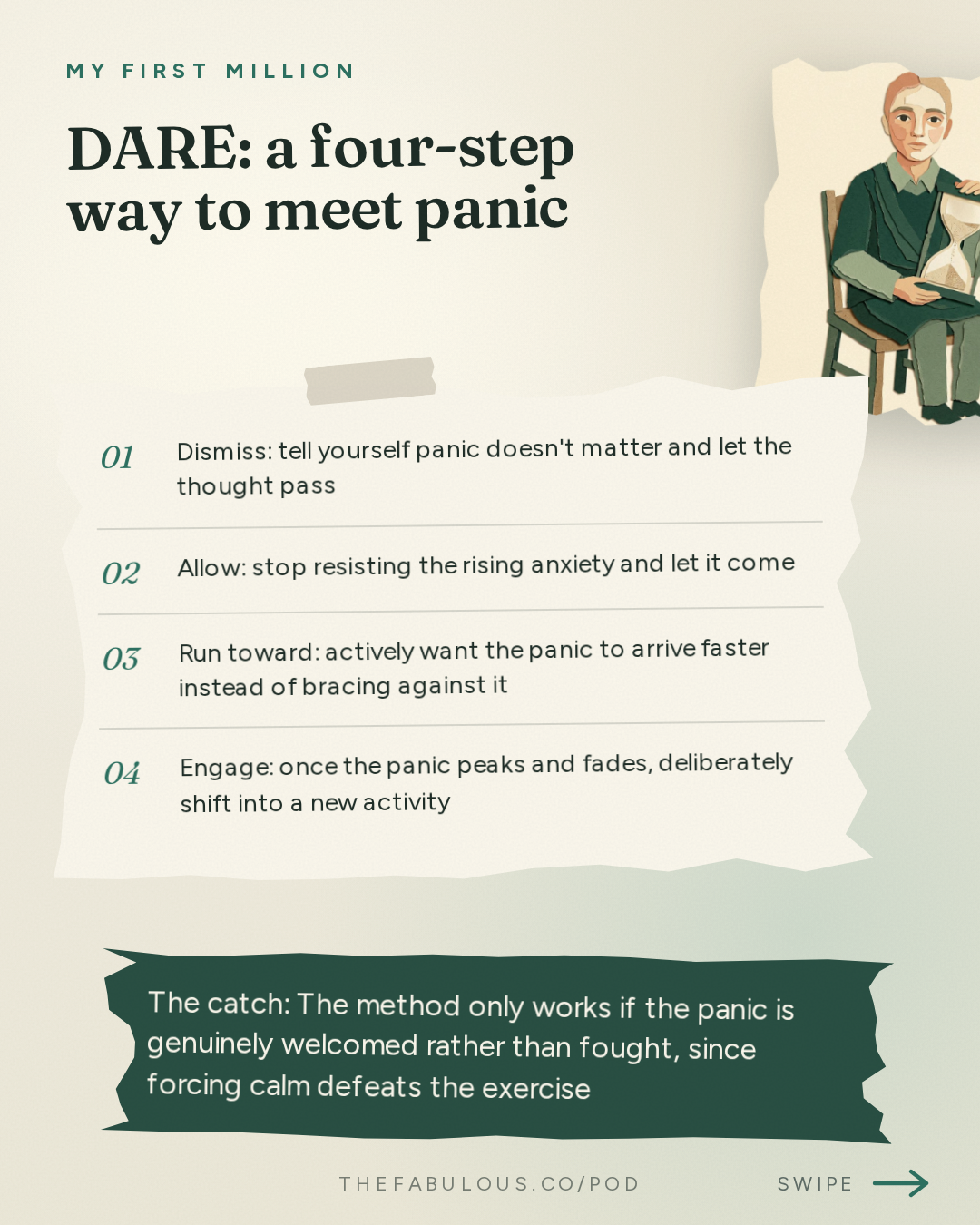
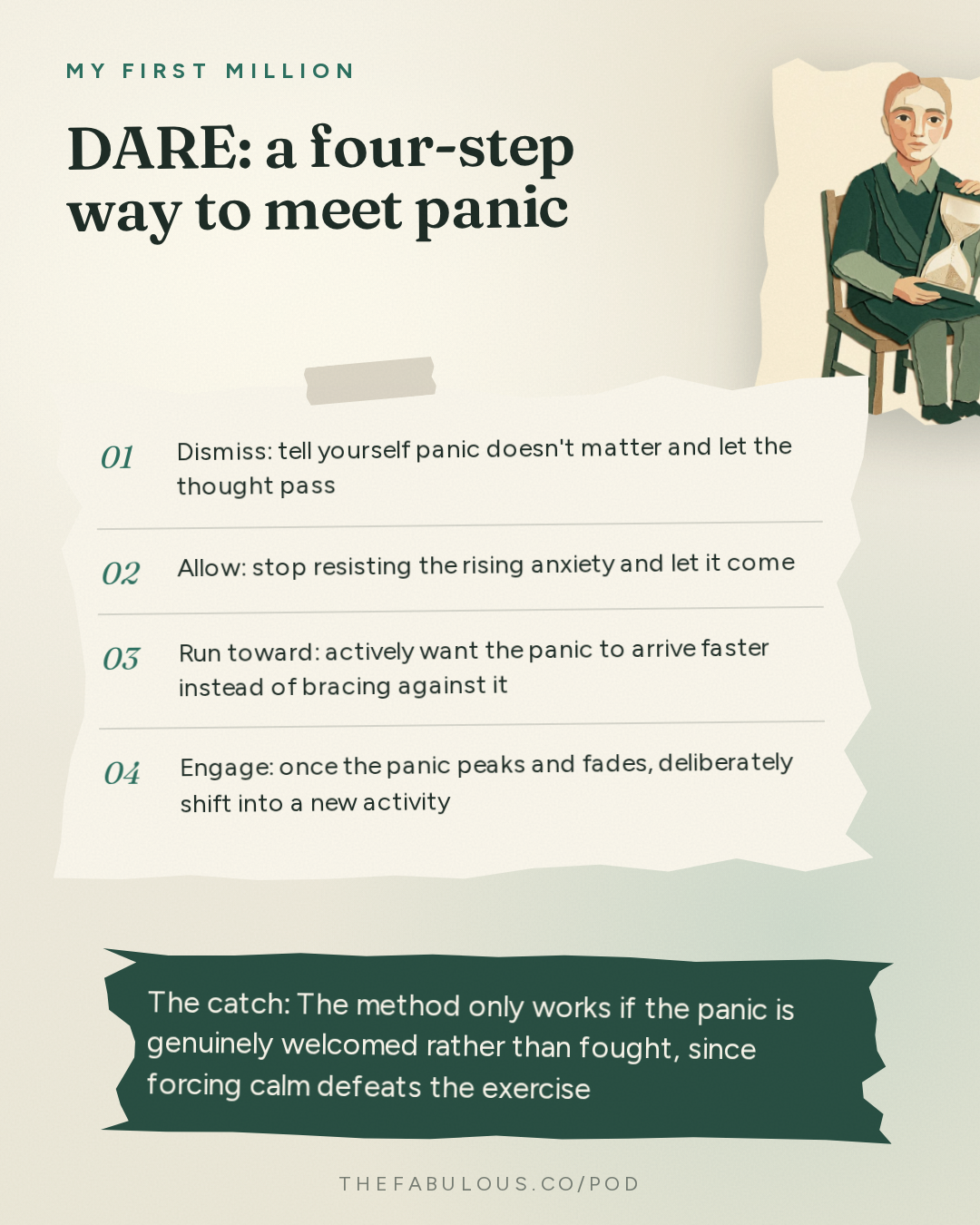
Fear itself gets the most concrete treatment of the episode. One host described using a book called Dare, which lays out a four-step method for panic: dismiss the thought that panic matters, allow it to come, run toward it by wanting it to arrive faster, and then engage with something else once it peaks (35:48). He tested it on a flight to Jackson Hole and stayed off the anti-anxiety medication he had relied on for fifteen years, a test made considerably harder when the plane landed, then took off again after the brakes failed and had to divert to Salt Lake City (38:52).
MMA coach Firas Zahabi used a related idea to prepare the fighter Georges St-Pierre, who by his own coach's account did not relish fighting and felt real fear before bouts. Months out from a fight, Zahabi had St-Pierre eat the same pre-fight meal, wear the actual UFC gloves and outfit, train under the same bright lights, and listen to the opponent's walkout music, so his nervous system had already lived through fight day by the time it arrived (42:04). The same principle, one host noted, applies to a hard conversation or a firing: rehearsing the scene in detail beforehand blunts its power.
There is a related finding about anticipation itself: the peak of enjoyment, and apparently also the peak of dread, often sits in the buildup rather than the event (43:48). Heavy anticipation of something exciting tends to make the real thing a letdown, while heavy anticipation of something scary can make the real thing feel almost dull by comparison, because the nervous system has already spent its charge.
The clearest illustration came from skydiving. One host said he was not especially afraid going in, until the plane climbed above the clouds and a friend jumped first and vanished. What dissolved the fear was not bravery.
"The antidote to the fear was not really, like, bravery... It was just acceptance." — Shaan Puri [45:35]
He was hooked to an instructor who was also leaving the plane, which meant the jump was no longer a decision. It was simply already happening. Accepting that, he said, neutralized roughly half the fear on the spot, leaving something closer to excitement than terror. It is the same move, scaled down, as waiting four months to buy one stock, or writing a hundred and forty reasons a company might die before building it anyway: stop negotiating with the moment, and just meet it.
Ask this episode anything
Pod's AI answers from the episode itself, with the minute mark so you can hear it yourself.
Or start with one of these
Ask this episode
Pod's AI listens to the whole episode to answer, and points you to the minute it comes from.
The rest of this answer, and any question after it
Answers come from the episode itself, never from a summary of it.
ContinueKey takeaways
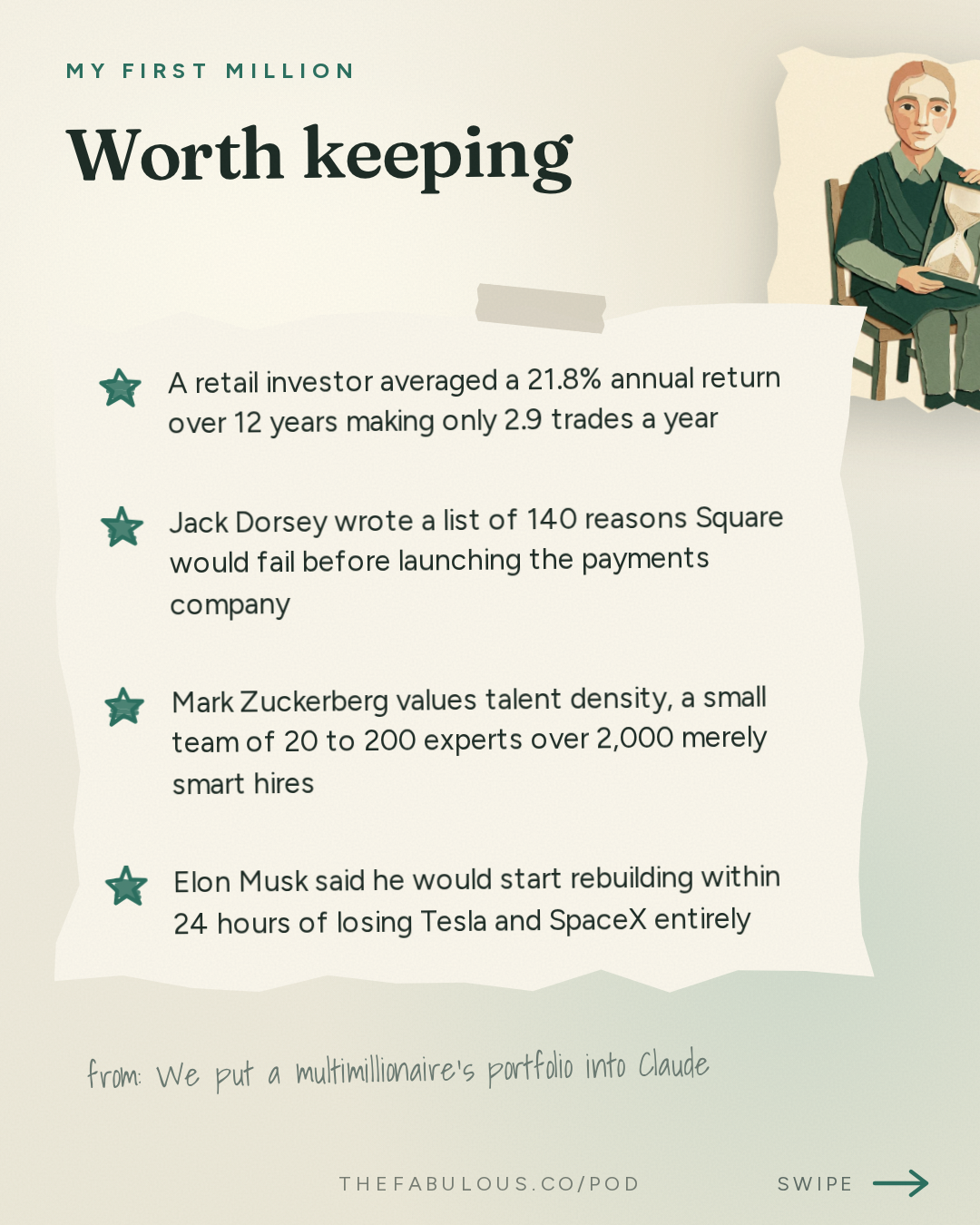
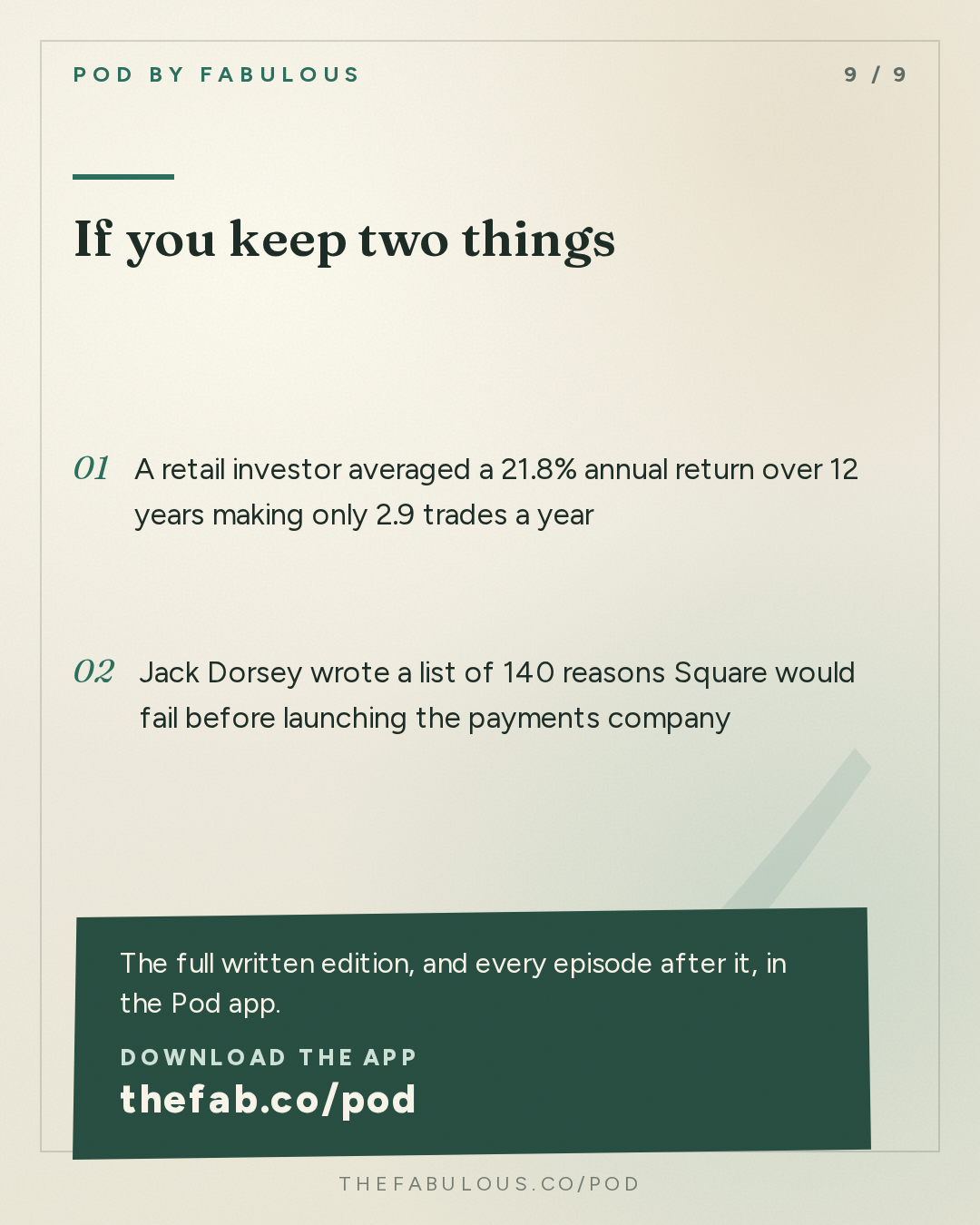
- A retail investor averaged a 21.8% annual return over 12 years making only 2.9 trades a year (01:59)
- Jack Dorsey wrote a list of 140 reasons Square would fail before launching the payments company (09:16)
- Mark Zuckerberg values talent density, a small team of 20 to 200 experts over 2,000 merely smart hires (16:05)
- Elon Musk said he would start rebuilding within 24 hours of losing Tesla and SpaceX entirely (29:50)
- The DARE method (dismiss, allow, run toward, engage) helped podcast host Sam Parr manage flight panic without medication (35:48)
The episode in cards
By the numbers
- 21.8% annual return the retail investor's average return over 12 years
- 13.5% annual return the S&P 500's average return over the same period
- 2.9 decisions per year the average number of stocks the investor bought or sold annually
- $60 million USD hypothetical value of $10 million invested at the start of the 12-year run
- 140 reasons items on Jack Dorsey's pre-launch list of why Square could fail
- 24 hours how fast Elon Musk said he would start a new venture after losing everything
In their words
“He only made 2.9 decisions a year. And we put together this cool graph, and there were some years, I believe, uh, three out of the last 10 years, he made zero decisions”
“You don't get judged by your mistakes. You're only judged by the things you got right, and how right you got them when you got them right.”
“The thing finds you. You just have to be building when it arrives.”
Protocols
-
The DARE method for panic
Sam Parr applies DARE, which stands for dismiss, allow, run toward, and engage, starting about 40 minutes before a flight by dismissing the thought that panic matters, allowing it to arrive, and actively wanting it to come faster. The catch is that the method only works if the panic is genuinely welcomed rather than resisted, since fighting it defeats the exercise.
Before any anxiety-inducing event
-
Writing a pre-mortem before launching
Jack Dorsey wrote a list titled '140 Reasons Why Square Will Fail' before launching the payments company Square, cataloging every way the business could collapse. The catch is that the goal is not to avoid every listed failure mode but to design the company so it can survive the ones that happen anyway.
Once, before starting a new venture
-
Simulating fight day before the fight
MMA coach Firas Zahabi had fighter Georges St-Pierre train in full UFC gloves and outfit, under bright arena lights, with the opponent's actual walkout music playing, months before the real bout, and eat the same pre-fight meal he would eat that morning. The catch is that the simulation has to match the real event in granular detail, or the nervous system will not register it as rehearsal.
Repeated during fight camp leading up to the event
Questions this episode answers
What is low-frequency investing and does it actually outperform?
One retail investor averaged a 21.8% annual return over 12 years by making only 2.9 buy or sell decisions a year, versus 13.5% for the S&P 500 (01:59). He studied a small number of companies deeply and waited, sometimes months, for the price to become cheap enough before acting (04:02).
What is a pre-mortem and how did Jack Dorsey use one?
A pre-mortem is a written list of every way a venture could fail, done before it starts, so failure becomes something to design around rather than deny. Twitter co-founder Jack Dorsey reportedly wrote a list titled '140 Reasons Why Square Will Fail' before launching the payments company Square (09:16).
What is the DARE method for panic attacks?
DARE stands for dismiss, allow, run toward, and engage, a four-step approach from the book Dare for meeting panic directly instead of resisting it (35:48). Podcast host Sam Parr used it before a flight and stayed off anti-anxiety medication for the first time in 15 years, even when the plane aborted takeoff mid-roll due to a brake issue (38:52).
What is talent density and why does Mark Zuckerberg care about it for AI?
Talent density means keeping an AI team small, something like 20 to 200 highly skilled people rather than 2,000 merely smart ones, so everyone can hold the whole problem in their head (16:05). Meta's Mark Zuckerberg cited this as a core reason he recruited Scale AI founder Alex Wang, whose company was valued around $14 billion before the deal (15:25).
What is Elon Musk's 24-hour rebuilding rule?
According to a story Musk told at a private dinner, if Tesla and SpaceX had both failed and he lost everything, he said he would find the cheapest apartment, buy a computer, and start building something new within 24 hours (29:50). He said the loss of money would not bother him, but he would let the devastation of losing the companies last only one night before returning to work (29:31).
The full read, in cards
Go deeper
- Dare — Lays out the D.A.R.E. method (dismiss, allow, run toward, engage) for meeting panic attacks head-on
- The Score — Argues that the game a person chooses to play determines what they want and who they must become to win it
- Cheeky Pint — Interview in which Mark Zuckerberg explains why he recruited Alex Wang and why he prizes talent density
Mentioned
Claude · Warren Buffett · Kevin Ryan · Jack Dorsey · Mark Zuckerberg · Alex Wang · Scale AI · Elon Musk · Firas Zahabi · Georges St-Pierre · The Score · Dare · Napoleon Bonaparte · Scott Galloway · Cornelius Vanderbilt
More from this show and category
The 6 Traits of Natural Money Makers
Sam Parr and Shaan Puri map the "natural money maker": unemotional, maximizing, and comfortable with complexity. They share entrepreneur Sayed Balkhi's "second derivative" rule (spend only investment returns, never income) and a 3% liquid-net-worth spending cap, plus six other wealth-building personality types like the Tank, the Trickster, and the Sniffer.
Shaan Puri's 3 Embarrassing Moments That Changed Him
Shaan Puri, host of My First Million, shares three embarrassing stories, including a 110 narcissism test score and a failed 250-page restaurant business plan. He explains how each moment taught him to stop chasing external validation, favor action over endless planning, and reinvent his identity by deciding who to become before he felt ready.
Jeff Harmon's Marketing Playbook Explained
Jeff Harmon built OraBrush, Poo-Pourri, Squatty Potty, and Angel Studios by spotting marketing glitches: cheap or ignored channels nobody else was using. He turned a 19-minute skippable ad into an $11 million crowdfund for The Chosen and grew Angel Studios into a $500 million business run by a 3 million-member guild that votes on every film.
Oxytocin Doping for Marriage: The Business Case
Palmer Luckey wants to fight divorce with oxytocin, a bonding hormone already sold unregulated online as powder. The hosts trace how niche communities like Knights of Columbus and Angel Studios turn shared identity into insurance and content revenue, and explain why even a hit movie like Angel Studios' biggest box-office success nets just a 2.5x return.
