The Business Economics Behind Seinfeld
Seinfeld
The brief
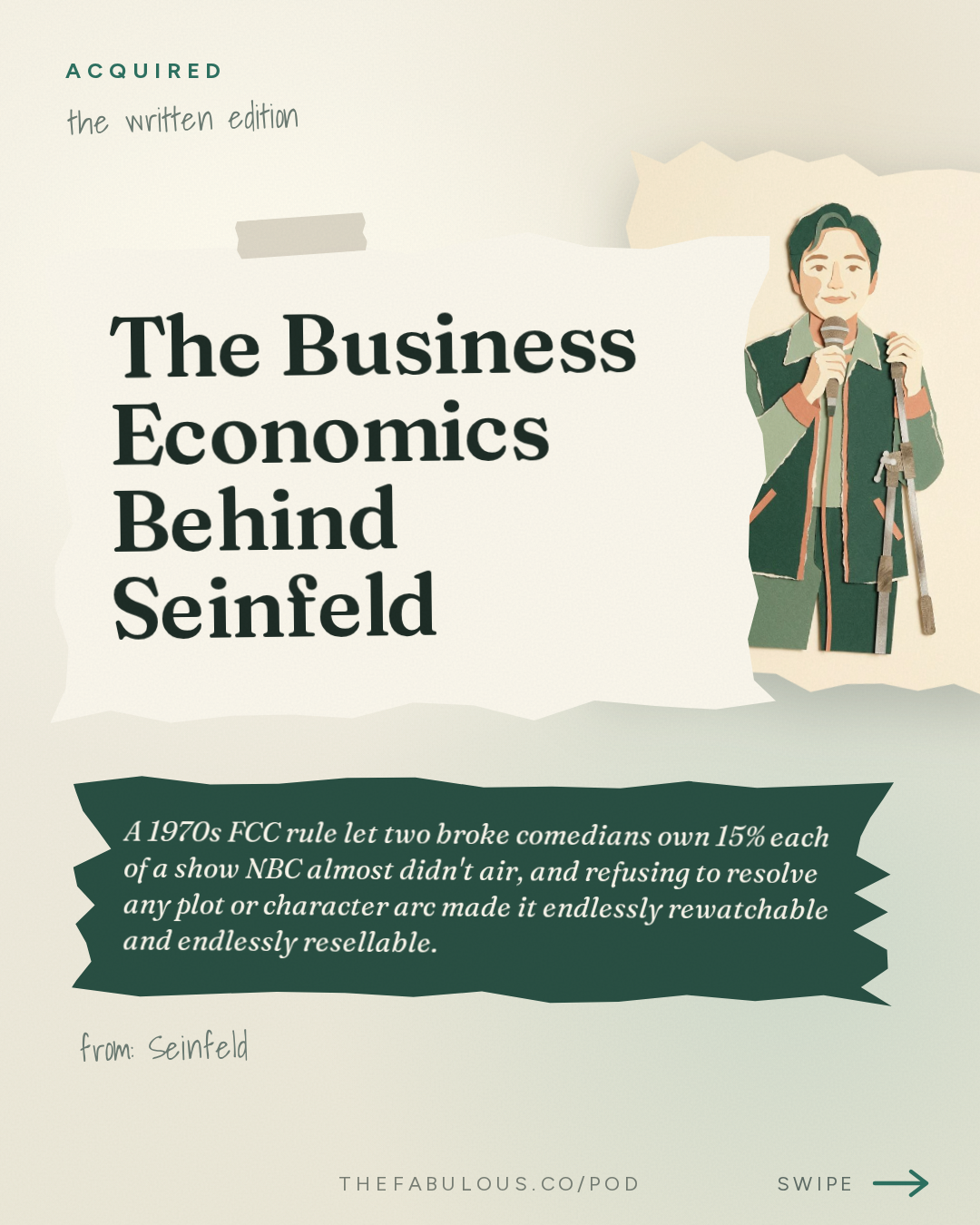
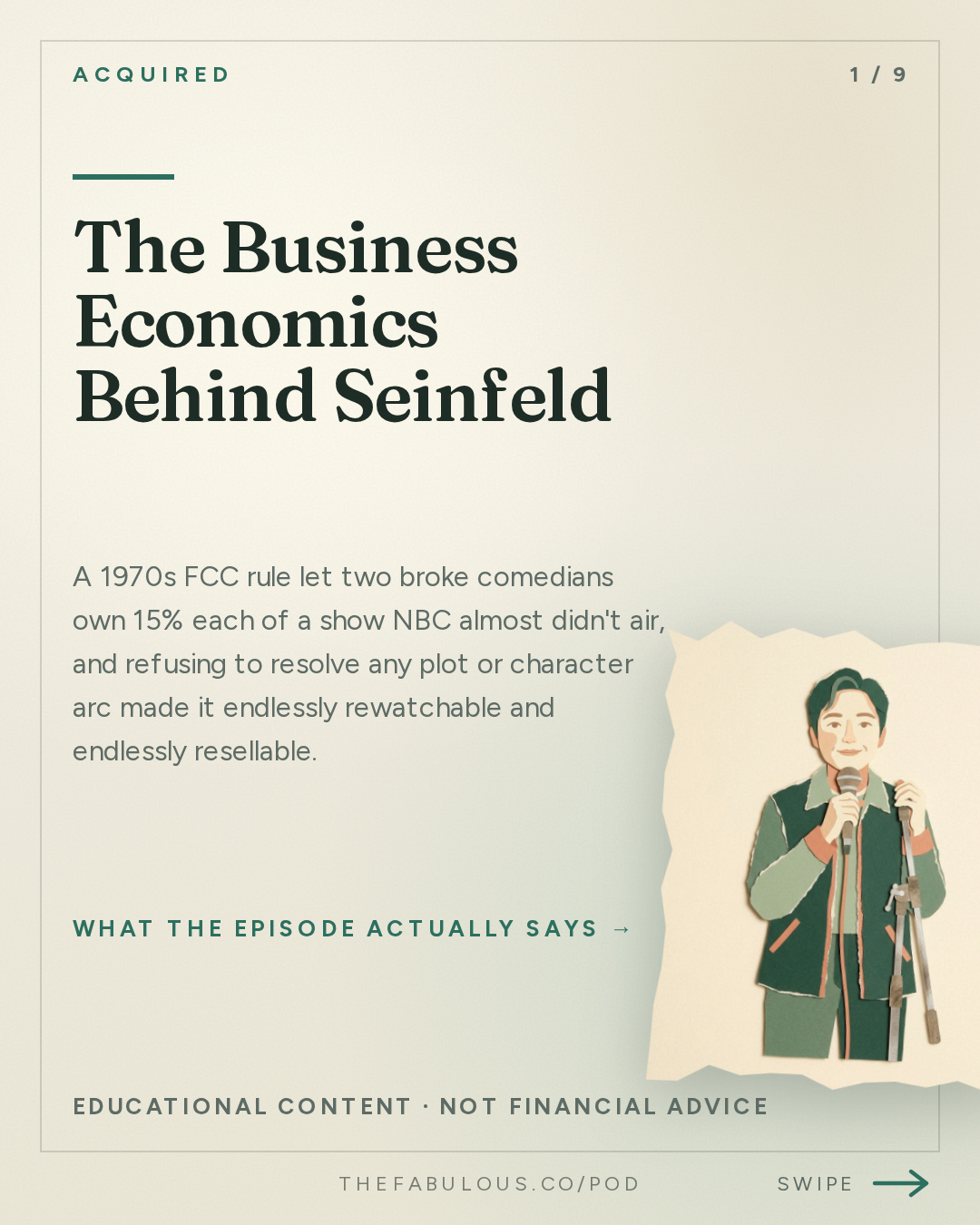
A 1970s FCC rule let two broke comedians own 15% each of a show NBC almost didn't air, and refusing to resolve any plot or character arc made it endlessly rewatchable and endlessly resellable. Seinfeld has now generated an estimated $7 billion on a $250 million production cost, and still draws 72 million US viewers a year.
In the summer of 1989, NBC's research department called four hundred households and asked them to tune a television to a blank channel at a set hour. The viewers watched a new pilot called The Seinfeld Chronicles, then answered a researcher's questions. The verdict, later framed and hung on the bathroom wall of the show's production office, was blunt: no segment of the audience wanted to watch it again, and the overall pilot performance was rated weak (62:46). NBC passed. Thirty seven years later, in the first eight months of 2026, 72 million Americans watched Seinfeld anyway, a number close to the audience that tuned in for its 1998 finale (02:15).
The gap between those two facts is not an accident of taste. It comes from a regulation almost nobody remembers, a pair of creators who ignored every piece of conventional sitcom advice, and one decision, made on a park bench, to stop making the show while people still wanted more of it.
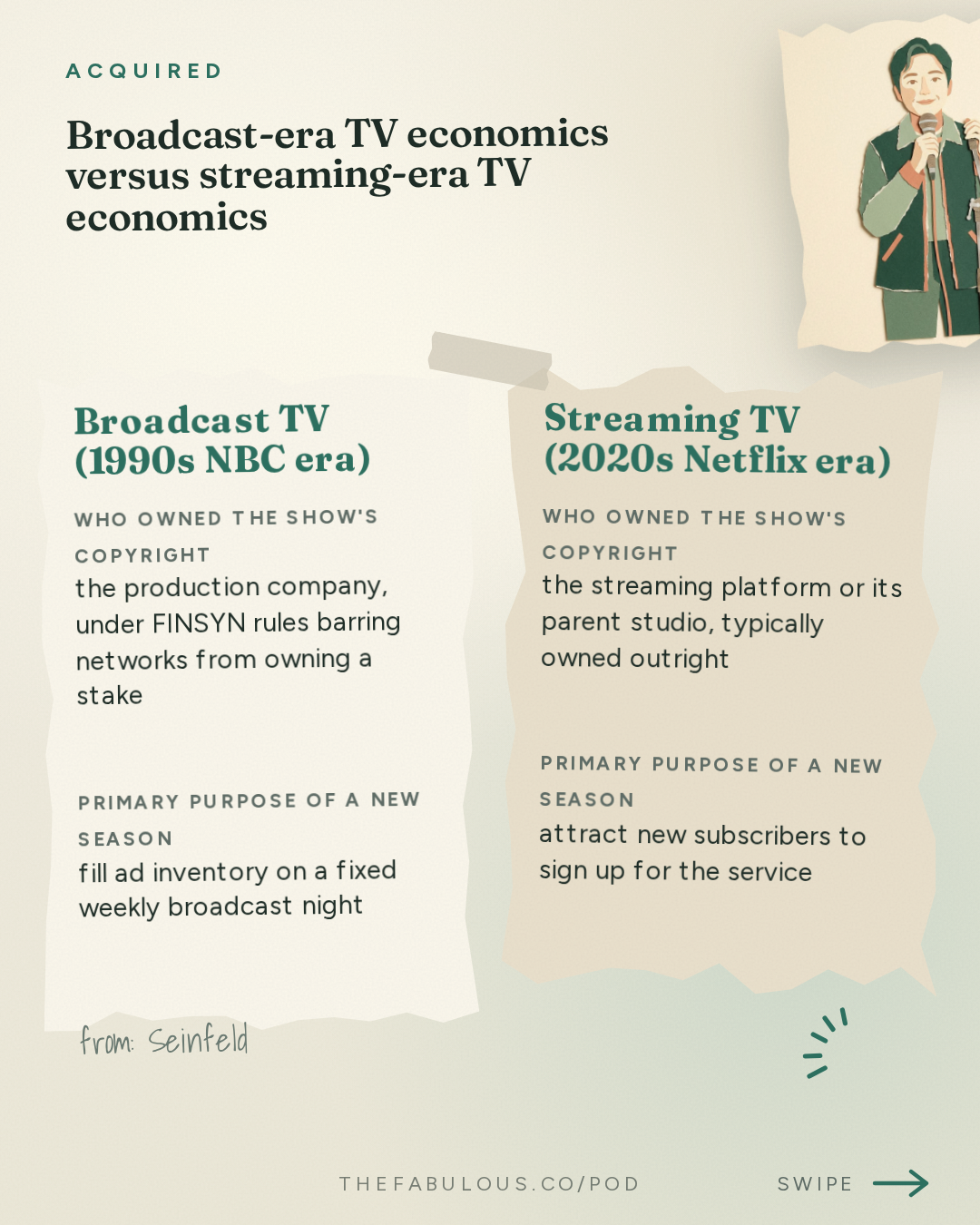
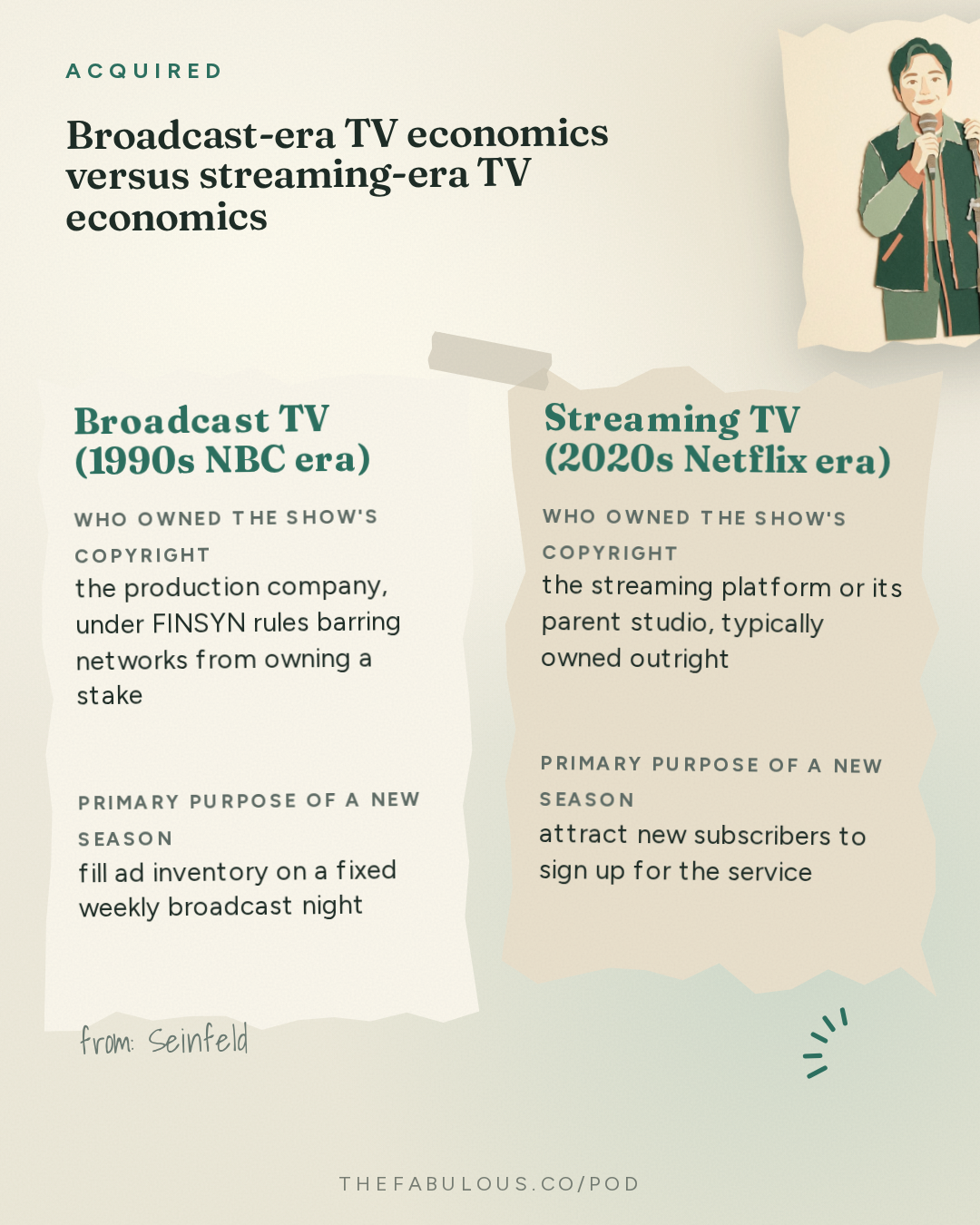
The regulation is called FINSYN, short for the Financial Interest and Syndication Rules, which the Federal Communications Commission put in place in 1970 (35:43). The rule barred a broadcast network like NBC from owning a financial stake in the shows it aired. Networks paid production companies most, but not all, of what it cost to make an episode, a practice called deficit financing, and in return the studio kept the rights to everything that came after the first broadcast: reruns, foreign sales, eventually home video. By 1988, when NBC finally agreed to develop something with stand-up comedian Jerry Seinfeld, this arrangement meant the network could promise to air a show without owning a cent of its future value. Seinfeld and his new writing partner, fellow stand-up comic Larry David, grasped what that meant immediately. Because NBC had already guaranteed it would air whatever they made, the risk that normally scares off production companies had disappeared, so Seinfeld and David could pick any studio and set the deal terms themselves. They chose Castle Rock Entertainment, an independent studio funded with $30 million from Coca-Cola (45:41), and walked away with roughly 15 percent of the show's long-term profits each, for Jerry Seinfeld, who had never written a television script before, and Larry David, who had prior television writing experience on Fridays and Saturday Night Live (50:34).
No Hugging, No Learning
What they did with that ownership is where the story turns from finance into craft. Both men came from stand-up, a form with no continuity and no character growth: a joke either lands tonight or it does not, and tomorrow it is a different joke. They built the show the same way, around one unwritten rule.
"No hugging, no learning." — Ben Gilbert and David Rosenthal, describing Larry David's rule for the show [77:57]
Characters never resolved conflicts, apologized, or grew wiser. George Costanza lied his way deeper into trouble and never once came clean. Nobody sat down at the end of an episode, the way sitcom parents always had, to explain the lesson of the week. NBC's own research had flagged this as a weakness early on, with viewers complaining that George was not a forceful enough character and that the hanging around scenes were boring (62:46). The network was not wrong that audiences, at first, did not warm to it. Even after a full first season, Seinfeld ranked only 42nd on television. It survived because a couple of NBC executives, Warren Littlefield in primetime and Rick Ludwin in the specials department, kept finding small, almost accidental ways to give it another chance (65:21).
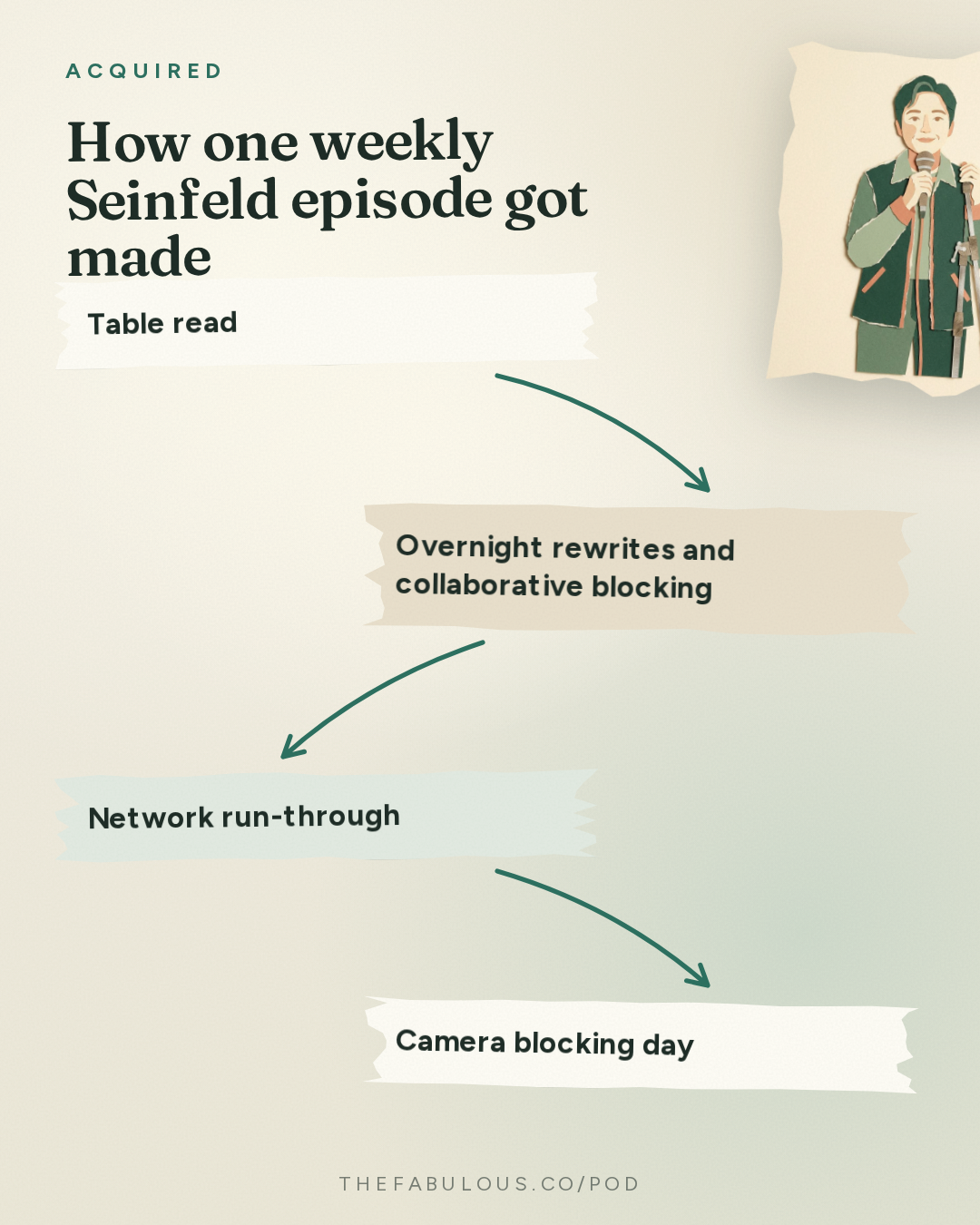
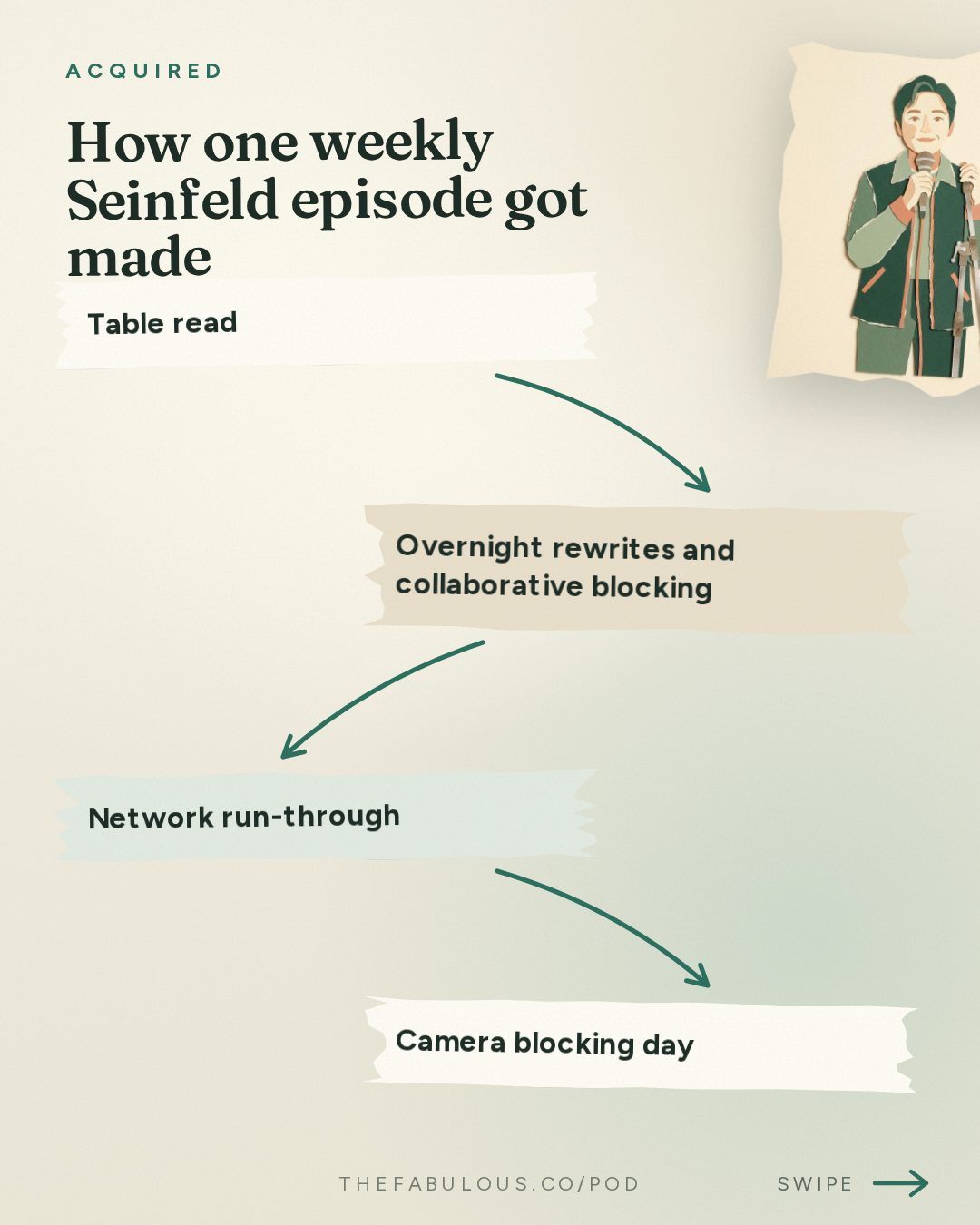
That refusal to resolve anything turned out to be the best business decision in the show's history, even though nobody made it for business reasons. A sitcom built on relationship arcs needs to be watched in order. A sitcom where nothing changes between episodes can be watched in any order, at any hour, forever, which is exactly the product a rerun market wants to buy. None of this came easily. Writers Alec Berg and David Mandel, who joined the show in its later seasons, describe a schedule that opened with a Wednesday table read and ran through overnight rewrites to a Tuesday night taping in front of a live audience, with almost no days off in between (129:03). Larry David left after season seven, worn out from running every rewrite himself for seven years (149:01). Jerry Seinfeld stayed on as showrunner, actor, and star, and by the ninth season was paid $1 million per episode, more than any television actor in history to that point (151:39).
Quitting While They're Screaming
By the end of 1997, Seinfeld was generating about $200 million a year in profit for NBC, roughly a fifth of the entire network's earnings (153:57). That is the context for the meeting General Electric chief executive Jack Welch arranged in NBC CEO Bob Wright's Manhattan apartment that December. Welch brought slides arguing the show had not yet peaked. Then he pulled Seinfeld aside, wrote three numbers on a scrap of paper, 5 million dollars, 22 episodes, 110 million dollars, and handed it over as a firm salary offer for one more season (165:53).
"If you can get off, they'll scream even louder. They'll never forget you." — Jerry Seinfeld [169:21]
Seinfeld turned it down. The conventional read at the time, repeated for years, was that this was sentimental and financially foolish. A Harvard Business Review interviewer pressed him on exactly that in 2017, asking why he had not found a more efficient way to keep the show running.
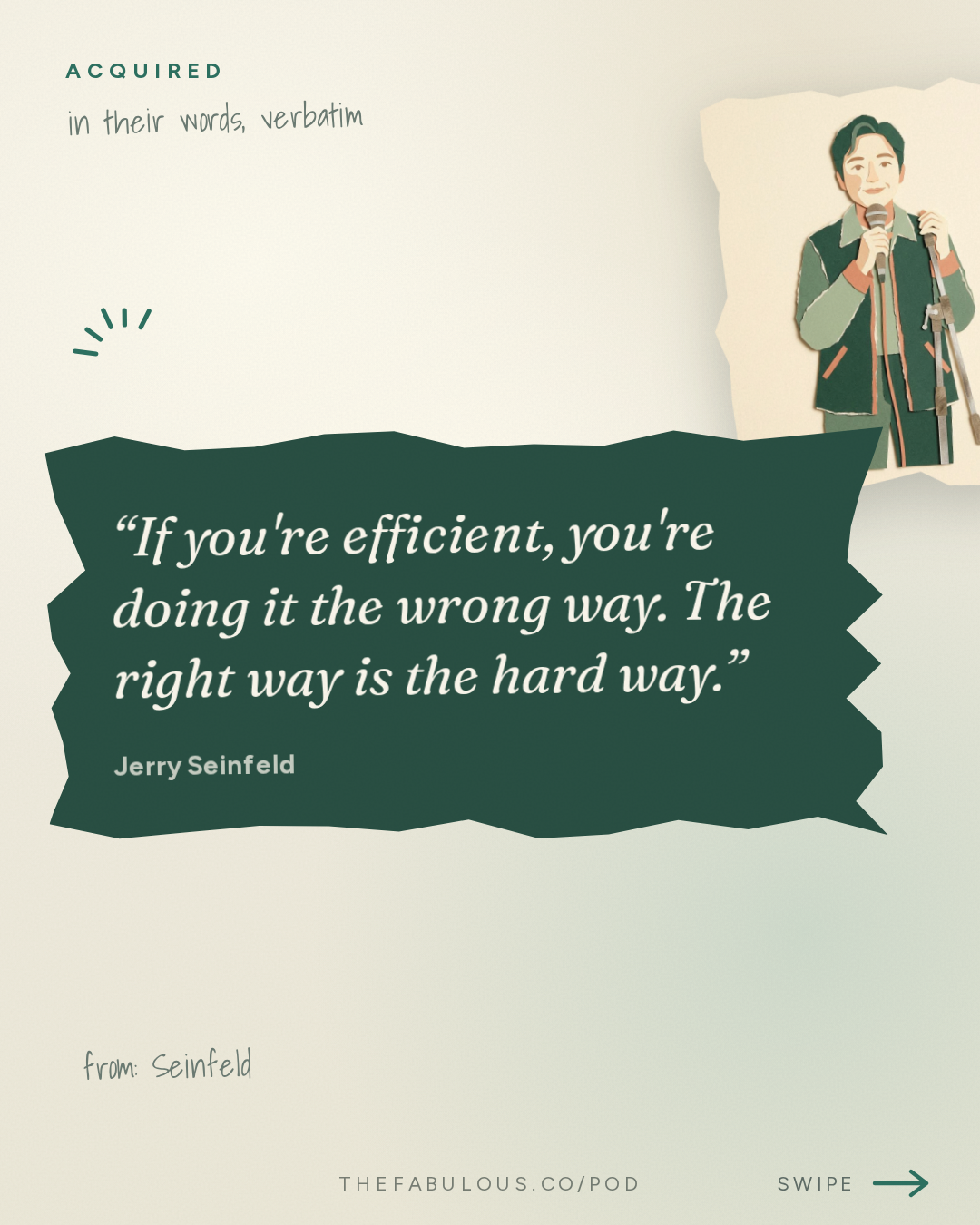
"If you're efficient, you're doing it the wrong way. The right way is the hard way." — Jerry Seinfeld [173:43]
The numbers since suggest he read the market correctly. Sony sold the first broadcast syndication cycle for over $500 million in 1995, while the show was still airing (142:01). A second cycle in 1998, after the finale, brought in a reported $1.1 billion across broadcast, cable, and international sales (177:01). Netflix paid a reported $500 million for a five year license in 2019, and renewed at a similar figure in 2026 for US and Canadian rights alone (191:20, 02:40). Add it up, and the total haul on the Seinfeld asset is now estimated at more than $7 billion, against a production cost of roughly $250 million across nine seasons (196:51).
The newest chapter in that math explains why a streaming service wants a show that finished filming in 1998 at all. New shows on a service like Netflix exist mainly to pull in subscribers, which is why seasons have shrunk to eight or ten episodes built to hook a signup fast. A finished, familiar show like Seinfeld does a different job: it keeps people from canceling. If a subscriber cannot find anything new to watch, Seinfeld is always there, comfortable enough to fall asleep to, which is why churn reduction, not new subscriber acquisition, is what a legacy sitcom is bought to solve now (201:48).
Almost everyone involved agrees this could not happen quite the same way today. FINSYN was repealed in 1995, so networks and studios are now usually the same company, and the independent, high risk, high reward ownership structure that let two unproven comedians keep 15 percent each of a hit no longer exists in that form. What remains is the show itself, a half hour built entirely around refusing to change, still the thing audiences keep returning to, unchanged.
Ask this episode anything
Pod's AI answers from the episode itself, with the minute mark so you can hear it yourself.
Or start with one of these
Ask this episode
Pod's AI listens to the whole episode to answer, and points you to the minute it comes from.
The rest of this answer, and any question after it
Answers come from the episode itself, never from a summary of it.
ContinueKey takeaways
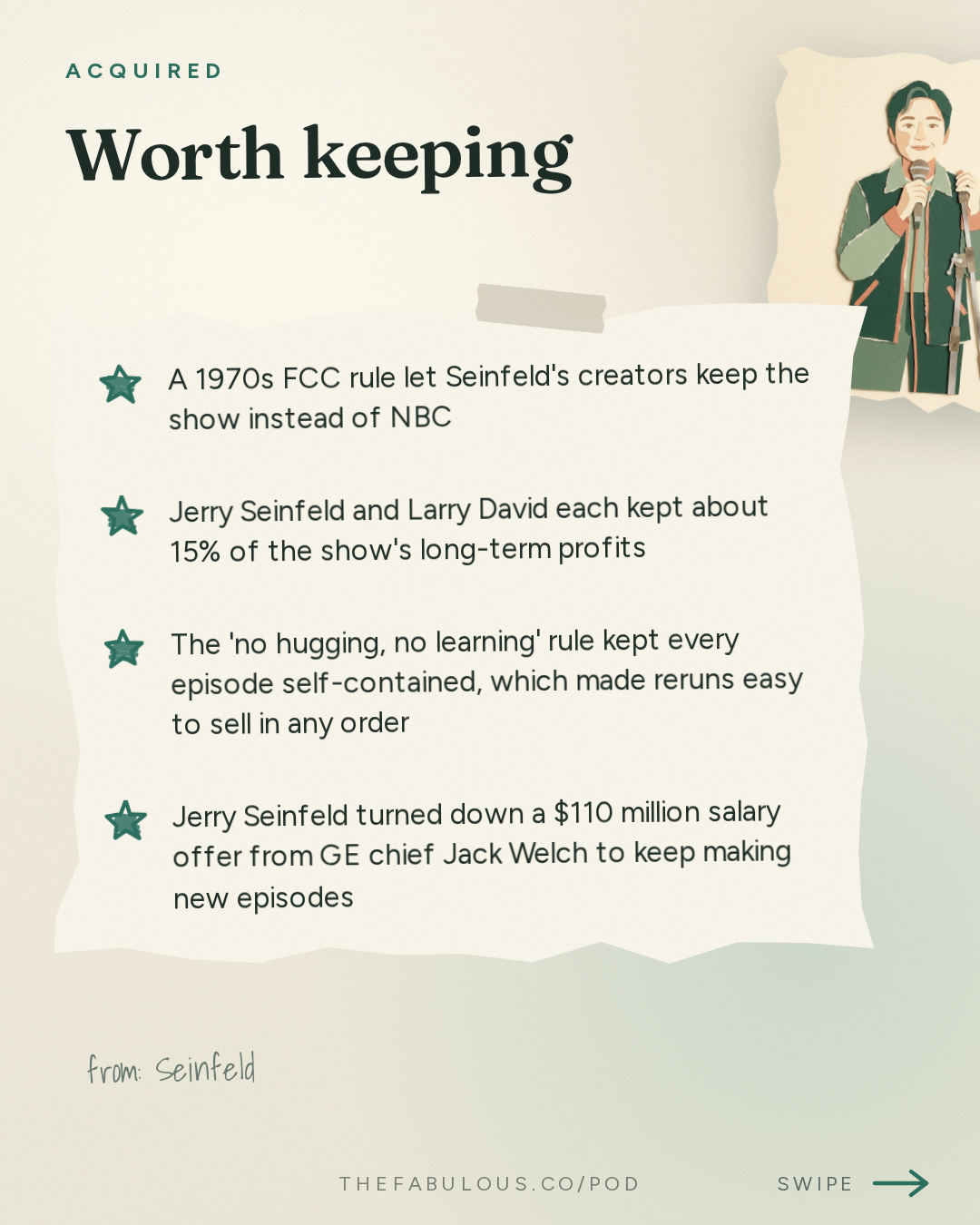
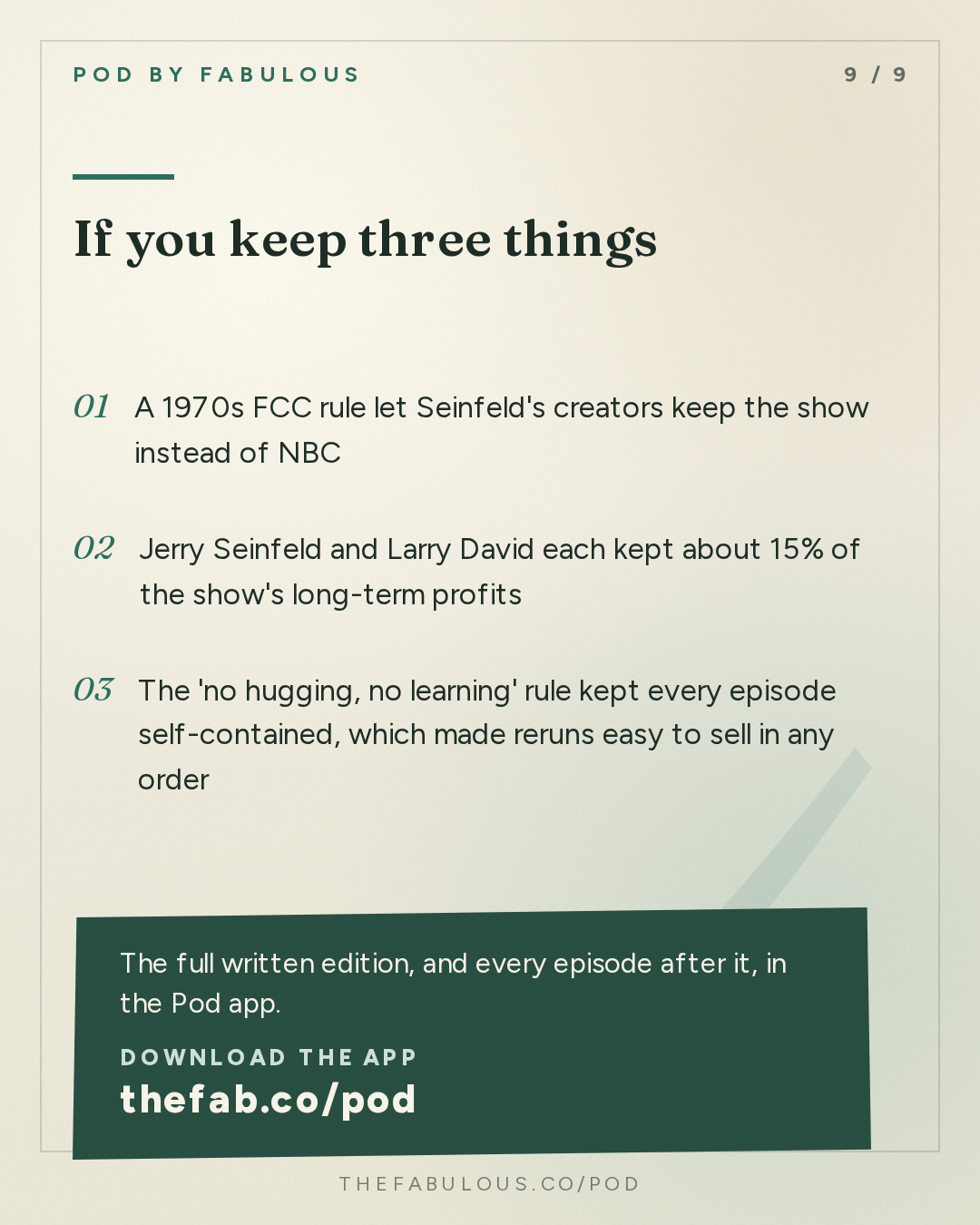
- A 1970s FCC rule let Seinfeld's creators keep the show instead of NBC
- Jerry Seinfeld and Larry David each kept about 15% of the show's long-term profits
- The 'no hugging, no learning' rule kept every episode self-contained, which made reruns easy to sell in any order
- Jerry Seinfeld turned down a $110 million salary offer from GE chief Jack Welch to keep making new episodes
- Streaming services like Netflix now license Seinfeld mainly to stop subscribers from canceling, not to win new ones
The episode in cards
By the numbers
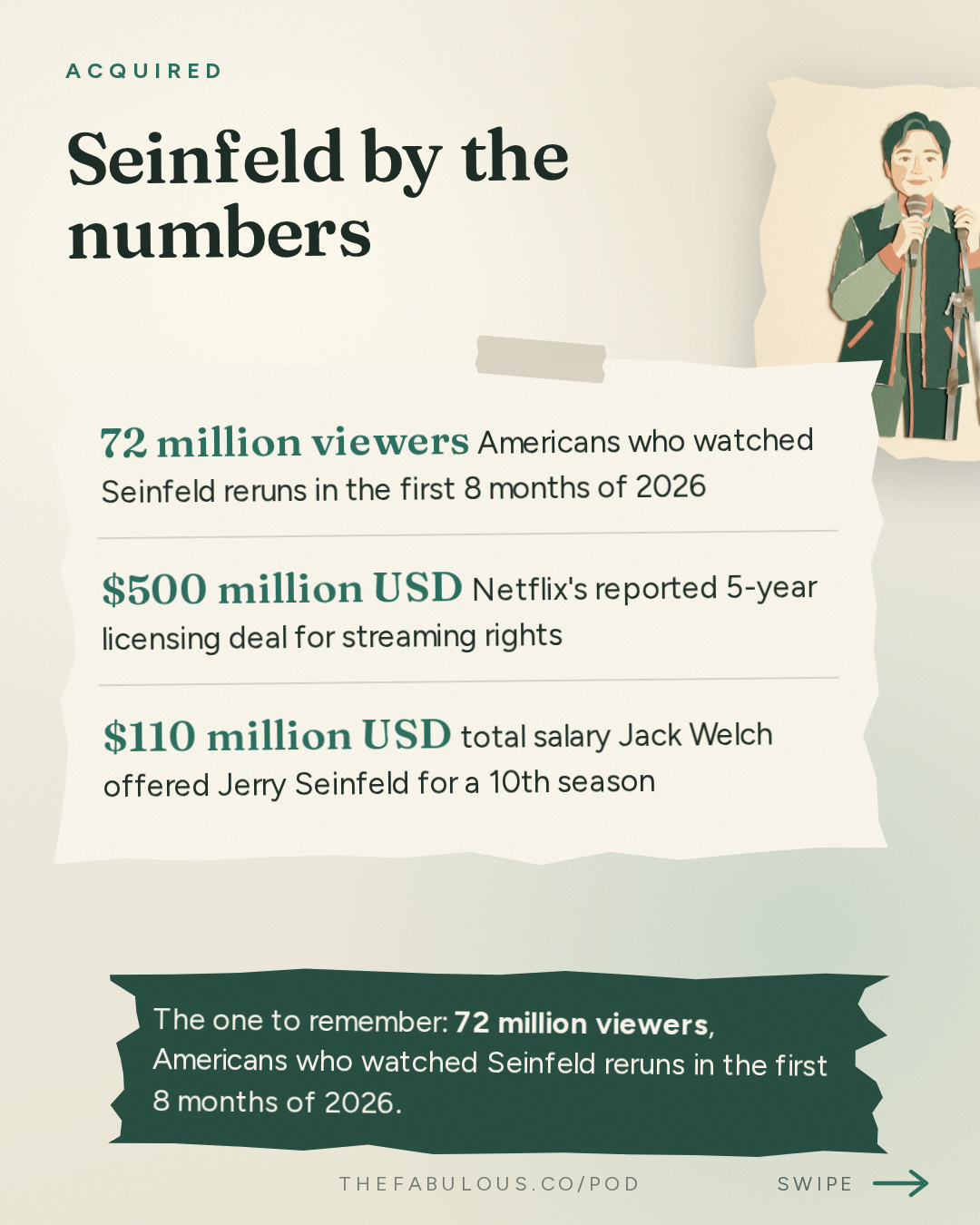
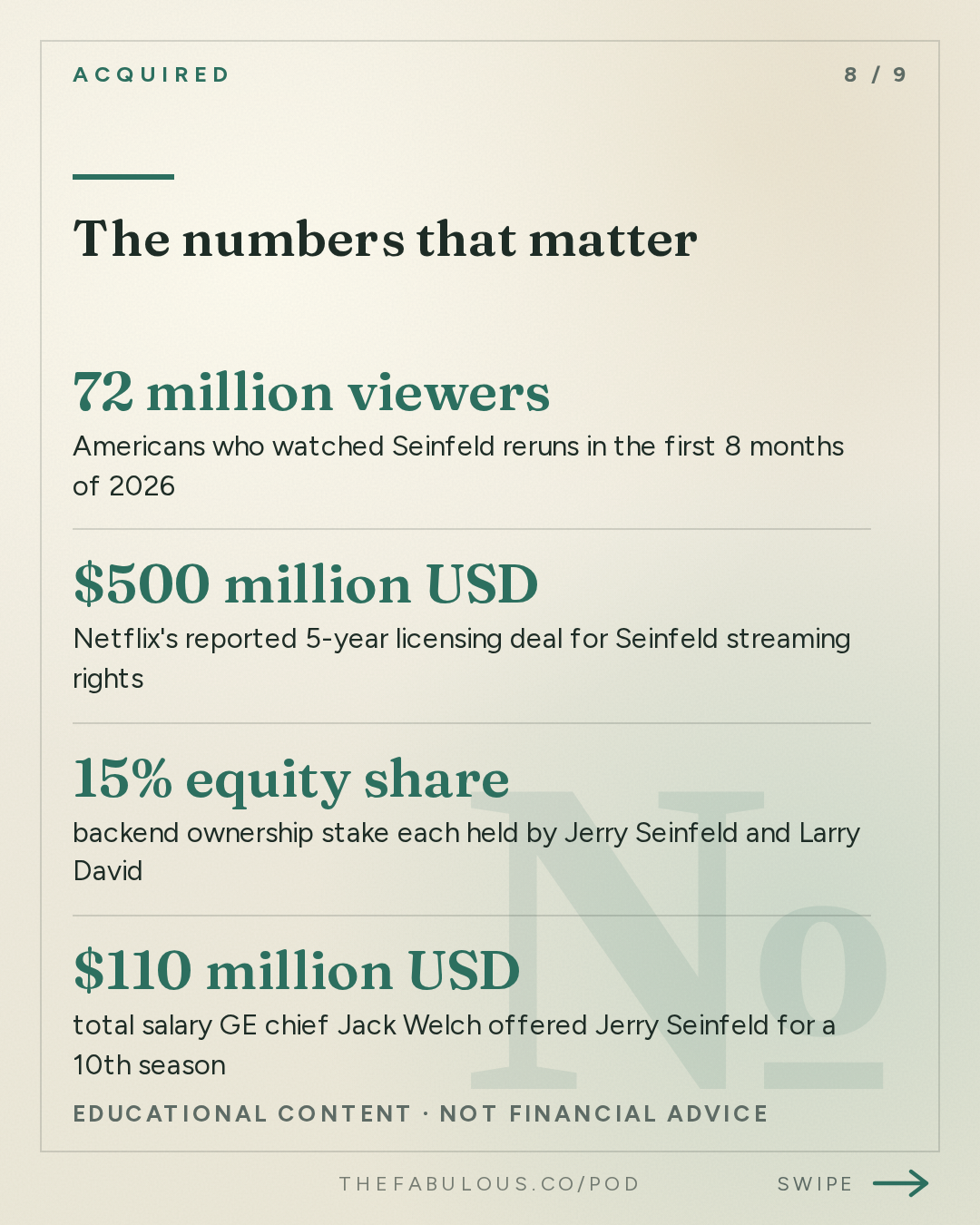
- 72 million viewers Americans who watched Seinfeld reruns in the first 8 months of 2026
- $500 million USD Netflix's reported 5-year licensing deal for Seinfeld streaming rights
- 15% equity share backend ownership stake each held by Jerry Seinfeld and Larry David
- $110 million USD total salary GE chief Jack Welch offered Jerry Seinfeld for a 10th season
- $7 billion USD estimated total lifetime revenue generated by the Seinfeld asset
In their words
“Success as a comedian is getting this meeting." Right. "So I'm, I'm like in this room. I'm excited to be in this room with you right now."”
“No hugging, no learning.”
“If you're efficient, you're doing it the wrong way. The right way is the hard way.”
“If you can get off, they'll scream even louder. They'll never forget you.”
Protocols
-
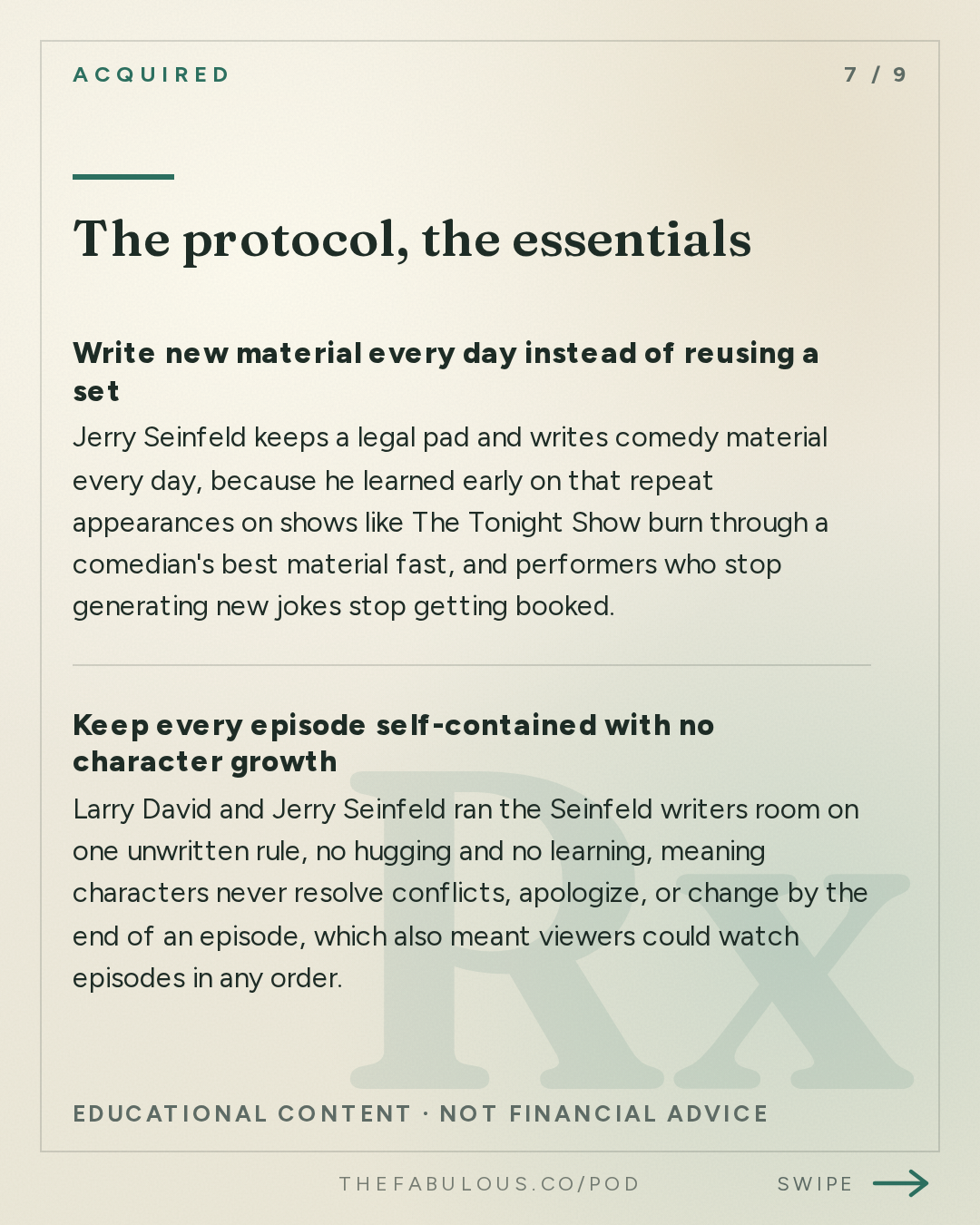
Write new material every day instead of reusing a set
Jerry Seinfeld keeps a legal pad and writes comedy material every day, because he learned early on that repeat appearances on shows like The Tonight Show burn through a comedian's best material fast, and performers who stop generating new jokes stop getting booked.
daily
-
Keep every episode self-contained with no character growth
Larry David and Jerry Seinfeld ran the Seinfeld writers room on one unwritten rule, no hugging and no learning, meaning characters never resolve conflicts, apologize, or change by the end of an episode, which also meant viewers could watch episodes in any order.
every episode
-
Run a compressed, overlapping weekly production cycle
Seinfeld writers Alec Berg and David Mandel describe how the show opened scripts with a Wednesday table read, rewrote overnight through the week, blocked camera shots on day four, and shot in front of a live audience on day five, so the cast and writers had almost no downtime between episodes.
weekly
Questions this episode answers
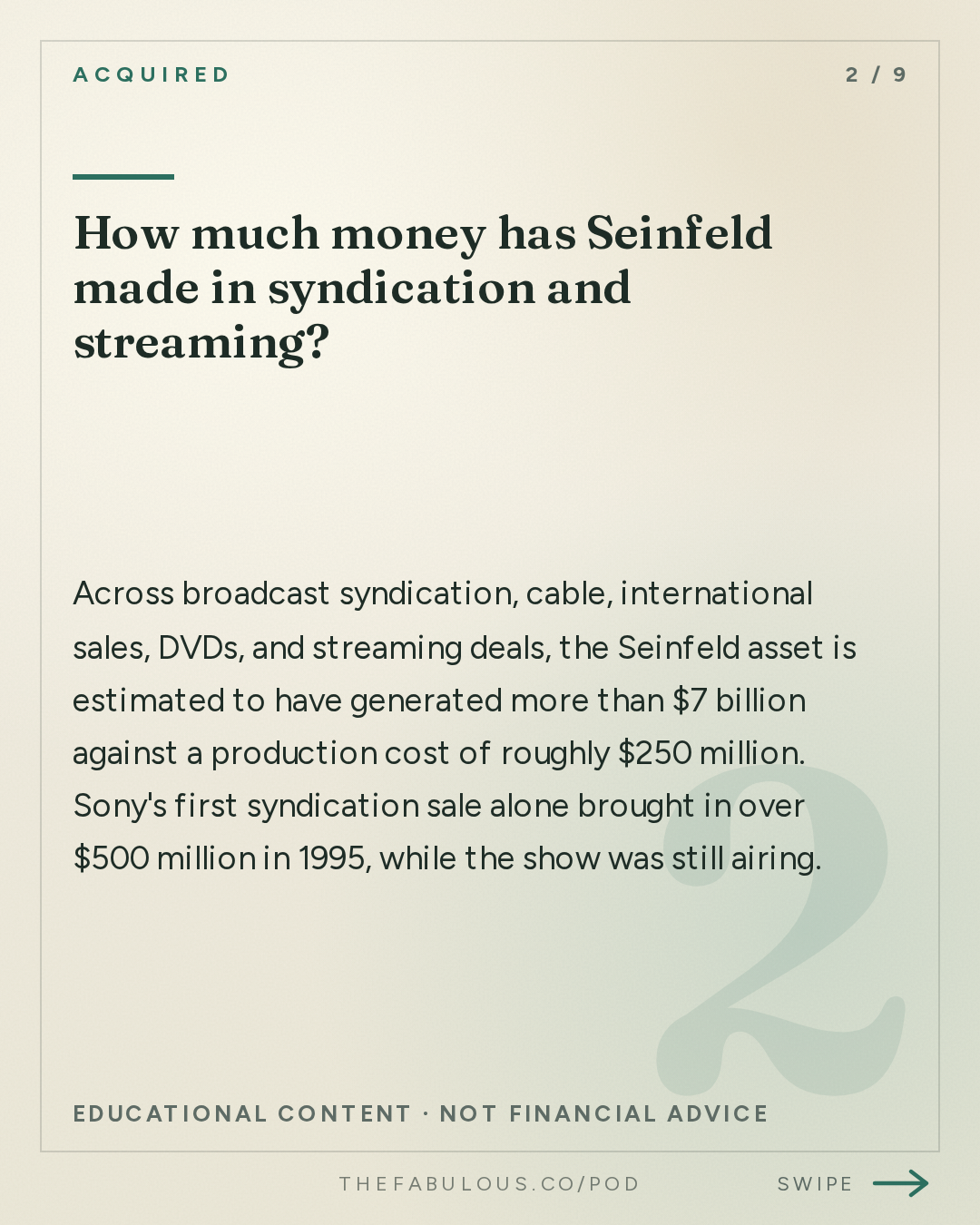
How much money has Seinfeld made in syndication and streaming?
Across broadcast syndication, cable, international sales, DVDs, and streaming deals, the Seinfeld asset is estimated to have generated more than $7 billion against a production cost of roughly $250 million (196:51). Sony's first syndication sale alone brought in over $500 million in 1995, while the show was still airing (142:01).
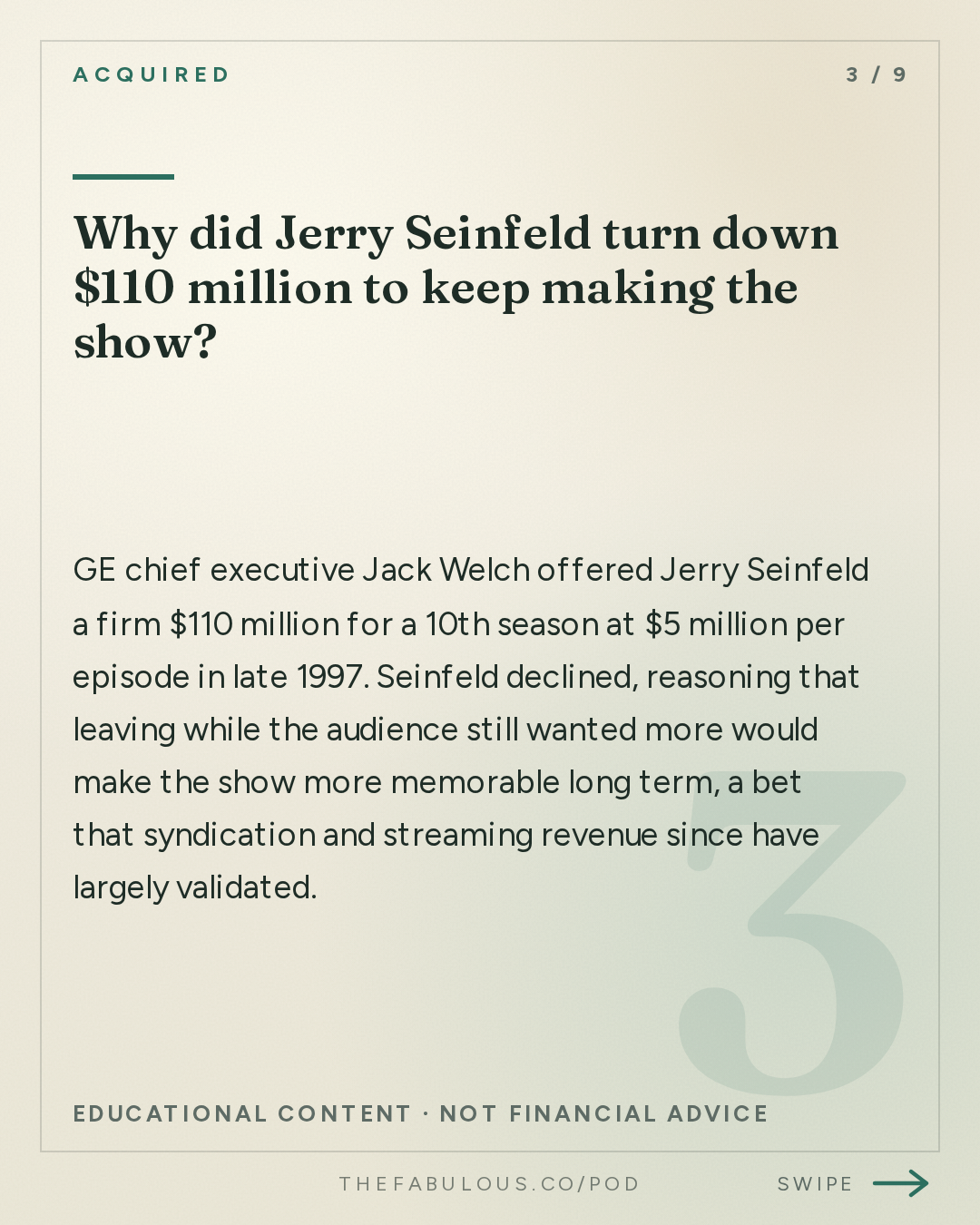
Why did Jerry Seinfeld turn down $110 million to keep making the show?
GE chief executive Jack Welch offered Jerry Seinfeld a firm $110 million for a 10th season at $5 million per episode in late 1997 (165:53). Seinfeld declined, reasoning that leaving while the audience still wanted more would make the show more memorable long term, a bet that syndication and streaming revenue since have largely validated (169:21).
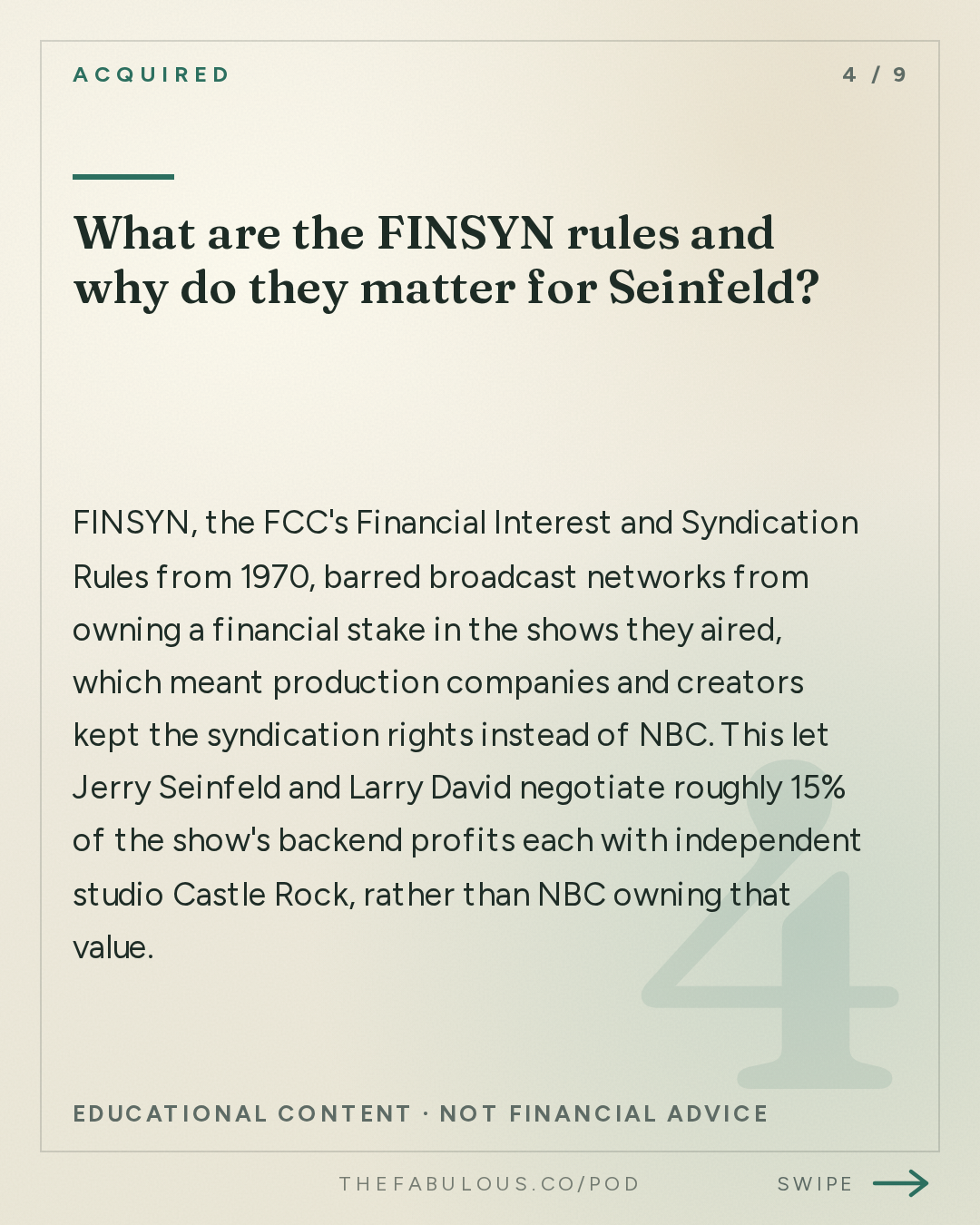
What are the FINSYN rules and why do they matter for Seinfeld?
FINSYN, the FCC's Financial Interest and Syndication Rules from 1970, barred broadcast networks from owning a financial stake in the shows they aired, which meant production companies and creators kept the syndication rights instead of NBC (35:43). This let Jerry Seinfeld and Larry David negotiate roughly 15% of the show's backend profits each with independent studio Castle Rock, rather than NBC owning that value (50:34).
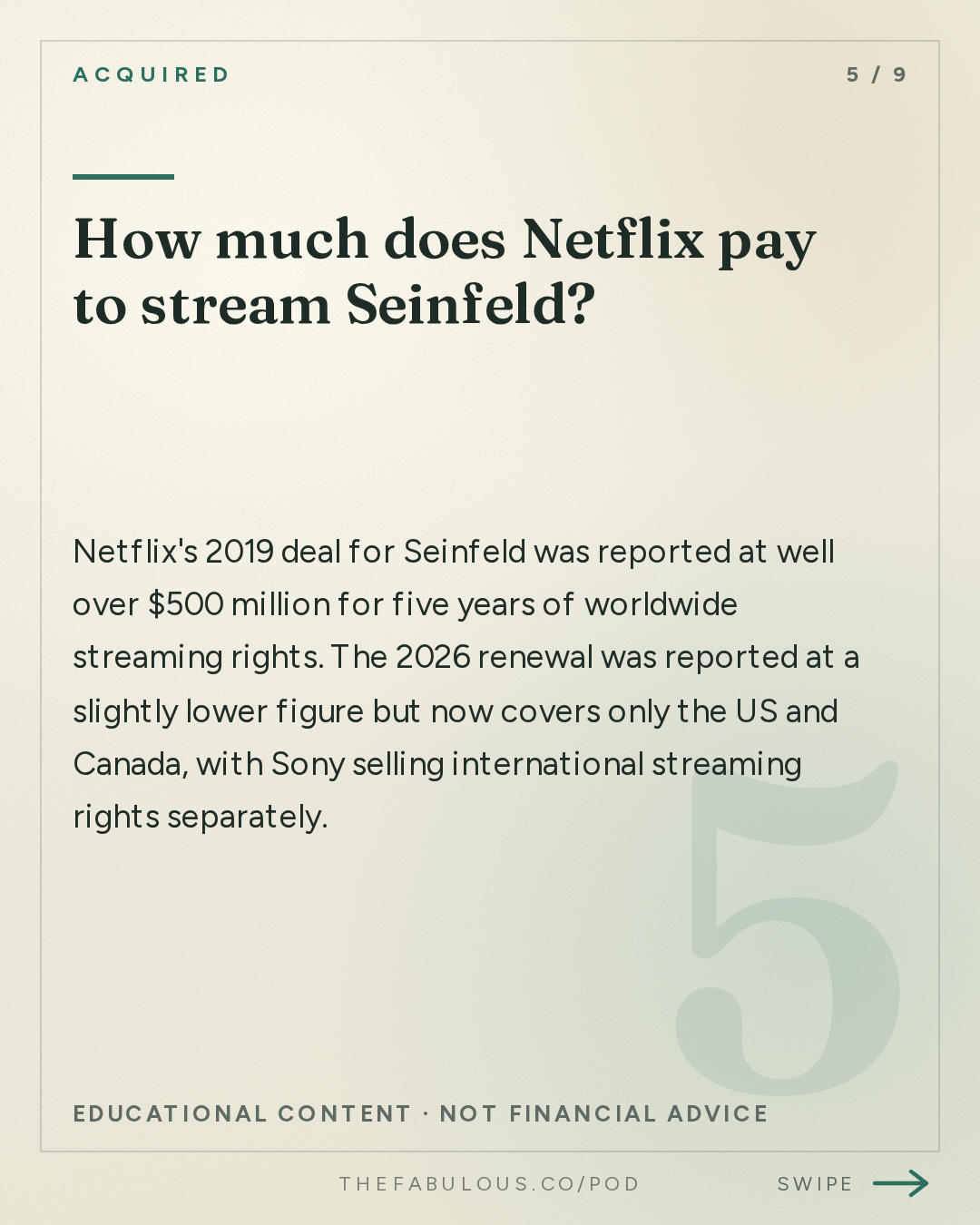
How much does Netflix pay to stream Seinfeld?
Netflix's 2019 deal for Seinfeld was reported at well over $500 million for five years of worldwide streaming rights (02:40). The 2026 renewal was reported at a slightly lower figure but now covers only the US and Canada, with Sony selling international streaming rights separately (191:20).
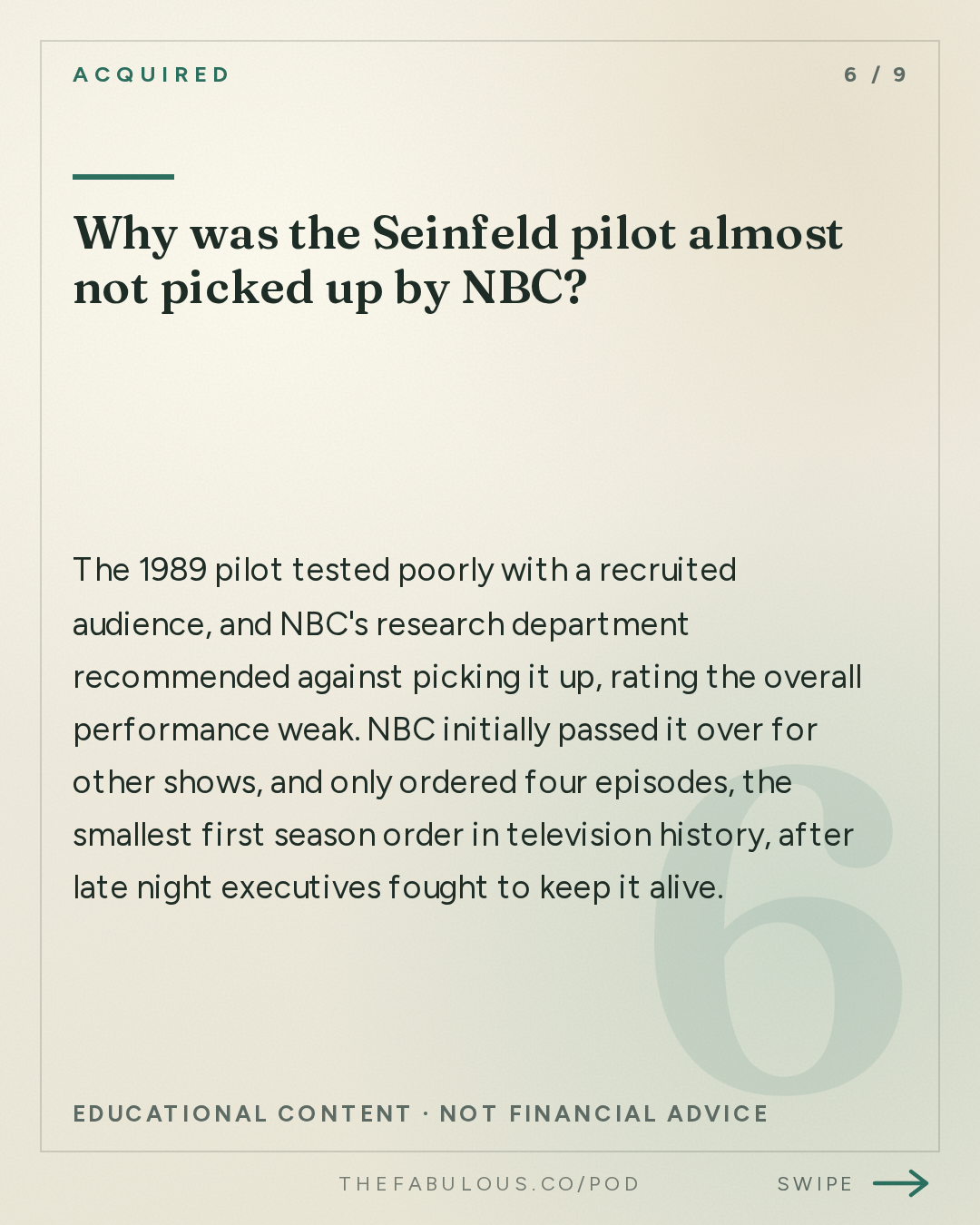
Why was the Seinfeld pilot almost not picked up by NBC?
The 1989 pilot tested poorly with a recruited audience, and NBC's research department recommended against picking it up, rating the overall performance weak (62:46). NBC initially passed it over for other shows, and only ordered four episodes, the smallest first season order in television history, after late night executives fought to keep it alive (66:19).
The full read, in cards
Go deeper
- Seinfeldia — a history of how Seinfeld was made and why it endured, referenced for research on the show's production
- Top of the Rock — NBC executive Warren Littlefield's oral history memoir covering the network's Seinfeld, Friends, and Cheers era
- Harvard Business Review interview with Jerry Seinfeld (2017) — Seinfeld explains why he rejects efficiency and consulting-style optimization in creative work
- The Seinfeld Chronicles: An Unnecessary Data Exploration — a hand-labeled data visualization project by Andy Kirk mapping laughs and screen time across every Seinfeld episode
Mentioned
Jerry Seinfeld · Larry David · Brandon Tartikoff · Warren Littlefield · George Shapiro · Jason Alexander · Michael Richards · Julia Louis-Dreyfus · Jack Welch · Rob Reiner · Kenny Kramer · Castle Rock Entertainment · NBC · Coca-Cola · Sony · Netflix · FINSYN · The Contest · Seinfeldia · Top of the Rock
More from this show and category
Home Depot's Business History and Strategy
Home Depot turned a 1978 firing into a $350 billion retailer by inventing the warehouse home-improvement store, arming clerks with trade skills, and paying workers in stock. A GE-style efficiency push nearly wrecked that culture before a quiet successor restored it and built the e-commerce backbone that saved the company during COVID.
Disney's Business History: Flywheel to Streaming
Disney's business model is a flywheel: make a beloved story once, then sell it forever through parks, merchandise, and reissues. This episode traces how Michael Eisner and Bob Iger rebuilt that flywheel twice, first with animation and ESPN, then with Pixar, Marvel, and streaming, and asks whether the flywheel still turns.
Walt Disney's IP Flywheel Business Model Explained
Walt Disney built the first intellectual property flywheel: create beloved animated characters, saturate distribution, then feed merchandise, TV, and theme parks off that IP without cannibalizing it. After a devastating 1928 betrayal cost him Oswald the Rabbit, Disney invented Mickey Mouse and never let a distributor own his characters again.
How AI Models Actually Think
Anthropic researcher Emmanuel Ameisen explains that language models are grown through training, not programmed line by line, so even their creators cannot read their internal logic directly. Interpretability research shows models form internal plans, share universal concepts across languages, and sometimes fixate on wrong answers when training data rewards them incorrectly (01:45, 15:31, 37:14).
