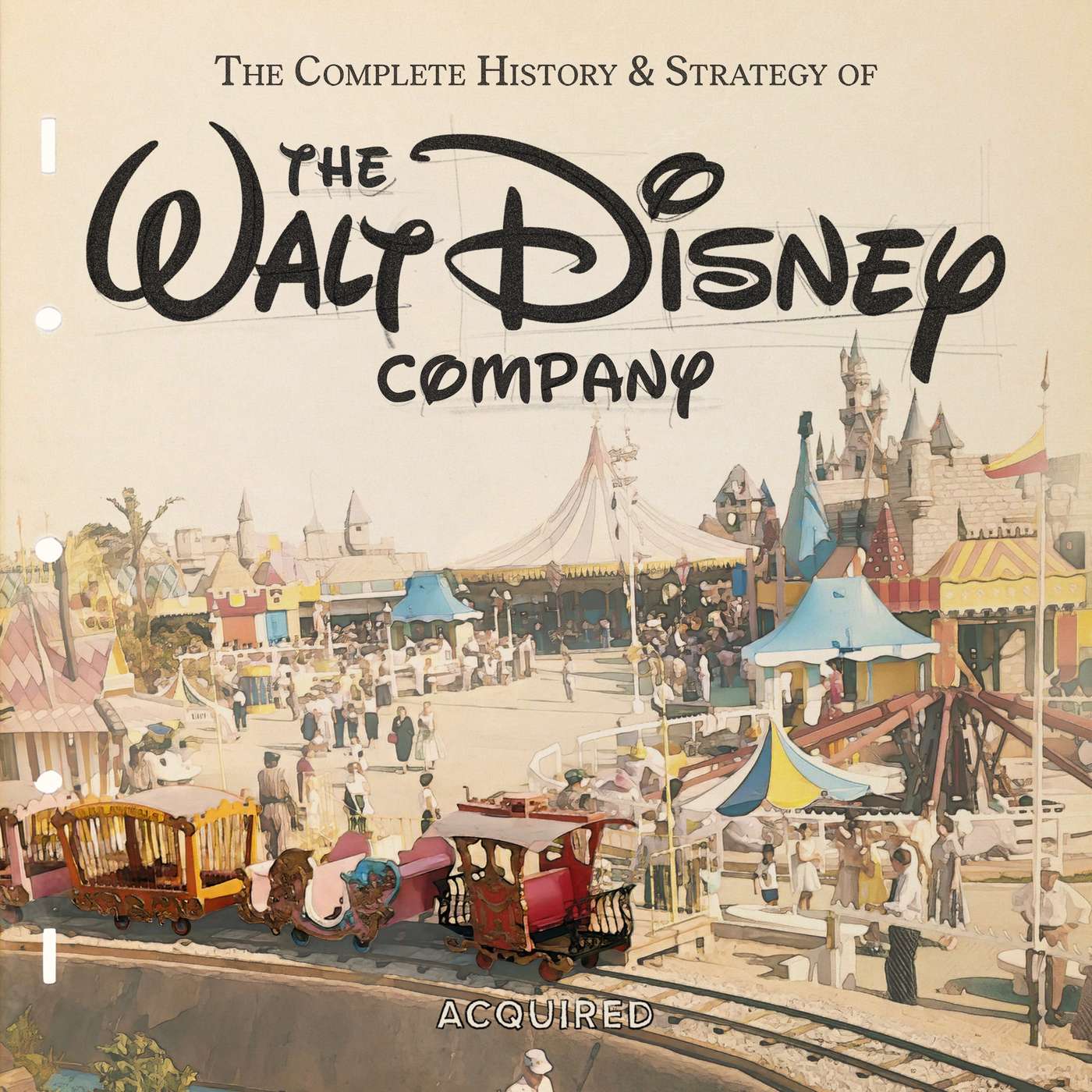
Walt Disney's IP Flywheel Business Model Explained
The Walt Disney Company
The brief
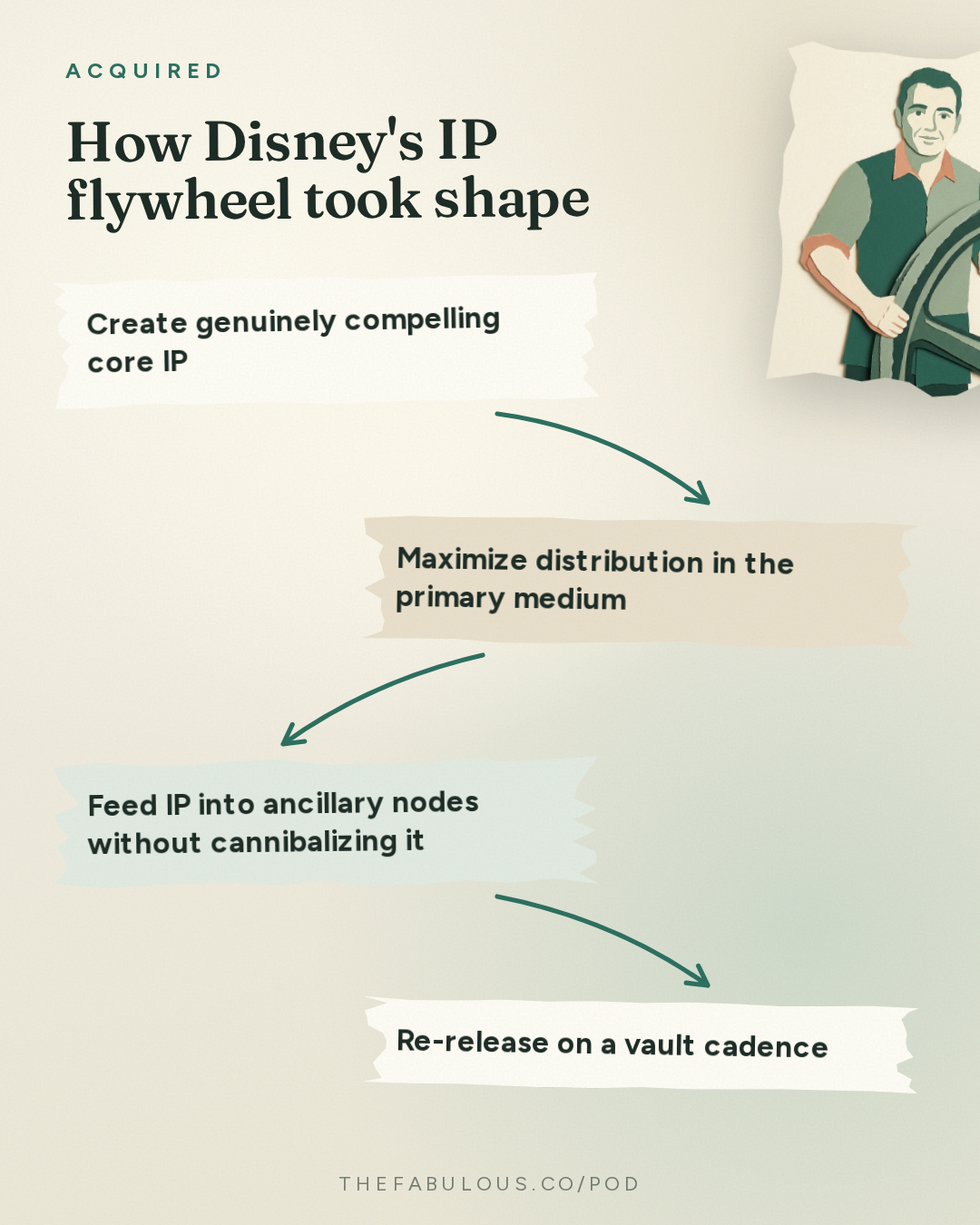
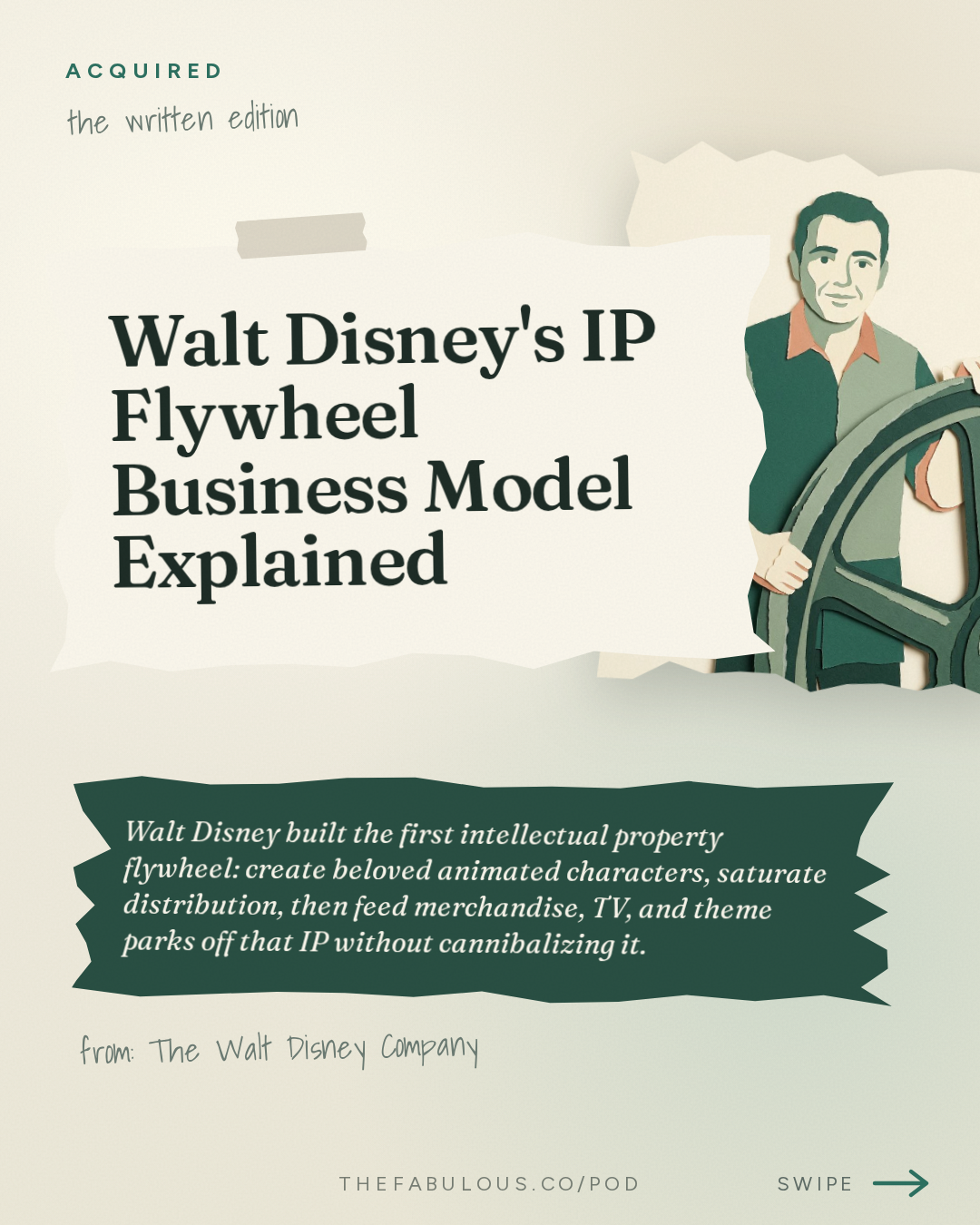
Walt Disney built the first intellectual property flywheel: create beloved animated characters, saturate distribution, then feed merchandise, TV, and theme parks off that IP without cannibalizing it. After a devastating 1928 betrayal cost him Oswald the Rabbit, Disney invented Mickey Mouse and never let a distributor own his characters again.
In 1928, a New York film distributor picked up a package of Life Savers candy while turning down Walt Disney's cartoon mouse. The public knows Life Savers, the man said. They don't know you, and they don't know your mouse. It was a humiliation. It was also, in hindsight, the moment that taught Walt Disney the single lesson his entire company would be built on: never again let someone else own the relationship between the audience and the character.
That lesson came at a brutal price. Disney's first real hit character, Oswald the Lucky Rabbit, wasn't his. Universal owned the rights, and when distributor Charles Mintz decided Disney himself was expendable, he simply signed away nearly all of Disney's animators behind his back and cut Disney's pay (35:59). Walt arrived at a meeting expecting a raise and left with nothing: no contract, no staff, no character. "Suddenly, the enterprise value... of Walt Disney Studios is effectively zero," as the hosts put it (38:19). On the train home, he sketched a new character in his notebook. This time, the studio's own name would be on the film before anyone else's.
That mouse, of course, was Mickey. But the real breakthrough wasn't the character. It was sound. Disney's crew rigged a synchronized soundtrack to a Mickey short called Steamboat Willie, and when they screened it for their wives and girlfriends, animator Ub Iwerks recalled the reaction: "I never saw such a reaction in an audience in my life... Walt kept crying, 'This is it. This is it. We've got it.'" (49:15). Synchronized sound did something no cartoon had managed before: it gave a drawing the illusion of a living personality. Audiences didn't just watch Mickey. They started to know him.
The Machine Behind the Mouse
What happened next is the part most people miss. Disney's studio began licensing Mickey to a children's writing tablet for $300, almost as an afterthought (62:19). Within a few years, an advertising man named Kay Kamen was running Disney's merchandise operation with such force that royalty income from merchandise had already overtaken revenue from film rentals by 1934 (69:56). A Mickey Mouse wristwatch, made by a nearly bankrupt Ingersoll Watch Company, sold two and a half million units and saved the manufacturer. Meanwhile, theaters spontaneously invented "Mickey Mouse Clubs," charging kids and parents membership fees to buy exclusive merchandise, and the idea spread to over 800 clubs with more than a million members, more than the Boy and Girl Scouts combined (58:56).
None of this was planned as a system when it started. But Disney and his brother Roy, who ran the business side, began to see the shape of something new. Animated characters, unlike movie stars, never age and never demand a raise (72:18). A cartoon mouse could appear in a comic strip, a wristwatch, a children's book, and a theatrical short all at once without competing with itself, so long as the primary medium, the films, stayed scarce and excellent. Merchandise and comics didn't cannibalize the core IP. They deepened people's attachment to it. This is the mechanism people now call the Disney flywheel, though as the hosts point out, the word "flywheel" is technically the wrong physics term for what's being described: a flywheel stores energy, it doesn't create feedback loops (70:47). Wrong metaphor or not, the pattern worked, and Disney had stumbled into a way of building value that no other Hollywood studio had.
That flywheel is what let Disney make an insane bet: the first full length animated feature film. Roy thought Snow White would bankrupt the studio. Walt was unmoved.
"We had decided there was only one way we could successfully do Snow White, and that was to go for broke. Shoot the works. There would be no compromise on money, talent, or time. We did not know whether the public would go for a cartoon feature, but we were darn sure that audiences would not buy a bad cartoon feature." — Walt Disney [83:59]
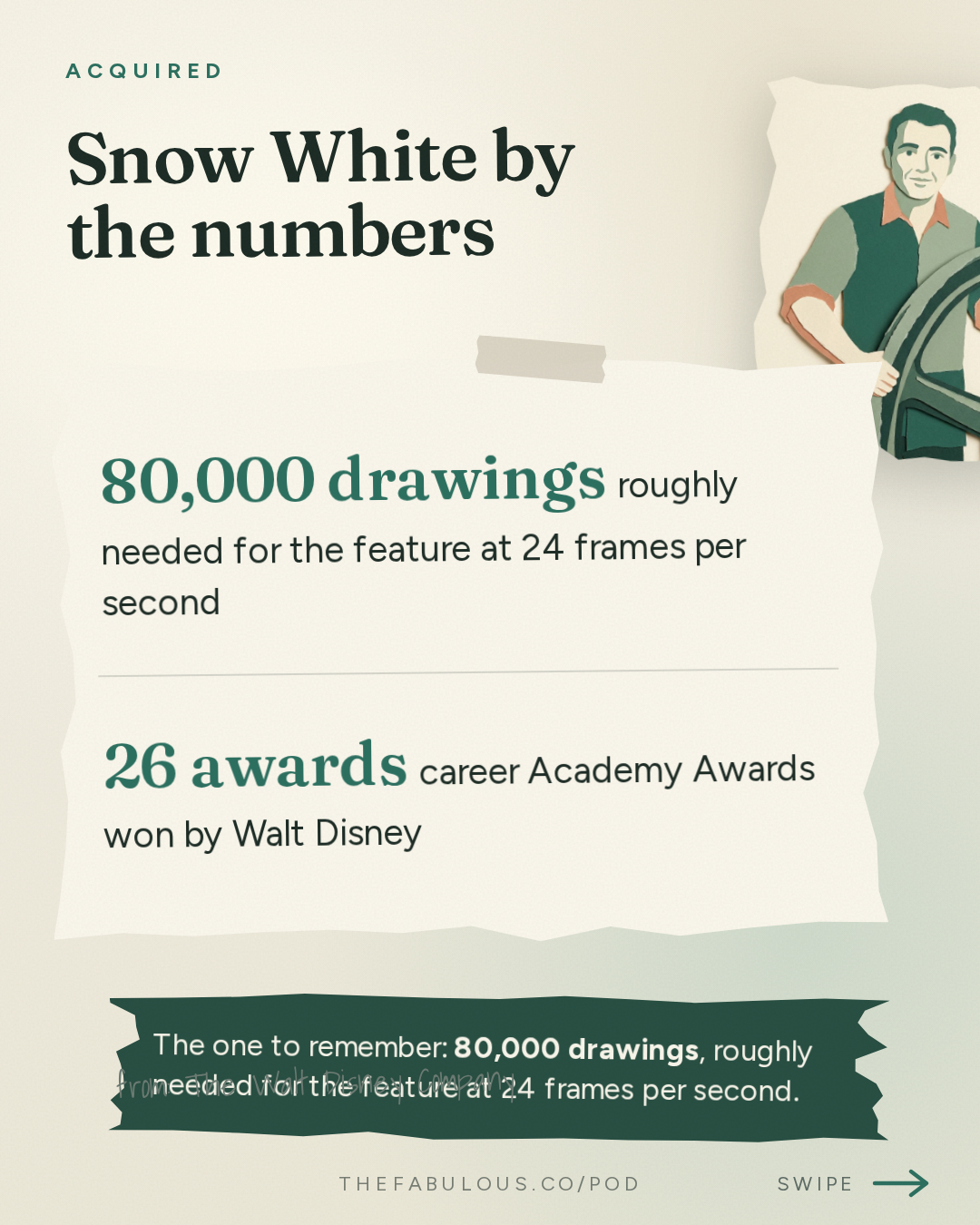
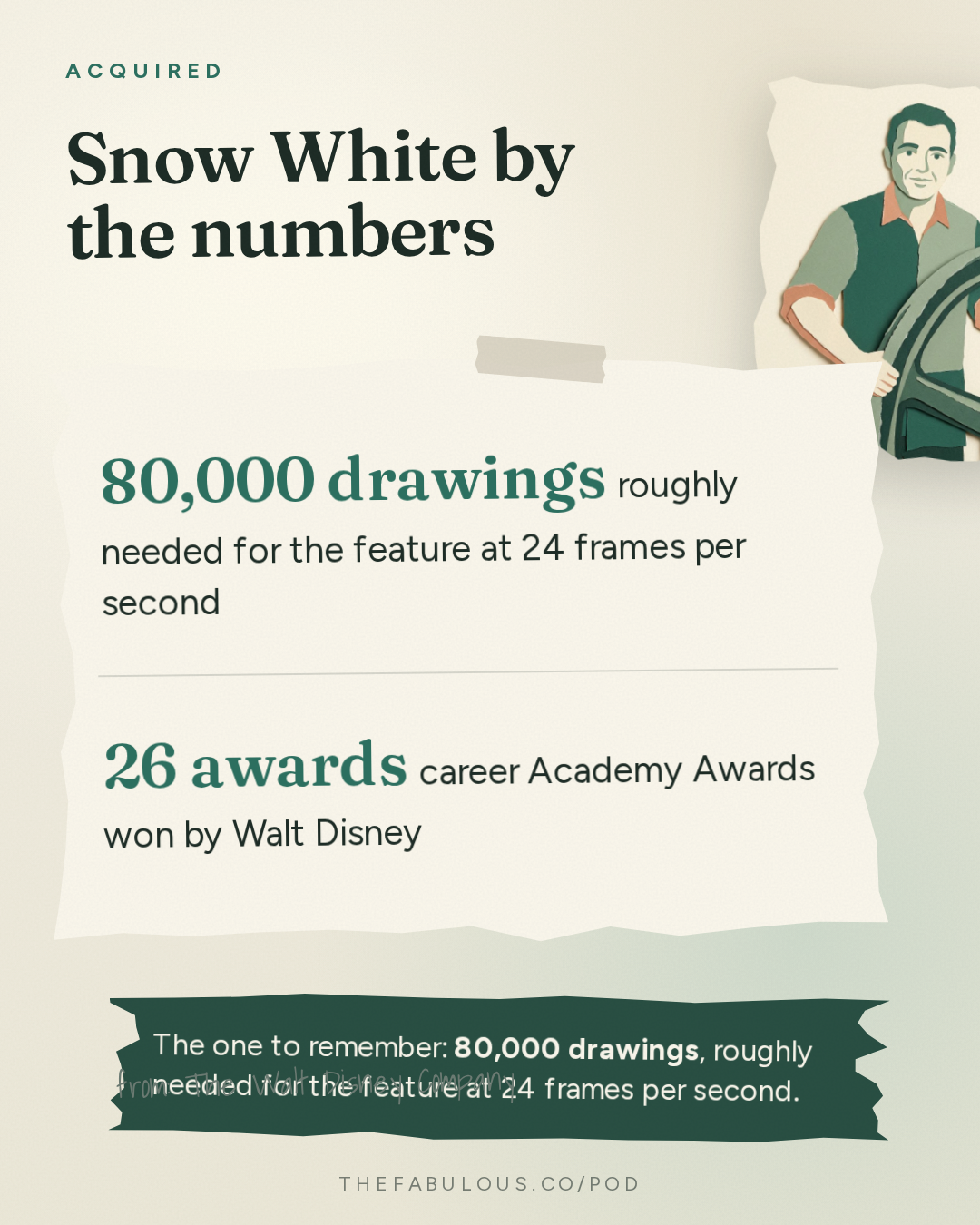
The film took three years, cost $1.5 million, and required roughly 80,000 individual drawings just for one character's movement across the screen (91:05). It became the highest grossing film of any kind made to that point, earning $8 million in rental revenue (102:46), and it won Walt Disney a specially created Oscar, one of 26 he would collect in his lifetime, still the record (103:09).
The Vault, the Park, and the Cost of Betting Everything
Success bought Disney the freedom to keep taking outsized risks, and outsized risks kept nearly killing the company. Pinocchio, Fantasia, and Bambi all went into production simultaneously right as World War II shut off European distribution, and Disney found itself $8 million in debt by 1940, forced to sell equity in the company for the first time (120:59). A brutal 1941 animators' strike, triggered by pay cuts tied to that same cash crunch, permanently damaged Walt's relationship with his own studio (124:43). During the war, the U.S. military occupied the Burbank lot, largely to guard the neighboring Lockheed Skunk Works, and Disney spent years making government training films instead of new characters (136:48).
Out of that same cash crunch came an accidental discovery: in 1944, with no money to make anything new, Disney simply re-released Snow White in theaters seven years after its debut, and it earned $3 million on almost no new cost, because an entirely new generation of children had grown up who'd never seen it (141:05). That accident became policy: re-release the classics roughly every seven years, long enough for a new generation of kids to discover them, not so often that the magic wears thin. Roy Disney later summed up why this mattered: "Our product is practically eternal" (147:00, referenced at 244:11).
The postwar years brought the biggest addition to the flywheel: television and Disneyland. Walt personally financed early theme park planning through his own company, WED Enterprises, because the public company's board wouldn't fund it. He then struck a deal with the third-place ABC network: a hit weekly TV show in exchange for financing and equity in Disneyland itself (174:12). Disney used that show to promote the park for a full year before it opened, and the strategy detonated spectacularly with a three-part Davy Crockett miniseries that sold ten million coonskin caps in a single year (183:47). When Disneyland opened on July 17, 1955, ABC's live broadcast drew 83 million viewers, roughly half of America (198:50), for a park that cost $17 million to build, about $210 million in today's money (195:01).
By his death in 1966, Walt Disney had spent his entire adult life betting the company again and again on unproven ideas. Analysts calculated that 99.95 percent of the company's eventual market value was created after he died (170:15), a strange kind of vindication: he never lived to see most of what he built pay off, yet almost none of it would have existed without his willingness to risk everything on the next idea. His last project, an actual planned city in Florida called EPCOT, meant to house 20,000 residents under a climate-controlled dome (232:20), died with him and was quietly scaled back by Roy into what became Walt Disney World's Magic Kingdom, built debt-free for $400 million (239:37). It was, in its way, the least Walt Disney thing the company ever did: cautious, budgeted, safe. And it worked.
Ask this episode anything
Pod's AI answers from the episode itself, with the minute mark so you can hear it yourself.
Or start with one of these
Ask this episode
Pod's AI listens to the whole episode to answer, and points you to the minute it comes from.
The rest of this answer, and any question after it
Answers come from the episode itself, never from a summary of it.
ContinueKey takeaways
- Disney's IP flywheel model was born from a 1928 betrayal that cost Walt Disney the rights to Oswald the Rabbit
- By 1934, Disney's merchandise royalty income had already exceeded revenue from film rentals
- Synchronized sound in Steamboat Willie let cartoon characters develop real personality, not just gags
- The Disney Vault strategy re-releases films roughly every seven years to reach each new generation of children
- 99.95% of Disney's market value was created after Walt Disney's death in 1966, showing the flywheel outlived its creator
The episode in cards
By the numbers
- 26 awards total Academy Awards won by Walt Disney, still the individual record
- 99.95% percent share of Disney's total market value created after Walt Disney died in 1966
In their words
“"We had decided there was only one way we could successfully do Snow White, and that was to go for broke. Shoot the works. There would be no compromise on money, talent, or time. We did not know whether the public would go for a cartoon feature, but we were darn sure that audiences would not buy a bad cartoon feature."”
“Television is gonna be my way of going direct to the public, bypassing the middle man.”
“My first recommendation to the lot of you is this. Put your own house in order. You can't accomplish a damn thing by sitting around and waiting to be told everything.”
“Our product is practically eternal.”
Questions this episode answers
What is the Disney IP flywheel business model?
It is a system where Disney creates a genuinely compelling animated character, maximizes distribution of that character's core film, then licenses the character into merchandise, comics, TV, and theme parks without oversaturating the core films (63:35). Animated characters work especially well for this because they never age and never need a bigger salary, unlike live-action stars (72:18).
How did Walt Disney lose the rights to Oswald the Rabbit?
Universal Pictures owned the Oswald character outright, and distributor Charles Mintz secretly signed away most of Disney's own animators while also cutting Disney's per-cartoon pay in 1928 (35:59). With no contract, no staff, and no IP ownership, Disney's studio value effectively dropped to zero, which pushed him to create Mickey Mouse, a character his own studio would fully own (38:19).
Why did synchronized sound matter for Disney's cartoons?
Before Steamboat Willie, sound in cartoons was loosely timed background music, not tied to on-screen action. Synchronized sound made it feel like the sound was coming directly from what characters were doing on screen, which gave the characters an illusion of real personality that audiences could bond with (49:15).
How did Disney finance the construction of Disneyland?
Disney's own board would not fund the park, so Walt built early plans through his personal company WED Enterprises, then struck a deal with the third-place ABC network: Disney would produce a hit weekly TV show, and ABC would provide equity and guarantee bank loans for the park (174:12). Disneyland ultimately cost $17 million to build in 1955 (195:01).
What is the Disney Vault strategy?
Disney discovered in 1944, out of a wartime cash crunch, that re-releasing Snow White in theaters seven years after its debut brought in $3 million on almost no new production cost, because a new generation of children had grown up who had never seen it (141:05). That accident became a deliberate cadence: pull classic films back roughly every seven years, long enough to reach new children without diluting the brand.
What was Walt Disney's original vision for Epcot?
Walt Disney's original EPCOT concept, revealed just weeks before his death in 1966, was not a theme park but an actual planned city: a climate-controlled domed downtown for about 20,000 residents, with no surface streets, monorails, underground tunnels for vehicles, and R&D outposts for major American companies (232:20). It was never built as envisioned; Roy Disney scaled the Florida project back into the debt-free Magic Kingdom that opened in 1971 (239:37).
The full read, in cards
Go deeper
- Walt Disney: The Triumph of the American Imagination — Neal Gabler's biography with full access to Disney archives, used as the main source for Walt quotes and facts
- The Animated Man — Michael Barrier's history, quoted on the 1941 strike cost-cutting and the SRI site analysis for Disneyland
- Wall Street Journal, 1958 feature on Disney — The origin of the famous Disney flywheel diagram, titled Disney's Land, Walt's Profit Formula: Dream, Diversify, and Never Miss an Angle
Mentioned
Walt Disney · Ub Iwerks · Roy Disney · Kay Kamen · Charles Mintz · Margaret Winkler · ABC · SRI (Stanford Research Institute) · WED Enterprises · Multiplane camera
More from this show and category
The Business Economics Behind Seinfeld
A 1970s FCC rule let two broke comedians own 15% each of a show NBC almost didn't air, and refusing to resolve any plot or character arc made it endlessly rewatchable and endlessly resellable. Seinfeld has now generated an estimated $7 billion on a $250 million production cost, and still draws 72 million US viewers a year.
Home Depot's Business History and Strategy
Home Depot turned a 1978 firing into a $350 billion retailer by inventing the warehouse home-improvement store, arming clerks with trade skills, and paying workers in stock. A GE-style efficiency push nearly wrecked that culture before a quiet successor restored it and built the e-commerce backbone that saved the company during COVID.
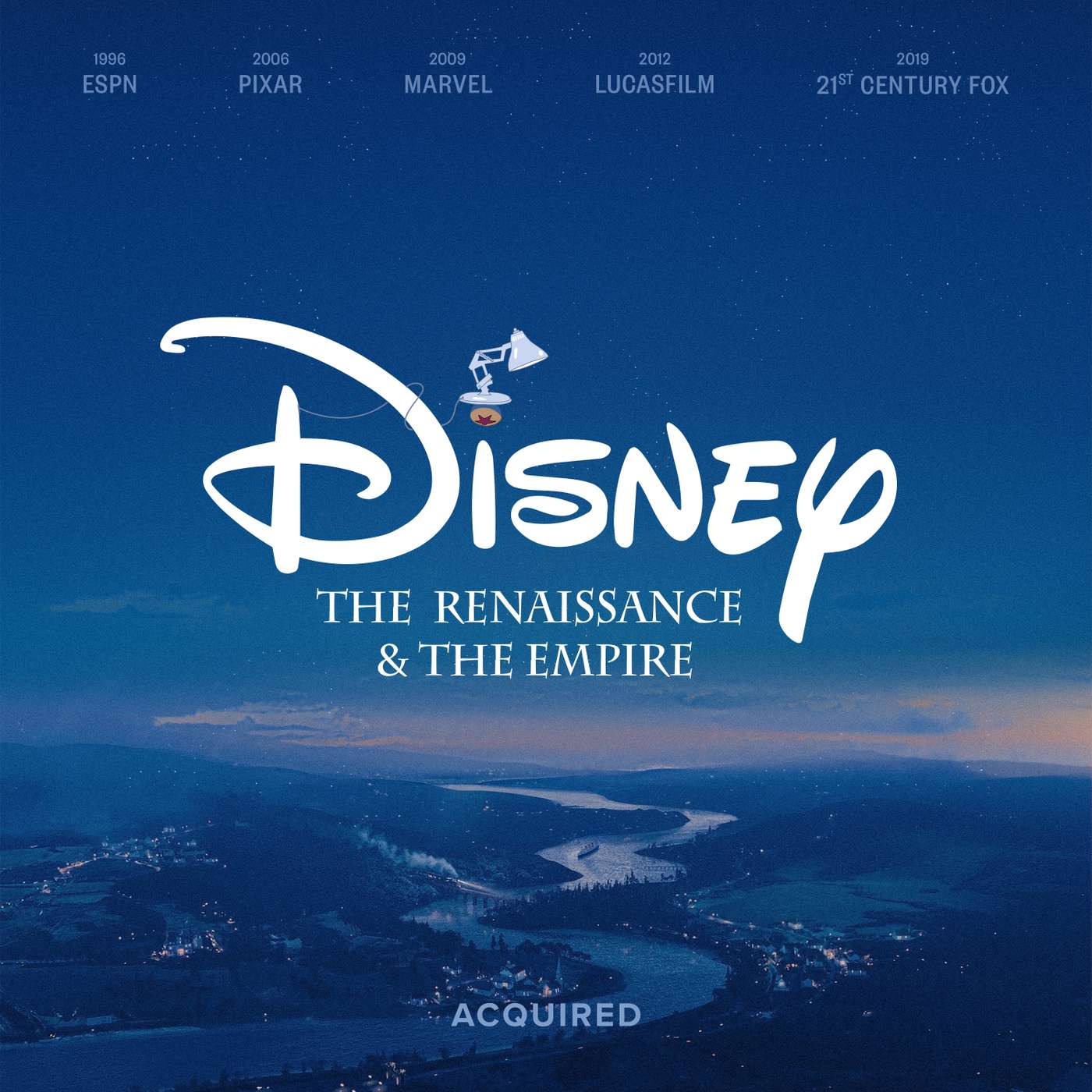
Disney's Business History: Flywheel to Streaming
Disney's business model is a flywheel: make a beloved story once, then sell it forever through parks, merchandise, and reissues. This episode traces how Michael Eisner and Bob Iger rebuilt that flywheel twice, first with animation and ESPN, then with Pixar, Marvel, and streaming, and asks whether the flywheel still turns.

Low-Frequency Investing: The 2.9-Decision Portfolio
A retail investor who made only 2.9 decisions a year beat the S&P 500 in 11 of 11 years, averaging 21.8% annual returns versus 13.5%. The hosts run his brokerage history through the AI assistant Claude, then widen out to Jack Dorsey's 140-reason pre-mortem, Mark Zuckerberg's talent-density bet, Elon Musk's 24-hour rebuilding rule, and a four-step method called DARE for panic and fear.
