
Relationship Tools That Actually Work
#880: Relationship Tools That Work — Esther Perel, Brené Brown, Dr. Sue Johnson, Terry Real, and More on Conflict, Repair, and Lasting Love
The brief
This compilation gathers concrete tools from five relationship experts for handling conflict and repair. Esther Perel names Gottman's four horsemen, Brené Brown replaces the 50/50 myth with an 80/20 energy split, Sue Johnson teaches the Hold Me Tight conversation, and Terry Real explains why repair is a one-way street, not a negotiation.
Marriage researcher John Gottman can watch five minutes of a couple arguing and predict, with something like 90 percent accuracy, whether they will divorce within three to five years (23:34). That number sounds like a magic trick. It isn't. Gottman is not reading minds. He is counting specific behaviors: contempt, stonewalling, the small sneer that says I've already lost respect for you. Harvard Negotiation Project deputy director Sheila Heen cites the finding to make a simple point: a difficult conversation is not something a relationship survives on the way to something better. The conversation is the relationship (23:55).
That idea holds this collection of clips together, drawn from past interviews with people who have spent careers studying how couples make it or don't. None of them argue for peace. All of them argue for skill.
Psychotherapist Esther Perel, author of Mating in Captivity, opens with basics: say thank you, notice the person, don't let the relationship run on autopilot (02:26). Then she gets specific about conflict. Borrowing from Gottman's research, she names four warning signs that predict decline, sometimes called the Four Horsemen: criticism, contempt, stonewalling, and defensiveness (05:48). Her tactical fix is almost embarrassingly simple: stop using "always" and "never."
"Banish them. 'I always have to ask you,' 'You never do this.' No, the moment you say you never, the other person's gonna come up with the one time that they know." - Esther Perel [06:15]
Perel's other move is to treat criticism as a badly disguised request. "Behind every criticism there's often a wish," she says (05:14). Translate the complaint into an ask, and the temperature drops.
Author and researcher Brené Brown attacks a different myth: that a partnership should run 50/50. She and her husband Steve, a pediatrician, instead grade their daily capacity on a scale up to 100, covering energy, patience, and kindness, and whoever has more covers whoever has less (08:35). Some nights she is at 10 and he is at 60; other nights it flips. When their combined total drops below 100, they make a plan: cutting extracurriculars, ordering food, canceling plans with people they "really actually don't like" (09:39). Brown's second habit is running her household as "family focused" rather than parent-focused or kid-focused, meaning decisions get weighed against what keeps the whole unit healthy, not what any one member wants (10:22).
Venture investor Brad Feld and his wife Amy solved the same problem of accumulated resentment with a calendar trick. Twenty years ago, Amy asked him to put a recurring appointment on his calendar: dinner, just the two of them, on the first of every month, wherever he was (12:44). He has kept it for two decades, more than a thousand dinners (13:22). The format borrows from Agile software development: the first half is a retrospective on the previous month, the second half is planning for the next one (14:13). The real payoff is timing. If something Amy did on the 21st annoyed him, he does not have to have the fight that night. He can hold it for the dinner. Feld adds a smaller claim worth keeping: simply naming an anxiety out loud, even without solving it, drains some of its power (15:49).
The Grammar of a Fight
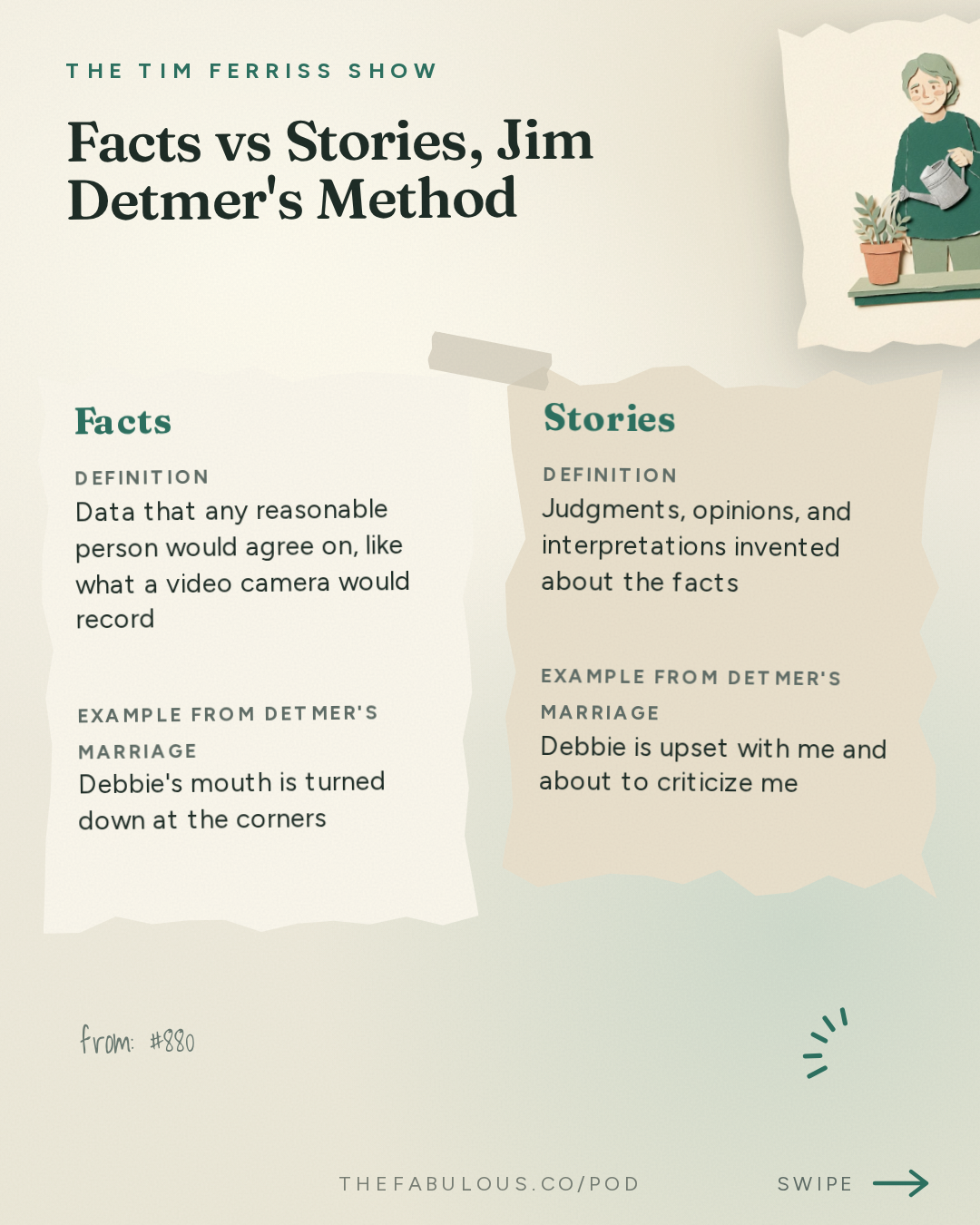
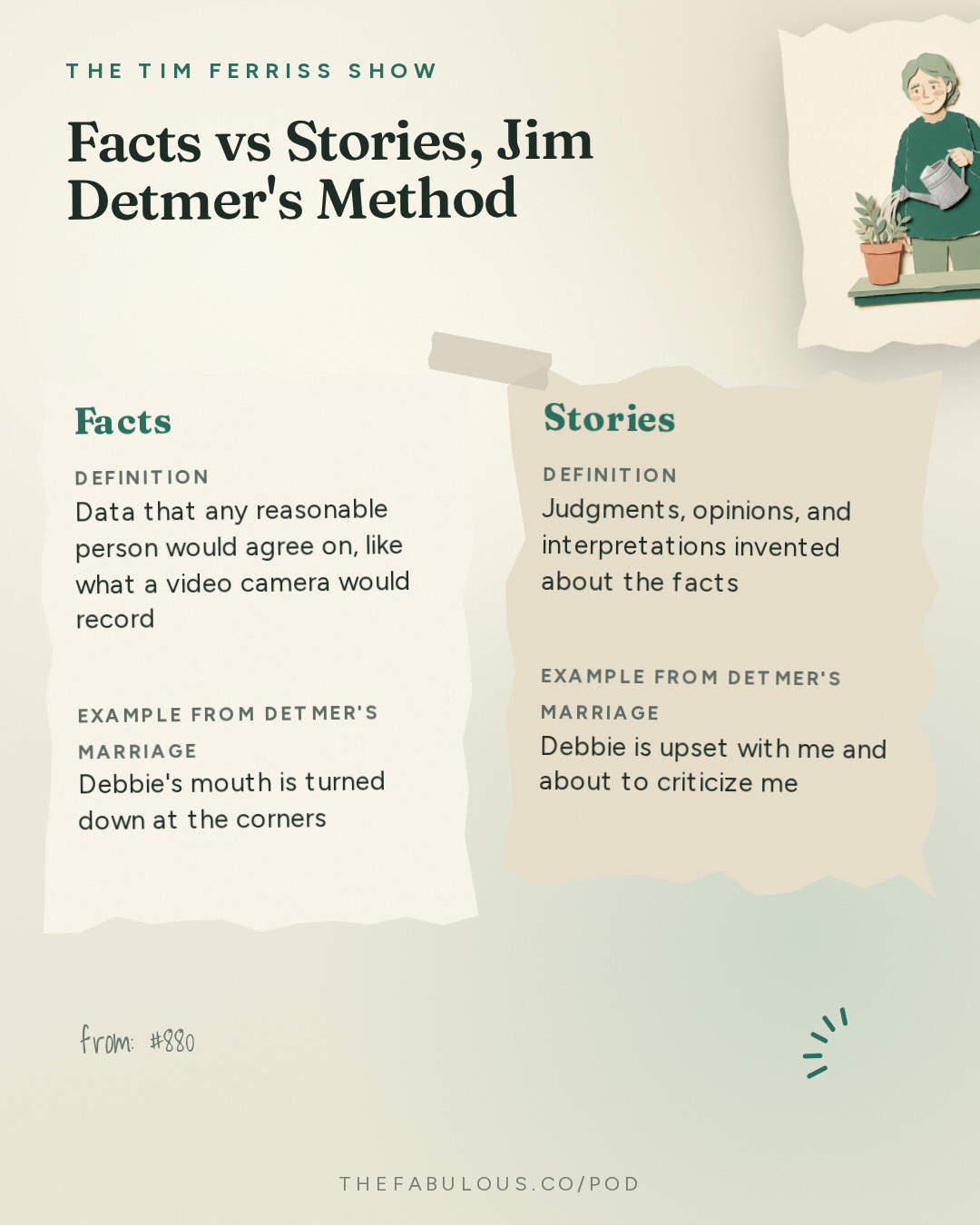
Conscious Leadership Group co-founder Jim Detmer offers the most useful single distinction in the hour: facts versus stories. A fact is what a video camera would record, something "totally unarguable" (17:43). A story is the interpretation layered on top: she's upset, she's upset with me, she's about to criticize me. Detmer's method is not to suppress the story. It's to say it out loud as a story, not as truth. Instead of "What are you upset about, I'm only ten minutes late," which defends a story while pretending it is fact, he suggests something closer to: "I'm making up the story that you're upset. Are you?" (19:51). The vulnerability, he argues, is not in confessing wrongdoing. It's in showing a partner the machinery of your own mind before deciding it's correct.
Heen's contribution pairs naturally with this: humor as what she calls a meta move. When a couple's fight escalates, a joke can work as an exit door, a way to step outside the argument and see the pattern instead of living inside it (24:32). She and her husband, who also teaches negotiation, have a private joke for their worst pattern: "why will you not just admit I am good and you are bad?" (26:05). The joke doesn't resolve anything. It breaks the trance long enough for someone to ask a real question instead of a loaded one.
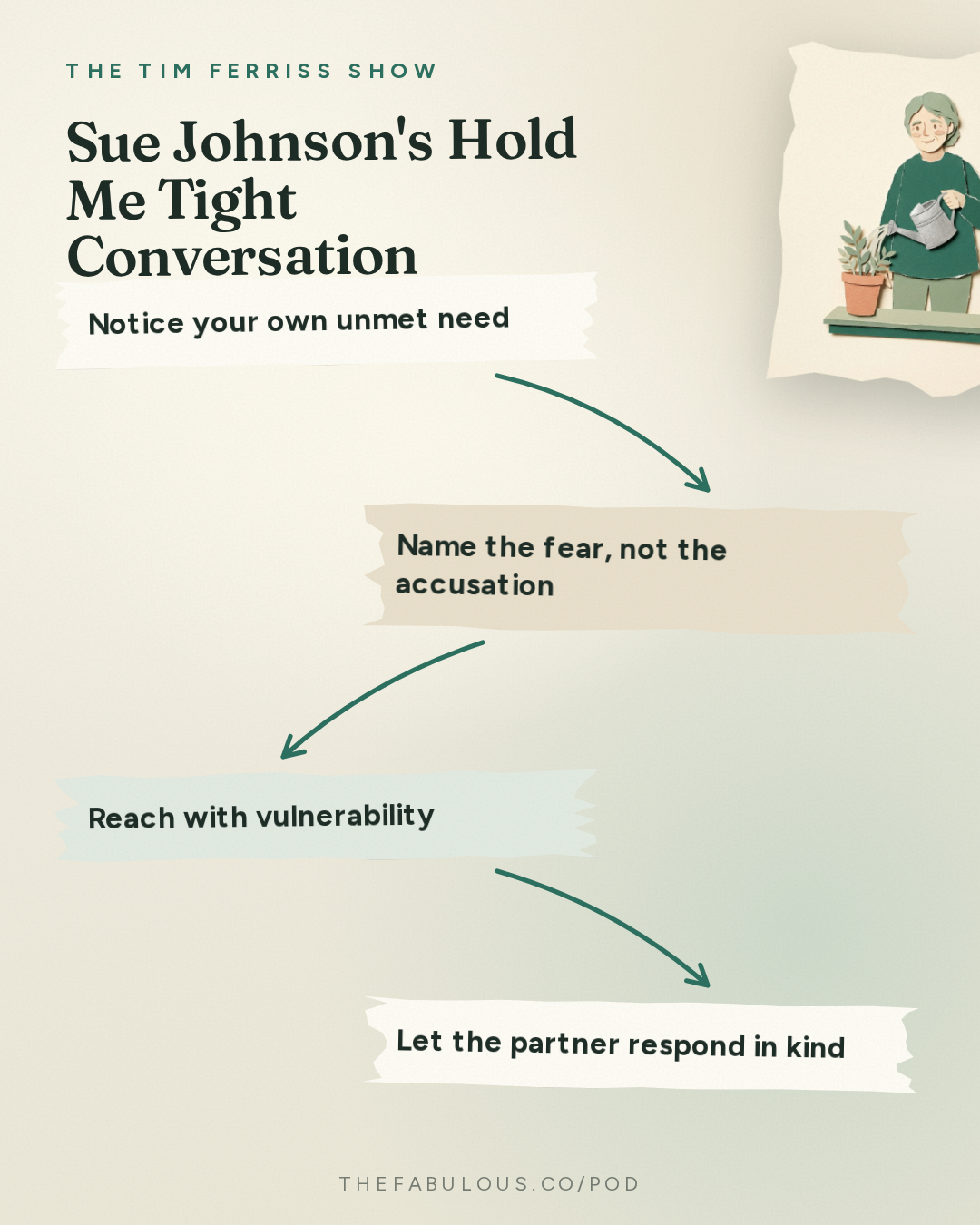
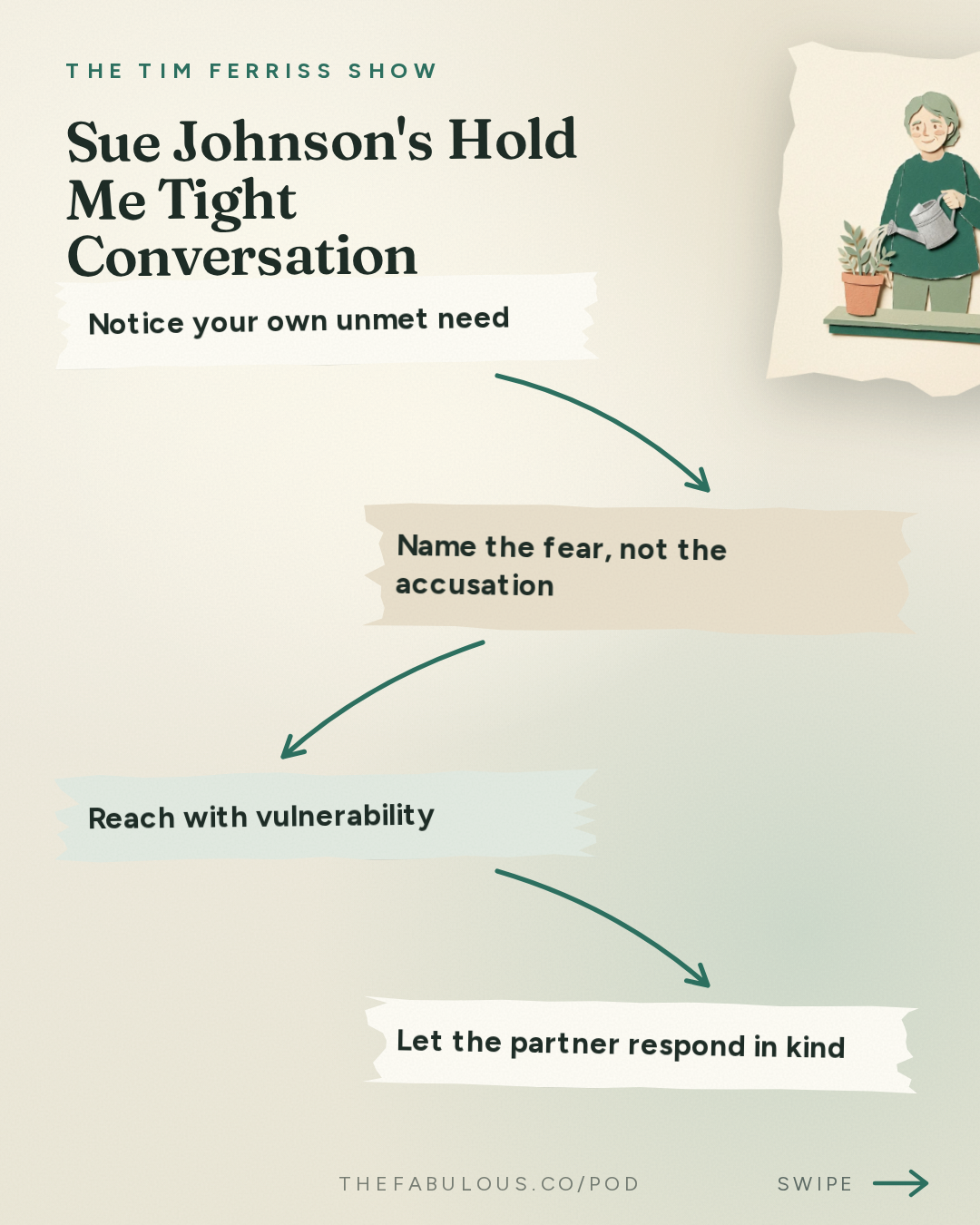
The late psychologist Sue Johnson, creator of emotionally focused therapy and, at the time of this recording, married 32 years (33:12), gave the collection its most affecting demonstration. She calls it the Hold Me Tight conversation: one partner opens up about a need or fear in a way that pulls the other closer, instead of pushing them away through blame (30:04). Johnson narrates her own failure mode first: her husband has been going to bed early, she misses their nightly talk, and instead of saying so, she attacks, delivering "You're going to bed very early these days" in a tone she admits carries a threat (31:12). He gets defensive. They're off. Then she narrates the alternative: naming her own feeling before blaming him, saying it scares her a little because she needs those conversations, rather than accusing him of not caring (34:22). That single shift, from accusation to disclosed fear, is what pulls a partner toward someone instead of away. Johnson's underlying claim is stark: emotional isolation is toxic for human beings, something she says the pandemic exposed without anyone fully absorbing the lesson (38:09).
Repair, Not Harmony
Family therapist Terry Real, who has treated couples for more than four decades, throws out the premise that a good relationship should look calm. Every relationship, he says, runs on a cycle of harmony, disruption, and repair, a pattern he borrows from infant researcher Ed Tronick's studies of mothers and babies (40:45). Real's term for the low point in that cycle is normal marital hatred: the stretch where partners genuinely dislike each other, and it is common, not a sign the relationship is broken (42:42).
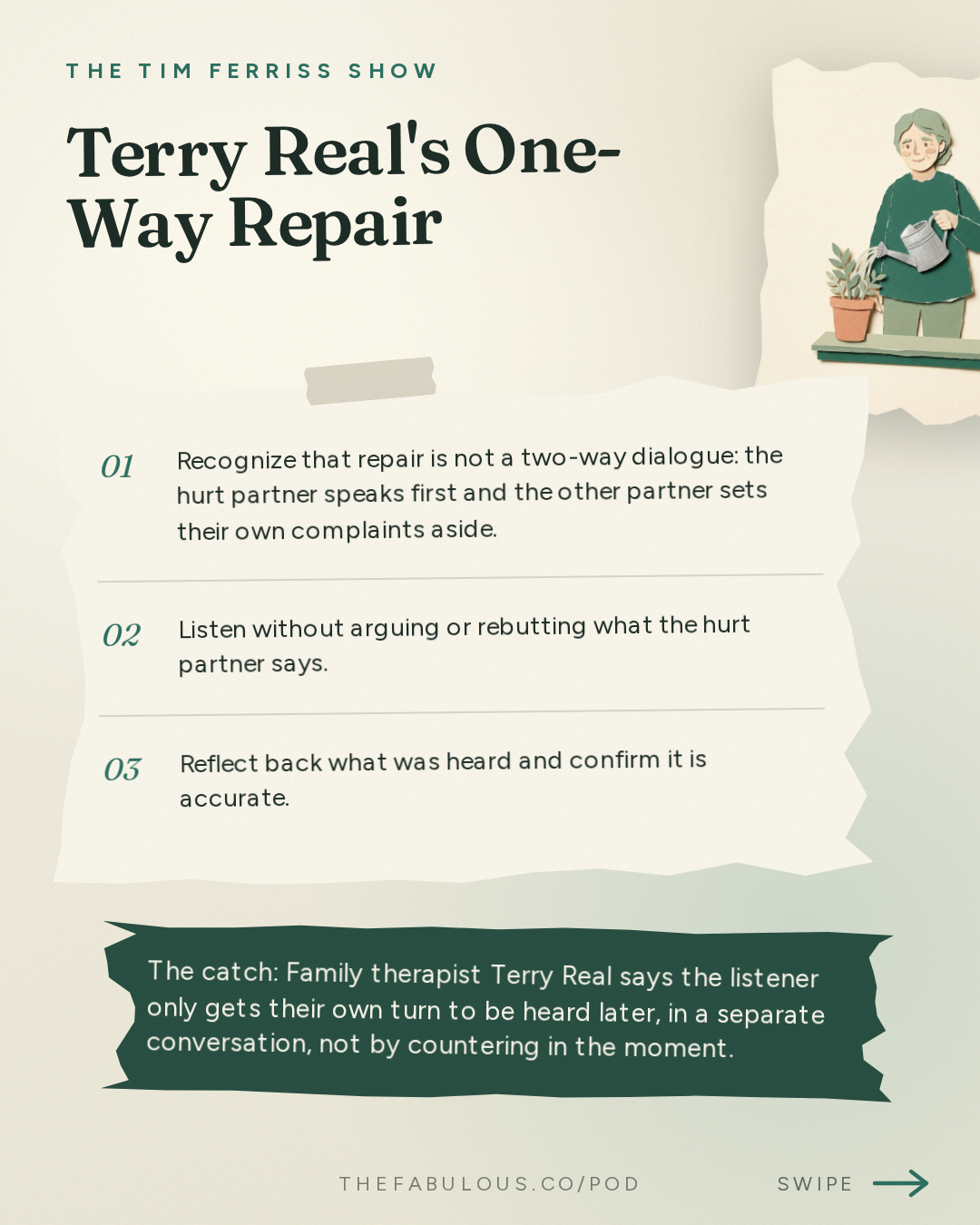
"Repair is a one-way street. Everybody gets that wrong. It's not a dialogue." - Terry Real [44:26]
His repair protocol is deliberately narrow. Whoever is hurt gets tended to first: the other partner listens without rebutting, reflects back what they heard, and asks directly, "Is there something I could say or do right now that would be helpful?" (45:15). Then they do it, short of anything absurd. Their own grievances wait their turn.
The episode's final voice, leadership coach Diana Chapman, applies the same logic to the biggest repair of all: letting an entire version of a marriage end so a new one can take its place. She and her husband Matt have done this at least three times, once nearly ending in divorce, before a friend asked her a question that reframed everything: who would she need to be to call forward the man she wanted to be with (50:26). The question moved the work from a complaint about him to a project on herself. Six months later, Chapman says, they were both different people, each crediting the other with having changed (51:18).
What ties Perel's vocabulary rule to Real's one-way repair to Johnson's vulnerable reach is a shared refusal to treat conflict as a symptom of failure. Contempt is the problem. Disagreement is not. The tools on offer here, quantified energy levels, scheduled retrospectives, a sentence that separates fact from story, are not romantic. They are procedural, closer to how a team runs a postmortem than to anything found in a greeting card. That may be the most useful thing the hour offers: the idea that staying close to someone for decades is less a feeling to protect than a set of skills to practice.
Ask this episode anything
Pod's AI answers from the episode itself, with the minute mark so you can hear it yourself.
Or start with one of these
Ask this episode
Pod's AI listens to the whole episode to answer, and points you to the minute it comes from.
The rest of this answer, and any question after it
Answers come from the episode itself, never from a summary of it.
ContinueKey takeaways
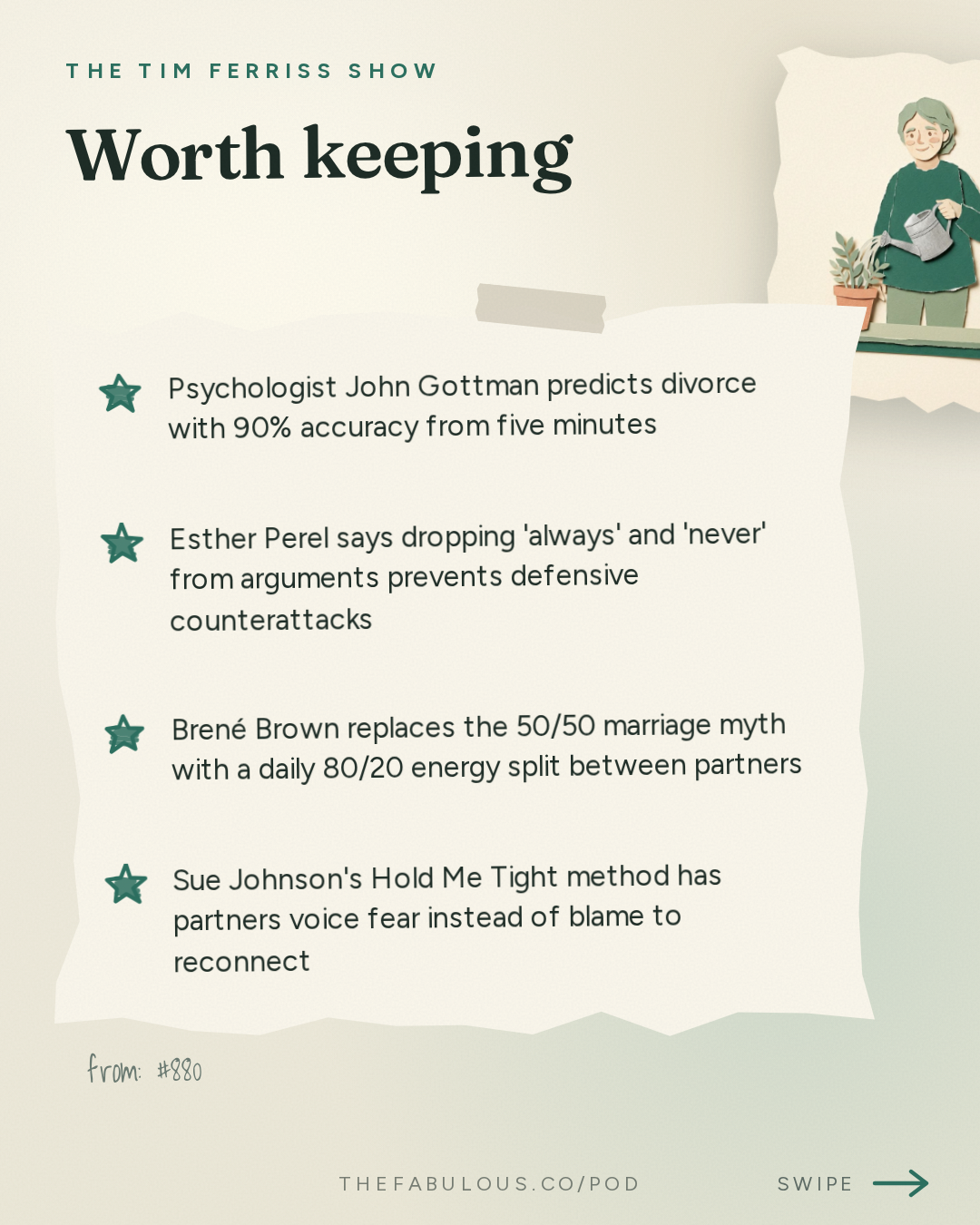
- Psychologist John Gottman predicts divorce with 90% accuracy from five minutes
- Esther Perel says dropping 'always' and 'never' from arguments prevents defensive counterattacks
- Brené Brown replaces the 50/50 marriage myth with a daily 80/20 energy split between partners
- Sue Johnson's Hold Me Tight method has partners voice fear instead of blame to reconnect
- Terry Real says repair after a fight is a one-way street, not a two-sided negotiation
The episode in cards


By the numbers
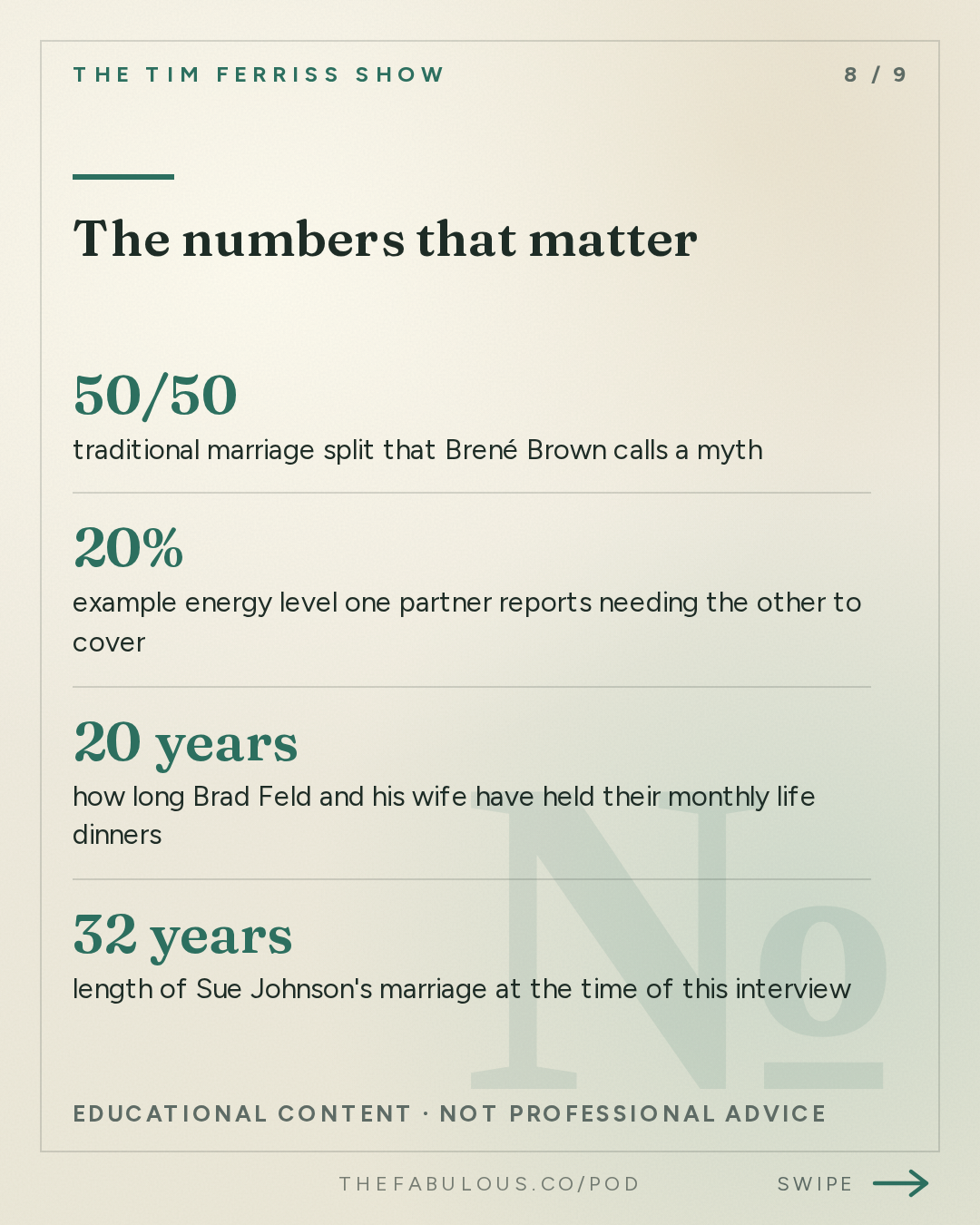
- 50/50 traditional marriage split that Brené Brown calls a myth
- 20% percent example energy level one partner reports needing the other to cover
- 20 years how long Brad Feld and his wife have held their monthly life dinners
- 32 years length of Sue Johnson's marriage at the time of this interview
In their words
“Banish them. 'I always have to ask you,' 'You never do this.' No, the moment you say you never, the other person's gonna come up with the one time that they know.”
“The big question in love relationships is, are you there for me? Do I matter to you? Can I count on you?”
“Repair is a one-way street. Everybody gets that wrong. It's not a dialogue.”
Protocols
-
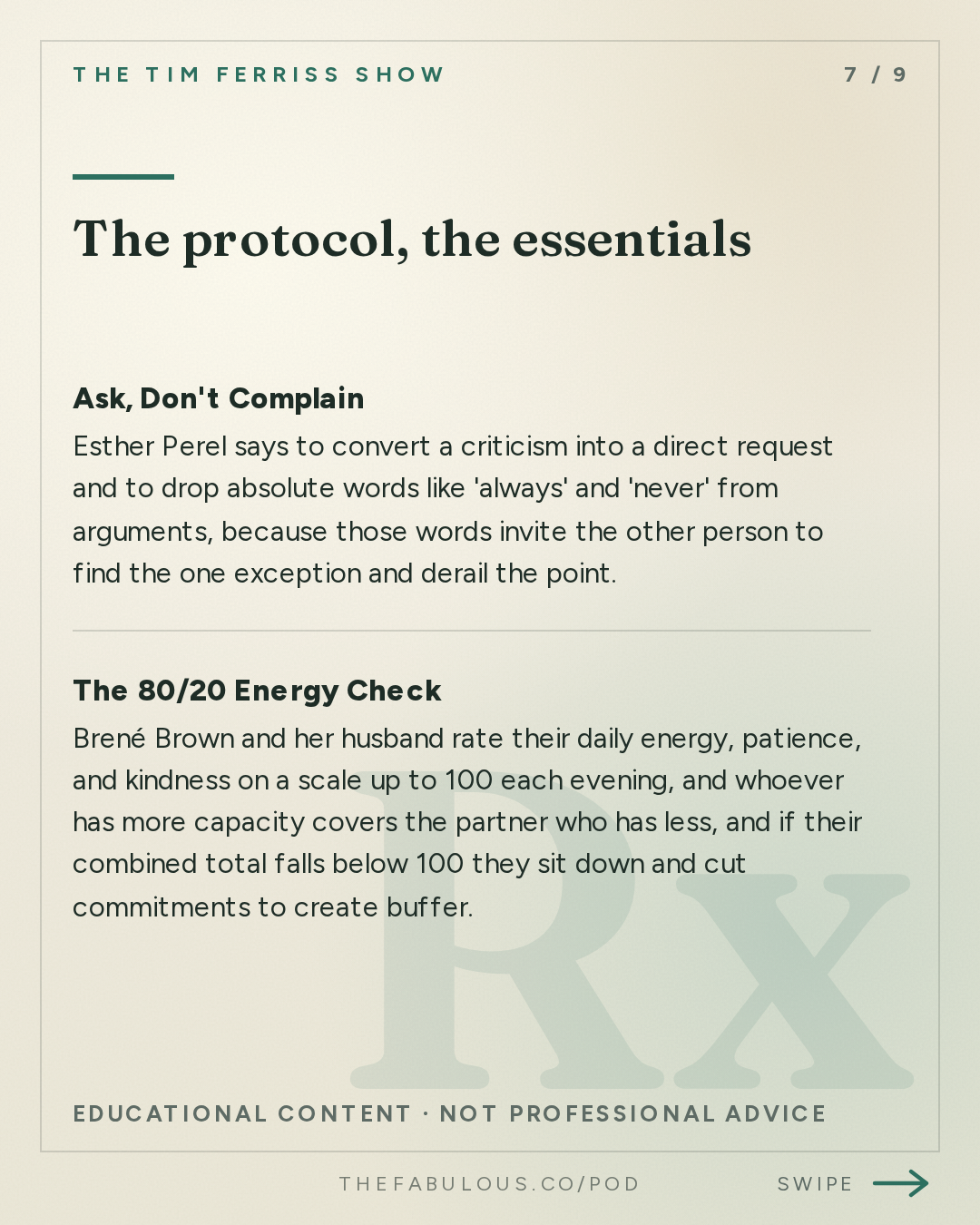
Ask, Don't Complain
Esther Perel says to convert a criticism into a direct request and to drop absolute words like 'always' and 'never' from arguments, because those words invite the other person to find the one exception and derail the point.
During any disagreement
-
The 80/20 Energy Check
Brené Brown and her husband rate their daily energy, patience, and kindness on a scale up to 100 each evening, and whoever has more capacity covers the partner who has less, and if their combined total falls below 100 they sit down and cut commitments to create buffer.
Daily, or whenever combined energy drops below 100
-
Monthly Life Dinner
Brad Feld and his wife Amy hold a recurring dinner on the first day of each month where the first half is a retrospective on the previous month and the second half is planning, including goals and worries, for the next one, and unresolved daily irritations get saved for this dinner instead of triggering an immediate fight.
Monthly, on the first of the month
-
Facts vs Stories
Jim Detmer tells partners to separate what a video camera would record, the fact, from the interpretation layered on top, the story, and to say the story out loud as a guess to check rather than defend it as truth.
Whenever a conflict starts
-
One-Way Repair
Terry Real says the partner who caused hurt should listen without rebutting, reflect back what they heard, and ask directly what would help, then provide it unless the request is absurd, and the hurt partner's turn to be heard comes later, not in the same conversation.
After any conflict, before other issues are raised
Questions this episode answers
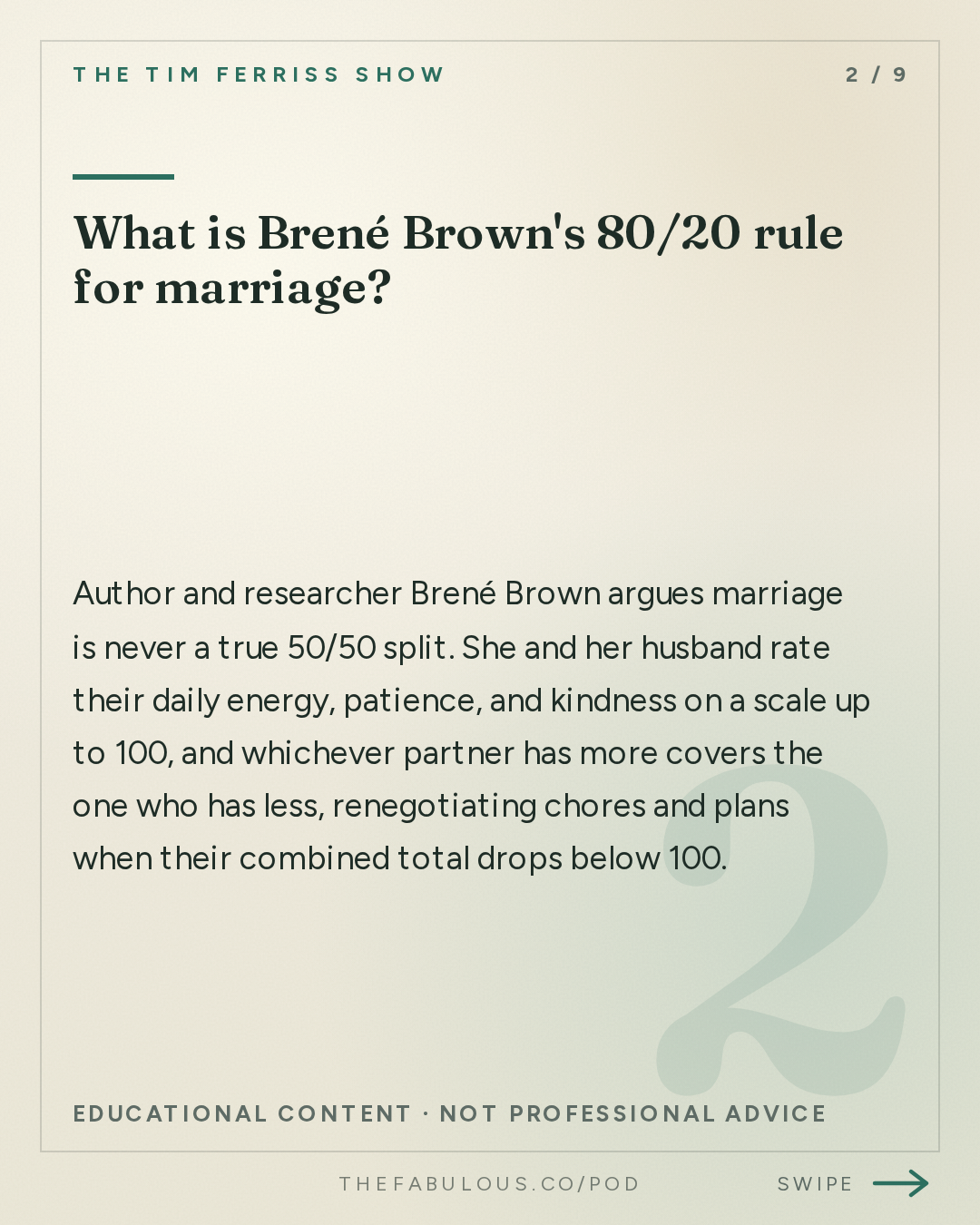
What is Brené Brown's 80/20 rule for marriage?
Author and researcher Brené Brown argues marriage is never a true 50/50 split. She and her husband rate their daily energy, patience, and kindness on a scale up to 100, and whichever partner has more covers the one who has less, renegotiating chores and plans when their combined total drops below 100 (08:35).
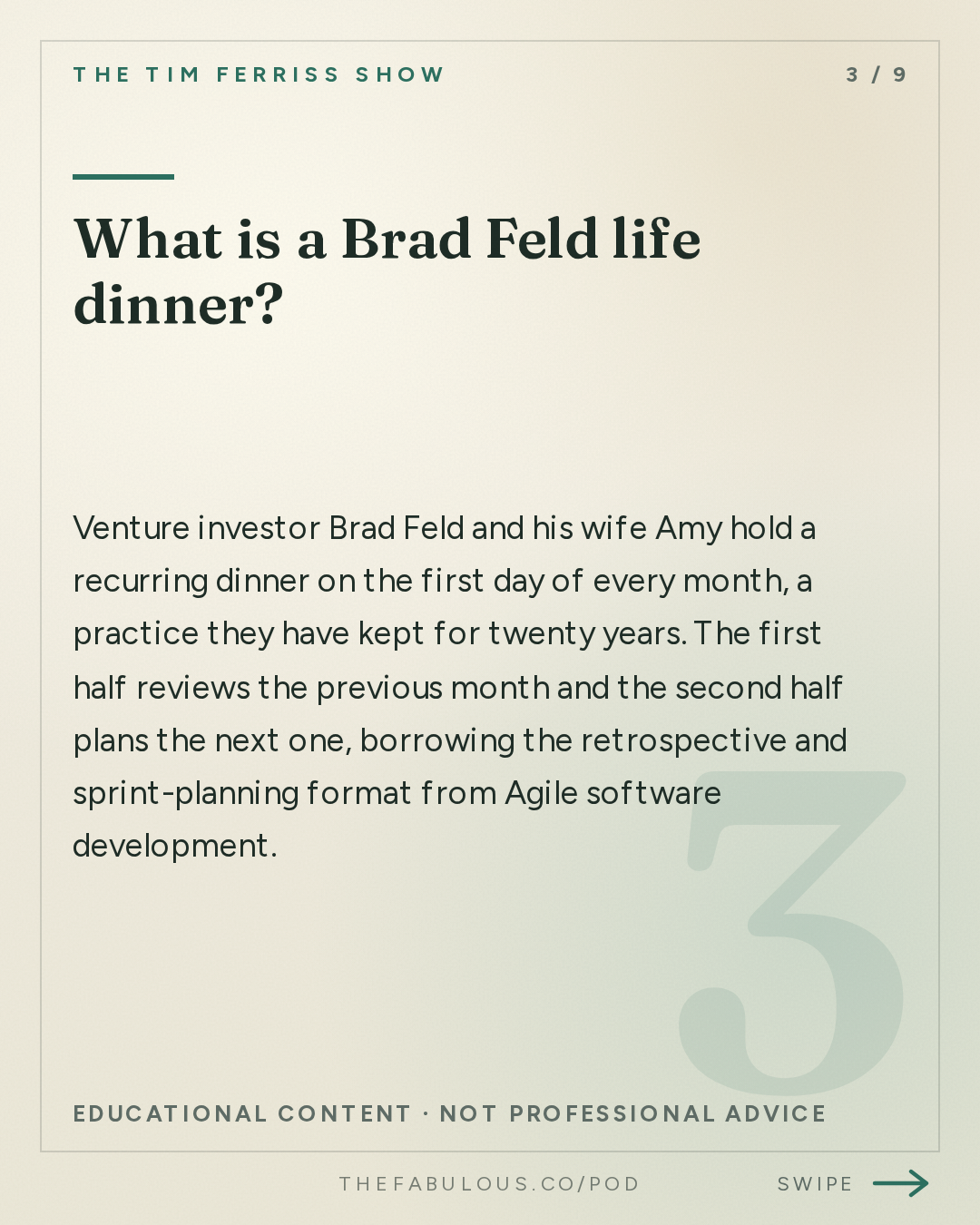
What is a Brad Feld life dinner?
Venture investor Brad Feld and his wife Amy hold a recurring dinner on the first day of every month, a practice they have kept for twenty years (13:22). The first half reviews the previous month and the second half plans the next one, borrowing the retrospective and sprint-planning format from Agile software development (14:13).
What are the steps in Sue Johnson's Hold Me Tight conversation?
Psychologist Sue Johnson's method has one partner notice an unmet need, name the underlying fear instead of the accusation, and reach toward the other partner from that vulnerable place rather than attacking (34:22). She says this pulls the partner closer and, across her studies, predicts stronger bonding and relationship satisfaction (39:11).
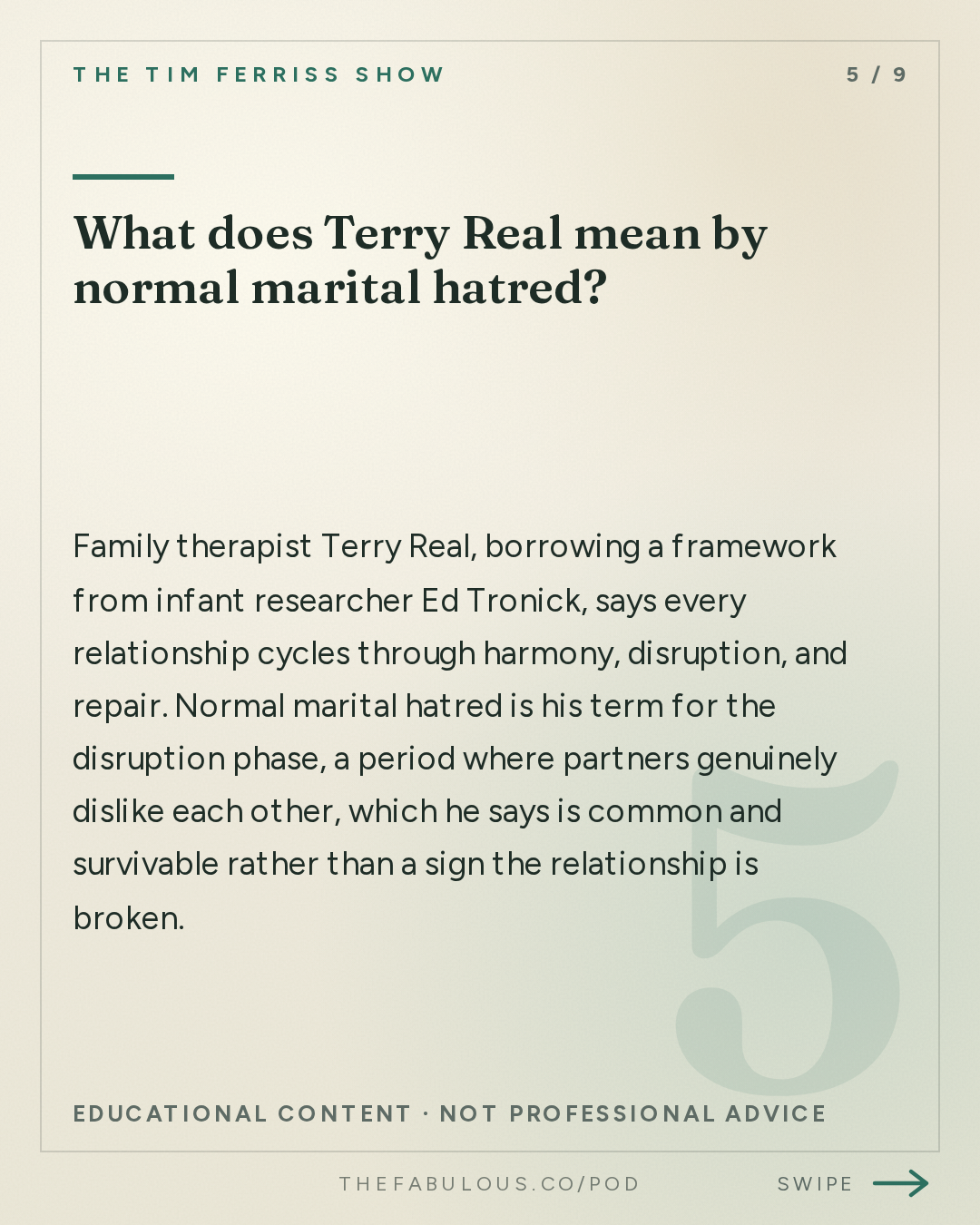
What does Terry Real mean by normal marital hatred?
Family therapist Terry Real, borrowing a framework from infant researcher Ed Tronick, says every relationship cycles through harmony, disruption, and repair (40:45). Normal marital hatred is his term for the disruption phase, a period where partners genuinely dislike each other, which he says is common and survivable rather than a sign the relationship is broken (42:42).
How do you separate facts from stories in an argument?
Conscious Leadership Group co-founder Jim Detmer defines a fact as anything a video camera would record, and a story as the judgment or interpretation added on top, like assuming a partner's frown means they are angry (17:43). He recommends saying the story out loud as a guess to check rather than defending it as truth (19:51).
What are Gottman's four horsemen in relationships?
Psychotherapist Esther Perel cites researcher John Gottman's finding that four behaviors predict relationship decline: criticism, contempt, stonewalling, and defensiveness (05:48). Gottman's lab has also shown he can predict divorce with about 90% accuracy after watching just five minutes of a couple's conflict (23:34).
The full read, in cards



Go deeper
- Mating in Captivity — Esther Perel's bestselling book on desire and intimacy in long-term relationships
- John Gottman's couples lab research — Watching five minutes of a couple's conflict predicts divorce within three to five years with about 90% accuracy
- The Fifteen Commitments of Conscious Leadership — Framework by Jim Detmer and Diana Chapman that includes the facts-versus-stories method for candid communication
Mentioned
Esther Perel · Brené Brown · Brad Feld · Jim Detmer · Sheila Heen · Sue Johnson · Terry Real · Diana Chapman · John Gottman · Ed Tronick · Byron Katie · Mating in Captivity · The Fifteen Commitments of Conscious Leadership · Hendricks Institute
More from this show and category
How to Simplify Your Life: 5 Expert Tips
Five longtime guests explain how to cut overwhelm: release the identity you've outgrown, question what you only value because you own it, write down every open task before sorting it, and decline requests without an excuse. Oliver Burkeman adds that real simplicity is an attitude, not a new system.
Kevin Ryan on Spotting 10-Year Trends
Kevin Ryan, the New York investor behind DoubleClick, MongoDB, and Business Insider, says he only bets on trends built to last ten years, not passing hype. His firm AlleyCorp co-founds companies with its own $500,000 stakes, starts narrow, and now leans into deep tech like nuclear energy and psychedelic medicine, including a compound called methylone for PTSD.
How Australia Legalized Psychedelic Therapy
Australia became the first country to let doctors prescribe MDMA and psilocybin for PTSD and depression, after a five-year campaign led by two entrepreneurs with no medical background. Tania de Jong and her husband built an advisory panel, trained 750 clinicians, and drove 13,000 public submissions, pushing the regulator to reclassify both drugs in February 2023.
Mentava Reading App: Does the $500 Method Work?
Niels Hoven's startup Mentava teaches two- to five-year-olds to read using phonics and game-style motivation design, and this coaching session with Tim Ferriss becomes a working seminar on pricing, messaging, and finding uncrowded marketing channels (01:29).
