
How to Simplify Your Life: 5 Expert Tips
#885: How to Simplify Your Life — Tips from Oliver Burkeman, Chip Conley, Elizabeth Gilbert, and More
The brief
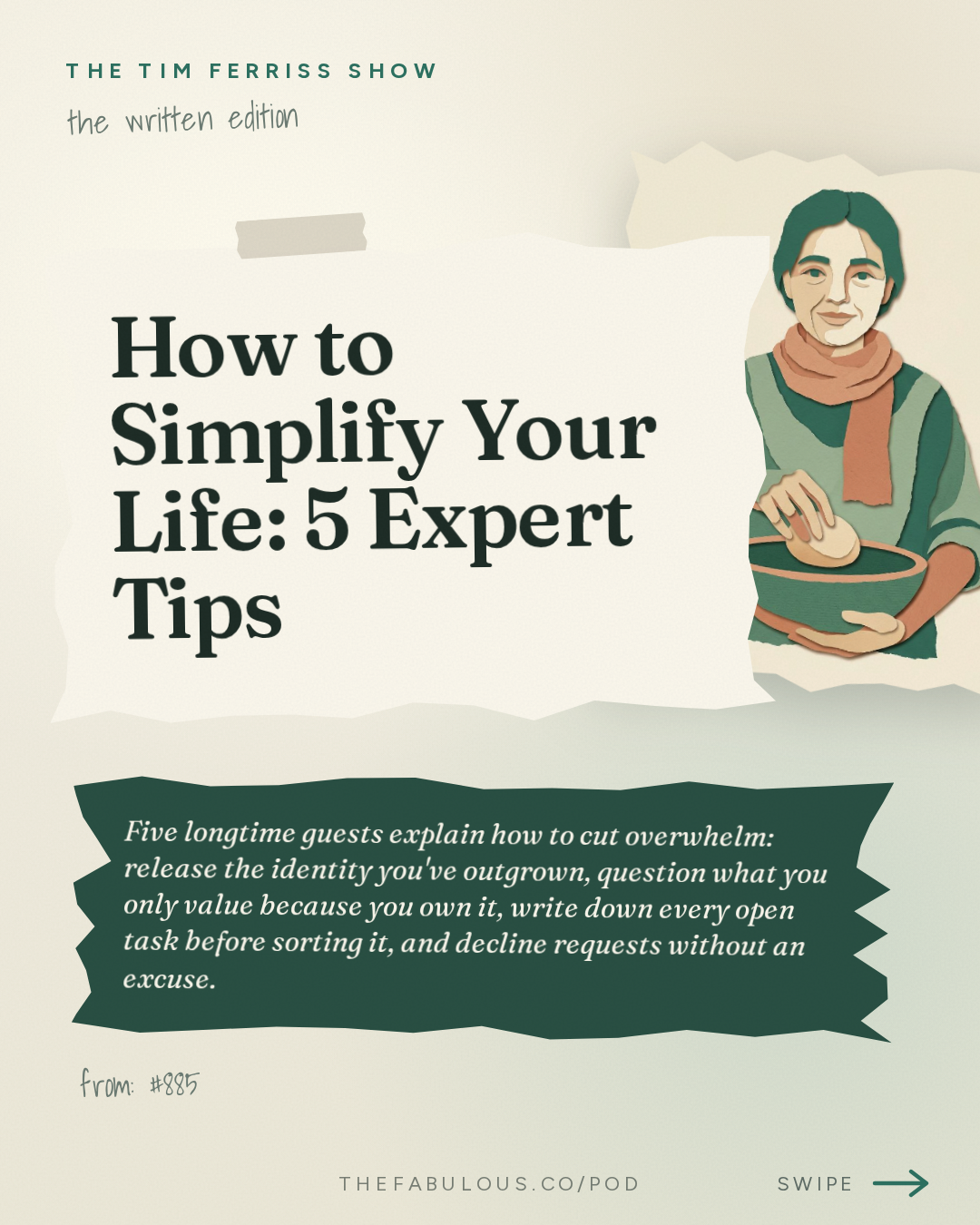
Five longtime guests explain how to cut overwhelm: release the identity you've outgrown, question what you only value because you own it, write down every open task before sorting it, and decline requests without an excuse. Oliver Burkeman adds that real simplicity is an attitude, not a new system.
Chip Conley was mid-sentence, giving a speech on a stage in St. Louis, when an allergic reaction to an antibiotic stopped his heart. He flatlined nine times in ninety minutes and spent three days in the hospital while doctors worked out what had gone wrong (02:36). He was in his late forties, running a chain of fifty-two boutique hotels through the dot-com bust, September 11, and the opening months of the Great Recession. The experience did not just scare him. It told him something he half already knew: the identity he had built, founder, CEO, the man with thirty-five hundred employees, mattered less than his health (02:56).
That story sets up the question behind this whole episode: what would actually make a crowded life simpler? Tim Ferriss put it to five past guests, and none of them answered with an app or a new filing system. Conley, who later became Airbnb's in-house "modern elder," calls what he did next mindful decoupling. The idea is plain: let go of the role you have outgrown before anything new can take its place.
"I don't know what I'm supposed to do next, but I know I'm not supposed to do this anymore." Chip Conley [03:36]
He sold the hotel company at the bottom of the recession, ended a relationship he had been clinging to as a kind of life preserver, and spent two years, from age fifty to fifty-two, in what the anthropologist Mary Catherine Bateson called a midlife atrium: a plain, light-filled space built for nothing except waiting to see what comes next (05:02). Conley filled it with hot springs research, a book called Emotional Equations, and a trip to thirty-six festivals in sixteen countries in a single year (06:15). Out of that open stretch came Airbnb, a company three young founders asked him to join just as his atrium was ending.
Why We Keep What We Don't Want
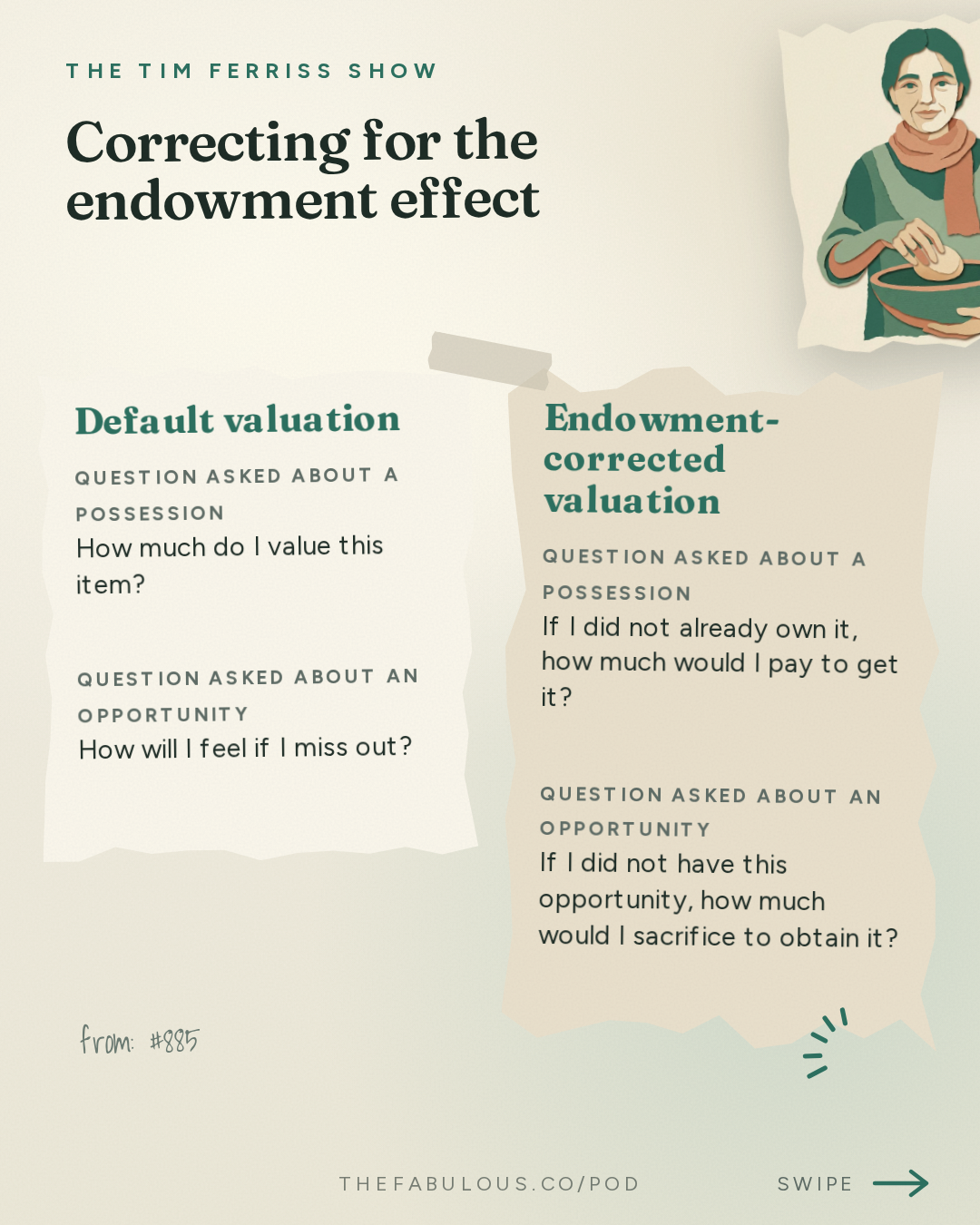
If Conley's problem was an identity he had outgrown, author Greg McKeown's problem was a Stormtrooper costume. Standing in a Halloween store at forty, dressed head to toe in the outfit, he realized he had wanted it since he was ten, when an older brother said it would be cool to own one. Thirty years later, he still didn't actually want it; he had just never questioned the idea (16:20). McKeown uses this to explain the endowment effect, a well-documented bias in which people value something more simply because they possess it, whether that's a sweater in a closet or a goal they've been chasing for years.
"We value things more because we have them." Greg McKeown [15:19]
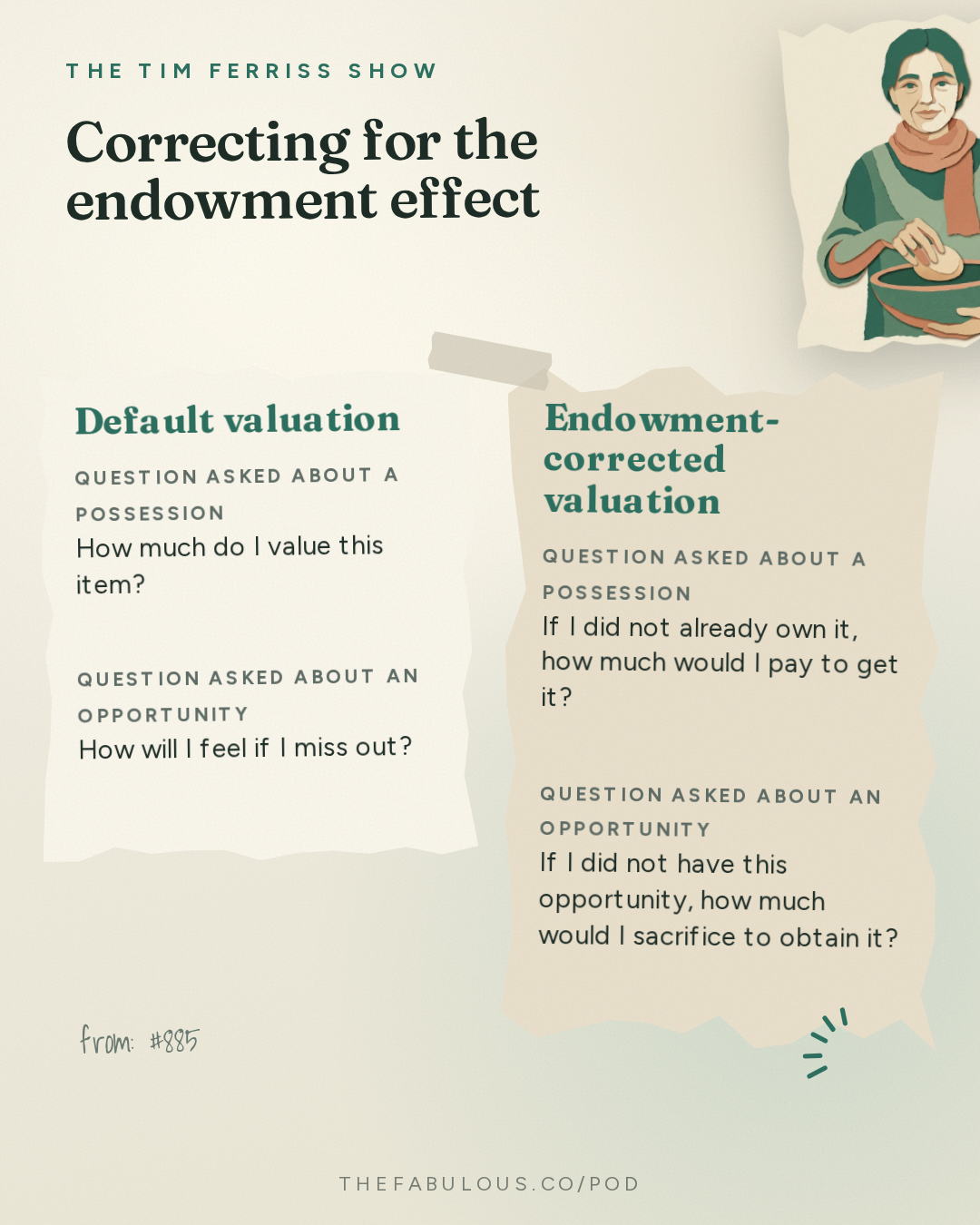
His fix is a reframing question. Instead of asking how much an item or opportunity means, ask the reverse: if I didn't already own this, how much would I pay to get it (19:00)? For a commitment or a project, the question becomes: if I didn't already have this opportunity, how much would I sacrifice to obtain it (19:19)? Ferriss credits a version of this to Intel's Andy Grove, who used it to decide which lines of business were worth staying in. The move strips out the inflation that ownership adds, so the decision gets made on the thing's actual value today, not on the fact that it's already yours.
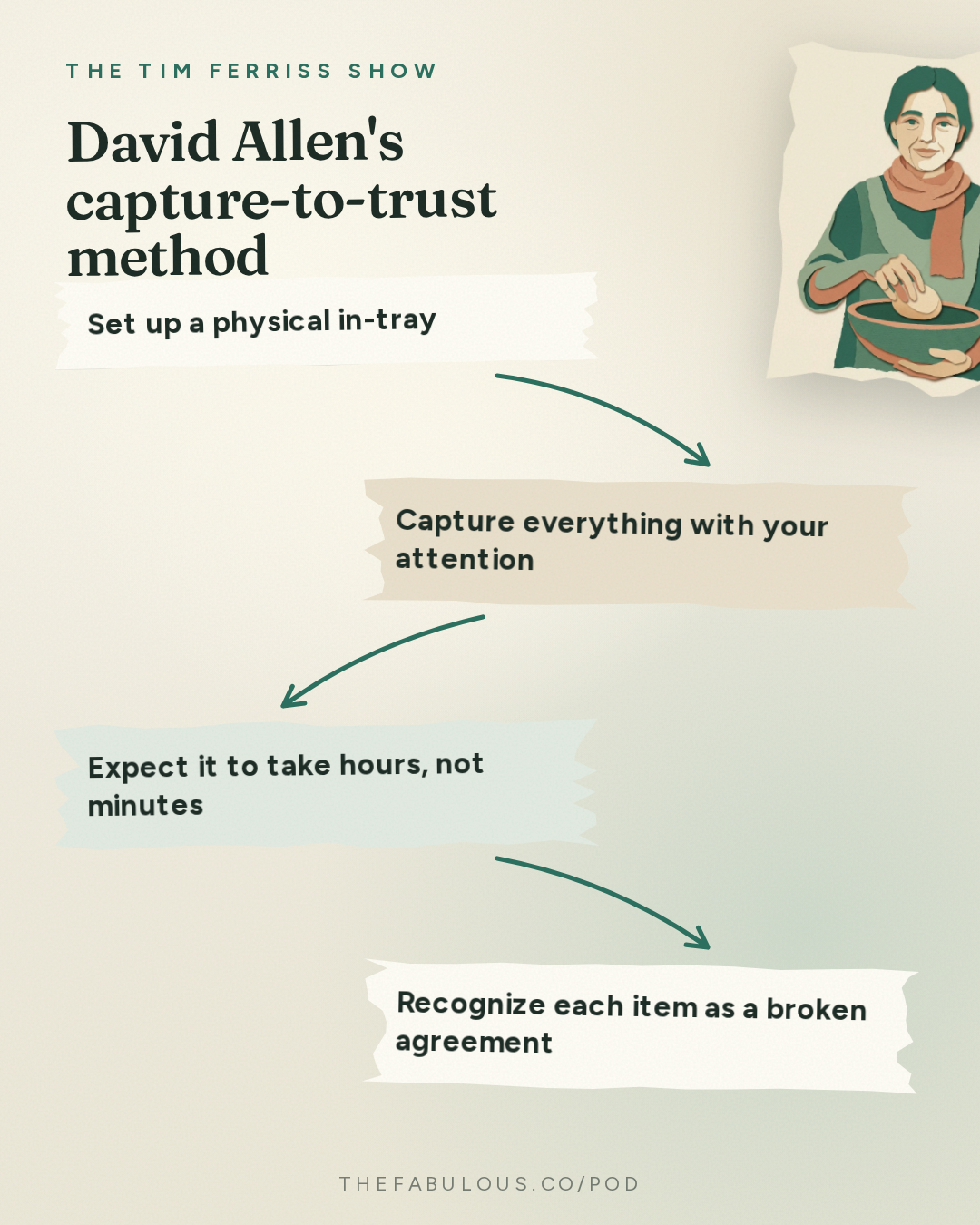
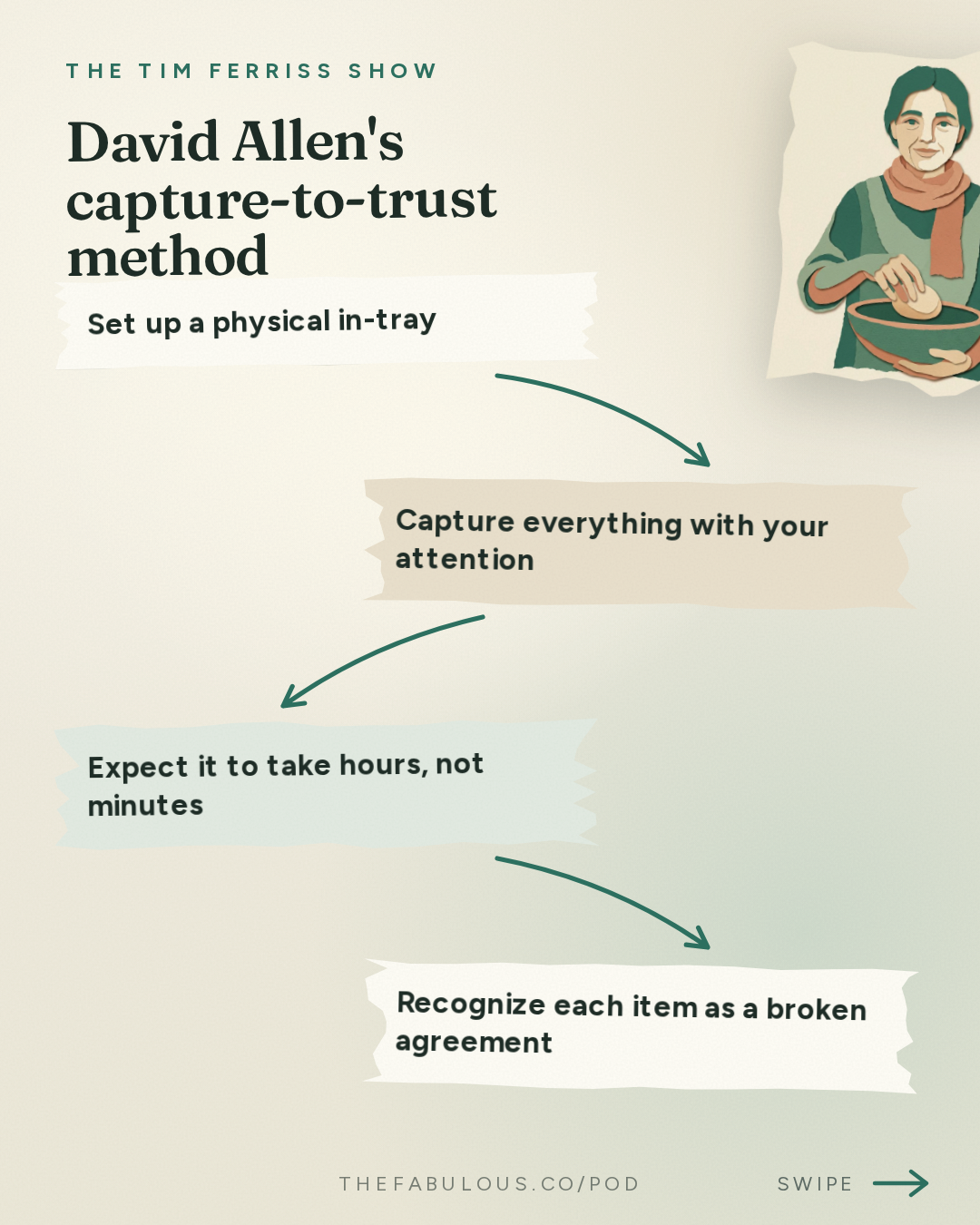
David Allen, the productivity consultant behind the "Getting Things Done" method, starts from a more physical version of the same problem: the stuff cluttering a mind instead of a closet. When he sits down with an overwhelmed professional, the first move isn't to organize anything. It's to get a stack of paper, a pen, and a physical in-tray, a literal container for everything competing for that person's attention (20:52). Each worry, whether it's cat food or a new vice president of marketing, goes on its own slip of paper. For a mid to senior-level professional, just identifying everything on their mind, not organizing it, not prioritizing it, takes one to six hours (22:08).
What makes the list painful, Allen argues, is not the length of it. It's that every item represents a promise to yourself you haven't kept, and breaking agreements with yourself, even small, silent ones, erodes self-esteem the same way breaking a promise to someone else erodes trust (22:47).
"What happens when you break an agreement with yourself is that your self-esteem plummets." David Allen [22:47]
The part of the mind holding onto these open loops has no sense of past or future, Allen says, which is why a trivial errand can jolt someone awake at three in the morning as urgently as a major deadline (23:36). The task doesn't need to be finished to close the loop; it only needs to leave the person's head, and then get resolved one of three ways: don't make the agreement, keep the agreement, or renegotiate the agreement (24:12). Writing it down and making a conscious choice, even the choice to not do it right now, is what restores the broken agreement.
Saying No Without Paying For It
Novelist Elizabeth Gilbert has her own version of the in-tray: she treats her email inbox like her home. An uninvited request, to her, is a stranger who has let themselves in through a door they shouldn't have a key to.
"I treat my inbox like it's my home because I think it's an extension of my home." Elizabeth Gilbert [29:56]
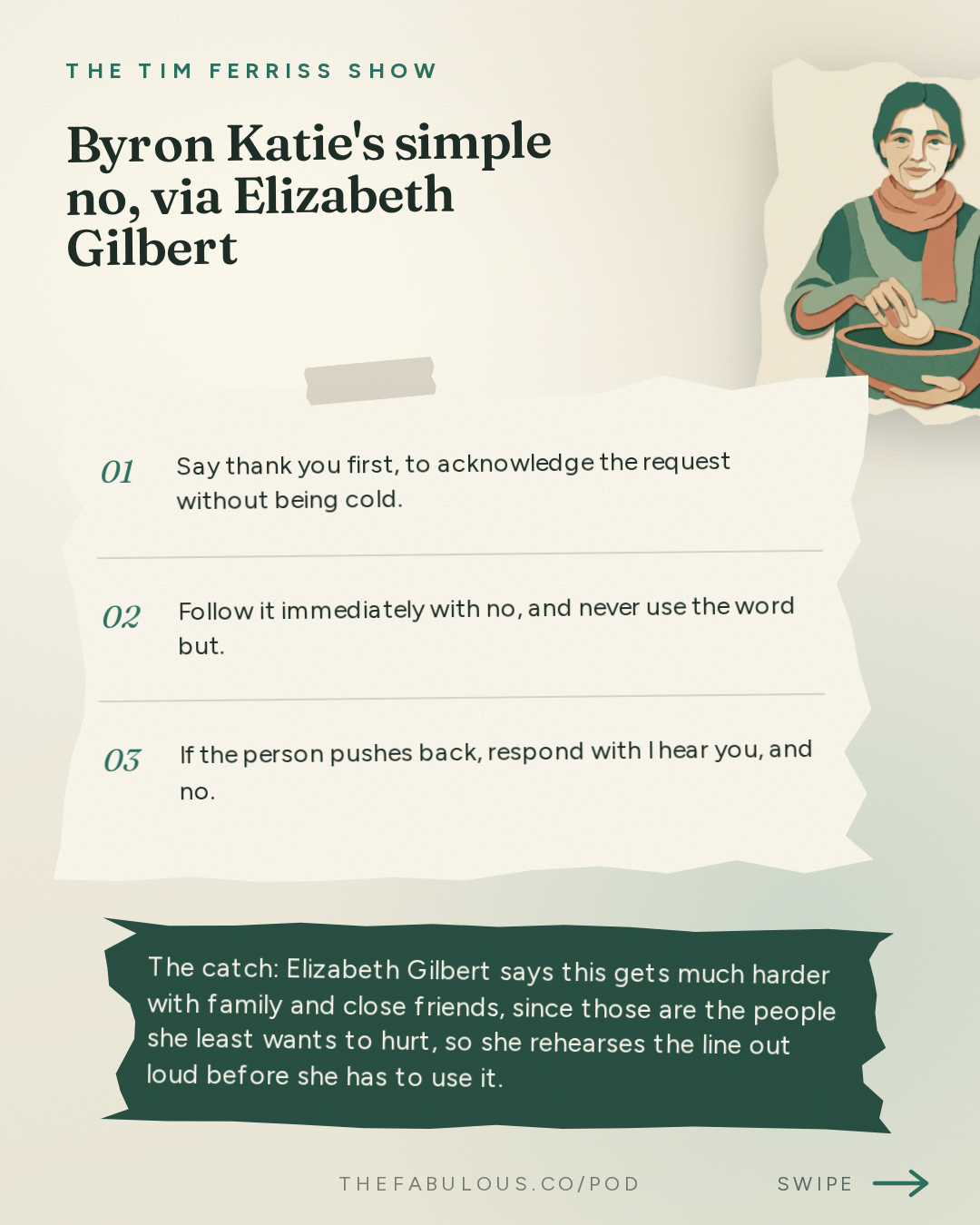
For requests that feel like an intrusion, she deletes without responding; she says she doesn't owe a stranger a polite reply any more than she'd owe coffee to someone eating breakfast uninvited at her kitchen table (30:09). For requests from people she actually cares about but still wants to decline, she uses a method she learned from her teacher Byron Katie, who runs a course called The School for the Work. The formula is short: thank the person, then say no, and never use the word "but" (33:43). "But" implies a justification, and a justification is exactly what a determined asker can argue with. A plain "thank you, and no" leaves nothing to push against (34:22). If someone pushes back anyway, Gilbert's next line is just as short: "I hear you, and no."
She's careful to note that this gets harder, not easier, the closer the relationship is, because the people closest to her are the ones she least wants to hurt. With family especially, she rehearses the line on long walks before she ever has to say it out loud (36:18).
Author Oliver Burkeman, who wrote Four Thousand Weeks, closes the episode by pushing back gently on the whole premise of life-simplification advice. Most systems built to reduce decisions, he argues, quietly create their own maintenance burden. Barack Obama famously wore only two suit colors as president to cut decision fatigue, but he also had a staff dedicated to keeping that wardrobe immaculate (37:25). A minimalist apartment with bare surfaces looks simple, but staying that way takes constant upkeep, which is its own form of complexity. For Burkeman, the fix isn't a better system at all.
"True simplicity... is not a question of techniques. It is an attitude." Oliver Burkeman [40:02]
He describes it as a relationship to reality rather than a set of rules: being less attached to whether the apartment is tidy, less bothered by an interruption, able to drop back into focus after one happens instead of needing a perfectly uninterrupted day to begin with (40:55). He borrows a line from the philosopher Krishnamurti to describe the goal: to not mind what happens (41:25). Not passivity, he's careful to add, but the freedom to act decisively once the clinging stops.
Across all five conversations, the actual lever is the same, even though the settings differ: a stage, a closet, an in-tray, an inbox, a tidy apartment. None of them simplify a life by adding a new tool. They simplify it by loosening a grip, on an old identity, an owned object, an unspoken promise, an unwanted request, or a demand that reality look a certain way. Psychologist Laura Carstensen's research at the Stanford Center on Longevity, which Conley cites, found that the less time people believe they have left, the more they focus on the present rather than the past or future (11:39). That may be the whole argument in miniature: simplicity isn't about having less to manage. It's about noticing, sooner rather than later, what was never worth holding onto in the first place.
Ask this episode anything
Pod's AI answers from the episode itself, with the minute mark so you can hear it yourself.
Or start with one of these
Ask this episode
Pod's AI listens to the whole episode to answer, and points you to the minute it comes from.
The rest of this answer, and any question after it
Answers come from the episode itself, never from a summary of it.
ContinueKey takeaways
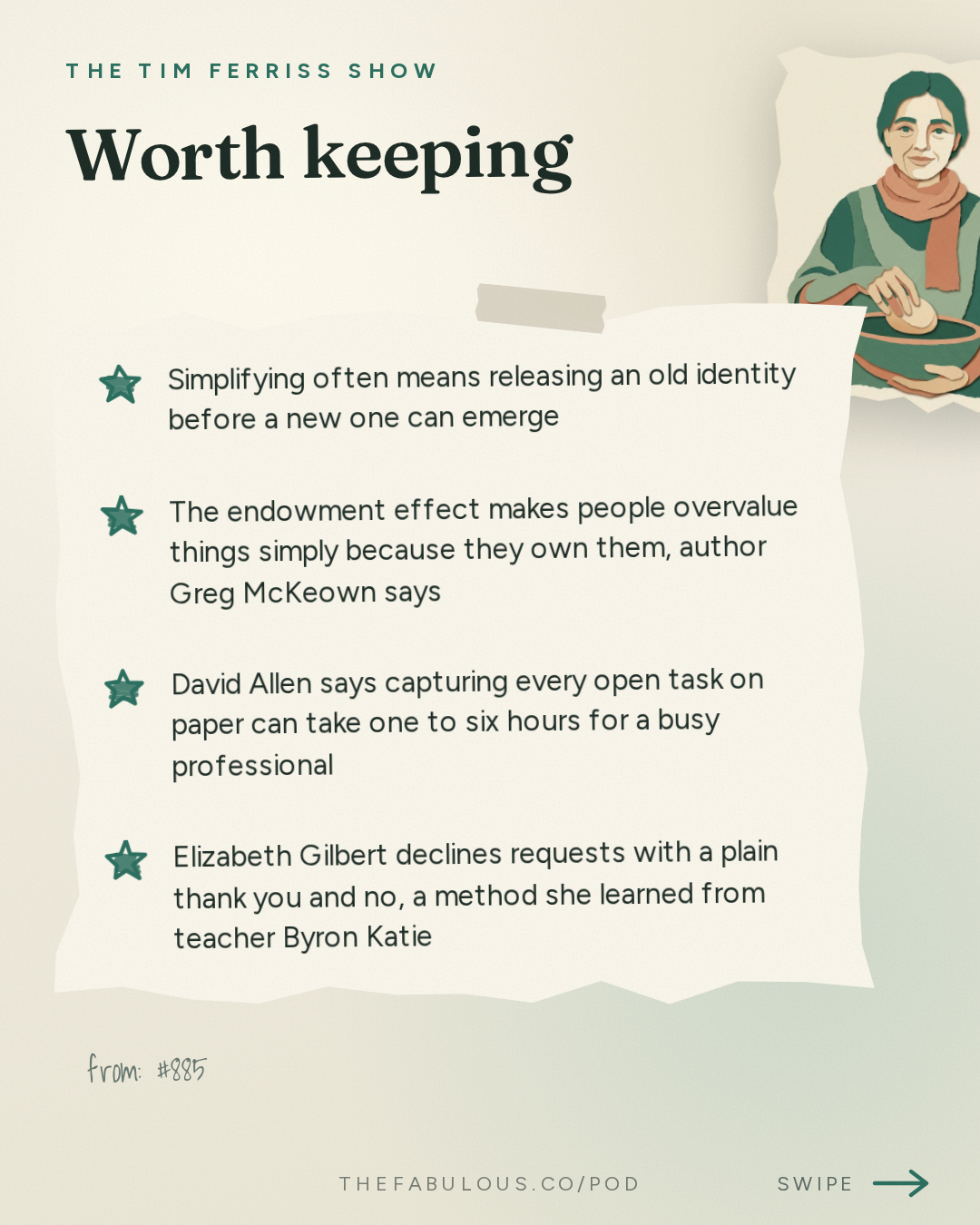
- Simplifying often means releasing an old identity before a new one can emerge
- The endowment effect makes people overvalue things simply because they own them, author Greg McKeown says
- David Allen says capturing every open task on paper can take one to six hours for a busy professional
- Elizabeth Gilbert declines requests with a plain thank you and no, a method she learned from teacher Byron Katie
- Oliver Burkeman argues true simplicity is an inner attitude rather than a new organizing system
The episode in cards
By the numbers
- 30 years how long Greg McKeown held onto the idea of owning a Stormtrooper costume before realizing he didn't want it
In their words
“I don't know what I'm supposed to do next, but I know I'm not supposed to do this anymore.”
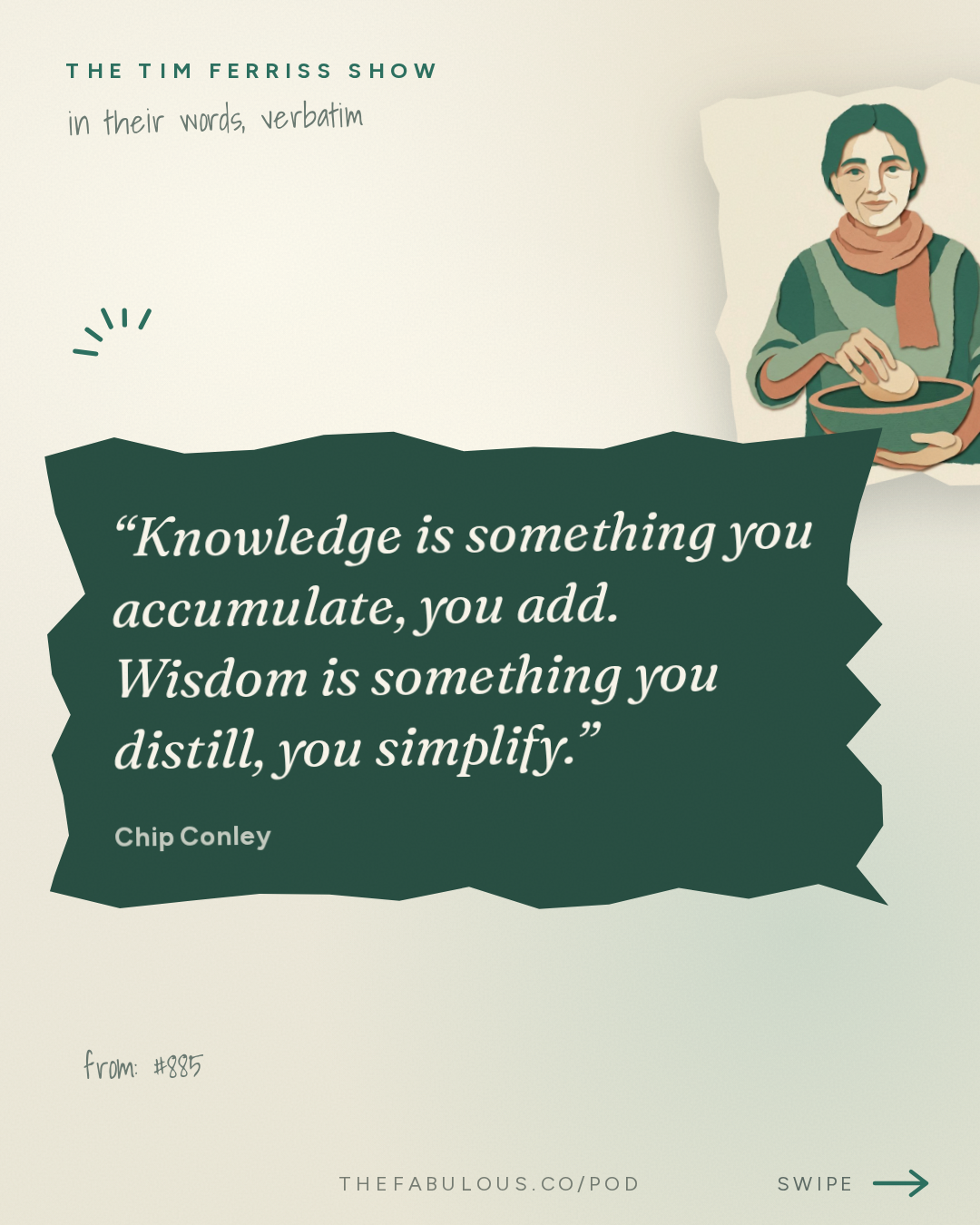
“Knowledge is something you accumulate, you add. Wisdom is something you distill, you simplify.”
“We value things more because we have them.”
“I now treat my inbox like it's my home because I think it's an extension of my home”
Protocols
-
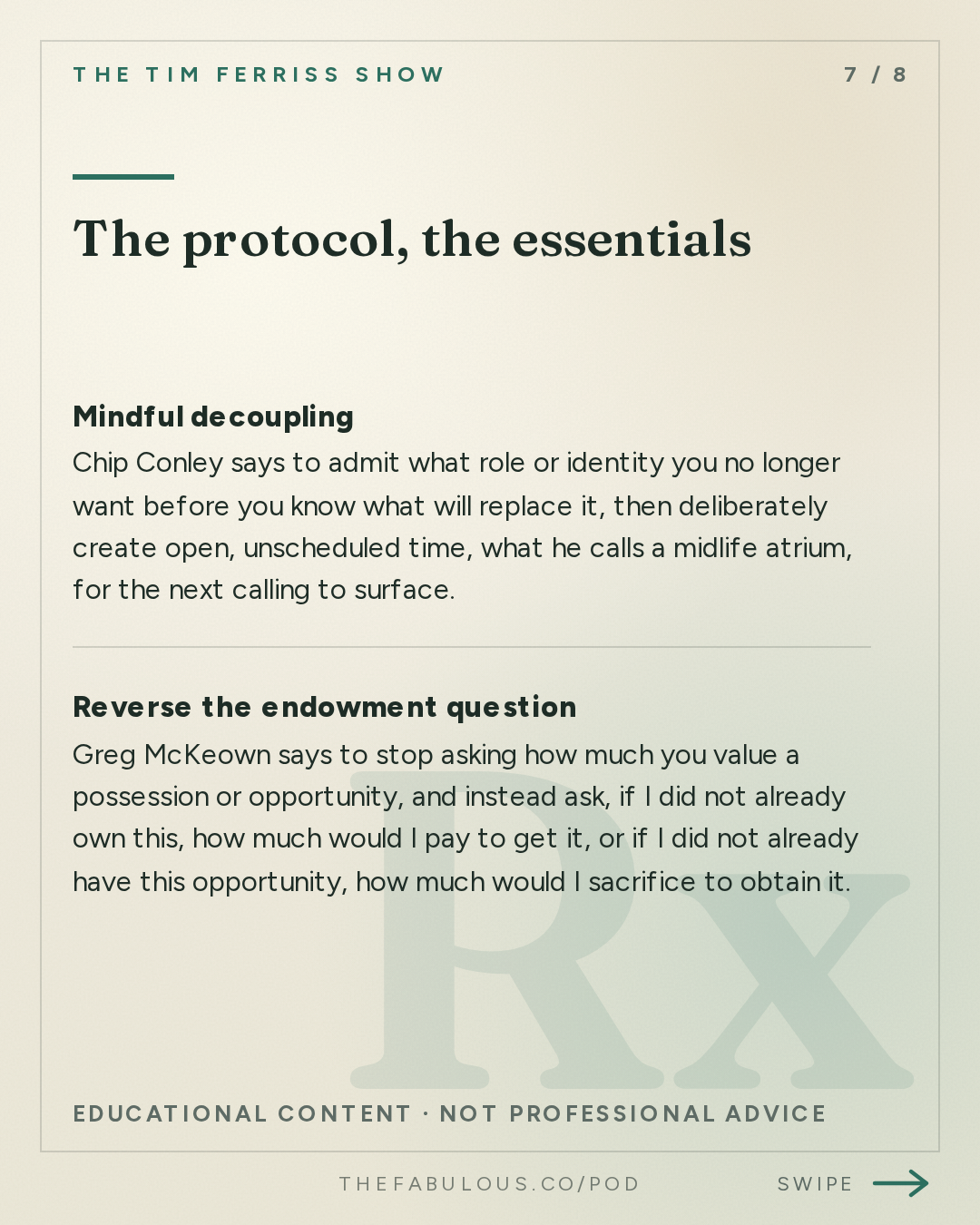
Mindful decoupling
Chip Conley says to admit what role or identity you no longer want before you know what will replace it, then deliberately create open, unscheduled time, what he calls a midlife atrium, for the next calling to surface.
Once, during a major life transition
-
Reverse the endowment question
Greg McKeown says to stop asking how much you value a possession or opportunity, and instead ask, if I did not already own this, how much would I pay to get it, or if I did not already have this opportunity, how much would I sacrifice to obtain it.
Before any decision to keep an item or commitment
-
Physical in-tray capture
David Allen has clients get a physical in-tray and write every task, worry, or want on its own slip of paper until nothing is left in their head, a step he keeps separate from organizing or prioritizing, and he says it takes one to six hours for a busy professional.
Once at the start, then as new items arise
-
The simple no
Elizabeth Gilbert, using a method from teacher Byron Katie, declines a request by saying thank you, then no, never using the word but, and if the person pushes back she repeats, I hear you, and no, without adding a justification.
Any time a request doesn't get an honest yes
-
Treat simplicity as an attitude
Oliver Burkeman recommends dropping the goal of a perfectly tidy home or schedule, and instead practicing not being bothered when things are messy or interrupted, since the systems built to enforce tidiness often create more upkeep than they save.
An ongoing internal practice, not a one-time setup
Questions this episode answers
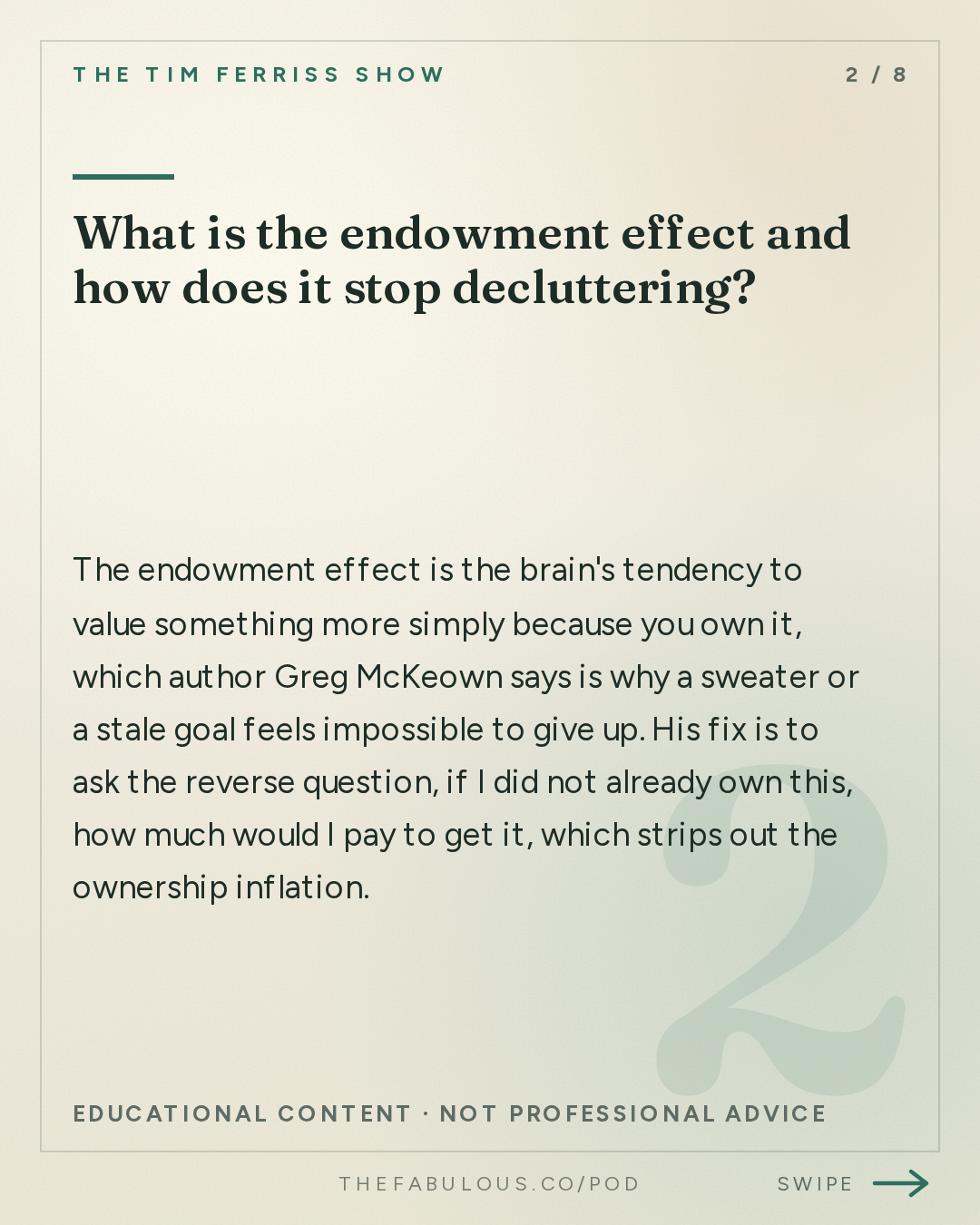
What is the endowment effect and how does it stop decluttering?
The endowment effect is the brain's tendency to value something more simply because you own it, which author Greg McKeown says is why a sweater or a stale goal feels impossible to give up (15:19). His fix is to ask the reverse question, if I did not already own this, how much would I pay to get it, which strips out the ownership inflation (19:00).
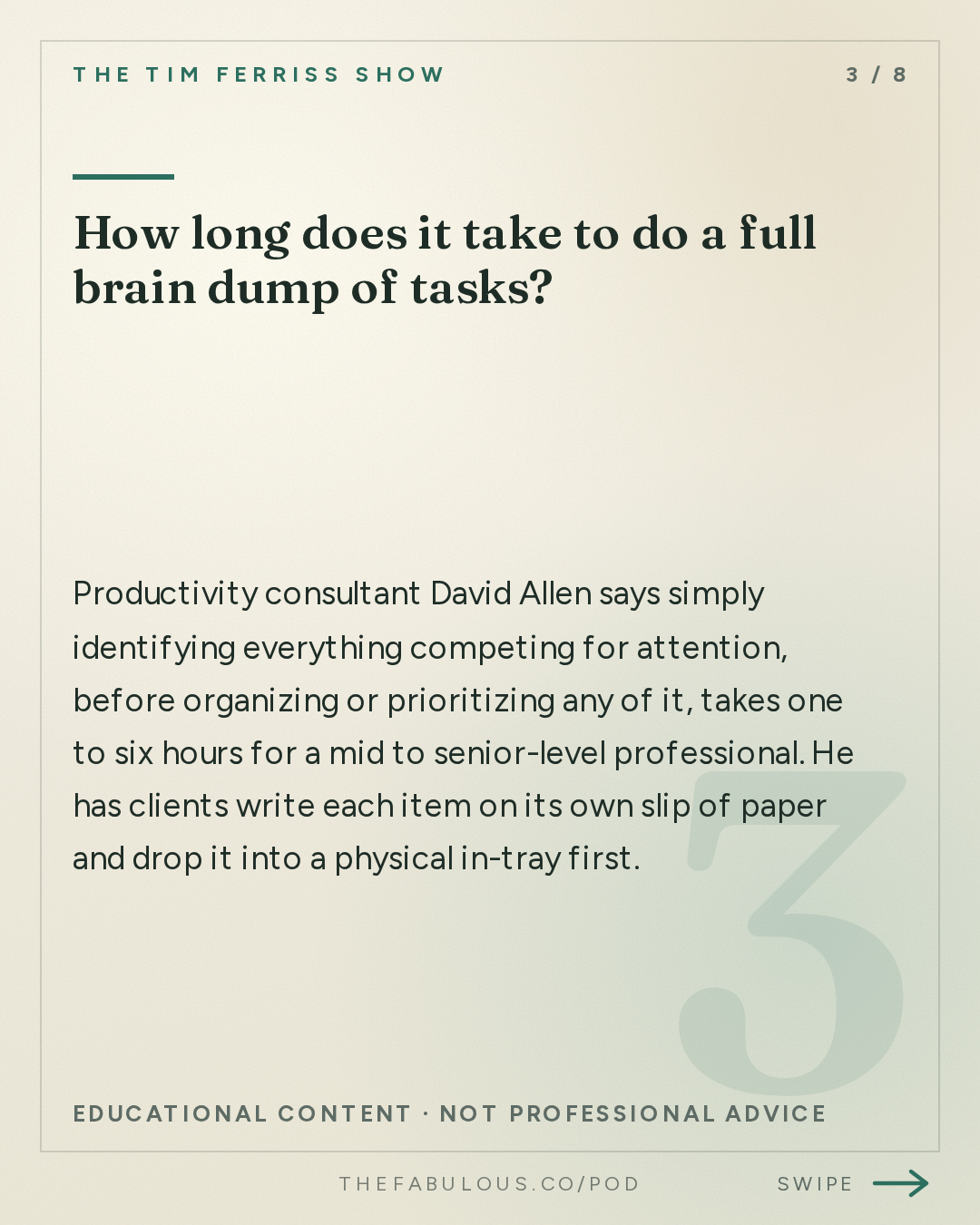
How long does it take to do a full brain dump of tasks?
Productivity consultant David Allen says simply identifying everything competing for attention, before organizing or prioritizing any of it, takes one to six hours for a mid to senior-level professional (22:08). He has clients write each item on its own slip of paper and drop it into a physical in-tray first (20:52).
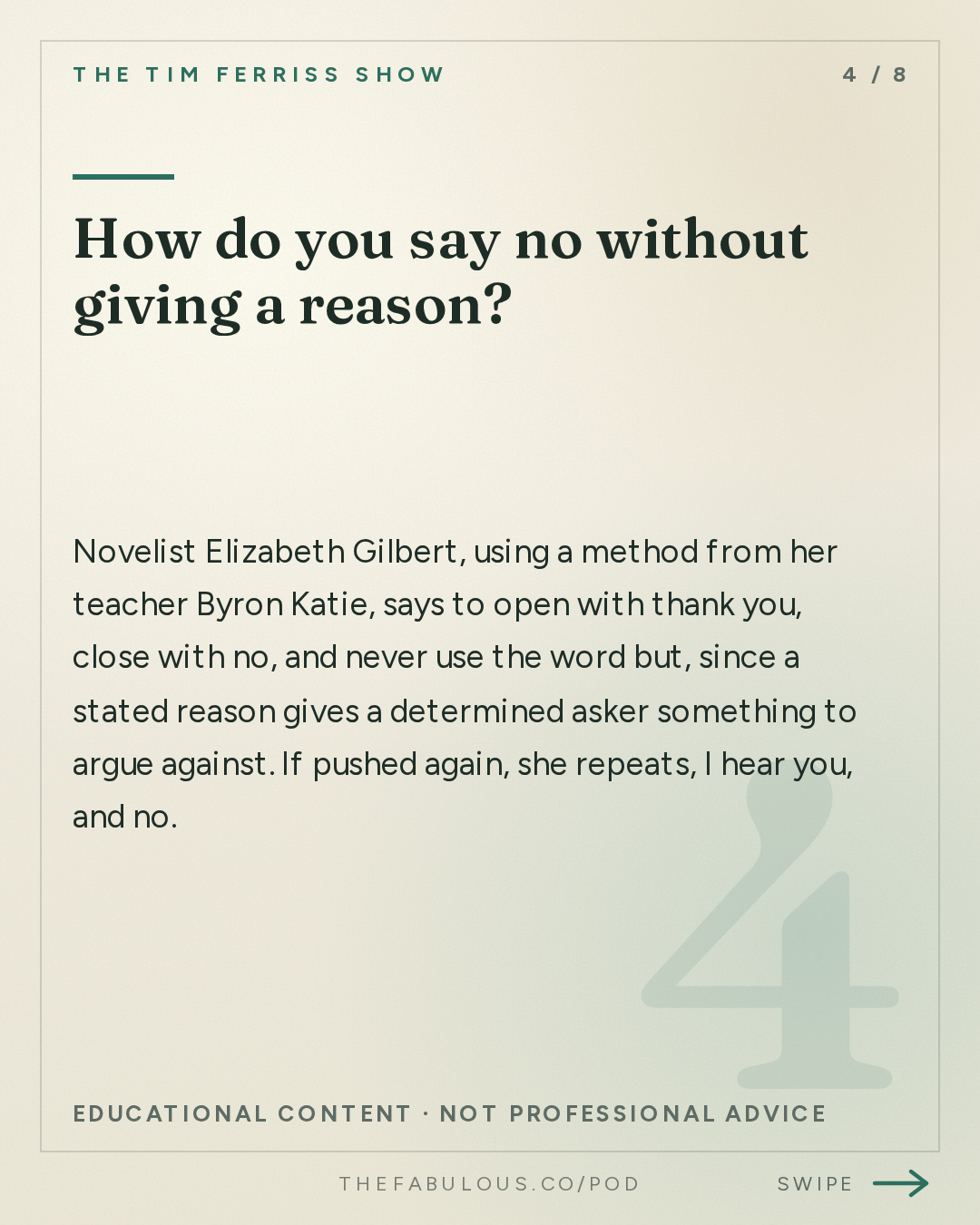
How do you say no without giving a reason?
Novelist Elizabeth Gilbert, using a method from her teacher Byron Katie, says to open with thank you, close with no, and never use the word but, since a stated reason gives a determined asker something to argue against (33:43). If pushed again, she repeats, I hear you, and no (34:22).
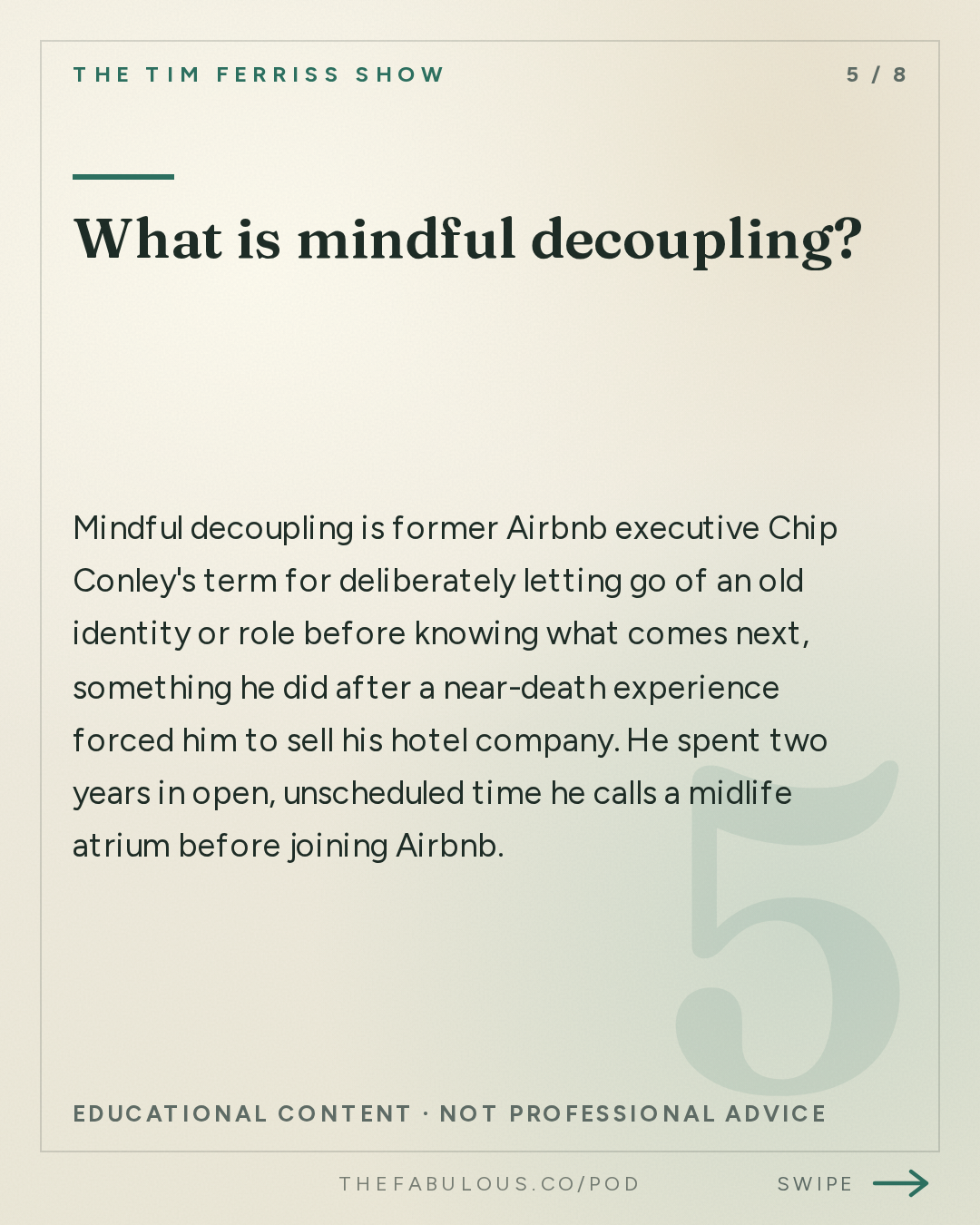
What is mindful decoupling?
Mindful decoupling is former Airbnb executive Chip Conley's term for deliberately letting go of an old identity or role before knowing what comes next, something he did after a near-death experience forced him to sell his hotel company (03:36). He spent two years in open, unscheduled time he calls a midlife atrium before joining Airbnb (05:02).
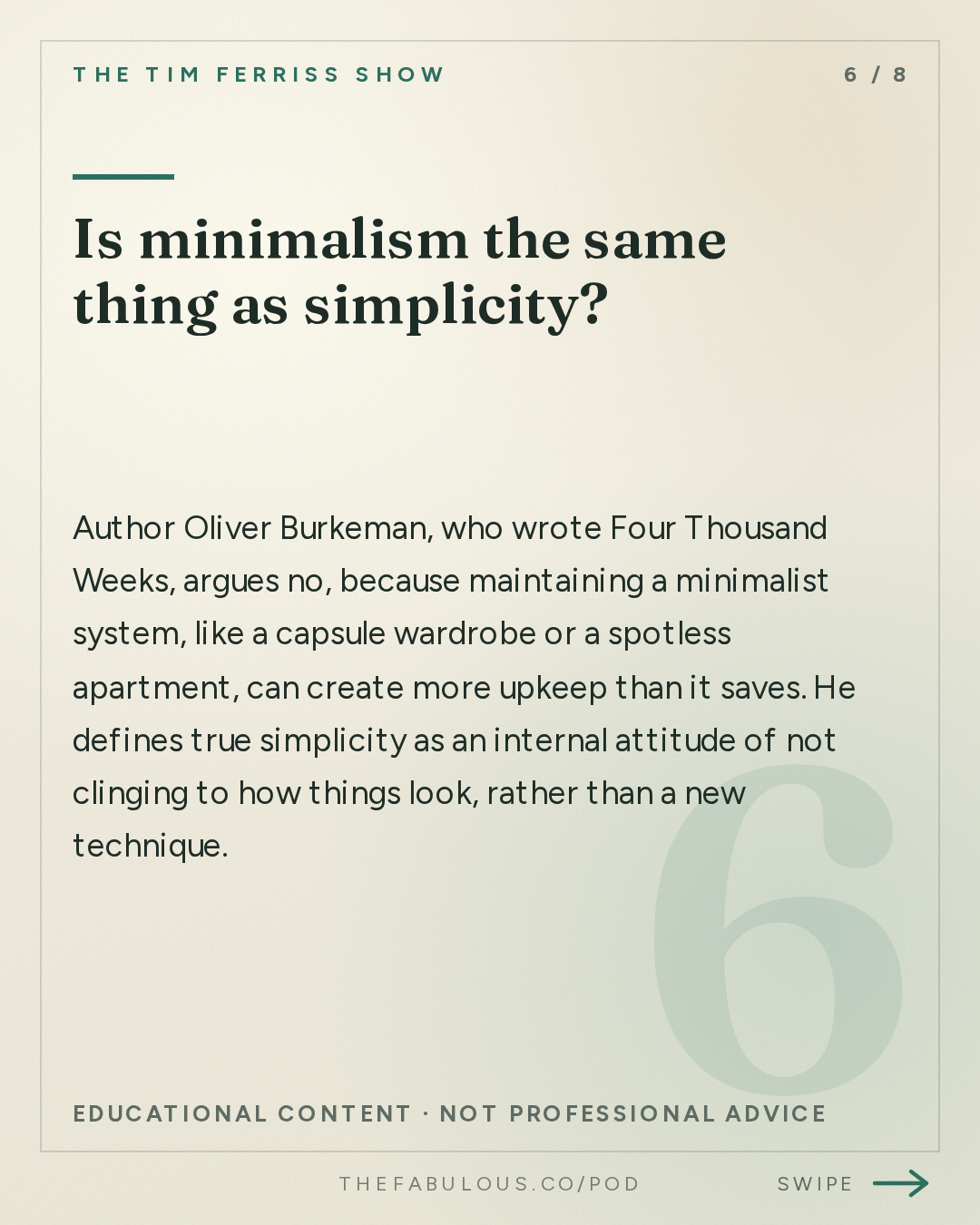
Is minimalism the same thing as simplicity?
Author Oliver Burkeman, who wrote Four Thousand Weeks, argues no, because maintaining a minimalist system, like a capsule wardrobe or a spotless apartment, can create more upkeep than it saves (37:25). He defines true simplicity as an internal attitude of not clinging to how things look, rather than a new technique (40:02).
The full read, in cards
Go deeper
- Emotional Equations — Chip Conley's book on emotional fluency, written during his two-year midlife atrium
- Four Thousand Weeks — Oliver Burkeman's book on finite time, referenced as the frame for his view that simplicity is an attitude, not a system
- Stanford Center on Longevity research — Psychologist Laura Carstensen's finding that less perceived time left shifts focus to the present moment
- Wired profile of David Allen — Described Allen's seminar exercise where audiences write out everything on their mind and feel a mix of grief and relief
Mentioned
Chip Conley · Greg McKeown · David Allen · Elizabeth Gilbert · Oliver Burkeman · Byron Katie · Laura Carstensen · Andy Grove · Airbnb · Modern Elder Academy · Stanford Center on Longevity · Emotional Equations · Four Thousand Weeks
More from this show and category
Kevin Ryan on Spotting 10-Year Trends
Kevin Ryan, the New York investor behind DoubleClick, MongoDB, and Business Insider, says he only bets on trends built to last ten years, not passing hype. His firm AlleyCorp co-founds companies with its own $500,000 stakes, starts narrow, and now leans into deep tech like nuclear energy and psychedelic medicine, including a compound called methylone for PTSD.
How Australia Legalized Psychedelic Therapy
Australia became the first country to let doctors prescribe MDMA and psilocybin for PTSD and depression, after a five-year campaign led by two entrepreneurs with no medical background. Tania de Jong and her husband built an advisory panel, trained 750 clinicians, and drove 13,000 public submissions, pushing the regulator to reclassify both drugs in February 2023.
Mentava Reading App: Does the $500 Method Work?
Niels Hoven's startup Mentava teaches two- to five-year-olds to read using phonics and game-style motivation design, and this coaching session with Tim Ferriss becomes a working seminar on pricing, messaging, and finding uncrowded marketing channels (01:29).
Relationship Tools That Actually Work
This compilation gathers concrete tools from five relationship experts for handling conflict and repair. Esther Perel names Gottman's four horsemen, Brené Brown replaces the 50/50 myth with an 80/20 energy split, Sue Johnson teaches the Hold Me Tight conversation, and Terry Real explains why repair is a one-way street, not a negotiation.
