
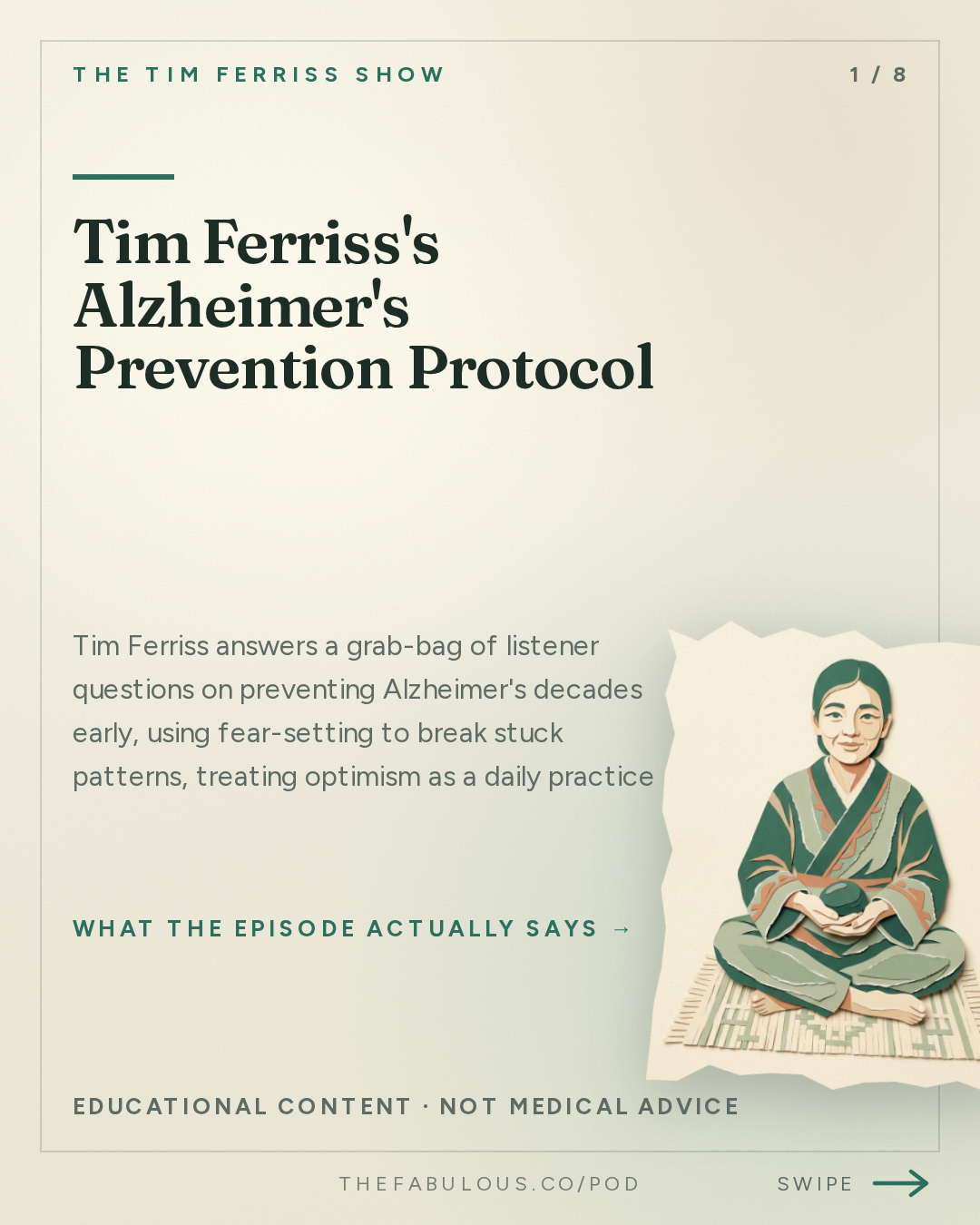
Tim Ferriss's Alzheimer's Prevention Protocol
#889: Q&A with Tim — How to Get Unstuck, Resilience in Hard Times, Tools for Brain Health, Finding Inner Peace, Optimism as a Learnable Skill, and More
The brief
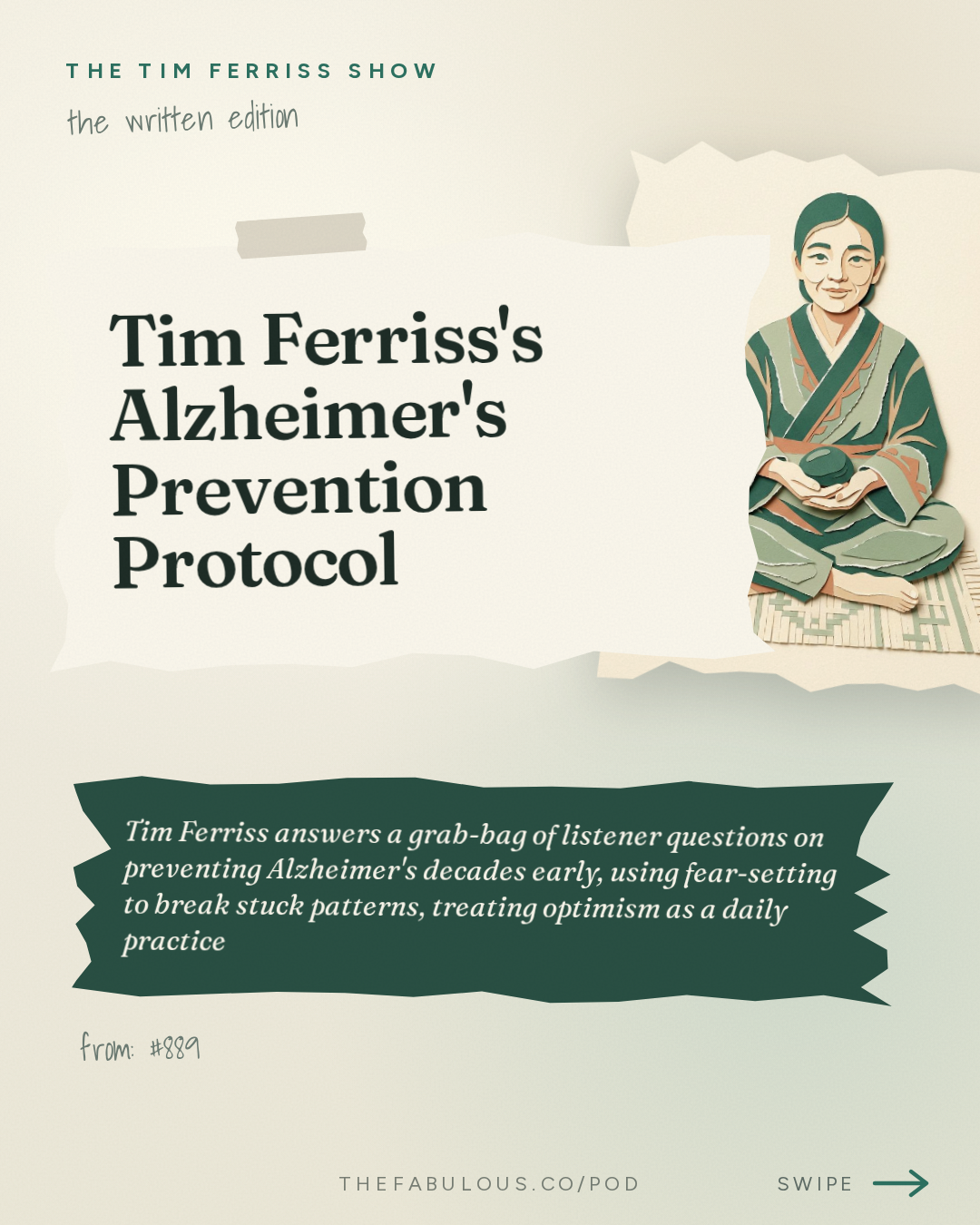
Tim Ferriss answers a grab-bag of listener questions on preventing Alzheimer's decades early, using fear-setting to break stuck patterns, treating optimism as a daily practice, and why he trusts well-studied drugs over unregulated supplements for serious risk. He also explains how meditation reshaped his posture and why he still treats psychedelics with real caution.
By the time a doctor says the word Alzheimer's out loud, the disease has usually had three or four decades to do its quiet work. That is the uncomfortable fact sitting under the first half of this episode, a solo Q&A in which Tim Ferriss answers listener questions with none of the usual guest to lean on. Ferriss, who carries the APOE 3/4 gene variant linked to higher Alzheimer's risk, says the processes that culminate in a diagnosis in old age typically begin in someone's thirties and forties (03:10). He is blunt about what that means for treatment once symptoms appear: not much. "We are in the dark ages still with Alzheimer's," he says, calling many current drugs "a Faustian bargain" (02:24). If there is a consensus among the researchers he talks to, it is a narrow one: prevention is the only lever that reliably moves.
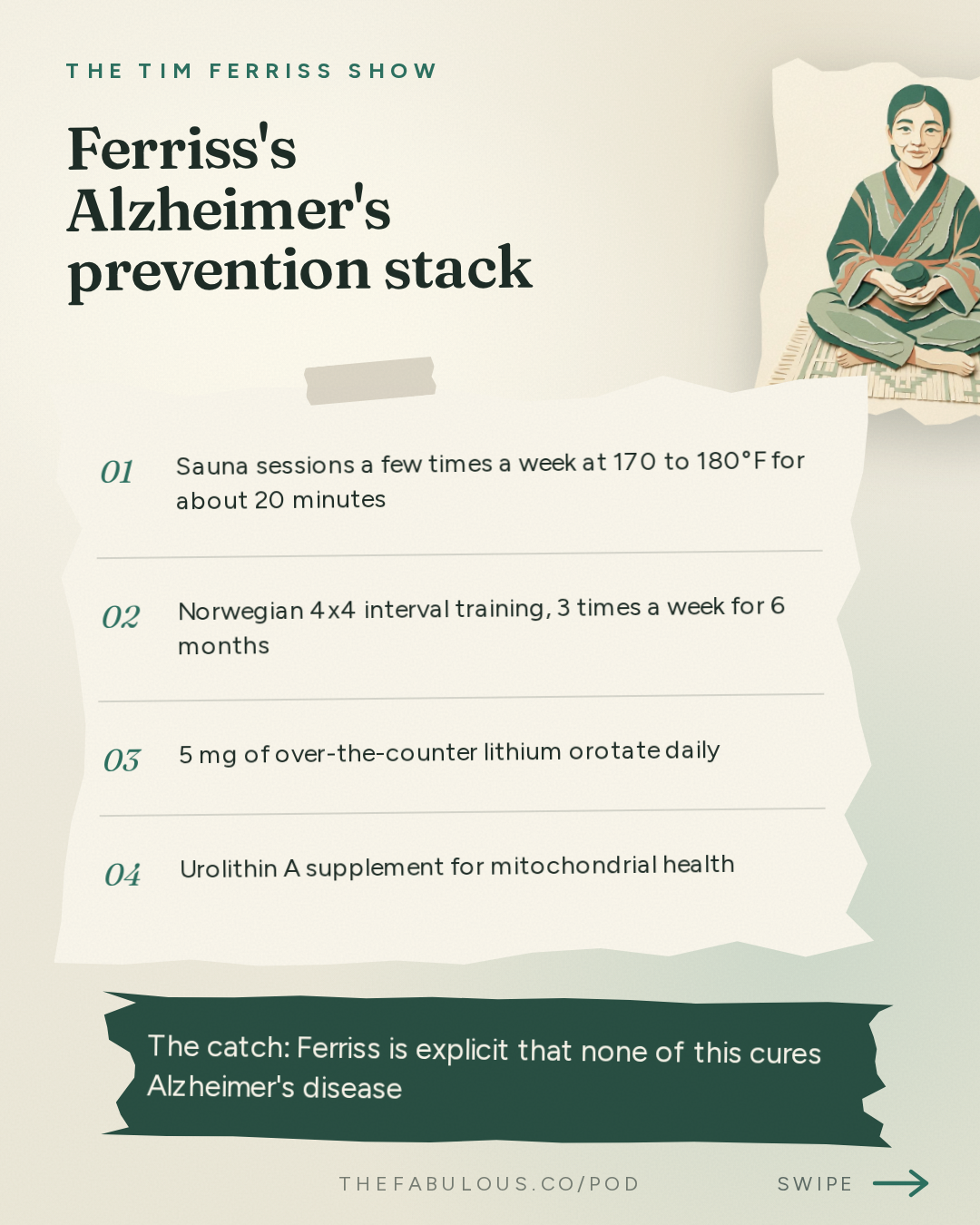
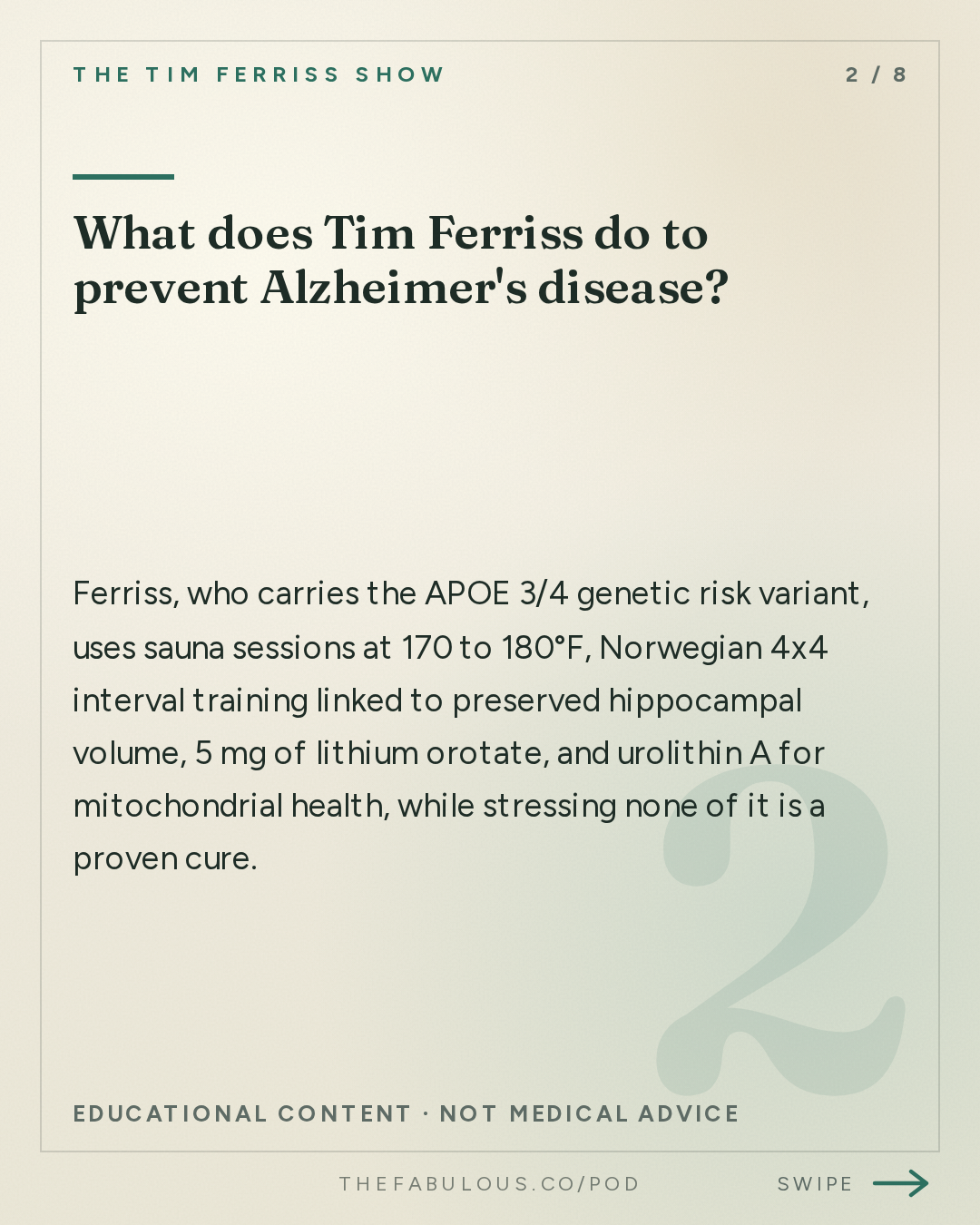
So he describes his own stack, offered with the caveat that none of it is a cure. He sits in a sauna a few times a week at 170 to 180 degrees Fahrenheit for about 20 minutes, noting that hotter is not better and can overheat the brain (03:40). He does Norwegian 4x4 interval training, four minutes of near-maximal effort followed by three minutes of rest, repeated four times, a protocol he and physiologist Dr. Tommy Wood have discussed at length because it is linked to preserved hippocampal volume, the brain region tied to memory, and to higher VO2 max, a measure of aerobic fitness (04:11). Three sessions a week for six months produced changes that still showed up five years later in the research he is citing, which he calls "nuts" (04:33). He also takes 5 milligrams of lithium orotate, an over-the-counter supplement, for its proposed neuroprotective effects (05:46), plus a mitochondria-focused supplement called urolithin A. None of it, he stresses, is a guarantee. It is, in his words, throwing everything in the kitchen sink at a problem that modern medicine still cannot solve once it has arrived.
The same arithmetic of delay shows up later when a listener, a longtime acupuncturist and former psychotherapist, asks why people who desperately want to change can't seem to let go of the patterns keeping them stuck. Ferriss's answer is less about technique than about intensity. "Sometimes the pain isn't painful enough," he says, describing what he has watched happen with family members and friends battling addiction. "Sometimes they have to really hit rock bottom" (08:44).
Sometimes the pain isn't painful enough. I mean, I've seen this with addicts over and over and over again. Sometimes they have to really hit rock bottom. (Tim Ferriss, 08:44)
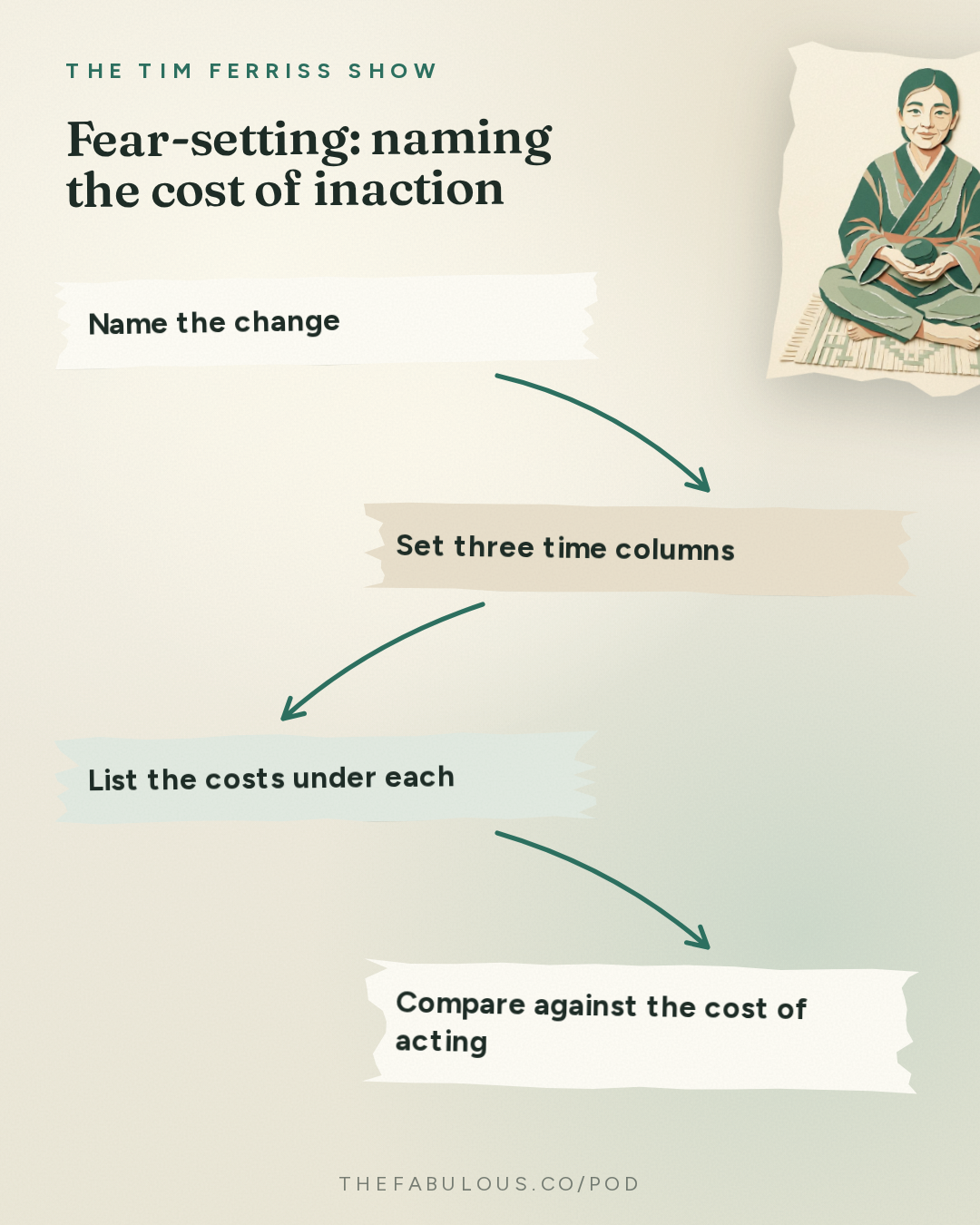
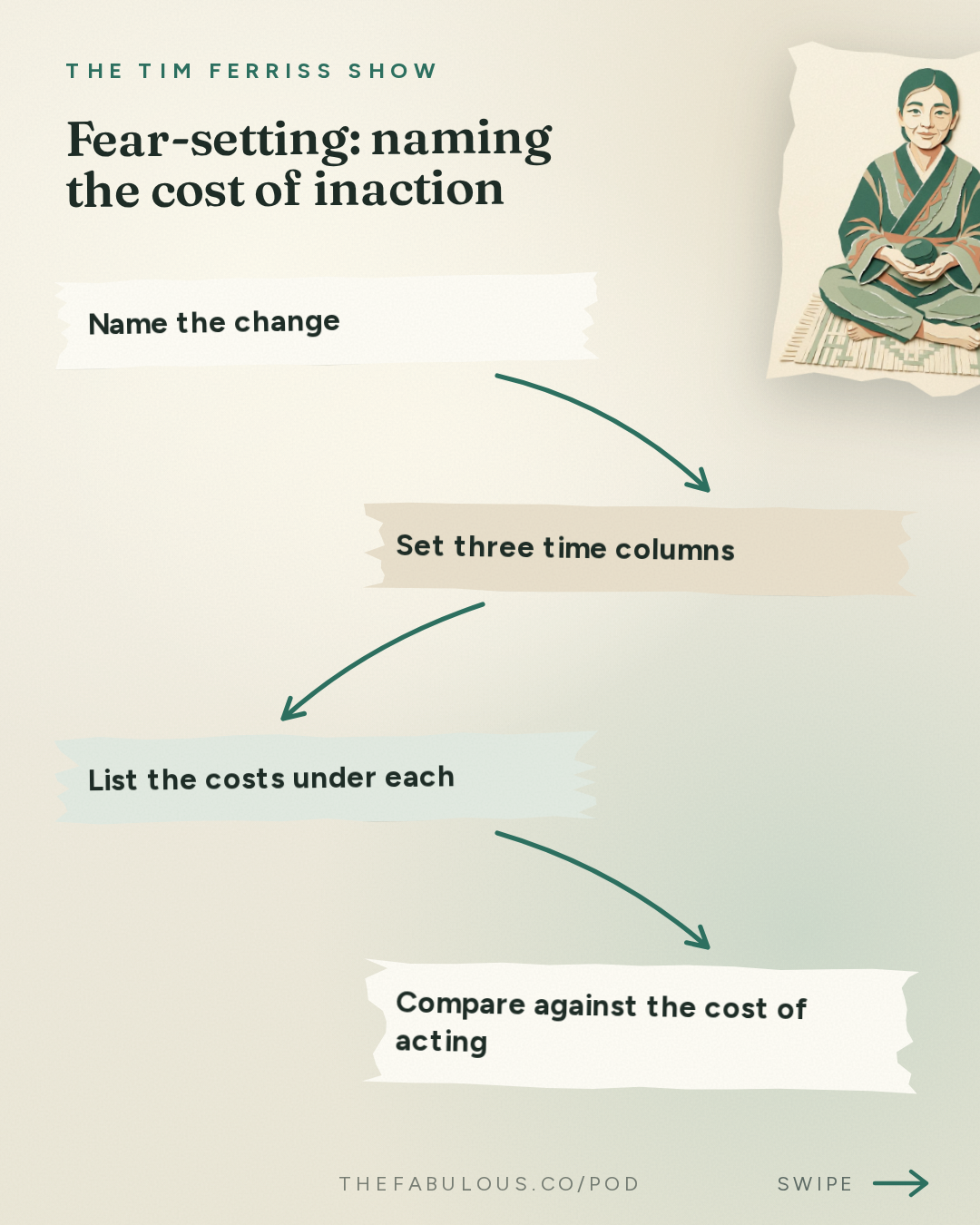
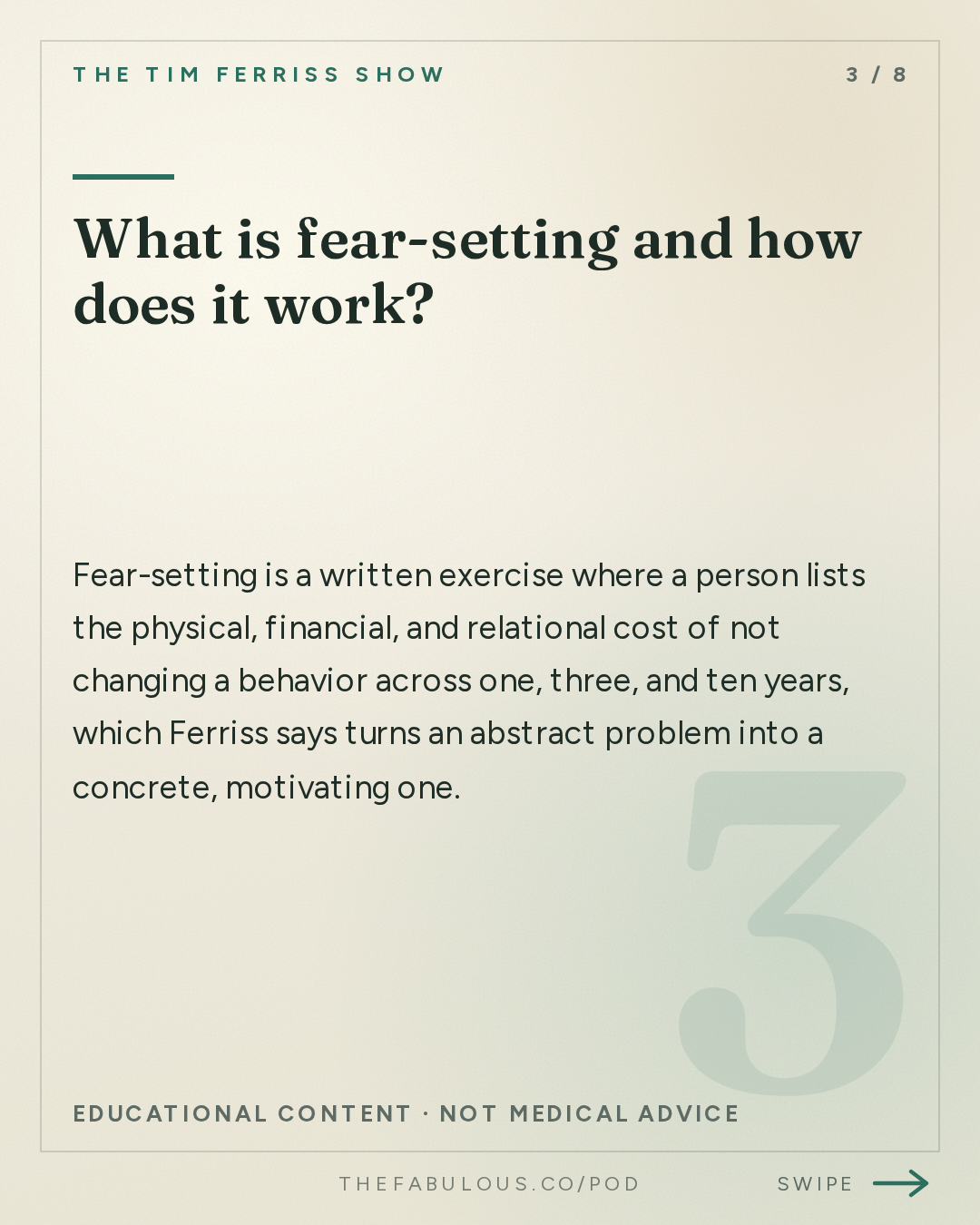
His proposed workaround is a tool he calls fear-setting, laid out in his TED Talk and in earlier books. The useful part, he says, is the piece people skip: writing down the cost of inaction. Take a sheet of paper. Make three columns, one year, three years, ten years. At the top, name the thing that needs to change. In each column, write out the physical, financial, and relational cost of doing nothing, at that distance in time (09:51). The exercise is a kind of reality accelerator. It takes a problem that doesn't feel urgent today and shows what it will cost if it is still around in a decade. Ferriss's point is not that change is painless. It is that the status quo has a price too, and most people never do the math.
The Discipline of Optimism
A listener named Mitchell asks how Ferriss stays hopeful as the news gets darker. His first answer is structural: he has had no social media apps on his phone for about five years (19:22). His second is a scheduling trick borrowed loosely from Edward de Bono's thinking hats. He blocks dedicated "upside time," where he actively searches for optimistic angles and real opportunities, often using an AI chatbot as a filter before going to YouTube, and separate "downside time," where he deliberately studies risks (19:55, 20:55). The reason for the split is a business-model observation he states flatly: "This is how the platforms continue to make you the product. Their customers are advertisers. They are selling your attention" (21:40). Left on autopilot, a feed will always lean toward outrage, because outrage holds attention longer than hope does.
He also credits a book, Studs Terkel's oral history of the Great Depression, Hard Times, with functioning as optimism research rather than escapism. The stories of people who thrived, invented, and kept their humor during the worst economic collapse in American history remind him, he says, how good people are at adapting (22:38). He traces this back to something the investor Mike Maples Jr. once told him: one of the few jobs a parent has is teaching a child to be optimistic, because optimism is what lets a person see options instead of walls (25:22).
If you teach them to be optimistic, they see options. They feel like they have agency. (Tim Ferriss, citing Mike Maples Jr., 25:22)
The same bias toward doing rather than absorbing shows up in his advice on learning artificial intelligence. Asked how to spend five to ten thousand dollars to get current on AI, Ferriss says don't spend it. Instead, use the tools to generate ten small, hour-or-three-long projects, drop that prompt into a few different models, and start building something, even something as small as automating one workflow (27:56). The models from six months ago, he adds, are already powerful enough for most people's purposes (29:21).
Supplements, Drugs, and the Problem of Certainty
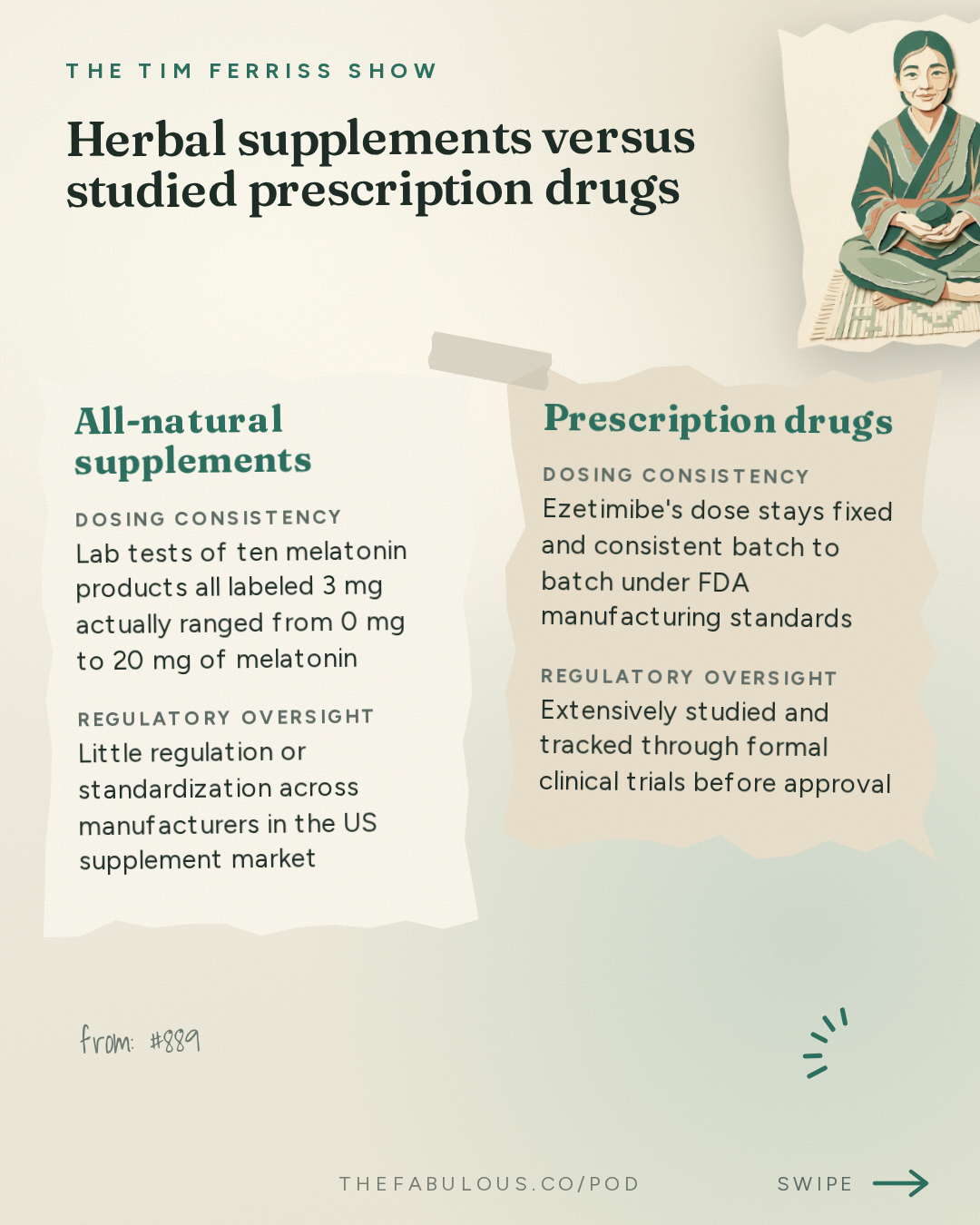
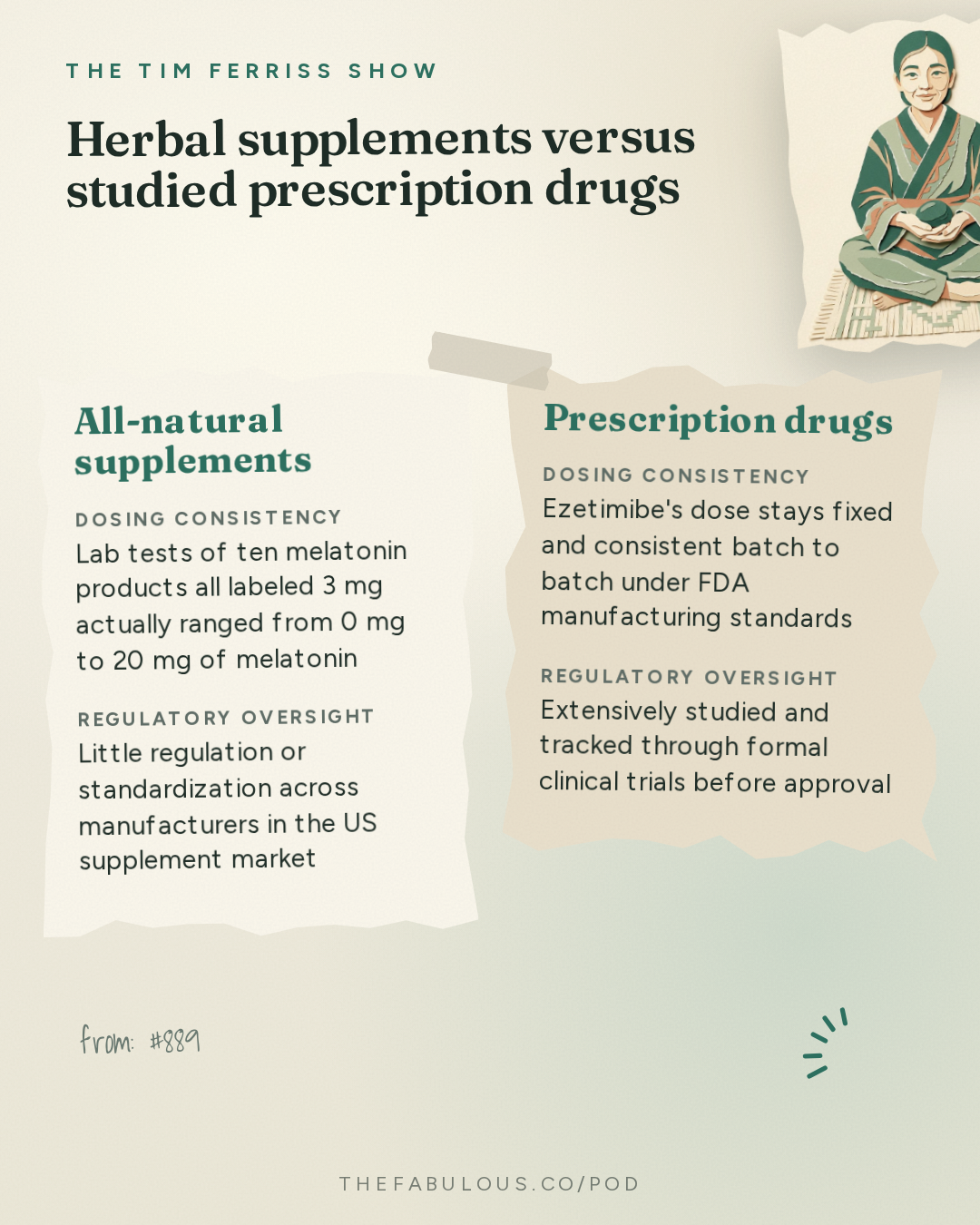
When a listener asks about natural statins for people with a family history of heart disease, Ferriss gives an answer that doubles as a philosophy of risk. All natural, he says, does not mean safe; hemlock and arsenic are natural too (50:37). His real objection to herbal supplements is inconsistency. He cites testing that found ten melatonin products, all labeled at 3 milligrams, actually ranging from zero milligrams of melatonin to 20 milligrams (51:06). For something he is taking seriously, that kind of variance is disqualifying. Knowing that every male in his family has died of heart problems, he asked his doctor to start with the most extensively studied, most innocuous of four proposed cholesterol medications, a drug called ezetimibe, before adding anything else. He turned out to respond well to it alone (54:37, 55:04). It is a small, specific story, but it captures his general rule: when the stakes are real, he wants dosing he can trust more than a halo of the word natural.
That same caution extends to psychedelics, which he has used and which he credits with letting him see, as he puts it, seventeen different problems that all traced back to one or two root causes (44:16). But he is explicit that he talks more people out of trying them than into it, warning against casual ceremonies with unqualified guides.
I talk more people out of psychedelics than I talk into psychedelics... You're using nuclear power. It is very, very powerful. (Tim Ferriss, citing the late researcher Roland Griffiths, 43:51)
He is also tracking a newer line of research: that some of the antidepressant effect of psychedelics may come not from the trip itself but from anti-inflammatory action on chronic neuroinflammation in the brain, often downstream of an old infection, even at doses far below what produces any noticeable effect (33:06). He is funding research into this himself.
The episode's smaller findings are just as concrete. Meditating twice a day for 20 minutes, in his case using Transcendental Meditation, trained his postural slow-twitch muscle fibers, the ones that fail quietly when someone sits hunched over a laptop all day, and within a few months, friends started telling him he walked like a dancer (61:09, 61:33). He has had better luck building flexibility through strength at the end range of a stretch, like holding a pike position and pulsing, than through passive stretching (63:05).
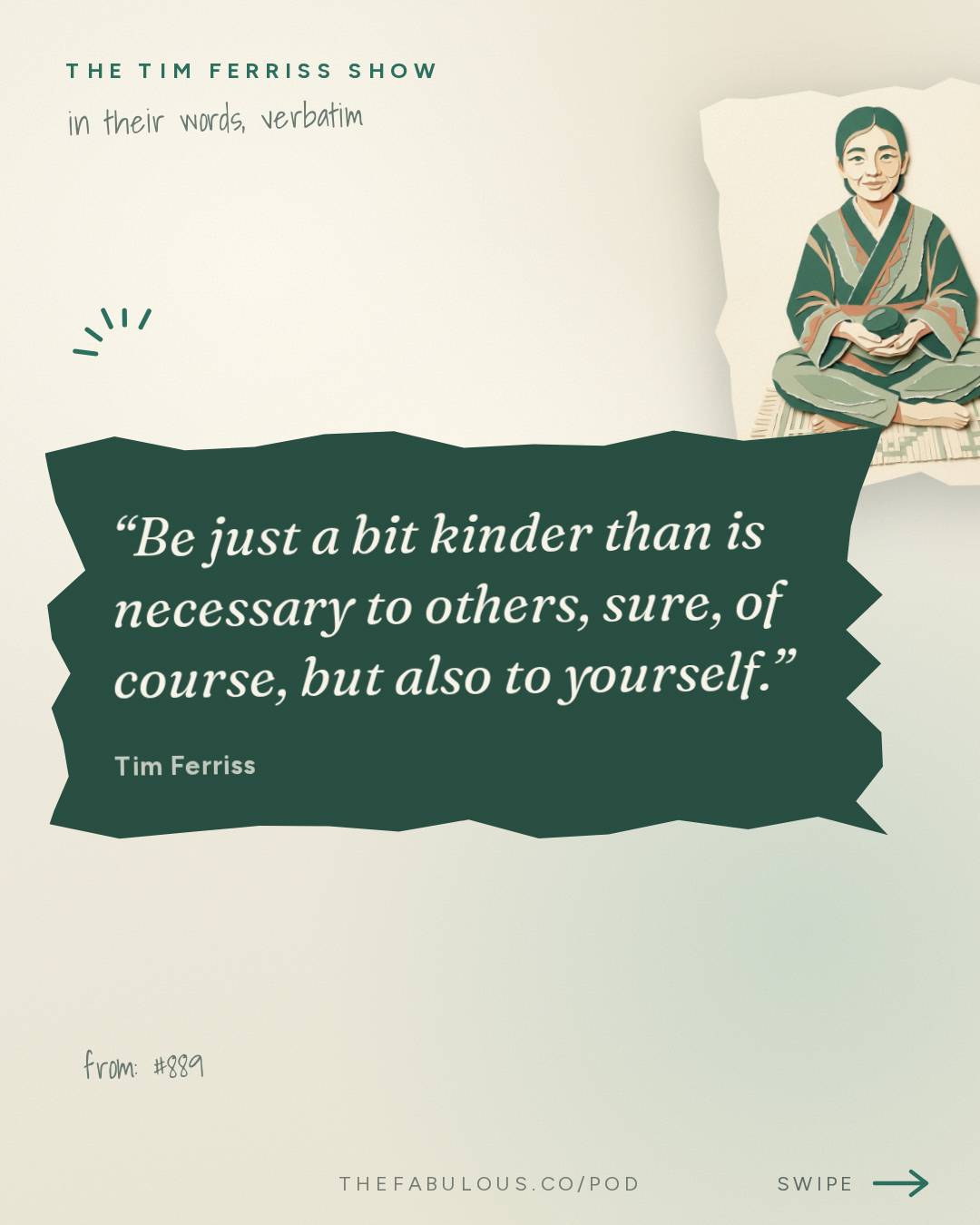
Asked, finally, whether he is at peace, Ferriss says yes, more than ever, and that it has nothing to do with money (68:04). He closes with a line that reads almost like the moral of the whole hour: be a little kinder than necessary to other people, sure, but also to yourself (70:14). After roughly seventy-four minutes spent cataloguing brain scans, cost-of-inaction worksheets, and lab-tested melatonin bottles, it lands less like a platitude and more like the conclusion of someone who has actually tried to measure his way to it.
Ask this episode anything
Pod's AI answers from the episode itself, with the minute mark so you can hear it yourself.
Or start with one of these
Ask this episode
Pod's AI listens to the whole episode to answer, and points you to the minute it comes from.
The rest of this answer, and any question after it
Answers come from the episode itself, never from a summary of it.
ContinueKey takeaways
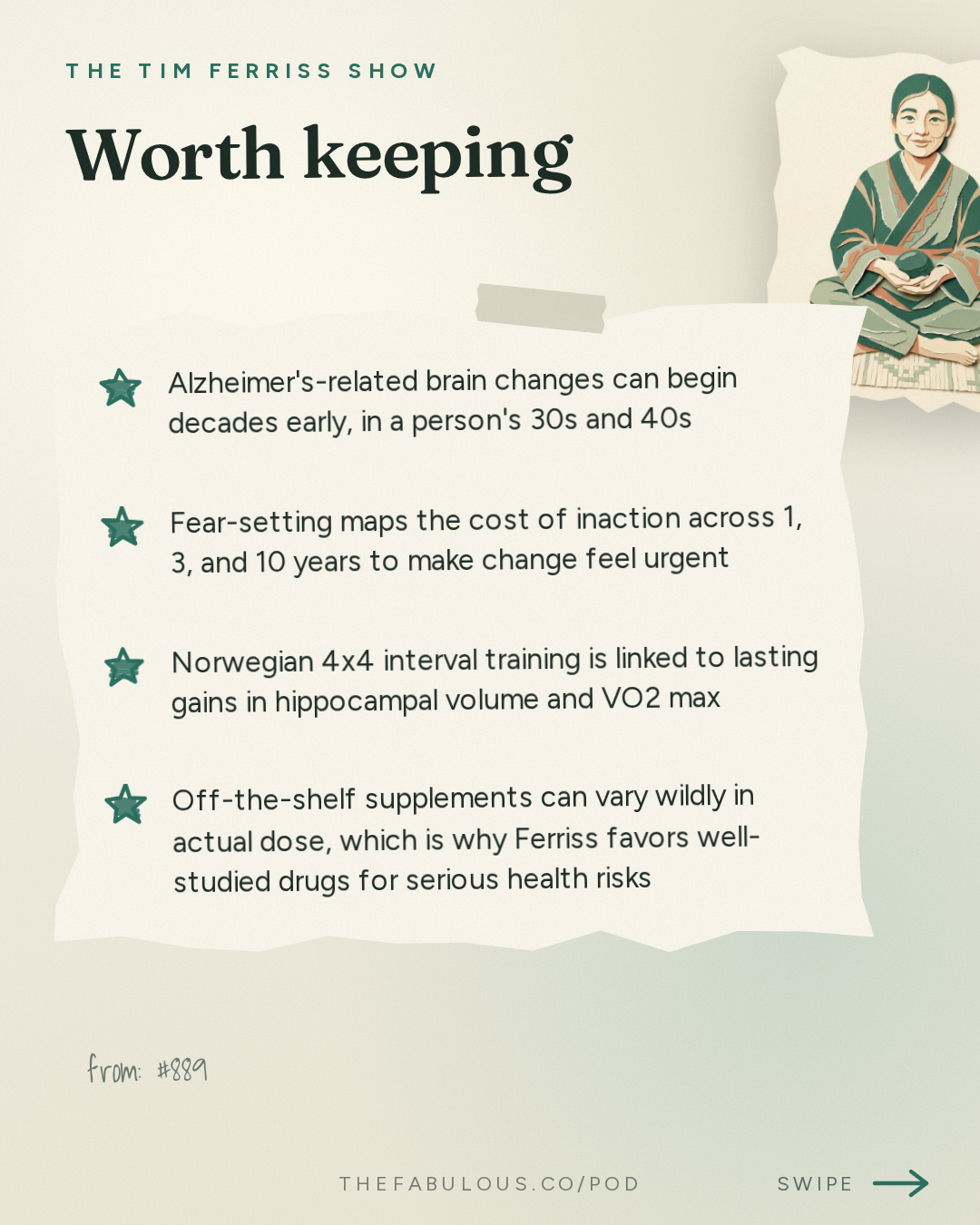
- Alzheimer's-related brain changes can begin decades early, in a person's 30s and 40s
- Fear-setting maps the cost of inaction across 1, 3, and 10 years to make change feel urgent
- Norwegian 4x4 interval training is linked to lasting gains in hippocampal volume and VO2 max
- Off-the-shelf supplements can vary wildly in actual dose, which is why Ferriss favors well-studied drugs for serious health risks
- Meditating 20 minutes twice a day retrained Ferriss's posture by strengthening postural slow-twitch muscle fibers
The episode in cards
By the numbers
- 5 mg daily lithium orotate dose Ferriss takes as an over-the-counter neuroprotective supplement
- 20 minutes, twice daily meditation duration Ferriss credits with improving his posture
In their words
“Be just a bit kinder than is necessary to others, sure, of course, but also to yourself.”
Protocols
-
Fear-setting the cost of inaction
Ferriss has people write the behavior or decision they are avoiding at the top of a page, then create three columns labeled one year, three years, and ten years, and under each one list the physical, financial, and relational costs of not changing, he says the goal is to make an invisible cost feel real enough to act on.
as needed, when stuck on a decision
-
Norwegian 4x4 interval training for brain and fitness
Ferriss does four minutes of near-maximal effort exercise followed by three minutes of rest, repeated for four rounds, three times a week for six months, and he notes the evidence so far is not proof of a perfect protocol, only the best-documented option he has found.
3 times per week for 6 months
-
Lithium orotate for neuroprotection
Ferriss takes 5 milligrams of over-the-counter lithium orotate daily as part of his Alzheimer's prevention stack, and he is careful to add that he is not treating disease, only trying to shift long-term risk.
daily
-
Meditate to retrain posture
Ferriss meditates in a straight, stacked seated position for 20 minutes twice a day, which he says trains both motor patterning and the postural slow-twitch muscle fibers that weaken from chronic slouching, and he notes it took about a month before others started commenting on his posture.
twice daily, 20 minutes each session
-
Choosing the most-studied drug first
Facing a family history of fatal heart disease, Ferriss asked his doctor to let him start with ezetimibe, the most extensively studied and most innocuous of four proposed cholesterol medications, before adding the other three, and he found he responded well to it alone.
one-time clinical decision, individual case
Questions this episode answers
What does Tim Ferriss do to prevent Alzheimer's disease?
Ferriss, who carries the APOE 3/4 genetic risk variant, uses sauna sessions at 170 to 180°F, Norwegian 4x4 interval training linked to preserved hippocampal volume, 5 mg of lithium orotate, and urolithin A for mitochondrial health, while stressing none of it is a proven cure (02:24).
What is fear-setting and how does it work?
Fear-setting is a written exercise where a person lists the physical, financial, and relational cost of not changing a behavior across one, three, and ten years, which Ferriss says turns an abstract problem into a concrete, motivating one (09:51).
What is the Norwegian 4x4 interval training protocol?
It is four minutes of near-maximal effort exercise followed by three minutes of rest, repeated four times, done three times a week; Ferriss cites research in which six months of this produced changes in hippocampal volume and VO2 max still measurable five years later (04:11).
Why does Tim Ferriss prefer prescription drugs over natural supplements for serious health risks?
Lab testing he cites found ten melatonin supplements all labeled 3 mg actually contained anywhere from 0 mg to 20 mg, which is why for a serious family history of heart disease he chose the most extensively studied drug, ezetimibe, over unregulated herbal options (51:06).
How does meditation improve posture according to Tim Ferriss?
Ferriss says meditating 20 minutes twice a day in a straight, stacked position trains both motor patterning and the postural slow-twitch muscle fibers that weaken from chronic slouching, and friends began complimenting his posture after about a month of practice (61:09).
The full read, in cards
Go deeper
- Hard Times: An Oral History of the Great Depression — Studs Terkel's Pulitzer-winning oral history that Ferriss reads as evidence of human resilience, not just hardship
- Atomic Habits — James Clear's book, cited for selling around 30 million copies and for its behavioral-change framework
- Outlive — Peter Attia's book, referenced for its framework on the major causes of death including cardiovascular disease
- Awareness — Anthony De Mello's book, which Ferriss says he has gifted more than 100 times and reread 15 to 20 times
Mentioned
Dr. Rhonda Patrick · Dr. Tommy Wood · James Clear · Studs Terkel · Peter Attia · Roland Griffiths · Mike Maples Jr. · Terry Laughlin · Chris Sommer · Internal Family Systems · Claude · Oura Ring · Oboe
More from this show and category
Why Is the Number Eight Lucky in Asia?
Tim Ferriss explains why the number eight, which sounds like the Mandarin word for prosperity, became East Asia's luckiest digit. He traces how that belief shaped skyscraper floor counts, casino design, license plate auctions, and Toyota's name, while four, linked to the word for death, disappears from elevators across China, Japan, and Korea.
4-Hour Workweek Meets AI: Tim Ferriss Q&A
Tim Ferriss says AI multiplies whatever work you feed it, so without defining and eliminating tasks first, it manufactures busywork instead of leisure (04:16). The episode also covers rebuilding self-trust through small daily actions, Oryx software for near vision, a critique of John Sarno's psychosomatic back pain theory, and why the slow-carb diet and 16-hour fasting still work after 40.
How to Simplify Your Life: 5 Expert Tips
Five longtime guests explain how to cut overwhelm: release the identity you've outgrown, question what you only value because you own it, write down every open task before sorting it, and decline requests without an excuse. Oliver Burkeman adds that real simplicity is an attitude, not a new system.
Kevin Ryan on Spotting 10-Year Trends
Kevin Ryan, the New York investor behind DoubleClick, MongoDB, and Business Insider, says he only bets on trends built to last ten years, not passing hype. His firm AlleyCorp co-founds companies with its own $500,000 stakes, starts narrow, and now leans into deep tech like nuclear energy and psychedelic medicine, including a compound called methylone for PTSD.
