
4-Hour Workweek Meets AI: Tim Ferriss Q&A
#887: Q&A with Tim — The 4-Hour Workweek in a World of AI, Rebuilding Personal Agency, The 4-Hour Body After 40, and More
The brief
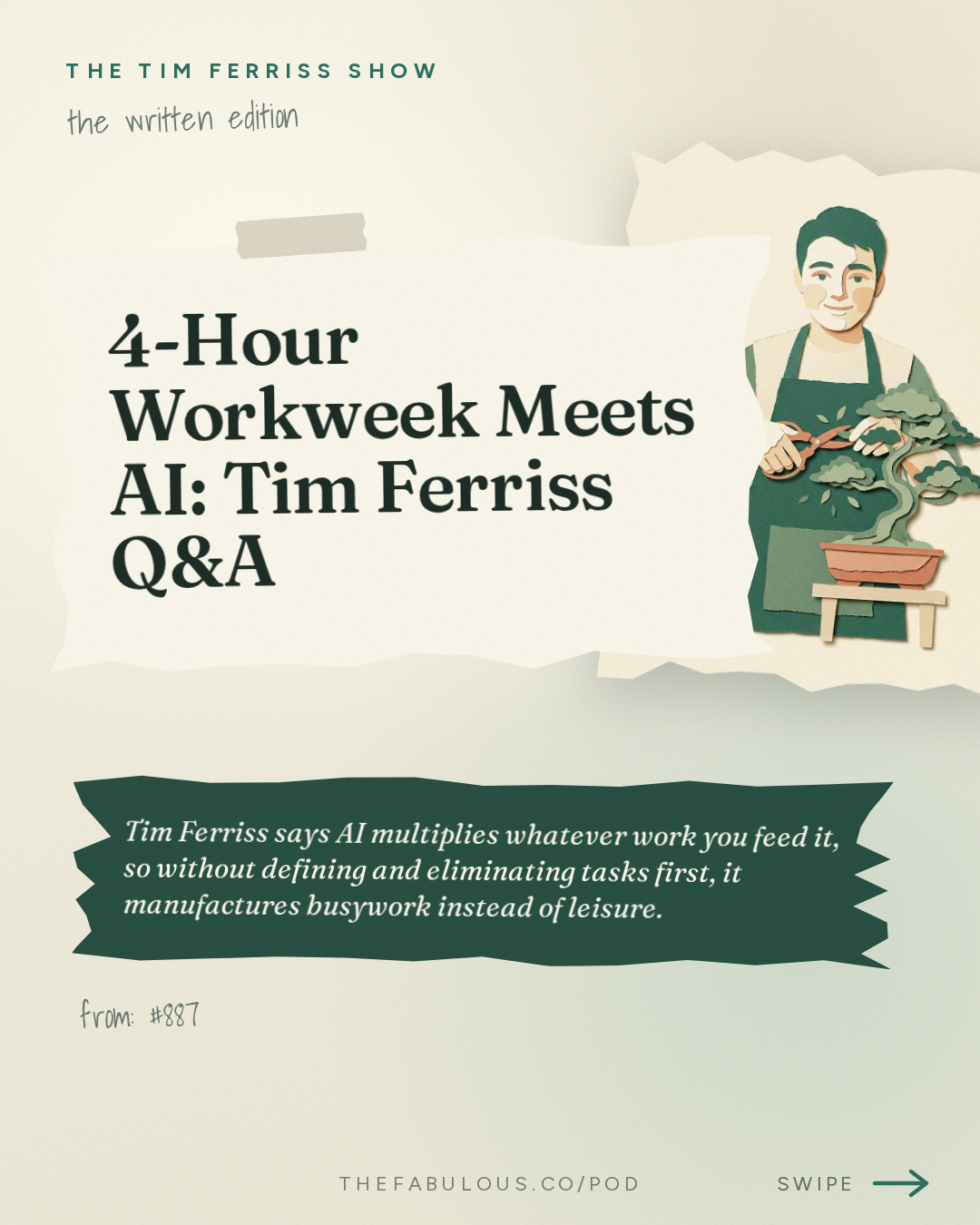
Tim Ferriss says AI multiplies whatever work you feed it, so without defining and eliminating tasks first, it manufactures busywork instead of leisure (04:16). The episode also covers rebuilding self-trust through small daily actions, Oryx software for near vision, a critique of John Sarno's psychosomatic back pain theory, and why the slow-carb diet and 16-hour fasting still work after 40.
In 2027, Tim Ferriss's The 4-Hour Workweek turns twenty (01:44). The book's premise, that a job could shrink to four hours through outsourcing and automation, now sounds almost quaint next to AI agents that can draft contracts, write code, and answer email without a human in the loop. So when a listener named Val N. asks what the four-hour workweek looks like in a world of agents, Ferriss does not answer with more enthusiasm for automation. He answers with a warning about automating the wrong things.
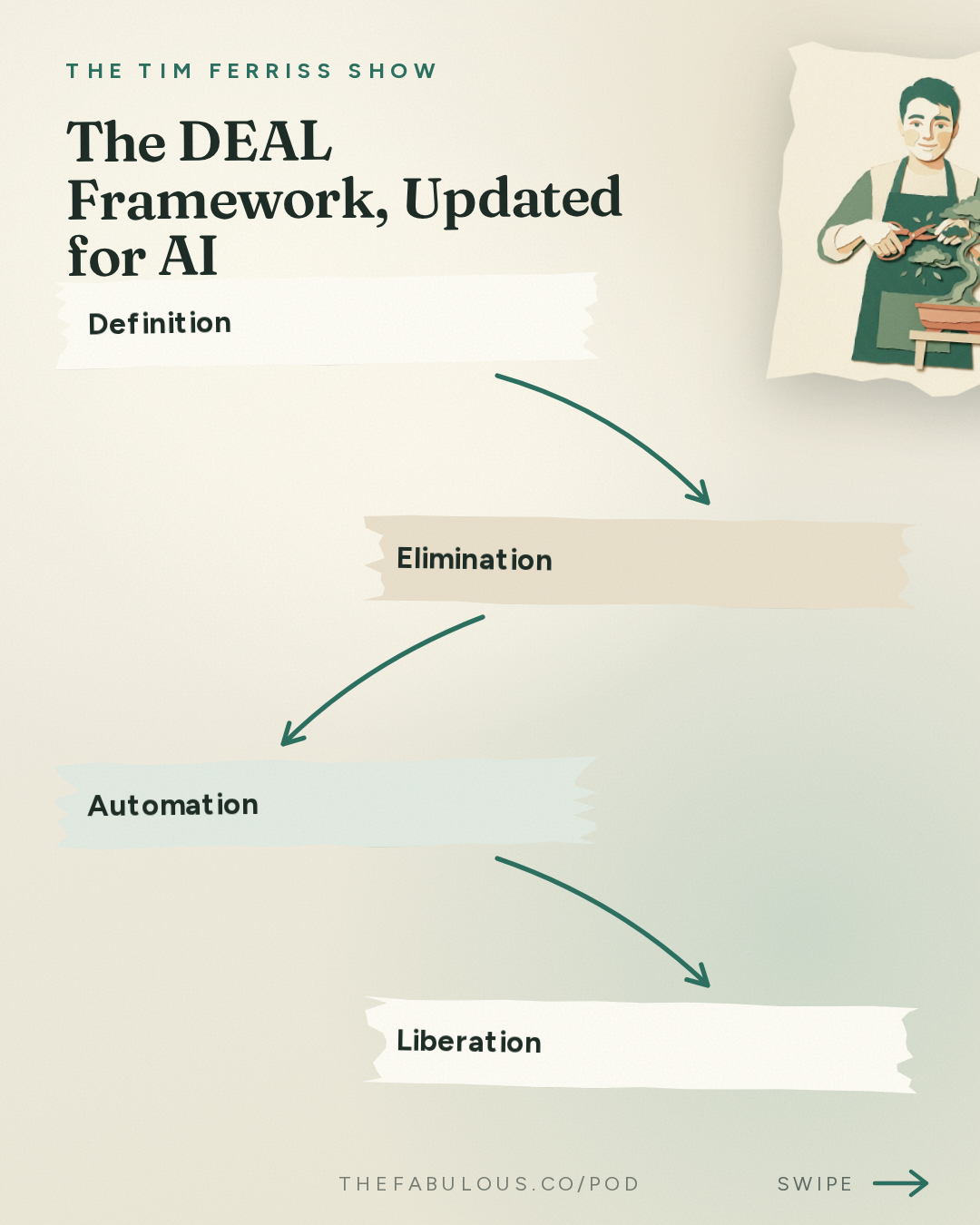
The book's structure, he explains, has always run on an acronym: DEAL. Definition means deciding exactly where you want to go and calculating the income and numbers that life requires. Elimination means using 80/20 analysis, the idea that a small share of effort produces most of the result, to cut the trivial many tasks down to a critical few. Automation hands off what remains to people or software. Liberation is what you do with the time that opens up (01:44 to 03:26). In 2007, automation meant hiring a virtual assistant. Now it means AI. Ferriss argues this shifts the weight of the four letters: definition and elimination matter more than ever, because AI does not discriminate between useful work and noise. It simply multiplies whatever it is given (04:16).
"AI simply multiplies the useless. It multiplies the unimportant, the trivial, the distracting, and you can end up then trying to automate all of those things." — Tim Ferriss [04:16]
Ferriss says he has already watched this happen: in more than ninety percent of the AI use cases he has seen, people take tasks that should not be done at all and simply do them faster, producing more work instead of less (04:55). The fix is not a cleverer prompt. It is the unglamorous work of definition and elimination, done before any tool touches the task list.
From Business Plans to Daily Proof
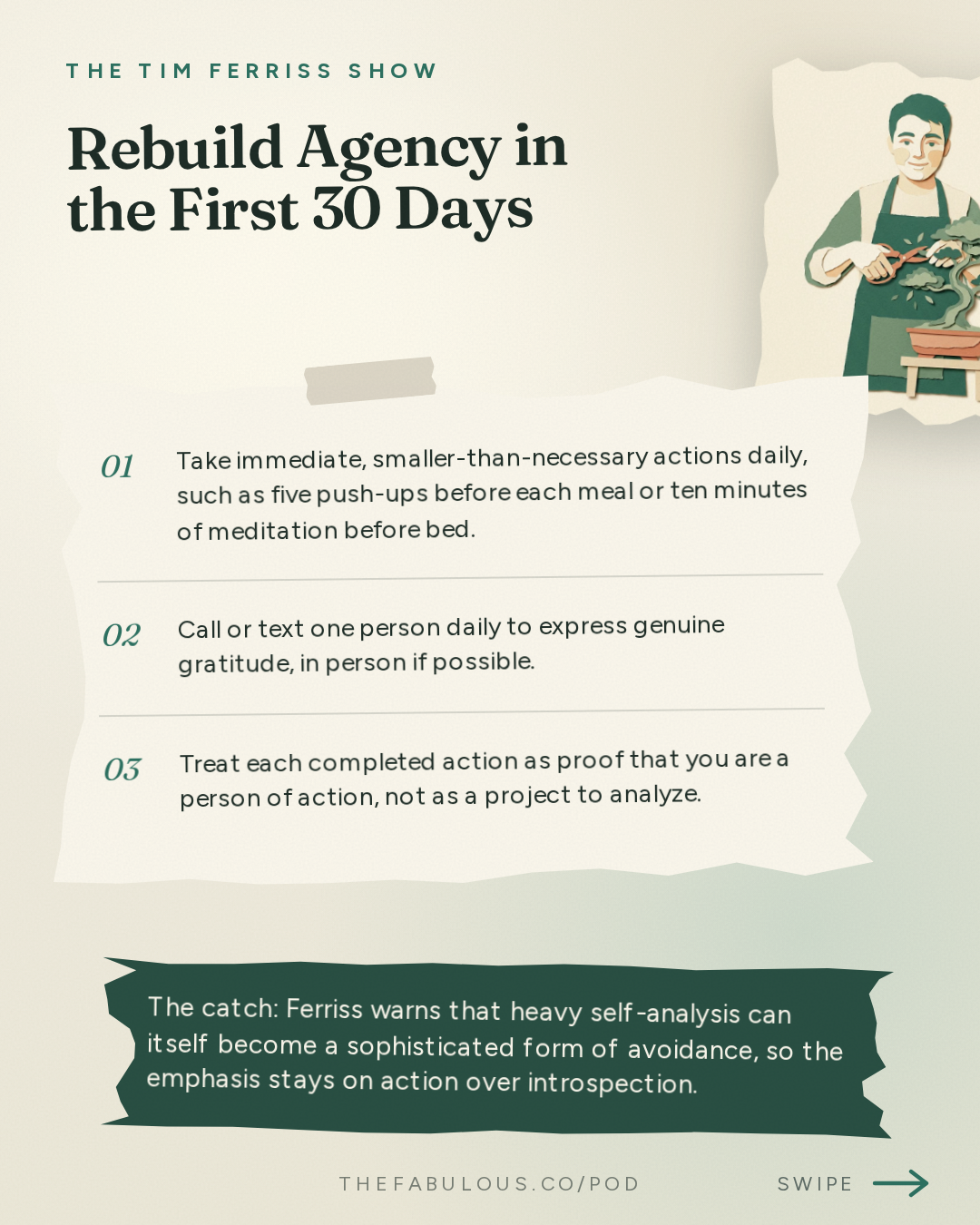
The same discipline, it turns out, applies to a stalled life and not only a stalled business. A caller named Daniel, 46, describes years of professional and personal setbacks that have left him in what he calls paralysis, despite, or perhaps because of, heavy journaling and self-examination (09:16). He wonders if introspection has become its own form of avoidance, and asks how to rebuild trust in his own ability to execute. Ferriss leans on a principle shared by habit researchers James Clear, author of Atomic Habits, and Stanford behavior scientist BJ Fogg: start with actions smaller than feel necessary, not larger (10:27). Five push-ups before each meal. Ten minutes of meditation before bed. One phone call a day to thank someone, a barista, an old friend, anyone. The size of the action is not the point.
"It is rebuilding your identity, and you start simple, and then over time, as you develop confidence, it's very hard to trick yourself at the deepest level, so you need proof, and the proof is daily action." — Tim Ferriss [12:03]
He extends the same logic to friendships that have drifted over politics, feeds, or simple distance. Rather than lecturing a friend who has slid into complaint or cynicism, he suggests modeling the change instead: running a shared 30-day no-complaint experiment, or asking a friend to raise a finger every time you use an absolute word like always or never, on the theory that absolutist language usually signals a disabling internal story rather than a fact (20:25). For bigger decisions, like whether to keep pushing on a stalled project, he borrows a thought exercise from investor Peter Thiel: if you had to hit your ten-year goal in the next six months, what would you do? The point is not a literal plan. It forces you out of routine thinking long enough to notice solutions you would otherwise dismiss (23:20). He pairs it with a second move: ask a close friend what would most likely cause this to fail in two years, a version of red-teaming, the practice of deliberately hunting for weaknesses in your own plan, that is hard to dodge because it leaves no room to just be encouraging (25:46).
Testing the Body's Assumptions
Ferriss applies the same experimental mindset to his own aging body. Asked about tools for presbyopia, the age-related stiffening of the eye's lens that makes close-up text harder to read, he describes testing software called Oryx for eight minutes a day over thirty days (28:24). The premise sounds far-fetched: rather than changing the lens, Oryx trains what Ferriss calls the eye's upstream visual processing, the brain's own ability to sharpen a blurred image. He went from struggling to read anything at arm's length to reading small menu text in dim restaurant lighting, a result he calls "bananas" (29:04), and he became an investor in the company only after it worked on him. The tool is still in limited pilot release, with a hundred spots offered at $999, down from a usual $1,300 (30:32), so this is an early, unproven tool rather than an established medical treatment.
On where to spend limited time and money generally, Ferriss borrows a heuristic from personal finance writer Ramit Sethi: what would it look like to invest ten times more in the one or two areas that matter most, instead of chasing frugality everywhere (32:46)? For Ferriss those two areas are health and relationships. Over-invest in both, he argues, and there is simply less time left to waste on activities that only look productive (33:36). He applies the same scrutiny to the opposite failure, over-engineering: asked whether being too deliberate about a planned life closes off the unplanned experiences that matter most, he agrees that total control is its own trap, and says indulging too heavily in the illusion of control makes a person blind to what is actually happening around them (42:15). He points to reading The Surrender Experiment, a book by Michael Singer recommended by entrepreneur Kevin Rose, as a deliberate counterweight to his own planning instinct (40:50).
For performance under pressure, Ferriss uses a sequence he credits to coach Tony Robbins: state, then story, then strategy (49:02). Most people jump straight to strategy, asking what should I do, while skipping the state that produces either a clear or a disabling story. Before recording a podcast, he manages his own state directly: up to fifteen grams of exogenous ketones, a supplement supplying compounds the brain can burn for fuel instead of glucose, taken about fifteen minutes beforehand, sometimes paired with twenty-five milligrams of caffeine from a nootropic toothpick five to ten minutes before sitting down (50:41). He also treats silence as a tool: pausing to think works better than filling a gap with filler words, and he notes that large language models stall for processing time the same way, with a throwaway compliment about the question (52:55).
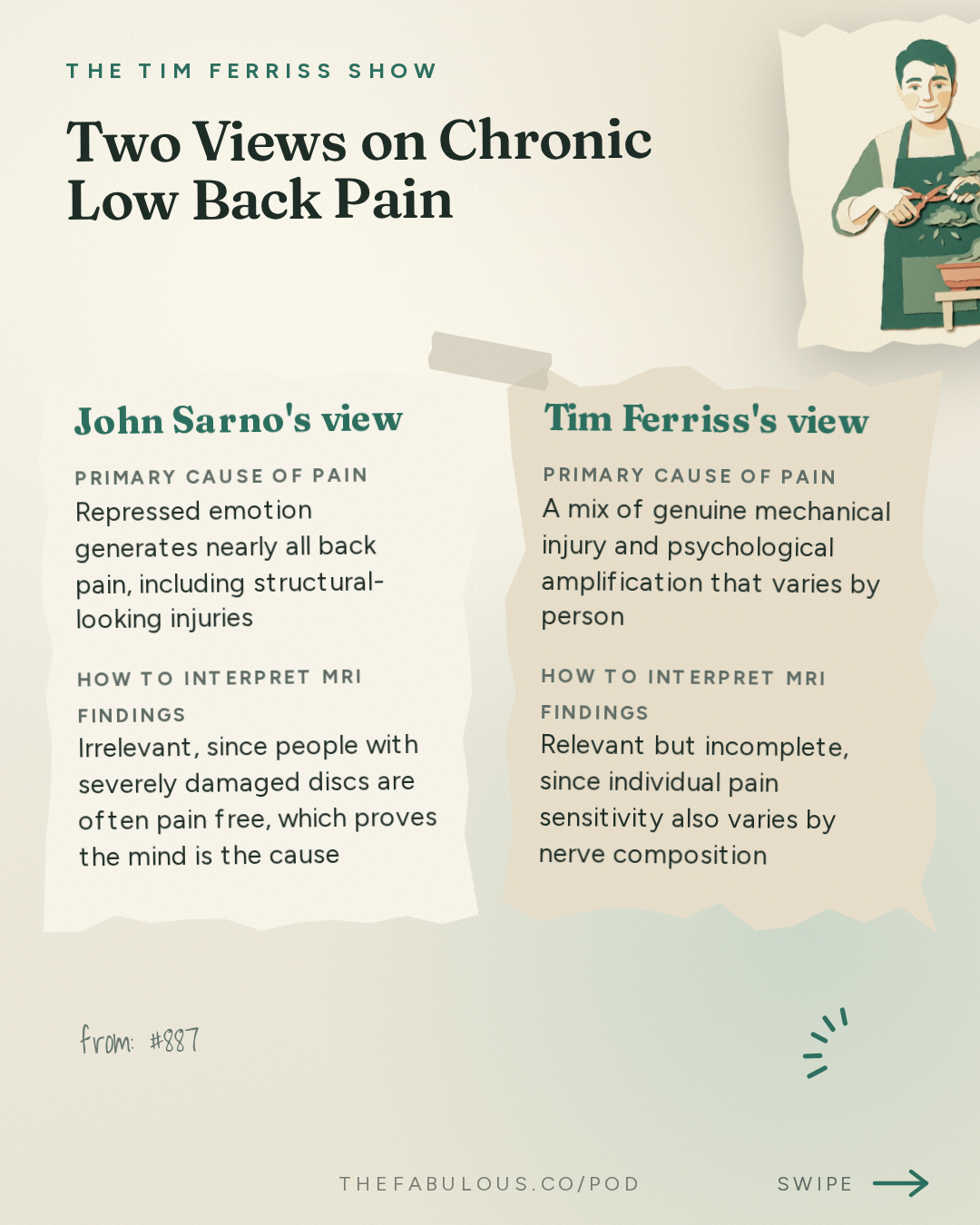
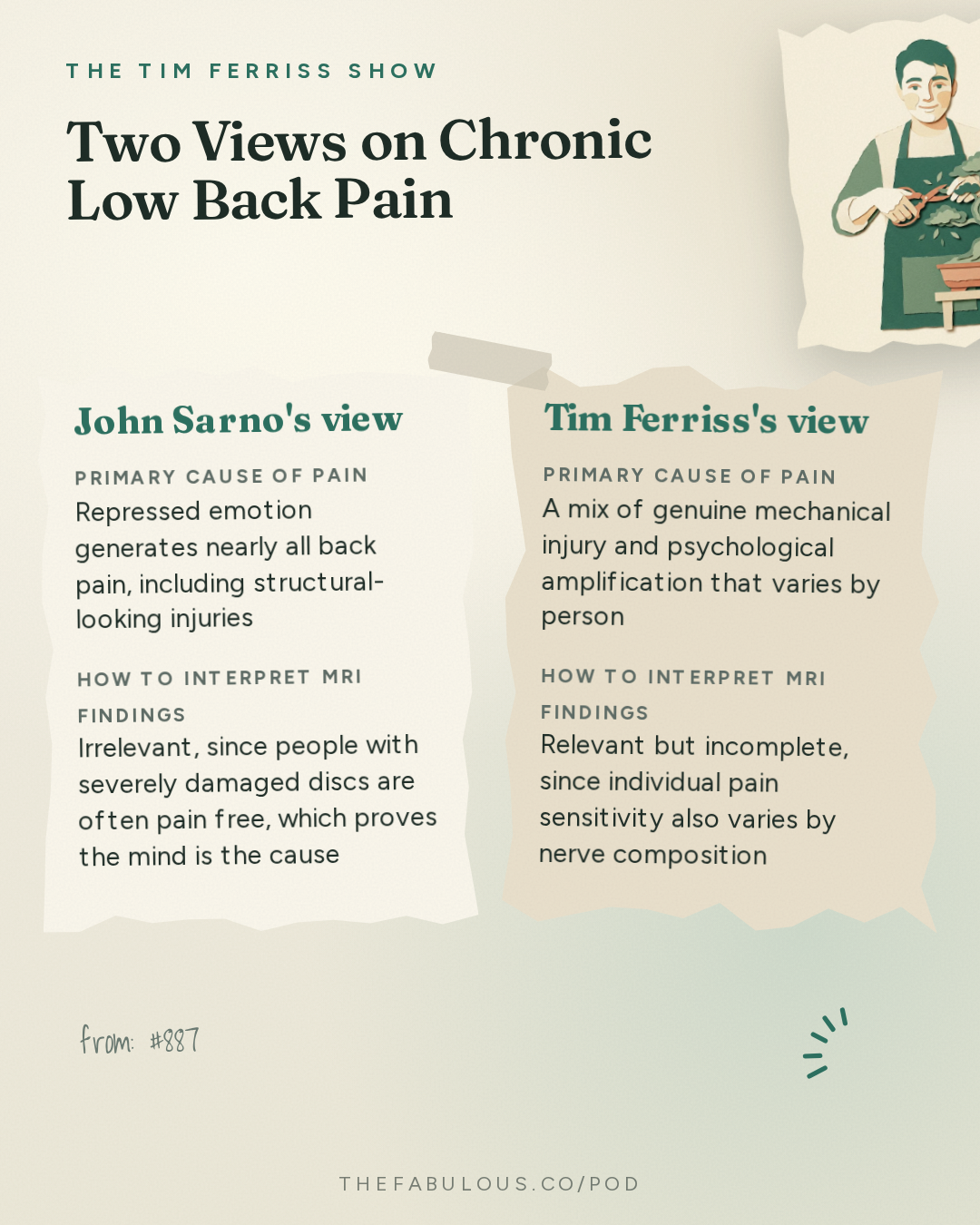
The same appetite for mechanism over dogma shows up in his long answer on Healing Back Pain, physician John Sarno's book arguing that nearly all chronic back pain is psychosomatic, generated by repressed emotion rather than physical damage (58:16). Ferriss has friends who credit the book with ending years of disabling pain, and he does not dismiss it. But he pushes back on the all-or-nothing claim with a blunt thought experiment: if you hit someone's lower spine with a hammer, would that cause real, lasting pain? Of course it would, and Sarno's hardline followers have to concede the point (59:59). He compares specialists treating back pain to blind men each describing a different part of an elephant: the physical therapist feels a muscular problem, the surgeon sees a structural one, the psychotherapist finds an emotional one, and each is partly right about the piece in front of them (61:50). He calls the low back "the Bermuda Triangle of effective diagnoses" (60:31), and notes that individual differences in nociceptors, the nerve endings that detect pain, mean two people with similar scans can feel very different amounts of pain (63:19).
Pressed on whether The 4-Hour Body, his 2010 book on body recomposition, still holds up after 40, Ferriss says almost all of it does. He still runs the slow-carb diet himself, often paired with a 16-hour daily fasting window that he says changed his insulin sensitivity, a measure of how efficiently the body processes blood sugar, within four to six weeks of testing (66:40, 67:10). The one piece he now questions is policosanol, an ingredient in the book's original PAG supplement stack, which he says deserves a fresh look at independent research (68:36). For parents with no time or budget, he points to two bodyweight-based systems, The Happy Body, built by Jerzy and Aniela Gregorek, and gymnastic strength training under coach Chris Sommer, as ways to stay strong without a gym membership (69:19 to 73:35), and he repeats a line from entrepreneur Richard Branson that daily exercise buys three to four extra hours of focused output (71:54). The thread running through a stalled career, a drifting friendship, a stiffening lens, and an aching back is the same small discipline: define the few things that matter, then prove you can act on them, one ordinary day at a time.
Ask this episode anything
Pod's AI answers from the episode itself, with the minute mark so you can hear it yourself.
Or start with one of these
Ask this episode
Pod's AI listens to the whole episode to answer, and points you to the minute it comes from.
The rest of this answer, and any question after it
Answers come from the episode itself, never from a summary of it.
ContinueKey takeaways
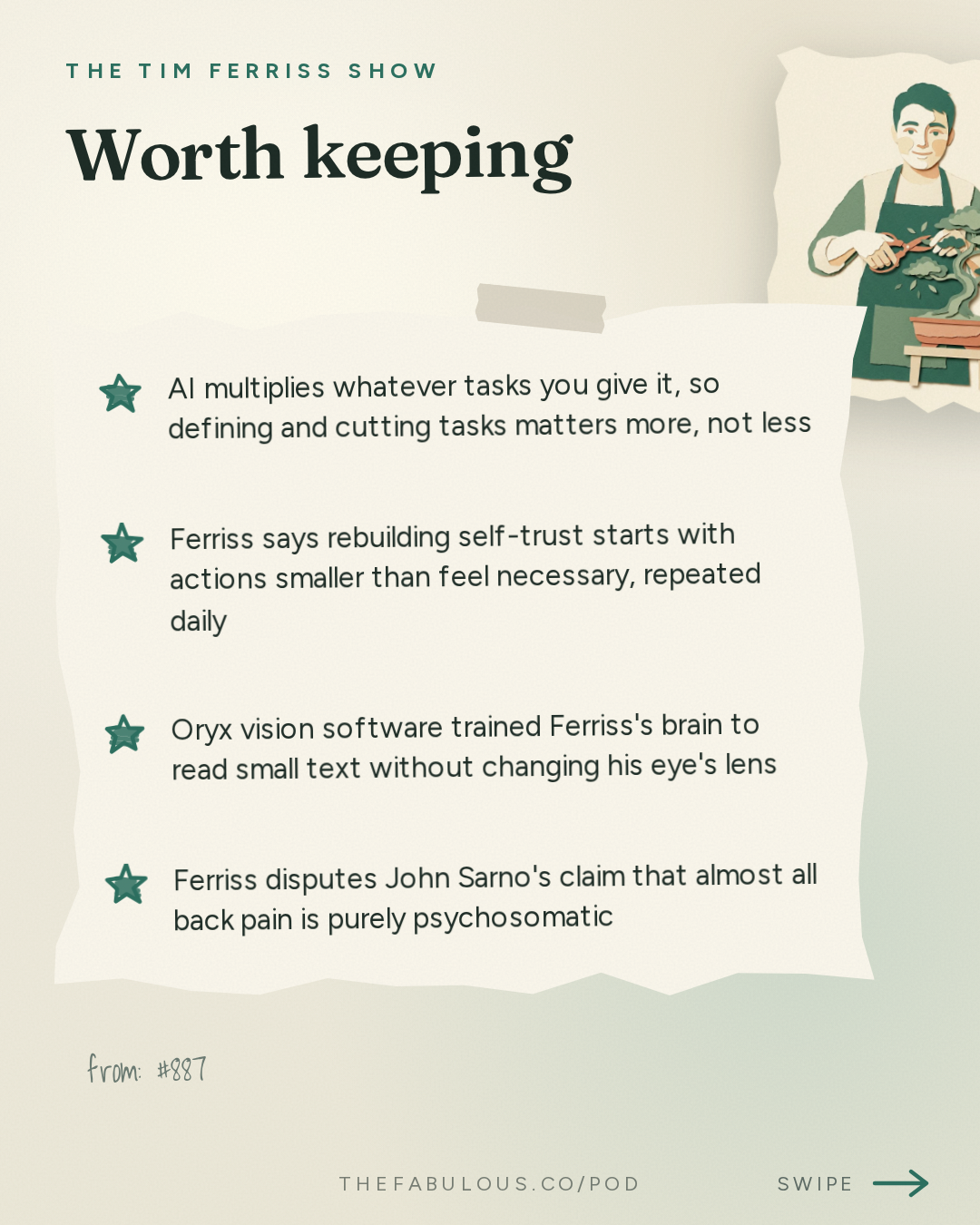
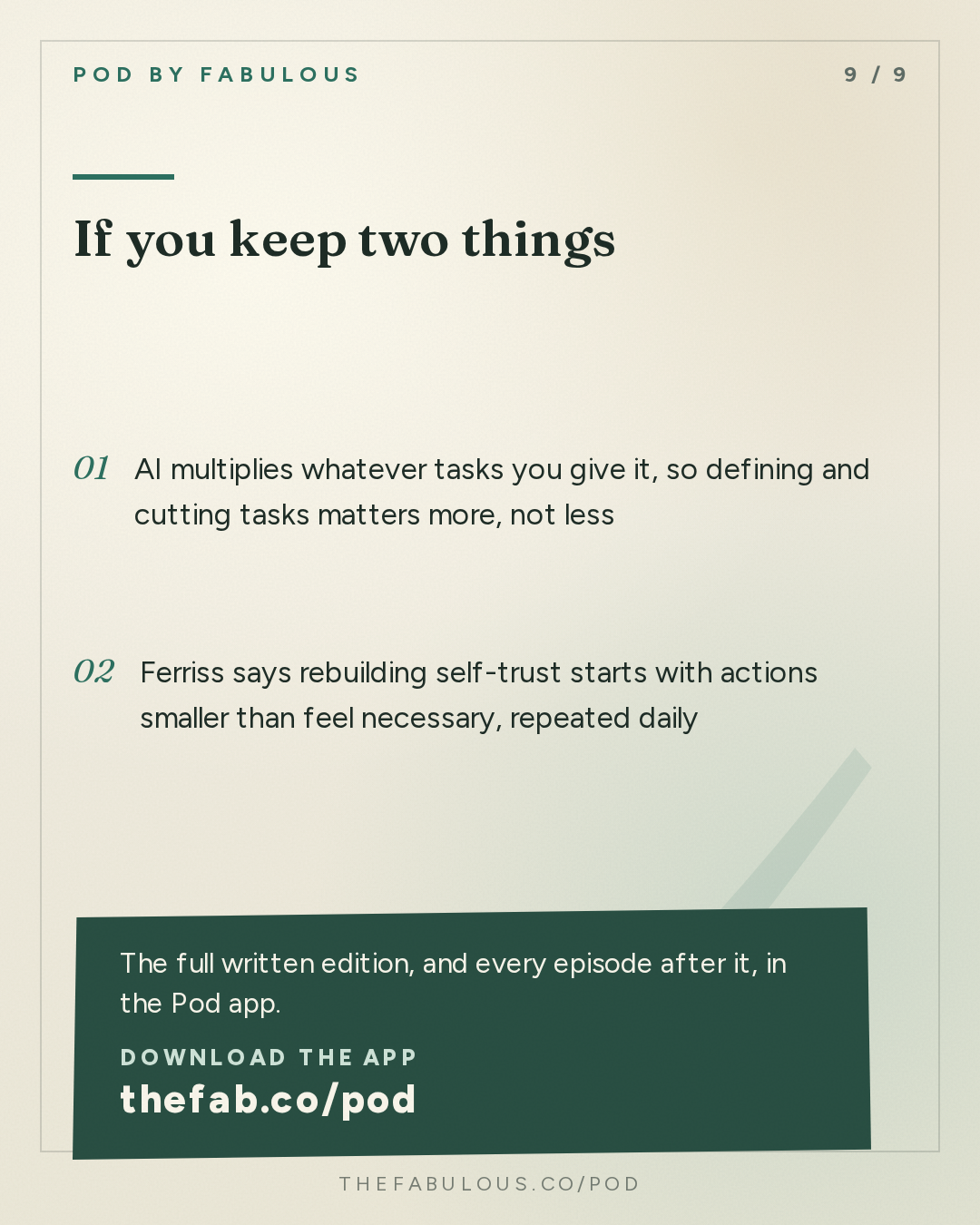
- AI multiplies whatever tasks you give it, so defining and cutting tasks matters more, not less
- Ferriss says rebuilding self-trust starts with actions smaller than feel necessary, repeated daily
- Oryx vision software trained Ferriss's brain to read small text without changing his eye's lens
- Ferriss disputes John Sarno's claim that almost all back pain is purely psychosomatic
- The slow-carb diet and 16-hour fasting still work for body recomposition after 40, Ferriss says
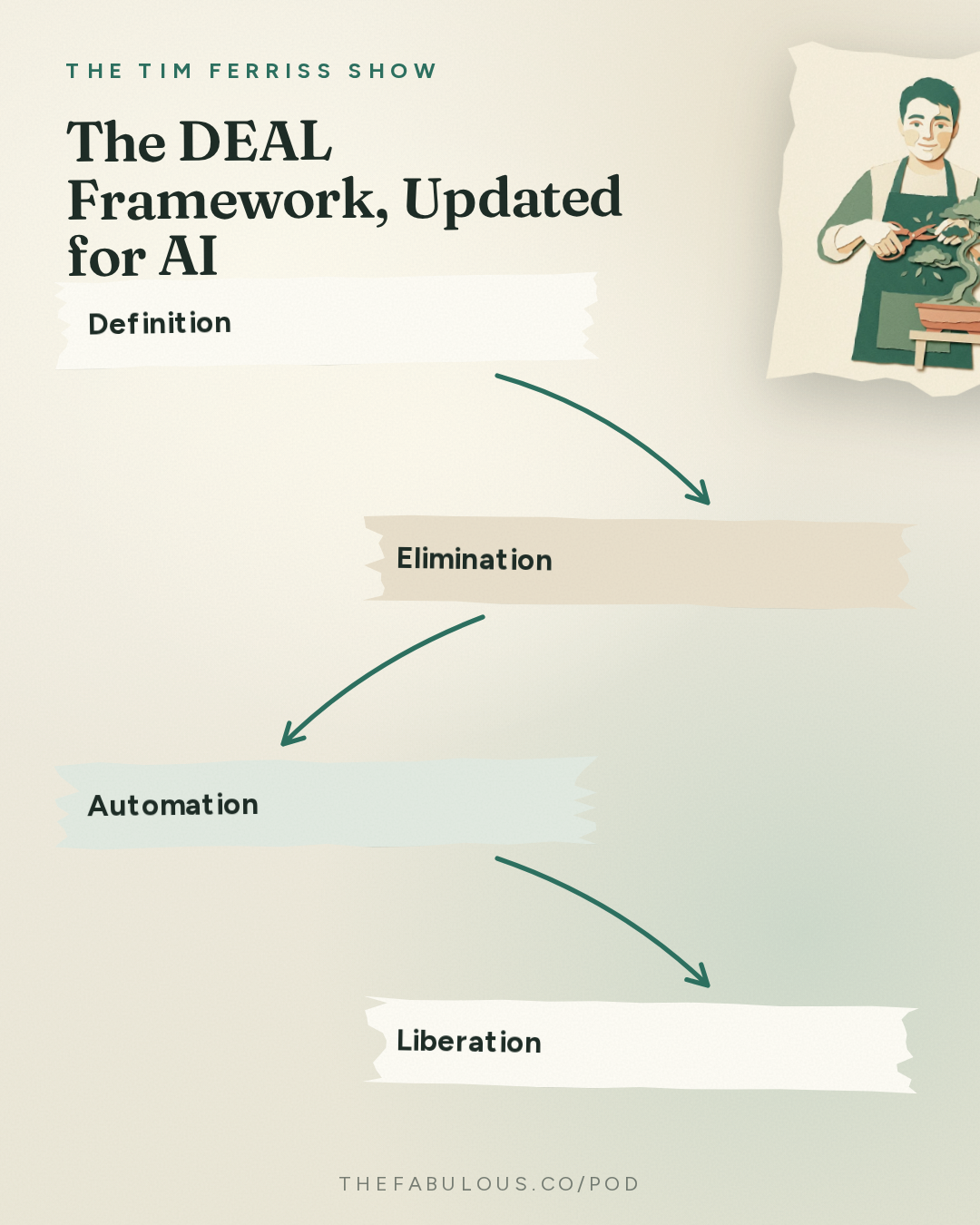
The episode in cards
By the numbers
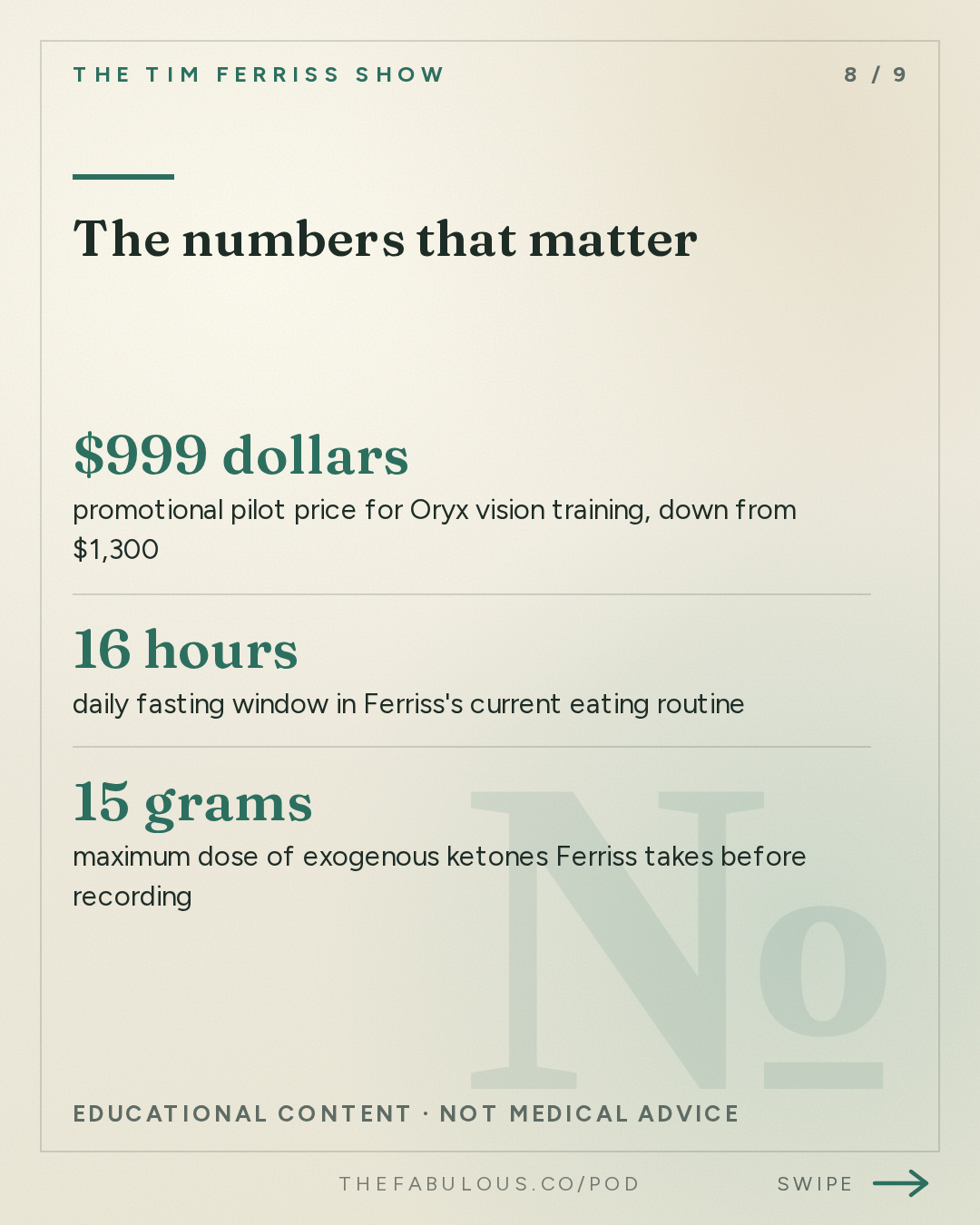
- $999 dollars promotional pilot price for Oryx vision training, down from $1,300
- 16 hours daily fasting window in Ferriss's current eating routine
- 15 grams maximum dose of exogenous ketones Ferriss takes before recording
In their words
“On simply multiplies the useless. It multiplies the unimportant, the trivial, the distracting, and you can end up then trying to automate all of those things”
“What might this look like if it were easy?”
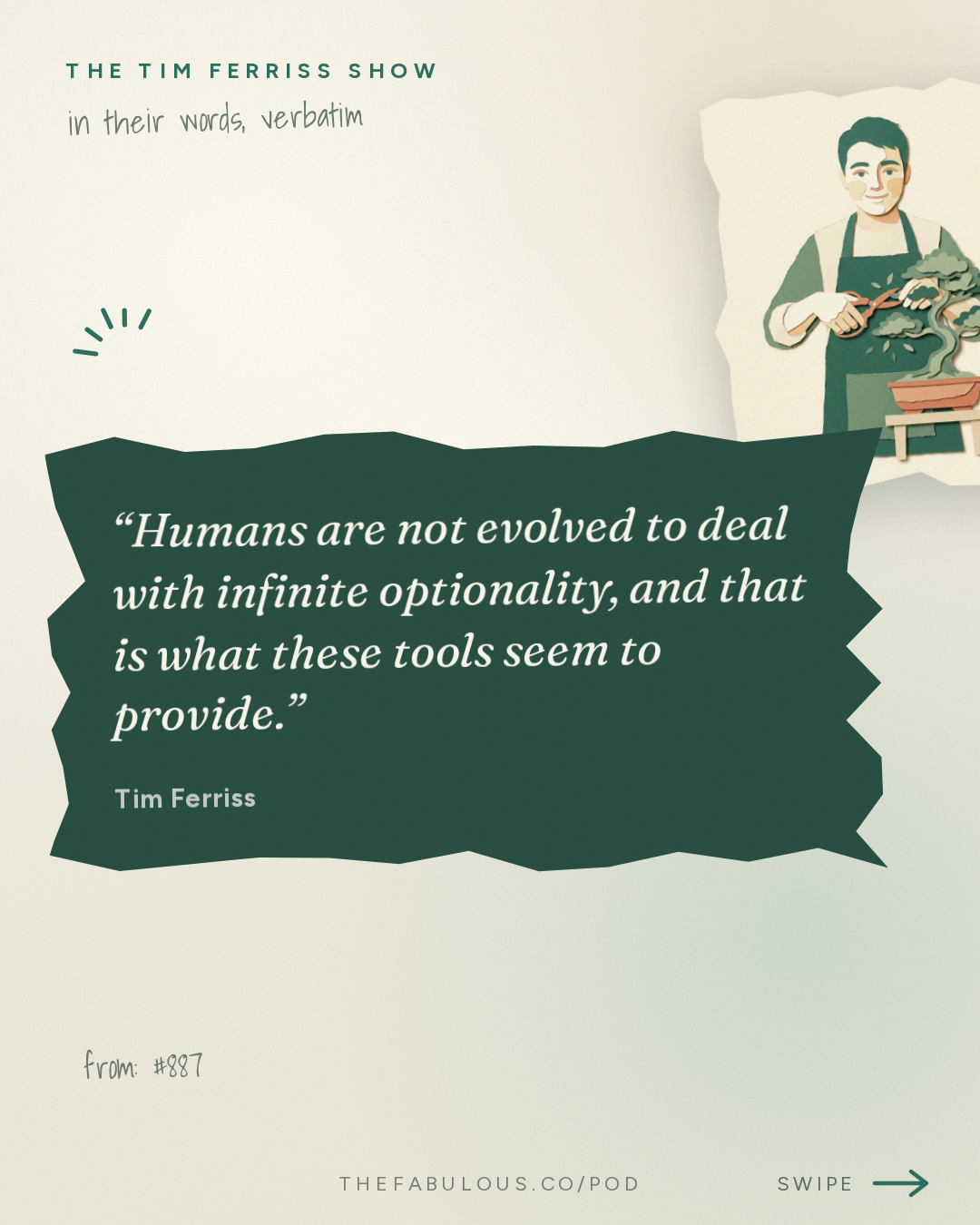
“Humans are not evolved to deal with infinite optionality, and that is what these tools seem to provide.”
“If you are overly deliberate, if you indulge too heavily in the illusion of control, you make yourself blind to things that are around you.”
“The best diet that you follow is a lot better than the perfect diet that you quit.”
Protocols
-
Rebuild Daily Agency With Small Proof Points
Ferriss recommends starting with actions smaller than what feels necessary, such as five push-ups before each meal or ten minutes of meditation before bed, and adding one gratitude phone call a day. He says the size of the action matters less than its consistency, because self-trust cannot be faked and requires daily proof.
Daily, before gradually increasing the size of the action
-
Train Near Vision With Oryx Software
Ferriss used the Oryx vision training software for eight minutes a day over thirty days and went from struggling to read anything at arm's length to reading small menu text in dim light. He cautions that the tool is still in limited pilot release and should not replace a standard eye exam.
8 minutes daily for about 30 days
-
Dial In State Before High-Stakes Recording or Thinking
Ferriss takes up to fifteen grams of exogenous ketones about fifteen minutes before recording and sometimes adds twenty-five milligrams of caffeine from a nootropic toothpick five to ten minutes before sitting down, on top of a meal eaten roughly two hours earlier. He warns against using exogenous ketones constantly, reserving them for occasions that demand sharp output.
Occasional, before high-focus sessions only
-
Compress TMS Treatment With the ONE-D Protocol
Researchers including Ampa Health's Jonathan Downer preload patients with the neuroplasticity drug d-cycloserine before transcranial magnetic stimulation sessions, a treatment that uses magnetic pulses to change brain activity. Ferriss says patients should confirm a provider uses this specific d-cycloserine-assisted protocol, since generic accelerated TMS without the drug does not compress into a single day.
One intensive day, versus three to four months of standard sessions
Questions this episode answers
What does the 4-Hour Workweek look like in the age of AI?
Tim Ferriss says the book's four-step DEAL process, definition, elimination, automation, liberation, still applies, but definition and elimination matter more now because AI is an accelerant that multiplies whatever task it is given (01:44). Without first cutting tasks down to the critical few, Ferriss says AI mostly creates more unimportant work rather than free time (04:16).
What is Oryx and does vision training software actually work?
Oryx is vision training software that Tim Ferriss tested for eight minutes a day over thirty days, after which he could read small menu text in dim restaurant lighting without reading glasses (28:24). He describes it as training the brain's upstream visual processing rather than changing the eye's lens, and became an investor in the company after seeing his own results (29:04). It remains in limited pilot release, so it is not yet an established medical treatment.
Does Tim Ferriss agree with John Sarno that back pain is psychosomatic?
No. Ferriss respects John Sarno's book Healing Back Pain and knows friends it has helped, but disputes the claim that nearly all back pain originates in repressed emotion (58:54). He compares back specialists to blind men describing an elephant, each recognizing only the part their own tool can treat, and calls the low back 'the Bermuda Triangle of effective diagnoses' (60:31).
What is the ONE-D protocol for accelerated TMS?
ONE-D is an accelerated transcranial magnetic stimulation, or TMS, protocol developed by researchers including Ampa Health's Jonathan Downer, which preloads patients with the neuroplasticity drug d-cycloserine before stimulation sessions (46:02). Ferriss says this combination compresses a three to four month standard TMS course into a single day and has been used most for depression, with emerging use for generalized anxiety disorder and OCD.
Does the slow-carb diet from The 4-Hour Body still work after 40?
Ferriss says yes, he still follows it personally, often combined with a 16-hour daily fasting window that he says measurably improved his insulin sensitivity within four to six weeks (66:40, 67:10). The one part of the original book he now questions is the policosanol ingredient in the PAG supplement stack, which he says needs a fresh look at independent research (68:36).
The full read, in cards
Go deeper
- The Effective Executive — Peter Drucker's short, principle-dense guide Ferriss recommends for timeless fundamentals
- Healing Back Pain — John Sarno's book arguing most back pain is psychosomatic, which Ferriss partly disputes
- The Surrender Experiment — Michael Singer's memoir Ferriss read as a deliberate counterweight to over-planning
- The Happy Body — Jerzy and Aniela Gregorek's bodyweight and light-weight daily strength program
- On Grief and Grieving — Elisabeth Kubler-Ross and David Kessler's grief resource Ferriss says has helped friends most
Mentioned
Peter Drucker · The Effective Executive · James Clear · Atomic Habits · BJ Fogg · Peter Thiel · Oryx · Ramit Sethi · The Surrender Experiment · Michael Singer · Ampa Health · Jonathan Downer · John Sarno · Healing Back Pain · The 4-Hour Body · The Happy Body · Jerzy and Aniela Gregorek · Coach Chris Sommer · Richard Branson · Terry Real · Fierce Intimacy · Elisabeth Kubler-Ross · David Kessler · On Grief and Grieving
More from this show and category
How to Simplify Your Life: 5 Expert Tips
Five longtime guests explain how to cut overwhelm: release the identity you've outgrown, question what you only value because you own it, write down every open task before sorting it, and decline requests without an excuse. Oliver Burkeman adds that real simplicity is an attitude, not a new system.
Kevin Ryan on Spotting 10-Year Trends
Kevin Ryan, the New York investor behind DoubleClick, MongoDB, and Business Insider, says he only bets on trends built to last ten years, not passing hype. His firm AlleyCorp co-founds companies with its own $500,000 stakes, starts narrow, and now leans into deep tech like nuclear energy and psychedelic medicine, including a compound called methylone for PTSD.
How Australia Legalized Psychedelic Therapy
Australia became the first country to let doctors prescribe MDMA and psilocybin for PTSD and depression, after a five-year campaign led by two entrepreneurs with no medical background. Tania de Jong and her husband built an advisory panel, trained 750 clinicians, and drove 13,000 public submissions, pushing the regulator to reclassify both drugs in February 2023.
Mentava Reading App: Does the $500 Method Work?
Niels Hoven's startup Mentava teaches two- to five-year-olds to read using phonics and game-style motivation design, and this coaching session with Tim Ferriss becomes a working seminar on pricing, messaging, and finding uncrowded marketing channels (01:29).
