
Mentava Reading App: Does the $500 Method Work?
#882: Why Kids Can Learn 10x Faster Than We Think — Niels Hoven of Mentava (Tim Coaching Session)
The brief
Niels Hoven's startup Mentava teaches two- to five-year-olds to read using phonics and game-style motivation design, and this coaching session with Tim Ferriss becomes a working seminar on pricing, messaging, and finding uncrowded marketing channels (01:29).
Show a three-year-old two pictures, a dog and a fish, arranged left to right, and ask which combination says "dog fish." An older child answers without thinking. A younger one often can't answer at all, not because the child can't read, but because the idea that order matters, that left comes before right, hasn't clicked yet. Niels Hoven, founder of the reading app Mentava, uses exactly this test to sort children before they ever start a phonics lesson, phonics being the method of sounding out letters and blending them into words (33:24). It turns out that knowing individual letter sounds and being able to blend them into a word are two separate developmental skills, and the second one, called directionality, tends to arrive later (33:05). Miss that gate and a child can memorize every letter sound in the alphabet and still not be able to read.
This small test is a useful lens for the whole episode, which is not really a debate about early childhood education so much as a live coaching session in which Tim Ferriss helps Hoven fix Mentava's messaging, pricing, and growth channels in real time. Mentava is an iPad app aimed at getting preschoolers, typically age three to five, to a second-grade reading level, meaning they can independently read books like Green Eggs and Ham (01:29). Hoven's argument is that the hard part of reading was solved long ago. "We know how to teach reading," he says. "You teach kids letter sounds, and then you teach them to blend them together" (08:58). What most software gets wrong, he argues, is not the curriculum but the motivation: getting a small child to want to sit through the repetition that blending requires.
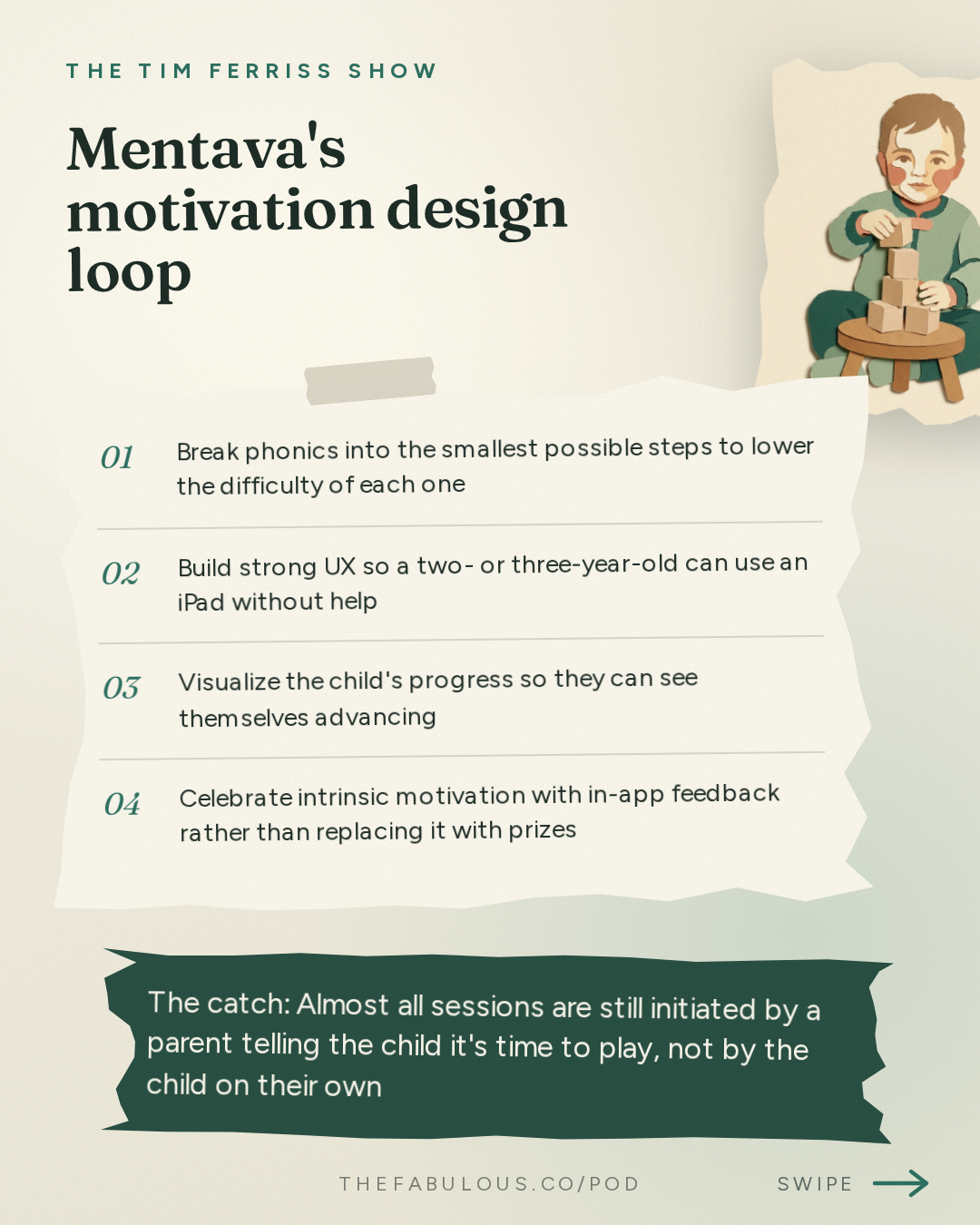
That is where the episode's most interesting mechanism shows up. Hoven describes motivation as a hoop a child has to jump through, with a reward waiting on the other side.
"Human motivation is kind of a solved problem. We know how to get people to do the things that we want them to do" (10:32).
A slot machine, he says, is the crudest version: the reward is enormous (a jackpot) and the hoop is almost nonexistent (press a button). Mentava's design problem is the same shape but harder to solve honestly: lower the size of the hoop, meaning make each phonics step as easy and well-designed as possible, and raise the reward, meaning build in the visual feedback and small celebrations that make a three-year-old want to come back tomorrow, without resorting to the empty dopamine tricks of a casino (10:56). This is also, not coincidentally, the design vocabulary of the mobile games Hoven built before Mentava, including one he says was the highest-grossing mobile game in the world in 2011 (16:22).
The price is not the problem, the guilt is
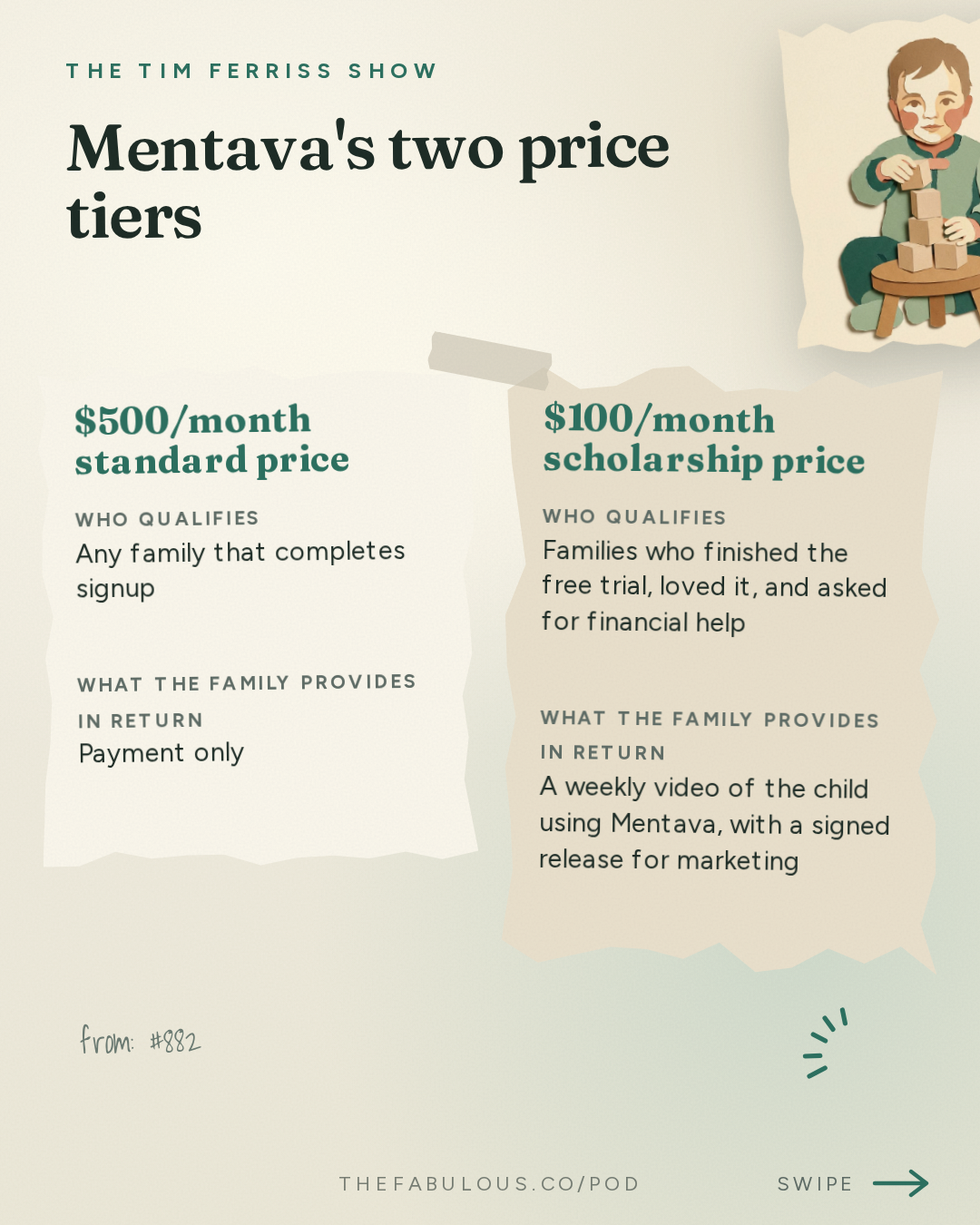
Mentava costs $500 a month per child (35:36), and a chunk of the conversation is about why that number, instead of scaring customers off, sometimes reassures them. Hoven says the company has "had luck leading with the price," because customers have told him a program that expensive couldn't survive years in business if it were a scam (80:28). Ferriss pushes on a related idea: that the real sales resistance isn't the dollar figure, it's the guilt a parent feels either way. Marketing the app as "you don't have to teach your kid" can quietly imply that a good parent should want to teach, while marketing it as "less nagging, less policing" removes a chore nobody romanticizes (51:08). Hoven pushes back gently, noting he doesn't want to overpromise that a kid will never need prompting, since almost all Mentava sessions with young children are still initiated by a parent, not the child (54:41). It's a small but telling moment: even a company built on motivation science is careful not to let its own marketing outrun what the product can honestly deliver.
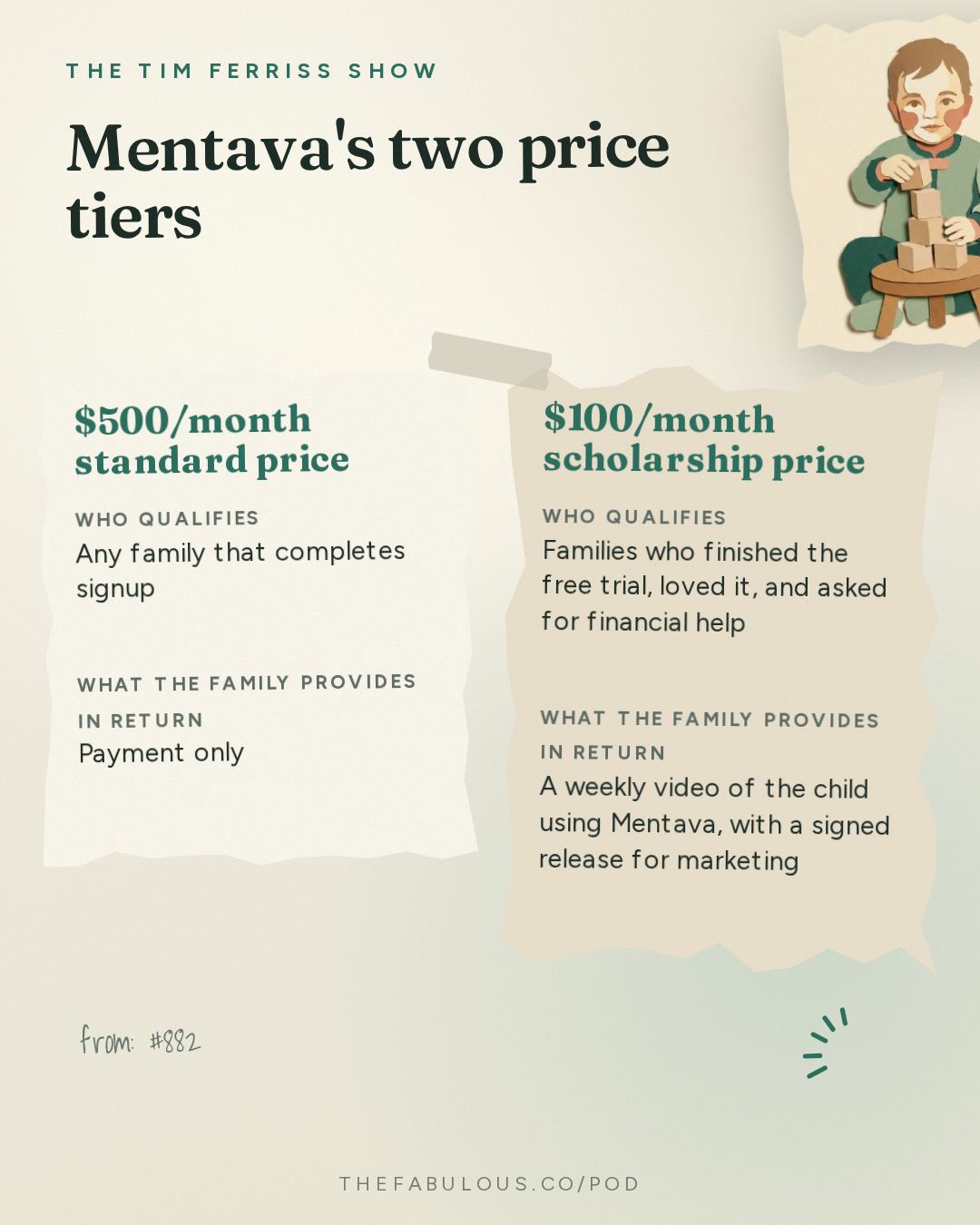
For families who can't afford the full price, Mentava runs an unadvertised $100-a-month scholarship rate, offered to anyone who finishes the free trial, loves it, and asks, in exchange for a weekly video of their child using the app that Mentava can use in marketing (39:00). Ferriss's broader argument here, echoing his own history of running a 110% money-back guarantee at an early business, is that policing a small amount of fraud usually costs more than the fraud itself (37:19). The 14-day free trial serves a second, quieter function: it's also where Mentava screens out children who aren't developmentally ready, a group Hoven estimates includes any child who stumbles on the dog-fish, fish-dog test (32:42).
One experiment did fail cleanly. Mentava tried a classic refer-a-friend incentive, a free month for both the referrer and the friend, worth roughly $1,000 per successful pair, and it produced zero measurable signups even though Hoven knows through customer calls that plenty of people did in fact hear about Mentava from friends (63:19). His theory is that Mentava's customer base is wealthy enough that a $500 credit isn't the thing driving behavior; the real currency at stake is social, since telling a friend about a $500-a-month reading app can read as bragging, and not telling them avoids that risk entirely (63:52). Ferriss's response is not to declare the idea dead but to note it was only tested once, with one structure and one framing, and that reframing the same incentive (a capped, scarce offer to the first 100 referrers, say) might behave completely differently (65:00).
Finding the room before you find the market
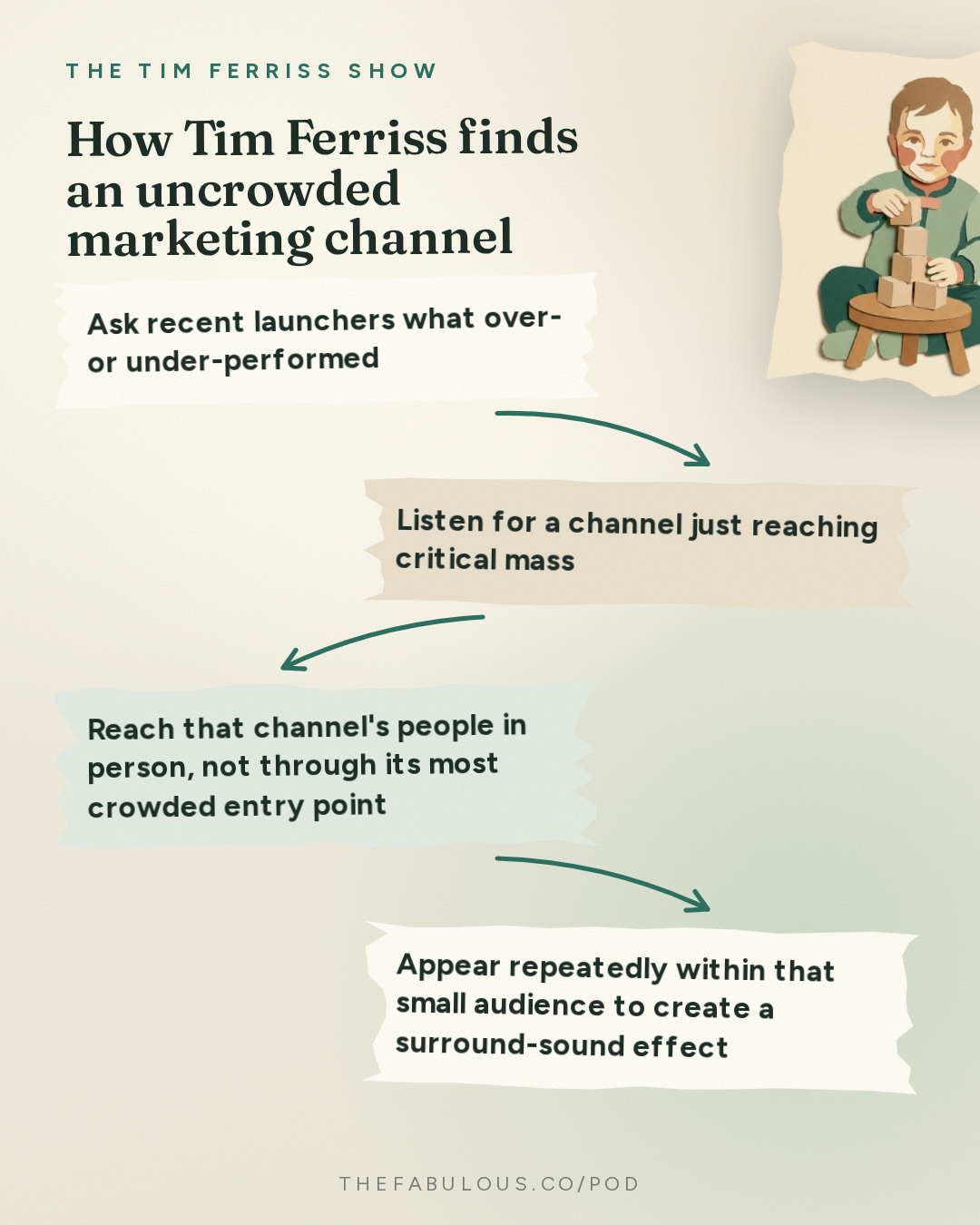
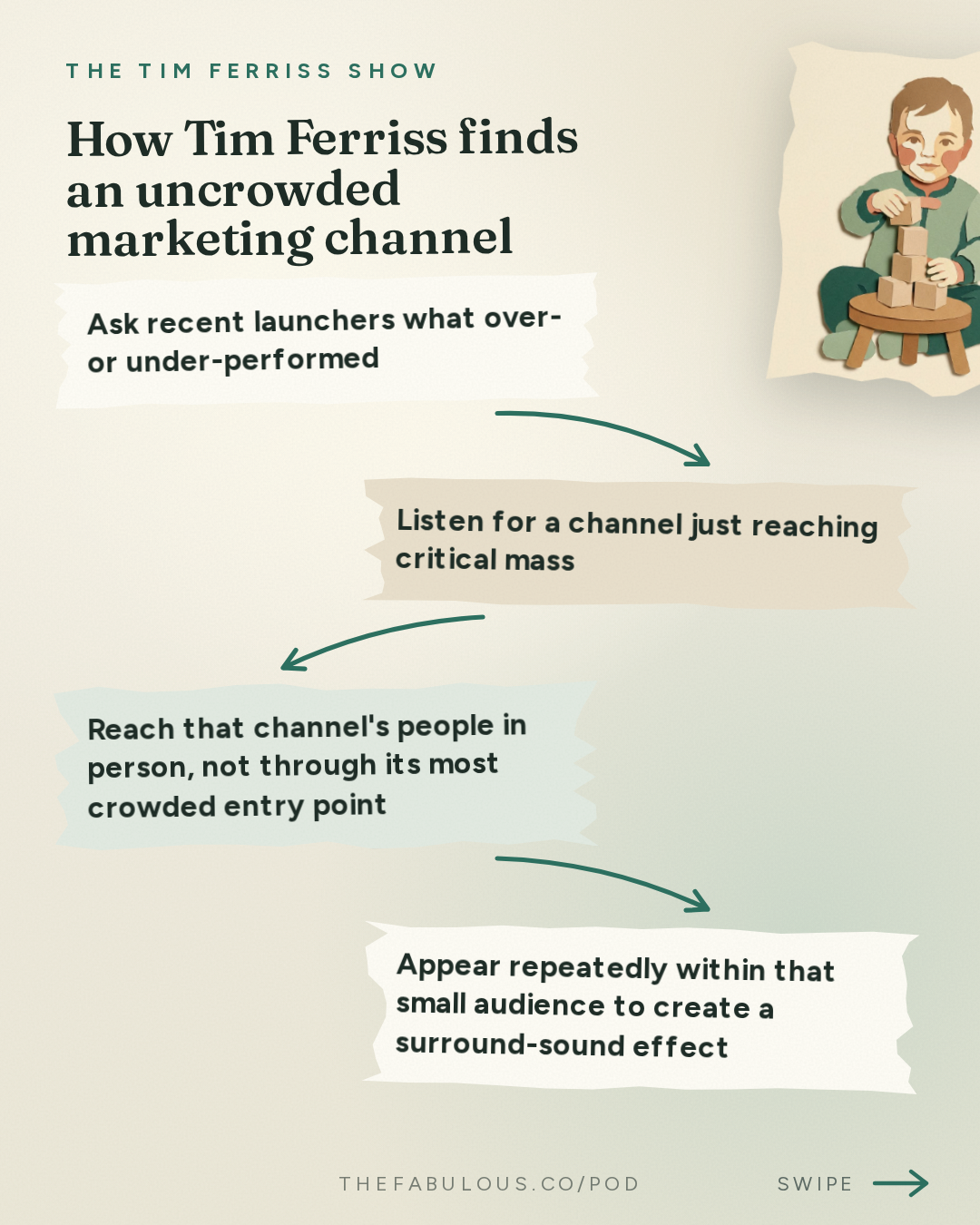
The back half of the conversation turns to distribution, and Ferriss offers a story from his own career as a kind of case study. Before publishing The 4-Hour Workweek in 2007, he asked established authors what had over- or under-delivered in their recent book launches, and kept hearing the same answer: television and radio were losing power, and a strange new format called a blog was outperforming everything (95:55). Rather than pitch bloggers by email, already the most crowded channel available, he flew to a web conference and spent his time in the hallways and lounges meeting them in person (96:41). Five years later, launching The 4-Hour Chef, he ran the same experiment and got a different answer: podcasts, still obscure enough in 2012 that his own appearance on Joe Rogan's show predated Rogan's mainstream fame (97:38). The lesson Ferriss draws out for Hoven is that the goal isn't a big top of funnel, it's finding the smallest, most concentrated group of people who are already sold on the underlying problem, and becoming inescapable to them.
Applied to Mentava, that means thinking past demographic averages and toward specific institutions where the target customer already congregates. Ferriss suggests organizations like TiE, a nonprofit entrepreneur network with roots in Indian and South Asian immigrant communities, on the logic that a population of first-generation immigrant entrepreneurs already prizes education intensely and simply hasn't heard of Mentava yet (113:11). The strategic point isn't really about TiE specifically. It's the general principle Ferriss used when he narrowed The 4-Hour Workweek's early audience down to "20 to 35-year-old tech-savvy males in San Francisco" before ever trying to reach anyone else (93:25).
"The target is not the market. The initial target is the lead domino that you tip over that makes the rest easier" (121:13).
Appearing everywhere within one small, well-chosen room, he argues, creates a feeling of ubiquity that a scattered ad budget across TikTok and Meta never will, and Hoven has already found the closest thing Mentava has to that room organically: arguments on X (formerly Twitter), where Hoven says the company's best paying, best-retained customers come from, because the disputes he gets into over accelerated learning put Mentava's mission in front of people who already agree with it (57:20).
The episode closes on something less tactical. Asked what he wants listeners to take away regardless of whether they ever try Mentava, Hoven doesn't mention pricing or channels at all.
"Never, ever let anybody make you feel guilty for advocating for your kid" (128:45).
It's a fitting last note for a conversation that spent ninety minutes trying to remove exactly that guilt, whether the guilt of paying $500 a month, of not teaching a child yourself, or of pushing a kid to learn faster than their classroom allows.
Ask this episode anything
Pod's AI answers from the episode itself, with the minute mark so you can hear it yourself.
Or start with one of these
Ask this episode
Pod's AI listens to the whole episode to answer, and points you to the minute it comes from.
The rest of this answer, and any question after it
Answers come from the episode itself, never from a summary of it.
ContinueKey takeaways
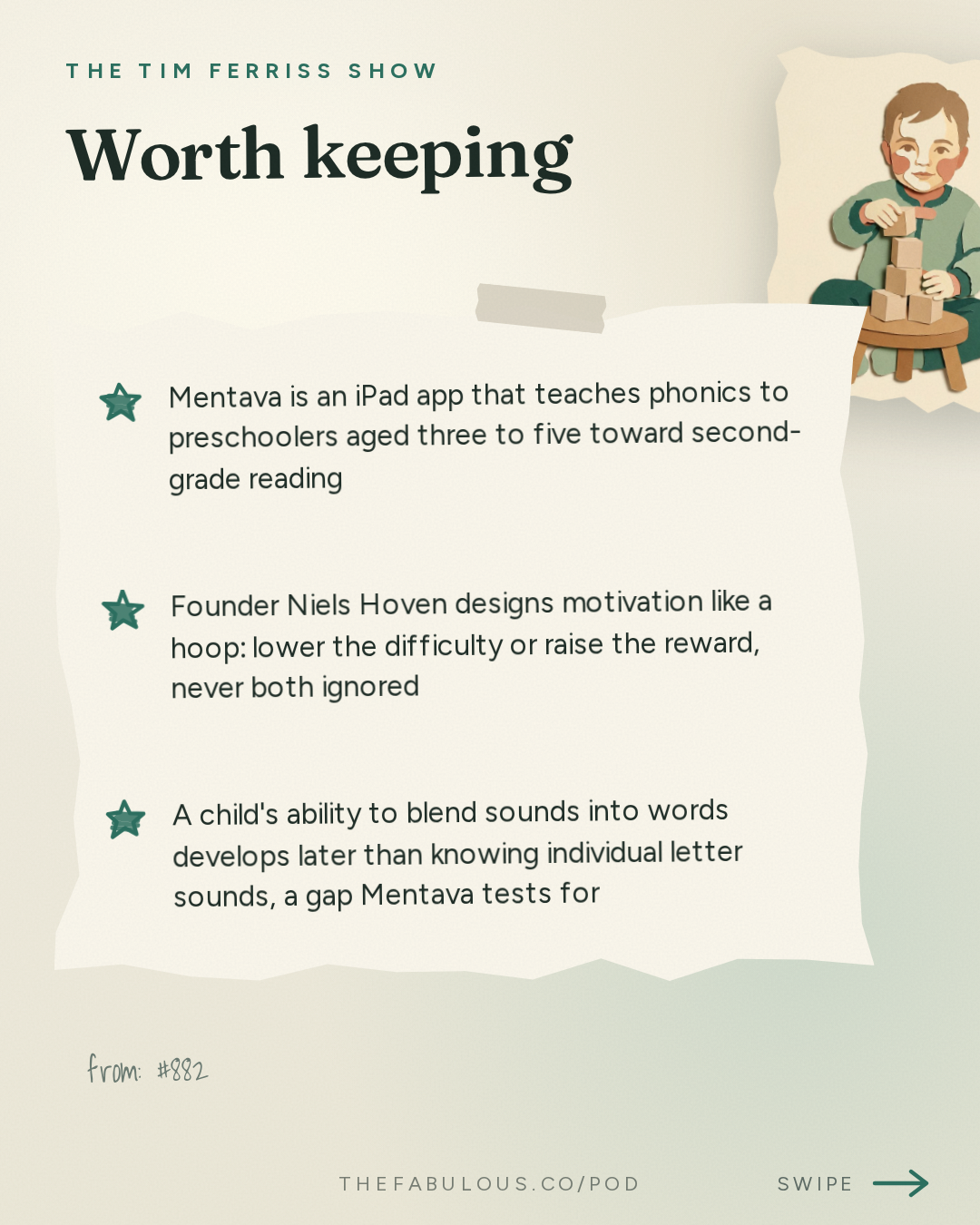
- Mentava is an iPad app that teaches phonics to preschoolers aged three to five toward second-grade reading (01:29)
- Founder Niels Hoven designs motivation like a hoop: lower the difficulty or raise the reward, never both ignored (10:56)
- A child's ability to blend sounds into words develops later than knowing individual letter sounds, a gap Mentava tests for (33:05)
- A $1,000-value refer-a-friend cash incentive produced zero signups because social risk, not money, drives wealthy customers to share (63:19)
- Tim Ferriss argues the best marketing target is a small, concentrated group already sold on the problem, not the largest possible audience (121:13)
The episode in cards
By the numbers
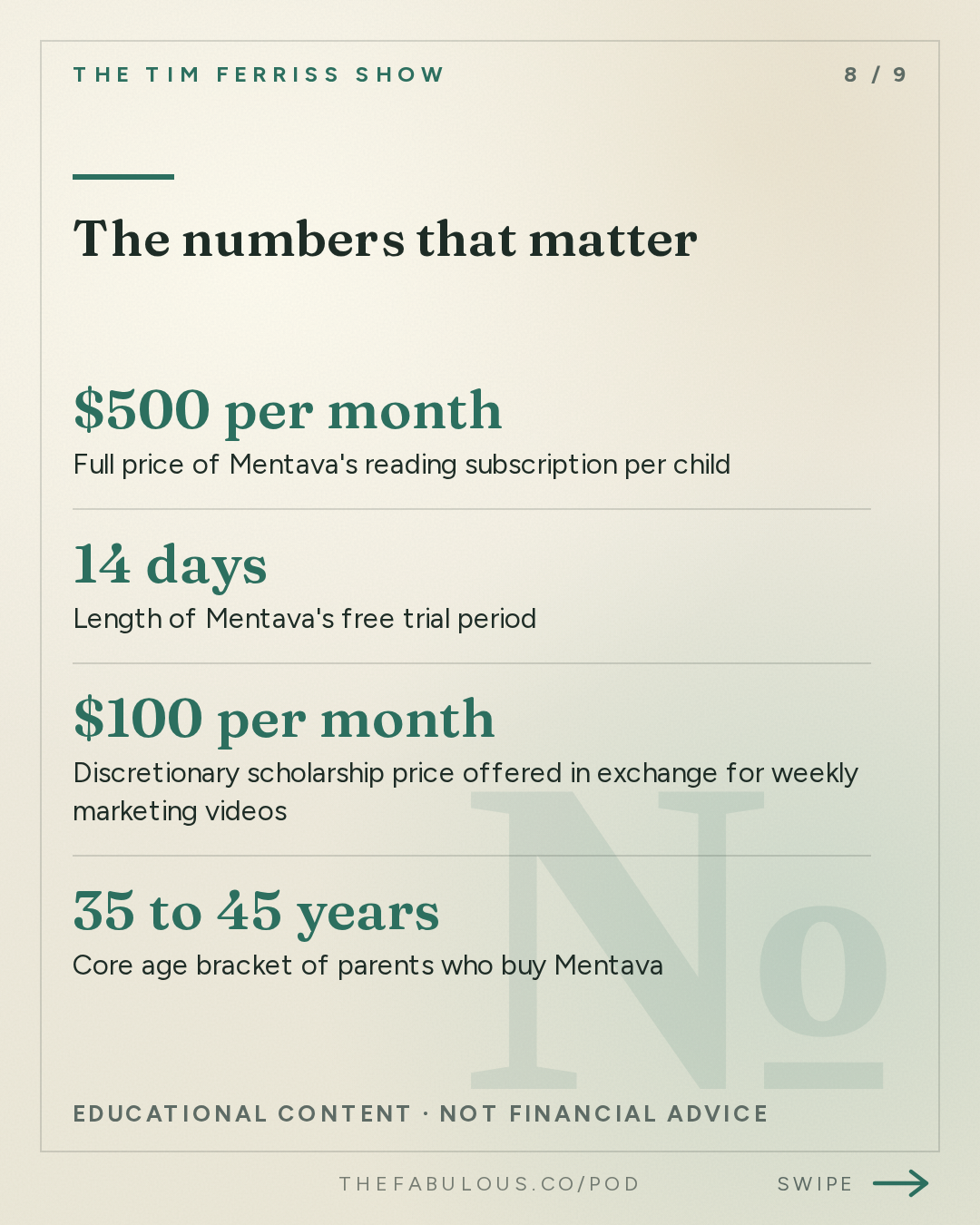
- $500 per month Full price of Mentava's reading subscription per child
- 14 days Length of Mentava's free trial period
- $100 per month Discretionary scholarship price offered in exchange for weekly marketing videos
- 35 to 45 years Core age bracket of parents who buy Mentava
In their words
“Mentava is software that is designed to let kids learn as fast as they're capable of learning- Mm-hmm ... instead of just at the pace assigned to their”
“Human motivation is kind of a solved problem. We know how to get people to do the things that we want them to do”
“The target isn't the market, right? So the initial target is lead domino that you tip over that makes the rest easier”
“Never, ever let anybody make you feel guilty for advocating for your kid.”
Protocols
-
Design motivation by adjusting the hoop, not just the reward
Niels Hoven designs Mentava's lessons by treating motivation as a hoop a child jumps through: he lowers the size of the hoop through simpler, better user-experience design, and raises the reward through visual progress and celebration built into the app, rather than relying on empty extrinsic prizes.
Applied to every lesson and interaction in the app
-
Offer a two-minute readiness quiz as a lead magnet
Tim Ferriss recommends that Mentava place a short, two-minute readiness quiz directly on its homepage instead of hiding developmental screening inside the paid trial, since the quiz can capture an email address, filter out children who aren't ready, and double as shareable content for parents who enjoy the result.
Before a family ever signs up for the paid trial
-
Cap referral incentives instead of leaving them open-ended
Tim Ferriss advises capping any referral incentive test, for example by limiting a free-month offer to the first 100 people who refer a friend, so the company knows its maximum downside cost in advance instead of running an open-ended promotion.
Applied whenever testing a new incentive structure
-
Test messaging in live conversation before scaling it in ads
Tim Ferriss suggests floating a candidate tagline or pitch in casual, in-person conversation, then watching whether the other person asks an unprompted follow-up question, because that reaction is a stronger signal of real interest than a survey answer or an ad click.
During customer calls, networking events, or conference talks
Questions this episode answers
What is Mentava and how does it teach kids to read?
Mentava is an iPad app built by founder Niels Hoven that teaches preschoolers, typically ages three to five, phonics, meaning letter sounds and blending, with the goal of reaching a second-grade reading level (01:29). It layers game-style motivation design on top of that curriculum so children want to keep practicing without a parent acting as teacher (08:34).
How much does Mentava cost?
The standard subscription is $500 a month per child (35:36). Mentava also offers an unadvertised $100-a-month scholarship rate to families who complete the 14-day free trial, love the product, and ask for help affording it, in exchange for a weekly video of the child using the app for marketing purposes (39:00).
Is phonics or whole-language reading instruction better supported by evidence?
Niels Hoven states that cognitive science and researchers outside education broadly treat phonics, sounding out letters and blending them into words, as the established method, while some teacher training has instead taught children to guess words from context or pictures, an approach he calls reading for "the gist" rather than decoding (59:50). This is Hoven's characterization of a decades-long debate in education, not an independent study cited in the episode.
At what age can a child realistically start learning to read?
Hoven says children often learn individual letter sounds by around a year and a half, but the separate skill of blending sounds into words, along with grasping left-to-right reading order, develops later, which is why Mentava screens for that milestone with a simple test before starting reading practice (33:05).
Why did Mentava's refer-a-friend incentive fail to generate signups?
Mentava offered a free month to both the referrer and their friend, worth about $1,000 per pair, and got zero measurable referrals even though many customers said they'd heard about the app from friends (63:19). Hoven's explanation is that wealthy target customers aren't motivated by a $500 credit, and sharing the app can carry social risk that the incentive doesn't offset.
The full read, in cards
Go deeper
- The Lean Startup — Author Eric Ries, an early Mentava investor, championed rapid customer testing, an approach mirrored in Mentava's iterative design and free-trial screening
- Waiting for Superman — Documentary Niels Hoven cites as a portrait of dysfunction in the public education system
Mentioned
Niels Hoven · Mentava · Eric Ries · The Lean Startup · Cloudflare · ClassDojo · Pocket Gems · Lenny Rachitsky · Alpha School · TiE · Claude · Jake Becraft · Strand Therapeutics
More from this show and category
4-Hour Workweek Meets AI: Tim Ferriss Q&A
Tim Ferriss says AI multiplies whatever work you feed it, so without defining and eliminating tasks first, it manufactures busywork instead of leisure (04:16). The episode also covers rebuilding self-trust through small daily actions, Oryx software for near vision, a critique of John Sarno's psychosomatic back pain theory, and why the slow-carb diet and 16-hour fasting still work after 40.
How to Simplify Your Life: 5 Expert Tips
Five longtime guests explain how to cut overwhelm: release the identity you've outgrown, question what you only value because you own it, write down every open task before sorting it, and decline requests without an excuse. Oliver Burkeman adds that real simplicity is an attitude, not a new system.
Kevin Ryan on Spotting 10-Year Trends
Kevin Ryan, the New York investor behind DoubleClick, MongoDB, and Business Insider, says he only bets on trends built to last ten years, not passing hype. His firm AlleyCorp co-founds companies with its own $500,000 stakes, starts narrow, and now leans into deep tech like nuclear energy and psychedelic medicine, including a compound called methylone for PTSD.
How Australia Legalized Psychedelic Therapy
Australia became the first country to let doctors prescribe MDMA and psilocybin for PTSD and depression, after a five-year campaign led by two entrepreneurs with no medical background. Tania de Jong and her husband built an advisory panel, trained 750 clinicians, and drove 13,000 public submissions, pushing the regulator to reclassify both drugs in February 2023.
