
How Sweet Loren's Cookie Dough Was Built
Sweet Loren’s: Loren Castle. How A Recipe Makeover Built a National Cookie Brand
The brief
Loren Castle grew Sweet Loren's cookie dough into a 30,000-plus-store brand by scaling slowly for a decade. Then she rebuilt the entire line around an allergen-free recipe that became the company's top-selling product within six months of its 2017 launch, after customer emails revealed how many shoppers had dietary restrictions.
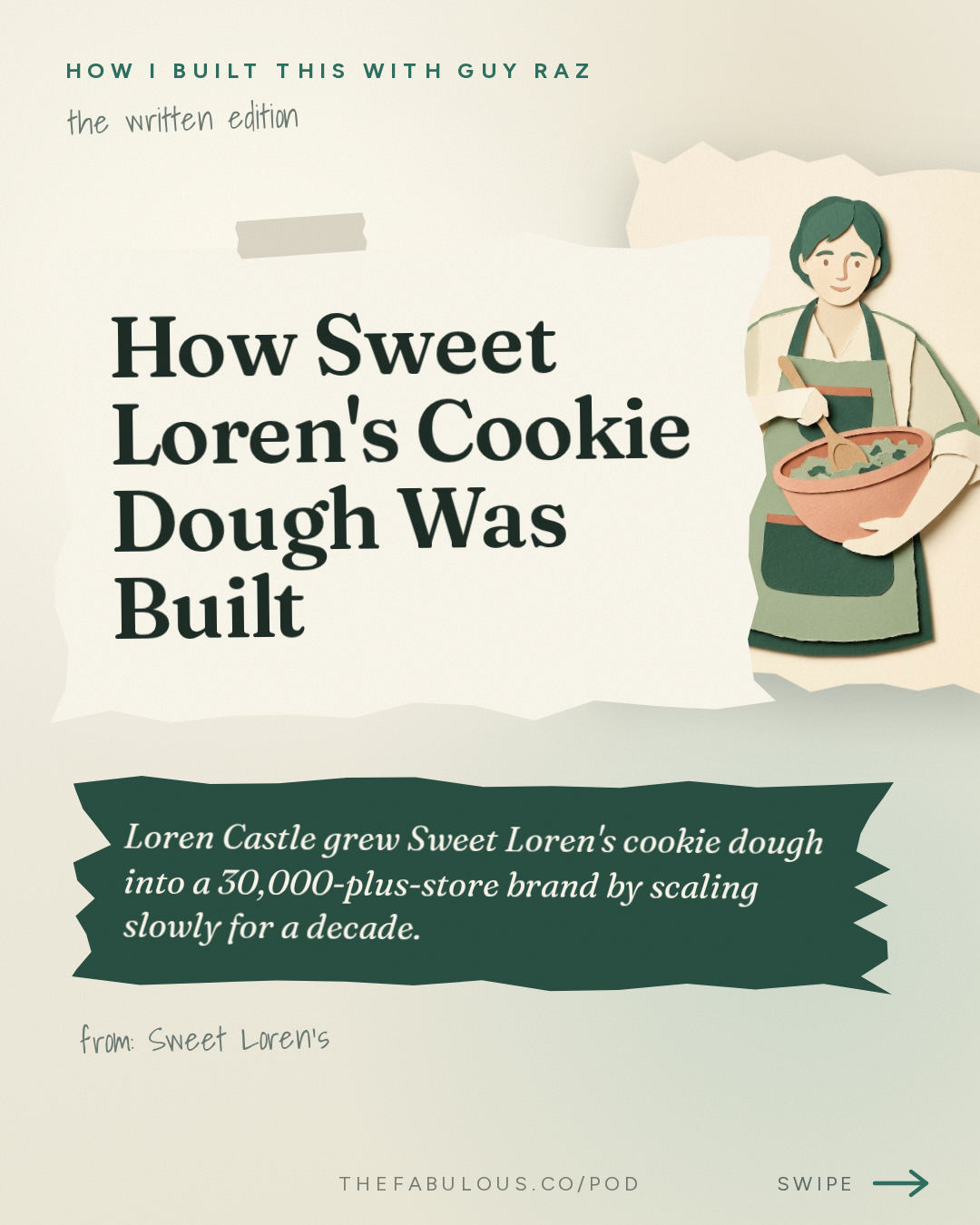
By year five, Loren Castle's cookie company was doing about $350,000 a year in sales (45:34). She was already selling in hundreds of stores across the Northeast, on the Today Show, and through her own website. And yet the number was so small that when she told Guy Raz about it years later, he assumed she'd say seven or eight million. That gap between visibility and revenue is the real subject of this episode. Sweet Loren's did not become a 30,000-store cookie dough brand (04:07) by moving fast. It became one by staying small on purpose, for a long time, until the market and the product finally matched.
Castle grew up in New York City, the daughter of an entrepreneur and a law partner at Jacoby & Meyers. At fourteen, her mother was diagnosed with a form of leukemia (05:44), a diagnosis that would stretch into a decade-long battle. At twenty-two, with a one-way ticket to Los Angeles already purchased, Castle found a swollen lymph node in her own neck. A doctor told her she had stage two Hodgkin's lymphoma (08:14), a cancer of the lymphatic system, and that treatment needed to start immediately so it would not progress to a harder-to-treat stage. The plane ticket got canceled. Chemotherapy started within days.
It was during recovery that Castle discovered baking as a kind of therapy. She took a sales job at Levain, the famous Manhattan bakery, and noticed something that would shape the rest of her career: out of breads, muffins, and brioche, cookies were the single best-selling and most profitable item in the store (12:56). She also started obsessing over healthier ingredients, swapping bleached flour for whole grains and experimenting with monk fruit and cane sugar late at night in her apartment, long before clean-label baking was a trend.
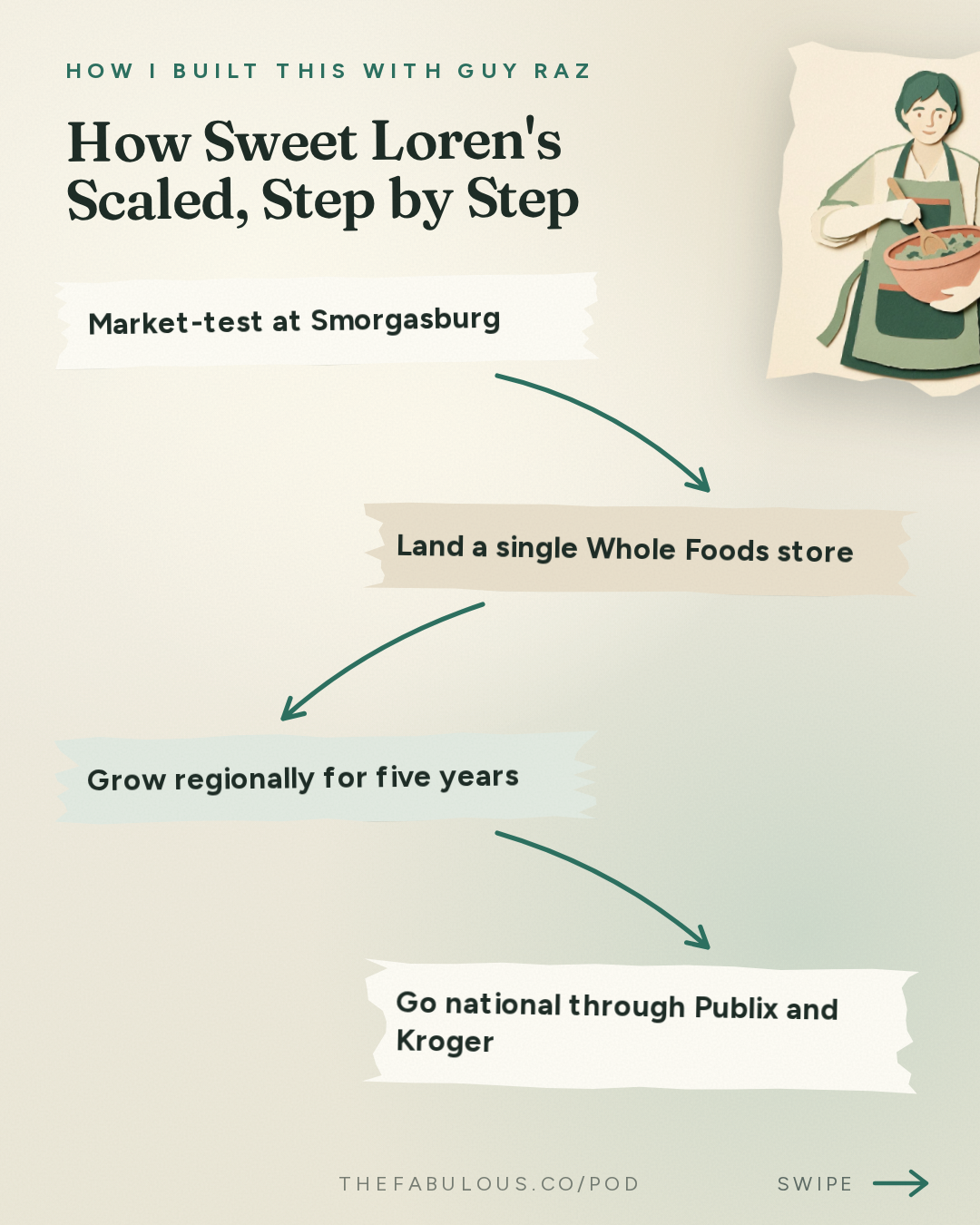
That obsession turned into a stall at Smorgasburg, the Brooklyn food market, where she sold cookies under the name Sweet Loren's (15:40). Customers kept asking for something specific: could they just buy the raw dough, so they could bake it warm at home whenever they wanted? That question became the business. A classmate from a two-year business program at Columbia Business School worked the overnight shift at a Whole Foods and got Castle an unplanned meeting with the store's grocery buyer (22:32). She showed up with freshly baked cookies, not the raw dough she'd eventually sell, and the buyer's team loved it so much he called the next day asking how soon they could get it as dough.
Castle's mother died shortly after that verbal yes from Whole Foods, before the product ever hit a shelf (25:06). Castle has said that building the company became a way to process grief she didn't have room to feel otherwise. The timing also set a pattern that would define the brand for years: good news and hard news arriving at the same moment, and Castle choosing to work through both at once.
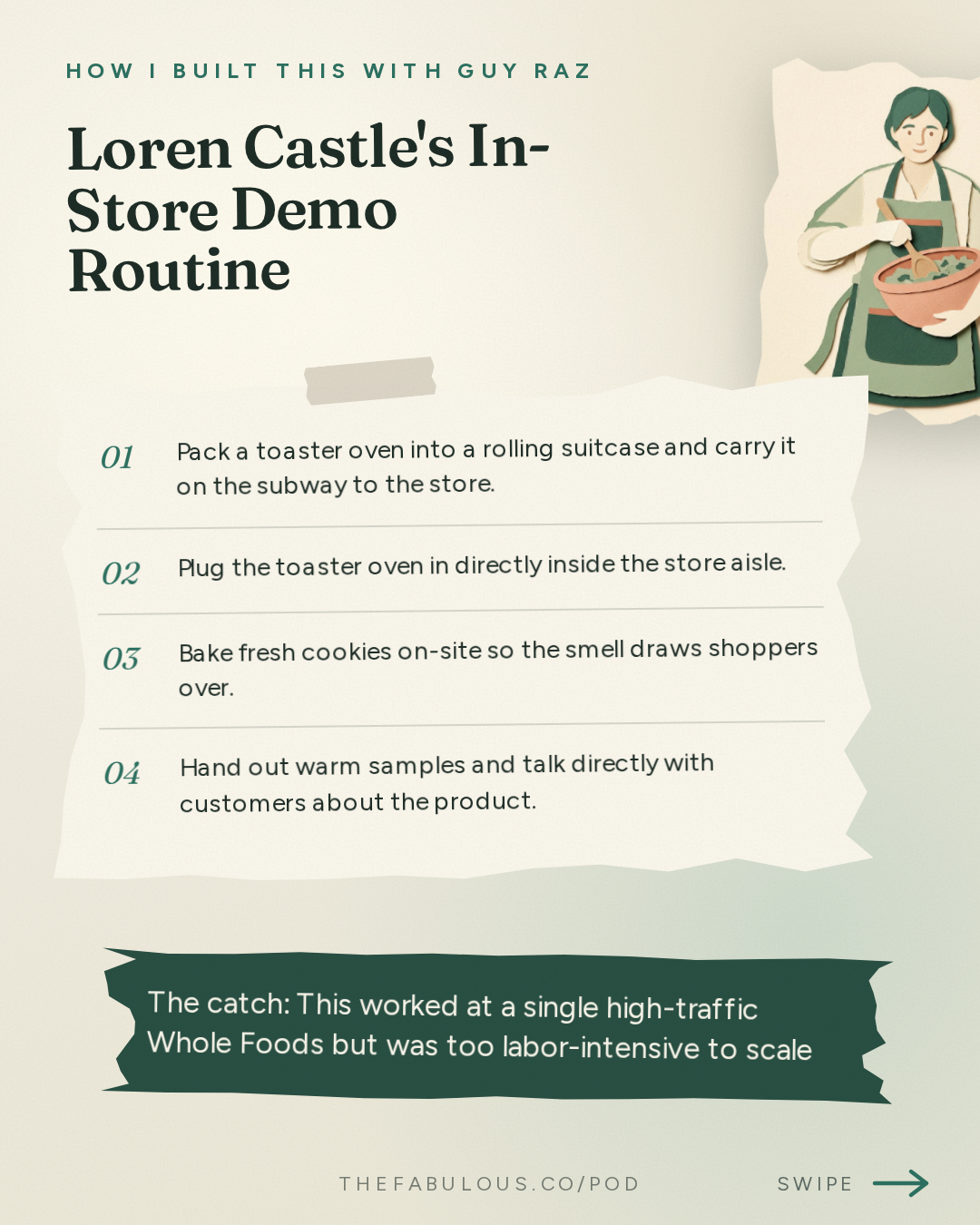
"I would bring a rolling suitcase with a toaster oven in it on the subway to the Whole Foods, plug it into the aisle, and stand in that aisle for three to four hours." — Loren Castle [33:20]
That toaster oven became her whole marketing budget. A single Whole Foods location at Columbus Circle, one of the busiest in the country, ordered just eight units a week to start (28:15). Castle found a tiny upstate New York factory willing to make small batches, since most large manufacturers required a minimum run of 10,000 pounds (29:28), a quantity she couldn't afford to risk on an unproven product. She put her own photo and a short version of her cancer story on the package from the beginning, worried at first that it was too heavy a thing to put next to a cookie, until she watched it make customers trust the brand instead.
Small On Purpose
Castle raised about $1 million from friends and family (37:47) and stretched it as far as she could. She paid herself $85,000 a year, raised her studio apartment bed three feet to store bulk ingredients underneath it, and refused to spend on a fancy office or marketing events. From her first Whole Foods meeting in 2011 to her national breakthrough in 2016, growth stayed almost entirely regional. Other venture-backed direct-to-consumer brands from that same era, Warby Parker, TOMS, Harry's, were raising large rounds and scaling fast. Some of Castle's peers in food tried the same thing and don't exist anymore.
"By year five we were probably 350,000 a year in sales." — Loren Castle [45:34]
The turning point came through a cold email. The refrigerated cookie dough category, dominated for decades by Nestle Toll House and Pillsbury, had been flat or declining for years, and a Publix buyer wanted something to reverse that. Publix alone represented more than 1,200 stores (48:39). Soon after, a food broker's neighbor, who worked at Kroger, tasted Sweet Loren's and arranged a meeting with the largest grocery chain in the country. Castle hired a COO to manage factory logistics and raised a bit more from friends and family and an angel investor to handle the jump. In 2016, Sweet Loren's went from roughly 300 regional stores to thousands overnight. The company repainted its packaging magenta specifically to stand out against the red and blue of its competitors on shelf (51:16), since there was no budget left for national in-store sampling.
The Pivot Nobody Asked For, Then Everyone Did
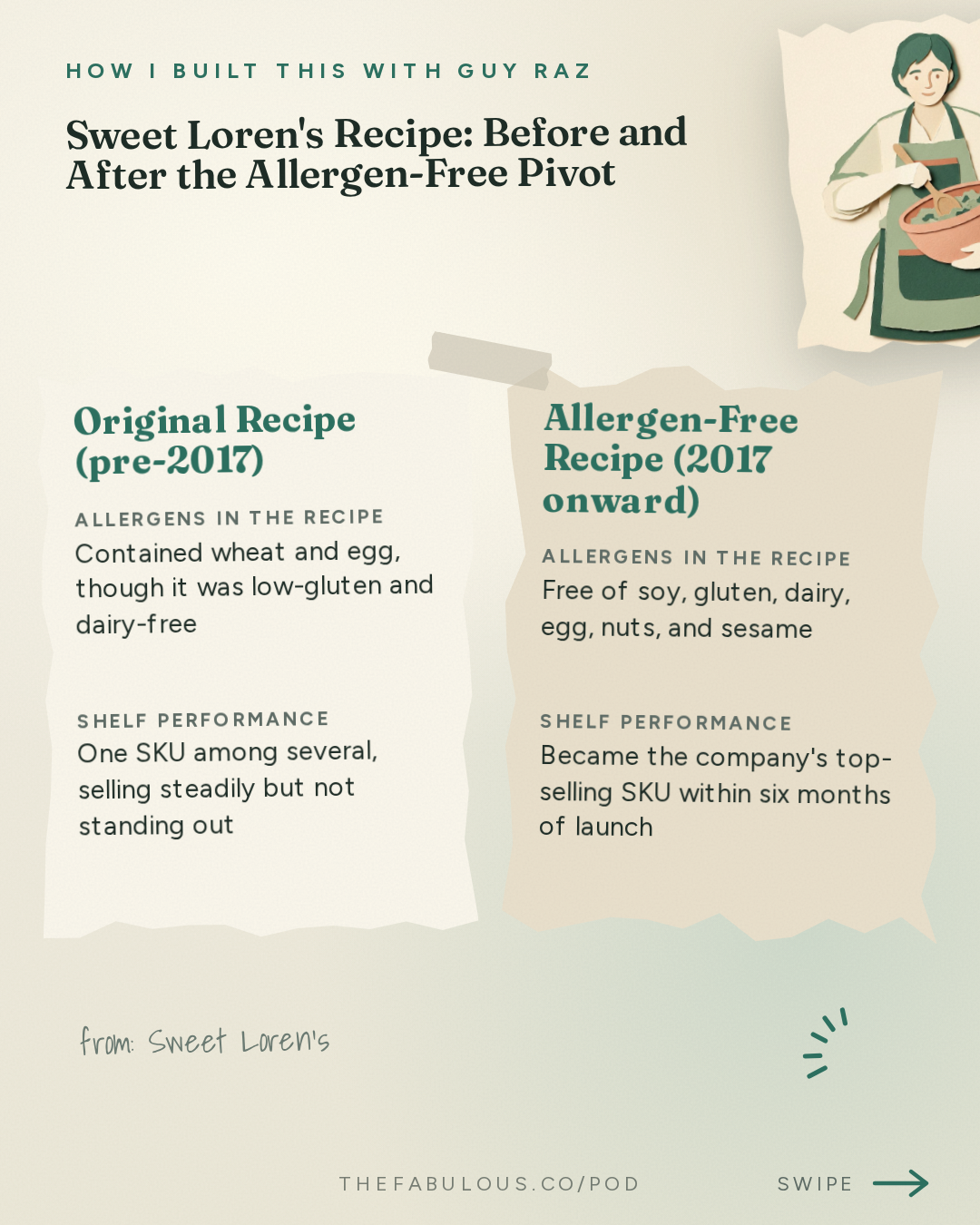
Once Sweet Loren's reached nearly every state through Publix and Kroger, something unexpected happened. Hundreds of unsolicited messages came in, not through formal research but through Facebook and email, from customers whose kids had nut allergies or whose partners were gluten-free (53:51). Castle pulled the only hard number she had: roughly 20 percent of Americans have some dietary restriction or food allergy (54:59), far more than the roughly 1 percent who are celiac. That gap between a tiny diagnosed population and a much larger group of people simply avoiding certain ingredients convinced her there was real, unmet demand.
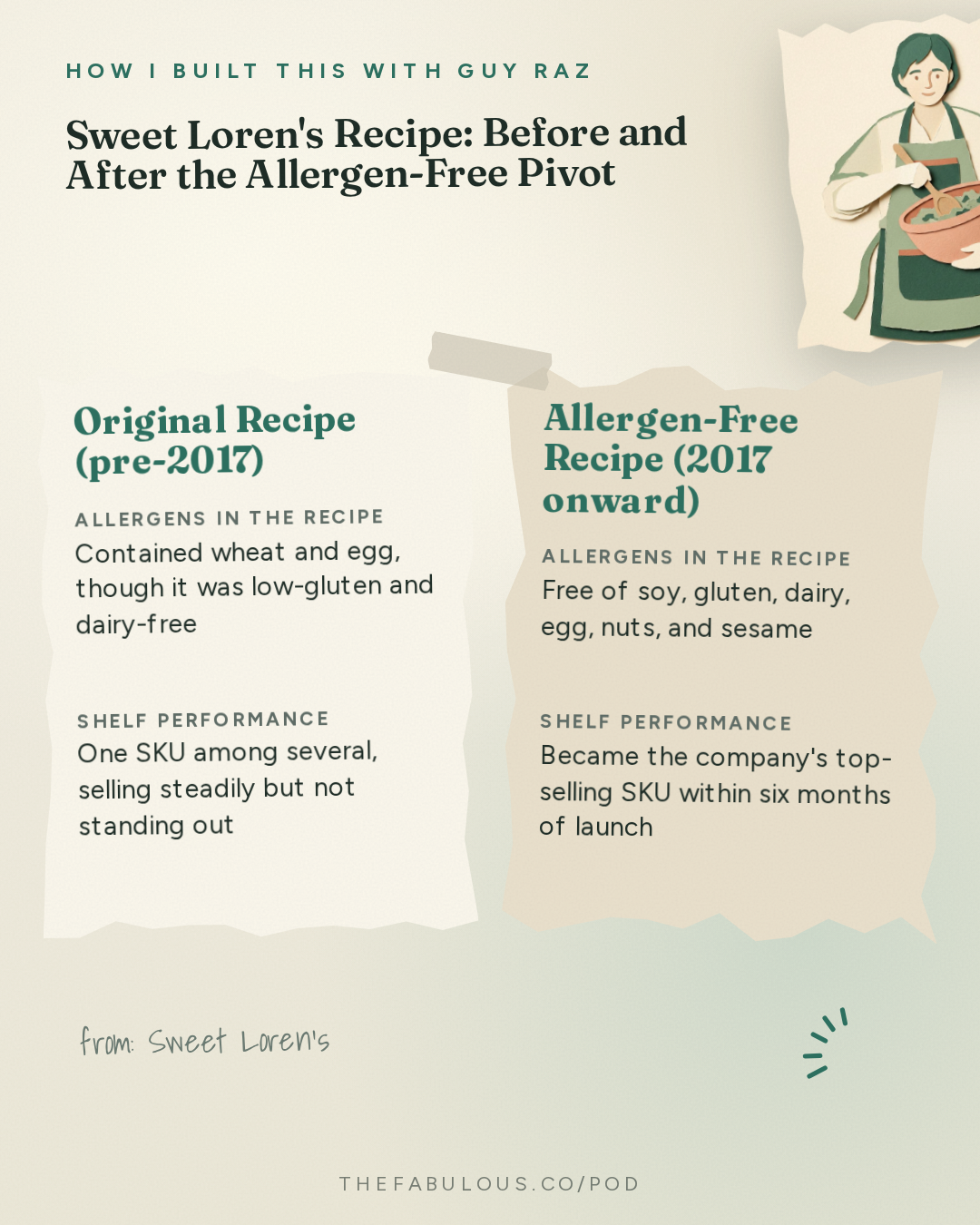
She spent four months rebuilding the recipe from scratch to remove the major allergens: soy, gluten, dairy, eggs, nuts, and sesame (56:10). Early attempts to bring in professional food scientists didn't work.
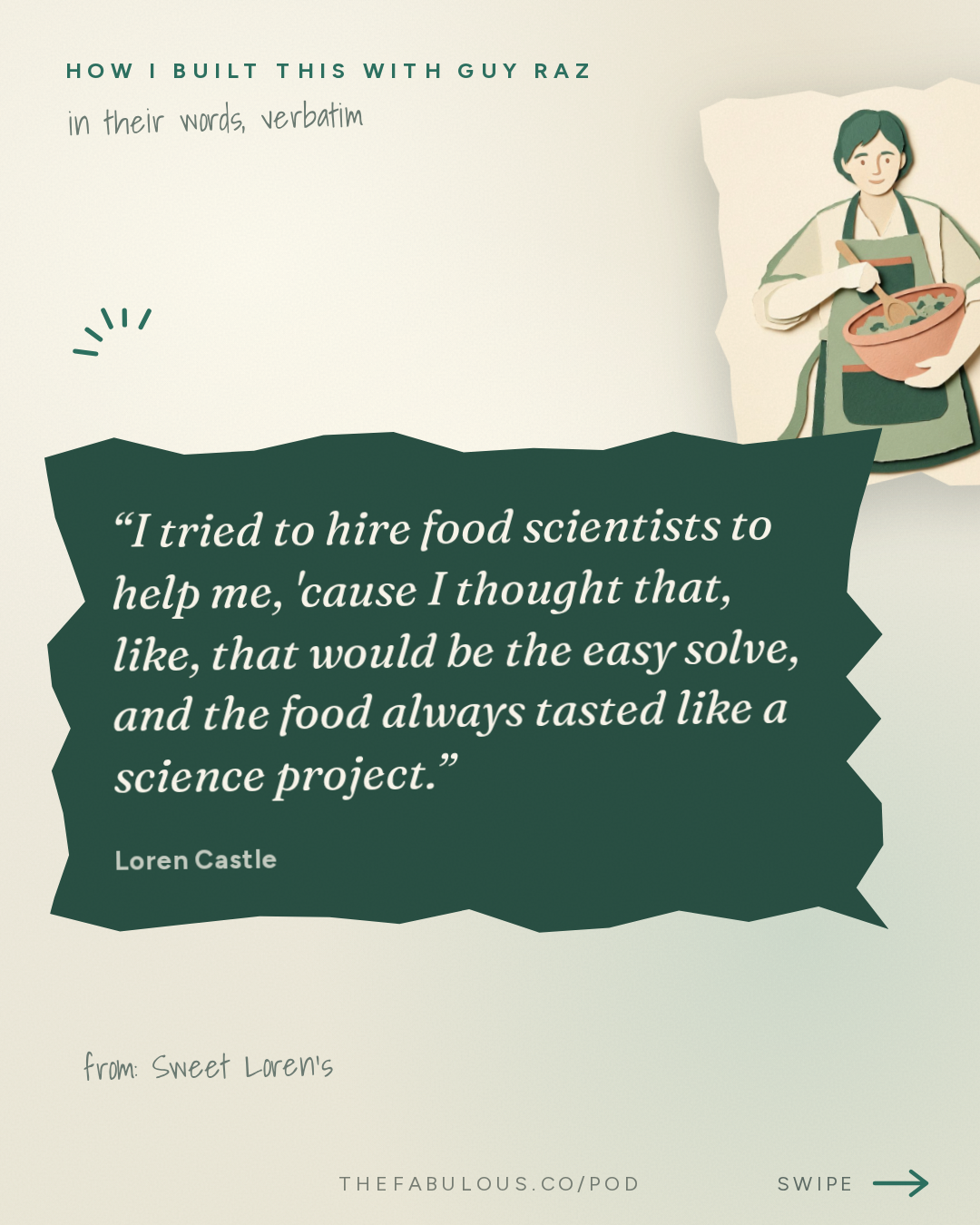
"I tried to hire food scientists to help me, 'cause I thought that, like, that would be the easy solve, and the food always tasted like a science project." — Loren Castle [57:21]
Instead, Castle went back to testing potato starch, tapioca starch, and oat flour combinations herself, since an egg's main job in baking is simply to bind ingredients together. When she and her VP of sales tasted the first successful batch, both of them cried. Publix and Kroger buyers, hearing the same consumer demand Castle had, agreed to carry it. The allergen-free chocolate chunk cookie launched in 2017 and became the company's number one selling product within six months (58:40), outselling every other item in the lineup.
Rather than run two separate lines, Castle made a call that reshaped the whole business: by the following year, every Sweet Loren's product would be free of the major allergens, with the gluten-free and dairy-free labeling made smaller and less central on the package so it wouldn't feel like a separate, niche line. 2018 became the company's first fully profitable year. Because the brand had grown slowly, most consumers were discovering Sweet Loren's for the first time as an allergen-free product, with no earlier identity to reconcile.
Today the company sells cookie dough, puff pastry, pizza crust, pie crust, and scones in more than 30,000 stores (04:07), employs more than 40 people (63:52), and has made the Inc. 5000 list of fastest-growing private companies for eight consecutive years. Sweet Loren's was projected to cross $100 million in sales in 2025 (63:22). Castle still describes the company as something closer to a first child than a business, and says her five-year-old has already asked to take it over one day. Asked how much of the outcome was luck versus work, she didn't pick one.
"I just looked at those challenges and said, 'This isn't gonna be my story. I'm gonna dream of a happier, fulfilling, abundant life.'" — Loren Castle [65:31]
The company's slowest decade looks, in hindsight, like its best decision. Staying small bought Castle time to learn the category, to build trust with buyers, and to wait for a market that, by 2017, was finally ready to pay attention to a cookie dough brand built around what it left out rather than what it put in.
Ask this episode anything
Pod's AI answers from the episode itself, with the minute mark so you can hear it yourself.
Or start with one of these
Ask this episode
Pod's AI listens to the whole episode to answer, and points you to the minute it comes from.
The rest of this answer, and any question after it
Answers come from the episode itself, never from a summary of it.
ContinueKey takeaways
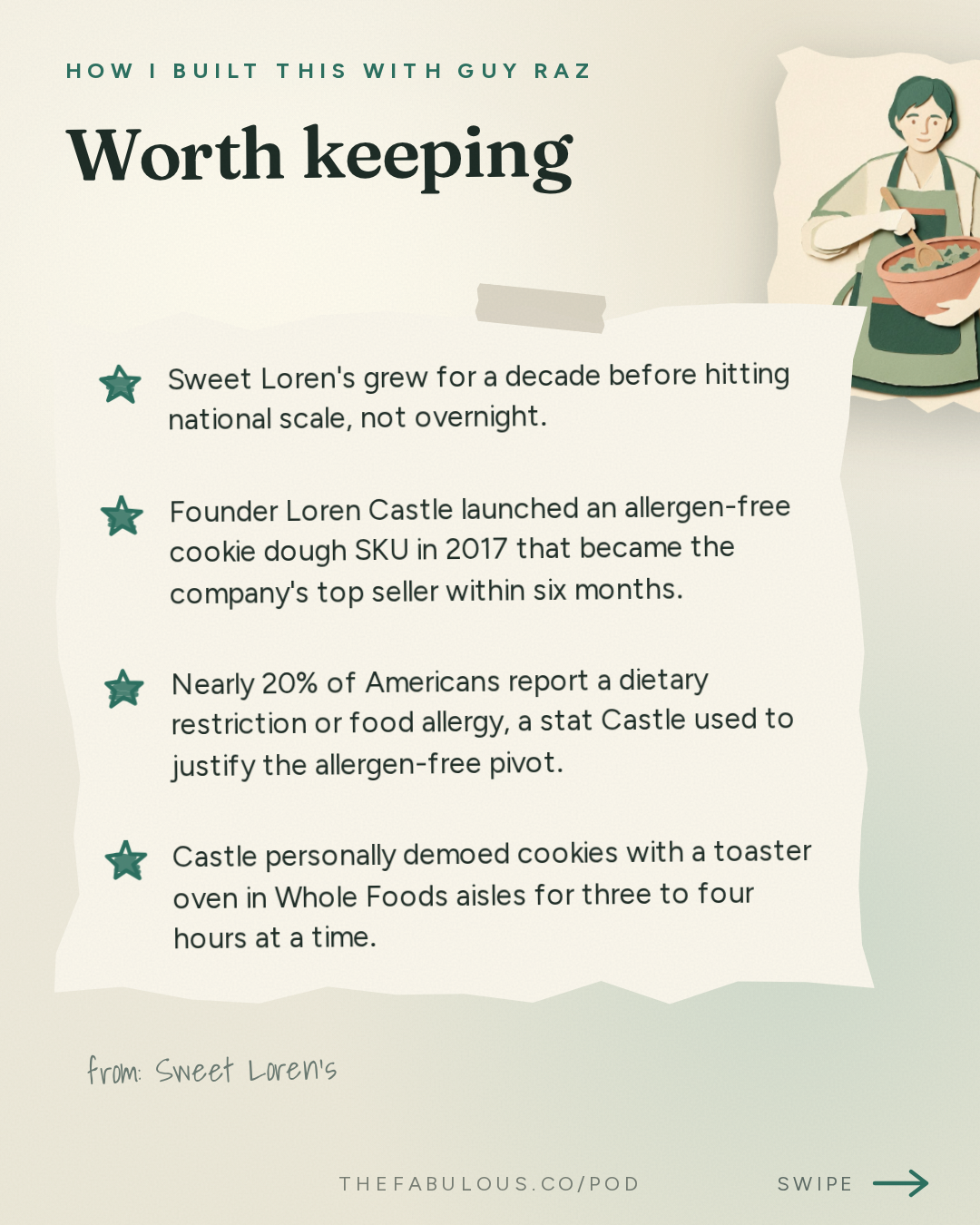
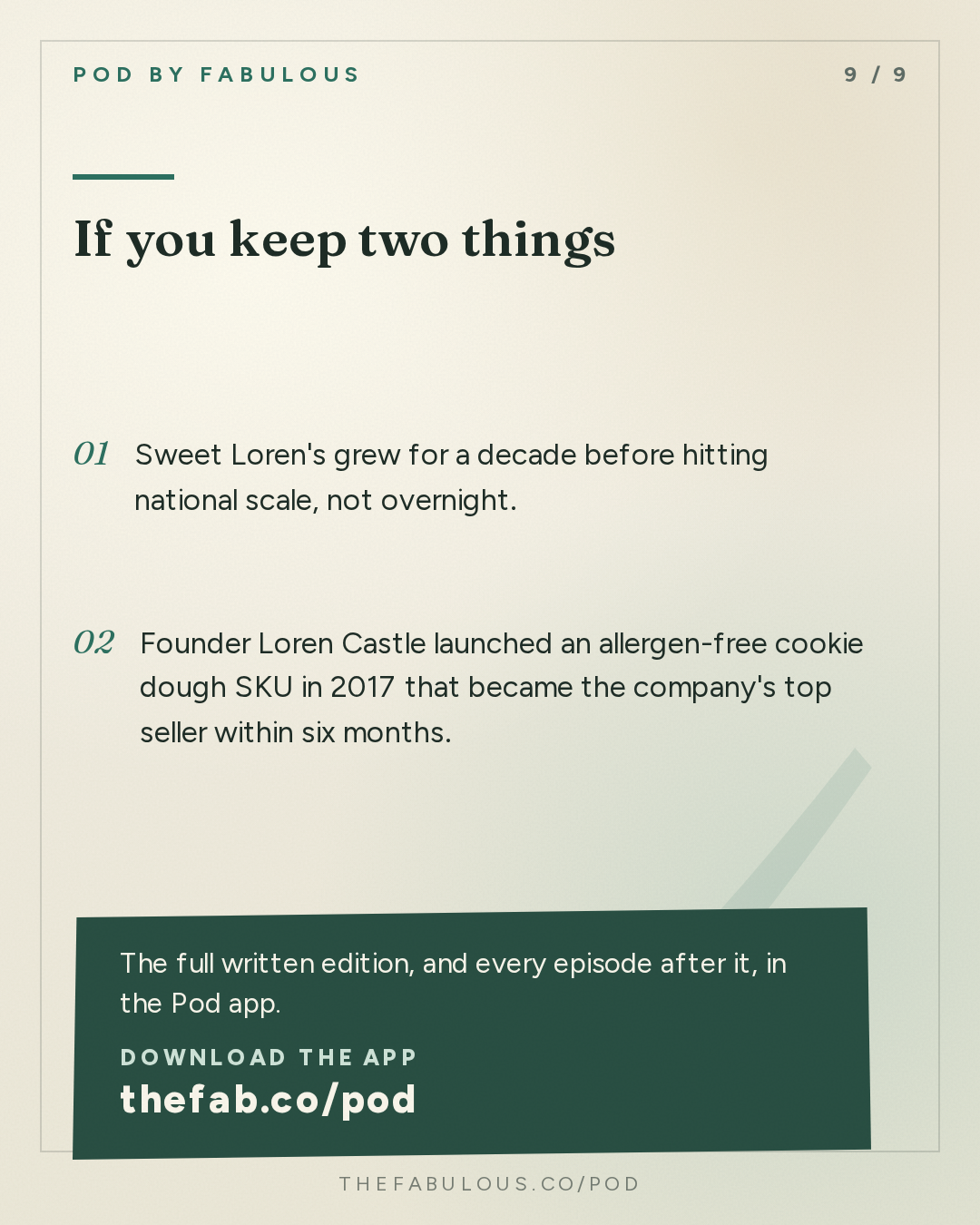
- Sweet Loren's grew for a decade before hitting national scale, not overnight.
- Founder Loren Castle launched an allergen-free cookie dough SKU in 2017 that became the company's top seller within six months (58:40).
- Nearly 20% of Americans report a dietary restriction or food allergy, a stat Castle used to justify the allergen-free pivot (54:59).
- Castle personally demoed cookies with a toaster oven in Whole Foods aisles for three to four hours at a time (33:20).
- Sweet Loren's made roughly $350,000 in annual sales by year five despite already selling in hundreds of stores (45:34).
The episode in cards
By the numbers
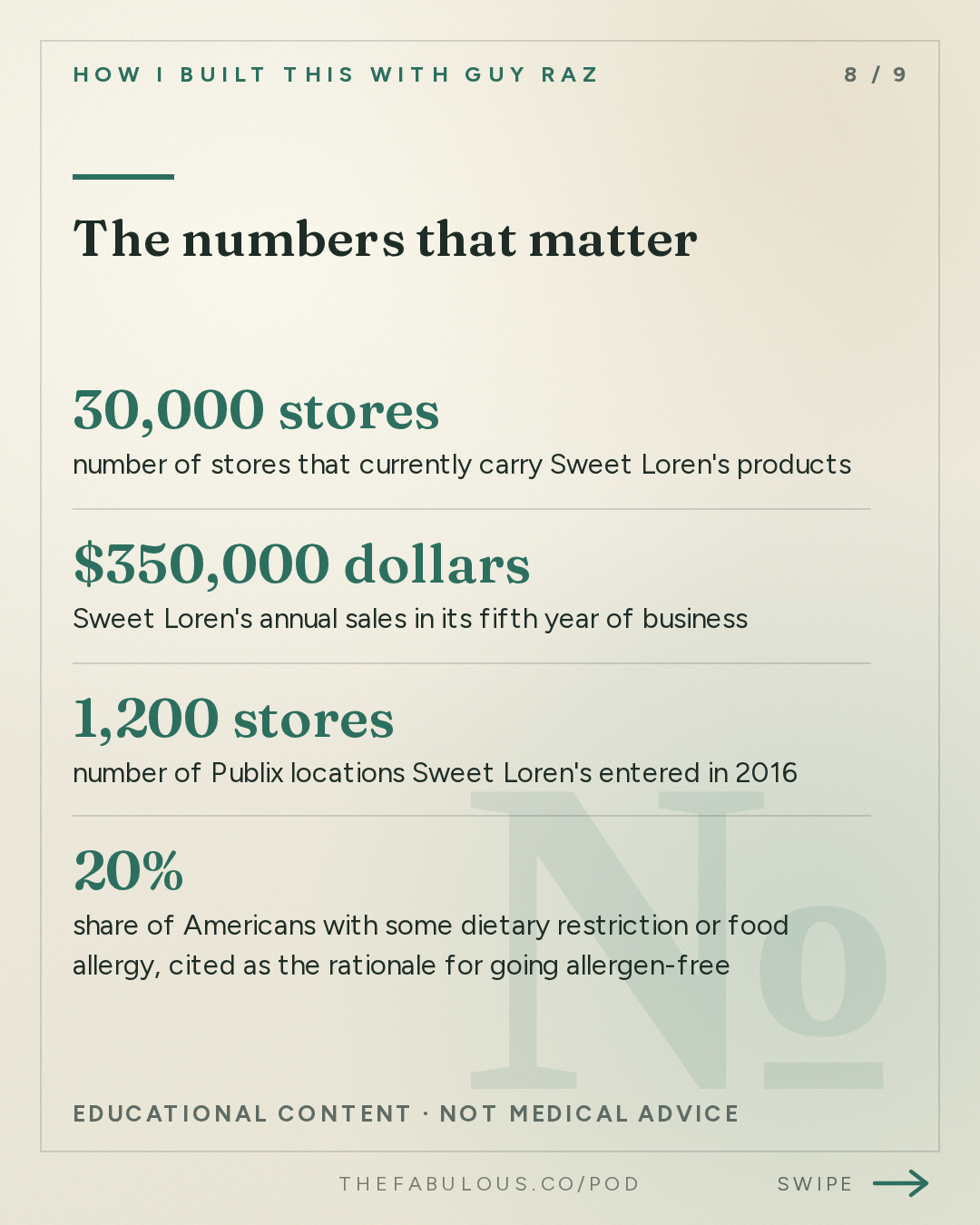
- 30,000 stores number of stores that currently carry Sweet Loren's products
- $350,000 dollars Sweet Loren's annual sales in its fifth year of business
- 1,200 stores number of Publix locations Sweet Loren's entered in 2016
- 20% percent share of Americans with some dietary restriction or food allergy, cited as the rationale for going allergen-free
- $100 million dollars Sweet Loren's projected sales for 2025
In their words
“I would bring a r- a rolling suitcase with a toaster oven in it on the subway to the Whole Foods, plug it into the aisle, and stand in that aisle for three to four”
“I tried to hire food scientists to help me, 'cause I thought that, like, that would be the easy solve, and the food always tasted like a science project.”
“By year five we were probably 350,000. A year in sales?”
“I just looked at those challenges and said, "This isn't gonna be my story. Like, I'm gonna dream of a happier, fulfilling, abundant life”
Protocols
-
Run low-cost in-aisle demos to build word of mouth
Loren Castle brought a rolling suitcase with a toaster oven on the subway to her local Whole Foods and baked fresh cookies in the aisle to hand out samples and create a smell that drew shoppers in. She says this worked because the single store had very heavy foot traffic, so it was not a strategy she could repeat once Sweet Loren's expanded into thousands of stores nationally.
three to four hours per visit, roughly weekly
-
Hold onto cash by hiring slowly and keeping overhead low
Loren Castle raised about $1 million from friends and family, paid herself $85,000 a year for the first several years, and avoided spending on a fancy office or marketing events so Sweet Loren's could fund its own growth. She says this kept the company from ever having to raise money under pressure, even though annual revenue stayed under $1 million for roughly five years.
ongoing through the company's first five to seven years
Questions this episode answers
How did Sweet Loren's become a national cookie dough brand?
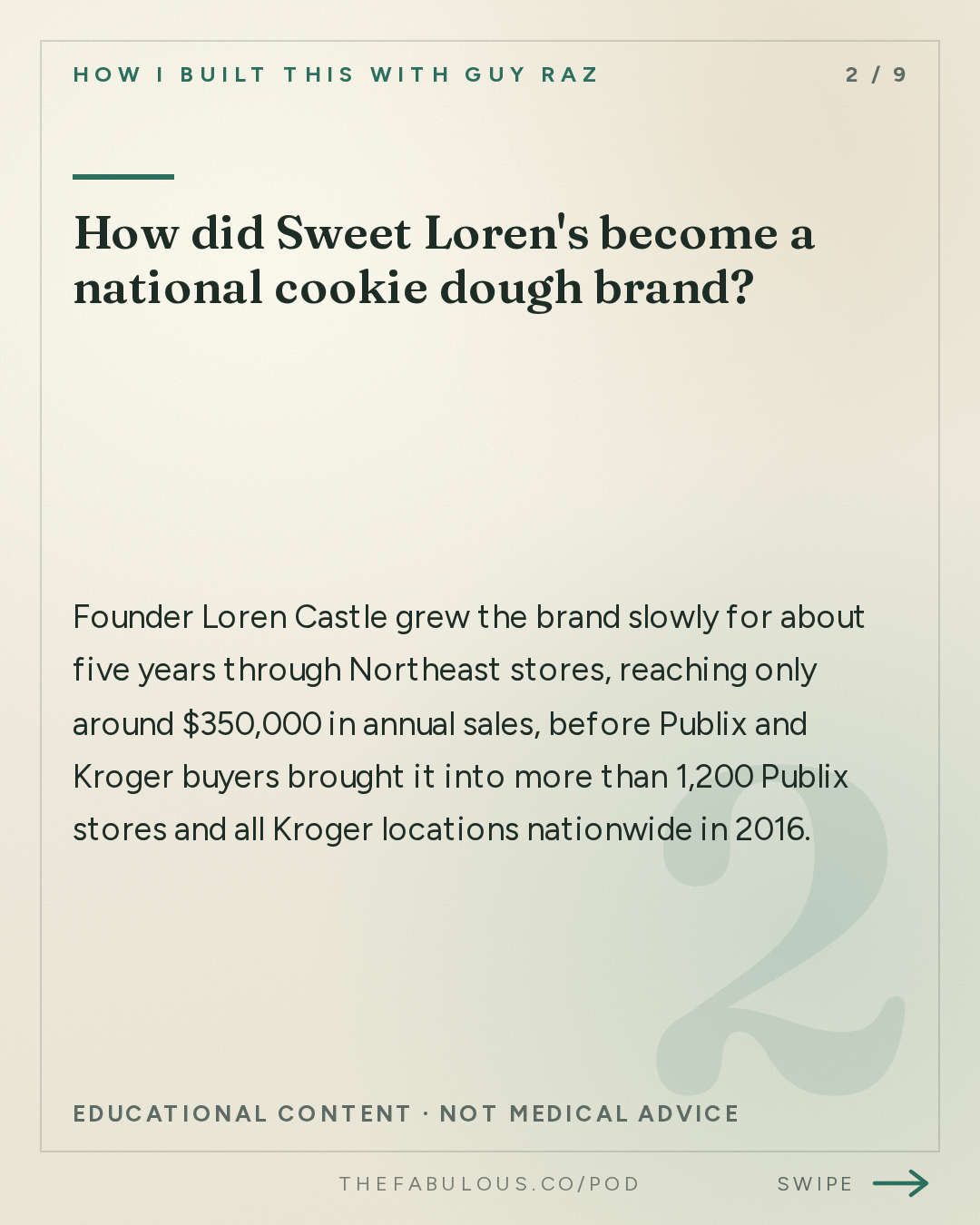
Founder Loren Castle grew the brand slowly for about five years through Northeast stores, reaching only around $350,000 in annual sales (45:34), before Publix and Kroger buyers brought it into more than 1,200 Publix stores and all Kroger locations nationwide in 2016 (48:17).
Why did Sweet Loren's switch to an allergen-free recipe?
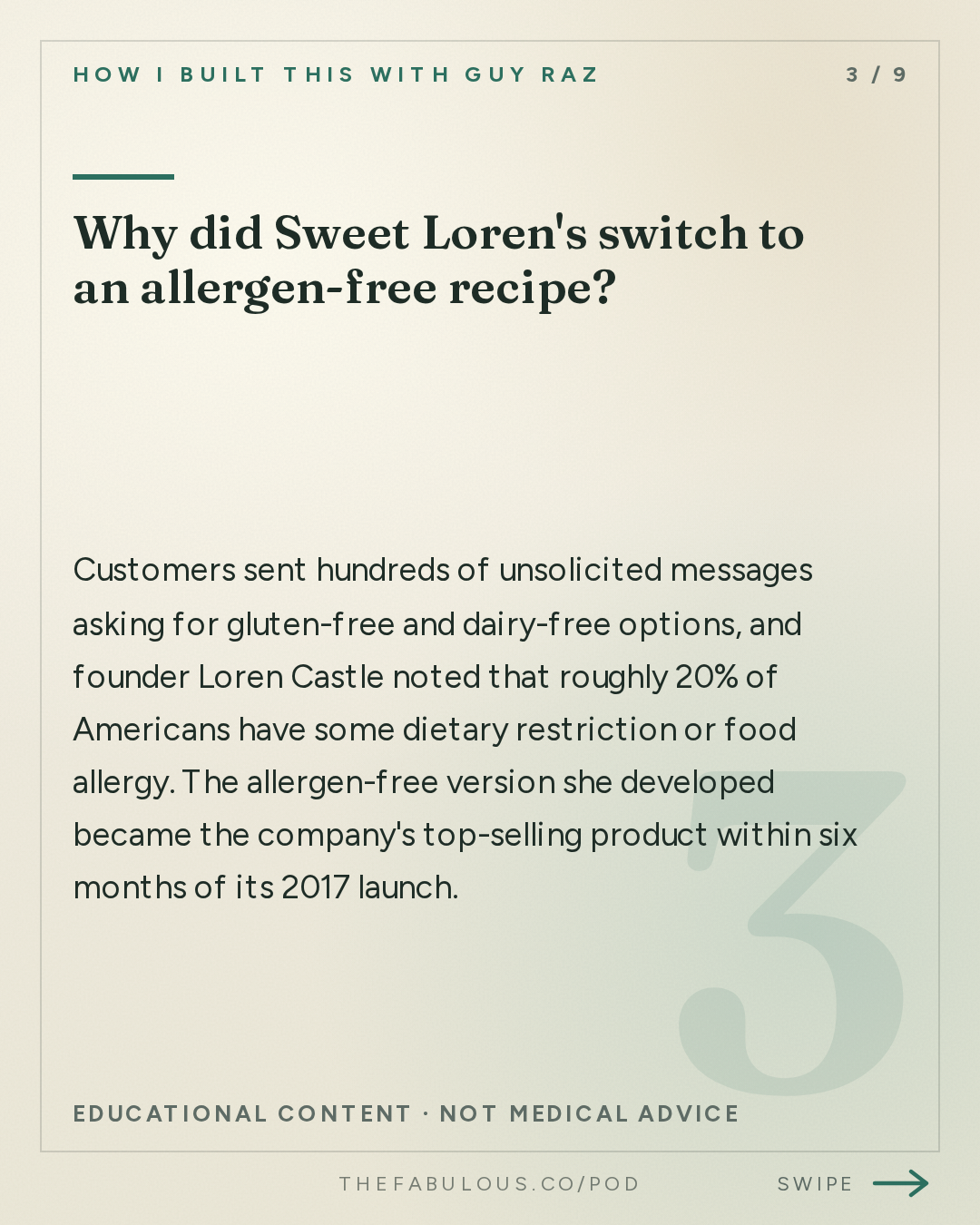
Customers sent hundreds of unsolicited messages asking for gluten-free and dairy-free options, and founder Loren Castle noted that roughly 20% of Americans have some dietary restriction or food allergy (54:59). The allergen-free version she developed became the company's top-selling product within six months of its 2017 launch (58:40).
How much money did Loren Castle raise to start Sweet Loren's?
Castle raised about $1 million from friends and family (37:47) and kept costs low by paying herself $85,000 a year and avoiding office and marketing spend, which let the company fund its own slow growth instead of raising again.
Did Loren Castle have cancer?
Yes. Castle was diagnosed with stage two Hodgkin's lymphoma at age 22 (08:14), a few years after her mother was diagnosed with a form of leukemia when Castle was 14 (05:44). Her mother passed away from the illness shortly after Sweet Loren's first verbal agreement with Whole Foods (26:05).
How big is Sweet Loren's today?
The brand is sold in more than 30,000 stores (04:07), employs more than 40 people (63:52), and was projected to surpass $100 million in sales in 2025 (63:22), according to founder Loren Castle.
The full read, in cards
Mentioned
Loren Castle · Jacoby & Meyers · Levain Bakery · Whole Foods · Columbia Business School · Hoda Kotb · Publix · Kroger · Inc. 5000 · Sweet Loren's
More from this show and category

Tara Bosch's Advice: D2C to Retail Growth
Tara Bosch, who sold a majority stake in her low-sugar candy brand SmartSweets for a reported $360 million (00:49), spends this advice-line episode teaching four early founders how to move from online sales to grocery shelves, price sugar and price value in three seconds, and read customer emotion through phone calls rather than DMs.

Sweet Loren's Cookie Dough Success Story
Loren Castle turned a cookie stand at Brooklyn's Smorgasburg market into Sweet Loren's, a cookie dough brand now in more than 30,000 stores. After surviving Hodgkin's lymphoma at 22, she built the business slowly, then rebuilt it entirely around allergen-free recipes once customer demand made clear that was the real opportunity, reaching profitability in 2018.
CPG Brand: Moving From D2C to Retail
SmartSweets founder Tara Bosch, who sold a majority stake for $360 million, coaches four founders on moving from D2C to grocery retail. She covers wholesale-versus-direct splits, reformulating sugar and allulose, niche marketing for a swimwear brand, and when to pivot an experience-subscription box.
The History of Alamo Drafthouse Cinema
Tim and Karrie League, two Rice University graduates with an engineering job and a microbiology PhD between them, opened a failed art house theater in Bakersfield in 1993, then rebuilt the idea inside an Austin parking garage in 1997 and grew it into Alamo Drafthouse Cinema, a dine-in chain that survived a lawsuit, a Me Too reckoning, and COVID bankruptcy before Sony Pictures Entertainment bought it in 2023.
