
Sweet Loren's Cookie Dough Success Story
Sweet Loren’s: Loren Castle. How A Recipe Makeover Built a National Cookie Brand
The brief
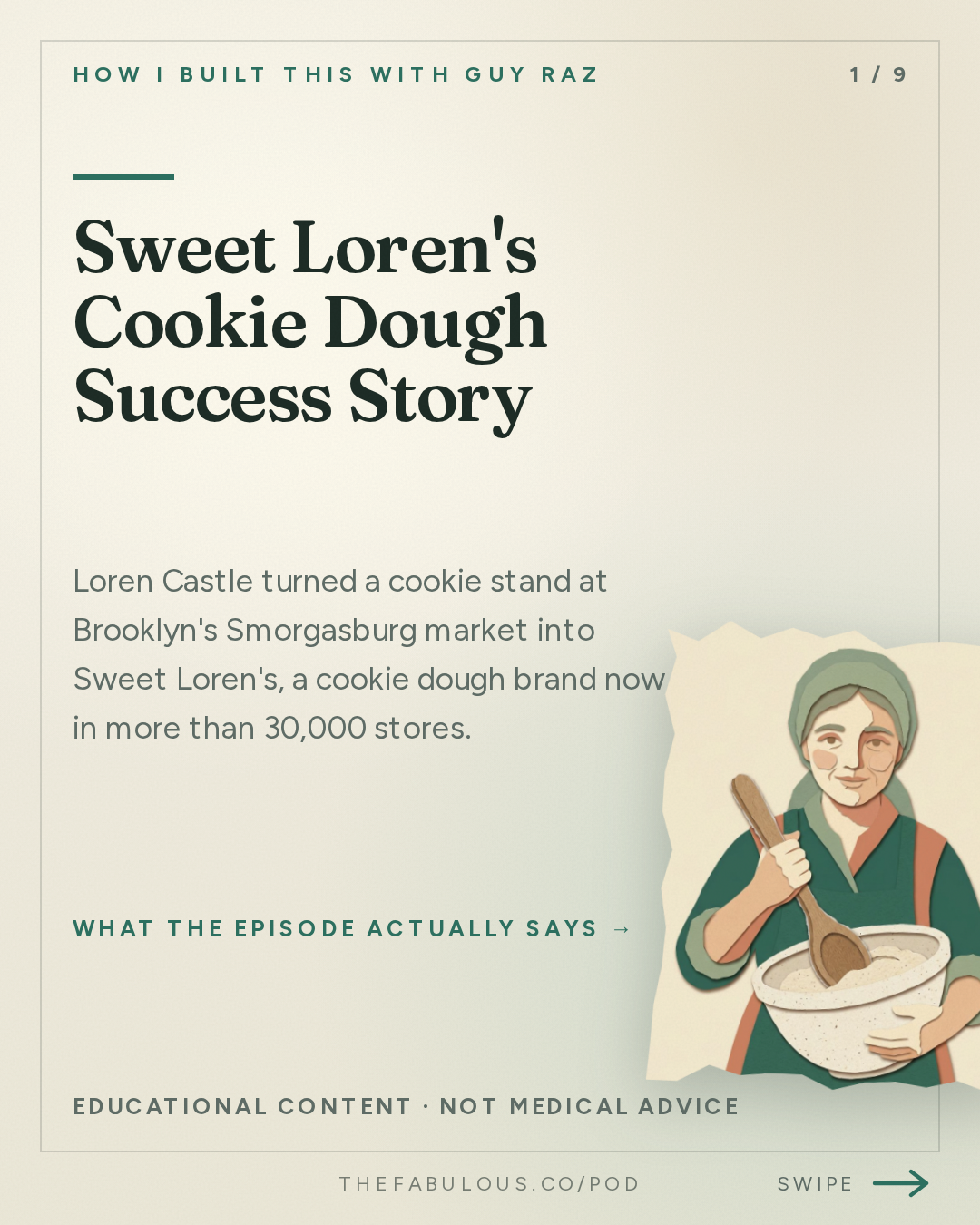
Loren Castle turned a cookie stand at Brooklyn's Smorgasburg market into Sweet Loren's, a cookie dough brand now in more than 30,000 stores. After surviving Hodgkin's lymphoma at 22, she built the business slowly, then rebuilt it entirely around allergen-free recipes once customer demand made clear that was the real opportunity, reaching profitability in 2018.
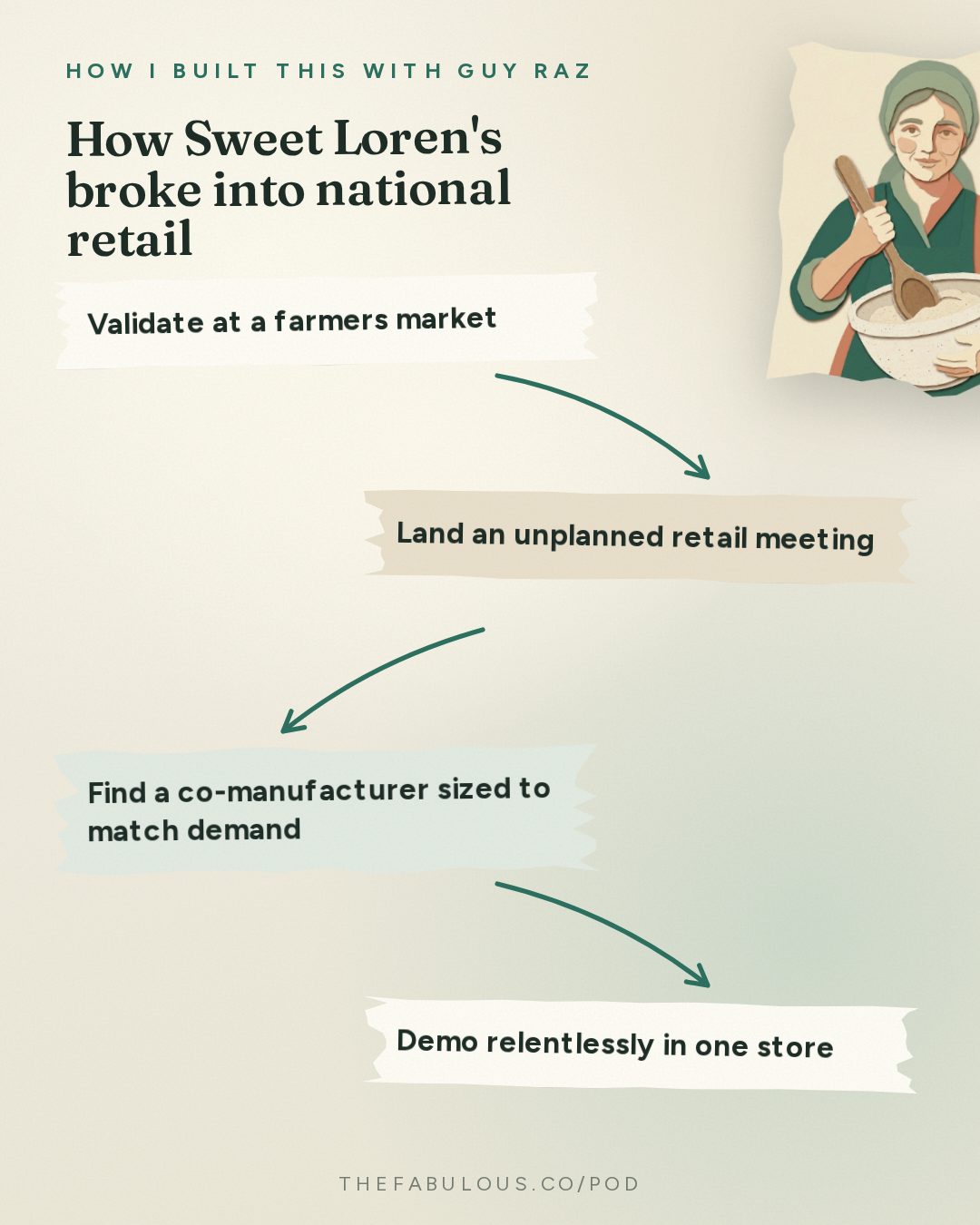
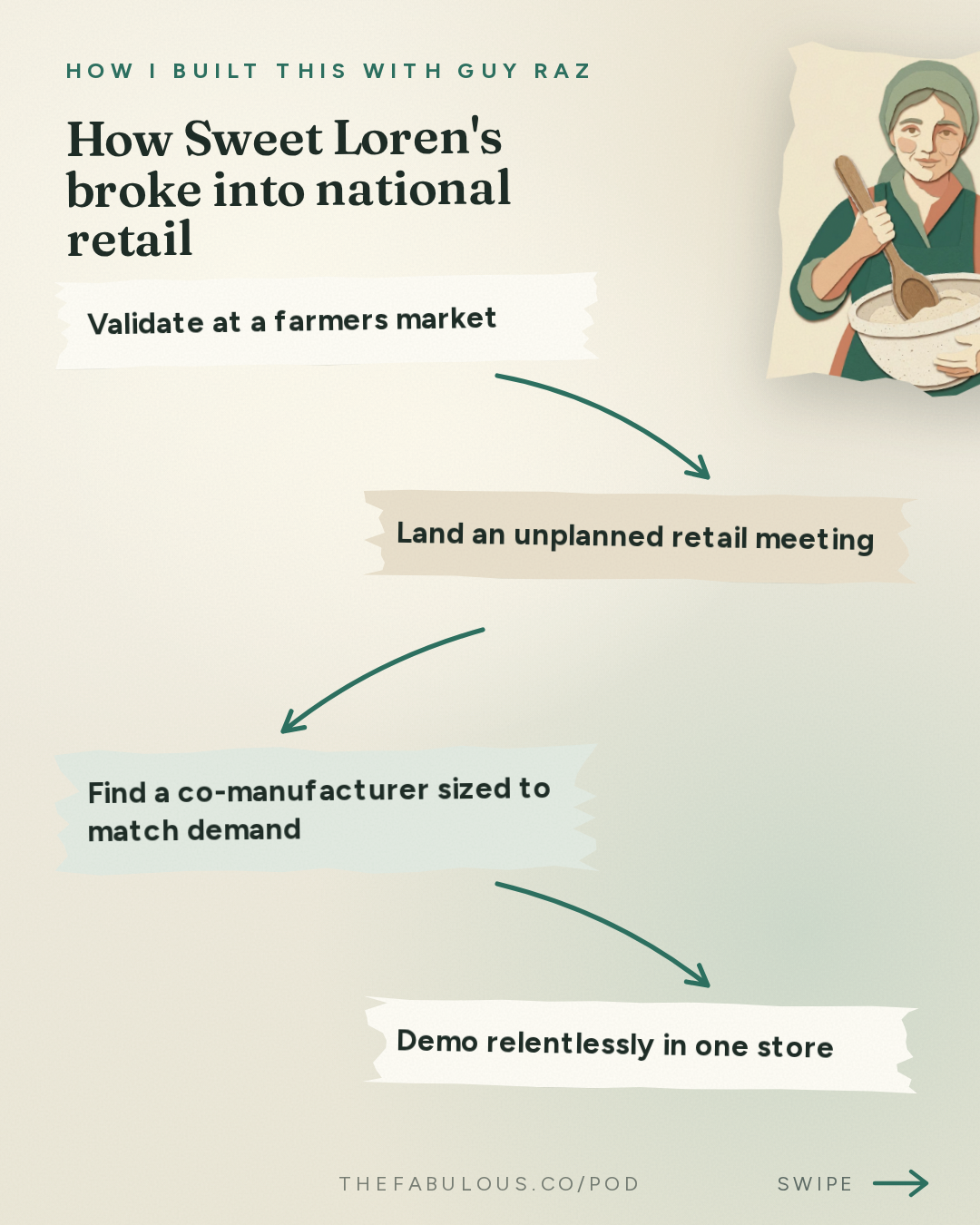
A toaster oven does not look like the beginning of a national food brand. But for a year, Loren Castle rode the New York City subway with one packed inside a rolling suitcase, carried it into the Whole Foods at Columbus Circle, plugged it into an aisle outlet, and baked fresh chocolate chip cookies for three or four hours at a stretch (38:16). She did this weekly, for free, in a single store, selling maybe eight units a week (33:29). It is a strange image for the origin of a brand that now sits in more than 30,000 stores. It is also the clearest evidence of how Sweet Loren's actually got built: through thousands of small, patient repetitions rather than one big launch.
Castle's path to that toaster oven started somewhere much darker. Her mother, a founding partner of the law firm Jacoby & Meyers, was diagnosed with leukemia when Castle was 14 (08:57). Eight years later, with a one-way plane ticket to California already bought, Castle woke up with swollen lymph nodes and was told by a doctor that she either had nothing or Hodgkin's lymphoma (10:55). It was Hodgkin's, stage two. "Stage two has a really high chance of being cured," she says. "My doctor felt very positive about it, but he just wanted to start the treatment immediately so it didn't become stage three or stage four" (11:20). The plane ticket was canceled. The California plan was over.
Chemotherapy, not ambition, is what pointed her toward food. Stuck in New York during treatment, she started reading about nutrition and became obsessed with ingredients nobody was talking about yet, coconut oil, whole grains, the idea that a cookie's ingredients could matter for health (16:18). She took a job at Levain Bakery, then a single-location shop in Manhattan, not baking but working the counter. She noticed that cookies, not the bread or muffins, were the bakery's best-selling and most profitable item (15:29). That observation, plus a refusal to accept that a healthier cookie had to taste like cardboard, became the whole business plan.
She tested recipes nightly in her apartment, swapping in potato starch, tapioca starch, and alternative flours, feeding the results to her sister with a chart to rate each one (17:43). Eventually she entered a local baking contest, won, and a pastry chef judge told her to do something with it. That something was a booth at Smorgasburg, the Brooklyn food market, where people lined up and asked a strange, telling question: could they just buy the raw dough, so they could bake warm cookies at home on their own schedule (19:47)? Nobody was selling that. Nestle Toll House had dominated the refrigerated cookie dough aisle for decades (06:22), and neither it nor Pillsbury was selling anything a nutrition-focused twenty-something would call real food.
The jump from market stall to Whole Foods happened almost by accident. Castle was enrolled in a free two-year entrepreneurship program through Columbia Business School, and a classmate named Corey, who worked the overnight shift at the Columbus Circle Whole Foods to fund a future bike shop, got her an unplanned meeting with the store's grocery buyer (22:47). She had no polished pitch and no packaged product. She baked a batch of cookies that morning, brought them in warm, and the buyer called the next day to say his team wanted to know how soon they could get it as cookie dough (30:04). This was still an era, Castle points out, when individual Whole Foods stores could make their own buying decisions, before Amazon owned the chain and centralized everything (28:30). A single enthusiastic buyer, not a corporate category review, is what got Sweet Loren's onto a shelf.
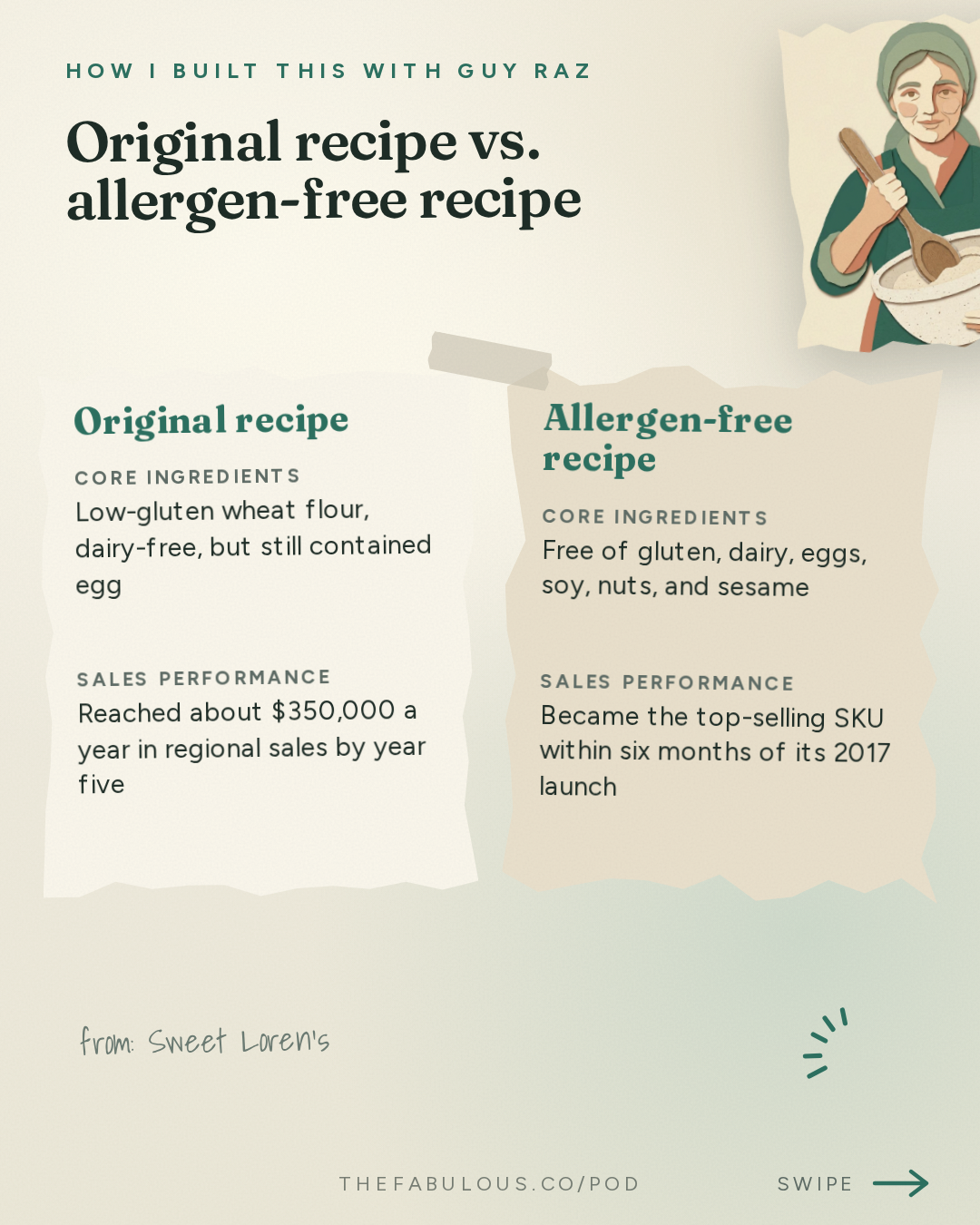
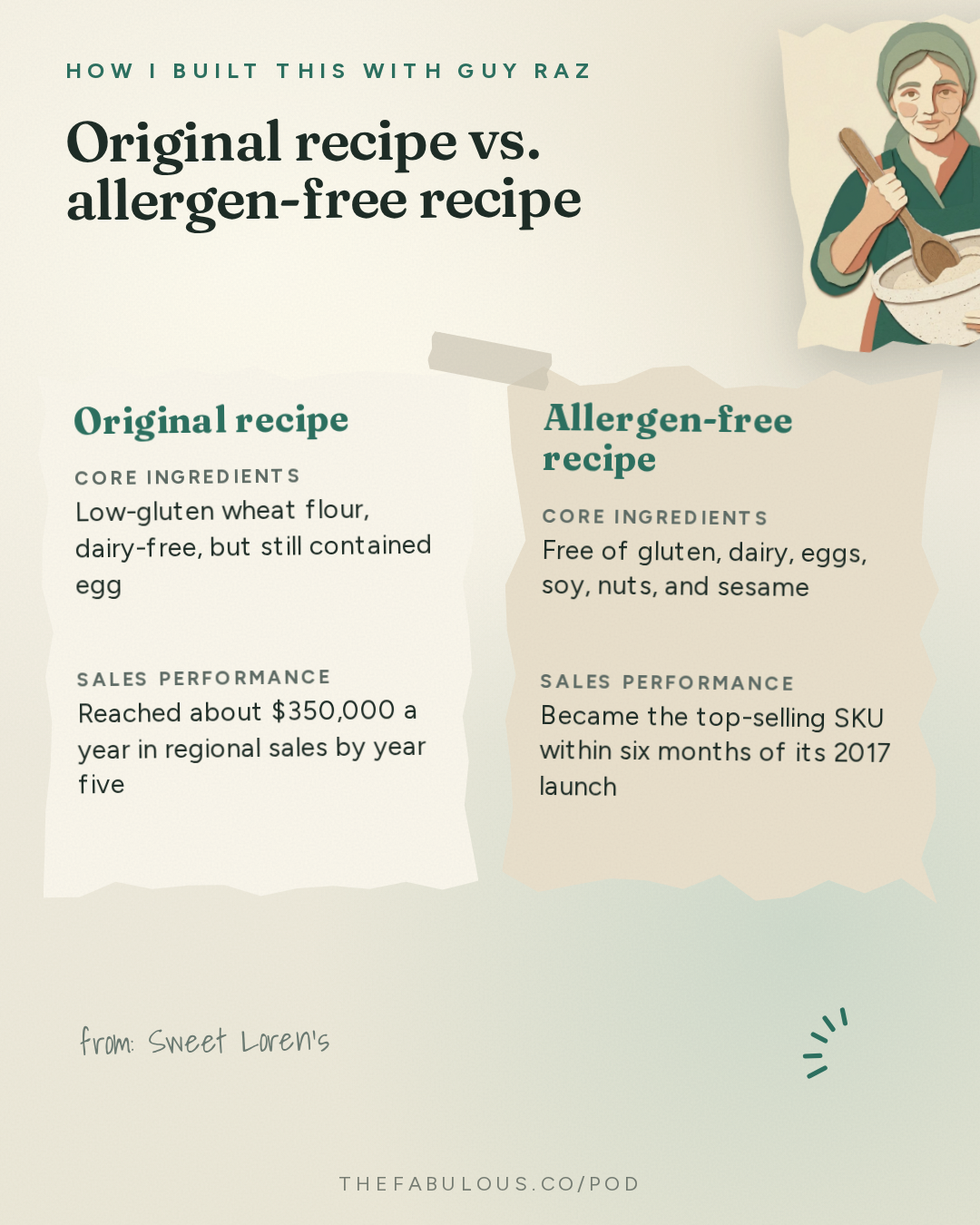
"Tiny" is the word Castle keeps returning to when she describes those years. The first Whole Foods order was eight units a week. Finding a factory to make the dough at scale meant calling dozens of co-manufacturers, most of which wanted minimum runs of 10,000 pounds, a volume she could not sell and could not afford to risk (34:44). She eventually found a small plant upstate that had never made cookie dough before but had mixers, and hired one of its workers to drive finished product into the city in a cooler in his trunk (35:48). Five years in, with Sweet Loren's sold mostly in the Northeast, annual sales were about $350,000 (51:28).
"By year five we were probably 350,000 a year in sales. We were tiny." Loren Castle, [51:28]
That slowness, which felt like failure at the time, turned out to be a kind of protection. Castle had raised about $1 million from friends and family and paid herself $85,000 a year, keeping the company lean enough that she never had to raise again out of desperation (43:18, 47:45). Competitors who scaled faster during the same CPG (consumer packaged goods) boom, alongside brands like Warby Parker and Harry's, sometimes burned through cash chasing growth the market was not ready to support. Castle's read, looking back, is that the barrier to entry in packaged food is higher than it looks. "It's actually so incredibly difficult to break into CPG," she says, "and it's not just about one thing" (52:24). A recipe is not one ingredient choice but hundreds, and a brand built on natural ingredients cannot simply be copied by a brand built on something else.
The Pivot Nobody Had to Force
The real inflection point came after Sweet Loren's finally reached national scale. In 2016, Publix, which operates more than 1,200 stores, and Kroger, the country's largest grocery chain, both agreed to carry the brand, after Castle argued that a flat or declining cookie dough category needed exactly the kind of reinvention she was offering (53:38, 54:11, 54:33). Suddenly a product built by one founder in a Brooklyn market stall was sitting in thousands of stores nationwide. And suddenly, the feedback changed. Hundreds of messages arrived from customers who loved the concept but could not eat it: a child with a nut allergy, a husband who was gluten-free, a household avoiding soy (59:44). Only about 1% of Americans are celiac, Castle notes, but close to 20% have some dietary restriction or food allergy, a market far larger than the niche it looks like from outside (60:52).
She spent four months rebuilding the recipe from scratch to remove gluten, dairy, eggs, soy, nuts, and sesame, without losing the texture of a real homemade cookie (62:03). It was harder than it sounds. She tried hiring food scientists to speed the process and found their contributions tasted wrong.
"I tried to hire food scientists to help me because I thought that, like, that would be the easy solve, and the food always tasted like a science project." Loren Castle, [04:50]
The fix came from the same method she had always used: nightly testing in her own kitchen, swapping starches and flours by hand until something tasted like a cookie again, not an experiment.
When the allergen-free version launched in 2017, it outsold every other Sweet Loren's product within six months (64:58). The company's response was not to add a second product line but to eliminate the original entirely. "I just felt like it was so confusing for the brand," Castle says. "Why have two different lines" (65:24)? By 2018, every Sweet Loren's product was free of the major allergens, the packaging was redesigned around a magenta color chosen to stand out against Toll House and Pillsbury on the shelf (57:09), and the allergen callouts were made small rather than central, so the people who needed them would notice and everyone else would just see a cookie. That year the company turned profitable for the first time, with sales around $3.5 million (68:28).
Sweet Loren's has since expanded into puff pastry, pizza crust, pie crust, and scones, operates with more than 40 employees, and was projected to cross $100 million in sales in 2025 (69:07). The US refrigerated cookie dough category it competes in is now roughly a billion-dollar business (67:50). None of that happened quickly. It happened because a woman who had already learned, twice, that her body and her family's health were not fully within her control built a company slowly enough to actually listen to what people kept telling her they needed. The toaster oven, in the end, was not a shortcut. It was the method.
Ask this episode anything
Pod's AI answers from the episode itself, with the minute mark so you can hear it yourself.
Or start with one of these
Ask this episode
Pod's AI listens to the whole episode to answer, and points you to the minute it comes from.
The rest of this answer, and any question after it
Answers come from the episode itself, never from a summary of it.
ContinueKey takeaways
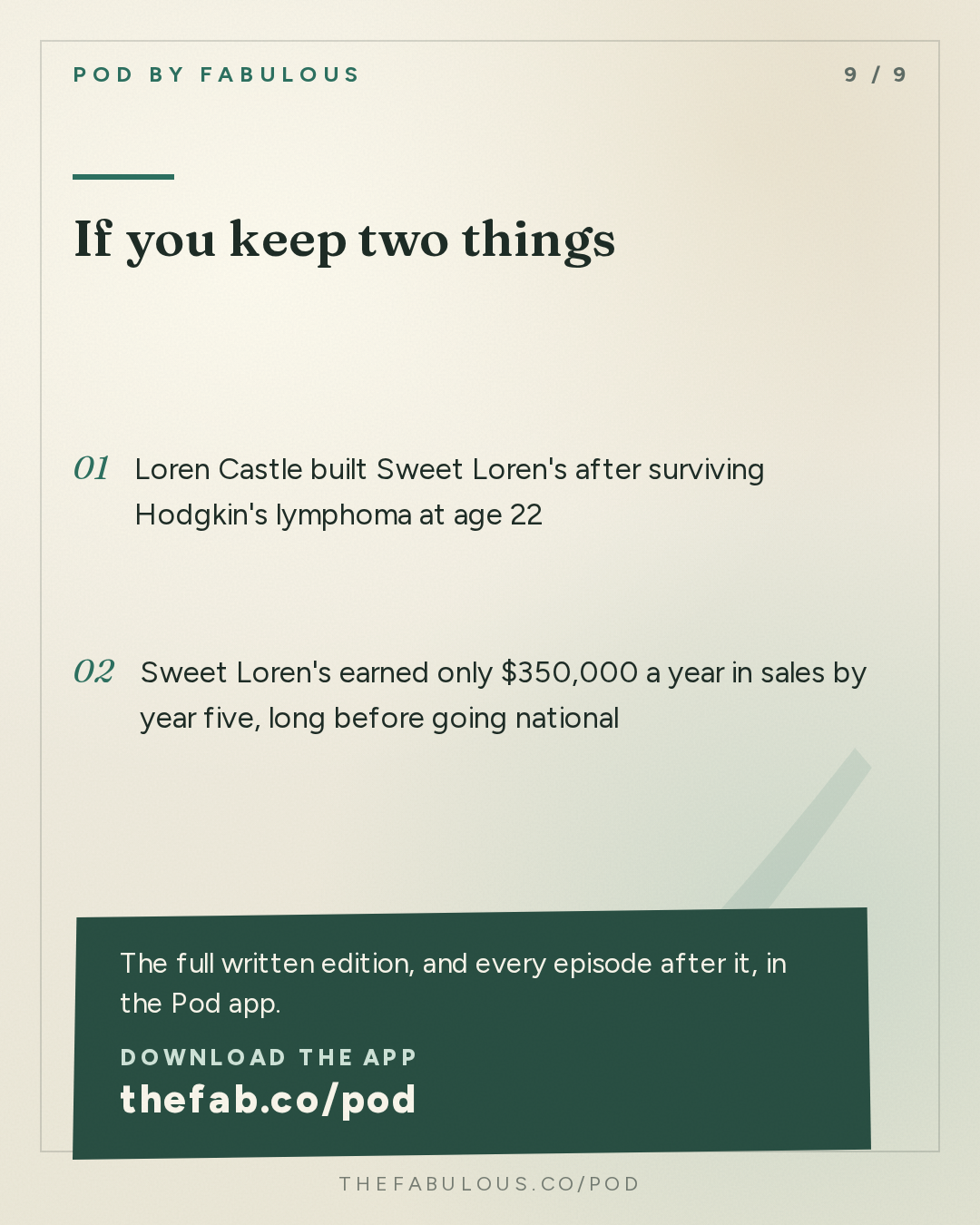
- Loren Castle built Sweet Loren's after surviving Hodgkin's lymphoma at age 22
- Sweet Loren's earned only $350,000 a year in sales by year five, long before going national
- Many co-manufacturing factories require minimum runs of 10,000 pounds, which forced Castle to find a tiny factory willing to start small
- Sweet Loren's allergen-free cookie dough outsold its original recipe within six months of launch in 2017
- Sweet Loren's became fully profitable in 2018 and projected $100 million in sales for 2025
The episode in cards
By the numbers
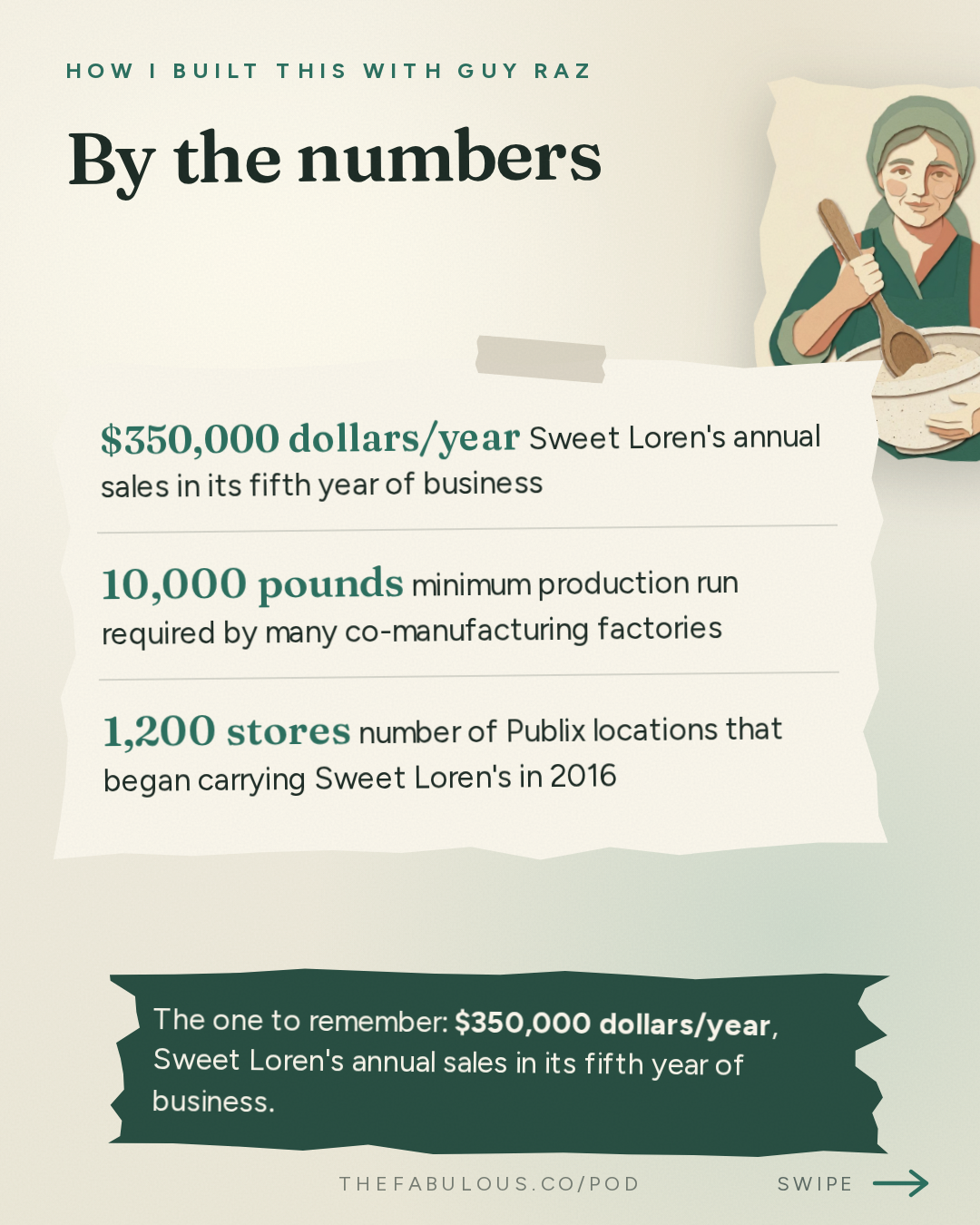
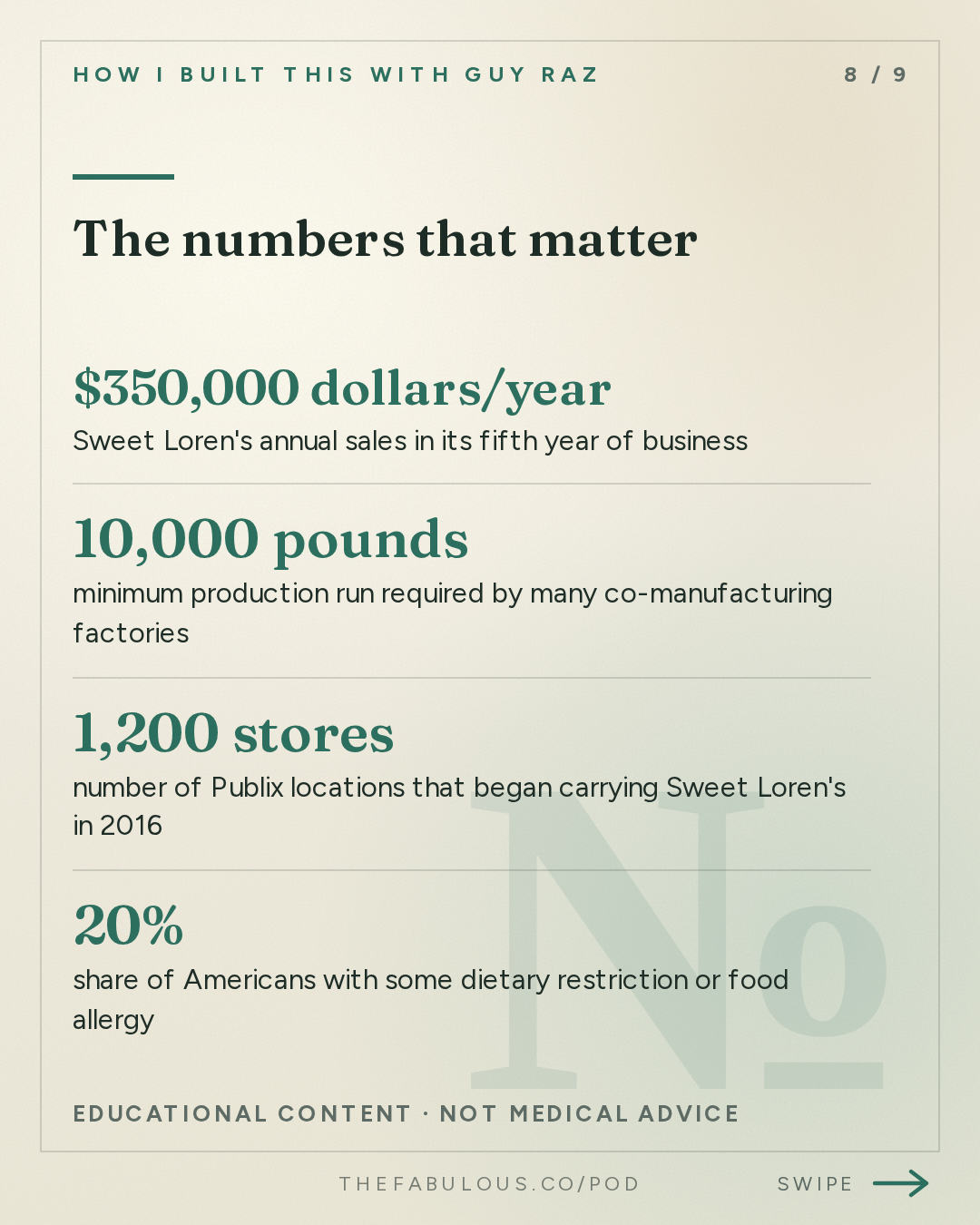
- $350,000 dollars/year Sweet Loren's annual sales in its fifth year of business
- 10,000 pounds minimum production run required by many co-manufacturing factories
- 1,200 stores number of Publix locations that began carrying Sweet Loren's in 2016
- 20% share of Americans with some dietary restriction or food allergy
- $100 million Sweet Loren's projected sales for 2025
In their words
“I tried to hire food scientists to help me because I thought that, like, that would be the easy solve, and the food always tasted like a science project.”
“I just saw over and over and over again how me being vulnerable and telling that story actually became so humanizing for the product.”
“I use my toaster oven more than I use my regular oven”
Protocols
-
Validate with low-cost in-store demos
Loren Castle demoed Sweet Loren's cookies by baking fresh samples on a toaster oven inside the Whole Foods aisle for three to four hours at a time, carrying the oven in on the subway.
Weekly, throughout the brand's first year in a single store
-
Match factory size to real demand
Castle turned down large co-manufacturers that required a minimum production run of 10,000 pounds and instead found a small upstate New York factory willing to produce tiny batches.
One-time sourcing decision made in the company's first year
-
Put the founder's story on the package
Castle added her photo, signature, and a short account of her cancer diagnosis to the back of the Sweet Loren's package starting with the brand's first release, saying the vulnerability humanized the product.
Ongoing, printed on every package from launch
-
Pitch retail buyers when a category is stuck
Castle says founders should approach retail category buyers when their product category is flat or declining, because those buyers are actively looking for a reinvention to pitch internally.
Situational, used when courting the Publix buyer in 2016
Questions this episode answers
How did Sweet Loren's get its first shelf space at Whole Foods?
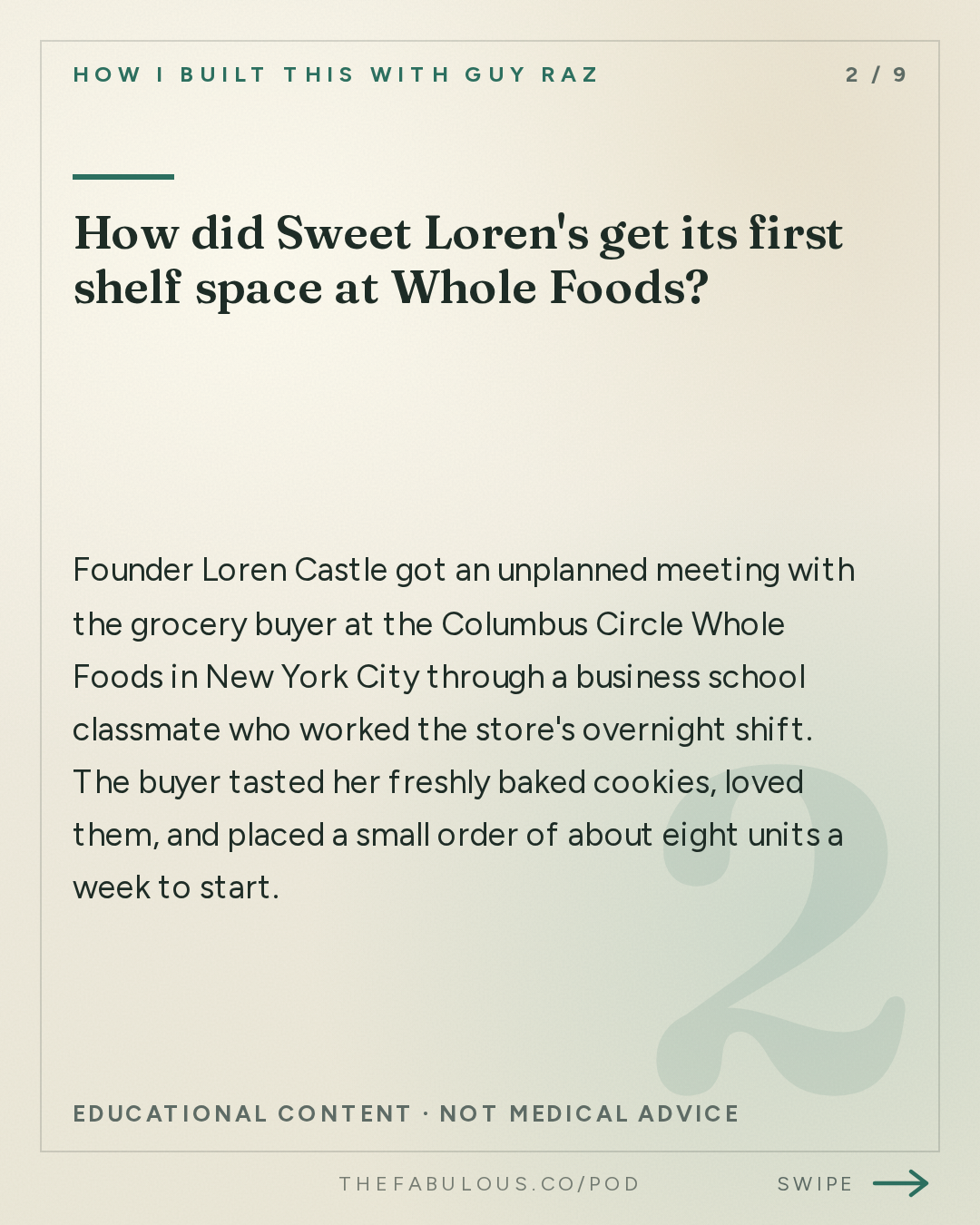
Founder Loren Castle got an unplanned meeting with the grocery buyer at the Columbus Circle Whole Foods in New York City through a business school classmate who worked the store's overnight shift (22:47). The buyer tasted her freshly baked cookies, loved them, and placed a small order of about eight units a week to start (30:04).
Why did Sweet Loren's switch to allergen-free cookie dough?
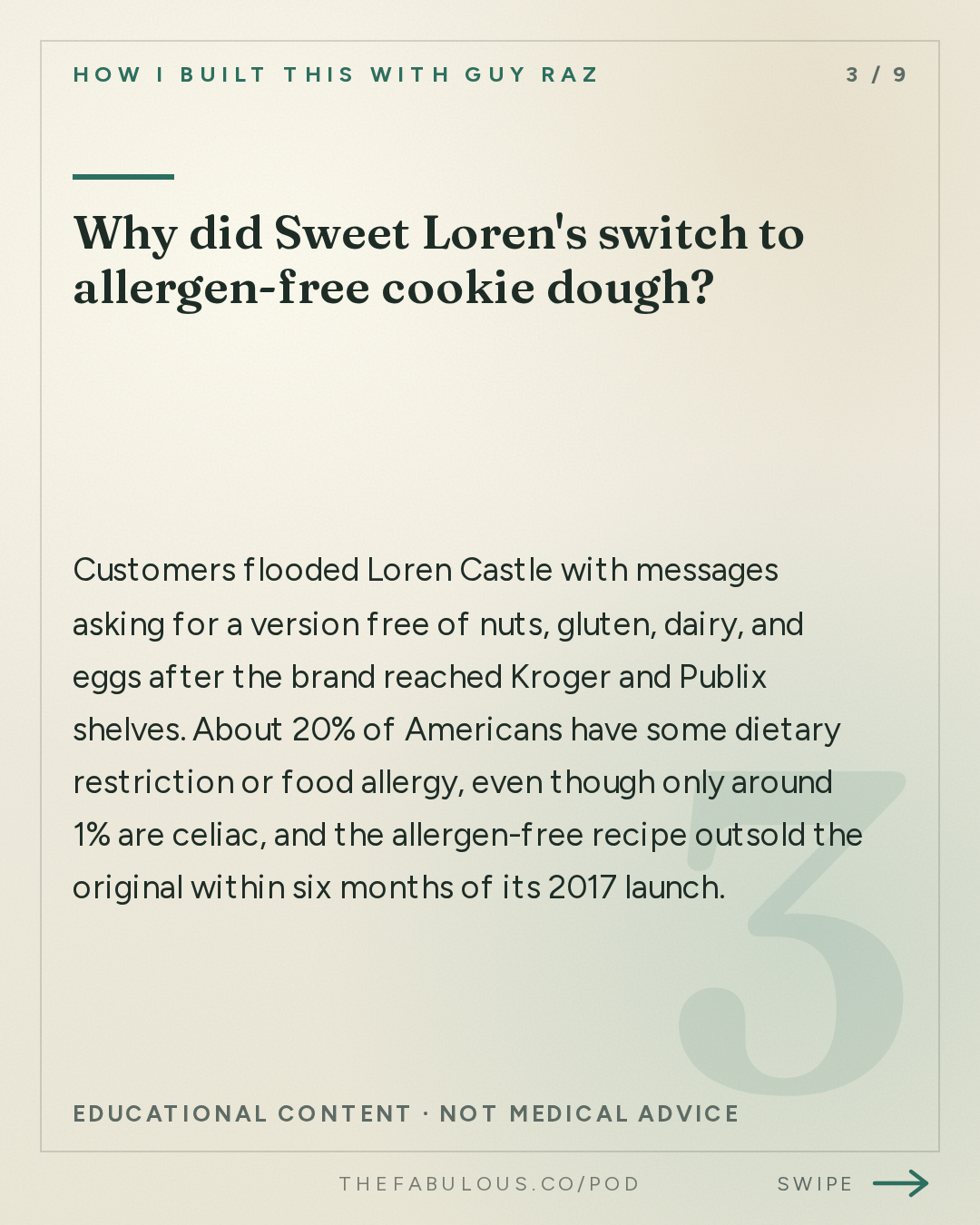
Customers flooded Loren Castle with messages asking for a version free of nuts, gluten, dairy, and eggs after the brand reached Kroger and Publix shelves (59:44). About 20% of Americans have some dietary restriction or food allergy, even though only around 1% are celiac (60:52), and the allergen-free recipe outsold the original within six months of its 2017 launch (64:58).
How big is the refrigerated cookie dough market?
The US refrigerated cookie dough category is roughly a billion-dollar market today, though it was closer to $500 to $600 million when Sweet Loren's went fully allergen-free in 2018 (67:50). Nestle Toll House and Pillsbury had dominated the category for decades before that (06:22).
How much did Sweet Loren's make before it scaled nationally?
Founder Loren Castle says Sweet Loren's brought in only about $350,000 a year in sales by its fifth year, while selling mainly through Northeast regional grocers (51:28). The business did not reach major national chains like Kroger and Publix until 2016 (53:38).
What health crisis shaped Loren Castle's path to founding Sweet Loren's?
Castle was diagnosed with stage two Hodgkin's lymphoma at age 22, shortly after her mother had spent years fighting leukemia (10:55). Her doctor said stage two had a high cure rate if treated immediately (11:20), and the experience pushed her toward studying nutrition and healthier baking.
The full read, in cards
Mentioned
Loren Castle · Jacoby & Meyers · Levain Bakery · Whole Foods · Kroger · Publix · Hoda Kotb · Columbia Business School · Smorgasburg · Graza Olive Oil
More from this show and category
CPG Brand: Moving From D2C to Retail
SmartSweets founder Tara Bosch, who sold a majority stake for $360 million, coaches four founders on moving from D2C to grocery retail. She covers wholesale-versus-direct splits, reformulating sugar and allulose, niche marketing for a swimwear brand, and when to pivot an experience-subscription box.
The History of Alamo Drafthouse Cinema
Tim and Karrie League, two Rice University graduates with an engineering job and a microbiology PhD between them, opened a failed art house theater in Bakersfield in 1993, then rebuilt the idea inside an Austin parking garage in 1997 and grew it into Alamo Drafthouse Cinema, a dine-in chain that survived a lawsuit, a Me Too reckoning, and COVID bankruptcy before Sony Pictures Entertainment bought it in 2023.
Nick Green's Advice for Scaling Niche Brands
Thrive Market CEO Nick Green coaches three founders to scale through focus, not features, on How I Built This's Advice Line. He tells a concert-wear designer to cut SKUs, a coffee founder to fund growth with subscriptions instead of outside cash, and an ALS app founder to court clinicians and caregivers, not patients, for awareness.
How I Built This: 10 Years of Top Lessons
Guy Raz marked 10 years of How I Built This by revisiting lessons from over 600 founder interviews with Ring co-founder Jamie Siminoff (07:23). The episode replays James Dyson's five-year vacuum quest (32:44) and Airbnb's 2008 pitches, where zero of 20 investors said yes (45:47), arguing fear, scrappiness, and rejection are normal parts of building something lasting.
