
How Jimmy Wales Built Wikipedia
Wikipedia: Jimmy Wales. The Man Who Trusted Strangers to Build an Encyclopedia (2018)
The brief
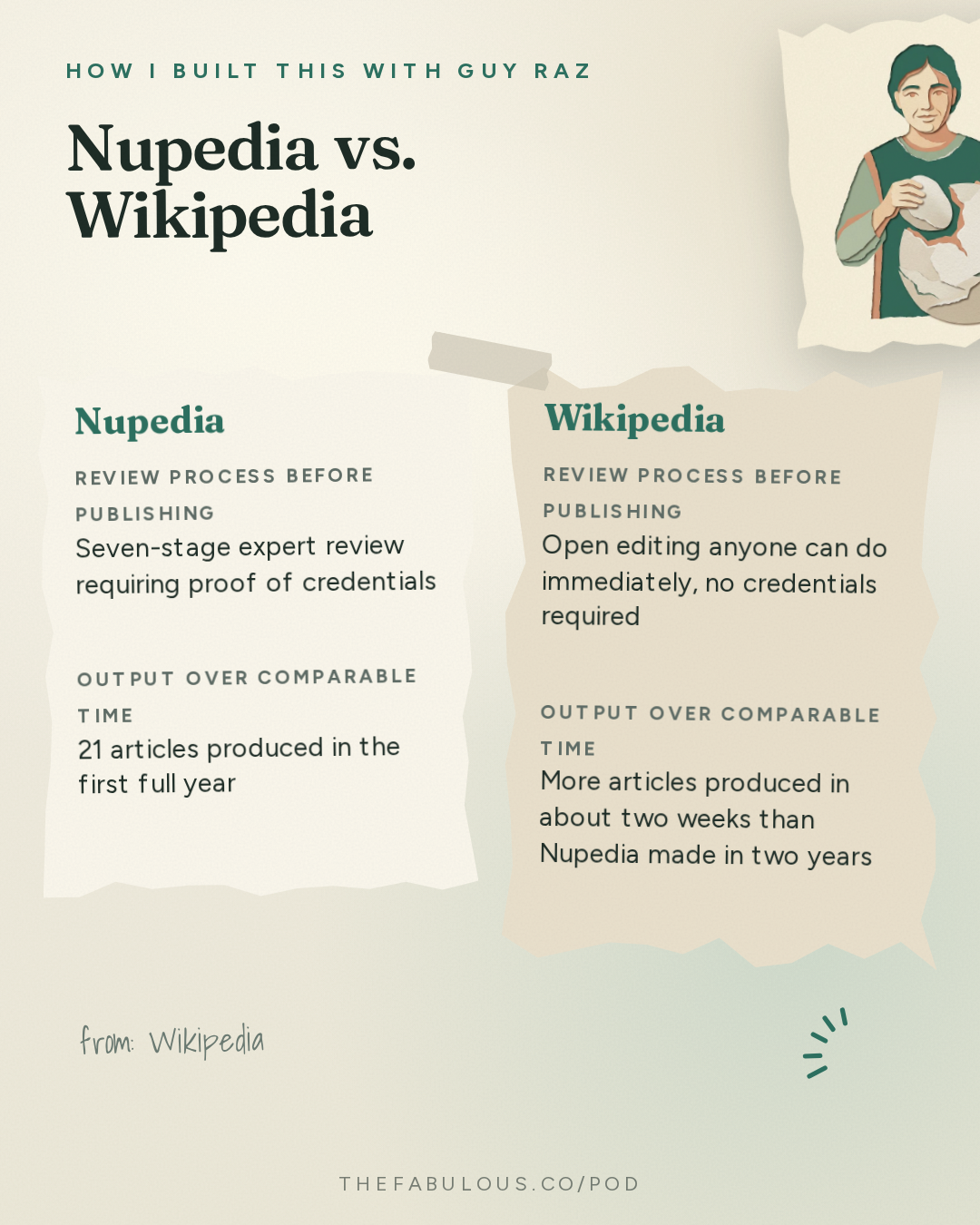
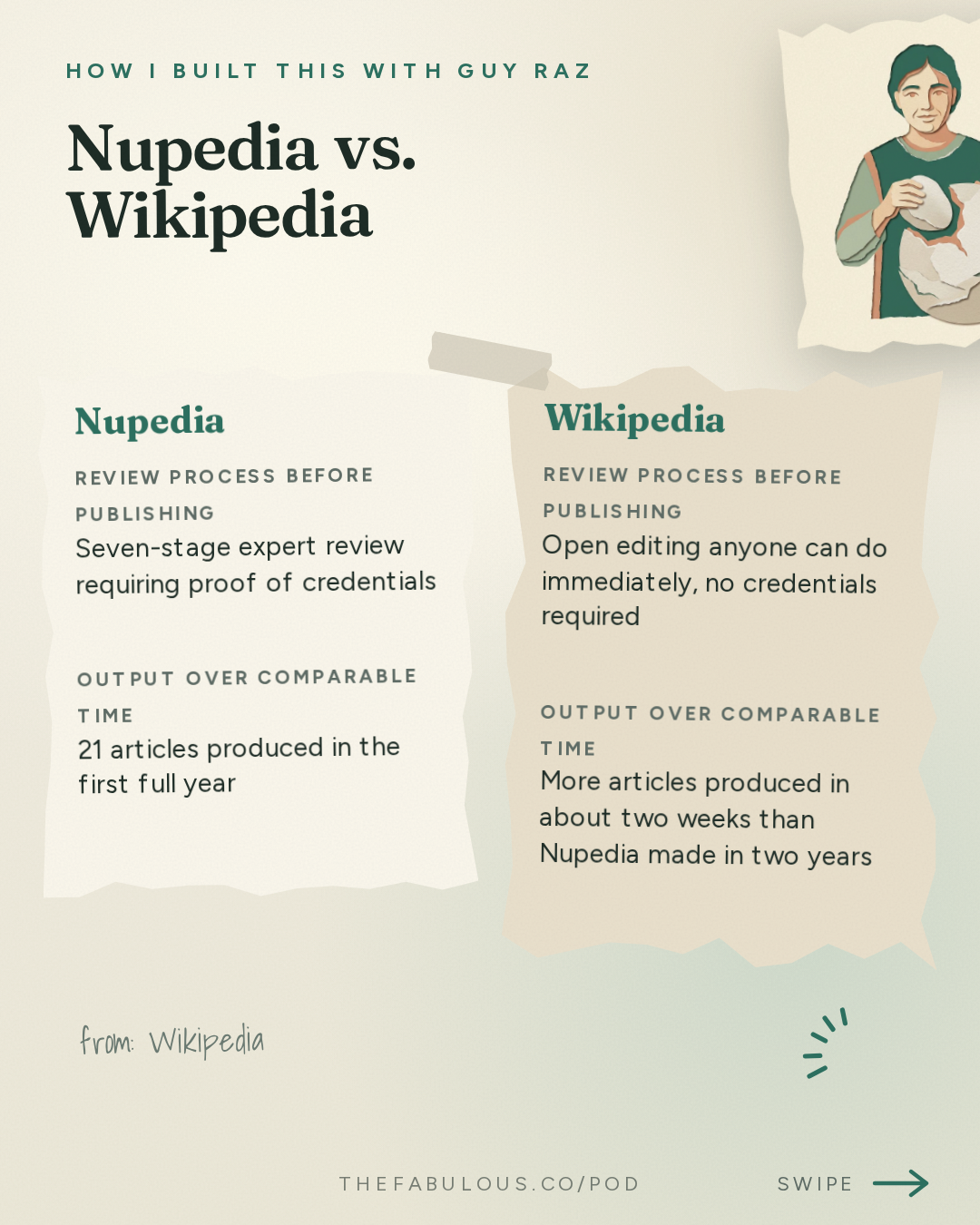
Jimmy Wales built Wikipedia after Nupedia's seven-stage academic review process produced only 21 articles in a year, then switched to open wiki software in 2001 and made it a donor-funded nonprofit so the mission, not ad revenue, would set the rules. The result: the world's fifth-most-visited site, run almost entirely by volunteers.
The first words ever typed into Wikipedia were "Hello, world." Jimmy Wales typed them himself, in January 2001, on a domain he half expected to fail (18:10). He remembers this clearly because almost nothing else from that week survives. No one saved the server logs. The earliest article anyone has since recovered is, fittingly, an entry on the letter Q (18:10). It is a strange, almost funny detail for the origin story of what would become the fifth-most-visited website on earth (05:05), behind Baidu and Facebook. But the strangeness is the point. Wikipedia was not supposed to start this way. It was supposed to start the responsible way, with credentials and committees, and that version of the project had already failed.
That earlier version was called Nupedia, and it was built on an idea Wales borrowed from the open-source software world, where programmers believed that if enough people looked at a piece of code, every flaw in it would eventually surface. "Given enough eyeballs, all bugs are shallow," he says, repeating the old maxim (14:02).
"Given enough eyeballs, all bugs are shallow." — Jimmy Wales [14:02]
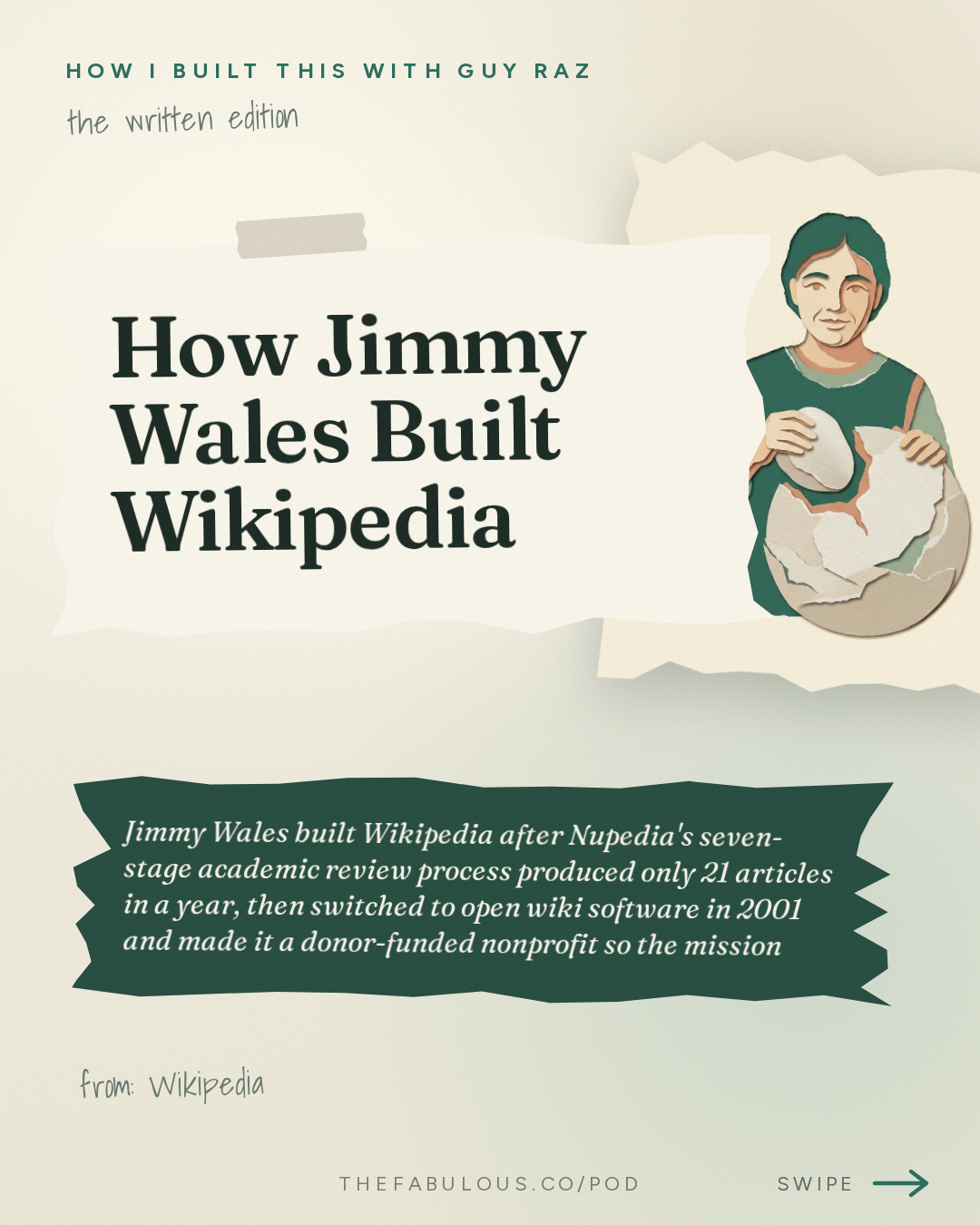
The trouble was that Nupedia never let enough eyeballs anywhere near the text before it was published. Wales set up a seven-stage process: propose a topic, prove your credentials, submit a draft, send it to expert reviewers, go through copy editing, and so on, with Larry Sanger installed as editor-in-chief to run it (12:29, 13:03). It looked rigorous. It behaved like a very small, very slow version of academic peer review. Wales wrote an entry himself, on the economist Robert Merton, whose option-pricing work he knew from his own graduate training in finance, and found the process so intimidating that he nearly gave up (14:48). After a full year of this, Nupedia had produced exactly 21 articles (14:48). One of those 21 turned out, on closer reading by outside visitors, to be plagiarized from other sources, a fact the seven-stage review had completely missed (13:21). The eyeballs were real. They had simply been locked out until it was too late to matter.
The fix came from a programmer named Ward Cunningham, who had invented a kind of website that anyone could edit directly, no review committee required. The word he used for it, wiki, is Hawaiian for quick (16:23). Wales and his small team at the search company Bomis, which was funding Nupedia on the side, decided to try the wiki software as a staging ground for Nupedia's own volunteers, and registered it under a separate name, Wikipedia, partly because they worried their more academic contributors would find the idea undignified (17:28). Wikipedia outgrew its parent almost immediately. Within about two weeks of launch it had generated more content than Nupedia had produced in its first two years combined (18:55). "It was like, wow, we've got this great community," Wales says, "and people just started writing, making articles on various random things" (19:12).
"In those early days it was very exciting. You could just be the first person to say Africa is a continent and hit save." — Jimmy Wales [00:21]
The Argument for Staying Poor
Wikipedia's early funding came from the same source as Nupedia's: ad revenue at Bomis, flush with dot-com-era money. When the crash hit and Bomis eventually shut down, that money disappeared, and Wikipedia was left running on volunteer labor and almost no cash (23:56). Wales says this near-poverty, far from crippling the project, is one of the real reasons it worked. "One of the reasons that Wikipedia became a huge success, I would say, ironically, is the lack of funding," he says (24:21). His reasoning is that money buys shortcuts. With real capital behind it, the natural move would have been to hire moderators and staff to make editorial calls from the top down. Without it, the community had to invent its own systems for handling vandalism and disputes, and those systems, built collectively rather than imposed, are what made the site self-governing at scale (24:21, 25:00).
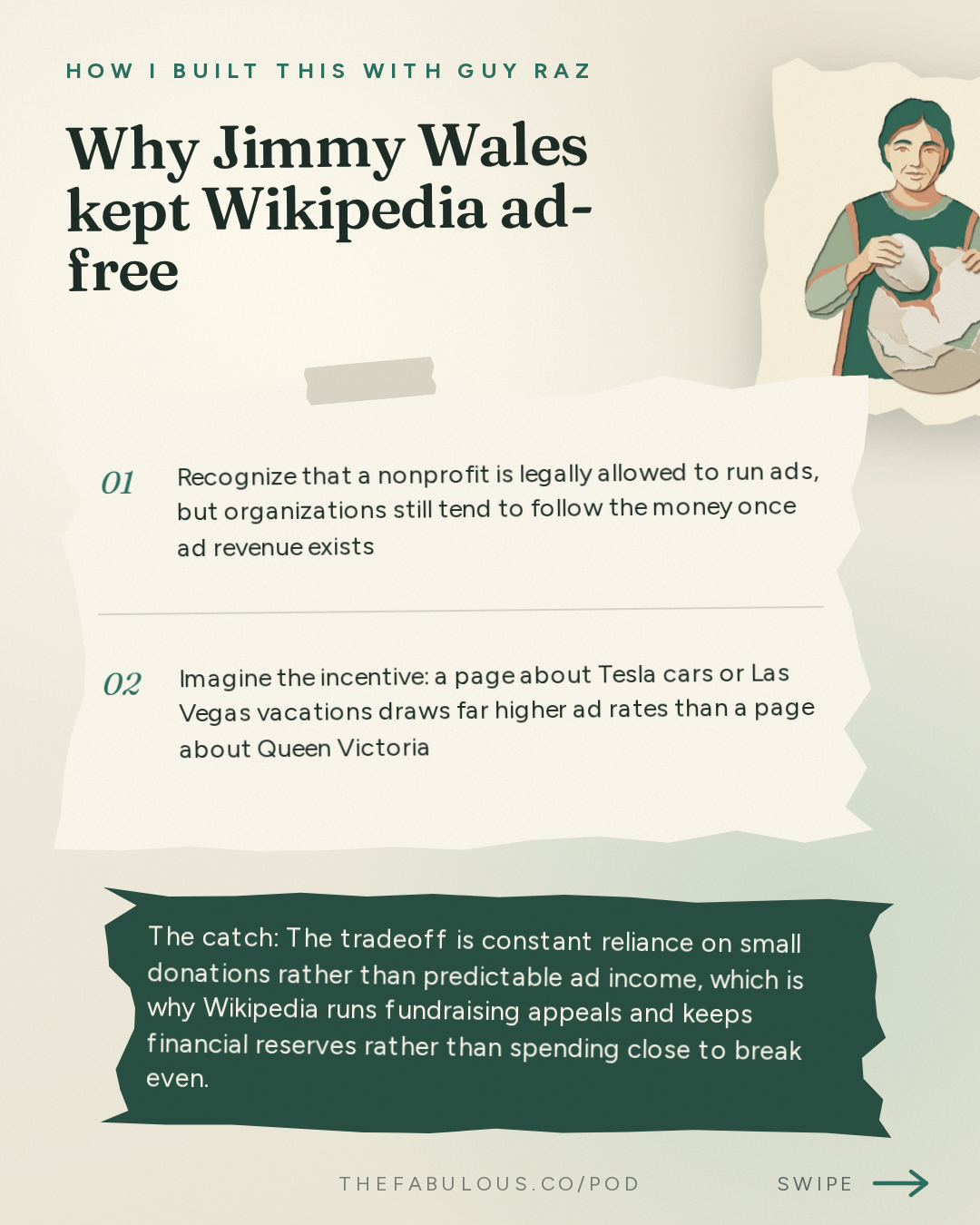
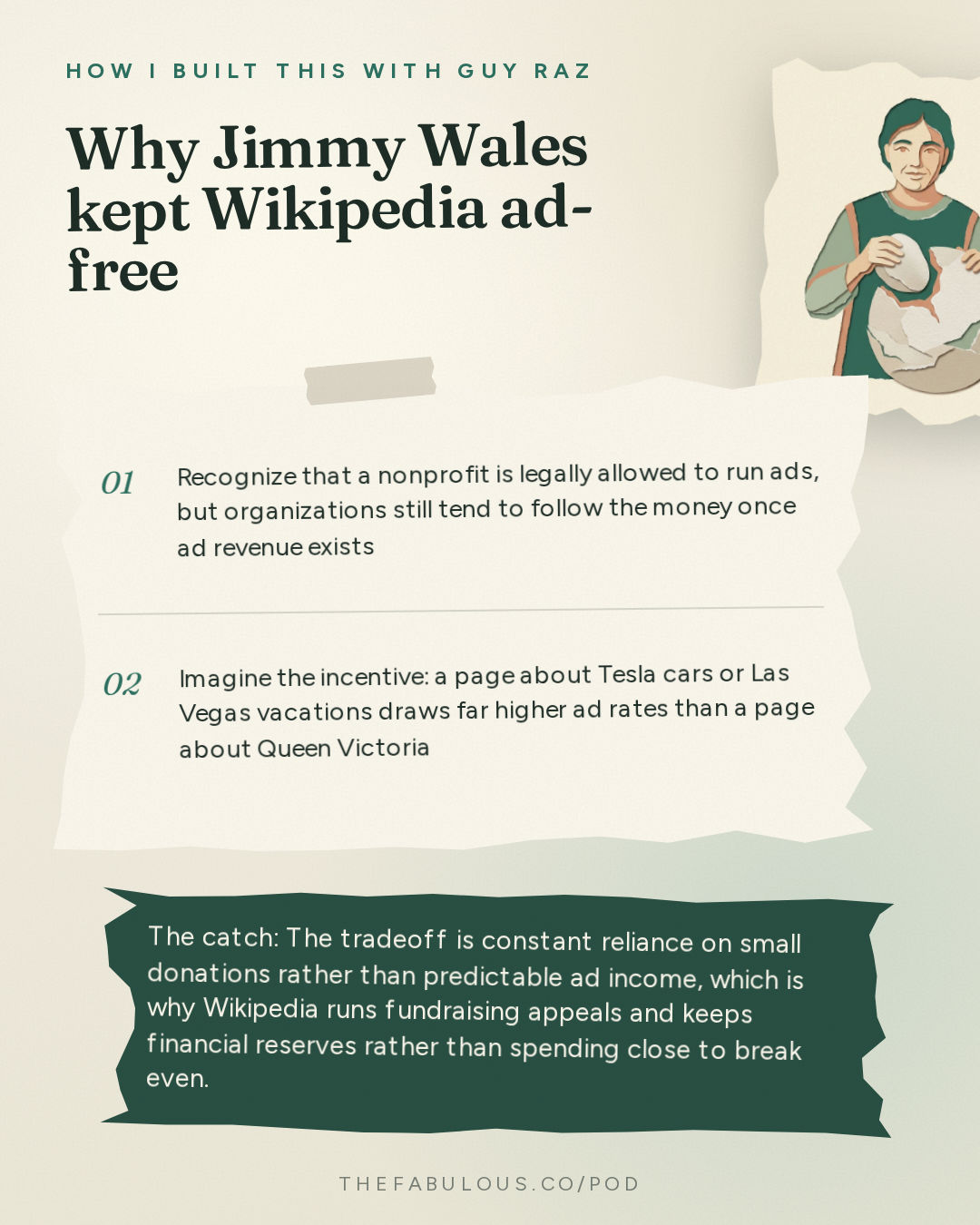
By 2003 Wales had formalized this instinct into a structural decision: Wikipedia would become a nonprofit, and it would carry no advertising. The absence of a clear business model during the dot-com bust was part of it, and the volunteer community's own preference was part of it too, but Wales also makes an argument about organizational behavior that is worth sitting with. "It's very difficult to stop an organization from following the money," he says (27:22). A nonprofit is legally free to run ads, he points out, but even a nonprofit will start caring more about traffic in lucrative categories once advertising dollars are on the table. An article about Queen Victoria draws thin ad rates; an article about Tesla cars or Las Vegas vacations draws much more. Once that incentive exists inside an organization, it reshapes decisions about what gets written and expanded, even for people with the best intentions (27:54). So Wikipedia took no ads at all, and in 2003 ran its first fundraising appeal instead, hoping for $20,000 and pulling in nearly $30,000 within two weeks (29:43). That small-donor model, built mostly from people giving what they could afford because they used the site and believed in it, is still how Wikipedia pays its bills.
Trust, Truth, and the Record
The clearest test of that community-run system came in 2005, when the veteran journalist John Seigenthaler Jr. called Wales directly to report that his Wikipedia biography falsely linked him to suspicion in the Kennedy assassination (30:37). The error was corrected within about ten minutes of the call (30:59), but Seigenthaler then wrote a scathing editorial in USA Today, and the story exploded into national news, landing Wales on CNN to answer for it (31:06). Out of that episode came Wikipedia's Biography of Living Persons policy: any negative claim about a living person now requires a solid, verifiable source, full stop (31:48). It was not a public-relations gesture. It changed how the community actually edits.
Wales is unusually candid about what Wikipedia is and is not good for. "Wikipedia is the place to go to get the questions, not the answers," he says, and he means this literally: check the talk page behind any article, see where editors are still arguing about which sources conflict, and that disagreement is often the most useful thing on the page (32:44). He agrees, without defensiveness, that newsrooms were right not to treat Wikipedia as a citable source back when NPR and others banned it in 2005 (32:25). The deeper worry he raises is less about any single article and more about a cultural drift toward thinking that no source is trustworthy at all. "The best way to prepare people for authoritarian rule is not to indoctrinate them into an authoritarian philosophy, but to make them believe that there's no such thing as truth," he says (36:07), framing Wikipedia's sourcing debates as a small, ongoing defense against that drift rather than a cure for it.
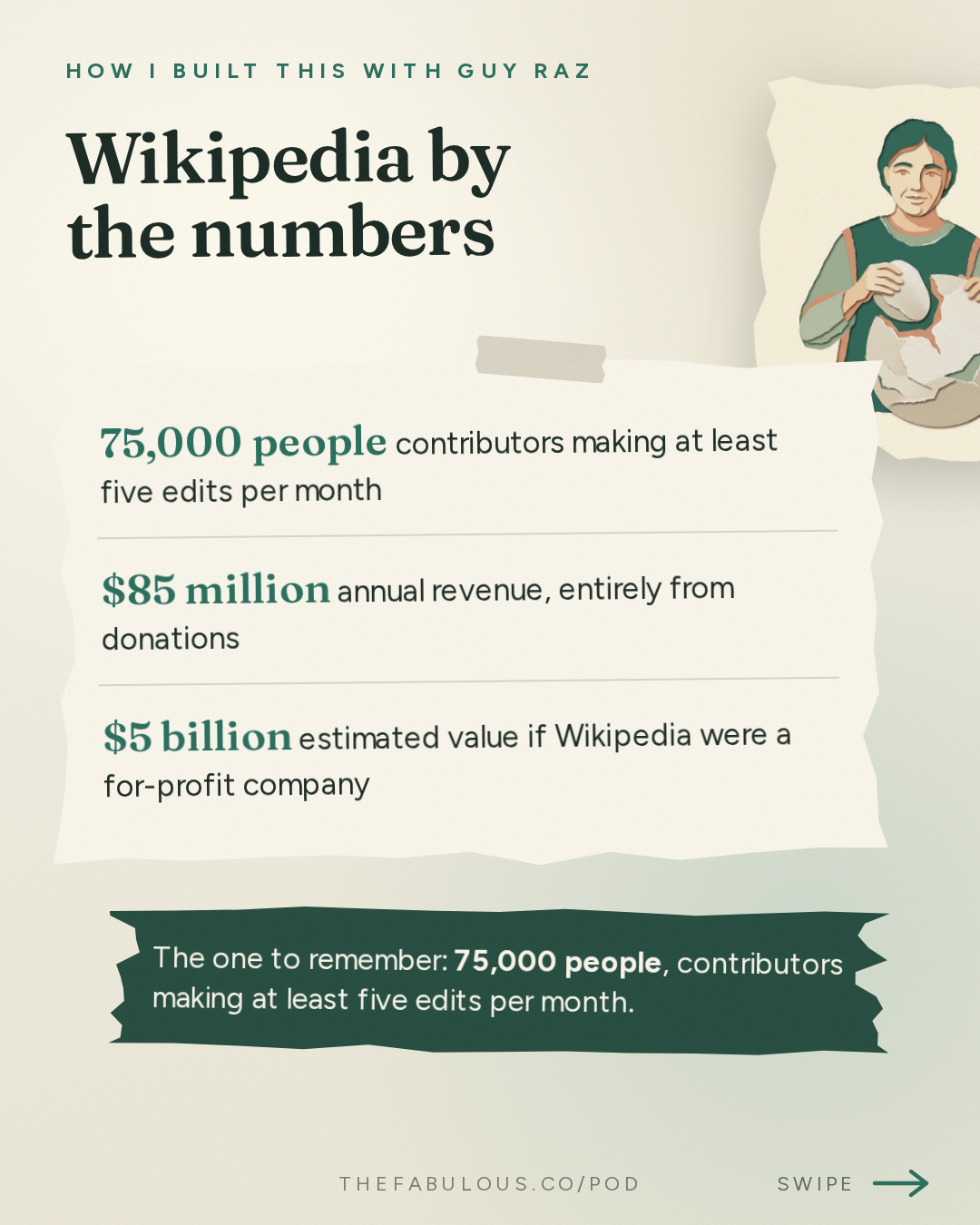
What that defense looks like today, in numbers, is a sprawling, largely anonymous workforce. English Wikipedia alone holds just over five million pages, and all language versions combined hold close to fifty million (38:42). Around 75,000 people make at least five edits in a given month, and the hard core of the community, the people racking up a hundred edits or more, numbers somewhere between three and five thousand (39:04). None of them are paid. The whole apparatus runs on roughly $85 million a year in donations, almost entirely from small individual gifts (40:53). People analysts have floated a for-profit valuation north of $5 billion for an enterprise like this, and Wales says the number means nothing to him (43:05). His own net worth, per Forbes, is estimated at not much more than $1 million, making him likely the least wealthy founder among the internet's five most-visited sites (05:37). He attributes the whole project less to his own talent than to timing and temperament: a willingness to be yelled at by volunteers and keep showing up anyway (42:09). "I do think that no one will remember me in 500 years," he says, "but they'll definitely remember Wikipedia" (43:47). Given how the project was built, on an abandoned seven-stage process, a word borrowed from Hawaiian, and a refusal to chase ad money, that seems like exactly the trade he set out to make.
Ask this episode anything
Pod's AI answers from the episode itself, with the minute mark so you can hear it yourself.
Or start with one of these
Ask this episode
Pod's AI listens to the whole episode to answer, and points you to the minute it comes from.
The rest of this answer, and any question after it
Answers come from the episode itself, never from a summary of it.
ContinueKey takeaways
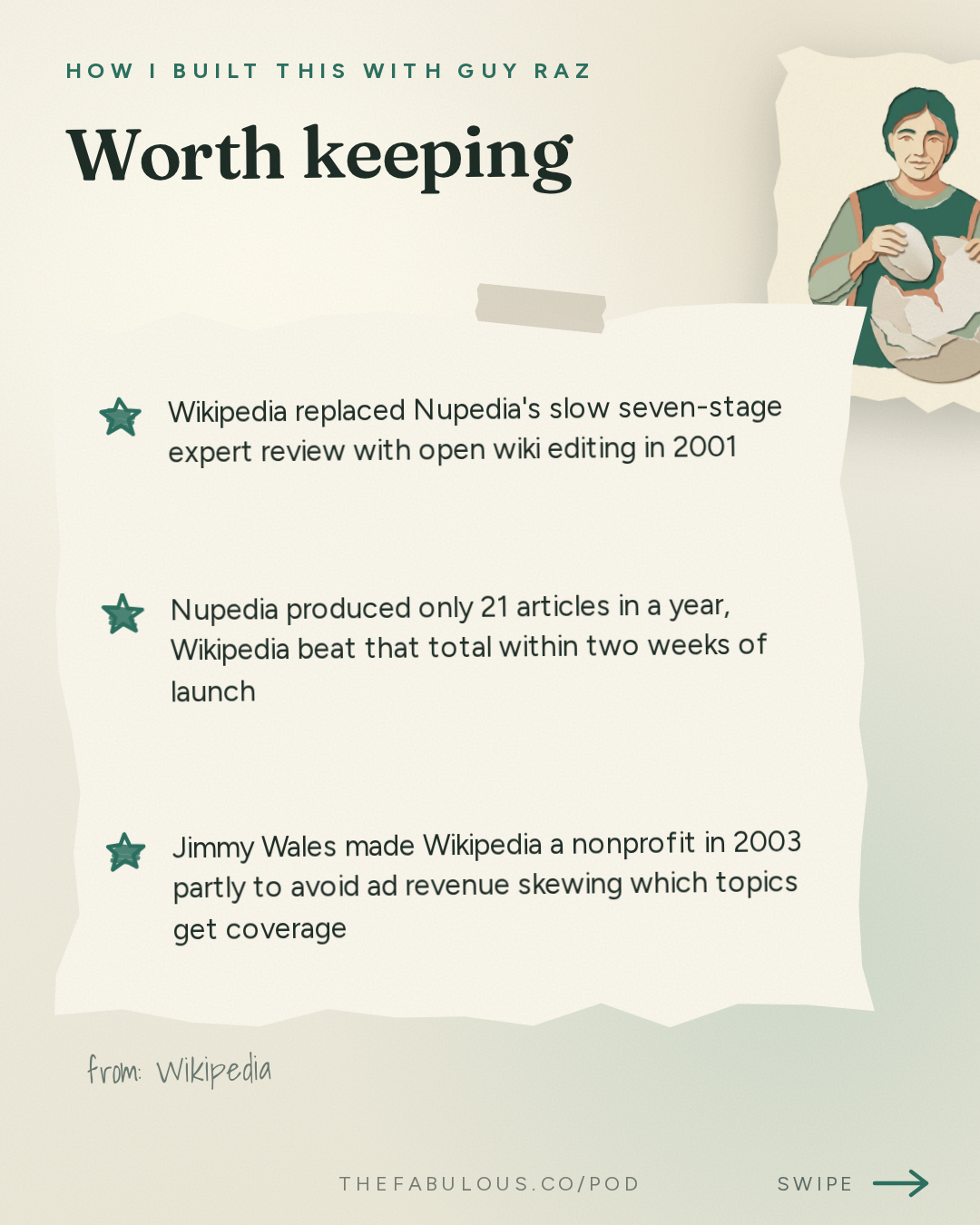
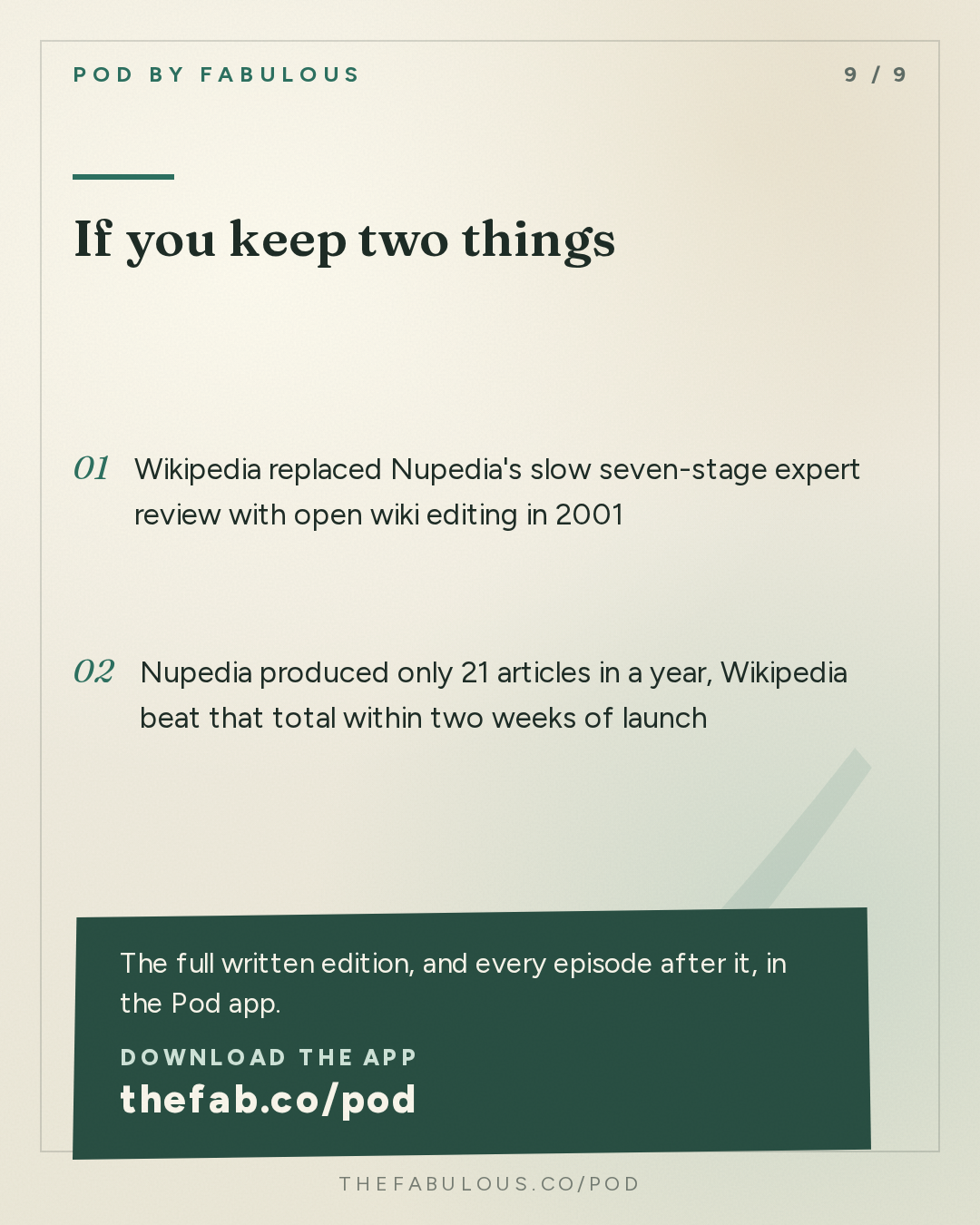
- Wikipedia replaced Nupedia's slow seven-stage expert review with open wiki editing in 2001
- Nupedia produced only 21 articles in a year, Wikipedia beat that total within two weeks of launch
- Jimmy Wales made Wikipedia a nonprofit in 2003 partly to avoid ad revenue skewing which topics get coverage
- The 2005 Seigenthaler controversy over a false Kennedy assassination claim led to Wikipedia's Biography of Living Persons policy
- Wikipedia runs on about $85 million a year in small donations with no advertising at all
The episode in cards
By the numbers
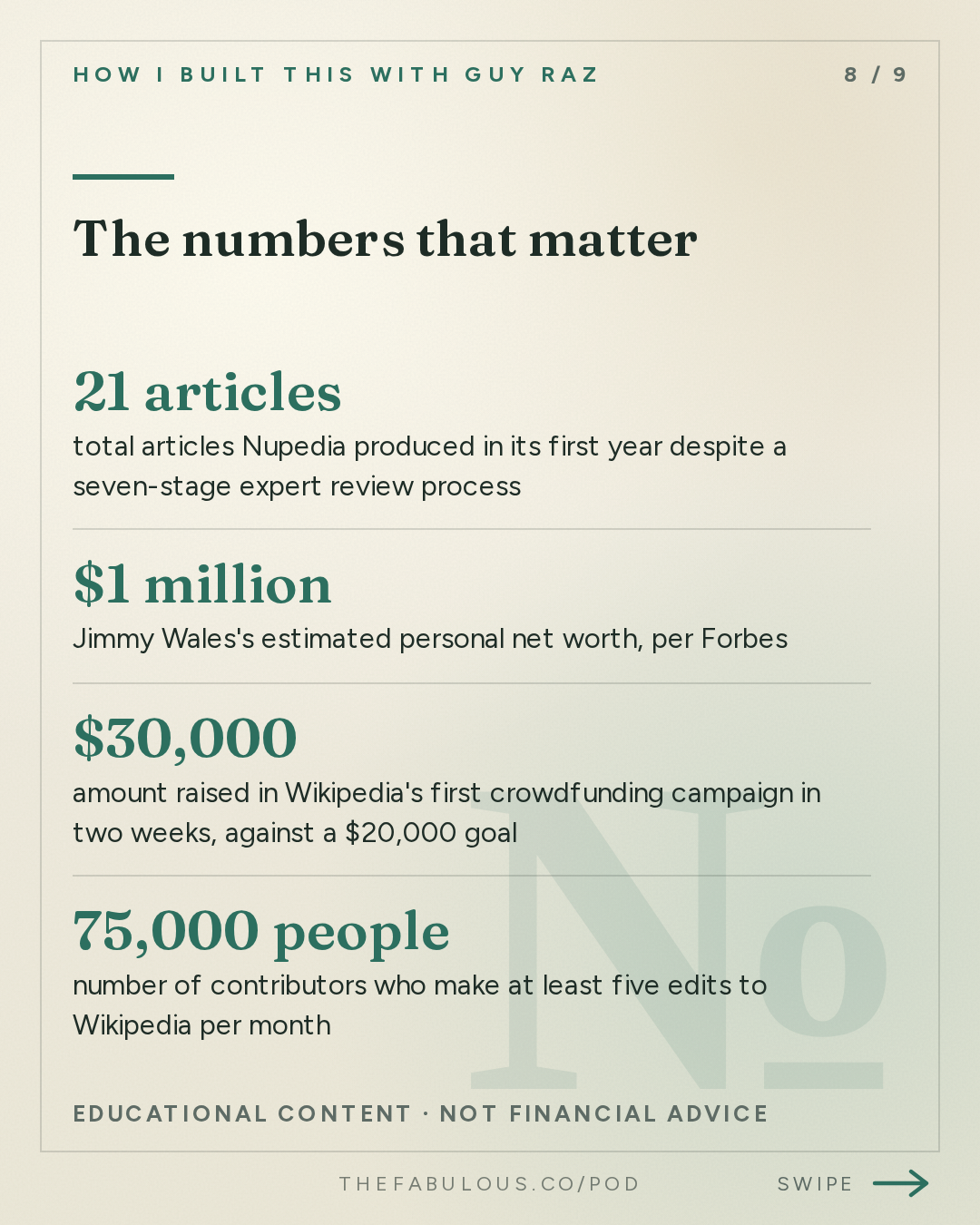
- 21 articles total articles Nupedia produced in its first year despite a seven-stage expert review process
- $1 million Jimmy Wales's estimated personal net worth, per Forbes
- $30,000 amount raised in Wikipedia's first crowdfunding campaign in two weeks, against a $20,000 goal
- 75,000 people number of contributors who make at least five edits to Wikipedia per month
- $85 million Wikipedia's approximate annual revenue from donations
In their words
“In those early days it was very exciting. You could just be the first person to say Africa is a continent and hit save.”
“Given enough eyeballs, all bugs are shallow.”
“One of the reasons that Wikipedia became a huge success, I would say, ironically, is the lack of funding.”
“It's very difficult to stop an organization from following the money.”
Protocols
-
Use Wikipedia to find the right questions, not final answers
Jimmy Wales advises treating a Wikipedia article as a starting point for orientation on a topic, then checking the article's talk page to see where editors disagree about sources, and following the footnotes to the original sources before citing anything as fact.
Every time someone uses Wikipedia for research
-
Require solid sourcing for any negative claim about a living person
After journalist John Seigenthaler Jr. found a false claim in his Wikipedia biography in 2005, Wales says the community adopted a rule that any negative statement about a living person must be backed by a good quality source or it gets removed.
Ongoing editorial standard since 2005
Questions this episode answers
How did Wikipedia start?
Jimmy Wales first tried building an online encyclopedia called Nupedia, which used a seven-stage expert review process and produced only 21 articles in its first year (14:48). In 2001 his team adopted open wiki software built by programmer Ward Cunningham, which let anyone edit directly, and Wikipedia outgrew Nupedia's two-year output within about two weeks (18:55).
Why is Wikipedia a nonprofit instead of ad-supported?
Jimmy Wales argues that any organization, nonprofit or not, tends to follow the money once advertising revenue exists, which would push editorial attention toward high-traffic, high-ad-rate topics instead of general knowledge coverage (27:22). Wikipedia became a nonprofit in 2003 and funds itself through small donations, raising nearly $30,000 in its first crowdfunding campaign against a $20,000 goal (29:43).
What was the John Seigenthaler Wikipedia controversy?
In 2005, journalist John Seigenthaler Jr. discovered his Wikipedia biography falsely suggested he had been briefly suspected in the Kennedy assassination (30:37). The error was corrected within ten minutes of his call, but his subsequent USA Today editorial drew national press attention and led Wikipedia to adopt its Biography of Living Persons policy, requiring solid sourcing for any negative claim about a living person (31:48).
What is Jimmy Wales's net worth?
Forbes estimates Jimmy Wales's personal fortune at not much more than $1 million (05:37), making him likely the least wealthy founder among the world's five most-visited websites, compared to founders of Google, Facebook, and Baidu who are worth billions.
How much money does Wikipedia make and how is it funded?
Wikipedia's annual revenue was approximately $85 million in donations, almost entirely from small individual donors, with no advertising on the site at all (40:53). Wales says the organization keeps financial reserves rather than running close to break even, because donors want Wikipedia to be financially stable (41:21).
The full read, in cards
Go deeper
- Slashdot interview with Jimmy Wales — Wales described the mission as giving every person on the planet free access to the sum of all human knowledge
- USA Today editorial by John Seigenthaler Jr. — Scathing piece about a false Wikipedia claim linking him to the Kennedy assassination, which drew national press attention
Mentioned
Jimmy Wales · Larry Sanger · Ward Cunningham · John Seigenthaler Jr. · Johannes Gutenberg · Wikipedia · Nupedia · Bomis · Google · Netscape
More from this show and category
Rothy's Founding Story: Roth Martin's $1B Shoes
Art dealer Roth Martin co-founded Rothy's with Steven Hawthorne-Waite, surviving years of failed shoe prototypes in Maine and China before building their own Chinese factory. The pair reached $100 million in sales by 2018 and a $220 million revenue run rate in 2024, staying profitable on every pair sold.
Jensen Huang: How NVIDIA Almost Died Twice
Jensen Huang, cofounder of NVIDIA, told Guy Raz how a failed first chip, a canceled Sega contract, and a decade-long bet on a platform called CUDA nearly broke the company before it became the engine of the AI boom. He also described what the climb cost him at home.
How Jesse Merrill Built Good Culture
Jesse Merrill grew Good Culture cottage cheese to $200 million in revenue by 2025, using branding skills from Honest Tea and Moby's tea startup. A 2015 ulcerative colitis diagnosis led him to cottage cheese's protein and sugar profile, and a 2023 TikTok ice cream hack made the category go viral before he sold a majority stake to private equity firm L Catterton.
Ron Shaich's Panera Bread Origin Story
Ron Shaich sold his own flagship chain, Au Bon Pain, to bet everything on a smaller concept, Panera Bread, which climbed from about $3 a share to $315 a share. The pivot grew out of a 1993 deal for 19 St. Louis Bread Company stores and a 'third place' strategy built around cheap real estate and room to linger, not just recipes.
