
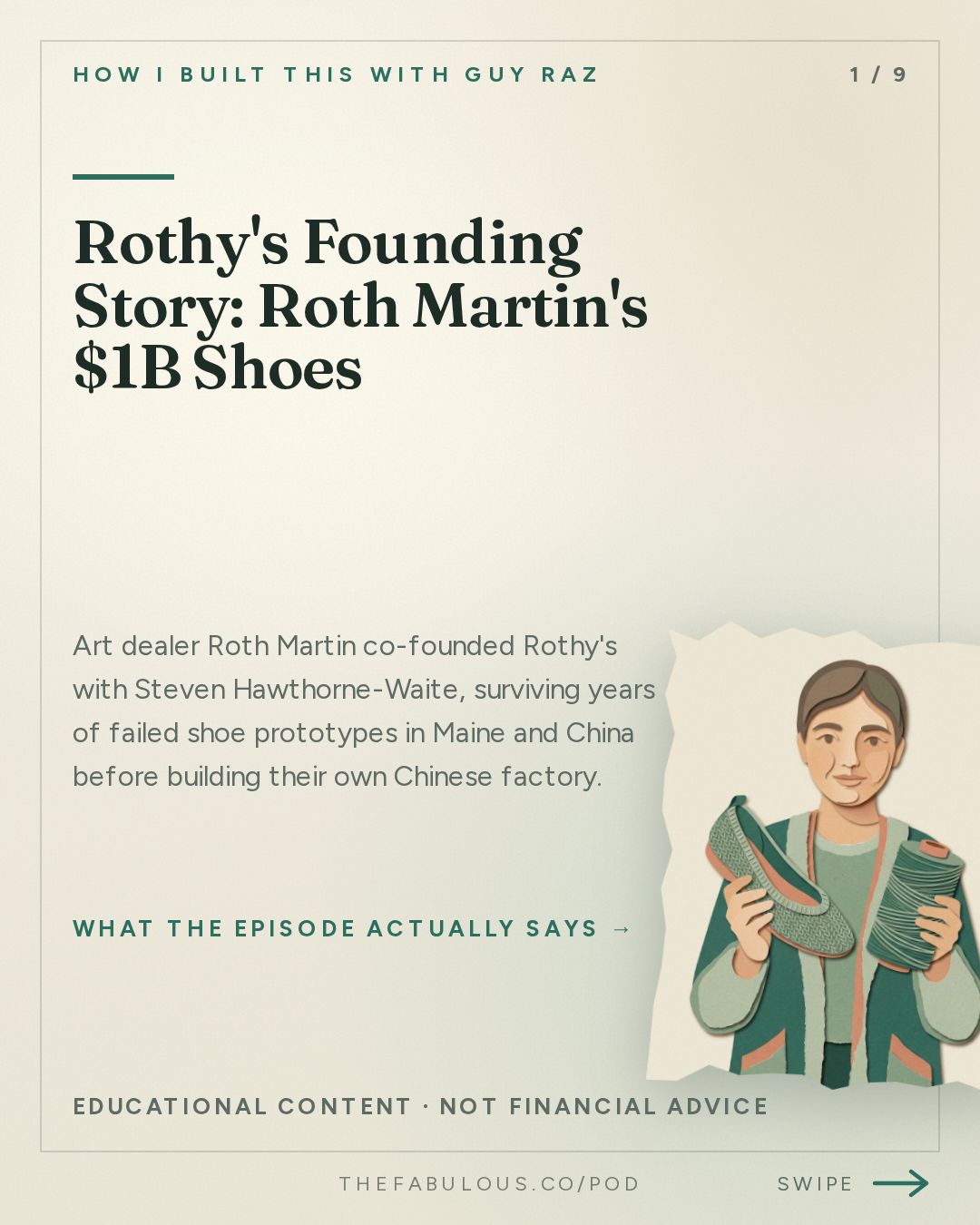
Rothy's Founding Story: Roth Martin's $1B Shoes
Rothy's: Roth Martin. The Art Dealer Who Built a $1B Shoe Brand from Plastic Bottles
The brief
Art dealer Roth Martin co-founded Rothy's with Steven Hawthorne-Waite, surviving years of failed shoe prototypes in Maine and China before building their own Chinese factory. The pair reached $100 million in sales by 2018 and a $220 million revenue run rate in 2024, staying profitable on every pair sold.
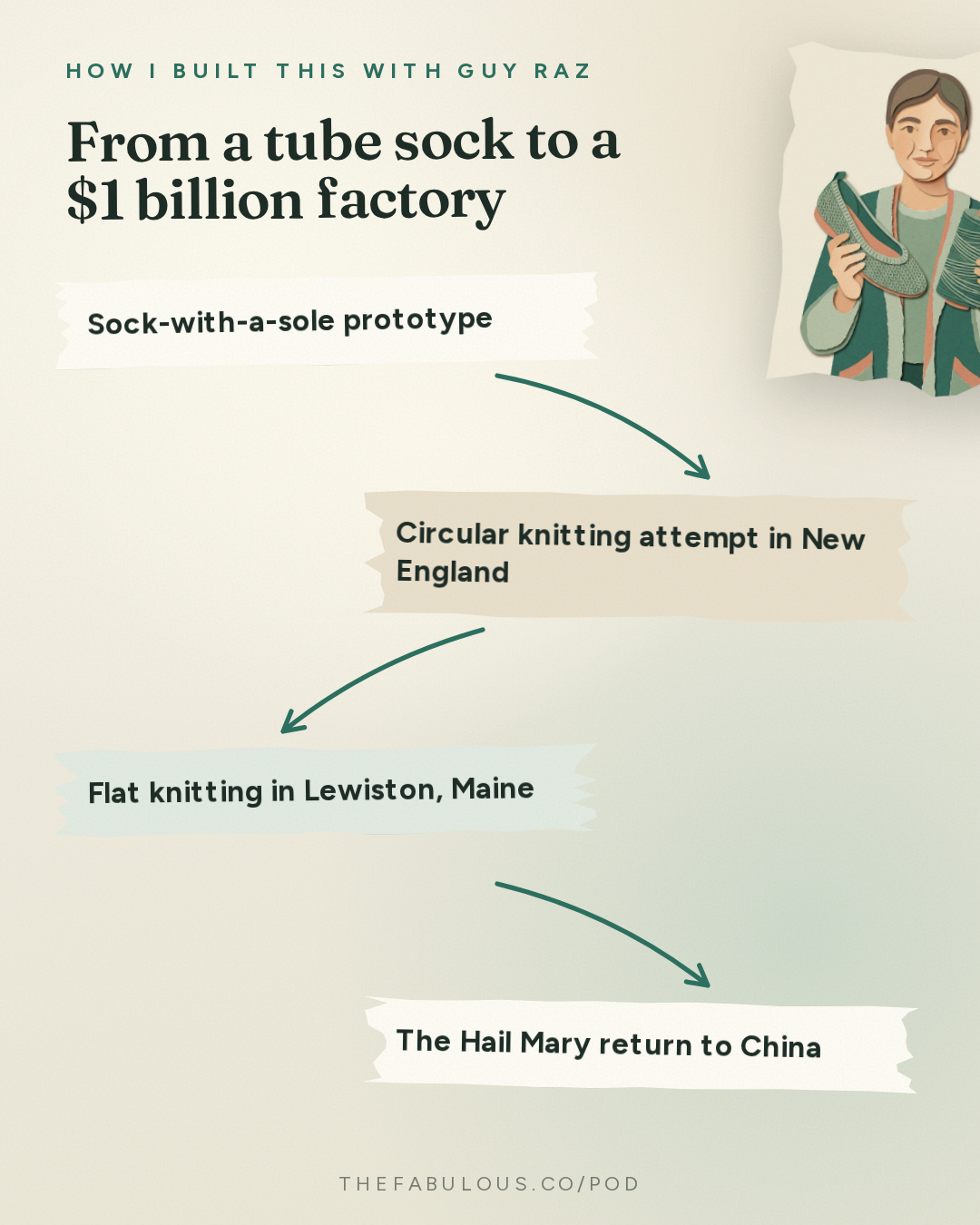
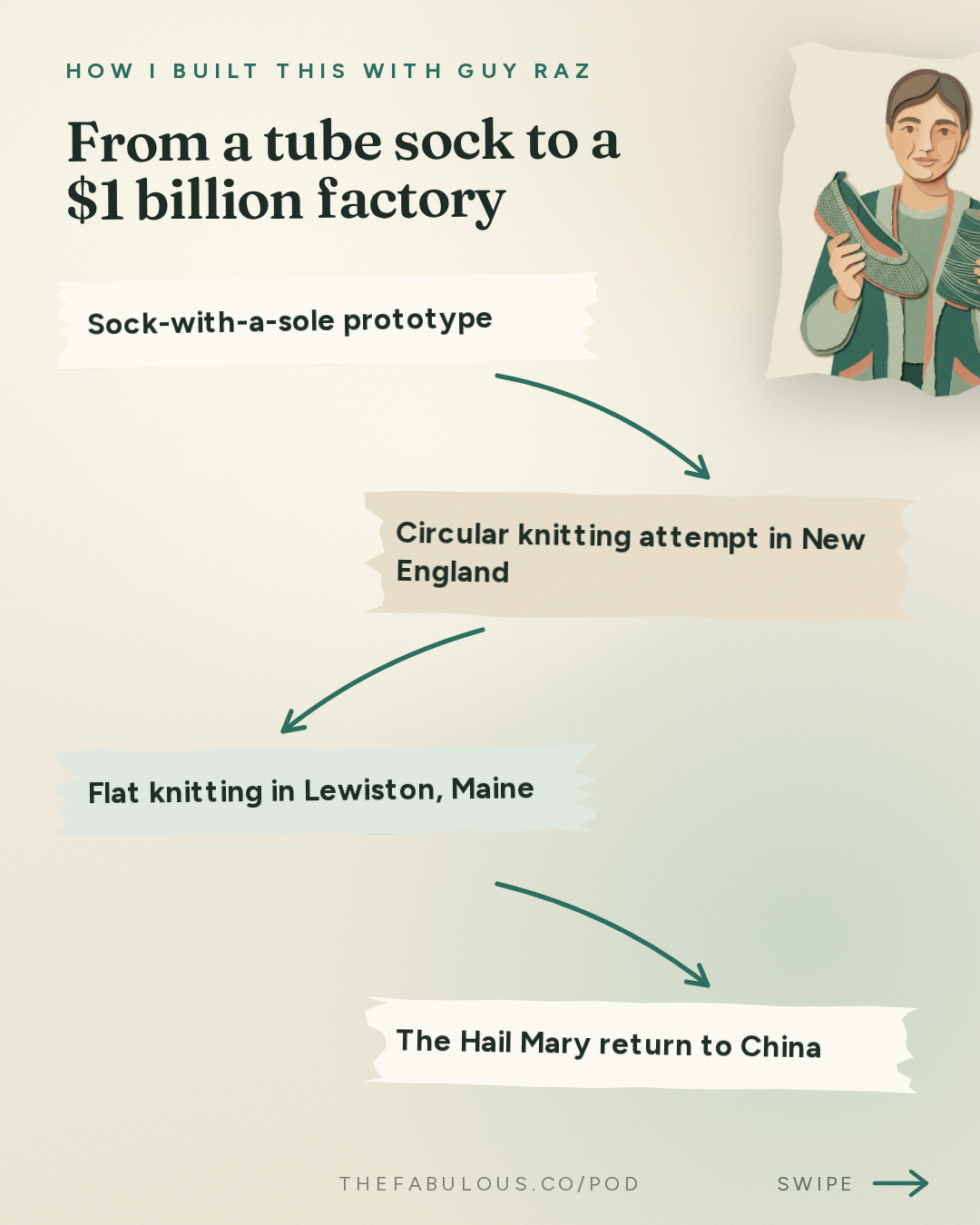
Here is a detail that tells you almost everything about how hard it is to build a physical product: the two men designing a women's shoe could not try it on. Roth Martin and his co-founder, Steven Hawthorne-Waite, had flown to a factory in Guangzhou, China, to test their first prototype, a tube sock with a rubber sole injected onto the bottom. When it came time to see if the thing actually worked, neither founder could slip it onto his own foot. A woman at the factory had to do it for them. "We were after solving this for women," Martin says, "which would later become one of the big challenges, right? Was two guys trying to make a woman's shoe and not even being able to experience the product."
That gap between idea and object is the real subject of Rothy's origin story. Martin arrived at footwear sideways. He started as a commodities trader hunting for deals on things like copper mines, then became an antique furniture dealer in San Francisco, flying to European auction houses to buy mid-century French and Italian pieces and reselling them in New York (05:52). He opened a gallery called Hedge. It worked, but it was not scalable: furniture is bulky, the client relationships were personal, and by his early forties Martin was fatigued and looking for the next thing. The next thing came from watching his wife get dressed. Around 2011 and 2012, Martin noticed that women in San Francisco had started wearing stretchy, technical fabrics like Lululemon's all day, not just to the gym, but no one had figured out the shoe to go with it. Sneakers meant lacing up. Ballet flats meant pain. Flip-flops were flip-flops. "Style and comfort were totally at odds," he says of that moment (19:10). The opportunity, as he and Hawthorne-Waite eventually saw it, was a slip-on flat that behaved like athletic wear: stretchable, washable, durable.
Knowing what you want and knowing how to make it are different problems, and the distance between them cost Martin and Hawthorne-Waite roughly four years and a meaningful amount of their own savings, about a million dollars each (45:40). Their first idea was to knit the shoe the way socks are made, using a process called circular knitting, which produces a continuous tube. They set up shop in a leased factory space above a shoe-machine repairman in Lewiston, Maine, a town that in 1938 made more shoes than anywhere else in the world (38:59). For a year and a half, Martin and Hawthorne-Waite flew from San Francisco to Portland almost every week. What they discovered, slowly and expensively, was that circular knitting could not control the "zones" of stretch a shoe upper needs the way it needs them. A sweater can tolerate a five-millimeter difference in sleeve length. A shoe cannot.
"Millimeters in, in, in footwear m- can be, be the difference between a size X and Y. It's a short and a grande at Starbucks." — Roth Martin [44:16]
The fix was flat knitting, the technique used to make sweaters, which let a computer program shape the upper directly so nothing had to be cut. They also landed on the material: polyester, later recycled polyester, developed with a yarn company called Unifi, because it held color and had the rigidity nylon and cotton lacked (35:32, 35:59). But the know-how to run this at scale did not exist in Maine. One of their few toolmakers went bankrupt. Progress stalled. In 2015, Martin made what he calls a Hail Mary: he packed two storm cases with every prototype, yarn sample, and computer pattern they had and flew back to China alone, this time to a sweater factory in Fujian, leaving Hawthorne-Waite to shut down the Maine operation. Within ten days, paired with a local programmer named Pan who spoke no English, Martin was making more progress than the previous eighteen months had produced. "I call Hathi and I'm like, 'Yeah, you can just shut down what we're doing in Maine,'" he recalls (47:33).
The factory that almost sank the launch
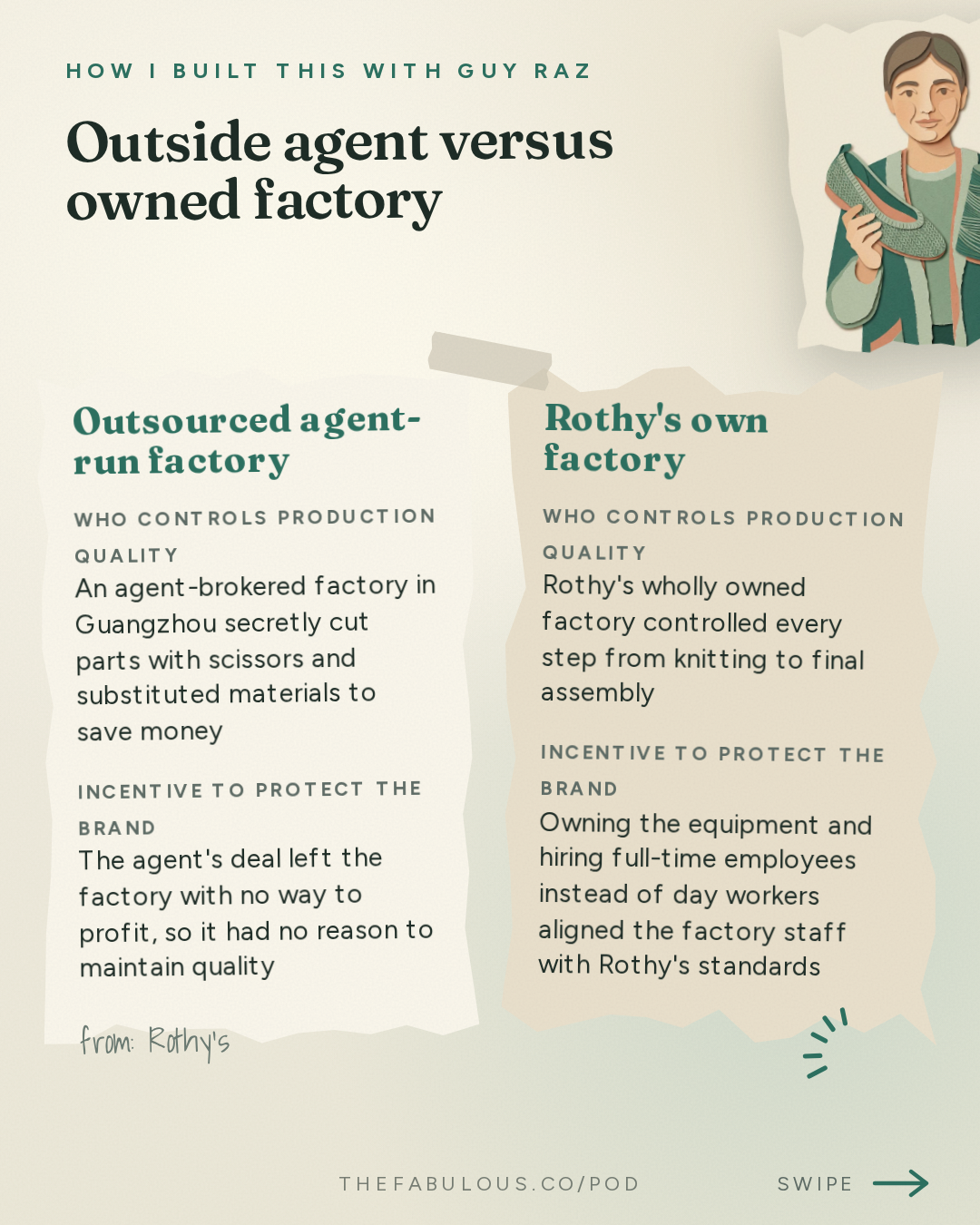
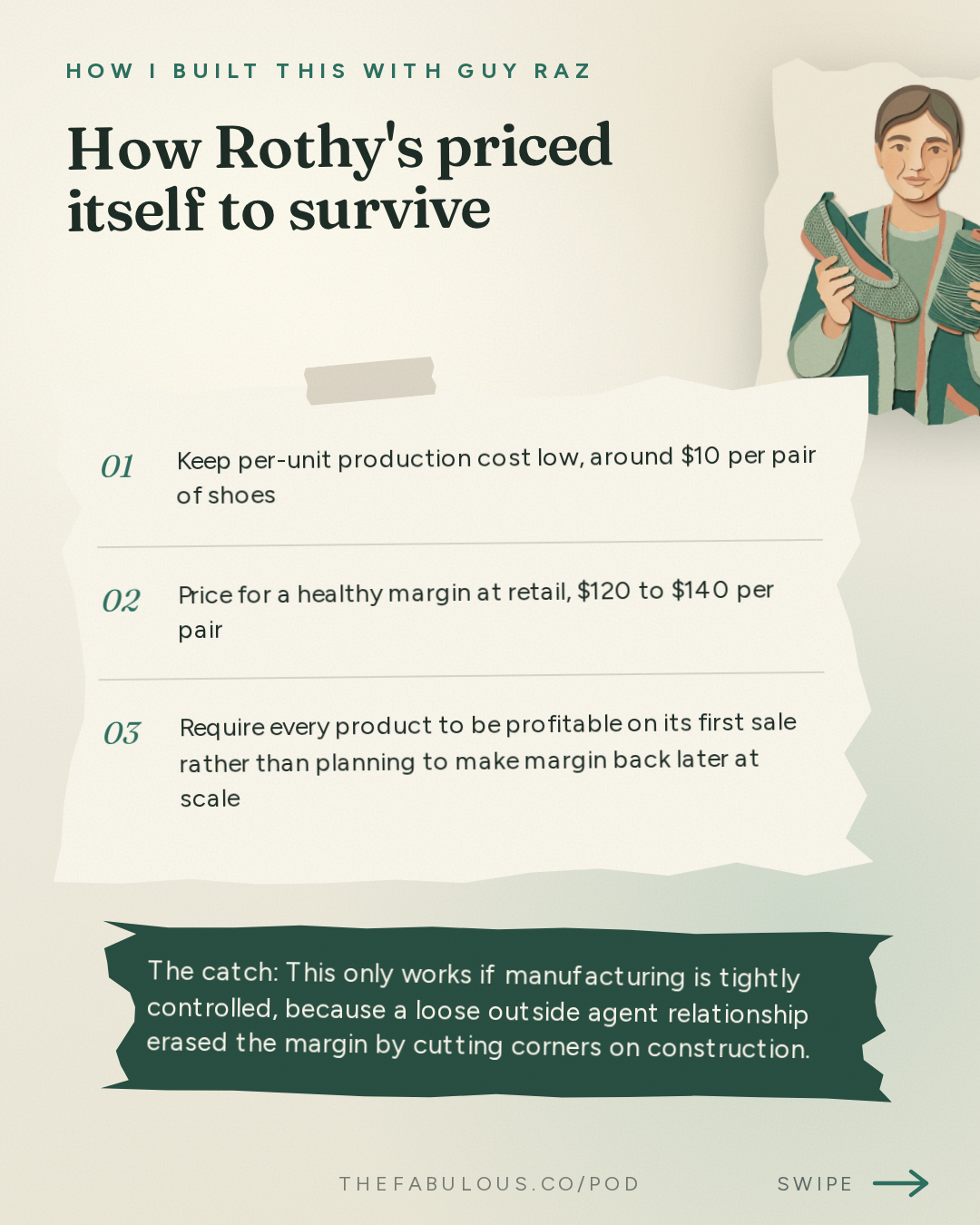
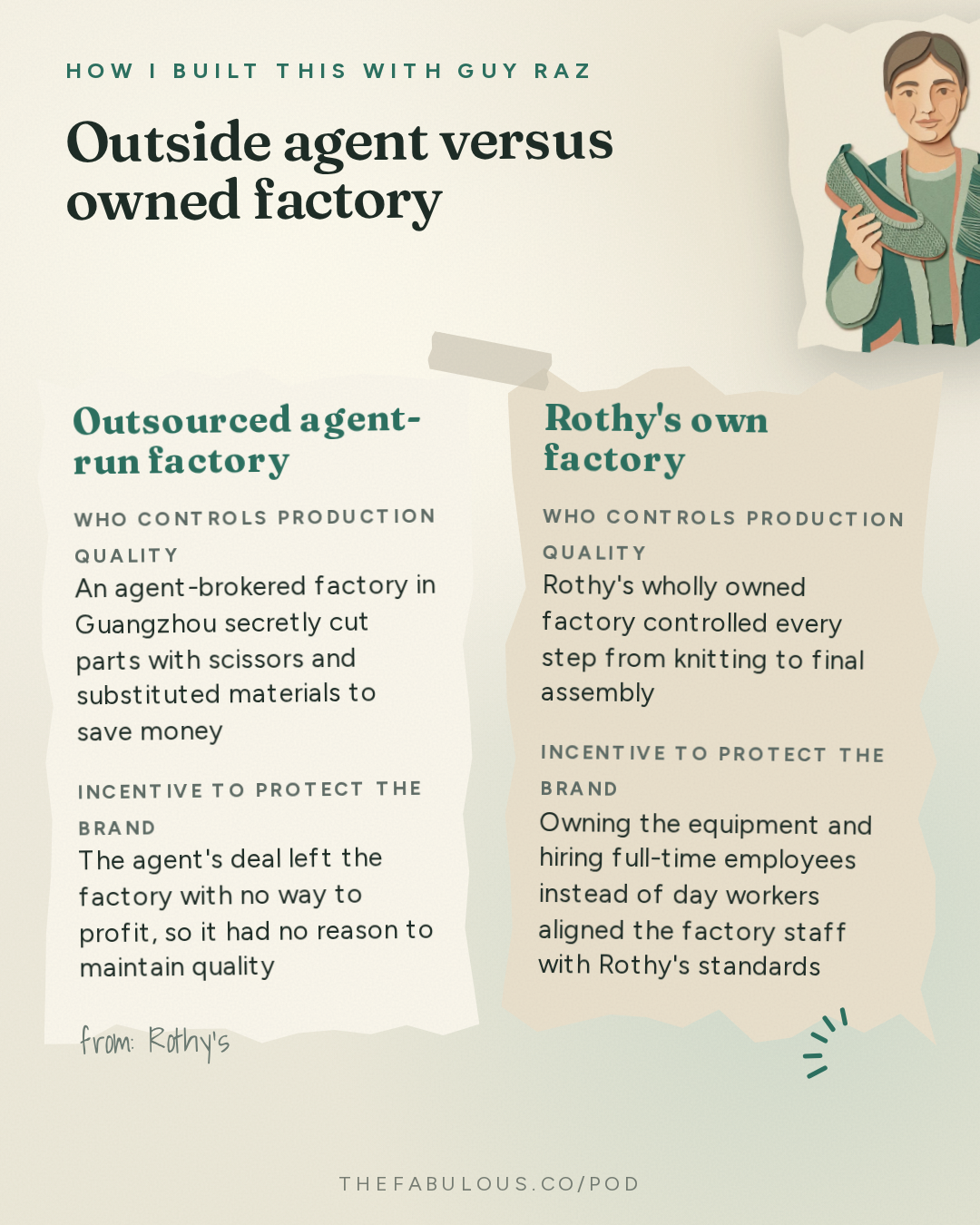
Rothy's finally launched in December 2015, selling through personal contact lists and Facebook ads, and brought in about $100,000 in its first month (57:31). Then the holiday rush exposed sizing problems and inconsistent product. Worse, Martin discovered that after he left China, the outside factory assembling the shoes had quietly changed its construction method to save money, cutting parts with scissors and substituting materials. "The product was butchered," Martin says flatly (00:02). The underlying problem was structural, not malicious: the agent who had brokered the manufacturing deal had negotiated terms that left the factory unable to turn a profit, so the factory had no reason to protect quality.
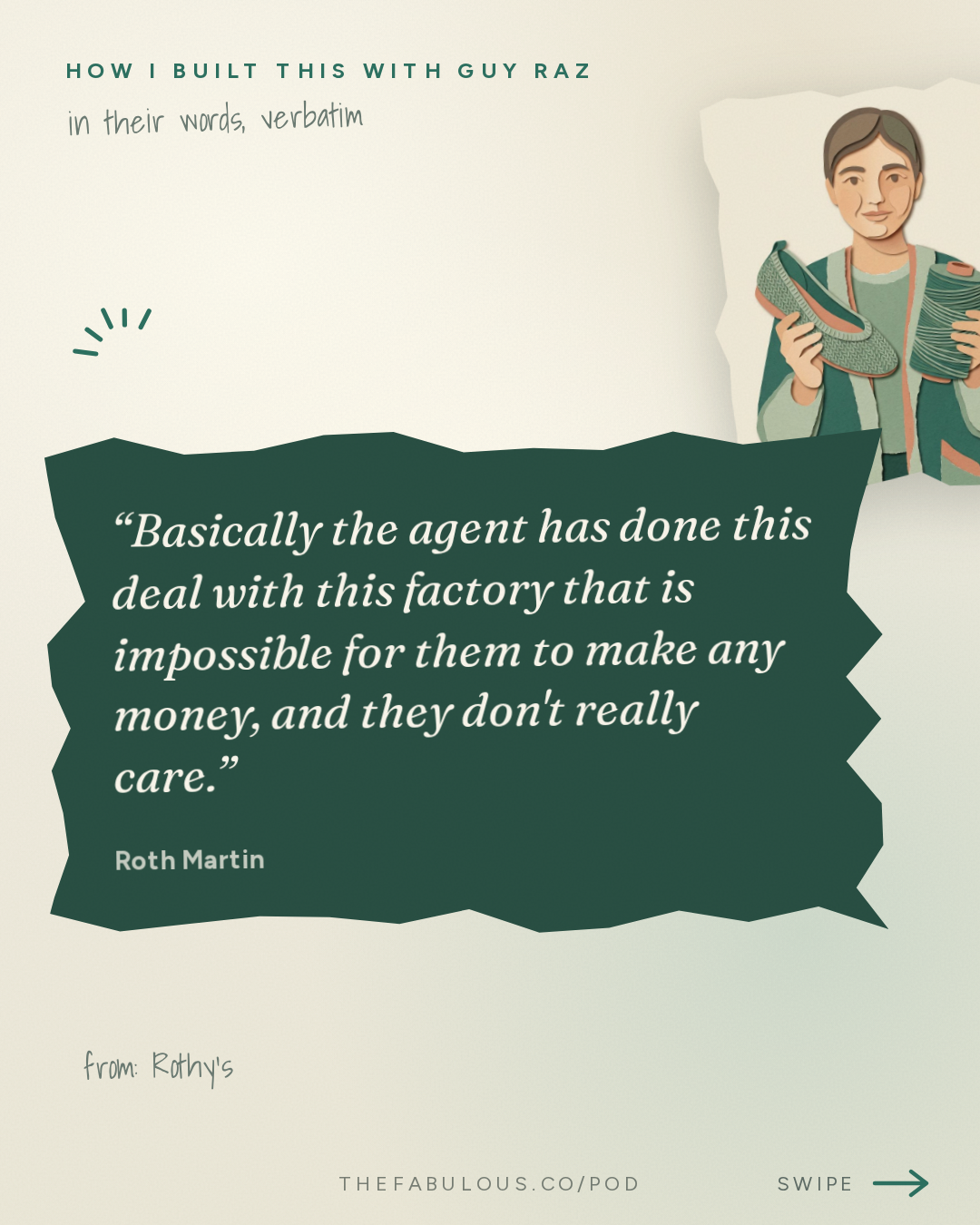
"Basically the agent has done this deal with this factory that is impossible for them to make any money, and they don't really care." — Roth Martin [61:47]
Rothy's went dark for six months in early 2016, pulling its product off the site entirely while Martin rebuilt the supply chain from scratch, this time buying his own knitting machines and hiring his own programmer rather than depending on a contract factory's goodwill. By January 2017, Rothy's operated a fully owned factory in Guangzhou that handled knitting and assembly under one roof. The factory grew from nine workers in January to two hundred by the end of that year (68:23). The payoff of owning the whole process was that Rothy's could control cost to the cent: a pair of shoes cost roughly ten dollars to make and sold for $120 to $140, and, Martin says, "we were profitable on first sale of every single product we made" (67:08).
That single fact separates Rothy's from much of the direct-to-consumer wave it rode in on. Revenue went from about $3 million in the back half of 2016 to more than $100 million by the end of 2018 (66:40, 68:23), fueled by a Series A from Lightspeed Ventures and word of mouth about shoes made from recycled plastic bottles. Then came COVID, which did not help a comfort shoe brand the way it helped stay-at-home apparel companies. "We're not a stay-at-home slipper kind of comfort," Martin says. "The wearing occasion went out the door, and so did sales" (71:34). With roughly 900 factory workers on payroll and nowhere to send the shoes, Rothy's pivoted part of its Chinese manufacturing to making masks.
What survives a shakeout
Rothy's came out of the COVID trough with a major capital infusion: in late 2021, Alpargatas, the Brazilian company that makes Havaianas sandals, bought a 49.9 percent stake for about $475 million, valuing Rothy's at roughly a billion dollars (73:26). That capital funded new retail stores and manufacturing diversification. But Martin is careful to separate the money from the reason the company survived at all, especially next to a cautionary case like Allbirds, the wool-sneaker brand that went public and later struggled. Rothy's, by contrast, took in only $5 million in outside capital before the Alpargatas deal (81:30) and funded roughly $300 million of its own growth out of cash flow. The company reported a 2024 revenue run rate of $220 million and about $20 million in profit the prior year (78:30, 80:33).
"Profitability is, is a big part of sustainability, and if you wanna be around, you gotta have a business model that works." — Roth Martin [80:33]
Martin's closing argument is less about shoes than about the physics of building things you can hold. Software companies can grow revenue faster than headcount because code does not need a factory. A shoe does. Chasing software-style growth curves with a product business, Martin argues, forces founders into unnatural moves: overbuilding retail footprints, overspending on customer acquisition, borrowing against future repeat purchases that may never come. Rothy's approach was almost stubbornly incremental. It opened one 300-square-foot retail store in San Francisco and watched it do $3.5 million before signing more leases (80:07). It raised money only twice before the Alpargatas deal. It insisted, from the first sock dipped in rubber in a Guangzhou factory, that the unit economics work before the growth numbers did. The lesson is not that patience guarantees success. It is that in a business built from plastic bottles and knitting machines, patience is the only ingredient that scales at the same speed as everything else.
Ask this episode anything
Pod's AI answers from the episode itself, with the minute mark so you can hear it yourself.
Or start with one of these
Ask this episode
Pod's AI listens to the whole episode to answer, and points you to the minute it comes from.
The rest of this answer, and any question after it
Answers come from the episode itself, never from a summary of it.
ContinueKey takeaways
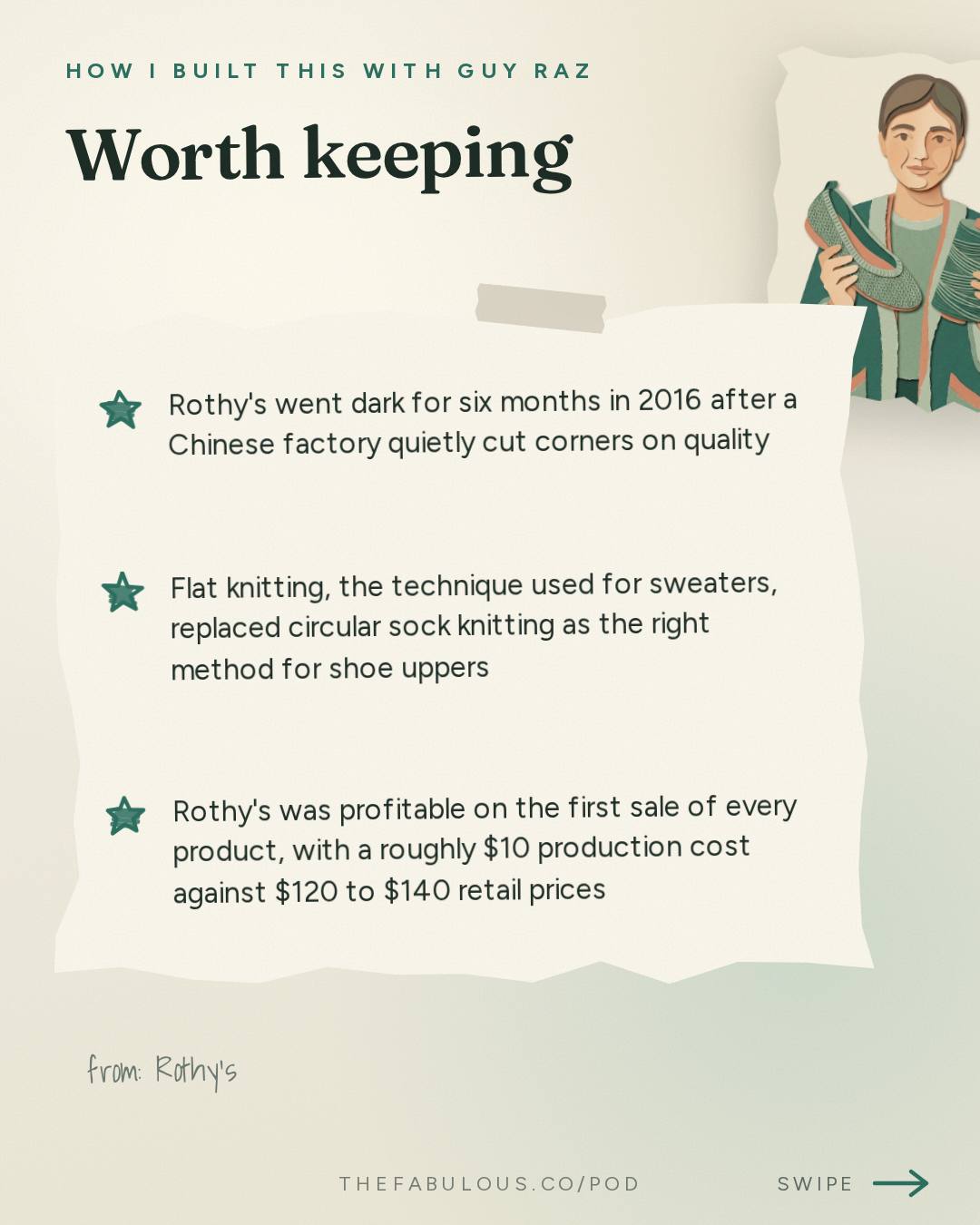
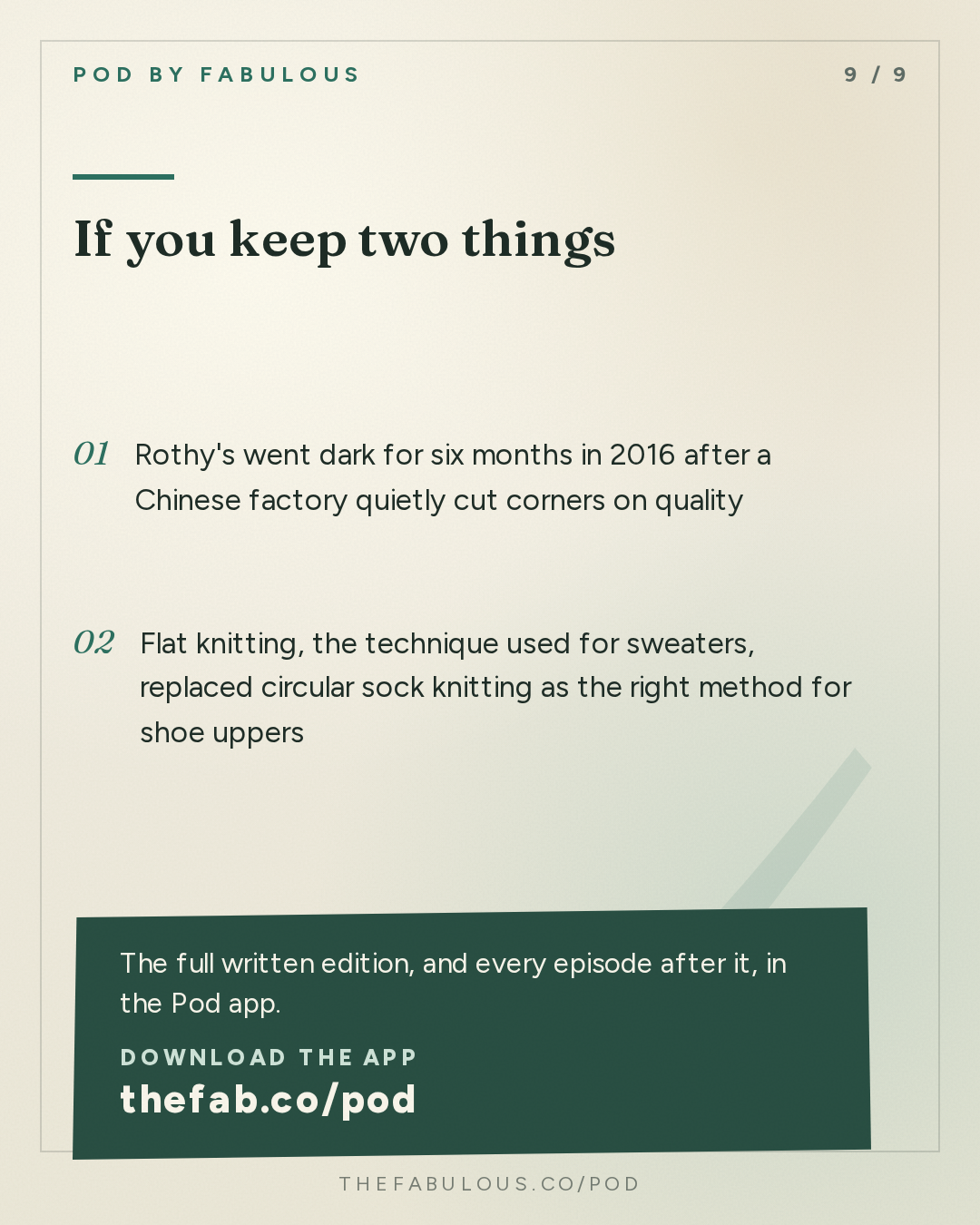
- Rothy's went dark for six months in 2016 after a Chinese factory quietly cut corners on quality
- Flat knitting, the technique used for sweaters, replaced circular sock knitting as the right method for shoe uppers
- Rothy's was profitable on the first sale of every product, with a roughly $10 production cost against $120 to $140 retail prices
- Rothy's raised only $5 million in outside capital before Alpargatas bought a 49.9 percent stake for about $475 million in 2021
- The brand reached a $220 million revenue run rate in 2024 after years of steady, not explosive, growth
The episode in cards
By the numbers
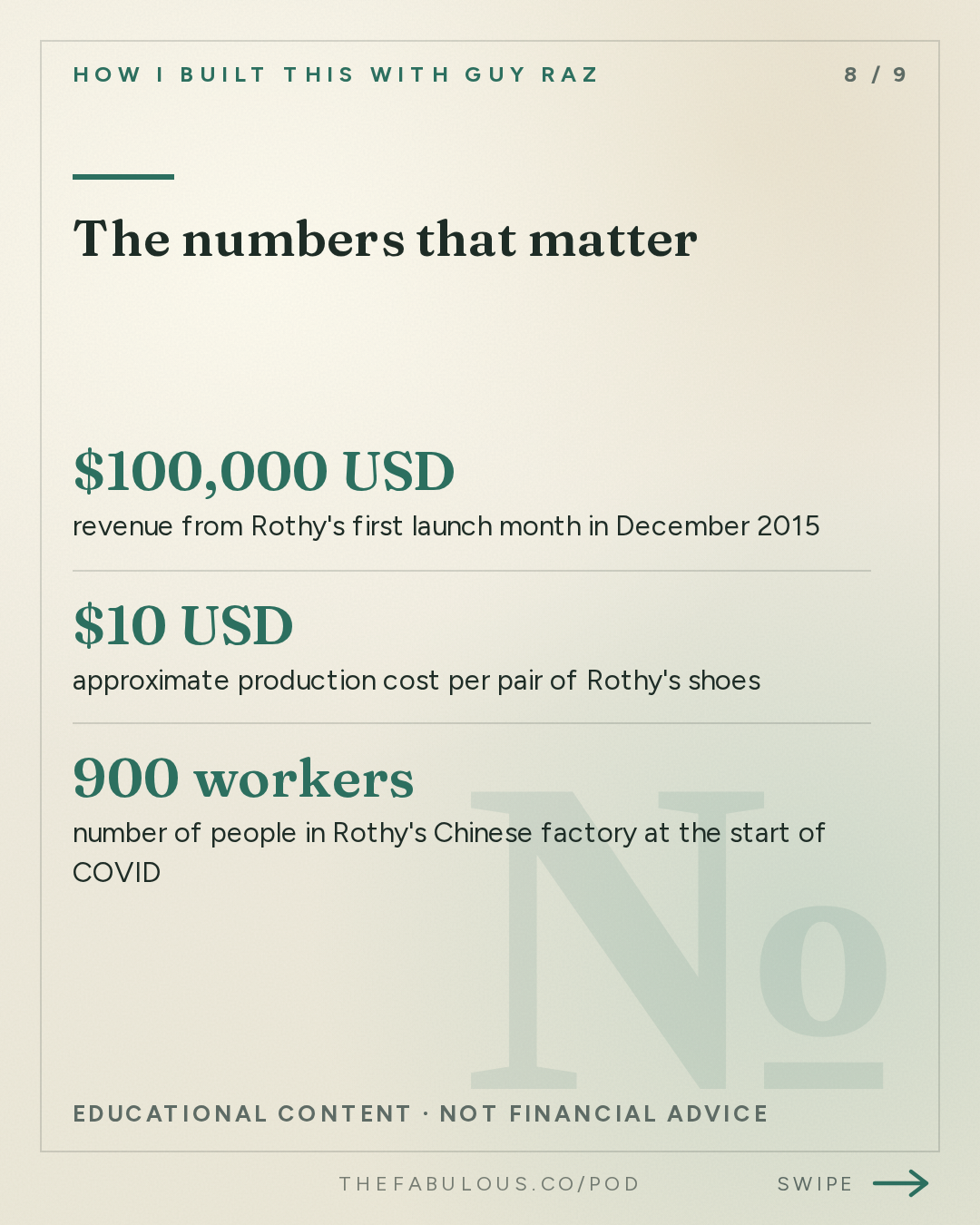
- $100,000 USD revenue from Rothy's first launch month in December 2015
- $10 USD approximate production cost per pair of Rothy's shoes
- 900 workers number of people in Rothy's Chinese factory at the start of COVID
In their words
“Basically the agent has done this deal with this factory that is impossible for them to make any money, and they don't really care.”
“Millimeters in, in, in footwear m- can be, be the difference between a size X and Y. It's a short and a grande at Starbucks.”
“We were profitable on f- on first sale of every single product we made.”
“Profitability is, is a big part of sustainability, and if you wanna be around, you gotta have a business model that works.”
Protocols
-
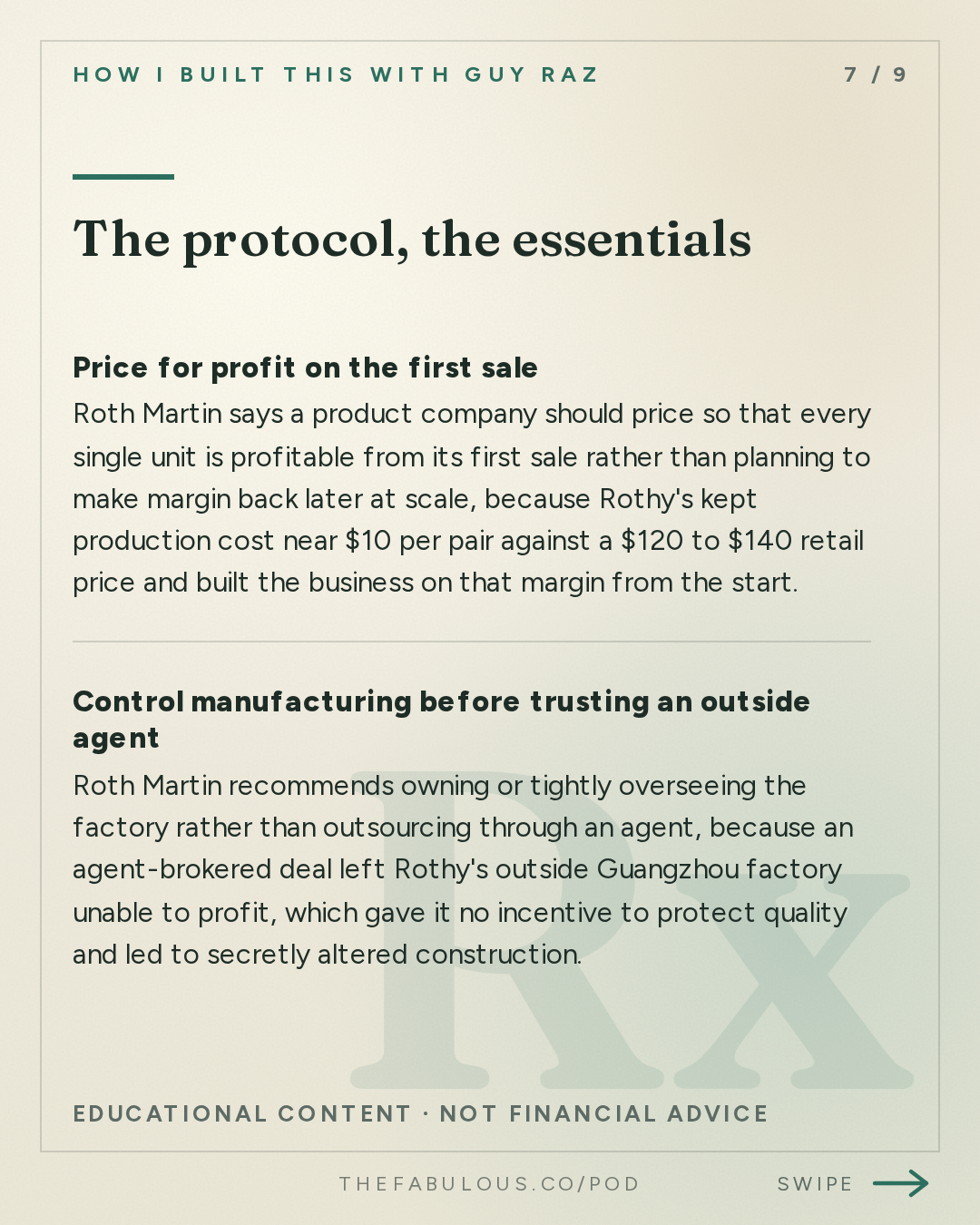
Price for profit on the first sale
Roth Martin says a product company should price so that every single unit is profitable from its first sale rather than planning to make margin back later at scale, because Rothy's kept production cost near $10 per pair against a $120 to $140 retail price and built the business on that margin from the start.
from launch onward
-
Control manufacturing before trusting an outside agent
Roth Martin recommends owning or tightly overseeing the factory rather than outsourcing through an agent, because an agent-brokered deal left Rothy's outside Guangzhou factory unable to profit, which gave it no incentive to protect quality and led to secretly altered construction.
before scaling production
-
Prove a retail format before expanding it
Roth Martin says to validate a single store's unit economics before signing more leases, pointing to Rothy's first 300 square foot San Francisco store, which generated $3.5 million before the company opened additional locations.
before each new retail commitment
Questions this episode answers
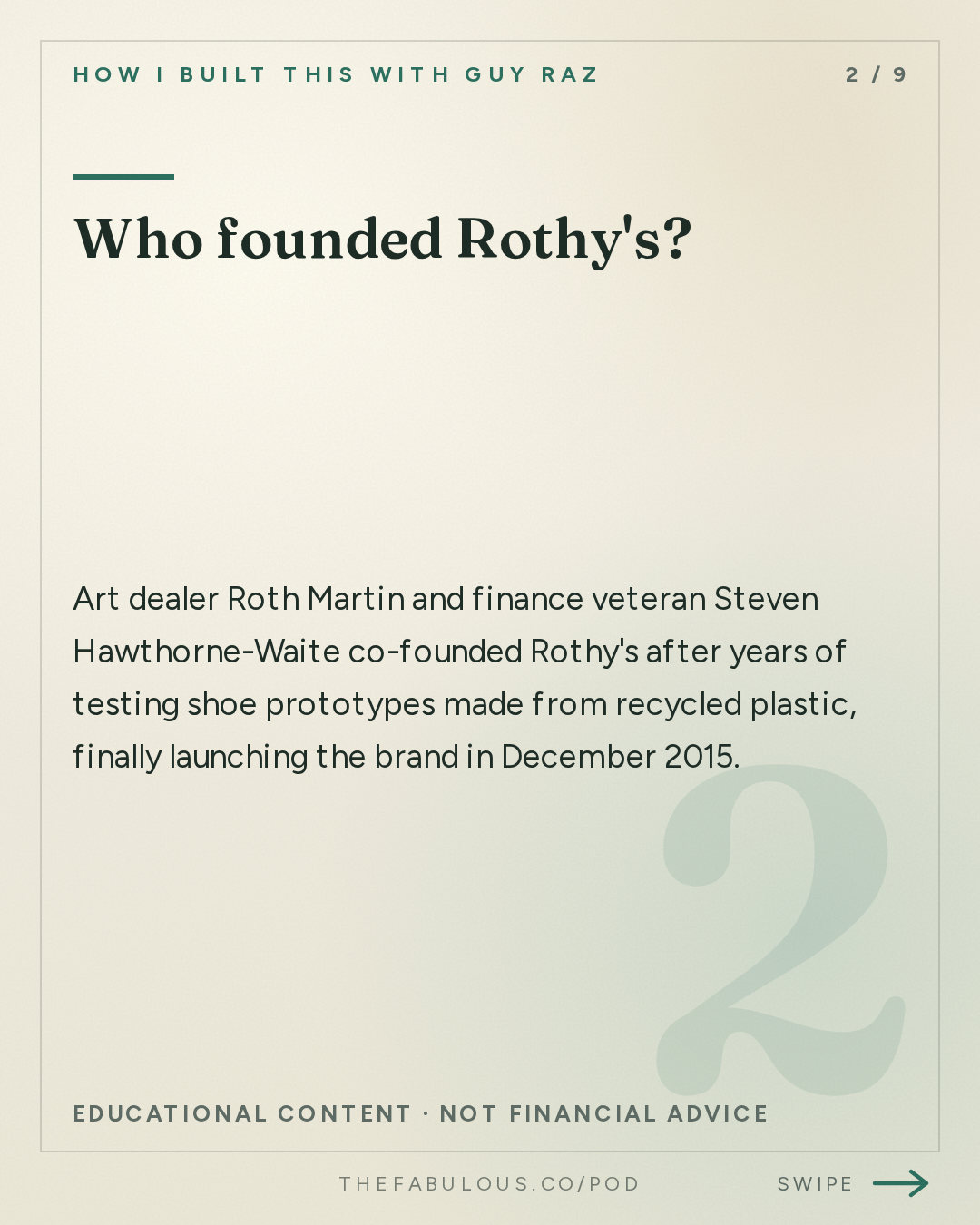
Who founded Rothy's?
Art dealer Roth Martin and finance veteran Steven Hawthorne-Waite co-founded Rothy's after years of testing shoe prototypes made from recycled plastic, finally launching the brand in December 2015 (16:20, 55:30).
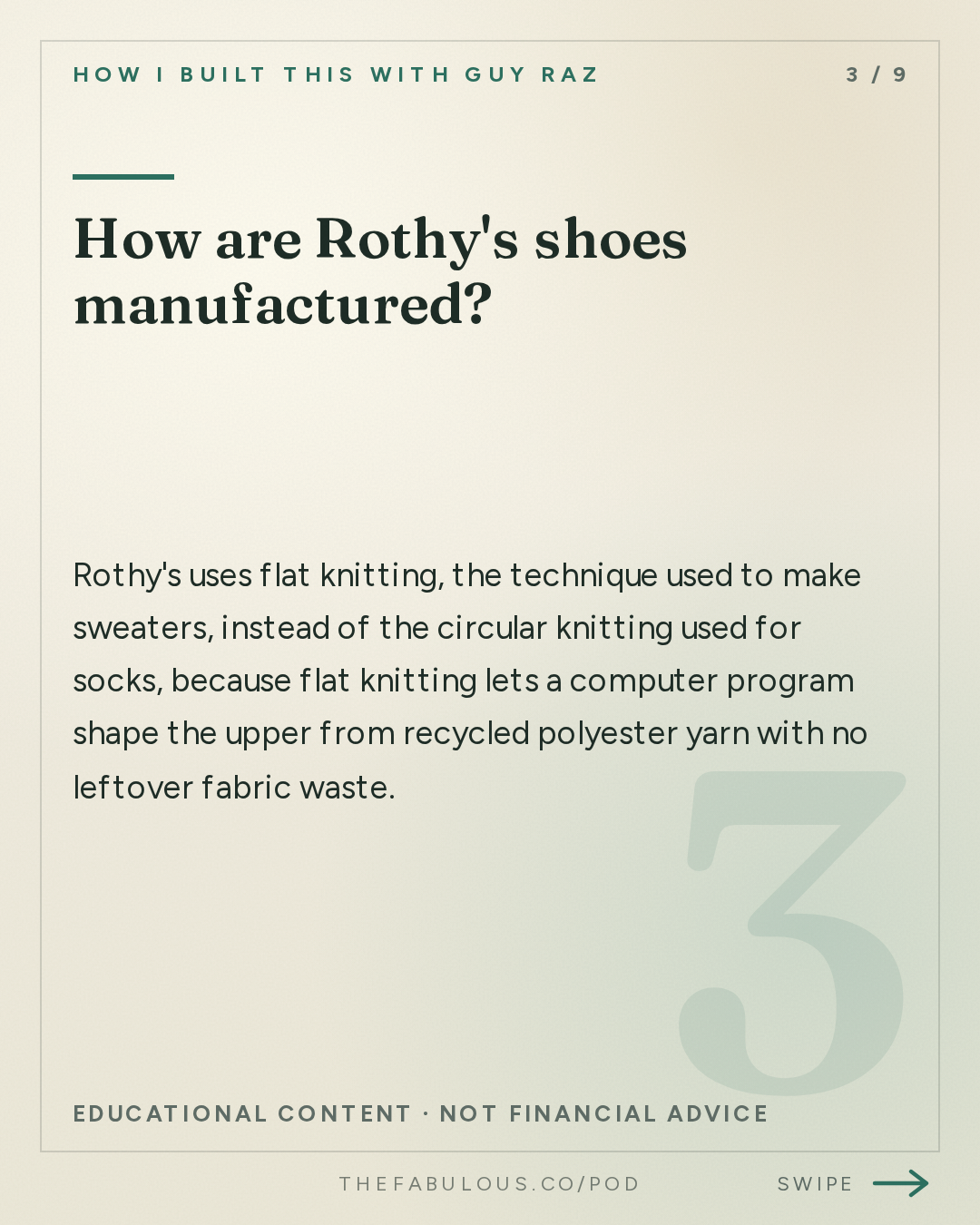
How are Rothy's shoes manufactured?
Rothy's uses flat knitting, the technique used to make sweaters, instead of the circular knitting used for socks, because flat knitting lets a computer program shape the upper from recycled polyester yarn with no leftover fabric waste (35:32, 36:58).
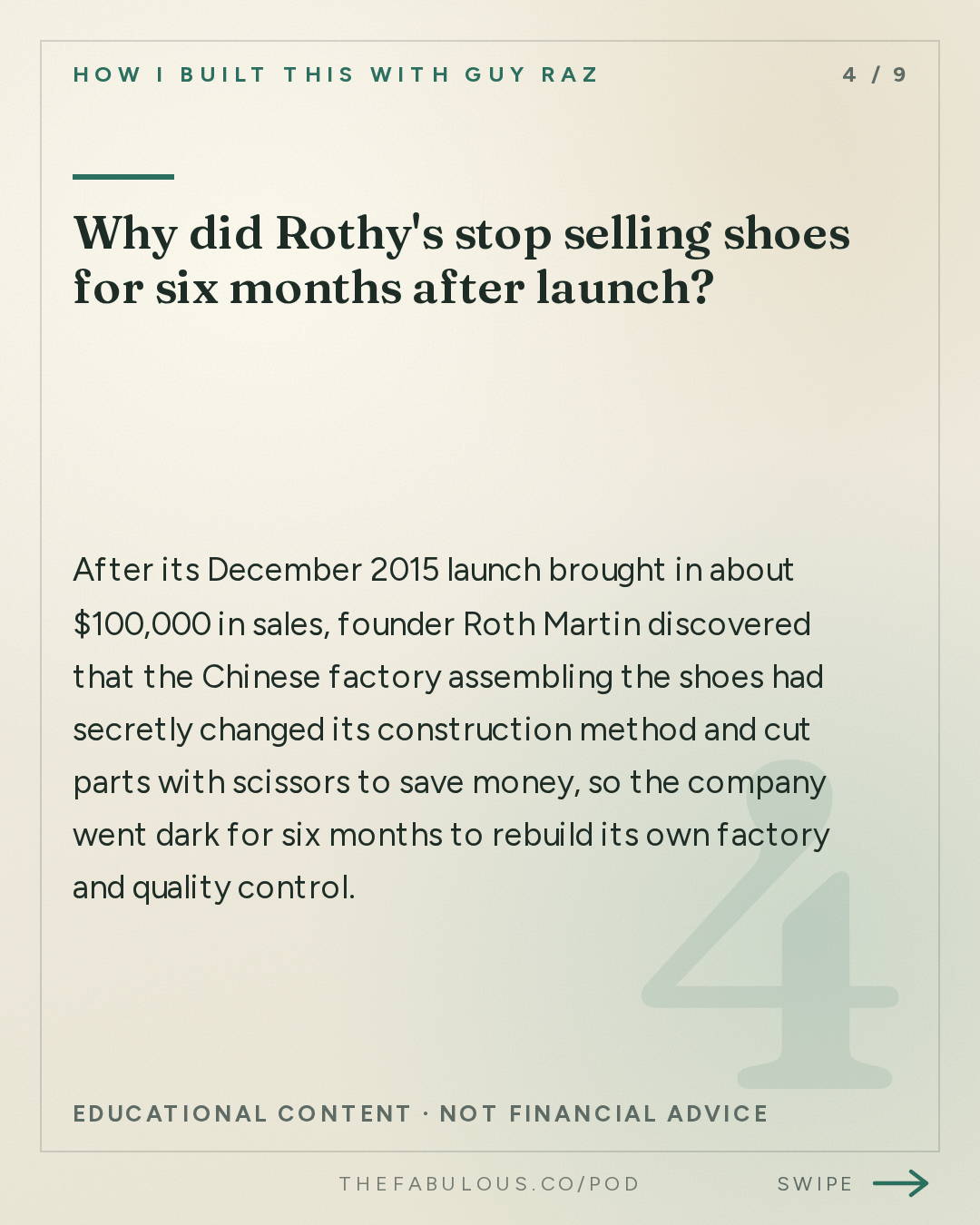
Why did Rothy's stop selling shoes for six months after launch?
After its December 2015 launch brought in about $100,000 in sales, founder Roth Martin discovered that the Chinese factory assembling the shoes had secretly changed its construction method and cut parts with scissors to save money, so the company went dark for six months to rebuild its own factory and quality control (57:31, 58:25, 61:47).
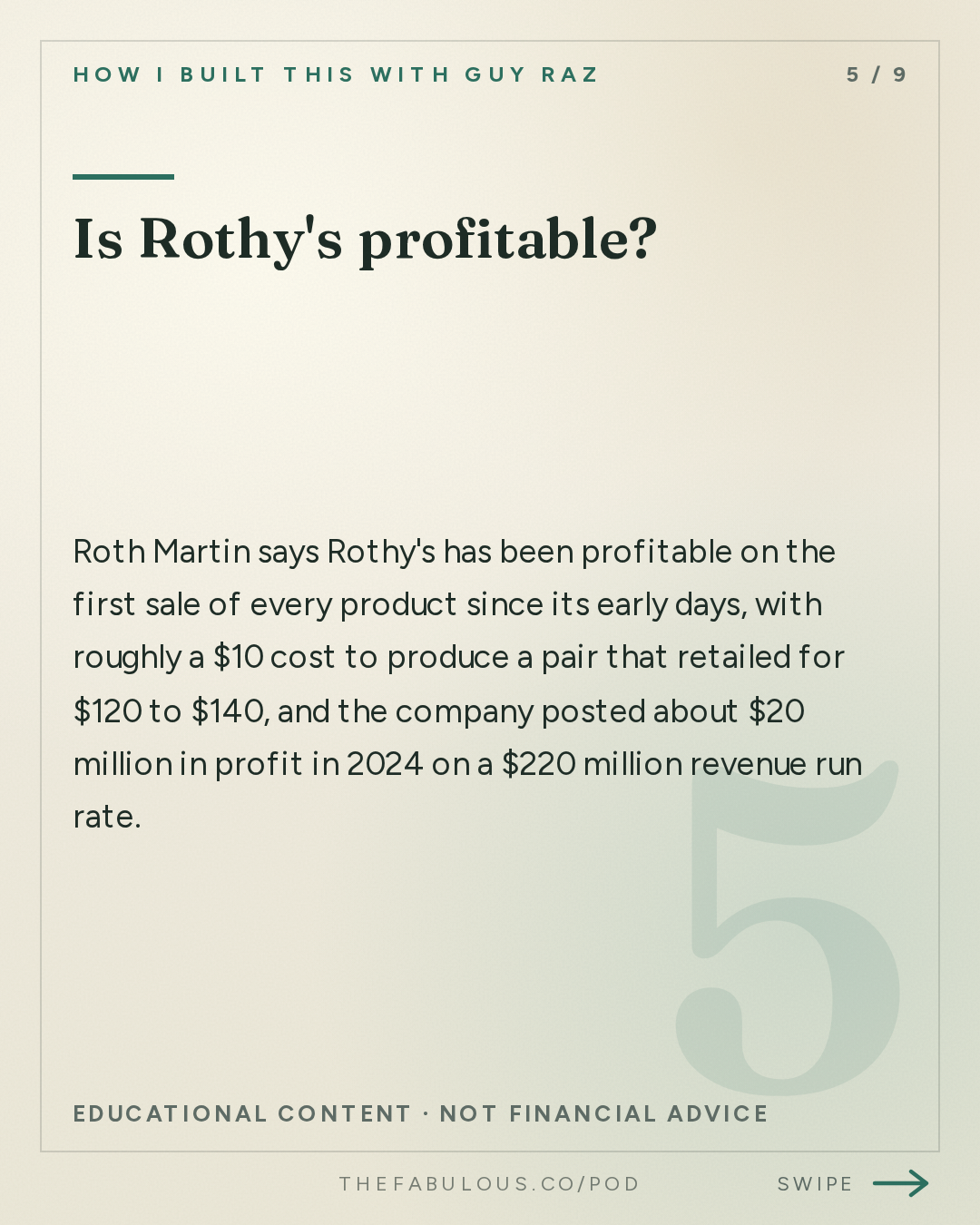
Is Rothy's profitable?
Roth Martin says Rothy's has been profitable on the first sale of every product since its early days, with roughly a $10 cost to produce a pair that retailed for $120 to $140, and the company posted about $20 million in profit in 2024 on a $220 million revenue run rate (67:08, 67:38, 80:33, 78:30).
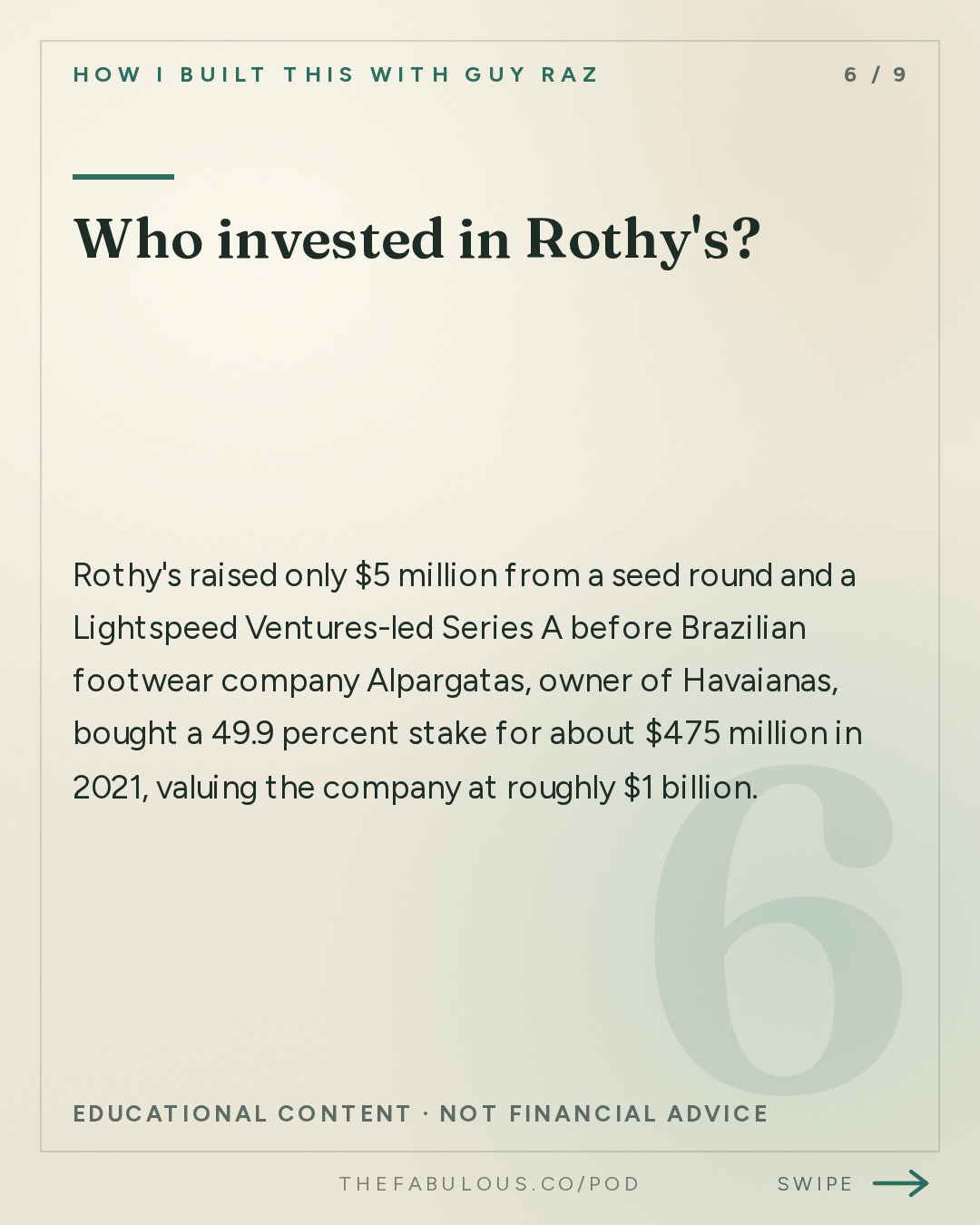
Who invested in Rothy's?
Rothy's raised only $5 million from a seed round and a Lightspeed Ventures-led Series A before Brazilian footwear company Alpargatas, owner of Havaianas, bought a 49.9 percent stake for about $475 million in 2021, valuing the company at roughly $1 billion (68:23, 73:26, 81:30).
The full read, in cards
Mentioned
Roth Martin · Steven Hawthorne-Waite · Lewiston, Maine · Unifi · Alpargatas · Lightspeed Ventures · Goldman Sachs · Allbirds · L.L.Bean
More from this show and category
Jensen Huang: How NVIDIA Almost Died Twice
Jensen Huang, cofounder of NVIDIA, told Guy Raz how a failed first chip, a canceled Sega contract, and a decade-long bet on a platform called CUDA nearly broke the company before it became the engine of the AI boom. He also described what the climb cost him at home.
How Jesse Merrill Built Good Culture
Jesse Merrill grew Good Culture cottage cheese to $200 million in revenue by 2025, using branding skills from Honest Tea and Moby's tea startup. A 2015 ulcerative colitis diagnosis led him to cottage cheese's protein and sugar profile, and a 2023 TikTok ice cream hack made the category go viral before he sold a majority stake to private equity firm L Catterton.
Ron Shaich's Panera Bread Origin Story
Ron Shaich sold his own flagship chain, Au Bon Pain, to bet everything on a smaller concept, Panera Bread, which climbed from about $3 a share to $315 a share. The pivot grew out of a 1993 deal for 19 St. Louis Bread Company stores and a 'third place' strategy built around cheap real estate and room to linger, not just recipes.
How Jesse Merrill Built Good Culture
Jesse Merrill turned a declining 1970s product, cottage cheese, into a $200 million brand called Good Culture. He stripped out gums and preservatives, hit grueling retail velocity targets, and caught a 2023 TikTok cottage-cheese-ice-cream trend that pulled Gen Z into a category now worth $2.4 billion in the US.
