
Jensen Huang: How NVIDIA Almost Died Twice
Jensen Huang: The Personal Cost of Building NVIDIA (April 2026)
The brief
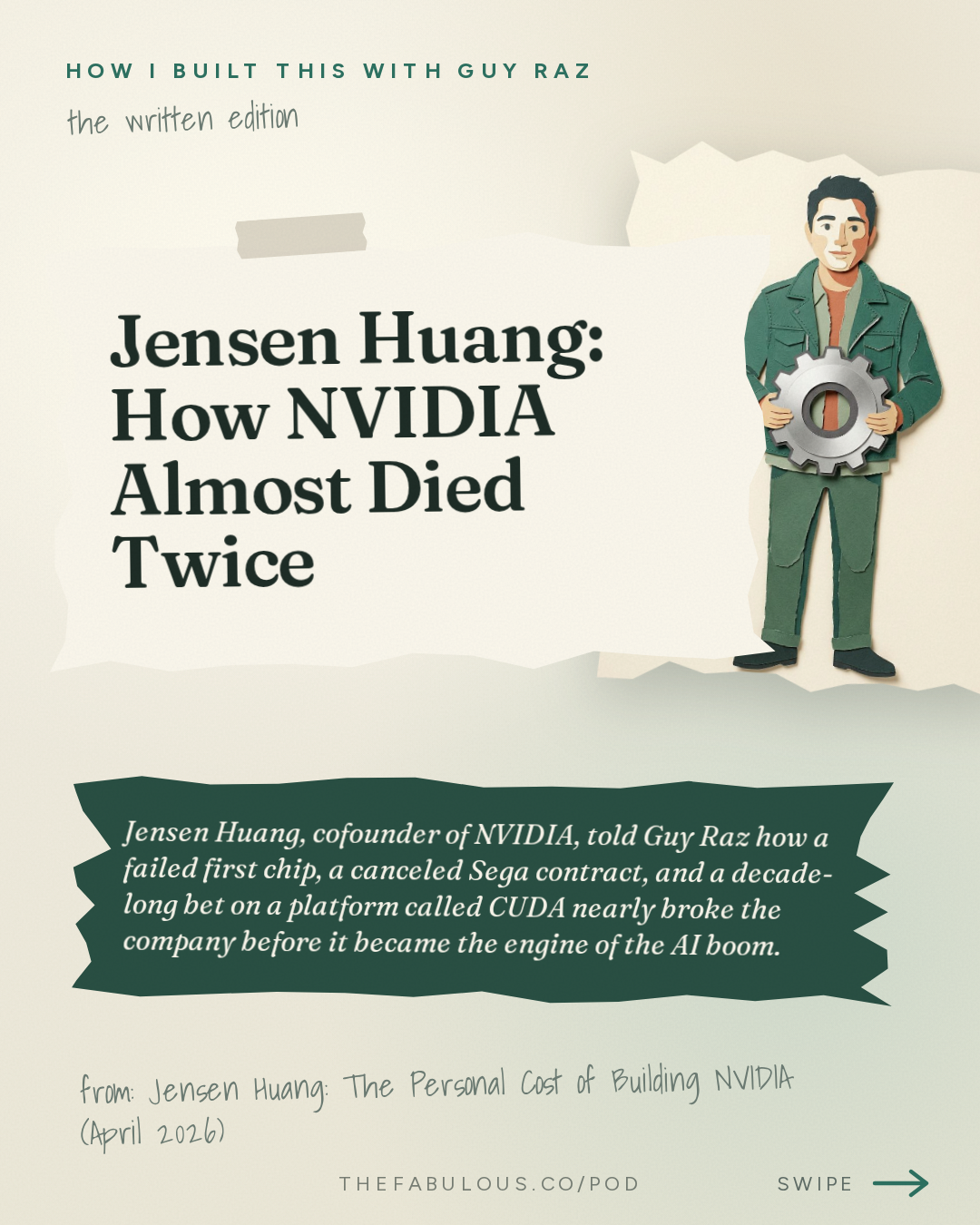
Jensen Huang, cofounder of NVIDIA, told Guy Raz how a failed first chip, a canceled Sega contract, and a decade-long bet on a platform called CUDA nearly broke the company before it became the engine of the AI boom. He also described what the climb cost him at home.
NVIDIA's first product was a disaster. The company sold two hundred and fifty thousand units of its debut graphics chip, the NV1, and then watched every single one come back (20:00). Not a partial recall. All of them. The chip used an approach to rendering images, called forward texture mapping, that turned out to be incompatible with a new Microsoft standard called DirectX (20:21). Twenty or thirty rival companies had guessed right. NVIDIA had guessed wrong, and it had spent two and a half years building two more chips on the same flawed foundation (20:50).
This is the part of the NVIDIA story that rarely makes the highlight reel. Jensen Huang, the company's cofounder and, until recently, its chief executive, told Guy Raz on How I Built This that the failure forced an almost impossible choice. NVIDIA had a twelve million dollar contract with Sega to supply chips for a game console, built on the broken architecture (21:35). Finishing it honestly would burn two more years the company didn't have. Huang flew to Japan, told Sega's CEO that NVIDIA could not deliver, and asked for something unusual: let the remaining five million dollars of the contract become an investment instead of a product.
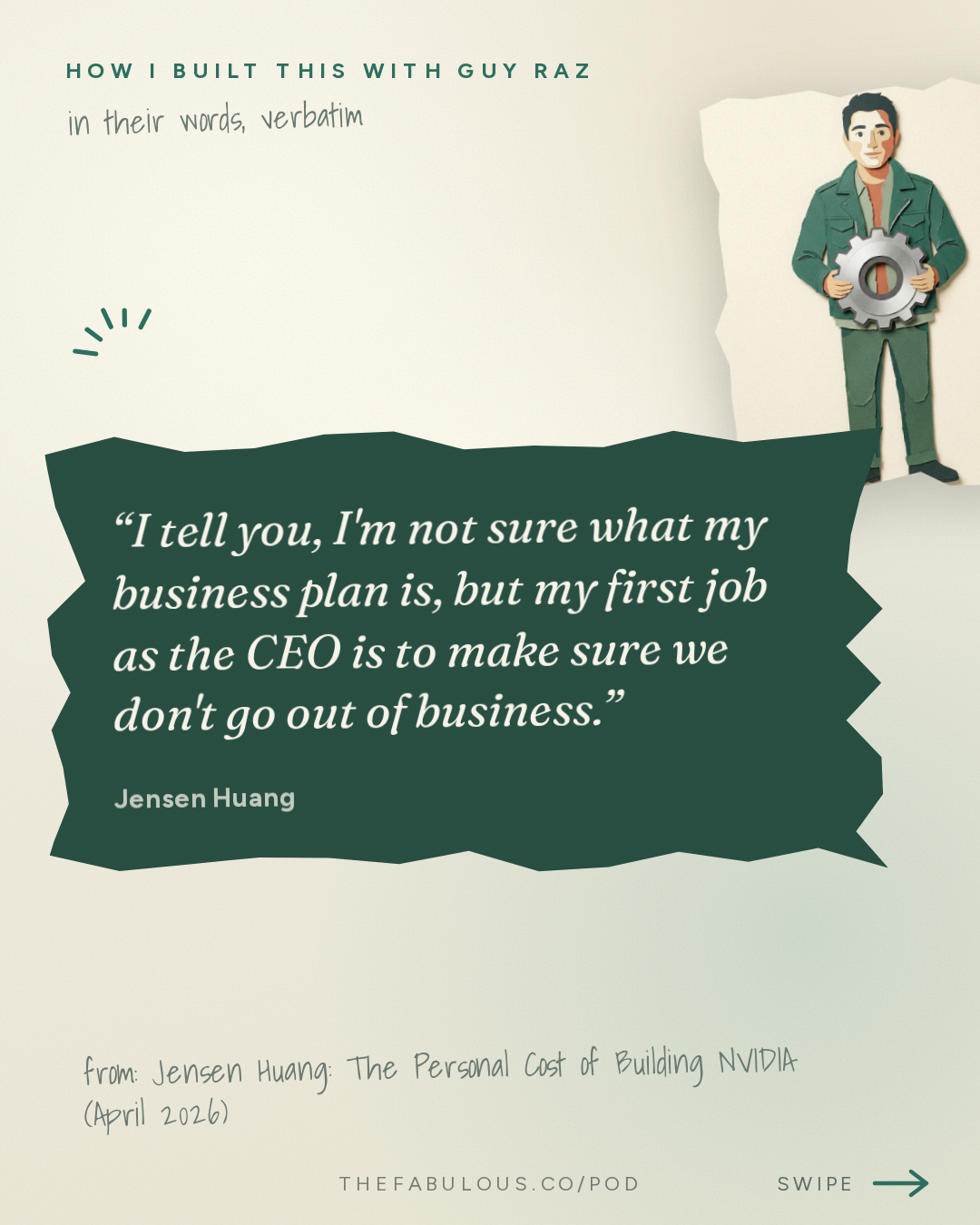
"I tell you, I'm not sure what my business plan is, but my first job as the CEO is to make sure we don't go out of business." — Jensen Huang [23:14]
Sega agreed. Huang laid off two-thirds of the company, roughly a hundred people, and bet everything on one more chip, the Riva 128 (24:05). There was no time to prototype it the normal way: design, test, fix, repeat, a cycle that usually took a year and a half. NVIDIA had about six months of money left (25:20). So Huang bought a used chip emulator, a machine that could simulate how an unmade chip would behave, from a company that had just gone out of business itself, and spent half of NVIDIA's remaining cash on it (26:29). If the emulator was wrong, there was no second chance. The company had a running joke, more true than funny, that it was thirty days from closing its doors (28:12). The chip worked. Not perfectly, Huang says, but "good enough to save the company" (28:34).
That phrase, good enough, became a kind of private doctrine. Huang later found a book by the late Harvard Business School professor Clayton Christensen called The Innovator's Dilemma, which argues that disruption rarely arrives as a superior product. It arrives as a mediocre one that is cheap enough and available enough to take root before anyone important is watching (33:46). "The single most important thing about technology is the moment it becomes good enough, when you overserve the market, you're ready for disruption," Huang said (34:06). NVIDIA's graphics chips were good enough for gamers. They would later turn out to be good enough, in a roundabout way, for something nobody at NVIDIA had planned for at all.
The Decade Nobody Understood
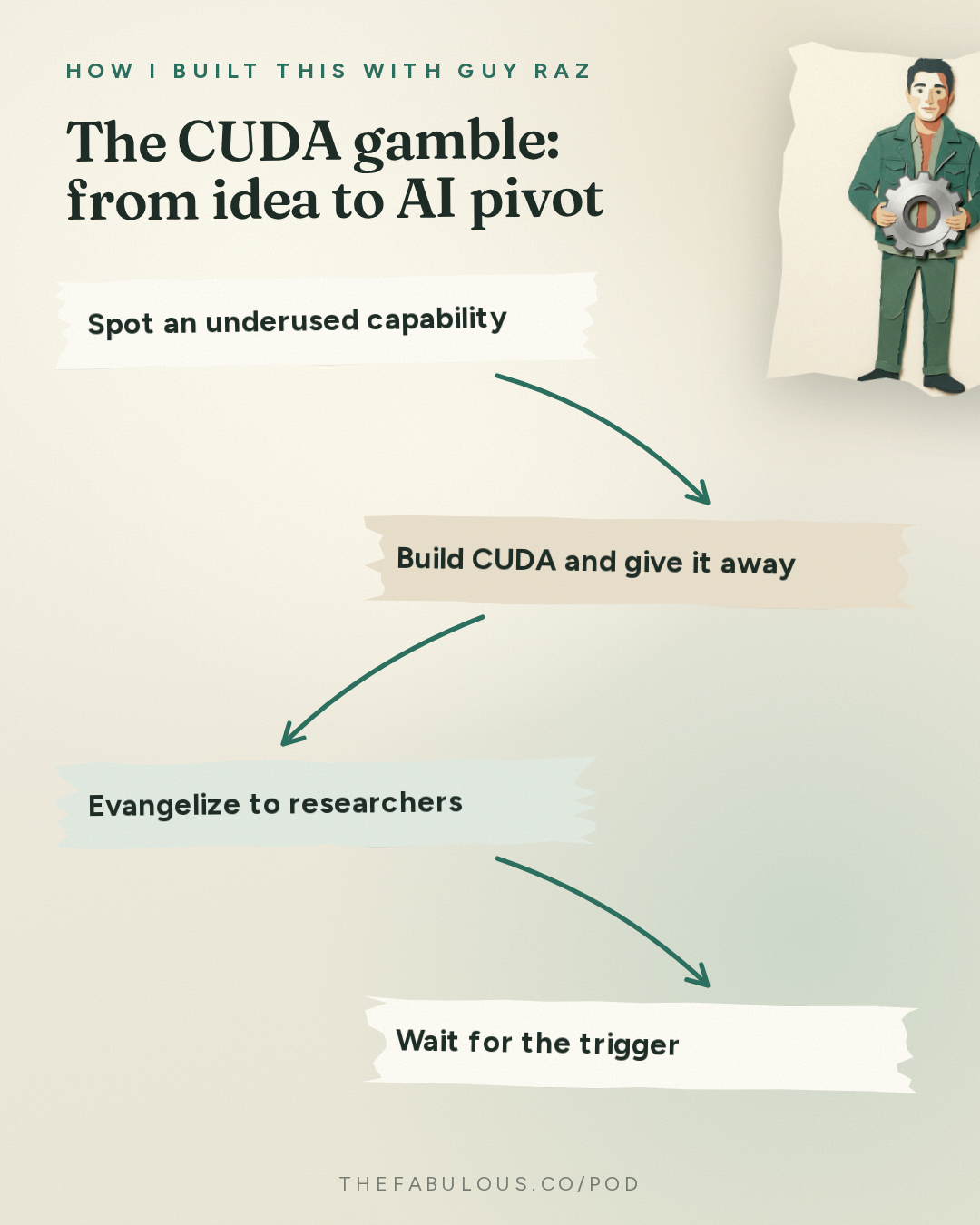
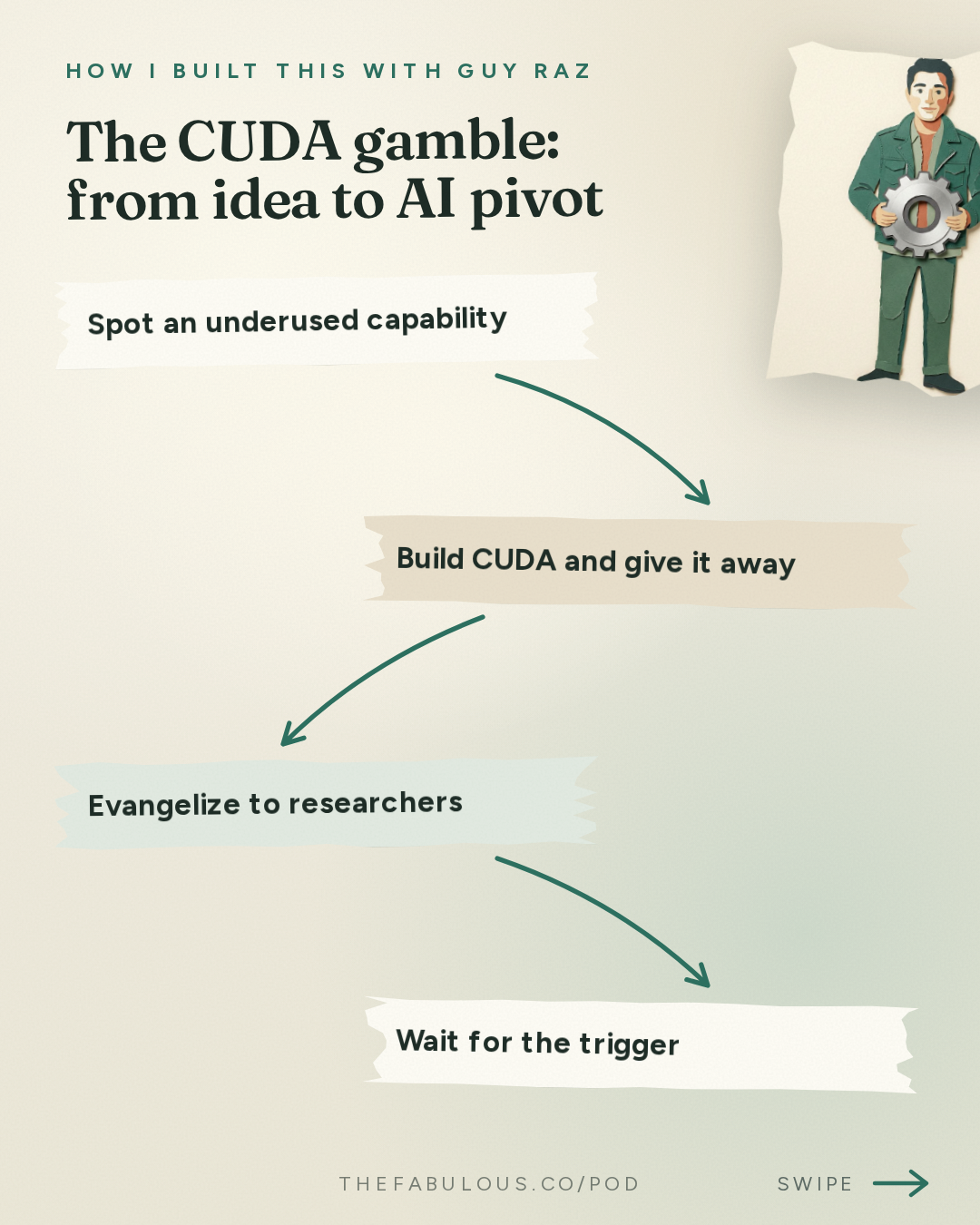
To follow what happened next, it helps to have a simple picture. Guy Raz compares a computer's main processor, the CPU, to a master chef: extremely capable, but working one dish at a time. A graphics processor, or GPU, is more like a kitchen with thousands of line cooks, each one simple, all working at once (06:43). Around 2006, NVIDIA built a software layer called CUDA that let outside programmers direct all those line cooks for tasks that had nothing to do with video games, turning a gaming chip into something closer to a general-purpose supercomputer (07:23).
The problem was timing. Almost nobody needed it yet. From roughly 2006 to 2012, NVIDIA's stock price went nowhere or fell, the company refunded hundreds of millions of dollars to customers, and outsiders openly questioned why Huang kept funding a platform with almost no paying customers (38:43). NVIDIA's answer was to let its gaming chip, GeForce, carry CUDA into every computer that bought it, for free, absorbing the cost in gross margins for a payoff nobody could date. Huang later admitted GeForce carried CUDA on its back for twenty-five years before most buyers even knew the capability was there (43:16).
The payoff arrived from an unexpected direction. In the early 2010s, a group of researchers in Toronto bought two NVIDIA gaming GPUs, plugged them into a computer, and trained a neural network that beat every prior attempt at image recognition in a contest called ImageNet (43:58). NVIDIA noticed research groups asking for help using CUDA to speed up this new technique, called deep learning, instead of relying on thousands of CPUs working one task at a time (44:21). Huang says he spent time reasoning from first principles about what the breakthrough implied, and on a weekend in 2013 he sent the company an email declaring that NVIDIA was now an AI company, after quietly bringing individual teams along for months beforehand (45:10).
Huang is notably unbothered by the warnings that have followed NVIDIA's rise, including a 2023 open letter signed by figures such as Geoffrey Hinton, one of the deep-learning pioneers whose work ran on NVIDIA chips, and tech leaders including Bill Gates, Sam Altman, and Dario Amodei, warning that AI risk should rank alongside pandemics and nuclear war (53:03). Huang argues that slowing innovation makes the technology less safe, not more, pointing to radiology, where AI reads scans faster and cheaper, which has increased the number of scans ordered and, he says, increased demand for radiologists rather than eliminating the job (57:12).
What the Climb Cost
The part of the conversation that lingers longest is not strategy. It is Huang's answer when Raz asked whether he would do it all again, knowing in advance how much pain the climb required: laying off two-thirds of a young company, the public humiliation of a collapsing stock price, years of missed karate tournaments. "Absolutely not," Huang said, adding that people who claim otherwise are usually being dishonest with themselves (66:24). He manages the weight of it, he says, by actively trying to forget the previous day's setbacks, the way athletes are taught to forget the last point, so the losses don't compound into paralysis (01:12).
His wife, Lori, whom he met as a lab partner at Oregon State University, ran the household through all of it and, he says, never once complained (68:23). Both of their children now work at NVIDIA, a company that is, Huang notes, thirty-three years old, almost exactly as old as his son Spencer (69:05). Asked whether the company's success came down to hard work or luck, Huang landed somewhere in between: a long series of forks in the road, mostly navigated with good judgment and good values, with some unavoidable luck layered on top (73:01). Near the end of the conversation he returned, without being asked, to the thing that seemed to matter most to him.
"It's not business, it's personal, it's always personal." — Jensen Huang [74:47]
It is a strange thing to hear from the person who built the most valuable company in the world, a company now worth more than the entire economic output of Japan, the United Kingdom, or France (05:25). But it matches everything else in the conversation: the chip that had to work because there was no money left to fix it, the decade of carrying a platform nobody asked for, the deliberate discipline of forgetting yesterday so tomorrow stays possible. Huang built a company that reshaped computing twice. He also built a case that no amount of scale erases what the climb actually costs the person doing the climbing.
Ask this episode anything
Pod's AI answers from the episode itself, with the minute mark so you can hear it yourself.
Or start with one of these
Ask this episode
Pod's AI listens to the whole episode to answer, and points you to the minute it comes from.
The rest of this answer, and any question after it
Answers come from the episode itself, never from a summary of it.
ContinueKey takeaways
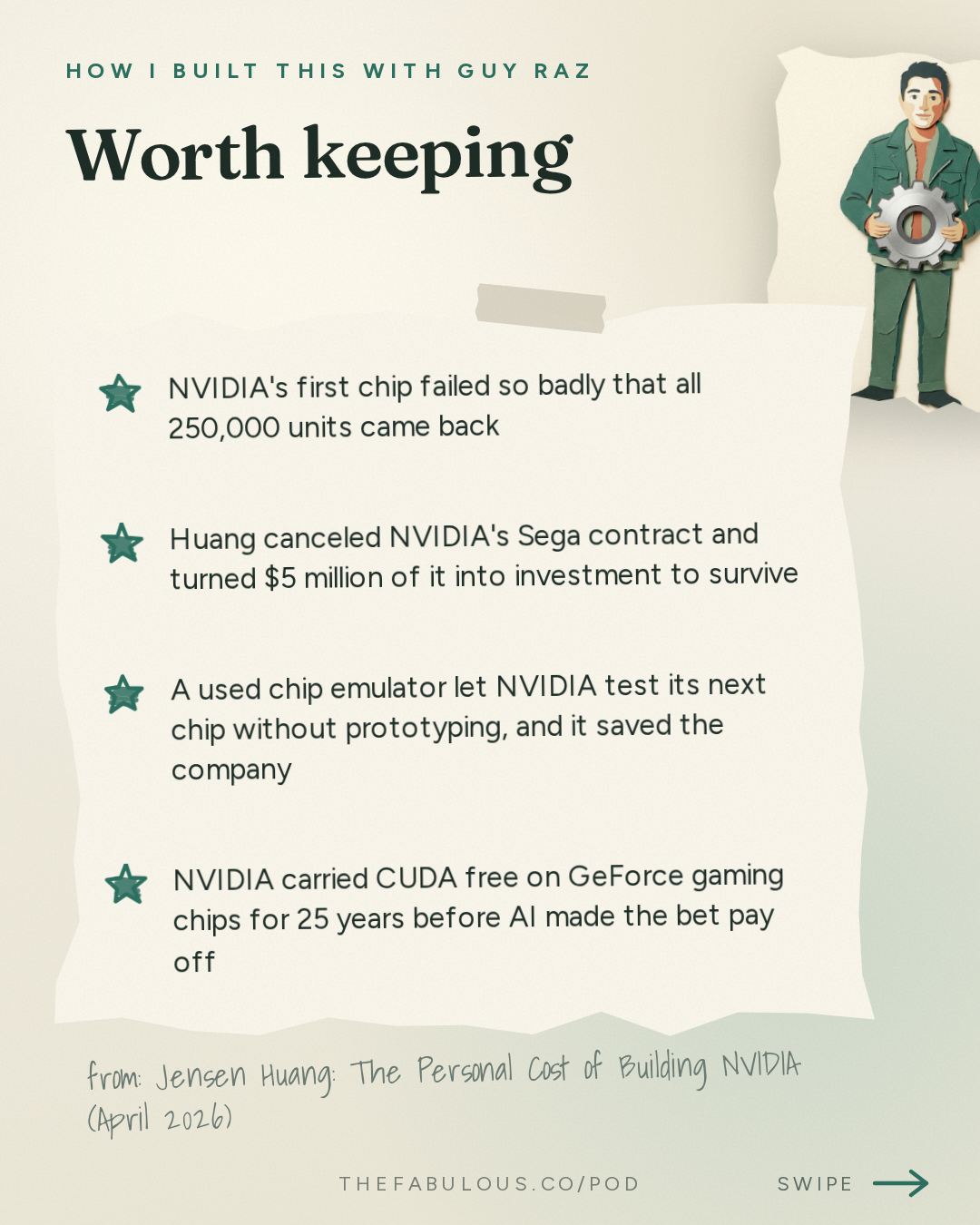
- NVIDIA's first chip failed so badly that all 250,000 units came back
- Huang canceled NVIDIA's Sega contract and turned $5 million of it into investment to survive
- A used chip emulator let NVIDIA test its next chip without prototyping, and it saved the company
- NVIDIA carried CUDA free on GeForce gaming chips for 25 years before AI made the bet pay off
- Huang says he would not build NVIDIA again knowing the personal cost it required
The episode in cards
By the numbers
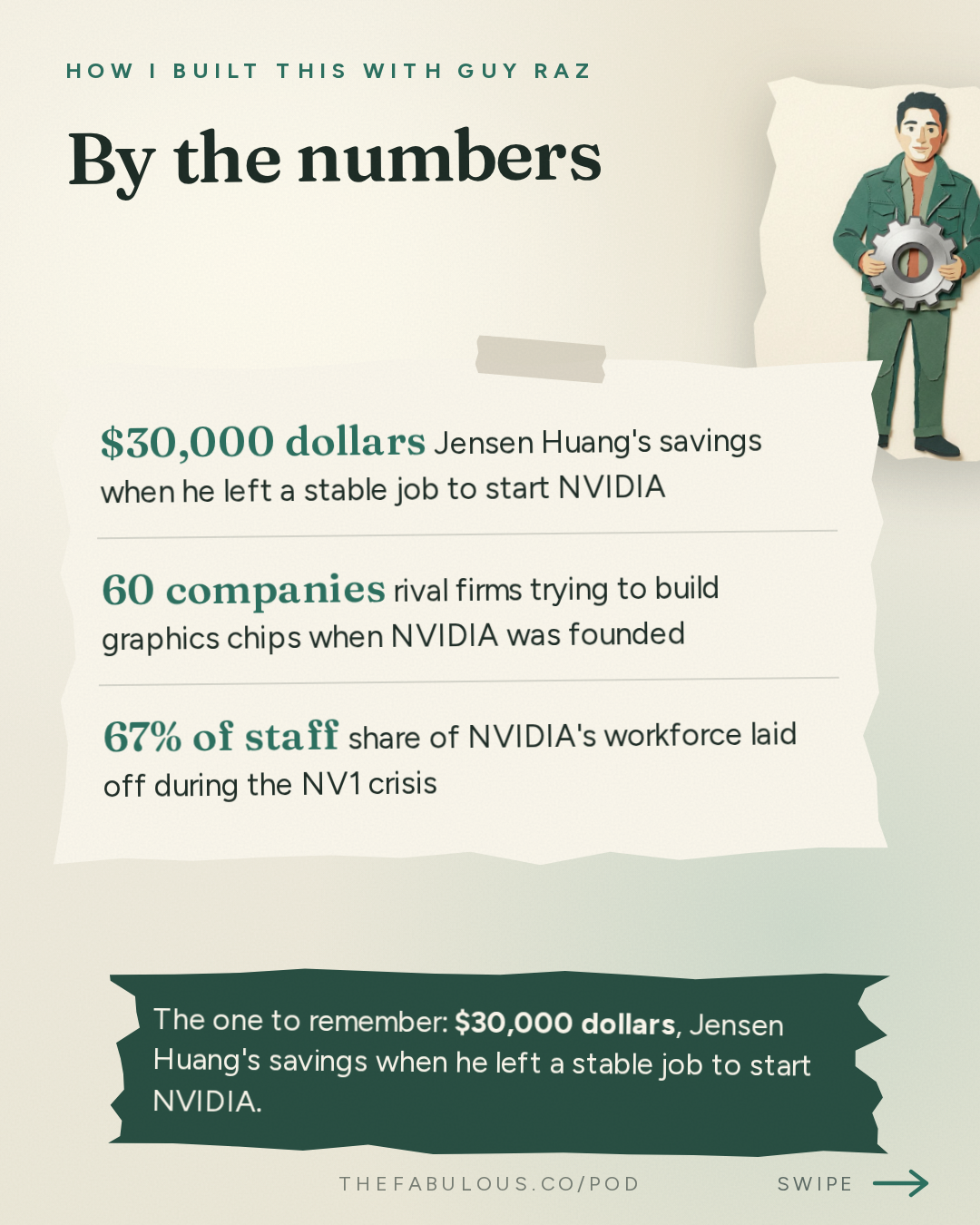
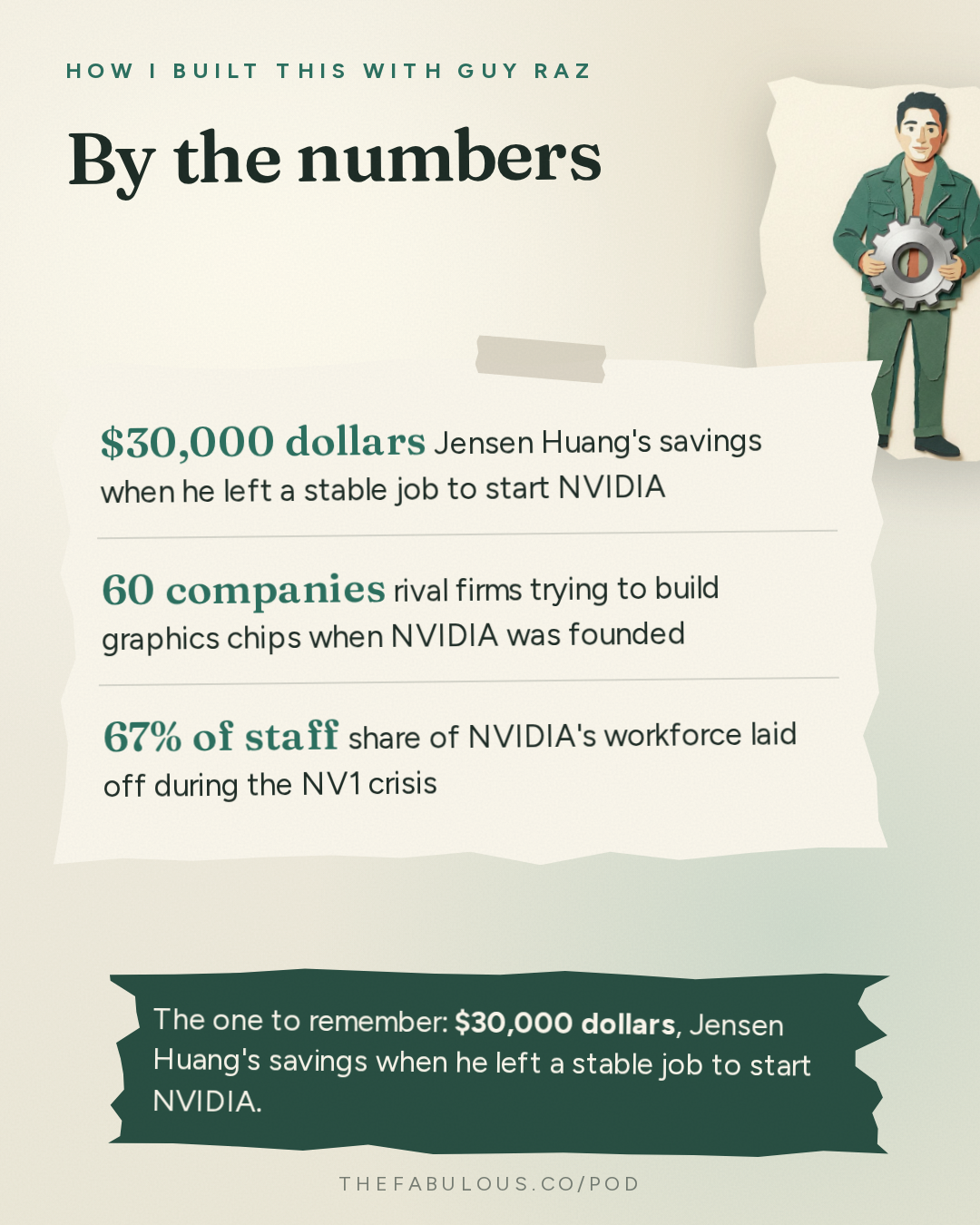
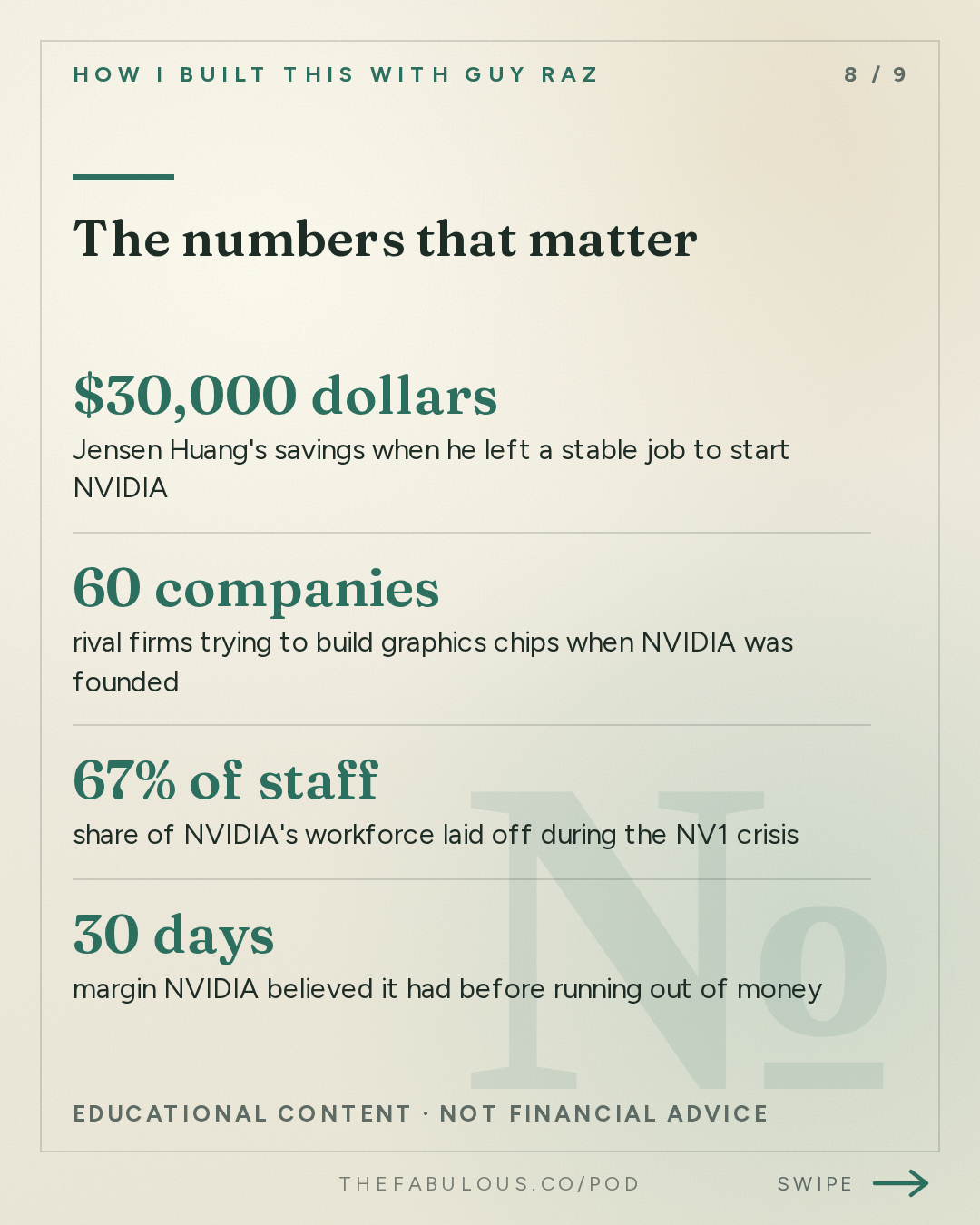
- $30,000 dollars Jensen Huang's savings when he left a stable job to start NVIDIA
- 60 companies rival firms trying to build graphics chips when NVIDIA was founded
- 67% of staff share of NVIDIA's workforce laid off during the NV1 crisis
- 30 days margin NVIDIA believed it had before running out of money
In their words
“I tell you, I'm not sure what my business plan is, but my first job as the CEO is to make sure we don't go out of business.”
“The single most important thing about technology is the moment it becomes good enough, when you overserve the market, you're ready for disruption.”
“I spend all of my time, all of my life trying to forget yesterday.”
“It's not business, it's personal, it's always personal.”
Protocols
-
Abandon a flawed design even mid-contract
Huang says that when the NV1 chip's texture-mapping approach turned out to be incompatible with Microsoft's DirectX standard, NVIDIA canceled its Sega contract rather than spend two more years finishing a design built on the wrong foundation.
one-time decision, treated as a model for any major technical dead end
-
Build supply chains with redundancy
Huang says a resilient company needs a supply chain with diversity and redundancy, and when diversity is not available, the team should still make the best decision it can with the options at hand.
ongoing company policy
-
Forget yesterday to stay focused
Huang says he spends all of his time trying to forget the previous day's setbacks, the same way athletes are taught to forget the last point, so he can stay focused on the next decision.
daily mental practice
Questions this episode answers
How did NVIDIA almost go out of business?
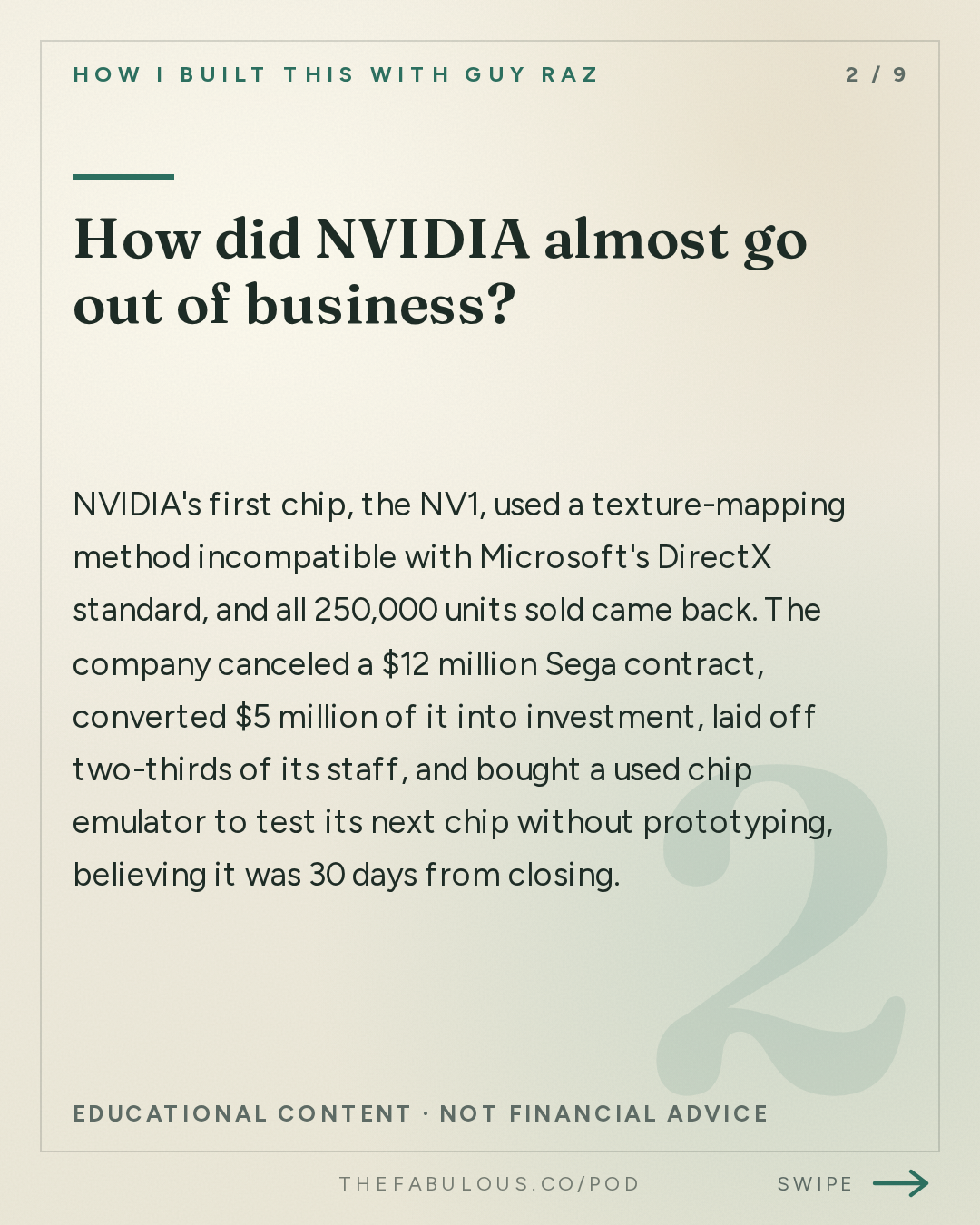
NVIDIA's first chip, the NV1, used a texture-mapping method incompatible with Microsoft's DirectX standard, and all 250,000 units sold came back (20:00). The company canceled a $12 million Sega contract, converted $5 million of it into investment, laid off two-thirds of its staff, and bought a used chip emulator to test its next chip without prototyping, believing it was 30 days from closing (28:12).
What is CUDA and why did Jensen Huang bet on it?
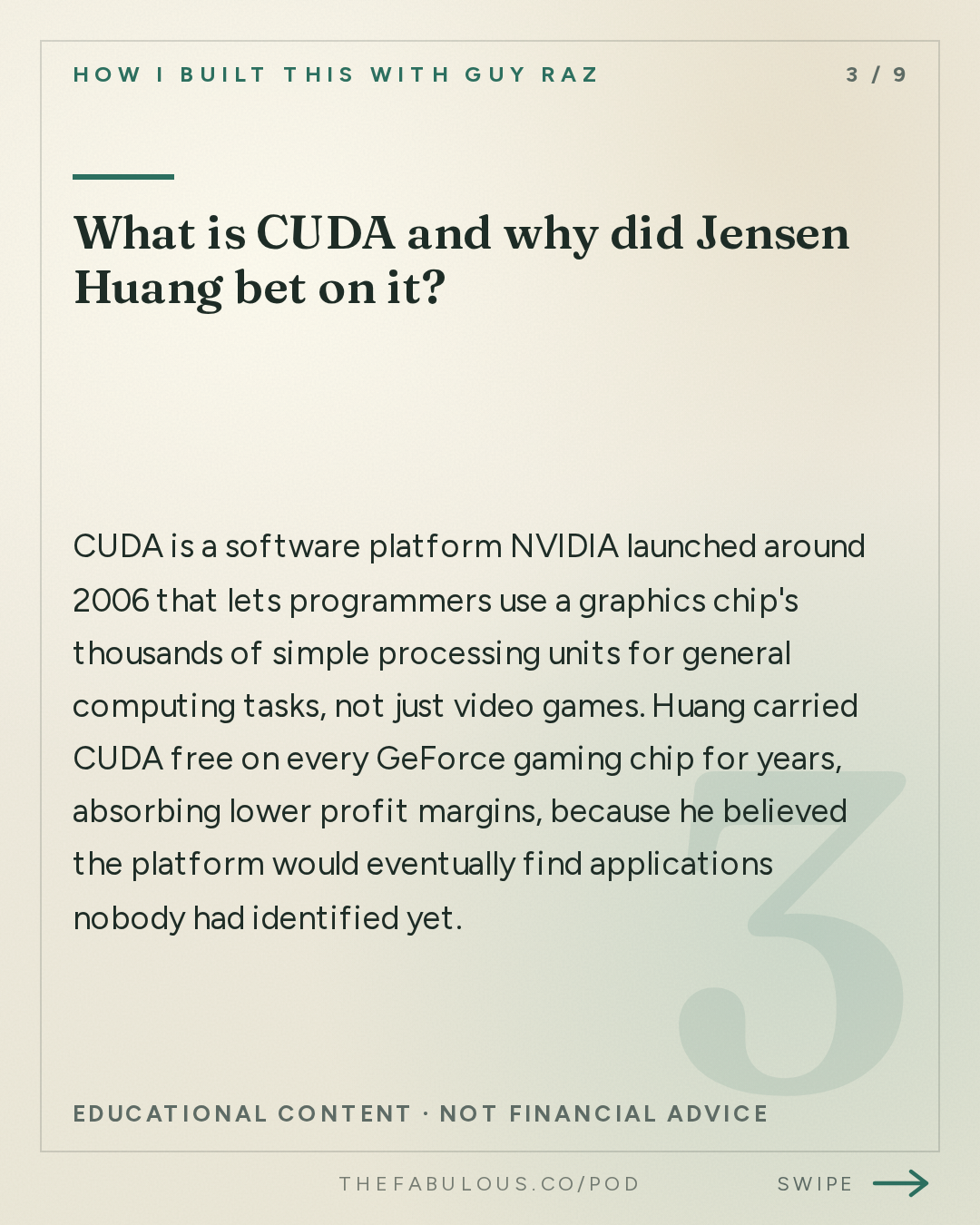
CUDA is a software platform NVIDIA launched around 2006 that lets programmers use a graphics chip's thousands of simple processing units for general computing tasks, not just video games (07:23). Huang carried CUDA free on every GeForce gaming chip for years, absorbing lower profit margins, because he believed the platform would eventually find applications nobody had identified yet (41:08).
When did NVIDIA become an AI company?
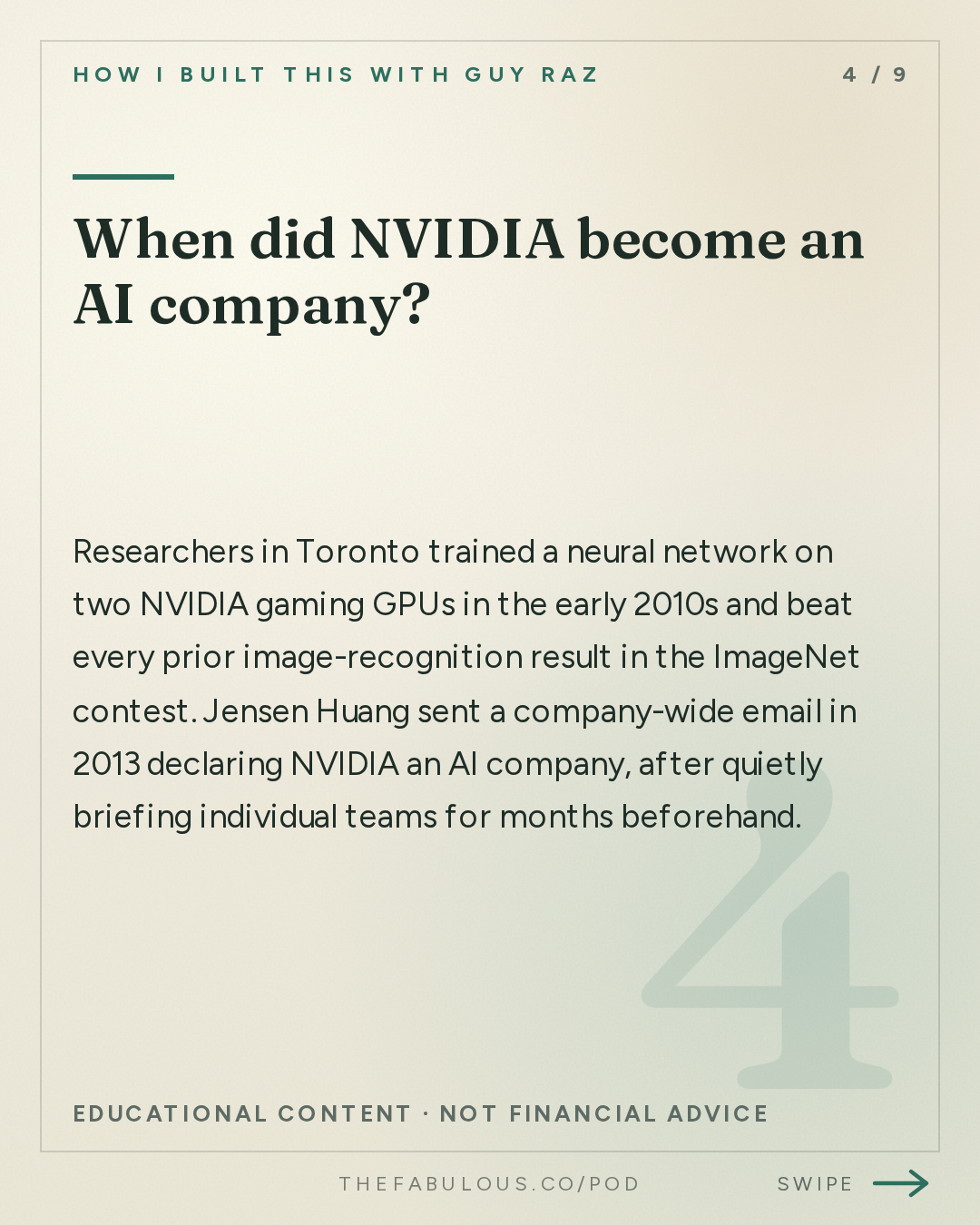
Researchers in Toronto trained a neural network on two NVIDIA gaming GPUs in the early 2010s and beat every prior image-recognition result in the ImageNet contest (43:58). Jensen Huang sent a company-wide email in 2013 declaring NVIDIA an AI company, after quietly briefing individual teams for months beforehand (45:34).
Is Jensen Huang worried about AI safety risks?
Huang argues that speeding up AI innovation makes the technology safer, not riskier, and points to radiology as an example: AI reads scans faster and cheaper, which increased the volume of scans ordered and, he says, increased demand for radiologists rather than eliminating the job (57:12). He did not sign a 2023 open letter warning that AI risk should rank alongside pandemics and nuclear war (53:03).
What personal sacrifices did Jensen Huang make building NVIDIA?
Huang says he missed most of his children's karate tournaments and other milestones while building NVIDIA, relying on his wife Lori to run the household without complaint (68:00). Asked whether he would do it all again knowing the pain involved, he said "absolutely not," adding that people who answer otherwise are usually being dishonest (66:24).
The full read, in cards
Go deeper
- The Innovator's Dilemma — late Harvard Business School professor Clayton Christensen's argument that disruption arrives as a 'good enough' product that overserved markets miss
- Defending Taiwan — writer Ake Freeman's book sketching a hypothetical conflict scenario over Taiwan, raised by Raz and dismissed by Huang as unlikely
Mentioned
Jensen Huang · NVIDIA · Oneida Baptist Institute · LSI Logic · Sega · The Innovator's Dilemma · Clayton Christensen · CUDA · GeForce · Chris Malachowsky · Curtis Priem · TSMC · Geoffrey Hinton · Stephen Witt · Lori Huang
More from this show and category
How Jesse Merrill Built Good Culture
Jesse Merrill grew Good Culture cottage cheese to $200 million in revenue by 2025, using branding skills from Honest Tea and Moby's tea startup. A 2015 ulcerative colitis diagnosis led him to cottage cheese's protein and sugar profile, and a 2023 TikTok ice cream hack made the category go viral before he sold a majority stake to private equity firm L Catterton.
Ron Shaich's Panera Bread Origin Story
Ron Shaich sold his own flagship chain, Au Bon Pain, to bet everything on a smaller concept, Panera Bread, which climbed from about $3 a share to $315 a share. The pivot grew out of a 1993 deal for 19 St. Louis Bread Company stores and a 'third place' strategy built around cheap real estate and room to linger, not just recipes.
How Jesse Merrill Built Good Culture
Jesse Merrill turned a declining 1970s product, cottage cheese, into a $200 million brand called Good Culture. He stripped out gums and preservatives, hit grueling retail velocity targets, and caught a 2023 TikTok cottage-cheese-ice-cream trend that pulled Gen Z into a category now worth $2.4 billion in the US.
How Ron Shaich Built Panera Bread
Ron Shaich turned a shoplifting dispute at Clark University into Panera Bread, a chain now worth billions, by repeatedly betting everything on a bigger idea before the old one had stopped working. He sold his profitable Au Bon Pain chain in 1999 to go all in on Panera, a bet that turned $3-a-share stock into $315 a share.
