
How Ron Shaich Built Panera Bread
Panera: Ron Shaich. The Big Bet That Changed Fast Food (2018)
The brief
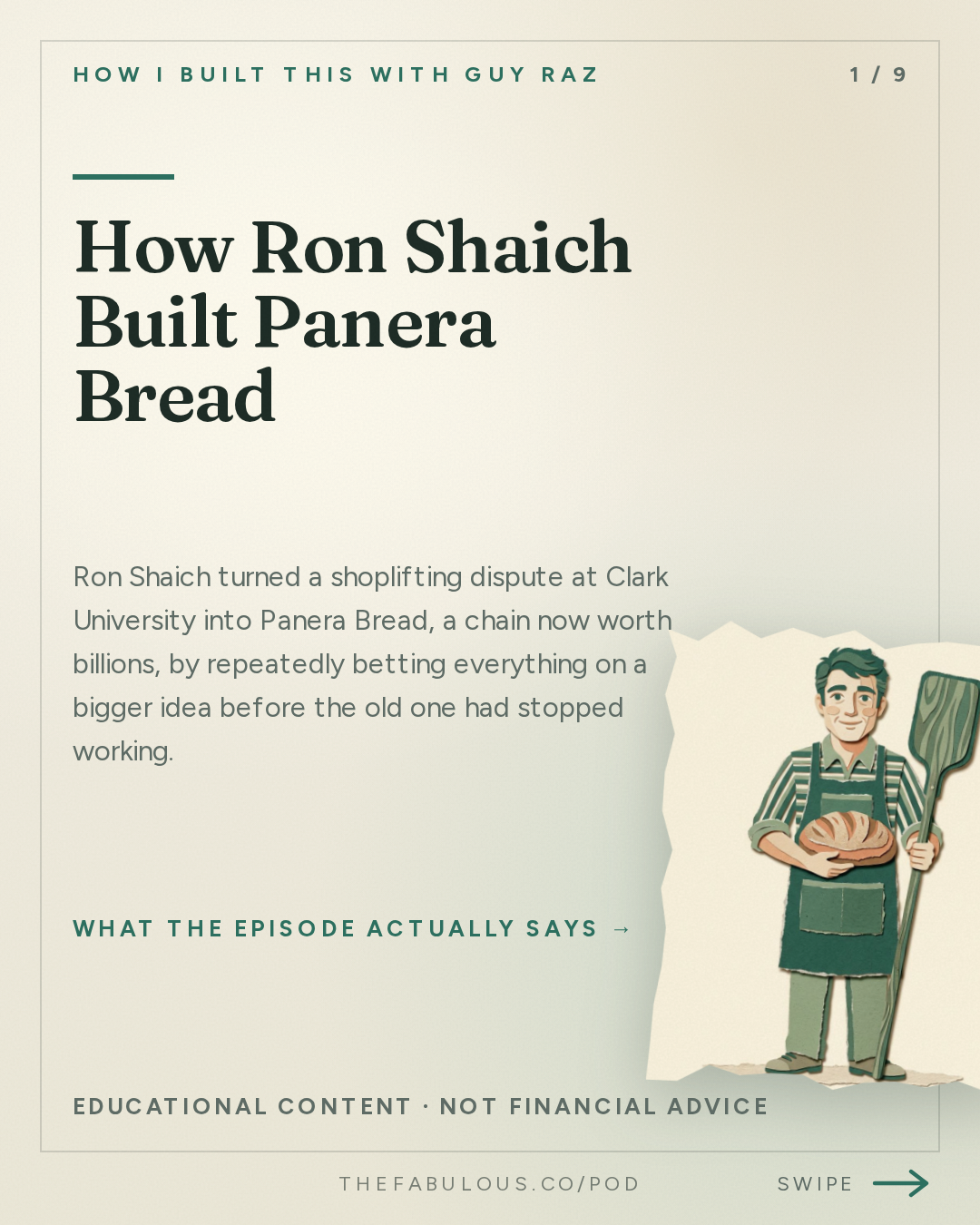
Ron Shaich turned a shoplifting dispute at Clark University into Panera Bread, a chain now worth billions, by repeatedly betting everything on a bigger idea before the old one had stopped working. He sold his profitable Au Bon Pain chain in 1999 to go all in on Panera, a bet that turned $3-a-share stock into $315 a share.
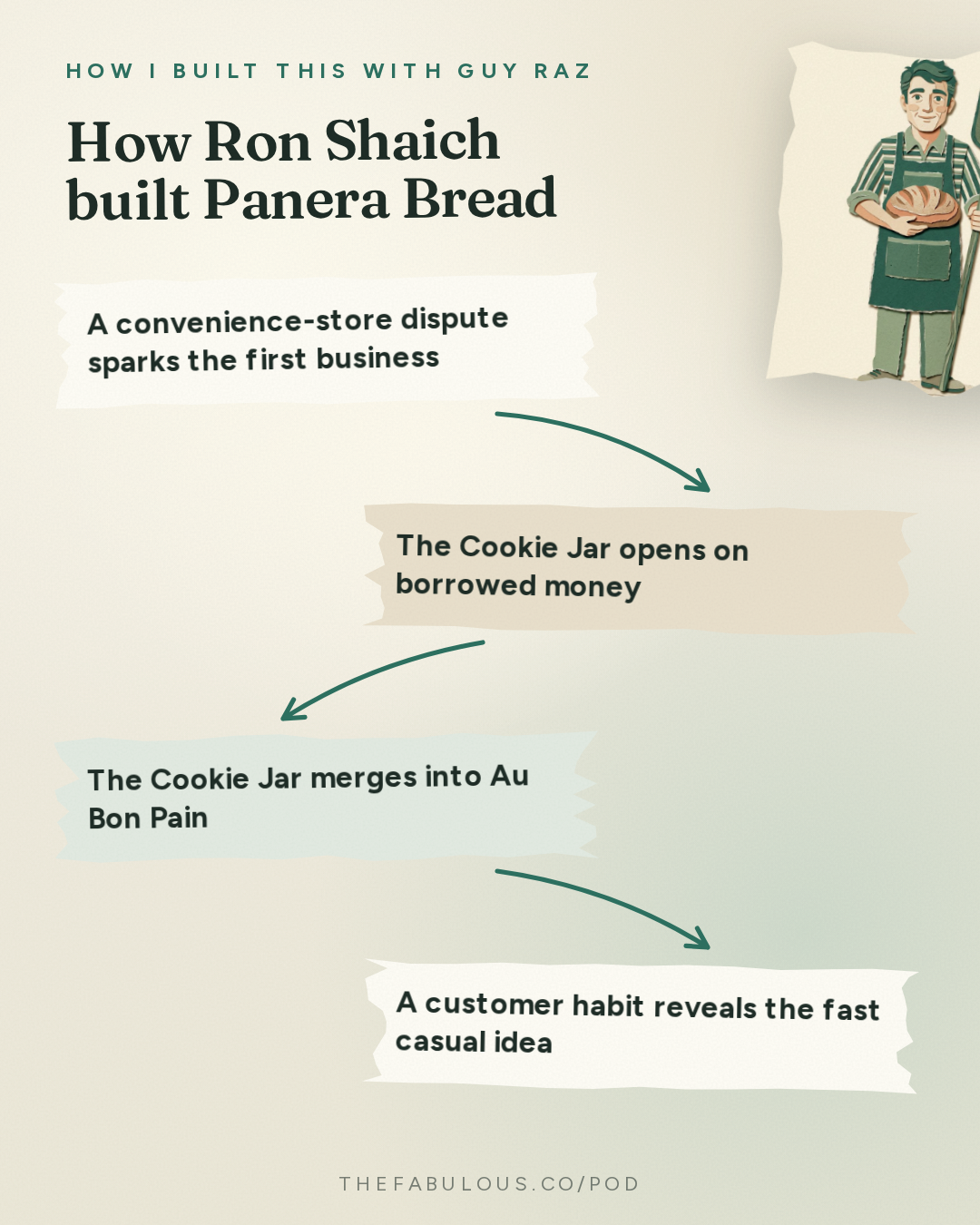
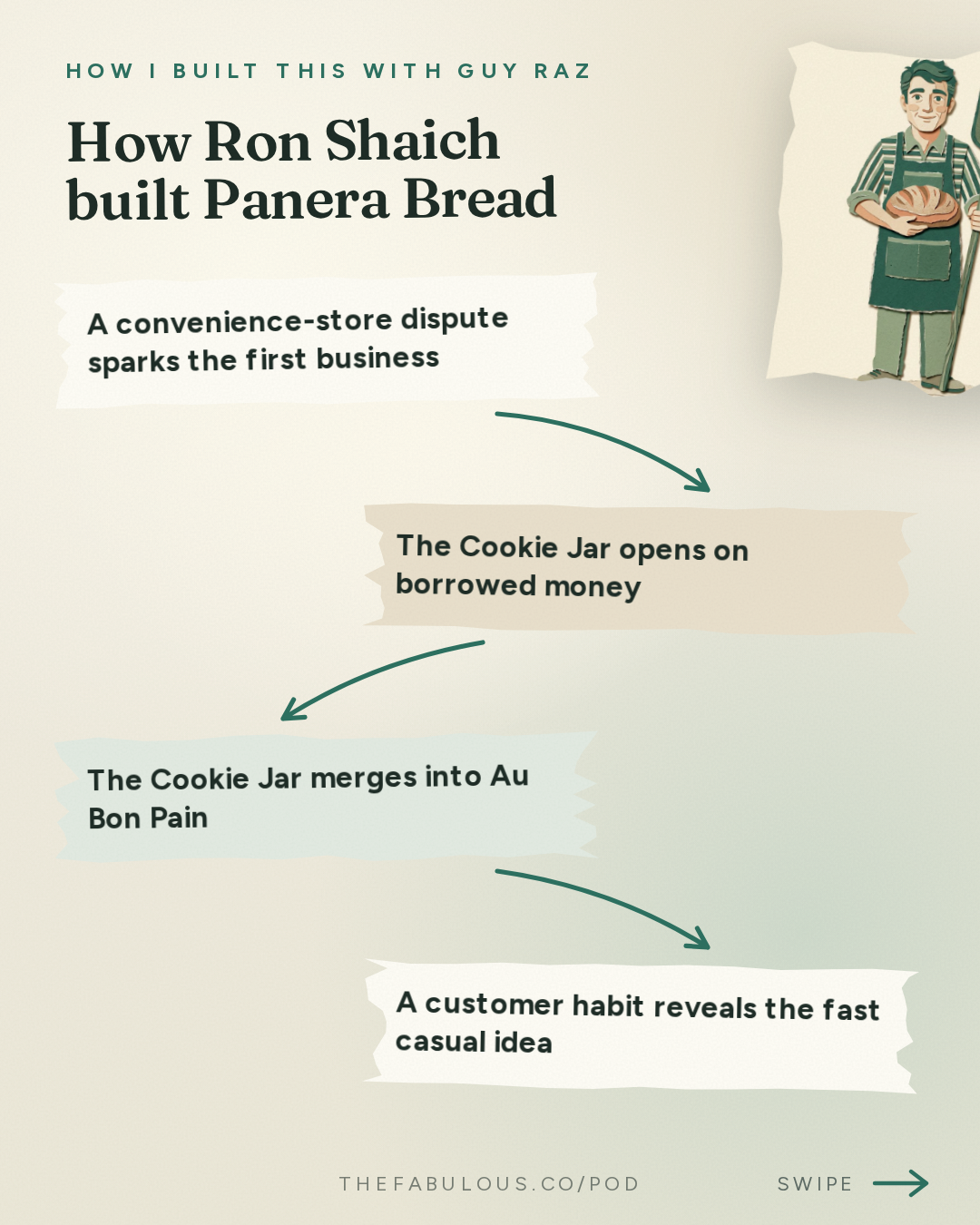
In the early 1970s, a group of college students got tossed out of a convenience store across from Clark University for shoplifting. They hadn't shoplifted anything. The students were furious, and one of them, a political science major named Ron Shaich, did something that would define the rest of his life: he decided the easiest revenge was to make the store obsolete. He pitched the university on letting students run their own convenience store instead (06:21). It worked. That small act of spite, as much as any business-school lesson, is where Panera Bread actually begins.
Shaich never set out to be a restaurant mogul. He grew up in a family of "raging liberals" in New Jersey, went to rallies before he could drive, and arrived at Clark assuming he'd spend his life in politics (05:48). But running that student store taught him something that stuck: a business, he realized decades later, "is a campaign that goes on and never ends" (07:53). The analogy holds up well. Campaigns have a thesis, a deadline, and a willingness to throw out the plan when the data changes. So, it turns out, did Shaich's career.
After Harvard Business School, he took a job managing mall cookie stores in the Midwest, then quit when his bosses wouldn't let him try an urban location. Nobody would lease him space on his own, he says, because he "had no credibility" and no balance sheet (10:13). His father ended up lending him $75,000 on top of his own $25,000 inheritance, and that $100,000 became The Cookie Jar, a 400-square-foot bakery in downtown Boston (10:39). On opening day, 50,000 people walked past the store. Shaich took in $400 (11:58). It was not a fortune, but it was proof the location worked, and that was the point.
What happened next is the real hinge of the story. Shaich noticed nobody bought cookies before noon, so he struck a licensing deal with a tiny three-location Boston chain called Au Bon Pain to sell French pastries in the mornings. The product was great, he says, but the company behind it was "out of control," missing deliveries and failing to bill him properly (14:59). So he offered to merge his profitable cookie business into Au Bon Pain in exchange for 60 percent ownership, with his new partner Lou Kane and the existing investors keeping 40 percent (15:19). It was the first of several moments in which Shaich decided that owning more of something harder to run beat owning all of something small and easy.
Running Au Bon Pain in its early years was chaos in a fairly literal sense. The crew tried to dry frozen spinach for croissants by running it through clothes dryers, until one blew its top and coated the entire 3,000-square-foot production floor in spinach (17:01). A dough divider, held together with baling wire and a coat hanger, once threw sparks and dropped an employee to the floor; everyone assumed the worst until the man opened one eye and asked why someone's tongue was in his mouth (18:35). These are good stories, but they also make a point Shaich returns to again and again: small operations survive on improvisation, not polish.
The baguette was never the point
The idea that actually built Panera came from behind the sales counter, not from a strategy session. Customers kept buying a baguette, slicing it open, and stuffing it with turkey and cheese they'd brought from the supermarket. Watching this, Shaich had his insight: "the baguette is not the end, it's the platform to sell sandwiches" (22:37). In 1985 Au Bon Pain opened its first bakery cafe in Boston's Copley Place mall, selling sandwiches made on its own bread, and had fifty people in line before the doors opened on day two (23:27). Shaich later described what he'd stumbled into as an alternative between "down and dirty fast food" and fine dining (24:23), a category the industry would eventually name fast casual.
Big companies noticed. Pepsi launched a competing bakery cafe chain called La Petite Boulangerie; Sara Lee bought a rival and announced plans for 400 stores; a Washington-area chain called Vie de France joined the race too (24:48). All of them had more money and better resumes than Shaich's team. All of them eventually failed. Shaich's explanation is that his people were simply more committed: "our guys were committed in this deep and profound way to making this concept work" (25:34). Au Bon Pain went public in 1991, having outlasted every well-funded competitor.
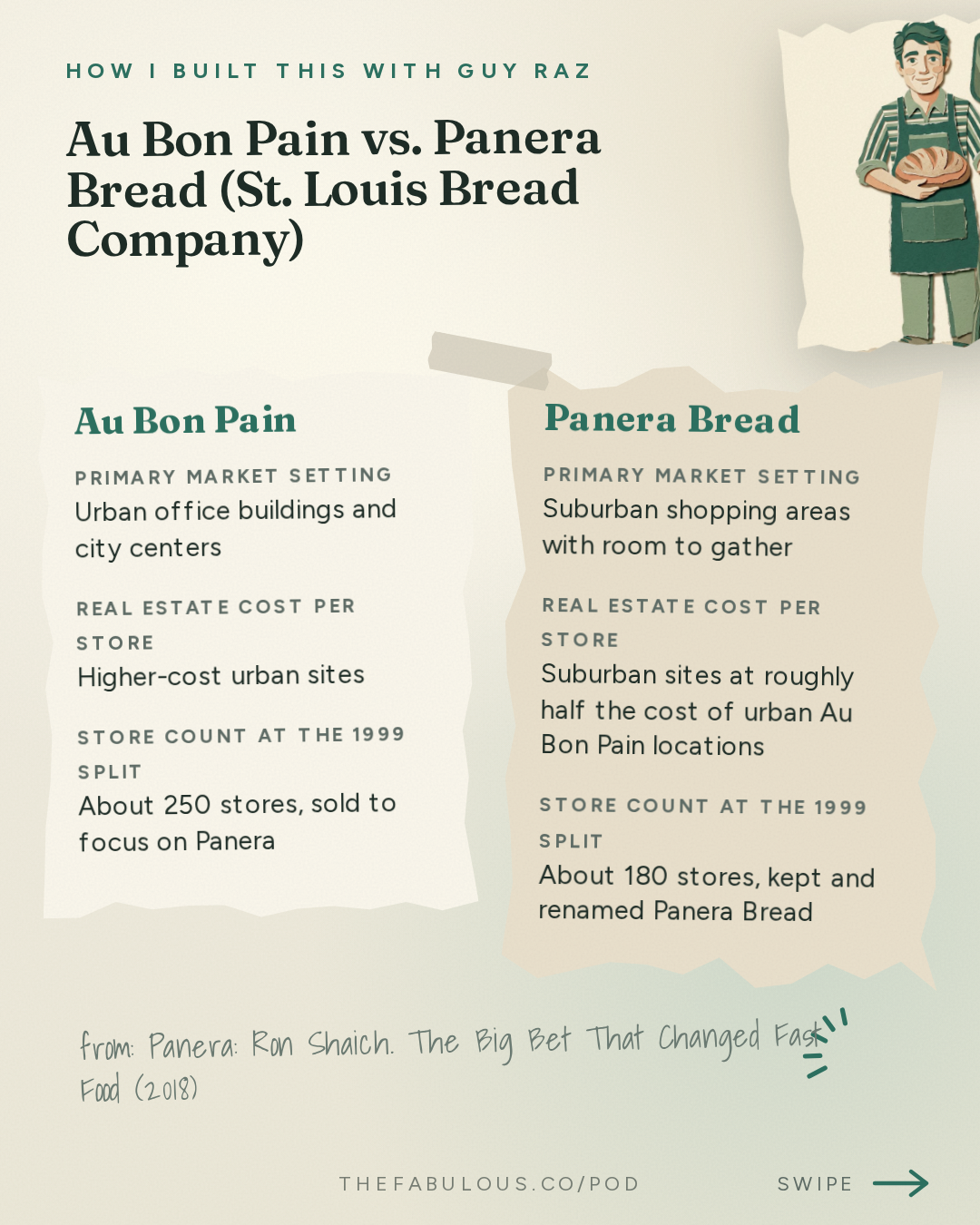
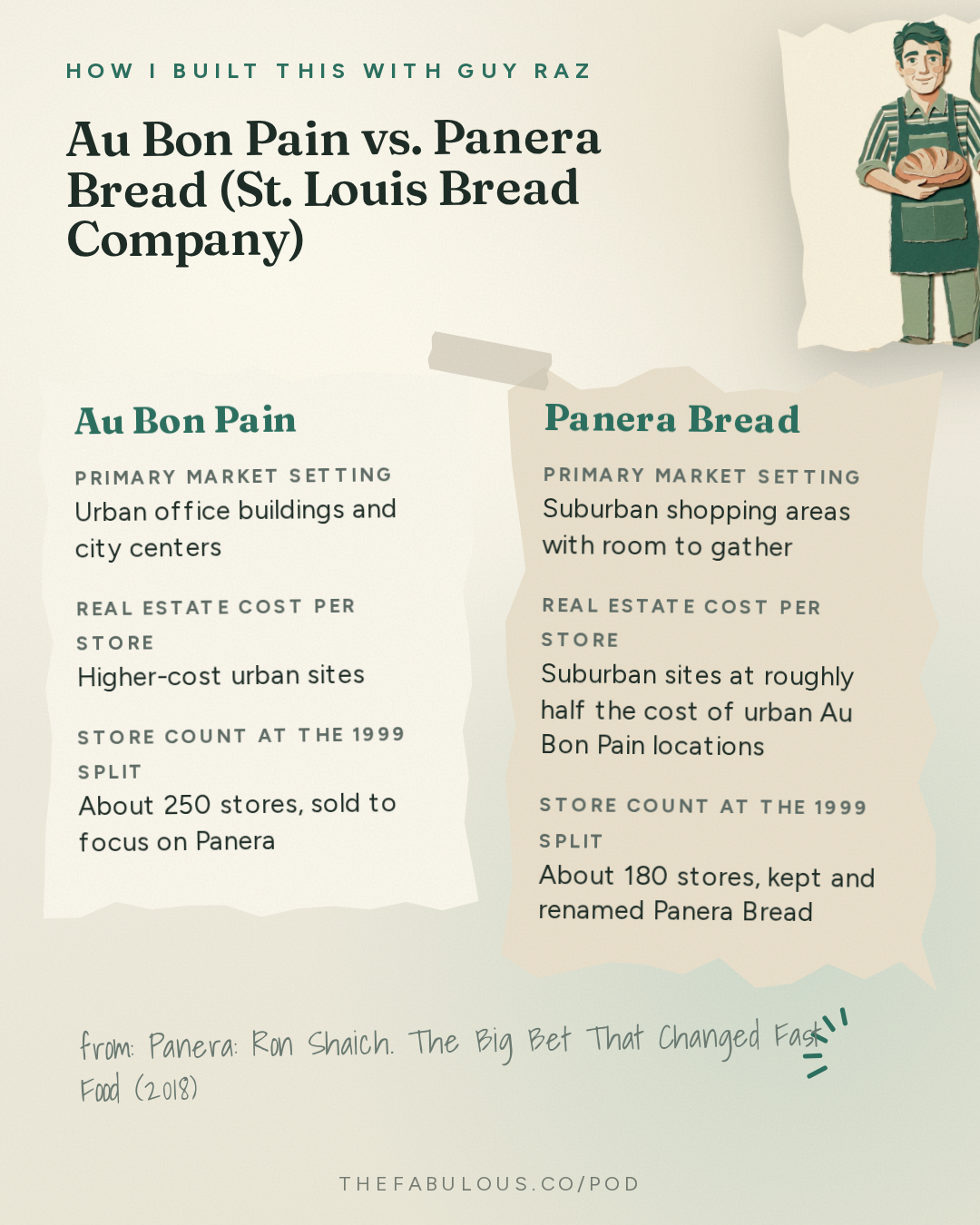
Two years later, Shaich bought a 19-store St. Louis sandwich chain called St. Louis Bread Company for $23 million (27:10). It was generating almost as much revenue per store as Au Bon Pain, but in cheaper suburban real estate with room for people to linger, what Shaich calls the "chill business" (27:31). He renamed it Panera Bread everywhere outside St. Louis, in part because customers elsewhere associated "St. Louis" with Clydesdale horses and beer, and he wanted, in his words, "an empty vessel, a personality we could form" (28:56).
By 1998, Panera had grown to about 150 stores, but it was buried as one of four divisions inside Au Bon Pain's parent company. A friend asked Shaich a question that changed everything: what would he do if Panera owned Au Bon Pain, instead of the other way around? Shaich's answer was to propose selling every other division, Au Bon Pain included, and pouring all the company's cash and people into Panera alone (31:04). His venture-capital board members, who had originally invested because of Au Bon Pain, fought him hard; he held two votes to their three (32:15). He has called Au Bon Pain his "first child," and selling it was not pleasant to live through even if, in hindsight, it looks obvious (35:12).
"I was proposing to sell everything other than Panera, and take all the money and all the human resources and myself and go down and make this happen." — Ron Shaich [31:04]
The company sold Au Bon Pain's roughly 250 stores and kept Panera's 180, then changed the public company's name from Au Bon Pain to Panera (34:46). Panera stock had traded around $3 to $4 a share before the sale. By the time Panera was eventually sold to the German holding company JAB in 2017, it traded at $315 a share (35:37). Nobody believed him at the time, Shaich says: "I was telling everybody. Nobody wanted to listen then" (35:37).
Betting against the crowd
Panera's other defining bet came during the 2008 financial crisis, when the company was opening a new store roughly every three days (37:15) while most competitors were cutting costs to survive. Real estate and construction costs had dropped about 20 percent, and Shaich decided that was exactly the moment to expand rather than retrench, a contrarian call he credits with helping triple the stock through the recession (38:09). The logic, borrowed loosely from Warren Buffett, was that fear is when fortunes get built, not protected.
By 2017, with roughly 100,000 employees depending on the company's decisions (41:38), Shaich chose to sell Panera back into private hands under JAB Holding. His reasoning was not that public markets had mistreated him personally; he controlled enough stock to resist pressure. It was that the next CEO might not have that luxury, and public markets, he argues, now punish exactly the kind of multi-year transformation that built Panera in the first place (41:05).
What ties the whole arc together, from the convenience-store dispute to the recession-era expansion, is a kind of comfort with discomfort. Shaich describes himself as someone who sees an opportunity, wades into the water, and figures out where the current takes him rather than planning the whole swim in advance (12:38). It's a loose way to run a company, and it does not sound like a strategy you'd teach in a case study. But it produced one.
Ask this episode anything
Pod's AI answers from the episode itself, with the minute mark so you can hear it yourself.
Or start with one of these
Ask this episode
Pod's AI listens to the whole episode to answer, and points you to the minute it comes from.
The rest of this answer, and any question after it
Answers come from the episode itself, never from a summary of it.
ContinueKey takeaways
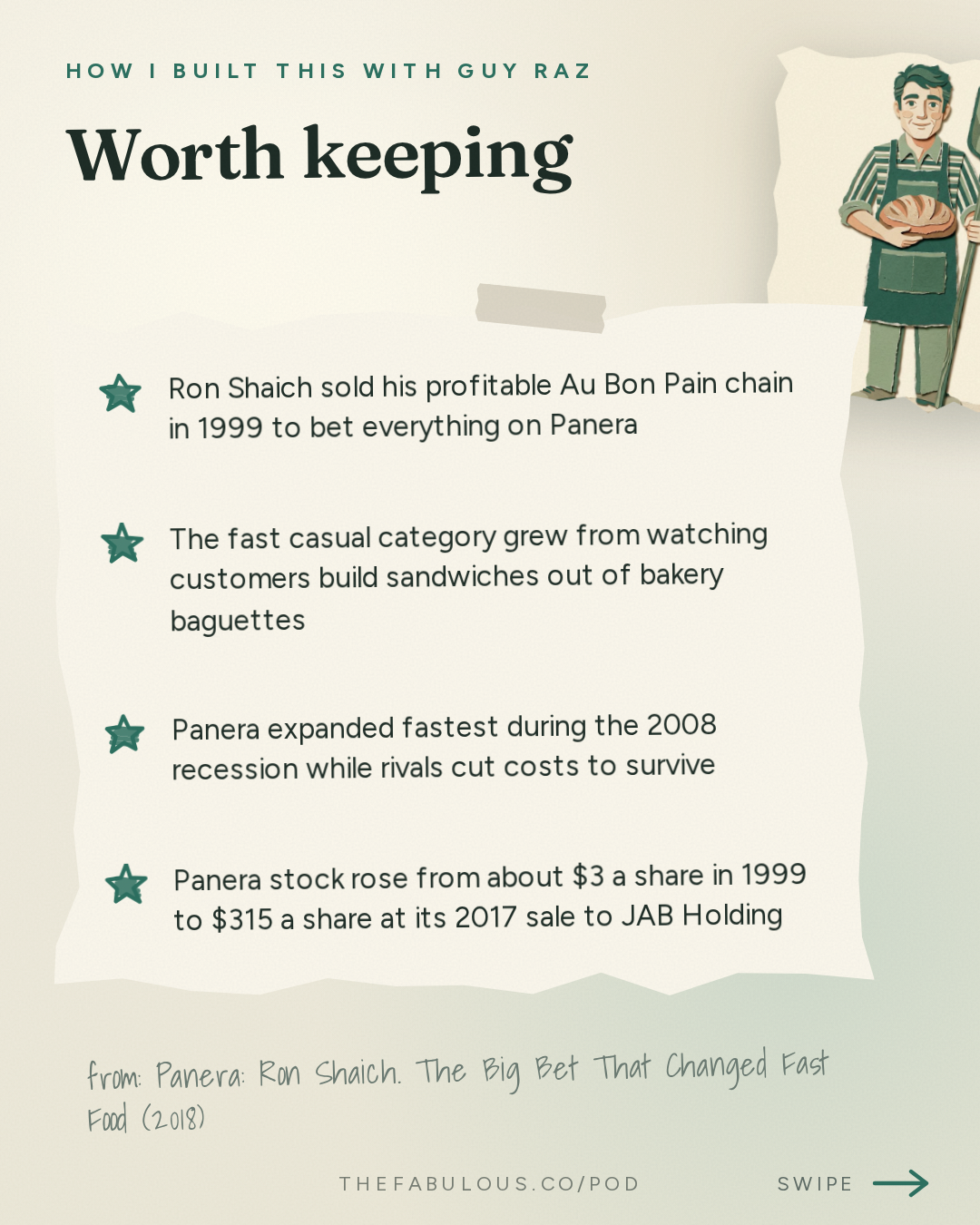
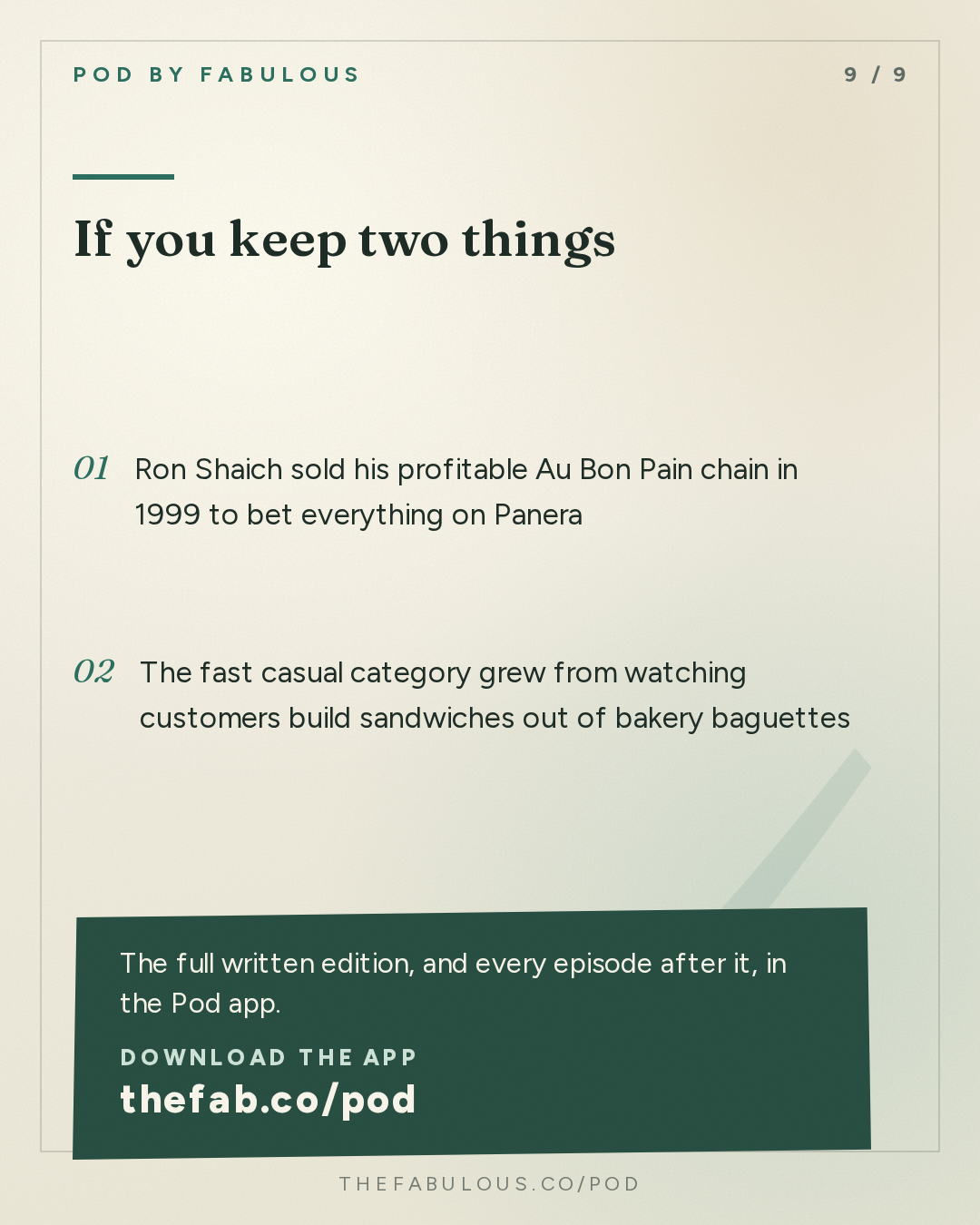
- Ron Shaich sold his profitable Au Bon Pain chain in 1999 to bet everything on Panera
- The fast casual category grew from watching customers build sandwiches out of bakery baguettes
- Panera expanded fastest during the 2008 recession while rivals cut costs to survive
- Panera stock rose from about $3 a share in 1999 to $315 a share at its 2017 sale to JAB Holding
- Shaich took Panera private again in 2017 because he believed public markets punish long-term bets
The episode in cards
By the numbers
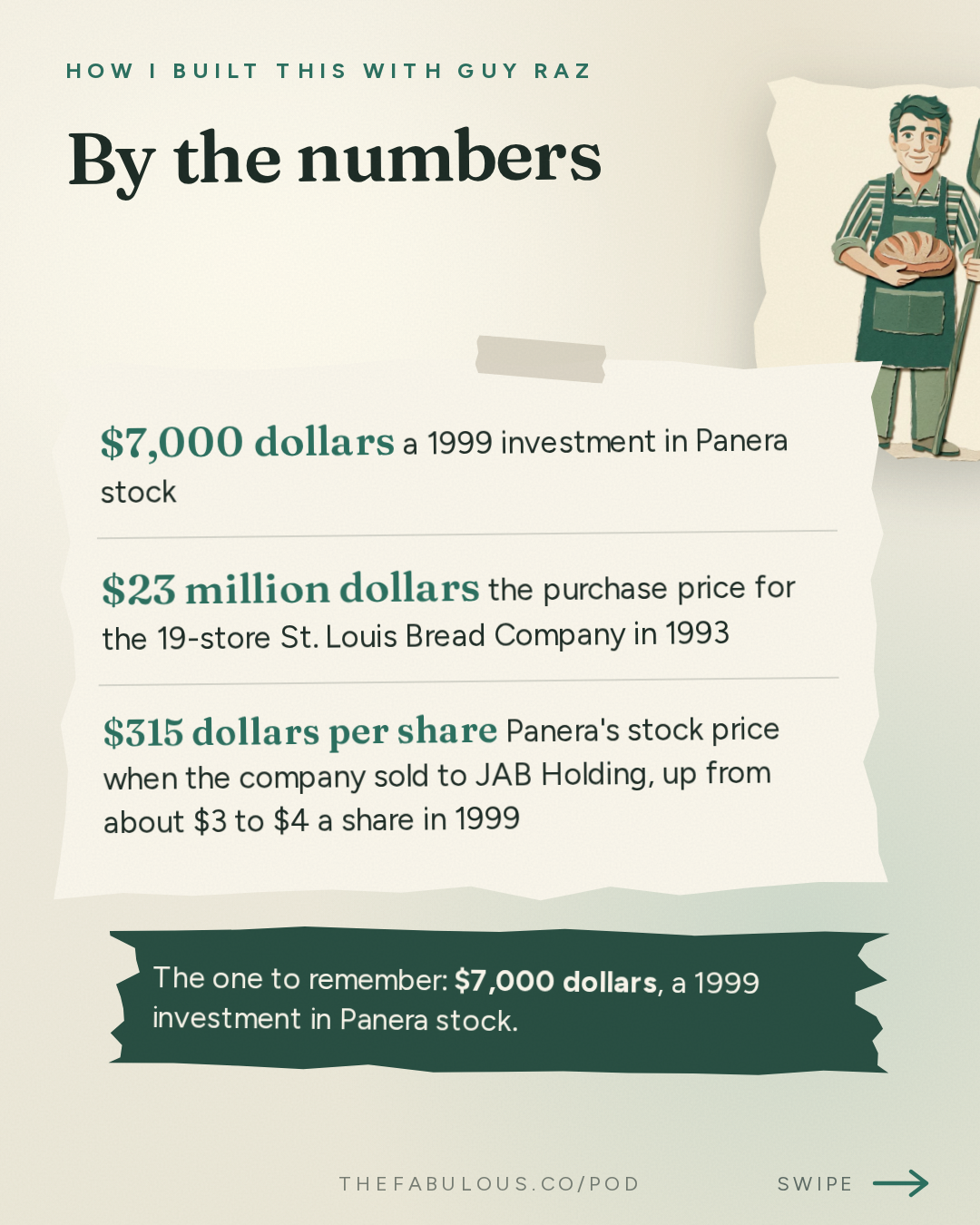
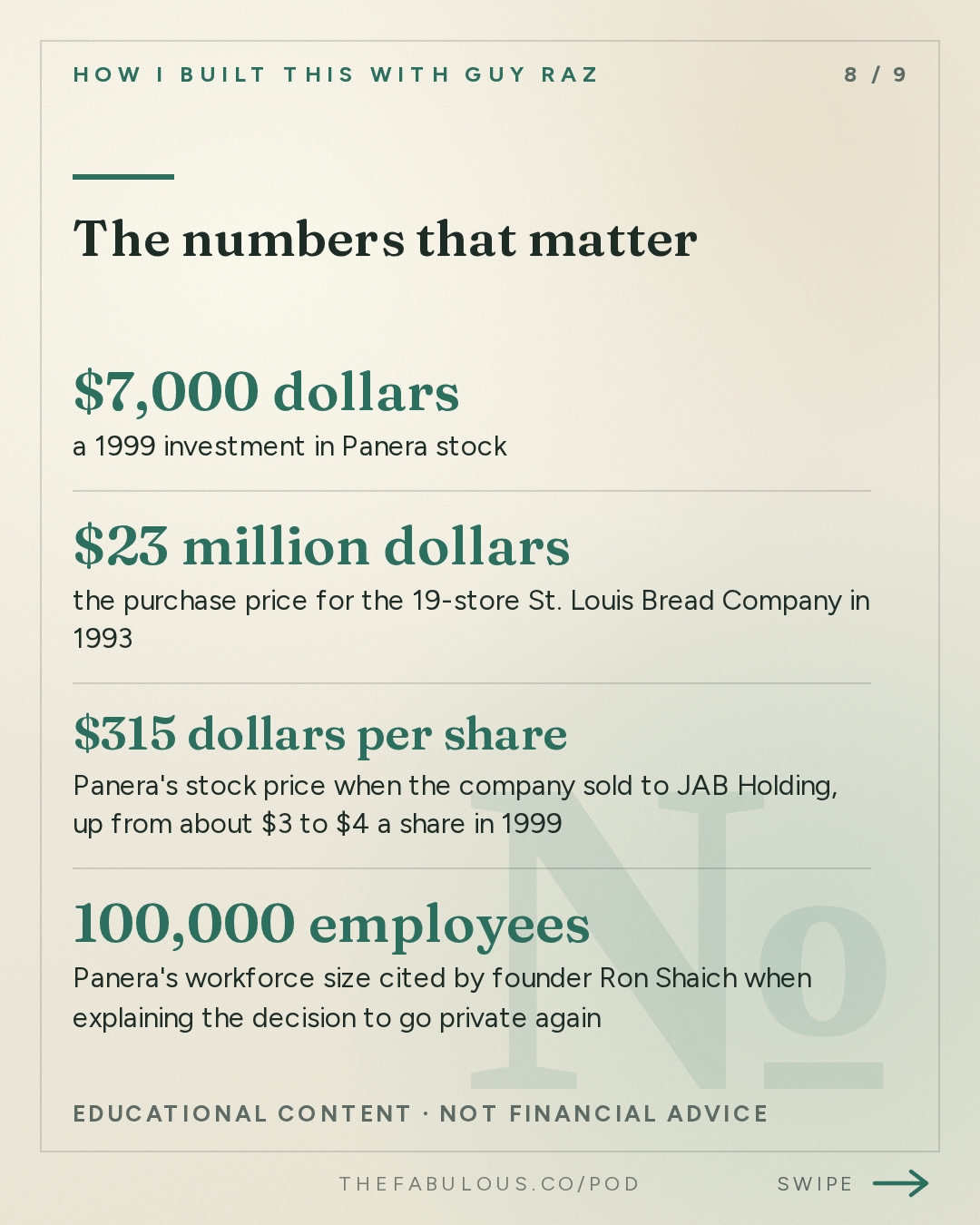
- $7,000 dollars a 1999 investment in Panera stock
- $23 million dollars the purchase price for the 19-store St. Louis Bread Company in 1993
- $315 dollars per share Panera's stock price when the company sold to JAB Holding, up from about $3 to $4 a share in 1999
- 100,000 employees Panera's workforce size cited by founder Ron Shaich when explaining the decision to go private again
In their words
“Running a business is no different than a campaign. In fact, a campaign is a business that, that essentially has one day in which it ends”
“You didn't have to be a Harvard MBA to say, "Wow, the real thing here is that the baguette is not the end." Hmm. "It's the platform to sell sandwiches."”
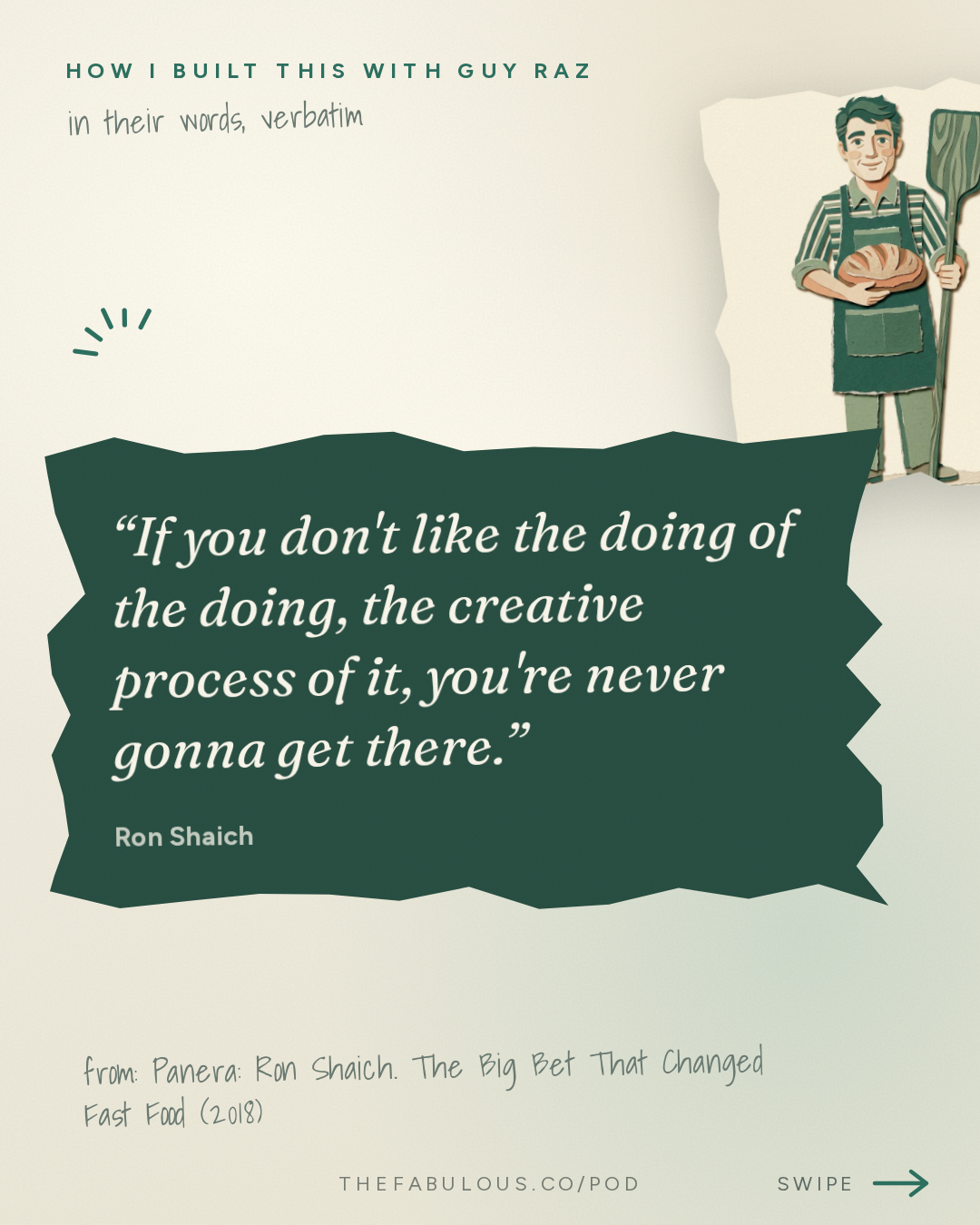
“If you don't like the doing of the doing, the creative process of it, you're never gonna get there.”
Protocols
-
Watch what customers actually do with the product
Panera founder Ron Shaich says founders should pay close attention to how customers improvise with a product, because that behavior often reveals the real opportunity. He noticed Au Bon Pain customers slicing open baguettes to make their own sandwiches, which led him to treat the baguette as a sandwich platform rather than a finished product.
ongoing, built into daily counter work
-
Be willing to sell the business you started first
Shaich sold his original company, Au Bon Pain, in 1999 to focus all of the company's money and people on the smaller but faster-growing Panera brand. He describes this as treating the original business like a 'first child' that still has to be let go when a bigger opportunity is clearly stronger.
one-time, at a strategic inflection point
-
Expand during downturns instead of cutting costs
Shaich kept Panera's balance sheet unlevered before the 2008 recession, then used the resulting flexibility to open new stores roughly every three days while competitors were cutting their own costs to survive falling sales. Real estate and construction costs had fallen about 20 percent, which made expansion cheaper exactly when rivals were retreating.
sustained through the 2008-2009 recession
Questions this episode answers
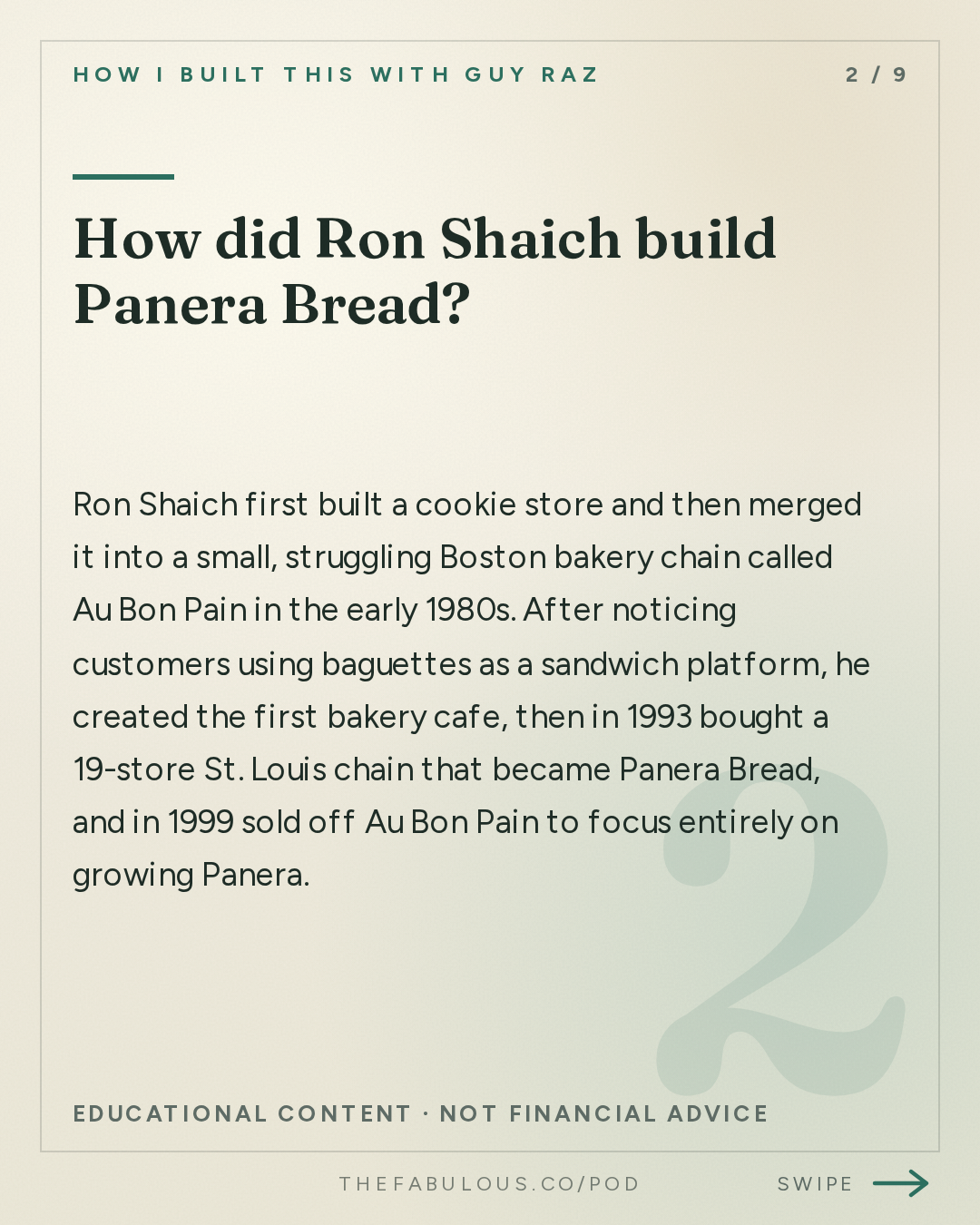
How did Ron Shaich build Panera Bread?
Ron Shaich first built a cookie store and then merged it into a small, struggling Boston bakery chain called Au Bon Pain in the early 1980s (15:19). After noticing customers using baguettes as a sandwich platform, he created the first bakery cafe, then in 1993 bought a 19-store St. Louis chain that became Panera Bread, and in 1999 sold off Au Bon Pain to focus entirely on growing Panera (27:10, 31:04).
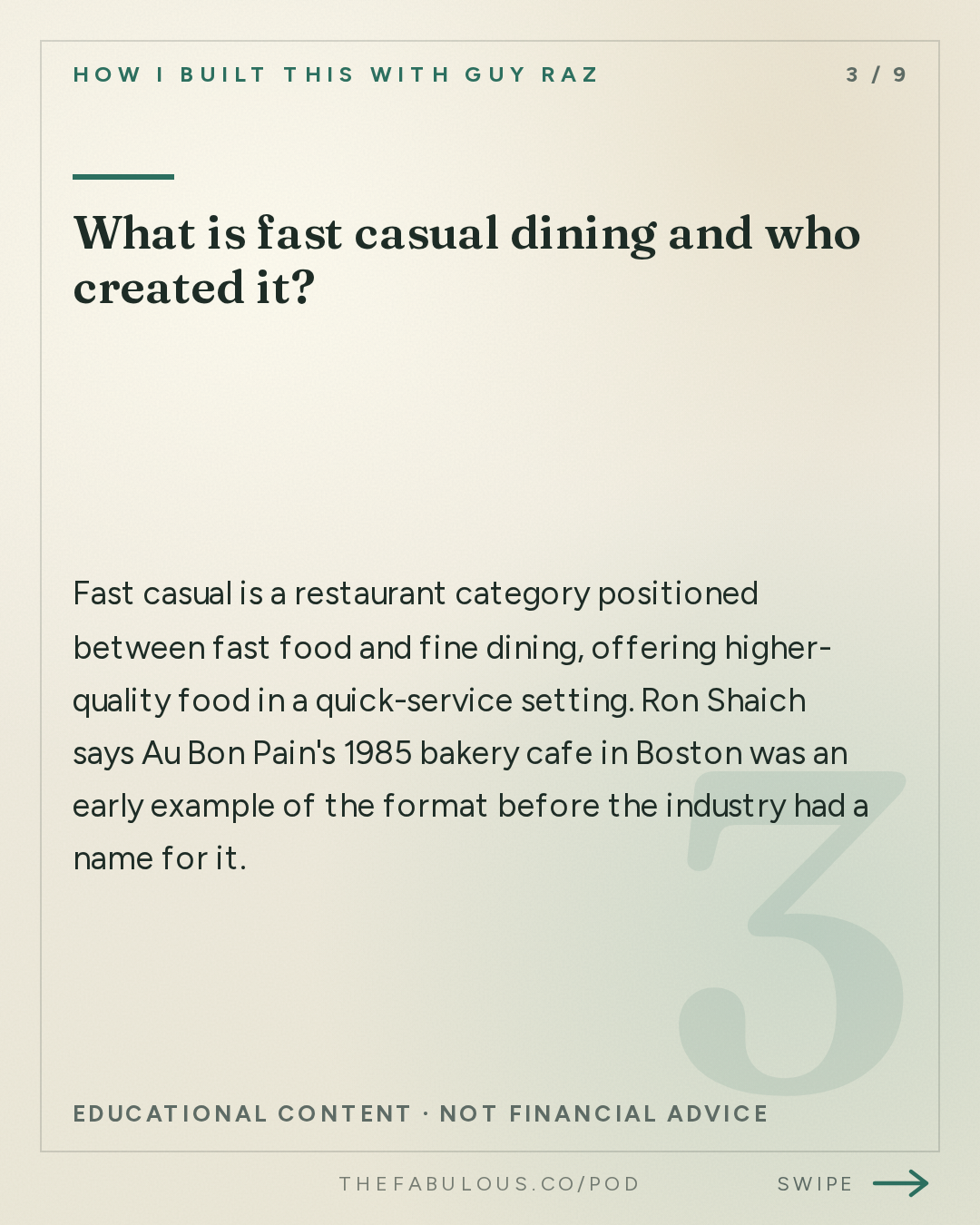
What is fast casual dining and who created it?
Fast casual is a restaurant category positioned between fast food and fine dining, offering higher-quality food in a quick-service setting. Ron Shaich says Au Bon Pain's 1985 bakery cafe in Boston was an early example of the format before the industry had a name for it (24:23).
Why did Ron Shaich sell Au Bon Pain?
By 1998 Panera was buried as one of four divisions inside the larger Au Bon Pain company, even though Shaich believed it had the potential to become a nationally dominant brand. In 1999 he proposed selling Au Bon Pain and the company's other divisions entirely so all of its money and people could go toward growing Panera, a move his own board initially resisted (31:04).
Why did Panera go private again in 2017?
Founder Ron Shaich says public markets create short-term pressure that discourages the kind of multi-year transformative bets that built Panera, such as the company's expansion during the 2008 recession. With about 100,000 employees depending on the company's decisions and his own eventual exit as CEO approaching, he sold Panera to JAB Holding to protect its ability to make long-term bets (41:05, 41:38).
How much would an early investment in Panera stock be worth today?
A $7,000 investment in Panera stock in 1999 would have grown to more than $500,000 by 2017, according to the episode's framing of the company's stock performance (05:17). Panera's share price rose from roughly $3 to $4 a share in 1999 to $315 a share when the company was sold to JAB Holding (35:37).
The full read, in cards
Mentioned
Ron Shaich · Lou Kane · Howard Schultz · Au Bon Pain · Panera Bread · St. Louis Bread Company · JAB Holding · Cava · Harvard Business School · Clark University
More from this show and category
How Dr. Squatch Built a $1.5 Billion Soap Brand
Jack Haldrup turned a $1,500 soap side hustle into Dr. Squatch, which Unilever bought for $1.5 billion in 2025. The hinge moments were ditching Google ads for Facebook, surviving a forced rebrand and a partner buyout, and shooting a $15,000 video that drew 120 million views and became the company's main sales engine.
How Michael Dell Built Dell From His Dorm Room
Michael Dell found marriage license records as a teenager, used them to sell newspapers, then applied the same instinct to undercut IBM on price. At 19 he ran a $50,000-to-$80,000-a-month computer business from his dorm room at UT Austin, and by 21 his company, Dell Computer Corporation, had $66 million in annual sales.
Brian Chesky's Founder Mode Explained
Airbnb CEO Brian Chesky says he was a great founder but a terrible CEO until the 2020 pandemic forced a hands-on style he calls founder mode. After Airbnb lost 80% of its business in eight weeks, he stopped deferring to veteran executives and began skip-leveling for raw information, a shift that still shapes how he runs the company.
Tope Awotona's Advice for Bootstrapped Founders
Calendly founder Tope Awotona takes four founder calls on How I Built This's Advice Line, covering AI's lowered barrier to building software, physical-product virality, gifting strategy, and his core lesson: build a business around a customer, not a product.
