
How Michael Dell Built Dell From His Dorm Room
Dell Computers: Michael Dell. The College Dropout Who Took on IBM (2018)
The brief
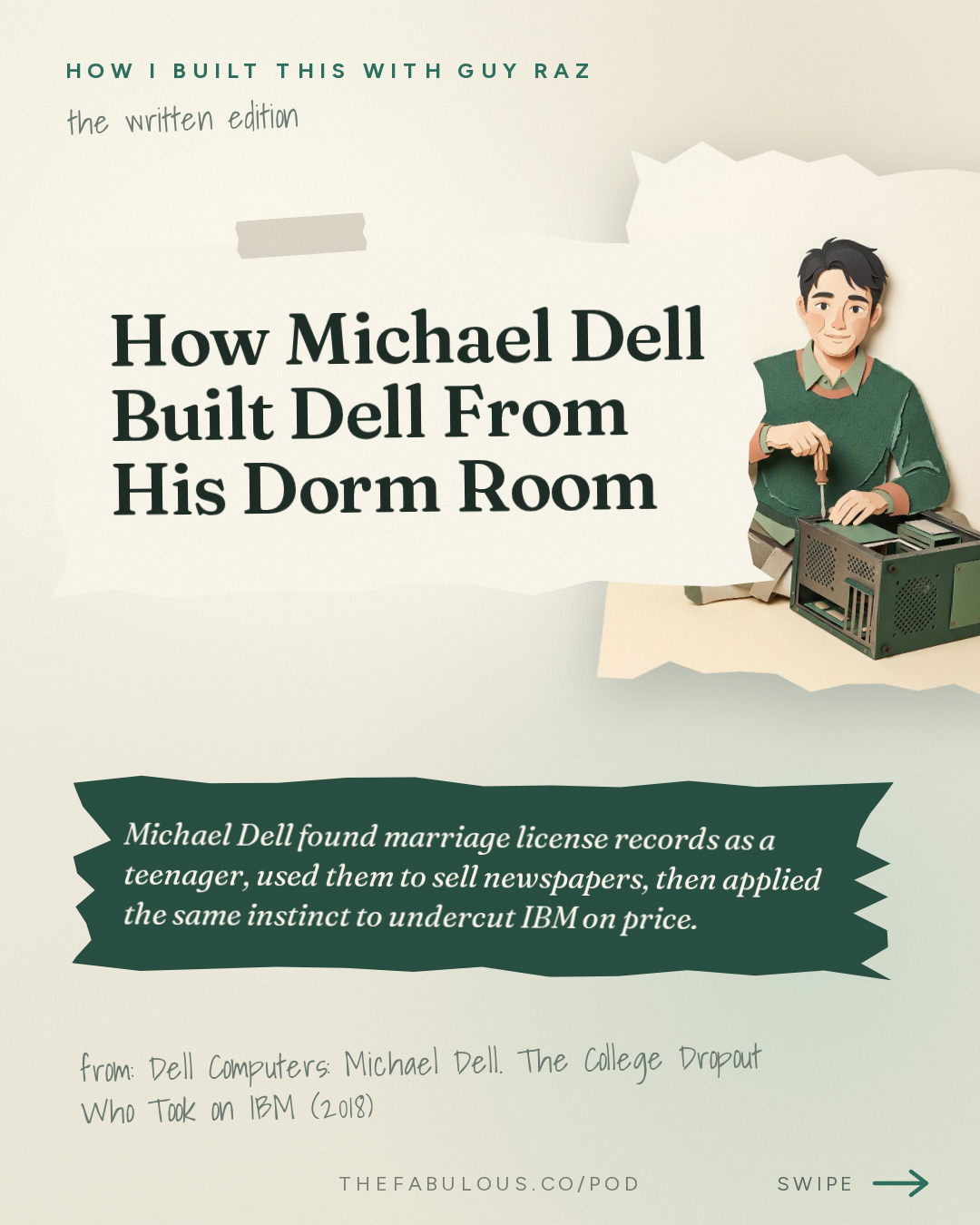
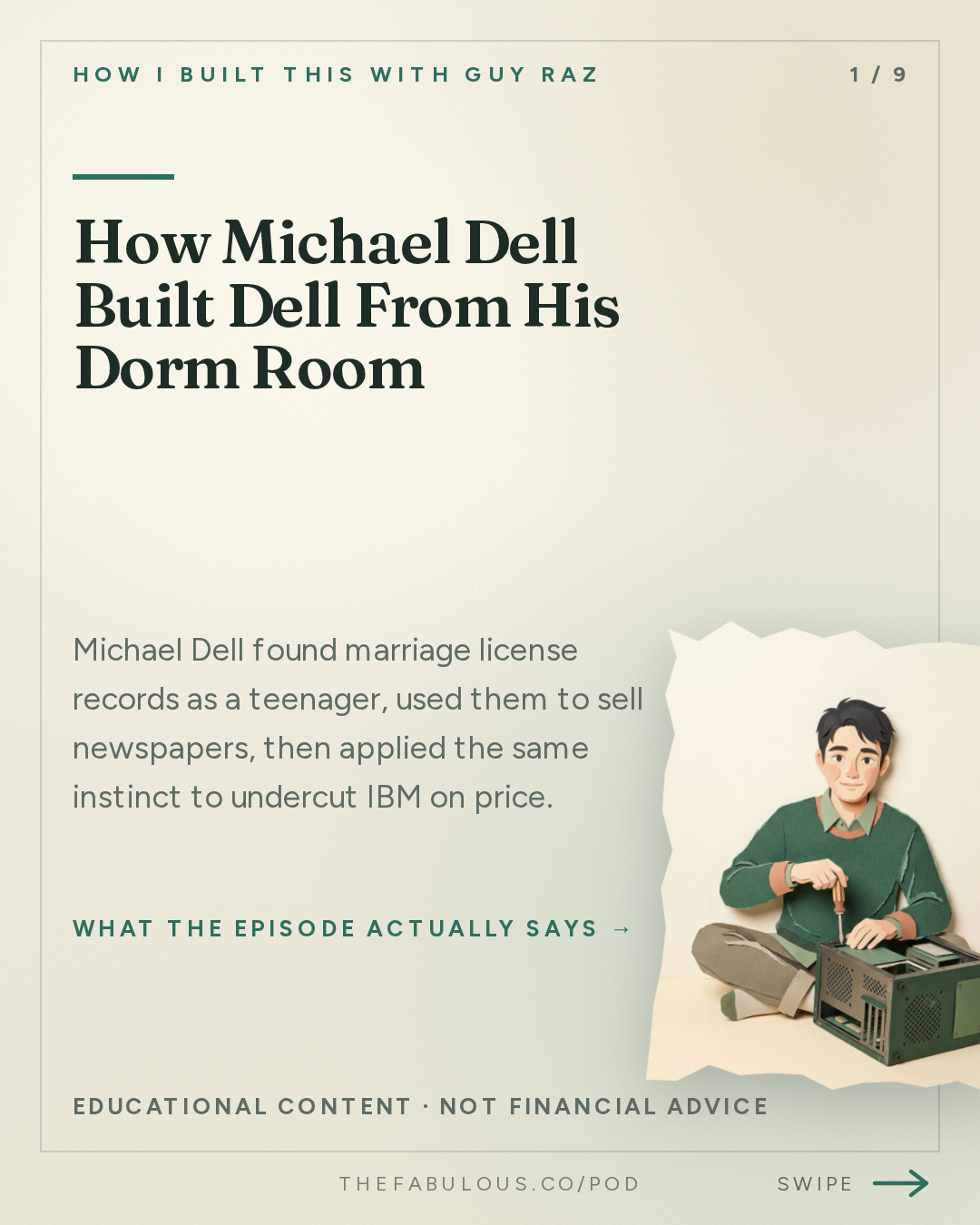
Michael Dell found marriage license records as a teenager, used them to sell newspapers, then applied the same instinct to undercut IBM on price. At 19 he ran a $50,000-to-$80,000-a-month computer business from his dorm room at UT Austin, and by 21 his company, Dell Computer Corporation, had $66 million in annual sales.
In the early 1980s, a Houston teenager figured out that the Harris County courthouse kept a public list of everyone who had just applied for a marriage license, and that the list included the address where the license would be mailed. Most people would see a filing cabinet. Michael Dell saw a mailing list. He hired his high school friends to copy the names onto index cards at small Apple II computers, then sent a direct mail campaign to newlyweds in a 16-county radius, betting that people setting up a new household would also want a newspaper. He was right.
By then he had already spent months on the phone for the Houston Post, cold-calling strangers to sell subscriptions. He noticed three things: people bought more often from callers who sounded like them, newlyweds bought more, and people who had just moved bought more (07:33). The marriage license trick and a side hustle canvassing new apartment complexes turned those observations into a business. At 17, Dell made a little over $18,000 that year (09:46), which he used to buy a BMW. He still was not sure why none of his classmates were doing the same thing. "I didn't really think about it like that," he told Guy Raz. "I just seemed like a good idea, so I was pursuing it, and it was working."
The same instinct, pull something apart until you understand exactly what it costs, is what built Dell Computer Corporation. When IBM released its first personal computer in 1981, the machine retailed for about $3,000. Dell bought one, took it apart, and estimated the parts inside were worth about $600 (12:23).
"How can you understand it if you don't take it apart?" (12:48) Michael DellThat gap between component cost and retail price became the entire logic of his company a few years later. IBM's monopoly on information technology was not a monopoly on manufacturing. It was a monopoly on markup.
The Dorm Room Economy
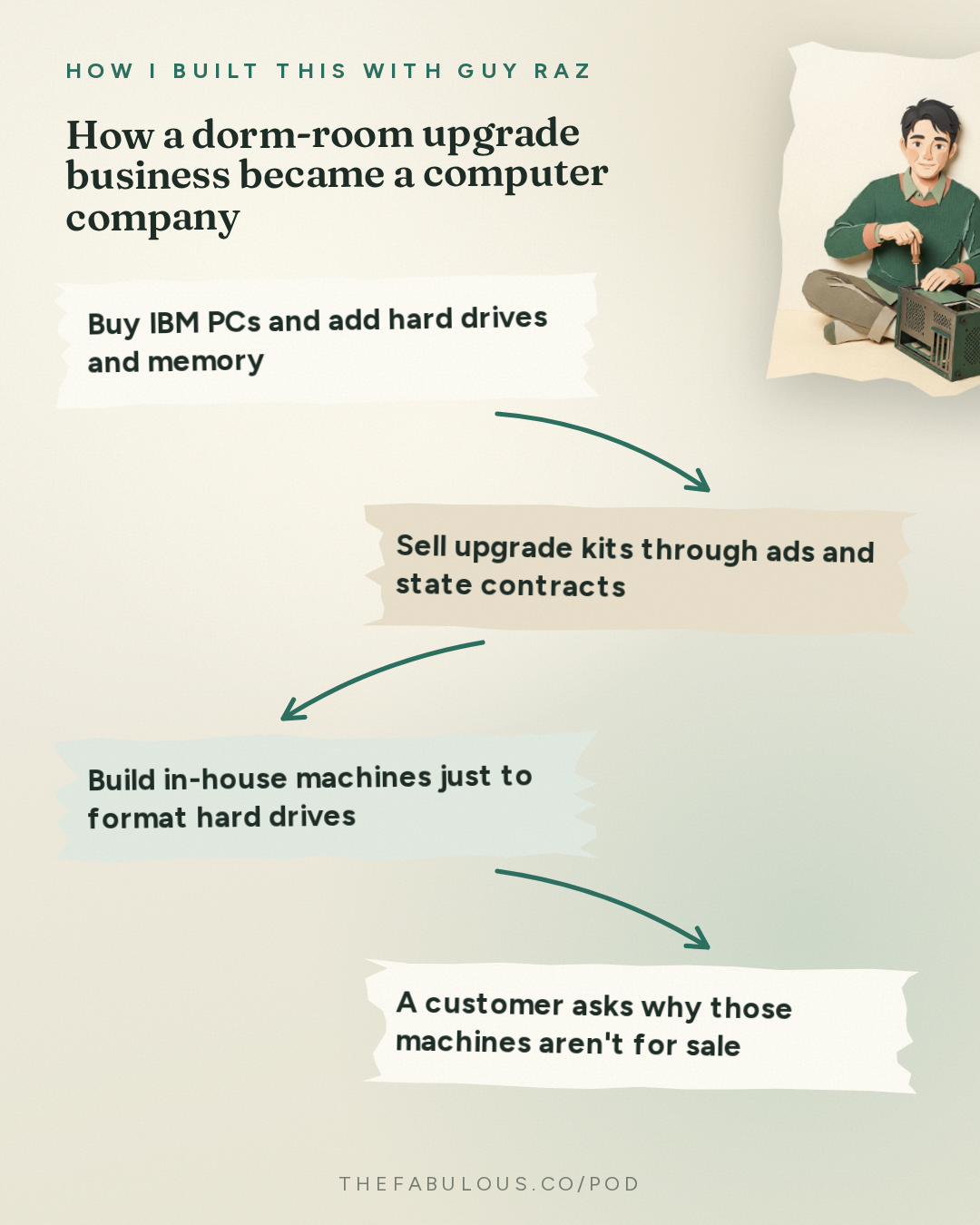
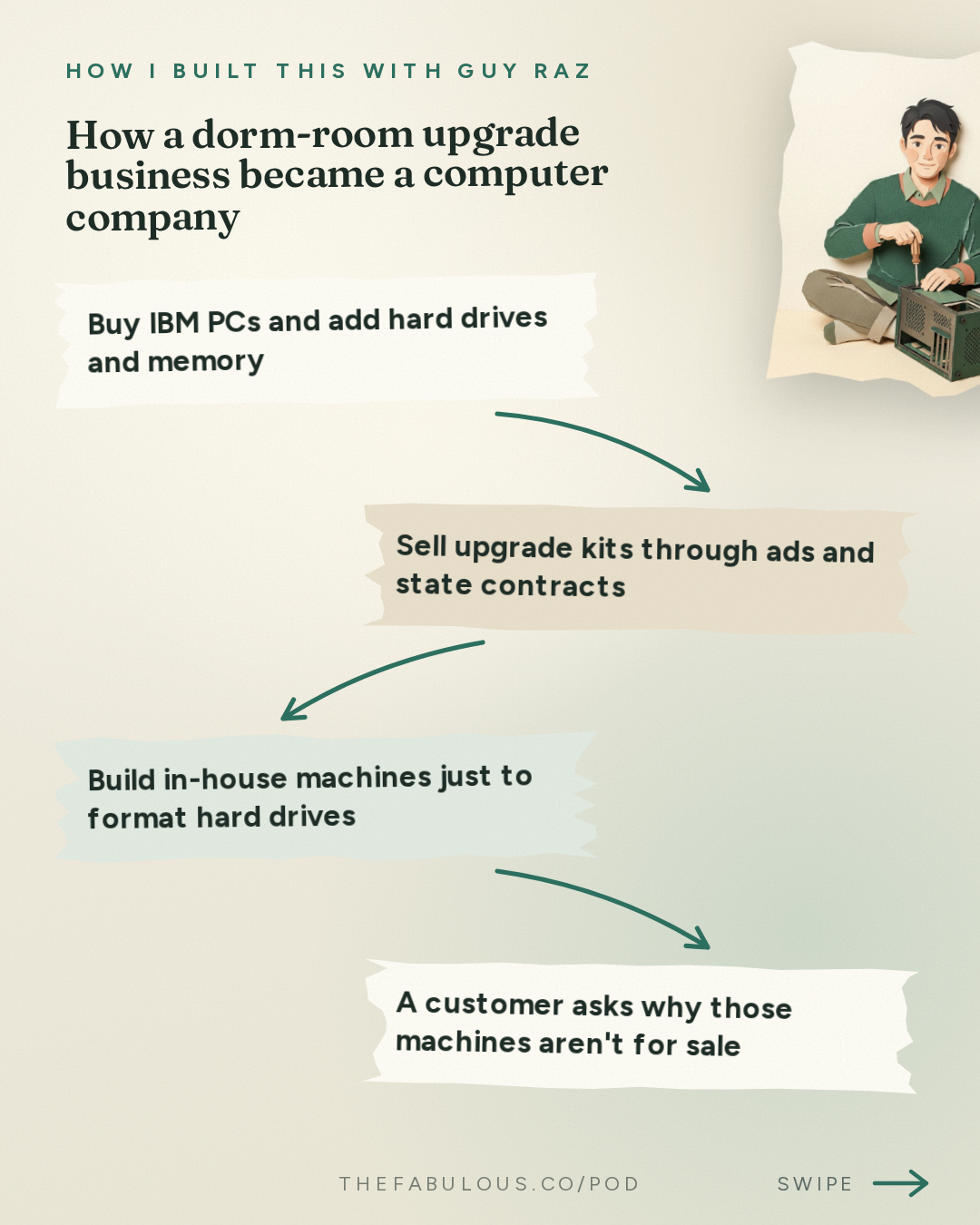
Dell enrolled at the University of Texas at Austin as a pre-med student, mostly because his father and older brother were doctors and that was the expected path. College also meant his parents were three hours away in Houston, which gave him room to keep buying IBM PCs, adding hard drives and memory, and reselling them to doctors, lawyers, architects, and local universities. He advertised in the newspaper and walked three blocks from his dorm to bid on state purchasing contracts. By his freshman year he was doing $50,000 to $80,000 a month in business out of his dorm room (19:24), a figure that dwarfed what most adults in Austin were earning, let alone an 18-year-old who was supposed to be studying organic chemistry.
When his parents found out, they made him stop. He agreed, and lasted about ten days before deciding the business was not a hobby (20:18). He spent those ten days mapping out how to finish his freshman year and then launch the company for real. The company grew by roughly one new hire a week through its first year (22:18). The turning point toward becoming an actual computer maker, rather than an upgrade shop, came almost by accident. A corporate customer, Martin Marietta, placed an order for 150 hard-drive kits and asked to tour the factory. Walking through what was, by Dell's own description, barely more organized than a dorm room, the visitor noticed the machines Dell's team used internally to format hard drives before shipping and asked why Dell did not just sell those (23:40). Dell had been so focused on building upgrade kits that it had not occurred to him to sell the computers underneath them.
Built From Having Nothing
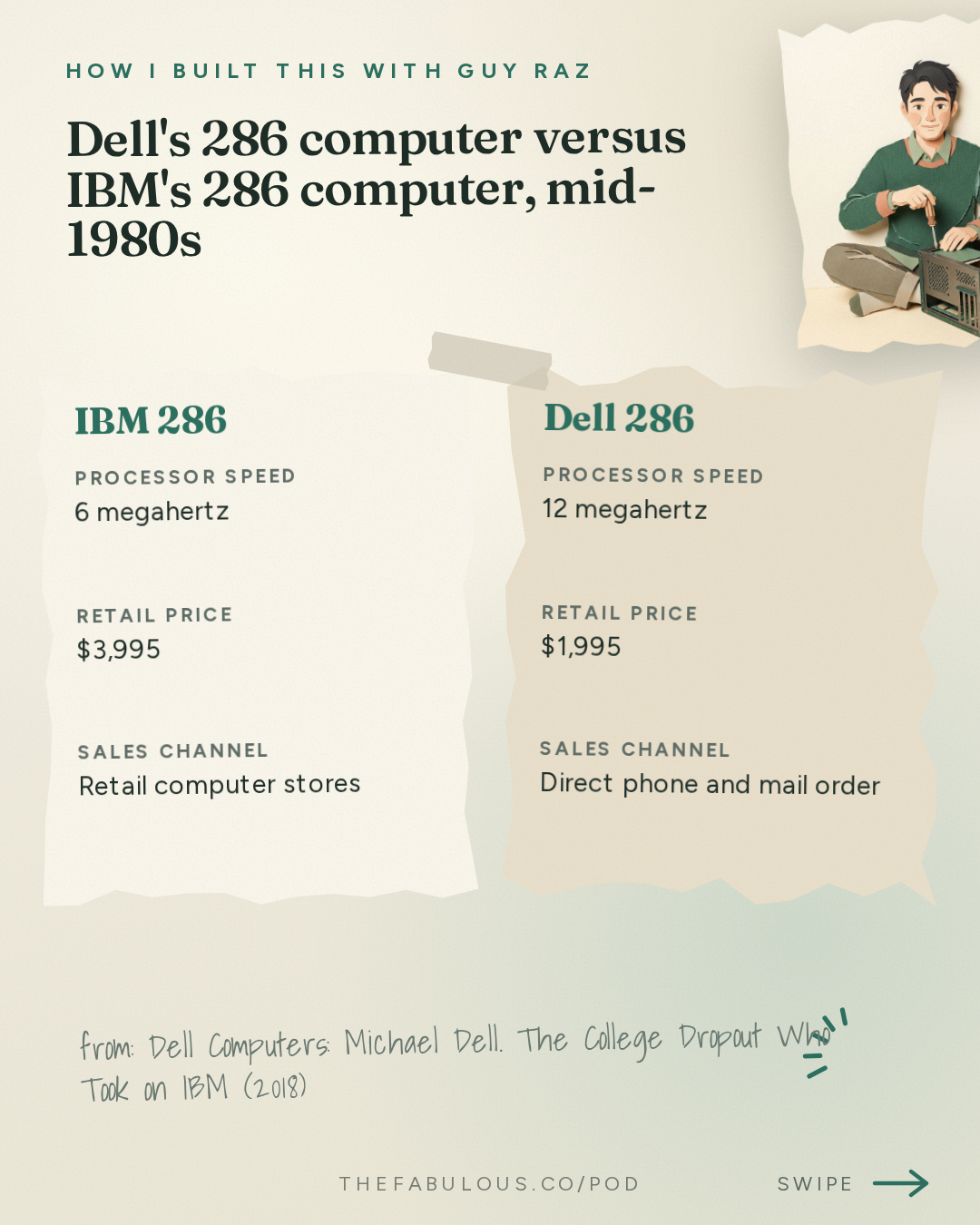
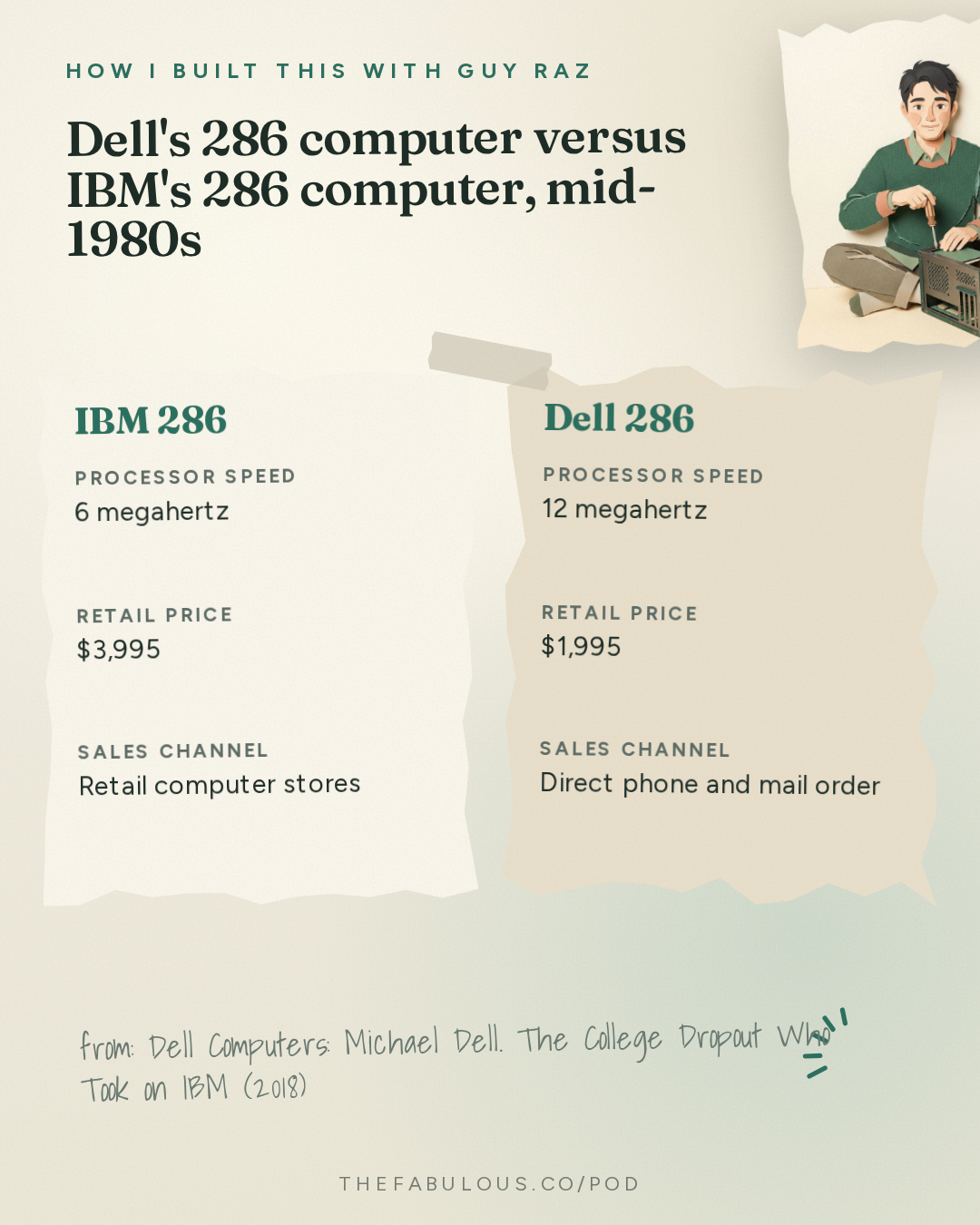
Once Dell started assembling its own PCs, the company's advantage was not a better processor. IBM and Dell both used the same Intel chips. The advantage was timing and inventory. Dell's 12-megahertz 286 computer sold for $1,995, twice as fast and half the price of IBM's six-megahertz 286 model at $3,995 (25:45). Dell explained the mechanism plainly: when the company sold 200 computers in a day, suppliers were told immediately, and parts arrived within hours rather than sitting in a warehouse.
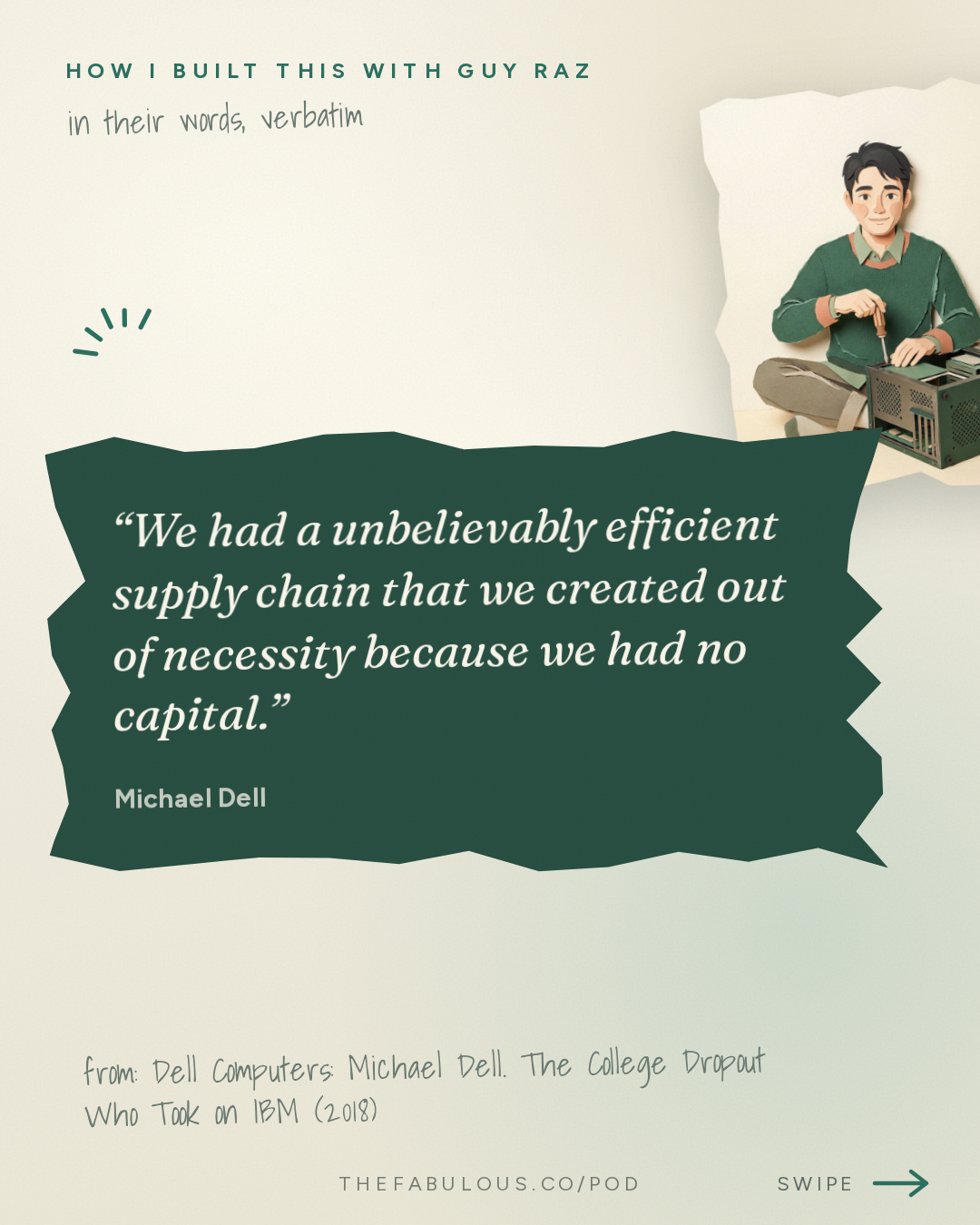
"We had a unbelievably efficient supply chain that we created out of necessity because we had no capital." (26:30) Michael DellNot having money to stockpile inventory forced a just-in-time system years before that phrase became common in manufacturing. Fresh parts also meant Dell could pass falling component prices straight to customers faster than competitors who were still selling machines built from older, pricier inventory.
A common misconception, Dell noted, is that this was a consumer story: a kid selling computers to other college kids by mail order. In fact, most of Dell's early revenue came from businesses and government agencies, not individual buyers (27:07). The company's next real innovation was service, not hardware. Before Dell, a broken computer meant driving it back to a retail store and waiting weeks for a repair. Dell built an on-site service program: call a phone number, and if the problem could not be solved over the phone, a technician was dispatched with parts to fix the machine where it sat (28:24). Dell expected sales to jump the moment the program was announced. Instead it took about three months for sales to double (29:16). By 21, he was running a company with $66 million in annual sales (29:43), a scale that is easy to state and hard to actually picture for a 21-year-old who, by his own account, still was not much of a public figure around campus.
None of this was free of trouble. In the mid-1980s a letter arrived from the Federal Communications Commission informing Dell that his computers, classified as Class B digital devices, had not been approved for sale and needed to stop immediately (32:30). A lawyer who had previously served as an FCC commissioner helped the company test its machines and file for compliance before the business was shut down. By 1988, growing at roughly 80 percent a year, Dell needed more capital than its profits could generate and took the company public (34:51). As competition with Compaq intensified, Dell says he learned a lesson that mattered more than any product spec:
"If you obsess on the competitors, you could be making a really bad mistake." (36:16) Michael DellChasing a rival's spec sheet, he argued, is a good way to stop listening to what customers actually want. By the end of 2000, Dell had become the top PC maker in the world by market share, ahead of both Compaq and IBM (36:42).
The company's history was not a clean ascent. A 1989 effort called Dell UNIX, an attempt to build its own operating system software before the Linux era, cost the company money and dented its stock (39:01). A separate, overly ambitious engineering effort called Project Olympic also failed outright. Dell's response to failure became something close to a personal operating principle:
"When you find a problem, fix it as fast as you find it." (39:53) Michael DellIn 2004 Dell stepped back from the CEO role, handing day-to-day leadership to company president Kevin Rollins while staying on as chairman. Over the following three years the market shifted toward cloud computing, Dell lost ground, and HP overtook it as the top PC seller. The board asked him to return as CEO in 2007. His summary of the industry remains blunt: "It's a change or die business. It's a quick or dead business" (41:35).
Since its 1984 founding, Dell has sold more than 650 million computers (04:03), and Michael Dell remains CEO of Dell Technologies, a company now built around infrastructure for artificial intelligence rather than beige desktop towers. He and his wife, Susan, have pledged more than $6 billion toward helping American children build financial security (44:13). Asked how much of his success came down to hard work versus luck, Dell did not claim some hidden genius. He pointed to something closer to circumstance: being born in a country where a 20-year-old could show up and sell something to a stranger without being laughed out of the room (43:45). The marriage license list, the disassembled IBM PC, the dorm room spreadsheet of monthly revenue: none of it required a secret. It required noticing information that was sitting in public, unexamined, and being willing to act on it before anyone else bothered to look.
Ask this episode anything
Pod's AI answers from the episode itself, with the minute mark so you can hear it yourself.
Or start with one of these
Ask this episode
Pod's AI listens to the whole episode to answer, and points you to the minute it comes from.
The rest of this answer, and any question after it
Answers come from the episode itself, never from a summary of it.
ContinueKey takeaways
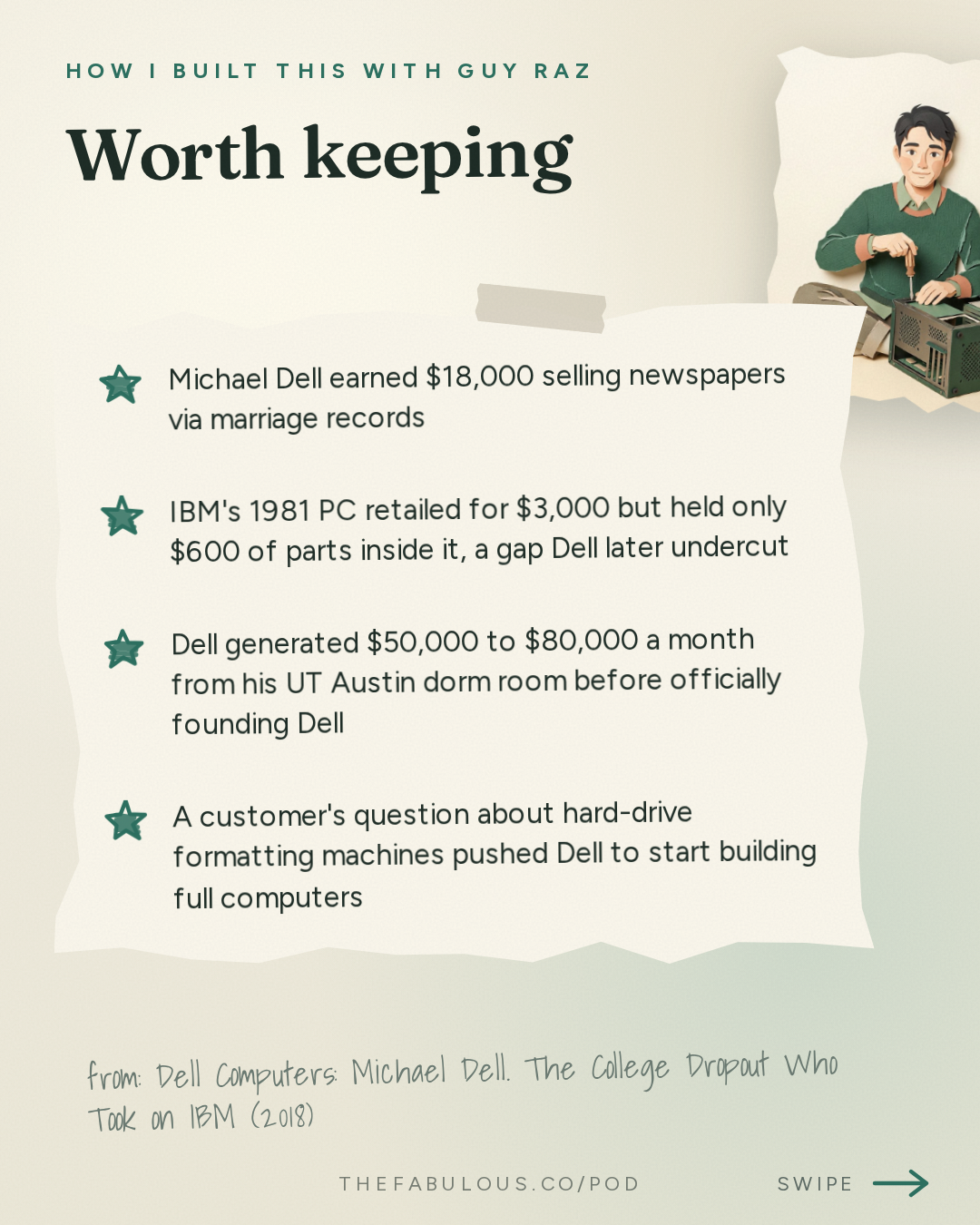
- Michael Dell earned $18,000 selling newspapers via marriage records
- IBM's 1981 PC retailed for $3,000 but held only $600 of parts inside it, a gap Dell later undercut
- Dell generated $50,000 to $80,000 a month from his UT Austin dorm room before officially founding Dell
- A customer's question about hard-drive formatting machines pushed Dell to start building full computers
- Dell says its lean supply chain was built from having no capital, not from clever design
The episode in cards

By the numbers
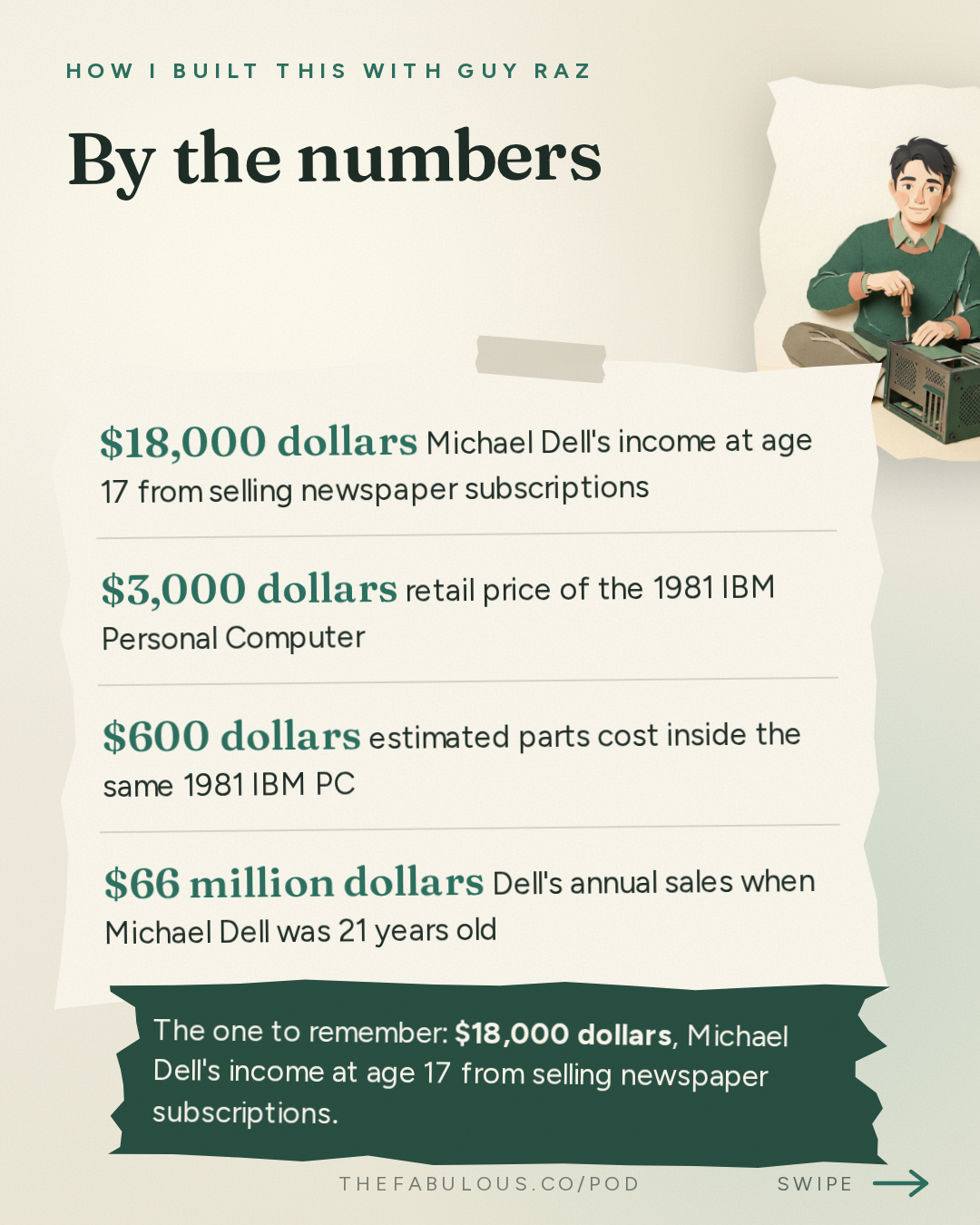
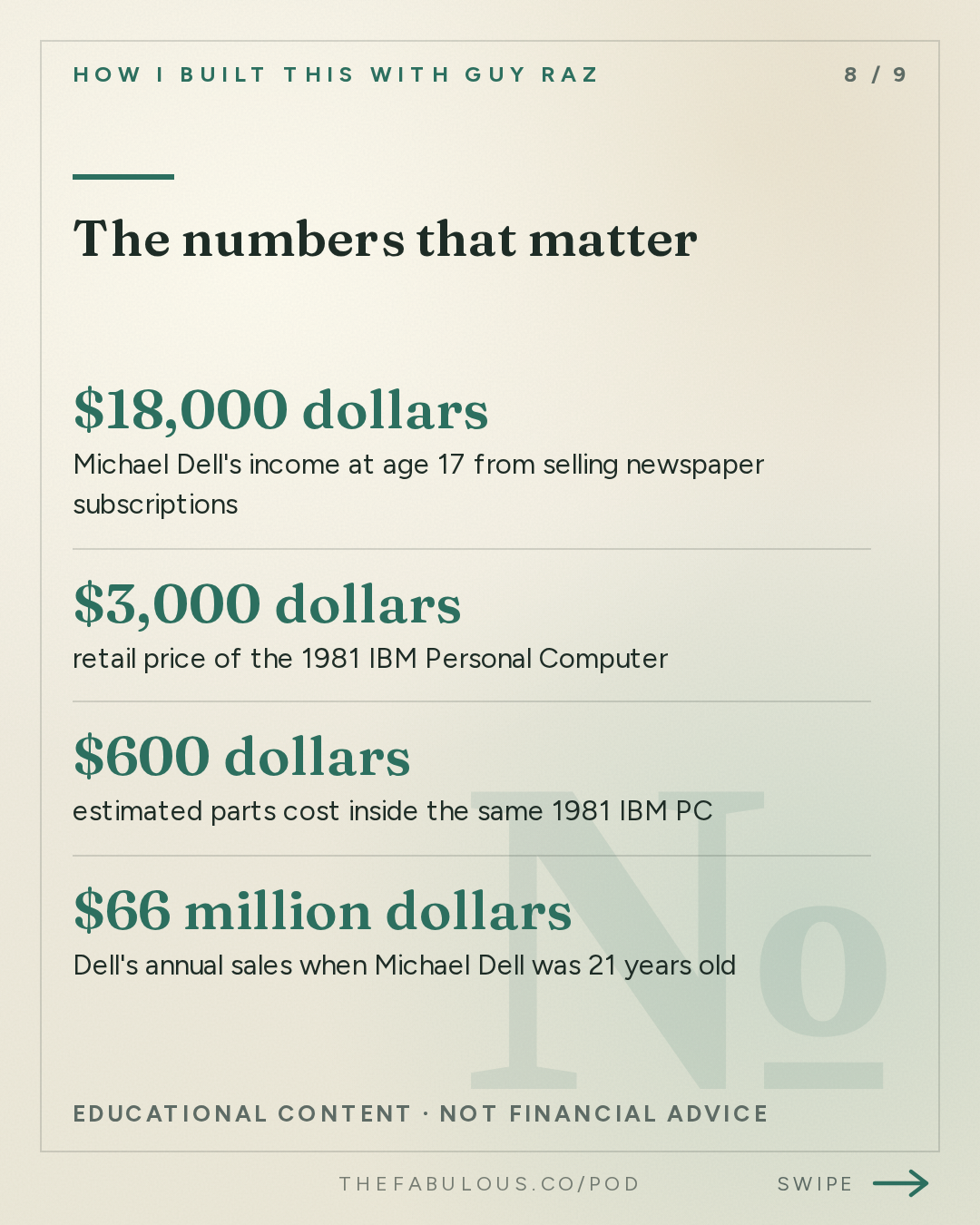
- $18,000 dollars Michael Dell's income at age 17 from selling newspaper subscriptions
- $3,000 dollars retail price of the 1981 IBM Personal Computer
- $600 dollars estimated parts cost inside the same 1981 IBM PC
- $66 million dollars Dell's annual sales when Michael Dell was 21 years old
- 650 million computers total computers Dell has sold since its 1984 founding
In their words
“I devised a direct mail program where I sent letters to all of the people that had applied for marriage licenses in a 16-county area.”
“How can you understand it if you don't take it apart?”
“We had a unbelievably efficient supply chain that we created out of necessity because we had no capital.”
“If you obsess on the competitors, you could be making a really bad mistake.”
“It's a change or die business. It's a quick or dead business.”
Protocols
-
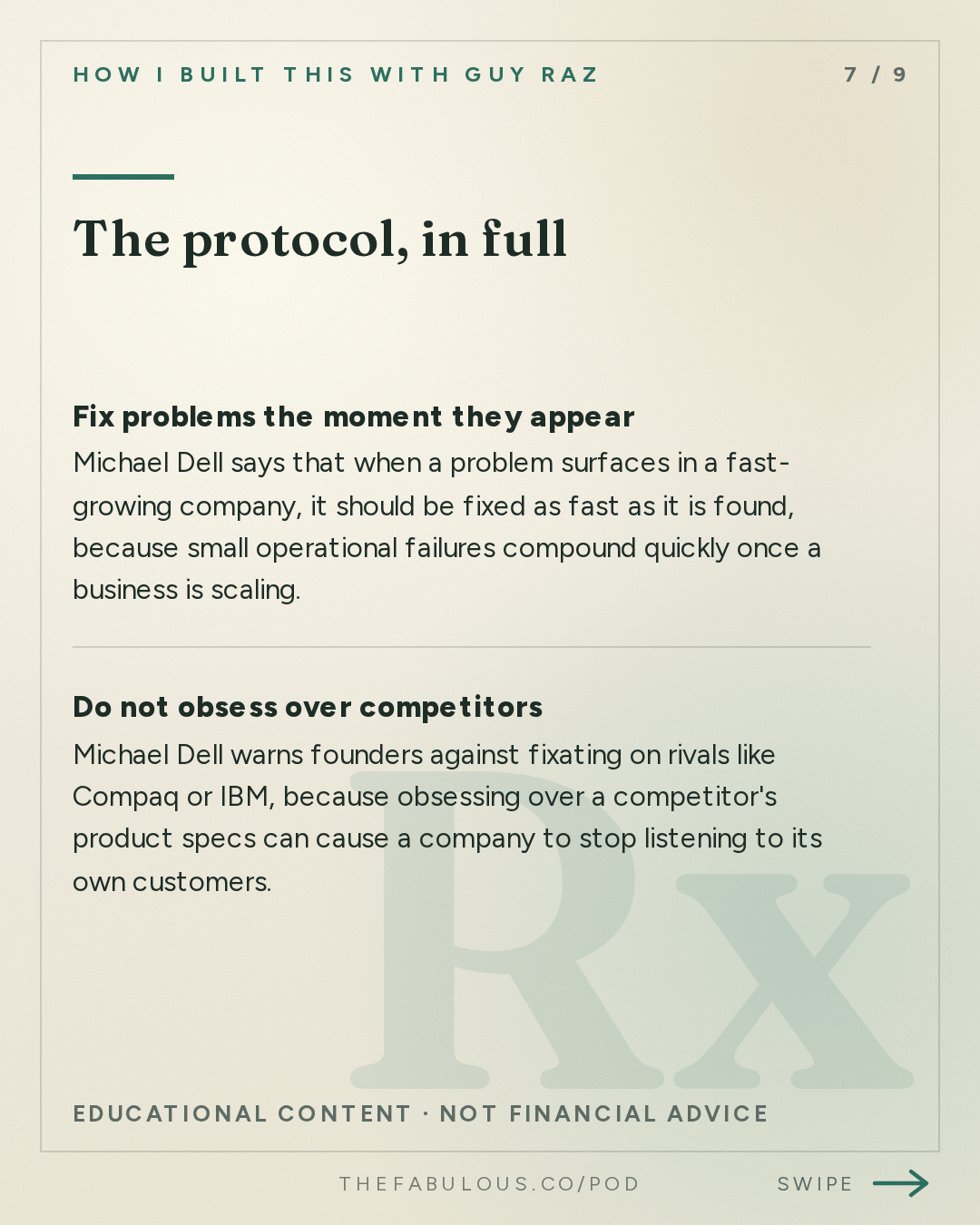
Fix problems the moment they appear
Michael Dell says that when a problem surfaces in a fast-growing company, it should be fixed as fast as it is found, because small operational failures compound quickly once a business is scaling.
ongoing, as issues arise
-
Do not obsess over competitors
Michael Dell warns founders against fixating on rivals like Compaq or IBM, because obsessing over a competitor's product specs can cause a company to stop listening to its own customers.
ongoing strategic discipline
Questions this episode answers
How did Michael Dell find customers for his newspaper subscription business?
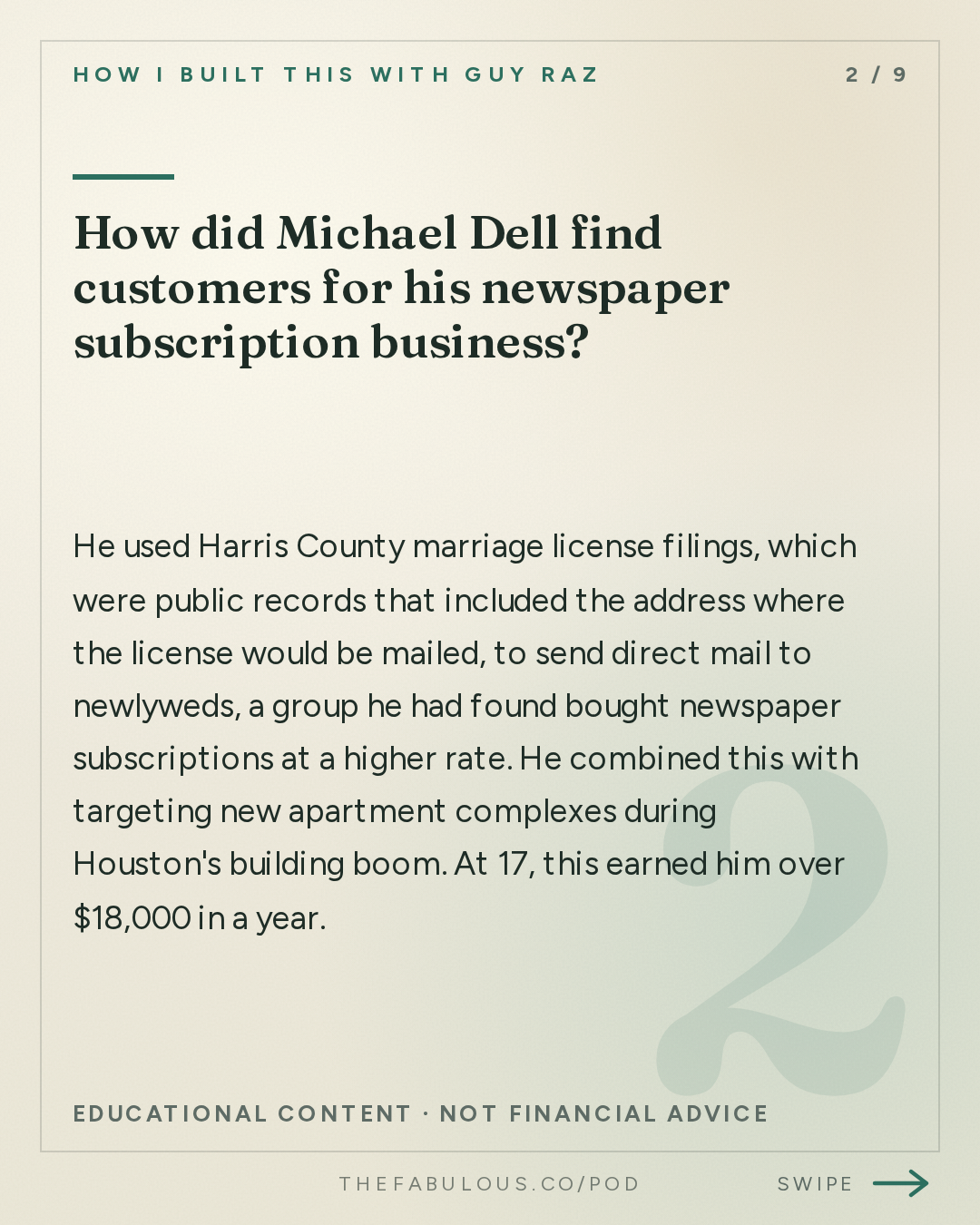
He used Harris County marriage license filings, which were public records that included the address where the license would be mailed, to send direct mail to newlyweds, a group he had found bought newspaper subscriptions at a higher rate (07:33, 08:20). He combined this with targeting new apartment complexes during Houston's building boom (09:24). At 17, this earned him over $18,000 in a year (09:46).
How much money did Michael Dell make in his dorm room before founding Dell?
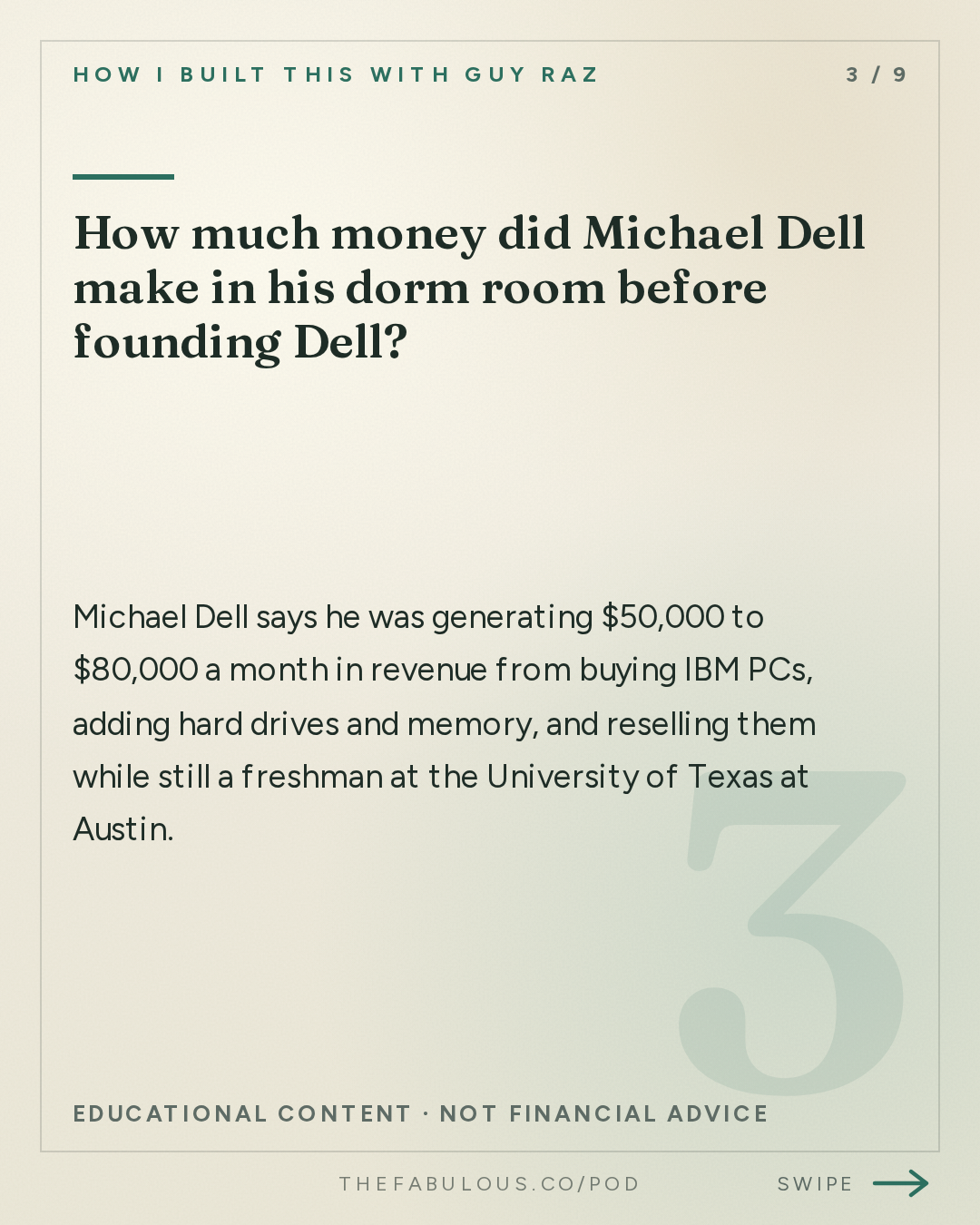
Michael Dell says he was generating $50,000 to $80,000 a month in revenue from buying IBM PCs, adding hard drives and memory, and reselling them while still a freshman at the University of Texas at Austin (19:24).
Why was the 1981 IBM PC so profitable to compete against?
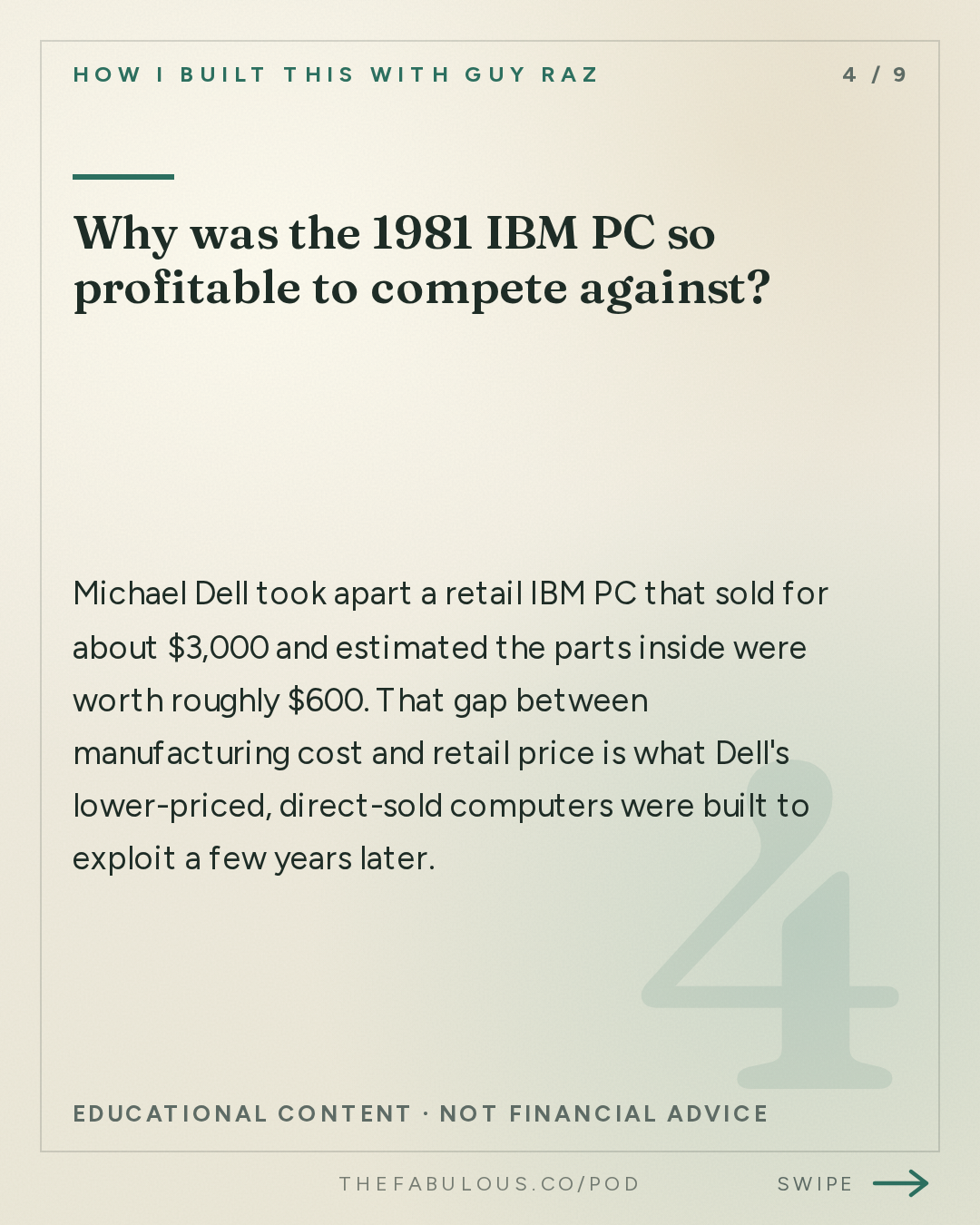
Michael Dell took apart a retail IBM PC that sold for about $3,000 and estimated the parts inside were worth roughly $600 (12:23). That gap between manufacturing cost and retail price is what Dell's lower-priced, direct-sold computers were built to exploit a few years later.
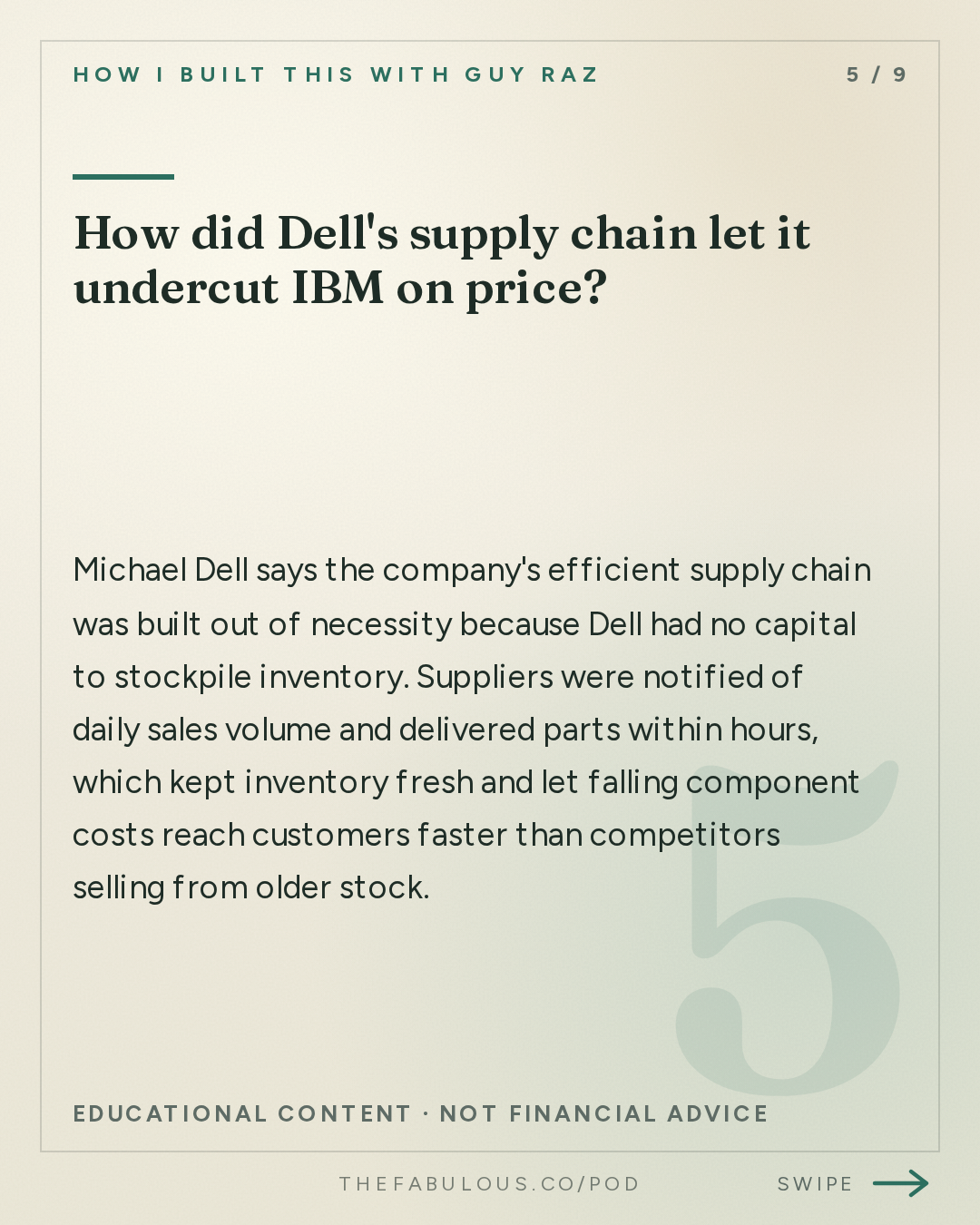
How did Dell's supply chain let it undercut IBM on price?
Michael Dell says the company's efficient supply chain was built out of necessity because Dell had no capital to stockpile inventory (26:30). Suppliers were notified of daily sales volume and delivered parts within hours, which kept inventory fresh and let falling component costs reach customers faster than competitors selling from older stock.
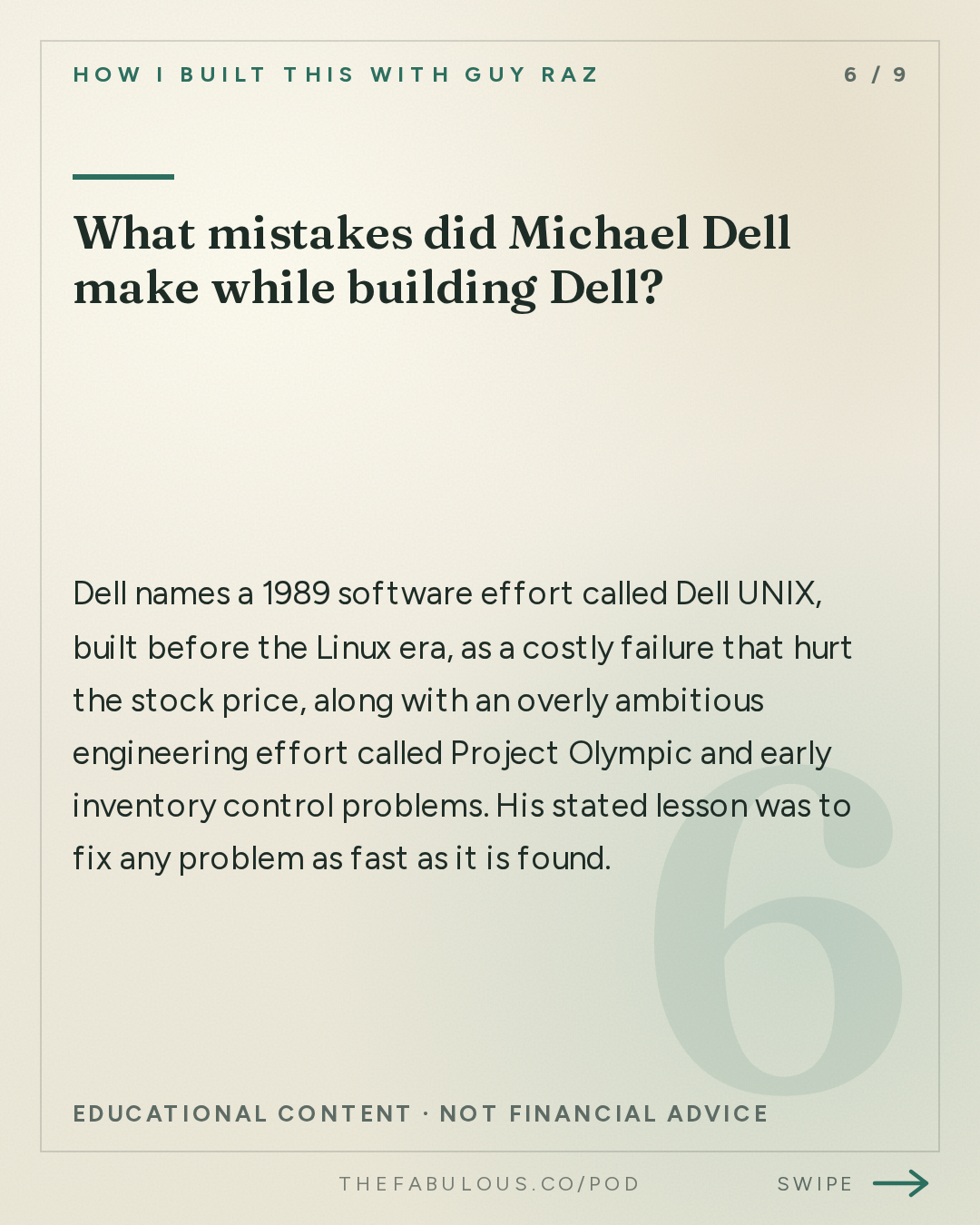
What mistakes did Michael Dell make while building Dell?
Dell names a 1989 software effort called Dell UNIX, built before the Linux era, as a costly failure that hurt the stock price (39:01), along with an overly ambitious engineering effort called Project Olympic and early inventory control problems (39:53). His stated lesson was to fix any problem as fast as it is found.
Why did Michael Dell step down and then return as Dell's CEO?
In 2004, Dell handed the CEO role to company president Kevin Rollins while staying on as chairman (40:19). As the market shifted toward cloud computing over the next three years, Dell lost market share to HP, and the board asked Michael Dell to return as CEO in 2007 (41:12).
The full read, in cards
Mentioned
Michael Dell · IBM · Compaq · UT Austin · Houston Post · RadioShack · Apple II · Rod Canion · Federal Communications Commission · Kevin Rollins · Martin Marietta
More from this show and category
Brian Chesky's Founder Mode Explained
Airbnb CEO Brian Chesky says he was a great founder but a terrible CEO until the 2020 pandemic forced a hands-on style he calls founder mode. After Airbnb lost 80% of its business in eight weeks, he stopped deferring to veteran executives and began skip-leveling for raw information, a shift that still shapes how he runs the company.
Tope Awotona's Advice for Bootstrapped Founders
Calendly founder Tope Awotona takes four founder calls on How I Built This's Advice Line, covering AI's lowered barrier to building software, physical-product virality, gifting strategy, and his core lesson: build a business around a customer, not a product.
FIGS Founders: How Scrubs Became a $2.5B Brand
Heather Hasson and Trina Spear turned boxy hospital scrubs into FIGS, a direct-to-consumer brand now worth $2.5 billion (04:13). They skipped distributors, kept 85% of healthcare workers as direct customers (23:53), survived 300 to 400 investor rejections (43:19), and beat an $800 million lawsuit (55:17) before going public in 2021.

Tara Bosch's Advice: D2C to Retail Growth
Tara Bosch, who sold a majority stake in her low-sugar candy brand SmartSweets for a reported $360 million (00:49), spends this advice-line episode teaching four early founders how to move from online sales to grocery shelves, price sugar and price value in three seconds, and read customer emotion through phone calls rather than DMs.
