
FIGS Founders: How Scrubs Became a $2.5B Brand
FIGS: Trina Spear and Heather Hasson. The $2.5 Billion Scrubs Brand That Investors Said Would Never Work
The brief
Heather Hasson and Trina Spear turned boxy hospital scrubs into FIGS, a direct-to-consumer brand now worth $2.5 billion (04:13). They skipped distributors, kept 85% of healthcare workers as direct customers (23:53), survived 300 to 400 investor rejections (43:19), and beat an $800 million lawsuit (55:17) before going public in 2021.
Here is a pitch almost no investor wants to hear: your customer is a sliver of the population, maybe seven percent, and the product is something people are legally required to wear anyway. That was the case for adult incontinence, and it was the case for hospital scrubs. There are 24 million healthcare workers in the United States, also about seven percent of the population (03:46). For decades, nearly all of them bought the same shapeless, boxy uniform at a strip-mall supply store stocked with bedpans and crutches. Heather Hasson and Trina Spear looked at that fraction of the population and saw a market nobody else had bothered to measure correctly. In 2013 they launched FIGS. Today it trades publicly at a market cap of over two and a half billion dollars (04:13).
Hasson did not arrive at this by a straight line. She wanted to be a reconstructive surgeon, failed organic chemistry, and drifted into fashion, designing handbags in New York with an Italian business partner who died of lung cancer at 36 (07:53). Heartbroken, she went to Kenya with no money and no plan. There she noticed children skipping school because they had no uniforms, and she started working retail at $9 an hour in Malibu (11:38) to buy fabric and hire sewers to make ties, funding 10,000 kids through school (12:42). In a Kenyan clinic, she watched nurses and doctors with 25 years of experience operate without proper scrubs. She sent some over. That is the entire origin of a billion-dollar apparel company: a woman trying to clear her head who kept noticing what people had to wear to do serious work.
Back in Los Angeles, Hasson sewed a small batch of forest-green scrubs, maybe 30 pairs, and sent them out to a couple of clinics. A nurse practitioner she met for coffee asked her to tailor a pair. Then the nurse's coworkers wanted the same thing.
"This is weird... And then that's when it shifted in my head, 'This is what I wanna do.'" (16:09)She financed a first production run of 15,000 units by convincing a manufacturer to front the cost, shot a lookbook with people she found on Craigslist, and started selling scrubs out of her car outside emergency rooms (18:51).
Trina Spear came from the opposite direction: Harvard Business School, then a job in finance at the private equity firm Blackstone in New York. A mutual friend introduced her to Hasson in 2012. Spear flew to Los Angeles, got beaten at tennis, and heard the pitch. What hooked her was not sentiment but a gap she could see in the data. Nike, Lululemon, and Under Armour had spent decades building technical gear for athletes. Nobody was building technical gear for people who worked 12-hour shifts saving lives.
The math nobody else had run
Spear did not quit her job for six months. Instead, she built a financial model. What she found reframed the whole opportunity. Healthcare apparel is mandated: workers have to wear it every day to go to work. It is replenishment-driven, meaning customers reorder constantly rather than waiting for a holiday season, which makes it a non-seasonal, non-cyclical business (23:10). Healthcare employment is recession-resistant. And crucially, 85 percent of healthcare professionals were buying their own uniforms out of pocket (23:53), which meant the real customer was the individual nurse or doctor, not a hospital purchasing department. The U.S. market alone was worth about $12 billion, and the global market about $80 billion (24:14).
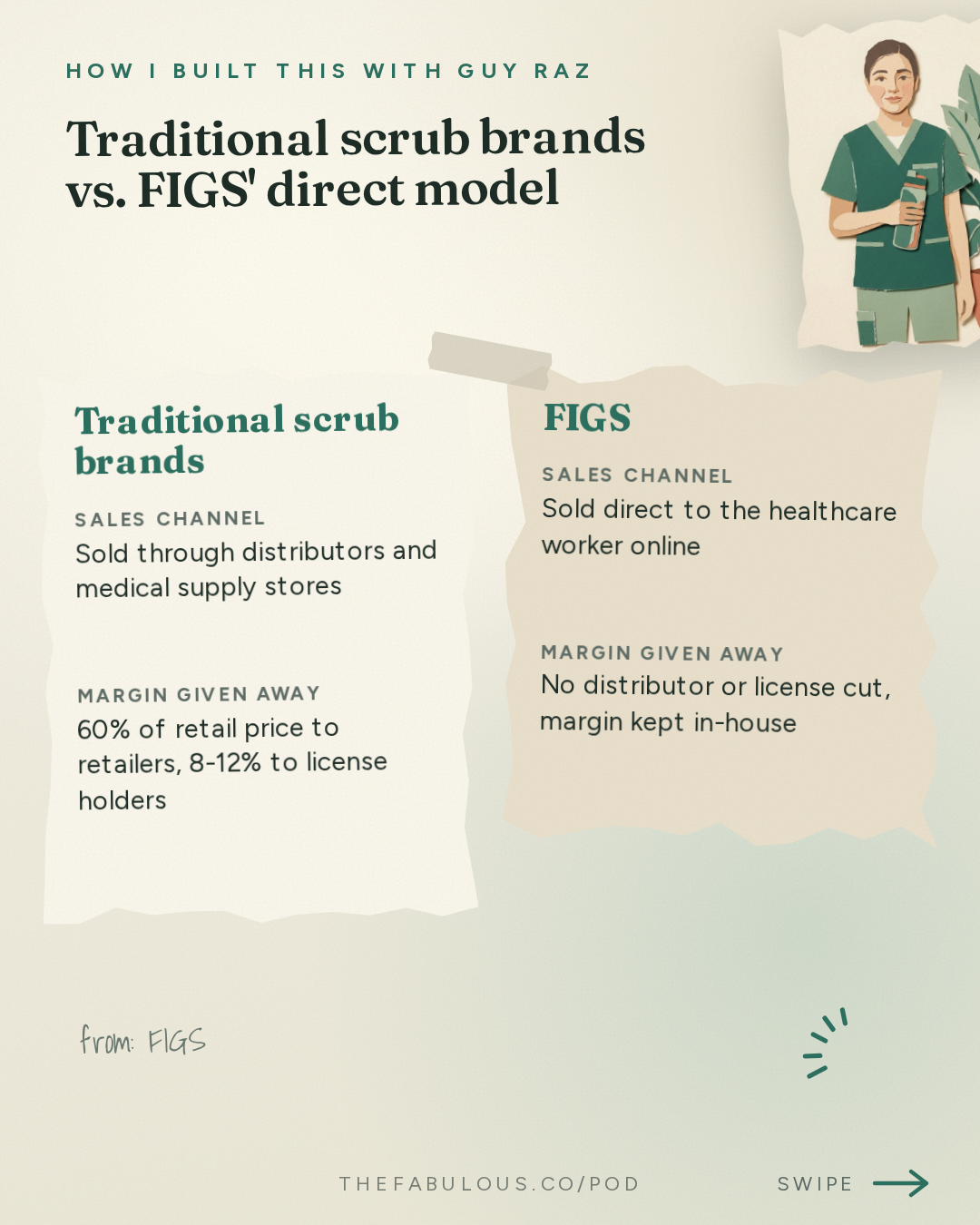
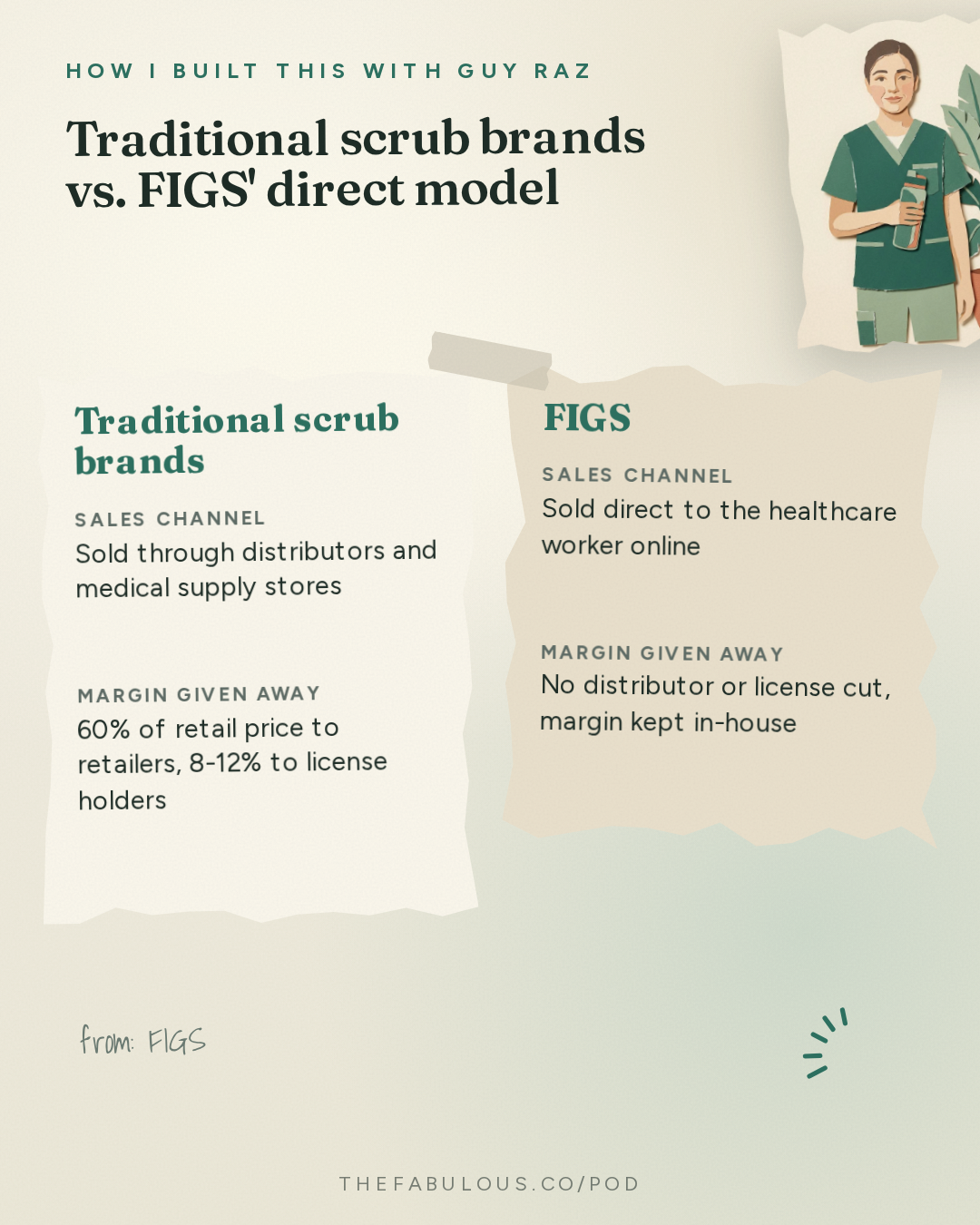
Yet the incumbents selling into that market had built a business that could never improve. Traditional scrub manufacturers sold through distributors, handing over 60 percent of the retail price to retailers and another 8 to 12 percent to license holders for brands like Dickies and Cherokee (42:22). That left almost nothing to spend on fabric, fit, or design. FIGS cut out the distributor entirely and sold direct to the healthcare worker. Its production cost ran roughly double what a traditional scrub maker spent, but it only had to charge 15 to 20 percent more at retail, because it had eliminated the middlemen taking most of the margin (42:22). That arithmetic, not a clever ad campaign, is why a slim-fit pant or a sleeveless layering top (the "Raffaella," which early customers called a muscle shirt) could become a bestseller: the company could actually afford to design something new.
Proving this to investors was another matter. FIGS collected something like 300 to 400 rejections during its early fundraising rounds (43:19). The objection was almost always the same: the addressable market looked too small. Spear's response became a kind of operating philosophy:
"We were very focused on getting fast nos. So, you know, when people were not sure or were not getting back to us, okay, that's a no." (43:50)Rather than chase ambivalent investors, the founders moved on immediately, treating a stalled conversation as a closed door so they could spend their limited time finding the handful of people willing to bet on an argument that sounded, to most of Wall Street, like a rounding error.
The money that got them through those early years was personal, and expensive. Spear liquidated her 401k retirement account to put in $70,000, acknowledging it was "a horrible tax decision" that cost her roughly 50 percent of the account's value to taxes and penalties (29:06). A friends-and-family round in 2013 raised $2 million from 40 to 50 investors writing $5,000 and $10,000 checks (36:49). It was not venture capital. It was people who believed two specific founders could pull this off.
Clearing the table, then facing a trial
The turning point came through Thomas Tull, a wealthy entertainment executive who ran Legendary Entertainment. An early investor pushed the founders to meet him in hopes of getting FIGS scrubs into movies; nothing came of the movie idea, but Tull invested in the seed round and the Series A. In 2017, he went further: he bought out every other investor on the cap table and put in $65 million of his own money, becoming FIGS' majority owner (49:37). It was a bet with real teeth attached: one earlier investor, a group called Campfire Capital, had tried to remove Hasson and Spear as operators, and part of the reason Tull bought them out was precisely to protect the founders' control (51:17). Even after Tull's investment, Hasson and Spear kept two of the three board seats, which meant they never lost the vote on their own company (50:50).
That discipline mattered because the company's growth soon invited a fight. Revenue went from $55 million in 2018 to $263 million in 2020 (51:17). As FIGS' visibility grew, Strategic Partners, which owns scrub brands including Dickies and Cherokee, sued the company in 2019, alleging false claims and trade secret theft, and seeking $800 million in damages (55:17). The case dragged on for roughly three years. FIGS refused to settle and spent $40 million in direct legal fees fighting it (54:09), plus an unquantified cost in founder time sitting through depositions. Hasson's reasoning was blunt:
"We were being sued for, I believe it was $800 million... so if we're gonna spend 40 or 60, that's absolutely worth it because we knew we were gonna win." (55:17)A jury ultimately ruled in FIGS' favor in 2022.
FIGS went public in May 2021, a year after its best sales year to date. Spear is careful to separate going public from cashing in on momentum; she frames the IPO as recognition that the company had reached the scale and discipline of a public business, and as a chance to bring 150 healthcare professionals to ring the opening bell at the New York Stock Exchange. The market, however, did not stay sentimental. The stock climbed to $50 in its first month, then fell to around $5 a year later (63:34), a swing that took the founders from Forbes' wealthiest-women lists to off them in a single cycle. Spear's read on that volatility doubles as a tidy description of how public markets work:
"Over time it's a weighing machine. In the short term, it's a voting machine." (63:12)Today FIGS runs at roughly 19 percent margins (66:40), a business shaped less by the stock chart than by the unglamorous arithmetic Spear worked out on a spreadsheet more than a decade earlier: cut out the middlemen, sell direct to the people who actually wear the product, and let replenishment do the rest.
Ask this episode anything
Pod's AI answers from the episode itself, with the minute mark so you can hear it yourself.
Or start with one of these
Ask this episode
Pod's AI listens to the whole episode to answer, and points you to the minute it comes from.
The rest of this answer, and any question after it
Answers come from the episode itself, never from a summary of it.
ContinueKey takeaways
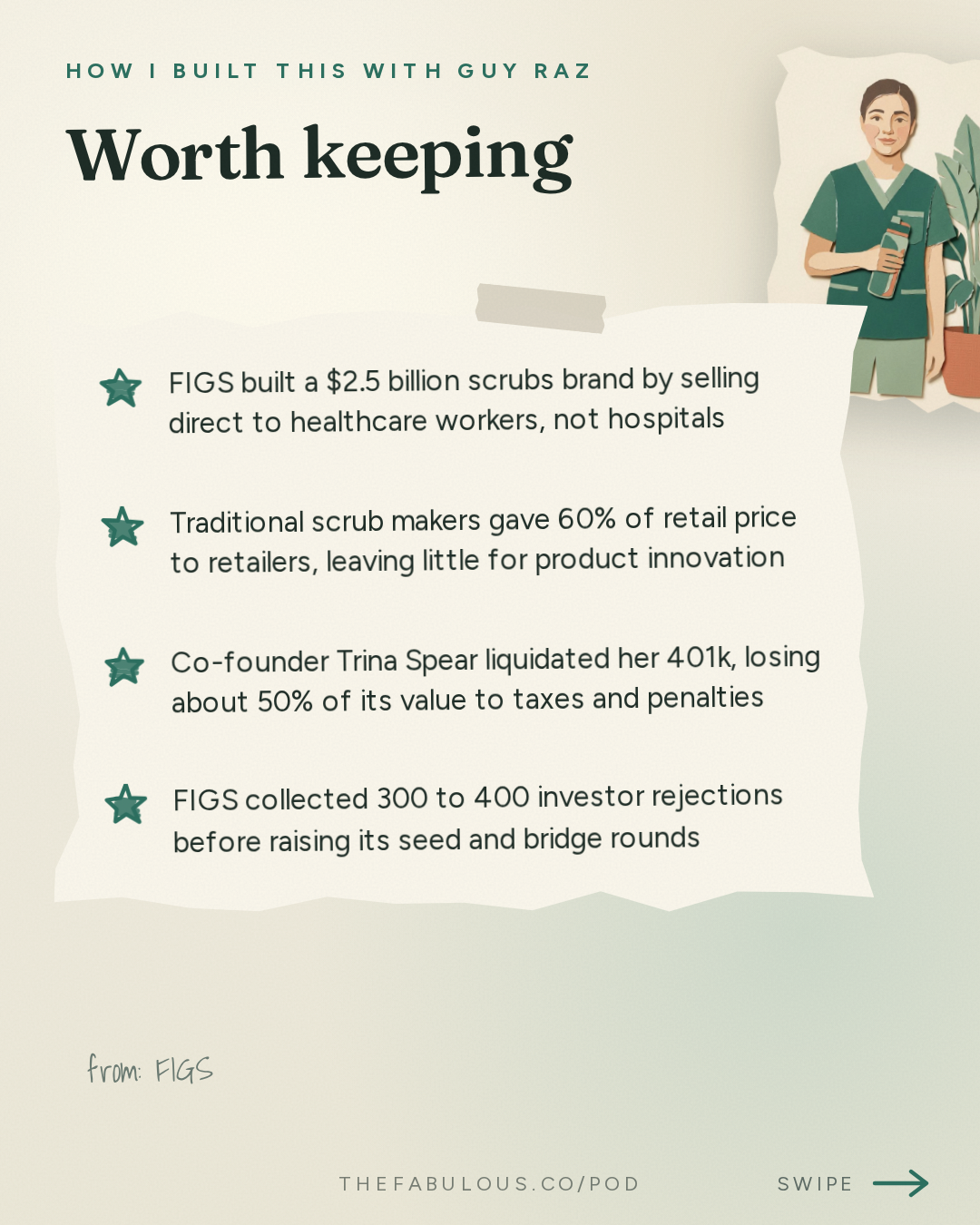
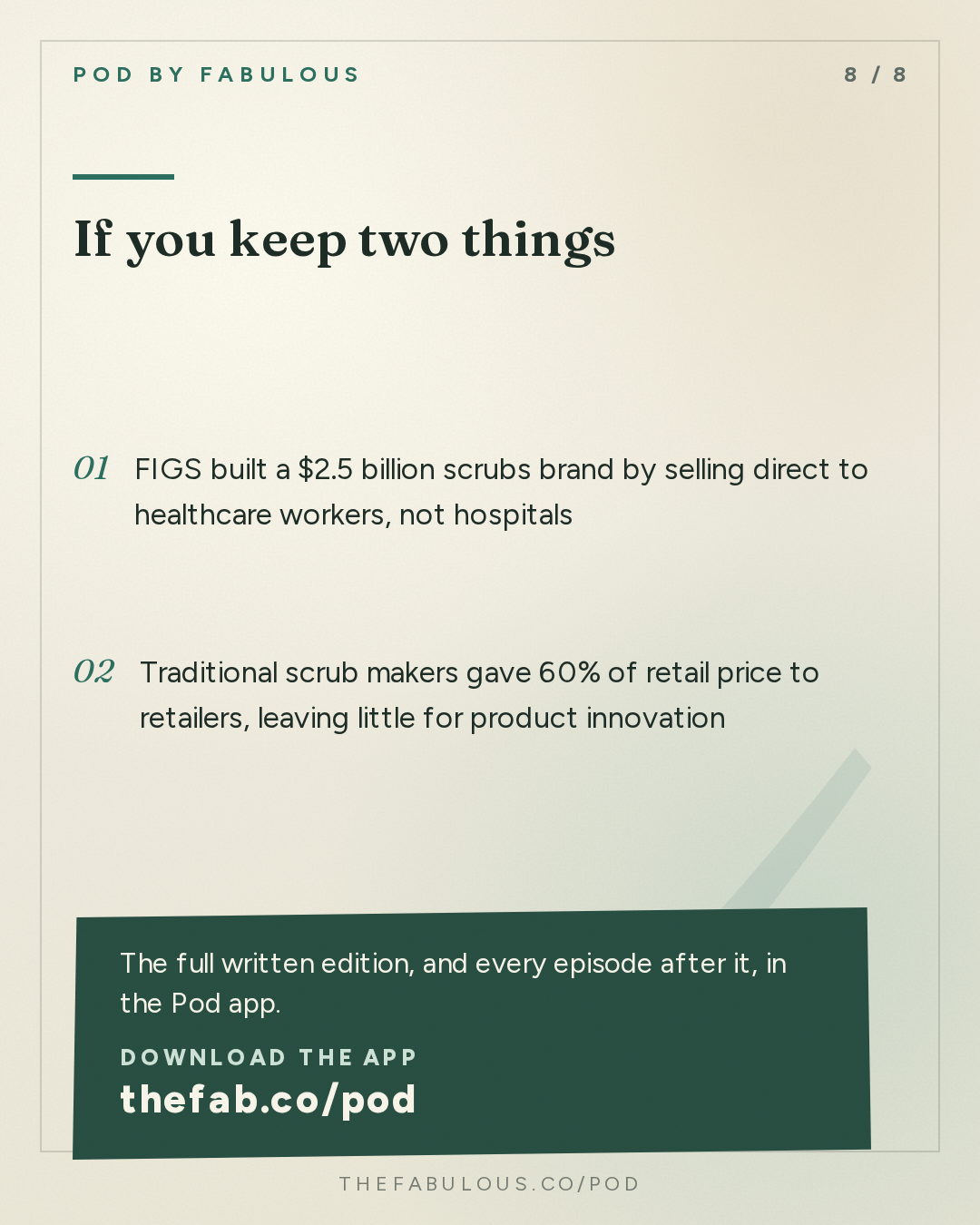
- FIGS built a $2.5 billion scrubs brand by selling direct to healthcare workers, not hospitals (04:13)
- Traditional scrub makers gave 60% of retail price to retailers, leaving little for product innovation (42:22)
- Co-founder Trina Spear liquidated her 401k, losing about 50% of its value to taxes and penalties (29:06)
- FIGS collected 300 to 400 investor rejections before raising its seed and bridge rounds (43:19)
- FIGS spent $40 million defending an $800 million lawsuit from rival Strategic Partners and won (54:09, 55:17)
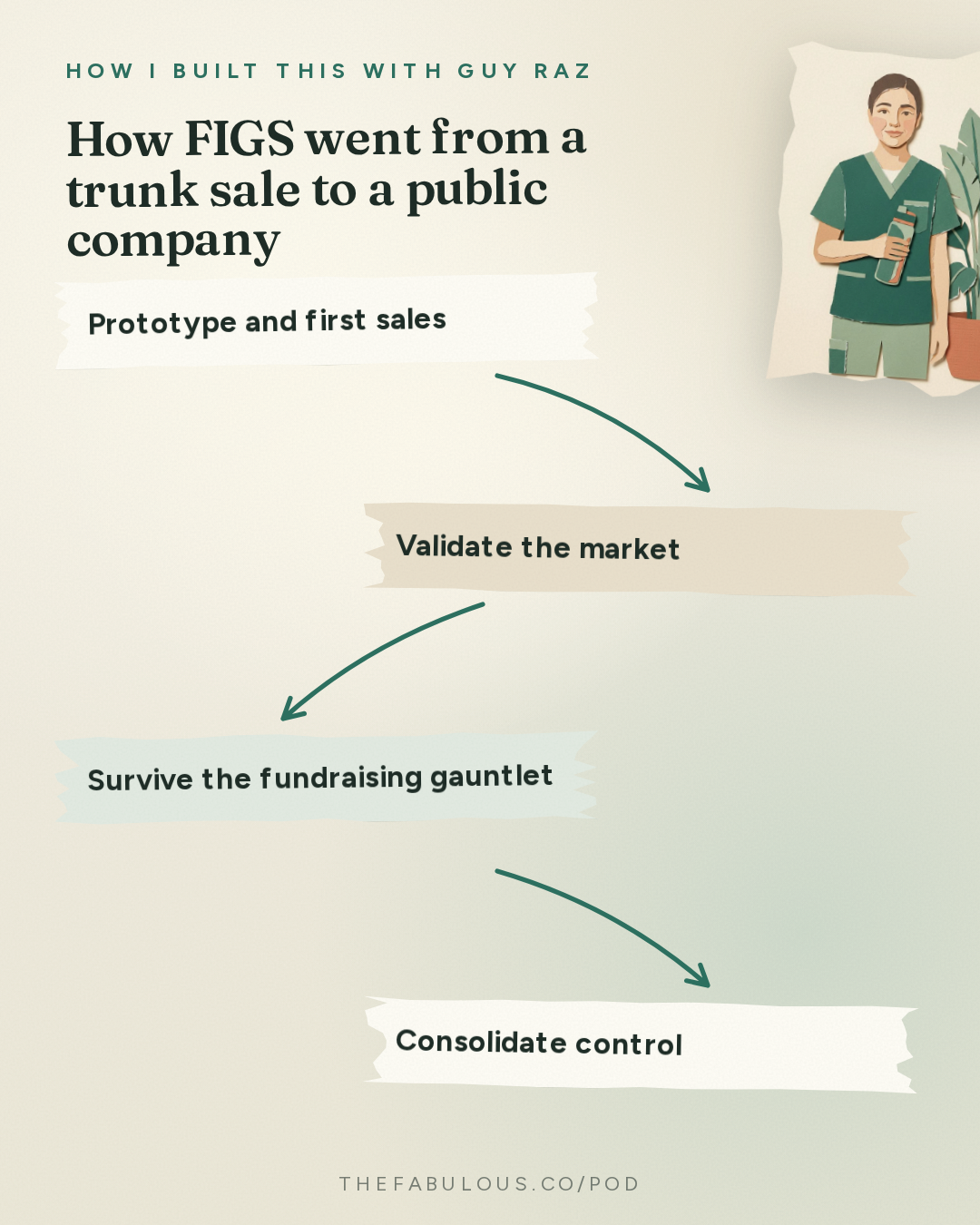
The episode in cards

By the numbers
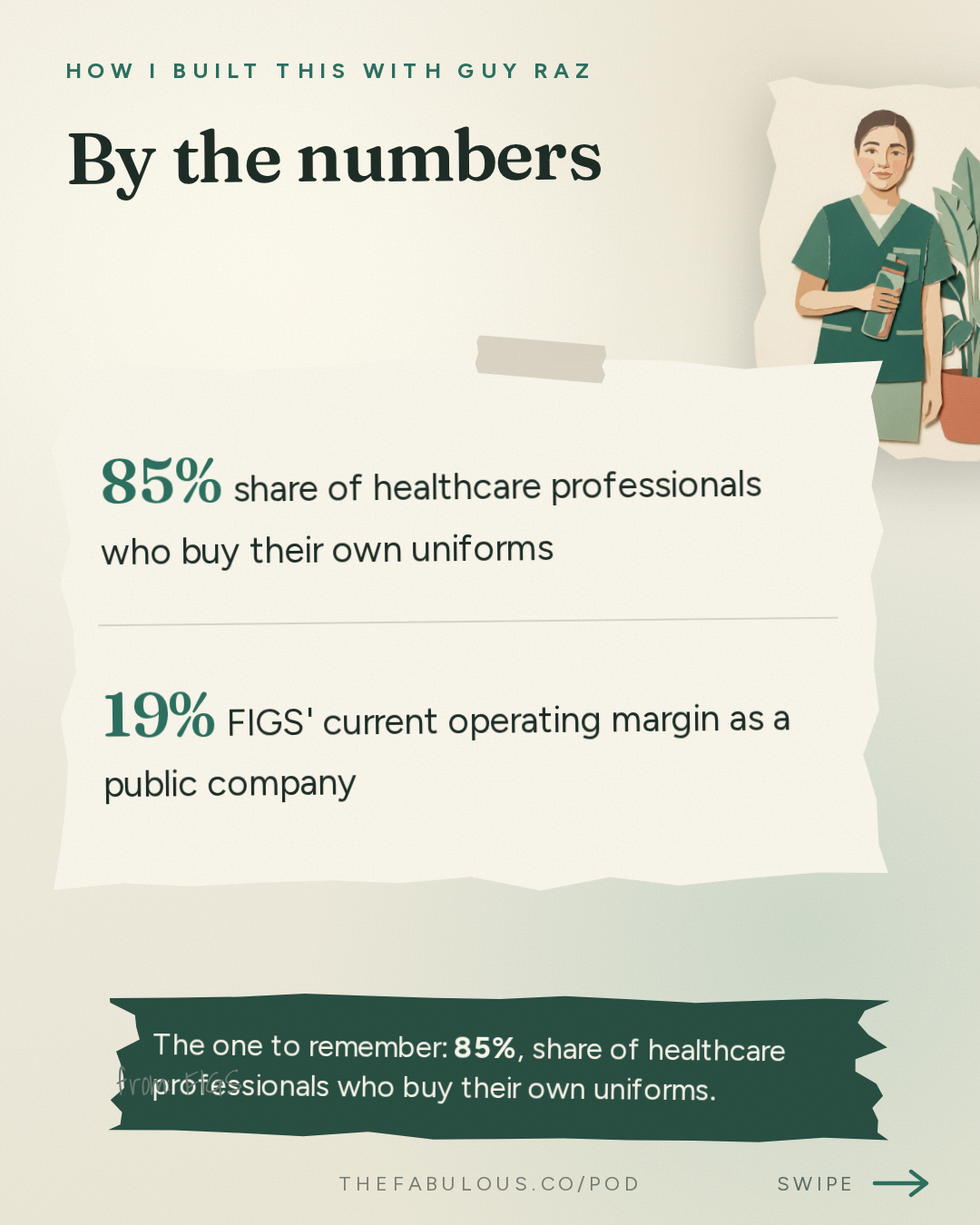
- 85% percent share of healthcare professionals who buy their own uniforms
- 19% percent FIGS' current operating margin as a public company
In their words
“We're an $8 billion company. Now we're a $400 million company, $600 million company. Now we're a two billion. Right. Like, it, none of it, it's so transient”
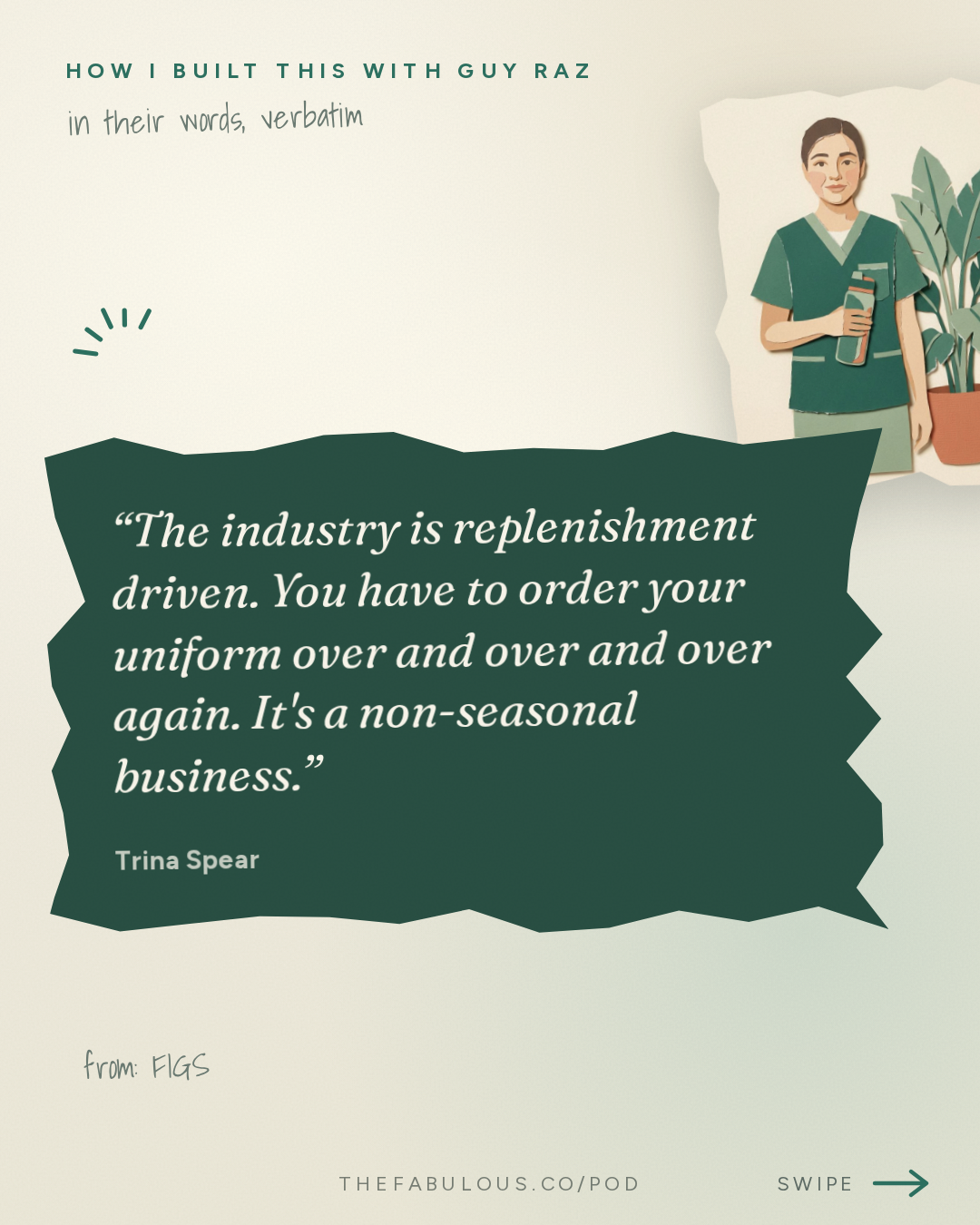
“The industry is replenishment driven. You have to order your uniform over and over and over again. It's a non-seasonal business.”
“I did liquidate my 401, um, and which is a horrible tax decision for those listening. You lose 50% of everything.”
“We were very focused on getting fast nos. Fast nos. Mm-hmm. So, you know, when people were not, uh, sure or were not getting back to us, okay, that's a”
“Over time it's a weighing machine. In the short term, it's a, it's a voting machine.”
Protocols
-
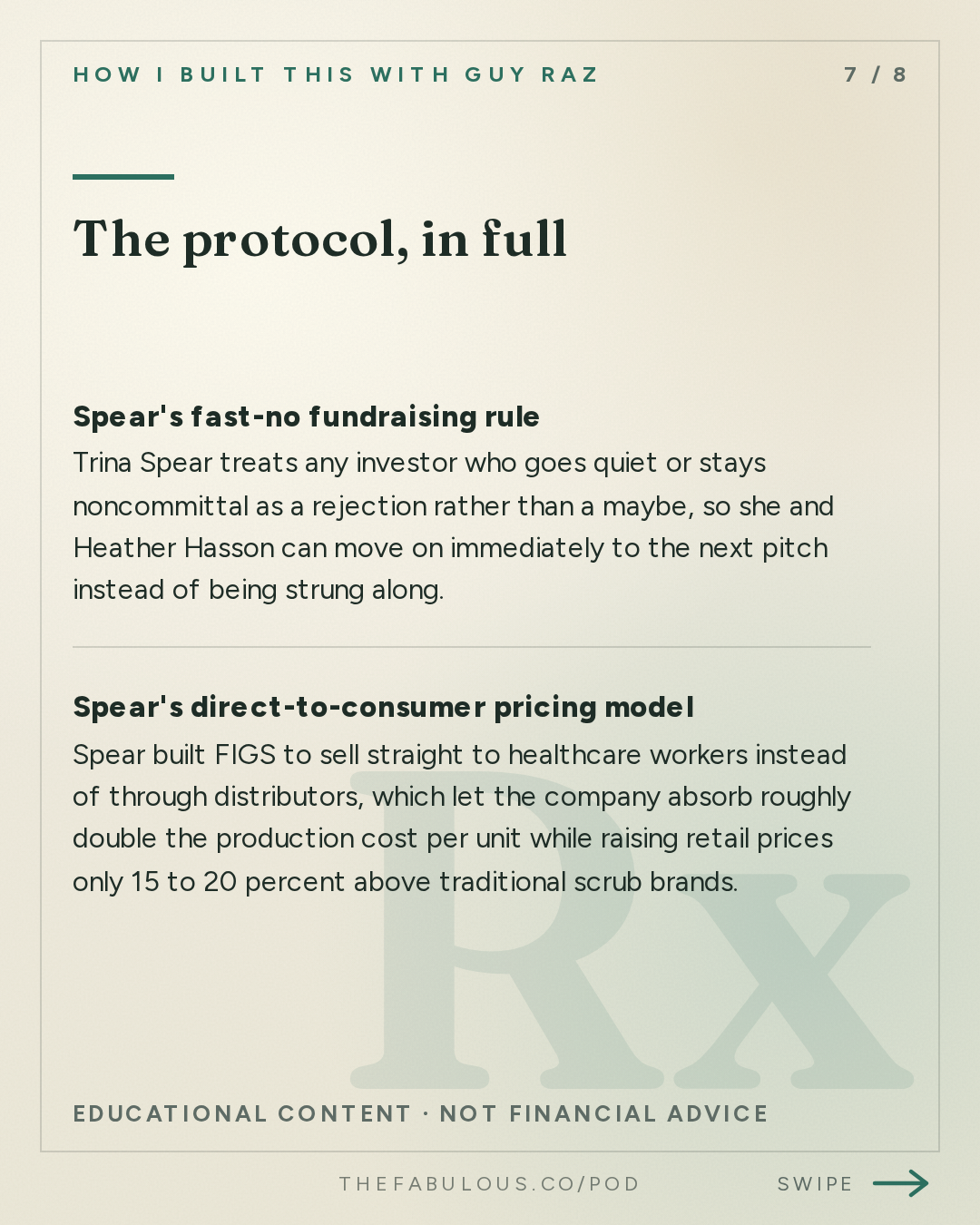
Spear's fast-no fundraising rule
Trina Spear treats any investor who goes quiet or stays noncommittal as a rejection rather than a maybe, so she and Heather Hasson can move on immediately to the next pitch instead of being strung along.
applied throughout early fundraising rounds
-
Spear's direct-to-consumer pricing model
Spear built FIGS to sell straight to healthcare workers instead of through distributors, which let the company absorb roughly double the production cost per unit while raising retail prices only 15 to 20 percent above traditional scrub brands.
core pricing strategy since 2013
Questions this episode answers
How did FIGS build a $2.5 billion scrubs brand?
FIGS sold scrubs directly to healthcare workers instead of through distributors, which let it skip the 60% retail margin and 8 to 12% licensing fee that traditional scrub brands gave away (42:22). It also targeted a market where 85% of healthcare professionals already bought their own uniforms, making the individual worker the real customer rather than the hospital (23:53). The company is now a public company with a market cap of over $2.5 billion (04:13).
Why did investors reject FIGS so many times?
Most investors told founders Heather Hasson and Trina Spear that the total addressable market was too small, since healthcare workers are a narrow slice of consumers (44:14). The company collected roughly 300 to 400 rejections during its early rounds before a small group of contrarian investors backed it (43:19).
What happened in the FIGS lawsuit with Strategic Partners?
Scrub manufacturer Strategic Partners, which owns brands including Dickies and Cherokee, sued FIGS in 2019 for $800 million, alleging false claims and trade secret theft (55:17). FIGS refused to settle, spent $40 million in legal fees over roughly three years, and won at trial in 2022 (54:09).
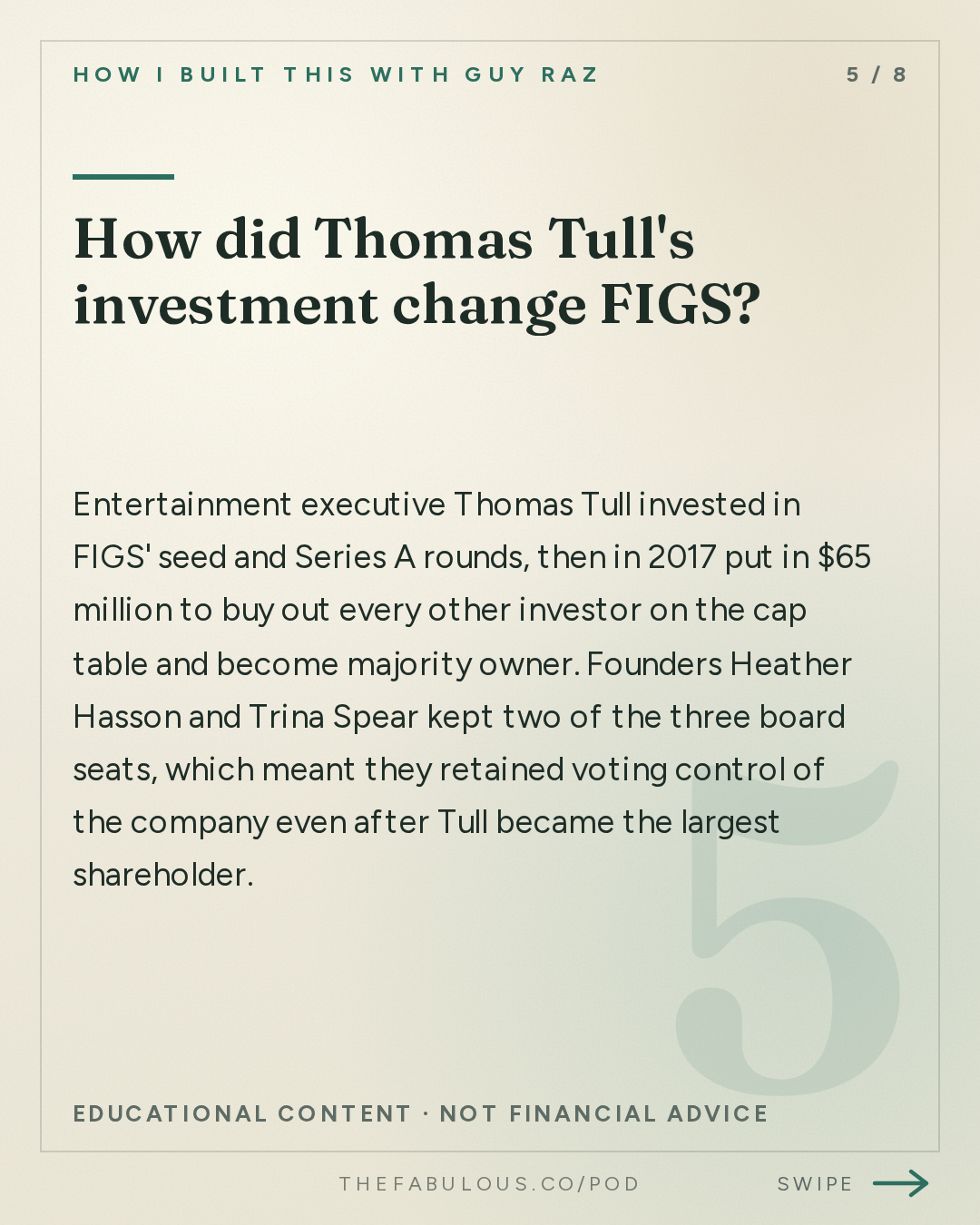
How did Thomas Tull's investment change FIGS?
Entertainment executive Thomas Tull invested in FIGS' seed and Series A rounds, then in 2017 put in $65 million to buy out every other investor on the cap table and become majority owner (49:37). Founders Heather Hasson and Trina Spear kept two of the three board seats, which meant they retained voting control of the company even after Tull became the largest shareholder (50:50).
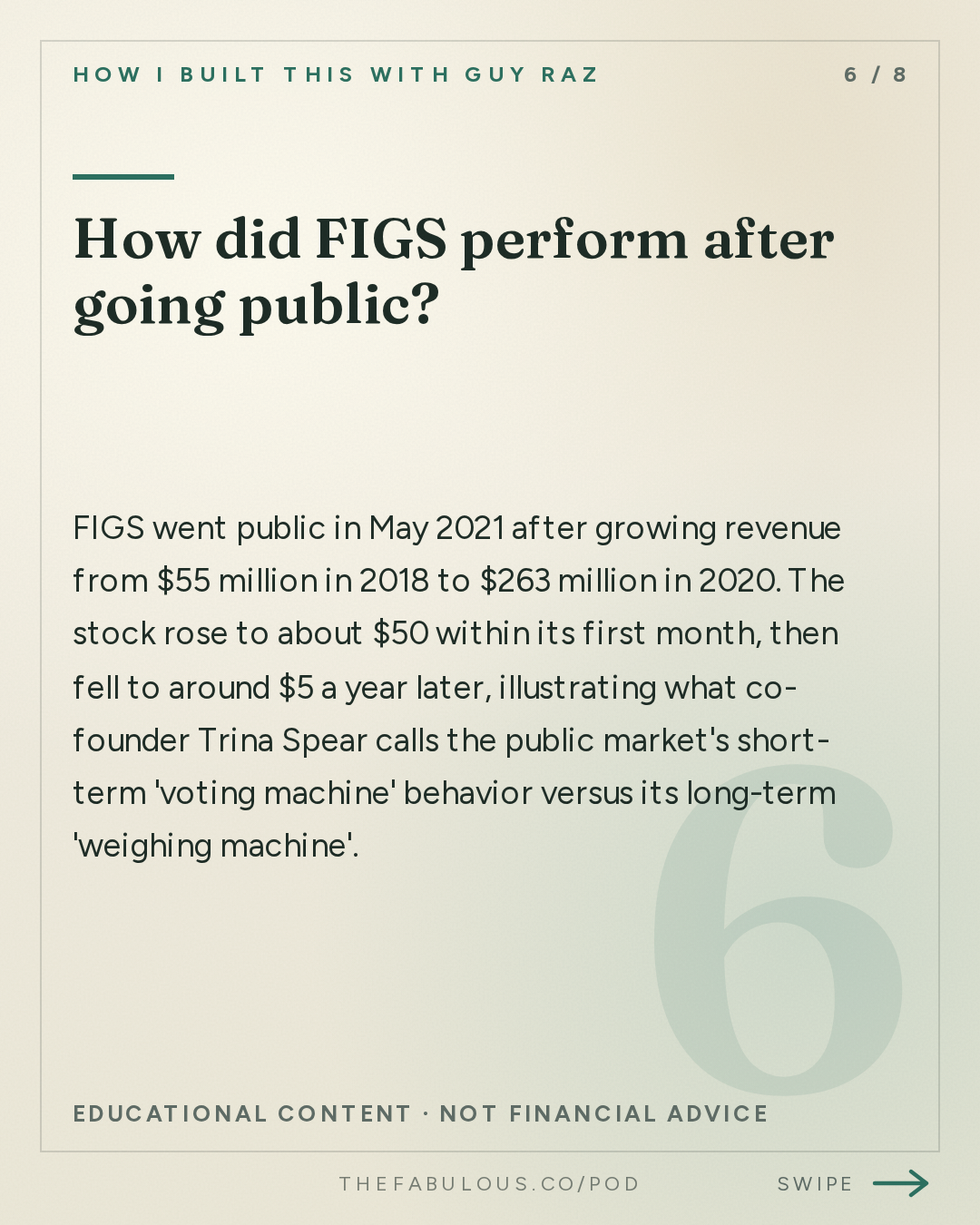
How did FIGS perform after going public?
FIGS went public in May 2021 after growing revenue from $55 million in 2018 to $263 million in 2020 (51:17, 59:57). The stock rose to about $50 within its first month, then fell to around $5 a year later, illustrating what co-founder Trina Spear calls the public market's short-term 'voting machine' behavior versus its long-term 'weighing machine' (63:12, 63:34).
The full read, in cards
Mentioned
Heather Hasson · Trina Spear · FIGS · Blackstone · Harvard Business School · Thomas Tull · Strategic Partners · Shopify · Lululemon · Campfire Capital
More from this show and category

Tara Bosch's Advice: D2C to Retail Growth
Tara Bosch, who sold a majority stake in her low-sugar candy brand SmartSweets for a reported $360 million (00:49), spends this advice-line episode teaching four early founders how to move from online sales to grocery shelves, price sugar and price value in three seconds, and read customer emotion through phone calls rather than DMs.

How Sweet Loren's Cookie Dough Was Built
Loren Castle grew Sweet Loren's cookie dough into a 30,000-plus-store brand by scaling slowly for a decade. Then she rebuilt the entire line around an allergen-free recipe that became the company's top-selling product within six months of its 2017 launch, after customer emails revealed how many shoppers had dietary restrictions.
Sweet Loren's Cookie Dough Success Story
Loren Castle turned a cookie stand at Brooklyn's Smorgasburg market into Sweet Loren's, a cookie dough brand now in more than 30,000 stores. After surviving Hodgkin's lymphoma at 22, she built the business slowly, then rebuilt it entirely around allergen-free recipes once customer demand made clear that was the real opportunity, reaching profitability in 2018.
CPG Brand: Moving From D2C to Retail
SmartSweets founder Tara Bosch, who sold a majority stake for $360 million, coaches four founders on moving from D2C to grocery retail. She covers wholesale-versus-direct splits, reformulating sugar and allulose, niche marketing for a swimwear brand, and when to pivot an experience-subscription box.
