
CPG Brand: Moving From D2C to Retail
Advice Line with Tara Bosch of SmartSweets
The brief
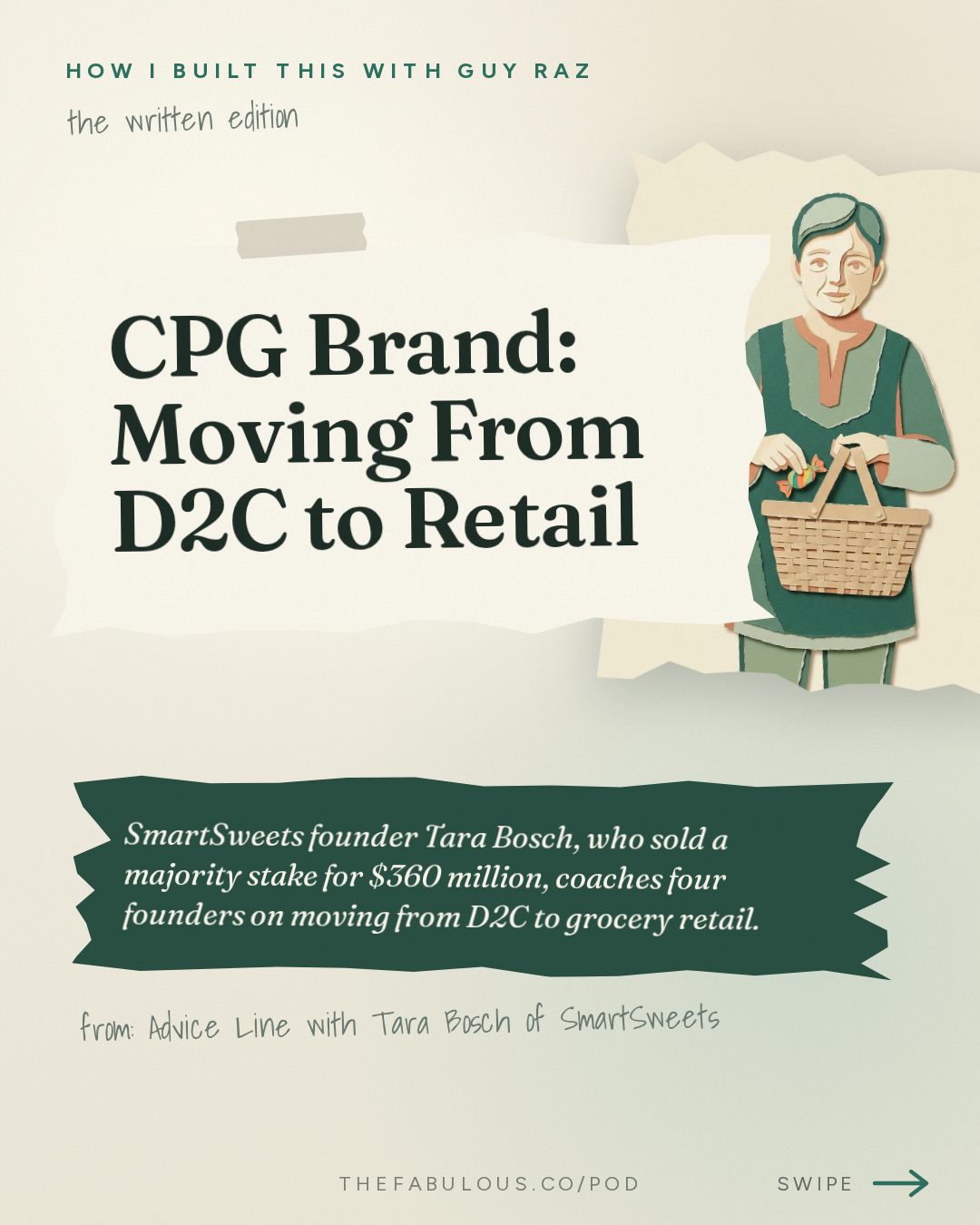
SmartSweets founder Tara Bosch, who sold a majority stake for $360 million, coaches four founders on moving from D2C to grocery retail. She covers wholesale-versus-direct splits, reformulating sugar and allulose, niche marketing for a swimwear brand, and when to pivot an experience-subscription box.
There is a phrase a marshmallow founder uses on this episode that does more work than she probably intends: a bag of boring. That is how Lindsay Shanks describes the supermarket marshmallow, the kind sold in plastic sacks, always the same flavor, always the same texture (12:20). It is a phrase that explains why a certain kind of founder keeps showing up on this advice line: someone who looked at a shelf-stable, over-processed category and thought, why does it have to be boring?
Tara Bosch asked herself a version of that question about candy in her kitchen a decade ago, and it became SmartSweets, a low-sugar gummy bear company she eventually sold a majority stake in for a reported $360 million (06:19). She is back this week not as a guest with a tidy origin story but as the host's co-pilot, fielding calls from four founders stuck at the exact point where a good idea has to become a bigger business. She is also, notably, starting over. Her new company, Snackish, makes high-protein potato chips, an idea she credits partly to her five-year-old daughter's obsession with a yellow chip bag (07:02). Asked whether a second company feels less urgent than the first, Bosch says no, just different.
"I'm very at peace with the unknown and knowing that I will figure it out." — Tara Bosch (11:39)That sentence turns out to be the quiet thesis of the whole episode: calm does not come from certainty, it comes from having done the not-knowing once before.
The Impulse Aisle
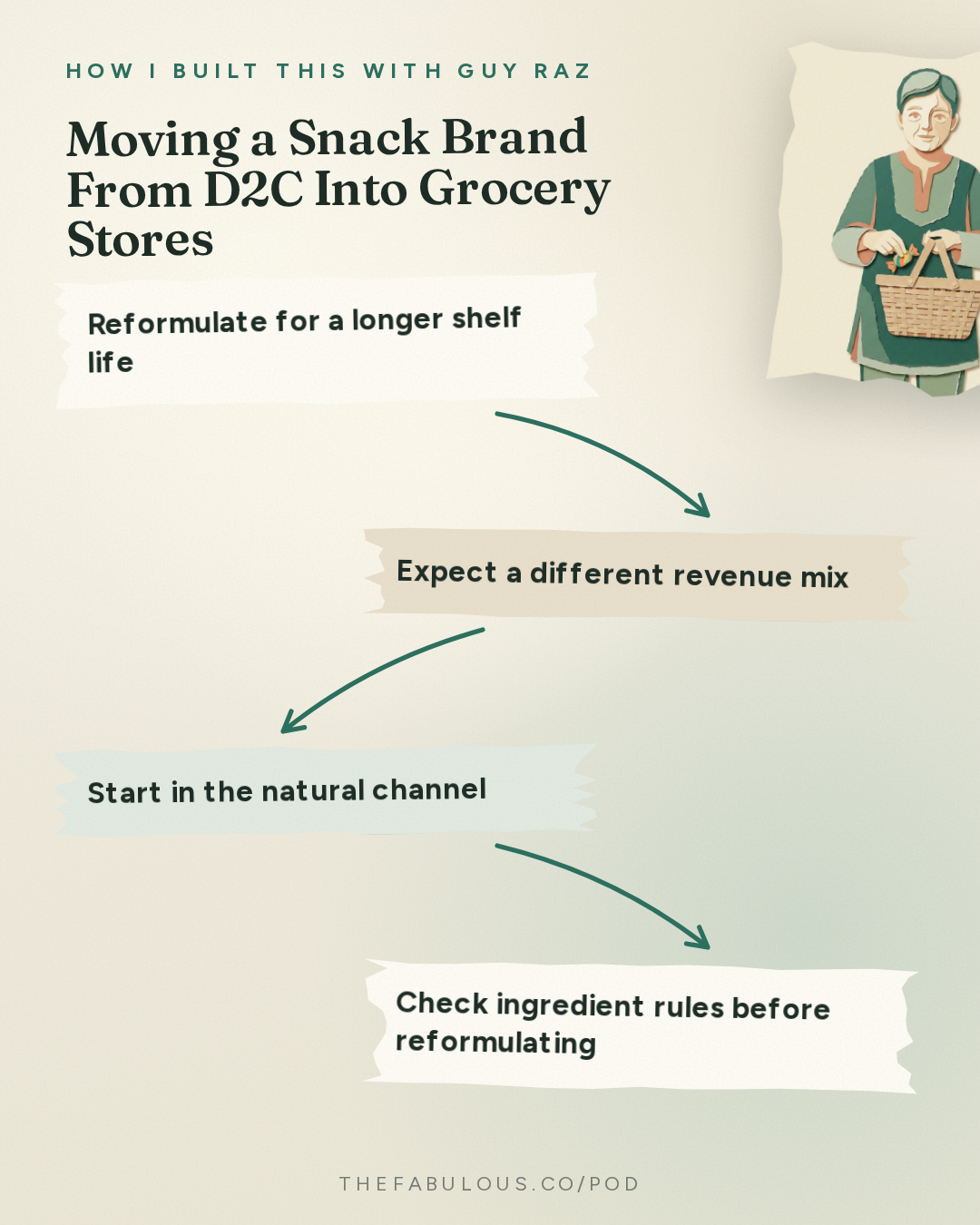
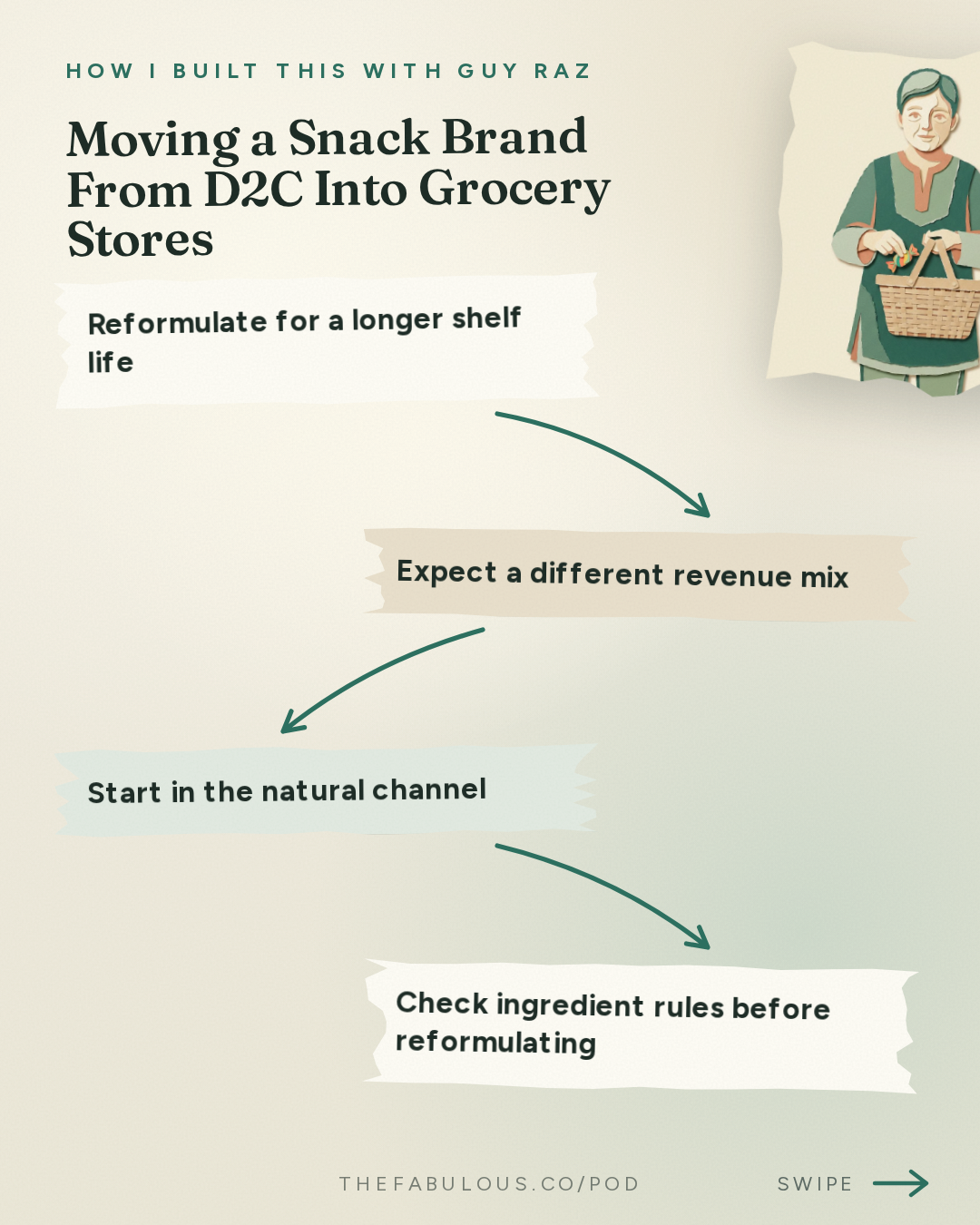
The first caller, Lindsay Shanks, has spent ten years building XO Marshmallow, a gourmet, better-for-you marshmallow brand now doing just under $5 million in projected revenue with 11 employees out of a 10,000-square-foot facility near Chicago (14:12, 14:33). Ninety percent of her sales are direct-to-consumer, meaning customers order from her own website rather than buying off a store shelf. She wants to move into grocery, but she is reformulating first: pulling corn out of the recipe and switching to shelf-stable packaging that stretches the product's life from 4 months to 18 months (14:52). Her question is really about math and nerve: will grocery sales eat into the high-margin D2C business she already has?
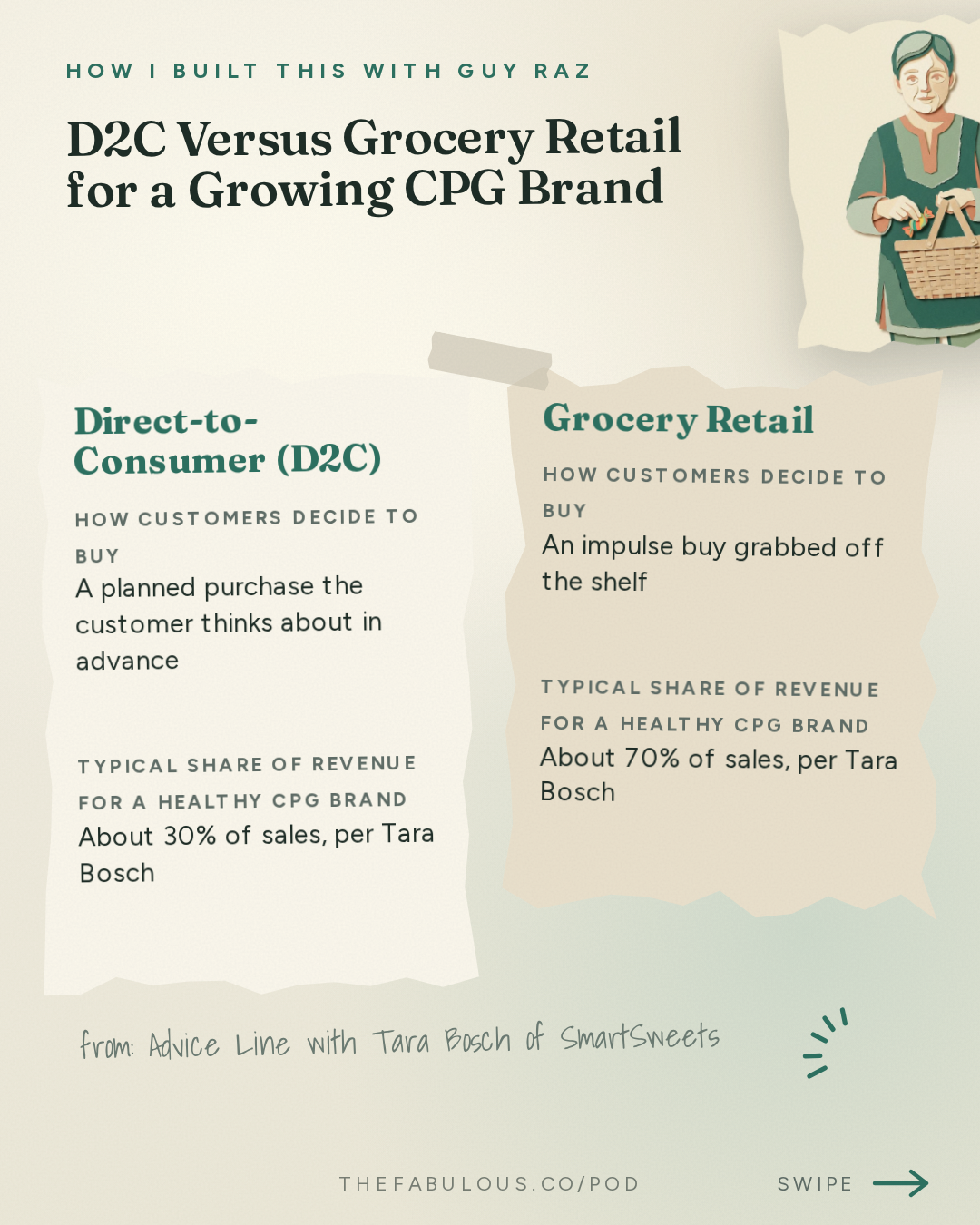
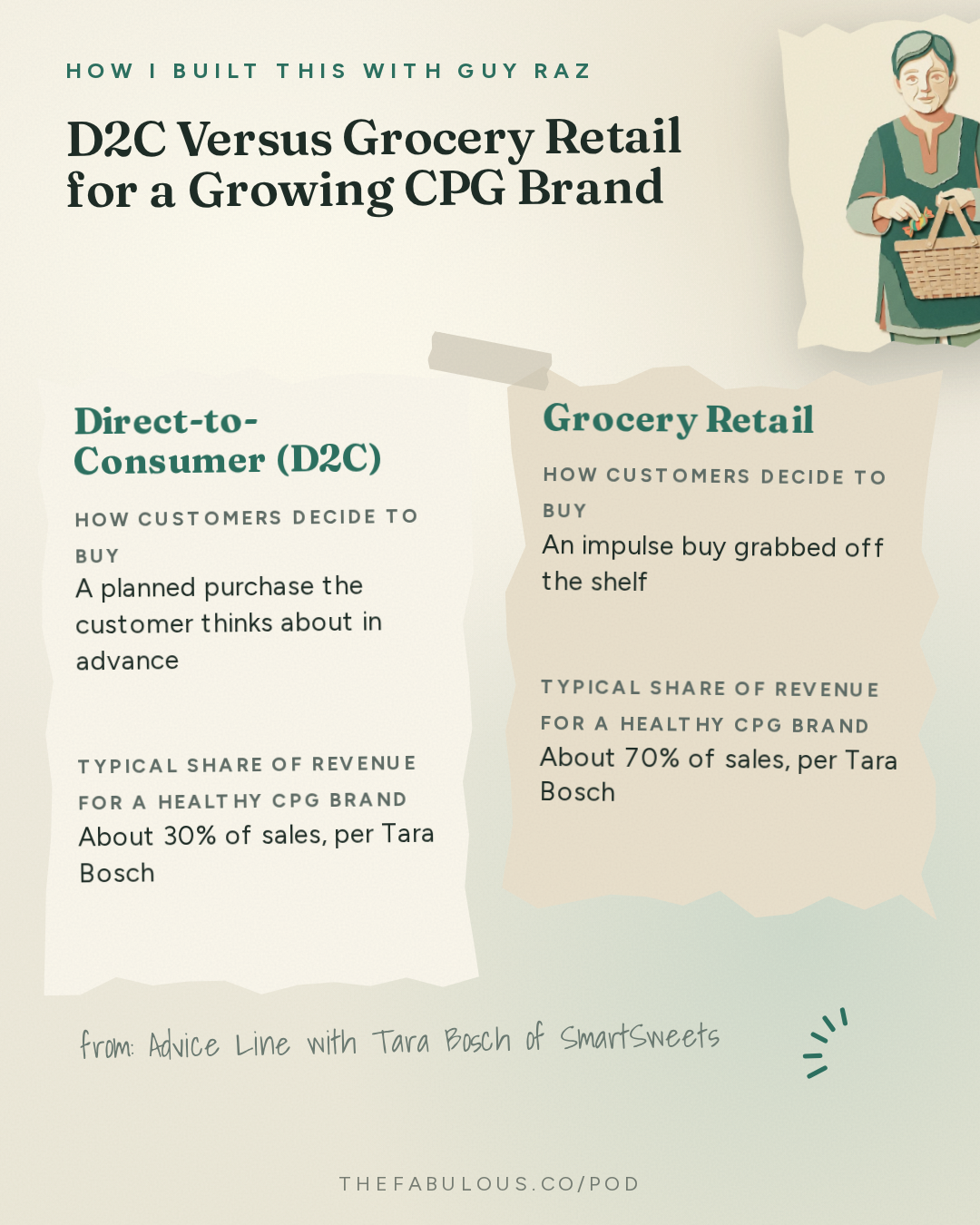
Bosch's answer leans on a distinction worth sitting with. D2C, she says, is a planned purchase, something a customer thinks about before she clicks buy. Grocery is closer to an impulse buy, something that happens because the product is right there on the shelf when she is already in the store.
"Grocery really became such an impulse buy, where she may not be thinking about it two weeks before she wants to order them." — Tara Bosch (16:10)Because the two behaviors are different, Bosch argues, the two channels tend to serve different customers rather than steal from each other. She cites a rule of thumb from her own SmartSweets years: a healthy split for a growing packaged-food brand is roughly 70 percent wholesale and 30 percent direct-to-consumer (16:10). That number is less a formula than a sanity check, a way to know whether a brand's channel mix looks like a mature business or a business still finding its footing.
The conversation also drifts into ingredients, specifically allulose, a sugar substitute that does not spike blood sugar and is popular with diabetics and people on low-inflammation diets. Guy Raz floats the idea of an allulose marshmallow SKU. Shanks is intrigued but wary, because some retailers, including Whole Foods, have begun banning allulose as an ingredient (21:39). The practical compromise Bosch suggests, and one that recurs as a theme across the episode, is to keep innovation in a side lane rather than risk the core product's retail eligibility. Launch the experiment, but do not let it become a liability for the thing already working. She adds a related note about which grocery channel to court first: the natural channel, meaning stores like Whole Foods that specialize in natural and organic goods, tends to be more forgiving toward early-stage brands on merchandising and fees than mass retailers are (22:04). It is advice with a clear financial logic. A startup without the budget to pay slotting fees, the charges retailers can demand for shelf space, needs a channel willing to work with smaller checks.
Making a Small Brand Look Big
The second call shifts from manufacturing to marketing. Vivi, who designs sustainable swimwear in Hawaii and New York under the label Vivi's Vacation, has been selling direct to consumer, with a peak of 60 orders in two weeks at her best and about 15 sets sold since a July relaunch (33:16). Her question is about editing: how does a founder with no marketing budget decide which three seconds of a product's story to put on a label, an Instagram post, or a website header (34:28)?
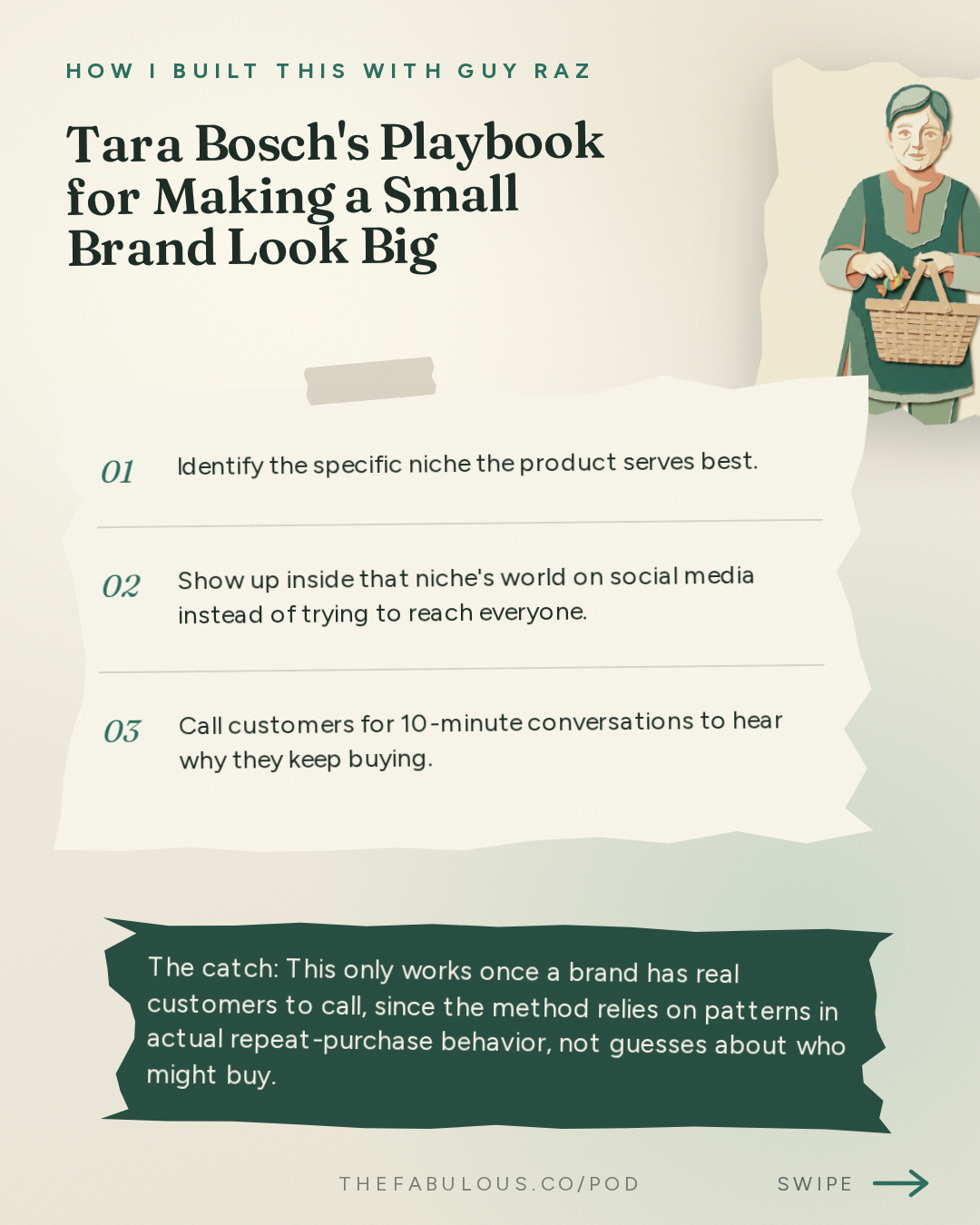
Bosch's answer traces back to an odd source: a podcast where Tim Ferriss described how he marketed his book, The 4-Hour Workweek. The lesson she took from it was not about reaching everyone, it was about finding the specific niche a product creates the most value for, and then showing up inside that niche's world.
"Identifying the niche that you are creating the most value for and then infiltrating their world." — Tara Bosch (35:50)Social platforms make this easier than it used to be, she argues, because a brand can get specific about audience in a way that makes a two-person company look like it has real scale. But niche strategy only works if a founder actually knows what that niche wants, and Bosch's method for finding out is almost anti-digital: pick up the phone. She describes calling SmartSweets customers for ten-minute conversations and hearing the same emotional threads come up again and again, the real reasons people kept buying.
"It was incredible the amount that I learned, and then also the consistent threads that were the emotional connections as to why somebody felt drawn to the product." — Tara Bosch (37:26)For Vivi, Bosch and Raz push toward a concrete fix: put the founder's own story and a photo of her surfing in Hawaii on the website, because a two-word label like sustainable swimwear is not enough to explain why the product is worth a premium price (38:36).
The last caller, Ally Aguilar, runs Romanticize Collective, a Los Angeles subscription box that delivers curated real-world experiences, such as a cavatelli pasta-making kit or a stargazing guide timed to a meteor shower, to 30 recurring members for just under $20,000 in total sales so far (41:34, 43:48). Her question is about timing: when does a founder keep refining the existing model versus rebuild it? Bosch's suggestion is to listen for what she calls a natural waterfall effect, the moment when a product experience is so good that a customer tells a friend immediately and that friend signs up too (48:06). If that is not happening, she says, the gap between what is and is not spreading on its own is the most useful data a founder has.
By the end of the hour, four very different businesses, marshmallows, chips, swimwear, and an experience box, start to sound like variations on one question: not whether an idea is good, but whether the founder can see clearly enough where it is going. Bosch's closing advice ties the episode together. Asked what she would tell herself at the start of SmartSweets, she does not mention funding or manufacturing. She mentions clarity.
"It's not that you can't get to where you wanna go, it's that most people don't know where they wanna go." — Tara Bosch (52:11)Defining what the business looks like five years out, with real specificity, is what let her move faster once she finally did it, she says (51:49). It is a modest-sounding piece of advice, almost a cliché, until it is set against four founders on the phone, each one circling the same practical fork: scale the thing that already works, or build the thing that might work better. Clarity, in Bosch's telling, is not a mood. It is the decision that makes every smaller decision after it easier to make.
Ask this episode anything
Pod's AI answers from the episode itself, with the minute mark so you can hear it yourself.
Or start with one of these
Ask this episode
Pod's AI listens to the whole episode to answer, and points you to the minute it comes from.
The rest of this answer, and any question after it
Answers come from the episode itself, never from a summary of it.
ContinueKey takeaways
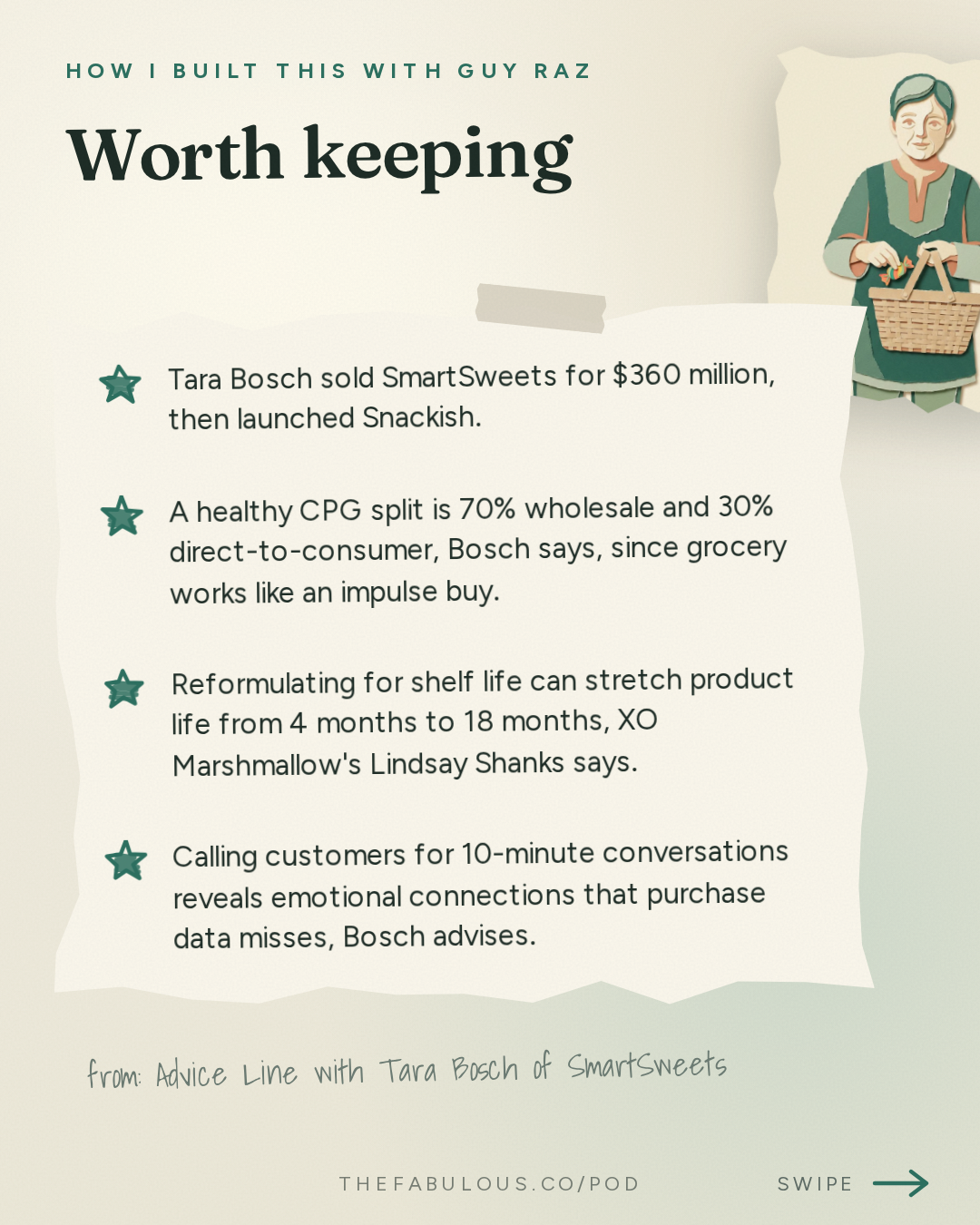
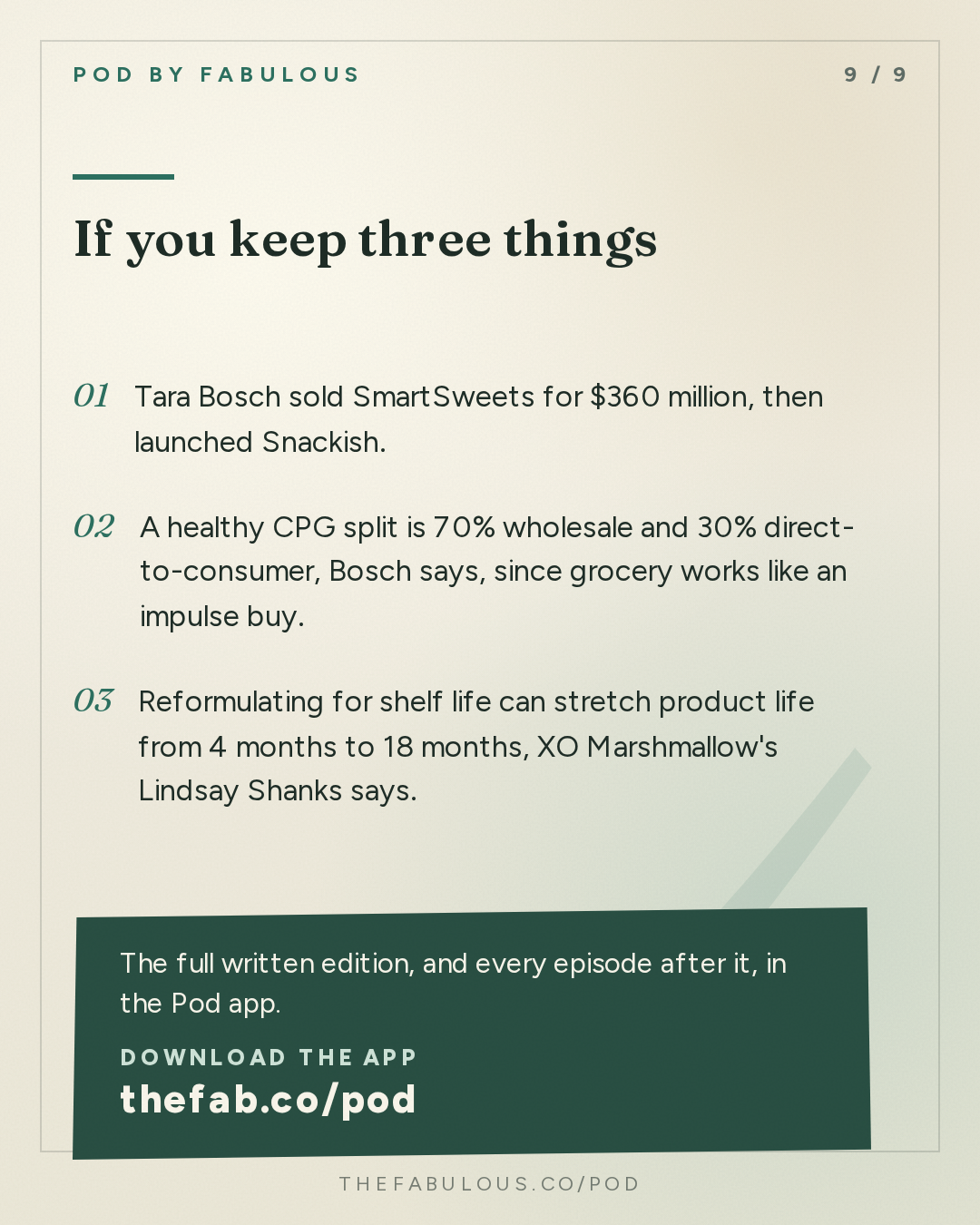
- Tara Bosch sold SmartSweets for $360 million, then launched Snackish.
- A healthy CPG split is 70% wholesale and 30% direct-to-consumer, Bosch says, since grocery works like an impulse buy.
- Reformulating for shelf life can stretch product life from 4 months to 18 months, XO Marshmallow's Lindsay Shanks says.
- Calling customers for 10-minute conversations reveals emotional connections that purchase data misses, Bosch advises.
- Defining a five-year vision with extreme clarity speeds up a startup's growth, Bosch says.
The episode in cards
By the numbers
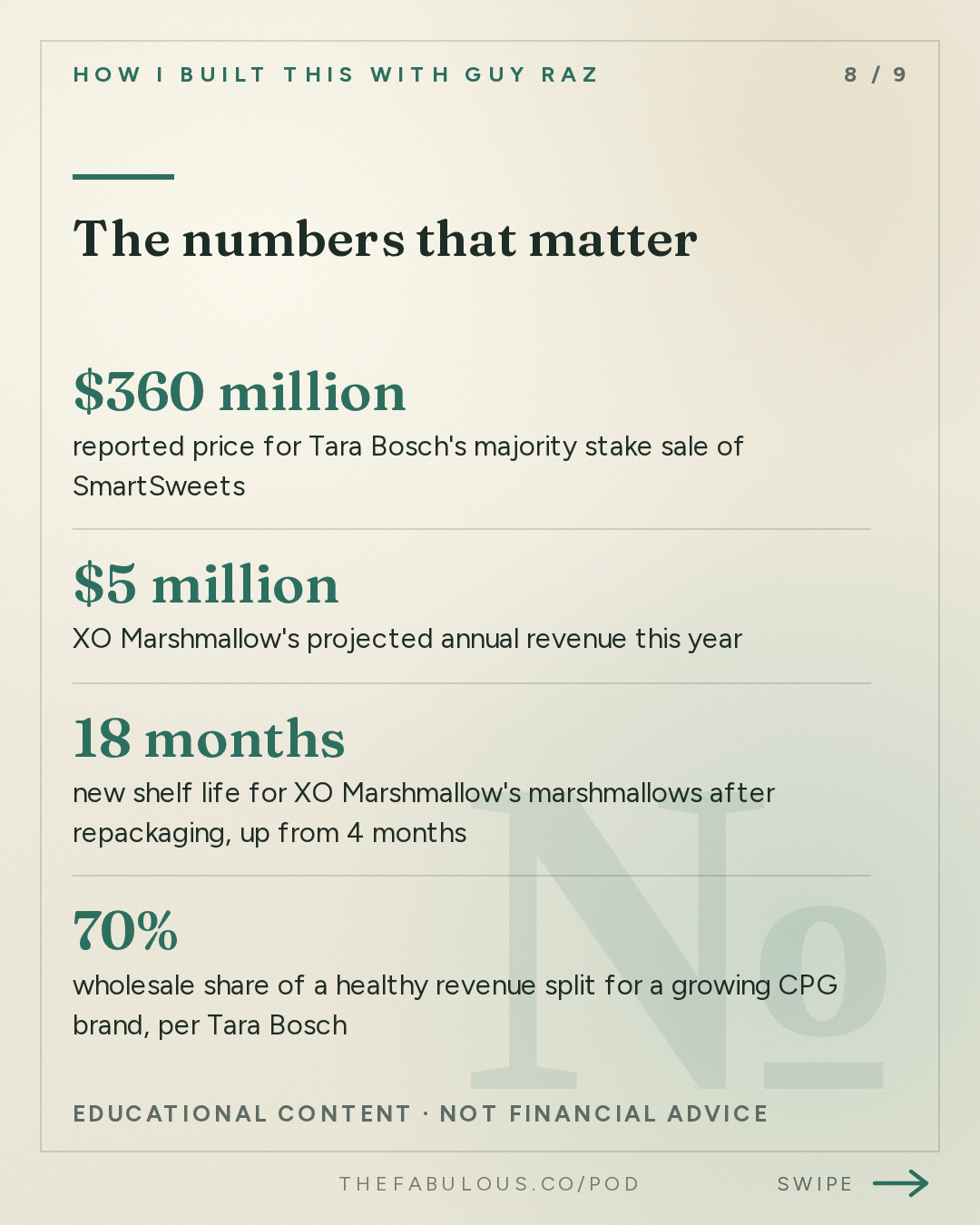
- $360 million reported price for Tara Bosch's majority stake sale of SmartSweets
- $5 million XO Marshmallow's projected annual revenue this year
- 18 months new shelf life for XO Marshmallow's marshmallows after repackaging, up from 4 months
- 70% wholesale share of a healthy revenue split for a growing CPG brand, per Tara Bosch
In their words
“I'm very at peace with the unknown and knowing that I will figure it out.”
“Identifying the niche- Mm-hmm ... that you are creating the most value for and then infiltrating their”
“It was incredible the amount that I learned, and then also the consistent threads that were the, um, emotional connections as to why somebody felt drawn to the product”
“It's not that you can't get to where you wanna go, it's that most people don't know where they wanna go.”
Protocols
-
Find the niche, then show up inside it
Tara Bosch advises identifying the specific niche a product serves best and then showing up inside that niche's world on social media, a tactic she borrowed from hearing Tim Ferriss describe marketing his book The 4-Hour Workweek. She says doing this can make a small brand look much bigger than it actually is.
Ongoing, as part of marketing strategy
-
Call customers instead of only messaging them
Tara Bosch recommends calling customers for 10-minute conversations rather than relying only on DMs or sales data. She says these calls reveal the emotional reasons people keep buying a product, patterns that data alone will not show.
Periodically, especially early in a brand's life
-
Test a sugar-substitute SKU separately from the core product
Guy Raz suggests that XO Marshmallow launch a separate SKU made with allulose, a sugar substitute that does not spike blood sugar, instead of reformulating its main product. He notes that some retailers, including Whole Foods, have started banning allulose, so keeping it out of the core line protects shelf placement.
One-time product decision before a retail launch
-
Define a five-year vision with extreme clarity before scaling
Tara Bosch says founders should define, with extreme clarity, what their business looks like five years out before making decisions about retailers or national launches. She says this clarity is what let her move faster with SmartSweets once she finally had it.
Once, revisited as the business grows
Questions this episode answers
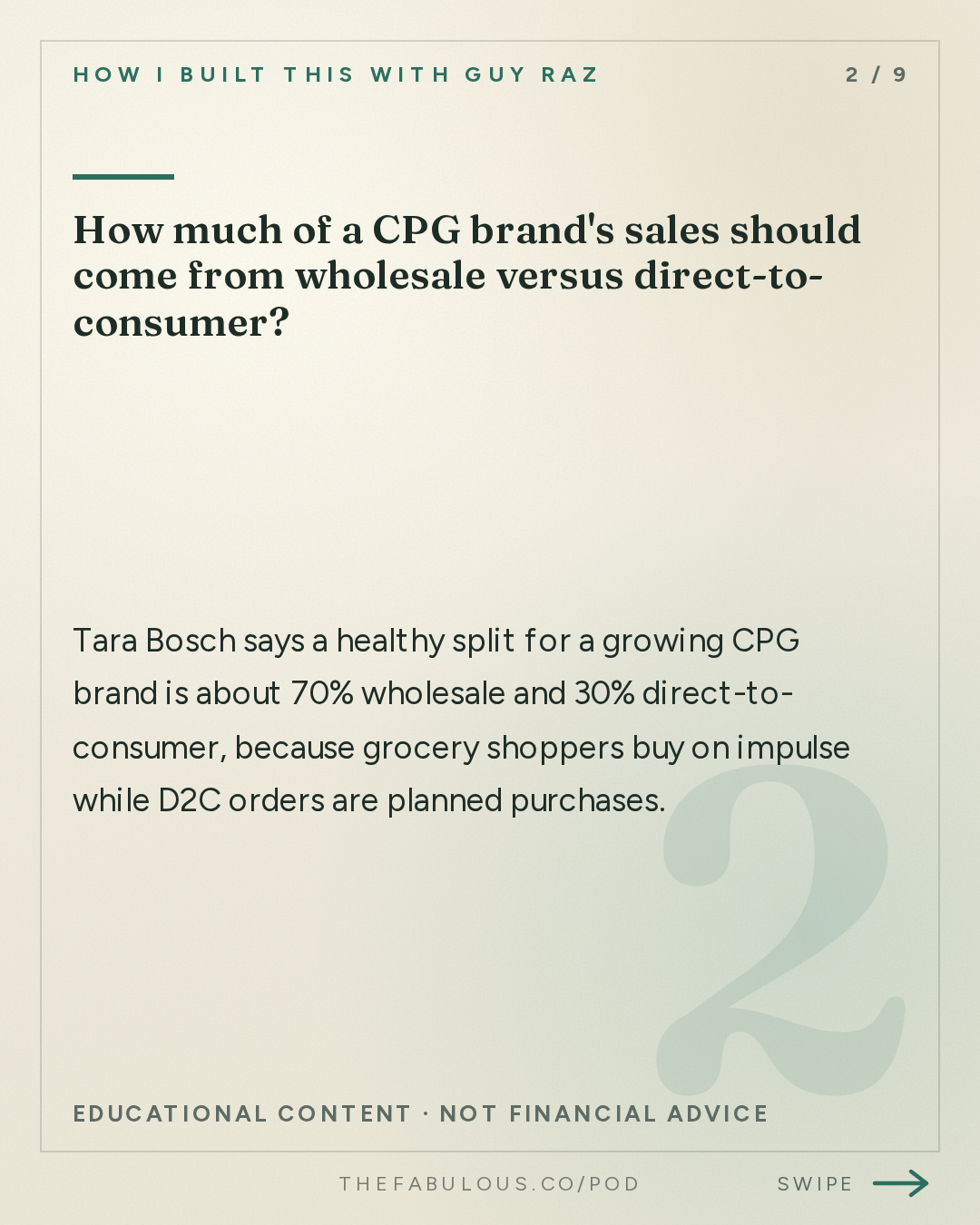
How much of a CPG brand's sales should come from wholesale versus direct-to-consumer?
Tara Bosch says a healthy split for a growing CPG brand is about 70% wholesale and 30% direct-to-consumer, because grocery shoppers buy on impulse while D2C orders are planned purchases (16:10).
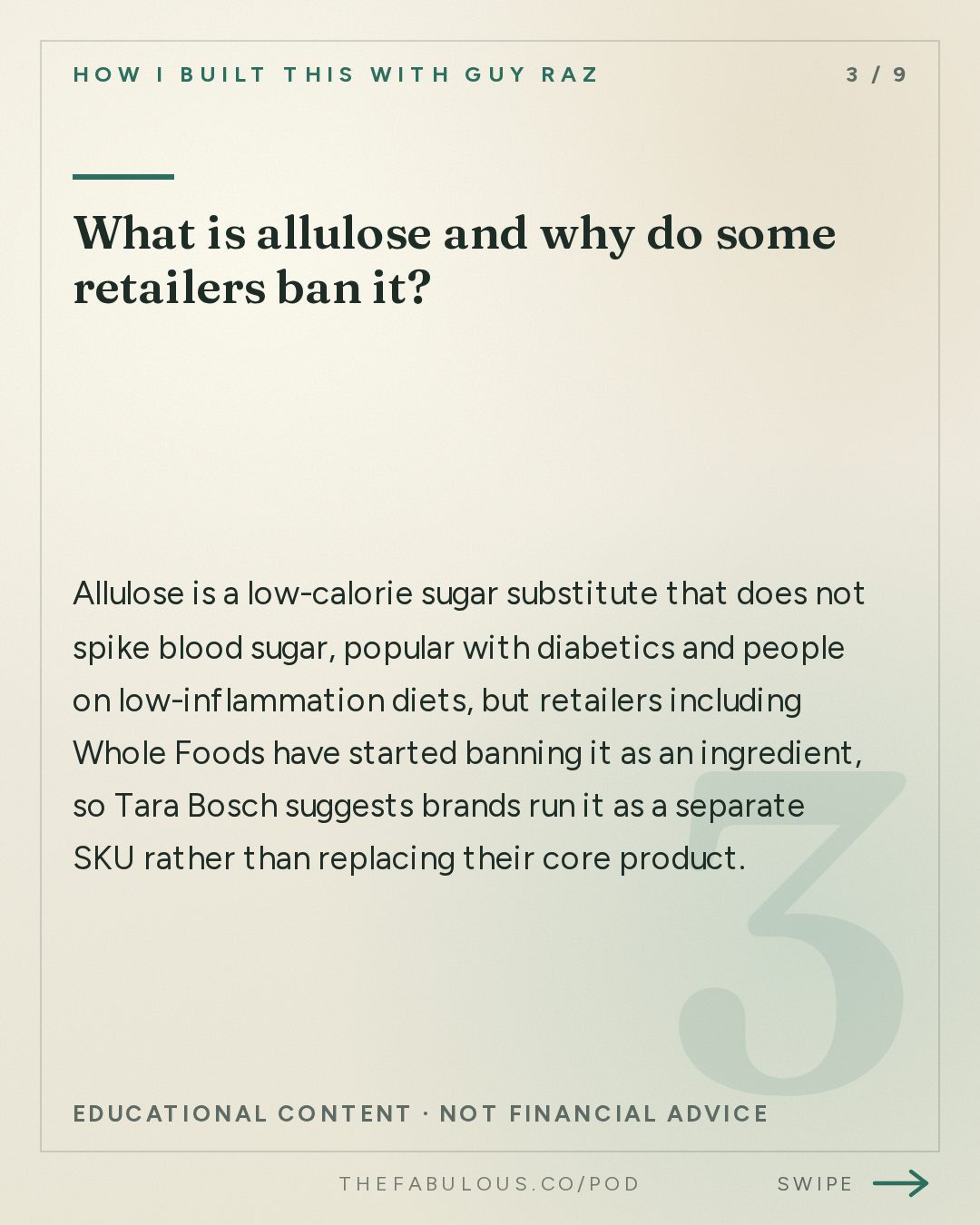
What is allulose and why do some retailers ban it?
Allulose is a low-calorie sugar substitute that does not spike blood sugar, popular with diabetics and people on low-inflammation diets, but retailers including Whole Foods have started banning it as an ingredient, so Tara Bosch suggests brands run it as a separate SKU rather than replacing their core product (21:17, 21:39).
How can a small brand compete in a crowded retail aisle?
Tara Bosch advises identifying the specific niche a product serves best and then showing up inside that niche's online world, a tactic she borrowed from a podcast where Tim Ferriss described marketing his book The 4-Hour Workweek, which can make a small brand look much bigger than it is (35:50).
How long can reformulating packaging extend a snack product's shelf life?
XO Marshmallow founder Lindsay Shanks says switching to new shelf-stable packaging and removing corn from her marshmallow recipe extends shelf life from 4 months to 18 months, a change she needed before moving into grocery stores (14:52).
Should a CPG founder call customers directly for feedback?
Tara Bosch says calling customers for 10-minute conversations surfaces emotional reasons for repeat purchases that data and DMs do not reveal, and she used those calls to find the common threads that shaped SmartSweets' brand story (36:54).
The full read, in cards
Go deeper
- The 4-Hour Workweek — Tara Bosch says hearing Tim Ferriss describe marketing this book on a podcast inspired her niche-first marketing strategy for SmartSweets
Mentioned
Tara Bosch · SmartSweets · Snackish · XO Marshmallow · Lindsay Shanks · Vivi's Vacation · The 4-Hour Workweek · Tim Ferriss · Banza · Romanticize Collective · Ally Aguilar · Guy Raz
More from this show and category
The History of Alamo Drafthouse Cinema
Tim and Karrie League, two Rice University graduates with an engineering job and a microbiology PhD between them, opened a failed art house theater in Bakersfield in 1993, then rebuilt the idea inside an Austin parking garage in 1997 and grew it into Alamo Drafthouse Cinema, a dine-in chain that survived a lawsuit, a Me Too reckoning, and COVID bankruptcy before Sony Pictures Entertainment bought it in 2023.
Nick Green's Advice for Scaling Niche Brands
Thrive Market CEO Nick Green coaches three founders to scale through focus, not features, on How I Built This's Advice Line. He tells a concert-wear designer to cut SKUs, a coffee founder to fund growth with subscriptions instead of outside cash, and an ALS app founder to court clinicians and caregivers, not patients, for awareness.
How I Built This: 10 Years of Top Lessons
Guy Raz marked 10 years of How I Built This by revisiting lessons from over 600 founder interviews with Ring co-founder Jamie Siminoff (07:23). The episode replays James Dyson's five-year vacuum quest (32:44) and Airbnb's 2008 pitches, where zero of 20 investors said yes (45:47), arguing fear, scrappiness, and rejection are normal parts of building something lasting.
Seventh Generation's Founders: A Partnership That Broke
Alan Newman and Jeffrey Hollender turned a discarded 1988 mail-order catalog into Seventh Generation, then split so badly they barely spoke for decades. Newman built the product and culture; Hollender raised money and later ran the company through a retail pivot, a 2010 board ouster, and Unilever's 2016 acquisition for $700 million.
