
How I Built This: 10 Years of Top Lessons
10 Years of How I Built This: A Decade of Innovation, Risk and Reinvention
The brief
Guy Raz marked 10 years of How I Built This by revisiting lessons from over 600 founder interviews with Ring co-founder Jamie Siminoff (07:23). The episode replays James Dyson's five-year vacuum quest (32:44) and Airbnb's 2008 pitches, where zero of 20 investors said yes (45:47), arguing fear, scrappiness, and rejection are normal parts of building something lasting.
Three in the morning has a reputation among people who build things. Jamie Siminoff, who founded the doorbell camera company Ring, says a particular kind of panic shows up right on the dot: sweaty, racing, certain that everything is about to collapse (09:29). He is not alone. That hour, and the fear that comes with it, is one of the threads running through the tenth anniversary episode of How I Built This, in which host Guy Raz invited Siminoff back to listen through a decade of interviews and talk about what stuck.
The numbers behind that decade make an argument of their own. Raz has interviewed more than 600 founders since the show began (07:23), people who built companies as different as Airbnb, Dropbox, Chobani, and Kinko's. What the anniversary episode suggests, mostly by example, is that fear, failure, and rejection are not detours from a successful founding story. They are the story.
Siminoff makes this explicit early on. "I think the most important thing in that clip, which I still think is so true, is we put ourselves out of business. It's more us than anyone else," he says, reflecting on his own first appearance on the show (08:24). Fear, in his account, is not an obstacle to manage away. It is raw material. Used well, it pushes a founder forward. Used badly, it seizes a person up entirely, the way panic does at 3 a.m.
Scary Versus Dangerous
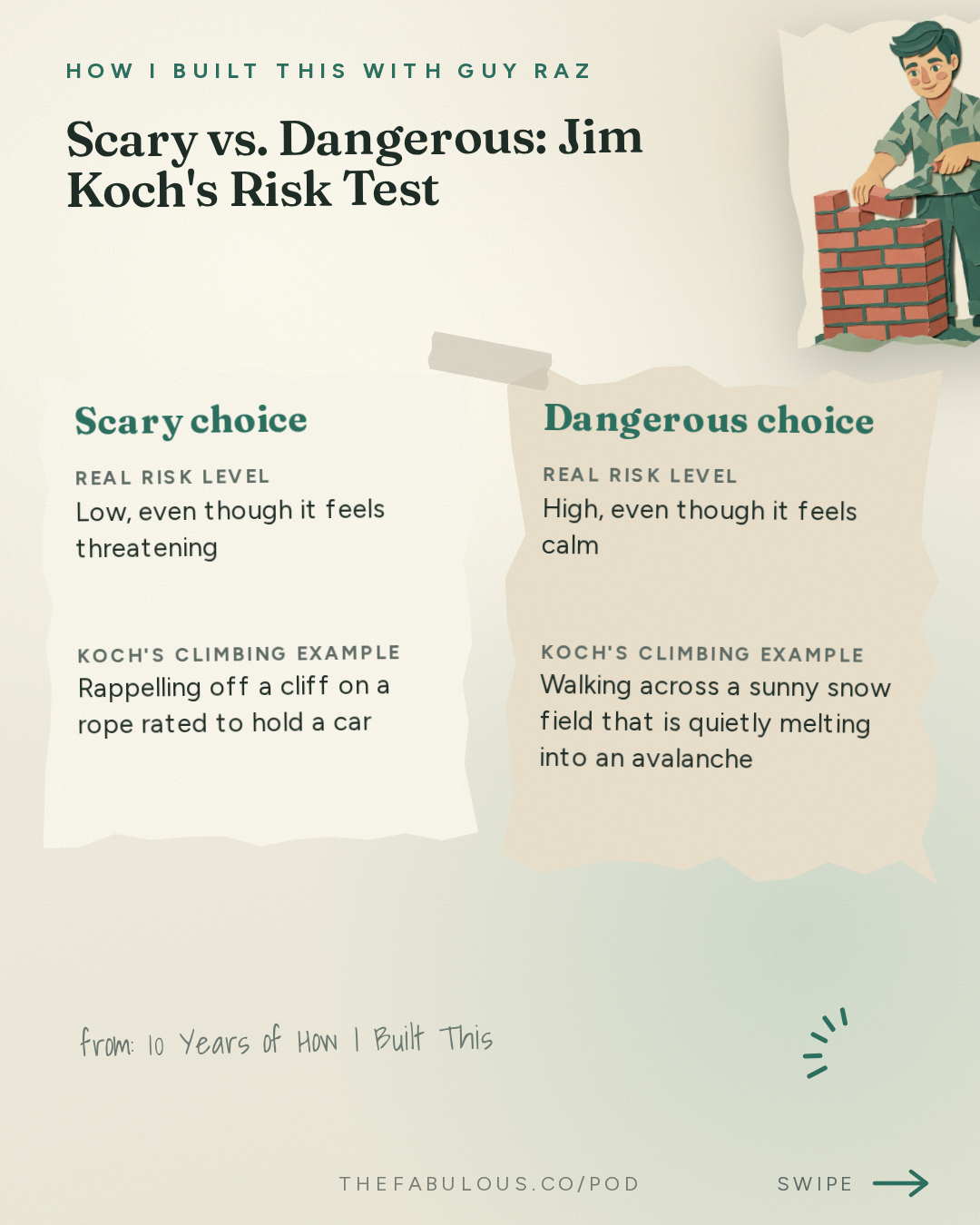
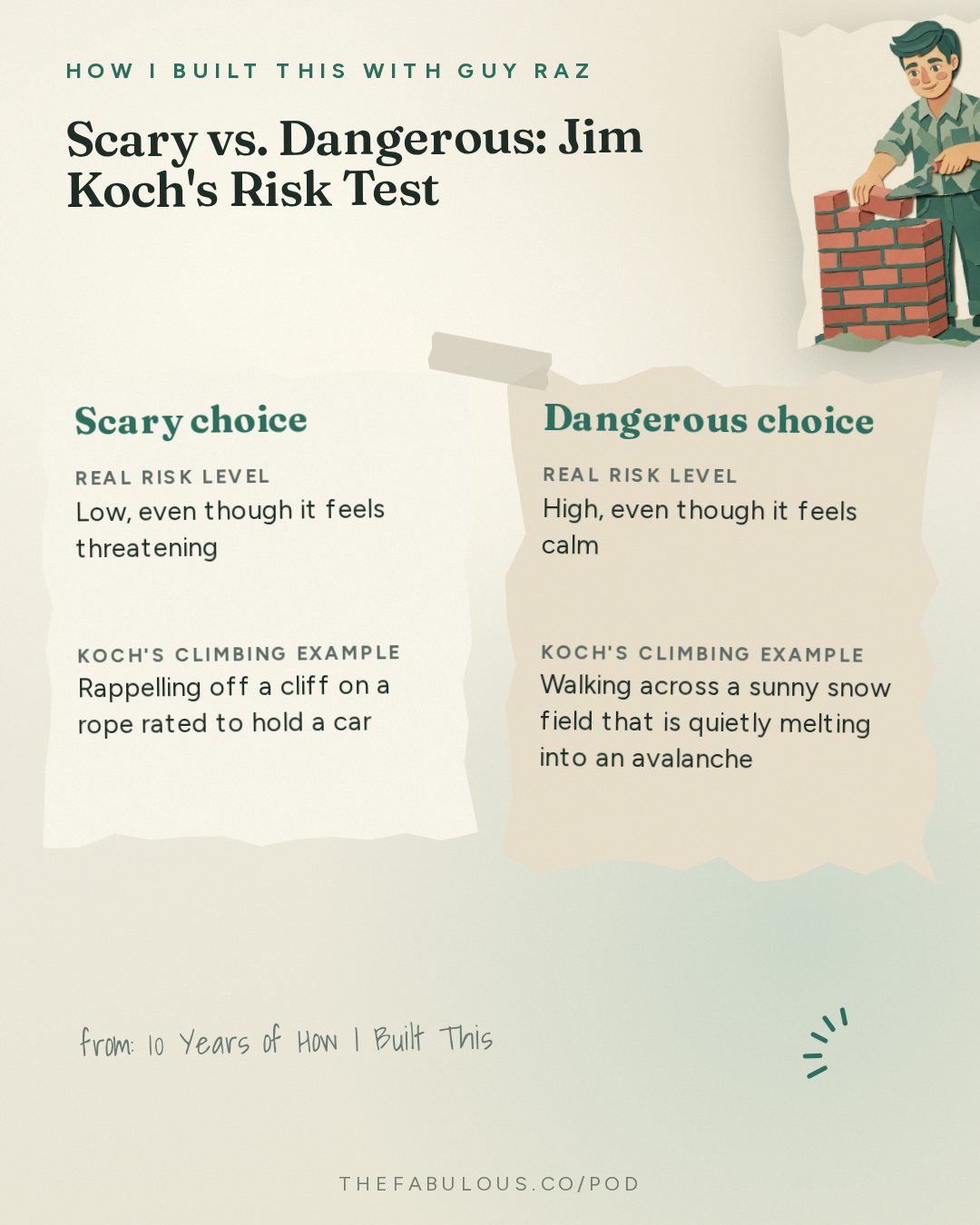
The clearest framework in the episode comes from Jim Koch, who left a stable, well paid job at Boston Consulting Group to found what became Boston Beer Company, maker of Sam Adams. Koch draws a line between things that are scary and things that are dangerous, using an analogy from his years teaching at the outdoor program Outward Bound (16:55).
"Staying at BCG was dangerous but not scary, and the risk was continuing to do something that didn't make me happy and getting to 65 and looking back and go, 'Oh my God, I wasted my life.'"
Jim Koch, founder of Boston Beer Company, speaking at [18:15].
Rappelling off a cliff feels terrifying, Koch says, but a rope rated to hold a car makes it safe. That is scary but not dangerous. Walking across a sunlit snow field on a calm afternoon feels like nothing at all, but melting snow can turn to ice, and ice can trigger an avalanche. That is dangerous but not scary (17:12). The unhappy, secure job is the snow field. It feels fine right up until it is not.
Several other stories map onto this test. Sal Khan left a lucrative finance career to found the free online education nonprofit Khan Academy, over his mother's objections (20:35). Hamdi Ulukaya, an immigrant from Turkey with no English, borrowed against a shuttered yogurt factory in upstate New York to build what became Chobani (53:33). None of these choices were safe in the ordinary sense. But staying put carried its own cost, one that simply took longer to arrive.
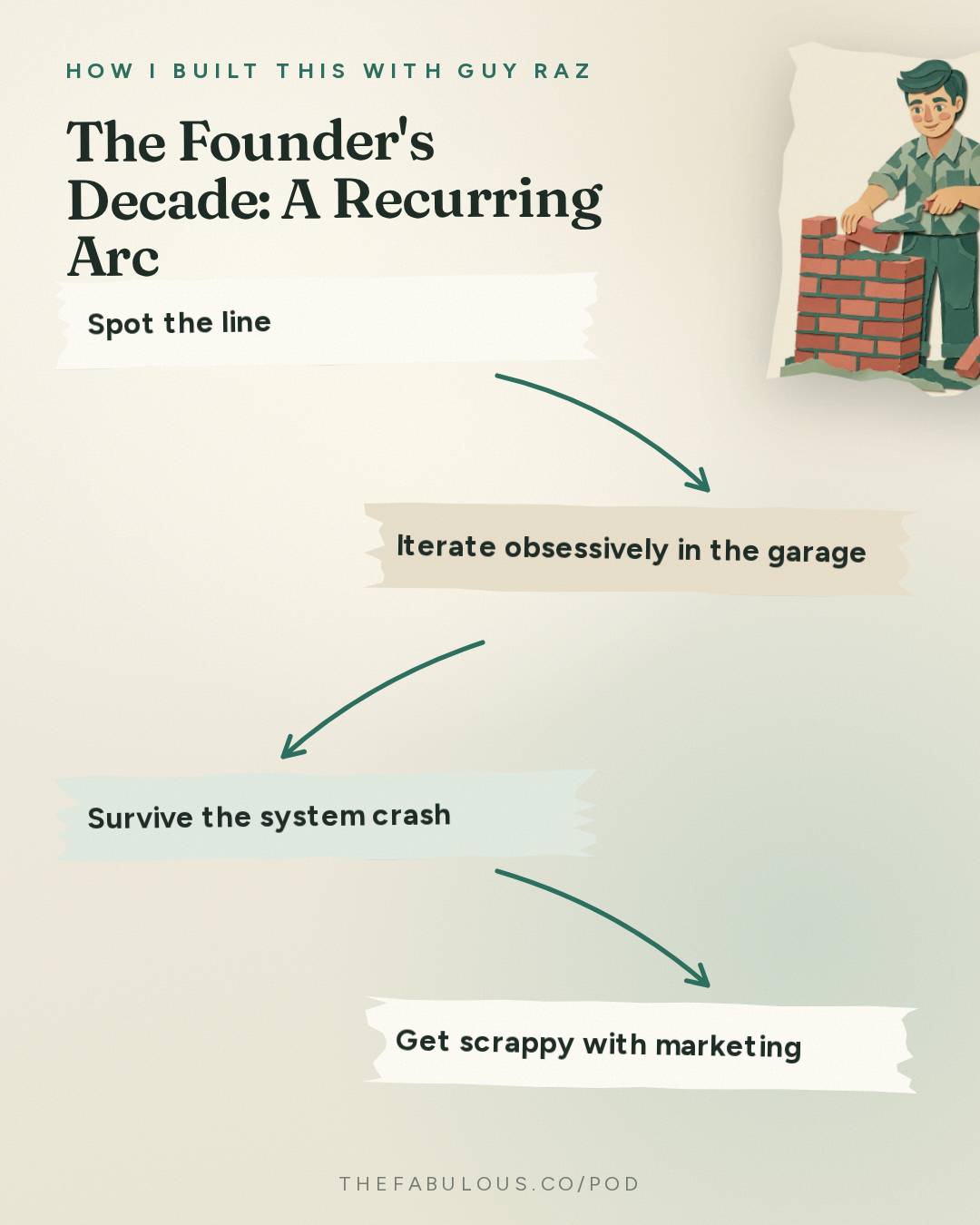
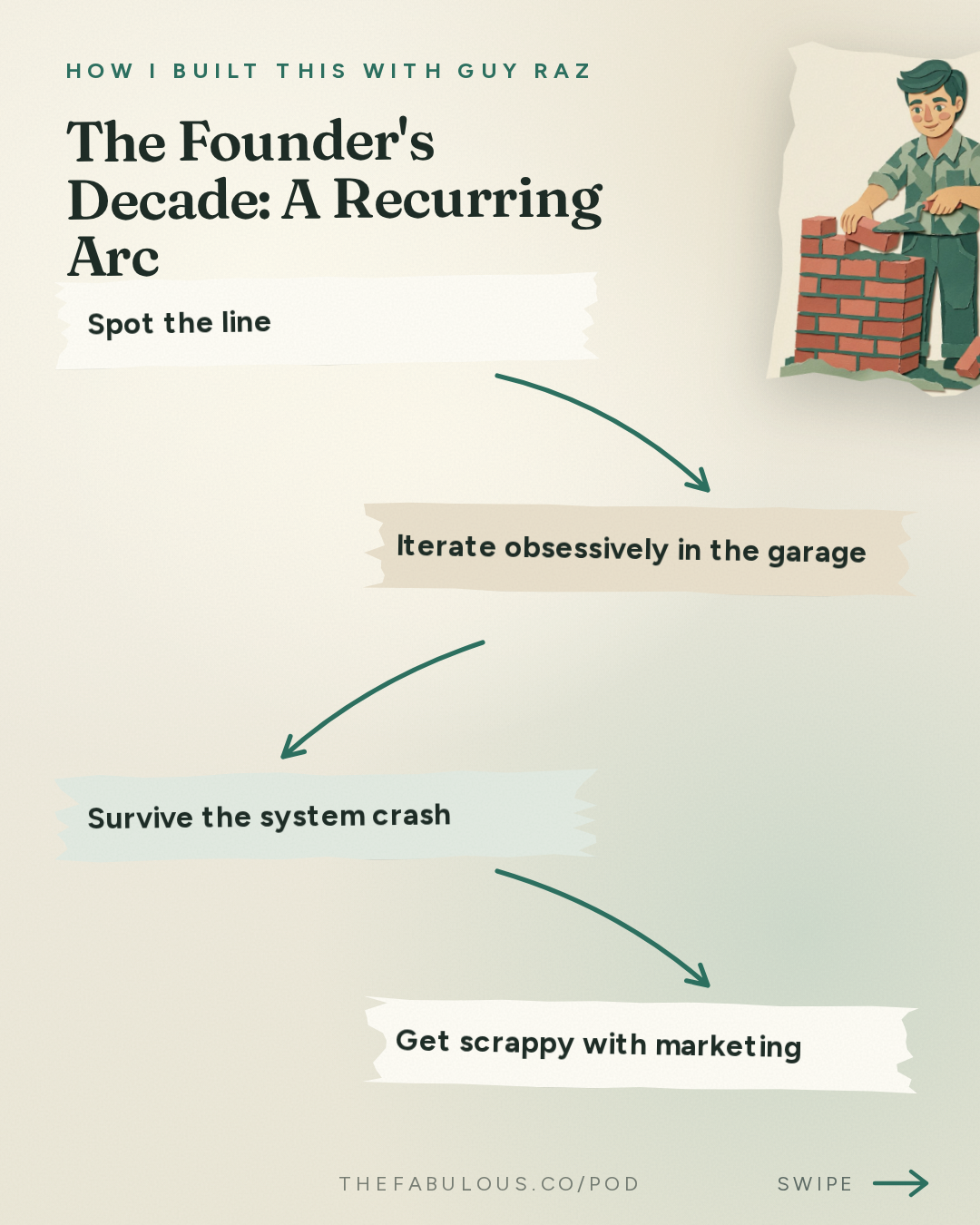
That cost shows up again in the obsessive, often embarrassing work of early prototyping. Justin Gold, founder of Justin's Nut Butters, made 40 different jars of peanut butter and jelly combinations in a food processor before he had a product he liked (22:55). The fashion designer Eileen Fisher showed up to her first trade show with four garments, no company name beyond her own, and so little composure that she could not answer buyers' questions (24:50). Siminoff built his own first trade show booth for Ring out of taped together cardboard boxes in the worst corner of a Las Vegas convention hall (25:40). The garage, in other words, is less a location than a permission slip, a low stakes space where a bad idea can fail quietly before it has to work in public (11:41).
Scrappiness does not end once a product exists. Sara Blakely, who founded the shapewear brand Spanx, got a buyer at Neiman Marcus to place an order after showing her a before and after demonstration in a store bathroom. But the order was not the finish line.
"Oh my gosh, that is the biggest mistake that entrepreneurs make. That is when the work begins."
Sara Blakely, founder of Spanx, speaking at [35:36].
Blakely paid friends, including people she had not spoken to since fourth grade, to buy Spanx off the shelf so the product would look like it was moving (35:45). Tom Rienks, founder of the sunscreen brand Sun Bum, ran his company out of Grand Rapids, Michigan, but routed customer calls through a Cocoa Beach, Florida post office box, instructing staff never to lie about the weather, only to call it "unbelievable" no matter which direction that cut (38:08). Mike Cesario built the water brand Liquid Death around a joke: cans that looked like cheap beer, designed to get shared on social media rather than simply bought (39:36). None of this is complicated. Most of it is just a willingness to look a little ridiculous in public.
The Fundraising Gauntlet
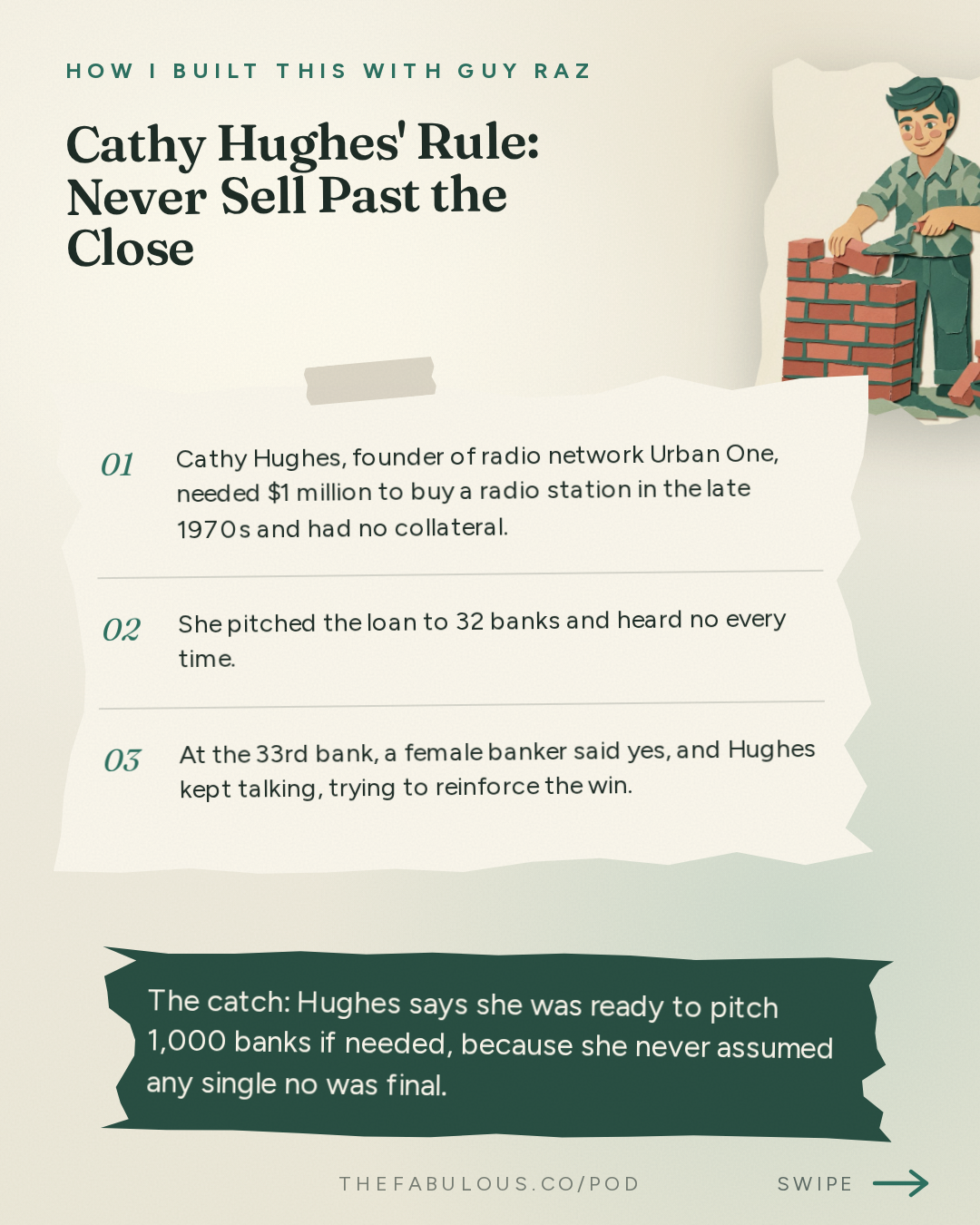
If there is a villain in this episode, it is the fundraising process, and the lesson is that rejection there means less than it feels like it means. Airbnb's founders pitched 20 investors in Silicon Valley in 2008 after they already had traction and press. Zero invested (45:47). Whole Foods co-founder John Mackey was turned down by a venture capitalist who told him he was "just a bunch of hippies" selling food to other hippies, missing that baby boomers were about to become the biggest consumer market in American history (45:08). Cathy Hughes, who built the radio network that became Urban One, was rejected by 32 banks while trying to raise $1 million to buy a station in the late 1970s. The 33rd banker said yes (48:20). Hughes kept pitching even after the yes, until the banker interrupted her: "Please, don't sell past the close" (48:35). The broader point, echoed by both Raz and Siminoff, is that founders who raise money easily are sometimes building something unoriginal, while the hardest pitches can belong to the ideas worth funding, because real invention rarely looks obvious to an investor meeting it for the first time (47:24).
Money does not stop being a problem once it arrives, either. The furniture brand Serena and Lily took on growth focused venture capital, then later brought in a private equity investor focused on profitability, because the company had become what Serena and Lily co-founder Lily Kanter calls a "cash incinerator," a term for a physical, inventory heavy business that burns cash fast while it scales (56:11). Raz's broader point is blunt: a small business clearing $4 million a year in sales while the founders take home $1 million in profit can be a better outcome than a much larger company that has never turned a profit (57:34).
Even a successful sale can come at a cost. Bobbi Brown stayed at her cosmetics company for 25 years after selling it to Estée Lauder, and found the final years hard as the corporation grew around her and she lost control over hiring and daily decisions (60:30). Paul Orfalea, who founded Kinko's, takes the opposite position almost forcefully.
"I never loved my business. I could enjoy it, but man, your business is an instrument to make you happy, and you own it. It doesn't own you."
Paul Orfalea, founder of Kinko's, speaking at [67:38].
Siminoff pushes back on this in real time, admitting that Ring is part of his identity in a way he is not sure is healthy (68:07). That disagreement, left unresolved, is more honest than a tidy conclusion would have been.
The episode closes on the question Raz asks nearly every guest: was it luck or skill? Zumiez founder Tom Campion credits discipline and hard work, dismissing luck almost entirely (70:02). Shopify founder Tobi Lütke credits timing almost entirely, saying his company needed the 2008 financial crisis to create the right conditions and could not have started even two years later (71:13). Dropbox founder Drew Houston splits the difference with a surfing metaphor: luck decides which wave shows up, skill decides whether a person stays on it (73:04). Raz, asked the same question about his own show, says it is mostly work, plus the luck of starting a podcast in 2013, before the format got crowded (75:40). Ten years and 600 conversations later, that answer sounds less like modesty and more like the show's actual thesis: nobody gets to pick their wave, but everyone gets to decide whether they paddle.
Ask this episode anything
Pod's AI answers from the episode itself, with the minute mark so you can hear it yourself.
Or start with one of these
Ask this episode
Pod's AI listens to the whole episode to answer, and points you to the minute it comes from.
The rest of this answer, and any question after it
Answers come from the episode itself, never from a summary of it.
ContinueKey takeaways
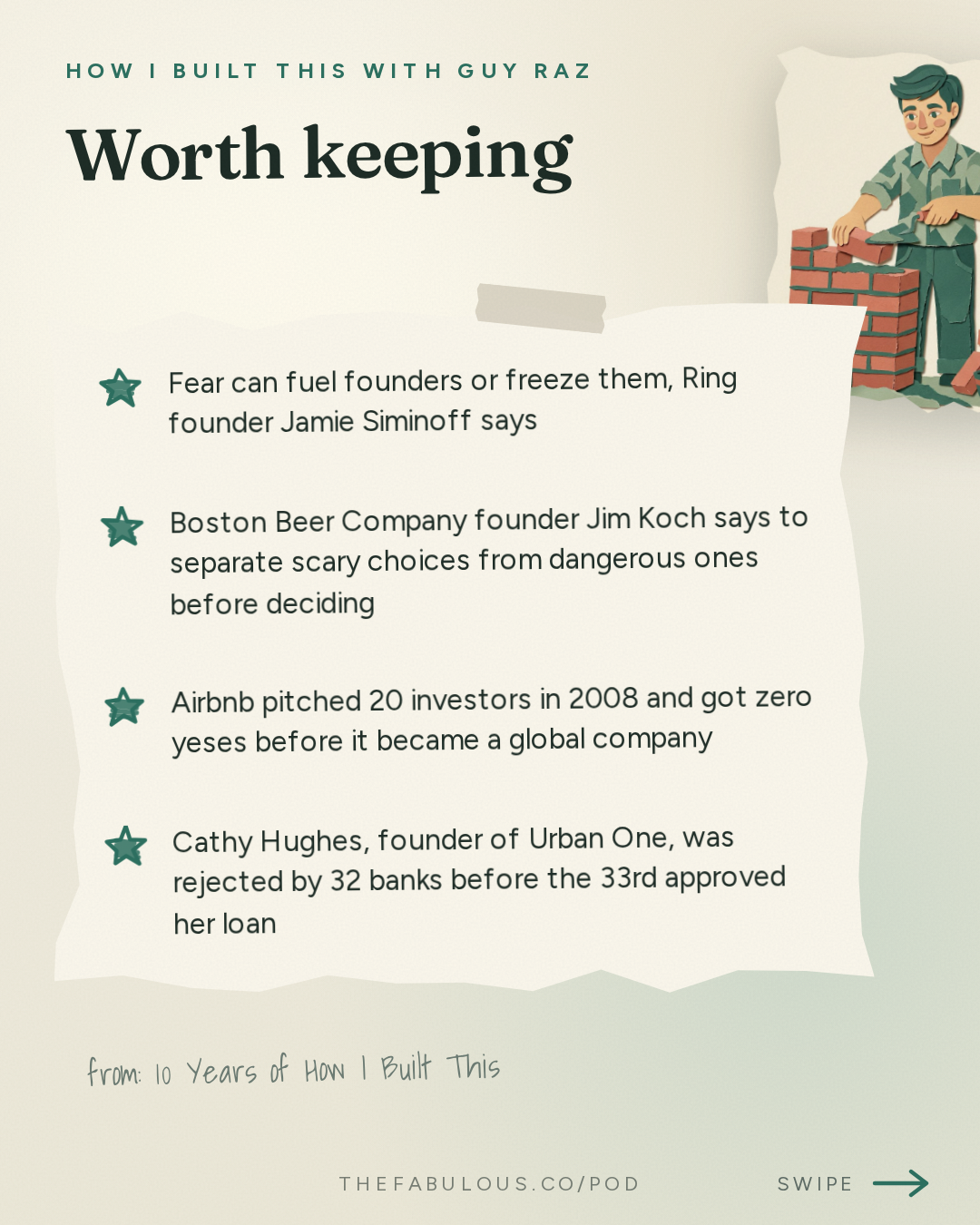
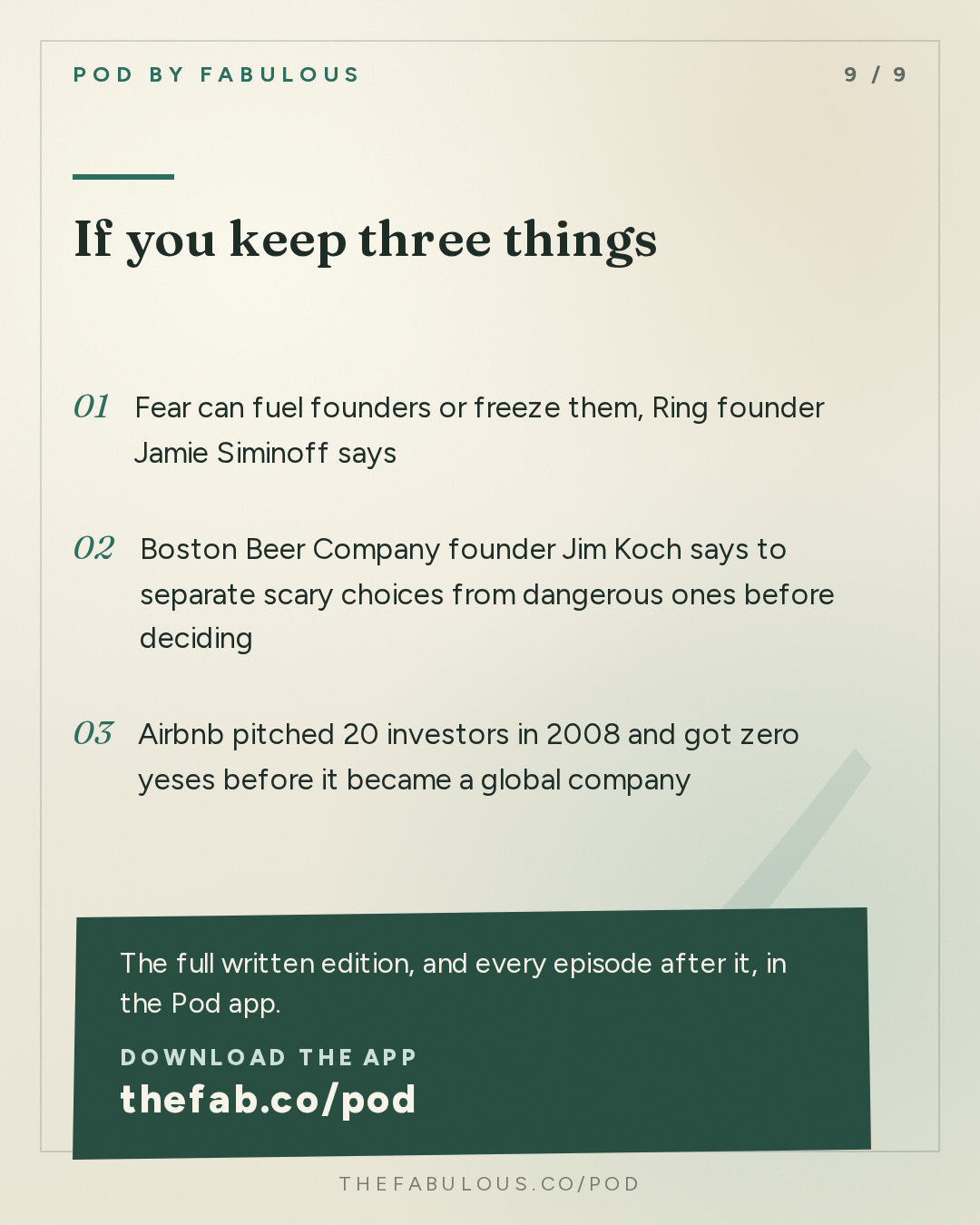
- Fear can fuel founders or freeze them, Ring founder Jamie Siminoff says
- Boston Beer Company founder Jim Koch says to separate scary choices from dangerous ones before deciding
- Airbnb pitched 20 investors in 2008 and got zero yeses before it became a global company
- Cathy Hughes, founder of Urban One, was rejected by 32 banks before the 33rd approved her loan
- Founders on the show split on luck versus skill: Tobi Lütke credits timing, Tom Campion credits hard work
The episode in cards
By the numbers
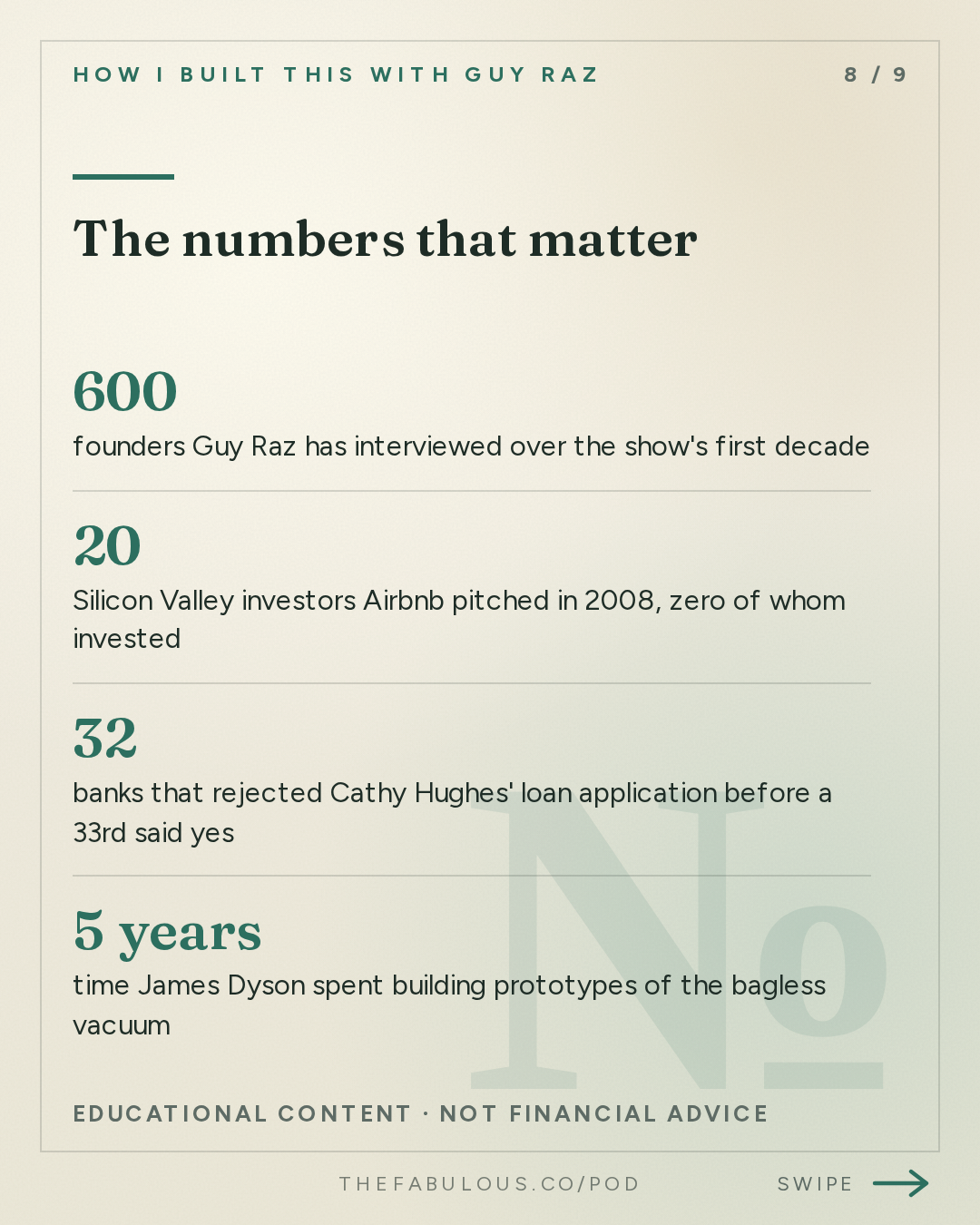
- 600 founders Guy Raz has interviewed over the show's first decade
- 20 Silicon Valley investors Airbnb pitched in 2008, zero of whom invested
- 32 banks that rejected Cathy Hughes' loan application before a 33rd said yes
- 5 years time James Dyson spent building prototypes of the bagless vacuum
- 40 jars of peanut butter Justin Gold made while testing recipes
In their words
“Staying at BCG was dangerous but not scary, and the, the danger there, the risk was Continuing to do something that didn't make me happy and getting to, you know, 65 and looking back and go, "Oh my”
“Oh my gosh, that is the biggest mistake that entrepreneurs make. That is when the work begins.”
“I've learned that with developing new technology, that when you feel like giving up, it's precisely the point everybody else gives up.”
“I never loved my business. I could enjoy it, but man, your business is an instrument to make you happy, and you own it. It doesn't own you.”
Protocols
-
Separate what's scary from what's dangerous before deciding
Jim Koch, founder of Boston Beer Company (Sam Adams), says to ask whether a decision is merely scary, meaning high fear but low real risk, like rappelling on a rope rated to hold a car, or truly dangerous, meaning low fear but high real risk, like staying in a stable job that makes you unhappy until retirement. He says the dangerous option deserves more weight than the scary one.
Before any major career or business decision
-
Push past the point everyone else quits
James Dyson, inventor of the bagless vacuum cleaner, says that in developing new technology, the exact moment a person feels like giving up is the point where most people actually do give up, so that moment calls for extra effort rather than stopping.
During long, failure-heavy prototyping phases
-
Stop selling once you've won the deal
Cathy Hughes, founder of the radio network Urban One, says to stop pitching the moment someone agrees, because continuing to sell after a yes risks making the other person reconsider. She calls this rule 'never sell past the close.'
At the close of any sales or fundraising conversation
Questions this episode answers
What is the difference between scary and dangerous in business decisions?
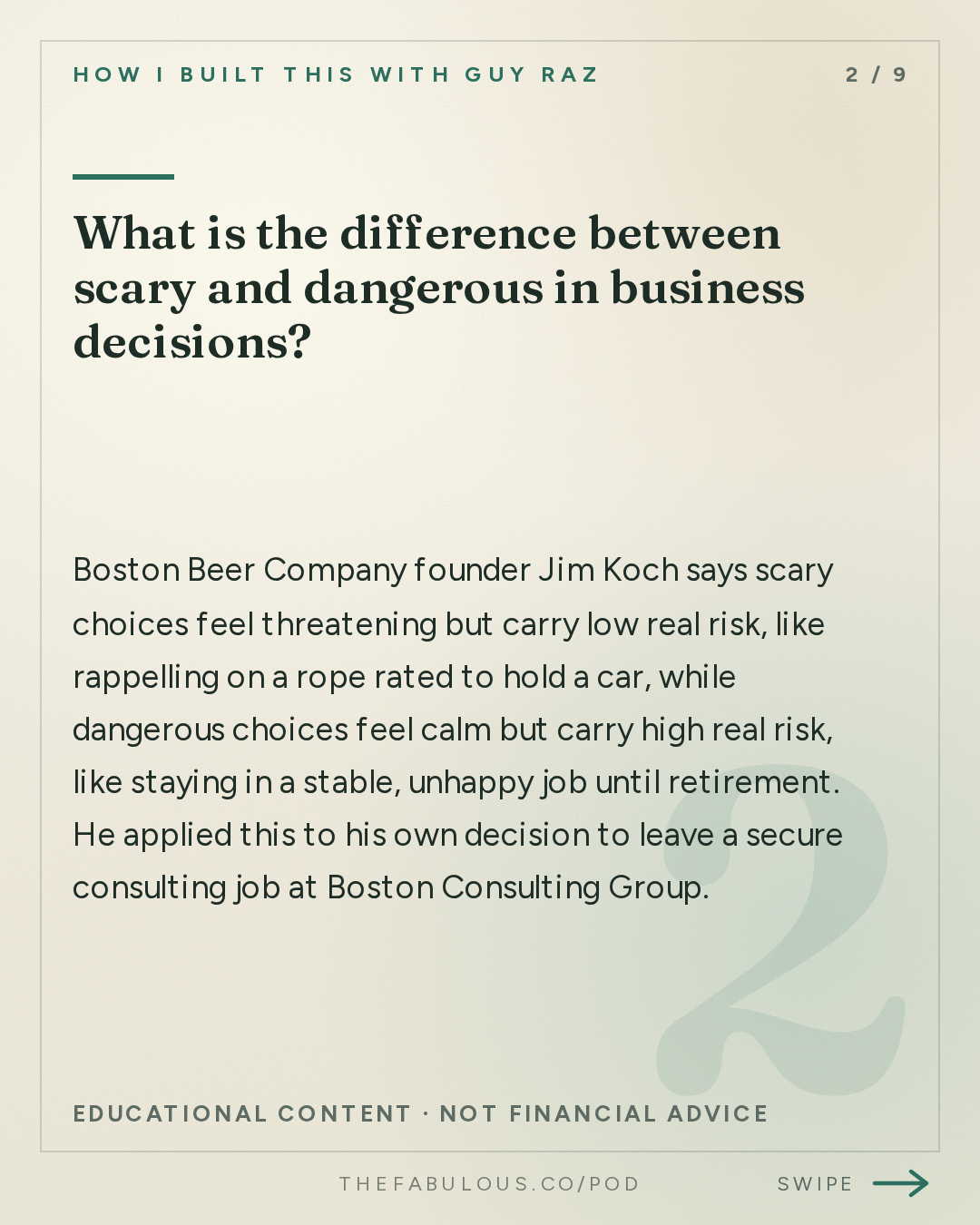
Boston Beer Company founder Jim Koch says scary choices feel threatening but carry low real risk, like rappelling on a rope rated to hold a car, while dangerous choices feel calm but carry high real risk, like staying in a stable, unhappy job until retirement (16:55). He applied this to his own decision to leave a secure consulting job at Boston Consulting Group (18:15).
How many founders has How I Built This interviewed in 10 years?
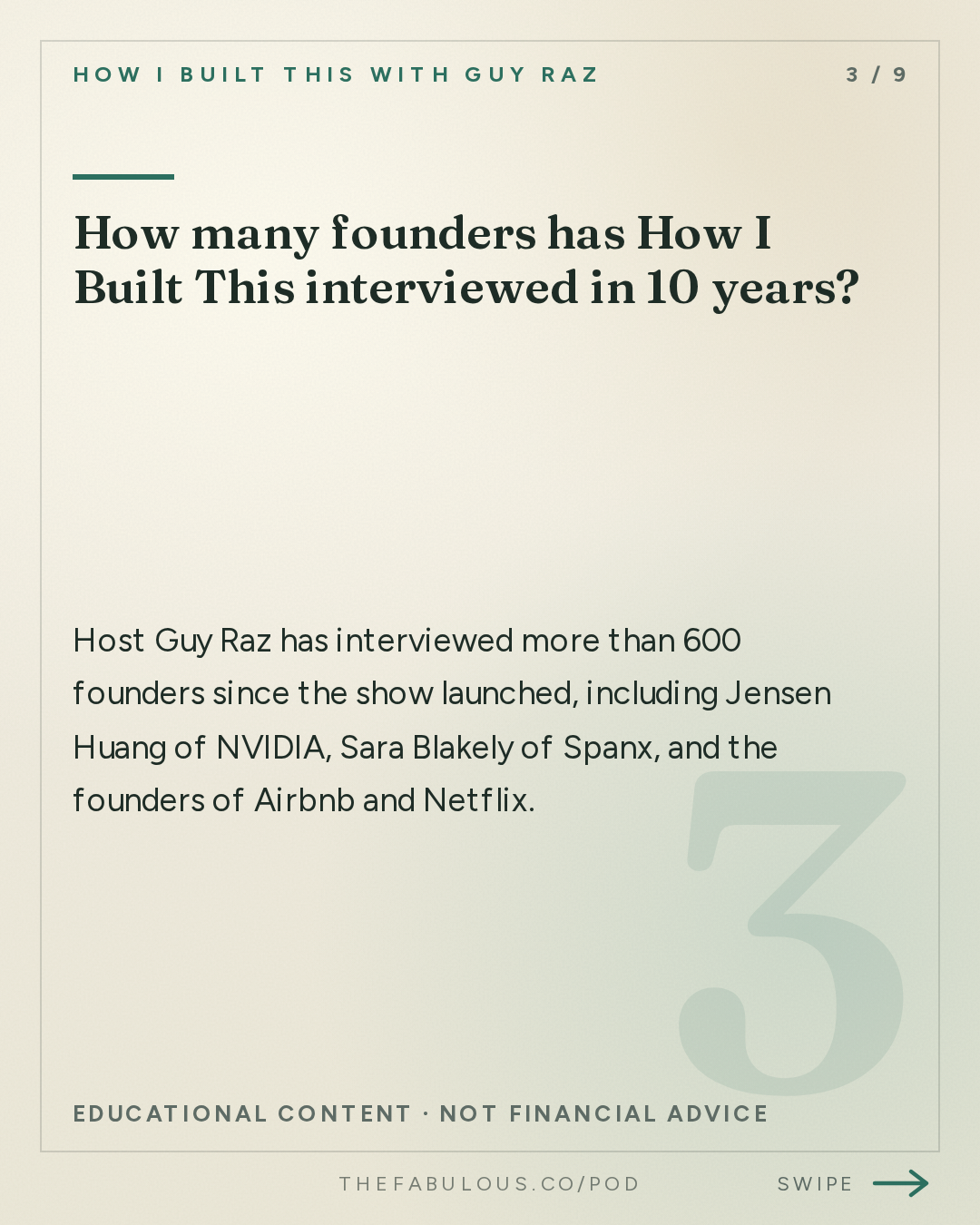
Host Guy Raz has interviewed more than 600 founders since the show launched, including Jensen Huang of NVIDIA, Sara Blakely of Spanx, and the founders of Airbnb and Netflix (07:23).
Why did Airbnb struggle to raise money in 2008?
Airbnb's founders pitched 20 investors in Silicon Valley after they already had user traction and press coverage, and none of the 20 invested (45:47). Cofounder Brian Chesky called 2008 the worst year of his life on the show.
What does 'never sell past the close' mean?
Urban One founder Cathy Hughes says it means to stop pitching the moment someone agrees to a deal, because continuing to sell after a yes can make the other person reconsider. A banker told her this after she kept talking following the loan approval that funded her first radio station (48:35).
Is startup success mostly luck or mostly skill?
Guests on the show disagree. Zumiez founder Tom Campion credits discipline and hard work and downplays luck (70:02), while Shopify founder Tobi Lütke says his company's success depended heavily on timing around the 2008 financial crisis (71:13). Dropbox founder Drew Houston compares it to surfing: luck determines which wave appears, skill determines whether you stay on it (73:04).
The full read, in cards
Mentioned
Jamie Siminoff · Ring · Jim Koch · Boston Beer Company · Sal Khan · Khan Academy · Justin Gold · Eileen Fisher · Sara Blakely · Spanx · Tom Rienks · Sun Bum · Mike Cesario · Liquid Death · John Mackey · Whole Foods · Cathy Hughes · Urban One · Bobbi Brown · Paul Orfalea · Kinko's · Tom Campion · Zumiez · Tobi Lütke · Shopify · Drew Houston · Dropbox · Hamdi Ulukaya · Chobani · Airbnb · James Dyson · Serena and Lily · Jensen Huang · NVIDIA
More from this show and category
Seventh Generation's Founders: A Partnership That Broke
Alan Newman and Jeffrey Hollender turned a discarded 1988 mail-order catalog into Seventh Generation, then split so badly they barely spoke for decades. Newman built the product and culture; Hollender raised money and later ran the company through a retail pivot, a 2010 board ouster, and Unilever's 2016 acquisition for $700 million.
Danny Meyer's Advice for Startup Founders
Danny Meyer, the Shake Shack founder, explains why he replaced family values with expected behaviors to run culture at Union Square Hospitality Group. On this advice-line episode he coaches three food and drink founders on branding canned cocktails, shipping perishable salmon, and pitching couscous to fast-casual chains, all through the lens of measurable, scalable hospitality.
How Banza Built Chickpea Pasta Into a Top Brand
Brian Rudolph turned a wheat allergy into Banza, the first chickpea pasta, by fixing a factory disaster with a tea-steeping trick and later rebuilding trust after a viral glyphosate scare. His story is a case study in scrappy product development and honest crisis response.
Michelle Wahler's Advice for Scaling a Business
Beyond Yoga co-founder Michelle Wahler answers four callers on scaling, sales, and client trust. She built Beyond Yoga for about a decade before Levi's bought it for $400 million in 2021, and now advises founders to skip venture money, filter high-ticket leads before a sales call, win back burned clients smallest account first, and always underpromise and overdeliver.
