
Seventh Generation's Founders: A Partnership That Broke
Seventh Generation: Alan Newman and Jeffrey Hollender. A Partnership that Flourished—until it Failed. (2021)
The brief
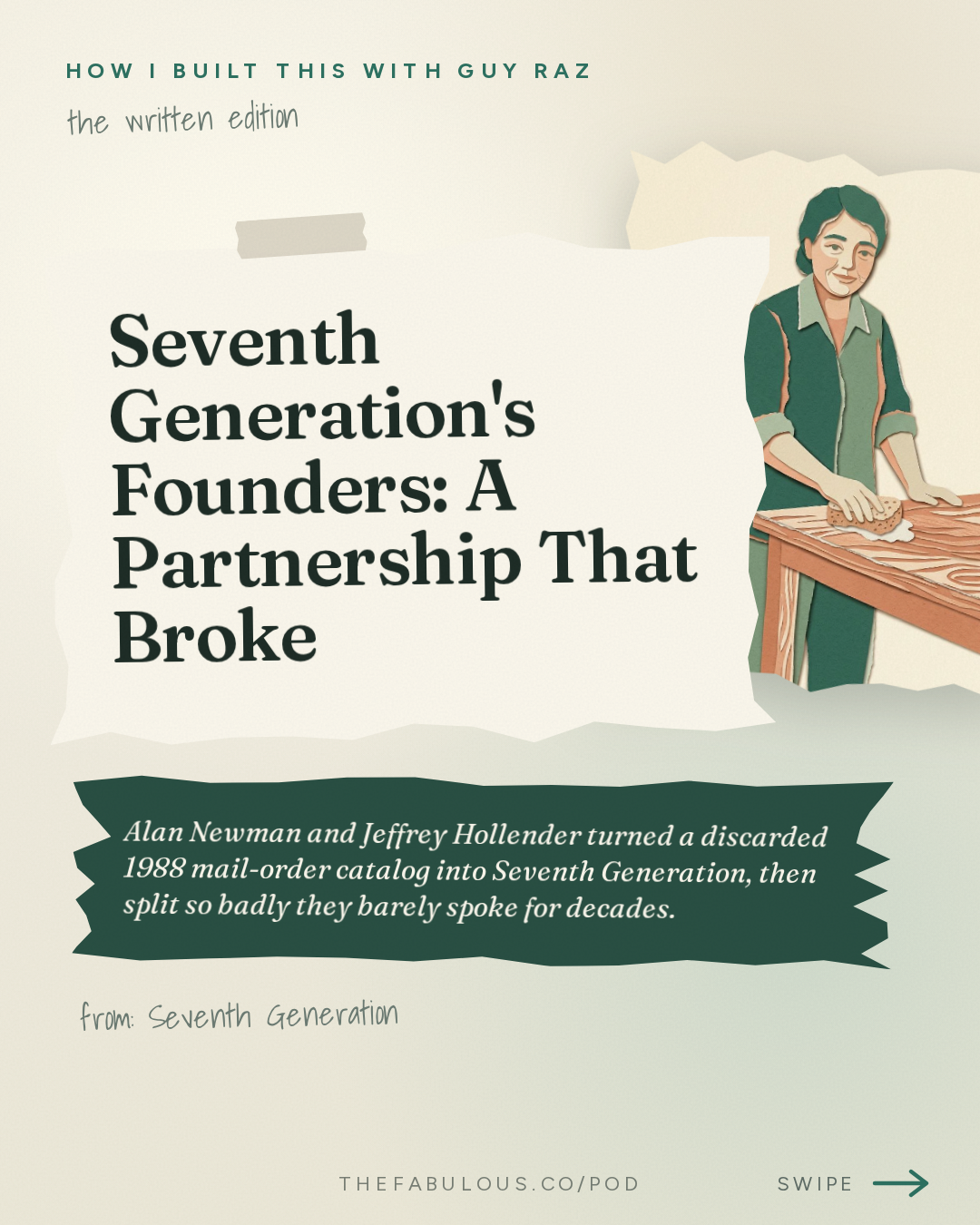
Alan Newman and Jeffrey Hollender turned a discarded 1988 mail-order catalog into Seventh Generation, then split so badly they barely spoke for decades. Newman built the product and culture; Hollender raised money and later ran the company through a retail pivot, a 2010 board ouster, and Unilever's 2016 acquisition for $700 million.
Ask this episode anything
Pod's AI answers from the episode itself, with the minute mark so you can hear it yourself.
Or start with one of these
Ask this episode
Pod's AI listens to the whole episode to answer, and points you to the minute it comes from.
The rest of this answer, and any question after it
Answers come from the episode itself, never from a summary of it.
Continue
Key takeaways
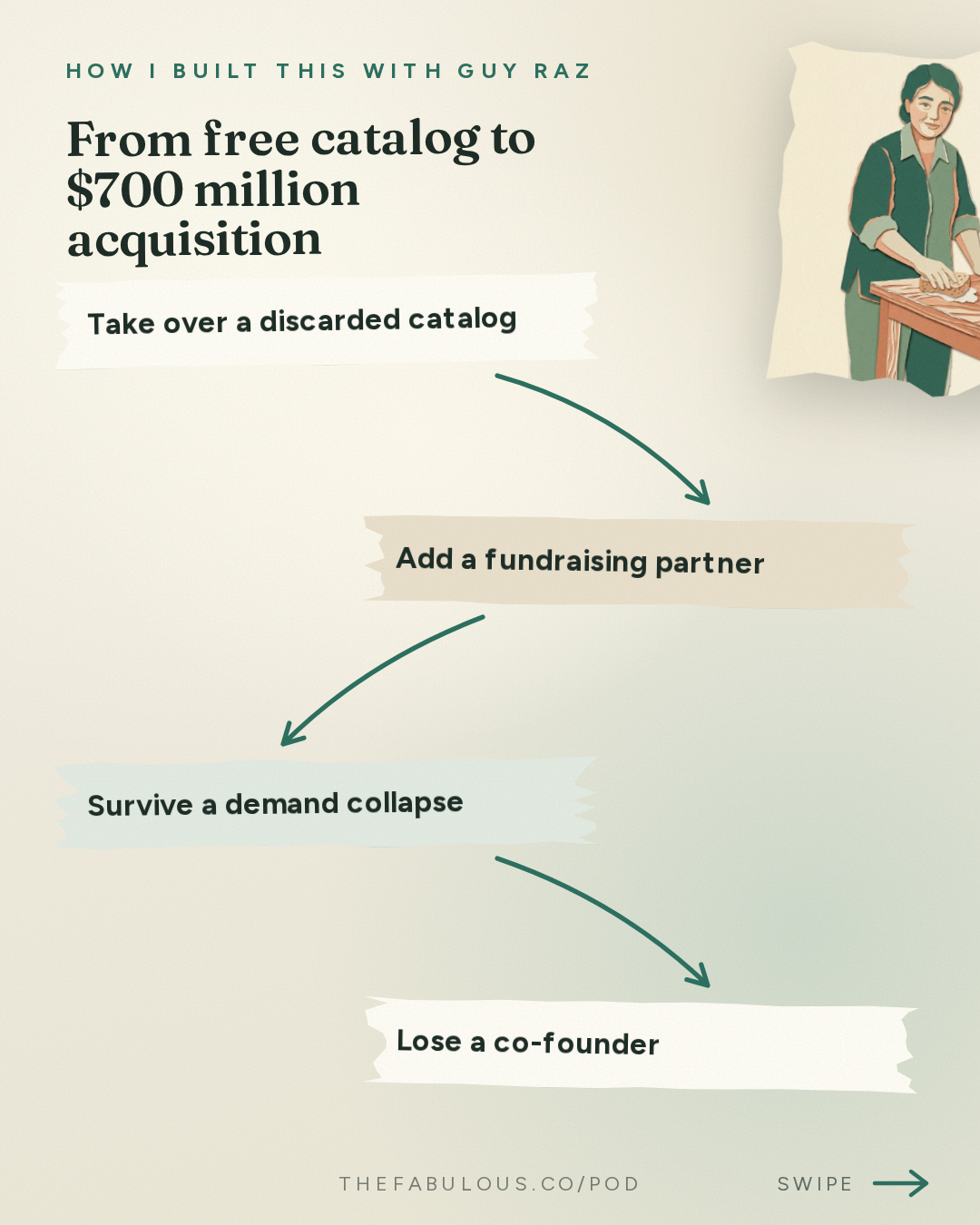
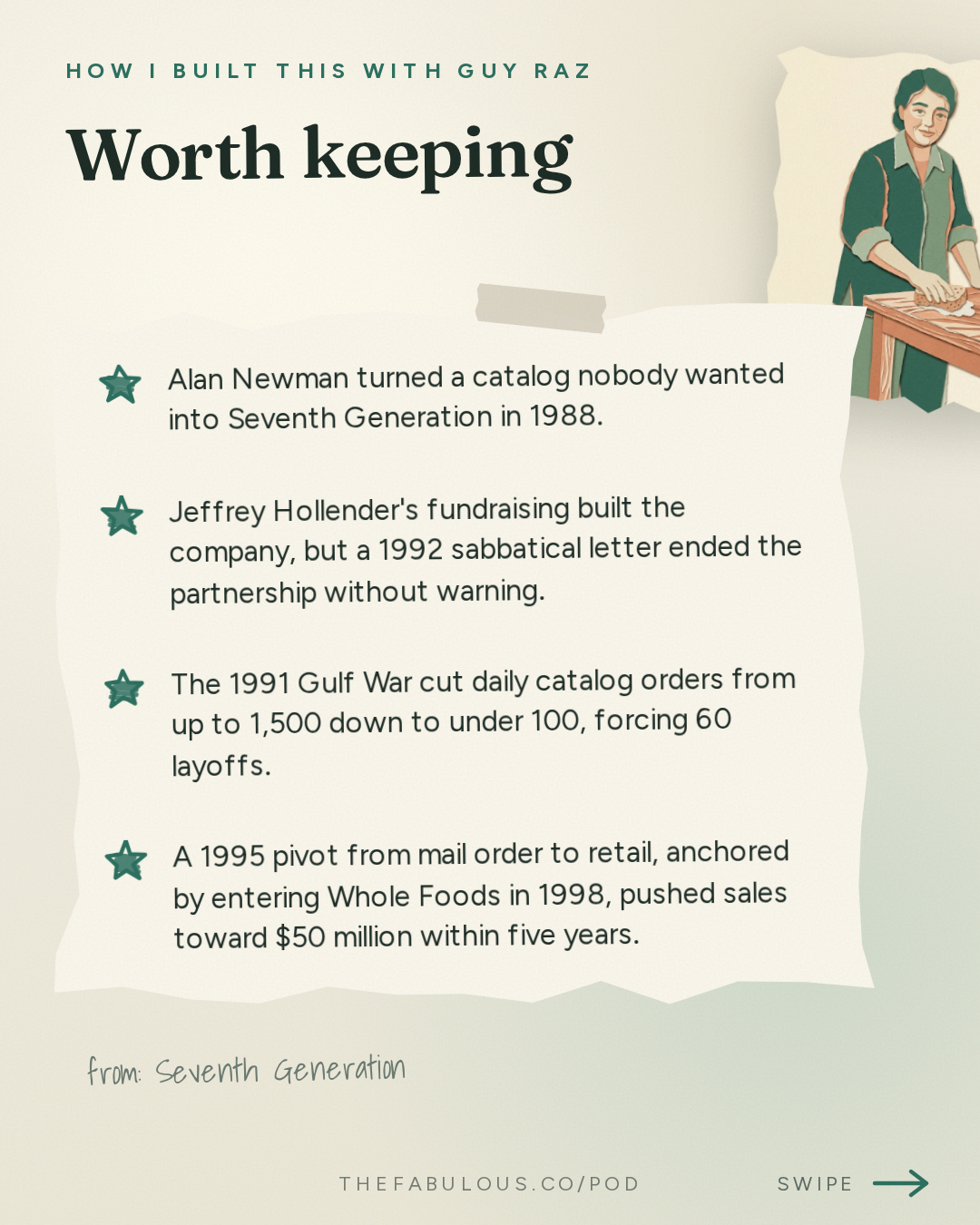
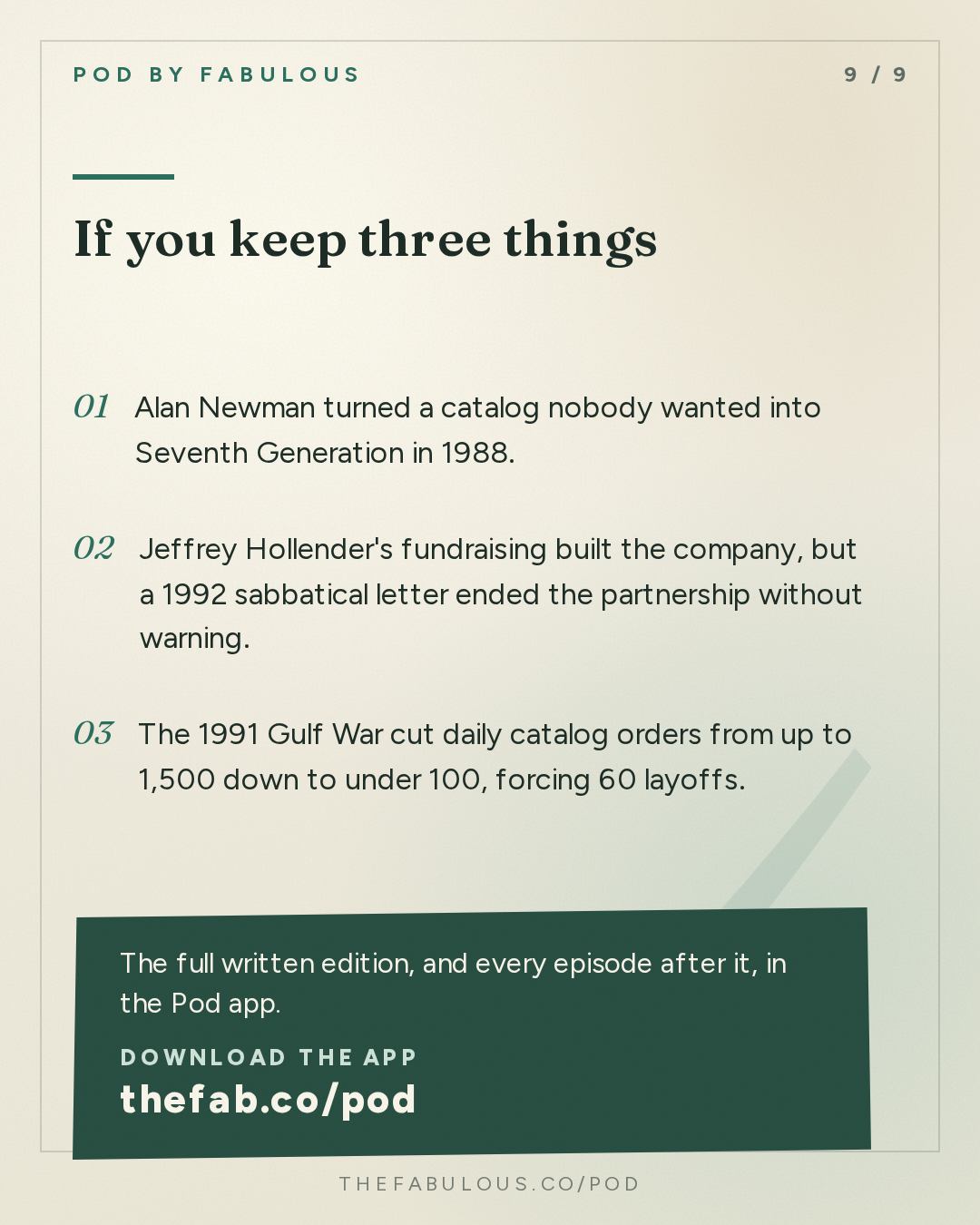
- Alan Newman turned a catalog nobody wanted into Seventh Generation in 1988.
- Jeffrey Hollender's fundraising built the company, but a 1992 sabbatical letter ended the partnership without warning.
- The 1991 Gulf War cut daily catalog orders from up to 1,500 down to under 100, forcing 60 layoffs.
- A 1995 pivot from mail order to retail, anchored by entering Whole Foods in 1998, pushed sales toward $50 million within five years.
- Board tension over Jeffrey Hollender's activism led to his 2010 ouster, six years before Unilever bought the company for $700 million.
The episode in cards
A Wisconsin tissue mill once hid a fact about its own paper. The stock was made entirely from recycled fiber, but the promotional copy left that out, because the mill believed shoppers linked recycled paper with cheap, scratchy quality (01:03). When Alan Newman insisted that his toilet paper say "100% recycled" right on the wrapper, the manufacturer told him he was out of his mind. It sold anyway, by the truckload. That small, stubborn bet says a lot about the company Newman built and later lost: a business run on convictions the market had not yet caught up to, held together by two founders who needed each other and, in the end, could not stand each other.
Seventh Generation did not start as an idea. It started as a favor nobody wanted. Newman, a college dropout who had drifted from a garden-supply mail-order house into running fulfillment systems for nonprofits, inherited a failing energy-catalog business called Renew America for free in the late 1980s, because the nonprofit that owned it had decided to either hand it over or throw it in a dumpster (17:46). "My brain is saying, 'no, no, no, no, no,' and out of my mouth comes, 'I'll take it,'" he recalls (18:04). He had six weeks to build a new catalog before the holiday season. He shrank the page size so the same photos looked bigger, renamed the business after an Iroquois principle about weighing decisions across seven generations, and rewrote every product description around a single insight: sell the benefit first, the environmental feature second. A water-saving shower head was worth buying because it cut a utility bill, not because it saved the planet (20:53).
Two founders, one tiger
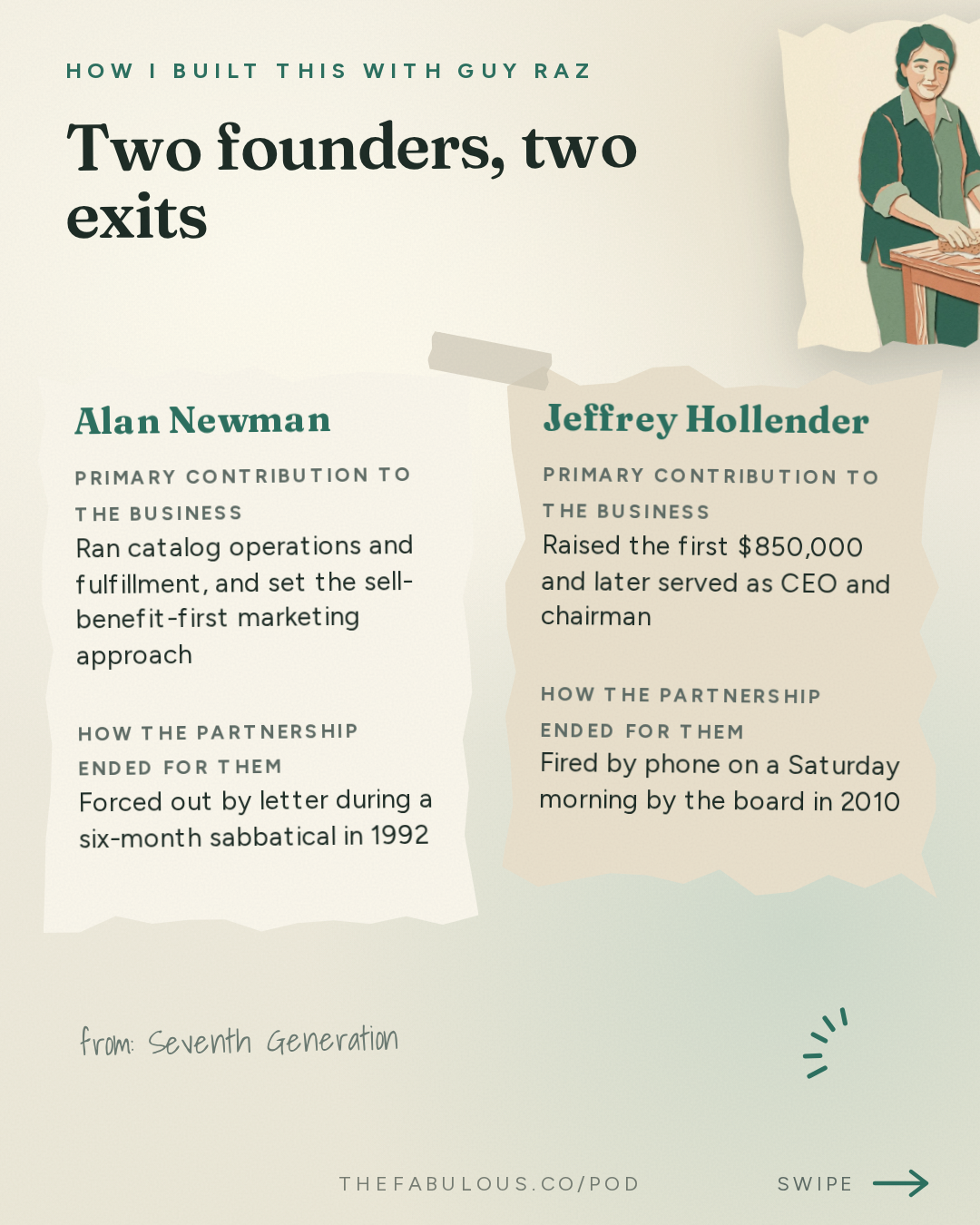
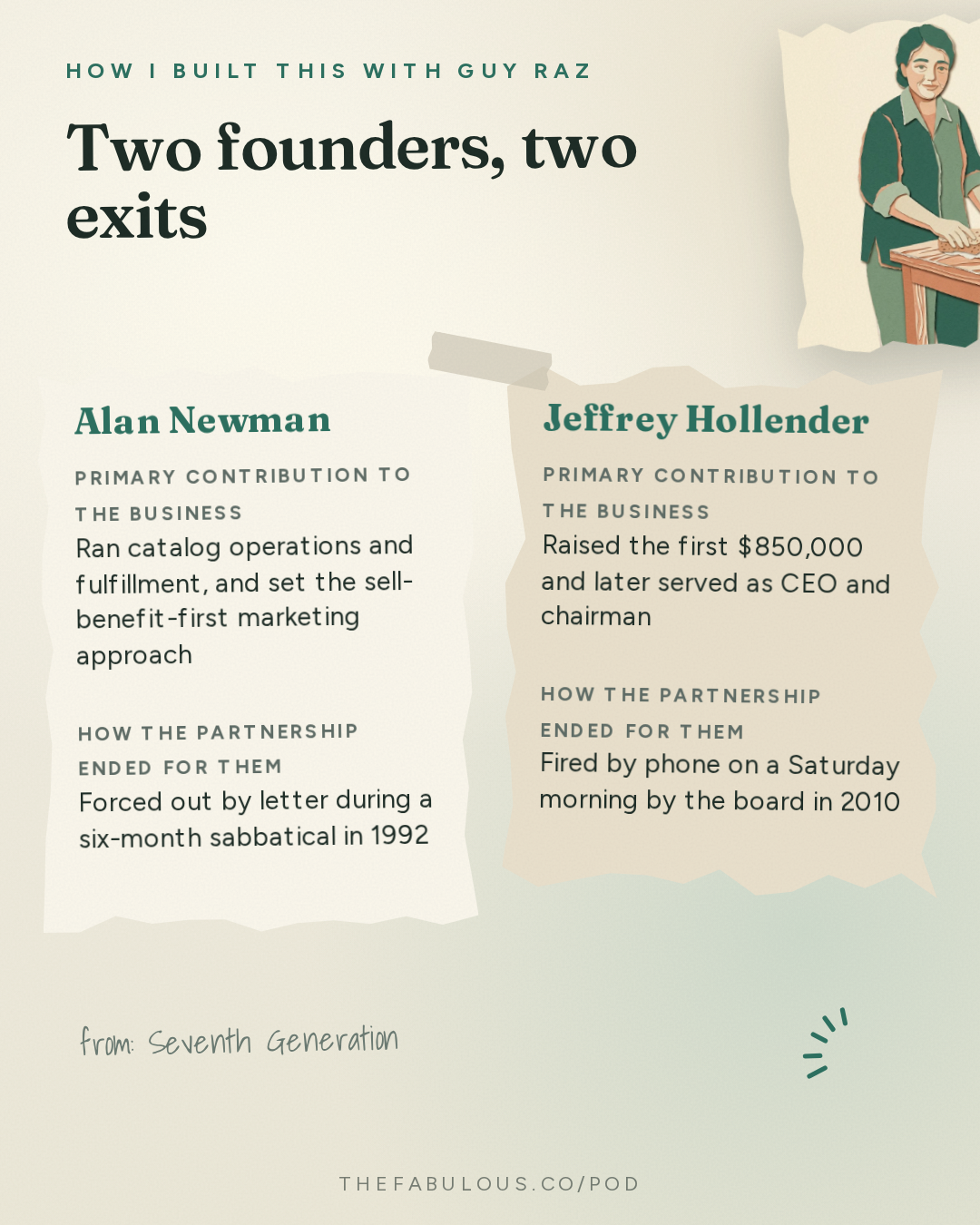
Jeffrey Hollender came from a different world, a Manhattan childhood on Park Avenue, a father in advertising, a stint teaching "how to marry money" seminars he later called soulless. After selling an audiobook business to Warner Communications, he tracked Newman down in Vermont in 1989 and offered to write a business plan and raise money. Newman had the operating know-how; Hollender had investor relationships from his prior venture, people who had already earned a ten-to-one return and were eager for the next ride (29:00). Together they raised $850,000 in Seventh Generation's first fundraising round (29:25). Hollender became CEO and chairman; Newman ran the Vermont office, a converted space with a ping-pong table, free Ben & Jerry's, chalkboards in the bathroom, and no chairs in the main conference room, just pillows.
Newman describes the culture he built as one built to defeat fear. "What I learned was that the greatest obstacle to success was fear," he says, "fear of people that they didn't know what they were doing, and somebody was gonna find out" (31:50). The company rewarded the biggest mistake of the week with a dinner-out coupon, on the logic that a hidden mistake gets repeated while a shared one gets fixed (39:01). It worked. Catalog sales went from $1 million in 1989 to $7 million in 1990, helped by the twentieth anniversary of Earth Day and a wave of press coverage neither founder could have bought (40:28).
Then came 1991. The Gulf War began, and catalog buying, which runs on impulse and attention, collapsed. Daily orders fell from a range of roughly 12 to 1,500 down to under 100 (41:52). The company laid off 60 of its 120 employees. Newman, exhausted after years of 100-plus-hour weeks stacked across three businesses, asked for a sabbatical before the next holiday catalog. Hollender agreed, or thought he did.
"I felt like I was on a ship that was sinking, and my partner, who was supposed to be steering the ship with me, just stepped off and left me alone with a boat that was really sinking." — Jeffrey Hollender [45:11]
Nobody put the terms of the sabbatical in writing, a gap both men now point to as the root of the disaster (47:43). Six months later, Newman wrote to say he was ready to return with new ideas. He got back a letter ending his role at the company. He owned 23 percent of the business and no seat on the board. "The fact that my friend threw me out and stole my baby without even a fucking discussion," he says, "I was rip shit" (49:16). He was eventually bought out for $200,000 when the company prepared to go public in 1993 (52:34).
When the mission met the boardroom
Without Newman, Hollender made a bet that reshaped the company: abandon the wasteful, expensive mail-order model and sell through retail stores instead. In 1995 he sold off the catalog business, which still made up 80 percent of revenue, to chase what he believed was bigger long-term upside (58:32). The gamble paid off. Seventh Generation entered Whole Foods in 1998, a deal that lent the brand instant credibility with shoppers and helped push revenue from roughly $10 to $12 million toward nearly $50 million within five years (59:59). The pitch to retailers combined health claims with a harder-nosed argument: these products generate more profit per square foot than the traditional brands they replace, because, as Hollender puts it, "retailers are in the real estate business" (61:20).
The company's values-driven instincts occasionally collided with plain commerce, and sometimes that collision became the story. When Seventh Generation's first traditional grocery partner, Albertsons in Southern California, hit a labor strike over healthcare benefits two weeks after the products launched, employees pushed to pull the products off the shelf. Instead the company donated its profits from those sales to the workers' strike fund (65:05). Hollender later became blunt about the limits of his own industry's marketing. "Being less bad is not being good," he says, arguing that recycled diapers still fill landfills, just less than the alternative, and that the sector needs what he calls a sustainability 2.0 built around genuinely reusable products rather than slightly improved disposable ones (69:14).
That same restlessness eventually cost Hollender his job. By 2010 he was serving on Greenpeace's board, getting arrested at protests, and pushing to raise employee ownership from 20 percent toward 30 percent, all while the company was trying to raise $30 million from more conventional investors (71:52). "The board was definitely not comfortable with a CEO who was getting thrown in jail," he says. Add a disagreement over an executive hire the board wanted to keep, and the math only worked one way. Seventh Generation posted its best financial year ever in 2010, roughly 50 percent growth, and Hollender was fired anyway, by phone, on a Saturday morning, with instructions never to return to the office (73:29). It is a clean illustration of a rule that shows up across founder stories: financial performance does not protect a leader whose values have drifted from the board's.
Newman, hearing the news from his small Vermont town, allowed himself some satisfaction. He had already moved on to build Magic Hat Brewing Company, a craft brewer he grew into one of the ten largest in the country by deliberately underselling demand for 18 months at a time to avoid the overexpansion that had nearly broken Seventh Generation (82:12). Unlike Seventh Generation, Magic Hat did not survive the 2008 recession intact, and Newman later sold it. In 2016, Unilever bought Seventh Generation for a reported $700 million (77:28), and Hollender, invited back onto the board after the sale, called it a chance to keep shepherding the company's mission from the inside.
Both men, asked what made the partnership impossible, land on the same idea from different angles. Newman recalls hearing a fellow founder explain why she sold her cosmetics company: she liked being the boss, and she was not the boss where she was. "I think Jeffrey also likes being the boss," Newman says, "and I think there was always a friction when we needed each other" (85:37). Complementary skills, it turns out, are not enough if both people want the same chair. Newman's early rule for himself was simpler and more forgiving: "Everybody's greatest strength is also their greatest weakness. One of mine is I tend to say yes" (13:34). Saying yes built the company. It just could not, on its own, keep two ambitious founders in the same room.
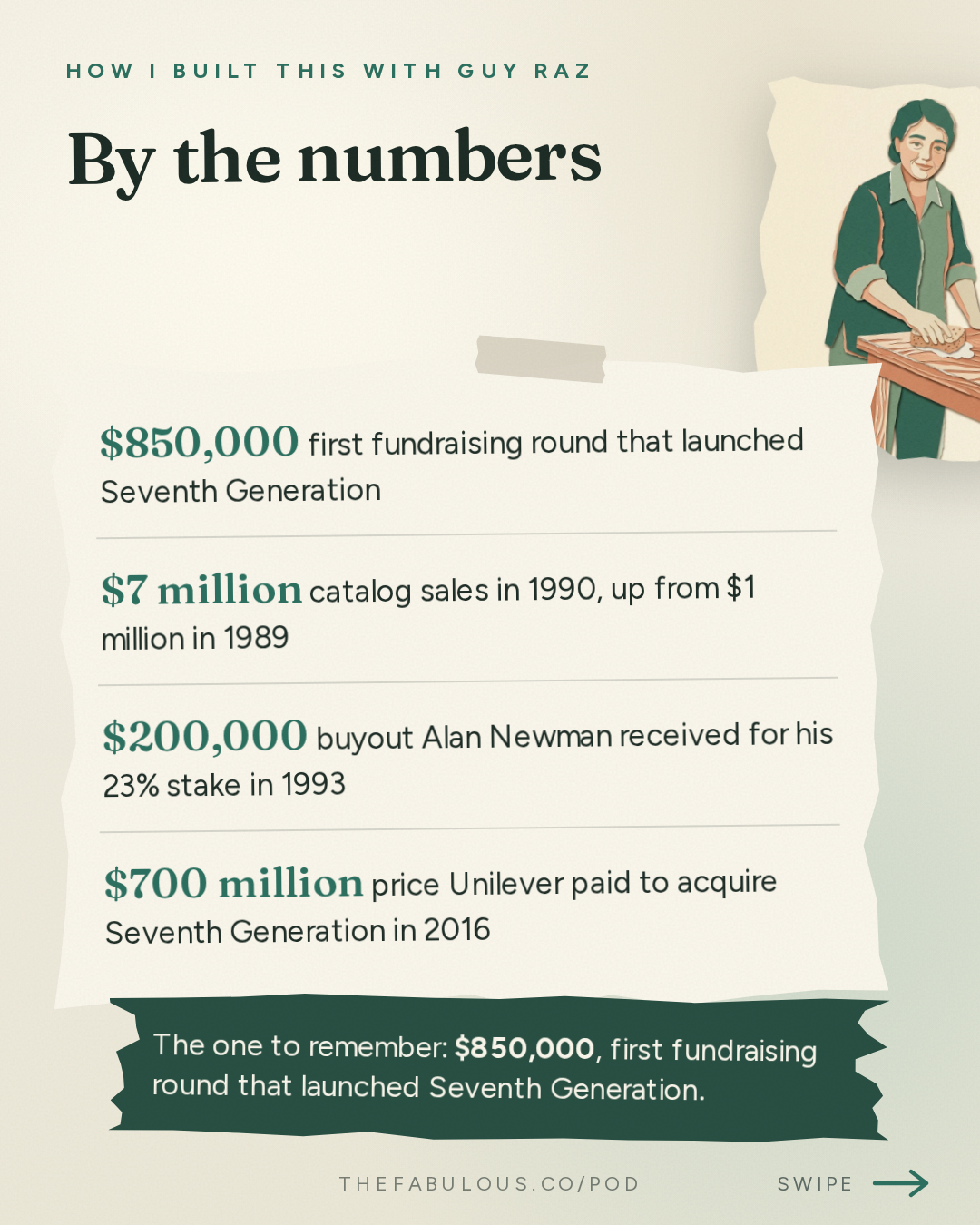
By the numbers
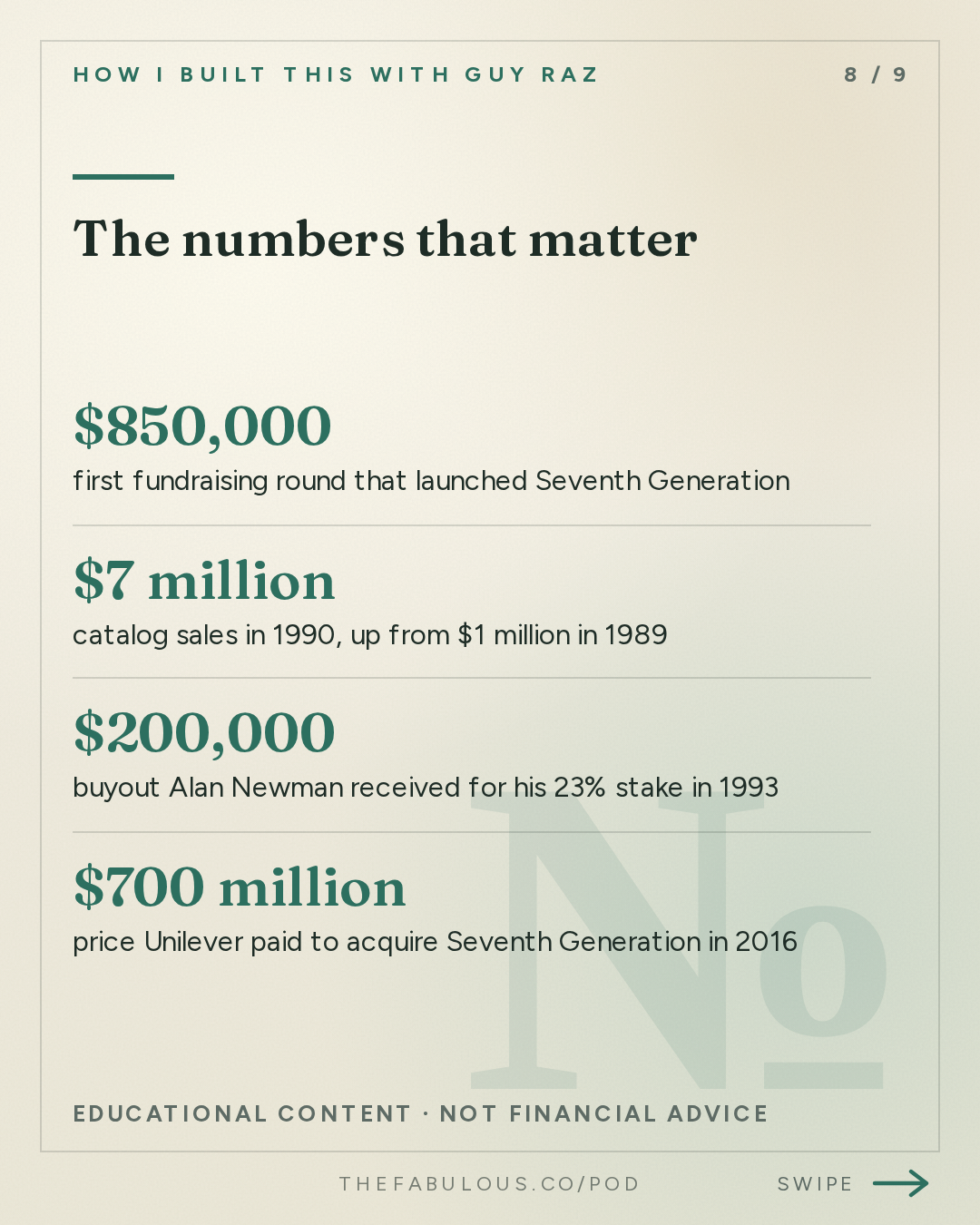
- $850,000 first fundraising round that launched Seventh Generation
- $7 million catalog sales in 1990, up from $1 million in 1989
- $200,000 buyout Alan Newman received for his 23% stake in 1993
- $700 million price Unilever paid to acquire Seventh Generation in 2016
In their words
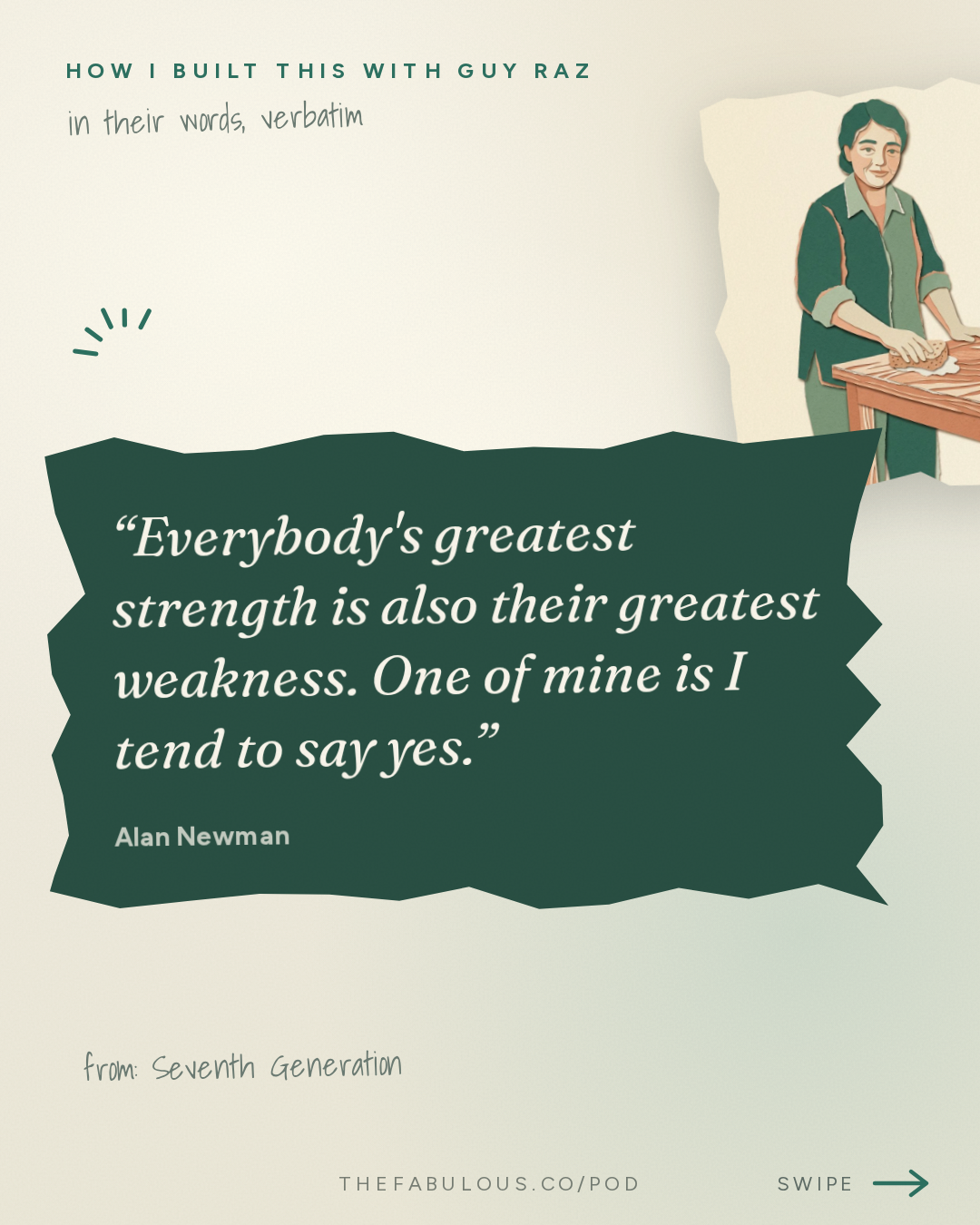
“Everybody's greatest strength is also their greatest weakness. One of mine is I tend to say yes.”
“I felt like I was on a ship that was sinking, and my partner, who was supposed to be steering the ship with me, just stepped off and left me alone with a boat that was really sinking.”
“The fact that my friend threw me out and stole my baby without even a fucking discussion, you know, I was rip shit.”
“Being less bad is not being good, and I think we really need sort of a sustainability 2.0 that's focused on good products.”
Protocols
-
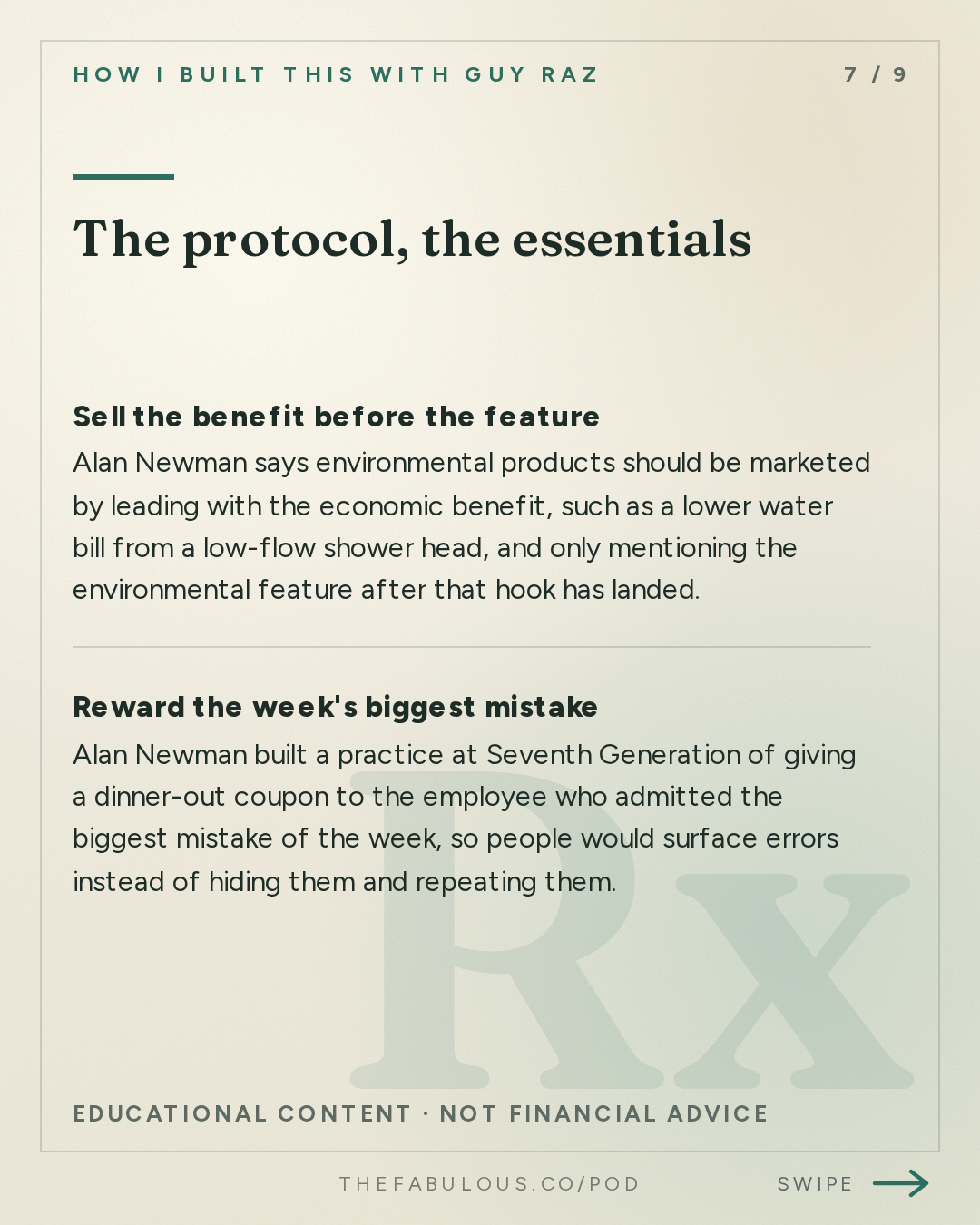
Sell the benefit before the feature
Alan Newman says environmental products should be marketed by leading with the economic benefit, such as a lower water bill from a low-flow shower head, and only mentioning the environmental feature after that hook has landed.
Applied to every Seventh Generation catalog product description
-
Reward the week's biggest mistake
Alan Newman built a practice at Seventh Generation of giving a dinner-out coupon to the employee who admitted the biggest mistake of the week, so people would surface errors instead of hiding them and repeating them.
Weekly, at staff meetings
-
Put co-founder terms in writing before they are needed
Jeffrey Hollender says a co-founder agreement should spell out in writing how disagreements and absences, including something like a sabbatical, will be handled, because Seventh Generation had no such document when Alan Newman took six months off in 1992.
Once, at partnership formation
Questions this episode answers
Why was Jeffrey Hollender fired from Seventh Generation?
The board grew uncomfortable with CEO Jeffrey Hollender's activism, including his arrests as a Greenpeace board member, his push to raise employee ownership past 20%, and a disagreement over an executive hire the board wanted to keep (71:52). He was fired by phone in 2010 even though the company had just posted its most profitable year, about 50% growth, showing that strong financial results did not protect him once he lost alignment with the board (73:29).
What happened between Alan Newman and Jeffrey Hollender?
Co-founder Alan Newman took a six-month sabbatical starting in January 1992 after the 1991 Gulf War crushed catalog sales, expecting to return to his old role (46:31). Because the two men never put the sabbatical's terms in writing, Jeffrey Hollender sent Newman a letter ending his role at the company while he was away, a rupture both men later attribute partly to that missing document (47:43).
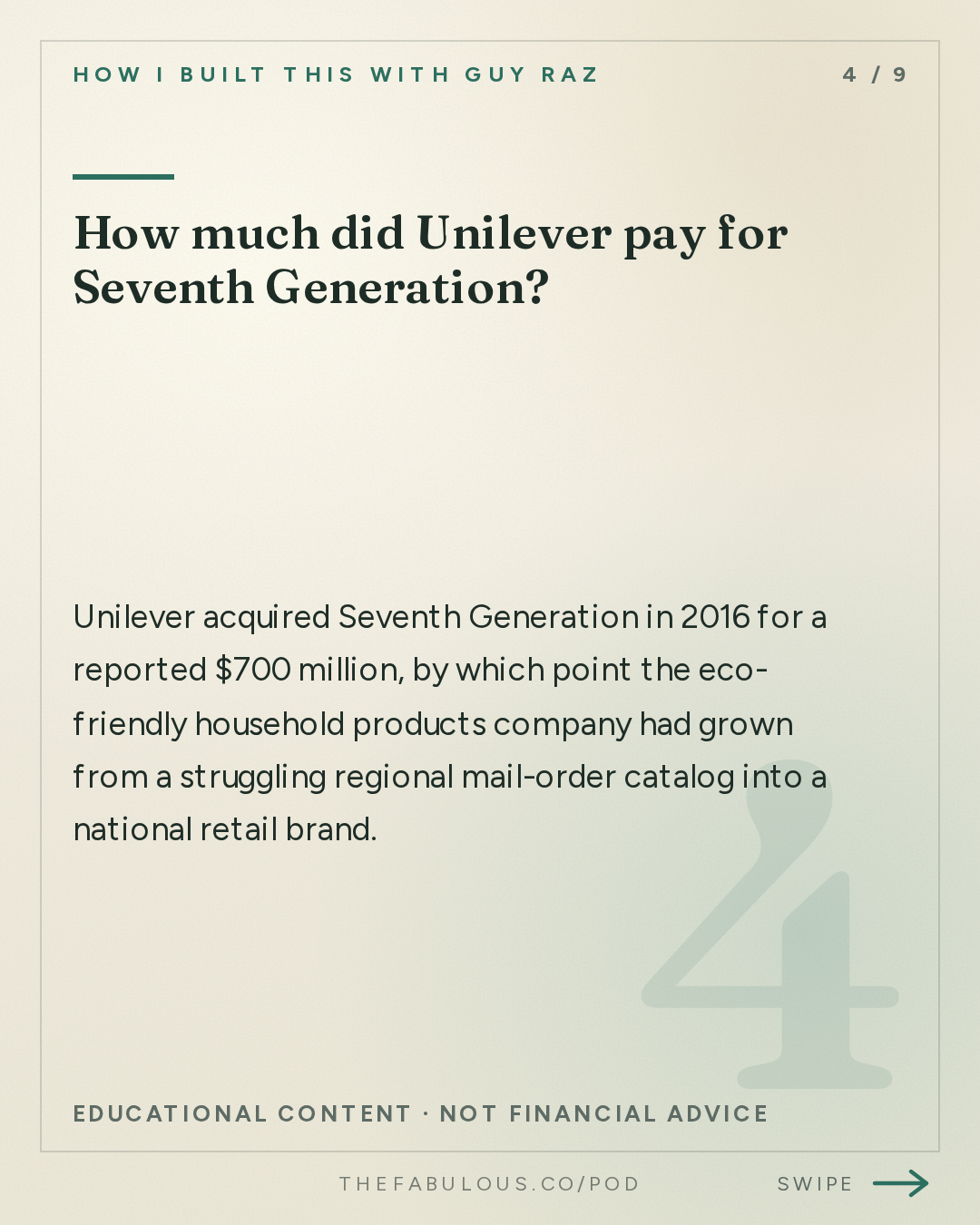
How much did Unilever pay for Seventh Generation?
Unilever acquired Seventh Generation in 2016 for a reported $700 million (77:28), by which point the eco-friendly household products company had grown from a struggling regional mail-order catalog into a national retail brand.
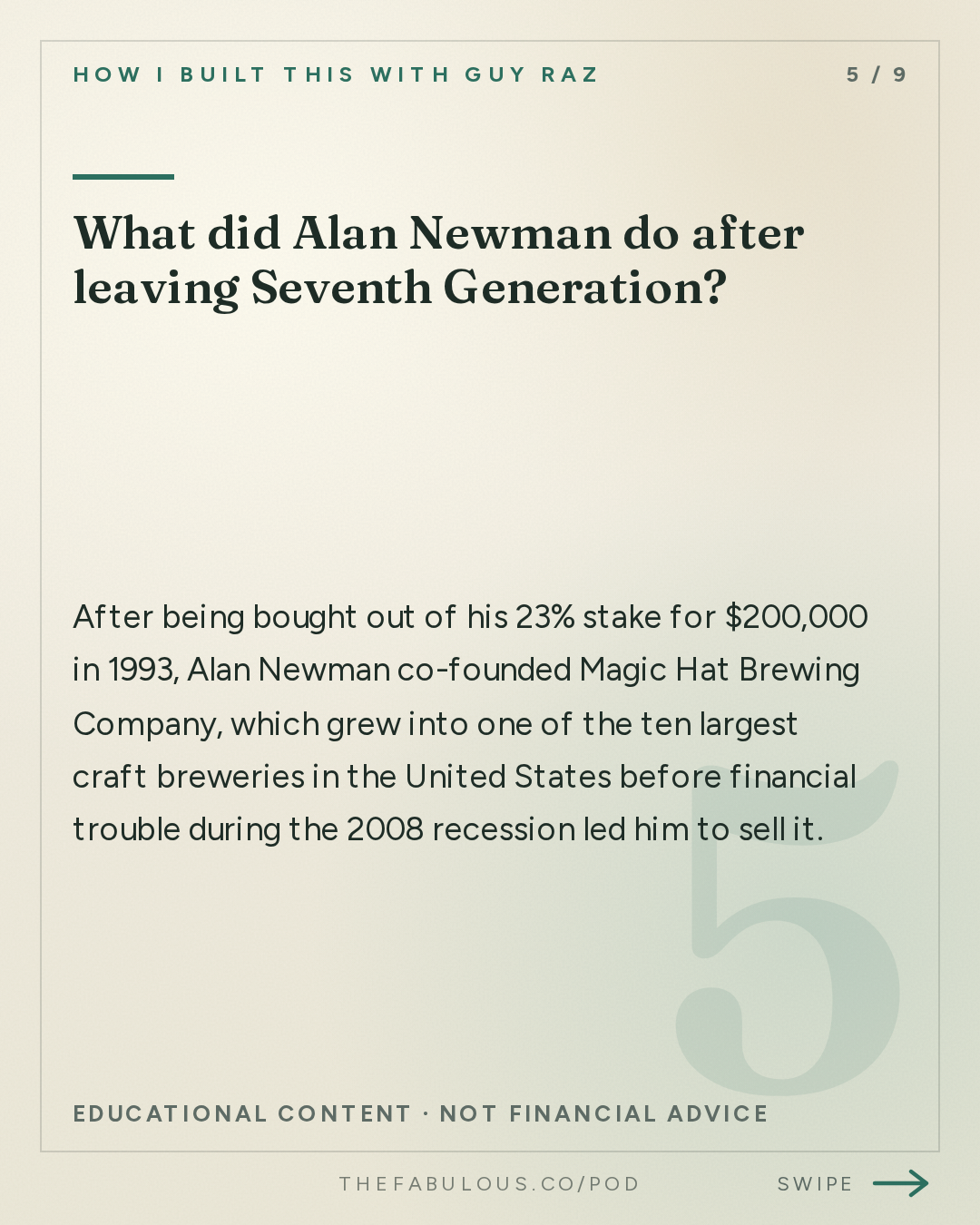
What did Alan Newman do after leaving Seventh Generation?
After being bought out of his 23% stake for $200,000 in 1993 (52:34), Alan Newman co-founded Magic Hat Brewing Company, which grew into one of the ten largest craft breweries in the United States before financial trouble during the 2008 recession led him to sell it (82:12).
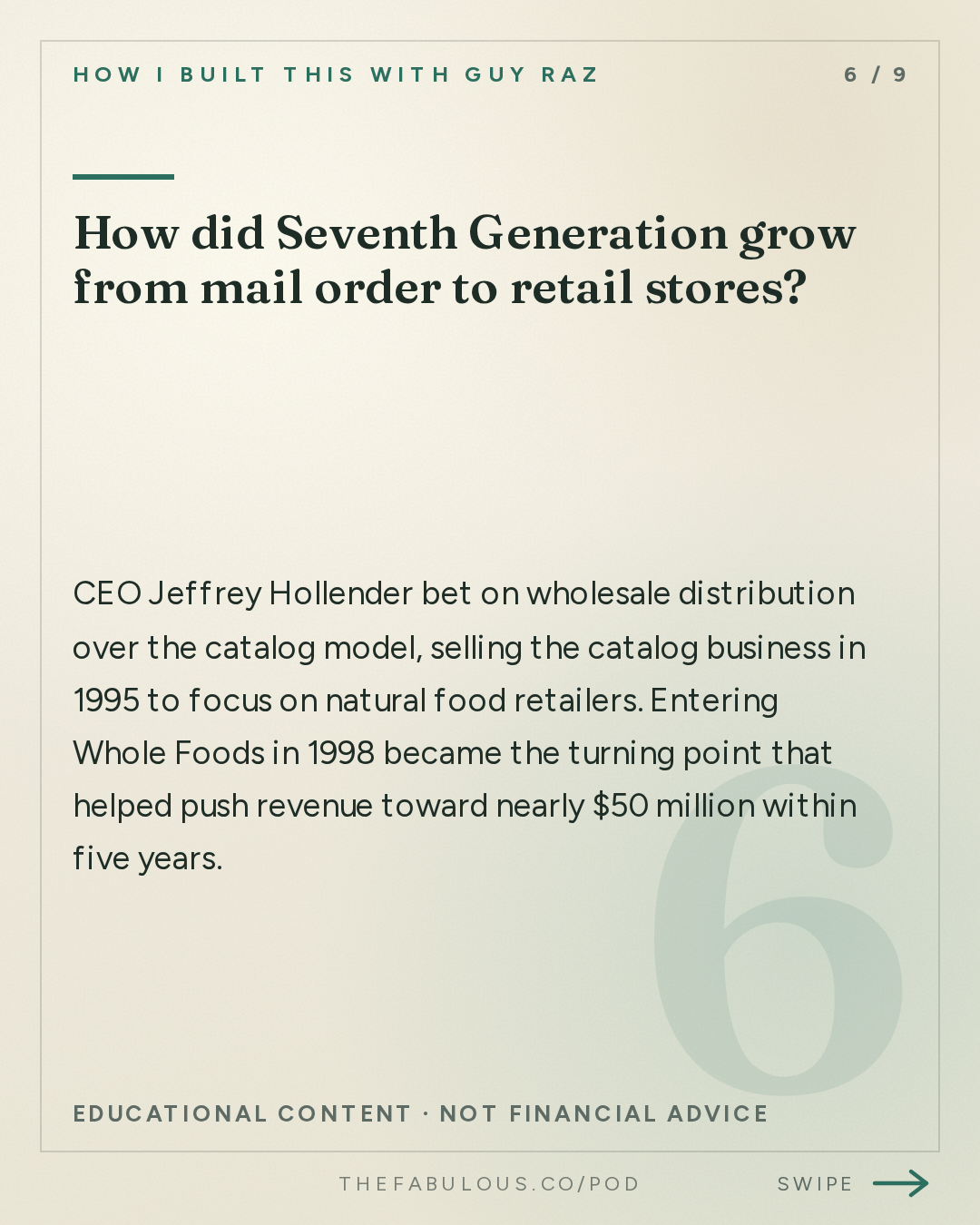
How did Seventh Generation grow from mail order to retail stores?
CEO Jeffrey Hollender bet on wholesale distribution over the catalog model, selling the catalog business in 1995 to focus on natural food retailers (58:32). Entering Whole Foods in 1998 became the turning point that helped push revenue toward nearly $50 million within five years (59:59).
The full read, in cards
Go deeper
- Deschooling Society — Ivan Illich's argument that formal schooling constrains the flow of knowledge more than it spreads it, which inspired Jeffrey Hollender's Skills Exchange
- The New York Times, 1989 feature — coverage that helped drive Seventh Generation's catalog sales from $1 million to $7 million within a year
Mentioned
Seventh Generation · Alan Newman · Jeffrey Hollender · Unilever · Deschooling Society · Ivan Illich · Renew America · Magic Hat Brewing Company · Bob Johnson · Whole Foods · Greenpeace · Chuck Maniscalco
More from this show and category
Danny Meyer's Advice for Startup Founders
Danny Meyer, the Shake Shack founder, explains why he replaced family values with expected behaviors to run culture at Union Square Hospitality Group. On this advice-line episode he coaches three food and drink founders on branding canned cocktails, shipping perishable salmon, and pitching couscous to fast-casual chains, all through the lens of measurable, scalable hospitality.
How Banza Built Chickpea Pasta Into a Top Brand
Brian Rudolph turned a wheat allergy into Banza, the first chickpea pasta, by fixing a factory disaster with a tea-steeping trick and later rebuilding trust after a viral glyphosate scare. His story is a case study in scrappy product development and honest crisis response.
Michelle Wahler's Advice for Scaling a Business
Beyond Yoga co-founder Michelle Wahler answers four callers on scaling, sales, and client trust. She built Beyond Yoga for about a decade before Levi's bought it for $400 million in 2021, and now advises founders to skip venture money, filter high-ticket leads before a sales call, win back burned clients smallest account first, and always underpromise and overdeliver.
Karissa Bodnar's Thrive Causemetics Story
Karissa Bodnar turned personal loss and self-taught cosmetic chemistry into Thrive Causemetics, a beauty brand that hit $150 million in revenue by 2020. She bootstrapped the company on $100,000 of personal savings, passed $30 million in sales before taking outside capital, and kept majority ownership by writing her own term sheet.
