
The History of Alamo Drafthouse Cinema
Alamo Drafthouse Cinema: Tim and Karrie League (2023)
The brief
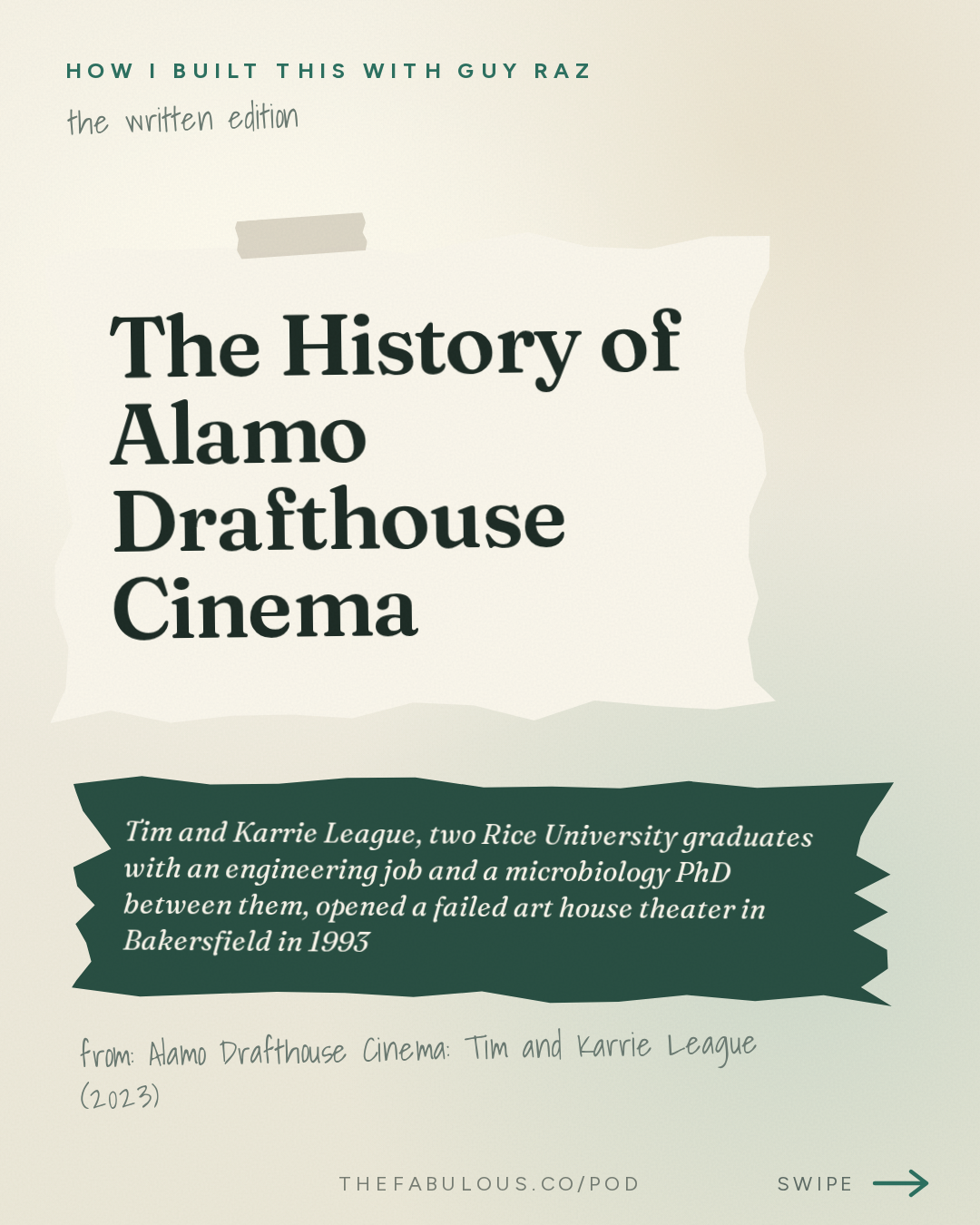
Tim and Karrie League, two Rice University graduates with an engineering job and a microbiology PhD between them, opened a failed art house theater in Bakersfield in 1993, then rebuilt the idea inside an Austin parking garage in 1997 and grew it into Alamo Drafthouse Cinema, a dine-in chain that survived a lawsuit, a Me Too reckoning, and COVID bankruptcy before Sony Pictures Entertainment bought it in 2023.
A building inspector once stood in a half-finished movie theater on the second floor of an Austin parking garage and told a sweaty twenty-something named Tim League that he had installed an entire kitchen's worth of sheetrock backwards. The little grooves meant for joint compound were facing the wrong way, which is why every wall bulged. The inspector passed him anyway. "It's still sheetrock," he said. "It still works. Just don't ever tell anybody about this because it's too embarrassing" (44:13). That backwards wall is as good a symbol as any for Alamo Drafthouse Cinema: a business built by two people who did not know the rules, got dozens of small things wrong, and somehow produced something sturdy anyway.
The chain that grew out of that garage eventually reached roughly 42 to 43 locations (77:46) before COVID-19 forced it into bankruptcy. For scale, American movie theaters sold about $11 billion worth of tickets in 2019, and then ticket sales fell 80 percent in a single year once the pandemic hit (06:22). But the real story starts almost three decades earlier, with a different theater in a different state, and the same two founders. Tim League studied mechanical engineering, and Karrie League studied microbiology. They met as freshmen at Rice University, and years later decided, against most available evidence, that they should run a movie theater instead of finishing their chosen careers.
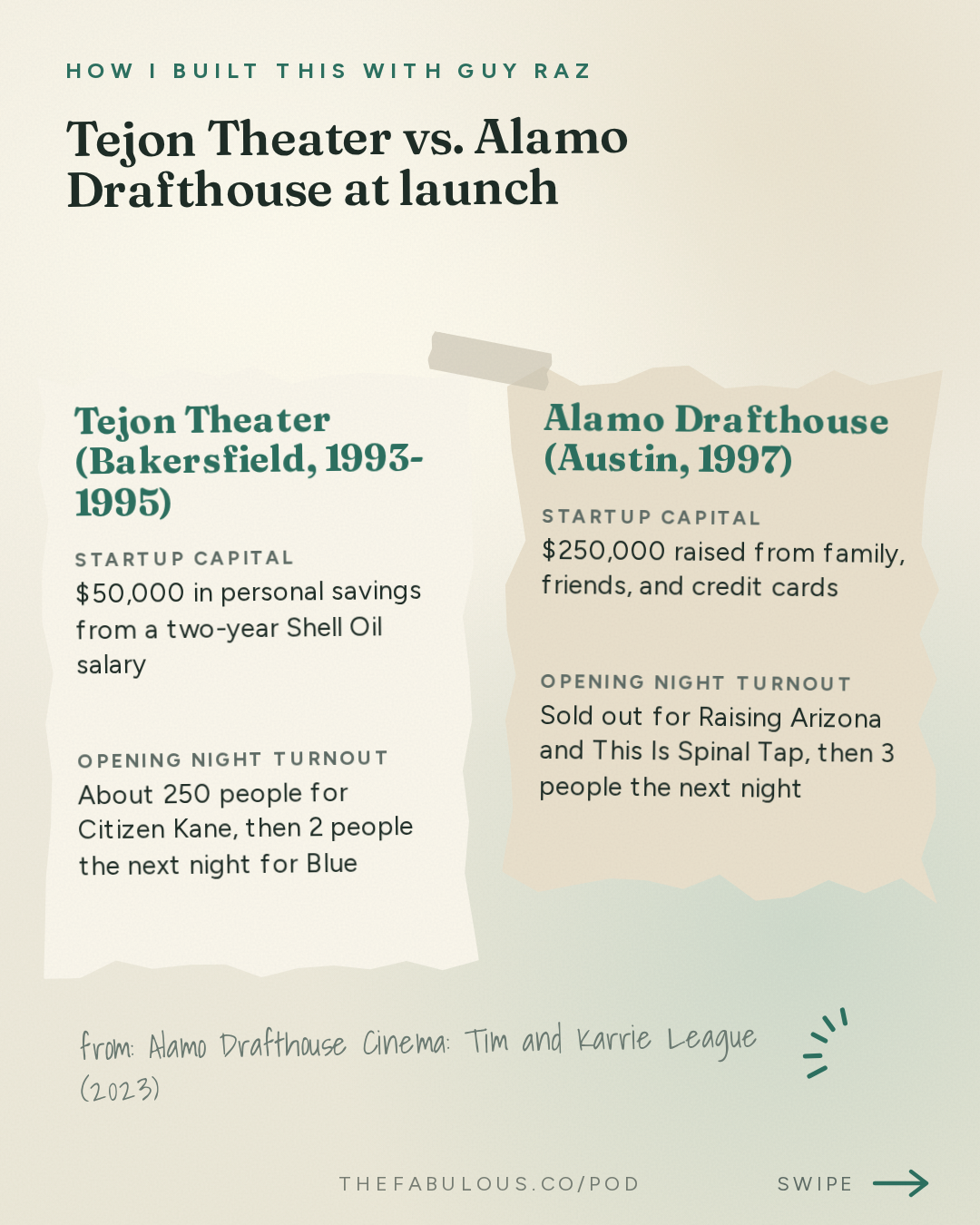
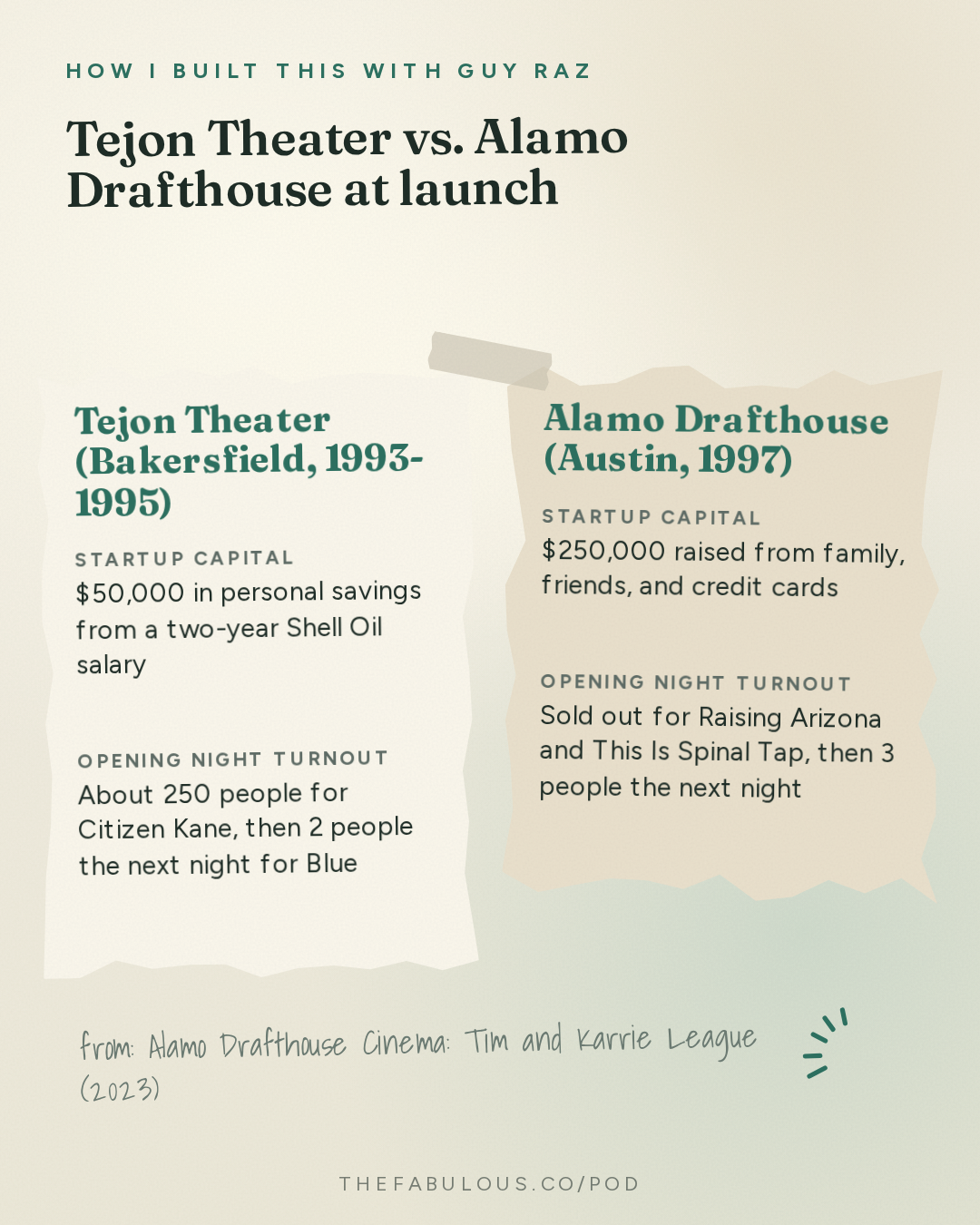
Tim took an engineering job at Shell Oil after graduation and quit almost as soon as he started. On his first day, a human resources manager sent him to the basement to choose decorative art for his office wall, a landscape, an oil derrick, or some combination of the two. "That left me cold in my tracks," he recalls (11:27). He stayed just long enough to save $50,000 over two years (17:20), money he used to rent an abandoned theater he had passed on his commute every morning in Bakersfield, California.
A Theater Built on Arrogance and a Library Card
The theater was called the Tejon. League signed the lease eight days after first noticing the for-lease sign, with no business plan beyond a stack of library books on how to run a company.
"My two greatest strengths at the time were arrogance and ignorance that just drove me forward because I should've thought it through maybe a little bit more." — Tim League [14:56]
He and Karrie reupholstered 500 secondhand seats by hand, Karrie doing about 90 percent of them, and lived in a room they carved out behind the screen, cooking crockpot meals for roughly a dollar a day. Opening night, a screening of Citizen Kane, drew about 250 people. The next night, a Krzysztof Kieslowski film called Blue, drew two. That gap turned out to define the whole venture. A film distributor, they learned by cold-calling every name in a trade magazine, charges either a flat minimum of a few hundred dollars or 35 percent of the box office, whichever is higher, which meant a nearly empty house still generated a bill (21:02). They had made peace with that risk before they ever opened the doors.
"We had come to peace before we started with the idea of total and complete abject failure." — Karrie League [26:02]
The Tejon lasted a little over two years. It ended after a concert at the theater turned violent: a shooting outside led to a fatal car crash into the box office, and the Leagues closed the theater 30 days later (29:02). They were not ready to quit the idea itself. They had already noticed other theaters around the country experimenting with serving food and drinks during a film, and they believed the concept could work somewhere with a bigger, younger audience.
Rebuilding Inside a Parking Garage
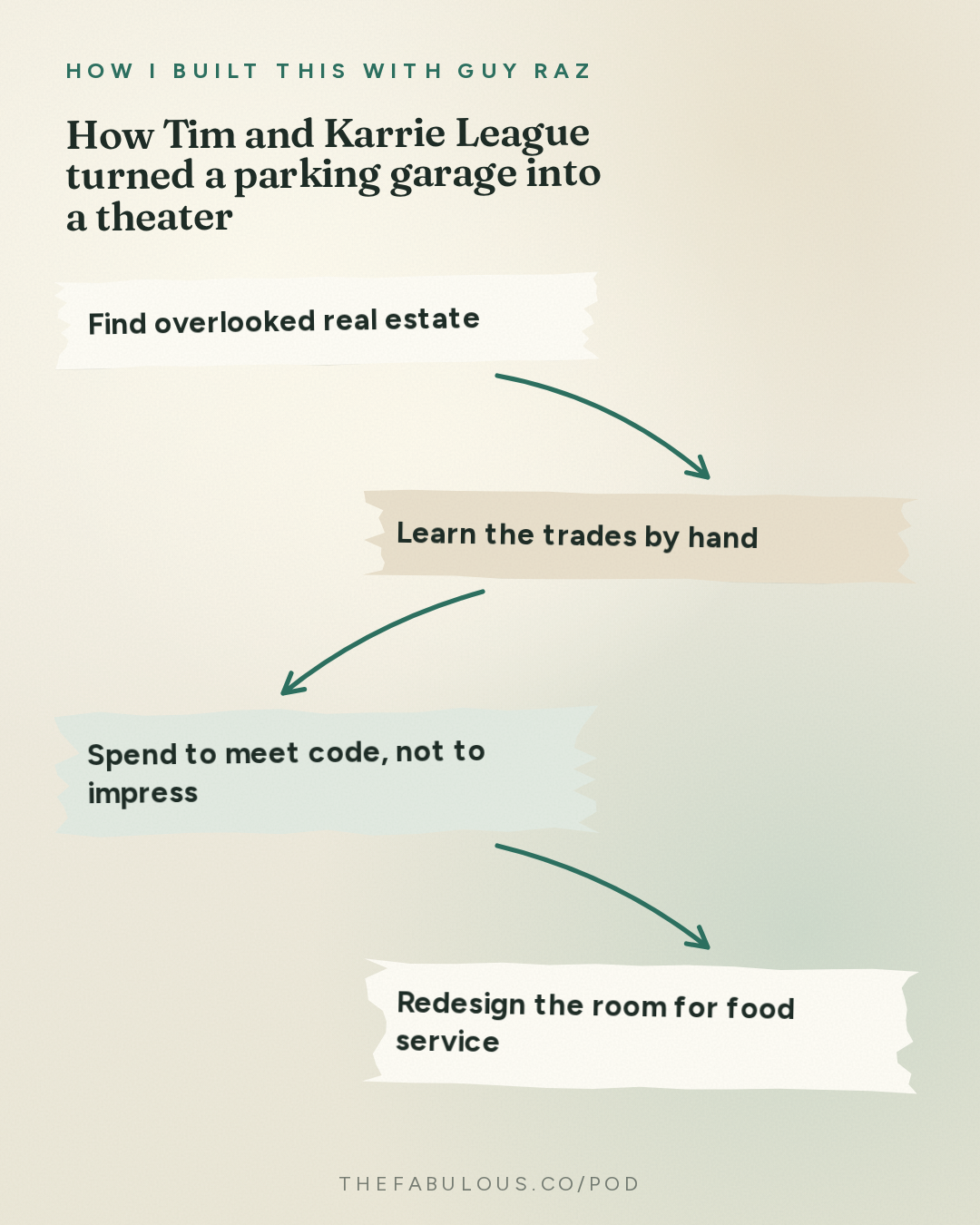
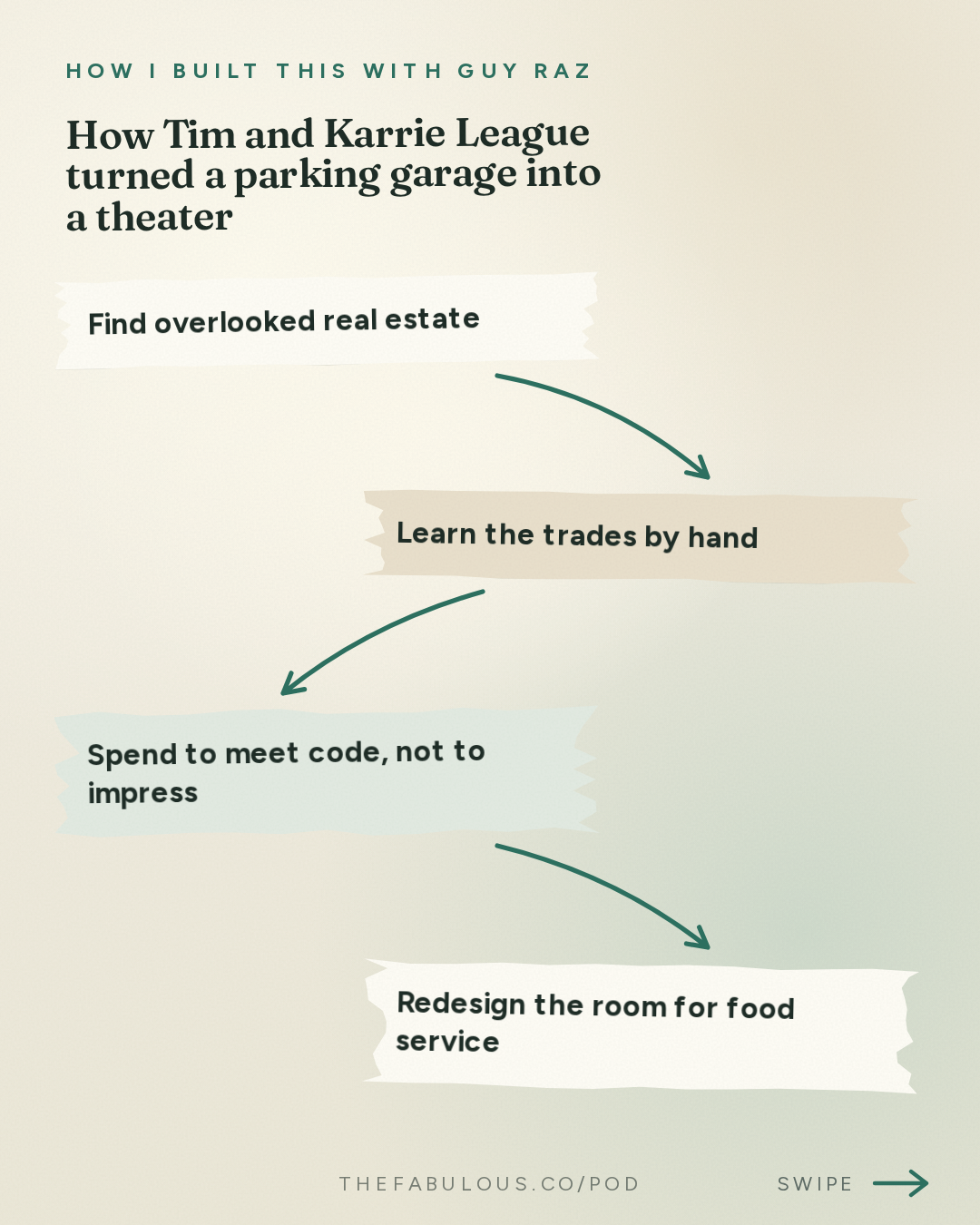
That somewhere turned out to be Austin, Texas, and the only space they could get was the second floor of a parking garage in the warehouse district, because the ground floor was considered too valuable to rent to them (40:19). Converting it into a working cinema and restaurant cost $230,000: a new elevator, restrooms built from scratch, a commercial kitchen, structural changes to raise the ceiling, and entirely new plumbing, electrical, and HVAC systems (40:39). They financed it with roughly $250,000 raised from family, friends, and credit cards, including a $100,000 mortgage Karrie's parents took out on their own house (35:33). The name Alamo was chosen for practical reasons rather than any Texas sentiment: a neon sign artist told them a name needed five or six letters to fit the budget, and they wanted to start with the letter A so the theater would appear first in the phone book (39:31). Inside, rows of seats were spaced about two and a half times farther apart than in a standard multiplex, so servers could deliver plates and drinks without blocking anyone's view of the screen (43:00).
Opening night was a sold-out double feature of Raising Arizona and This Is Spinal Tap, with 220 seats filled. The next night, three people showed up, and the company had enough cash for about three more payroll cycles before it would run out of money (46:32). Three weeks later, Austin Powers hit the second-run market, and a line formed around the block. The Leagues had a staff of four working that night: two cooks, two waiters, and Karrie at the register, until the bartender was pulled onto the floor mid-shift to wait tables (48:25).
Once the theater found its footing, the economics of dinner-and-a-movie became clear. On a first-run film, a theater pays a large share of the ticket price back to the studio, but food costs run close to only 25 percent of what is charged for it, which gives food and drink a far better profit margin than ticket sales alone (58:30). The business settled into roughly one-third of revenue from the box office and two-thirds from concessions. That math is also why the Leagues refused, repeatedly, to sell advertising time before the previews, even after learning exactly how much money they were leaving on the table. They decided not to find out the number at all, reasoning that skipping ads would build long-term loyalty with guests who were tired of sitting through commercials at every other theater (54:17, 54:59).
Franchising, a Lawsuit, and an Unlikely Breakfast
As Alamo expanded to a second and third Austin location, outside investors began pushing to franchise the brand nationally. The Leagues agreed in 2004, splitting the business into two companies: one they would keep running in Austin, and a new franchising entity run by partners John Martin and David Kennedy. By 2009 the arrangement had soured, with the franchise side frustrated that individual theaters kept appealing to the Leagues instead of following company systems. Kennedy's company sued first over contract language; the Leagues countersued. The case was heading toward a costly, bitter trial until the first day of depositions, when Kennedy heard Tim League explain, for the first time outside of lawyers and paperwork, why the company had knowingly spent money on events that were never meant to turn a profit. Kennedy texted him that evening and invited him to breakfast the next morning, then proposed combining the two companies back into one, with League as CEO (65:32 to 69:37). The merger gave the Leagues a partner with real operating discipline in accounting and expansion, and gave Kennedy's side a product the Leagues actually knew how to build.
In 2017, as the Me Too movement reshaped workplace accountability across industries, Alamo faced its own reckoning after a former employee accused of sexual harassment was quietly rehired in a remote role. Tim League, as CEO, acknowledged the decision had been a mistake, then traveled to every location on what he calls a listening tour, surfacing additional complaints about harassment and racism the company had not addressed (73:17 to 75:37). The company set up an anonymous feedback channel that League read every morning and began addressing the hardest comments publicly at monthly all-staff meetings (76:02).
COVID closed every Alamo location almost overnight in March 2020, cutting revenue from tens of millions of dollars a year to zero while expensive leases and debt from rapid expansion kept accruing. By December 2020 the company took on distressed financing just to survive, and in March 2021 it filed for Chapter 11 bankruptcy, a legal process that let it renegotiate debt and leases while continuing to operate, at a time when the chain had grown to roughly 42 to 43 locations (77:24, 77:46). It emerged smaller but solvent, and since the interview first aired in 2023, Sony Pictures Entertainment acquired the chain outright, with Tim and Karrie selling their remaining stakes as part of the deal (84:11).
Asked whether people will still want to go to a movie theater a decade from now, given that a decent television costs 200 dollars, Tim League answered with a question of his own: does anyone still own a stove, and do they still go out to eat anyway? "There's legit pressure to up the game to make sure that our industry delivers exceptional experiences," he said (81:10). The Leagues built a career on that same instinct twice, once in a failing Bakersfield storefront and once in a converted parking garage, long before the rest of the industry caught up to the idea that a trip to the movies had to be worth leaving the house for.
Ask this episode anything
Pod's AI answers from the episode itself, with the minute mark so you can hear it yourself.
Or start with one of these
Ask this episode
Pod's AI listens to the whole episode to answer, and points you to the minute it comes from.
The rest of this answer, and any question after it
Answers come from the episode itself, never from a summary of it.
ContinueKey takeaways
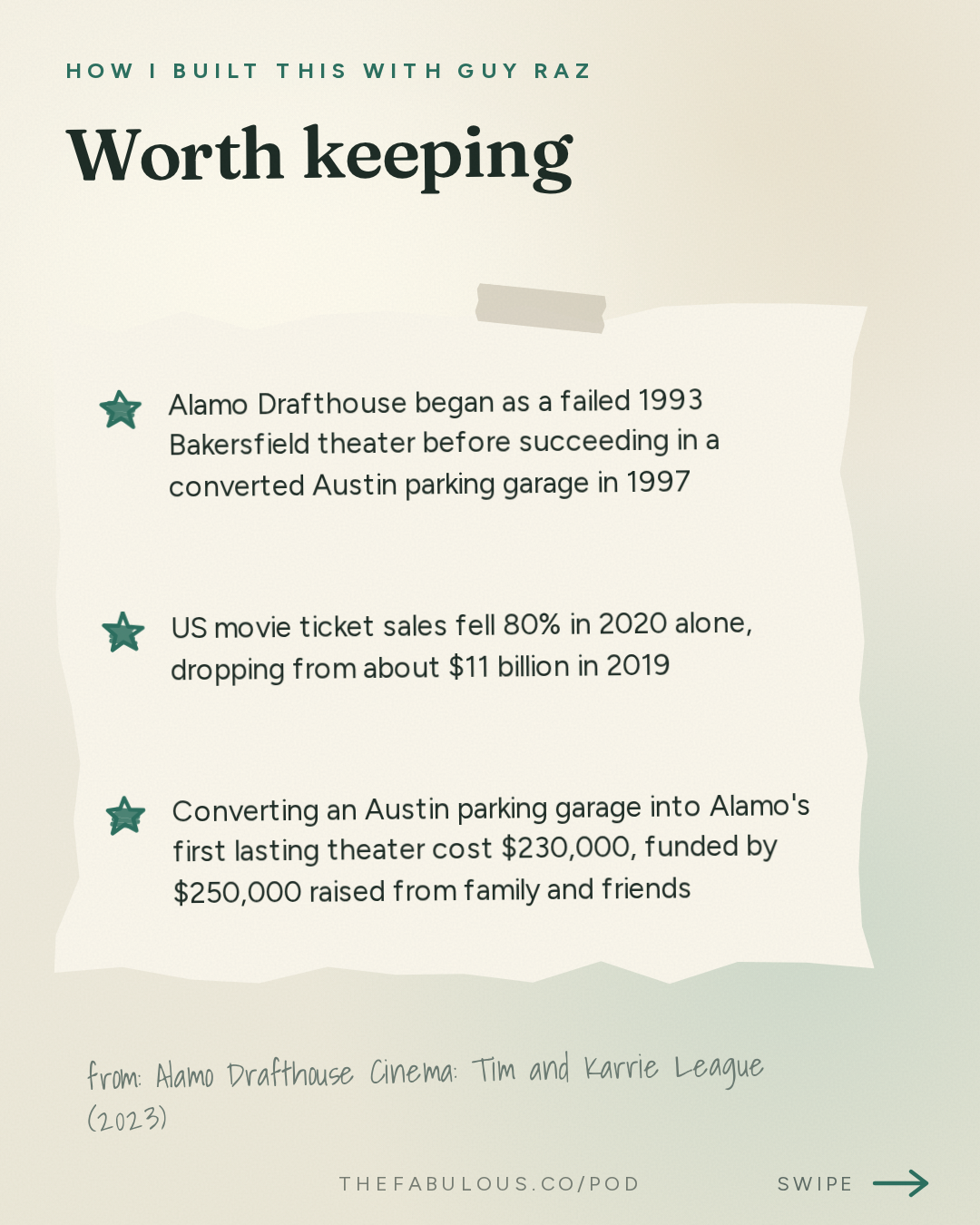
- Alamo Drafthouse began as a failed 1993 Bakersfield theater before succeeding in a converted Austin parking garage in 1997
- US movie ticket sales fell 80% in 2020 alone, dropping from about $11 billion in 2019 (06:22)
- Converting an Austin parking garage into Alamo's first lasting theater cost $230,000, funded by $250,000 raised from family and friends
- Food margins outperform ticket sales because food costs run about 25% versus the much larger cut studios take from box office
- Sony Pictures Entertainment acquired Alamo Drafthouse in 2023 after a 2021 Chapter 11 bankruptcy tied to COVID theater closures
The episode in cards
By the numbers
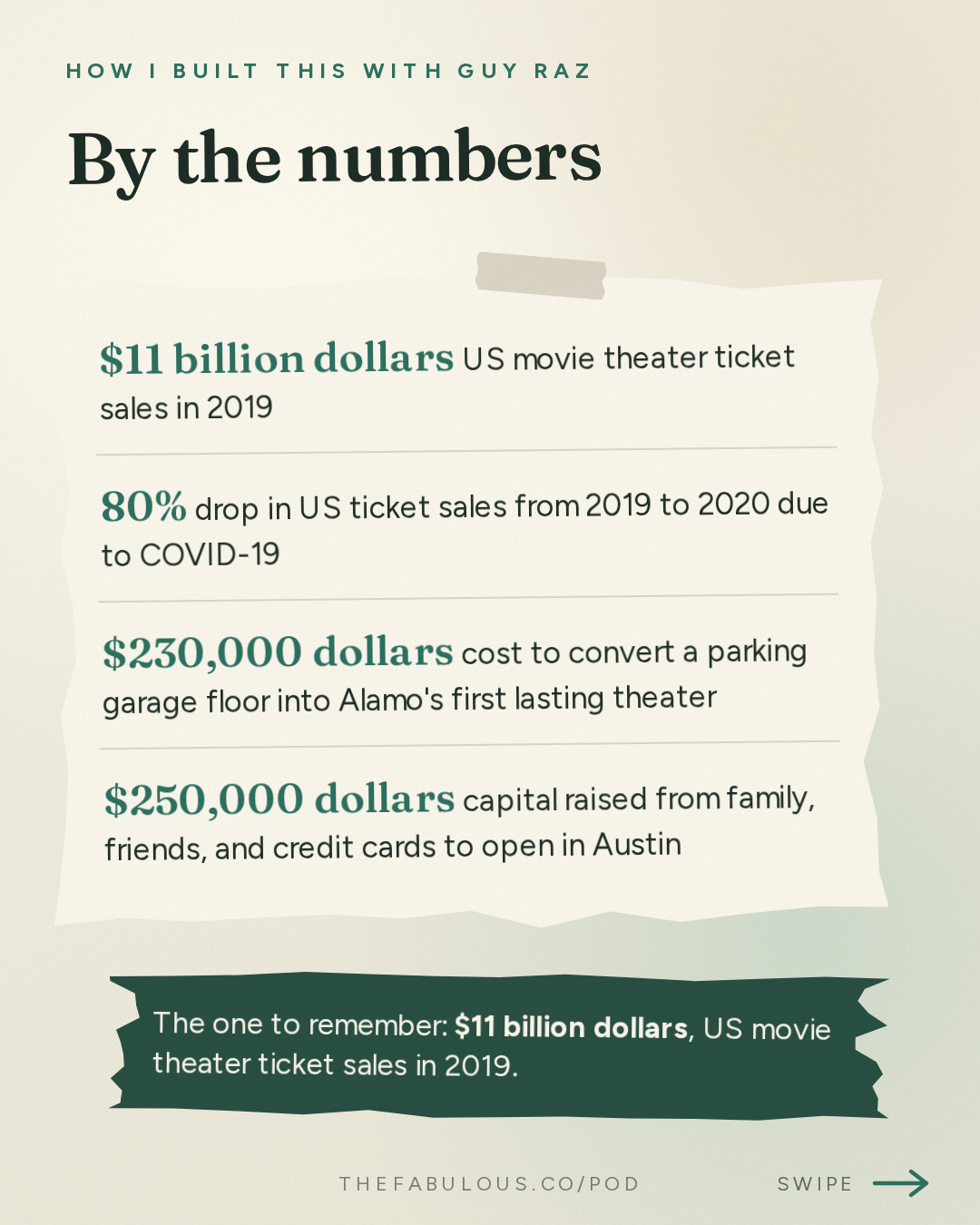
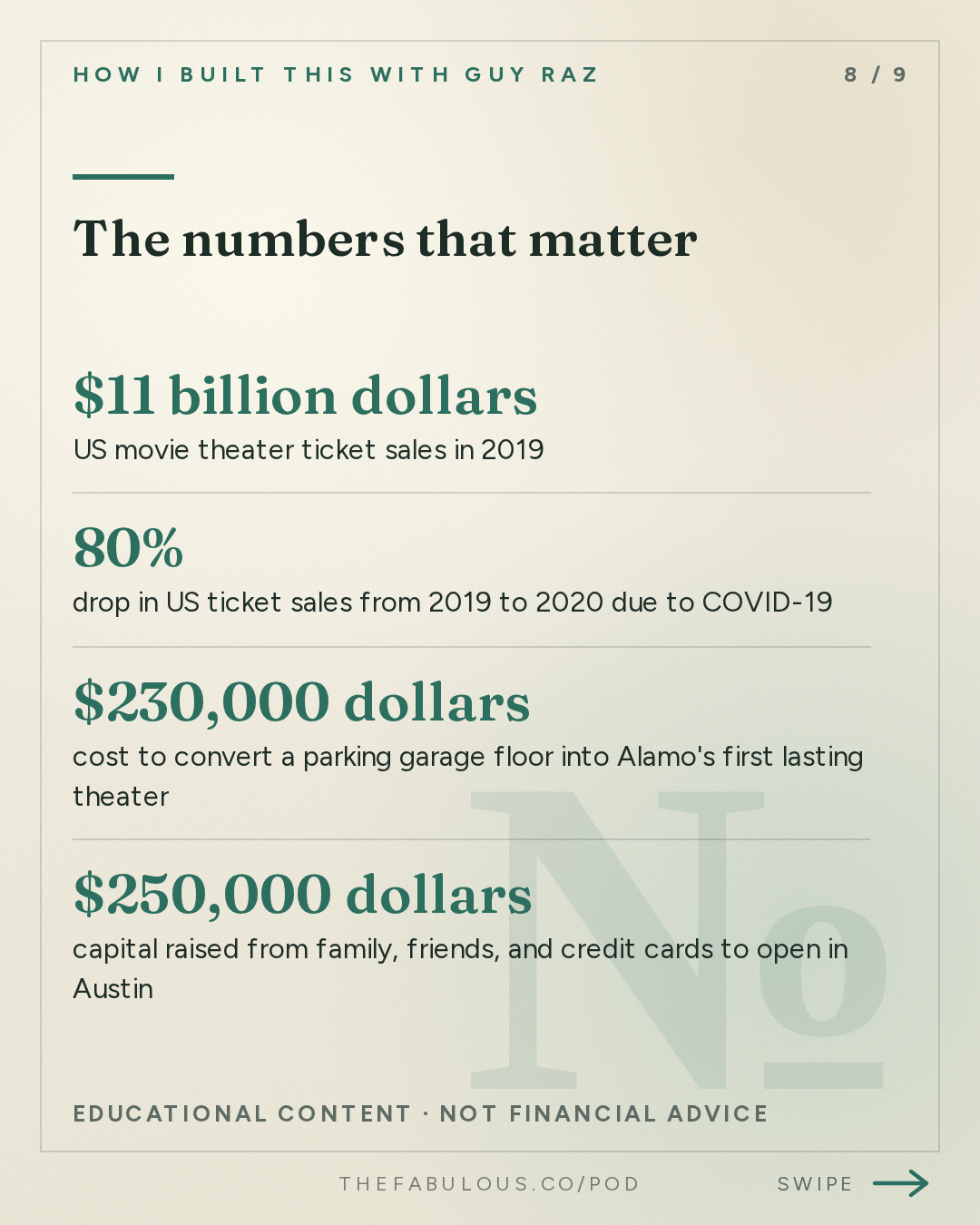
- $11 billion dollars US movie theater ticket sales in 2019
- 80% percent drop in US ticket sales from 2019 to 2020 due to COVID-19
- $230,000 dollars cost to convert a parking garage floor into Alamo's first lasting theater
- $250,000 dollars capital raised from family, friends, and credit cards to open in Austin
- 47 locations approximate chain size before the 2021 Chapter 11 bankruptcy
In their words
“My two greatest strengths at the time were, uh, arrogance and ignorance that just drove me forward because, uh, I should've thought it through maybe a little bit”
“We had come to peace before we started with the idea of c- total and complete abject failure”
“So our neon guy told us, "You have to choose a name with- Five or six ... five”
“I think there's, there's legit pressure to up the game to make sure that our industry, cinema industry, delivers”
Protocols
-
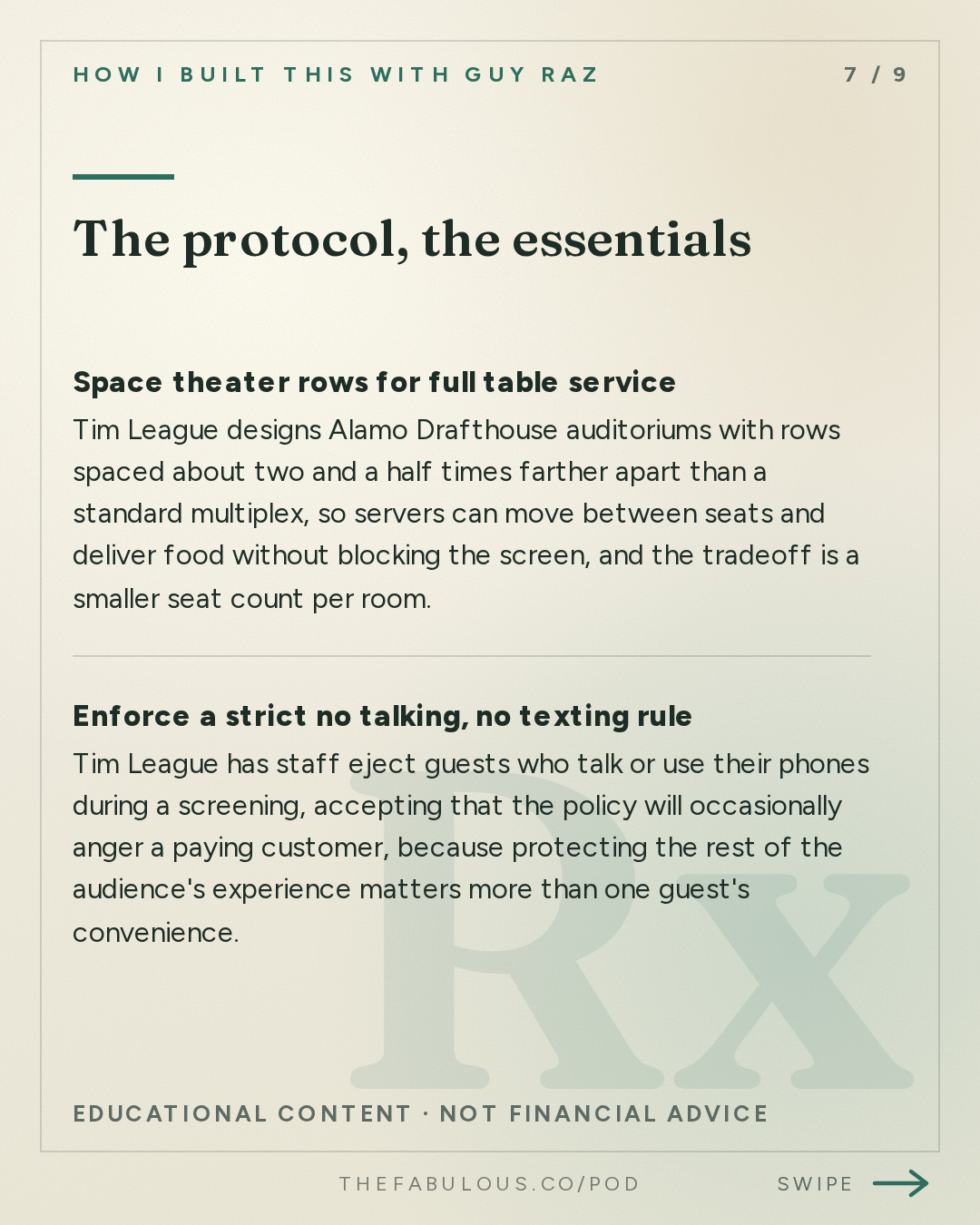
Space theater rows for full table service
Tim League designs Alamo Drafthouse auditoriums with rows spaced about two and a half times farther apart than a standard multiplex, so servers can move between seats and deliver food without blocking the screen, and the tradeoff is a smaller seat count per room.
Applied as a standard build spec at every new Alamo location
-
Enforce a strict no talking, no texting rule
Tim League has staff eject guests who talk or use their phones during a screening, accepting that the policy will occasionally anger a paying customer, because protecting the rest of the audience's experience matters more than one guest's convenience.
Enforced at every Alamo Drafthouse screening
-
Refuse pre-show advertising revenue
Tim and Karrie League decided never to sell advertising time before films, even after learning how much revenue they were passing up, because they wanted guests to trust that an Alamo screening would feel different from a typical multiplex.
A standing company policy since the 1997 Austin opening
Questions this episode answers
How did Tim and Karrie League start Alamo Drafthouse Cinema?
The founders first opened a dine-in movie theater called the Tejon in Bakersfield in 1993 using Tim League's $50,000 in savings from a Shell Oil job, and it closed after about two years (17:20, 07:18). After relocating, they rebuilt the concept on the second floor of an Austin parking garage in 1997, spending $230,000 to convert the space into Alamo Drafthouse's first lasting location (40:39).
Why did Alamo Drafthouse file for bankruptcy?
COVID-19 closed every Alamo Drafthouse location in March 2020, cutting revenue to zero while debt from an earlier expansion push and expensive leases kept accruing, which left the company with roughly two payroll cycles of cash by late 2020 (77:24). It filed for Chapter 11 bankruptcy in March 2021 at around 47 locations, then emerged smaller but solvent (77:46).
Who owns Alamo Drafthouse now?
Sony Pictures Entertainment acquired the Alamo Drafthouse chain in 2023, and co-founders Tim and Karrie League sold their remaining ownership stakes as part of that deal (84:11).
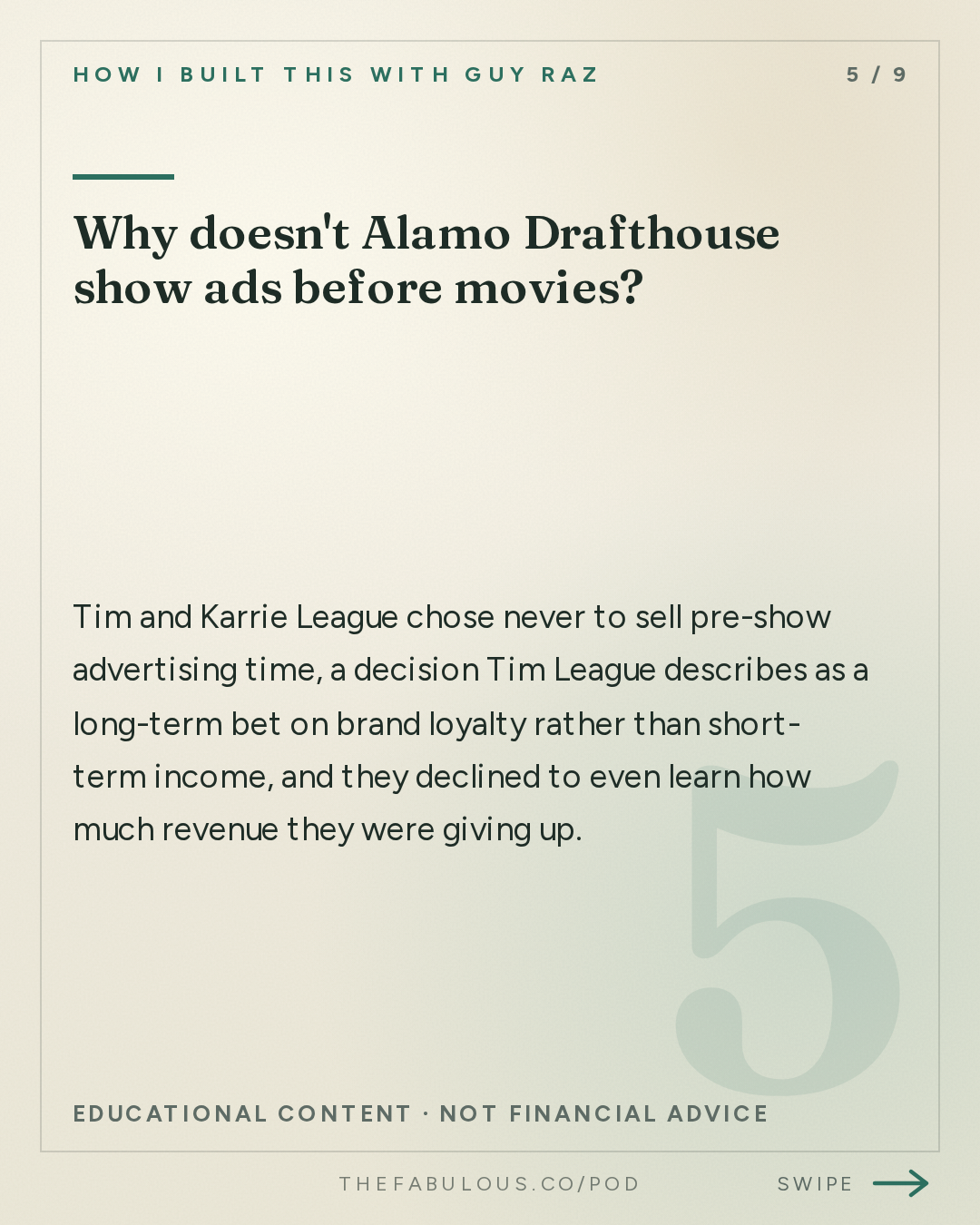
Why doesn't Alamo Drafthouse show ads before movies?
Tim and Karrie League chose never to sell pre-show advertising time, a decision Tim League describes as a long-term bet on brand loyalty rather than short-term income, and they declined to even learn how much revenue they were giving up (54:17, 54:59).
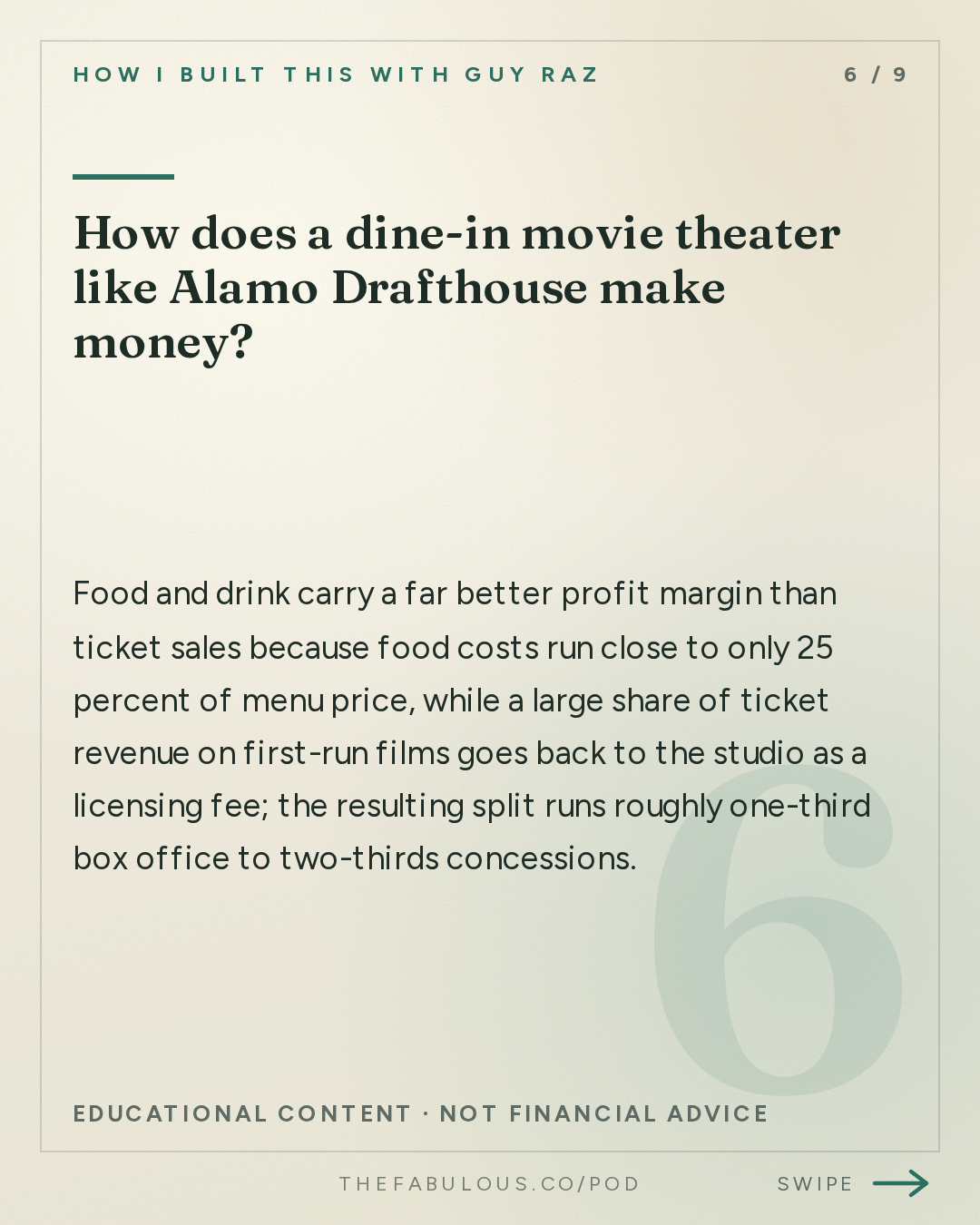
How does a dine-in movie theater like Alamo Drafthouse make money?
Food and drink carry a far better profit margin than ticket sales because food costs run close to only 25 percent of menu price, while a large share of ticket revenue on first-run films goes back to the studio as a licensing fee; the resulting split runs roughly one-third box office to two-thirds concessions (58:30).
What is the no talking, no texting policy at Alamo Drafthouse?
Alamo Drafthouse trains staff to eject guests who talk or use phones during a screening, a policy Tim League says protects the rest of the audience's experience even when it upsets an individual customer (49:33). A viral 2011 voicemail from an ejected guest, which the company turned into a PSA, later became the chain's most-watched video with over 10 million views (72:05).
The full read, in cards
Go deeper
- Boxoffice magazine — Trade directory Tim League used to cold-call every film distributor when opening the Tejon Theater
- There Will Be Blood — Referenced by Karrie League to explain Bakersfield's oil industry history
Mentioned
Tim League · Karrie League · Guy Raz · Shell Oil Company · Rice University · Alamo Drafthouse Cinema · Sony Pictures Entertainment · Bakersfield · Austin
More from this show and category
Nick Green's Advice for Scaling Niche Brands
Thrive Market CEO Nick Green coaches three founders to scale through focus, not features, on How I Built This's Advice Line. He tells a concert-wear designer to cut SKUs, a coffee founder to fund growth with subscriptions instead of outside cash, and an ALS app founder to court clinicians and caregivers, not patients, for awareness.
How I Built This: 10 Years of Top Lessons
Guy Raz marked 10 years of How I Built This by revisiting lessons from over 600 founder interviews with Ring co-founder Jamie Siminoff (07:23). The episode replays James Dyson's five-year vacuum quest (32:44) and Airbnb's 2008 pitches, where zero of 20 investors said yes (45:47), arguing fear, scrappiness, and rejection are normal parts of building something lasting.
Seventh Generation's Founders: A Partnership That Broke
Alan Newman and Jeffrey Hollender turned a discarded 1988 mail-order catalog into Seventh Generation, then split so badly they barely spoke for decades. Newman built the product and culture; Hollender raised money and later ran the company through a retail pivot, a 2010 board ouster, and Unilever's 2016 acquisition for $700 million.
Danny Meyer's Advice for Startup Founders
Danny Meyer, the Shake Shack founder, explains why he replaced family values with expected behaviors to run culture at Union Square Hospitality Group. On this advice-line episode he coaches three food and drink founders on branding canned cocktails, shipping perishable salmon, and pitching couscous to fast-casual chains, all through the lens of measurable, scalable hospitality.
