
Nick Green's Advice for Scaling Niche Brands
Advice Line with Nick Green of Thrive Market
The brief
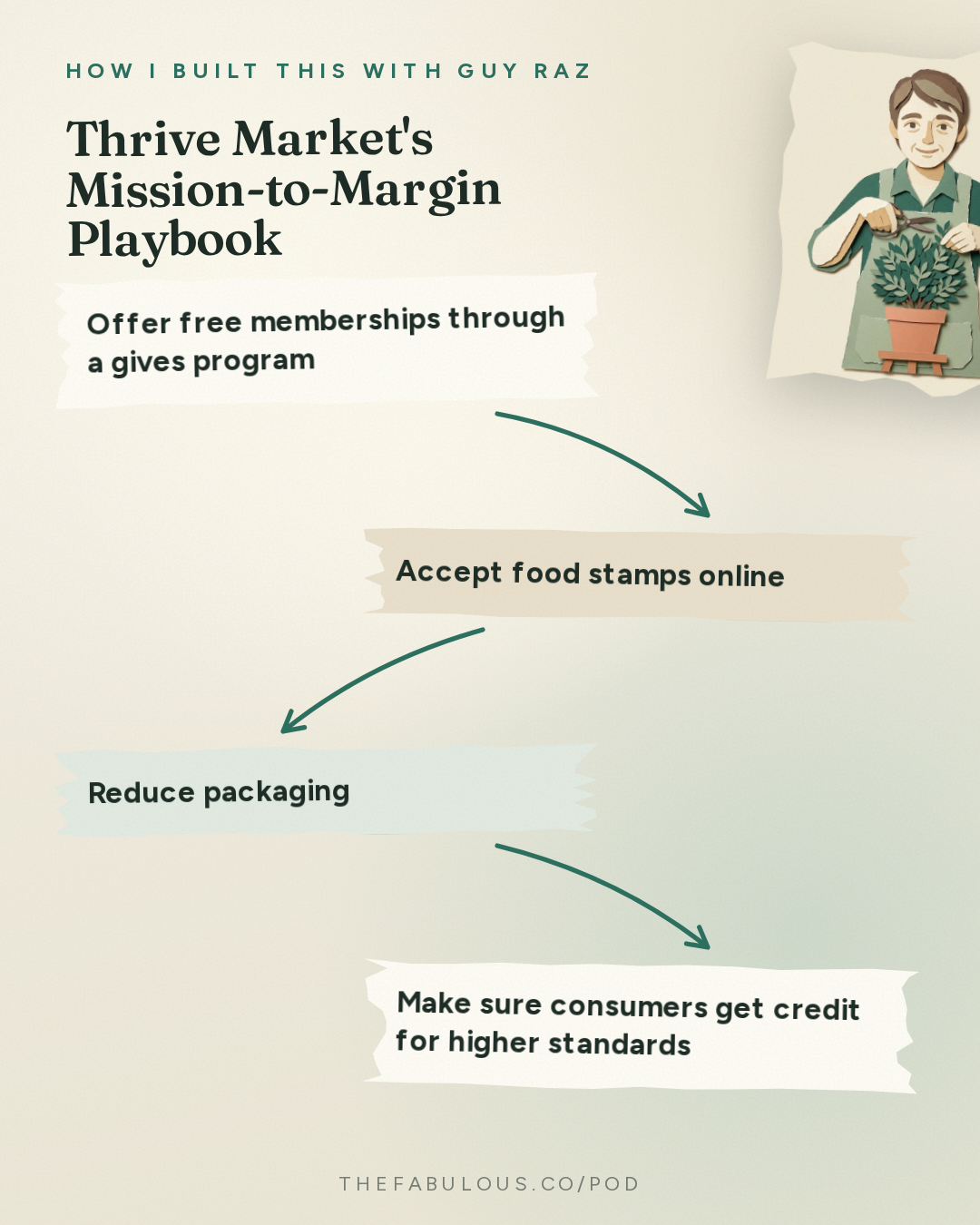
Thrive Market CEO Nick Green coaches three founders to scale through focus, not features, on How I Built This's Advice Line. He tells a concert-wear designer to cut SKUs, a coffee founder to fund growth with subscriptions instead of outside cash, and an ALS app founder to court clinicians and caregivers, not patients, for awareness.
A grandmother with ALS is handed an iPad loaded with text-to-speech voices. Every one of them sounds like a machine, the same flattened cadence that made Stephen Hawking's voice instantly recognizable and instantly inhuman. She refuses to use any of them and writes notes instead, which is slower and sometimes dangerous when no one can read her handwriting fast enough. Her granddaughter, a Duke student named Riya Jain, eventually builds an app that clones a voice from ten seconds of old audio, so a person losing the ability to speak can keep sounding like themselves (39:31). That app, Voiceback, is one of three businesses that call into a recent episode of How I Built This's advice segment, where the host, Guy Raz, puts listeners' problems in front of a guest who has already solved a version of them.
The guest this time is Nick Green, co-founder and CEO of Thrive Market, the online grocery membership company he and his partners built after failing, repeatedly, to raise money from traditional investors and instead taking small checks from hundreds of health bloggers. Twelve years later, Thrive has 1.5 million members and did over $700 million in sales last year (03:55). Green spends the hour fielding calls from a concert-wear designer, a mushroom-coffee founder, and Jain, and across all three conversations the same instinct keeps surfacing: when a business is straining, the fix is almost never to add something. It is to take something away.
The Twenty Percent That Matters
The first caller is Mercedes Smith, principal flutist of the Utah Symphony, who after twenty years of performing in itchy, impractical concert black decided to design her own line of formal wear for musicians (10:00). Her company, Black Strad Concert Attire, now does about $40,000 a month (11:58), and her problem is the oldest one in manufacturing: every round of product improvements slows down the next launch, and she is doing all of it herself, including the ad creative, while holding down a full-time orchestra job.
Green's answer is to narrow, not widen. Thrive Market, he points out, could serve more customers by carrying more SKUs, the retail term for a stock keeping unit, essentially one distinct product line. Instead the company keeps its catalog curated, which keeps it efficient and lets it pass savings to members (13:23).
Nick Green, [13:03]: "Quality really has to imply scalability. Like, they have to become two sides of the same coin."
For Smith, that means picking two or three hero products and telling their story well rather than offering every sleeve length a customer might request. Green's broader rule, borrowed from the athletic-apparel brand Figs, which solved a similar formality-versus-comfort problem for medical scrubs, is to protect whatever a business does uniquely and stop reinventing everything else (15:01). He also invokes the 80/20 principle directly, the idea that a fifth of a business's inputs usually produce most of its results, and tells Smith to be "maniacal" about finding that fifth before she hires her way out of the overwhelm (17:34).
Mission Is Not a Tax on Margin
The second caller, Danny Walsh, founded Peak State Coffee in Boulder during the pandemic, infusing roasted beans with mushroom extracts like reishi and lion's mane so customers get the supposed cognitive benefits without the bitter taste of mushroom powder (24:47). The business does about $500,000 in trailing twelve-month sales, almost entirely direct to consumer (26:15), with a striking 60 percent repeat purchase rate among customers who have not even subscribed yet (32:18). Walsh's question is whether a values-driven brand, his gives one percent of sales to environmental conservation and keeps B Corp certification, can raise money without compromising what makes it worth building (27:21).
Green's first move is to dismantle the premise.
Nick Green, [28:33]: "The first thing to try to break down is that assumption... that there was basically zero sum between the mission or building a big business."
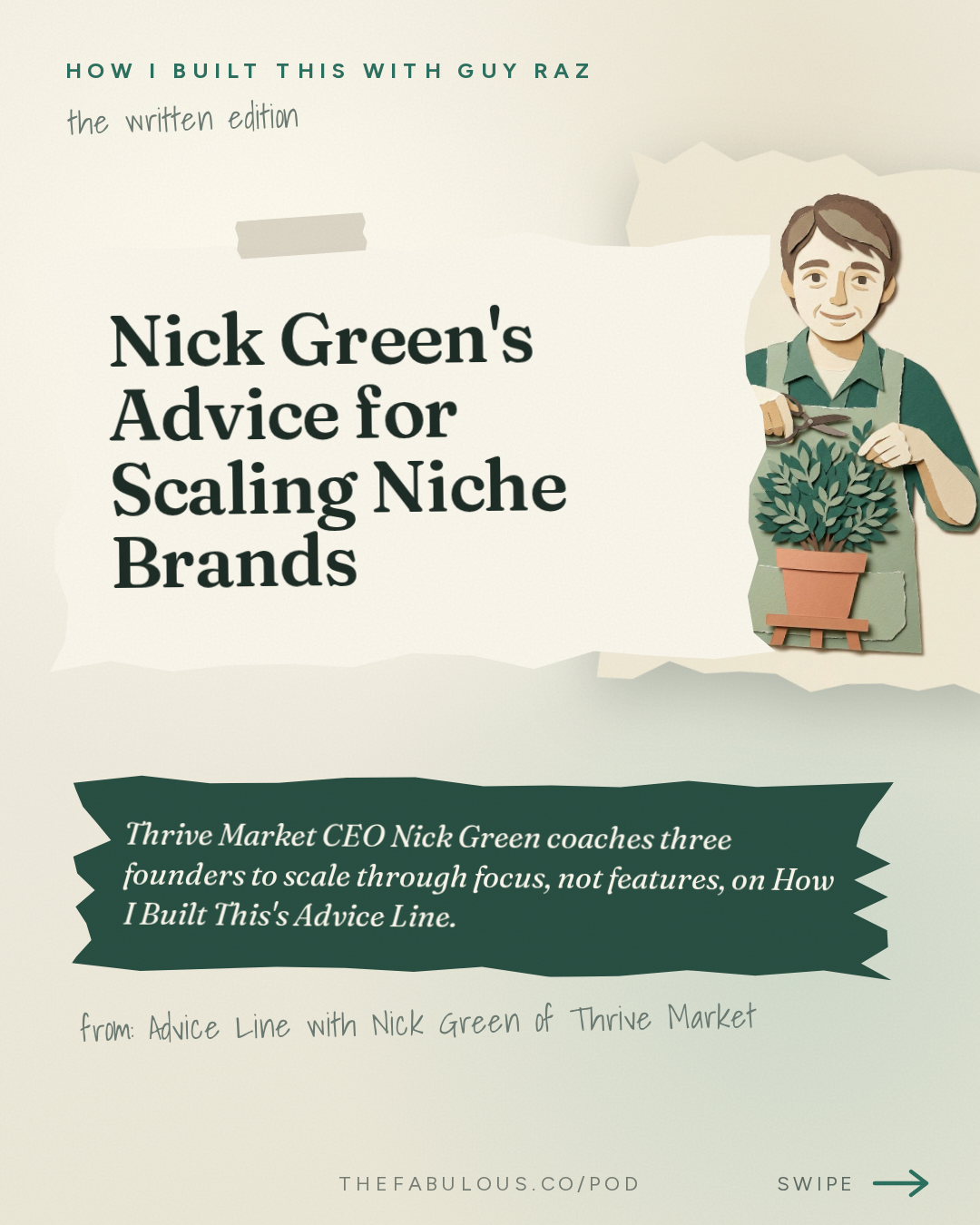
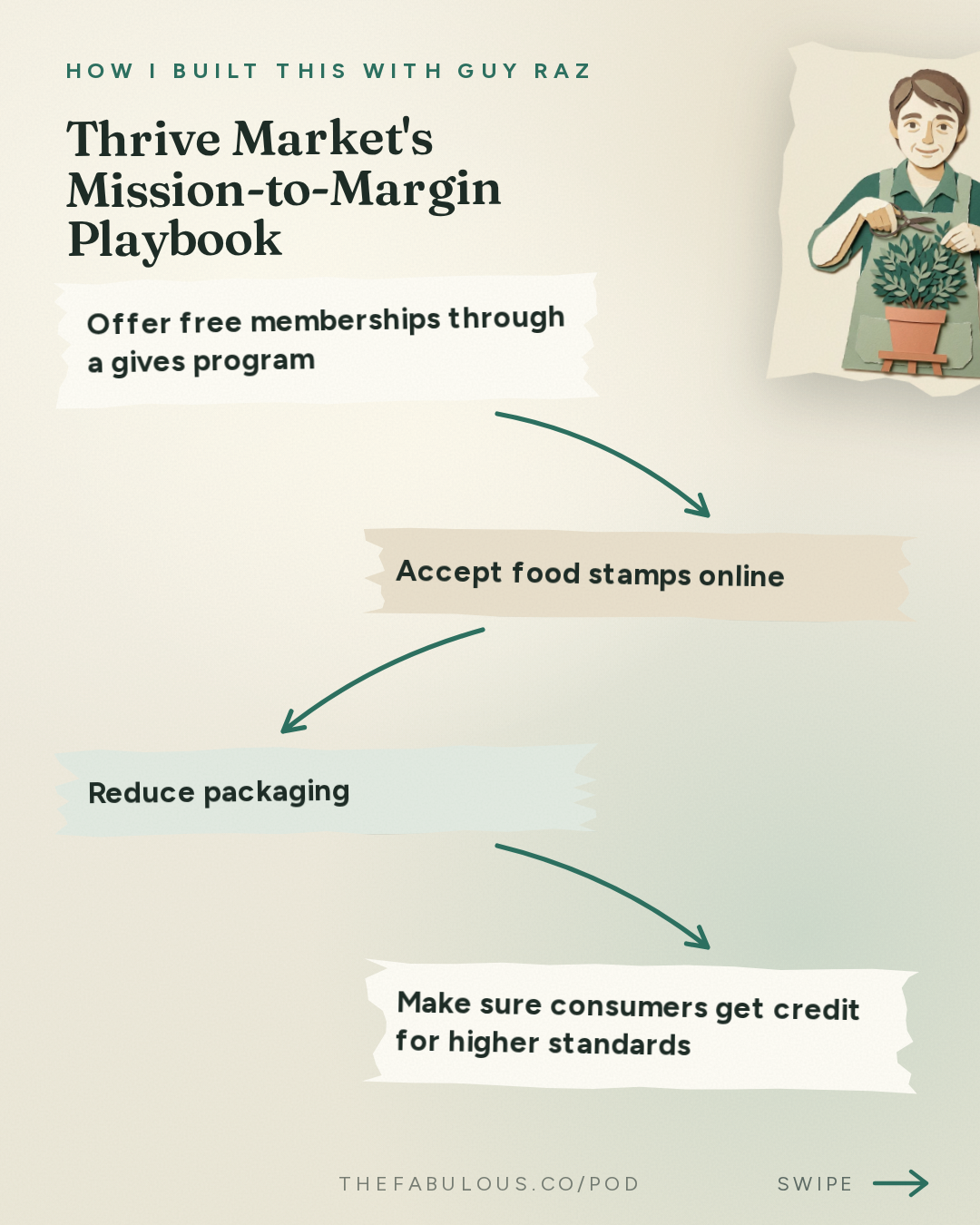
He points to Thrive Market's own playbook: free memberships for people who can't afford them still generate product sales, accepting food stamps online was good for the mission and good for the business, and packaging reduction cuts cost at the same time it cuts waste (28:33 to 29:12). The trick, he says, is sorting which mission commitments are pure cost, like the one percent giveback, and which ones actually make money, and then making sure consumers get credit for the difference (29:32).
On the funding question, Green is unsentimental about the tradeoffs: debt avoids diluting ownership but has to be repaid regardless of how the year goes, while the right equity partner shares risk and can double as a thinking partner for a solo founder like Walsh (29:55 to 30:32). But he also warns that capital can be a trap.
Nick Green, [33:48]: "Being constrained on capital as just a forcing function to do things right, be intellectually honest."
Coffee, Guy Raz notes, is an unusually strong subscription product precisely because it is habitual, people run out of it and need more on a predictable schedule, and Raz later suggests that squeezing more loyalty out of Walsh's existing 60 percent repeat rate is the real opportunity for the business before chasing new money at all (33:08, 35:08). Green adds one more move from Thrive's early years: paying influencers in equity rather than cash let the company reach an audience without selling as much of itself to venture investors (35:29).
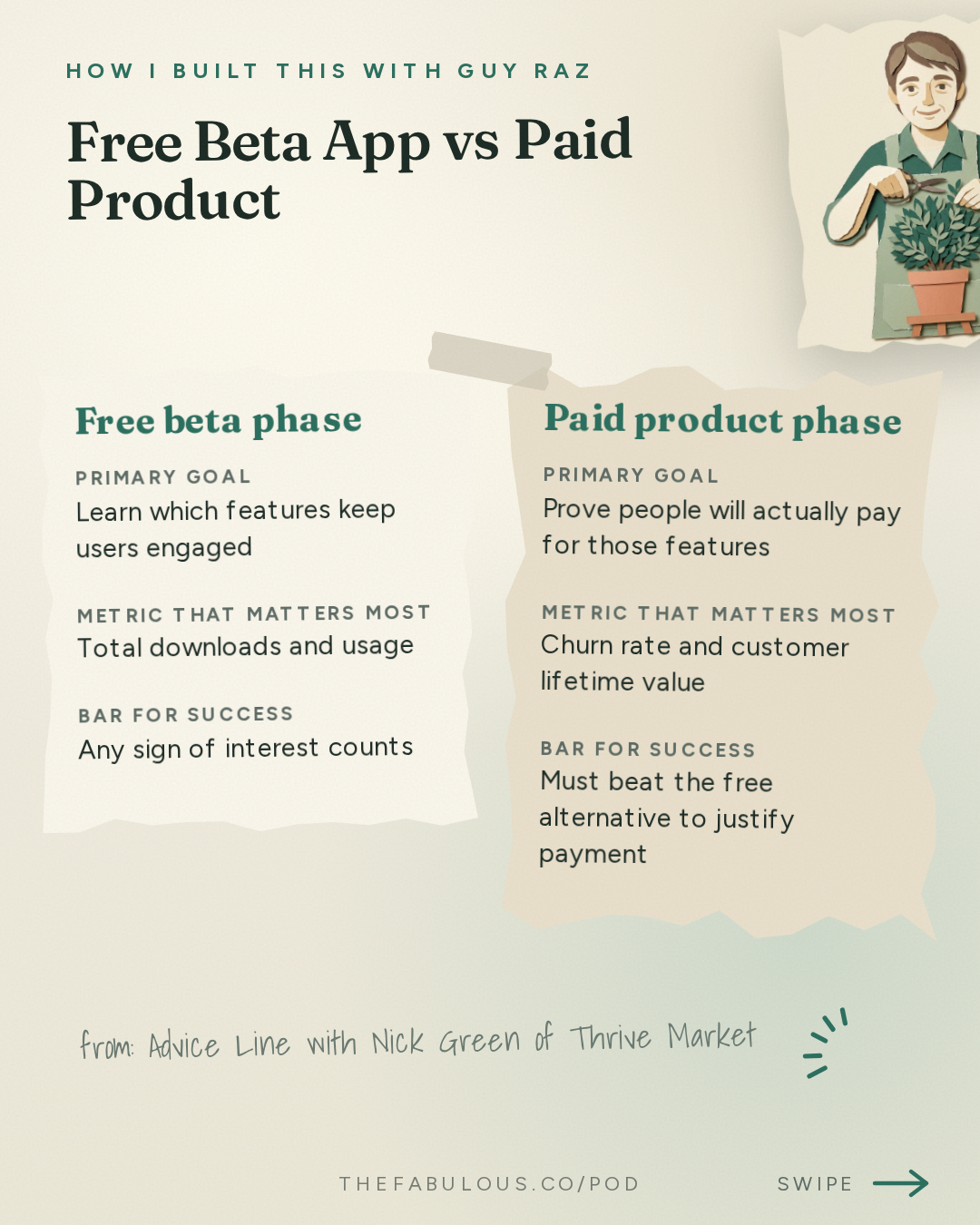
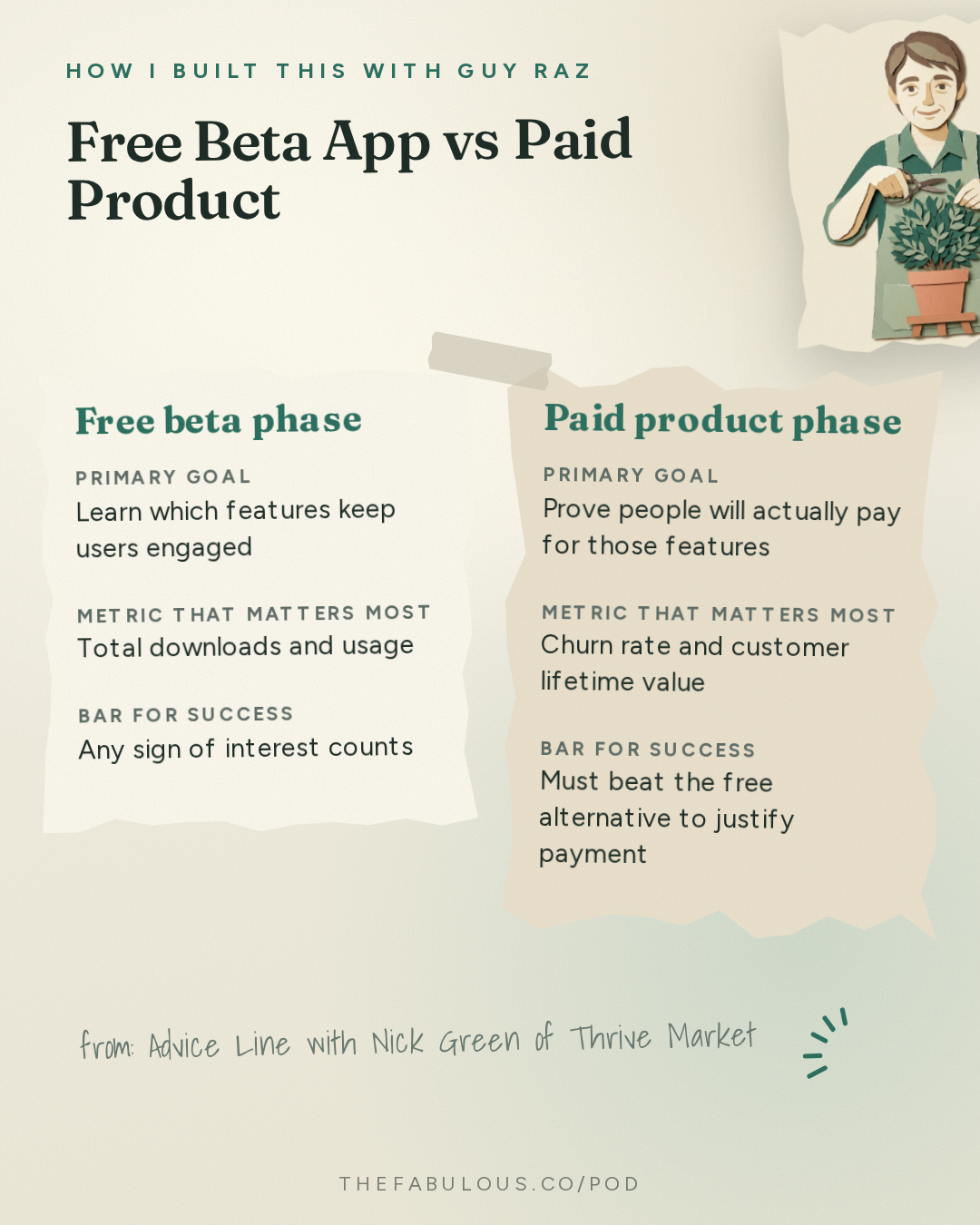
That same logic of narrowing, who to reach, not how many, returns in the final call. Riya Jain's Voiceback has had 50,000 downloads in its first year, nearly all free beta users, and has made $20,000 since adding a paywall two months ago, priced at $2.99 a month or $23.99 for lifetime access (41:18 to 41:40). Her problem is that the people who need Voiceback most find it at the moment of a devastating diagnosis, which makes ordinary ad targeting useless (42:14). Green's advice is to resist the urge to chase awareness before the paid product itself is proven, since product-market fit for something people pay for is a different test than product-market fit for something free (42:40). Once that funnel is solid, he says the path is grassroots: ALS forums, support groups, and the family members and clinicians who already search for solutions on behalf of someone who cannot search for themselves (43:34).
Guy Raz, [44:37]: "The number you wanna focus on is not the fifty thousand downloads but on five hundred people who are gonna be far more valuable."
Guy Raz sharpens the point further, suggesting Jain build a list of every ALS clinic and treatment center she can find, then cold-email the speech pathologists and neurologists who work there directly, because caregivers and clinicians, not patients, are often the ones making the purchase decision in medical technology (44:50). Jain mentions she has already landed Dr. Richard Bedlack, a prominent ALS physician at Duke, as a medical advisor after reaching out cold, which she credits as the single most effective thing she has done (48:16).
What ties the three calls together is not a tactic so much as a temperament: a willingness to make a business smaller on purpose, in SKUs, in dollars raised, in the size of the audience targeted, so that what remains can actually hold up under growth. Green, asked what he would tell his 2014 self starting Thrive Market, says he is not sure he would want to know how hard it was going to get, because that knowledge might have dulled the fear that pushed him forward in the first place.
Nick Green, [50:04]: "To be an entrepreneur, you have to be irrational, you know, arguably insane to take that risk and go do it."
It is a strange note to end on, given how disciplined the rest of his advice sounds. But maybe that is the honest shape of it: the discipline is what makes the irrational bet survivable once it is made.
Ask this episode anything
Pod's AI answers from the episode itself, with the minute mark so you can hear it yourself.
Or start with one of these
Ask this episode
Pod's AI listens to the whole episode to answer, and points you to the minute it comes from.
The rest of this answer, and any question after it
Answers come from the episode itself, never from a summary of it.
ContinueKey takeaways
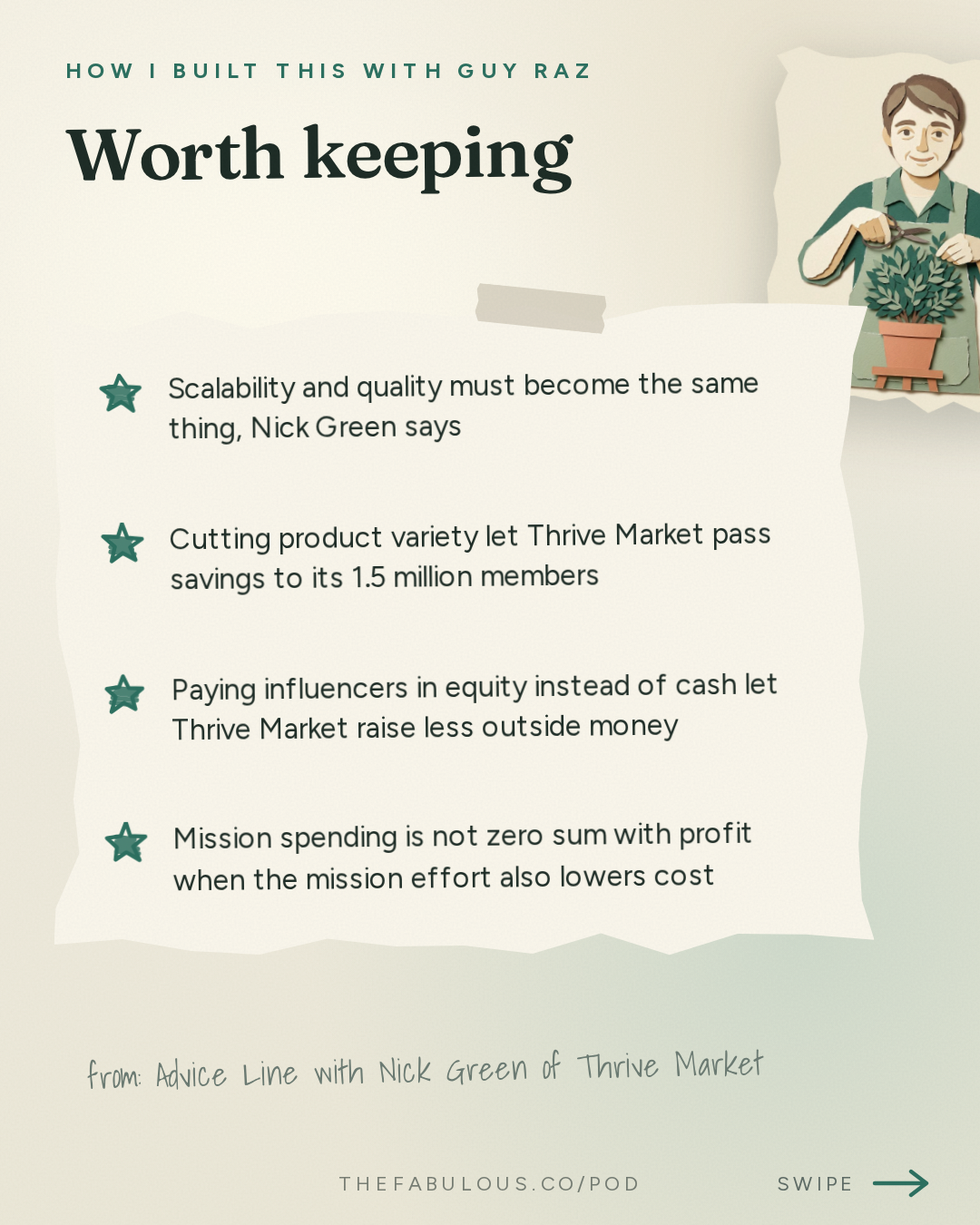
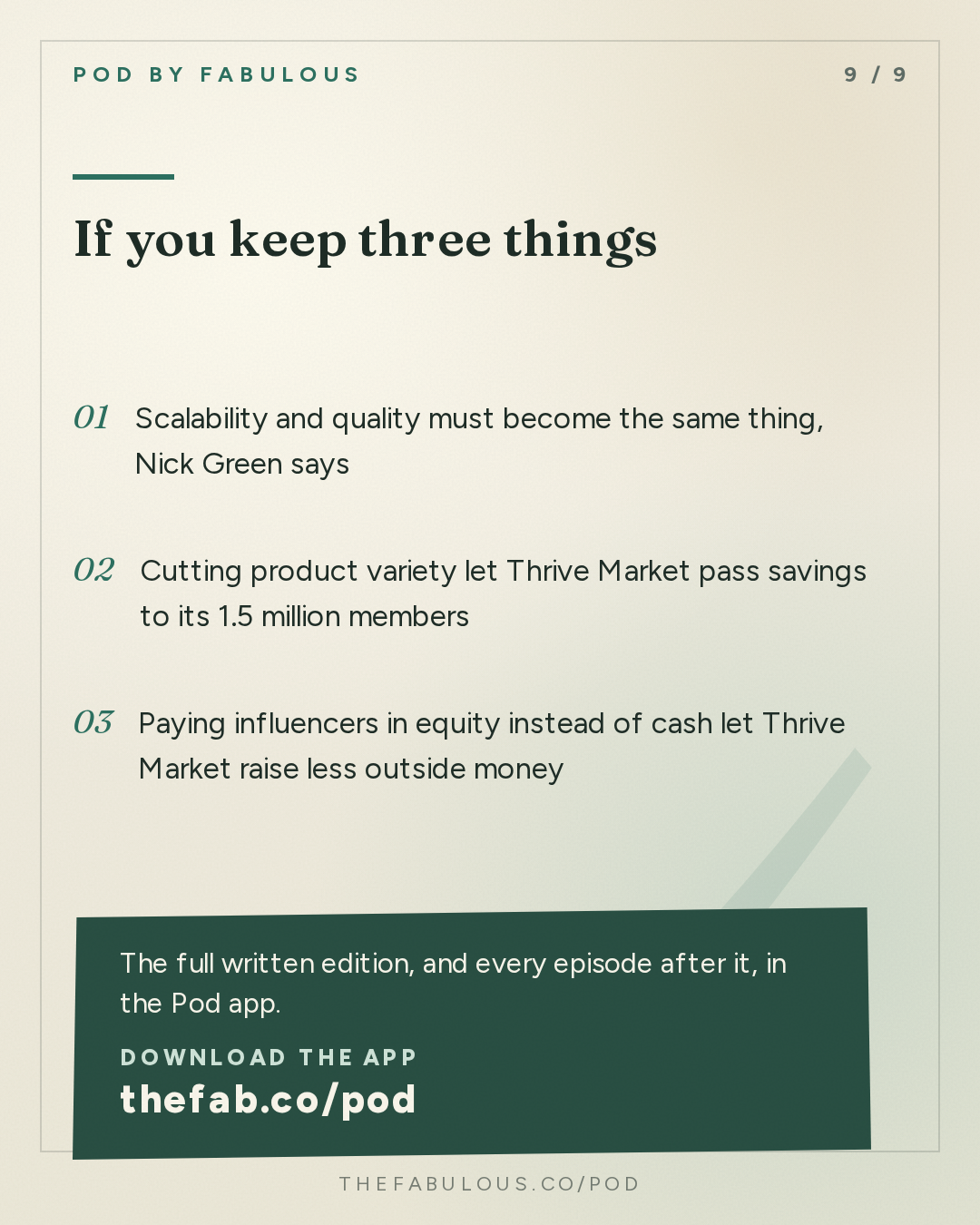
- Scalability and quality must become the same thing, Nick Green says
- Cutting product variety let Thrive Market pass savings to its 1.5 million members
- Paying influencers in equity instead of cash let Thrive Market raise less outside money
- Mission spending is not zero sum with profit when the mission effort also lowers cost
- For medical tech founders, caregivers and clinicians can be better customers than patients themselves
The episode in cards
By the numbers
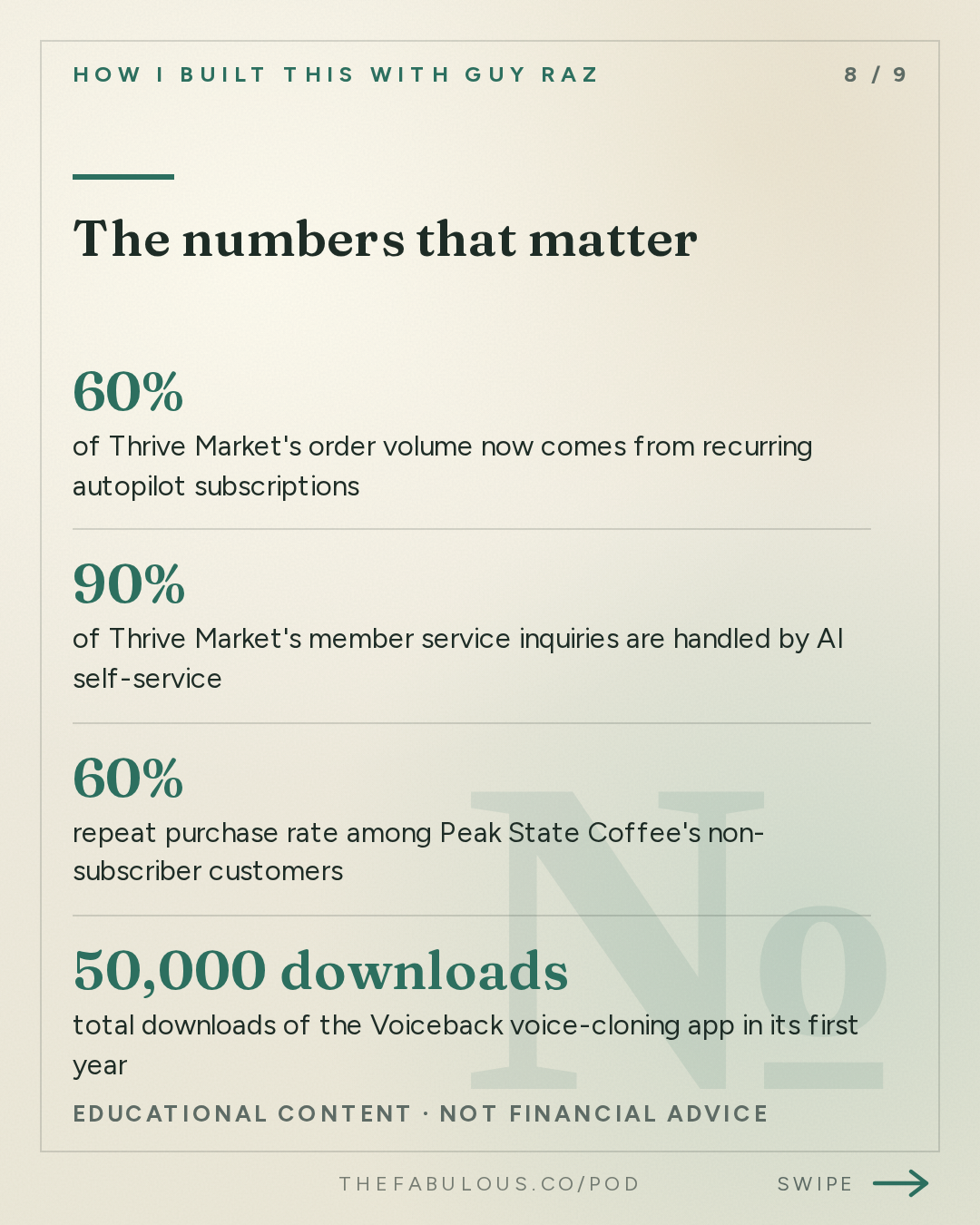
- 60% percent of Thrive Market's order volume now comes from recurring autopilot subscriptions
- 90% percent of Thrive Market's member service inquiries are handled by AI self-service
- 60% percent repeat purchase rate among Peak State Coffee's non-subscriber customers
- 50,000 downloads total downloads of the Voiceback voice-cloning app in its first year
In their words
“Quality really has to imply scalability. Like, they have to become two sides of the same coin.”
“Being constrained on capital as just a forcing function to do things right, be intellectually honest.”
“The number you wanna focus on is not the fifty thousand downloads but on, on five hundred people who, who, who are gonna be far more valuable.”
“To be an entrepreneur, you have to be irrational, you know, arguably insane to take that risk and go do it.”
Protocols
-
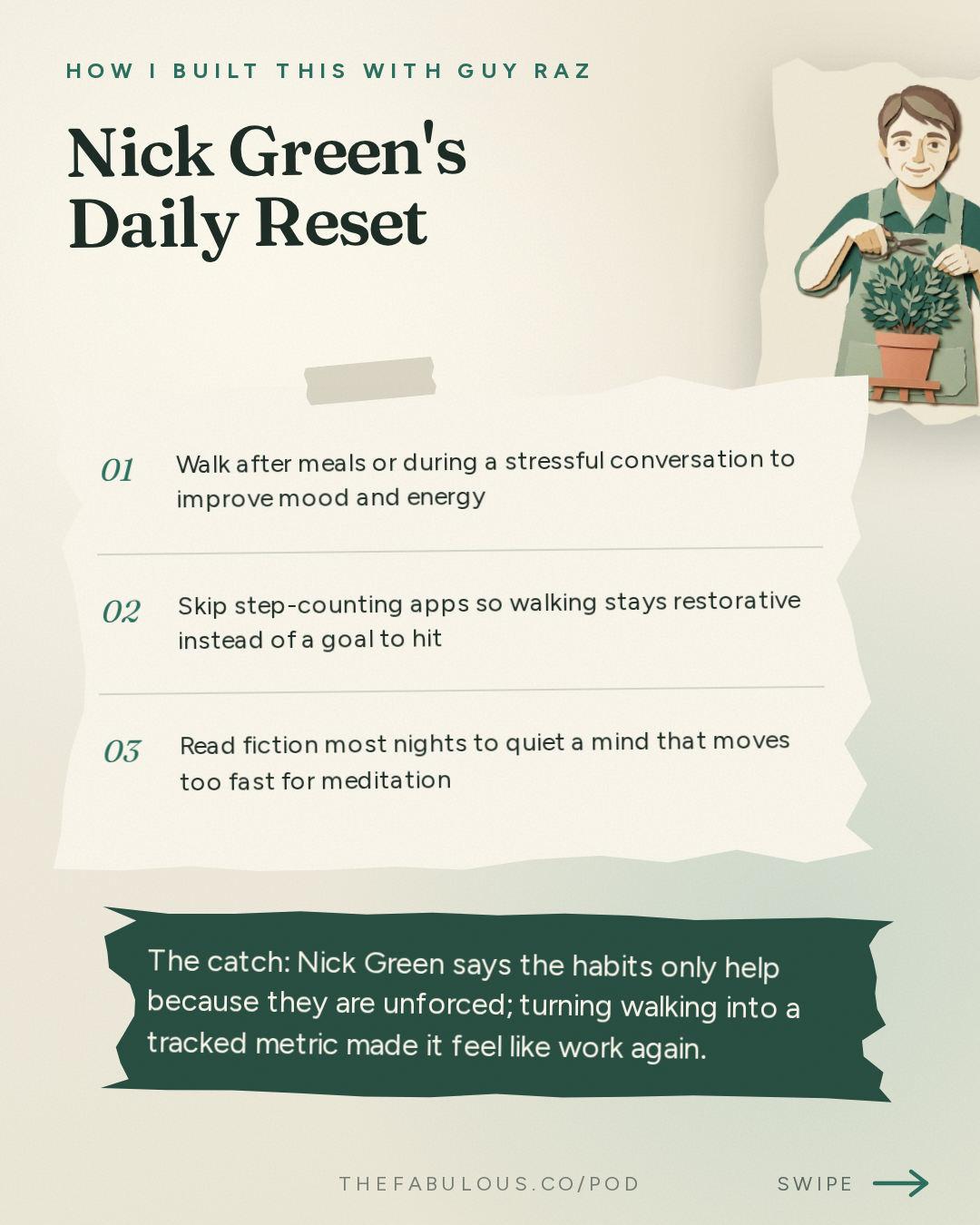
Walk after eating or during stress
Nick Green walks after meals and during stressful conversations because staying in motion improves his mood and energy, and he no longer tracks his steps because doing so turned the habit into a goal-driven chore instead of something restorative.
daily
-
Read fiction to quiet a fast-moving mind
Nick Green reads fiction most nights because meditation does not work for him and reading transports his attention away from work, which he considers the most underappreciated mental health habit for founders whose minds run too fast to slow down.
nightly
-
Find the 20 percent driving 80 percent of results
Nick Green advises founders who are overwhelmed across every part of their business to identify the small share of inputs, whether that is SKUs, channels, or tasks, that drives most of the output, then simplify ruthlessly around that core before hiring or expanding further.
ongoing, revisited as the business grows
-
Pay promotion in equity, not cash
Nick Green says Thrive Market paid early influencers in company equity instead of cash to promote the brand, which let the company raise less outside venture money while still building a marketing channel that felt authentic rather than like a paid ad.
one-time equity grants during early fundraising rounds
Questions this episode answers
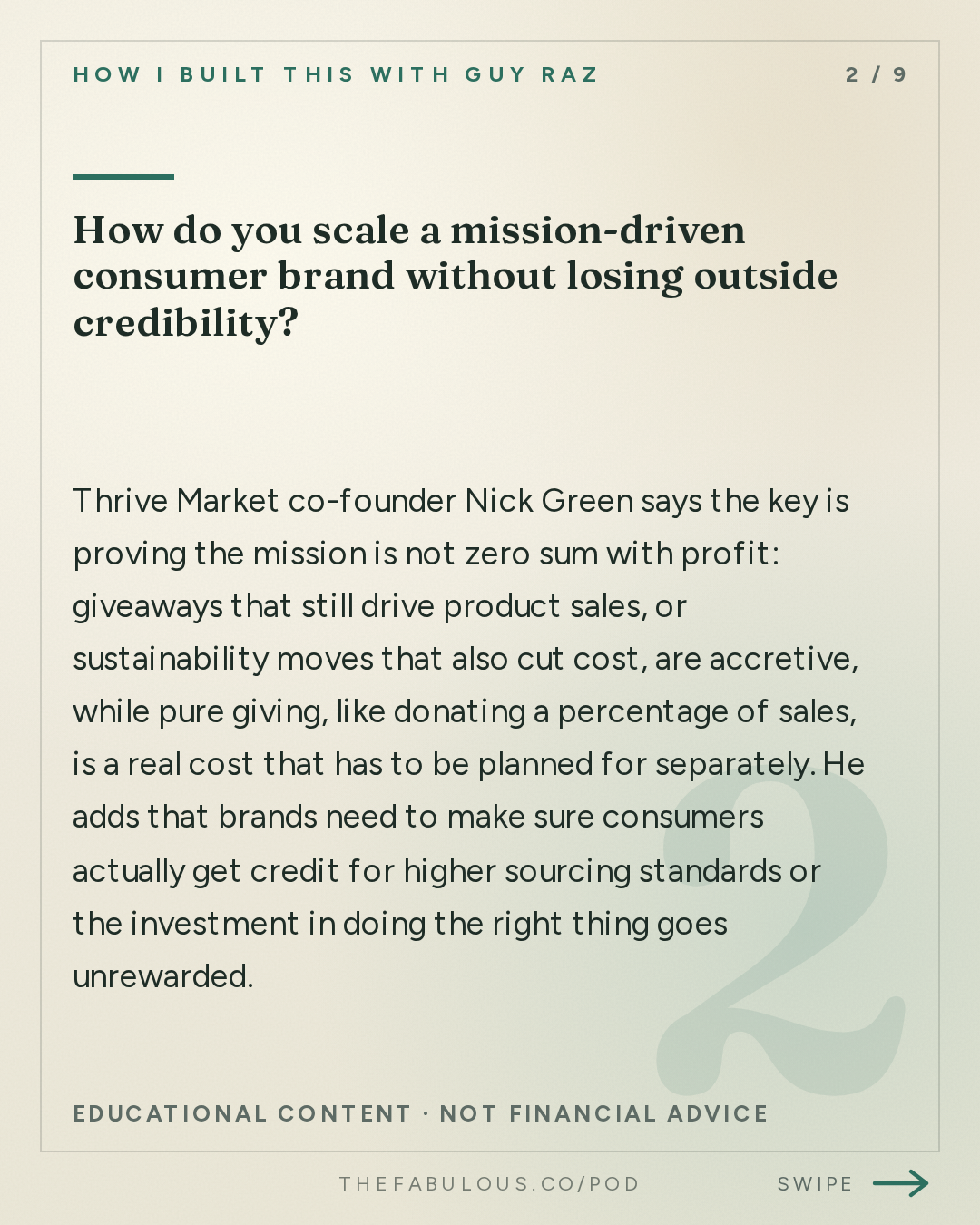
How do you scale a mission-driven consumer brand without losing outside credibility?
Thrive Market co-founder Nick Green says the key is proving the mission is not zero sum with profit: giveaways that still drive product sales, or sustainability moves that also cut cost, are accretive, while pure giving, like donating a percentage of sales, is a real cost that has to be planned for separately (28:33). He adds that brands need to make sure consumers actually get credit for higher sourcing standards or the investment in doing the right thing goes unrewarded (29:32).
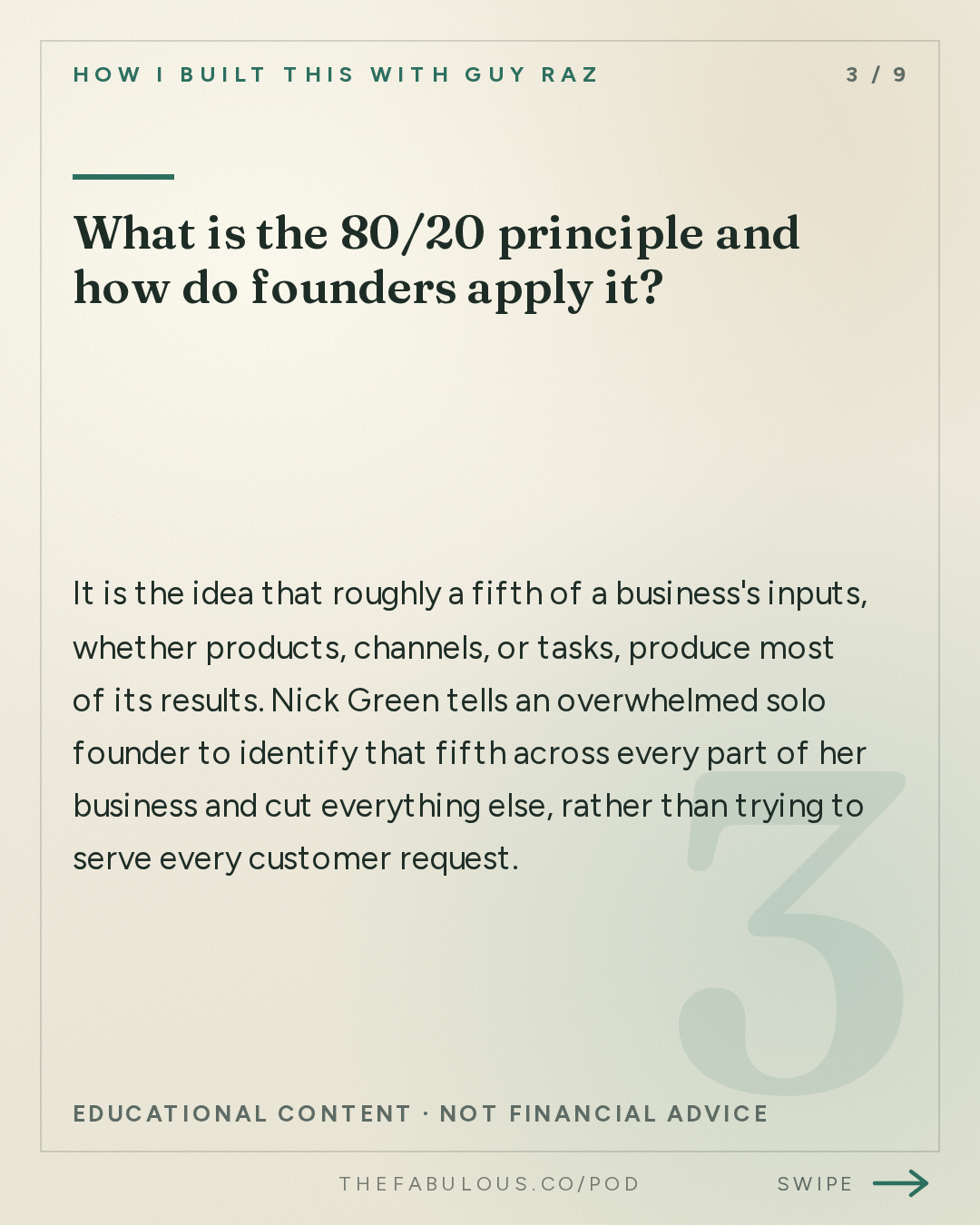
What is the 80/20 principle and how do founders apply it?
It is the idea that roughly a fifth of a business's inputs, whether products, channels, or tasks, produce most of its results. Nick Green tells an overwhelmed solo founder to identify that fifth across every part of her business and cut everything else, rather than trying to serve every customer request (17:34).
Should a coffee subscription brand raise venture capital to grow?
Nick Green argues it depends on timing: debt avoids diluting ownership but must be repaid regardless of performance, while equity partners share risk and can act as thought partners for a solo founder (29:55). He also notes that staying capital-constrained forces intellectual honesty and discipline, and that a coffee brand with a 60 percent repeat purchase rate among non-subscribers may be able to grow to $5 million or $10 million without raising money at all (33:48).
What does it mean to pay influencers in equity instead of cash?
Nick Green says Thrive Market gave early influencers company equity to promote the brand rather than paying cash fees, which let the company raise less outside venture funding while building an authentic marketing channel driven by people who were already customers and fans (35:29).
How do you market an AI health app when standard ad targeting can't reach the right customer?
For Voiceback, an app that clones voices for people losing speech to ALS, Nick Green advises proving the paid product works before chasing broad awareness, then growing through grassroots channels like ALS forums and support groups rather than paid social targeting (42:40). Guy Raz adds that founders should cold-email neurologists, speech pathologists, and ALS clinics directly, since caregivers and clinicians often make the purchase decision on a patient's behalf (44:50).
The full read, in cards
Mentioned
Nick Green · Guy Raz · Thrive Market · Mercedes Smith · Black Strad Concert Attire · Figs · Danny Walsh · Peak State Coffee · Riya Jain · Voiceback · Dr. Richard Bedlack
More from this show and category
How I Built This: 10 Years of Top Lessons
Guy Raz marked 10 years of How I Built This by revisiting lessons from over 600 founder interviews with Ring co-founder Jamie Siminoff (07:23). The episode replays James Dyson's five-year vacuum quest (32:44) and Airbnb's 2008 pitches, where zero of 20 investors said yes (45:47), arguing fear, scrappiness, and rejection are normal parts of building something lasting.
Seventh Generation's Founders: A Partnership That Broke
Alan Newman and Jeffrey Hollender turned a discarded 1988 mail-order catalog into Seventh Generation, then split so badly they barely spoke for decades. Newman built the product and culture; Hollender raised money and later ran the company through a retail pivot, a 2010 board ouster, and Unilever's 2016 acquisition for $700 million.
Danny Meyer's Advice for Startup Founders
Danny Meyer, the Shake Shack founder, explains why he replaced family values with expected behaviors to run culture at Union Square Hospitality Group. On this advice-line episode he coaches three food and drink founders on branding canned cocktails, shipping perishable salmon, and pitching couscous to fast-casual chains, all through the lens of measurable, scalable hospitality.
How Banza Built Chickpea Pasta Into a Top Brand
Brian Rudolph turned a wheat allergy into Banza, the first chickpea pasta, by fixing a factory disaster with a tea-steeping trick and later rebuilding trust after a viral glyphosate scare. His story is a case study in scrappy product development and honest crisis response.
