
Tara Bosch's Advice: D2C to Retail Growth
Advice Line with Tara Bosch of SmartSweets
The brief
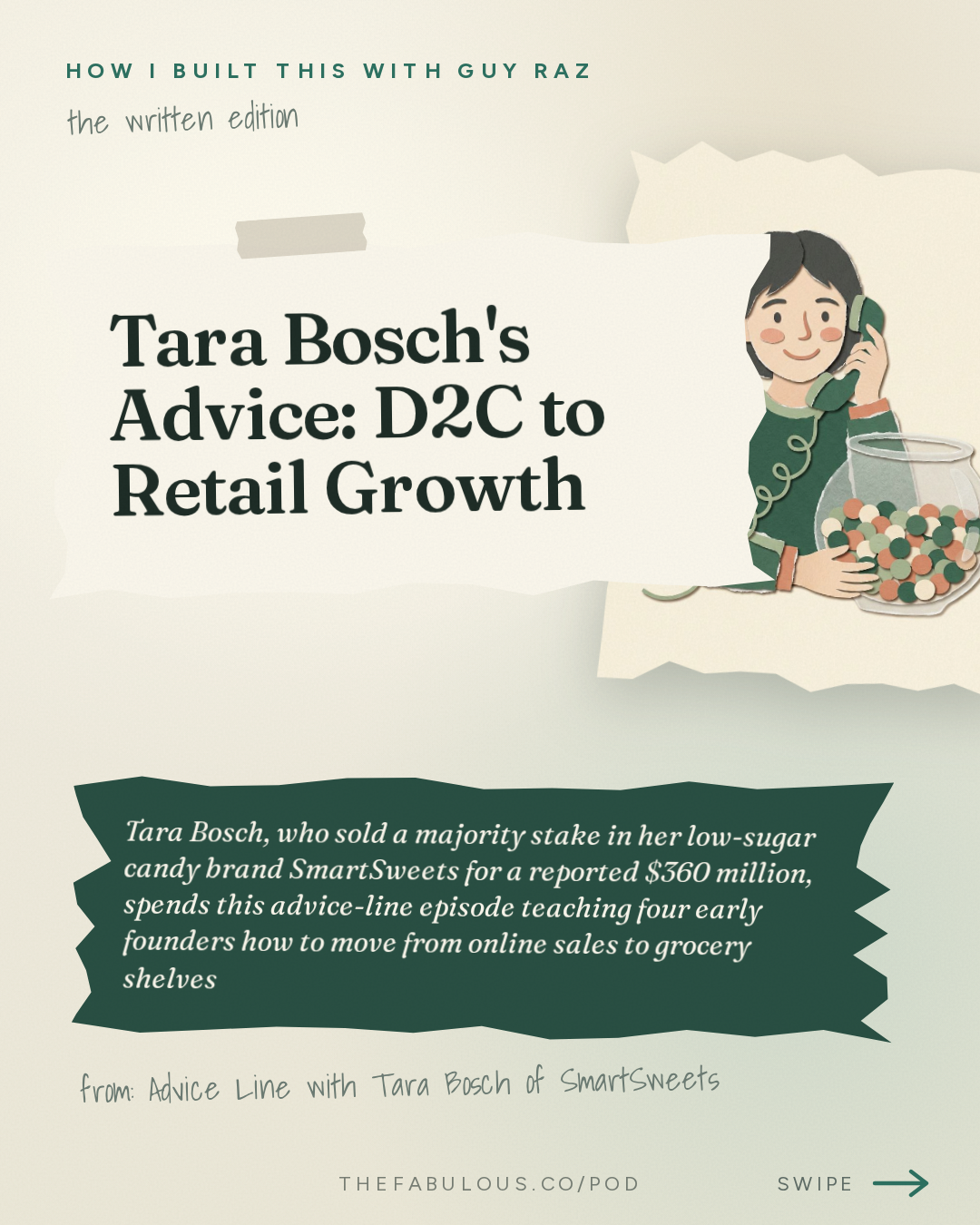
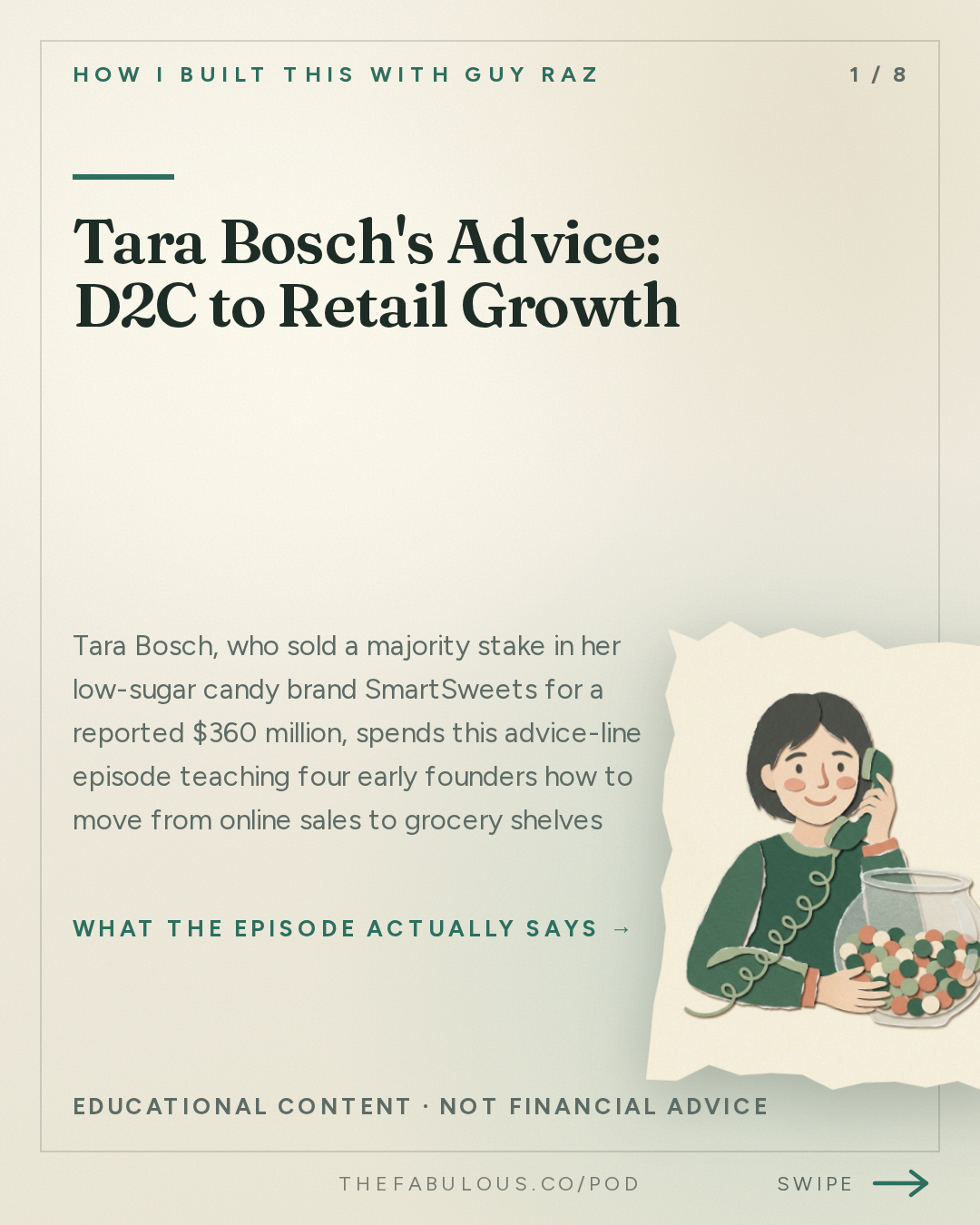
Tara Bosch, who sold a majority stake in her low-sugar candy brand SmartSweets for a reported $360 million (00:49), spends this advice-line episode teaching four early founders how to move from online sales to grocery shelves, price sugar and price value in three seconds, and read customer emotion through phone calls rather than DMs.
A marshmallow bought online and a marshmallow bought in a grocery aisle are, chemically, the same marshmallow. But they are different products, because they are bought for different reasons. One is ordered two weeks ahead, in a box of twelve, by someone who already loves the brand. The other is grabbed on the way to the checkout by someone who wasn't thinking about marshmallows at all until she saw them. This gap, between a considered purchase and an impulse one, turns out to be the hinge on which most of this episode of How I Built This Lab's Advice Line turns.
The host, Guy Raz, brings back Tara Bosch, who built the low-sugar candy brand SmartSweets from kitchen experiments into a company that sold a majority stake for a reported $360 million (00:49). She dropped out of college at 21 with no background in food science (01:08) and is no longer operationally involved in SmartSweets. She now runs a second company, Snackish, built around high-protein potato chips, an idea she credits partly to her four-year-old daughter's obsession with a yellow chip bag (02:07). But the real value of the episode isn't Bosch's own story. It's watching her diagnose three strangers' businesses in real time, using the same handful of mental models she used to build her own.
The shelf is not the website
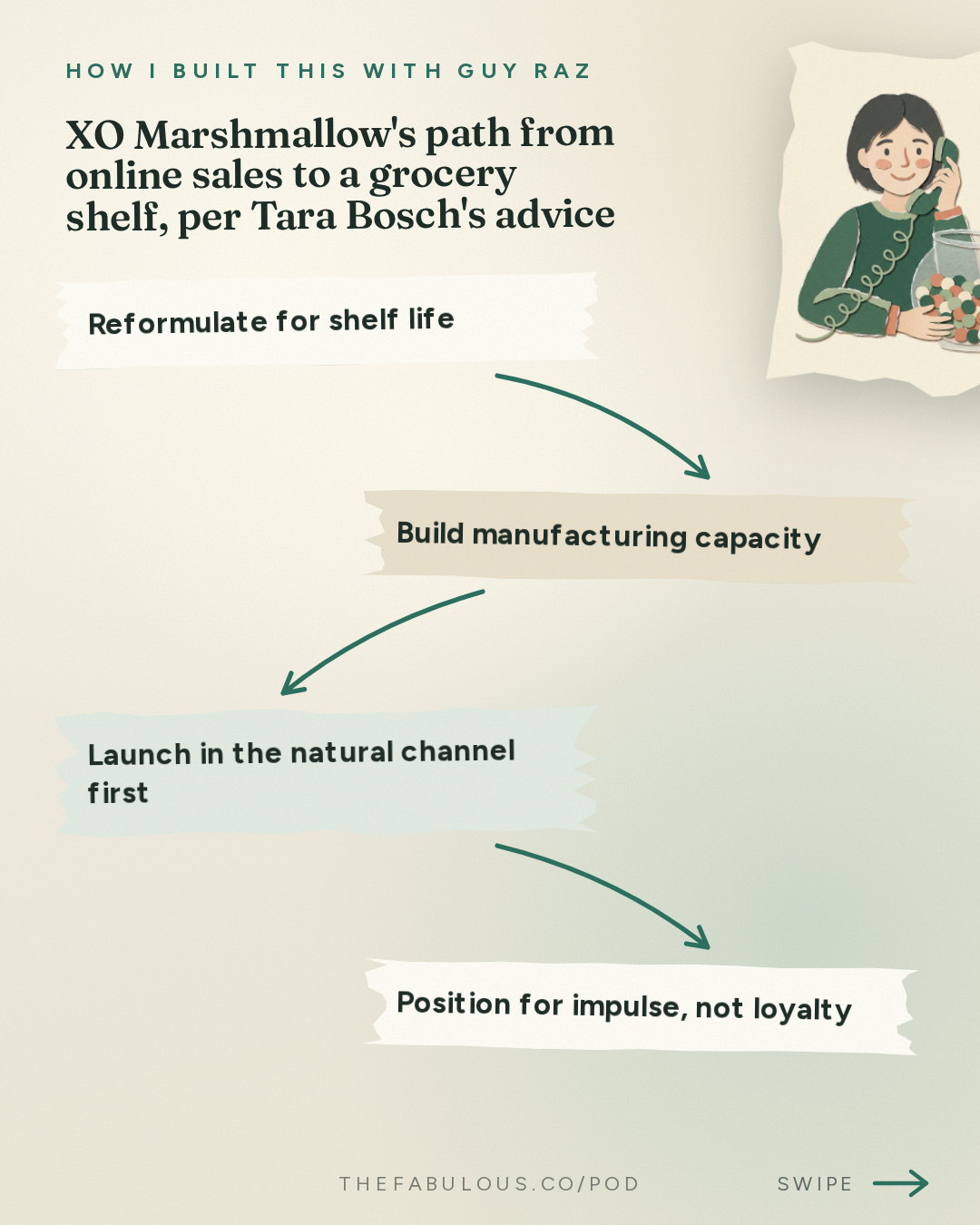
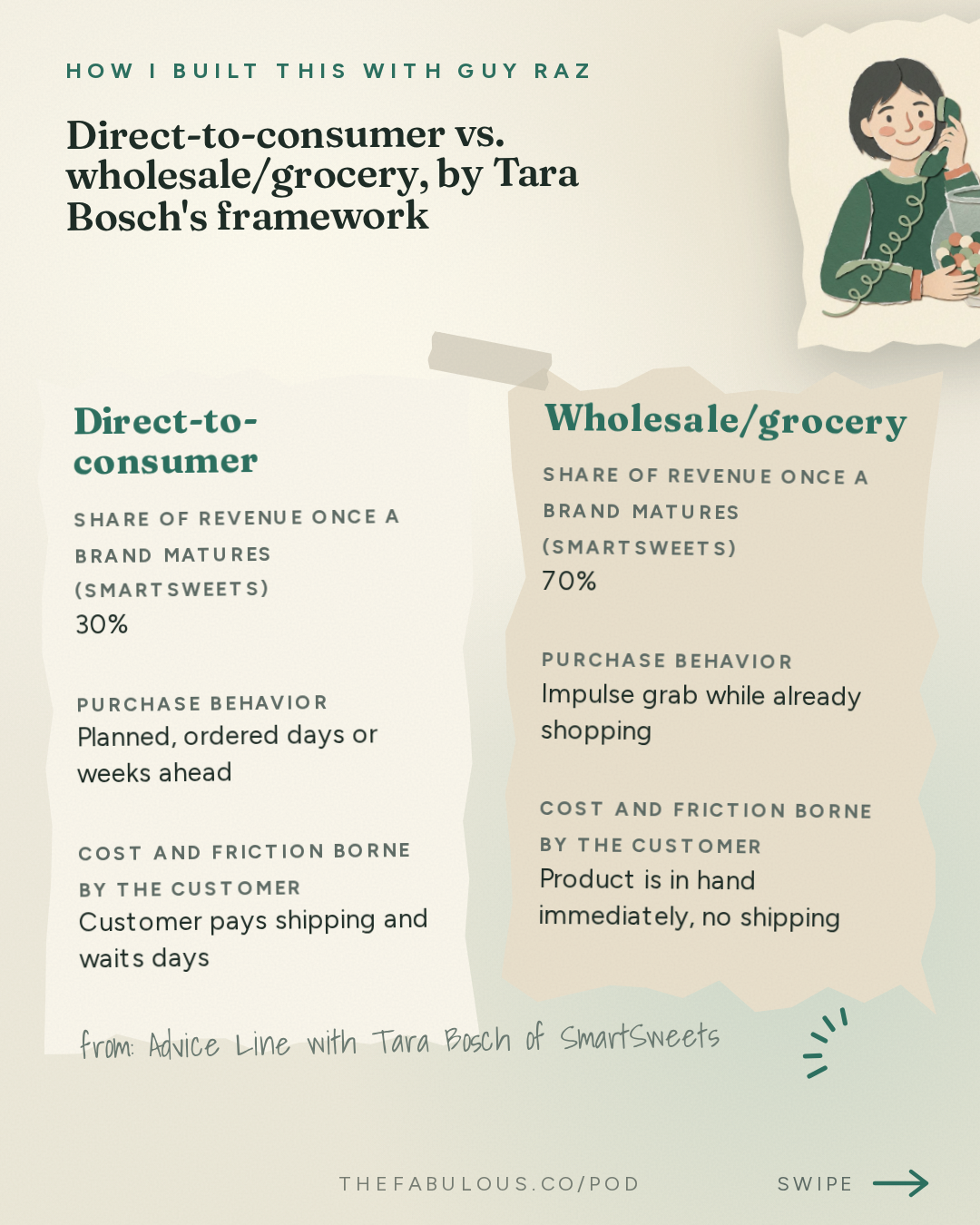
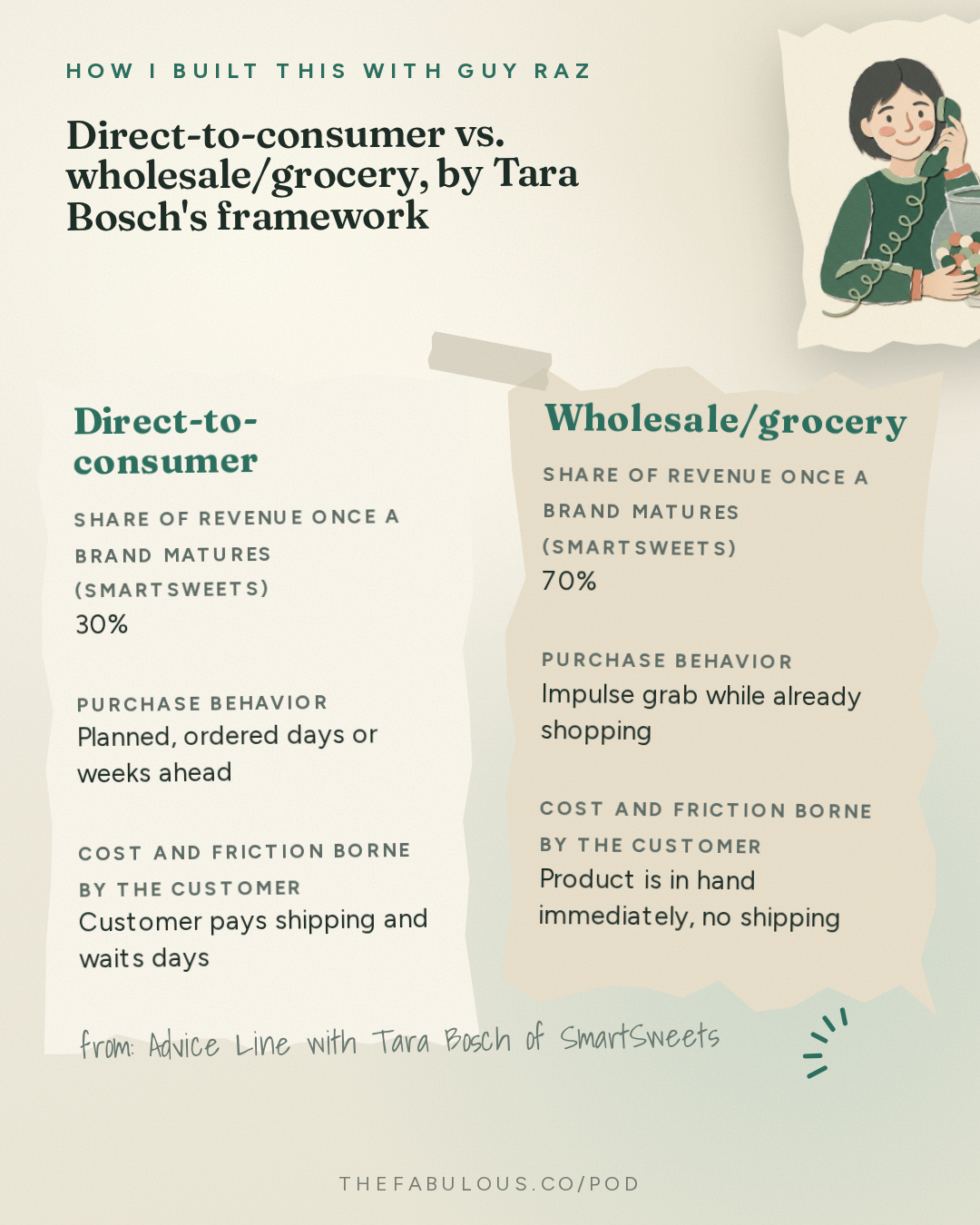
The clearest case study arrives with Lindsay Shanks, founder of XO Marshmallow, a Chicago-based gourmet marshmallow brand doing just under $5 million in annual revenue with 11 employees (08:42). Ninety percent of her sales are direct-to-consumer, and she wants to move into grocery stores without cannibalizing that high-margin online business (08:42, 09:47). She is also mid-reformulation: pulling corn out of her recipe and switching to shelf-stable packaging extends a marshmallow's shelf life from four months to eighteen (09:22), a prerequisite for sitting on a grocery shelf at all. Bosch's answer rests on a single observation: marshmallows and candy are impulse items. At SmartSweets, the revenue mix eventually settled at roughly 70% wholesale and 30% direct-to-consumer (10:10), and Bosch argues the two channels serve different jobs rather than competing for the same customer. "Grocery really became such an impulse buy," she tells Shanks, "where she may not be thinking about it two weeks before she wants to enjoy them to order them" (10:48). Online, a customer plans ahead and absorbs shipping costs and wait times, Shanks's own customers' biggest complaint (11:14). On a shelf, the purchase happens because the product is physically in front of someone, which is why accessibility, not loyalty, drives grocery sales.
Bosch also advises Shanks to launch through the natural retail channel, meaning stores like Whole Foods that sell organic or minimally processed goods, rather than mass retailers. In her experience, natural retailers are more forgiving to early-stage brands: they grant end caps and merchandising placement without demanding the same upfront payments mass chains require "from the hop" (16:39). It's a quieter, slower on-ramp, but one that doesn't require the capital a young company usually doesn't have.
Underneath the channel strategy sits a subtler question: how much sugar is too much, and how little is too little? Shanks says four to six of her marshmallows contain about 20 grams of sugar (14:29). Bosch reframes this not as a nutrition problem but a permission problem. At SmartSweets, she says, the insight wasn't removing sugar for health's sake, it was finding "what is that threshold with sugar that's the tipping point for giving people that permissibility to truly eat marshmallows every single day" (14:29). Raz's suggestion, a sugar-alternative SKU made with allulose, a natural sweetener that doesn't spike blood sugar, is offered as an add-on line rather than a replacement, as Shanks proposes, partly because some retailers, including Whole Foods, have begun restricting allulose (15:21, 16:08). The lesson generalizes beyond candy: better-for-you products succeed not by maximizing virtue but by finding the exact point where a customer stops feeling guilty and starts feeling fine.
Three seconds, then a phone call
The second caller, Vivi, runs a sustainable swimwear label called Vivi's Vacation, sewn with Brazilian fabric she considers superior to typical U.S. market swimwear (20:47). She has sold direct-to-consumer only, peaking at 60 orders in a two-week span (22:43), and asks how to edit a complicated product story down for packaging, social posts, and email. Bosch's answer is a constraint: communicate the value proposition in three seconds or less (24:50), the rough window a shopper gives a product before moving on. She credits the idea partly to a Tim Ferriss interview about marketing his book The 4-Hour Workweek, where the strategy wasn't to appeal to everyone but to find and "infiltrate" a specific niche audience first (25:15). Raz points to Banza, a protein pasta brand whose orange box, he says, is a primary reason it catches a shopper's eye in the pasta aisle (27:13). For Vivi, the advice lands as a demand for specificity: stop saying "sustainable swimwear" and start showing why Brazilian fabric and a surfer's authentic story make this swimsuit different, starting with the website.
The second half of Bosch's answer is less about design than discipline. She tells Vivi that calling customers directly, not messaging them, taught her more about SmartSweets than any dashboard did:
"It was incredible the amount that I learned... in picking up the phone and calling the customers." — Tara Bosch (26:18)
The method is almost embarrassingly simple: ask repeat buyers for ten minutes, then listen for the emotional thread that repeats across conversations, not the one clever line from a single customer. It costs nothing but time, which is precisely why early founders tend to skip it in favor of scrolling analytics.
The last caller, Ali Aguilar, runs Romanticize Collective, a Los Angeles-based subscription box that delivers curated real-world experiences, like learning to make cavatelli pasta or watching a meteor shower, rather than physical products (30:58). Launched in January, it has 30 recurring members and just under $20,000 in total sales (33:13). Aguilar's question is a classic early-stage fork: keep refining the existing subscription model, or evolve the business into something else entirely.
Bosch's diagnostic tool here is word of mouth, or what she calls the "waterfall effect," the natural chain reaction where a product experience is good enough that a customer immediately tells a friend, who signs up the next day (37:10). If that chain isn't happening, she argues, the problem isn't marketing spend, it's something in the product itself creating friction. Raz adds a broader read: as more of daily life becomes digital or AI-generated, tactile, in-person experiences become scarcer and therefore more valuable, which is why he suggests Aguilar test an in-person version of the box in Los Angeles rather than only iterating the mailed product (36:03, 38:56). Aguilar reveals she is already testing exactly that, a scavenger hunt and journaling event in Culver City at month's end (39:26), suggesting the advice confirmed an instinct already forming rather than supplying a new one.
What ties these four conversations together isn't candy or swimwear or marshmallows. It's the recurring claim that growth doesn't come from spending more, it comes from seeing more clearly: what a customer is actually buying, what threshold makes a product feel permissible, and what three seconds of attention a package has to earn. Bosch closes with the most abstract piece of advice and, not coincidentally, the one she says mattered most. Asked what she'd tell her younger self at the start of SmartSweets, she doesn't mention sugar or retailers. She repeats a quote she can't attribute:
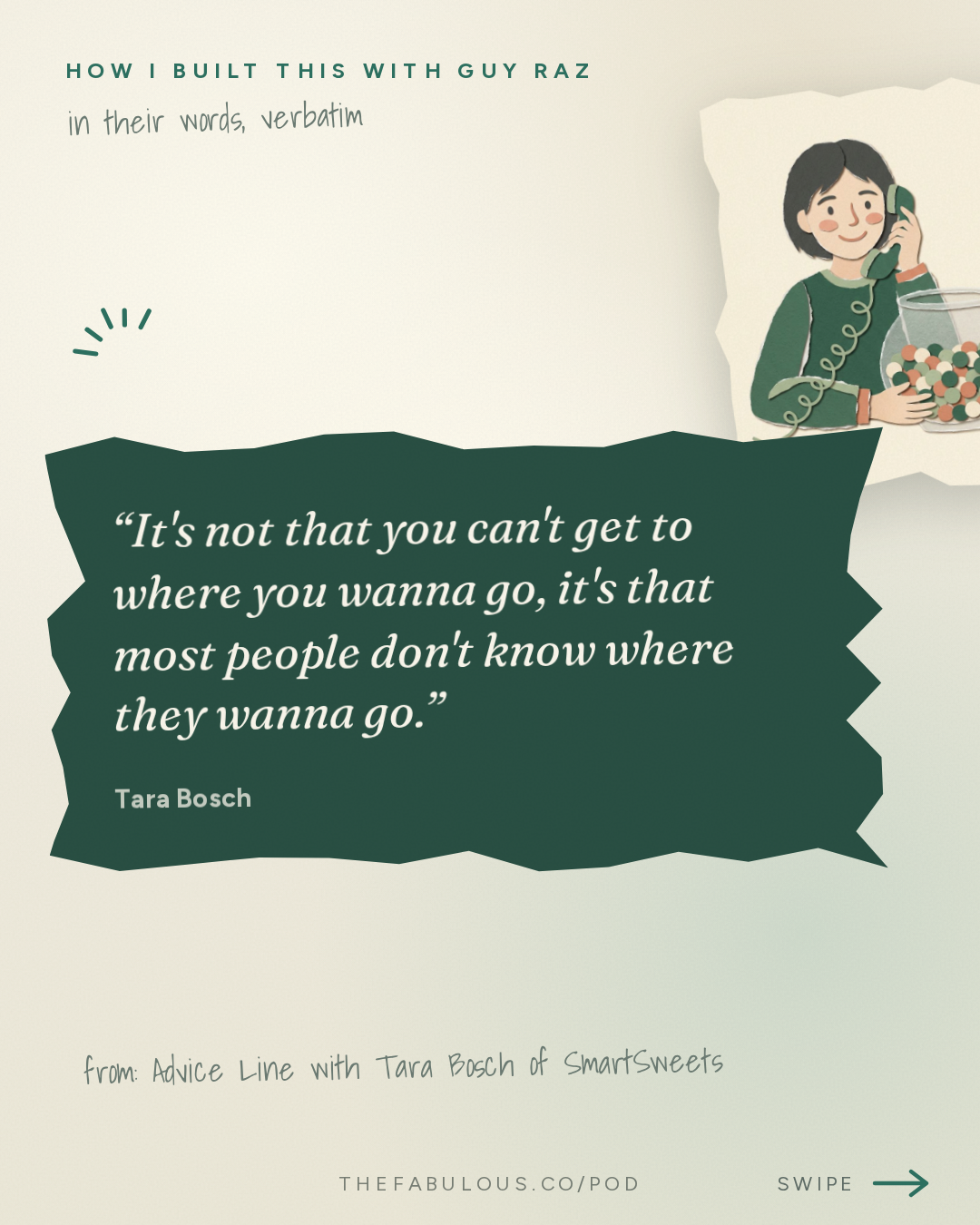
"It's not that you can't get to where you wanna go, it's that most people don't know where they wanna go." — Tara Bosch (41:12)
She says defining that five-year picture with real clarity, not just a vague sense of ambition, shaped every specific decision that followed, including which retailers to chase and which to ignore (41:35). It's a strange note to end a tactical advice show on, since it offers no formula at all. But it matches everything that came before it: the three-second rule, the sugar threshold, the ten-minute phone call. Each is a way of forcing clarity out of something that feels, at first, too big or too vague to name.
Ask this episode anything
Pod's AI answers from the episode itself, with the minute mark so you can hear it yourself.
Or start with one of these
Ask this episode
Pod's AI listens to the whole episode to answer, and points you to the minute it comes from.
The rest of this answer, and any question after it
Answers come from the episode itself, never from a summary of it.
ContinueKey takeaways
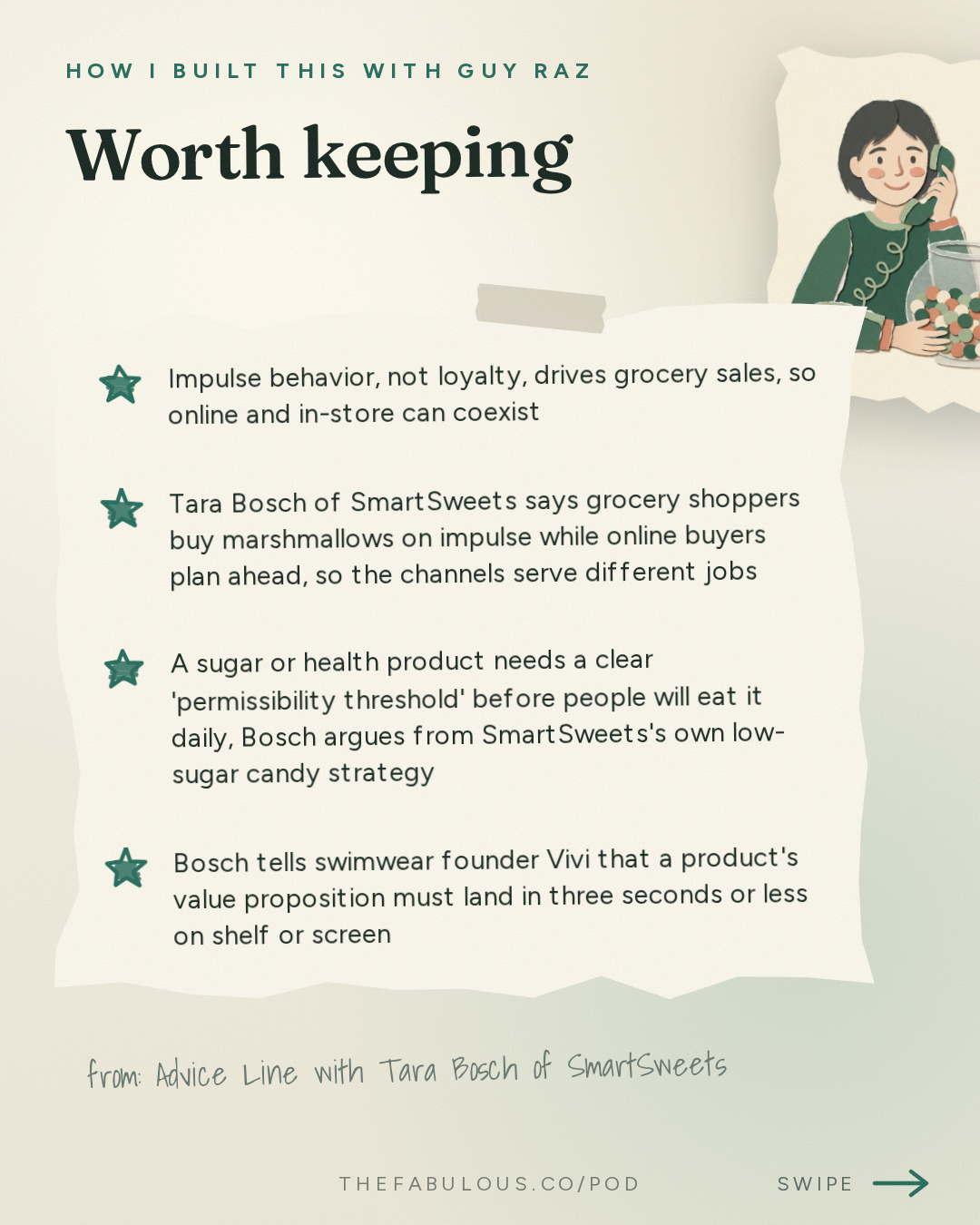
- Impulse behavior, not loyalty, drives grocery sales, so online and in-store can coexist
- Tara Bosch of SmartSweets says grocery shoppers buy marshmallows on impulse while online buyers plan ahead, so the channels serve different jobs (10:48)
- A sugar or health product needs a clear 'permissibility threshold' before people will eat it daily, Bosch argues from SmartSweets's own low-sugar candy strategy (14:29)
- Bosch tells swimwear founder Vivi that a product's value proposition must land in three seconds or less on shelf or screen (24:50)
- Bosch says calling repeat customers for a 10 minute conversation reveals emotional buying motives that DMs and dashboards miss (26:18)
- Bosch calls lack of 5-year clarity, not lack of ability, the main reason founders stall, a lesson she says shaped SmartSweets's retail decisions (41:12)
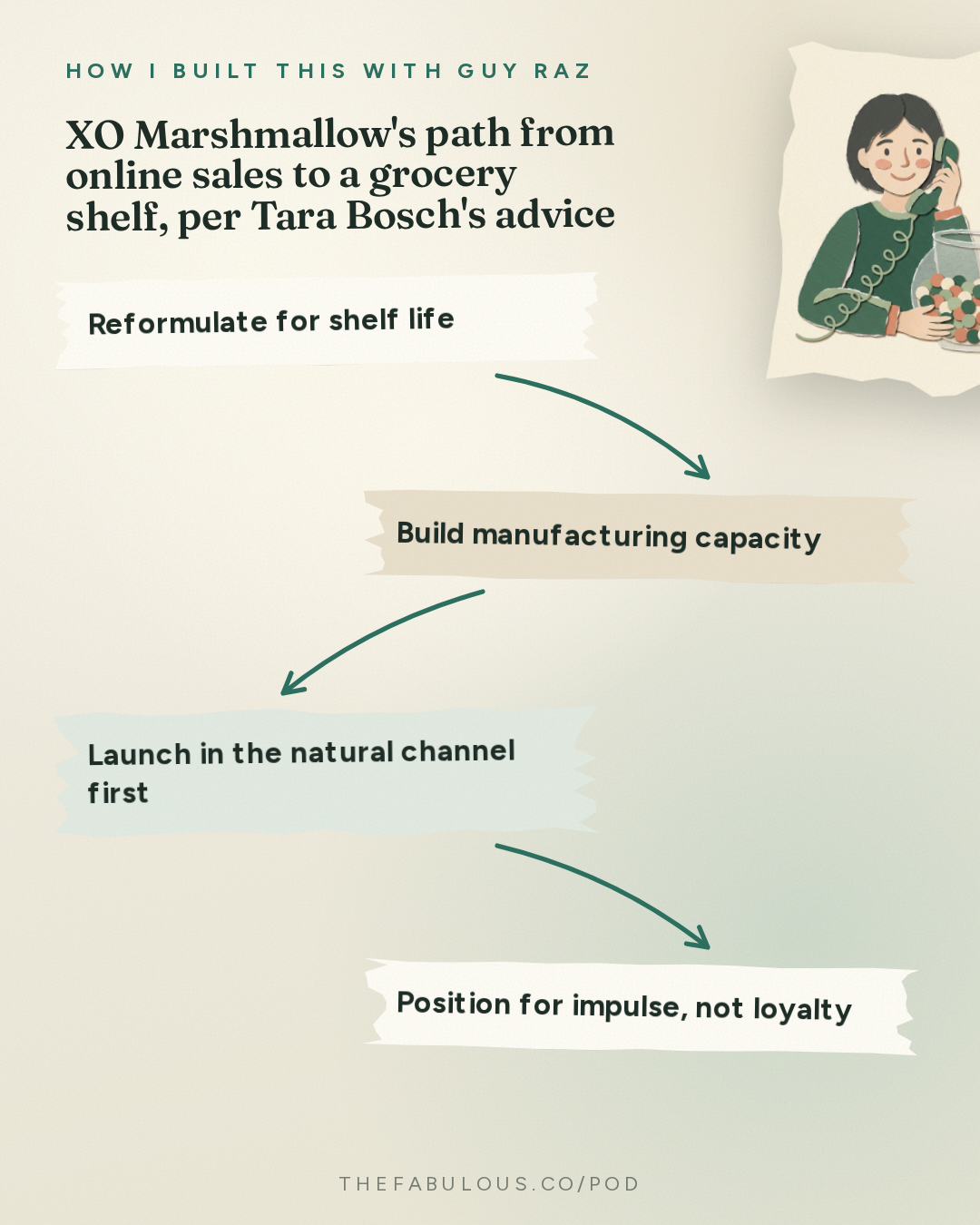
The episode in cards
By the numbers
- 70% percent share of SmartSweets's revenue that came from wholesale once the business matured
- 18 months shelf life XO Marshmallow reaches after reformulating to remove corn
In their words
“How do we leverage- Hmm ... the community and cultural relevance that we've spent the last 10 years building to drive grocery sales”
“What is that threshold with sugar that's the tipping point for giving people that permissibility to truly eat marshmallows every single day?”
“It's not that you can't get to where you wanna go, it's that most people don't know where they wanna go.”
Protocols
-
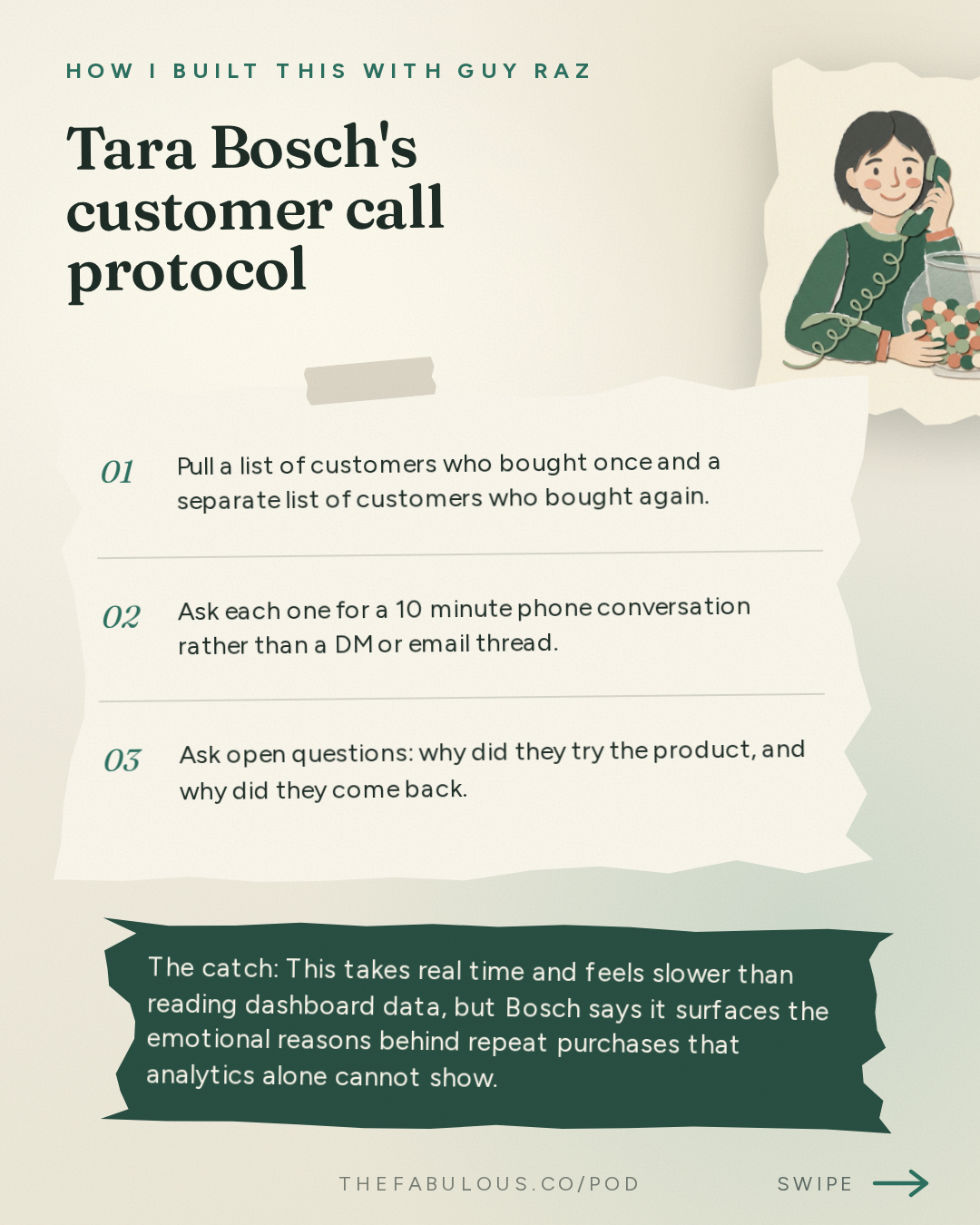
Tara Bosch's customer phone call method
Bosch tells founders to identify customers who bought once and customers who bought again, then ask each for a 10 minute phone conversation instead of relying on DMs or email. She says to ask open questions about why they first tried the product and why they came back, then listen across several calls for the emotional theme that repeats, since that recurring thread, not any single comment, points to the real reason people buy.
Ongoing, especially in early-stage growth
-
Bosch's three-second value proposition rule
Bosch advises founders to compress their product's core value proposition so a shopper or scroller can grasp it in three seconds or less, whether on a package, a website header, or a social post. She points to Banza's orange pasta box as an example of a design choice that captures attention that fast on a shelf.
Applied to every customer-facing touchpoint: packaging, website, social, email
Questions this episode answers
How does Tara Bosch suggest a D2C brand move into grocery stores without hurting online sales?
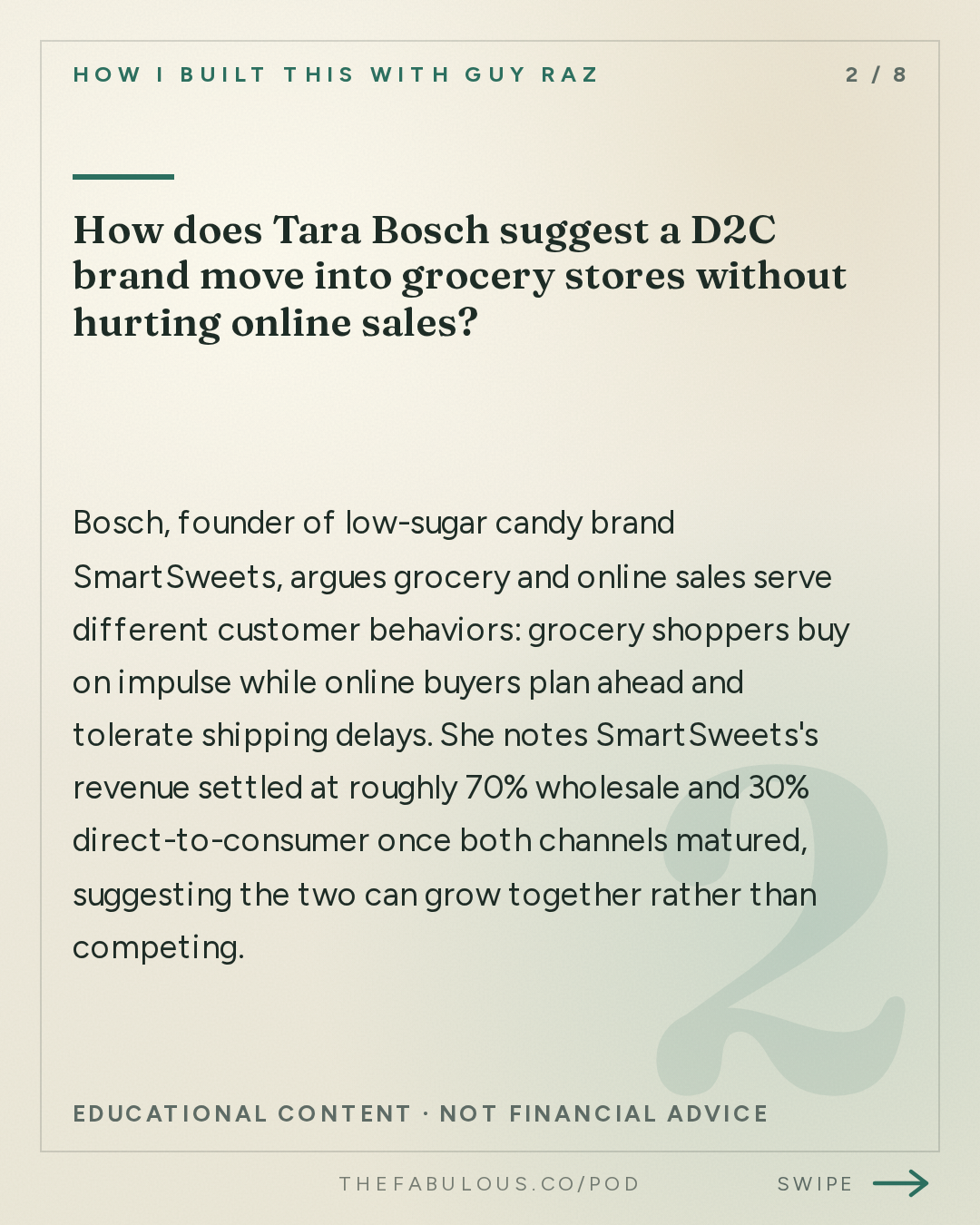
Bosch, founder of low-sugar candy brand SmartSweets, argues grocery and online sales serve different customer behaviors: grocery shoppers buy on impulse while online buyers plan ahead and tolerate shipping delays (10:48, 11:14). She notes SmartSweets's revenue settled at roughly 70% wholesale and 30% direct-to-consumer once both channels matured (10:10), suggesting the two can grow together rather than competing.
What is the 'permissibility threshold' Tara Bosch talks about for sugar?
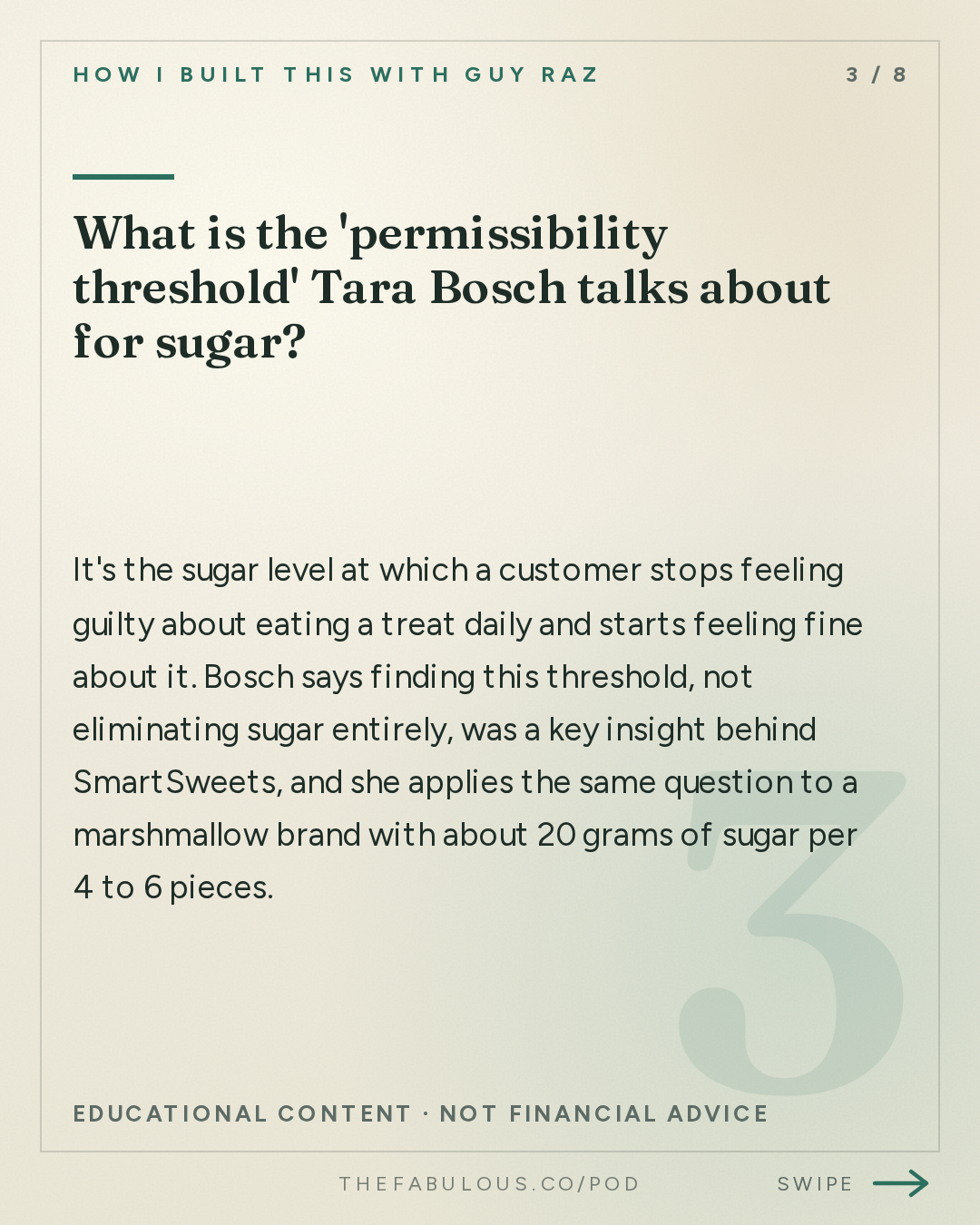
It's the sugar level at which a customer stops feeling guilty about eating a treat daily and starts feeling fine about it. Bosch says finding this threshold, not eliminating sugar entirely, was a key insight behind SmartSweets, and she applies the same question to a marshmallow brand with about 20 grams of sugar per 4 to 6 pieces (14:29).
Why does Tara Bosch recommend calling customers instead of messaging them?
Bosch says a 10 minute phone call reveals emotional reasons behind repeat purchases that DMs and analytics dashboards miss. She describes using this method at SmartSweets to find the recurring emotional thread across customers, which guided product and marketing decisions (26:18).
What retail channel does Tara Bosch recommend for early-stage food brands?
Bosch recommends starting in the natural retail channel, stores like Whole Foods that focus on organic or minimally processed goods, because these retailers tend to grant merchandising space and end caps to new brands without requiring the upfront payments mass retailers often demand (16:39).
How did Tara Bosch grow Snackish, her new high-protein chip brand?
Bosch says the idea for Snackish came from watching her five-year-old daughter become attached to a bag of chips, leading Bosch to ask why eating chips daily couldn't feel good the way low-sugar candy did for SmartSweets (02:07). Snackish targets everyday snackers rather than an extreme fitness or diet niche (05:01).
The full read, in cards
Go deeper
- The 4-Hour Workweek — Tara Bosch says a podcast interview with author Tim Ferriss about marketing this book inspired her strategy of targeting a specific niche audience before expanding
Mentioned
Tara Bosch · SmartSweets · Snackish · XO Marshmallow · Lindsay Shanks · Vivi's Vacation · Vivi · Tim Ferriss · Banza · Smashmallow · Ali Aguilar · Romanticize Collective
More from this show and category

How Sweet Loren's Cookie Dough Was Built
Loren Castle grew Sweet Loren's cookie dough into a 30,000-plus-store brand by scaling slowly for a decade. Then she rebuilt the entire line around an allergen-free recipe that became the company's top-selling product within six months of its 2017 launch, after customer emails revealed how many shoppers had dietary restrictions.

Sweet Loren's Cookie Dough Success Story
Loren Castle turned a cookie stand at Brooklyn's Smorgasburg market into Sweet Loren's, a cookie dough brand now in more than 30,000 stores. After surviving Hodgkin's lymphoma at 22, she built the business slowly, then rebuilt it entirely around allergen-free recipes once customer demand made clear that was the real opportunity, reaching profitability in 2018.
CPG Brand: Moving From D2C to Retail
SmartSweets founder Tara Bosch, who sold a majority stake for $360 million, coaches four founders on moving from D2C to grocery retail. She covers wholesale-versus-direct splits, reformulating sugar and allulose, niche marketing for a swimwear brand, and when to pivot an experience-subscription box.
The History of Alamo Drafthouse Cinema
Tim and Karrie League, two Rice University graduates with an engineering job and a microbiology PhD between them, opened a failed art house theater in Bakersfield in 1993, then rebuilt the idea inside an Austin parking garage in 1997 and grew it into Alamo Drafthouse Cinema, a dine-in chain that survived a lawsuit, a Me Too reckoning, and COVID bankruptcy before Sony Pictures Entertainment bought it in 2023.
