
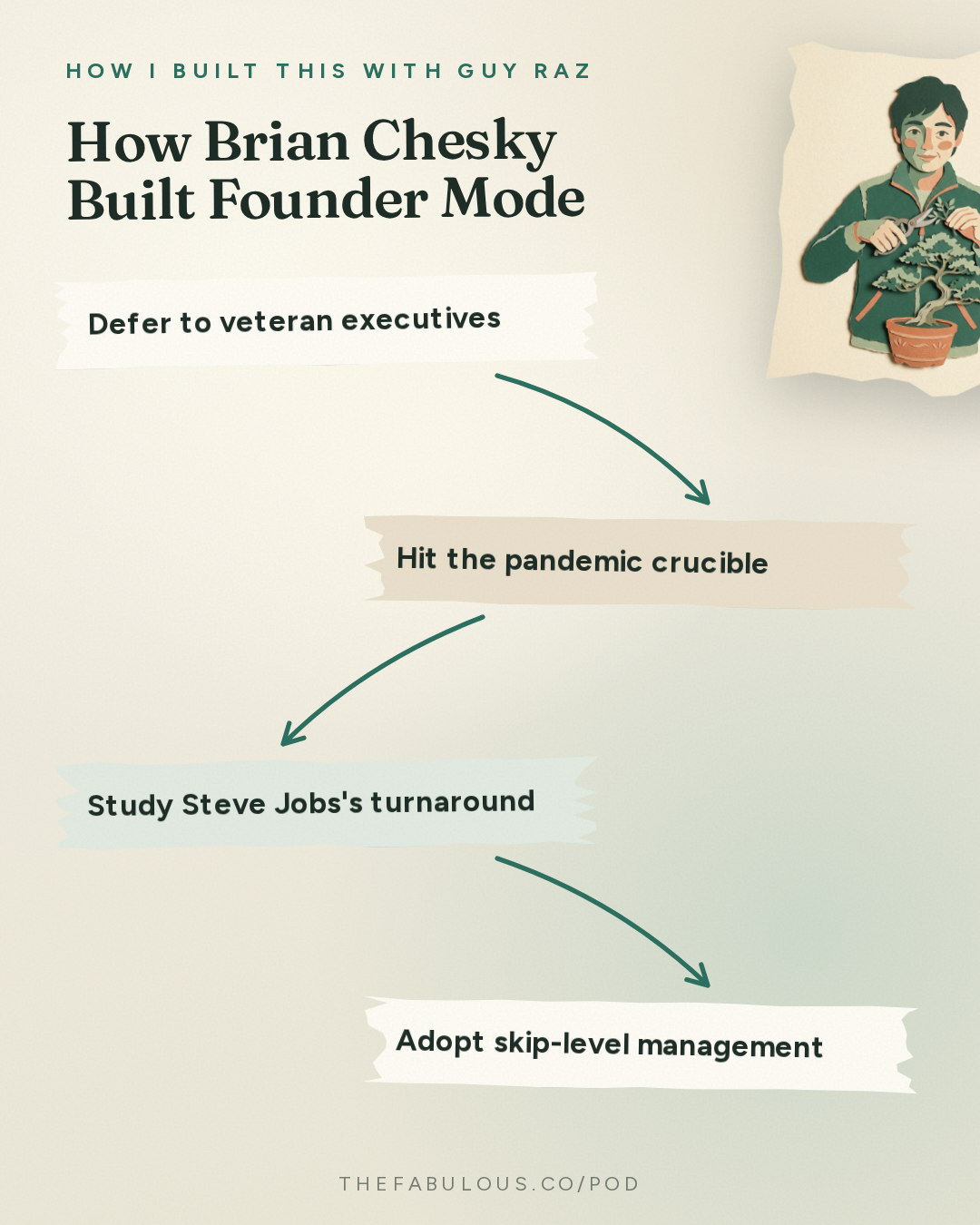
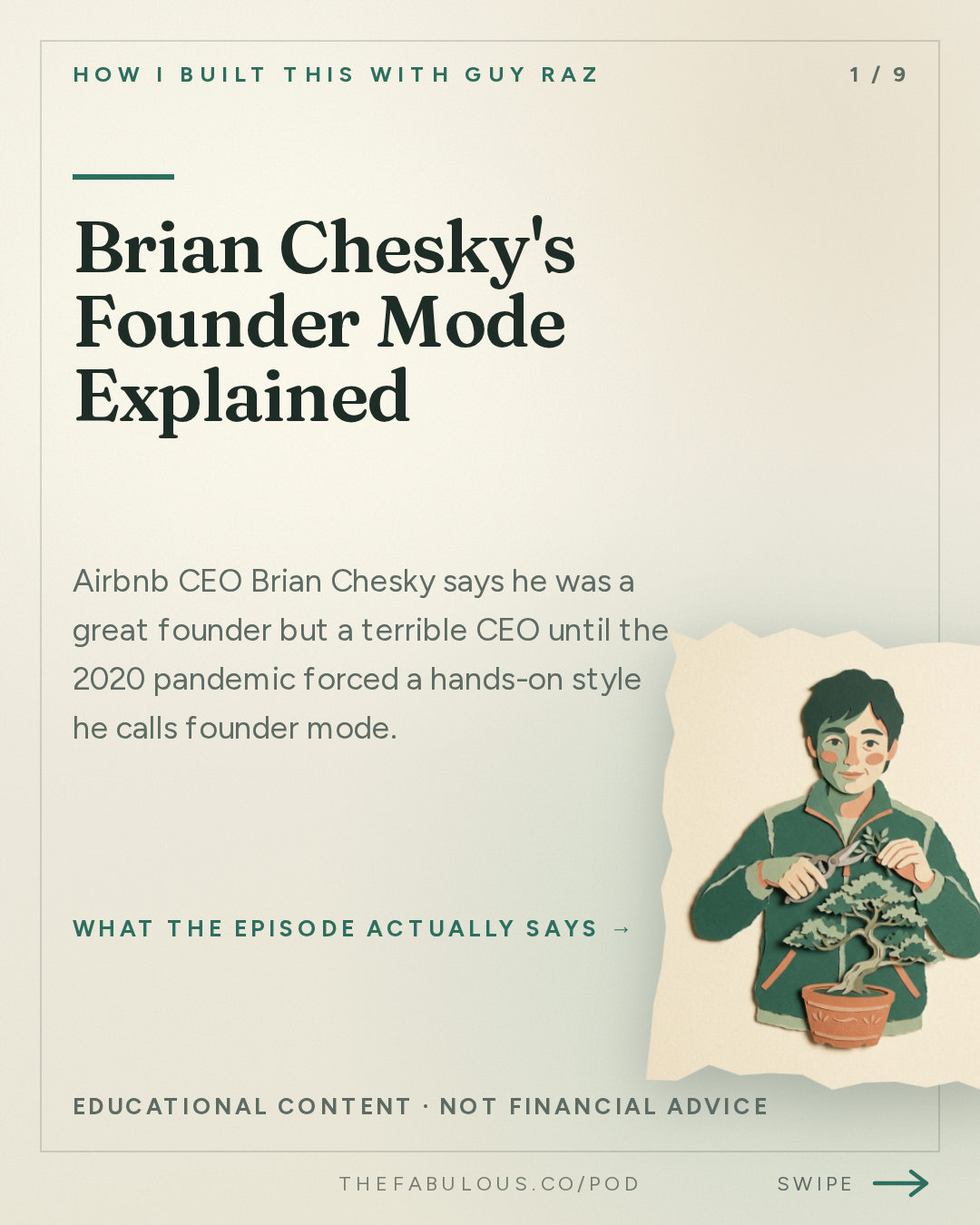
Brian Chesky's Founder Mode Explained
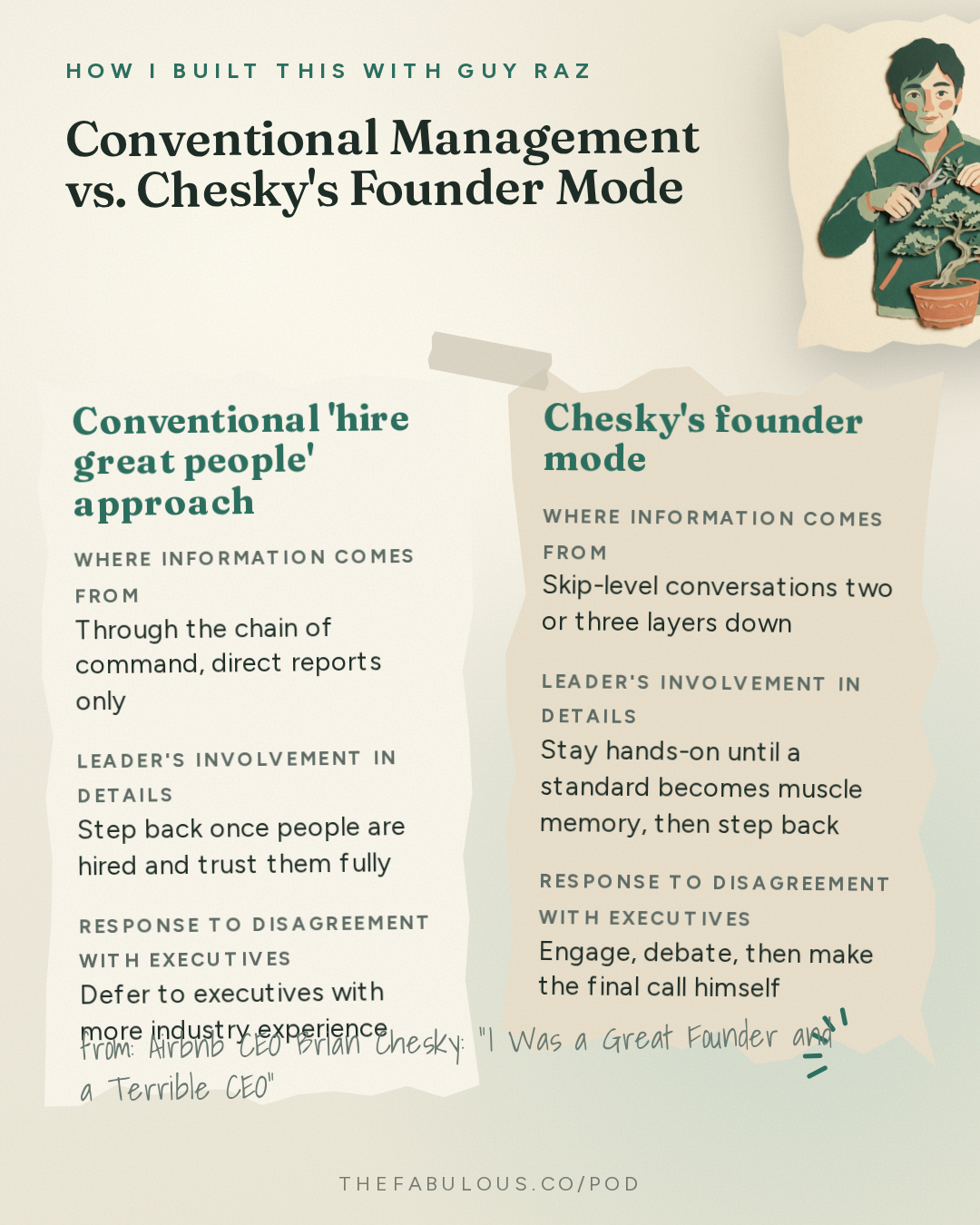
Airbnb CEO Brian Chesky: “I Was a Great Founder and a Terrible CEO”
The brief
Airbnb CEO Brian Chesky says he was a great founder but a terrible CEO until the 2020 pandemic forced a hands-on style he calls founder mode. After Airbnb lost 80% of its business in eight weeks, he stopped deferring to veteran executives and began skip-leveling for raw information, a shift that still shapes how he runs the company.
On December 10, 2020, Brian Chesky took Airbnb public from his living room. There was no bell to ring and no crowd of early employees cheering on a trading floor, just a grid of boxes on a Zoom call, because the pandemic had emptied the streets along with the stock exchange (06:13). By the end of that day, the company he had co-founded on air mattresses in a San Francisco apartment was worth more than $100 billion (05:50). He went to bed the chief executive of a hundred-billion-dollar public company, he says, never imagining he would one day run something that size. The next morning he put on sweatpants and logged onto another Zoom meeting, and nothing felt any different.
"I wake up, put on sweatpants. I get on a Zoom meeting." Brian Chesky, [06:38]
That flatness, he says, cracked something open. So much of his life, starting in childhood, had been organized around wanting to be special (07:02). Once he reached the mountaintop, he realized the view did not change how he felt inside, and the applause, he says, works like a drug that wears off fast (07:46). What follows in his conversation with Guy Raz is not really the story of how Airbnb got built. It is the story of how long it took Chesky to learn to run it.
He was 26 when he, Joe Gebbia, and Nathan Blecharczyk started Airbnb (04:49), and for the next decade or so, he says, he was excellent at the wrong job.
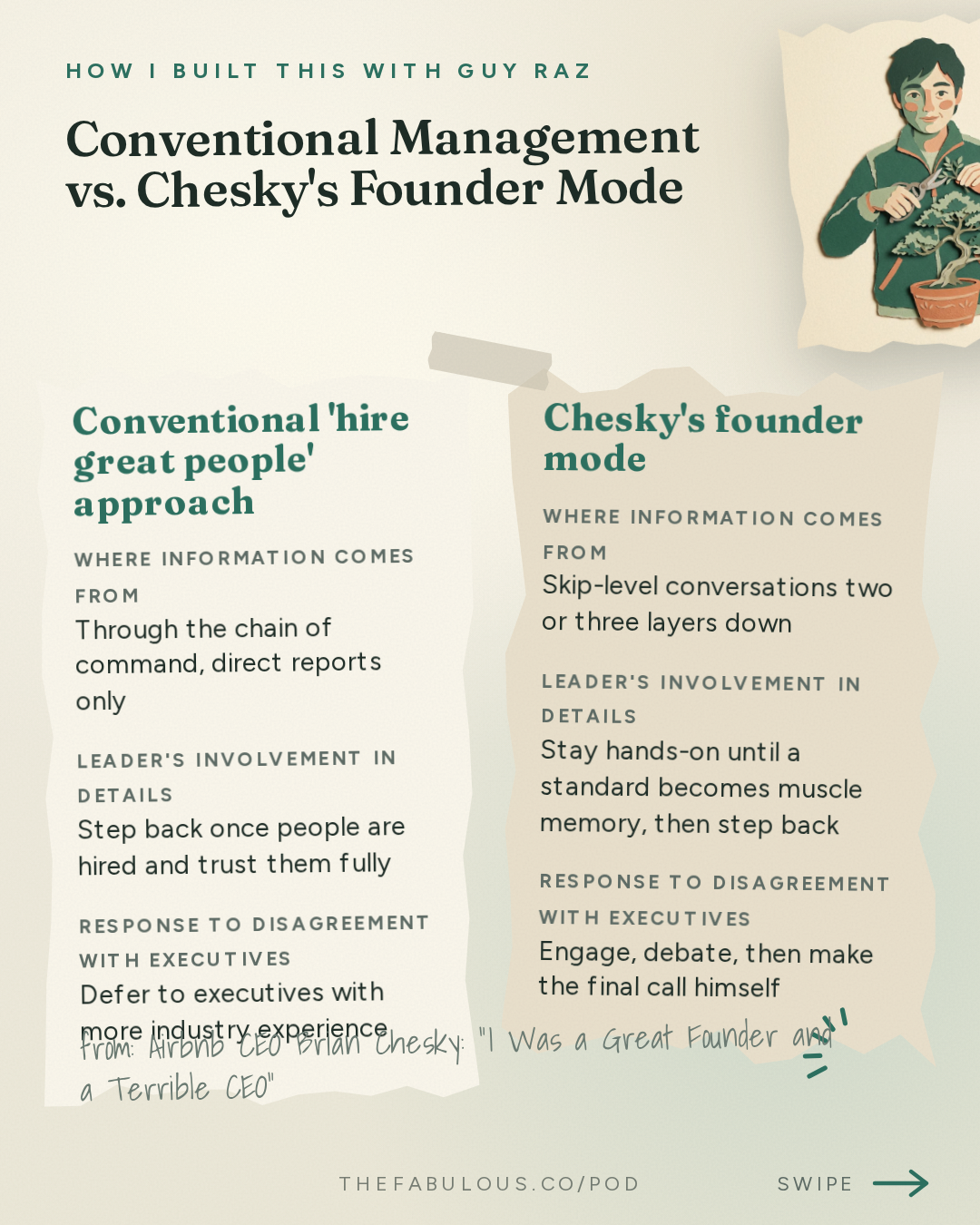
Founding, Chesky argues, is a skill people practice their whole lives without noticing, going back to childhood, taking apart Christmas toys, selling things to friends. Running a company is almost the opposite of that instinct. The conventional wisdom, hire great people and get out of their way, is advice for a mature organization, not a young one. A young company needs its leader to hire people only slightly ahead of where the company is and then stay close to them, not hand off control to seasoned outsiders.
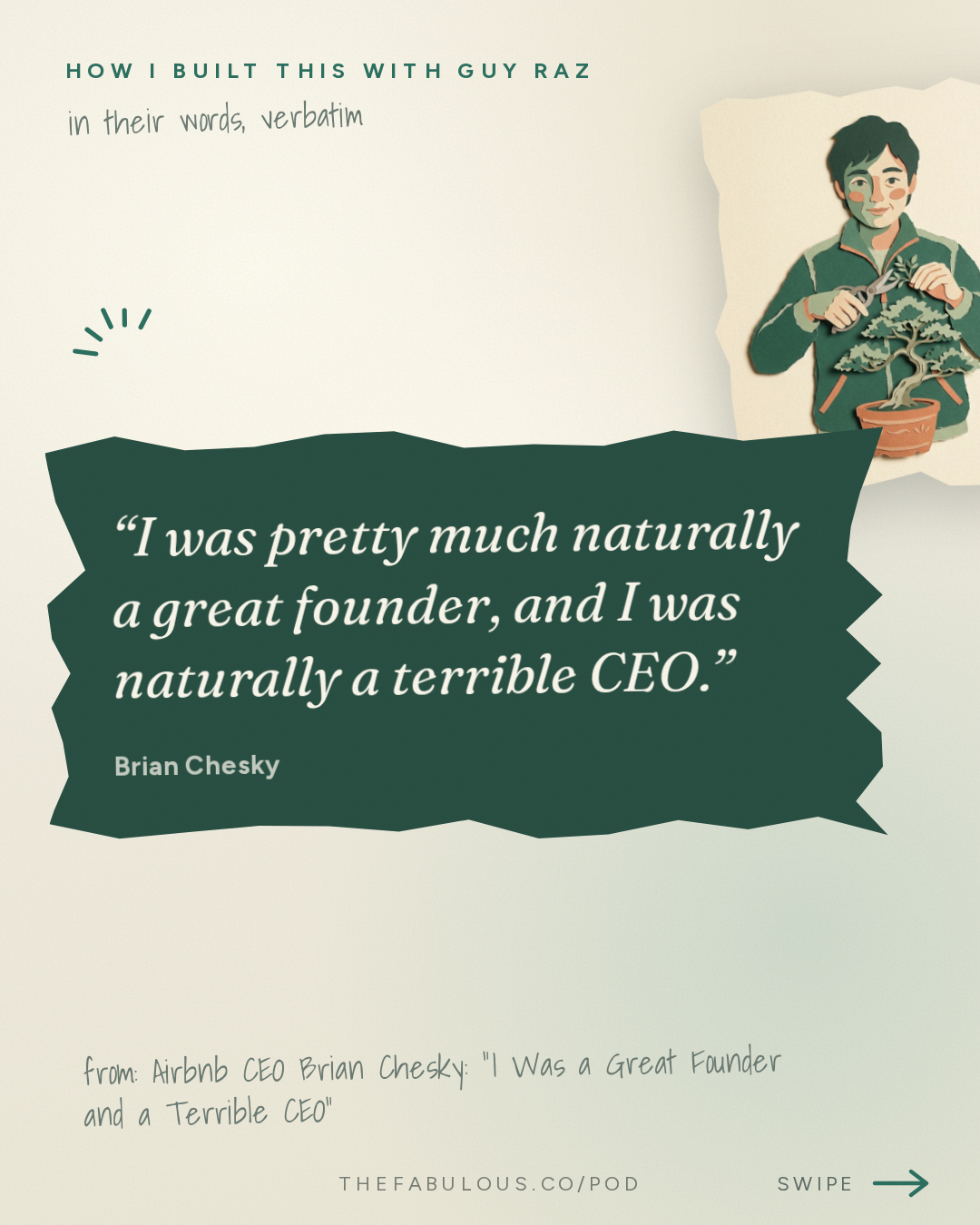
"I was pretty much naturally a great founder, and I was naturally a terrible CEO." Brian Chesky, [13:22]
Chesky did the opposite of his own later advice for years. He hired executives twenty years his senior, deferred to their experience even when his gut disagreed, and avoided conflict so thoroughly that he would do an underperforming employee's job for them rather than have a hard conversation (16:09). The company kept growing anyway, propped up by what he now calls an unusually good business model, but it grew sprawling and chaotic, with too many executives pulling in too many directions at once.
The Crucible
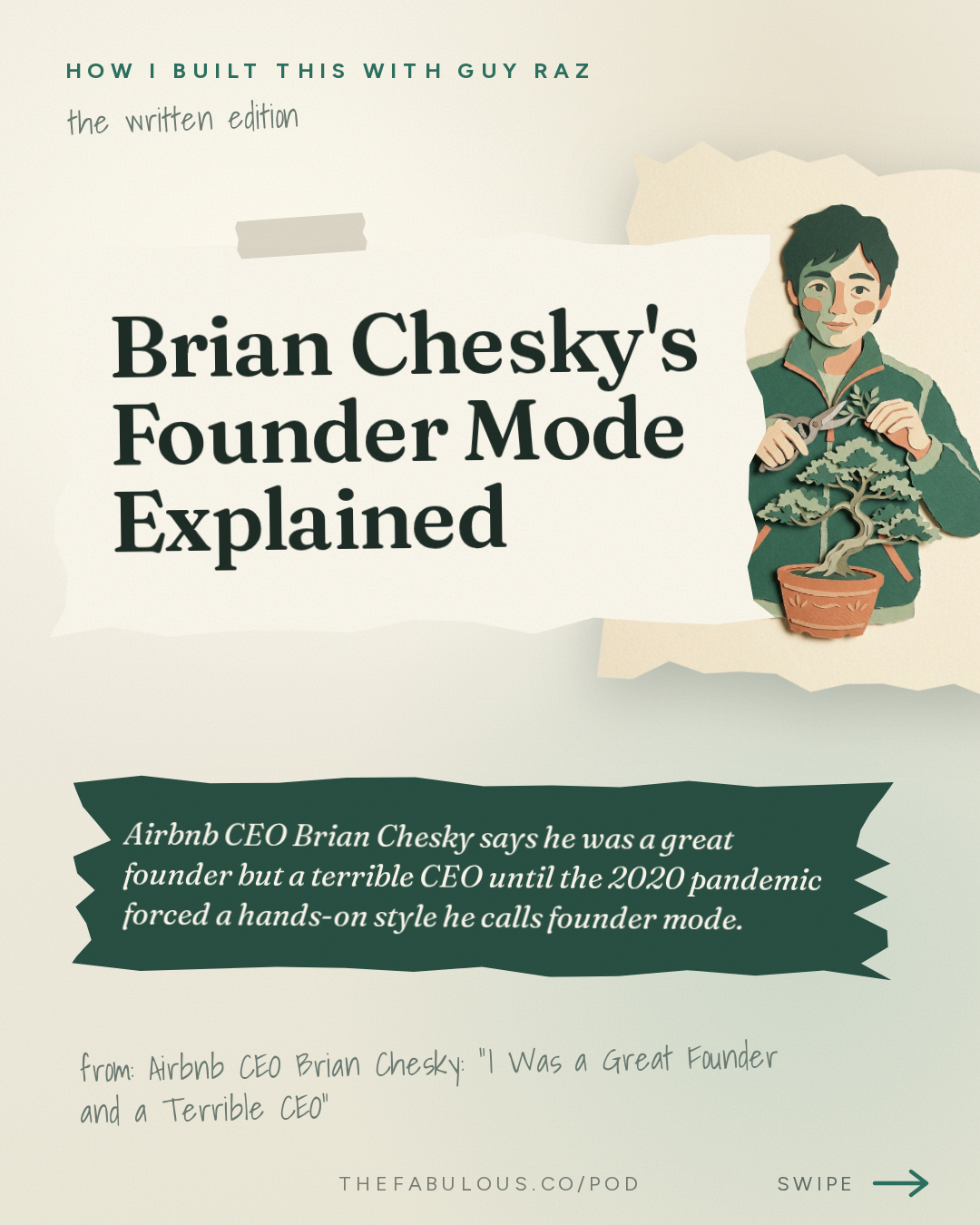
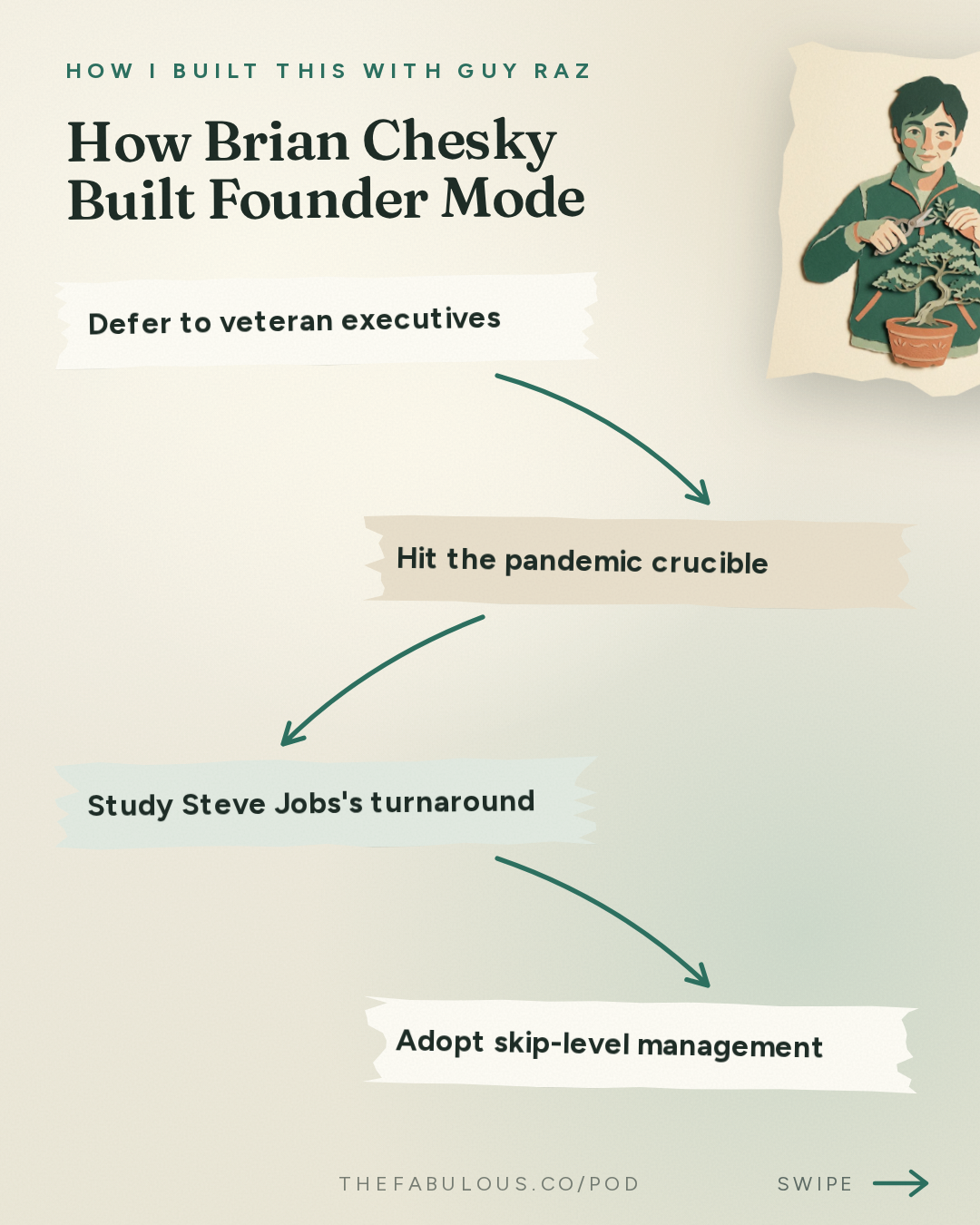
The correction came from outside, not from insight. In March 2020, a board member who had run American Express through 9/11 and the 2008 financial crisis warned Chesky that travel was about to take a hit ten times larger. It did: Airbnb lost 80% of its business in eight weeks, after twelve years of building (25:19). Suddenly being a good CEO was not a nice-to-have, it was survival.
"A company can't grow faster than a CEO's learning curve." Brian Chesky, [21:07]
Around the same time, Chesky started studying Steve Jobs seriously for the first time, nine years after Jobs's death. What struck him was how Jobs, returning to Apple just twelve weeks from bankruptcy in 1997, got into every detail, cut most of the product line, and simplified everything he touched (44:53). Chesky began doing the same at Airbnb: reviewing expenses line by line, sitting in rooms with junior employees instead of only their managers, treating the crisis as a foxhole everyone shared.
The public triumph of the IPO, it turned out, sat right alongside private isolation. Feeling the walls close in, Chesky wrote a long letter to former President Barack Obama asking for help. Obama's answer was blunt: Chesky was simply lonely. The Surgeon General of the United States, who was helping Airbnb during COVID and had studied loneliness, described connection as a set of concentric circles, a relationship with oneself, then roughly five family members, then 15 people one confides in, then a community of about 150, then something as large as a country (32:09). Obama told Chesky he kept about 15 friends he could call at any moment without catching them up on his life, many of them friends from high school (28:18).
"The way I didn't lose my mind is I stayed grounded, and the way you stay grounded is you stay connected to your roots, and the way you stay connected to your roots is you stay connected to people in your roots." Brian Chesky, recounting Barack Obama's advice, [28:39]
Chesky began calling old friends and then scheduling annual trips with them, since Zoom calls alone left them with nothing new to talk about but the past. He also started naming the thing that had happened to the company itself. Bureaucracy and layers of management had built up around him, he says, until the organization he created became something he was trapped inside of.
"At some point, your castle becomes your prison, and you basically built this beautiful castle, and then you've locked yourself in the top of it." Brian Chesky, [41:26]
Founder Mode
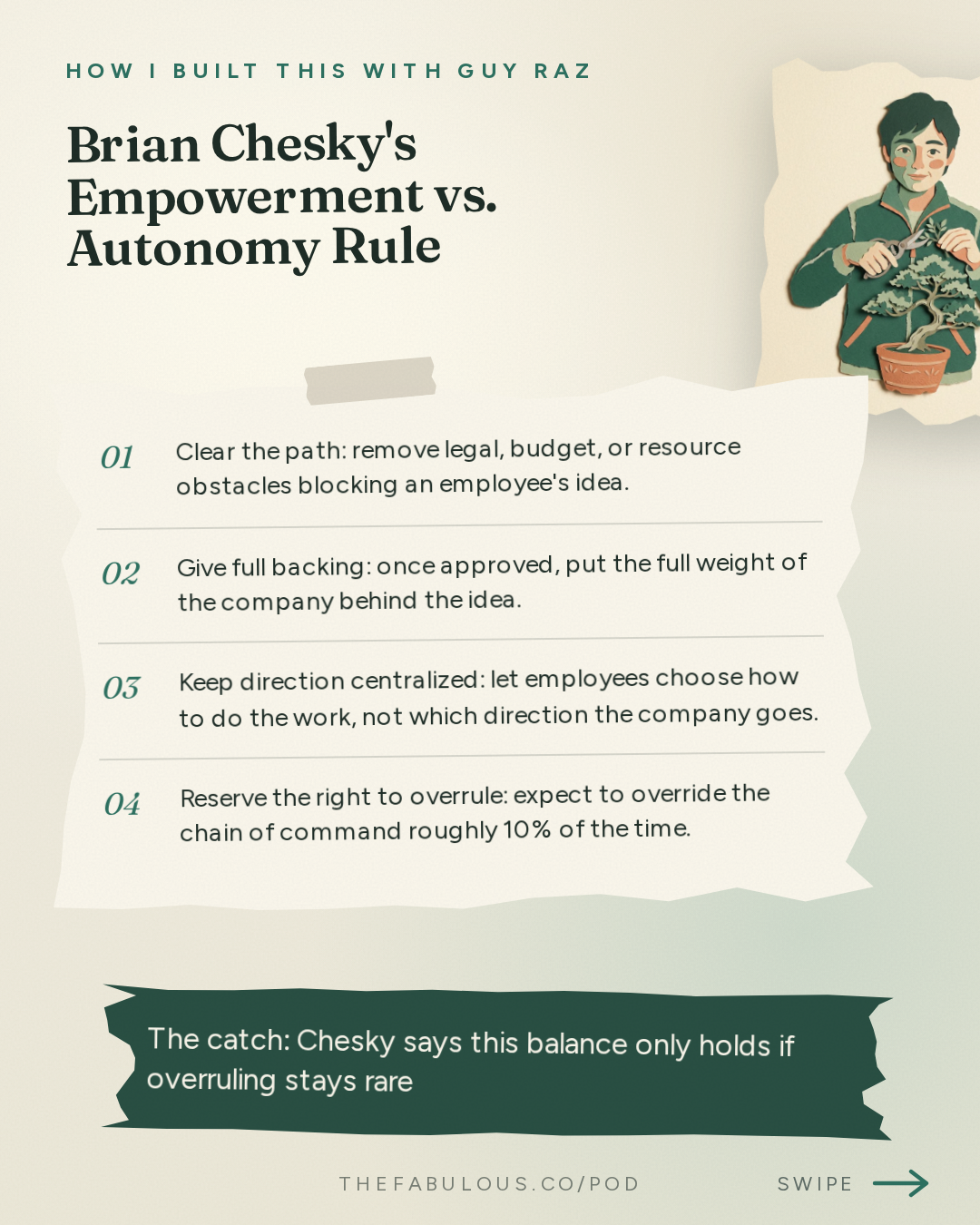
What Chesky built out of the crisis became a management philosophy that writer Paul Graham later popularized after hearing Chesky describe it privately at a Y Combinator talk, in an essay that gave it the name founder mode (51:35). The core move is skip-leveling: instead of getting information only from his direct reports, Chesky talks two or three layers down the organization, sometimes putting an entire chain of command in one room so he can hear from the person actually doing the work (46:38). He draws a sharp line between empowerment and autonomy. He will clear obstacles, supply resources, and put the company's full weight behind an employee's idea, but he keeps final say over which direction the company goes, because five executives going five different directions is not one company (51:01).
Staying this involved is not meant to last forever. Chesky compares it to a golf instructor watching a student's swing: close attention is needed until good habits become automatic, and only then can a leader step back. The clearest example he gives is mundane: his team rewrote a single press release 70 times until it met his bar for excellence, not because every release needs that scrutiny, but because the team needed to internalize where the bar actually was (55:17).
The approach cost him people. By his own account, almost his entire executive team eventually left once he stopped delegating details and started showing up in them (56:06). Chesky says he did not need everyone to stay, only enough people willing to work that way and deliver results, which is how he rebuilt the leadership team around people who had previously worked for other founders, like Steve Jobs or Jeff Bezos, and needed no convincing.
The same hands-on instinct now drives Airbnb.org, the company's nonprofit arm, which traces back to an email Chesky sent his co-founders in 2008, before Airbnb had even launched. It stayed dormant until Hurricane Sandy in 2012, when a host asked to shelter an evacuee for free, and Airbnb rebuilt its systems to allow it. Since then the nonprofit has housed 20,000 Afghan refugees, 100,000 Ukrainian refugees (66:19), and tens of thousands of people displaced by the Los Angeles fires, and it now responds to roughly 170 disasters a year. Airbnb is committing $500 million to try to provide a million free nights a year to people in crisis over the next five years (64:59, 68:34), an idea partly inspired by other people his mother met on the train during her own cancer treatment, who could not afford to stay overnight near her hospital.
Asked whether he imagines a future without Airbnb, Chesky points instead to a list of heroes who worked until the end: Walt Disney sketching Disney World from a hospital bed, Steve Jobs still caring about Apple while surrounded by family, Leonardo da Vinci carrying the Mona Lisa until he died. Chesky says he is not doing this for adulation anymore, and certainly not for money he cannot spend. He calls Airbnb one of the largest canvases any designer has ever been handed, and says that as long as he still has it, he intends to keep painting (70:29, 73:07).
Ask this episode anything
Pod's AI answers from the episode itself, with the minute mark so you can hear it yourself.
Or start with one of these
Ask this episode
Pod's AI listens to the whole episode to answer, and points you to the minute it comes from.
The rest of this answer, and any question after it
Answers come from the episode itself, never from a summary of it.
ContinueKey takeaways
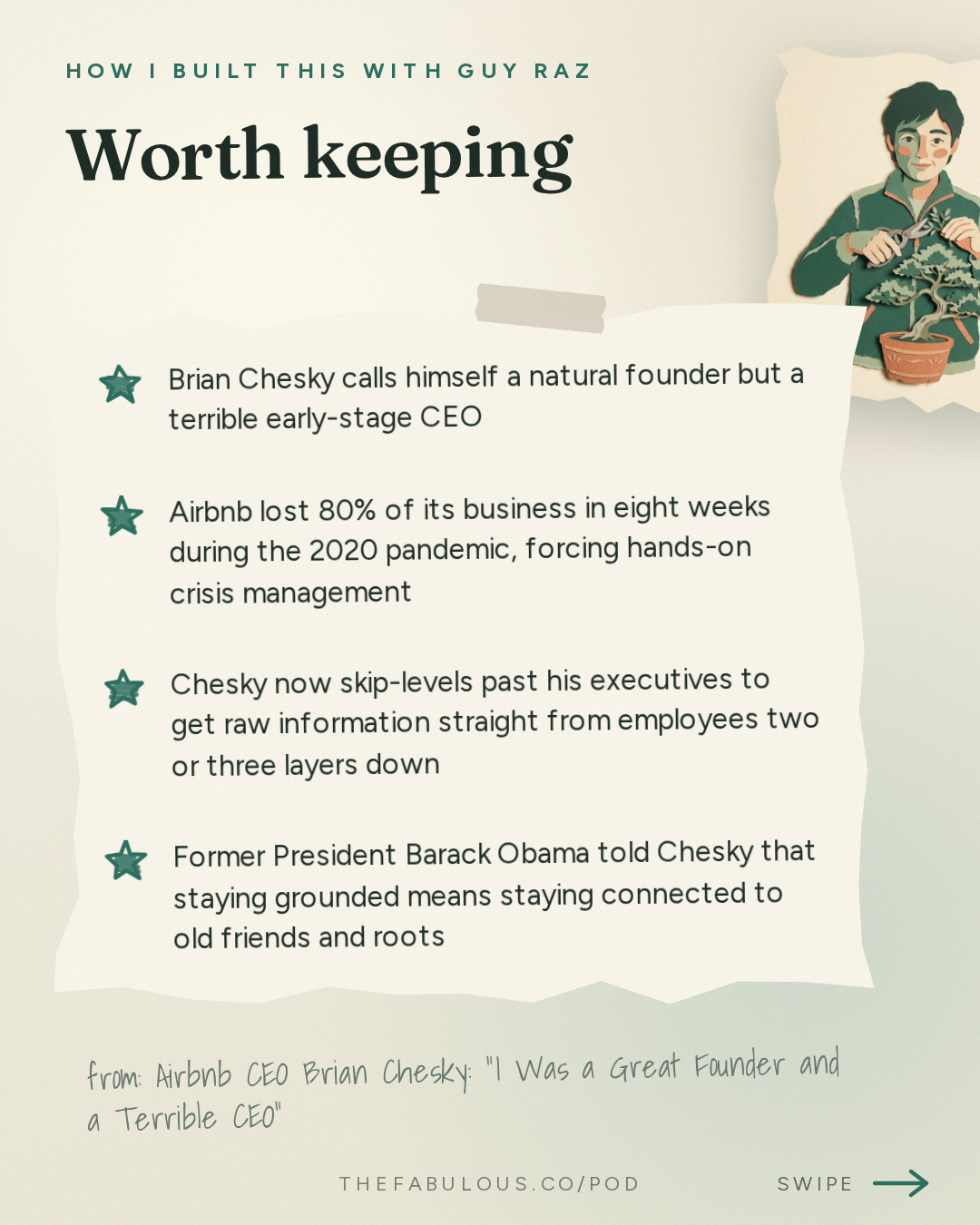
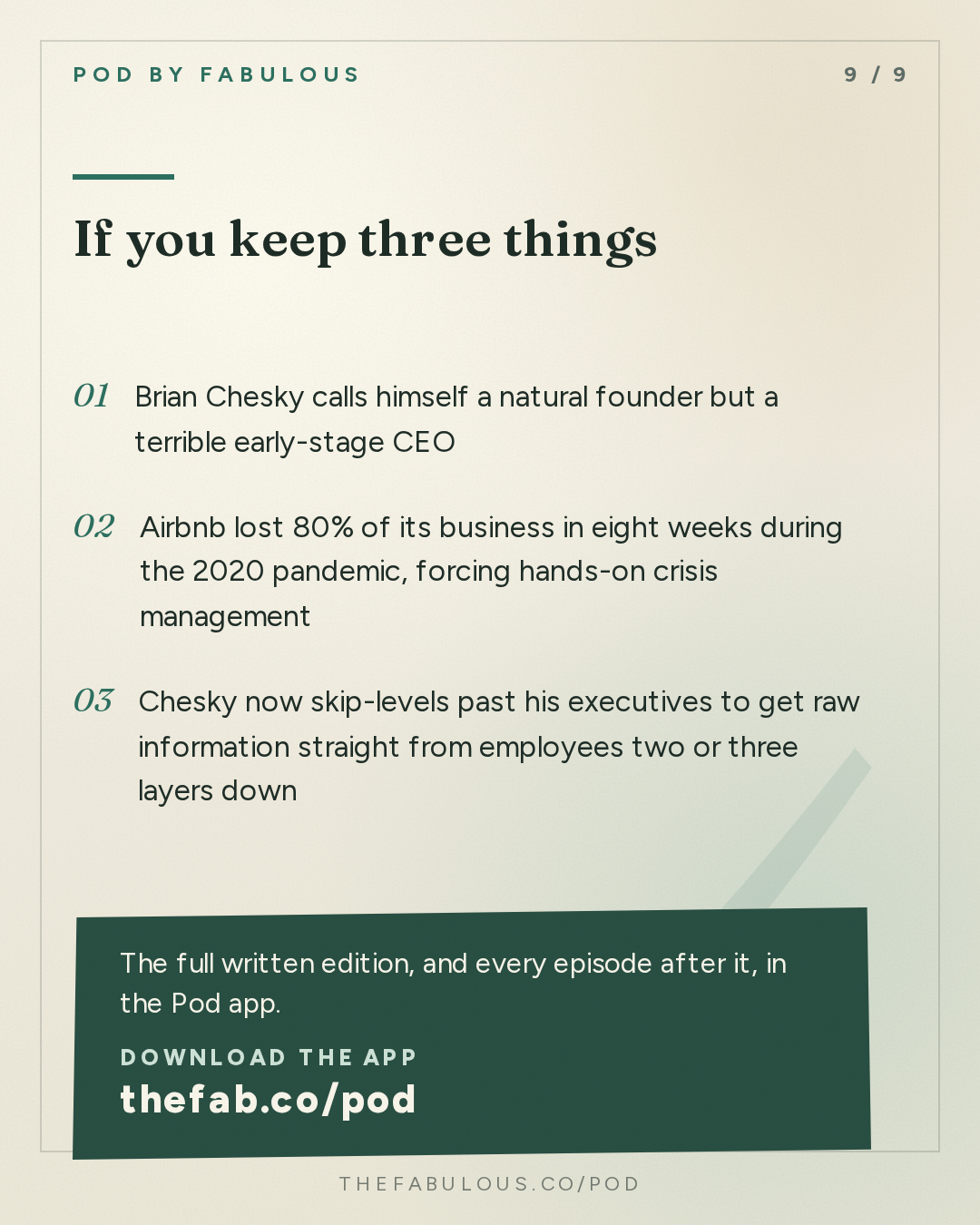
- Brian Chesky calls himself a natural founder but a terrible early-stage CEO
- Airbnb lost 80% of its business in eight weeks during the 2020 pandemic, forcing hands-on crisis management
- Chesky now skip-levels past his executives to get raw information straight from employees two or three layers down
- Former President Barack Obama told Chesky that staying grounded means staying connected to old friends and roots
- Airbnb.org plans to provide a million free nights a year to people in crisis over the next five years
The episode in cards
By the numbers
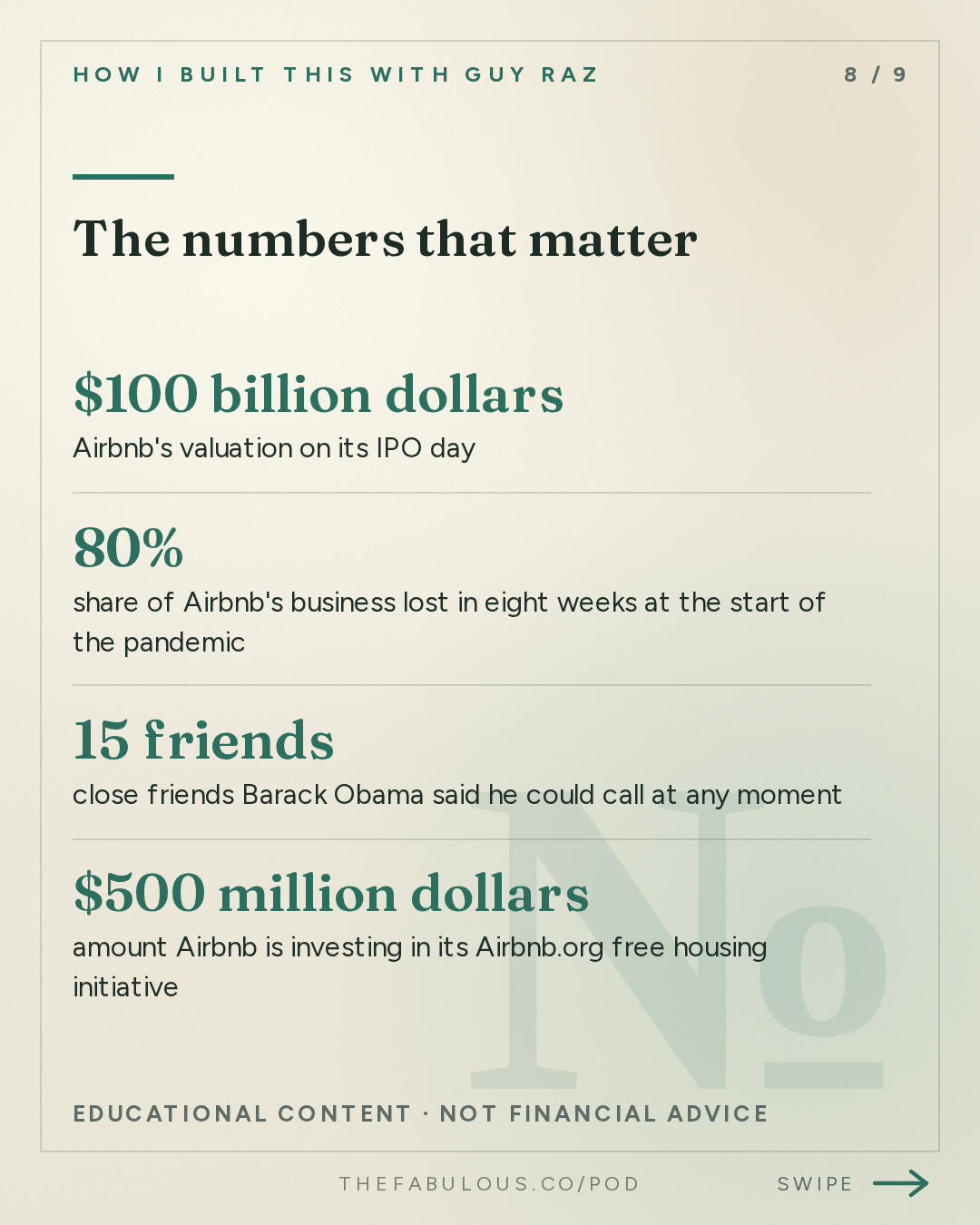
- $100 billion dollars Airbnb's valuation on its IPO day
- 80% percent share of Airbnb's business lost in eight weeks at the start of the pandemic
- 15 friends close friends Barack Obama said he could call at any moment
- $500 million dollars amount Airbnb is investing in its Airbnb.org free housing initiative
- 70 iterations drafts Chesky's team wrote of one press release to reach his bar for excellence
In their words
“I wake up, put on sweatpants. I get on a Zoom meeting.”
“I was pretty much naturally a great founder, and I was naturally a terrible CEO.”
“A company can't grow faster than a CEO's learning curve.”
“At some point, your castle becomes your prison, and you basically built this beautiful castle, and then you've locked yourself in the top of it.”
“The way I didn't lose my mind is I stayed grounded, and the way you stay grounded is you stay connected to your roots, and the way you stay connected to your roots is you stay connected to people in your roots.”
Protocols
-
Skip-Level Past Your Executives
Brian Chesky bypasses his own direct reports and talks directly with employees two or three layers down the organization to get unfiltered information on projects he cares about. He says the catch is that executives can feel undermined by this, so he frames it as working in the room together rather than going around them.
Ongoing, especially on priority projects
-
Reconnect With Old Friends to Fight Loneliness
Following advice from former President Barack Obama, Brian Chesky started calling high school and college friends during the pandemic and then set up annual trips with them to rebuild relationships that had gone dormant for a decade. He says the catch is that occasional calls are not enough, because friendships need new shared experiences rather than only updates on old times.
Regular calls plus an annual trip
-
Drill One Task Until It Becomes Muscle Memory
Brian Chesky stays hands-on in the details of a single task, such as rewriting a press release through 70 versions, until his team internalizes the standard of excellence he wants. He says the catch is that a leader has to let go once the standard becomes automatic, or the close involvement turns into micromanagement.
Once per new standard, then periodic check-ins
-
Set Projects Up Before Stepping Back
Brian Chesky says a leader should confirm a project has a clear vision, the right people, a single directly responsible owner, and full resources before stepping back from it. He says the catch is that skipping this setup lets a team spend months heading in the wrong direction before anyone notices.
At the start of every major project
Questions this episode answers
What does Brian Chesky mean by 'founder mode'?
Founder mode is a term popularized after writer Paul Graham heard Airbnb CEO Brian Chesky describe it at a private talk. It means staying deep in operational details and skip-leveling past executives to question employees two or three layers down, while still giving people empowerment through resources and backing, even as the leader keeps final say over direction (51:35).
Why did Brian Chesky think he was a bad CEO?
Chesky says the skills that made him a strong founder, like designing products and trusting instinct, came naturally, but running a company felt counterintuitive. Deferring to seasoned executives rather than staying close to decisions nearly caused Airbnb to drift into bureaucratic chaos during its growth years (13:22).
How much business did Airbnb lose during the pandemic?
Airbnb lost 80% of its business in eight weeks in March 2020, after twelve years of growth, according to Chesky. He says that crisis turned being a good CEO into a life-or-death requirement rather than a nice-to-have, pushing him to get hands-on with every detail (25:19).
What advice did Barack Obama give Brian Chesky about loneliness?
Former President Barack Obama told Chesky that staying grounded means staying connected to one's roots and the people in them, and that he personally keeps about 15 friends he can call at any moment without catching them up on his life. Chesky says this led him to restart dormant friendships and schedule annual trips with old friends (28:18).
What is Airbnb.org and how big is its free housing program?
Airbnb.org is Airbnb's nonprofit arm, started after a host asked in 2012 to house a Hurricane Sandy evacuee for free. Chesky says Airbnb is investing $500 million to provide a million free nights a year to people in crisis, including disaster survivors, refugees, and medical patients, over the next five years (64:59).
Did Airbnb executives support Chesky's founder mode shift?
Not all of them. Chesky says almost his entire executive team eventually left after he started skip-leveling and staying hands-on in details, since many felt undermined. He says he did not need everyone to agree, only enough people willing to stay and deliver results (52:16).
The full read, in cards
Go deeper
- Paul Graham's essay "Founder Mode" — Popularized the term after Graham heard Chesky describe his hands-on leadership style at a private Y Combinator talk
Mentioned
Brian Chesky · Joe Gebbia · Nathan Blecharczyk · Barack Obama · Steve Jobs · Jony Ive · Paul Graham · Ken Chenault · Rhode Island School of Design · Airbnb.org
More from this show and category
Tope Awotona's Advice for Bootstrapped Founders
Calendly founder Tope Awotona takes four founder calls on How I Built This's Advice Line, covering AI's lowered barrier to building software, physical-product virality, gifting strategy, and his core lesson: build a business around a customer, not a product.
FIGS Founders: How Scrubs Became a $2.5B Brand
Heather Hasson and Trina Spear turned boxy hospital scrubs into FIGS, a direct-to-consumer brand now worth $2.5 billion (04:13). They skipped distributors, kept 85% of healthcare workers as direct customers (23:53), survived 300 to 400 investor rejections (43:19), and beat an $800 million lawsuit (55:17) before going public in 2021.

Tara Bosch's Advice: D2C to Retail Growth
Tara Bosch, who sold a majority stake in her low-sugar candy brand SmartSweets for a reported $360 million (00:49), spends this advice-line episode teaching four early founders how to move from online sales to grocery shelves, price sugar and price value in three seconds, and read customer emotion through phone calls rather than DMs.

How Sweet Loren's Cookie Dough Was Built
Loren Castle grew Sweet Loren's cookie dough into a 30,000-plus-store brand by scaling slowly for a decade. Then she rebuilt the entire line around an allergen-free recipe that became the company's top-selling product within six months of its 2017 launch, after customer emails revealed how many shoppers had dietary restrictions.
