
How Dr. Squatch Built a $1.5 Billion Soap Brand
Dr. Squatch: Jack Haldrup. From a Closet Full of Soap to a $1.5 Billion Brand
The brief
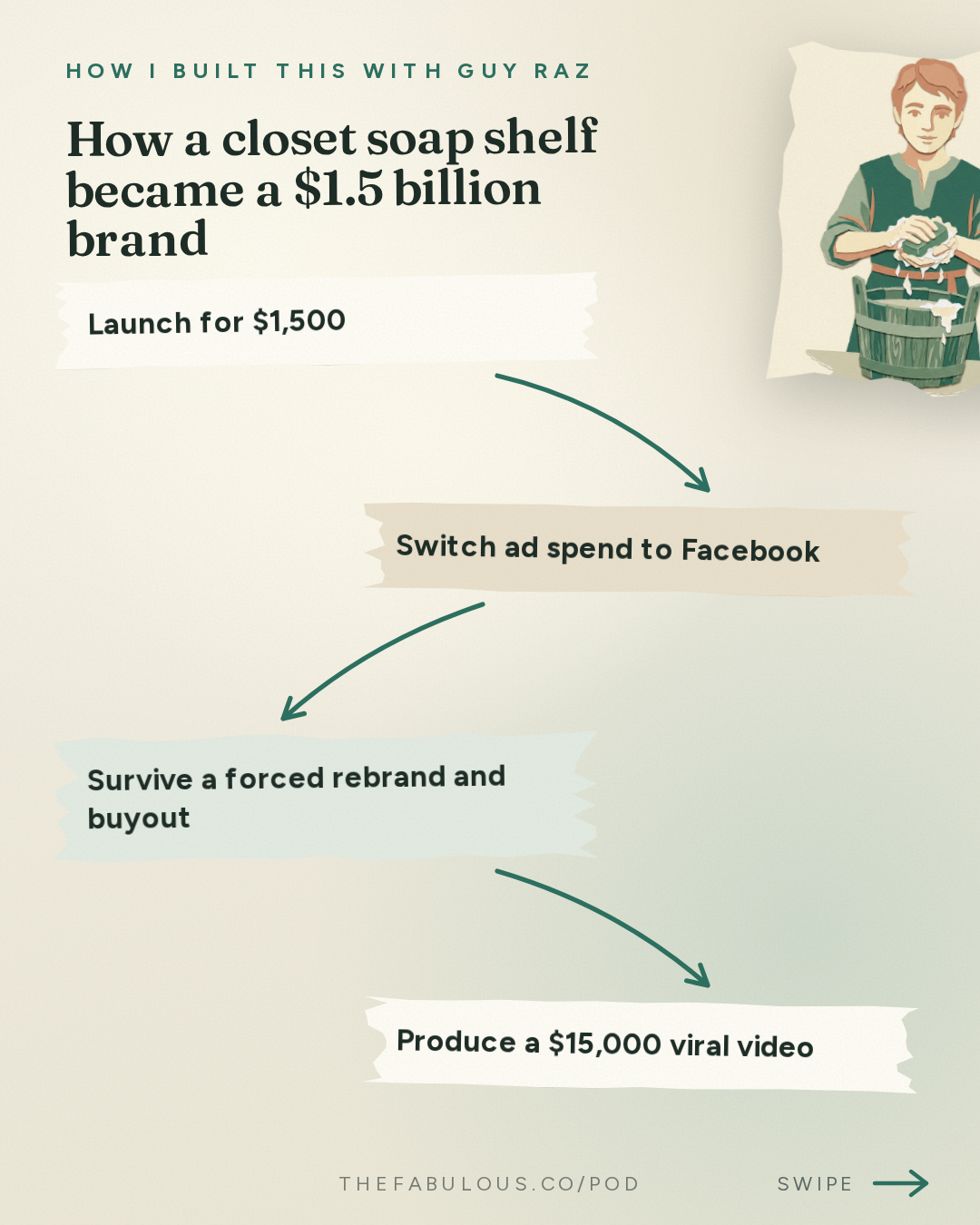
Jack Haldrup turned a $1,500 soap side hustle into Dr. Squatch, which Unilever bought for $1.5 billion in 2025. The hinge moments were ditching Google ads for Facebook, surviving a forced rebrand and a partner buyout, and shooting a $15,000 video that drew 120 million views and became the company's main sales engine.
In 2018, an ad agency called the Harmon Brothers quoted Jack Haldrup $250,000 to shoot a comedic video for his small soap company, plus another $250,000 to push it out on Facebook and YouTube. Haldrup didn't have that kind of money. So he and a local agency called Raindrop tried to copy the format themselves for $15,000 (57:15). The result, a three-minute spot in which a bearded man showers outdoors and tells viewers their soap "sucks," has since drawn 120 million views (56:53). It became the single biggest push behind turning a company once stored on a closet shelf into Dr. Squatch, a brand Unilever bought in 2025 for $1.5 billion (04:46).
Haldrup grew up middle-class in Carmel, Indiana, studied business at Indiana University, and took a consulting job in Chicago after graduating. He hated it. "I didn't like being a consultant, and a lot of consulting is kind of positioning yourself as an expert and telling other people what to do, even though you're not necessarily in their business," he says (05:35). Around the same time, in his mid-twenties, he developed psoriasis, a skin condition that causes patches of inflamed, scaly skin. Wary of conventional treatment, he started reading about diet and natural products, and on a whim bought a bar of soap at a farmers market. It changed how his skin felt after a shower, and it sent him down a research hole into something called cold process soap: a slower, small-batch method that uses lye, water, and oils, and that fell out of fashion in the early 1900s because it is harder to produce at scale than the heat-extruded bars sold in most stores (12:50, 13:19).
Haldrup gave himself a 90-day deadline to launch a business around it. He found a Chicago manufacturer, bought a website template, filed the paperwork, and ordered 400 to 500 bars that he stored on a shelf in his closet. Total cost: about $1,500 (18:14). He named it Sasquatch Soap, after a character his sister drew, and sold it only online, never at farmers markets himself. Early sales were modest: $12,000 in the first partial year, climbing to $80,000 by 2013 (26:58). His mother took over shipping out of his childhood bedroom, boxing orders into old cigar boxes she haggled down to a dollar apiece, until his father called to say he needed to find a fulfillment center so he could "have his wife back." A childhood friend, AJ Fountain, joined first as a door-to-door soap salesman working for a dollar a bar, then as a formal business partner. Subscription boxes like Birchbox and Bespoke Post gave the brand an early marketing boost, paying at or above cost for product samples, before those arrangements shifted toward fees and wholesale terms that made the channel far less valuable over time.
From Search to Scroll
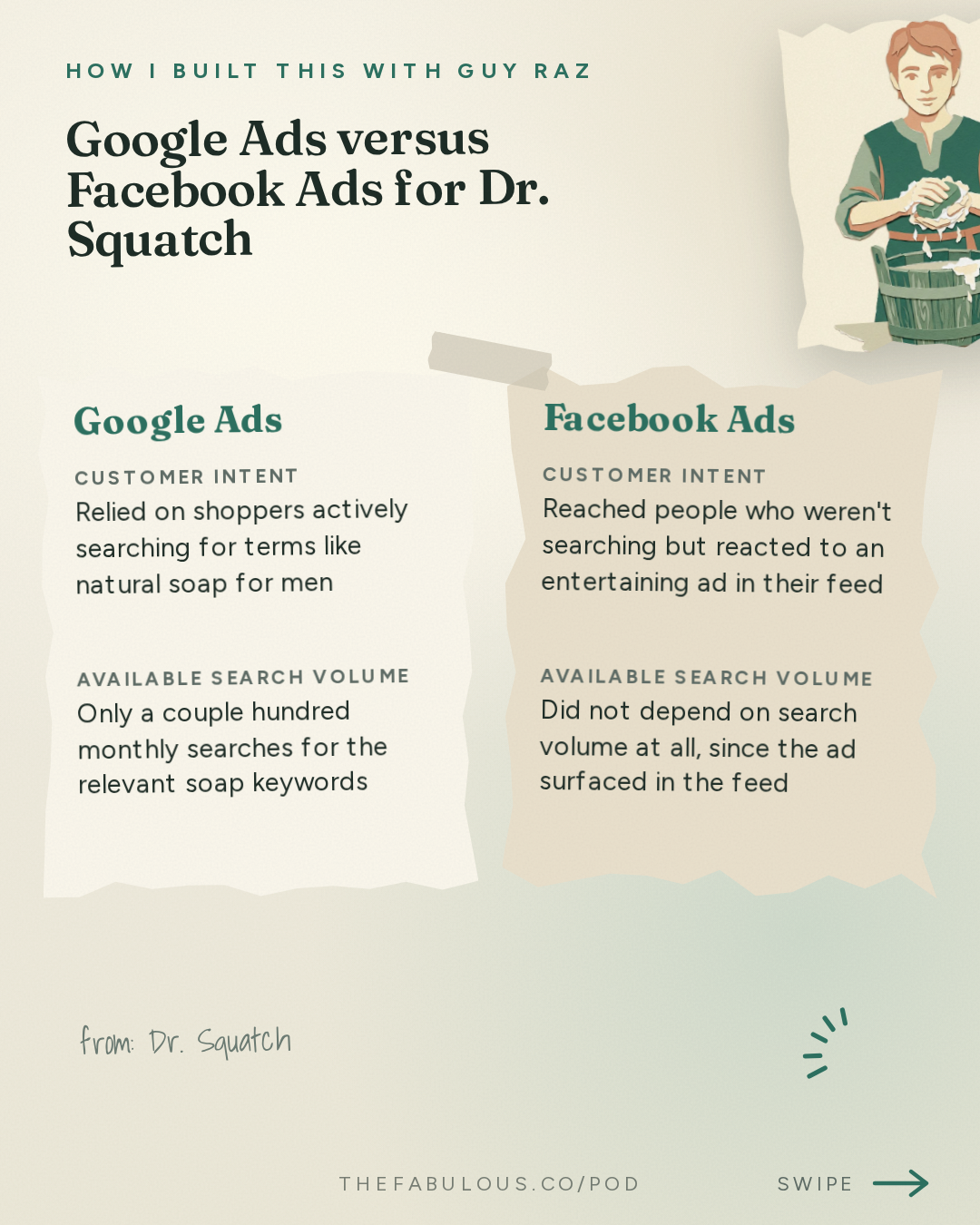
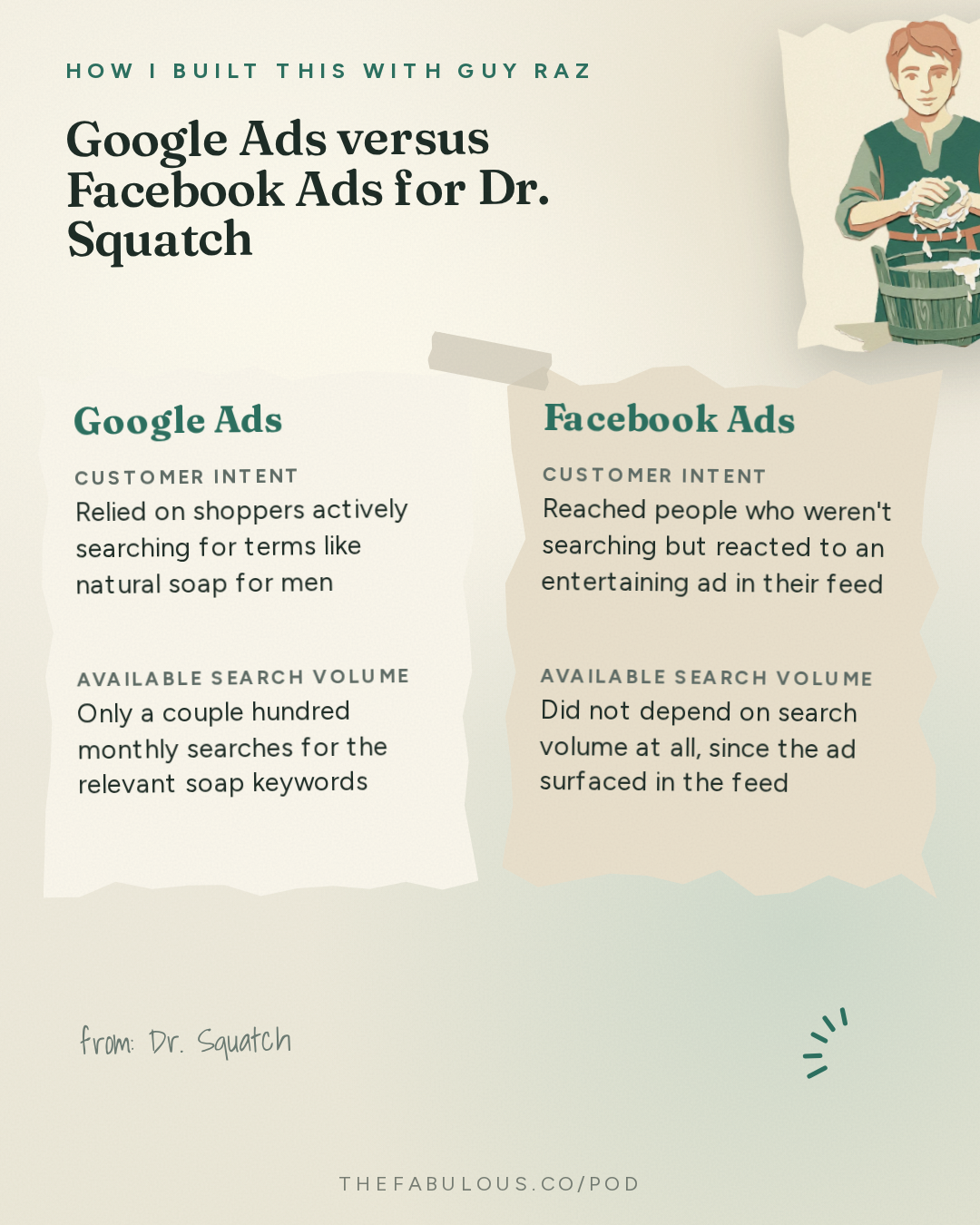
The real inflection point came in 2014, after Haldrup's employer collapsed and he enrolled in a digital marketing class at General Assembly, a training program, spending $3,500 of roughly $5,000 left in savings. The instructor, who ran paid media for another clothing brand, showed him that Google ads were the wrong tool. "Ultimately, nobody was searching Google for men's soap or natural soap," Haldrup says. Even when the company ranked for its target keyword, it generated only about five sales a month (35:50). Facebook was different.
"Nobody was actively looking on the internet to buy natural soap, or very few people were. But if it came across their feed in a way that was kind of interesting and entertaining, then they would be like, 'Oh, okay, I'll try this out.'" — Jack Haldrup [36:13]
Shifting spend to Facebook produced close to a 3x jump in revenue within a month (35:09). It also reframed how Haldrup thought about the product: not something people searched for, but something they discovered mid-scroll and bought on impulse.
Just as that shift was paying off, the brand's name became a liability. Another company held a common-law trademark on "Sasquatch Soap," and a third party tried to register it first, surfacing the conflict. Haldrup and Fountain had weeks to find a replacement, cycling through rejected names like Kingsley's and Sudsworth's before landing on Dr. Squatch, which Haldrup felt gave the mascot a more elevated, character-driven identity (37:01, 41:22). The rebrand cleared trademark review and, in hindsight, improved the brand. But it arrived alongside a harder problem: Fountain wanted the business to fund a modest, outdoors-centered life, while Haldrup wanted to swing for something much bigger. The partners negotiated a buyout, paid out over time from the company's own cash flow, that left Haldrup carrying both debt and operating risk. The following six to nine months were among the toughest of his tenure, as new hires and higher overhead drained profitability. His fix was blunt. "I literally printed out, you know, three months' worth of bank statements and was circling every line item or crossing things out just to cut expenses as much as possible," he says, describing the point when he had to let two employees go and strip the company back to essentials (54:03).
That discipline set up the 2018 video. Because the ad was so efficient at turning viewers into paying customers, cheaply and profitably, Haldrup treated its budget less like a marketing line item and more like a machine. At one point the company was acquiring customers for roughly three to four dollars each (59:01), while making about $25 in profit per order. "I would spend as much as I possibly could, as long as I have the supply chain to fulfill it," he says. "I wouldn't even think about that as a marketing budget, right? I would think of that as a sales machine" (59:23). Sales for 2018 came in a little over $5 million, with the video driving 30 to 50 percent of that (60:12, 60:36).
What followed was rapid, outside-funded scaling. In 2019, Haldrup raised $1.3 million from Guild Capital at a post-money valuation of $5.7 million, the company's first outside capital after years of bootstrapping (62:04, 63:43). Revenue reportedly reached $113 million by the end of 2020 (65:33), helped by a pandemic-driven surge in hygiene spending and by product-line expansion that pushed up average order size. In 2021 a private equity firm bought a majority stake. By then Dr. Squatch had also built its own manufacturing facility, because scaling a handmade, small-batch soap process to millions of units a month required engineering the company had to invent from scratch (75:03). Retail, almost nonexistent in 2021, grew into a segment worth more than $300 million on its own (76:24), a shift Haldrup says simply would not have been possible without years of proof of concept built online first (78:00).
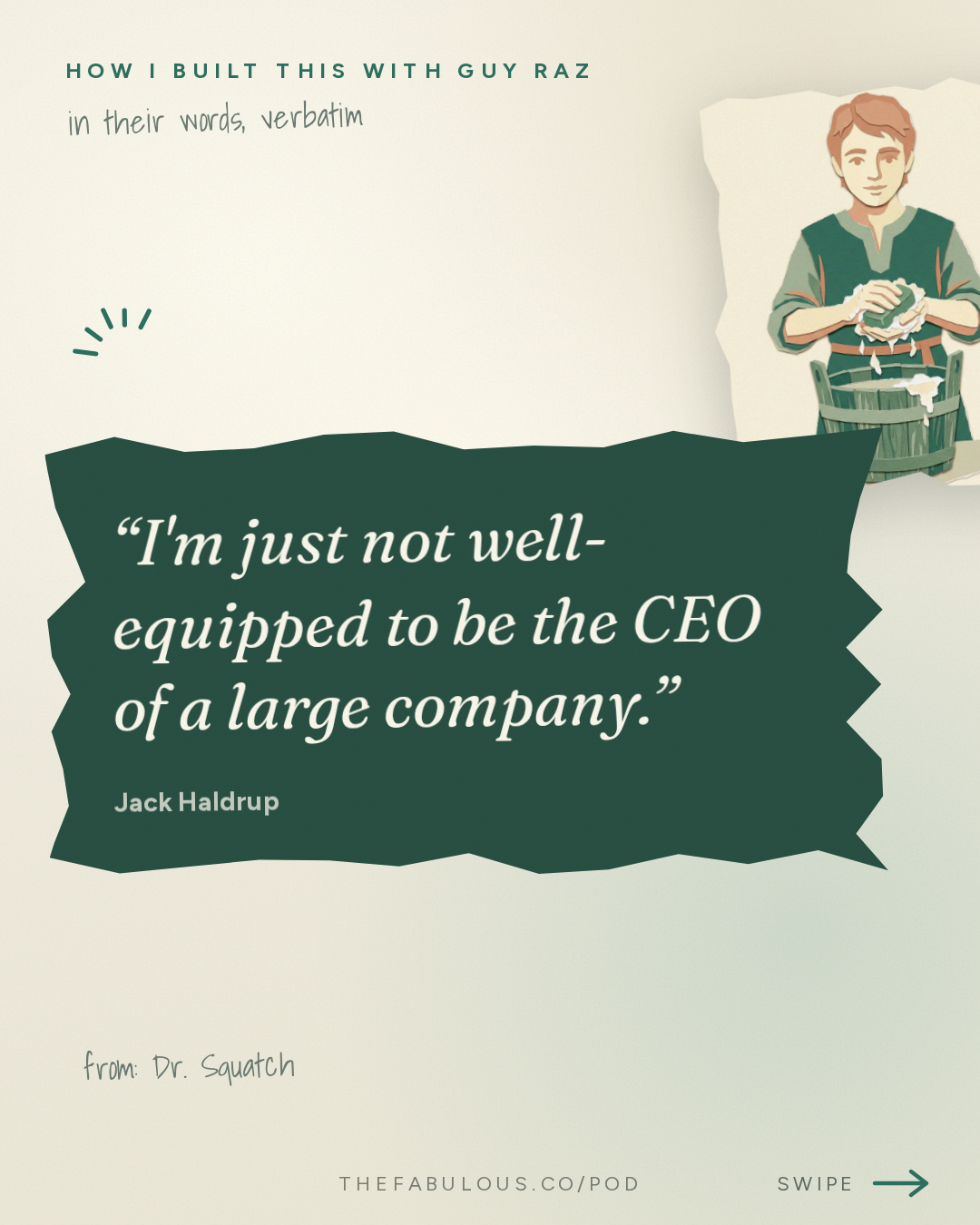
By 2023, with roughly 300 employees, Haldrup stepped down as CEO. "I'm just not well-equipped to be the CEO of a large company," he says, adding that most founders are not built to run at that scale indefinitely (69:46). He stayed on the board until Unilever's 2025 acquisition closed, after which his involvement ended entirely. Asked how much of the outcome he attributes to skill versus timing, Haldrup doesn't claim full credit. "It's close to 50/50," he says (77:35), crediting Facebook's early advertising tools, a hygiene-obsessed pandemic, and simple chance alongside the discipline of starting, surviving, and executing. The honesty is itself instructive: a founder who built a billion-dollar brand out of a farmers-market soap bar is also the first to say that the wind was, for a few crucial years, blowing in exactly the right direction.
Ask this episode anything
Pod's AI answers from the episode itself, with the minute mark so you can hear it yourself.
Or start with one of these
Ask this episode
Pod's AI listens to the whole episode to answer, and points you to the minute it comes from.
The rest of this answer, and any question after it
Answers come from the episode itself, never from a summary of it.
ContinueKey takeaways
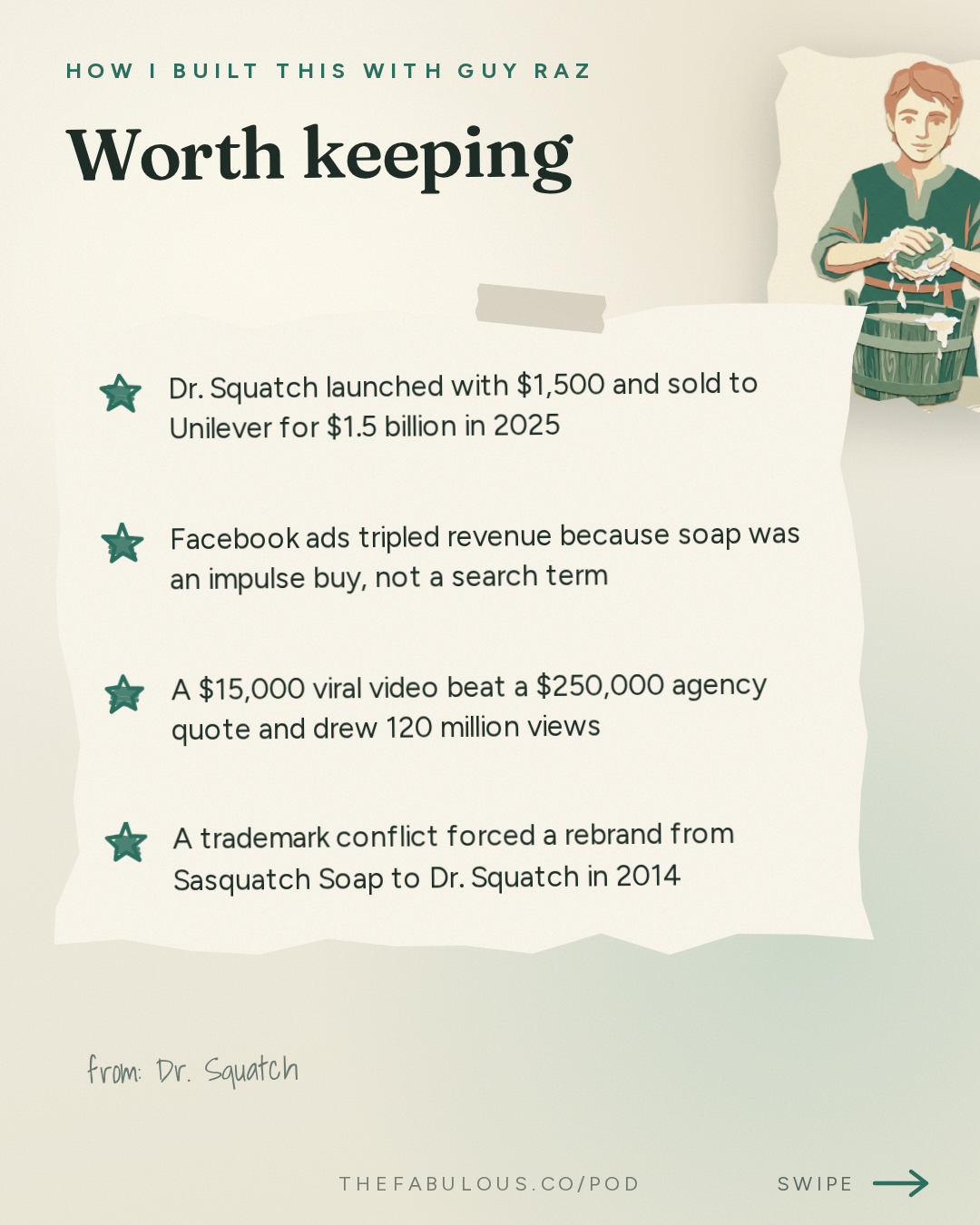
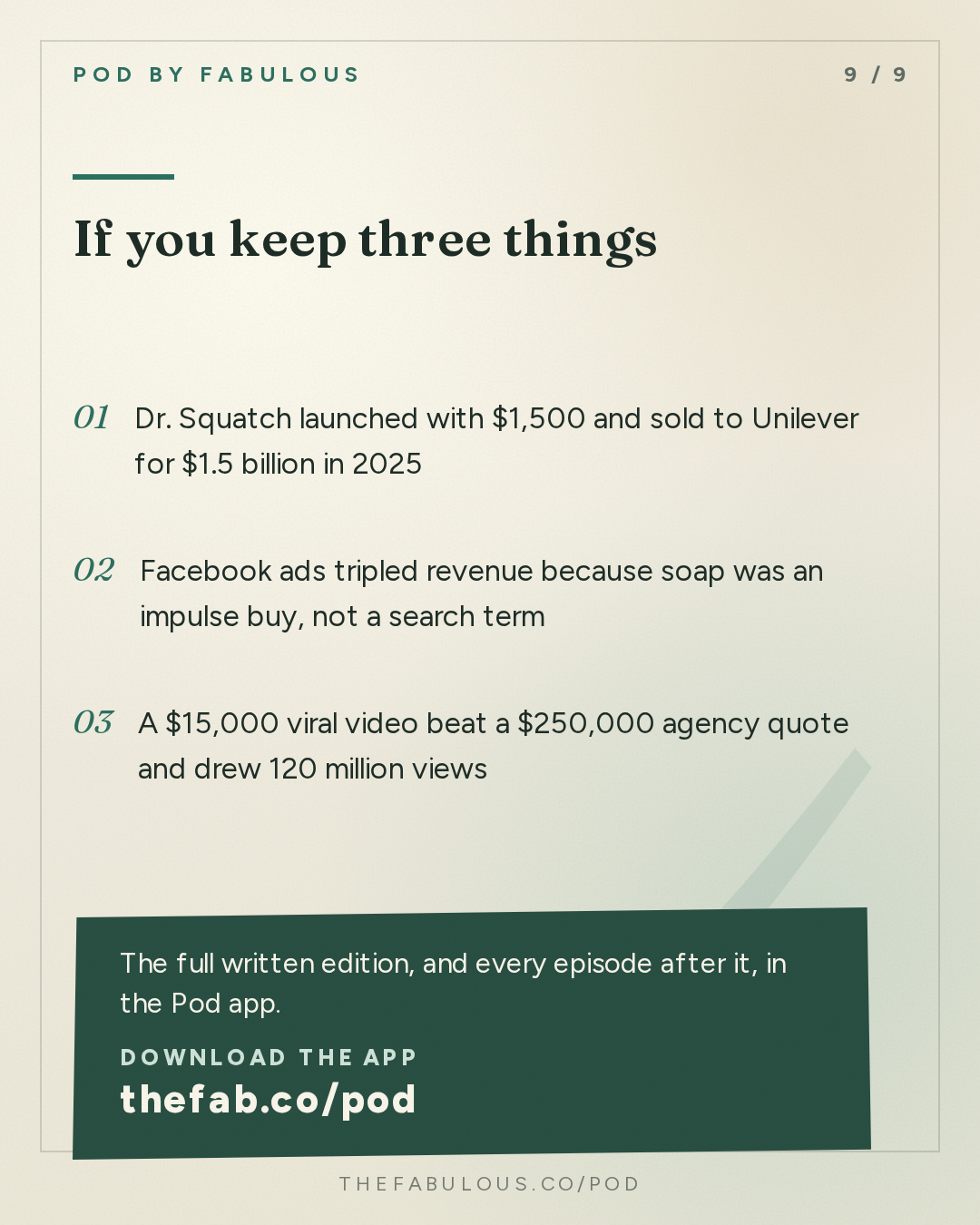
- Dr. Squatch launched with $1,500 and sold to Unilever for $1.5 billion in 2025
- Facebook ads tripled revenue because soap was an impulse buy, not a search term
- A $15,000 viral video beat a $250,000 agency quote and drew 120 million views
- A trademark conflict forced a rebrand from Sasquatch Soap to Dr. Squatch in 2014
- Jack Haldrup stepped down as CEO in 2023, saying he wasn't built to run a 300-person company
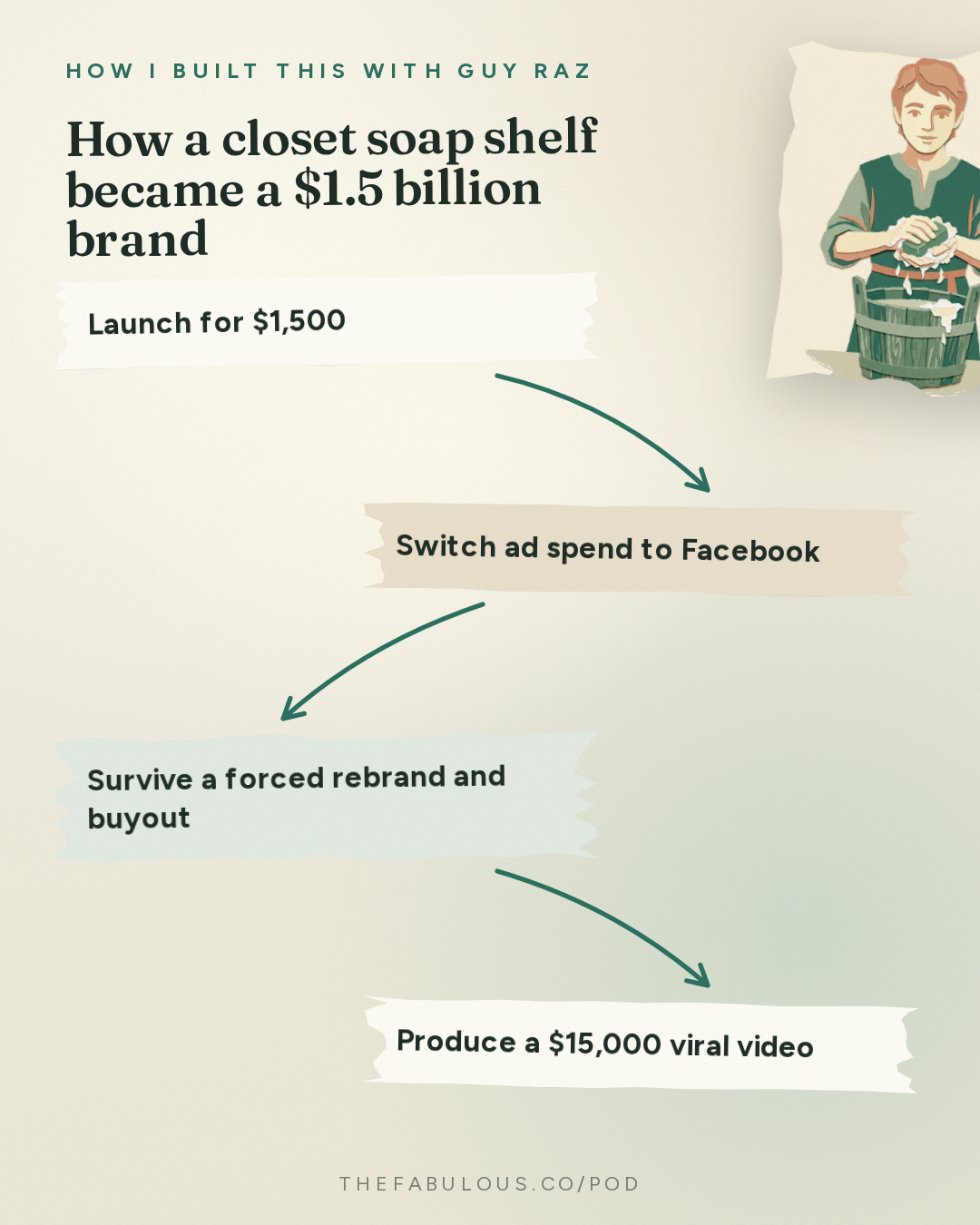
The episode in cards
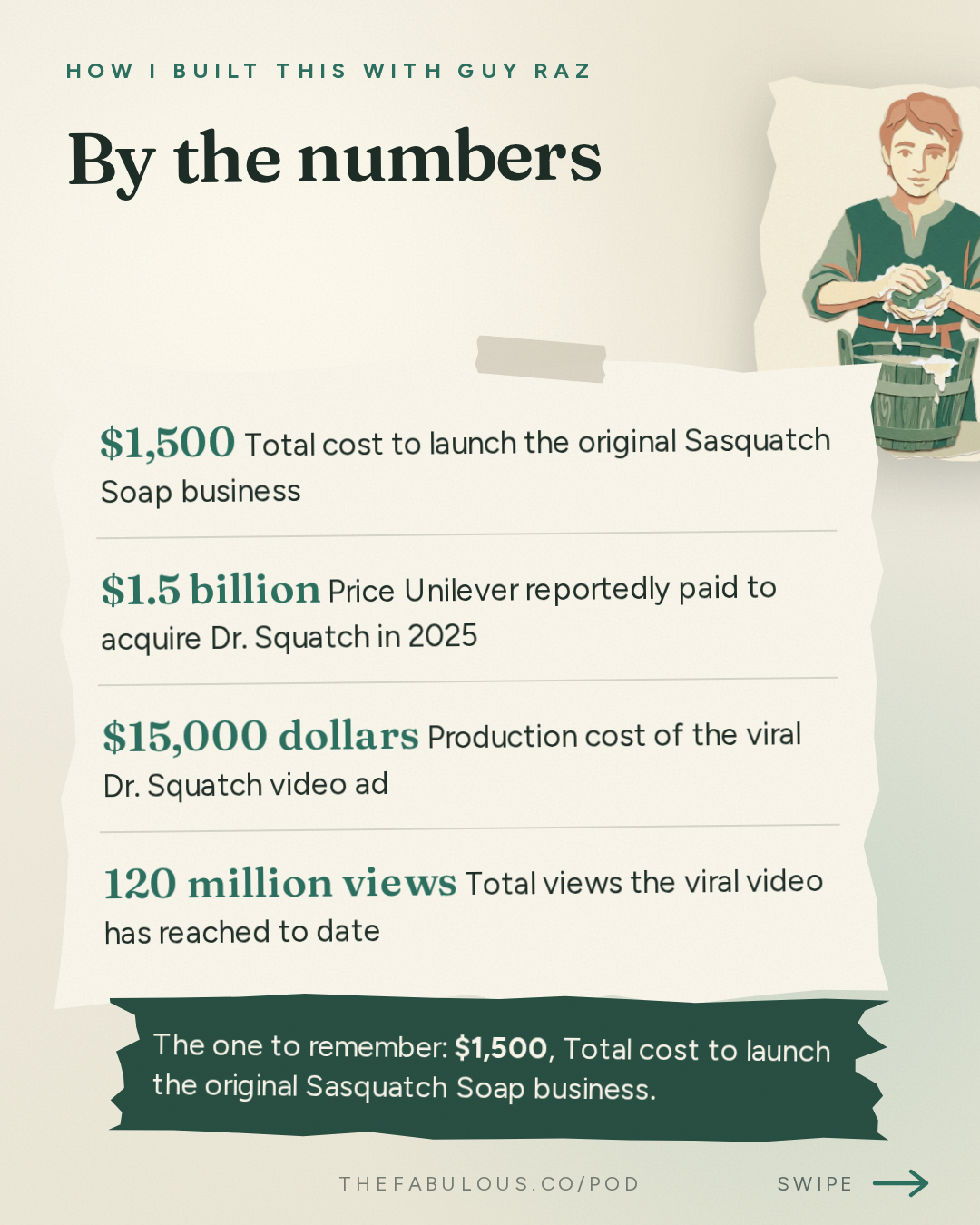
By the numbers
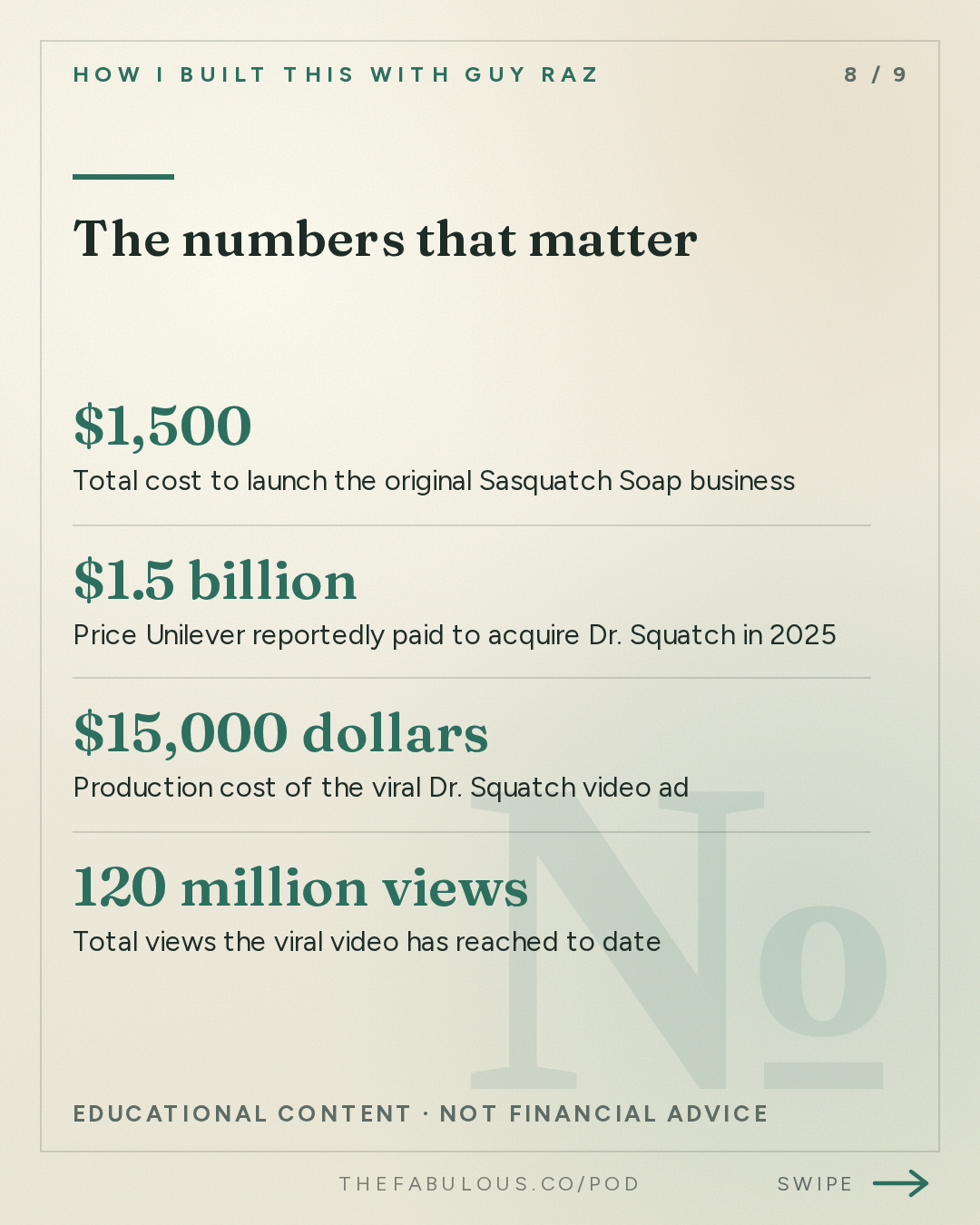
- $1,500 Total cost to launch the original Sasquatch Soap business
- $1.5 billion Price Unilever reportedly paid to acquire Dr. Squatch in 2025
- $15,000 dollars Production cost of the viral Dr. Squatch video ad
- 120 million views Total views the viral video has reached to date
- 3X multiplier Revenue increase in the month after shifting ad spend from Google to Facebook
In their words
“I didn't like being a consultant, and a lot of consulting is kind of positioning yourself as an expert and telling other people what to do, even though you're not necessarily in their business.”
“Nobody was actively looking on the internet to buy natural soap, or very few people were. But if it came across their feed in a way that was kind of interesting and entertaining, then they would be like, "Oh, okay, I'll try this out."”
“I literally printed out, you know, three months' worth of bank statements and was circling every line item or crossing things out just to cut expenses as much as possible.”
“I'm just not well-equipped to be the CEO of a large company.”
“It's close to 50/50.”
Protocols
-
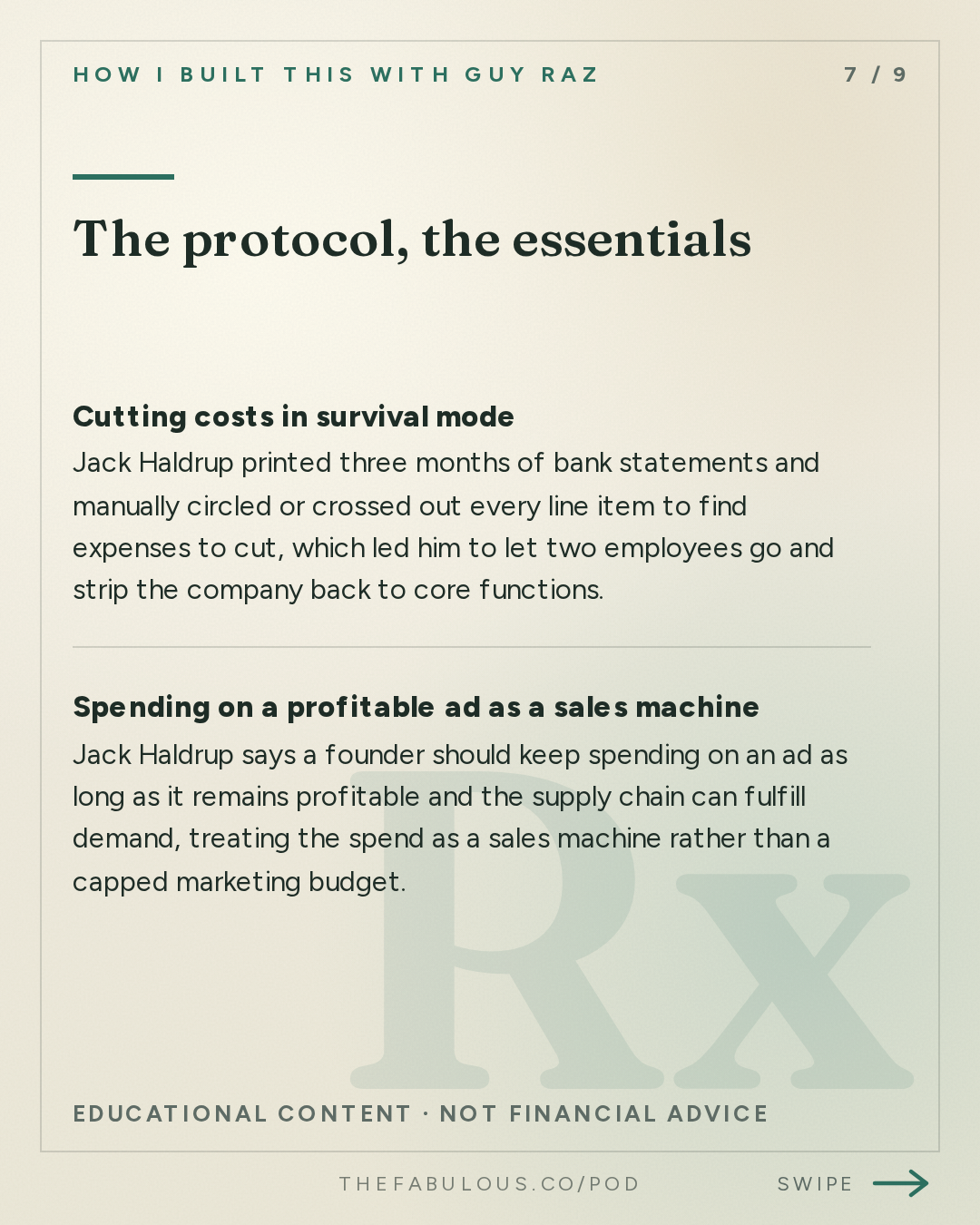
Cutting costs in survival mode
Jack Haldrup printed three months of bank statements and manually circled or crossed out every line item to find expenses to cut, which led him to let two employees go and strip the company back to core functions.
one-time crisis response
-
Spending on a profitable ad as a sales machine
Jack Haldrup says a founder should keep spending on an ad as long as it remains profitable and the supply chain can fulfill demand, treating the spend as a sales machine rather than a capped marketing budget.
ongoing, while the ad stays profitable
-
Matching the ad channel to buying behavior
Jack Haldrup recommends testing social feeds over search ads for impulse-buy products, since customers were not actively searching for terms like natural soap for men but would respond to an entertaining ad in their feed.
applied when choosing a primary ad platform
Questions this episode answers
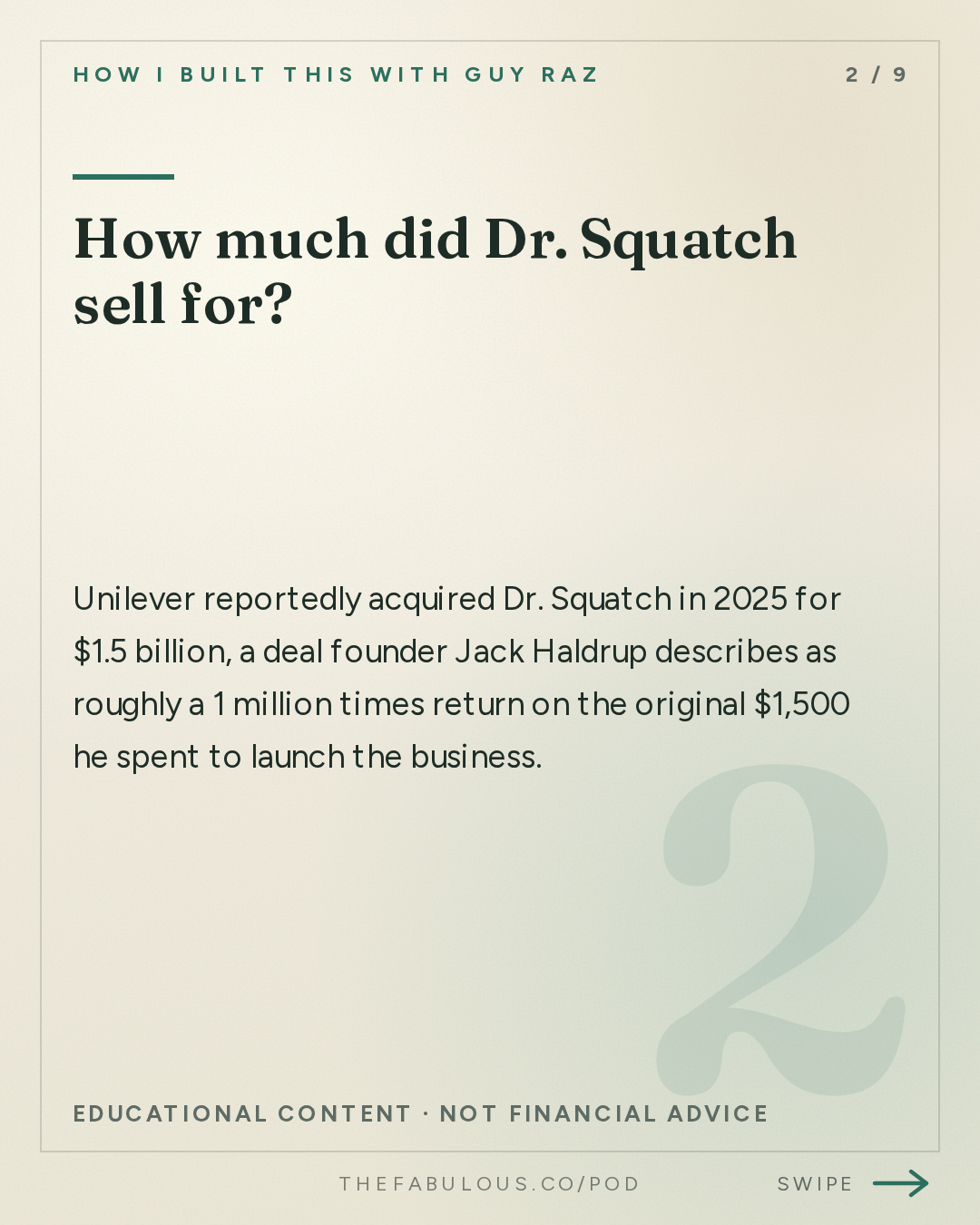
How much did Dr. Squatch sell for?
Unilever reportedly acquired Dr. Squatch in 2025 for $1.5 billion, a deal founder Jack Haldrup describes as roughly a 1 million times return on the original $1,500 he spent to launch the business (04:46).
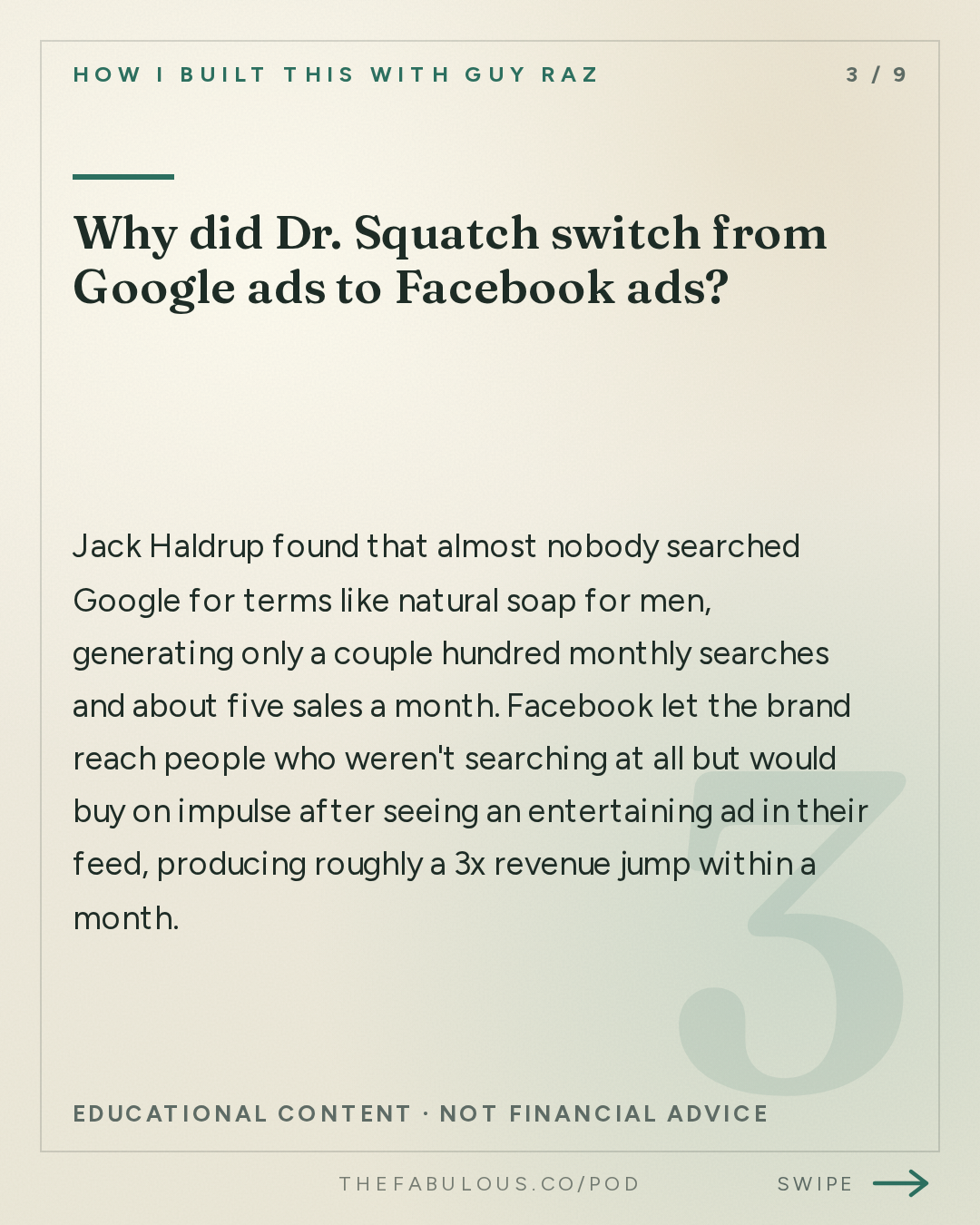
Why did Dr. Squatch switch from Google ads to Facebook ads?
Jack Haldrup found that almost nobody searched Google for terms like natural soap for men, generating only a couple hundred monthly searches and about five sales a month (35:50). Facebook let the brand reach people who weren't searching at all but would buy on impulse after seeing an entertaining ad in their feed (36:13), producing roughly a 3x revenue jump within a month (35:09).
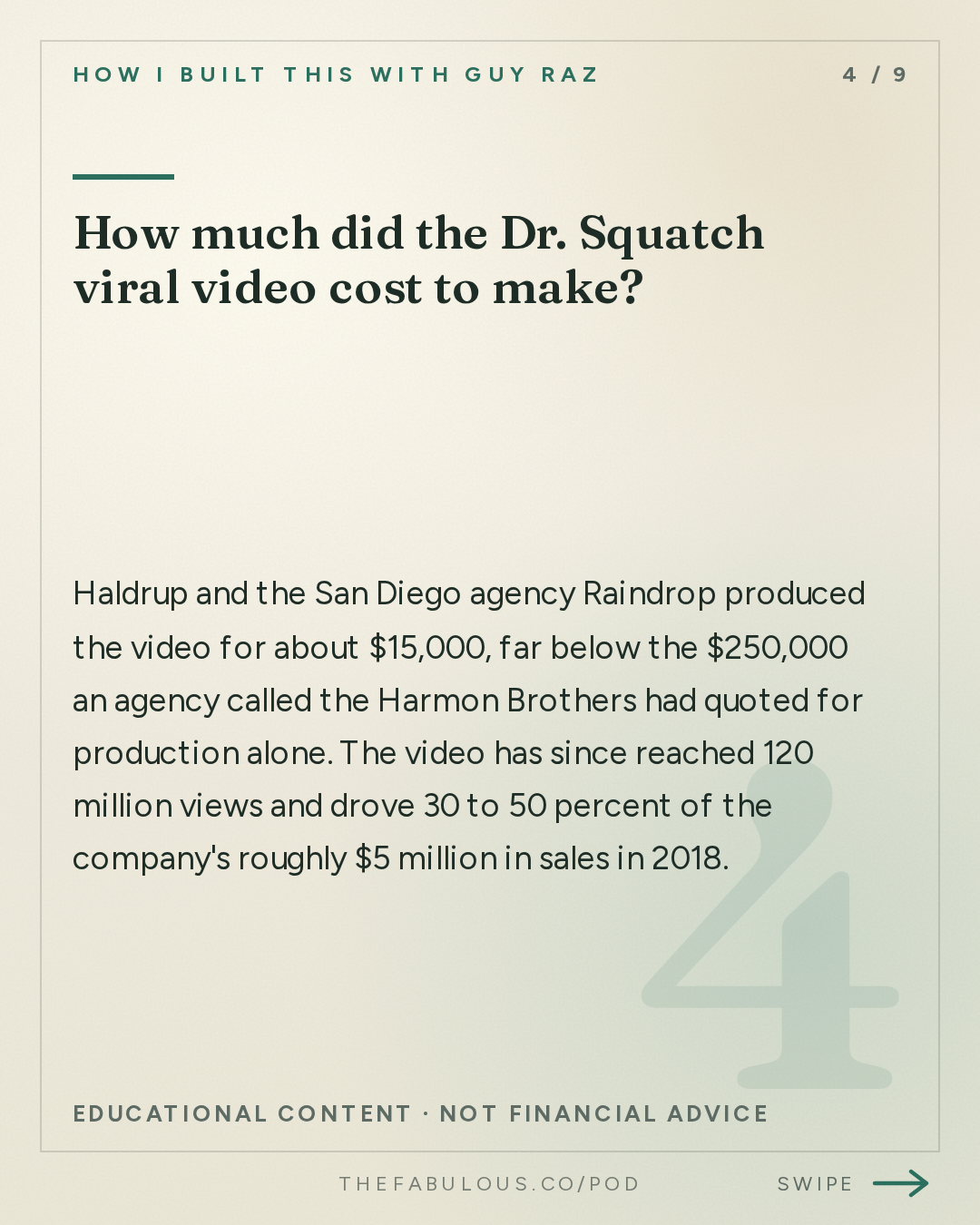
How much did the Dr. Squatch viral video cost to make?
Haldrup and the San Diego agency Raindrop produced the video for about $15,000, far below the $250,000 an agency called the Harmon Brothers had quoted for production alone (57:15). The video has since reached 120 million views (56:53) and drove 30 to 50 percent of the company's roughly $5 million in sales in 2018 (60:36).
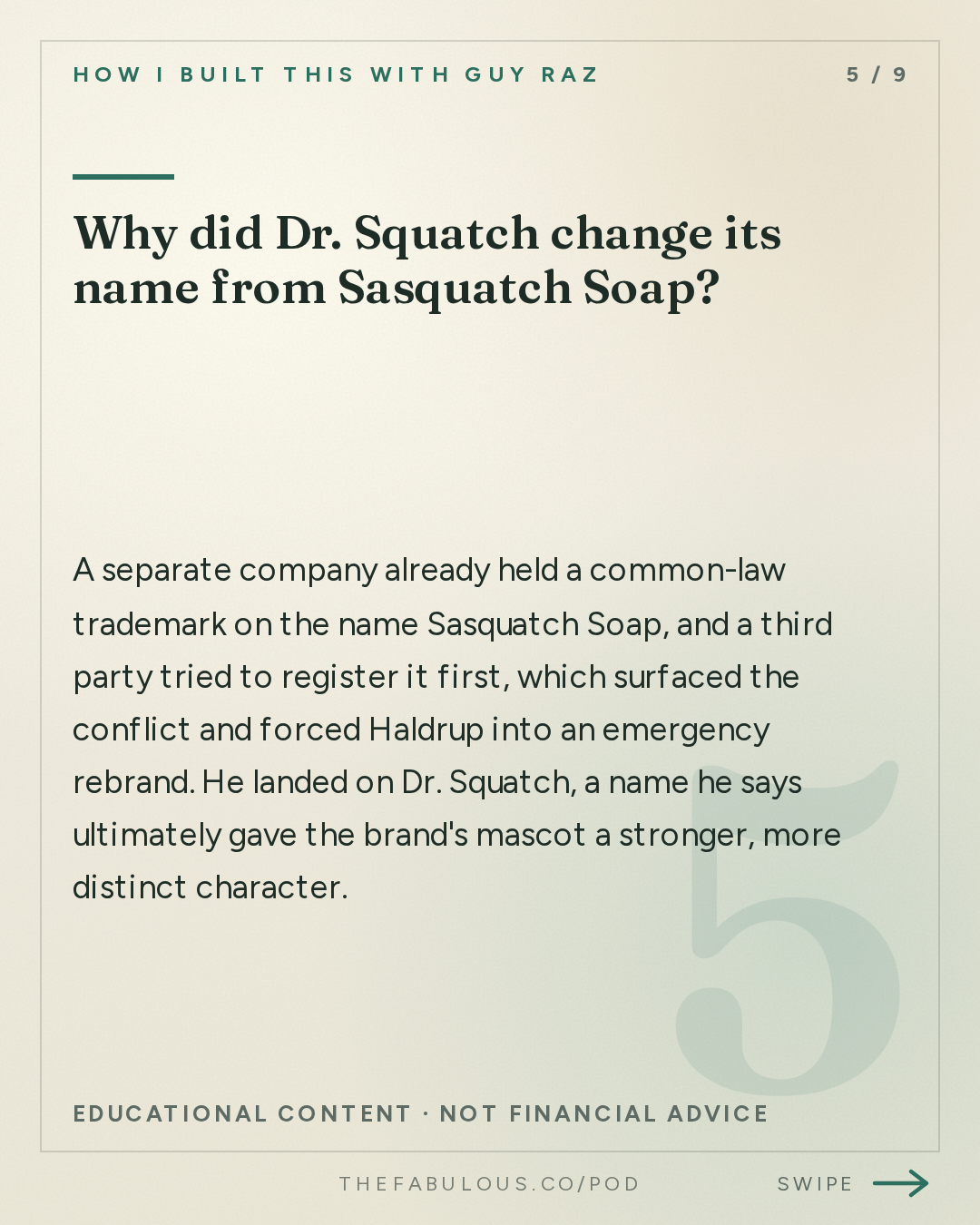
Why did Dr. Squatch change its name from Sasquatch Soap?
A separate company already held a common-law trademark on the name Sasquatch Soap, and a third party tried to register it first, which surfaced the conflict and forced Haldrup into an emergency rebrand (37:28). He landed on Dr. Squatch, a name he says ultimately gave the brand's mascot a stronger, more distinct character (41:22).
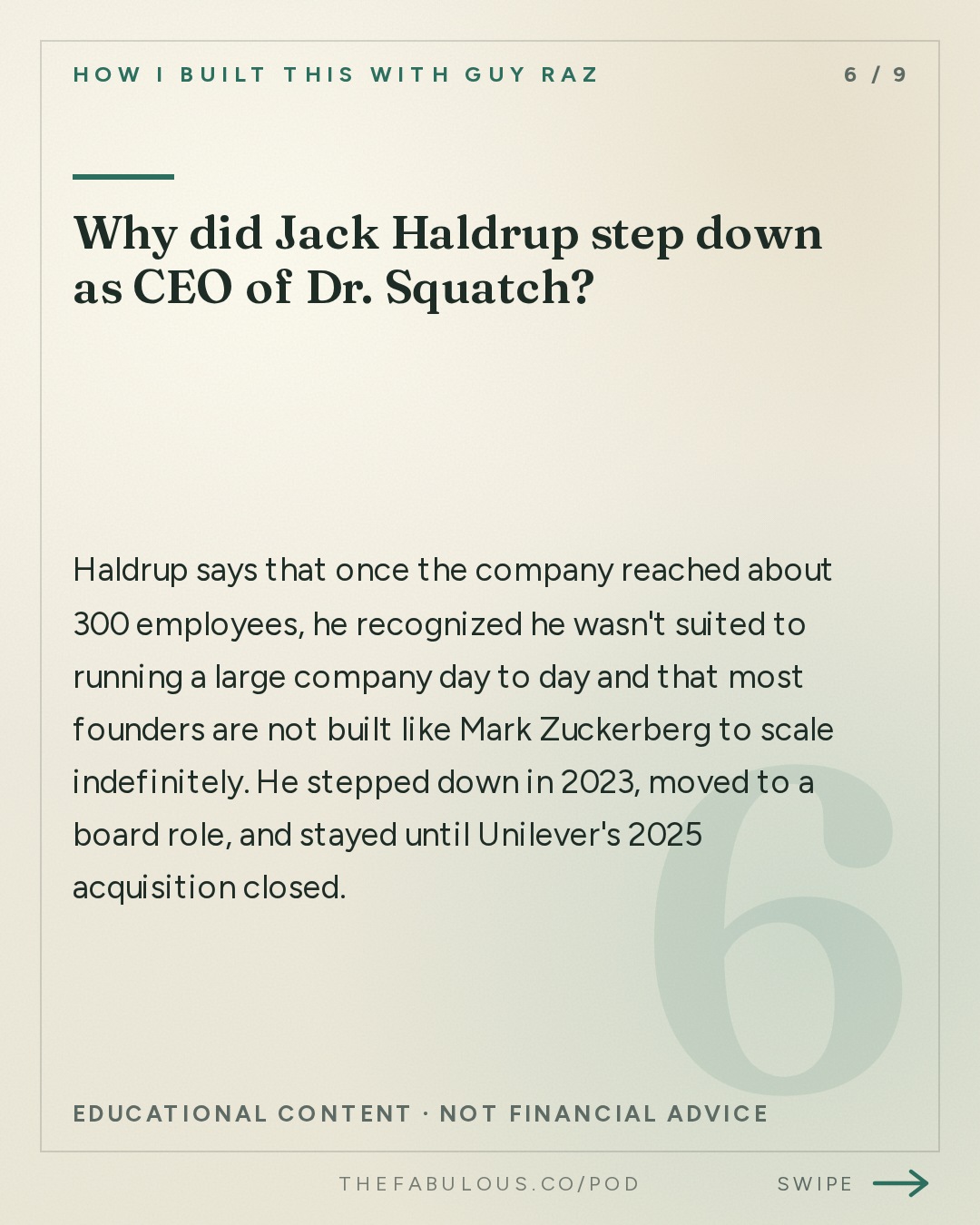
Why did Jack Haldrup step down as CEO of Dr. Squatch?
Haldrup says that once the company reached about 300 employees, he recognized he wasn't suited to running a large company day to day and that most founders are not built like Mark Zuckerberg to scale indefinitely (69:46). He stepped down in 2023, moved to a board role, and stayed until Unilever's 2025 acquisition closed (73:46).
The full read, in cards
Go deeper
- The 4-Hour Workweek — Book by Tim Ferriss that Haldrup read while still working as a consultant and that shaped his belief he could build a business remotely
- The Lean Startup — Book by Eric Ries that influenced Haldrup's early approach of launching without a clear sense of how big the business could become
- Primal Blueprint — Book Haldrup read after his psoriasis diagnosis that pushed him toward natural foods and personal care products
Mentioned
Jack Haldrup · Unilever · Dr. Squatch · AJ Fountain · General Assembly · Harmon Brothers · Raindrop · Bespoke Post · Birchbox · Guild Capital · The 4-Hour Workweek · The Lean Startup · Primal Blueprint
More from this show and category
How Michael Dell Built Dell From His Dorm Room
Michael Dell found marriage license records as a teenager, used them to sell newspapers, then applied the same instinct to undercut IBM on price. At 19 he ran a $50,000-to-$80,000-a-month computer business from his dorm room at UT Austin, and by 21 his company, Dell Computer Corporation, had $66 million in annual sales.
Brian Chesky's Founder Mode Explained
Airbnb CEO Brian Chesky says he was a great founder but a terrible CEO until the 2020 pandemic forced a hands-on style he calls founder mode. After Airbnb lost 80% of its business in eight weeks, he stopped deferring to veteran executives and began skip-leveling for raw information, a shift that still shapes how he runs the company.
Tope Awotona's Advice for Bootstrapped Founders
Calendly founder Tope Awotona takes four founder calls on How I Built This's Advice Line, covering AI's lowered barrier to building software, physical-product virality, gifting strategy, and his core lesson: build a business around a customer, not a product.
FIGS Founders: How Scrubs Became a $2.5B Brand
Heather Hasson and Trina Spear turned boxy hospital scrubs into FIGS, a direct-to-consumer brand now worth $2.5 billion (04:13). They skipped distributors, kept 85% of healthcare workers as direct customers (23:53), survived 300 to 400 investor rejections (43:19), and beat an $800 million lawsuit (55:17) before going public in 2021.
