
Bogg Bag: Kim Vaccarella's $100M Story
Bogg Bag: Kim Vaccarella. The $100 Million Business She Almost Abandoned
The brief
Kim Vaccarella built Bogg Bag from a beach-bag sketch into a $100 million brand. She survived a $30,000 defective shipment, gave the ruined bags away after Superstorm Sandy, worked a day job for a decade, and later turned down a $100 million buyout to keep control, eventually selling a 40% stake to fashion investors Andrew Rosen and Lou Frankfort.
Picture a woman standing in a factory outside a Chinese city, jet-lagged, furious, telling a manufacturer she has never met that she will burn his building to the ground. That is Kim Vaccarella in 2013, mid-way through a decade of building Bogg Bag, the washable tote that would eventually sell close to five million units and pull in more than $100 million a year (03:47). The line is not a metaphor she reached for later. It is what she actually said.
"I will burn this effing factory to the ground." Kim Vaccarella, [00:54]
To understand why she got there, it helps to go back to a much calmer scene: a New Jersey beach, sometime around 2008. Vaccarella's kids had forgotten their sneakers on a trip to an amusement park, so she bought them a pair of Crocs instead. Sitting on the sand the next day, she started fidgeting with the material, a foam called EVA that starts life as small pellets, gets mixed with color, then is heated and cooled into a mold (25:39). It felt warm but never hot, sturdy but not stiff. She thought: this is what a beach bag should be made of, something you can hose off at the end of the day (17:49).
Her first instinct was not to start a company. She had been reading books with titles like how to make a million dollars, and the formula they sold was simple: patent an idea, then sell it to a company that already makes something similar (15:18). She had a real example in mind. A woman in Colorado had started threading little charms through the holes of Crocs shoes, and her company, Jibbitz, sold to Crocs for around $20 million (15:58). Vaccarella figured she could do the same thing with a bag. She filed for patents, borrowed against her husband's pension to pay the attorney, and started cold-calling Crocs.
It did not go how the books promised. A Crocs employee told her the company already had two hundred people in research and development, and there was no one for her to pitch. When Vaccarella pushed, the employee ended the call by saying, "good luck with that" (23:33). That dismissal is arguably the real founding moment of Bogg Bag, because it forced Vaccarella to become a manufacturer instead of an idea-seller. A neighbor originally from China connected her, through a friend of a friend, to a small factory that made flip-flops out of the same material. She had no experience negotiating with factories, and she turned that into an advantage. "The greatest thing about not knowing what I was doing," she says, "is I said no to everything" (26:31). No to minimum order sizes, no to prices that sounded made-up, because she had nothing to compare them to and nothing to lose. The first mold cost her $5,000 (27:18).
The shipment that nearly ended it
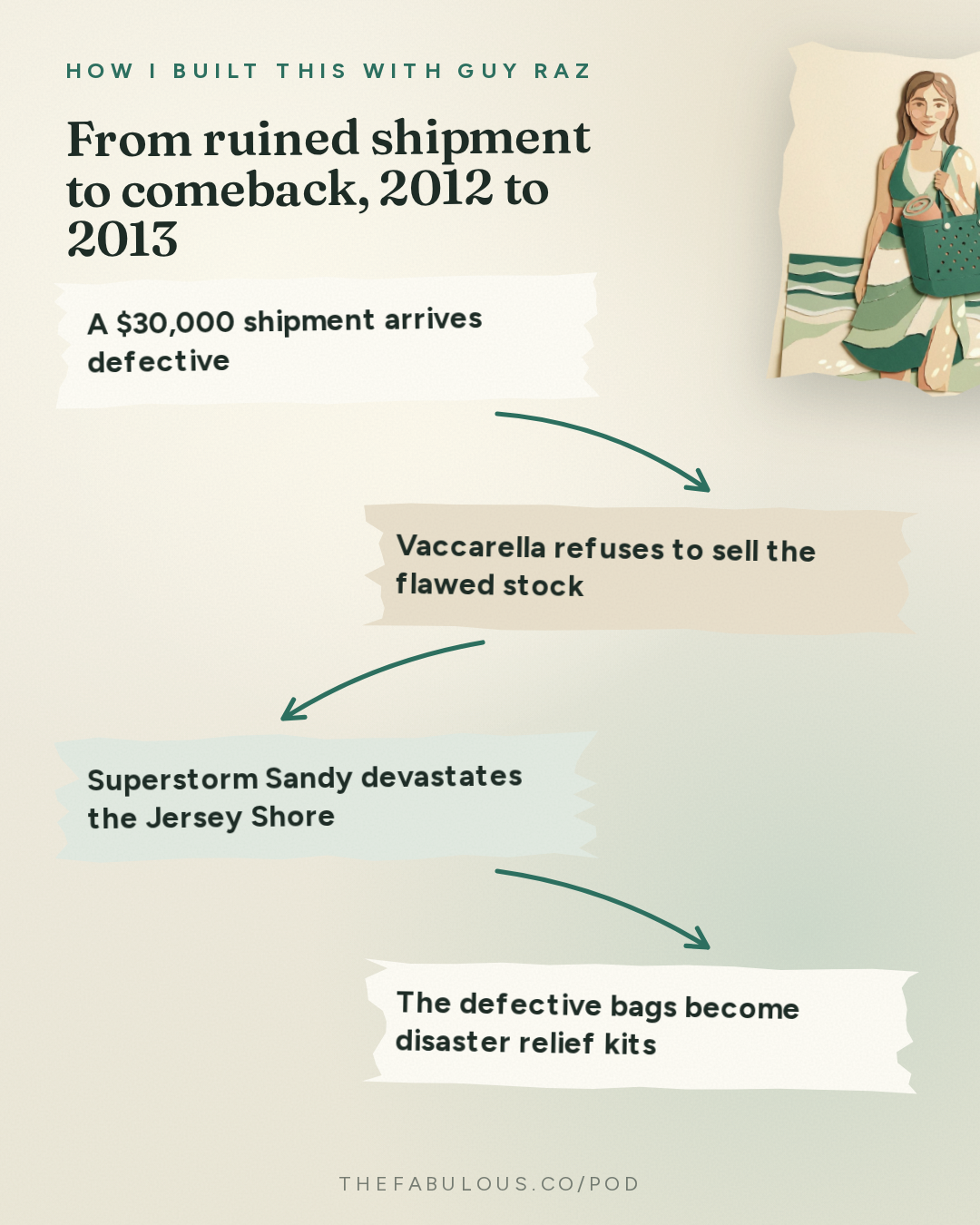
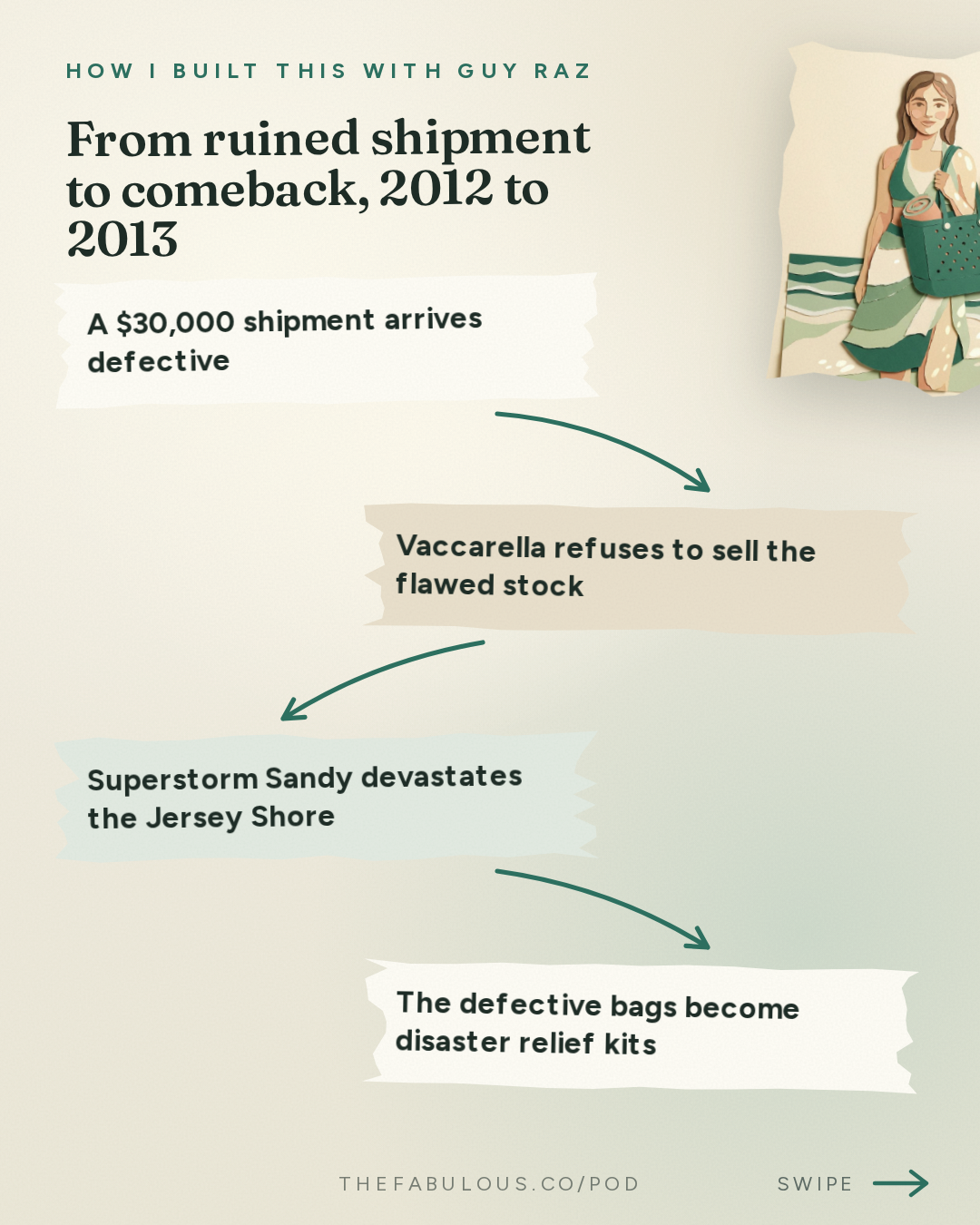
The business limped along on small boutique orders and shared trade-show booths for a couple of years. Then, in 2012, Vaccarella scraped together enough money for her first full shipping container, 1,200 bags for about $30,000, most of her family's savings (38:17). When the container finally arrived at midnight, she tore open the first box and found black streaks running through the foam. A factory worker had failed to clean out the dye barrel before mixing a new color, so residue from the last batch had burned into the plastic (39:33). Between 800 and 1,000 of the 1,200 bags were affected. The manufacturer refused a refund or a replacement batch.
Vaccarella could have sold the flawed bags anyway. She later admitted most customers would never have noticed. She chose not to.
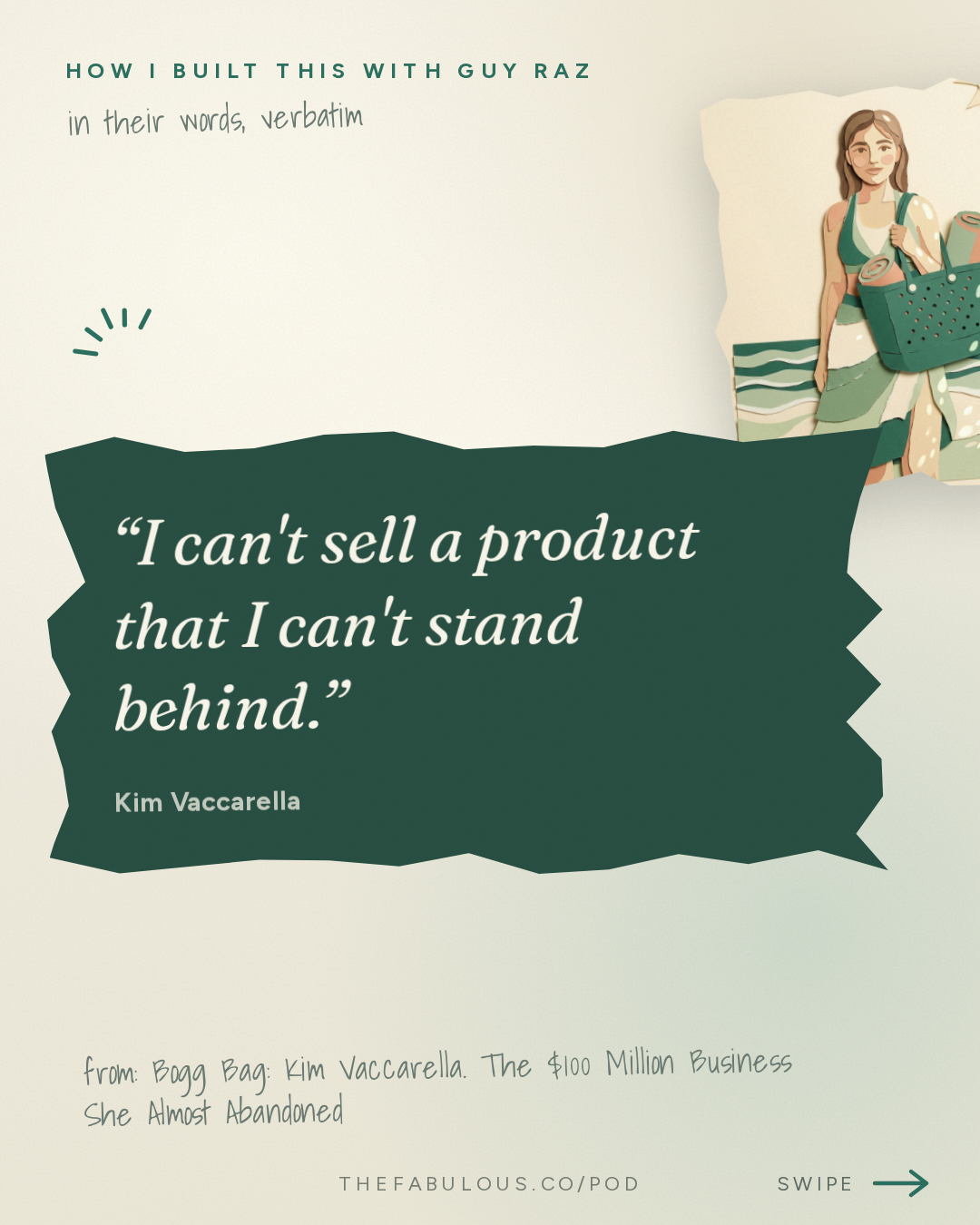
"I can't sell a product that I can't stand behind." Kim Vaccarella, [40:25]
She shut the business down. Then, that October, Superstorm Sandy tore through the same stretch of Jersey Shore where the whole idea had started, destroying homes and leaving families without electricity for weeks (44:38). Vaccarella had a warehouse full of bags she could not sell. So she filled the defective ones with cleaning supplies, flashlights, and garbage bags, drove them to Toms River, and handed them out free to storm victims (45:24). It was meant to be a one-time act of charity, not a business strategy.
Roughly a year later, people who had received a free, mold-stained bag started messaging her, asking to buy more for gifts and for themselves (48:57). They had never noticed the black streaks. They just liked the bag. That unplanned feedback loop is what pulled Vaccarella out of what she calls her first depression and back into the business. She flew to China to confront the original factory, and when they threatened to sell her defective stock on their own, she delivered the line about burning the building down and walked out. She fired them, found a new manufacturer through a Facebook group for mom entrepreneurs (53:51), and secured a $120,000 investment from the wife of a colleague, in exchange for 25% of the company, on nothing more than a handshake and a reputation for hard work (56:05).
The years that followed were less dramatic but no less grinding. Unable to afford her own trade-show booth, Vaccarella split a 10-by-10 space with four other founders selling unrelated products, from sarongs to wine glasses (57:38). She kept her full-time job in commercial real estate lending the entire time, working nights and weekends on the bag business, a pattern she later realized had gone on for nine years once a school therapist pointed it out to her (59:56). She did not leave that job until 2018, and only after setting herself an arbitrary target: sell $1 million worth of bags in a single year, or stay put (63:32). With only three months left in the year to hit that number, she squeaked it by.
Saying no to $100 million
Then came two strokes of fortune that had nothing to do with any plan. During the COVID-19 pandemic, most direct-to-consumer brands leaned into online sales as stores closed. Vaccarella did the opposite, leaning into her wholesale boutique partners, who used Bogg Bag as a vehicle for curbside Easter kits and other creative bundles (67:01). Around the same time, a community of Peloton exercise-bike users started keeping their sneakers in Bogg Bags on camera during group rides, and the brand went viral without any paid marketing behind it (67:24). By 2020, annual sales had reached $10 million (68:17).
That growth attracted a publicly traded company that offered to buy a majority stake, a deal that would have paid Vaccarella more than $100 million (71:13). She came close to accepting, even buying her nieces and nephew luggage for a Disney World trip she planned to fund with the proceeds. Then she looked more closely at the acquirer's finances and grew uneasy, and she also realized she was not ready to give up control of the company she had built (71:49). She walked away from the deal, and the aftermath sent her into a second depression, one bad enough that she says she did not shower for five days (73:14). She wrote her way out of it, producing 35,000 words about the business over three or four days, an exercise she says helped her see how far she had already come (73:45).
Not long after, a different kind of offer arrived, this time from Andrew Rosen, an investor known for building Theory and Rag & Bone, and Lou Frankfort, the former Coach executive credited with growing that company from a small leather-goods business into a multi-billion-dollar brand (75:28). In 2023, their group bought a 40% stake in Bogg Bag, leaving Vaccarella with 60% and, crucially, control (77:41). The company has since grown from about five employees to nearly 100 (79:15), and Vaccarella says the goal now is a billion dollars in annual sales, and a brand her grandchildren will one day talk about as part of the family (81:38).
Guy Raz, closing the interview, called it "a get rich slow story" (82:01), and the phrase fits better than most origin-story clichés. Nothing about Bogg Bag looks inevitable in hindsight. A ruined shipment became a disaster-relief supply chain. A rejected buyout became a bigger, better one. The through-line is not a single insight or a lucky break, but a founder who kept refusing the versions of the deal that would have cost her the thing she actually wanted, which was never just the money.
Ask this episode anything
Pod's AI answers from the episode itself, with the minute mark so you can hear it yourself.
Or start with one of these
Ask this episode
Pod's AI listens to the whole episode to answer, and points you to the minute it comes from.
The rest of this answer, and any question after it
Answers come from the episode itself, never from a summary of it.
ContinueKey takeaways
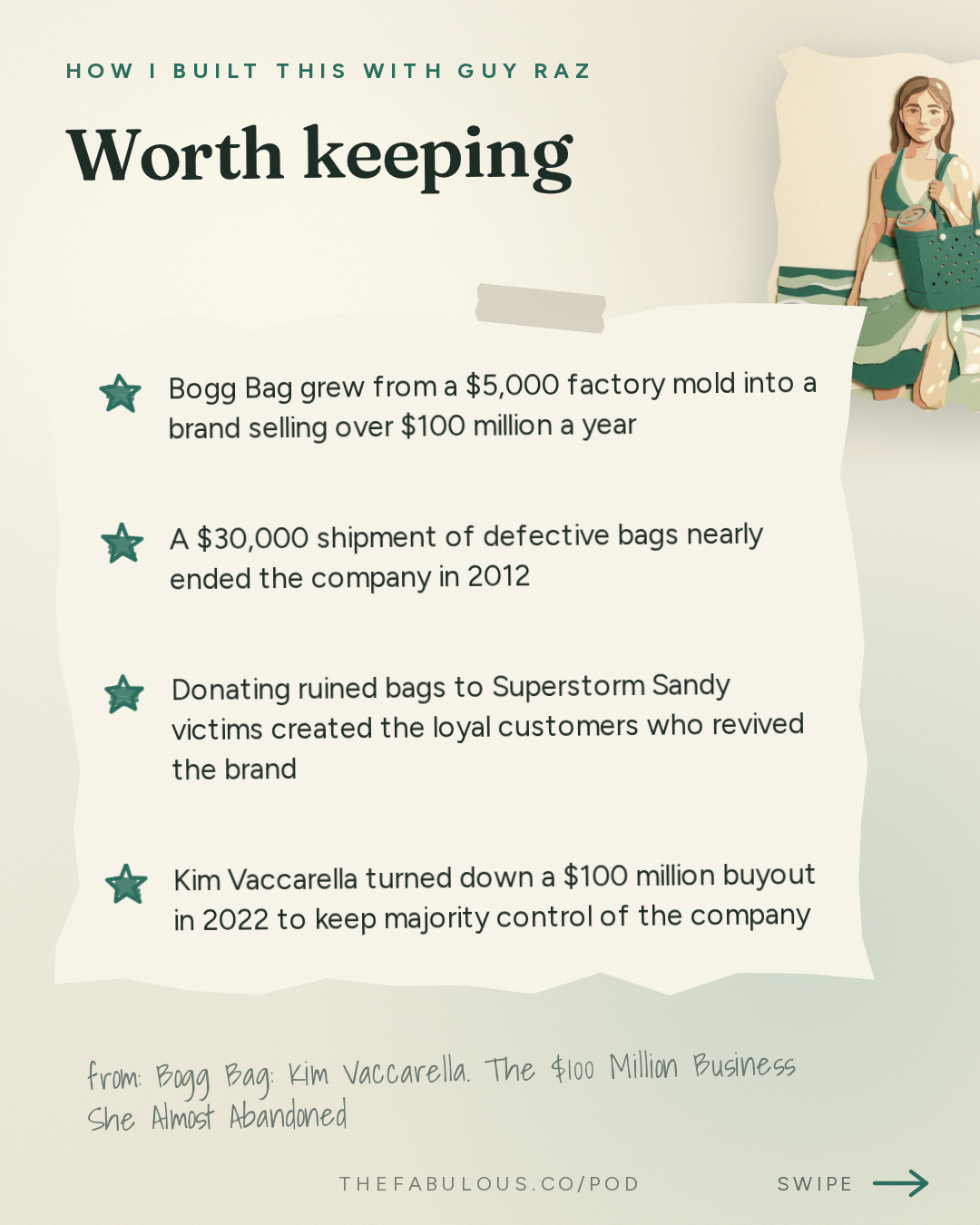
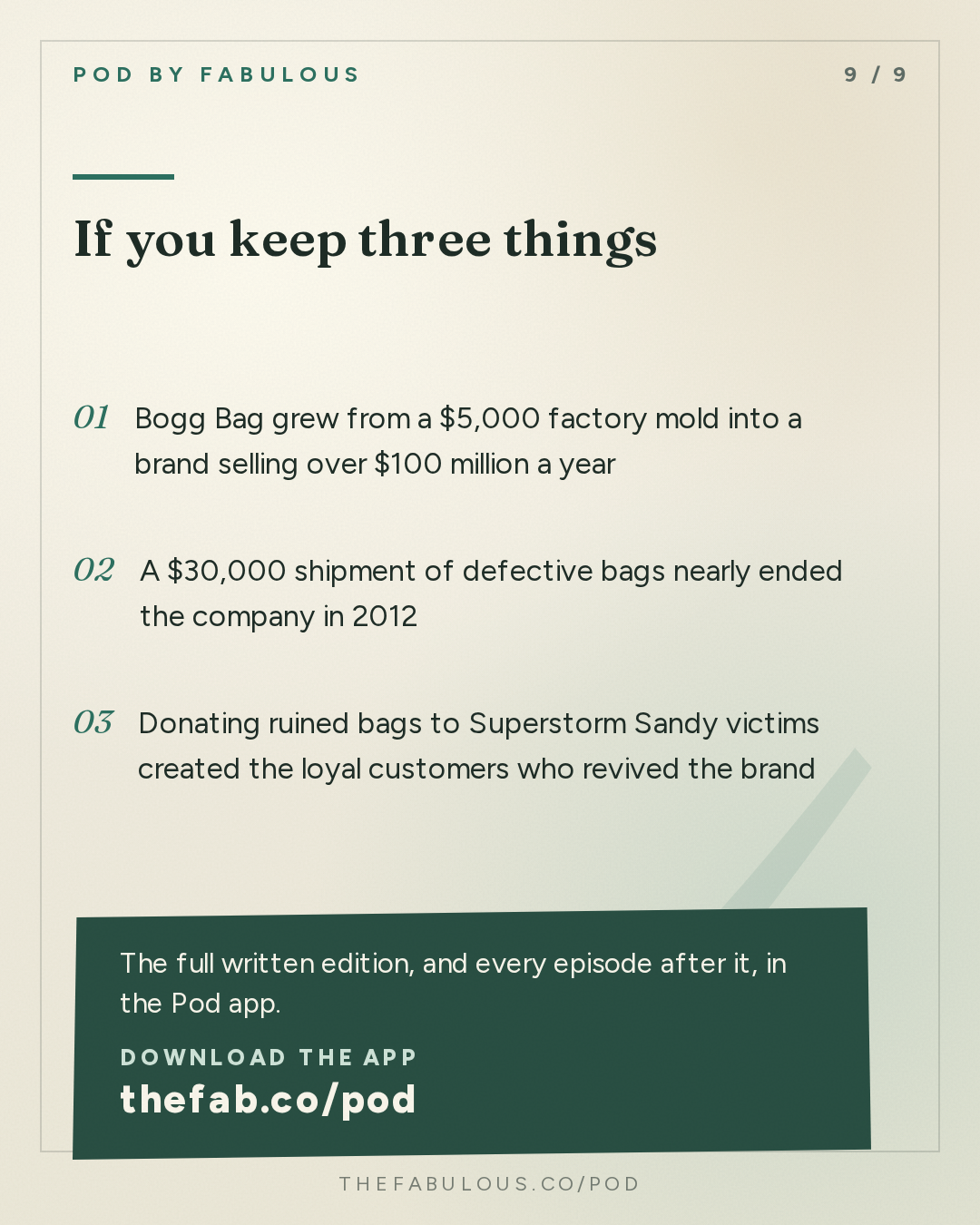
- Bogg Bag grew from a $5,000 factory mold into a brand selling over $100 million a year
- A $30,000 shipment of defective bags nearly ended the company in 2012
- Donating ruined bags to Superstorm Sandy victims created the loyal customers who revived the brand
- Kim Vaccarella turned down a $100 million buyout in 2022 to keep majority control of the company
- Fashion investors Andrew Rosen and Lou Frankfort bought 40% of Bogg Bag in 2023, leaving Vaccarella in control
The episode in cards
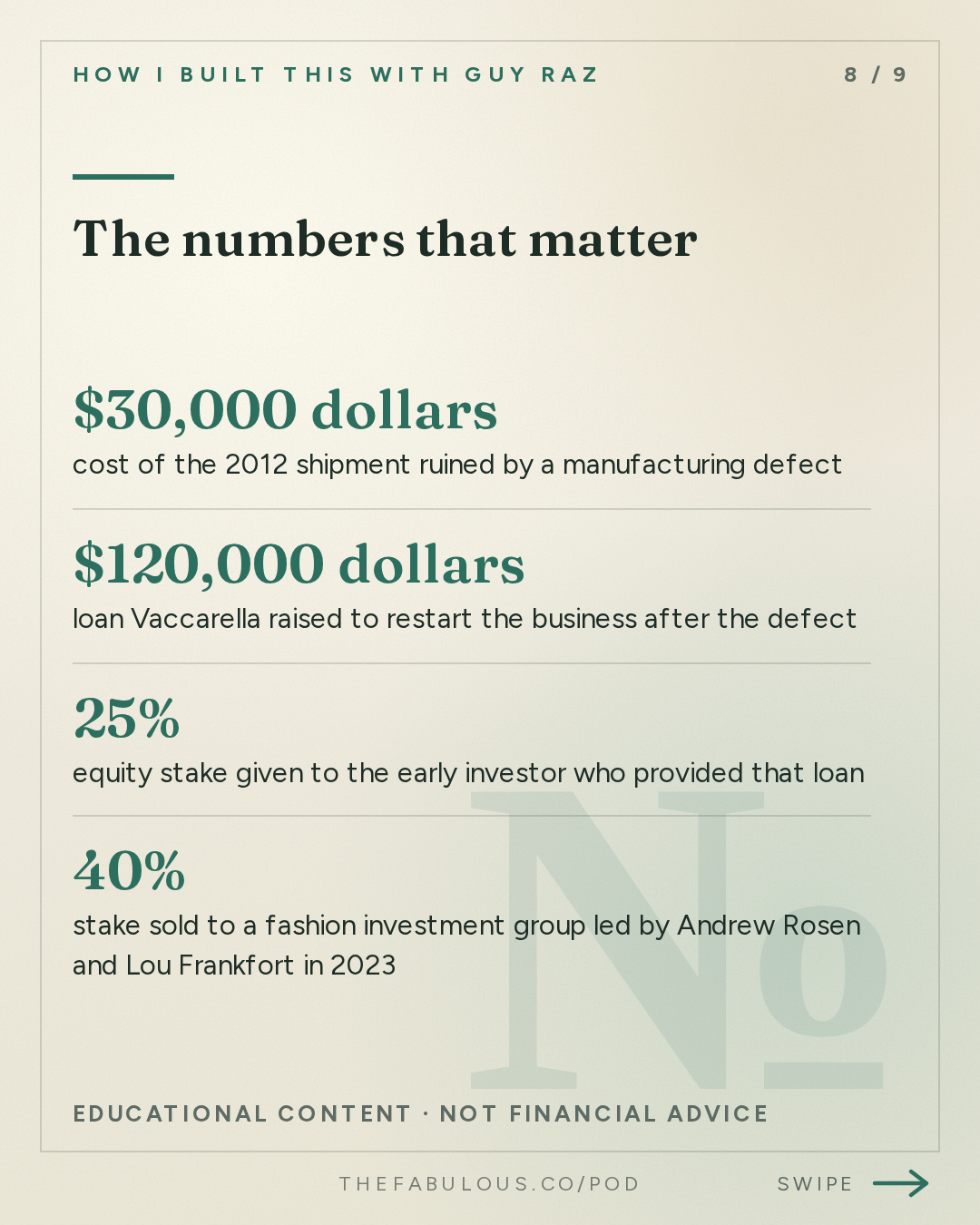
By the numbers
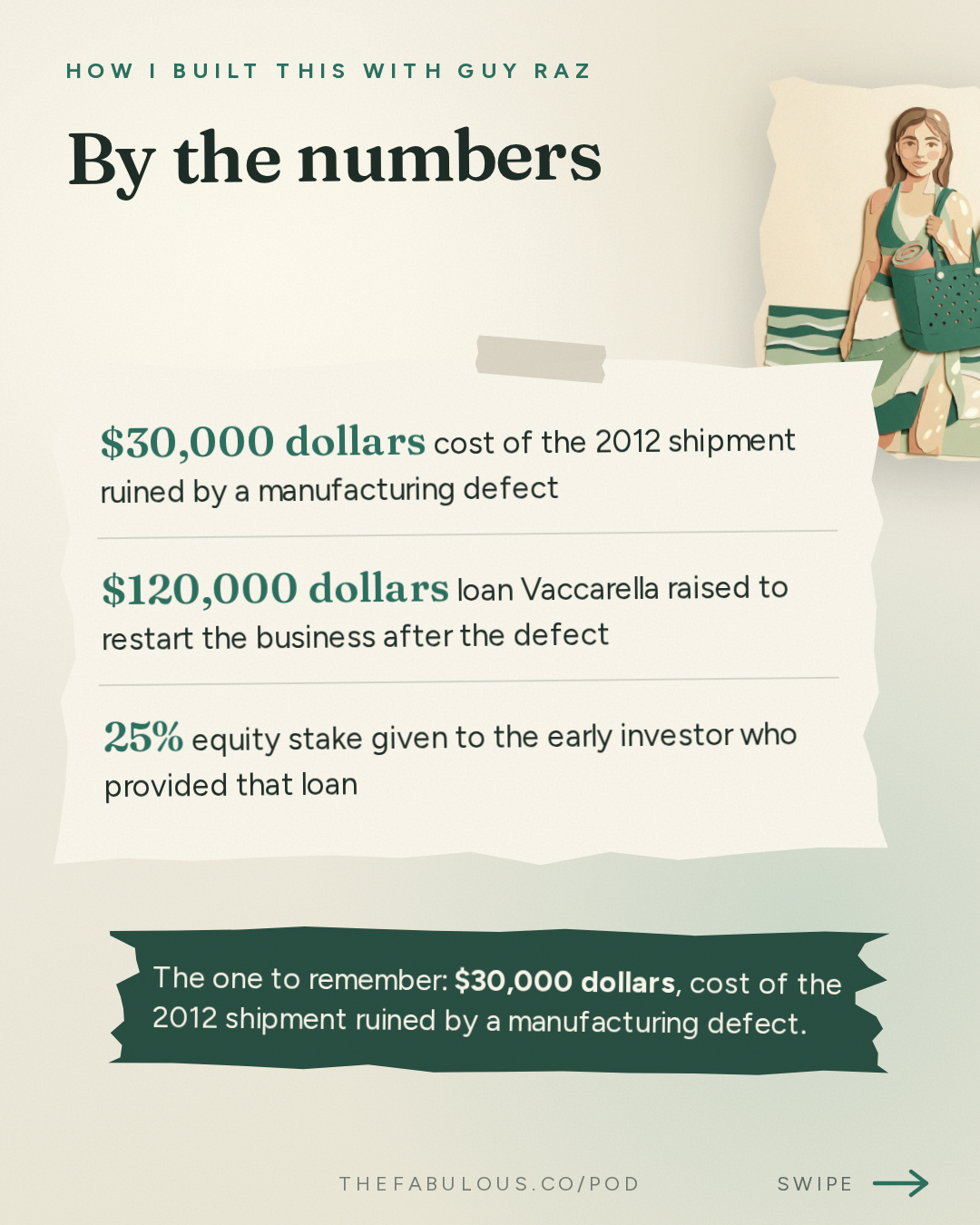
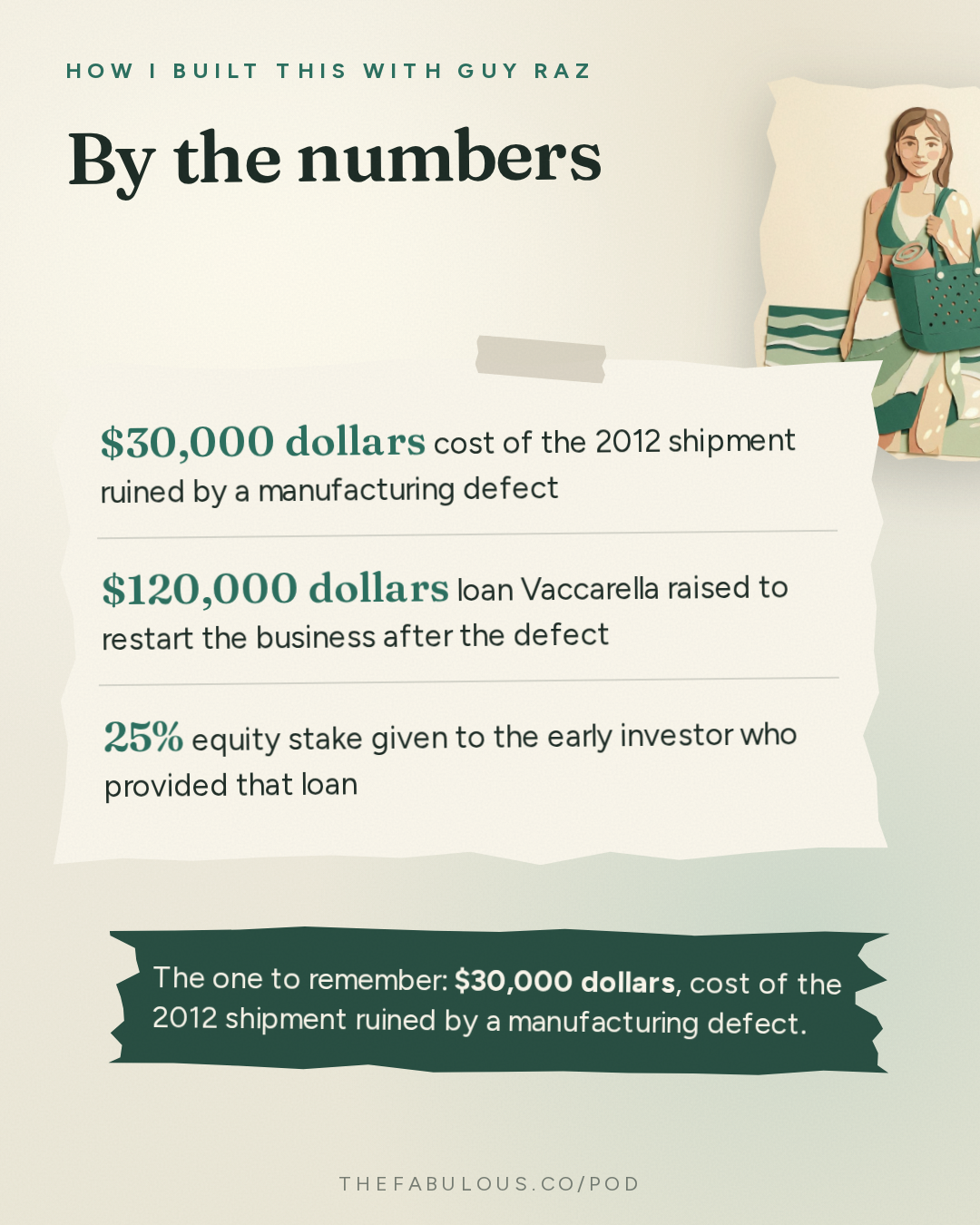
- $30,000 dollars cost of the 2012 shipment ruined by a manufacturing defect
- $120,000 dollars loan Vaccarella raised to restart the business after the defect
- 25% percent equity stake given to the early investor who provided that loan
- 40% percent stake sold to a fashion investment group led by Andrew Rosen and Lou Frankfort in 2023
In their words
“I will burn this effing factory to the ground.”
“I can't sell a product that I can't stand behind.”
“It's a get rich slow story- Yeah ... which I, I think are the best”
Protocols
-
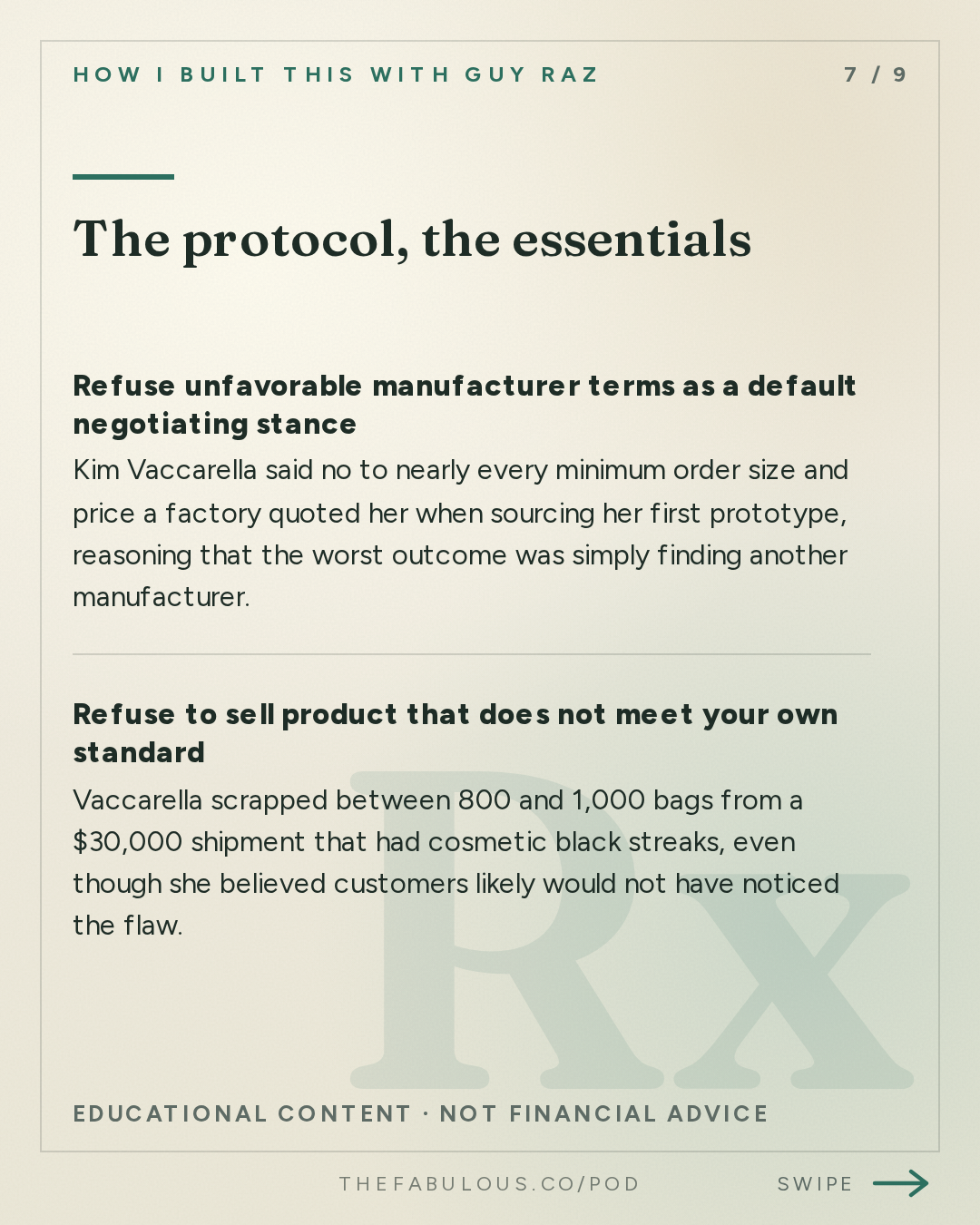
Refuse unfavorable manufacturer terms as a default negotiating stance
Kim Vaccarella said no to nearly every minimum order size and price a factory quoted her when sourcing her first prototype, reasoning that the worst outcome was simply finding another manufacturer.
During early manufacturer negotiations before her first order
-
Refuse to sell product that does not meet your own standard
Vaccarella scrapped between 800 and 1,000 bags from a $30,000 shipment that had cosmetic black streaks, even though she believed customers likely would not have noticed the flaw.
One-time decision after the 2012 defective shipment
-
Share trade show costs with unrelated small brands
Vaccarella split a single 10-by-10 trade show booth with four other founders selling unrelated products, rotating who stood at the booth, when she could not afford her own space.
Across roughly seven to ten trade shows in the early growth years
Questions this episode answers
How did Kim Vaccarella come up with the idea for Bogg Bag?
Vaccarella bought her sons a pair of Crocs shoes for a day trip and, sitting on a New Jersey beach, noticed the shoe material stayed pliable but never got too hot. She sketched a square, structured beach bag made of the same foam that night in 2008 (18:32).
What went wrong with Bogg Bag's first big shipment?
In 2012, a $30,000 order of 1,200 bags arrived with black streaks because the factory failed to clean a dye barrel between color runs. Roughly 800 to 1,000 bags were affected, and Vaccarella refused to sell them (39:33).
How did Superstorm Sandy help revive Bogg Bag?
Vaccarella filled her defective, unsellable bags with cleaning supplies and gave them free to Superstorm Sandy victims on the Jersey Shore in 2012. About a year later, recipients started asking to buy more bags, which convinced her to restart the business (45:24, 48:57).
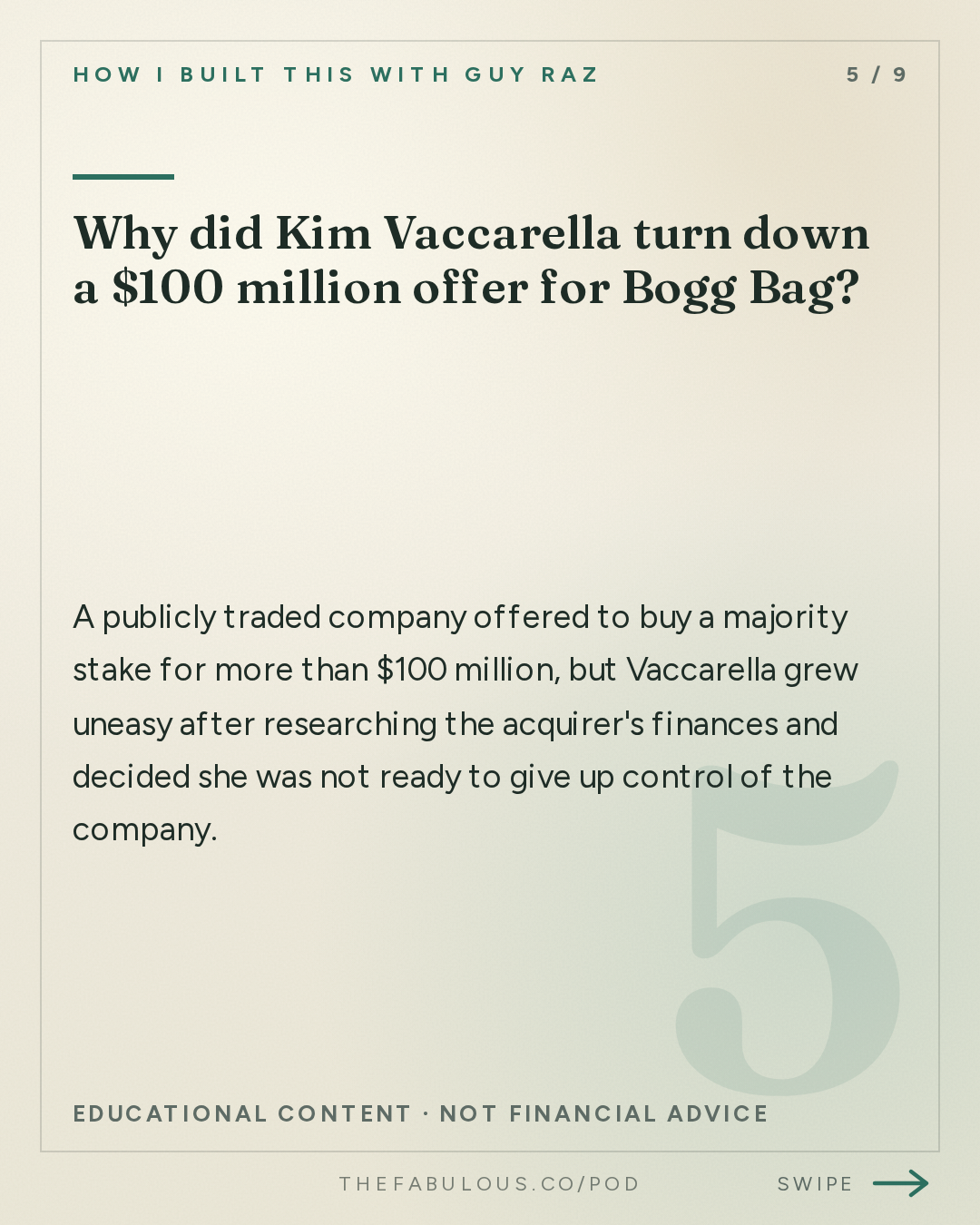
Why did Kim Vaccarella turn down a $100 million offer for Bogg Bag?
A publicly traded company offered to buy a majority stake for more than $100 million, but Vaccarella grew uneasy after researching the acquirer's finances and decided she was not ready to give up control of the company (70:54, 71:49).
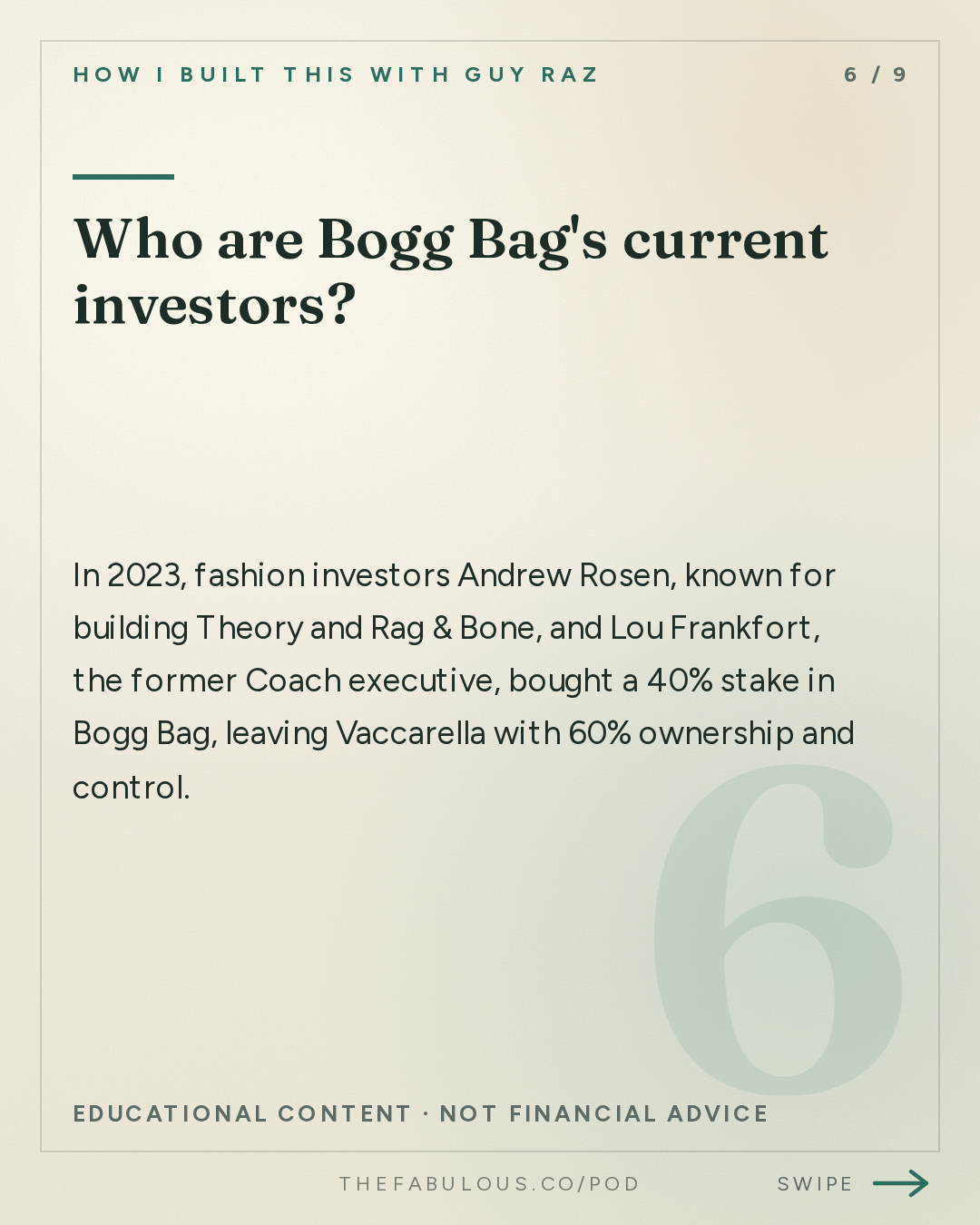
Who are Bogg Bag's current investors?
In 2023, fashion investors Andrew Rosen, known for building Theory and Rag & Bone, and Lou Frankfort, the former Coach executive, bought a 40% stake in Bogg Bag, leaving Vaccarella with 60% ownership and control (75:28, 77:41).
The full read, in cards
Go deeper
- How to Make a Million Dollars / Millionaire Mommy — self-help books that told Vaccarella to patent an idea and sell it, shaping her early strategy of pitching Crocs directly
Mentioned
Kim Vaccarella · Guy Raz · Crocs · Jibbitz · Pink Bungalow · Andrew Rosen · Lou Frankfort · Coach · Peloton · Alibaba
More from this show and category

Tara Bosch's Advice: D2C to Retail Growth
Tara Bosch, who sold a majority stake in her low-sugar candy brand SmartSweets for a reported $360 million (00:49), spends this advice-line episode teaching four early founders how to move from online sales to grocery shelves, price sugar and price value in three seconds, and read customer emotion through phone calls rather than DMs.

How Sweet Loren's Cookie Dough Was Built
Loren Castle grew Sweet Loren's cookie dough into a 30,000-plus-store brand by scaling slowly for a decade. Then she rebuilt the entire line around an allergen-free recipe that became the company's top-selling product within six months of its 2017 launch, after customer emails revealed how many shoppers had dietary restrictions.
Sweet Loren's Cookie Dough Success Story
Loren Castle turned a cookie stand at Brooklyn's Smorgasburg market into Sweet Loren's, a cookie dough brand now in more than 30,000 stores. After surviving Hodgkin's lymphoma at 22, she built the business slowly, then rebuilt it entirely around allergen-free recipes once customer demand made clear that was the real opportunity, reaching profitability in 2018.
CPG Brand: Moving From D2C to Retail
SmartSweets founder Tara Bosch, who sold a majority stake for $360 million, coaches four founders on moving from D2C to grocery retail. She covers wholesale-versus-direct splits, reformulating sugar and allulose, niche marketing for a swimwear brand, and when to pivot an experience-subscription box.
