Anish Acharya on AI Loops and Company Design
Why companies are becoming a series of loops | Anish Acharya (a16z)
The brief
Anish Acharya, general partner at venture firm a16z, argues that companies are turning into stacks of self-correcting AI loops, from bug fixes to sales, but that every loop still hits a plateau where only human judgment can point it toward the next opportunity (15:15).
Start with the fear everyone in Silicon Valley seems to be quietly nursing: that anyone who does not master AI fast enough will slide into a permanent underclass. Anish Acharya, a general partner at venture firm a16z who focuses on consumer investing, calls this notion "a funny, dark fantasy" (03:00). His evidence cuts against the mood. Job postings for radiologists and programmers, the two professions most confidently declared obsolete, are higher than they have ever been (04:28). The technology that was supposed to flatten us, he argues, has instead done something else: it has unbundled skill from desire.
"This is a technology that really amplifies our agency. It kind of unbundles skill from desire." — Anish Acharya [00:19]
What he means is simple. Wanting to make music no longer requires years at a piano. Wanting to write software no longer requires a computer science degree. The gap between wanting and doing, which used to be filled by training, is now filled by a model. Acharya thinks this explains why his firm's calculus on ambition has flipped. Three years ago, a startup pitch that seemed too ambitious got passed over. Today, he says, the opposite problem shows up more often: an idea that is too small does not get funded at all (00:36).
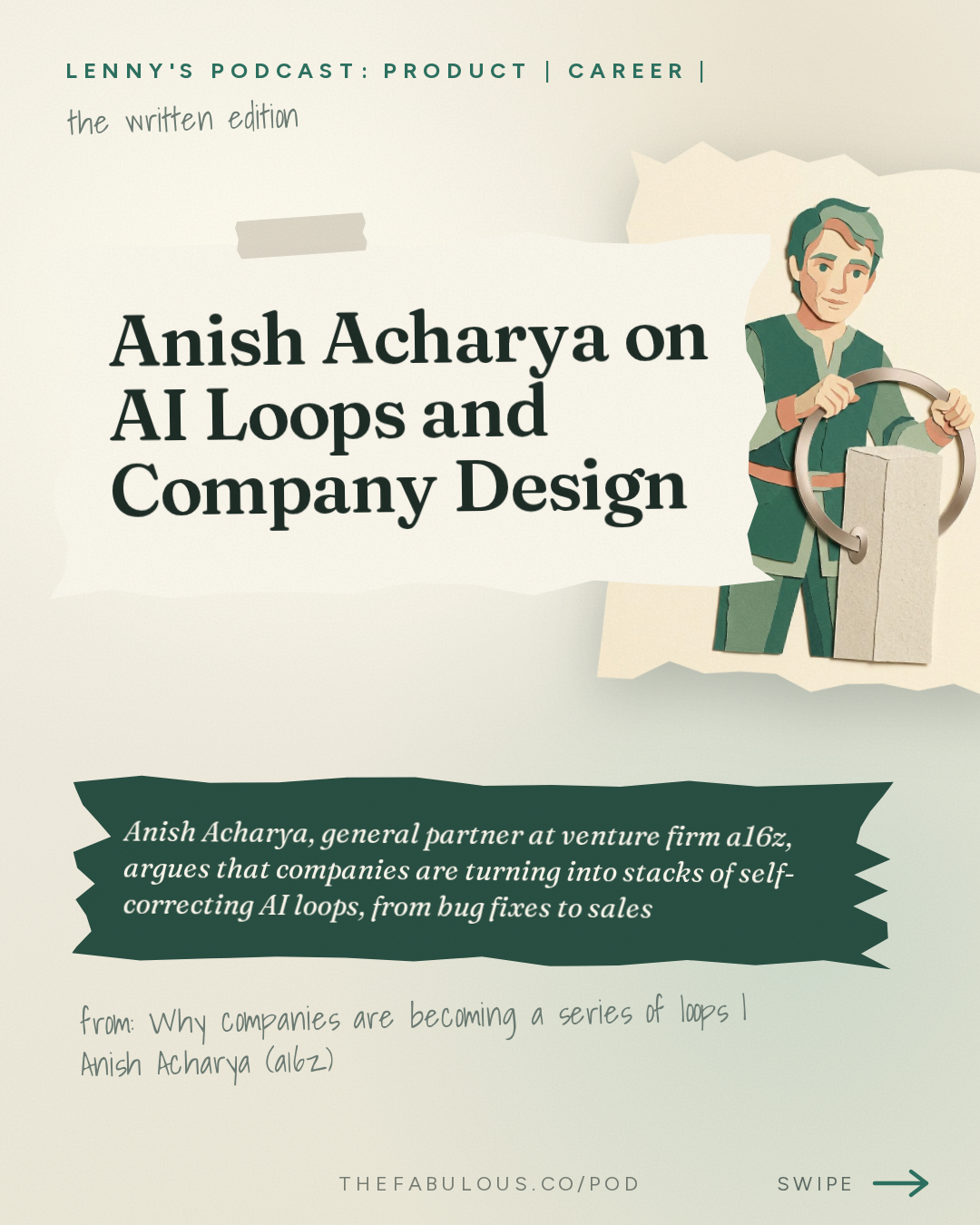
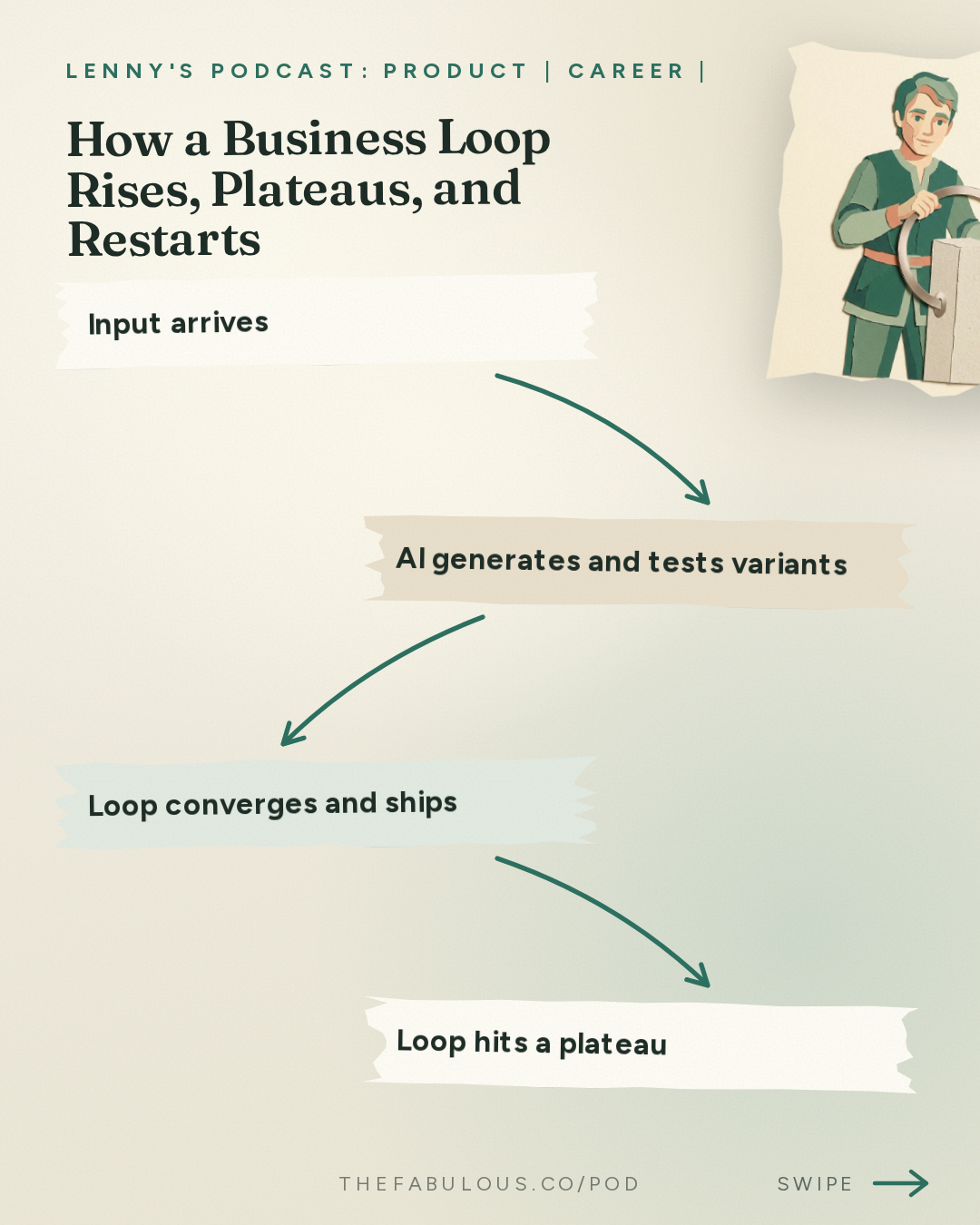
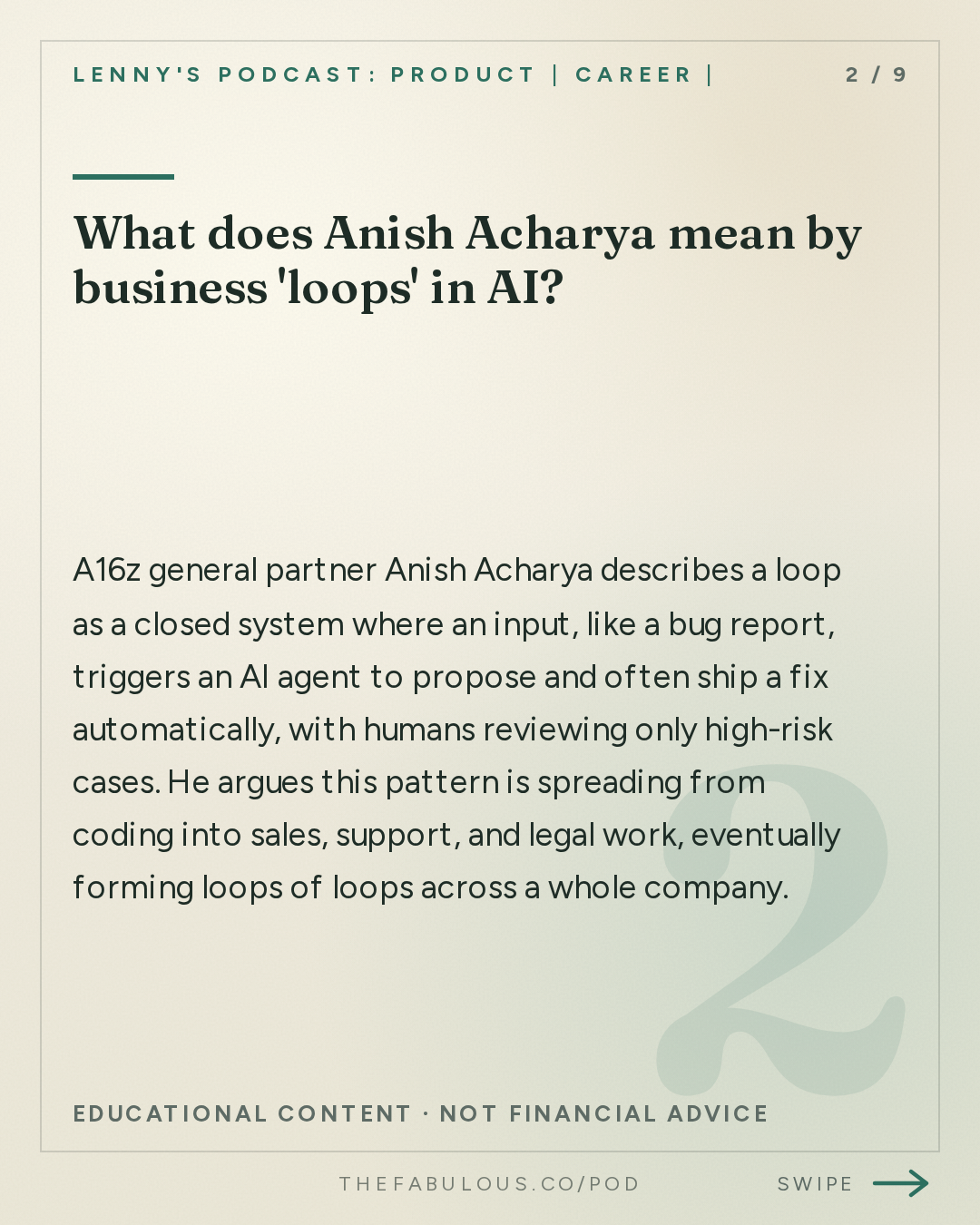
The frame he uses to describe what happens inside a company once it takes AI seriously is "loops." A loop is not just a chatbot answering questions. It is a small closed system: an input comes in, like a bug report or a customer complaint, an AI agent proposes a fix, a human signs off if the risk is high, and the fix ships, sometimes within five minutes (12:16). Acharya's claim is that this pattern, proven first in software engineering, is spreading into sales, support, legal, and marketing. Eventually, he says, the output of many small loops becomes itself a kind of loop that a company's general manager can watch and tune (12:43).
But loops have a ceiling, and this is the part of the conversation that gives the whole hour its shape. Take a growth team running experiments, the kind of work Lenny Rachitsky himself once did at Airbnb. An AI loop can generate variants, test them for statistical significance, and ship the winner automatically. Do that long enough and performance climbs, then flattens. Acharya calls this a local maximum, borrowing a term from optimization math for the best result you can reach without a bigger, different idea.
"The loop will help you climb to the local maxima, but then it plateaus, and you need some sort of out of distribution thinking. You need human intuition. You need somebody to actually help you land at the base of the next hill." — Anish Acharya [15:15]
This is the durable argument in an episode otherwise full of dazzling, fast-moving detail: automation compounds gains until it runs out of road, and only a person asking a genuinely new question can find the next road. Acharya's test case is blunt. Ask an AI agent, "make me a million dollars, make no mistakes," and nothing happens, because direction is the one thing the loop cannot supply for itself (15:56).
Why the same intelligence costs 100 times more in one job than another
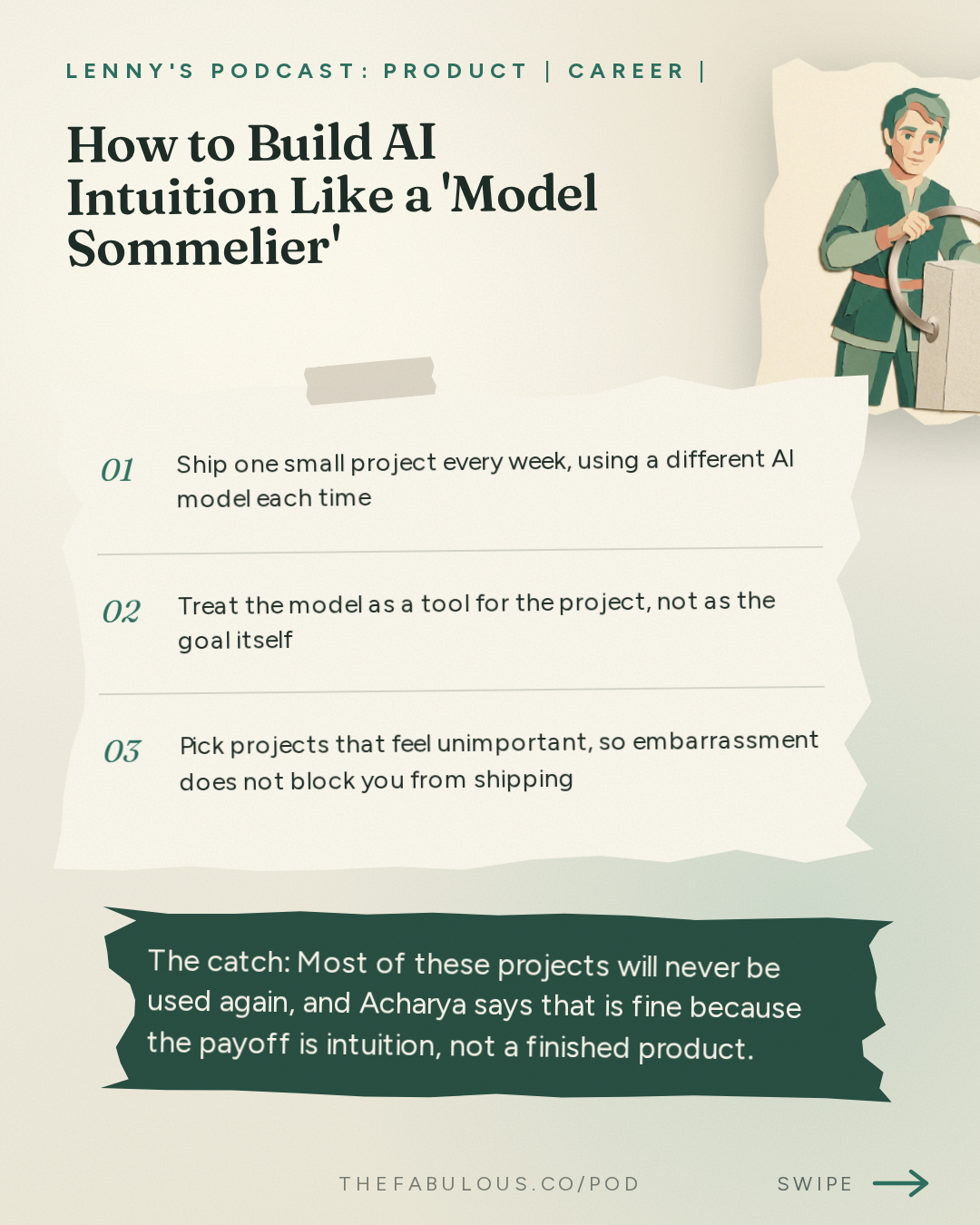
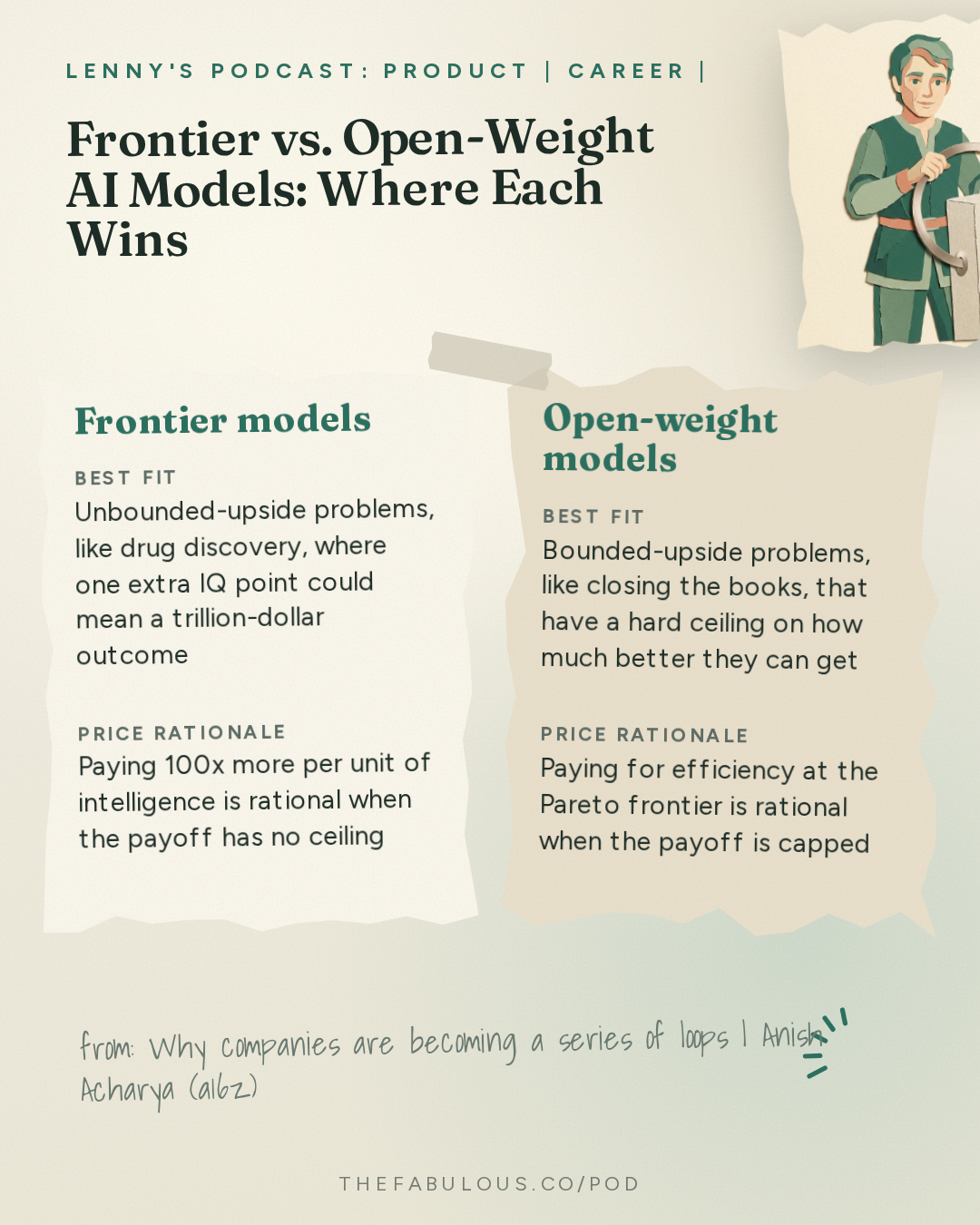
Acharya spends a chunk of the conversation on something he calls being a "model sommelier," a habit of trying every new AI model the moment it ships so he can feel its particular strengths (26:34). This leads him to an economic idea worth sitting with: the pricing of AI models does not track their raw intelligence, it tracks the size of the problem they are solving. He points to Pareto efficiency, a standard economic idea for finding the best trade-off between price and performance along a curve, where every extra dollar buys a proportionate improvement.
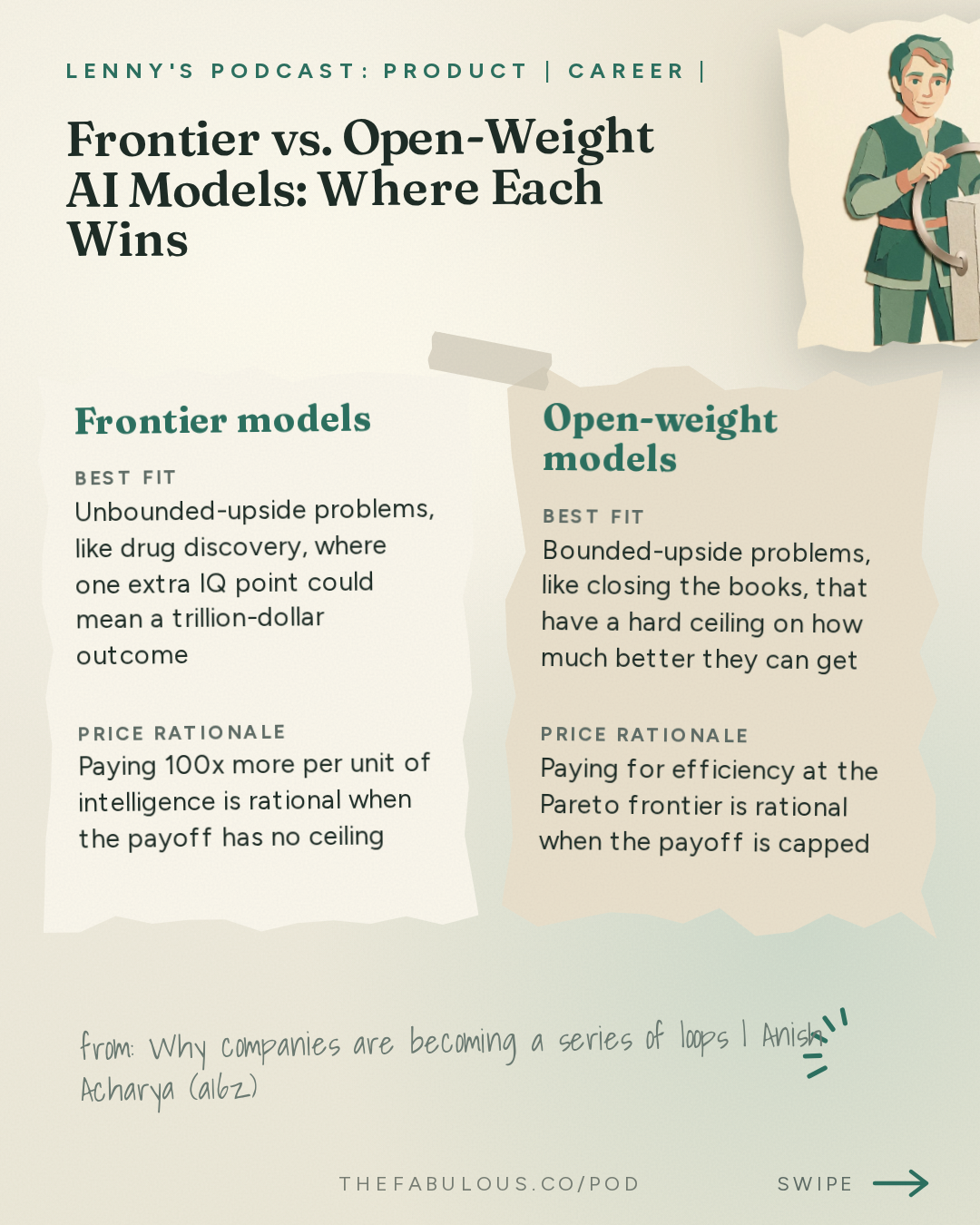
Frontier models, the most advanced and most expensive systems on the market, break that curve on purpose. Acharya estimates that for roughly one extra unit of intelligence, a frontier model can cost 100 times more than a solid mid-tier model like Anthropic's Opus 4.8 (22:31). That looks irrational until the job has unbounded upside. Drug discovery is his example: if one additional point of model intelligence surfaces the next blockbuster drug, paying absurd prices for it is completely rational, because the ceiling on the payoff is effectively infinite (22:31). Legal or accounting work sits at the other end. Closing the books correctly has a hard ceiling, you cannot close them 100 times better, so paying for a cheaper, efficient model that hits the ceiling reliably makes more sense than paying frontier prices for headroom nobody will use (24:37). The practical result, Acharya predicts, is that companies will run two model architectures side by side: frontier tokens for functions with open-ended upside like sales and research, and cheaper, fine-tuned open-weight models for bounded, verifiable, back-office work (23:21).
This same logic explains why he thinks AI's biggest economic prize is unglamorous: administrative waste. In American healthcare, administrative costs eat up 45 percent of total spending (40:58). Strip that out with AI-driven paperwork and coordination, and healthcare gets cheaper without touching the actual medicine. He points to education as a parallel case, arguing that traditional institutions now face their strongest competition in two hundred years because credentials are starting to separate from learning itself (41:07).
Nobody actually wants to save time
The most contrarian idea in the conversation is about what people want from technology in the first place. Acharya's read on forty years of consumer software is that the industry built tools to extend intellect, spreadsheets and their descendants, while mostly ignoring anything that might extend a person's sense of connection or meaning (33:00).
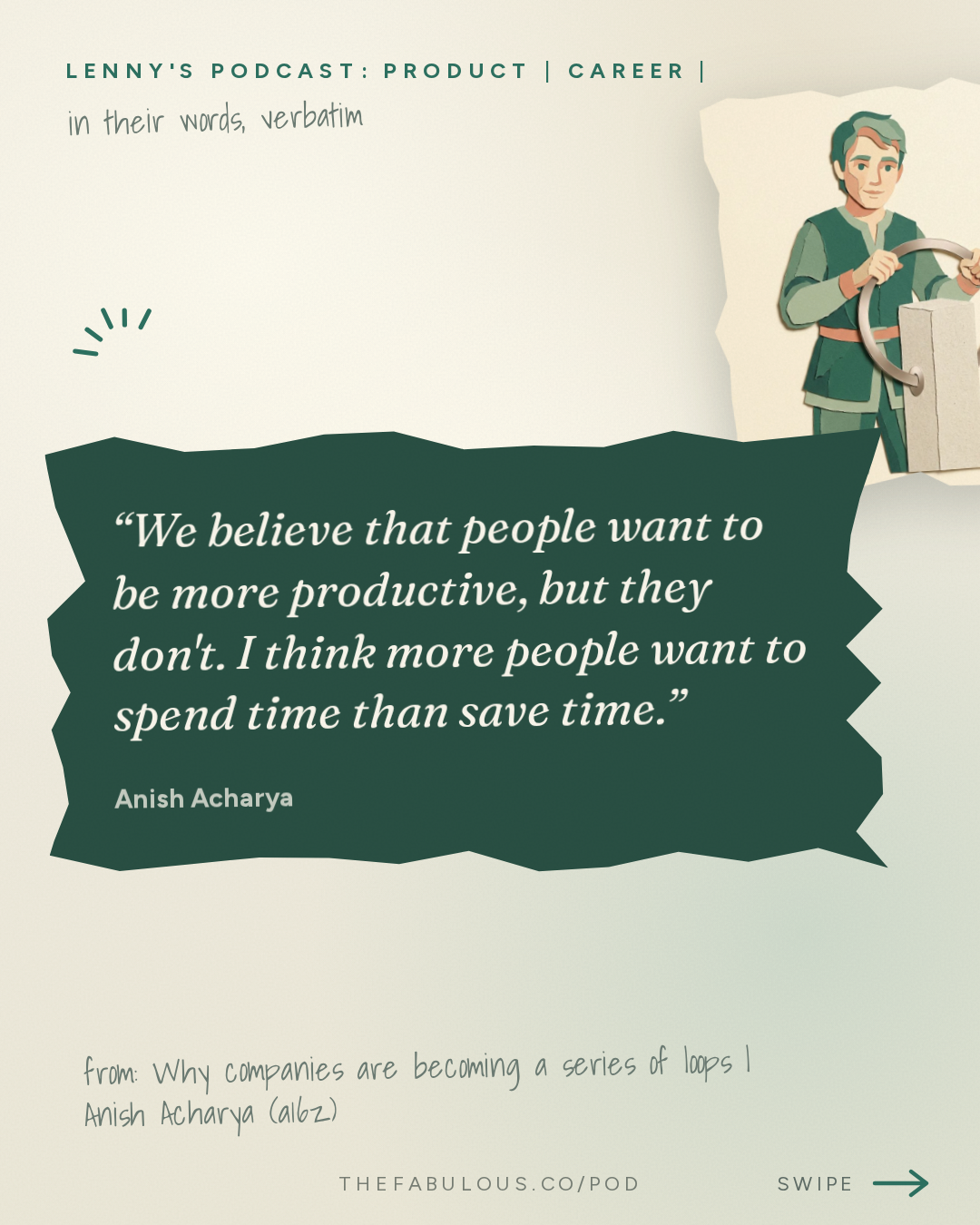
"We believe that people want to be more productive, but they don't. I think more people want to spend time than save time." — Anish Acharya [31:13]
He backs this with a simple observational split he half-jokes about: the "X user," fluent in which open-source model beats which other one, versus the "Instagram user," who experiences AI as a slightly better search box and does not understand the hype (32:16). His argument is that the second group is the actual market, and that the industry has mostly failed to build products aimed at their real needs, which are closer to connection, progress, and fun than to productivity. He does not think this is a capability gap. He thinks it is a product design failure, one that startups, unburdened by a big company's fear of controversy, are better positioned to solve than incumbents (34:10).
That belief connects to his last big claim, about competitive advantage. Founders worry constantly about having a defensible moat, a lasting reason competitors cannot just copy them. Acharya's answer, borrowed from a founder he admires, is that "moats are most often discovered, not designed" (55:04). He points to the AI coding tool Cursor, which drew criticism early on for lacking a clear moat, then built one anyway by capturing usage data and training its own models as it grew (55:22). His advice to founders chasing a pitch-deck-ready moat is to stop designing one on paper and start shipping, because the advantage tends to reveal itself only after the product is in people's hands.
He closes the episode on a habit rather than a theory: build something small every week, with a new model each time, even if nobody else ever sees it (70:46). He calls this "building as the new reading," a phrase he credits to an unnamed researcher at Google, meaning the point of the project is not the output but the intuition it leaves behind (50:50). It is a modest instruction sitting underneath a sweeping argument about loops, pricing, and psychology, but it is the one piece of the conversation any listener can act on by Monday.
Ask this episode anything
Pod's AI answers from the episode itself, with the minute mark so you can hear it yourself.
Or start with one of these
Ask this episode
Pod's AI listens to the whole episode to answer, and points you to the minute it comes from.
The rest of this answer, and any question after it
Answers come from the episode itself, never from a summary of it.
ContinueKey takeaways
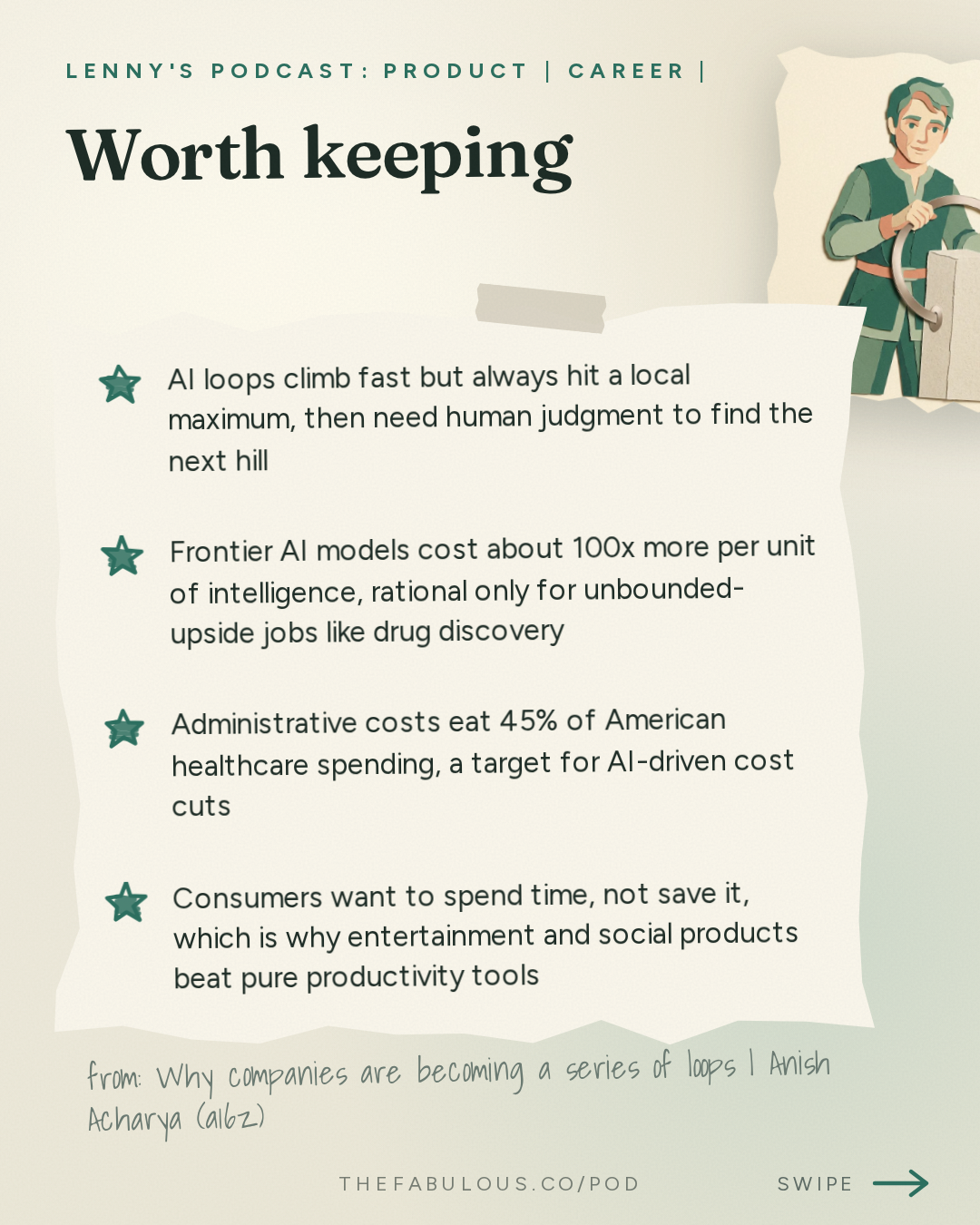
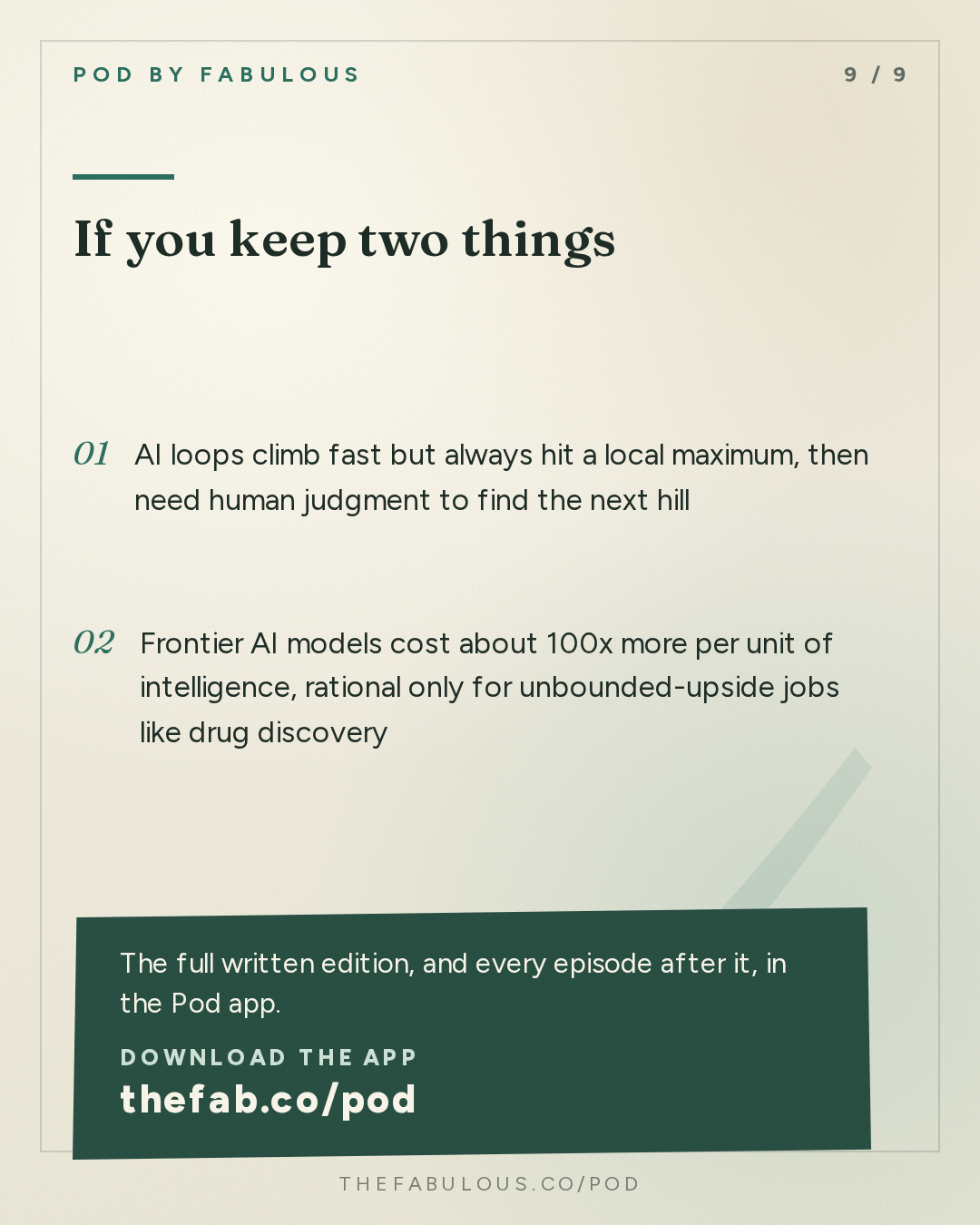
- AI loops climb fast but always hit a local maximum, then need human judgment to find the next hill
- Frontier AI models cost about 100x more per unit of intelligence, rational only for unbounded-upside jobs like drug discovery (22:31)
- Administrative costs eat 45% of American healthcare spending, a target for AI-driven cost cuts (40:58)
- Consumers want to spend time, not save it, which is why entertainment and social products beat pure productivity tools (31:13)
- Startup moats are usually discovered by shipping and iterating, not designed in advance in a business plan (55:04)
The episode in cards
By the numbers
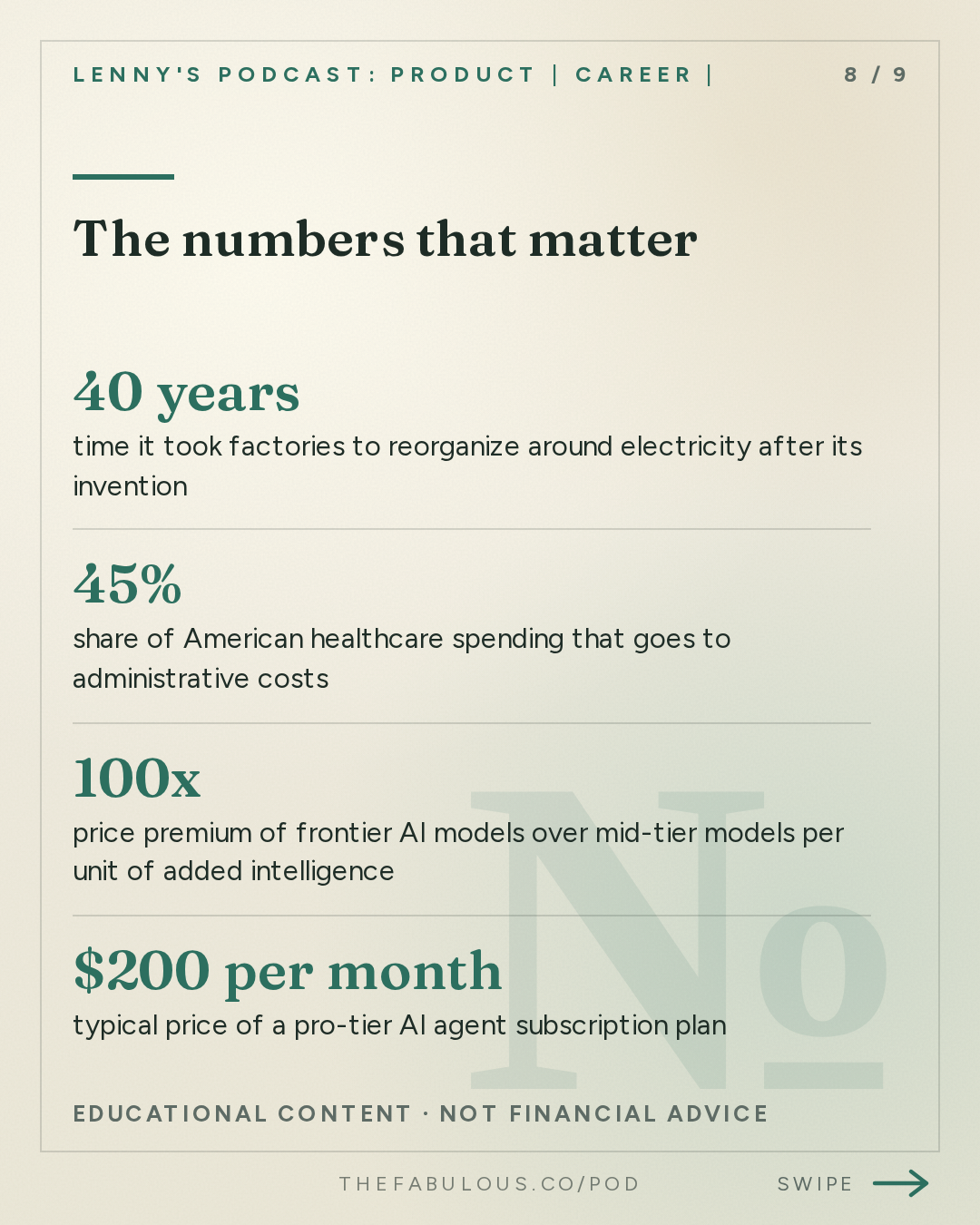
- 40 years time it took factories to reorganize around electricity after its invention
- 45% share of American healthcare spending that goes to administrative costs
- 100x price premium of frontier AI models over mid-tier models per unit of added intelligence
- $200 per month typical price of a pro-tier AI agent subscription plan
In their words
“This is a technology that really amplifies our agency. It kind of unbundles skill from desire”
“The loop will help you climb to the local maxima, but then it plateaus. You need human intuition. You need somebody to actually help you land at the base of the next hill.”
“We believe that people want to be more productive, but they don't. I think more people want to spend time than save time.”
“Moats are most often discovered, not designed.”
Protocols
-
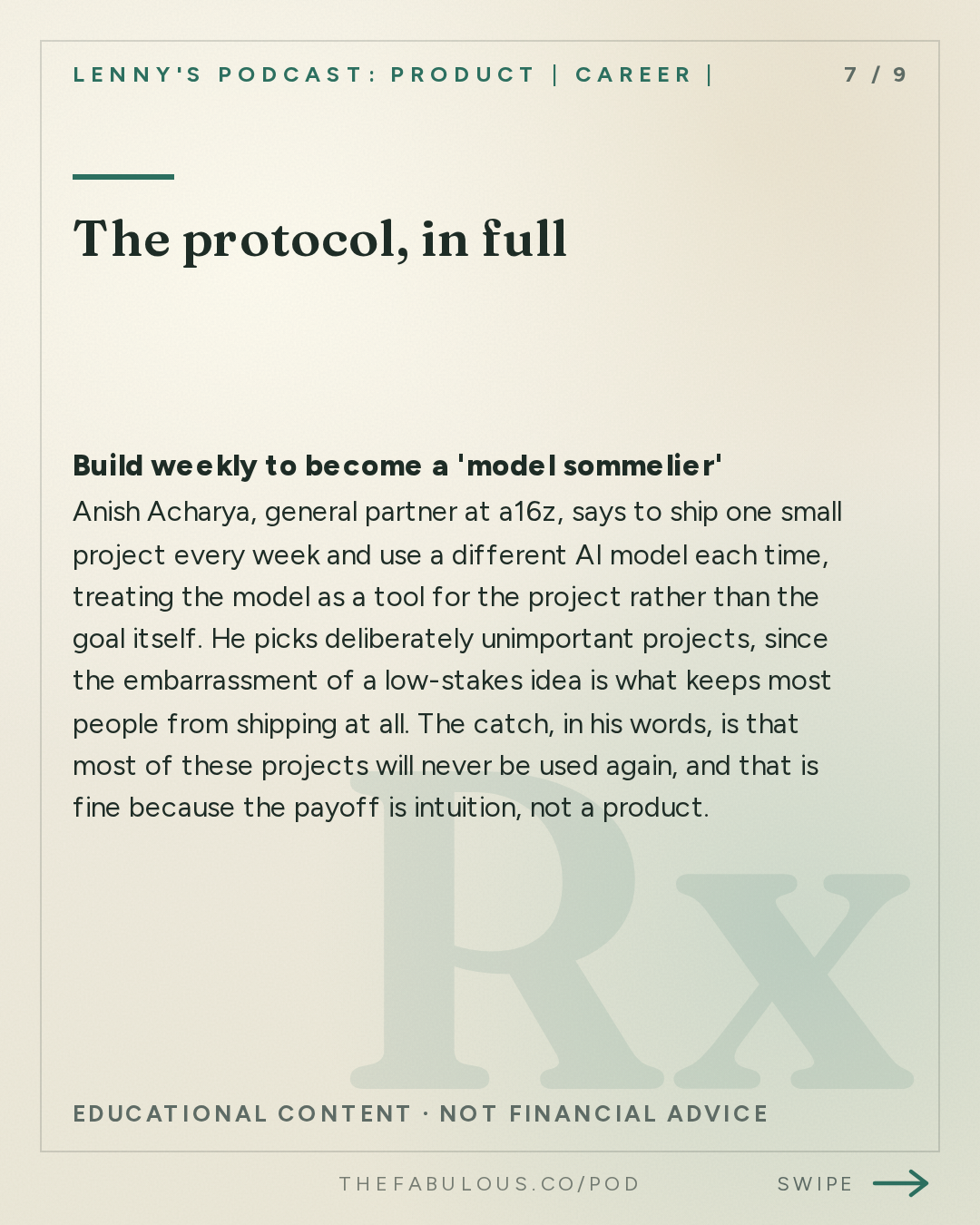
Build weekly to become a 'model sommelier'
Anish Acharya, general partner at a16z, says to ship one small project every week and use a different AI model each time, treating the model as a tool for the project rather than the goal itself. He picks deliberately unimportant projects, since the embarrassment of a low-stakes idea is what keeps most people from shipping at all. The catch, in his words, is that most of these projects will never be used again, and that is fine because the payoff is intuition, not a product.
weekly
Questions this episode answers
What does Anish Acharya mean by business 'loops' in AI?
A16z general partner Anish Acharya describes a loop as a closed system where an input, like a bug report, triggers an AI agent to propose and often ship a fix automatically, with humans reviewing only high-risk cases. He argues this pattern is spreading from coding into sales, support, and legal work, eventually forming loops of loops across a whole company (11:34).
Why do frontier AI models cost so much more than other models?
Acharya says frontier models can cost 100 times more per unit of added intelligence than mid-tier models, which looks irrational unless the task has unbounded upside, like drug discovery, where one extra insight could be worth a trillion dollars. For bounded-upside tasks like accounting, he argues paying for a cheaper, efficient model makes more economic sense (22:31).
Do consumers actually want AI to save them time?
Acharya argues that most consumers want to spend time, not save it, which is why entertainment and social products are the biggest category in tech rather than pure productivity tools. He frames this as a product design gap, not a limitation of the underlying AI models (31:13).
How much of healthcare spending in America is administrative?
Acharya cites a figure of 45 percent of healthcare spending going to administrative costs, and argues that AI applied to that paperwork and coordination burden could bring healthcare costs down without touching medical treatment itself (40:58).
Are startup moats designed in advance or found later?
Acharya argues moats are usually discovered through shipping rather than planned upfront, pointing to AI coding tool Cursor, which was criticized for lacking a moat early on before it built one by capturing usage data and training its own models over time (55:04).
The full read, in cards
Go deeper
- Seven Powers — Framework on business moats and compounding competitive advantages, referenced as still applicable in the AI era
- High Output Management — Named as one of the few management books Acharya considers still fully relevant
- Hard Things About Hard Things — Ben Horowitz's book, praised as the first emotionally honest business book
- Increasing Returns and Path Dependence in the Economy — Brian Arthur's book recommended by Marc Andreessen, cited to explain software's outlier economics
Mentioned
Anish Acharya · Lenny Rachitsky · Claire Vo · Marc Andreessen · Ben Horowitz · Kavak · Cursor · Qwen · WorkOS · Granola
More from this show and category

How AI Models Actually Think
Anthropic researcher Emmanuel Ameisen explains that language models are grown through training, not programmed line by line, so even their creators cannot read their internal logic directly. Interpretability research shows models form internal plans, share universal concepts across languages, and sometimes fixate on wrong answers when training data rewards them incorrectly (01:45, 15:31, 37:14).

Josh Woodward on Building an AI Labs Team
Google Labs head Josh Woodward argues every company now needs a frontier team that tests new AI models obsessively, judges early products by watching users' eyes rather than dashboards, and hires for an 'unlearning rate' as much as a learning one (32:13).

OpenAI's Tibo Sottiaux on Dots and AI Agents
OpenAI's Head of ChatGPT Tibo Sottiaux says agents will soon take most actions on the internet, not humans. He describes Dots, OpenAI's persistent agent that remembers personal context, controls multiple devices, and learns from feedback, plus a plugin ecosystem with revenue sharing and 16 sign-in partners, as proof the industry is moving from manually built loops to self-learning systems (00:16, 11:58).

Molly Graham's Give Away Your Legos AI Advice
Molly Graham's decade-old advice to give away your career projects still works, but she now says some tasks, like judgment and vision, should never go to AI. Tech burnout jumped from 44% to 55% in a year, and she argues AI needs coaching like a lazy intern rather than blind trust, while good management matters more than ever.
