
How to Close $100K+ Enterprise Deals
How to close $100K+ enterprise deals, step by step | Jen Abel
The brief
Enterprise sales runs on fifteen real steps, not the five stages most CRMs track, and the actual product changing hands on every call is information. Jen Abel, co-founder of Jellyfish and GM of enterprise sales at State of Affairs, walks through targeting, demos, pilots, and procurement for deals over $100,000.
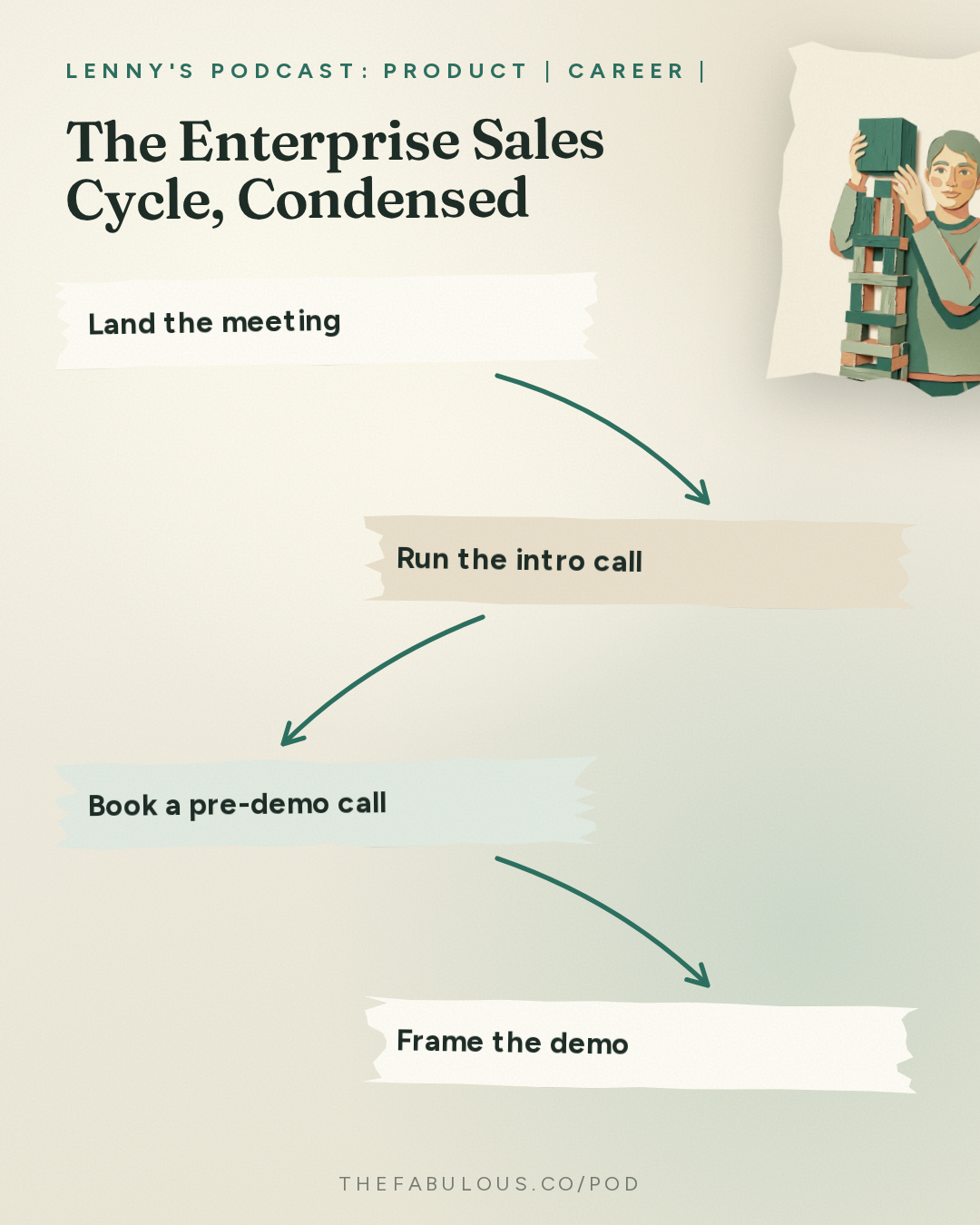
Most sales teams run on a five-stage funnel: intro, demo, proposal, contract, closed-won or closed-lost. It fits neatly into a CRM dashboard, and it is almost useless as a map for actually winning a deal. Jen Abel, co-founder of the company Jellyfish and now GM of enterprise sales at State of Affairs, makes this point early and then spends most of an hour and a half proving it. Those five buckets, she says, were built to weight a sales forecast, not to guide a seller through a real account (63:04). Inside them sit closer to fifteen distinct moves, and most people skip half of them (02:08).
Abel builds her case study around SpaceX and its legal department, partly for fun and partly because it makes a serious point: legal is often the largest line item in an enterprise budget, sometimes three to four times the size of other departments, and there is always more money for it (06:28). That single fact explains why so many AI startups target legal teams first. But the deeper lesson of the episode is not about which department to pick. It is about how little of enterprise selling is actually about the product, and how much of it is about who talks to whom, in what order, and what they choose to say.
The information edge
Abel's first rule cuts the target list down hard. In a company like SpaceX, she says, there are only two people worth approaching: the chief legal officer at the top, or someone one level below, what she calls the N-1, meaning the deputy or director just under the executive (10:03). Anyone further down turns the pitch into a game of telephone, and the seller ends up hearing about user-level annoyances instead of the executive-level problem that actually unlocks a budget. She calls the tactic of reaching both layers at once the pincer model: the founder emails the executive directly while an account executive works the N-1, and whichever one responds first pulls the other one in (11:55). The pitch itself has to survive in two to three sentences, because a C-suite inbox is already flooded and nobody senior reads a paragraph from a stranger (10:55).
The first real call is where Abel's philosophy shows up most clearly. She shows up with no slides, no demo, and, deliberately, no recording tool. "Do not bring a recorder to this call. Do not record the call. They will not be open, they will not be vulnerable," she says (23:09). The goal of that first thirty minutes is not to pitch anything. It is to let the prospect talk first, because whoever speaks first gives away leverage, and whoever listens gets to shape the pitch around what they just heard. She pushes past the surface answer, too. Instead of asking what problem the client wants solved, which she thinks invites a generic, commoditized answer, she asks what needs to change, because change is usually dictated from above and reveals what the executive actually cares about (21:12). About one call in four ends in a polite no, because the prospect simply is not mature enough yet to buy, and Abel treats that as a normal, healthy ratio rather than a failure (25:42).
"The whole game is to slow down to go fast." — Jen Abel [00:19]
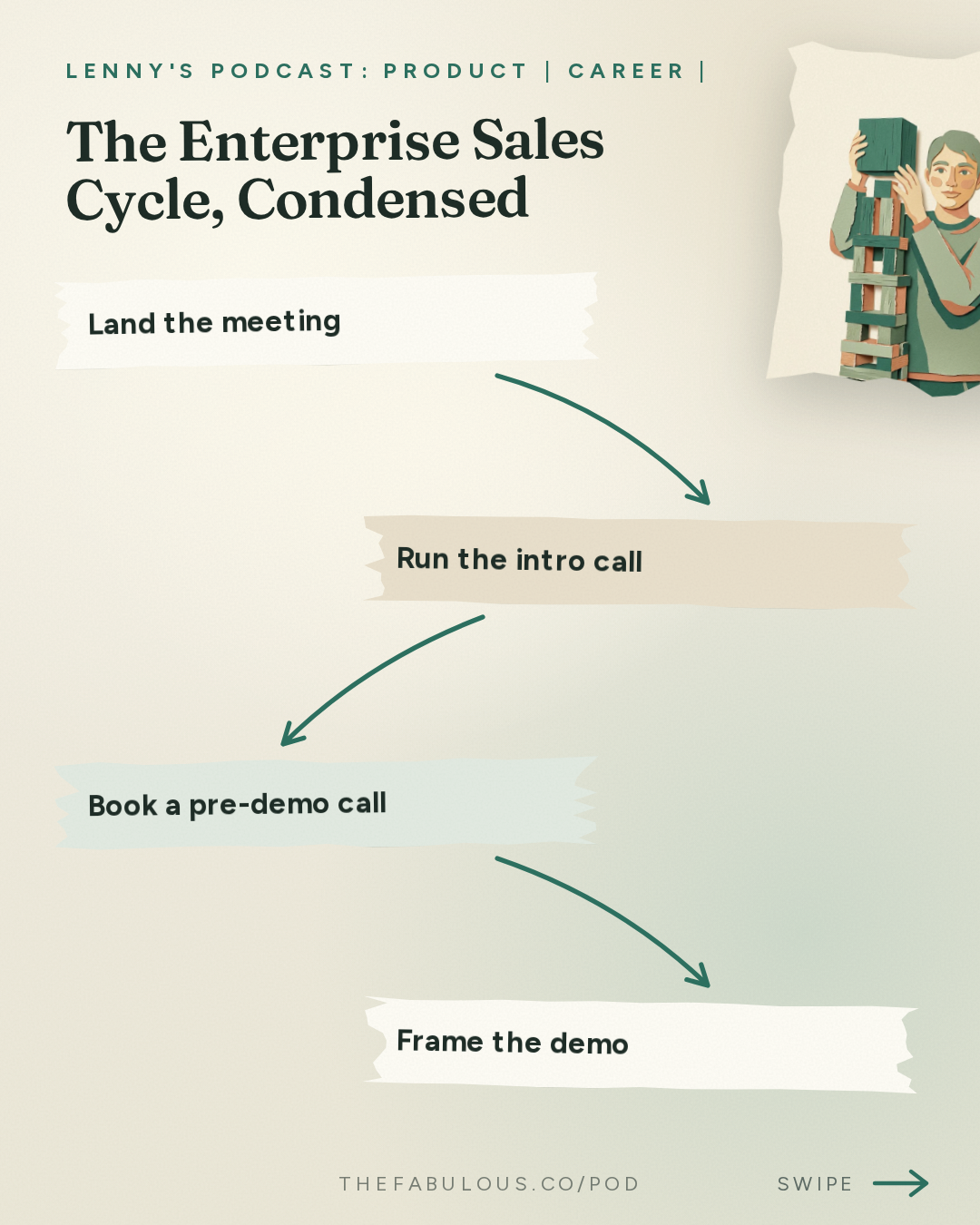
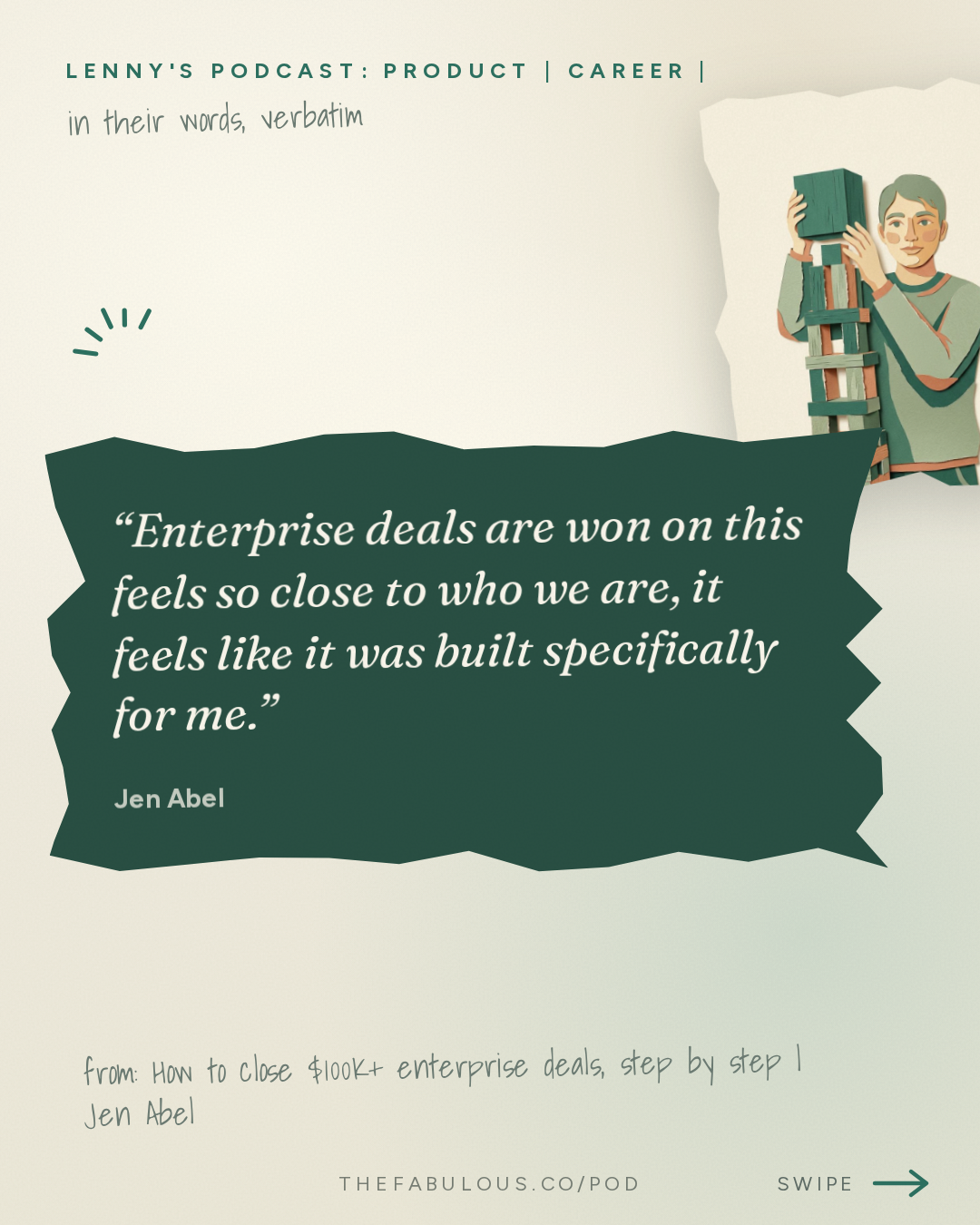
That patience shows up again before the demo, a step Abel says almost everyone skips. Rather than jumping straight from the intro call to a group demo, she books a short fifteen-minute call with her new internal contact first, to learn who else needs to be in the room and what would resonate with each of them (31:27). By the time the real demo happens, she already knows which two or three features to show, because "eighty percent of the value comes from twenty percent of the product," and showing everything else risks someone in the room deciding they would never use half of what they just saw (41:06). The point of all that pre-work is to make the room feel, in her words, like the product "was built specifically for me" (35:40), even though what actually happened is that a seller quietly collected more intelligence than any competitor bothered to gather.
Abel is blunt about the alternative. Trained sales scripts, she argues, including the classic acronym BANT (budget, authority, need, timing), are "the fastest way to commoditize yourself," because a scripted question makes a buyer feel like a checkbox instead of a partner (01:01). She estimates that ninety percent of founders and salespeople get this wrong by trying to force a prospect through a rigid five-step CRM process instead of mirroring how that specific buyer actually makes decisions (64:33).
Where deals actually die
The steps that follow the demo are less glamorous and more mechanical, and Abel treats them with the same discipline. She texts her internal champion within minutes of a demo ending, before anyone has had time to settle on a polite, watered-down group opinion, to get a raw first reaction (46:45). A champion, in her definition, is simply the person inside the company who wants the tool to succeed and is willing to fight friction to get it adopted (48:44). If that person goes quiet for two or three weeks, that silence is the clearest signal a deal has stalled, clearer than anything said out loud, because most buyers would rather disappear than deliver bad news directly (77:13).
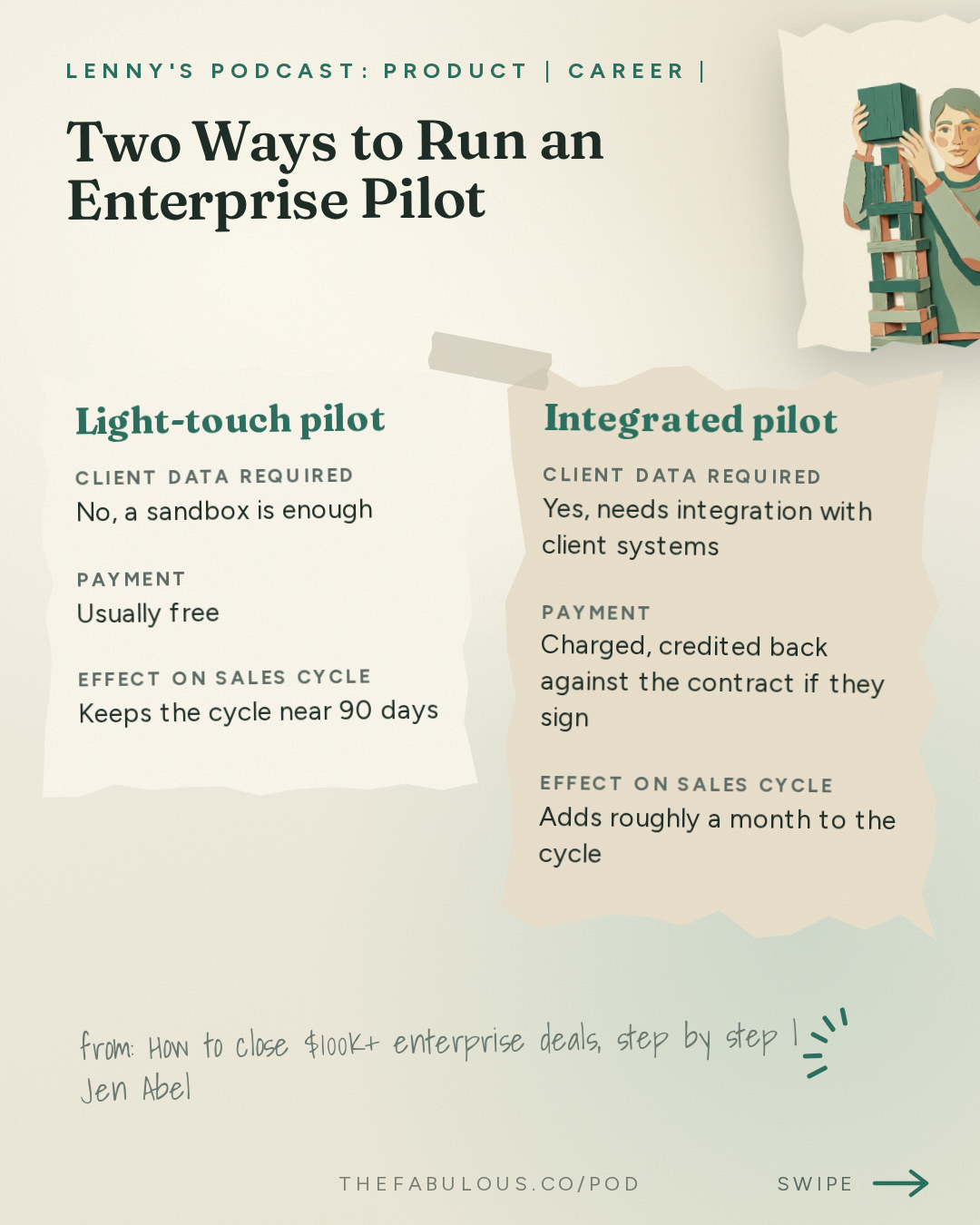
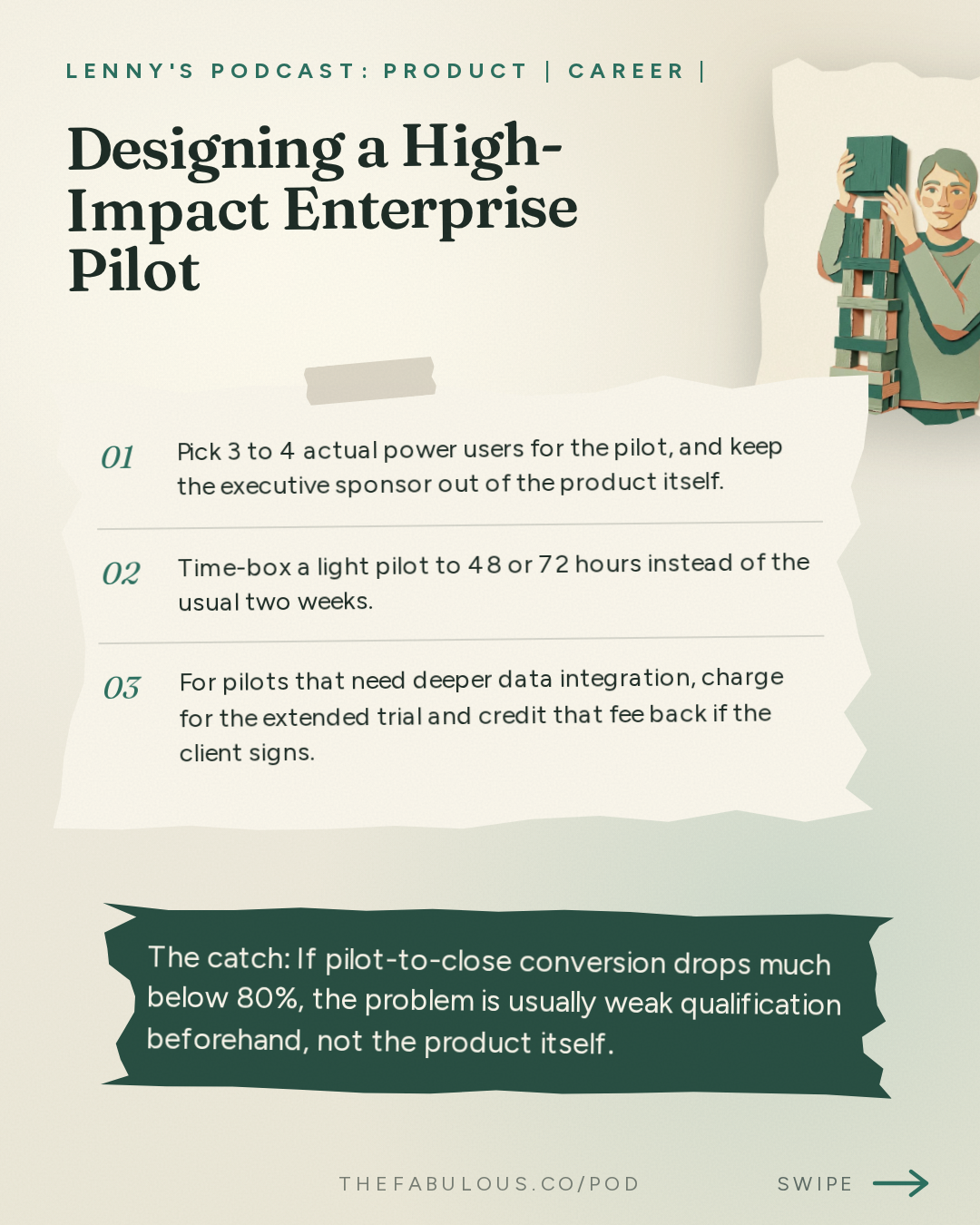
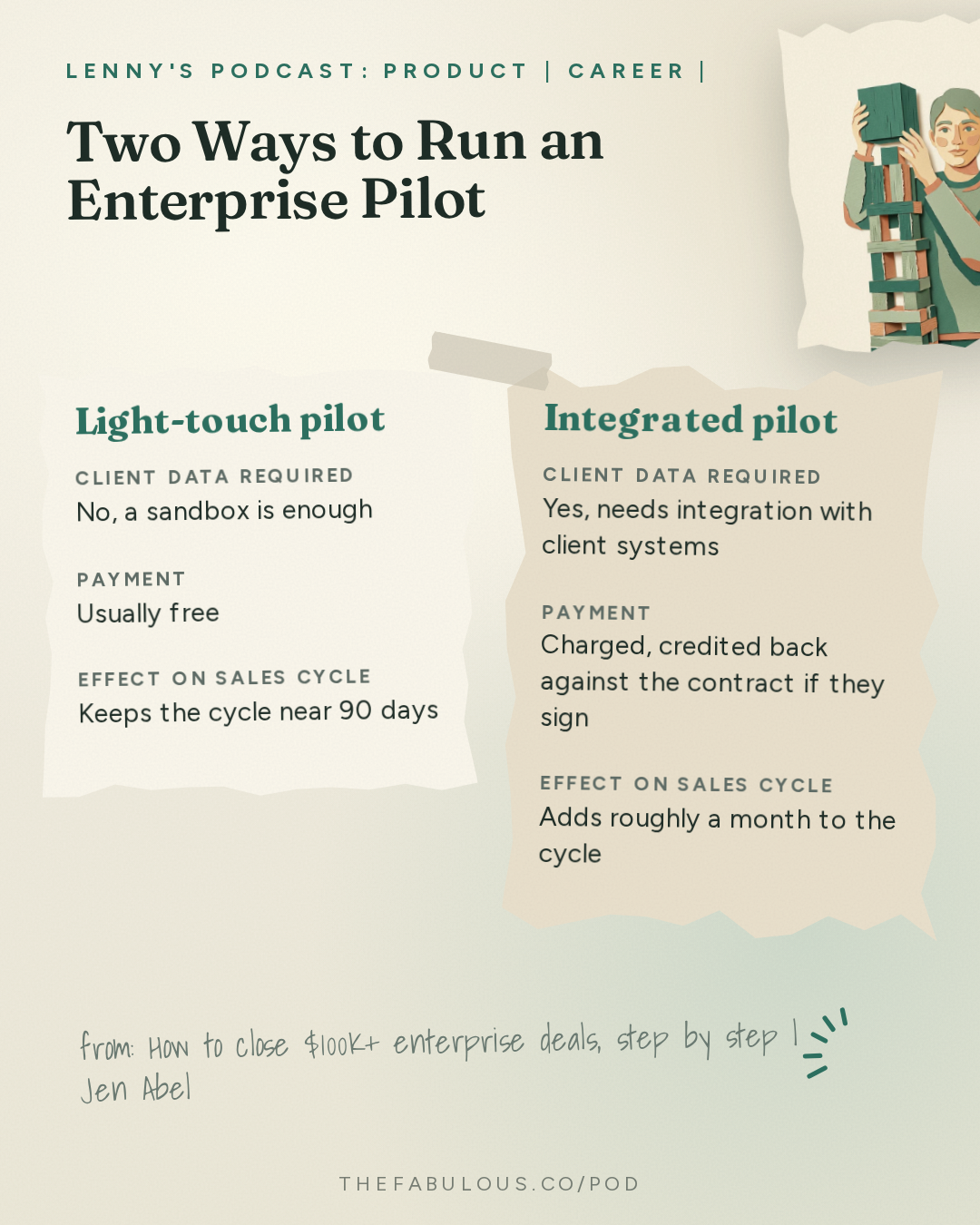
Pilots get the same tight design. Abel avoids two-week trials and instead time-boxes a light pilot to 48 or 72 hours, run by three or four actual power users rather than the executive sponsor, who should never be the one logging into the product (50:47, 58:43). If a pilot genuinely requires deeper integration with the client's own data, she charges for it, typically running it over a month or two, and credits that fee back against the final contract if the client signs (51:09). A client willing to pay for a pilot, she notes, is already showing a serious buying signal.
Procurement is where Abel says many good deals quietly die, usually for reasons that have nothing to do with the product. "Procurement is the only person that can get you paid. Business unit leaders can't just pay you," she says (73:57). She sends contracts as Word documents rather than PDFs, because the buyer's legal team will redline the contract regardless, and a Word file makes that back-and-forth faster (72:29). Extensive redlines, in her experience, move faster over one live call with the legal team than through days of email (75:07).
All of this discipline exists to protect a number that sounds almost too healthy to be true: a good enterprise win rate, measured from qualified opportunity to signed contract, sits between 25 and 35 percent (68:51). Anything meaningfully higher, Abel argues, is not a sign of a great sales team. It is a sign the price is too low (68:20). Enterprise buyers talk to each other, she points out, the same way a group of founders compares notes in a WhatsApp group, and a company that quietly discounts for one client and not another eventually gets caught (69:15).
By the time a contract is signed, Abel's system has already been shaping the deal for weeks: an executive persuaded through a founder-to-founder note, an N-1 walked through a private preview, a champion who helped write the success criteria for the pilot, a procurement lead who was looped in before anyone thought to ask. None of it looks like a sales script, which is precisely her point. The skill she is describing is closer to careful listening under time pressure than to persuasion in the traditional sense, and it is the reason she insists, only half joking, that the best salespeople in enterprise software are usually the founders who never had formal sales training at all (25:05).
Ask this episode anything
Pod's AI answers from the episode itself, with the minute mark so you can hear it yourself.
Or start with one of these
Ask this episode
Pod's AI listens to the whole episode to answer, and points you to the minute it comes from.
The rest of this answer, and any question after it
Answers come from the episode itself, never from a summary of it.
ContinueKey takeaways
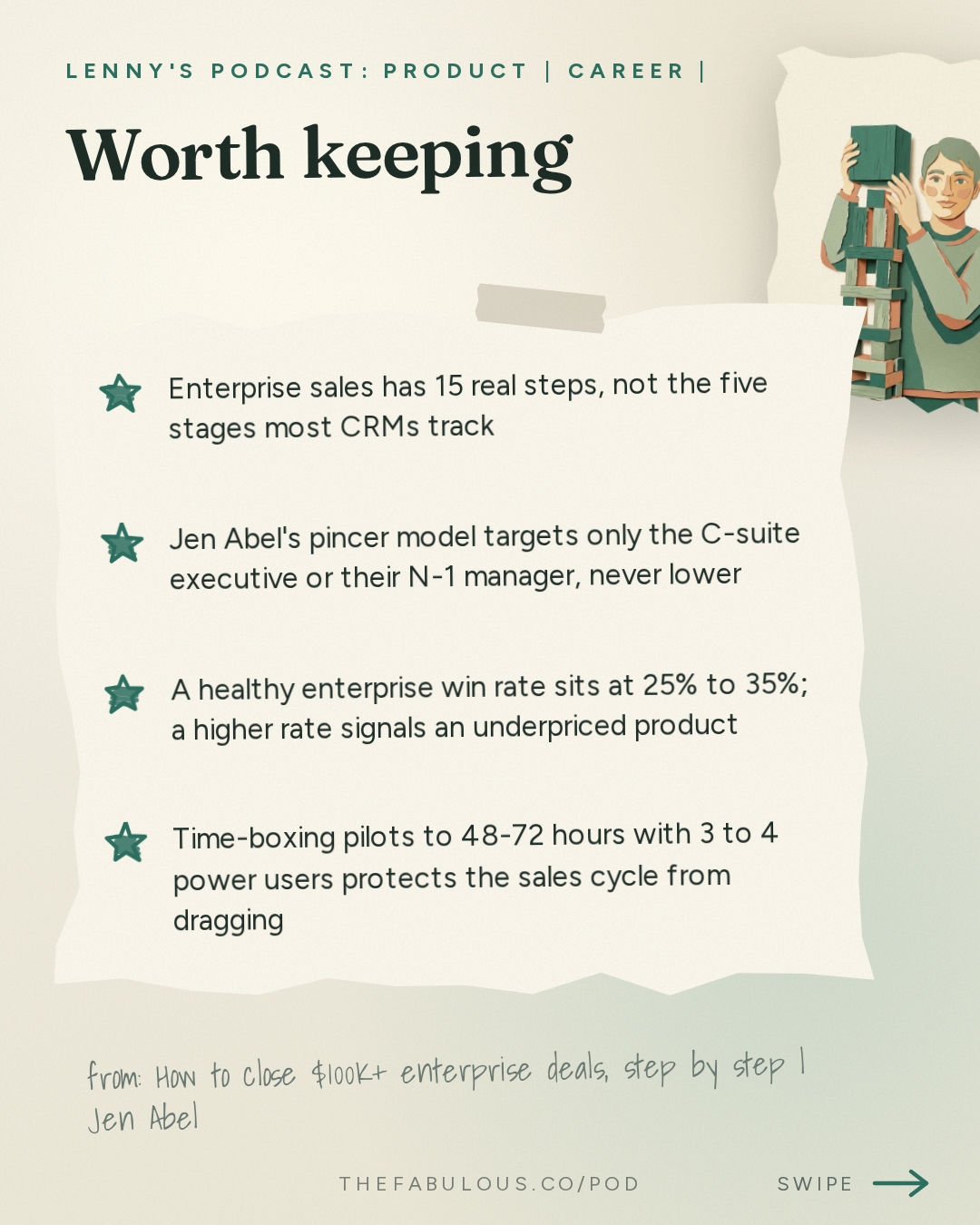
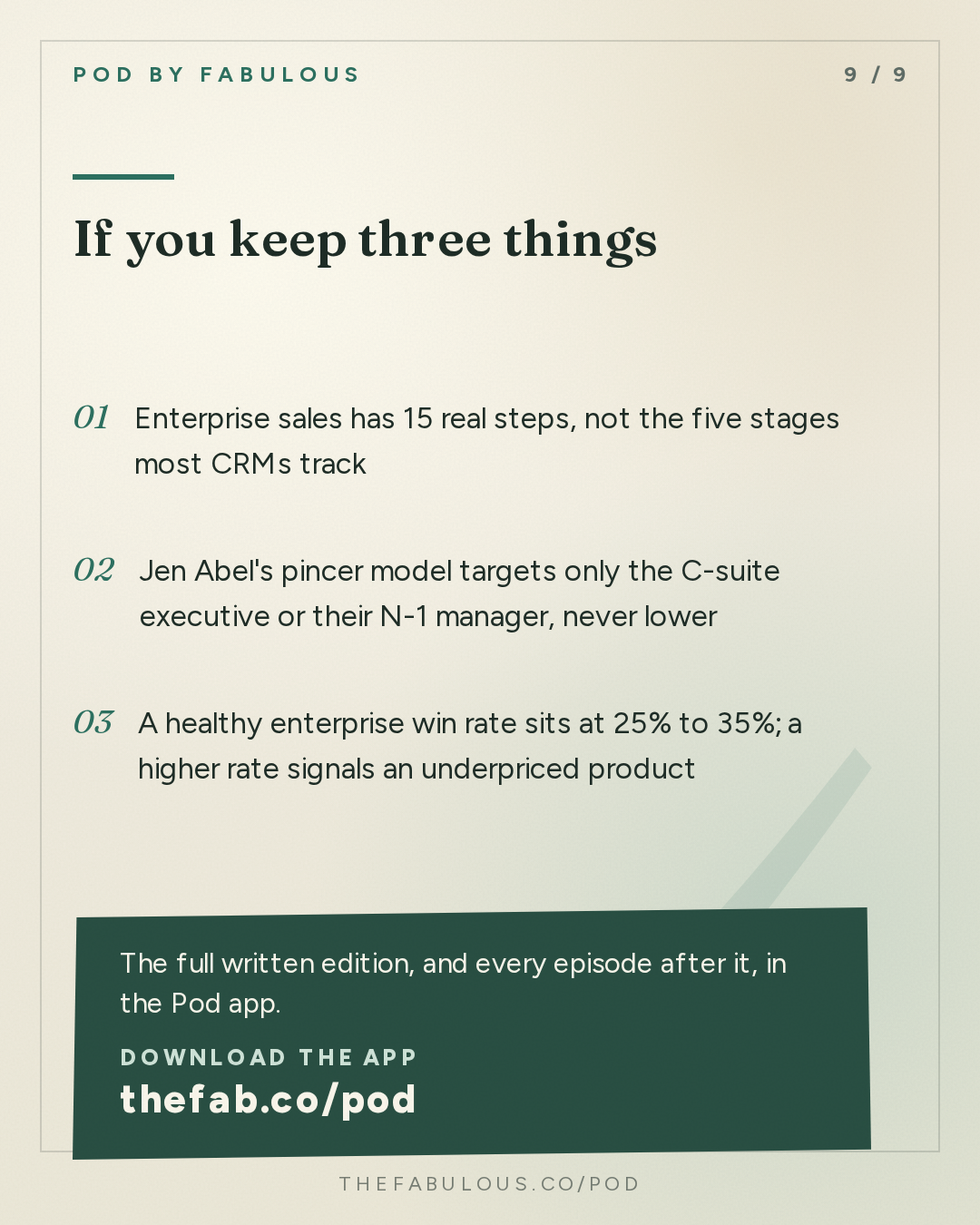
- Enterprise sales has 15 real steps, not the five stages most CRMs track
- Jen Abel's pincer model targets only the C-suite executive or their N-1 manager, never lower
- A healthy enterprise win rate sits at 25% to 35%; a higher rate signals an underpriced product
- Time-boxing pilots to 48-72 hours with 3 to 4 power users protects the sales cycle from dragging
- Procurement cannot be skipped because only that team can actually release payment to a vendor
The episode in cards
By the numbers
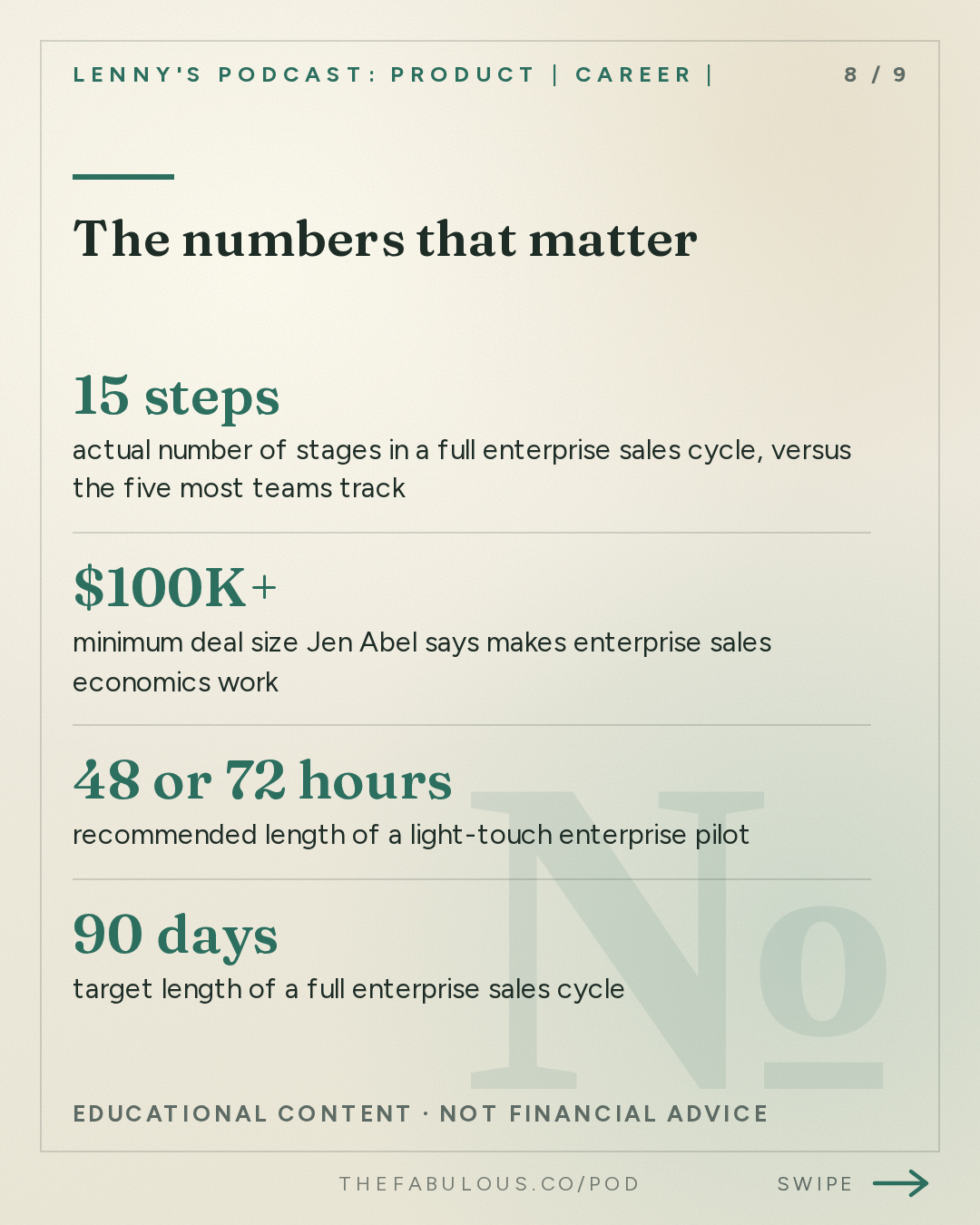
- 15 steps actual number of stages in a full enterprise sales cycle, versus the five most teams track
- $100K+ minimum deal size Jen Abel says makes enterprise sales economics work
- 48 or 72 hours recommended length of a light-touch enterprise pilot
- 90 days target length of a full enterprise sales cycle
- 90% share of founders and salespeople Jen Abel says run enterprise sales wrong by following a basic five-step process
In their words
“The whole game is to slow down to go fast.”
“The fastest way to commoditize yourself is to go into some sales script.”
“Enterprise deals are won on this feels so close to who we are, it feels like it was built specifically for me.”
Protocols
-
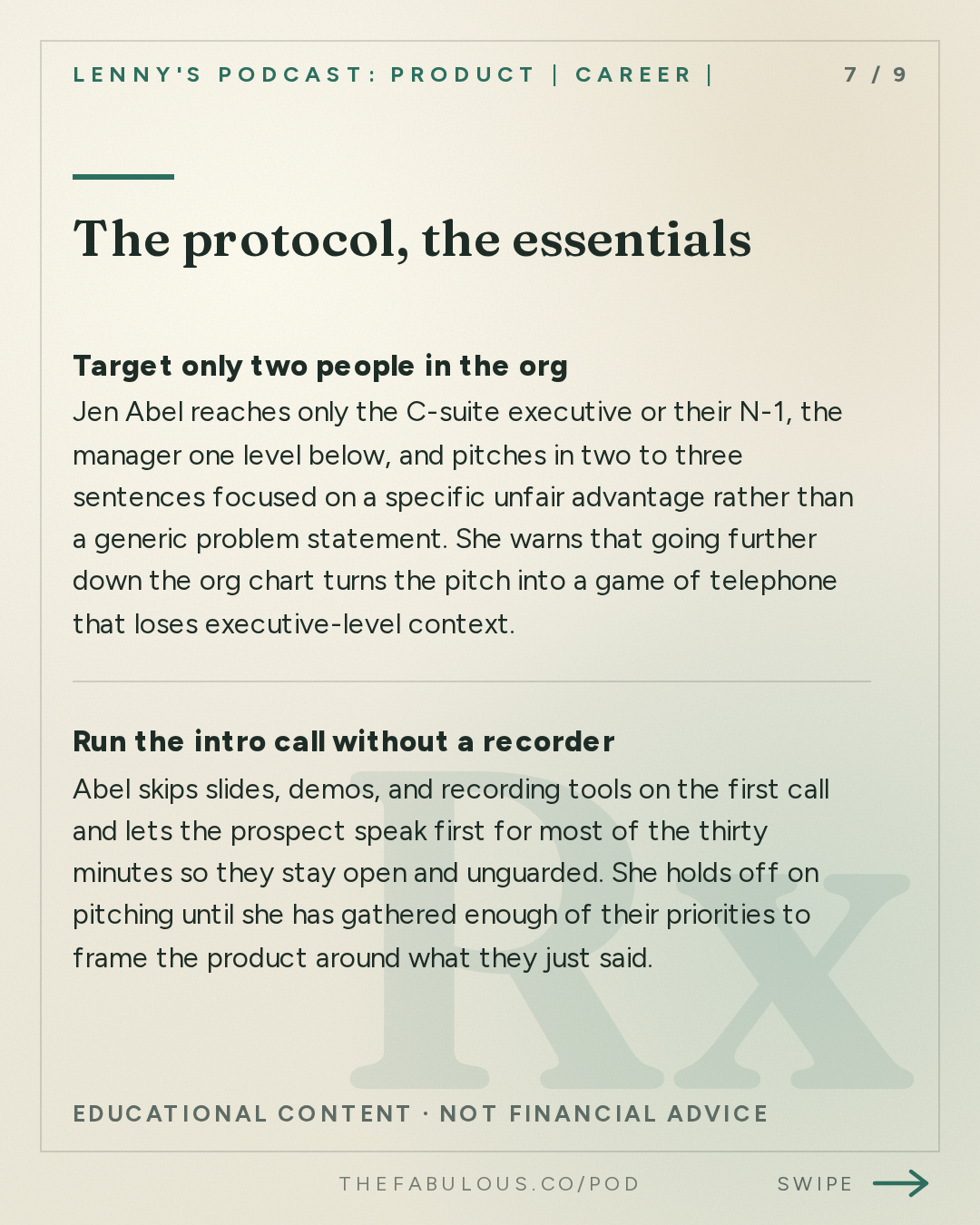
Target only two people in the org
Jen Abel reaches only the C-suite executive or their N-1, the manager one level below, and pitches in two to three sentences focused on a specific unfair advantage rather than a generic problem statement. She warns that going further down the org chart turns the pitch into a game of telephone that loses executive-level context.
At the start of every new enterprise account
-
Run the intro call without a recorder
Abel skips slides, demos, and recording tools on the first call and lets the prospect speak first for most of the thirty minutes so they stay open and unguarded. She holds off on pitching until she has gathered enough of their priorities to frame the product around what they just said.
Once, on the first call with a new prospect
-
Time-box pilots to 48-72 hours
Abel runs a light pilot for two to three days with three or four actual power users, never the executive sponsor, and charges for any longer pilot that requires deeper data integration, crediting that fee back against the contract if the client signs.
Once per deal, after the demo stage
-
Send contracts in Word, not PDF
Abel sends contracts as Word documents rather than PDFs because procurement and legal teams will redline the contract regardless, and she offers the client the option of using her paper or their own to speed up the process.
Once, at the contract stage
-
Debrief immediately after every demo
Abel texts her internal champion within minutes of a demo ending to ask for a raw, unfiltered reaction before the group settles on an official, watered-down summary of what happened.
After every demo call
Questions this episode answers
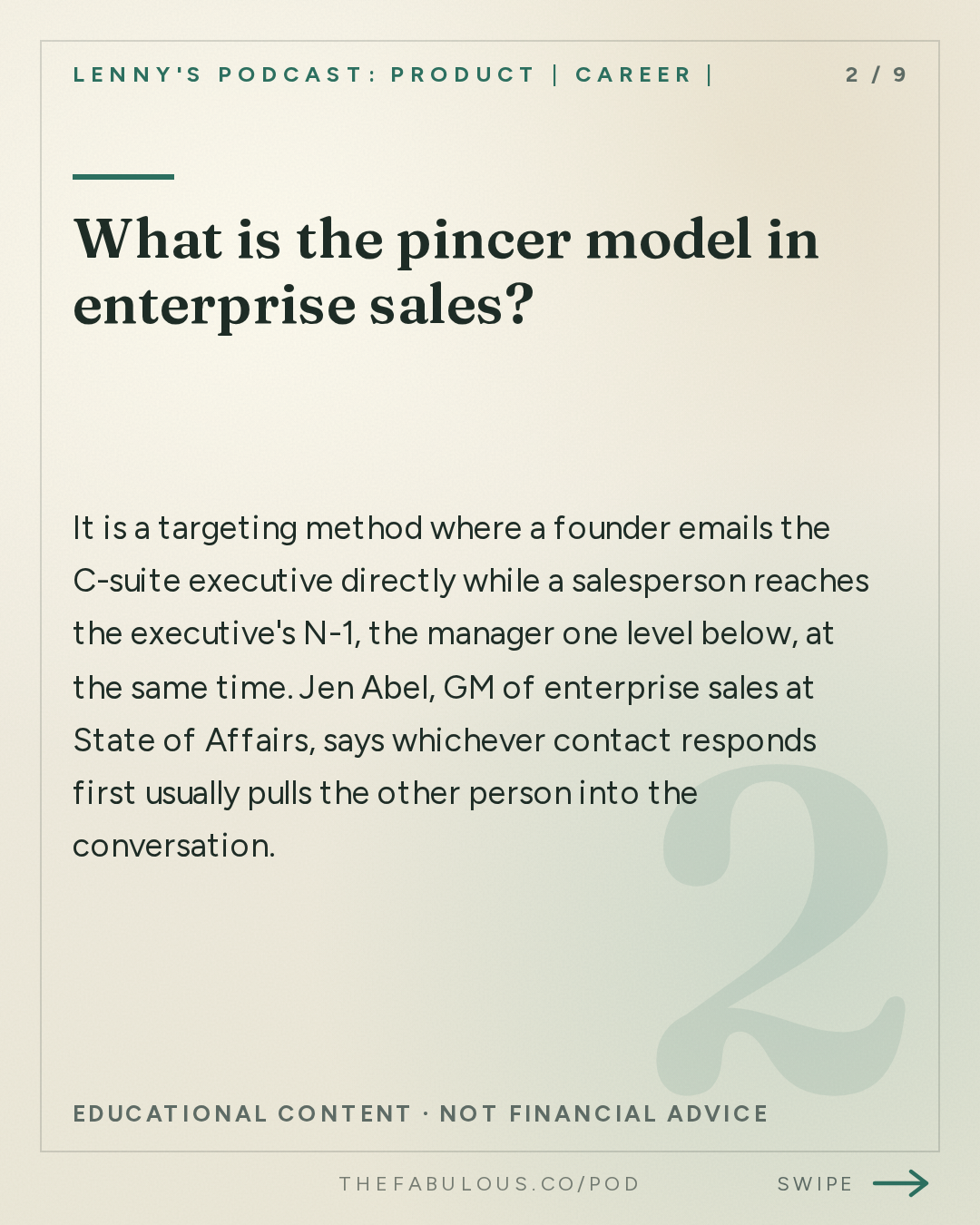
What is the pincer model in enterprise sales?
It is a targeting method where a founder emails the C-suite executive directly while a salesperson reaches the executive's N-1, the manager one level below, at the same time. Jen Abel, GM of enterprise sales at State of Affairs, says whichever contact responds first usually pulls the other person into the conversation (11:55).
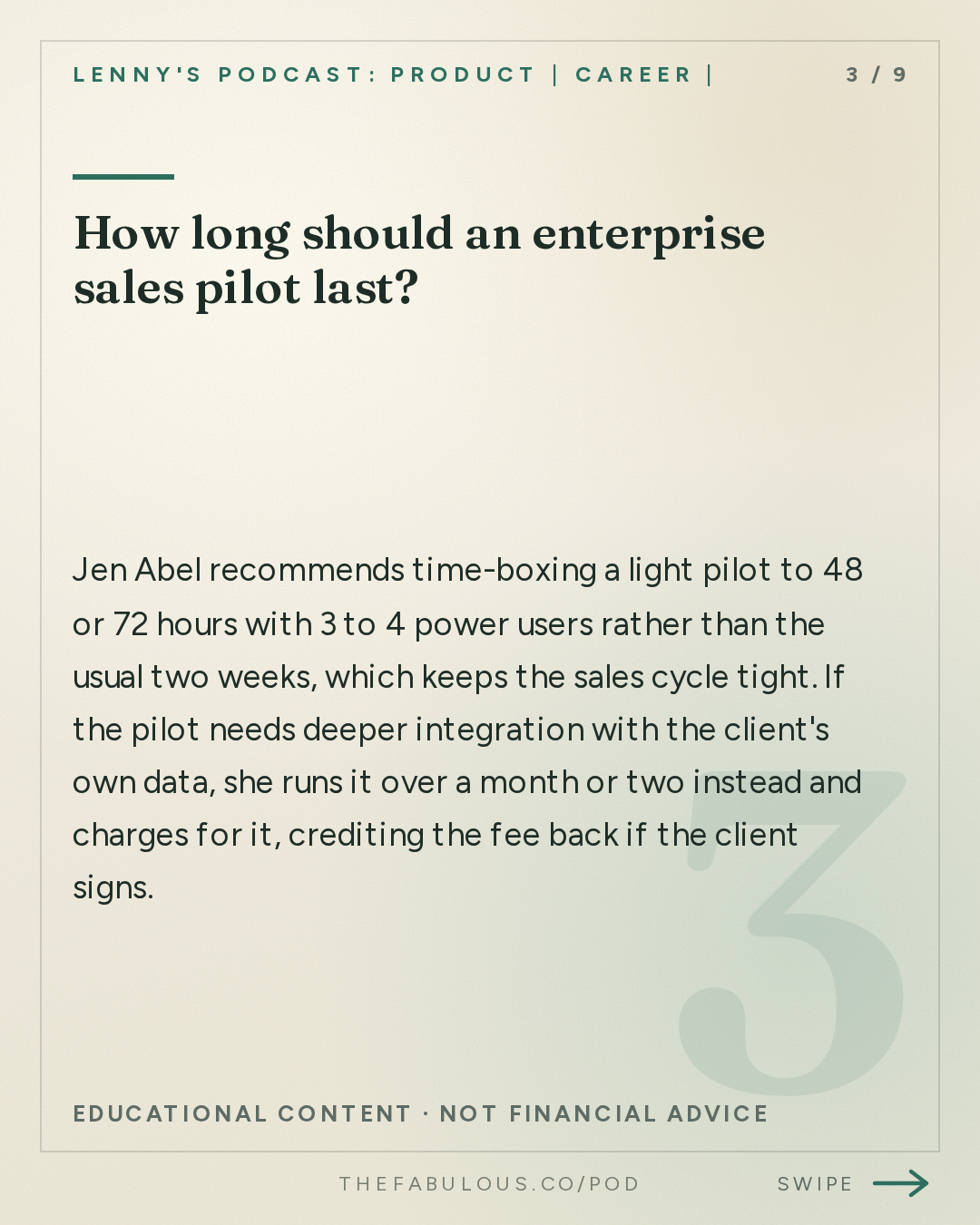
How long should an enterprise sales pilot last?
Jen Abel recommends time-boxing a light pilot to 48 or 72 hours with 3 to 4 power users rather than the usual two weeks, which keeps the sales cycle tight. If the pilot needs deeper integration with the client's own data, she runs it over a month or two instead and charges for it, crediting the fee back if the client signs (50:47).
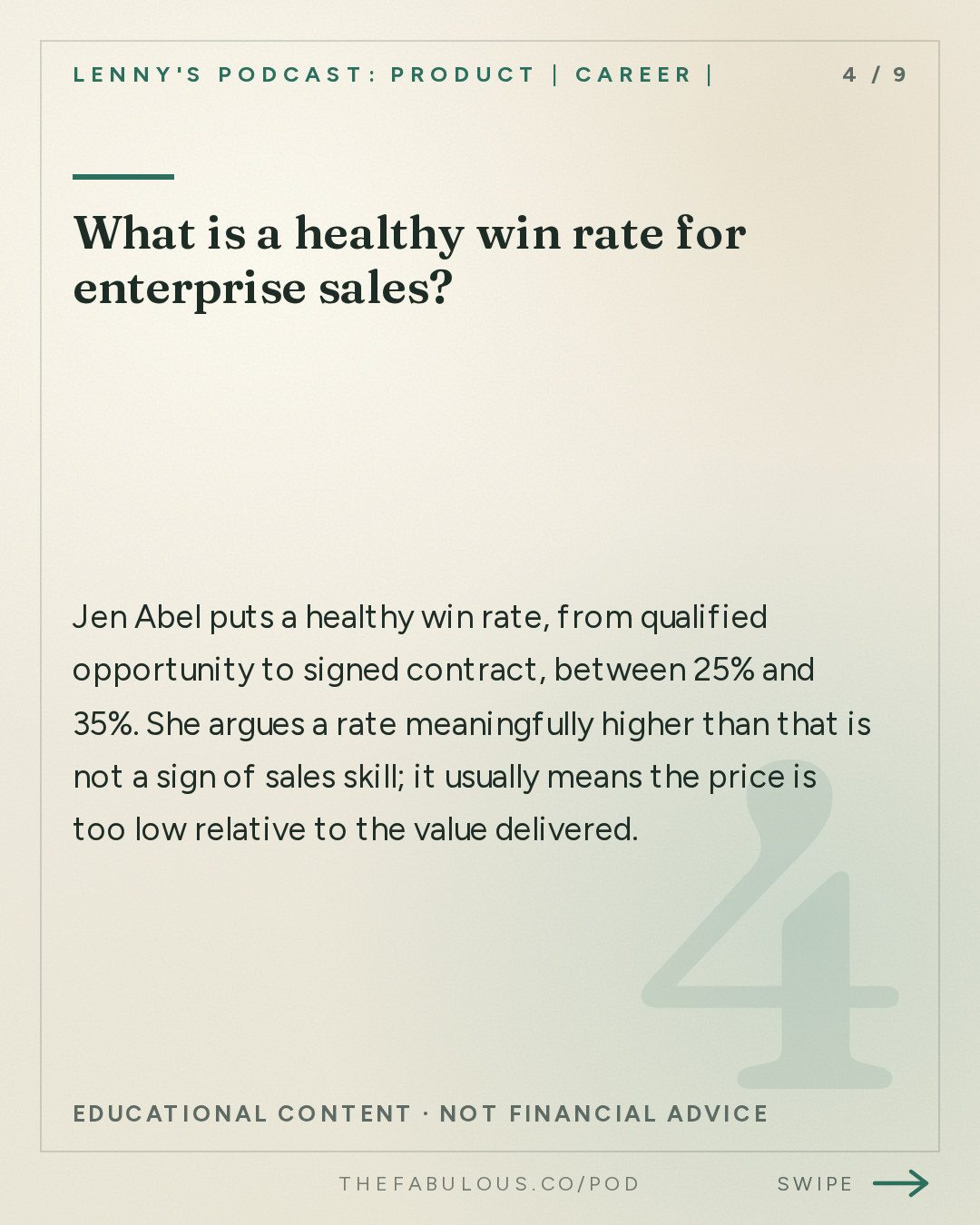
What is a healthy win rate for enterprise sales?
Jen Abel puts a healthy win rate, from qualified opportunity to signed contract, between 25% and 35%. She argues a rate meaningfully higher than that is not a sign of sales skill; it usually means the price is too low relative to the value delivered (68:51).
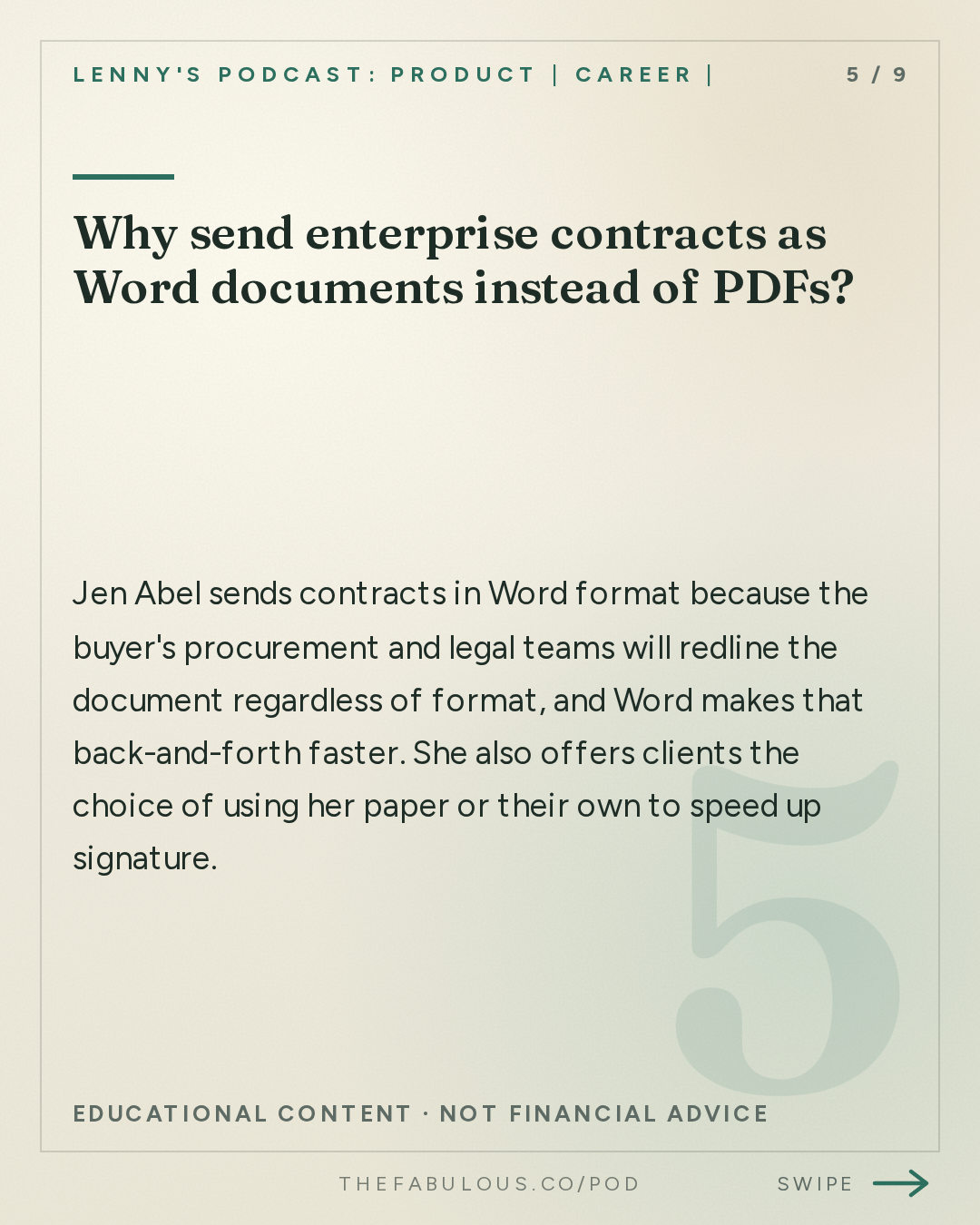
Why send enterprise contracts as Word documents instead of PDFs?
Jen Abel sends contracts in Word format because the buyer's procurement and legal teams will redline the document regardless of format, and Word makes that back-and-forth faster. She also offers clients the choice of using her paper or their own to speed up signature (72:29).
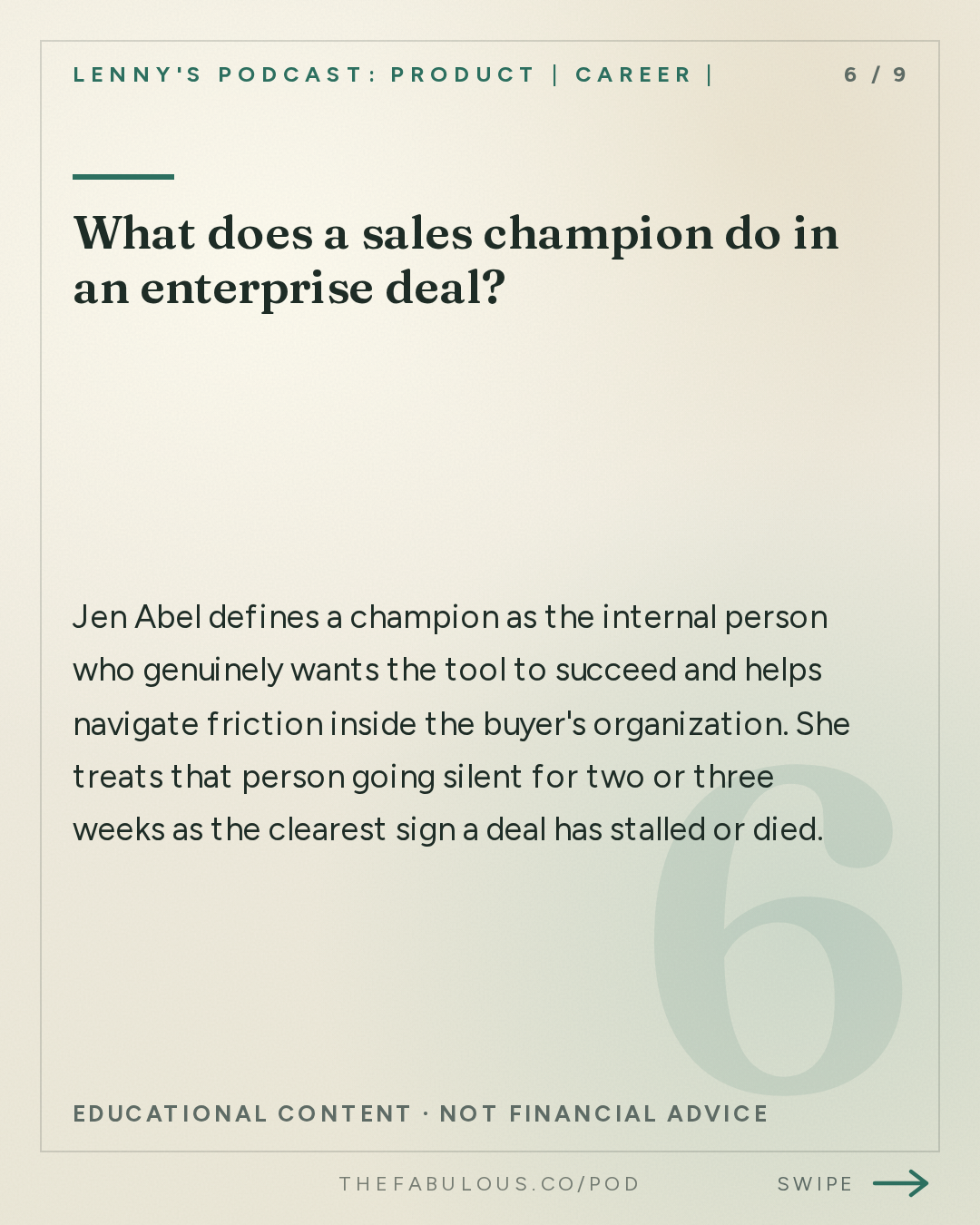
What does a sales champion do in an enterprise deal?
Jen Abel defines a champion as the internal person who genuinely wants the tool to succeed and helps navigate friction inside the buyer's organization. She treats that person going silent for two or three weeks as the clearest sign a deal has stalled or died (48:44, 77:13).
The full read, in cards
Mentioned
Jen Abel · SpaceX · Jellyfish · State of Affairs · Work OS · Mercury · Palantir
More from this show and category

How AI Models Actually Think
Anthropic researcher Emmanuel Ameisen explains that language models are grown through training, not programmed line by line, so even their creators cannot read their internal logic directly. Interpretability research shows models form internal plans, share universal concepts across languages, and sometimes fixate on wrong answers when training data rewards them incorrectly (01:45, 15:31, 37:14).

Josh Woodward on Building an AI Labs Team
Google Labs head Josh Woodward argues every company now needs a frontier team that tests new AI models obsessively, judges early products by watching users' eyes rather than dashboards, and hires for an 'unlearning rate' as much as a learning one (32:13).

OpenAI's Tibo Sottiaux on Dots and AI Agents
OpenAI's Head of ChatGPT Tibo Sottiaux says agents will soon take most actions on the internet, not humans. He describes Dots, OpenAI's persistent agent that remembers personal context, controls multiple devices, and learns from feedback, plus a plugin ecosystem with revenue sharing and 16 sign-in partners, as proof the industry is moving from manually built loops to self-learning systems (00:16, 11:58).

Molly Graham's Give Away Your Legos AI Advice
Molly Graham's decade-old advice to give away your career projects still works, but she now says some tasks, like judgment and vision, should never go to AI. Tech burnout jumped from 44% to 55% in a year, and she argues AI needs coaching like a lazy intern rather than blind trust, while good management matters more than ever.
