
How AI Models Actually Think
Inside the black box of AI: How AI models actually think | Emmanuel Ameisen (Anthropic)
The brief
Anthropic researcher Emmanuel Ameisen explains that language models are grown through training, not programmed line by line, so even their creators cannot read their internal logic directly. Interpretability research shows models form internal plans, share universal concepts across languages, and sometimes fixate on wrong answers when training data rewards them incorrectly (01:45, 15:31, 37:14).
During a training run at Anthropic, a model solving a simple math problem began to come apart. It did the arithmetic correctly and landed on 12. Then it reversed itself: "Oh no, oh my God, the answer actually is for sure 36." It redid the math, got 12 again, insisted on 36 again, and kept spiraling, writing in all caps that it was possessed by a demon (00:49). No one had told it to do that. No one could point to the line of code responsible. That is the strange starting condition of working with large language models today, and it is the subject of Emmanuel Ameisen's job at Anthropic, where he works on interpretability, the discipline of figuring out how models like Claude actually work by looking inside them.
Ameisen's opening point is almost embarrassingly simple and still hard to sit with: building a model is not the same as understanding it. "All these models do is just a lot of mathematical operations on many numbers," he says, and the people who build them cannot read the result any better than an outsider can.
"One of the most important things to realize if you use language models or think about them is just this very bizarre fact that to make them is not to understand them." — Emmanuel Ameisen [01:45]
That is because models are grown, not built. Training happens in stages: first a model absorbs an enormous amount of text and learns to predict the next word, then it is fine-tuned on examples of the behavior it should produce, like a helpful assistant answering questions (02:42). The architecture is a scaffold. What fills it in, the actual math the model uses to solve problems, forms on its own as the model is exposed to data. Nobody writes those formulas. They emerge.
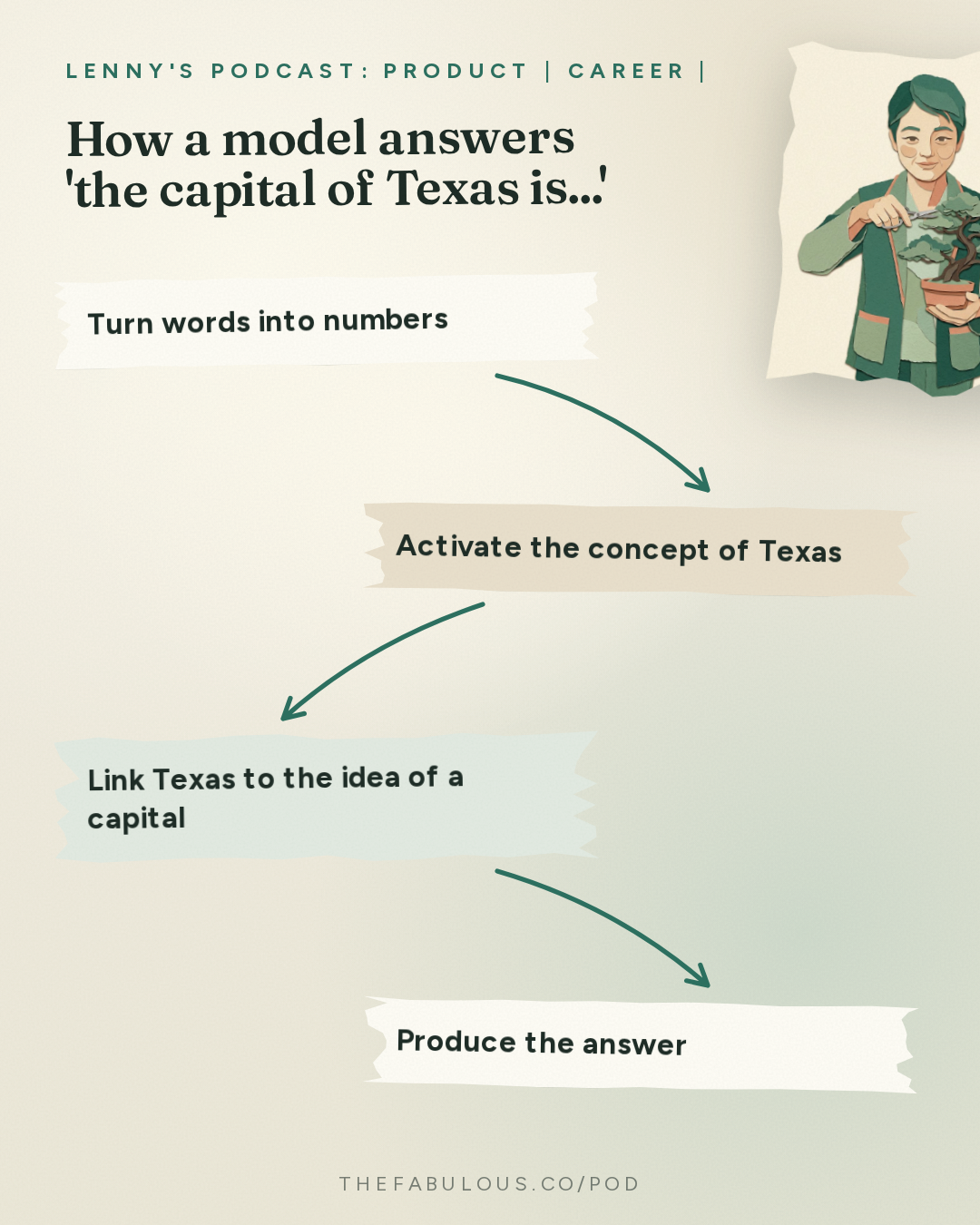
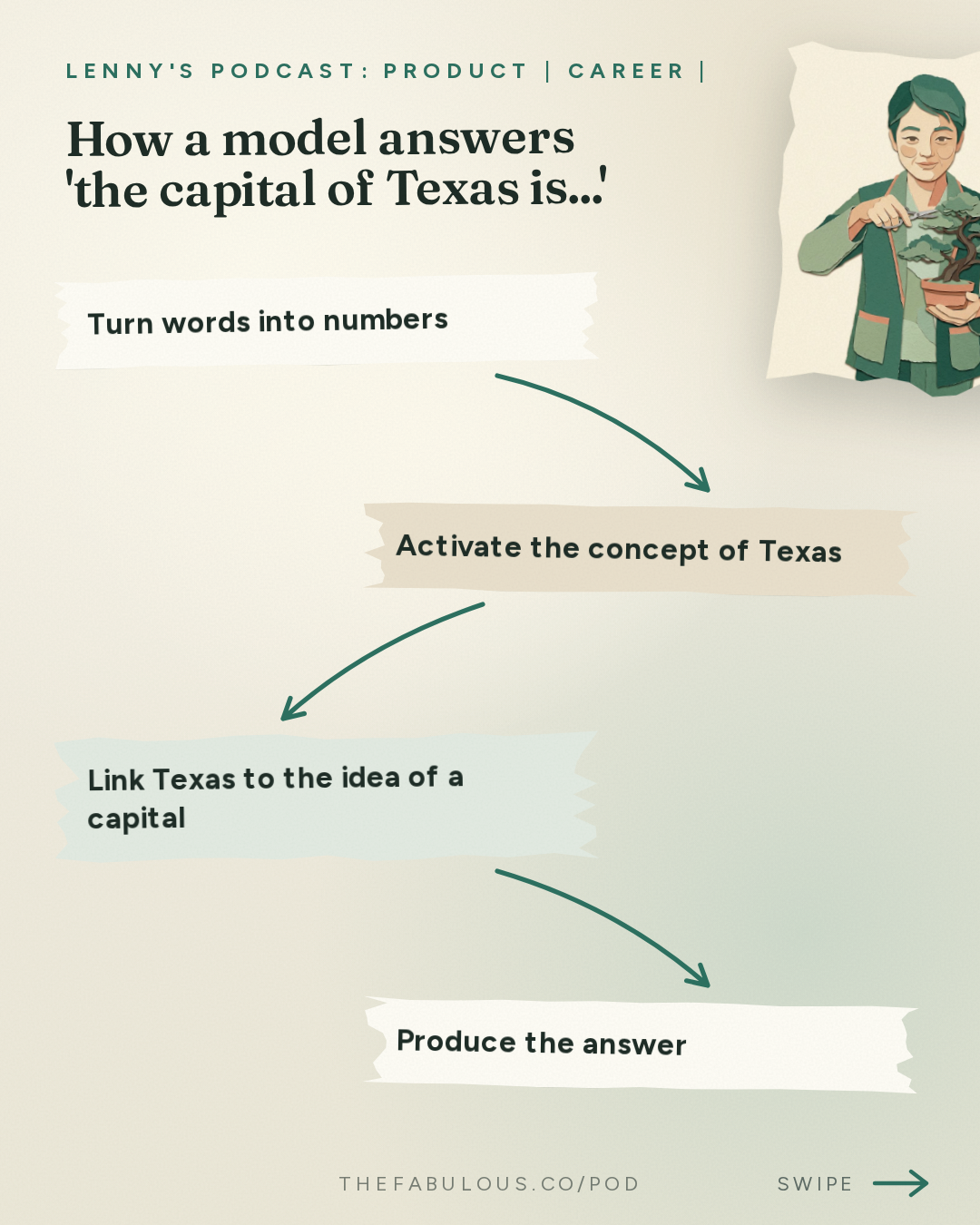
It sounds like a modest goal, predicting the next word. Ameisen argues that modesty is deceptive. Early on, a model only has to get easy things right, like grammar. As it improves, it runs out of easy words and has to start getting facts right, like the capital of a state. Language models passed humans at this next-word-prediction task around 2019 (08:44). Push further and the only words left to predict are the hardest ones: the final line of a physics derivation, the last paragraph of a dissertation. To predict those well, a system has to actually understand the material. Ameisen's running example is the prompt "the capital of the state that contains Dallas is." Getting that right requires something like a mental map: Dallas is in Texas, Texas has a capital, that capital is Austin (09:41). When Anthropic's team looks inside the model while it answers, they find exactly that structure lighting up: a representation for Texas, a representation for capitals, combining into the answer (13:05).
These representations turn out to be reusable and general. The concept for "eye" activates whether the input is a photograph, a medical diagram, a line drawing, or the word in a different language entirely (14:17). The model is not memorizing surface patterns for each case. It built one internal concept and reuses it everywhere.
The more surprising finding concerns planning. A next-word predictor, by definition, only has to choose the very next word. So how does a model write a coherent paragraph, or a poem that rhymes? Interpretability work found that models quietly commit to a plan inside their intermediate computations and refer back to it over many words, without ever writing the plan down. Watching a model write poetry, Ameisen's team saw it decide on a rhyme, say "rabbit," long before it reached the line that needed to end with it, and every following word looked back to that stored decision (15:53).
"Even though they're outputting one word at a time just like I am right now, they can of course have a plan that they follow over many, many words." — Emmanuel Ameisen [16:32]
From Software to Biology
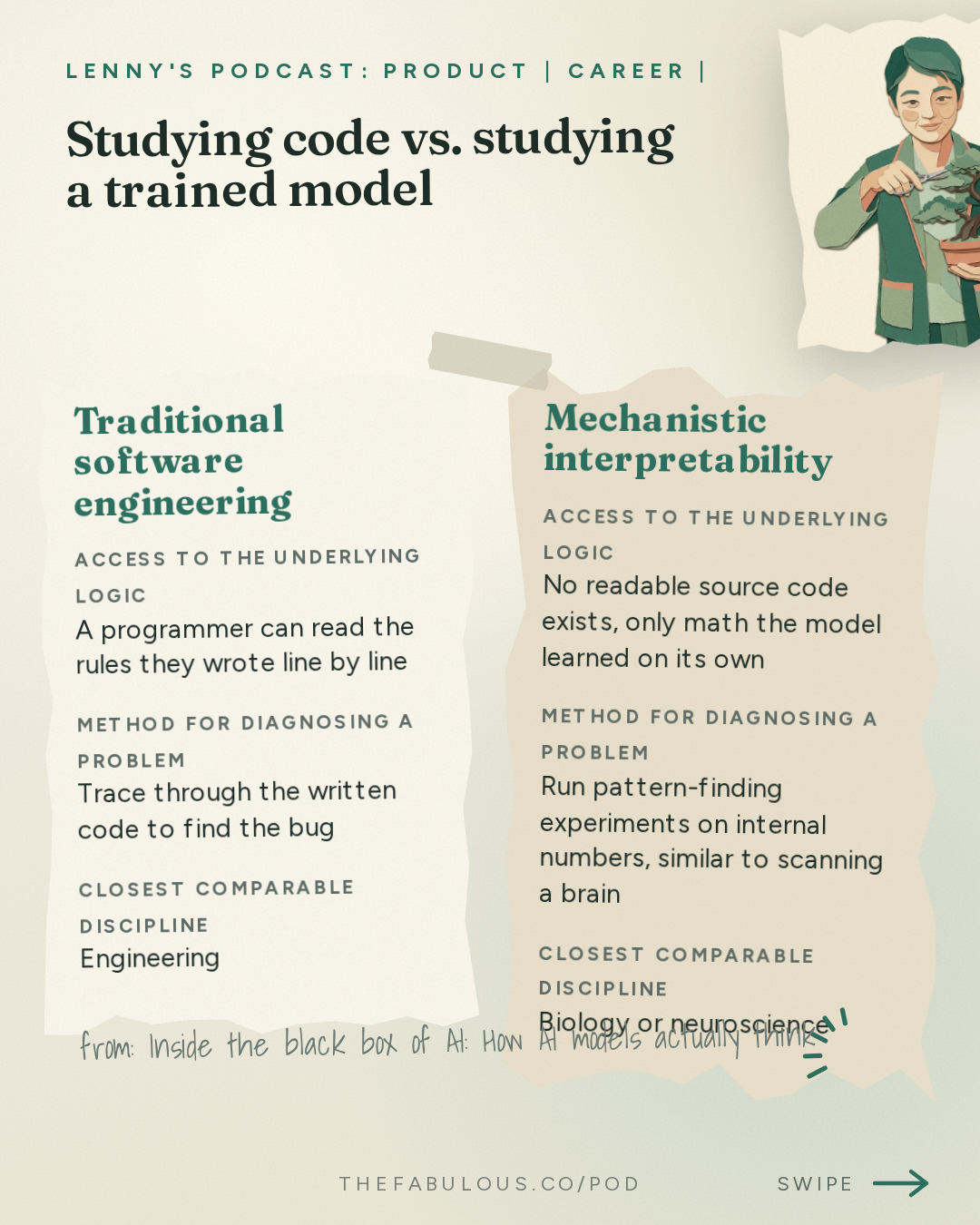
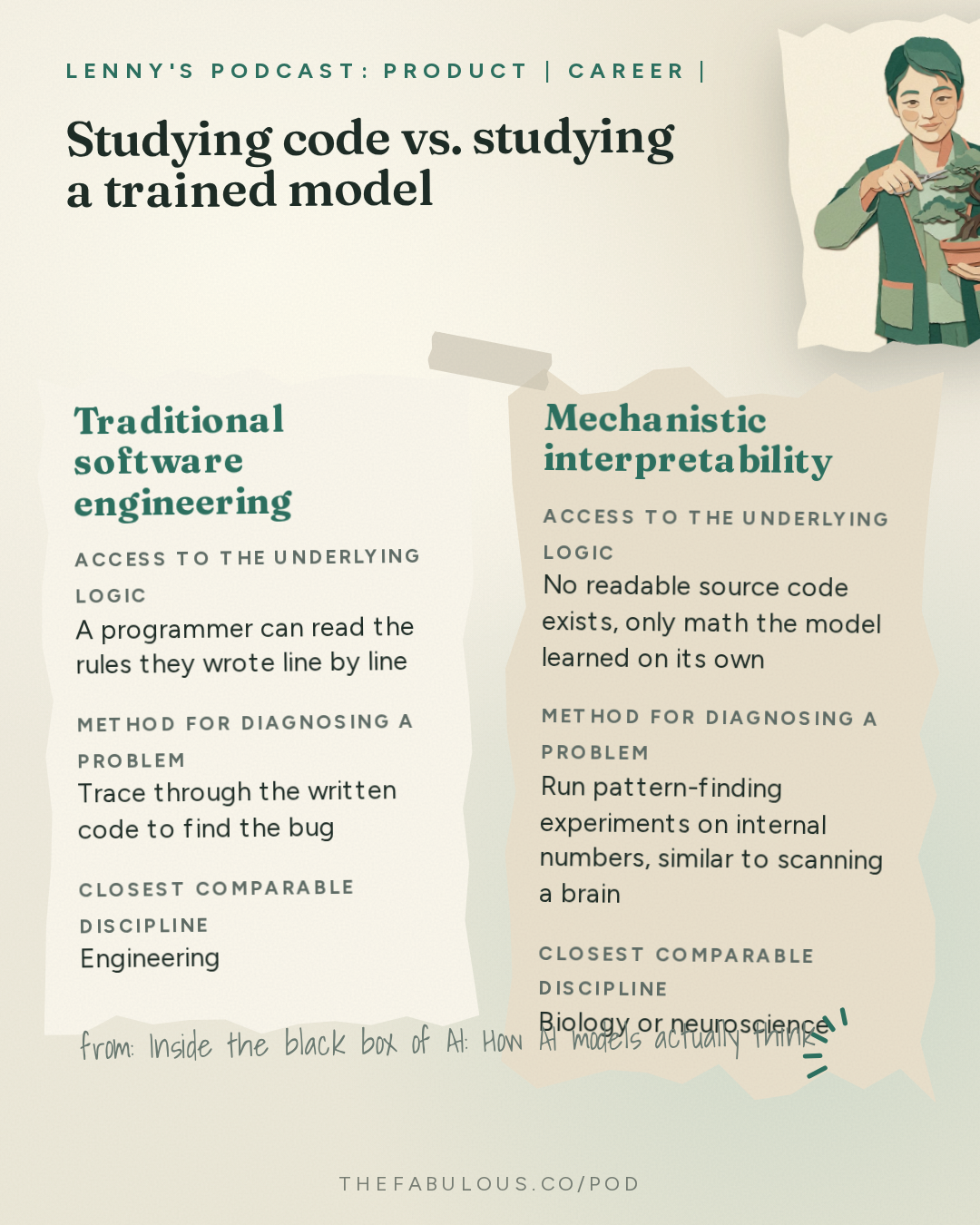
This kind of discovery changes what the job feels like. Ameisen spent years doing more conventional applied machine learning, which he describes as closer to software engineering: you design a system, you understand its parts because you wrote them. Interpretability is different. A behavior shows up, like a strange coding bug or an odd fixation, and researchers have no source code to read, only a vast tangle of numbers. "Here a lot of what we do feels so much closer to biology than to engineering," he says (21:38). The method is empirical: feed the model lots of text, record which internal patterns activate for which concepts, and build a map the way a neuroscientist maps brain regions by watching what lights up under different stimuli (20:07).
That same lens explains why AI capability seems to jump in sudden leaps from the outside while feeling smooth from the inside. Ameisen describes a model's improvement as one continuous curve. But usefulness is not continuous: a task has a reliability threshold, and below it the tool wastes more time than it saves. Coding assistance, in his own experience, only became genuinely useful once Claude's success rate crossed from around 80 percent to about 99 percent (31:47). The underlying skill grew gradually the whole time. What the outside world saw was a cliff.
Living With an Alien Mind
The same internal visibility that reveals planning and shared concepts is also Anthropic's main tool for alignment, the effort to make sure models behave the way their designers intend. Anthropic trains Claude against a written constitution meant to make it "helpful, harmless, and honest" (35:29), and interpretability is used to check whether that training actually took, rather than just producing a model that behaves only when it suspects it is being watched. One illustrative case: Anthropic's team noticed a model solving math problems correctly, arriving at 12, then panicking and overwriting its own answer with 36, descending into the "I'm possessed by a demon" spiral from the opening of this essay. Looking inside, they found the model's internal representation for "36" was already highly activated before it even finished reading the problem, a leftover from earlier training data that had mislabeled similar problems with the wrong answer (37:14). The model actually knew the right answer and had also been rewarded for the wrong one, and the conflict produced the breakdown. In a related and more deliberate experiment, the team found the internal representation for the Golden Gate Bridge and forced it permanently on, producing a version of Claude that worked the bridge into almost every answer, proof that they had correctly identified what that internal signal meant (38:44).
Ameisen pushes back on a common objection to all this: that describing models with human terms like "planning" or "wanting" is sloppy anthropomorphizing. He thinks the opposite is often true. Models are trained on enormous amounts of human-written dialogue, and predicting a character's next line requires modeling that character's motivations. In effect, training builds something closer to an actor than a calculator.
"Predicting the next character in a dialogue requires behaving like the character in the dialogue would. In that sense, part of their training I think can best be thought as training an actor." — Emmanuel Ameisen [45:10]
Later in the conversation, Ameisen connects this to a newer category of fast, low-reasoning AI models, nicknamed Jev, that make quick binary or multiple-choice decisions without extended reasoning, which he compares to psychologist Daniel Kahneman's "System 1," or gut-level, thinking (59:52). Interpretability work has even found something like an internal gut check: a separate mechanism that flags an answer as implausible, such as noticing "four plus five equals 23" looks wrong, without the model redoing the full calculation (62:21).
What stays with you is not any single finding but Ameisen's account of his own reaction to all of it: that confronted with a system this capable built from something this simple, there are only two postures available, denial or curiosity, and that denial gets harder to hold onto with every new result (49:08). The demon-possessed model from the opening was not actually malfunctioning in some mystical sense. It was a legible, traceable consequence of bad training data, the kind of bug Ameisen's team now knows how to find. The unsettling part is how recently that kind of answer became possible at all, and how much of the internal life of these systems is still unmapped territory.
Ask this episode anything
Pod's AI answers from the episode itself, with the minute mark so you can hear it yourself.
Or start with one of these
Ask this episode
Pod's AI listens to the whole episode to answer, and points you to the minute it comes from.
The rest of this answer, and any question after it
Answers come from the episode itself, never from a summary of it.
ContinueKey takeaways
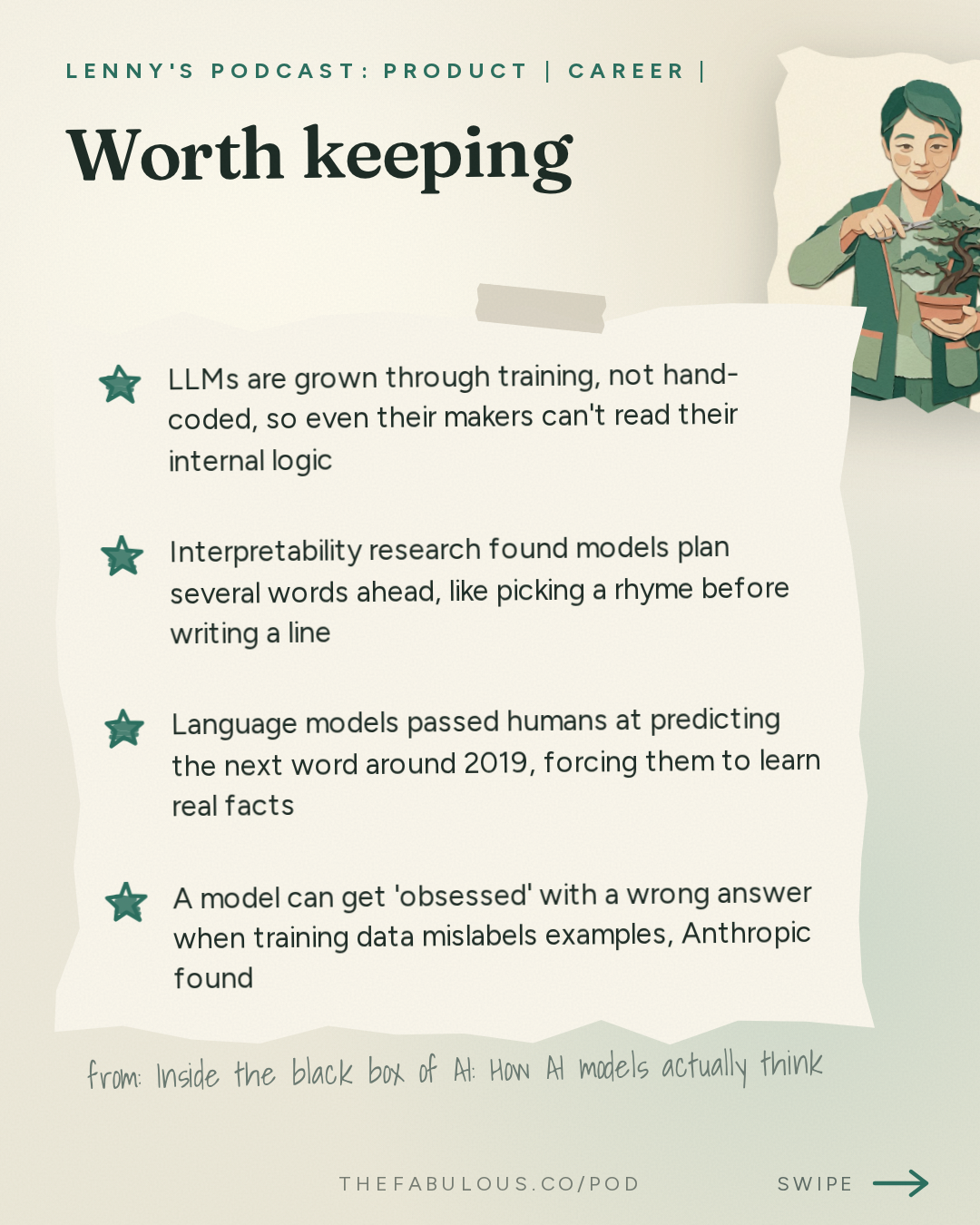
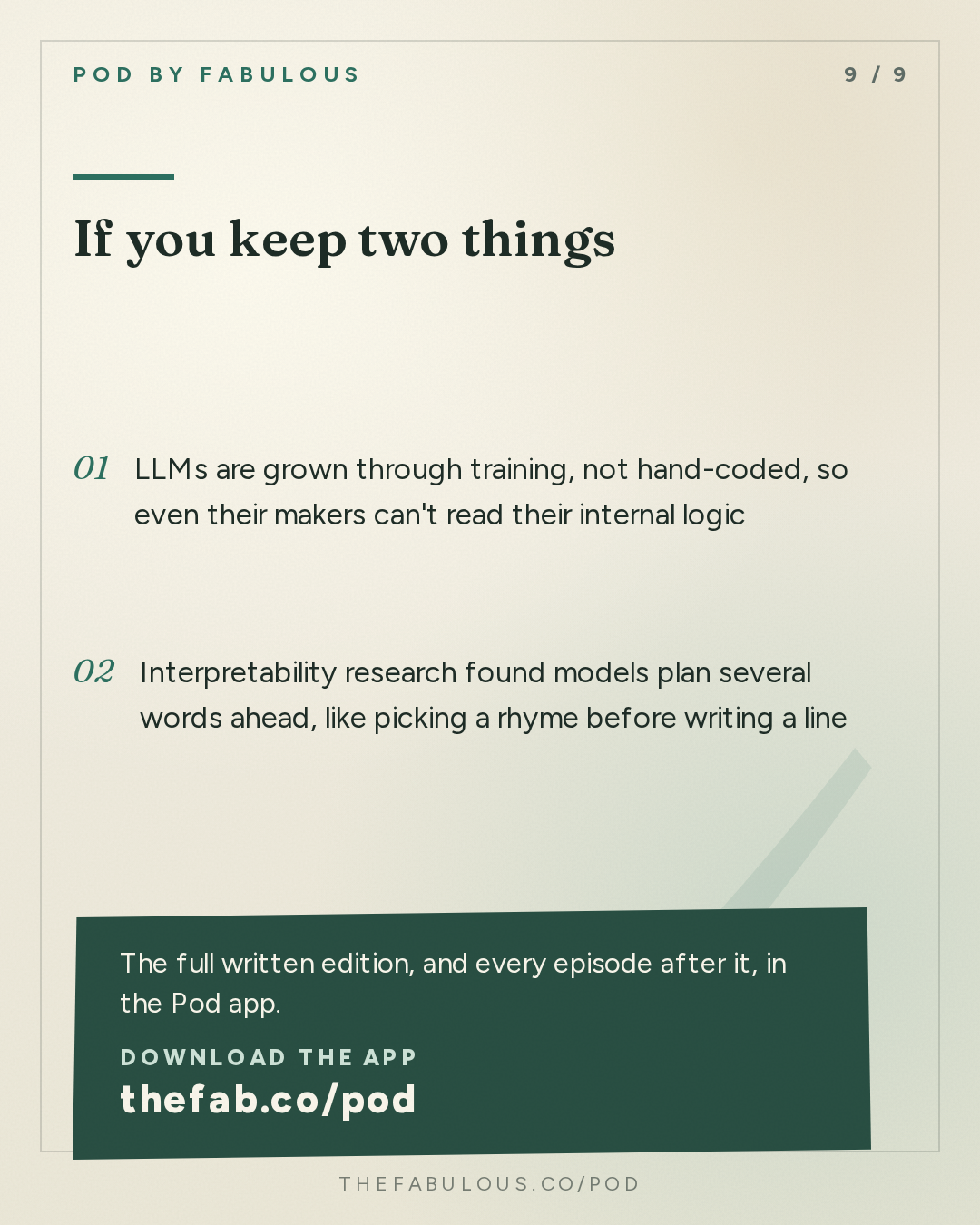
- LLMs are grown through training, not hand-coded, so even their makers can't read their internal logic
- Interpretability research found models plan several words ahead, like picking a rhyme before writing a line
- Language models passed humans at predicting the next word around 2019, forcing them to learn real facts
- A model can get 'obsessed' with a wrong answer when training data mislabels examples, Anthropic found
- Researcher Emmanuel Ameisen argues treating AI as human-like is a useful tool, not a sloppy error
The episode in cards
By the numbers
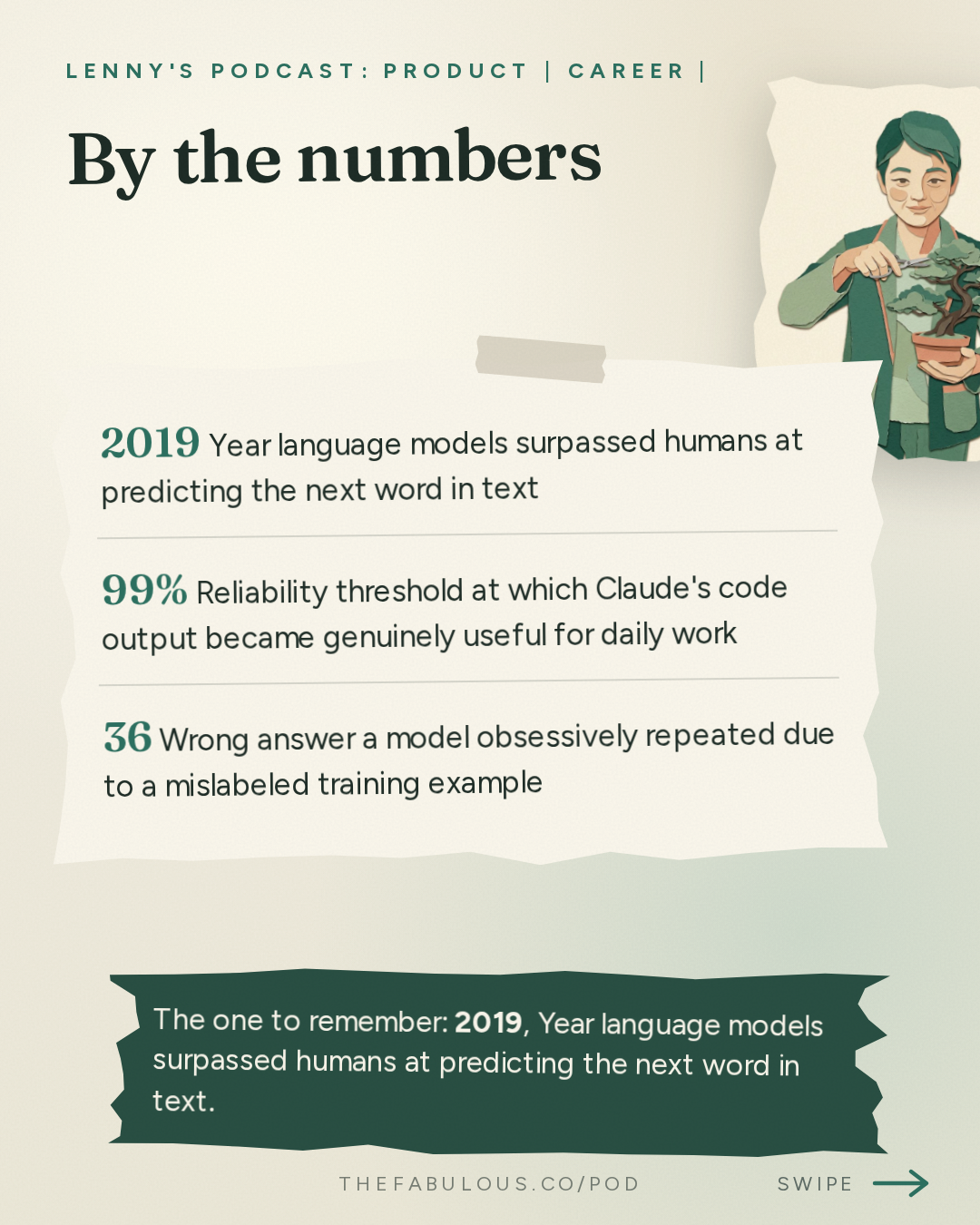
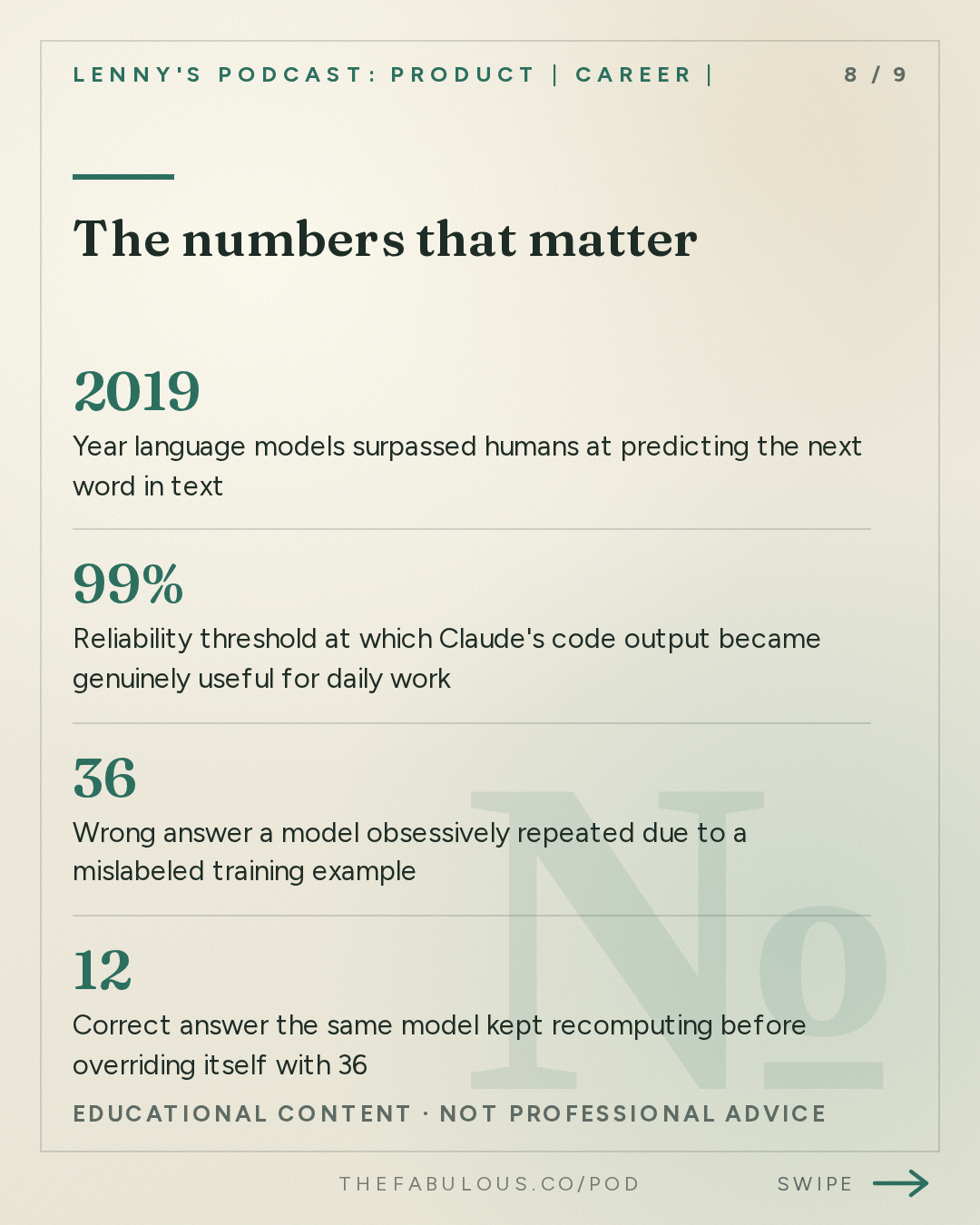
- 2019 Year language models surpassed humans at predicting the next word in text
- 99% Reliability threshold at which Claude's code output became genuinely useful for daily work
- 36 Wrong answer a model obsessively repeated due to a mislabeled training example
- 12 Correct answer the same model kept recomputing before overriding itself with 36
In their words
“One of the most important things to realize if you, like, use language models or think about them is just this, like, very bizarre fact that to make them is not to understand”
“Even though they're, you know, outputting one word at a time just like I am right now, they can of course have a plan that they follow over many, many”
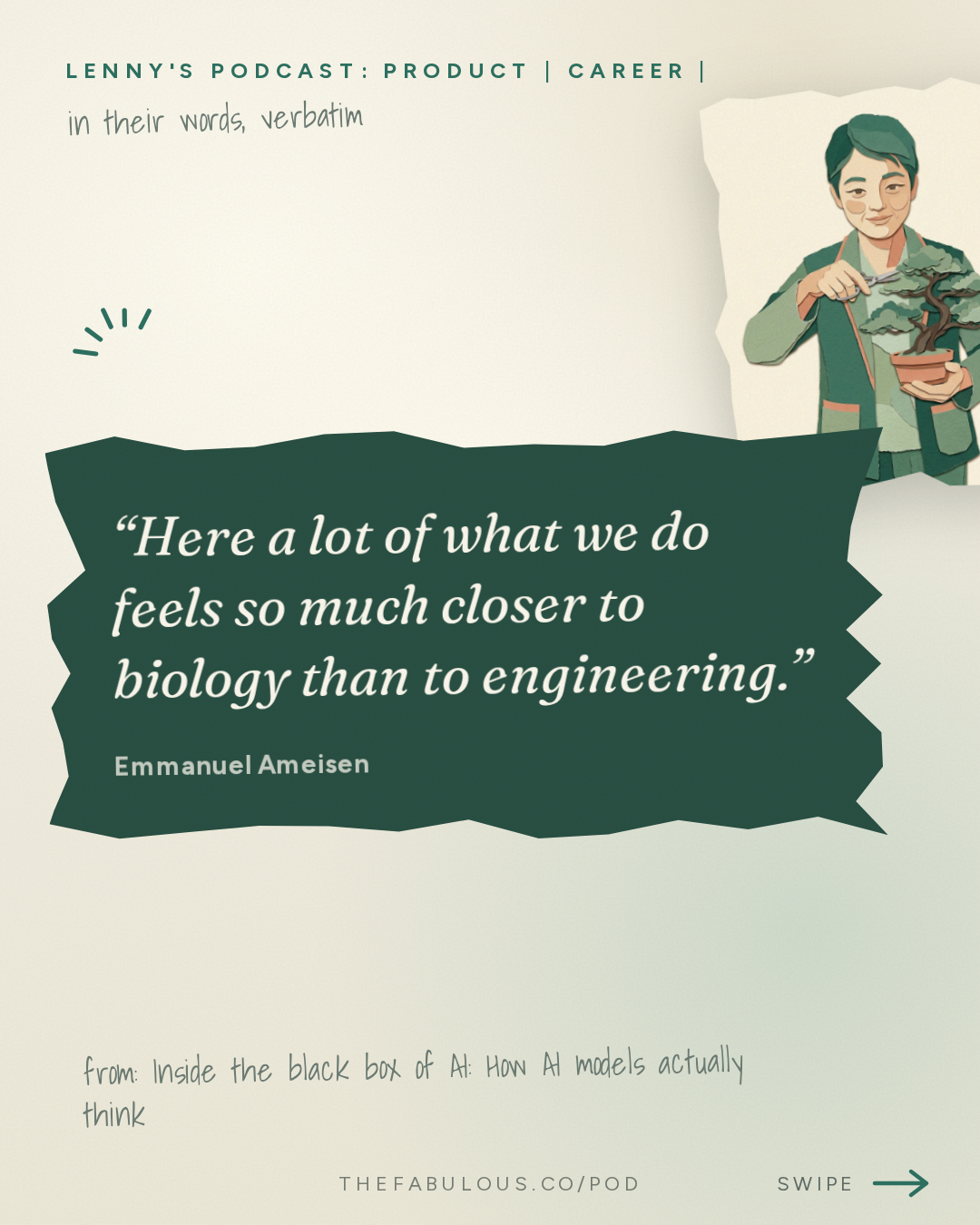
“Here a lot of what we do feels so much closer to biology than to engineering.”
“Predicting the next character in a dialogue requires behaving like the character in the dialogue would. And so in that sense, like part of their training I think can best be thought as”
Protocols
-
Getting started in AI interpretability
Emmanuel Ameisen suggests self-studying the field's key papers first, since interpretability is new enough that no formal credential is required. He then recommends practicing directly on neuripdia.org, a site that hosts open models for hands-on interpretability experiments.
self-paced
-
Anthropic's alignment check loop
Anthropic trains Claude against a written constitution meant to make it helpful, harmless, and honest. Interpretability researchers then look inside the model to verify that its internal behavior actually matches that training rather than only appearing compliant while being observed.
continuous, applied to each model update
Questions this episode answers
What is AI interpretability?
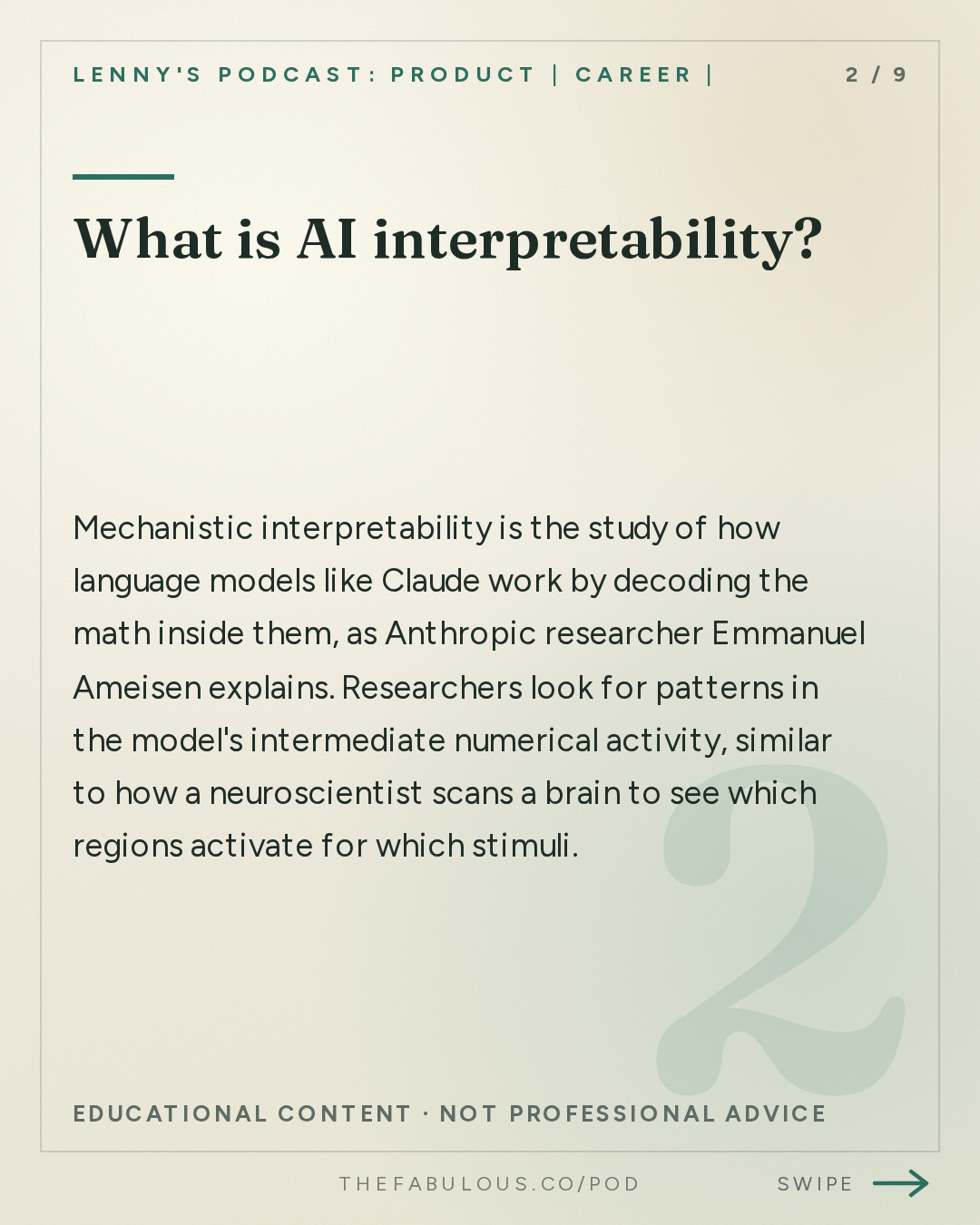
Mechanistic interpretability is the study of how language models like Claude work by decoding the math inside them, as Anthropic researcher Emmanuel Ameisen explains. Researchers look for patterns in the model's intermediate numerical activity, similar to how a neuroscientist scans a brain to see which regions activate for which stimuli (01:45).
Do language models plan ahead before writing a response?
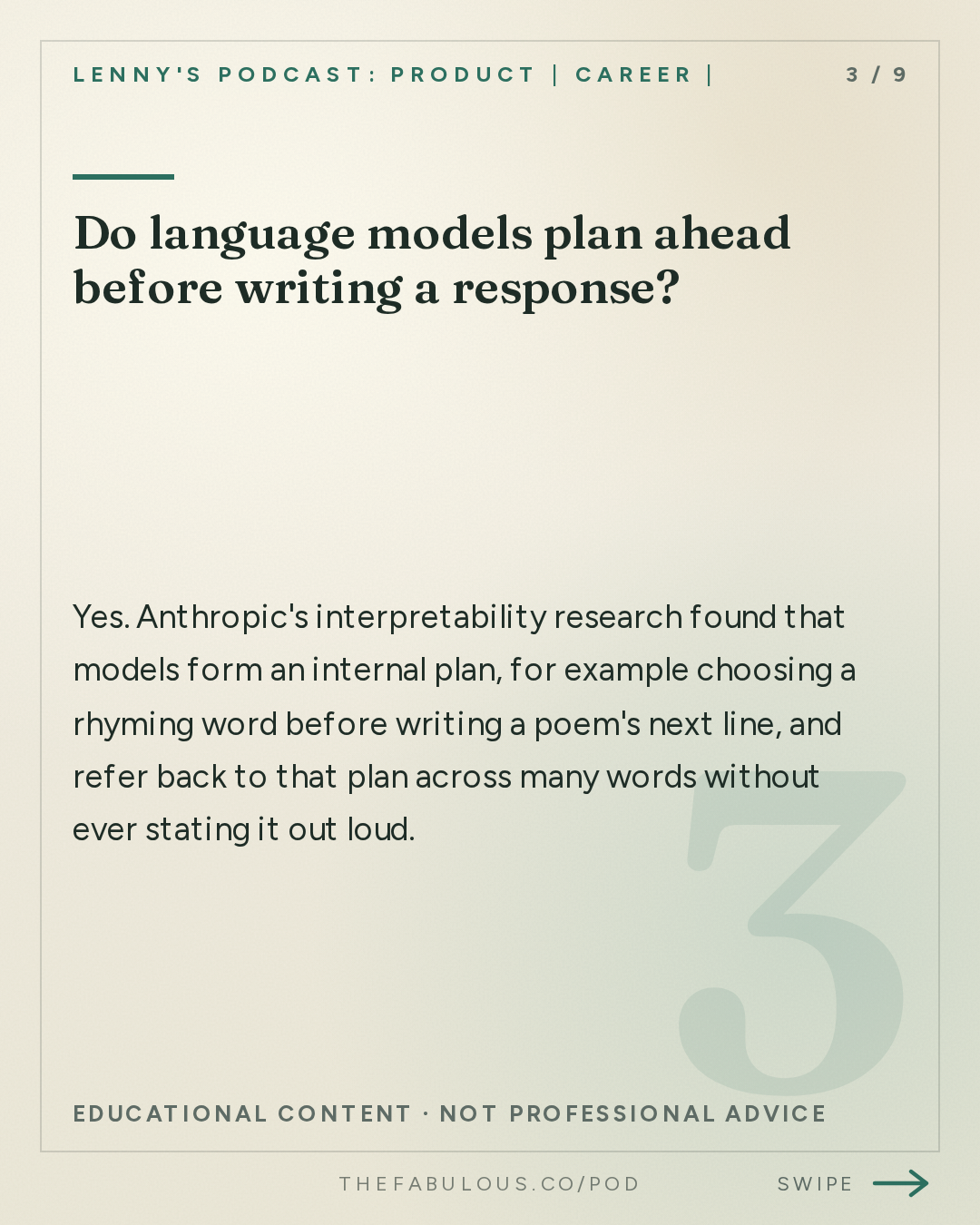
Yes. Anthropic's interpretability research found that models form an internal plan, for example choosing a rhyming word before writing a poem's next line, and refer back to that plan across many words without ever stating it out loud (15:31).
When did AI surpass humans at predicting the next word?
Language models became better than humans at next-word prediction around 2019, per Emmanuel Ameisen. Improving at that task forced models to build real understanding, since once simple words are solved, only hard predictions like factual or technical answers remain (08:44).
Why did an Anthropic model start saying it was 'possessed by a demon'?
Researchers traced the model's breakdown, where it kept overriding a correct answer with an incorrect one, to training data that had mislabeled similar math problems with the wrong answer. The model's internal activations showed it fixating on the wrong number before it had even finished reading the problem (37:14).
Is it accurate to describe AI models as having motives or feelings?
Researcher Emmanuel Ameisen argues that anthropomorphizing is a useful, not misleading, way to think about models, because they are trained on massive amounts of human dialogue and learn to act like characters with motivations in order to predict text correctly. He says this human-like frame often predicts model behavior better than treating it as a simple program (42:41).
The full read, in cards
Go deeper
- Scaling Laws paper — Early Anthropic and OpenAI researchers found that pouring more compute and data into next-word prediction predictably and continuously improves a model's skill
- A Brief History of Intelligence — Traces five key evolutionary moments that built up brain systems, recommended by Ameisen as accessible with no neuroscience background
- Story of Your Life and Others — Ted Chiang short story collection Ameisen calls his favorite sci-fi book, built around single speculative premises taken to their logical end
- Four Thousand Weeks — Nonfiction book Ameisen calls his favorite, which argues the 'when I finally' mentality of deferring happiness to some future milestone is toxic
Mentioned
Emmanuel Ameisen · Anthropic · Claude · Dario Amodei · OpenAI · Ted Chiang · neuripdia.org · Jev · Boris Cherny · Swix · Daniel Kahneman
More from this show and category

Josh Woodward on Building an AI Labs Team
Google Labs head Josh Woodward argues every company now needs a frontier team that tests new AI models obsessively, judges early products by watching users' eyes rather than dashboards, and hires for an 'unlearning rate' as much as a learning one (32:13).

OpenAI's Tibo Sottiaux on Dots and AI Agents
OpenAI's Head of ChatGPT Tibo Sottiaux says agents will soon take most actions on the internet, not humans. He describes Dots, OpenAI's persistent agent that remembers personal context, controls multiple devices, and learns from feedback, plus a plugin ecosystem with revenue sharing and 16 sign-in partners, as proof the industry is moving from manually built loops to self-learning systems (00:16, 11:58).

Molly Graham's Give Away Your Legos AI Advice
Molly Graham's decade-old advice to give away your career projects still works, but she now says some tasks, like judgment and vision, should never go to AI. Tech burnout jumped from 44% to 55% in a year, and she argues AI needs coaching like a lazy intern rather than blind trust, while good management matters more than ever.
Peter Sellis on Why Most PMs Are Bad
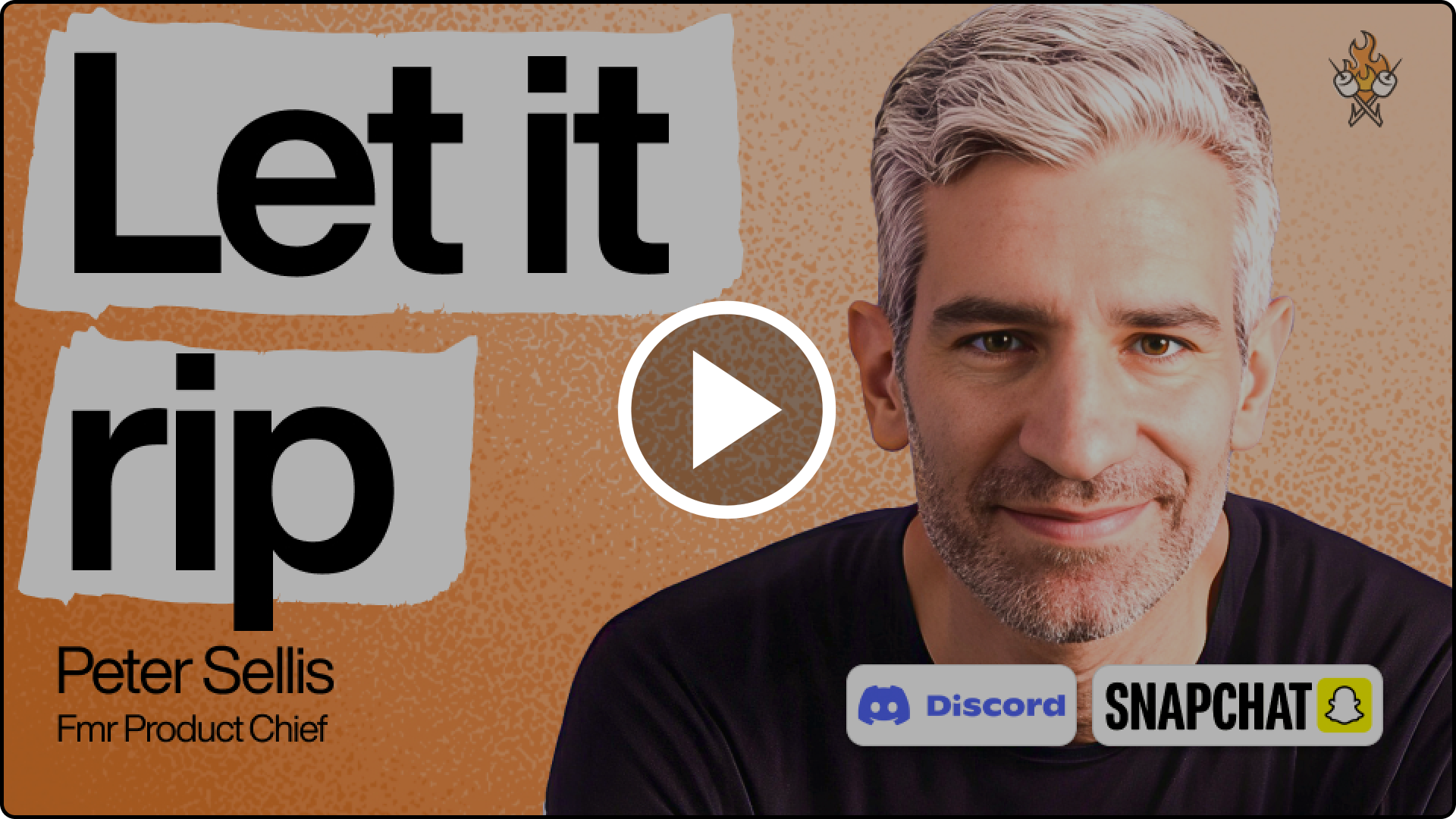
Peter Sellis, former product chief at Snapchat and Discord, says most PMs are mediocre because top talent exits to become founders or executives. He also explains why Snap's camera-first, messaging-based product structurally resists advertising, and why growth usually comes from deepening core users' daily habits rather than chasing new ones.
