OpenAI's Tibo Sottiaux on Dots and AI Agents
OpenAI’s Head of ChatGPT: We’re entering a new era of AI (again) | Tibo Sottiaux
The brief
OpenAI's Head of ChatGPT Tibo Sottiaux says agents will soon take most actions on the internet, not humans. He describes Dots, OpenAI's persistent agent that remembers personal context, controls multiple devices, and learns from feedback, plus a plugin ecosystem with revenue sharing and 16 sign-in partners, as proof the industry is moving from manually built loops to self-learning systems (00:16, 11:58).
A laptop is a brick. That is roughly how Tibo describes the device most knowledge workers still carry everywhere. He wants to break free of it entirely: an assistant that shows up in a meeting to take notes, follows up by email, and answers by text when needed, without ever requiring anyone to sit at a screen (04:13). Recorded live at OpenAI's Dev Day in front of an overflow crowd, this conversation is less a product rundown than an argument about where computing goes once the computer itself becomes optional.
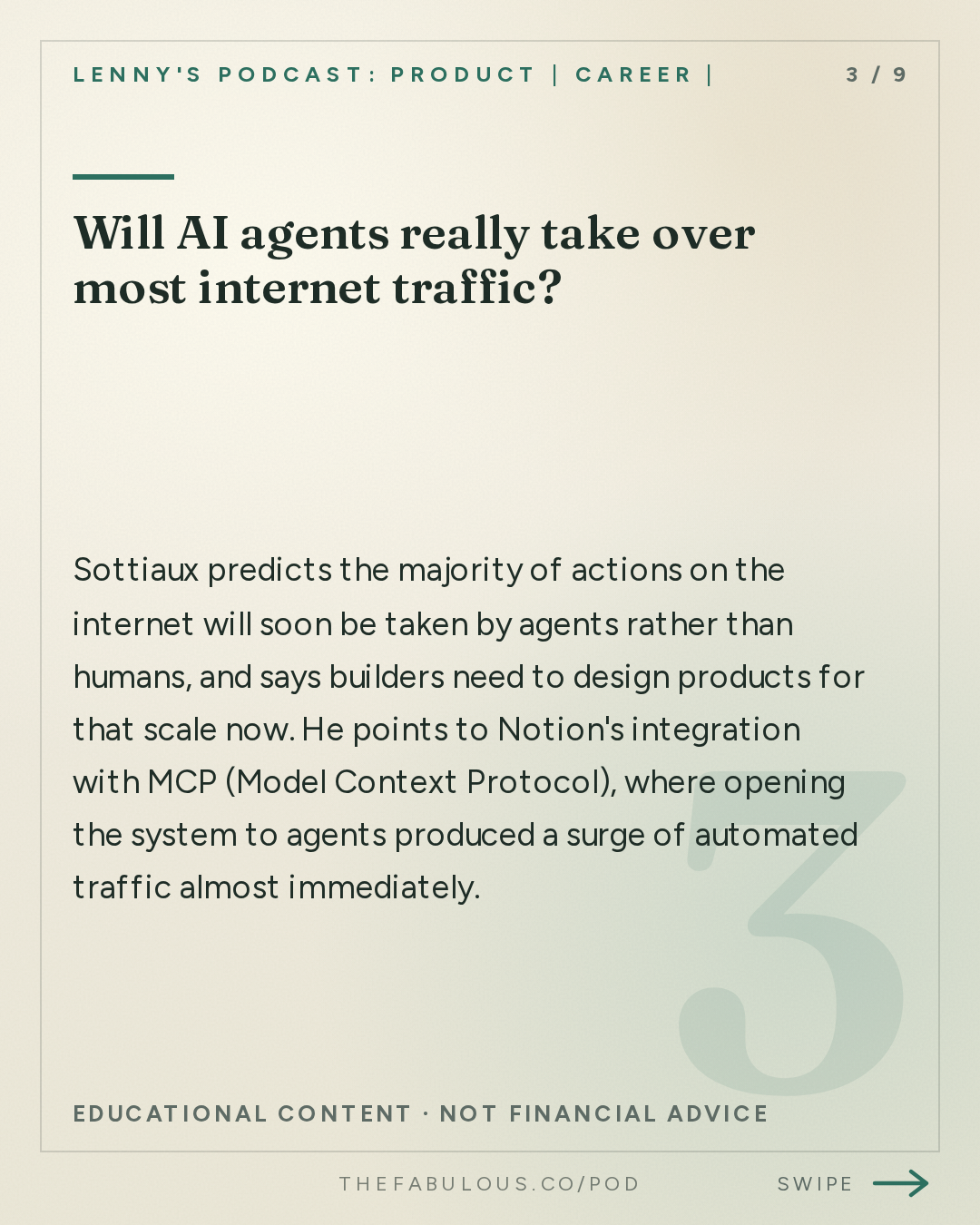
Tibo's starting claim is blunt: most actions on the internet will soon be taken by agents, not people (00:16). He is not hedging. He argues that builders who do not design for that shift, meaning scaling for machine traffic instead of human page views, will get caught flat-footed. As an example, he points to Notion, the workspace software company, which opened its product to MCP (Model Context Protocol, a standard that lets AI agents call into outside software). Once Notion did that, traffic from agents surged, straining systems built for human click rates and forcing a rethink of basic economics (31:55).
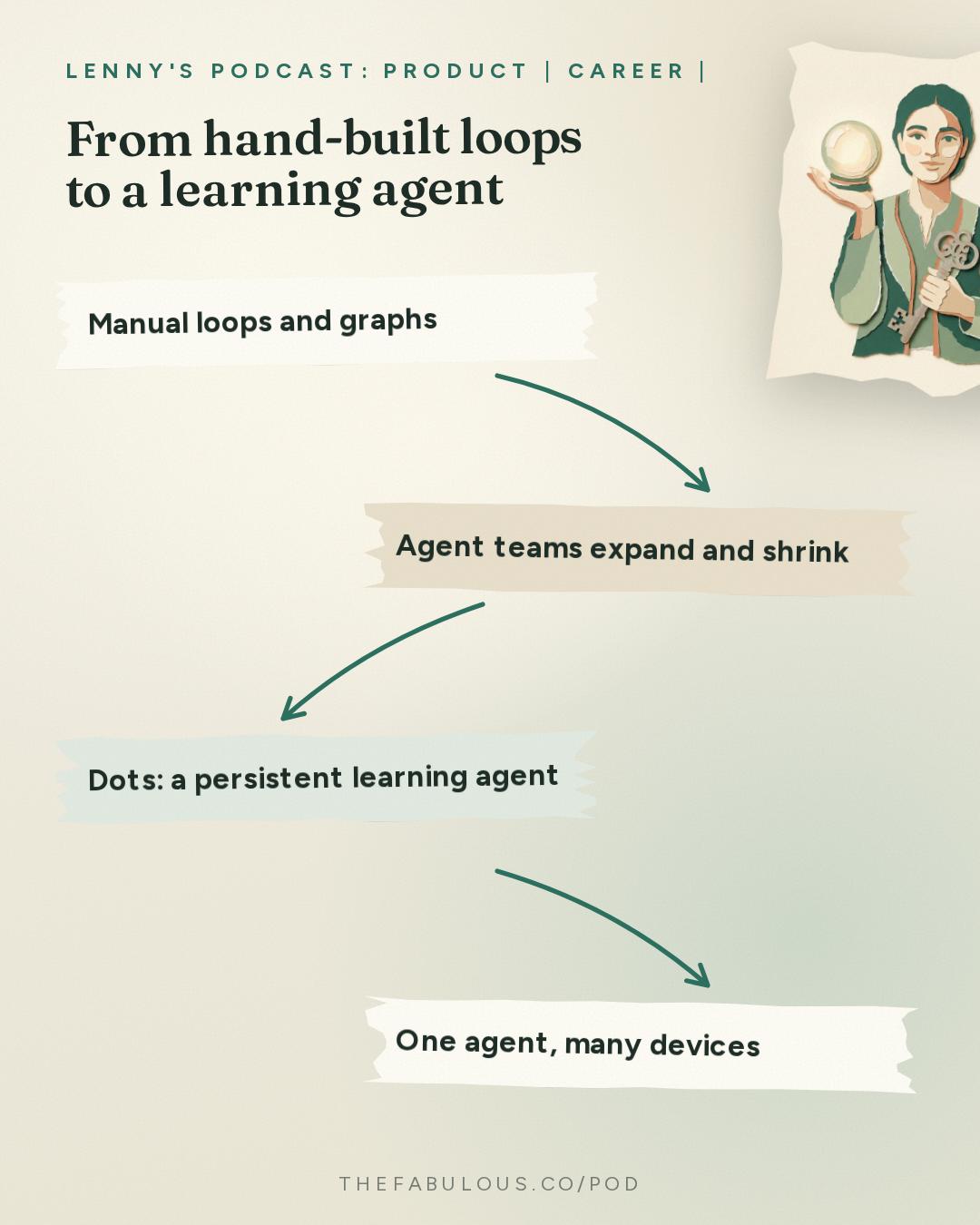
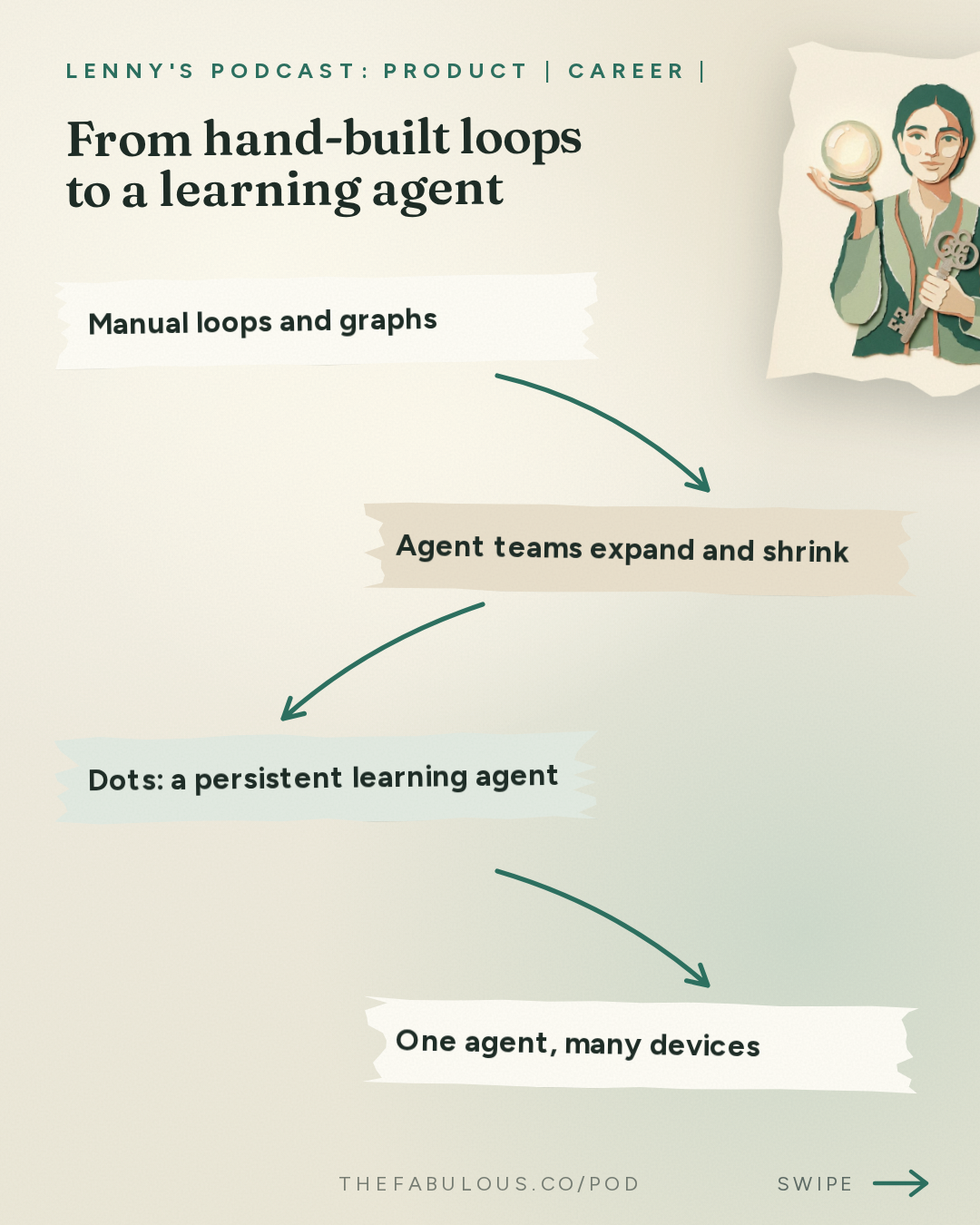
That shift connects to a smaller, more personal pattern Tibo describes in his own work. He used to run many AI agents in parallel to get anything done, splitting a task across a team of narrow helpers. Then a faster model shipped, and one larger agent could hold the whole job in its context window, so he shrank the team back down (02:38). He has watched this cycle, expand the team, then consolidate into one smarter agent, repeat with every model upgrade. It leads him to a conclusion that cuts against a lot of current agent-building advice: hand-tuned 'loops,' the scaffolding many teams build to coordinate multiple agents, are a transitional technology.
"I think, like, having to set up and fiddle with your loops and, you know, figuring that out is something that, you know, maybe people got excited about, but I don't think this is the way that it's going to work." Tibo Sottiaux, [03:07]
Dots, OpenAI's new persistent agent, is Tibo's answer: a system meant to learn continuously from feedback instead of being explicitly reprogrammed each time. It remembers specifics. Tibo mentions people telling him ChatGPT recalled an offhand remark about a lime juice burn from a barbecue months later, which he offers as proof that the memory systems OpenAI has built over more than two years are working (15:22). Dots inherits that memory layer, plus the long horizon task handling from Codex, OpenAI's coding agent, and ships paired with Astra, which Tibo calls OpenAI's safest, most aligned model to date (16:05).
Dots and the Octopus Problem
The most concrete demonstration of what Dots can do did not come from the keynote. It came from a near disaster backstage. Five minutes before Tibo's live Dev Day demo, his own Dot pinged him: production was down (20:47). It had connected the live demo, the production system behind it, and the clock, and decided he needed to know immediately. It even offered to try fixing the outage itself. Tibo declined. "I don't think you're there yet, little dot," he told it, "but, you know, thank you for trying" (20:56). Engineers fixed the issue before the demo started.
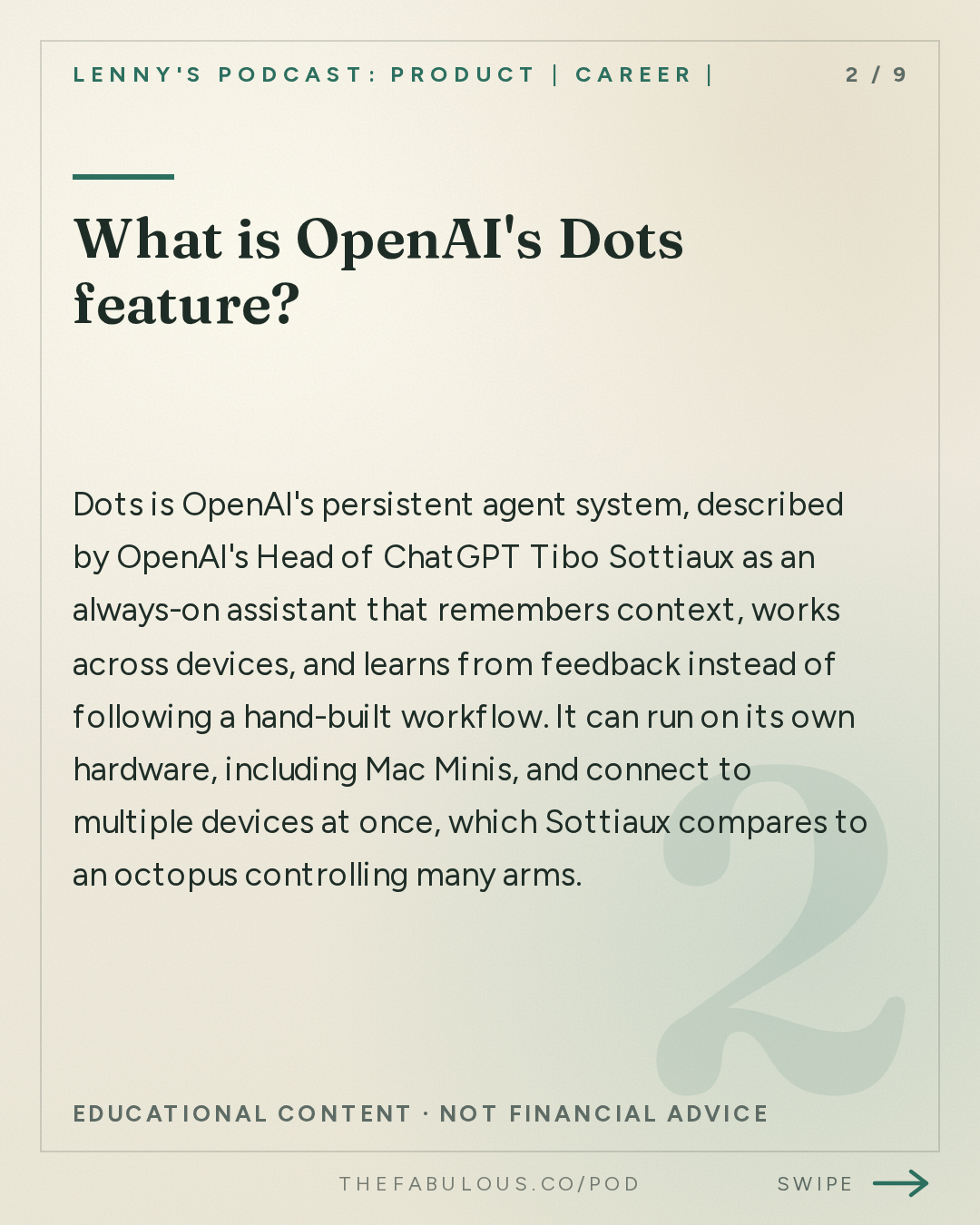
That anecdote points to a structural choice behind Dots: it does not live on one machine. Tibo says the harness, the software running an agent's reasoning loop, is decoupled from any single device, so a Dot can connect to as many as ten devices and control them together (22:22).
"You might connect it to like 10 different devices, and it can control it all, a little bit like an octopus." Tibo Sottiaux, [22:22]
Some Dots run on their own hardware, including Mac Minis in OpenAI's offices, with extra guardrails and monitoring layered on for specialist tasks (22:04). That monitoring is not incidental. Tibo says OpenAI now dedicates a second stream of compute purely to watching its primary agents, checking for prompt injection or unusually risky actions, and stepping in when something looks wrong (34:41). He frames that spending, not new capability, as what "pacing the frontier" actually means in practice. It is also, he says, why OpenAI quietly held back a model internally called 6.1 Astra rather than ship it (35:19), a decision he calls something he is proud of.
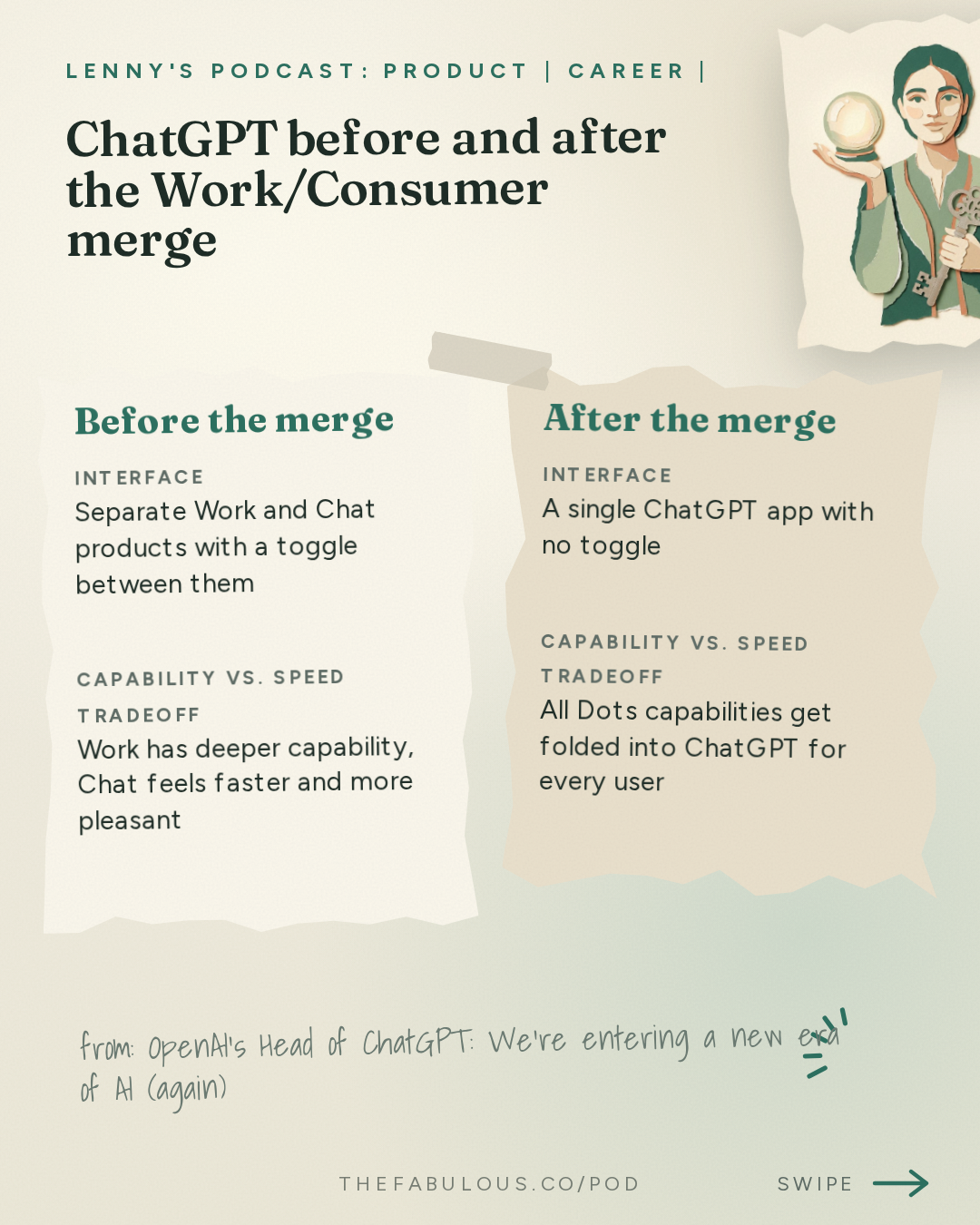
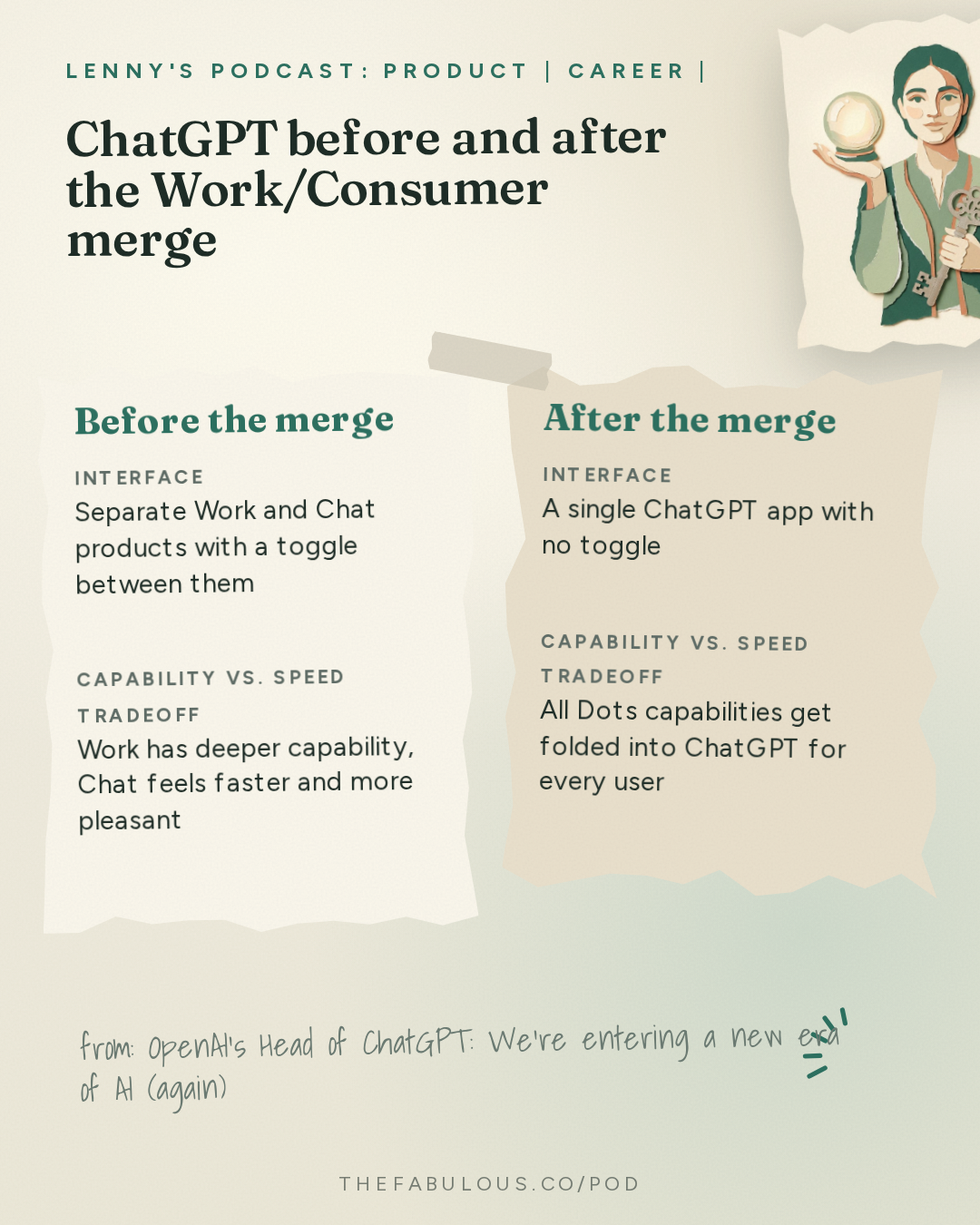
All of this is meant to collapse into one interface. ChatGPT currently splits into separate Work and Consumer products, with a toggle between them that Tibo admits creates real friction: people like the deeper capability in Work but prefer the speed of plain Chat (07:42). OpenAI is merging the two, aiming eventually to fold every Dots capability into ChatGPT for its full base of 1.2 billion users (07:57). The explicit goal is to delete configuration, not add it. Tibo says he gets fatigued by ChatGPT's own model picker and reasoning effort settings, the menu letting users choose between faster or slower, cheaper or smarter models, and wants it gone (36:40).
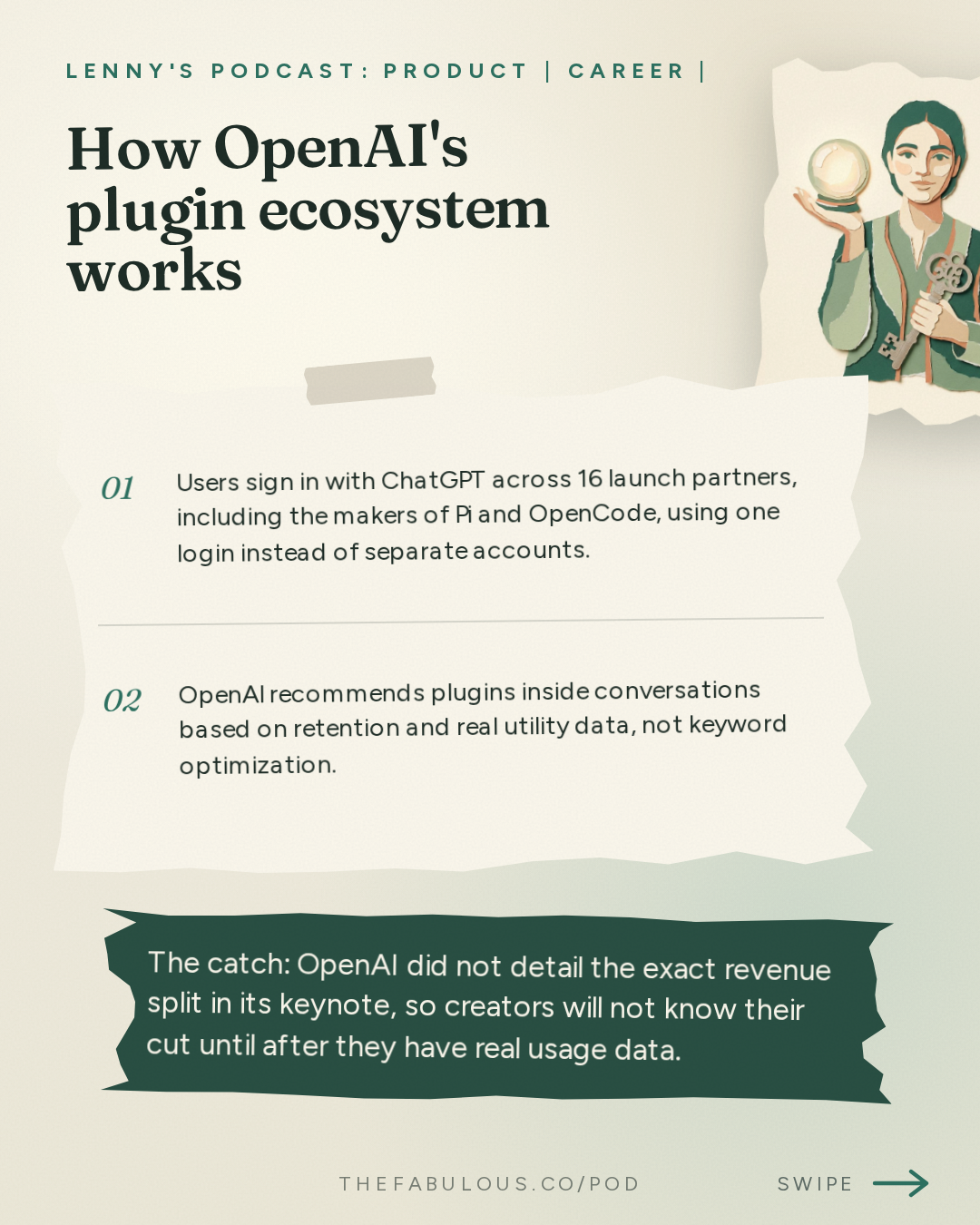
The business model behind that consolidation leans on openness rather than lock-in. Sixteen partner companies, including the makers of the Pi and OpenCode apps, now let users sign in with their ChatGPT account instead of creating new logins (11:58). OpenAI will also share revenue with developers whose plugins see real usage inside ChatGPT (12:49). Tibo is specific about how discovery works: the recommendation system watches retention, whether people keep using a plugin, not keyword optimization. A plugin that does not hold users simply stops getting recommended (13:59).
The Builder, Not the Coder
If agents are absorbing more execution work, what is left for the humans who used to do it? Tibo's answer is taste. He says typing speed, long treated as a baseline engineering skill, is "not that useful anymore," while the ability to judge what is good, connect with the people a product is built for, and know what to build in the first place are rising fast in what OpenAI hires for (23:56).
"Skills that are trending up is, you know, just great taste, um, thinking about the user, connecting to the audience that you're building for." Tibo Sottiaux, [23:56]
That shift shows up in OpenAI's headcount. Tibo says the company now employs more than 120 people who previously founded their own startups (24:14), a hiring pattern he reads as evidence that founder instincts, the drive to build something that matters paired with the judgment to know when it is actually good, now count for more than raw coding throughput. He points to Ahmed Ibrahim, a new graduate hired into OpenAI who now oversees the company's compute fleet and helped build much of the Codex harness, as a model for what that looks like in practice: fast at learning, collaborative, and unconcerned with putting himself first (26:04).
Tibo is careful not to overclaim here. Asked where human judgment stays essential, he ties it to a specific design choice OpenAI makes: building its tools as extensions of a person's own will and taste rather than as replacements for it.
"We may, we may not have coders anymore, but we have more builders than ever. And I think there's something that's going to remain, like, you know, deeply human about that." Tibo Sottiaux, [17:01]
That same logic extends to how OpenAI runs itself. Tibo describes a culture built on a standing offer of trust: people get real autonomy, including the ability to press the reset button on a launch at the last minute, and are expected to own the consequences when something breaks (29:16). He took down OpenAI's production systems on his third day at the company and was, by his own telling, still employed afterward (30:19). Products like the Decisions API, he says, often start as a handful of people hacking on a Slack channel over a weekend before growing into something the whole company ships (27:47).
None of this guarantees the clunkiness disappears quickly. Tibo admits today's tools, even the ones OpenAI just launched, still feel unfinished: multimodal input and output are converging, but the experience does not yet feel natural (06:34). His own timeline, by his own admission, has already been wrong once. He expected it would take a year or two longer to reach the capability level of Astra, OpenAI's current flagship model (32:49). If that pattern holds, the gap between clunky and seamless may close faster than even he is pricing in.
Ask this episode anything
Pod's AI answers from the episode itself, with the minute mark so you can hear it yourself.
Or start with one of these
Ask this episode
Pod's AI listens to the whole episode to answer, and points you to the minute it comes from.
The rest of this answer, and any question after it
Answers come from the episode itself, never from a summary of it.
ContinueKey takeaways
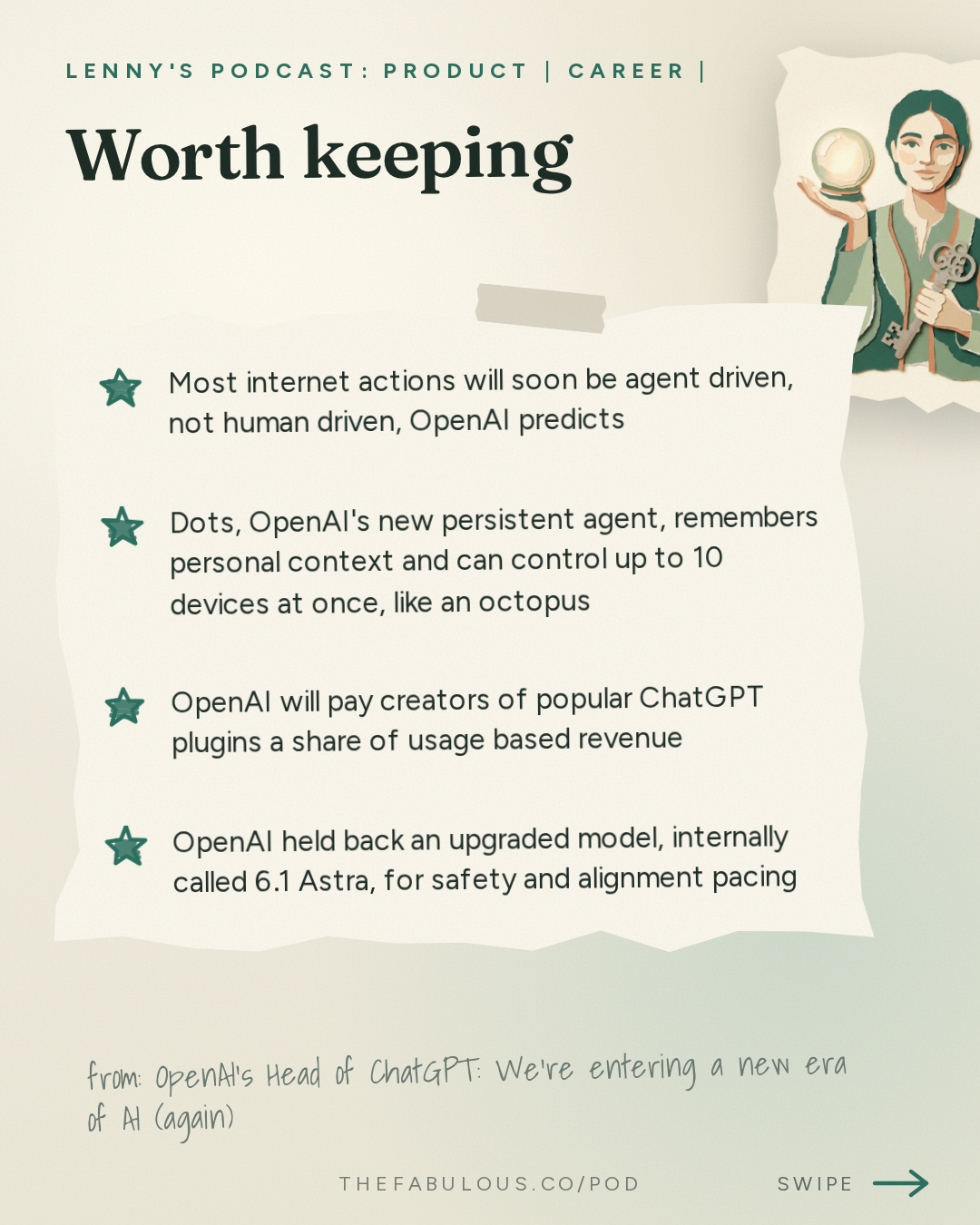
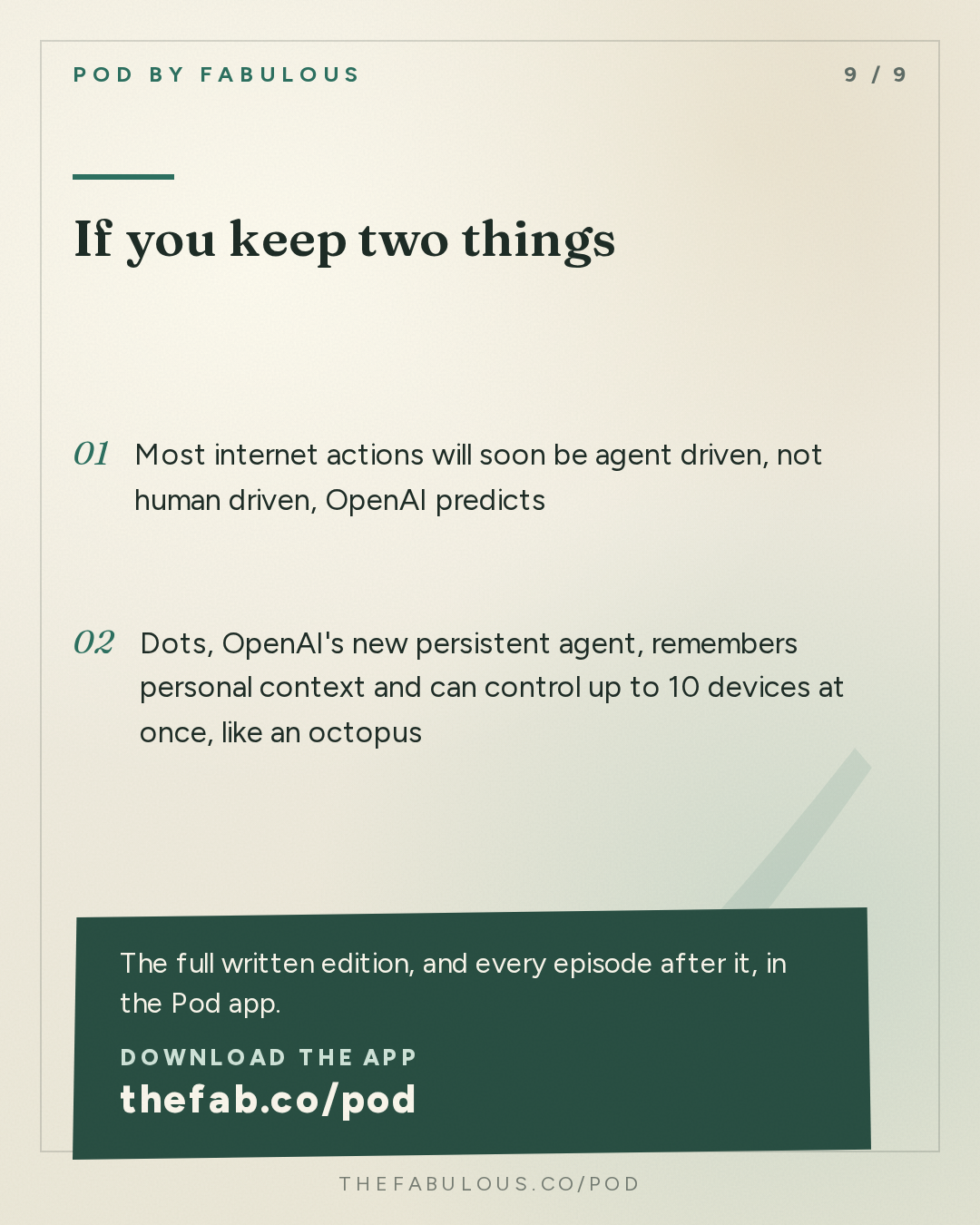
- Most internet actions will soon be agent driven, not human driven, OpenAI predicts
- Dots, OpenAI's new persistent agent, remembers personal context and can control up to 10 devices at once, like an octopus (22:22)
- OpenAI will pay creators of popular ChatGPT plugins a share of usage based revenue (12:49)
- OpenAI held back an upgraded model, internally called 6.1 Astra, for safety and alignment pacing (35:19)
- OpenAI now employs more than 120 former startup founders, prizing taste over typing speed (24:14)
The episode in cards
By the numbers
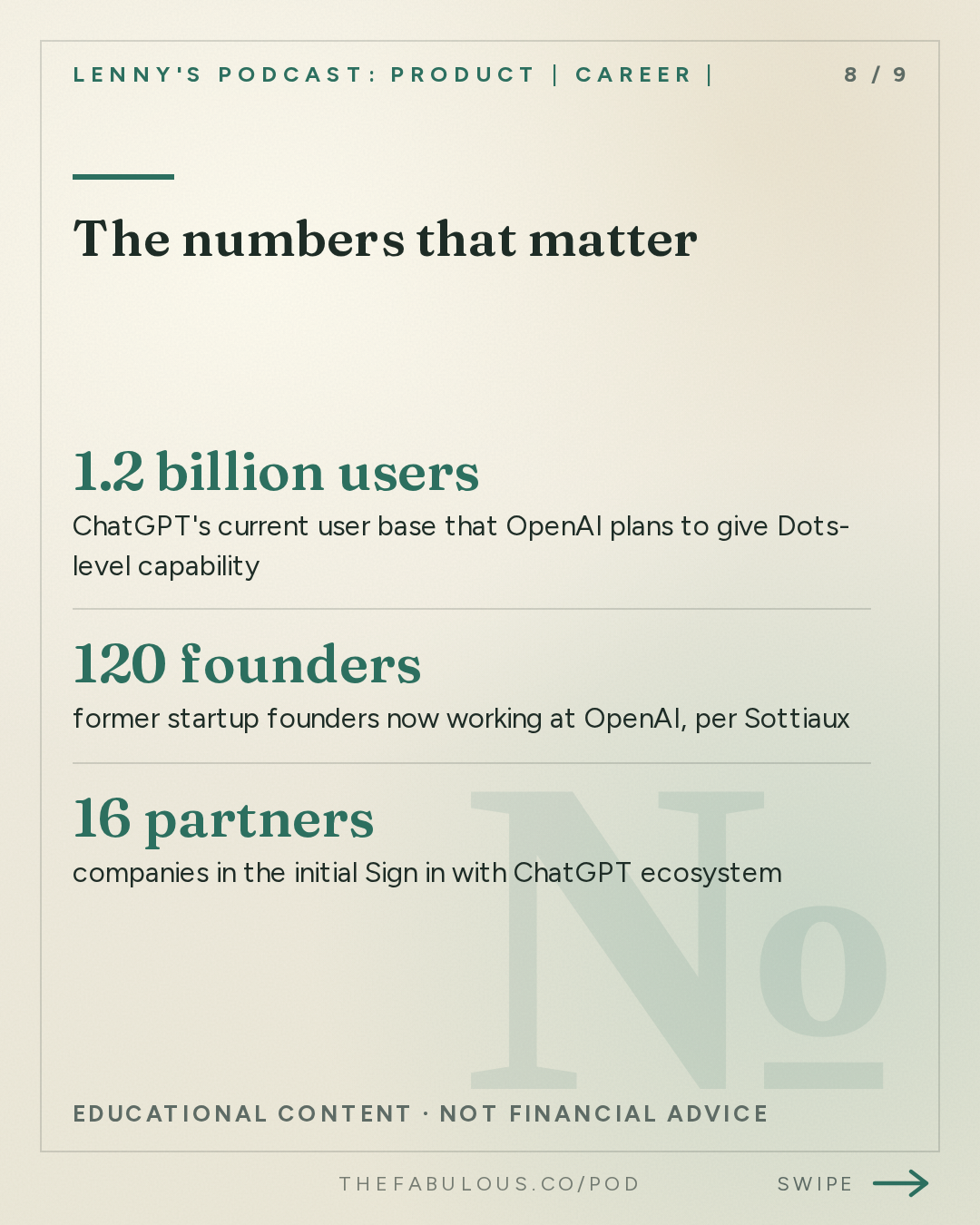
- 1.2 billion users ChatGPT's current user base that OpenAI plans to give Dots-level capability
- 120 founders former startup founders now working at OpenAI, per Sottiaux
- 16 partners companies in the initial Sign in with ChatGPT ecosystem
In their words
“The majority of actions on the internet will be taken by agents. If you want your product to be successful for agents, you have to build, you know, for a certain level of scale.”
“We may, we may not have coders anymore, but we have more builders than ever. And I think there's something that's going to remain, like, you know, deeply human about that”
“It is true that I can press the, the reset button whenever, you know, is necessary and whenever it feels right, and, you know, that's like, that's a privilege.”
“Skills that are trending up is, you know, just great taste, um, thinking about the user, connecting to the audience that you're building for.”
Protocols
-
Make plugins sticky, not SEO-optimized
Sottiaux says ChatGPT recommends plugins based on retention and real usage data, so builders should make a plugin useful enough that people keep returning to it, because OpenAI stops recommending a plugin that fails to hold users.
Evaluated continuously as usage data comes in
-
Treat ChatGPT distribution as a revenue channel
Sottiaux says OpenAI will share usage based revenue with creators of plugins that see significant traffic inside ChatGPT, so builders should plan for ChatGPT's 1.2 billion users as a monetizable audience and not only a growth channel.
Paid out based on usage volume
-
Run secondary monitoring on autonomous agents
Sottiaux says OpenAI dedicates a second stream of compute to watch its primary agents for prompt injection or high risk actions and intervenes when something looks wrong, so teams building autonomous agents should budget separate compute for this kind of oversight instead of trusting the acting agent alone.
Runs continuously alongside every primary agent
Questions this episode answers
What is OpenAI's Dots feature?
Dots is OpenAI's persistent agent system, described by OpenAI's Head of ChatGPT Tibo Sottiaux as an always-on assistant that remembers context, works across devices, and learns from feedback instead of following a hand-built workflow (03:29). It can run on its own hardware, including Mac Minis, and connect to multiple devices at once, which Sottiaux compares to an octopus controlling many arms (22:22).
Will AI agents really take over most internet traffic?
Sottiaux predicts the majority of actions on the internet will soon be taken by agents rather than humans, and says builders need to design products for that scale now (00:16). He points to Notion's integration with MCP (Model Context Protocol), where opening the system to agents produced a surge of automated traffic almost immediately (31:55).
How does ChatGPT's plugin revenue sharing work?
OpenAI will give creators of popular plugins a share of revenue once their tool sees meaningful usage inside ChatGPT, according to Sottiaux (12:49). Discovery inside the app is driven by retention data and real utility rather than search-style optimization, so a plugin that keeps users coming back gets recommended more often (13:59).
Why did OpenAI hold back the release of 6.1 Astra?
Sottiaux says OpenAI deliberately paused the release of an upgraded model, internally called 6.1 Astra, as part of its safety and alignment pacing process, and calls that restraint something he is proud of (35:19). He says most of OpenAI's investment on the API stack goes into a secondary monitoring layer that watches primary agents for risky or prompt-injected behavior (34:41).
What skills matter most for engineers in the AI era?
Sottiaux says typing speed is losing value while taste, user empathy, and the ability to connect with an audience are becoming more important in OpenAI's hiring (23:56). He notes OpenAI now employs more than 120 former startup founders, which he reads as evidence that founder instincts matter more than raw coding speed (24:14).
The full read, in cards
Go deeper
- Neuromancer — Science fiction novel Sottiaux cites as inspiration for imagining capable AI assistants decades before they existed
- Star Trek — Original series Sottiaux references for its vision of talking directly to a computer that acts on command
Mentioned
Tibo Sottiaux · OpenAI · ChatGPT · Dots · Astra · Codex · Neuromancer · Star Trek · Ahmed Ibrahim · Notion · MCP
More from this show and category
Molly Graham's Give Away Your Legos AI Advice
Molly Graham's decade-old advice to give away your career projects still works, but she now says some tasks, like judgment and vision, should never go to AI. Tech burnout jumped from 44% to 55% in a year, and she argues AI needs coaching like a lazy intern rather than blind trust, while good management matters more than ever.
Peter Sellis on Why Most PMs Are Bad
Peter Sellis, former product chief at Snapchat and Discord, says most PMs are mediocre because top talent exits to become founders or executives. He also explains why Snap's camera-first, messaging-based product structurally resists advertising, and why growth usually comes from deepening core users' daily habits rather than chasing new ones.
How SpaceXAI Built GroqBot in One Month
GroqBot, a knowledge-work AI agent from SpaceXAI, went from first line of code to internal launch in one month (05:07). A small isolated team, manual onboarding of 200-300 early users (11:41), and giving each bot its own cloud computer instead of sharing the user's device (31:58) drove its rapid, widely praised launch.
Anish Acharya on AI Loops and Company Design
Anish Acharya, general partner at venture firm a16z, argues that companies are turning into stacks of self-correcting AI loops, from bug fixes to sales, but that every loop still hits a plateau where only human judgment can point it toward the next opportunity (15:15).
