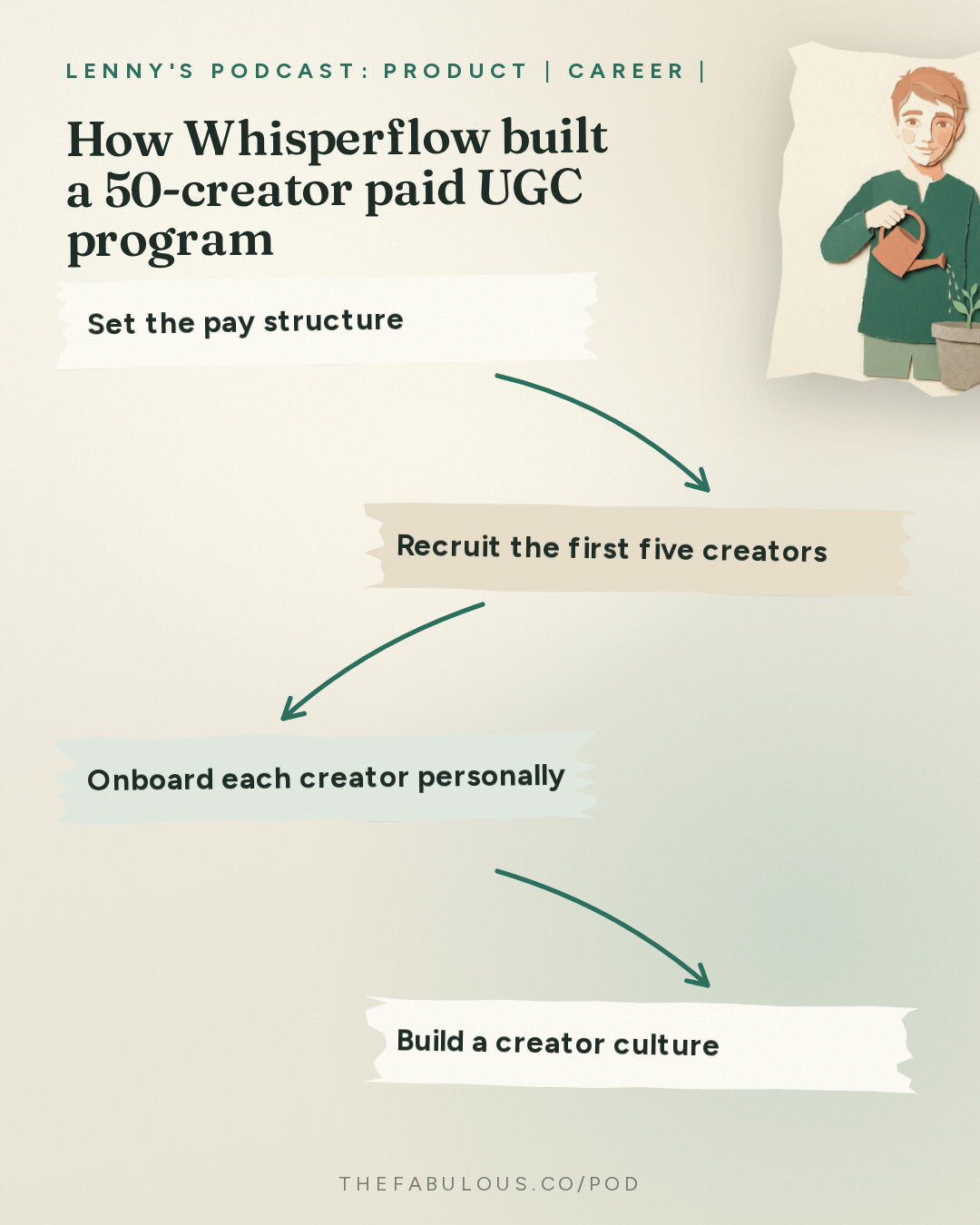
Hector Serrano's Whisperflow Growth Playbook
How a 19-year-old intern built the growth engine behind this $2B AI company | Hector Serrano
The brief
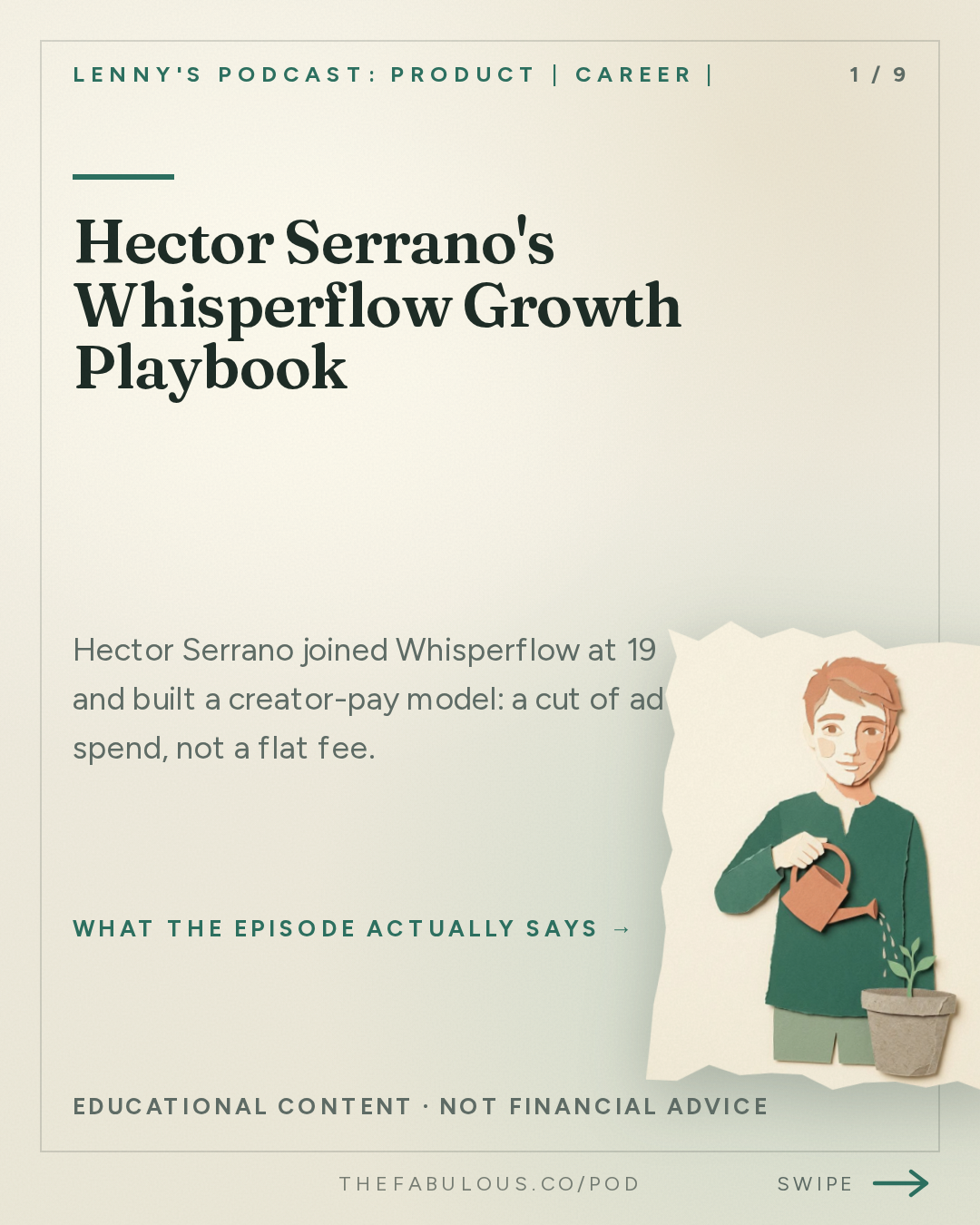
Hector Serrano joined Whisperflow at 19 and built a creator-pay model: a cut of ad spend, not a flat fee. The approach helped fuel the company's 30X revenue growth and $2B valuation (01:45). Serrano argues young, hungry hires beat polished resumes, and creative work should stay human, not AI-made (65:44).
Picture a calculus class interrupted by a Slack ping. A teenager slips out to the bathroom, opens a laptop, and joins a huddle with his boss, who says the company's launch video needs "more Gen Z vibes," and could he fix it in CapCut, today. That teenager is Hector Serrano, and the boss is Tanay Kothari, founder of the voice-dictation app Whisperflow. Serrano joined three days after quitting Division I soccer, and the calculus-class Slack message came during one of his first weeks on the job (29:18). He did not know what he was doing. Neither, by his own account, did the people who hired him.
That scene is worth holding onto, because Serrano's whole pitch, two years later, is that not knowing what you're doing is sometimes the point. He applied to roughly 200 creator jobs on LinkedIn, landed one at a pre-product startup, and asked for equity in his first call with the founder, who laughed and hired him anyway (00:00). Since then, Whisperflow's revenue has grown 30 times over in a single year, and the company recently raised money at a $2 billion valuation (01:45). Serrano did not build that alone. But the content engine he runs, and the hiring philosophy behind it, is a tight, exportable argument about how a certain kind of company grows now: not through bigger ad budgets, but through a different deal with the people making the ads.
Paying creators like partners, not vendors
Whisperflow's model is called paid UGC, short for user-generated content: ordinary people, not polished influencers, make short pitch videos for the product. The twist is how they get paid. Instead of a flat fee or a rate per thousand views, Whisperflow gives creators a percentage of what the company spends running their video as an ad, or a share of resulting sales for e-commerce clients (13:44). The company found the model through a tool called Trybe, built originally for a clothing brand to replicate TikTok Shop's pay-on-performance logic for Meta ads (11:31).
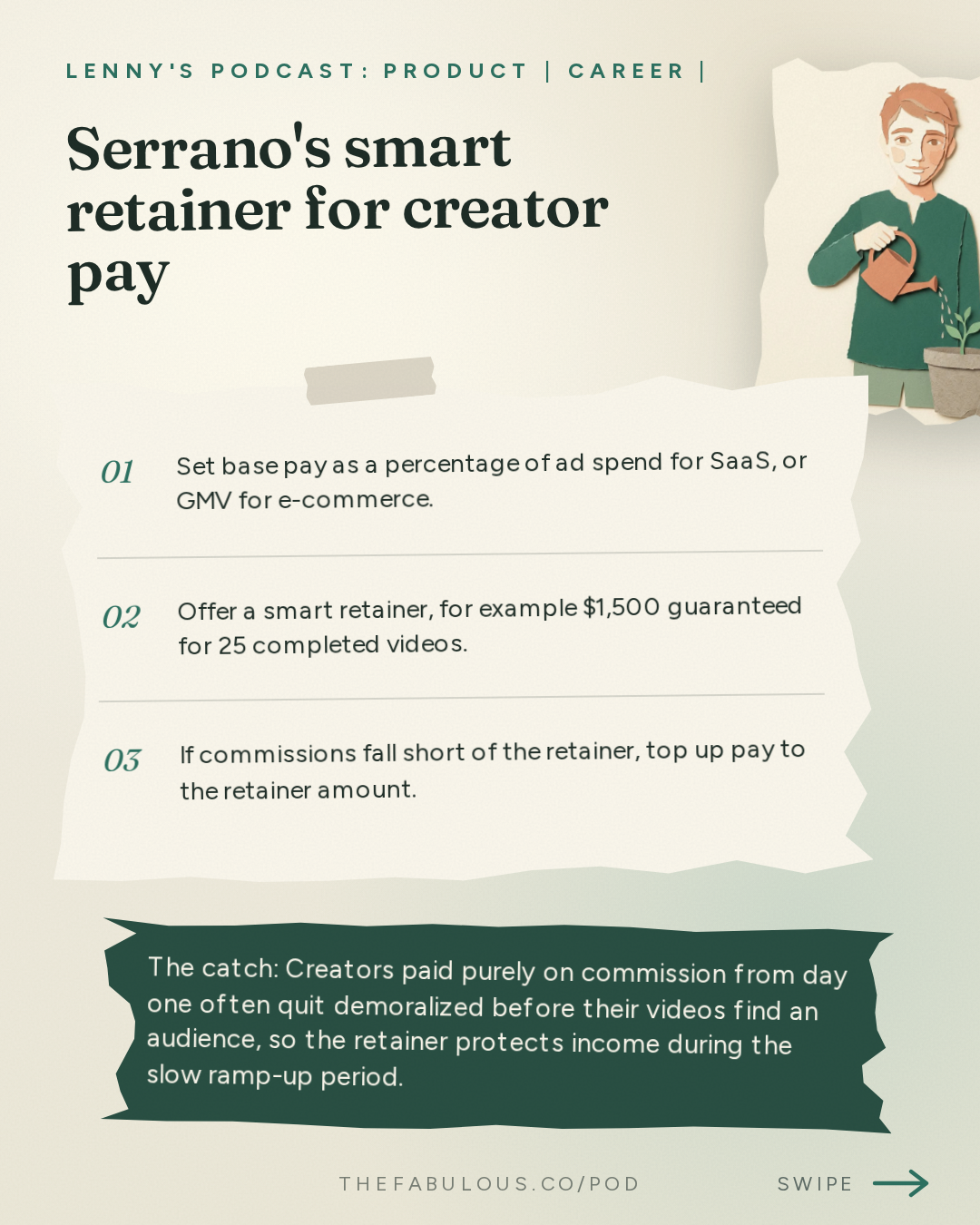
Serrano is candid about the problem this solves. A creator who shoots 30 videos and earns $100 in commission is demoralized and quits. So Whisperflow layers in what Serrano calls a "smart retainer": a guaranteed payment, say $1,500 for 25 videos, that tops up a creator's commission if it falls short, and disappears once commissions outpace it (14:08). The ceiling, meanwhile, does not exist. Top creators now make around $13,000 a month, often with only a few thousand followers of their own (16:37). Whisperflow has paid out roughly $300,000 to its roster of 50 creators (31:59), and the company now launches 500 to 600 ads every month (12:19).
Serrano also refuses to write long creative briefs, on the theory that a 10-page guideline strips a creator of the instinct that made them worth hiring. One of the program's best ads, he says, came from a creator who filmed his keyboard on a rooftop in the rain and wrote, "What is my keyboard trying to say?" over raindrops that spelled out words before cutting to a download prompt (37:07). Nobody briefed that. The looseness is the strategy.
Hiring for hunger, not GPA
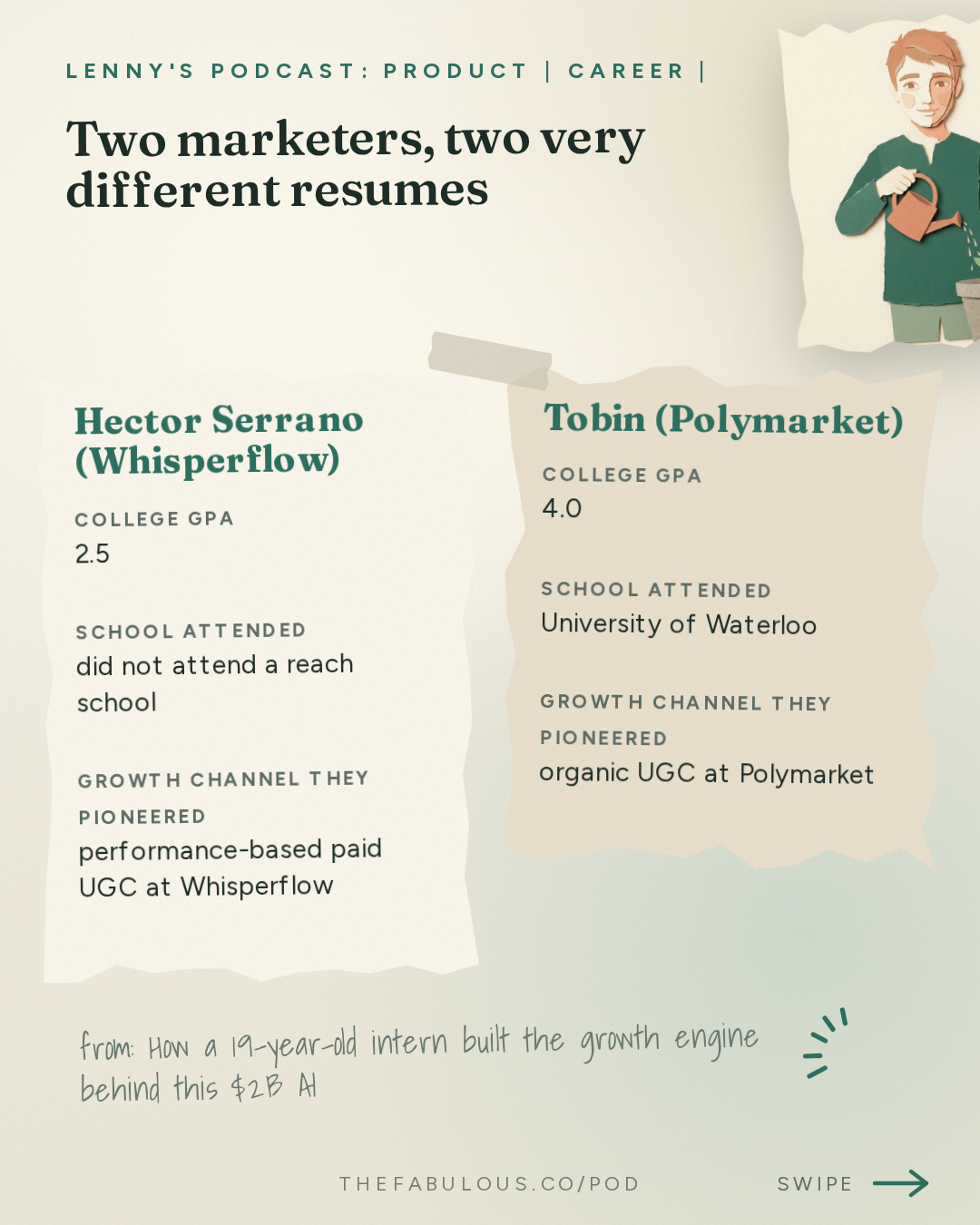
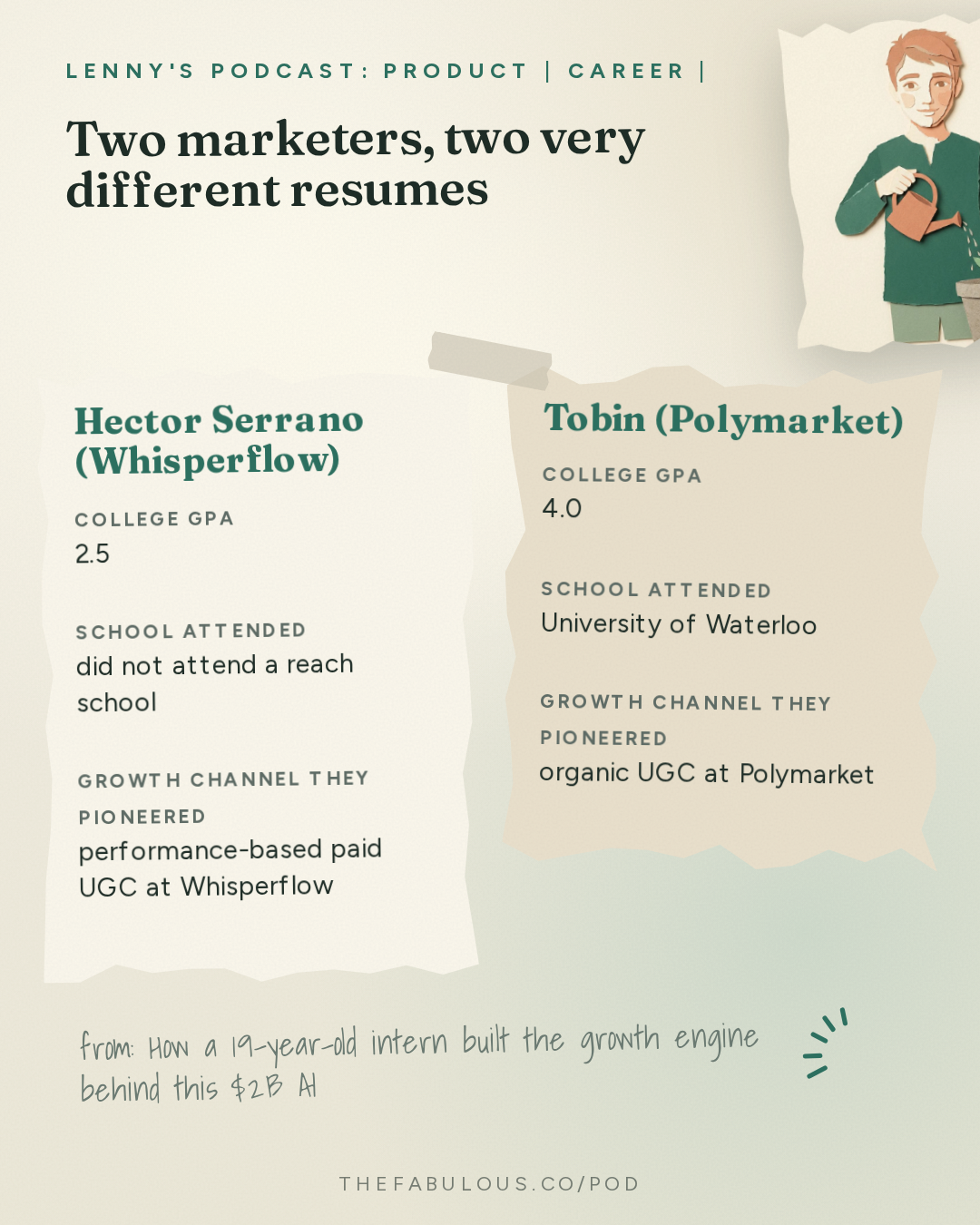
Serrano's other running argument is about who gets hired to run programs like this. He likes to compare his own resume to that of Tobin, a friend who built Whisperflow's earlier organic UGC effort before moving to the prediction-market company Polymarket. Serrano had a 2.5 college GPA and played Division I soccer; Tobin had a 4.0 and attended the University of Waterloo (20:39). Both, Serrano argues, turned out to be excellent marketers, and neither resume would have predicted it.
His actual filter is simpler: has this person grown a social account to at least 10,000 followers, ideally on Instagram, which he considers a higher signal than TikTok because the audience and content are more polished (21:42, 23:39). That, plus evidence of hard work and a personality that fits the team, is the whole screen. "If you think that looking for someone with the best grades or the best school is gonna get you the best hire, you're in for a rude awakening," he says (01:21). It is advice he extends past Whisperflow: he points to Jimmy Farley, a TikTok Shop marketer who built an agency as a teenager and later sold it to a supplement company, as proof that a founder in his thirties or forties often cannot see what is working on platforms he does not use himself (26:15).
None of this is a brief for recklessness. Serrano is explicit that it took him roughly a year to feel competent, and that Whisperflow's leadership gave him room to be, in his words, "all over the place" during that stretch (22:18). The bet is not on a finished product. It is on a trajectory.
What Serrano will not extend the same patience to is artificial intelligence, at least in the part of the business people actually see.
"The best marketers are allergic to AI." — Hector Serrano [00:38]
He treats this as near-doctrine. Whisperflow is, after all, an AI company, one built to help people dictate instead of type. But Serrano argues that AI-generated ads, AI avatars, and AI copy tend to read as what he calls "slop," and that the risk of looking fake outweighs the time saved (65:44). Even Whisperflow's most automation-heavy marketer, a former head of growth Serrano describes as one of the most bullish people on AI he knows, still routes every final asset through a human before it ships (66:07). The reasoning behind the allergy is less about ideology than arithmetic: in a feed saturated with AI-assisted content, the signal that cuts through is evidence of a real person's effort.
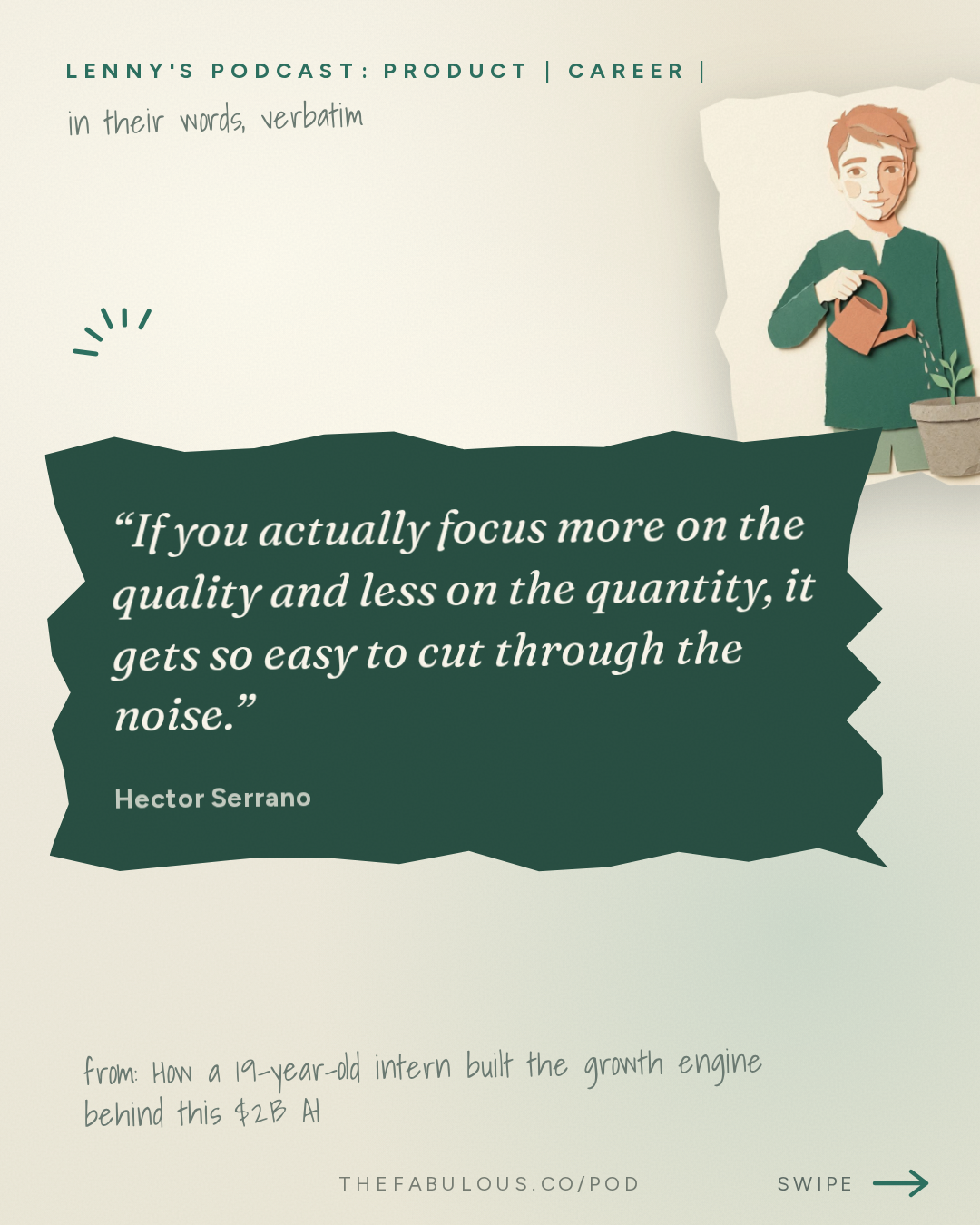
"If you actually focus more on the quality and less on the quantity, it gets so easy to cut through the noise." — Hector Serrano [00:55]
That logic extends to something counter-intuitive about the ads themselves. For Whisperflow's more technical, older customers, the ugliest ads tend to win: plain screen recordings, long run times, no polish (40:42).
"The more boring and the uglier the ads are, the better they will perform." — Hector Serrano [40:42]
Partly this is self-preservation. Meta's ad system, which Serrano refers to by its internal name, Andromeda, scans creative for similarity and buries anything that looks repeated, which means an ad reaching $100,000 in spend now often hits fatigue within weeks rather than months (52:37). Constant, varied, human-made output is less a creative preference than a defense against an algorithm that punishes sameness.
The same instinct shapes Whisperflow's founder-led content, built around Tanay Kothari's YouTube channel, which crossed 20,000 subscribers within three months of five videos (67:21). Serrano's logic is that people buy from people, and that a prospective customer typically needs about seven touchpoints with a brand before converting, so every organic appearance, a YouTube video, an Instagram story, a founder post, makes the eventual paid ad cheaper to close (73:41). It is the same bet he made on himself at 19: that a real, visible, slightly imperfect person, consistently present, beats a polished pitch that nobody trusts. Looking back at the calculus-class Slack message now, Serrano says the throughline only makes sense in reverse. At the time, it was just a kid trying not to get fired.
Ask this episode anything
Pod's AI answers from the episode itself, with the minute mark so you can hear it yourself.
Or start with one of these
Ask this episode
Pod's AI listens to the whole episode to answer, and points you to the minute it comes from.
The rest of this answer, and any question after it
Answers come from the episode itself, never from a summary of it.
ContinueKey takeaways
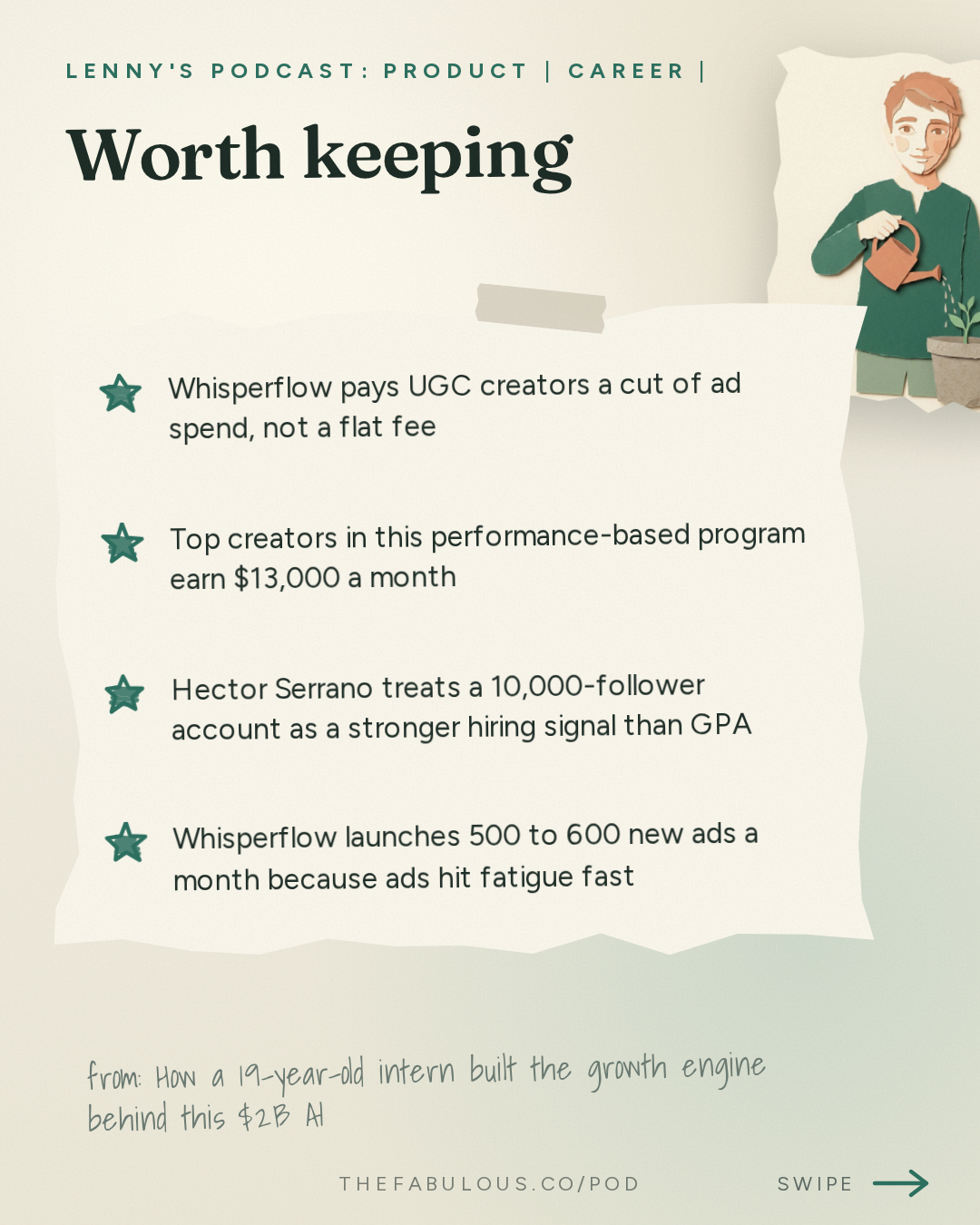
- Whisperflow pays UGC creators a cut of ad spend, not a flat fee
- Top creators in this performance-based program earn $13,000 a month (16:37)
- Hector Serrano treats a 10,000-follower account as a stronger hiring signal than GPA (21:42)
- Whisperflow launches 500 to 600 new ads a month because ads hit fatigue fast (52:37)
- Serrano says creative work should stay 100% human-led, not AI-generated (65:44)
The episode in cards
By the numbers
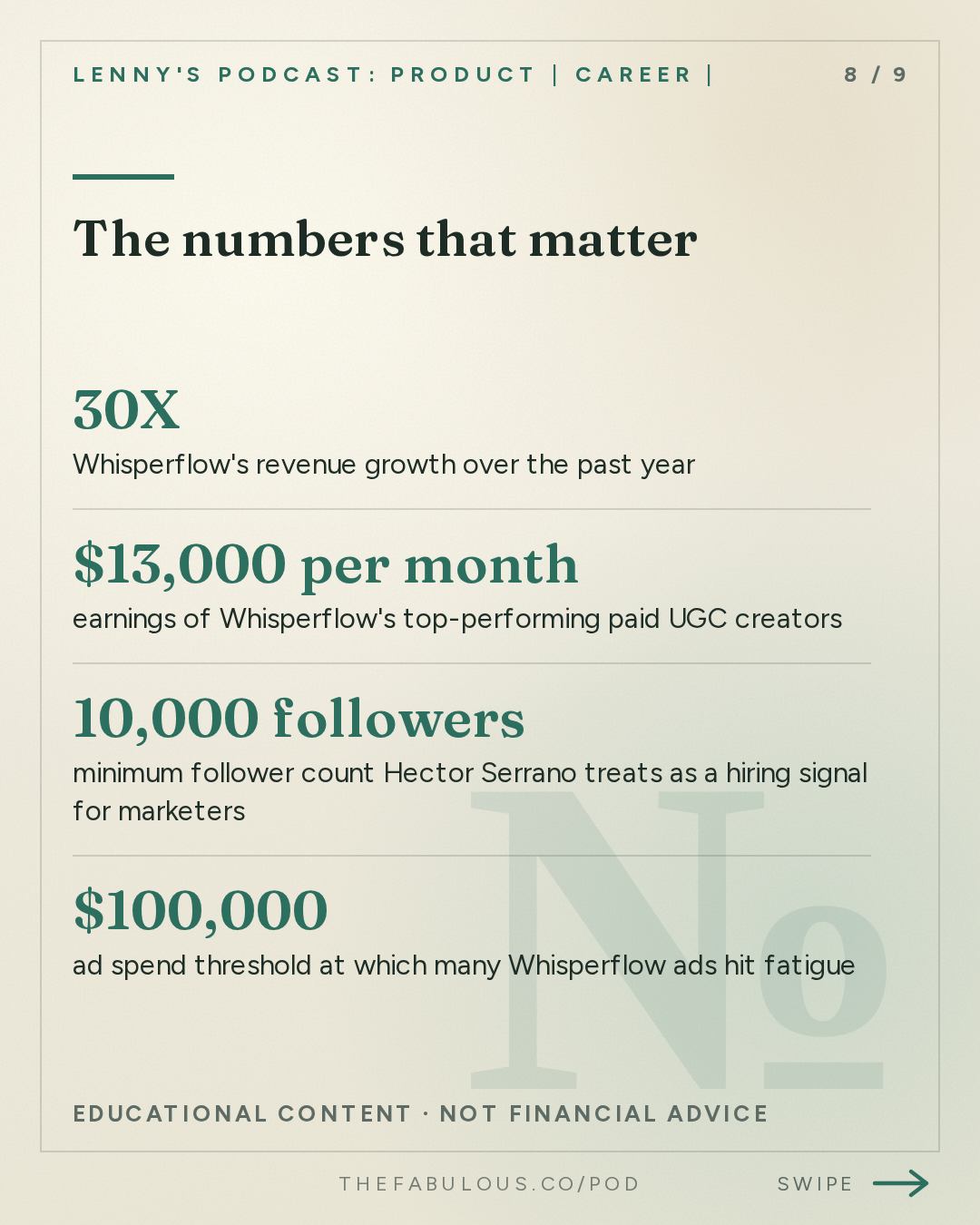
- 30X Whisperflow's revenue growth over the past year
- $13,000 per month earnings of Whisperflow's top-performing paid UGC creators
- 10,000 followers minimum follower count Hector Serrano treats as a hiring signal for marketers
- $100,000 ad spend threshold at which many Whisperflow ads hit fatigue
In their words
“The best marketers are allergic to AI.”
“If you actually focus more on the quality and less on the quantity, it gets so easy to cut through the noise.”
“The more boring and the uglier the ads are, the better they will perform.”
“Media is like one of the best forms of leverage because you don't have to ask for permission. It's permissionless leverage.”
Protocols
-
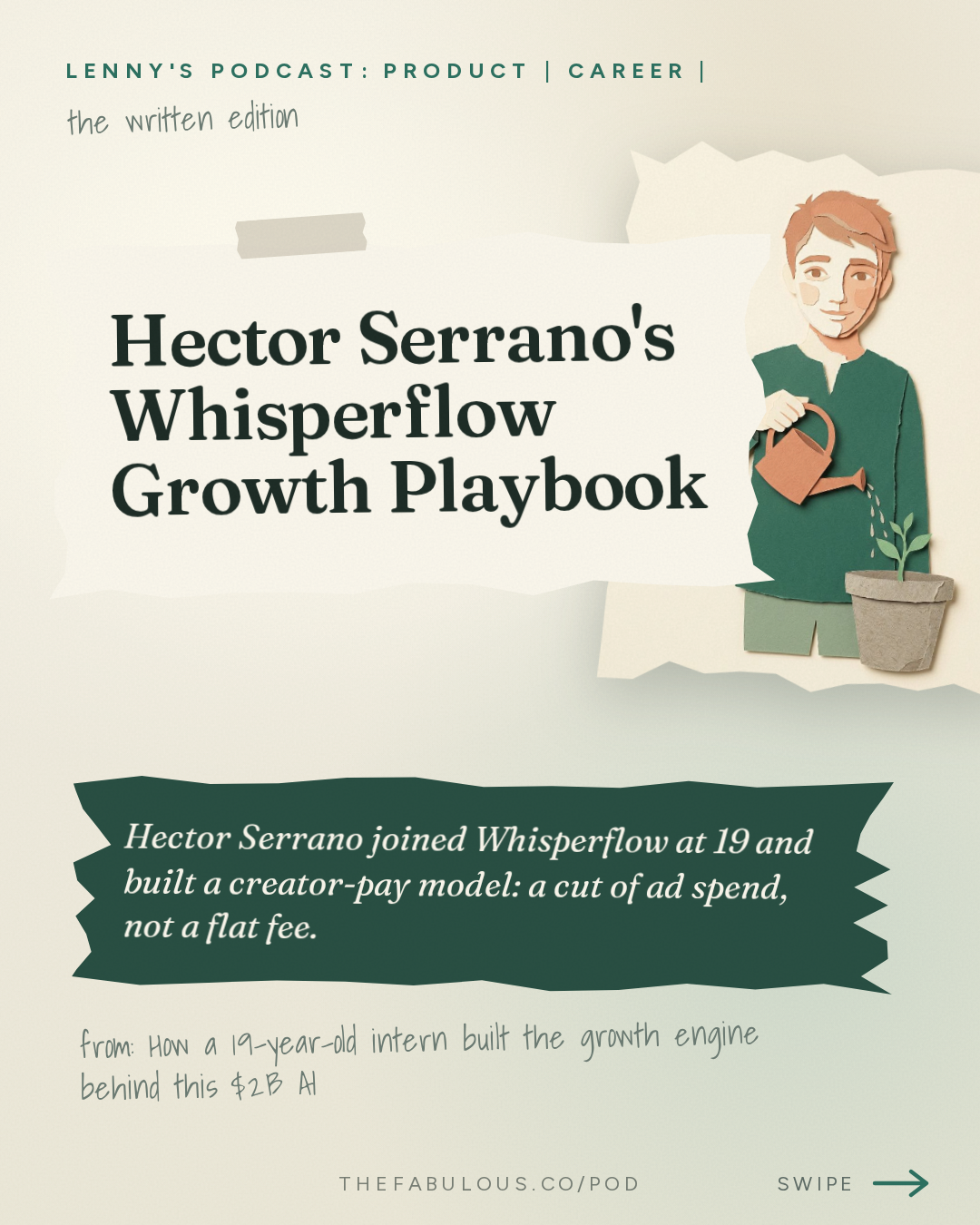
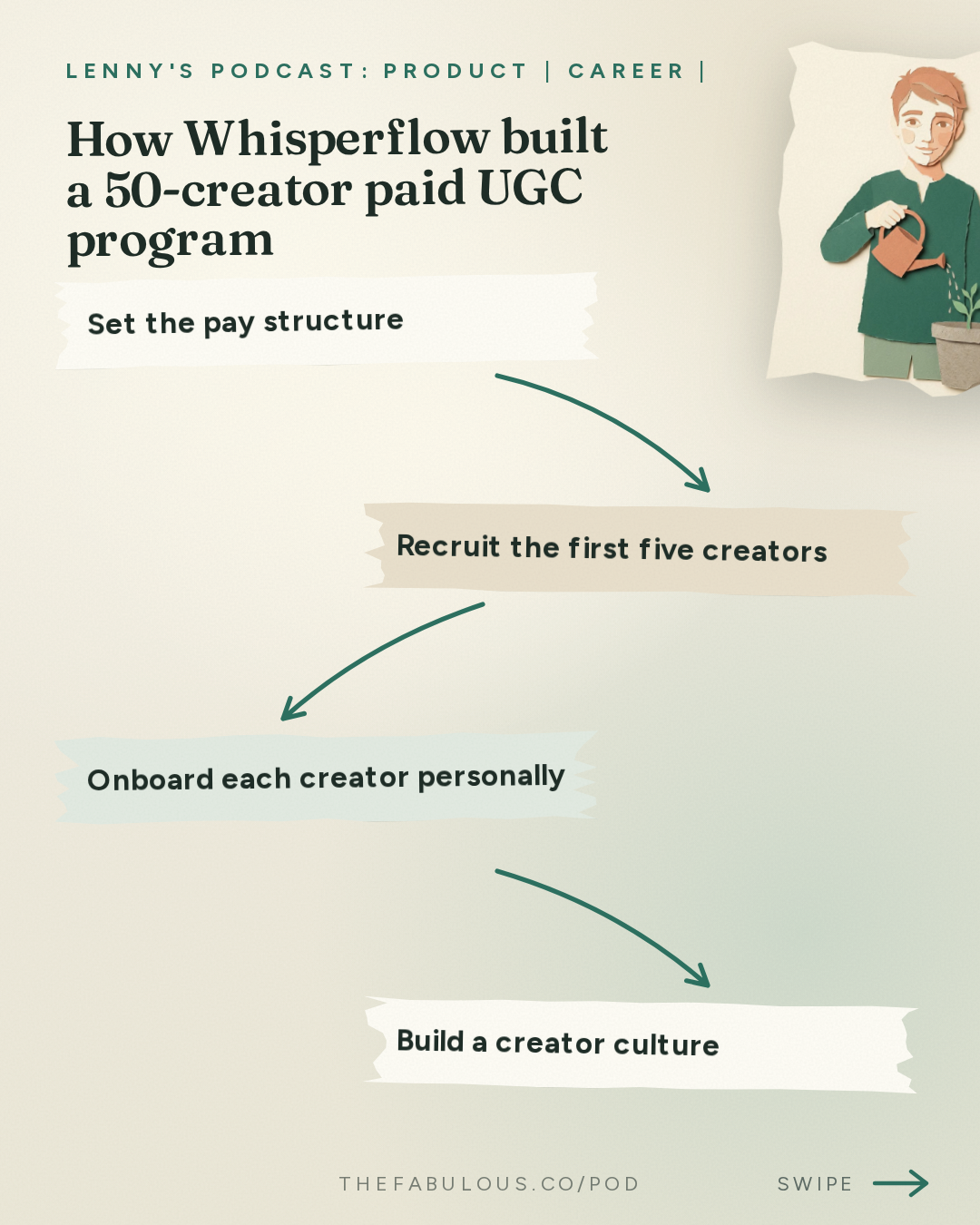
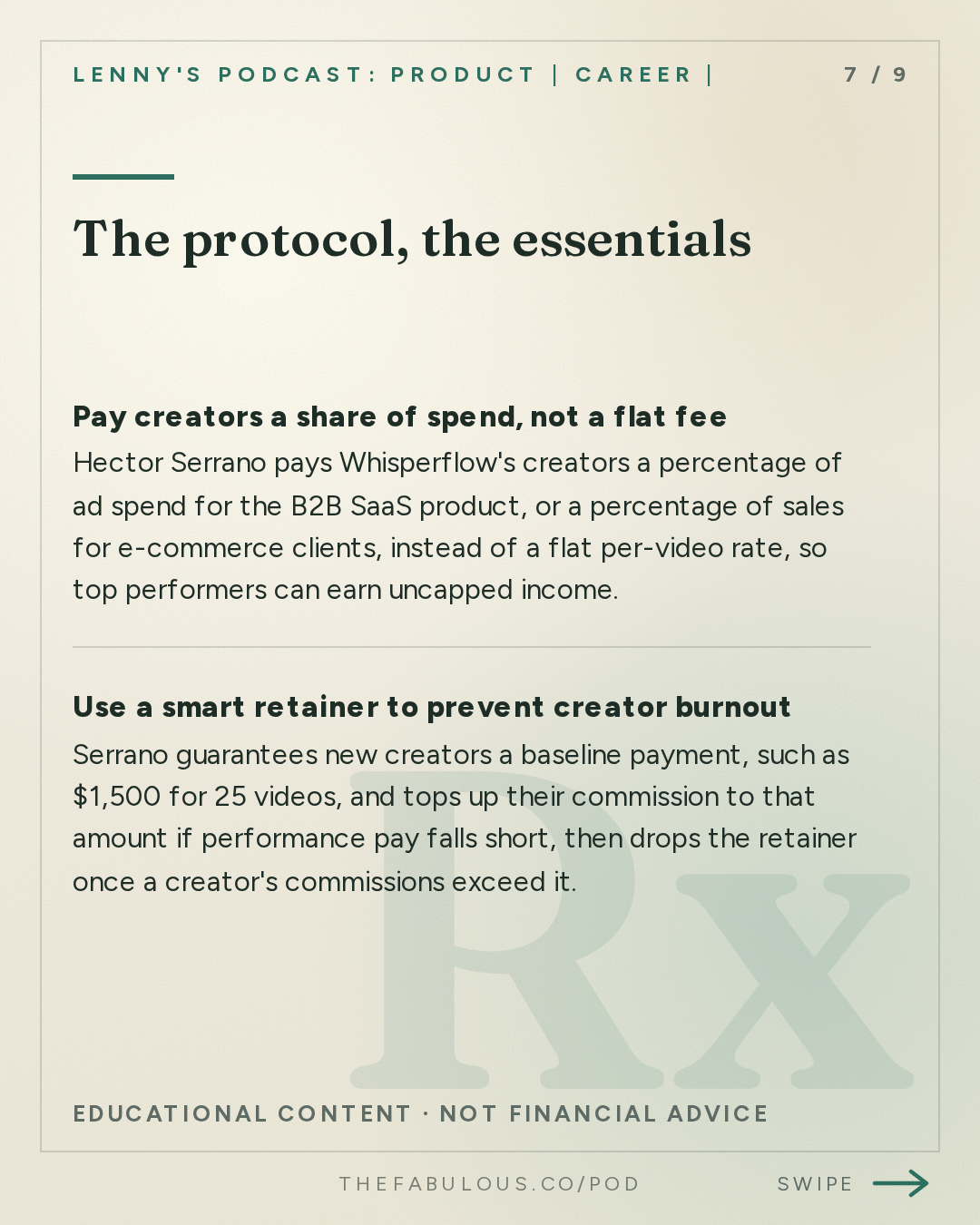
Pay creators a share of spend, not a flat fee
Hector Serrano pays Whisperflow's creators a percentage of ad spend for the B2B SaaS product, or a percentage of sales for e-commerce clients, instead of a flat per-video rate, so top performers can earn uncapped income.
ongoing, reviewed per creator
-
Use a smart retainer to prevent creator burnout
Serrano guarantees new creators a baseline payment, such as $1,500 for 25 videos, and tops up their commission to that amount if performance pay falls short, then drops the retainer once a creator's commissions exceed it.
per creator, during the ramp-up period
-
Recruit creators through targeted manual outreach
Serrano sends 150 to 250 personally written Instagram DMs a week to creators found through niche keyword searches, rather than mass automated outreach, because manual targeting produces fewer but higher-quality creators.
weekly, until the first five or six creators are onboarded
-
Hire marketers for an audience, not a resume
Serrano screens marketing candidates for evidence of a social account grown to at least 10,000 followers, a strong work ethic, and a values fit with the team, rather than GPA, school name, or major.
per hire
Questions this episode answers
How does Whisperflow pay its UGC creators?
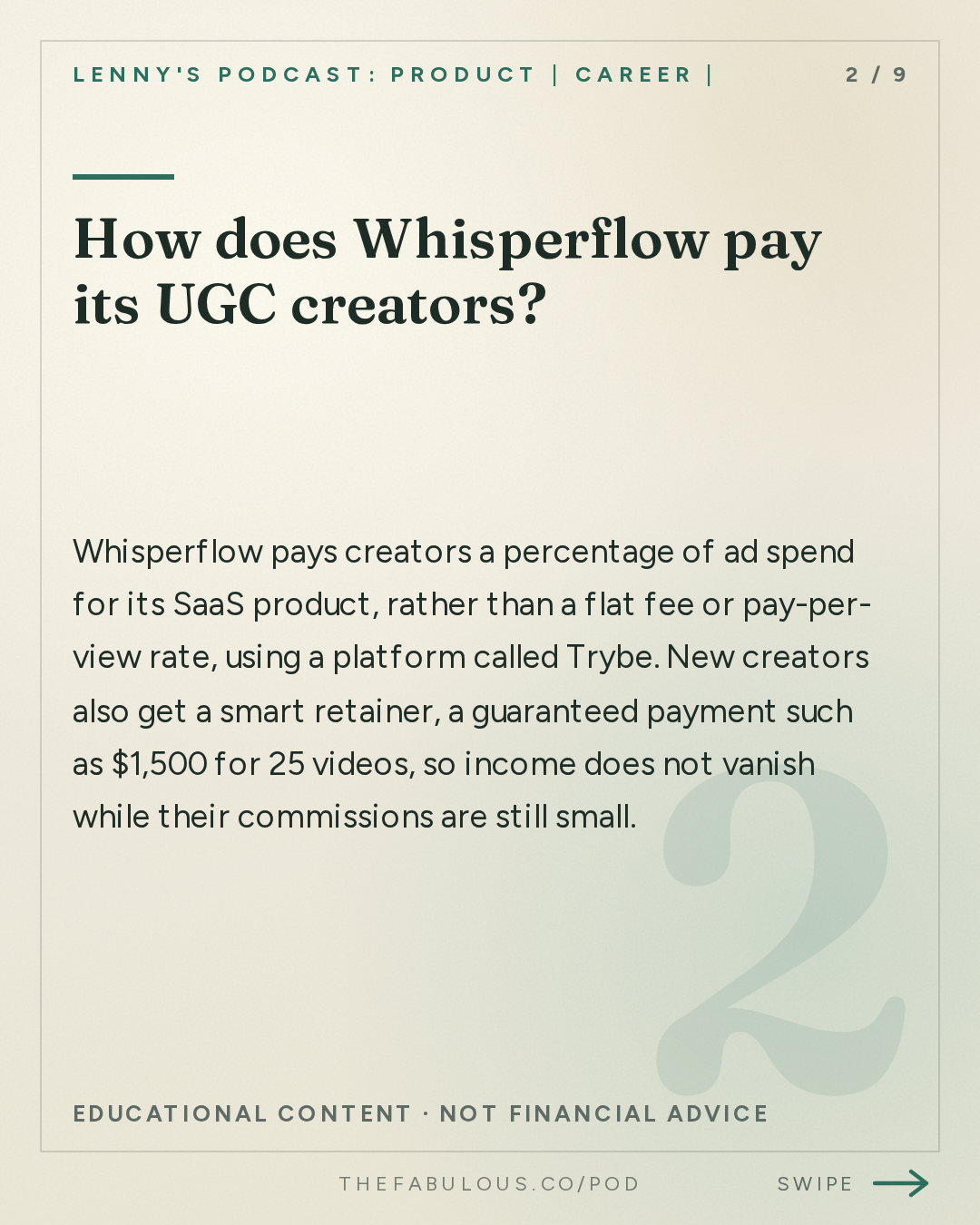
Whisperflow pays creators a percentage of ad spend for its SaaS product, rather than a flat fee or pay-per-view rate, using a platform called Trybe (13:44). New creators also get a smart retainer, a guaranteed payment such as $1,500 for 25 videos, so income does not vanish while their commissions are still small (14:08).
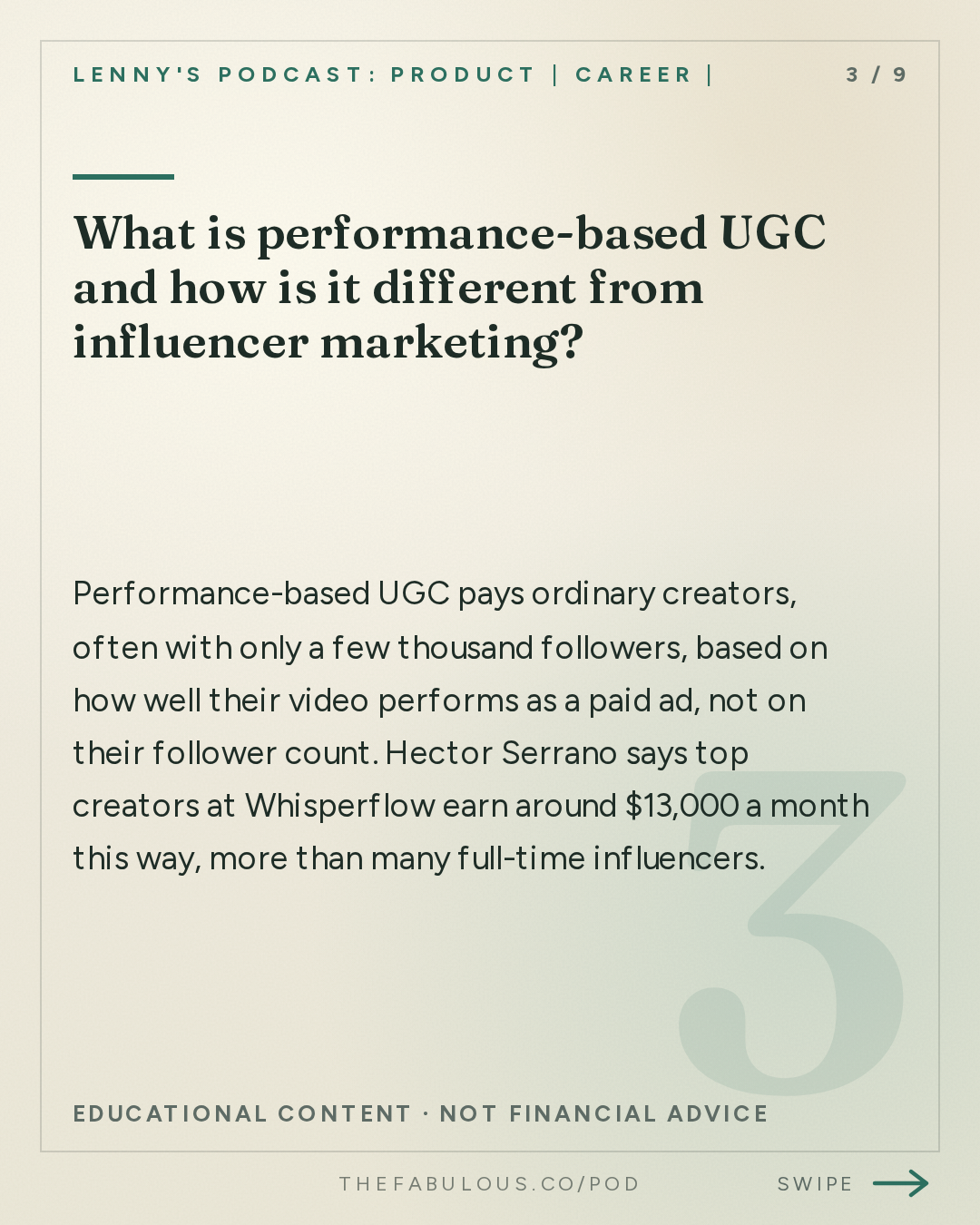
What is performance-based UGC and how is it different from influencer marketing?
Performance-based UGC pays ordinary creators, often with only a few thousand followers, based on how well their video performs as a paid ad, not on their follower count. Hector Serrano says top creators at Whisperflow earn around $13,000 a month this way, more than many full-time influencers (16:37).
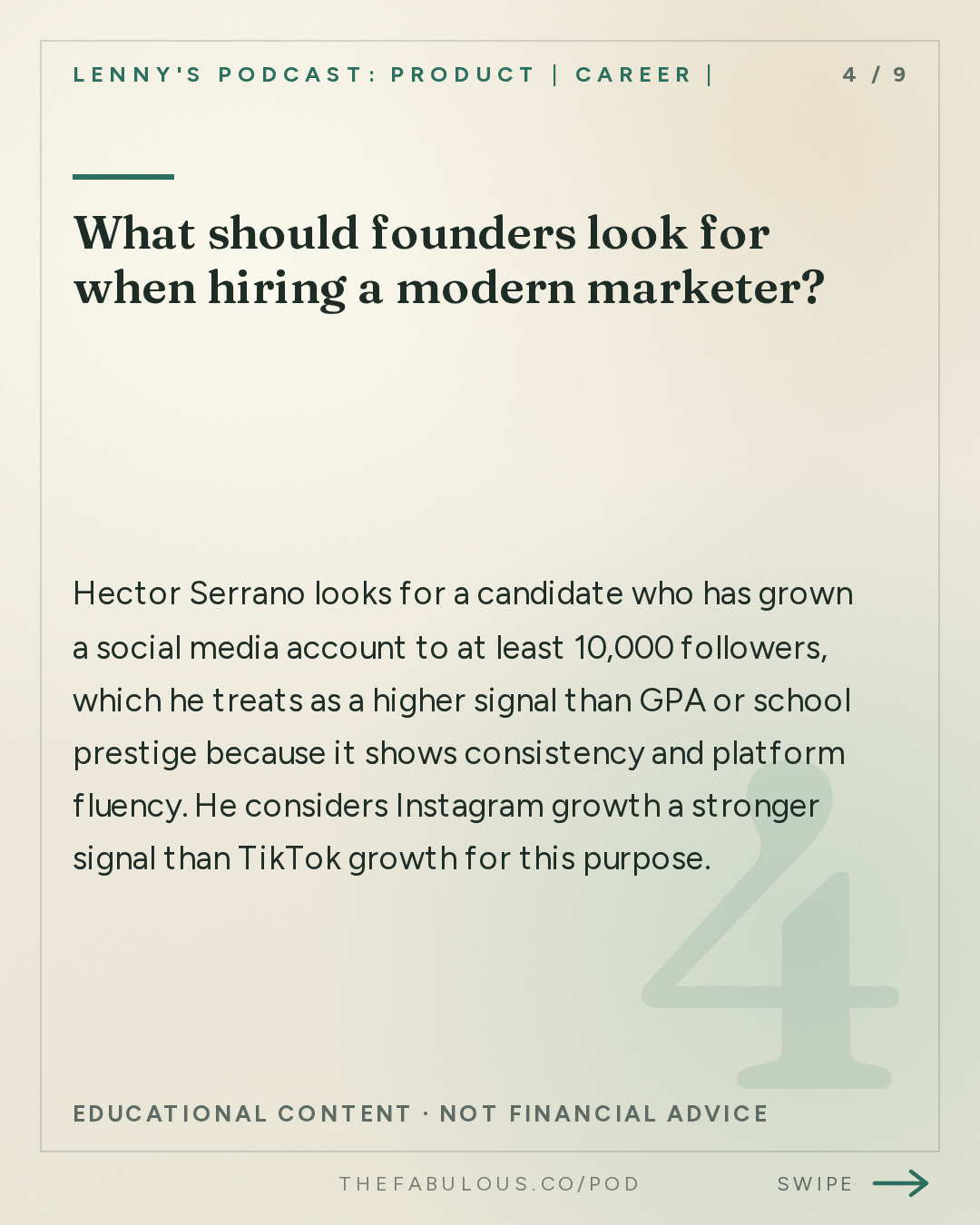
What should founders look for when hiring a modern marketer?
Hector Serrano looks for a candidate who has grown a social media account to at least 10,000 followers, which he treats as a higher signal than GPA or school prestige because it shows consistency and platform fluency (21:42). He considers Instagram growth a stronger signal than TikTok growth for this purpose (23:39).
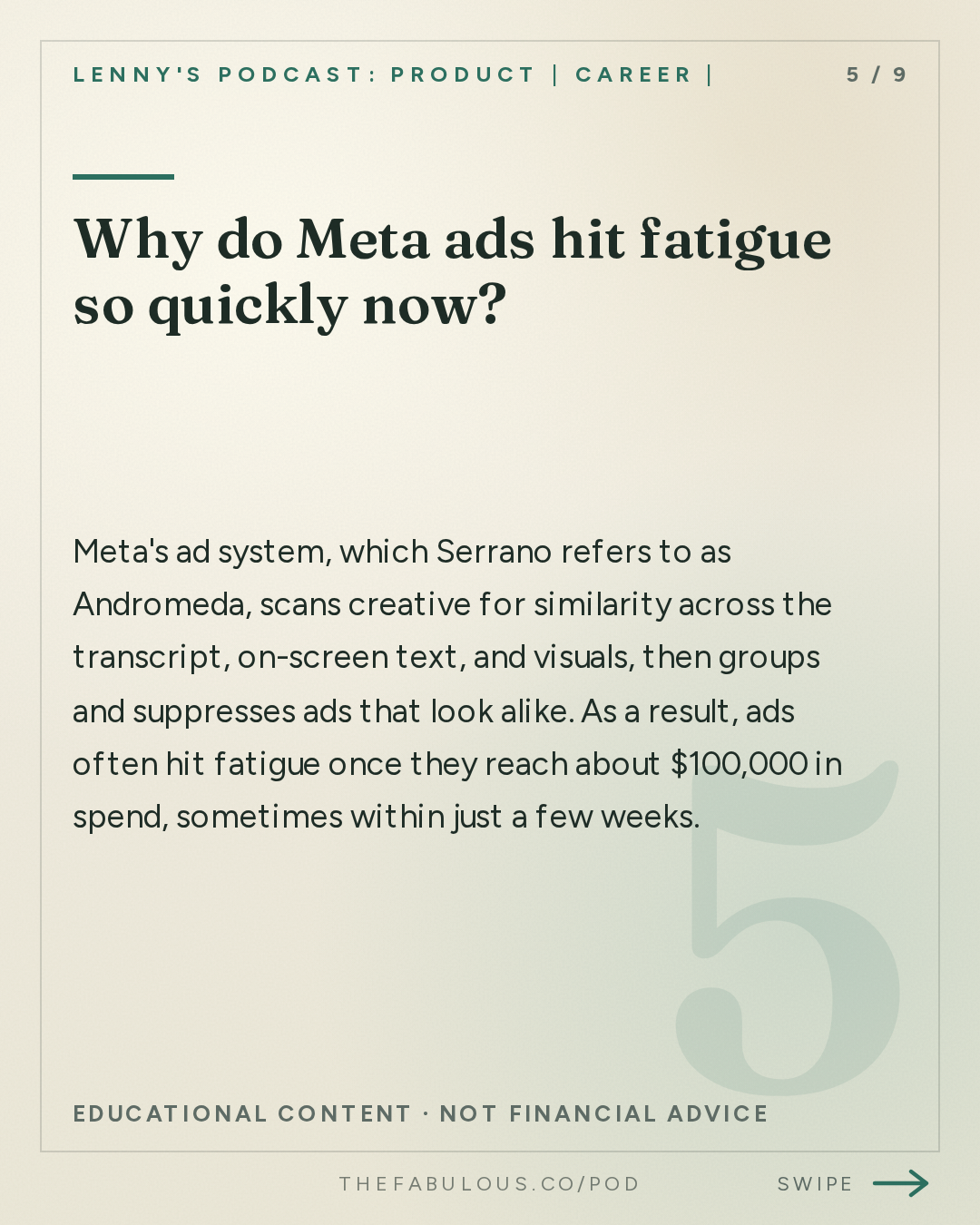
Why do Meta ads hit fatigue so quickly now?
Meta's ad system, which Serrano refers to as Andromeda, scans creative for similarity across the transcript, on-screen text, and visuals, then groups and suppresses ads that look alike. As a result, ads often hit fatigue once they reach about $100,000 in spend, sometimes within just a few weeks (52:37).
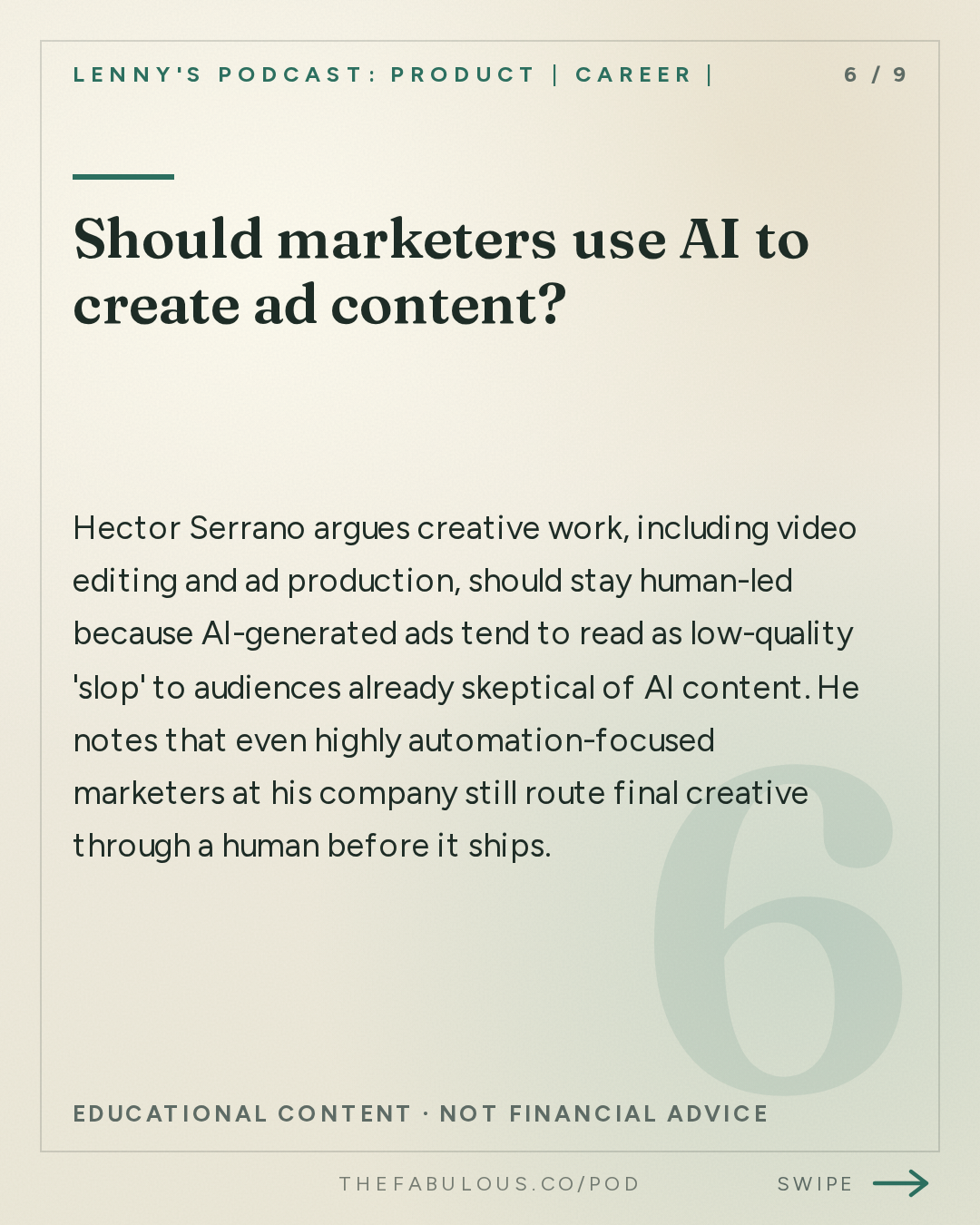
Should marketers use AI to create ad content?
Hector Serrano argues creative work, including video editing and ad production, should stay human-led because AI-generated ads tend to read as low-quality 'slop' to audiences already skeptical of AI content (65:44). He notes that even highly automation-focused marketers at his company still route final creative through a human before it ships (66:07).
The full read, in cards
Go deeper
- The Almanac of Naval Ravikant — Collection of entrepreneur Naval Ravikant's ideas on leverage, including the concept of media as permissionless leverage that shaped Serrano's approach to content.
Mentioned
Hector Serrano · Whisperflow · Tanay Kothari · Trybe · Tobin · The Almanac of Naval Ravikant · Miso · CapCut · Daniel
More from this show and category
Rob Snyder's Pull Framework for Product-Market Fit
Startup advisor Rob Snyder says product-market fit shows up when one specific person inside a company has an urgent, unavoidable project that no current option solves (04:36). His PULL framework (Project, Unavoidable, List of options, Limitations) replaces guesswork with a testable hypothesis, verified by cold outreach and five real sales calls (07:33, 45:13).
How AI Models Actually Think
Anthropic researcher Emmanuel Ameisen explains that language models are grown through training, not programmed line by line, so even their creators cannot read their internal logic directly. Interpretability research shows models form internal plans, share universal concepts across languages, and sometimes fixate on wrong answers when training data rewards them incorrectly (01:45, 15:31, 37:14).

Josh Woodward on Building an AI Labs Team
Google Labs head Josh Woodward argues every company now needs a frontier team that tests new AI models obsessively, judges early products by watching users' eyes rather than dashboards, and hires for an 'unlearning rate' as much as a learning one (32:13).
OpenAI's Tibo Sottiaux on Dots and AI Agents
OpenAI's Head of ChatGPT Tibo Sottiaux says agents will soon take most actions on the internet, not humans. He describes Dots, OpenAI's persistent agent that remembers personal context, controls multiple devices, and learns from feedback, plus a plugin ecosystem with revenue sharing and 16 sign-in partners, as proof the industry is moving from manually built loops to self-learning systems (00:16, 11:58).
