
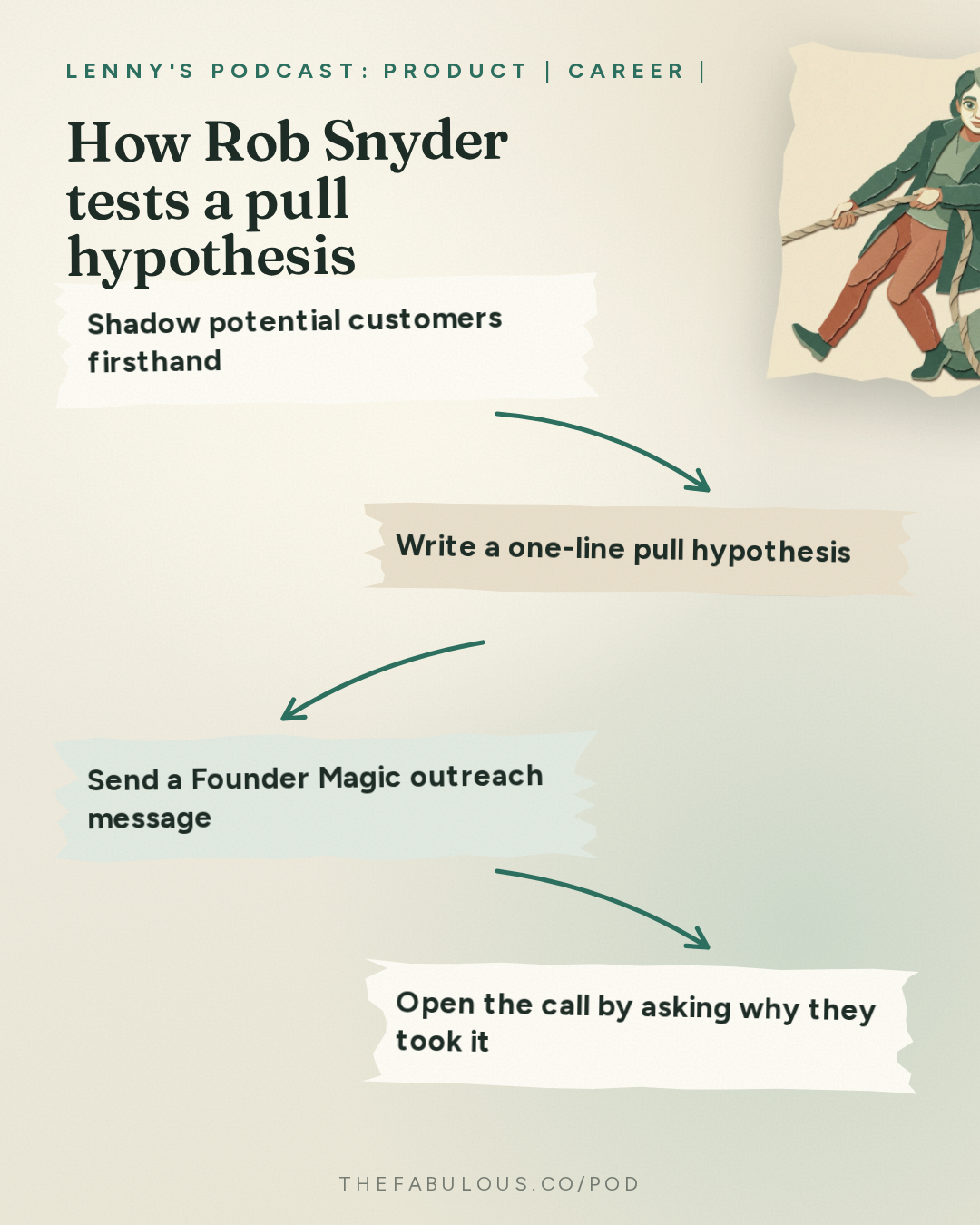
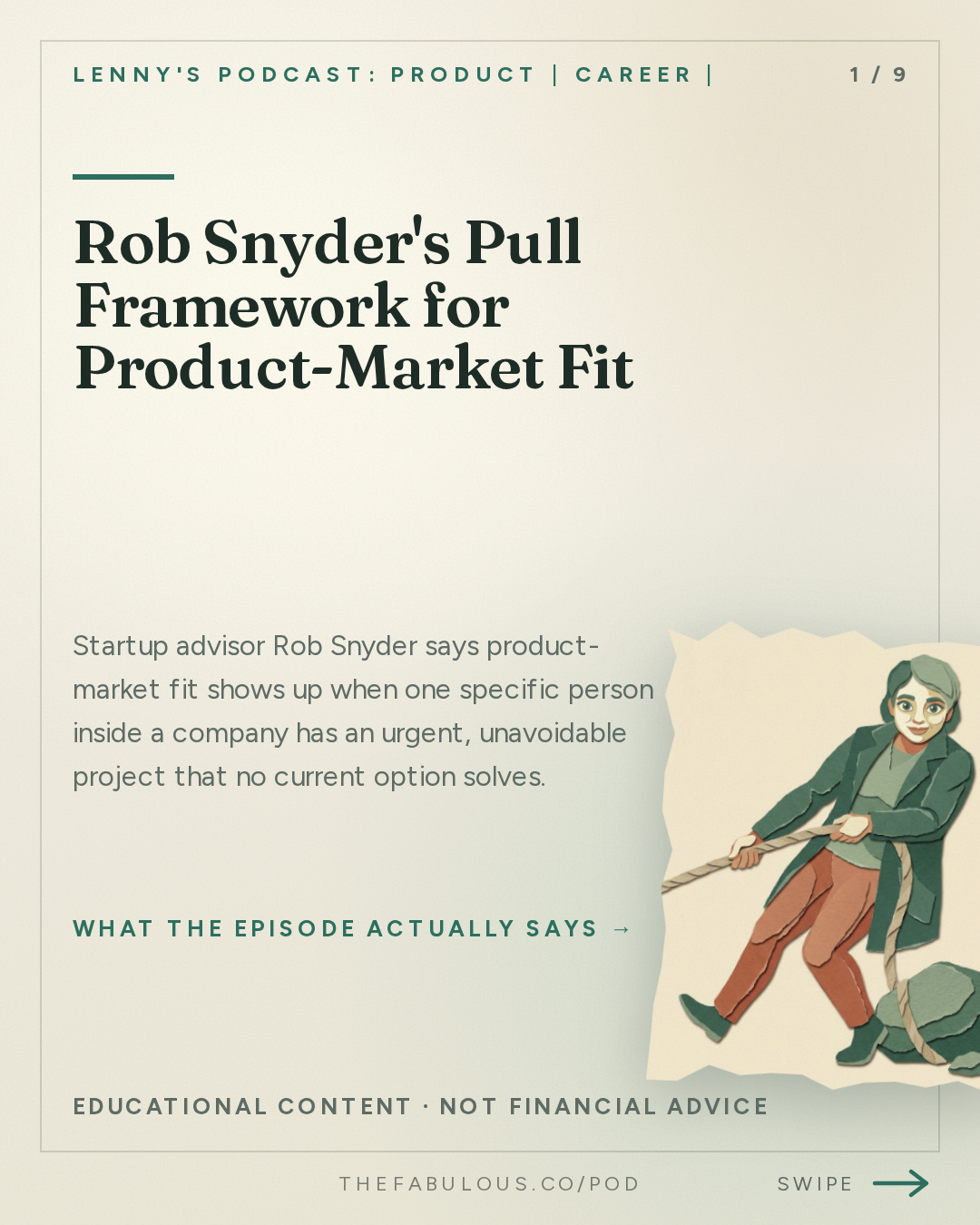
Rob Snyder's Pull Framework for Product-Market Fit
An 86-minute guide to finding PMF | Rob Snyder (Author, The Power of Pull)
The brief
Startup advisor Rob Snyder says product-market fit shows up when one specific person inside a company has an urgent, unavoidable project that no current option solves (04:36). His PULL framework (Project, Unavoidable, List of options, Limitations) replaces guesswork with a testable hypothesis, verified by cold outreach and five real sales calls (07:33, 45:13).
A financial advisor once told the founders of an AI note-taking startup called Jump that using their product felt like how Alexander Graham Bell must have felt the day he invented the telephone (11:14). It is a strange thing to say about software that just writes down meeting notes. But that strangeness is the point. Rob Snyder, author of The Power of Pull and writer of a newsletter called The Physics of Startups, has a name for the feeling behind that comment: pull. Pull is what happens when a customer would be weird not to buy.
Snyder says he has helped about 50 startups go from zero revenue to more than a million dollars a year in recurring revenue (02:11). His central argument, made early in the conversation, cuts against how most people hunt for product-market fit: the moment when a product's value to customers becomes undeniable and growth takes care of itself.
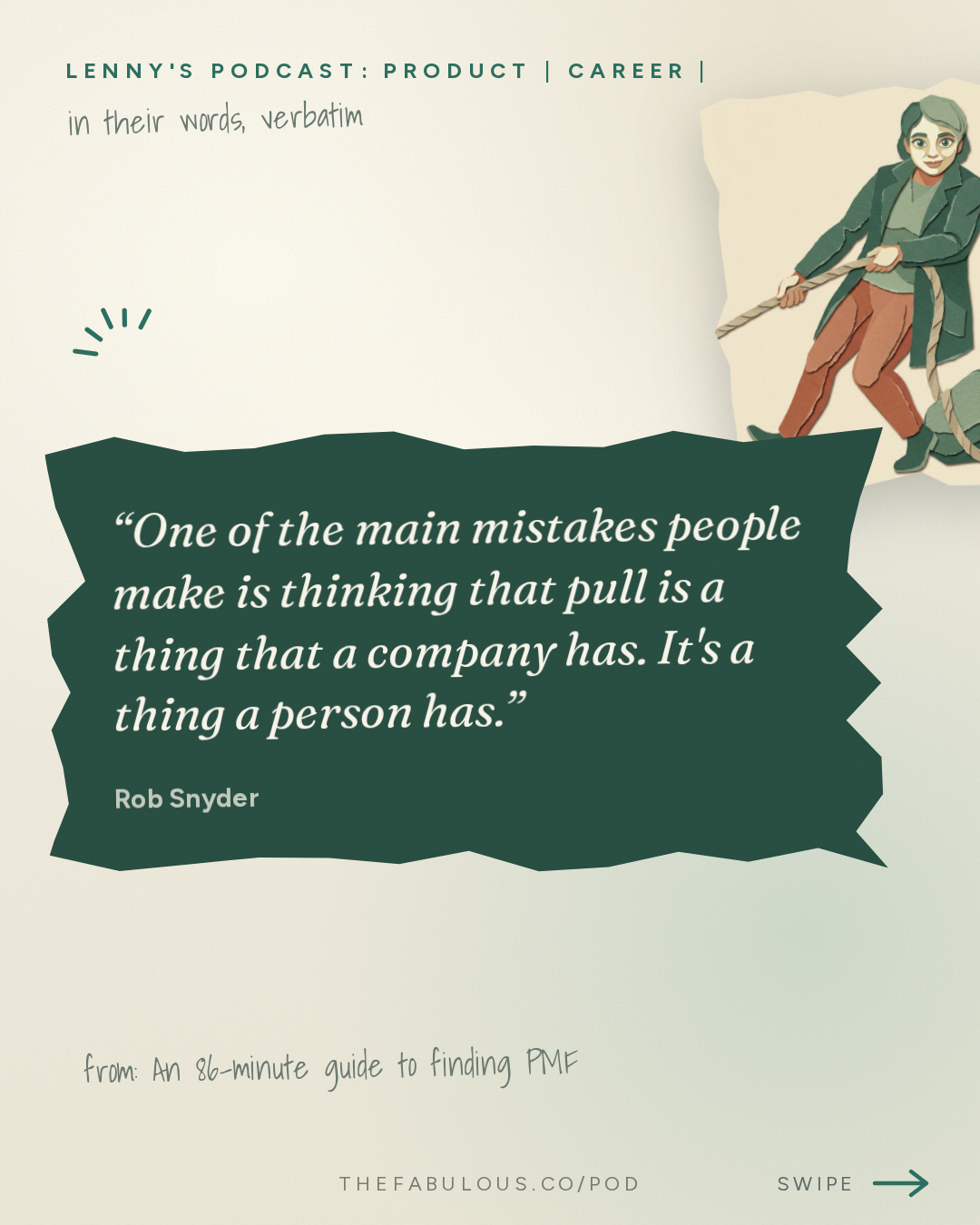
One of the main mistakes people make is thinking that pull is a thing that a company has. It's a thing a person has. (16:20) — Rob Snyder
Pull, in other words, is never a property of a market segment or an org chart. It belongs to one person: the head of legal at a specific company, the specific financial advisor filing a specific report. Snyder's framework for finding that person spells out PULL: a Project on someone's to-do list, something Unavoidable about doing it now, a List of options they've already tried, and the Limitations that make those options fall short (07:33). All four have to be true at once. Miss the U and someone will politely tell you how interesting your idea is and then do nothing.
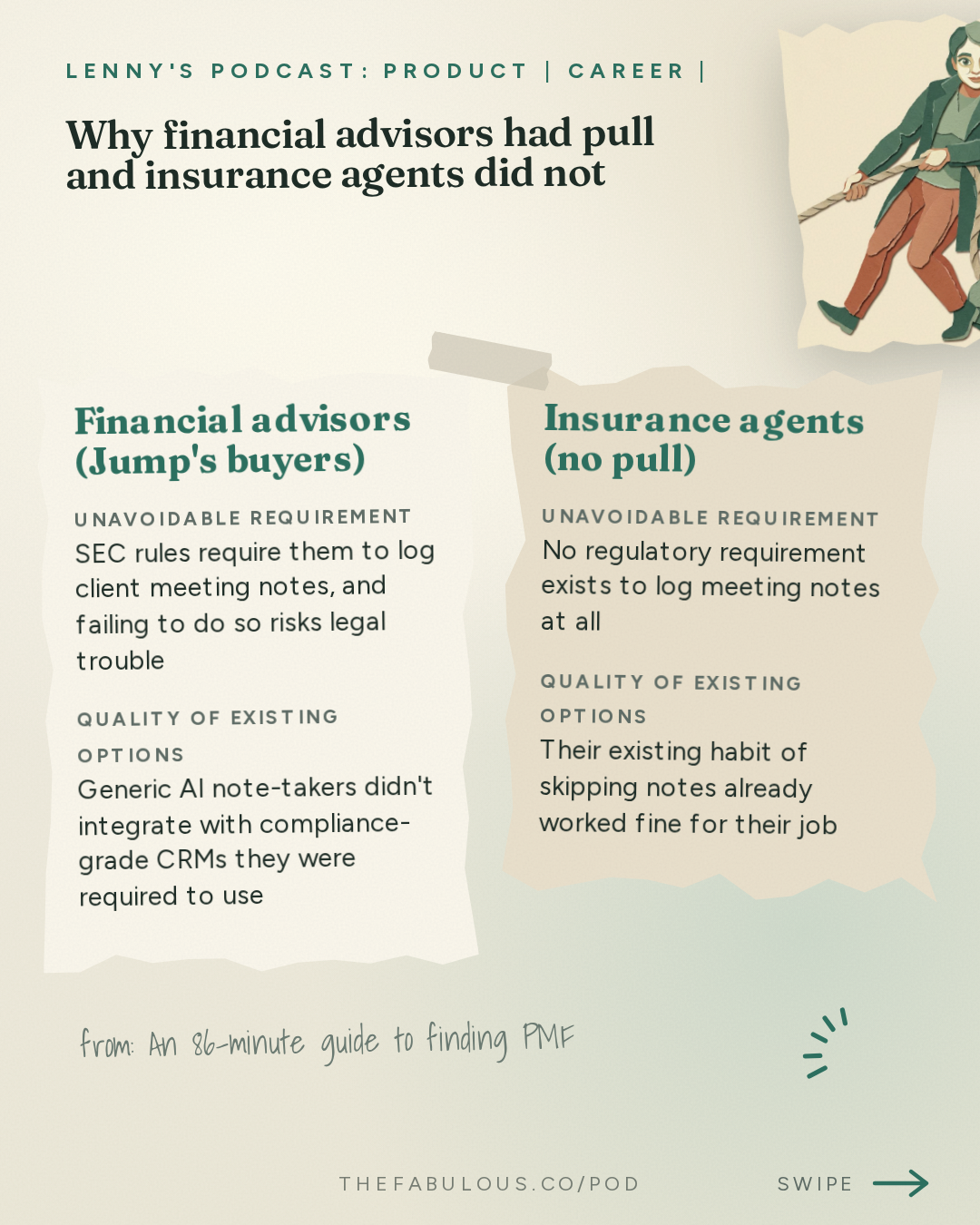
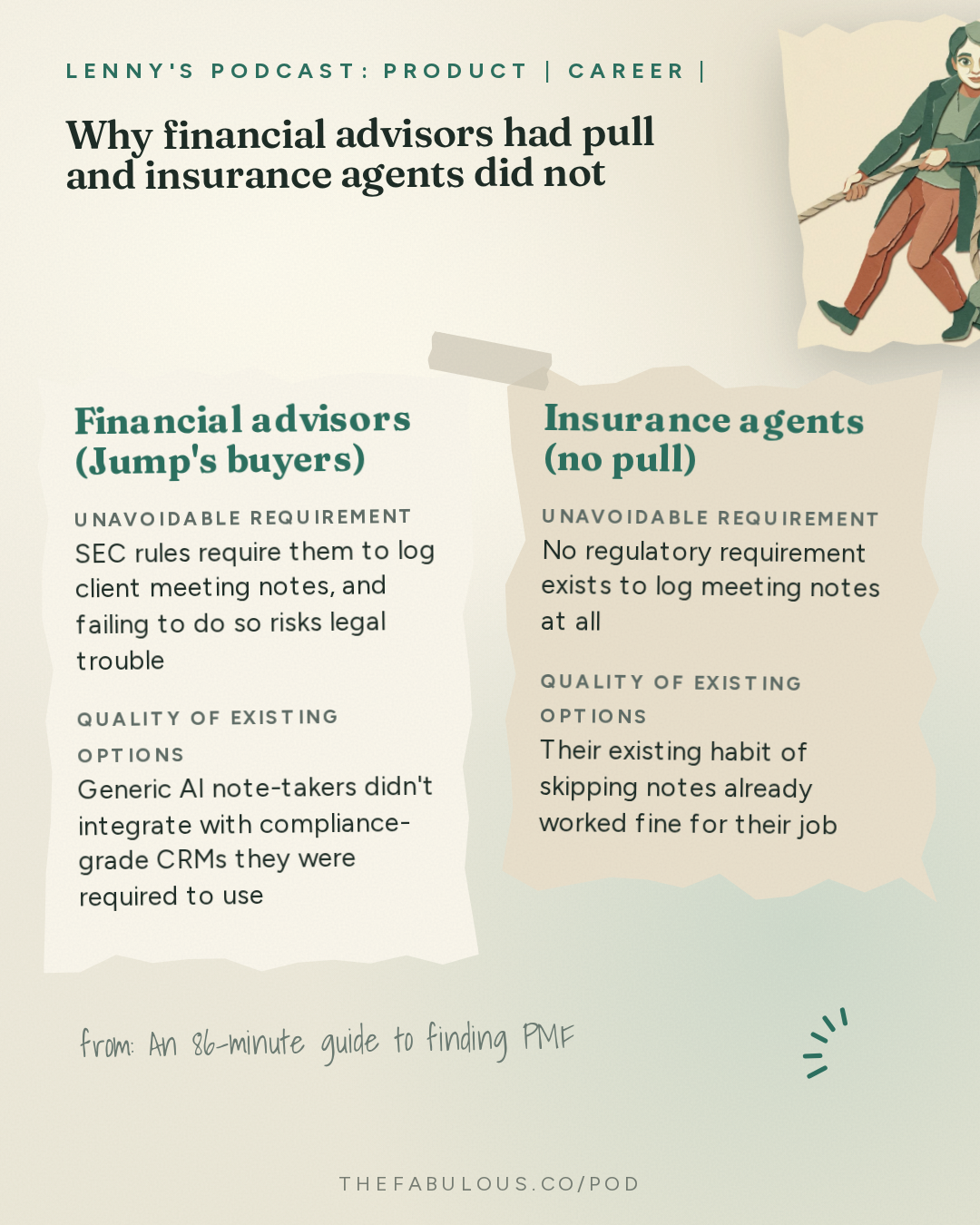
The Jump example shows why the unavoidable part matters so much. Financial advisors are legally required to log client meeting notes in their compliance systems, and skipping that step can mean real trouble with regulators (10:28). Generic AI note-takers did not integrate with their systems and were not clearly compliant, so advisors were stuck (10:49). That stuckness is what made them grab Jump's product. Snyder contrasts this with insurance agents, who also hate taking notes but face no such regulatory requirement. Their existing habit, however annoying, was good enough, so the same pitch fell flat (11:52, 12:17). Same job, same irritation, no pull, because one letter of the acronym was missing.
Snyder knows this the hard way. As a first-time founder he built a product with hair-on-fire pain points, a differentiated solution, and daily-active design partners, then spent two years getting nowhere before a pivot finally worked (05:07, 05:31). What he eventually realized was that pain and value are not what make someone buy. People do not drop their existing priorities for a slightly better option; they buy to get an unavoidable project unstuck.
Earned Secrets, Not Whiteboards
If pull already exists out in the world, the founder's job is not to invent a clever idea but to go find it. Snyder is blunt about where good ideas do not come from: a whiteboard, a brainstorm, or ten thirty-minute Zoom interviews (18:53). He tells the story of a friend with no product idea who simply picked industries to shadow in person for days at a time. He hated working with solar panel installers. He loved independent physical therapists, rode along with them, and eventually tried to buy a franchise just to study its profit and loss statement. Somewhere in that process he spotted a real, unavoidable cost the therapists were stuck trying to cut, and that became his pull hypothesis (20:36, 21:23). Snyder calls this kind of insight an earned secret, something you cannot get by asking people what they want, only by living next to the problem.
He is also skeptical of a piece of standard startup advice: find design partners. In his experience, design partners tend to play what he calls Steve Jobs, handing out feedback with no intention of ever paying, because people with a genuinely unavoidable project do not want to help build a product, they just want the project finished (32:12).
Selling To Learn
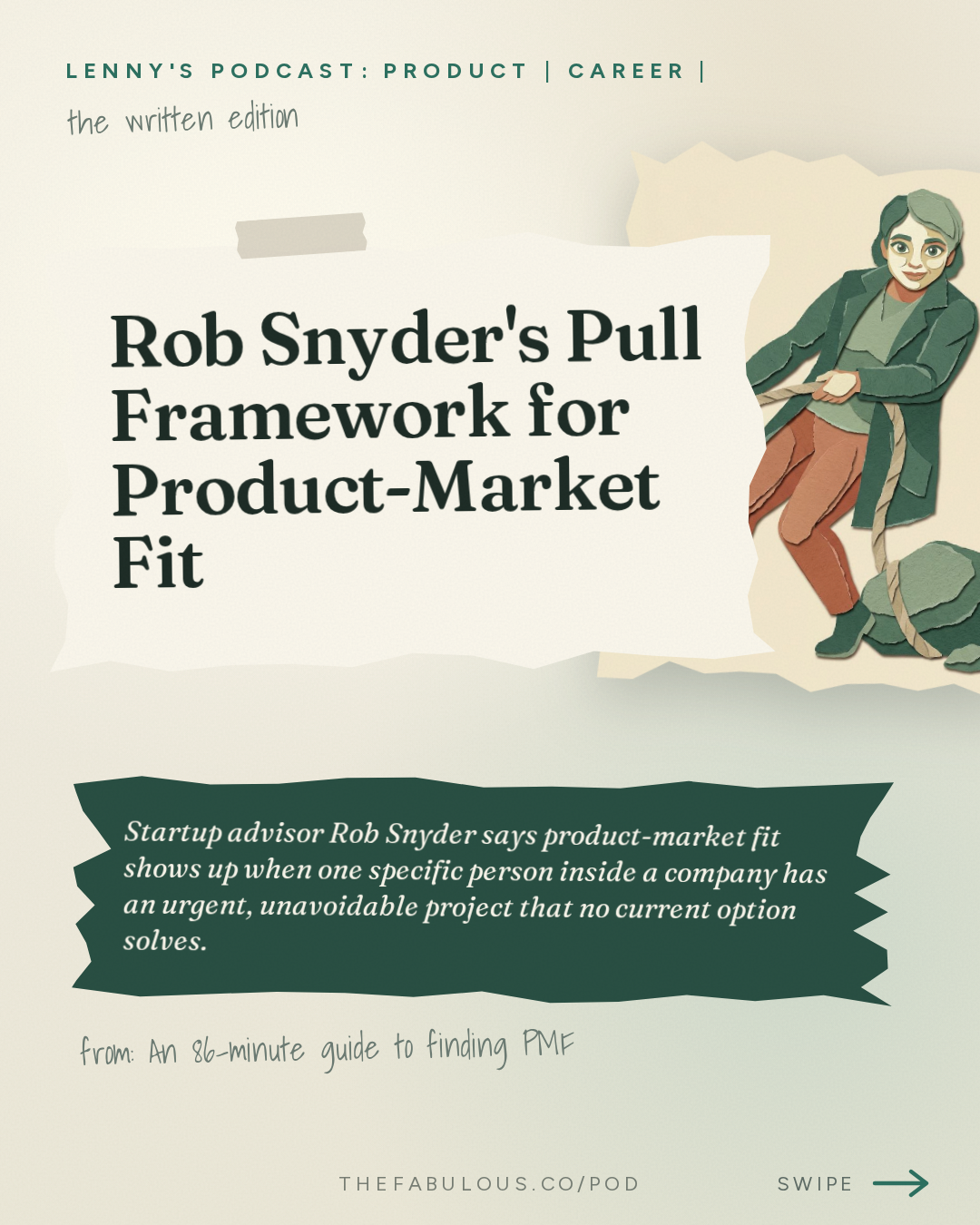
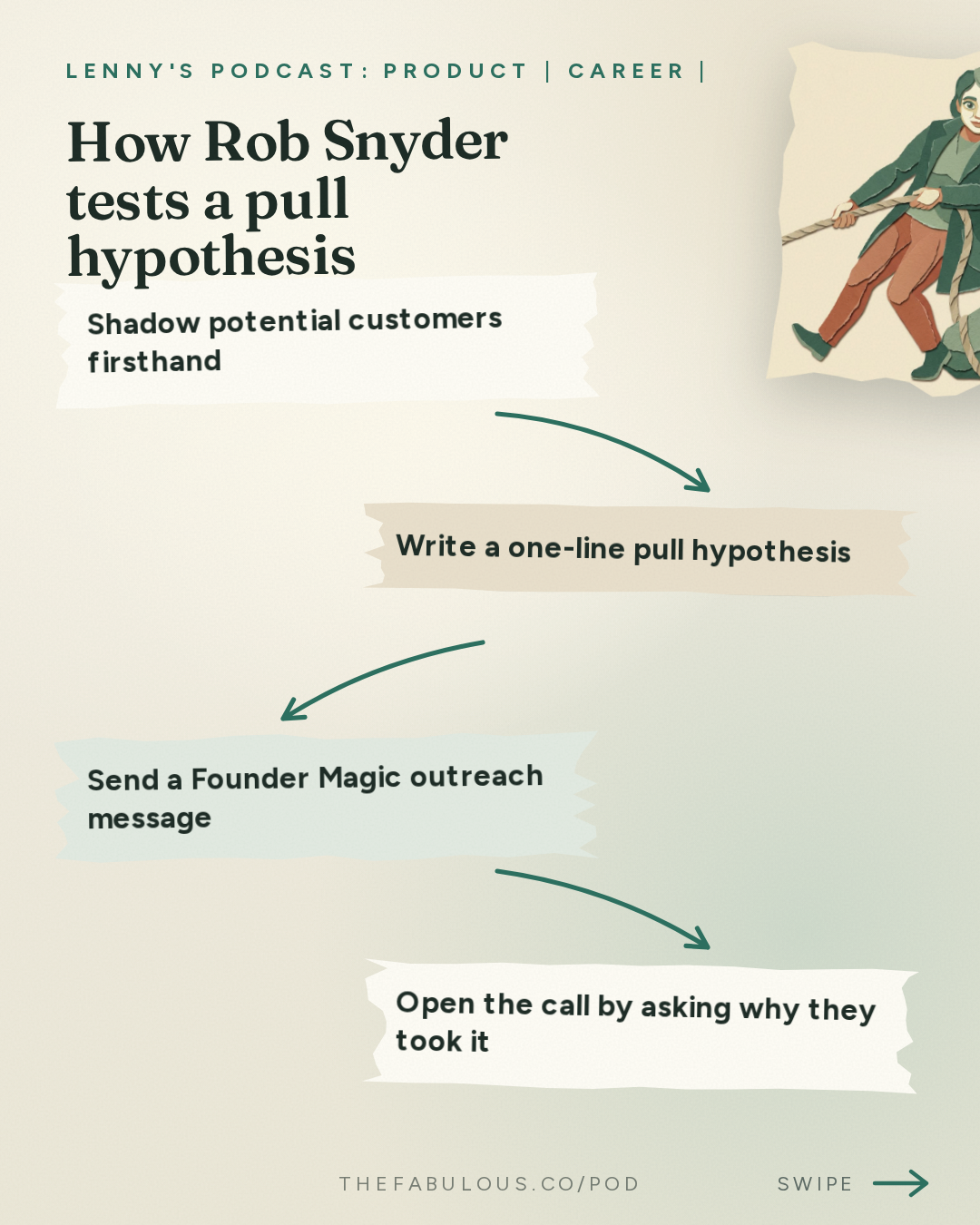
Once a founder has a pull hypothesis, the next step is cold outreach, and Snyder's advice here is almost anti-marketing. Skip the template that opens with a pain point and a pitch. Instead, send what he calls a Founder Magic message: short, personal, and interesting enough to earn a conversation, nothing more. One startup he advised got replies with a line as simple as mentioning that Snoop Dogg had invested in them (35:39). The message's only job is to get someone on a call, not to sell them anything.
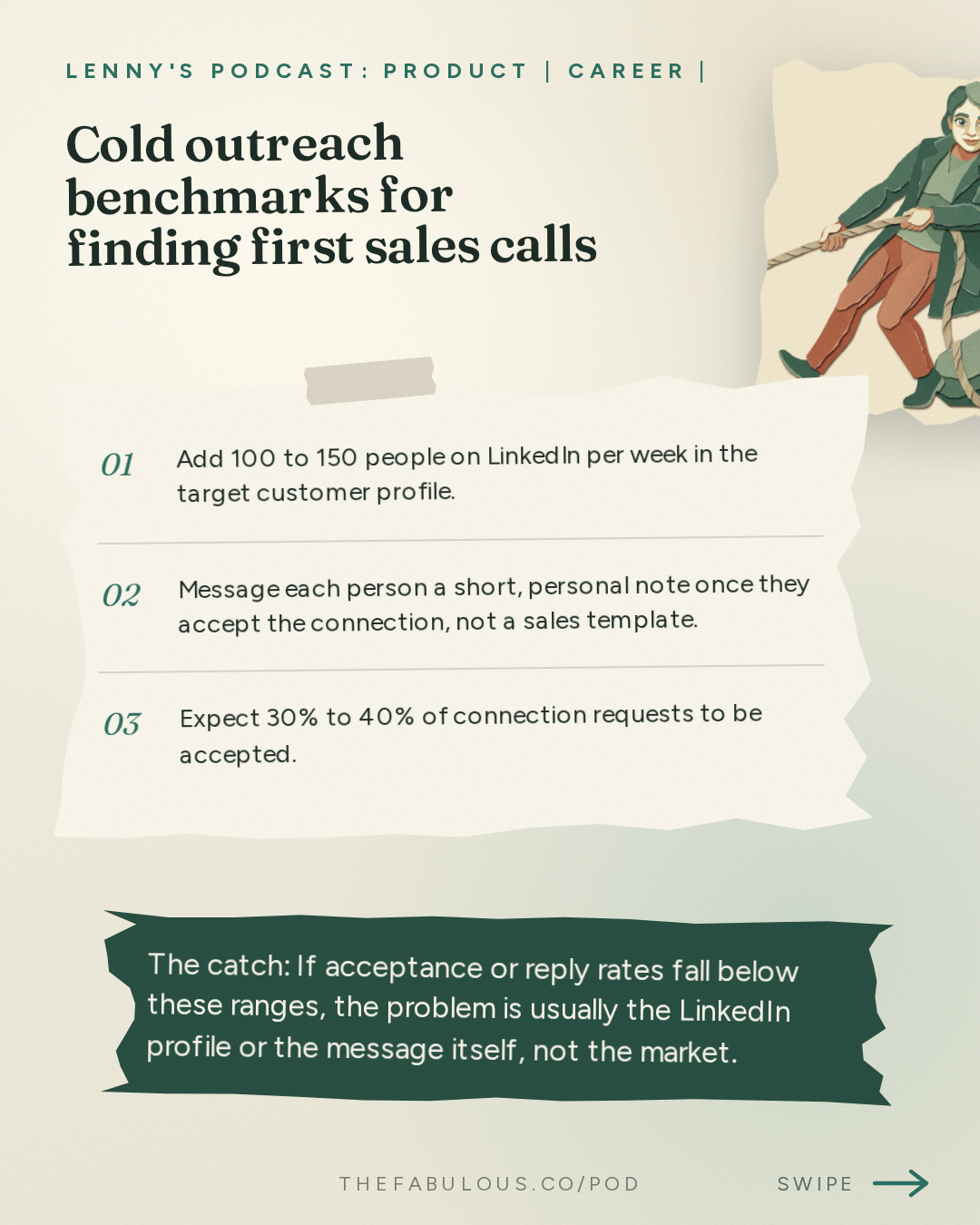
For volume, Snyder suggests adding 100 to 150 people on LinkedIn per week and messaging them once they accept (39:33). His rough benchmarks: 30 to 40 percent of connection requests should be accepted, and 30 to 50 percent of those people should reply (40:09). Fall short, and the problem is usually the profile or the message, not the market.
The sales call itself follows a specific order. Snyder recommends opening with a direct question: why did you agree to take this call (42:35)? Often the prospect will answer by accidentally filling out the entire PULL framework unprompted. Calls run thirty minutes, because shorter blocks tend to get skipped on people's calendars (43:37). His heuristic for cutting losses: do five calls, then take stock. If everyone leans back and nothing surfaces, the hypothesis is probably wrong (45:13). When a call goes lukewarm, Snyder throws what he calls a Hail Mary: asking if there is anything else on the person's to-do list they would pay someone to take off their plate right now (29:11). He has watched more than one startup pivot entirely off that single question.
We're selling to learn, not really to, to, like, push something. We're gonna learn, and we're seeing if they try to buy. (46:16) — Rob Snyder
Pricing, too, gets grounded in the framework rather than guessed at. Snyder suggests anchoring early deals to the cost of whatever the customer is already paying, whether that is a consultant, a competitor, or the time of an existing employee (56:00). It gives a number that feels intuitive to the buyer instead of arbitrary.
The Factory, Not the Widget
Landing a first customer is not the finish line. Snyder says every new customer is guaranteed to churn until they cross a specific point where leaving would feel strange. He points to a stat from sales consultant Mark Roberge: Slack found that customers who sent around 10,000 messages early on almost never churned (68:21). Snyder's own startup, which sold retention software to restaurants, found its own version of that threshold in the first two weeks after signup (68:21 context, 67:57). The job of onboarding, in his framework, is reverse-engineering that threshold and building a fast path to it for every customer.
His bigger mental model ties all of this together. Snyder argues that a startup, at its core, is a machine for repeating one case study an unlimited number of times: a customer with pull, a sales process that surfaces it, and a delivery process that locks in retention (72:59). Once that case study exists, the founder's job is not to invent a hundred different stories but to build a factory that reproduces the same one, over and over, and to look at each stage, pipeline, sales, delivery, as a potential bottleneck to fix one at a time.
When none of this is working, Snyder's last tool is what he calls goblin mode: doing something a little extreme, like flying to a conference uninvited or going door to door, just to get in front of real customers and learn something (79:38). It is not a sustainable operating mode, he says, just a break-glass option for when a founder is stuck and time is burning.
Near the end of the conversation, Snyder offers the best summary of what the whole framework is for. It will not hand anyone a guaranteed idea. What it does is narrow the search.
This is just giving you a metal detector. You might not find metal where you're looking right now, but at least I'm not giving you a spoon. (81:05) — Rob Snyder
That, more than any acronym, is the quiet promise of the whole method: not a shortcut to product-market fit, but a faster, less painful way to find out, honestly, whether it exists at all.
Ask this episode anything
Pod's AI answers from the episode itself, with the minute mark so you can hear it yourself.
Or start with one of these
Ask this episode
Pod's AI listens to the whole episode to answer, and points you to the minute it comes from.
The rest of this answer, and any question after it
Answers come from the episode itself, never from a summary of it.
ContinueKey takeaways
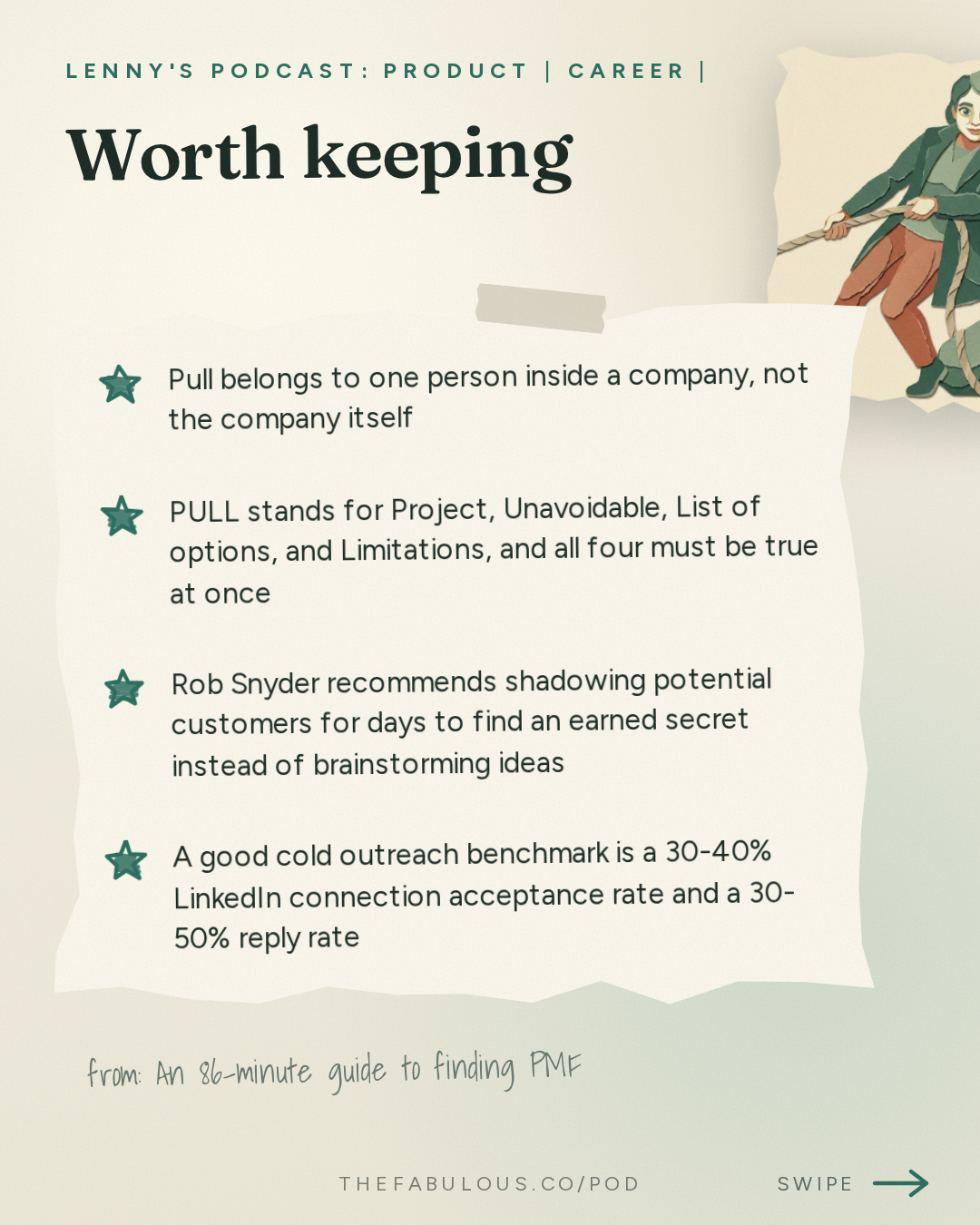
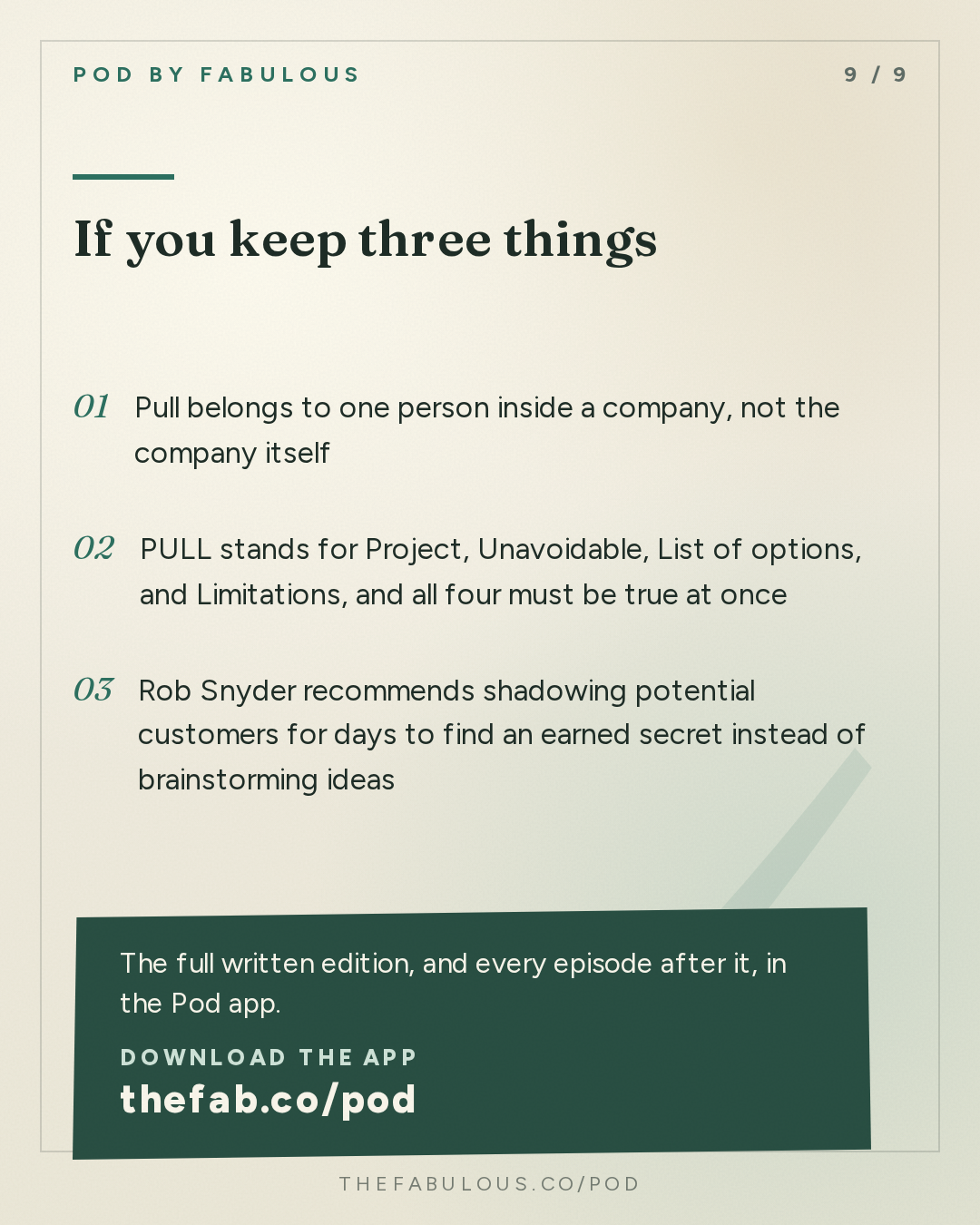
- Pull belongs to one person inside a company, not the company itself (16:20)
- PULL stands for Project, Unavoidable, List of options, and Limitations, and all four must be true at once (07:33)
- Rob Snyder recommends shadowing potential customers for days to find an earned secret instead of brainstorming ideas (18:53)
- A good cold outreach benchmark is a 30-40% LinkedIn connection acceptance rate and a 30-50% reply rate (40:09)
- Retention depends on reaching a specific point where it would be weird for a customer to churn, like Slack's 10,000-message threshold (68:21)
The episode in cards
By the numbers
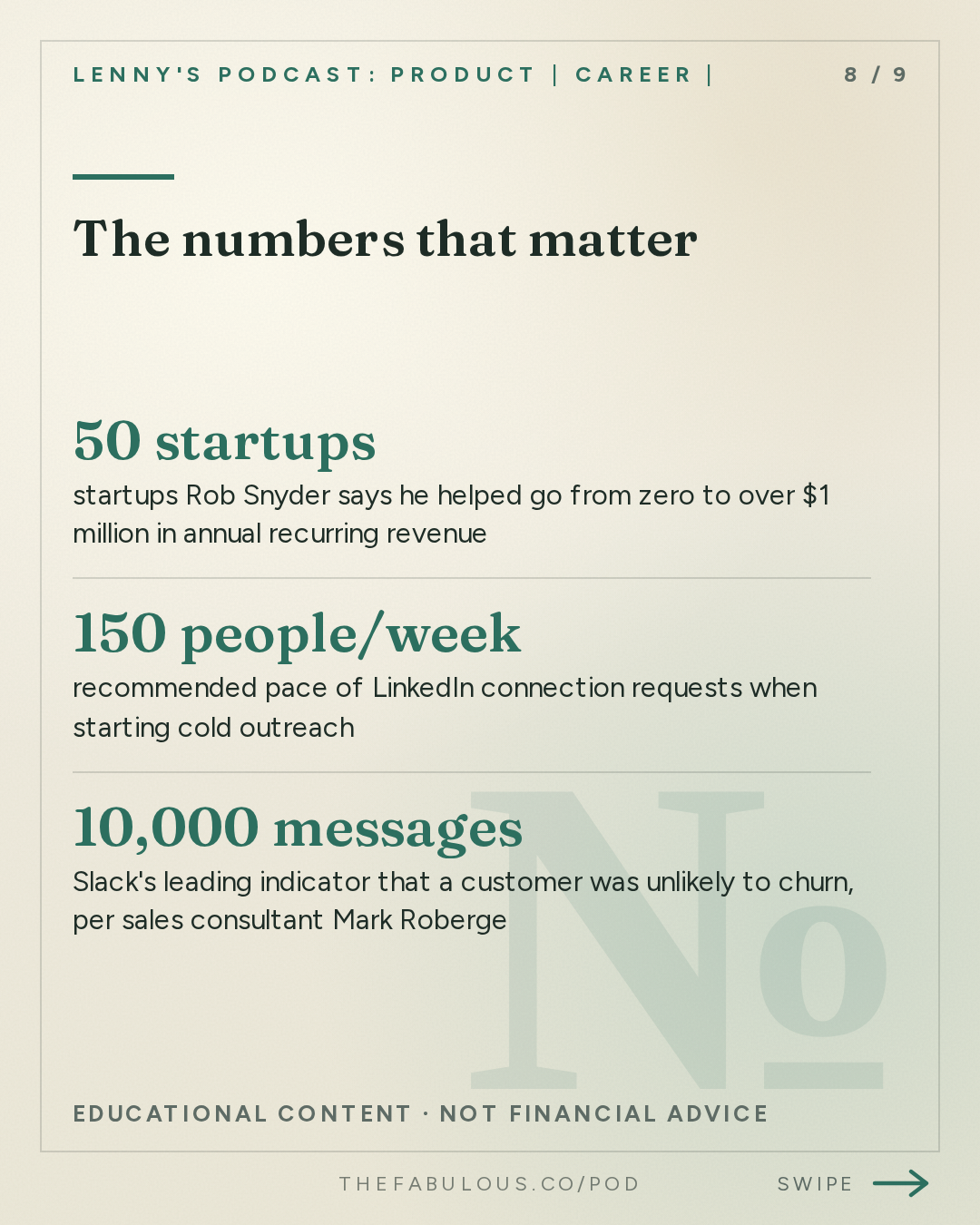
- 50 startups startups Rob Snyder says he helped go from zero to over $1 million in annual recurring revenue
- 150 people/week recommended pace of LinkedIn connection requests when starting cold outreach
- 10,000 messages Slack's leading indicator that a customer was unlikely to churn, per sales consultant Mark Roberge
In their words
“Pull describes a person who'd, who'd be weird not to buy. The question is just, like, what causes somebody to pull a product out of your hands?”
“One of the main mistakes people make is thinking that pull is a thing that a company has. It's a thing a person has.”
“A startup is just a thing that repeats one case study infinite times. And all the stuff that I do is to build a factory for repeating that case study.”
“This is just giving you a metal detector. You might not find metal where you're looking right now, but at least I'm not giving you a spoon.”
Protocols
-
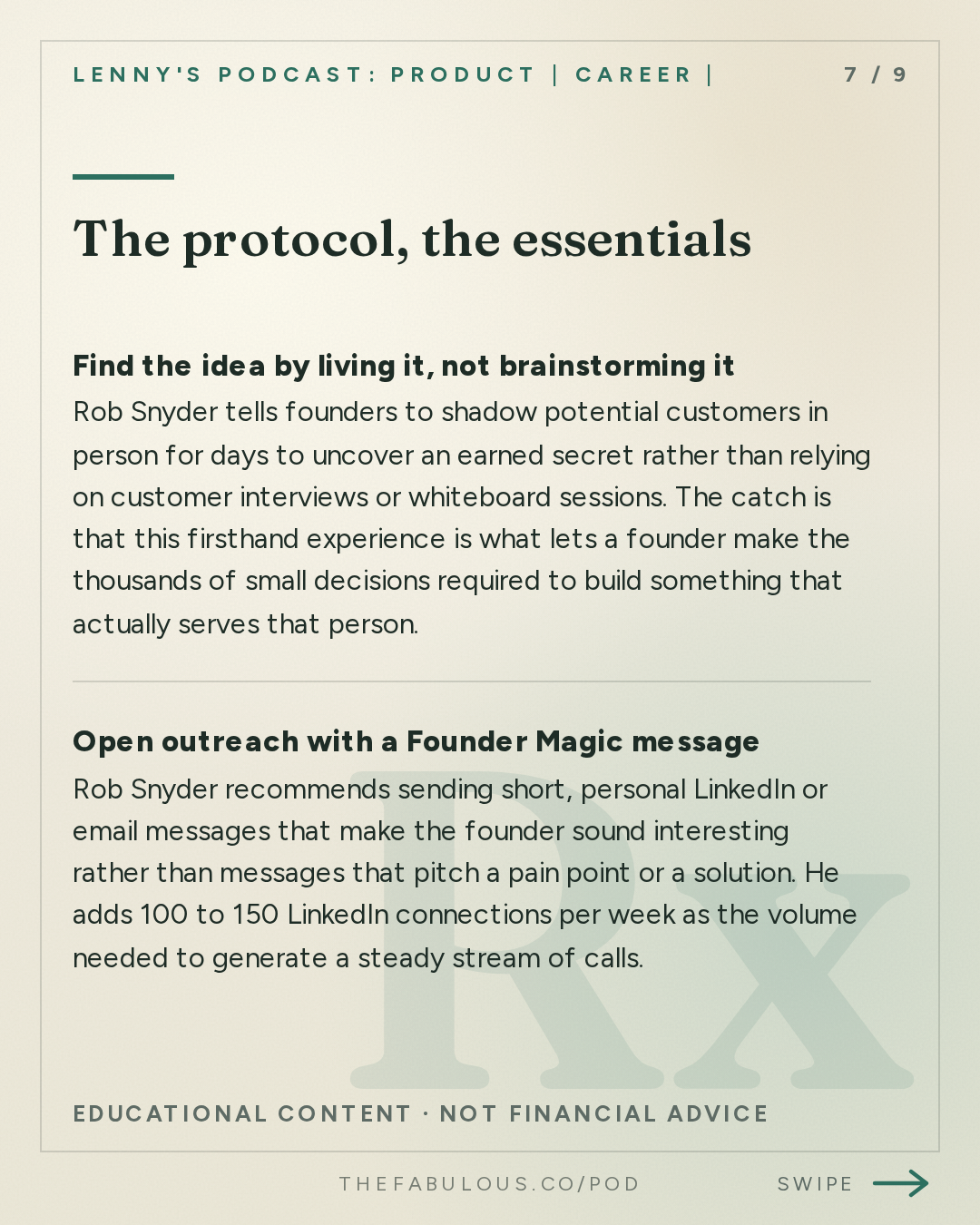
Find the idea by living it, not brainstorming it
Rob Snyder tells founders to shadow potential customers in person for days to uncover an earned secret rather than relying on customer interviews or whiteboard sessions. The catch is that this firsthand experience is what lets a founder make the thousands of small decisions required to build something that actually serves that person.
before writing a pull hypothesis
-
Open outreach with a Founder Magic message
Rob Snyder recommends sending short, personal LinkedIn or email messages that make the founder sound interesting rather than messages that pitch a pain point or a solution. He adds 100 to 150 LinkedIn connections per week as the volume needed to generate a steady stream of calls.
weekly, ongoing during idea validation
-
Open every discovery call by asking why they took it
Rob Snyder starts sales calls by asking the prospect directly why they agreed to take the call, because the answer often reveals their project, urgency, and current alternatives without further prompting. The catch is that founders must then ask permission before probing further, or the questions feel like an interrogation and the prospect shuts down.
every discovery call
-
Assess pull after five calls, not fifty
Rob Snyder recommends running five discovery calls against a given pull hypothesis and then stopping to review what was learned. The catch is that if everyone on those calls leans back and nothing of value surfaces, the hypothesis is likely wrong and needs to be revised rather than pursued through more calls.
every batch of 5 calls
-
Price against the cost of the current alternative
Rob Snyder suggests framing an early deal's price against what the customer already spends on consultants or existing tools, rather than guessing at value-based pricing. The catch is that this works best once a founder has learned specifics, such as the dollar cost of a competing consultant, during discovery calls.
at time of first pricing conversation
Questions this episode answers
What is Rob Snyder's Pull Framework for product-market fit?
It's a four-part acronym, PULL: a Project on someone's to-do list, something Unavoidable about doing it now, a List of options they've already tried, and the Limitations that make those options not good enough (07:33). Rob Snyder argues all four conditions have to be true at once for a customer to actually buy, not just say they're interested.
How do you find a product-market fit idea according to Rob Snyder?
Snyder recommends shadowing potential customers in person for days to find what he calls an earned secret, rather than relying on customer interviews or brainstorming sessions (18:53). He cites a founder who shadowed physical therapists for days and found a cost they were stuck trying to cut, which became his pull hypothesis (20:36).
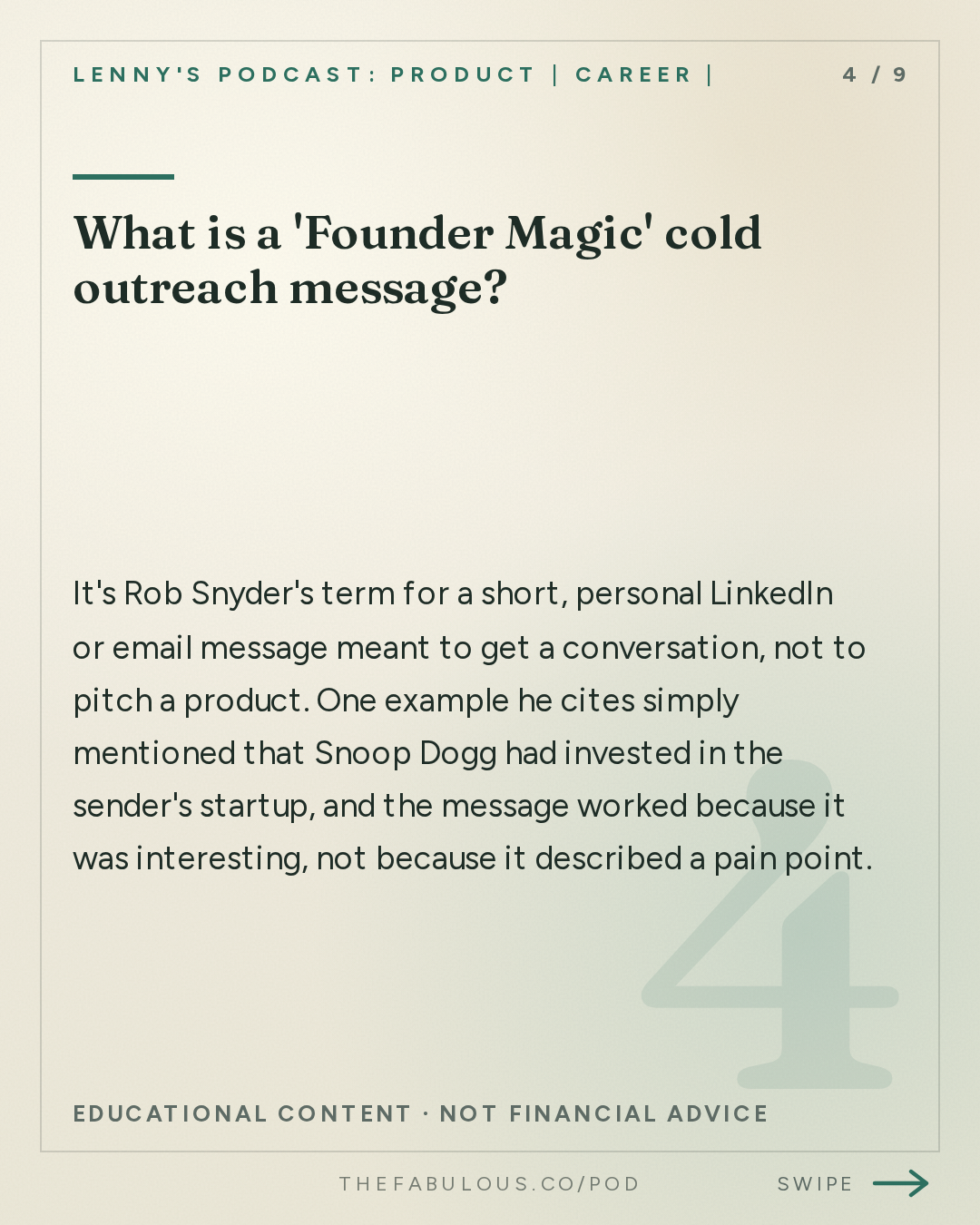
What is a 'Founder Magic' cold outreach message?
It's Rob Snyder's term for a short, personal LinkedIn or email message meant to get a conversation, not to pitch a product (35:39). One example he cites simply mentioned that Snoop Dogg had invested in the sender's startup, and the message worked because it was interesting, not because it described a pain point.
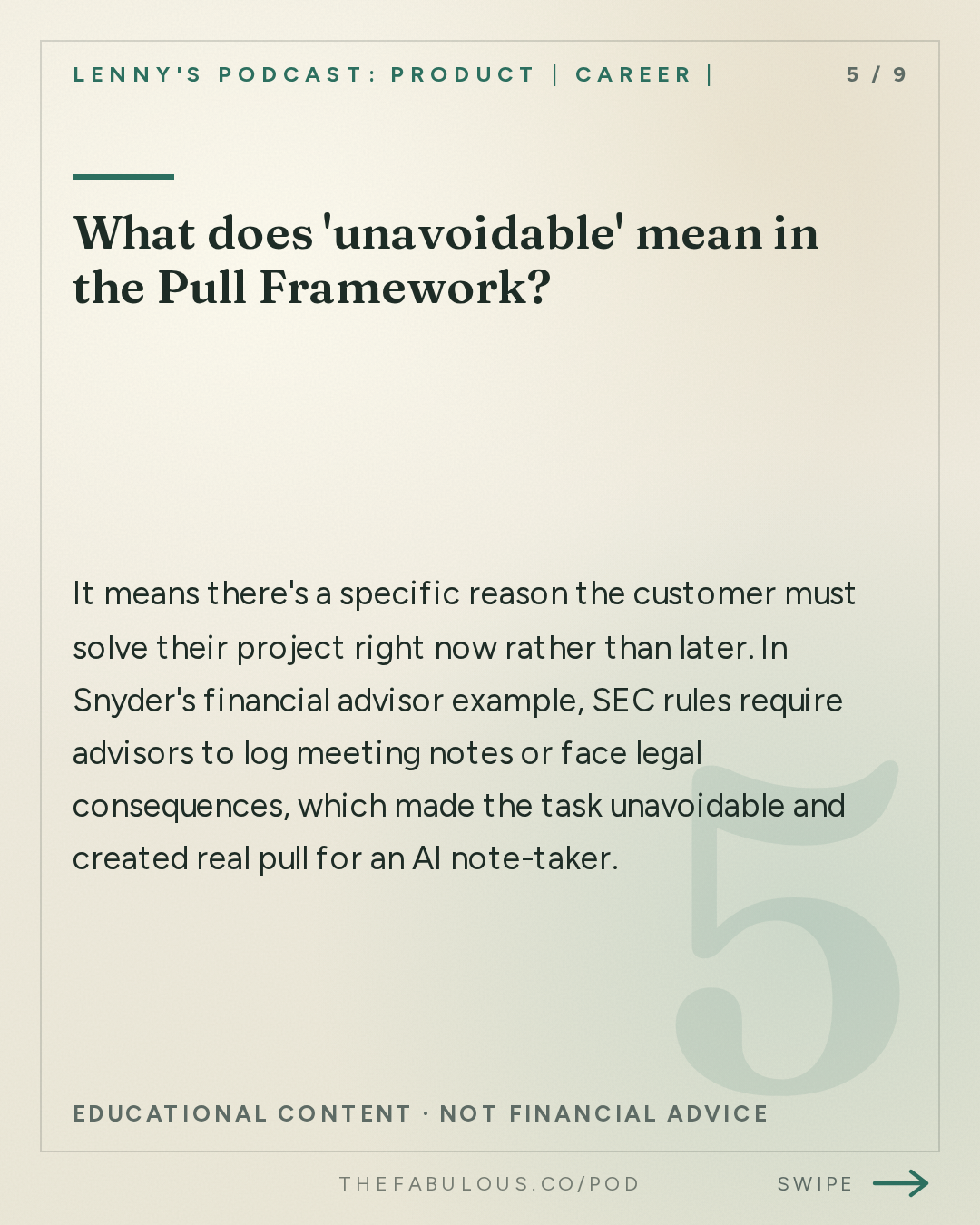
What does 'unavoidable' mean in the Pull Framework?
It means there's a specific reason the customer must solve their project right now rather than later. In Snyder's financial advisor example, SEC rules require advisors to log meeting notes or face legal consequences, which made the task unavoidable and created real pull for an AI note-taker (10:28).
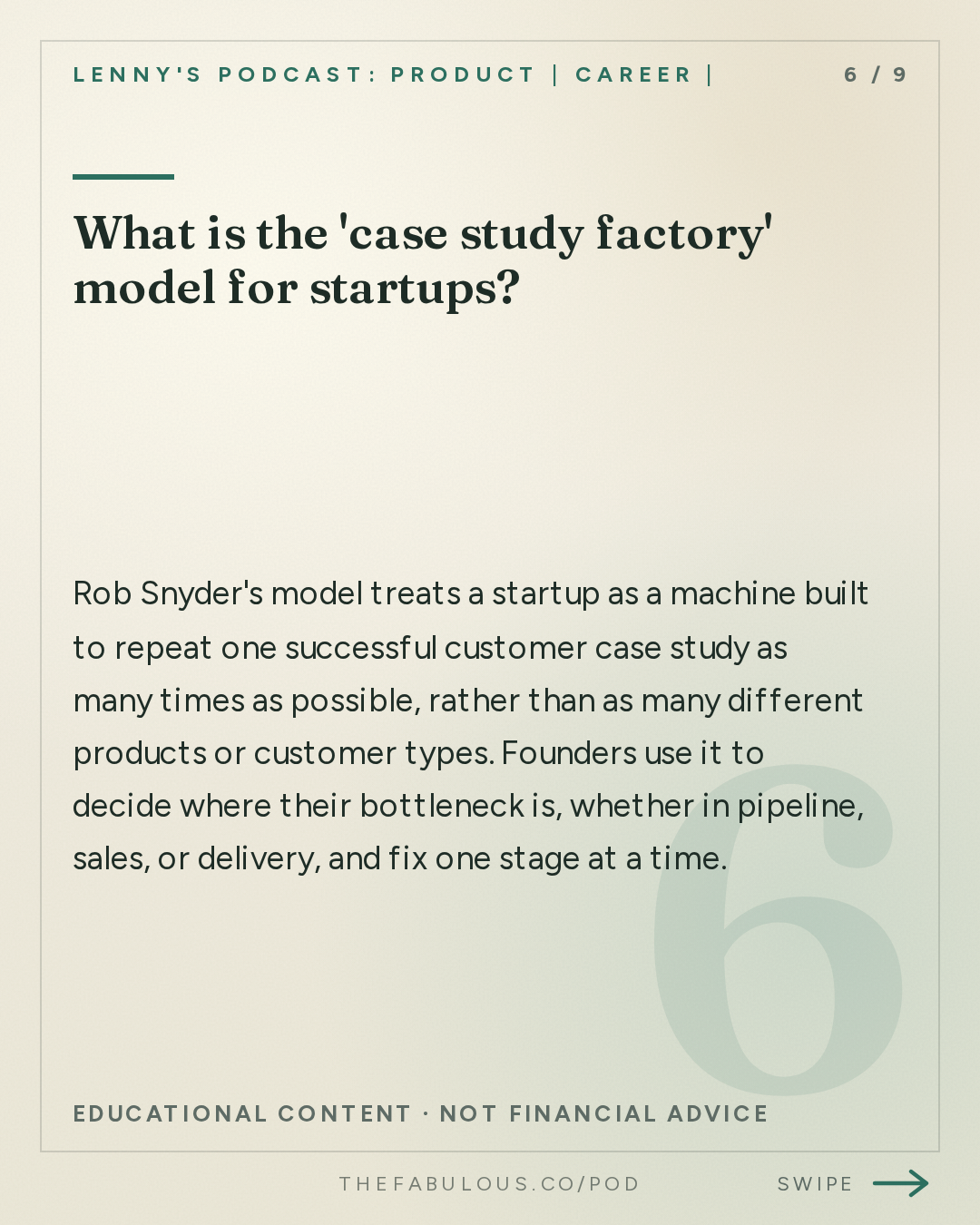
What is the 'case study factory' model for startups?
Rob Snyder's model treats a startup as a machine built to repeat one successful customer case study as many times as possible, rather than as many different products or customer types (72:59). Founders use it to decide where their bottleneck is, whether in pipeline, sales, or delivery, and fix one stage at a time.
What are good benchmarks for early-stage B2B sales discovery calls?
Rob Snyder suggests 30-minute calls, aiming for 30% to 40% of LinkedIn connection requests to be accepted and 30% to 50% of those contacts to reply (40:09, 43:37). He also recommends running five discovery calls against a pull hypothesis before deciding whether it's working (45:13).
The full read, in cards
Go deeper
- The Power of Pull — Rob Snyder's book laying out the PULL framework for finding product-market fit
- The Physics of Startups — Snyder's newsletter where he develops the pull framework further with new case studies
- Mark Roberge's Slack retention indicator — Finding that Slack customers who sent around 10,000 messages early on rarely churned
Mentioned
Rob Snyder · The Power of Pull · The Physics of Startups · Jump · Linear · Bob Moesta · Jen Abel · Mark Roberge · Databricks
More from this show and category

How AI Models Actually Think
Anthropic researcher Emmanuel Ameisen explains that language models are grown through training, not programmed line by line, so even their creators cannot read their internal logic directly. Interpretability research shows models form internal plans, share universal concepts across languages, and sometimes fixate on wrong answers when training data rewards them incorrectly (01:45, 15:31, 37:14).

Josh Woodward on Building an AI Labs Team
Google Labs head Josh Woodward argues every company now needs a frontier team that tests new AI models obsessively, judges early products by watching users' eyes rather than dashboards, and hires for an 'unlearning rate' as much as a learning one (32:13).

OpenAI's Tibo Sottiaux on Dots and AI Agents
OpenAI's Head of ChatGPT Tibo Sottiaux says agents will soon take most actions on the internet, not humans. He describes Dots, OpenAI's persistent agent that remembers personal context, controls multiple devices, and learns from feedback, plus a plugin ecosystem with revenue sharing and 16 sign-in partners, as proof the industry is moving from manually built loops to self-learning systems (00:16, 11:58).

Molly Graham's Give Away Your Legos AI Advice
Molly Graham's decade-old advice to give away your career projects still works, but she now says some tasks, like judgment and vision, should never go to AI. Tech burnout jumped from 44% to 55% in a year, and she argues AI needs coaching like a lazy intern rather than blind trust, while good management matters more than ever.
