
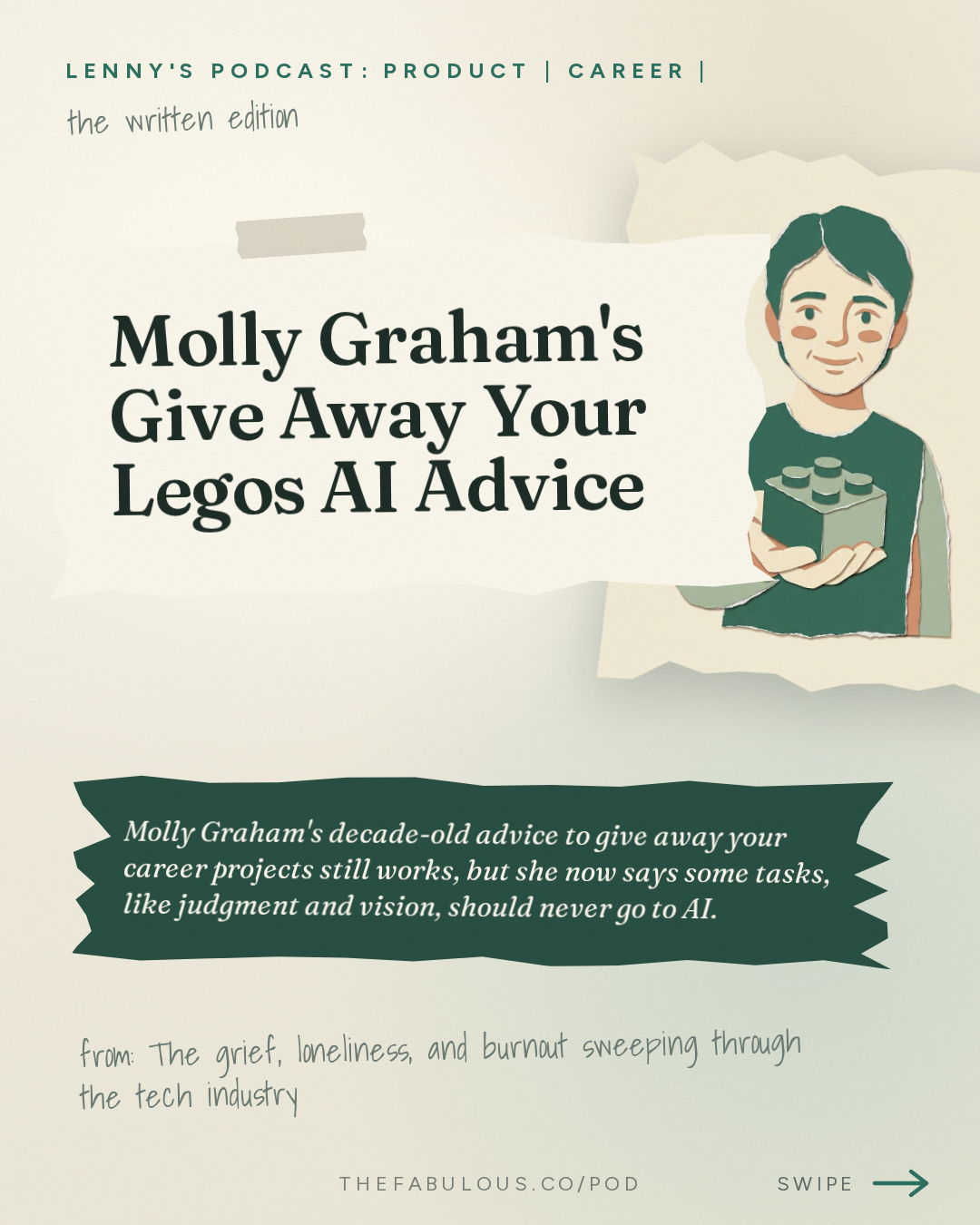
Molly Graham's Give Away Your Legos AI Advice
The grief, loneliness, and burnout sweeping through the tech industry right now | Molly Graham
The brief
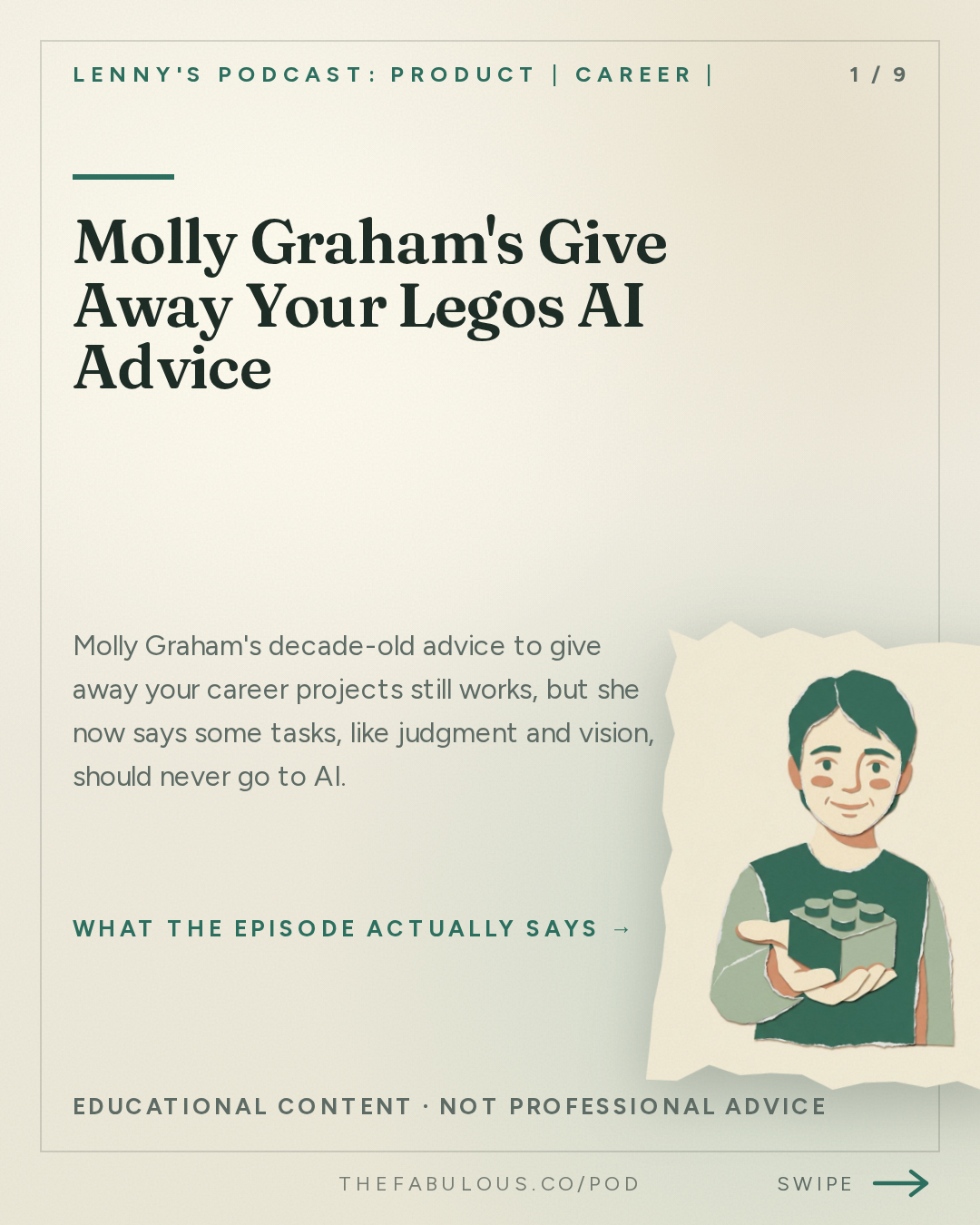
Molly Graham's decade-old advice to give away your career projects still works, but she now says some tasks, like judgment and vision, should never go to AI. Tech burnout jumped from 44% to 55% in a year, and she argues AI needs coaching like a lazy intern rather than blind trust, while good management matters more than ever.
Ask this episode anything
Pod's AI answers from the episode itself, with the minute mark so you can hear it yourself.
Or start with one of these
Ask this episode
Pod's AI listens to the whole episode to answer, and points you to the minute it comes from.
The rest of this answer, and any question after it
Answers come from the episode itself, never from a summary of it.
Continue
Key takeaways
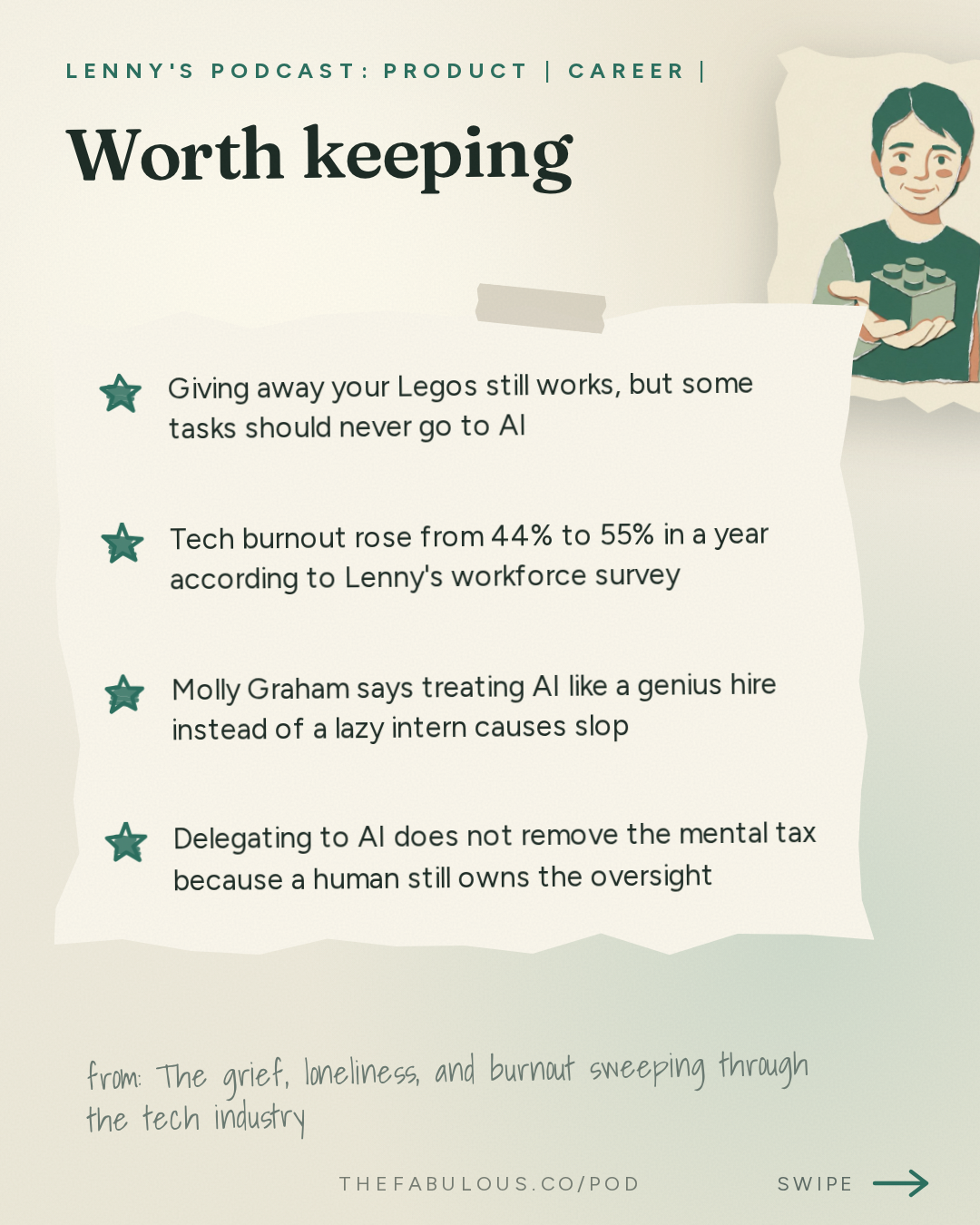
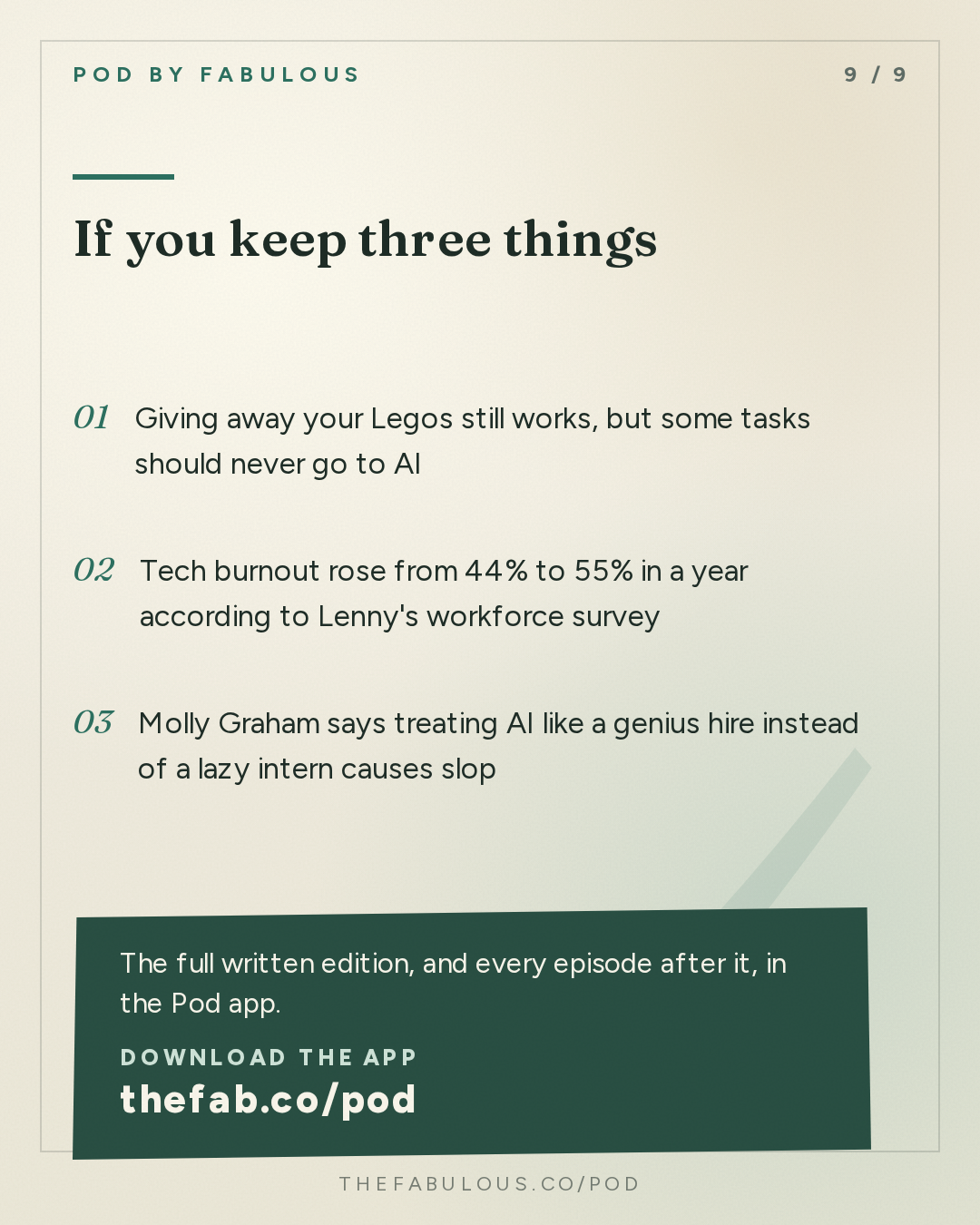
- Giving away your Legos still works, but some tasks should never go to AI
- Tech burnout rose from 44% to 55% in a year according to Lenny's workforce survey
- Molly Graham says treating AI like a genius hire instead of a lazy intern causes slop
- Delegating to AI does not remove the mental tax because a human still owns the oversight
- Molly Graham caps effective management at 10 to 12 direct reports, even counting AI agents
The episode in cards
Imagine being handed a new coworker who is smarter than anyone on the team, told to pour everything you know into training them, and warned they might take your job within six months. That is the story a lot of people in tech are being told right now, and it is a bad one (00:24). Molly Graham, who has spent two decades helping companies survive rapid growth, from Google to Facebook to Quip to the Chan Zuckerberg Initiative, thinks the story is mostly wrong, and that it is making an already hard moment feel worse.
Thirteen years ago Graham wrote a career essay that became one of the most read posts on First Round Review, an outlet for startup advice (11:12). The idea, nicknamed give away your Legos, said that during fast growth the smartest move is to hand off the project, team, or product you built rather than cling to it. She had lived the problem herself: her department at Google grew from 25 people to 125 in nine months, inside a company of 10,000 employees in 2007, and at Facebook she watched headcount balloon from 500 to 5,500 employees during her five years there (06:08, 06:29). People she managed kept trying to hold on to what they had built, the way a toddler grips a Lego tower when someone reaches for it. Her advice was to let go on purpose, because holding on guarantees you fall behind.
Some of that advice, she says, still holds exactly as written. Job one in a fast-changing company is to make yourself irrelevant, because that is the only way to be ready for whatever comes next (13:42). And she still believes the future belongs to people who learn quickly, not people who already know a lot, a line that lands differently now that generative AI resets what counts as expertise every few months (15:56).
The grief of rowing versus steering
What has changed is the emotional weather. Graham describes conversations with engineers who say they miss what their job used to be: sitting down and writing code, rather than supervising a swarm of AI agents and checking their work (18:55). One framing she keeps returning to, borrowed from a guest on a previous episode, is that the job used to be rowing and is now steering, and a lot of people never wanted to steer (20:39). A product leader recently told her the new work feels lonely, because collaboration with humans has been replaced by collaboration with robots. Graham's response was simple: let the sadness be real before rushing to the upside.
"Change sucks. It also can be awesome, but we don't have to be fluffy bunnies about this. We can also just say, 'This is hard.'" — Molly Graham [21:44]
The data backs up the mood. A workforce survey run by this show found that 55% of tech workers now report feeling burned out, up from 44% a year earlier (30:03). Graham thinks part of that is simple exhaustion from narrative whiplash: a friend at OpenAI told her it took the company six months to go from urging everyone to use AI constantly to asking whether all that AI use was actually paying off (31:38). None of this means everyone is miserable. The same survey found roughly half of respondents report the happiest they have ever felt in their career, concentrated among people who feel AI has amplified what they are good at, while designers reported the lowest happiness because design still requires slow, human feedback loops that cannot be sped up by an agent (33:15, 34:00).
Treat it like an intern, not a genius
The bigger break from Graham's original advice is this: some Legos should never be given away, and the reason is that AI is not the coworker the hype describes. Her mental model is blunt.
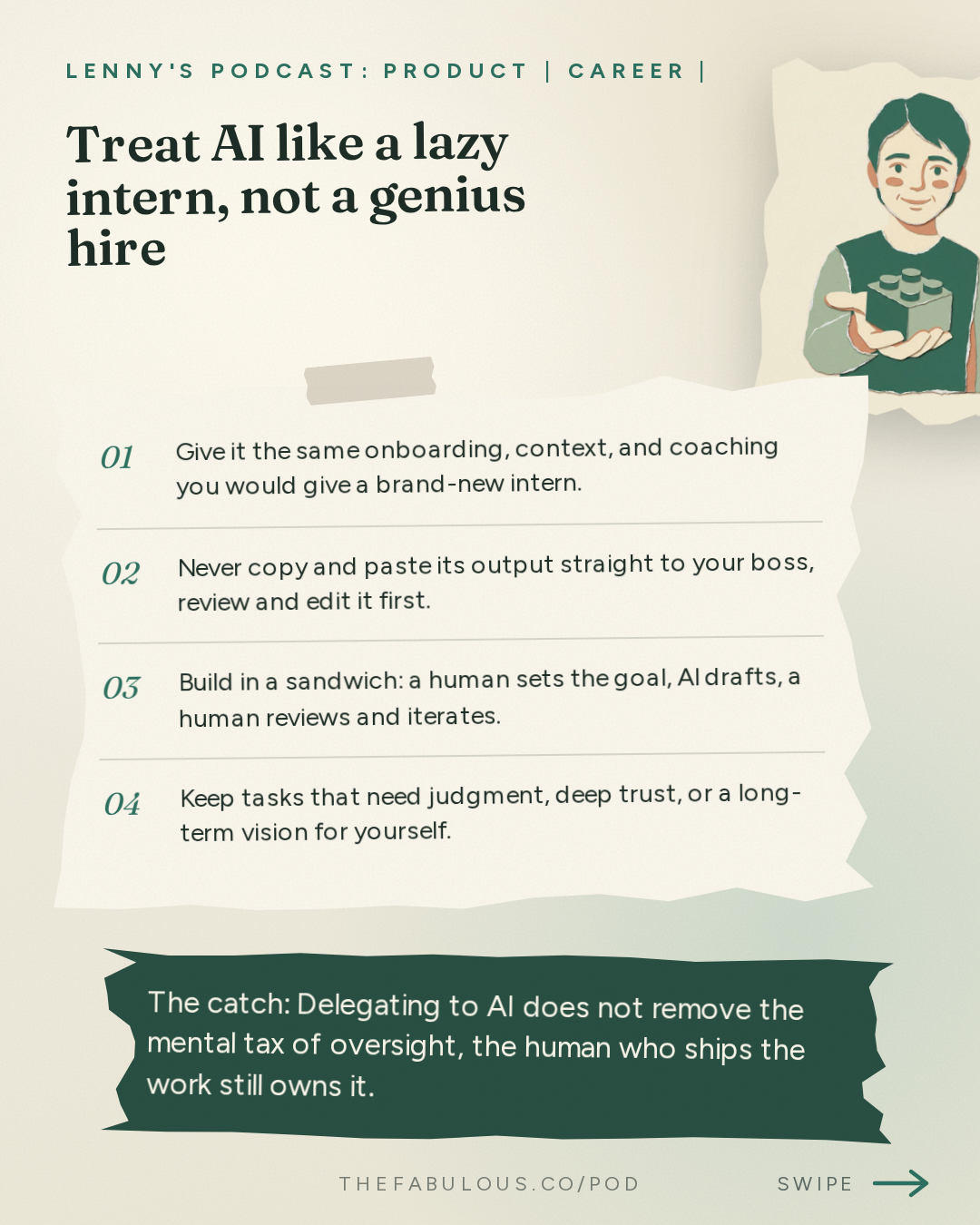
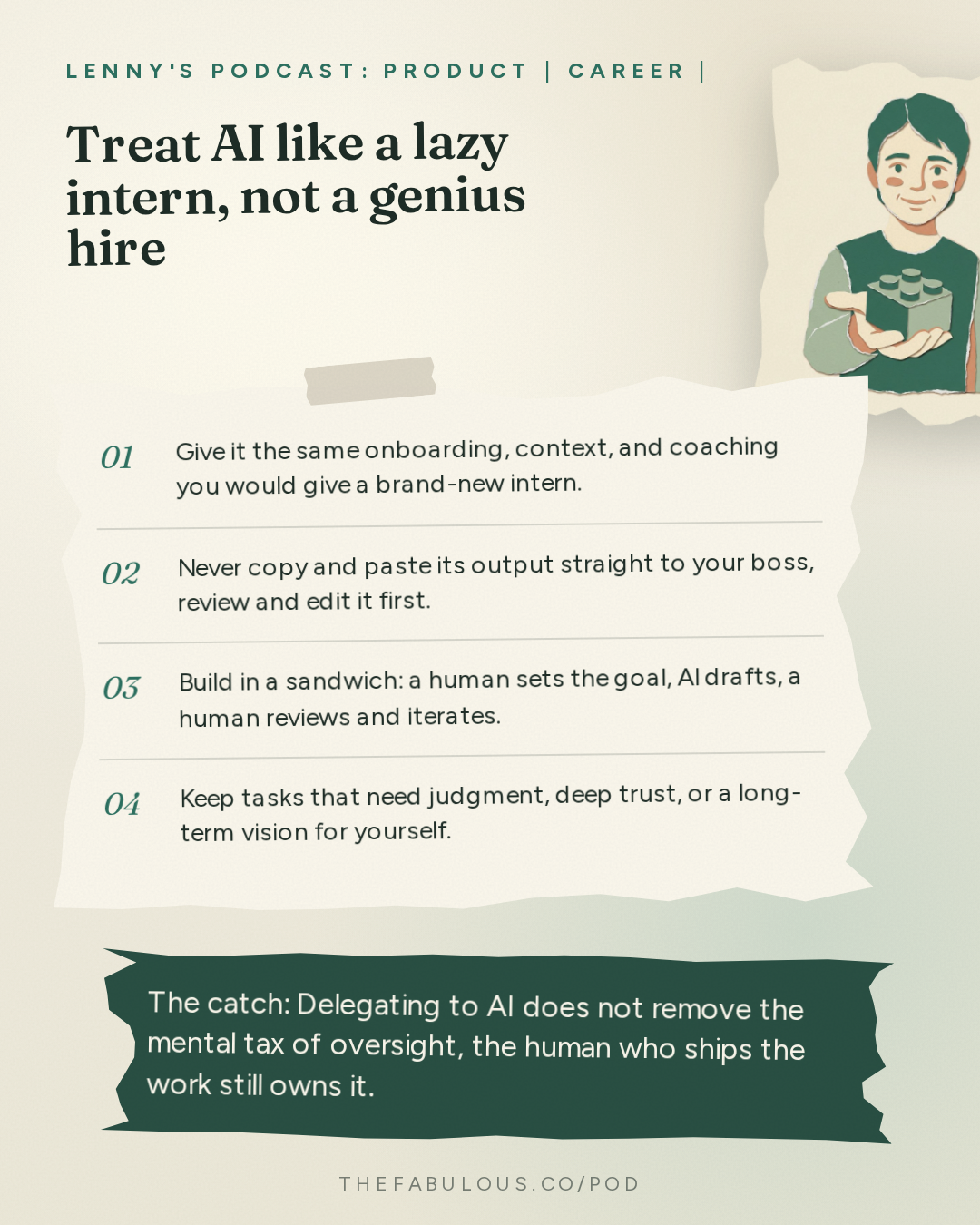
"AI is like a lazy intern. It needs the same coaching and training that a human does. It needs context. It needs onboarding." — Molly Graham [35:48]
Most AI slop, in her view, comes from people skipping that step, treating an AI's first draft as if it came from the best hire they ever made and forwarding it unedited. She points to CEOs who ask AI for a strategy memo and paste it straight into a company-wide message, which quietly tells every employee that outsourcing your thinking is fine (37:32). The fix she recommends is what she and this show's host call an AI sandwich: a human sets the goal and the vision, AI produces a draft, and a human reviews and iterates before anything ships (63:04).
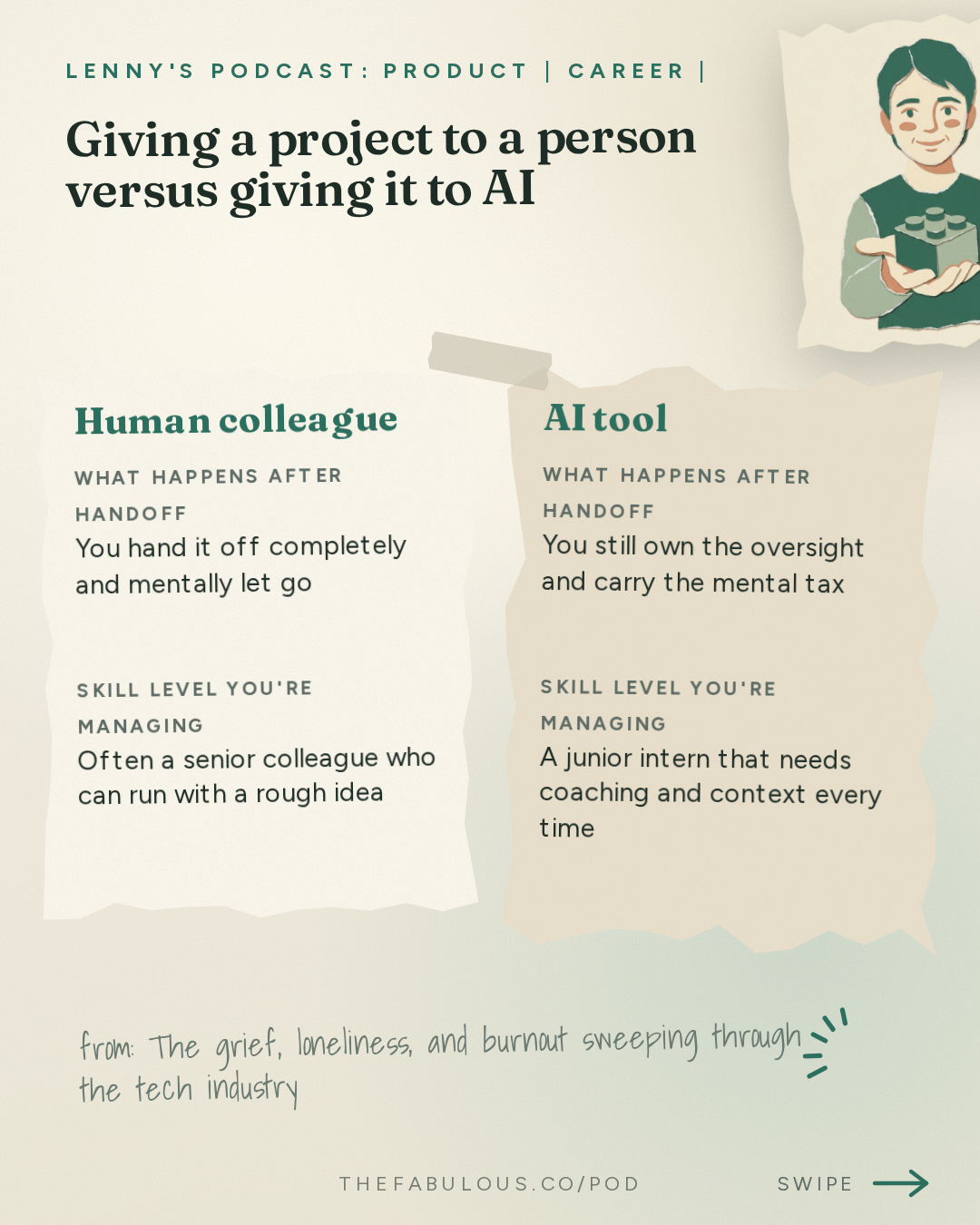
There is a second, more surprising twist. Giving a project to a person and giving it to a robot are not the same act, even though both look like delegation. Handing work to a colleague means truly letting go, what Graham describes as chucking the Lego at their face and running the other way so your mind is free to move on (43:55). Handing work to AI does not work that way, because the human still owns the oversight. The mental tax never leaves. Output goes up, but so does the invisible cost of checking, correcting, and being accountable for whatever the AI produced (44:47, 45:09). That is one reason burnout can rise even as productivity metrics look great: people are managing more, not less.
Because everyone with an AI tool is now effectively a manager, Graham's old rule of thumb for team size applies more broadly than it used to. She caps the effective limit at 10 to 12 direct reports, and worries about what happens to people's psychology once AI agents get counted toward that number too (47:51). She also names, for the first time in this advice, categories of work that should stay human no matter how good the tools get: tasks that require judgment, tasks that depend on deep trust between people, and tasks that require a vision of where something should go, not just a fast path to somewhere (61:55). An engineering report cited in the conversation found that while AI coding tools made engineers faster, the amount of code that later had to be rewritten rose roughly 8 times, a concrete example of speed without judgment (39:22).
None of this argues for retreating from AI, and Graham is explicit that she does not think jobs are vanishing as fast as the layoff headlines suggest; she calls most AI-branded layoffs a cover story for companies that simply over-hired (27:14). Her closing advice is to stop asking whether a job will disappear and start asking what it will look like in five years, following what she calls the Manoush Zomorodi test, named for the journalist and podcast host who has rebuilt her career every few years across three decades of disruption (28:28). Graham also pushes back on the current fashion for stripping out management layers at large companies, arguing that a manager is still the single strongest lever for how happy someone is at work, and that removing that layer to save cost now will cost more later (82:56, 83:17).
She ends with an image borrowed from executive coach Chip Conley: sometimes you need to hold a small funeral for the version of your job that is going away, grieve it honestly, and then ask what you could build next that you would be proud to describe years from now (67:49). The people living through this moment, she says, are going to have stories worth telling, about what they got right, what they got wrong, and what they helped build before anyone knew what to call it (86:36).
By the numbers
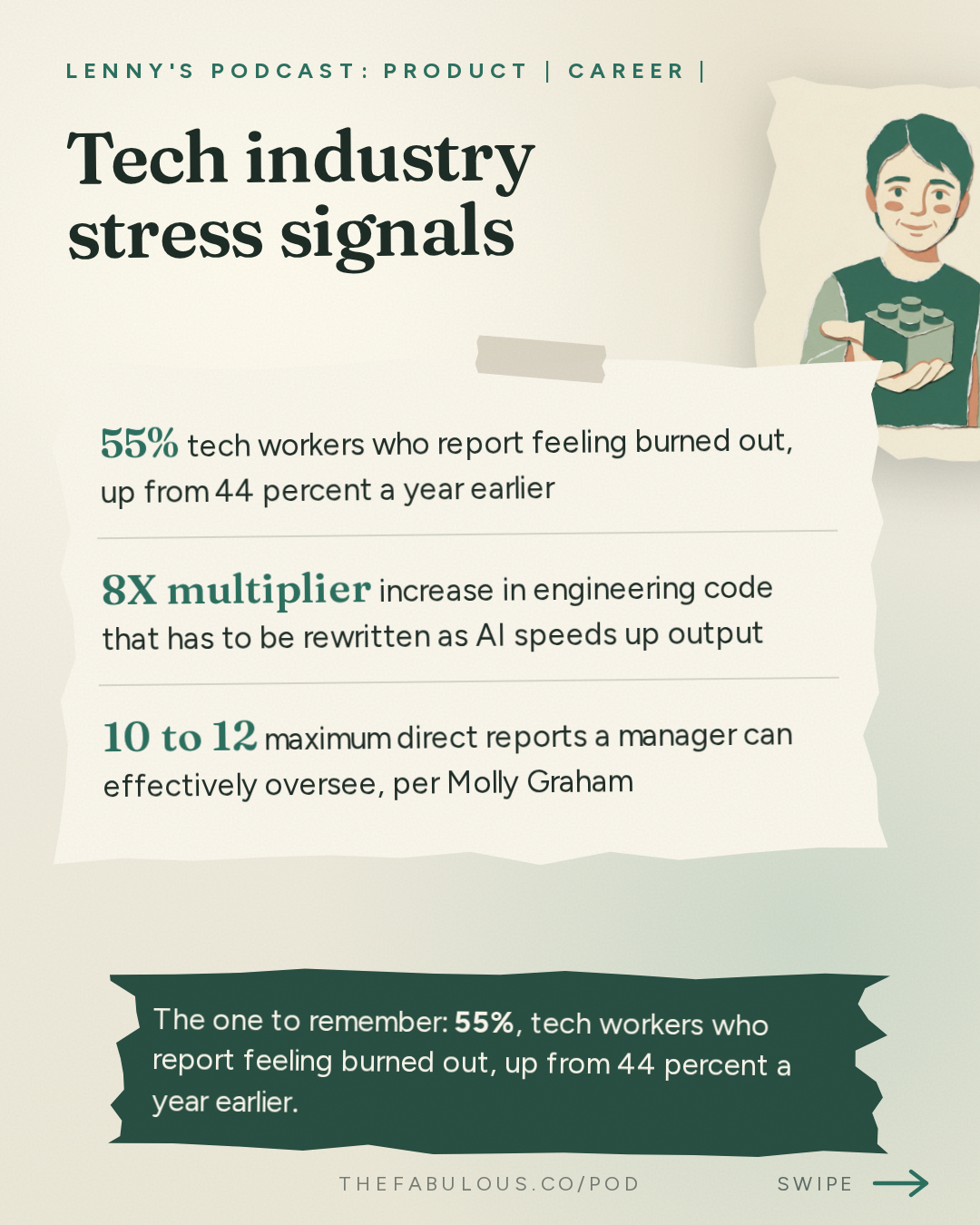
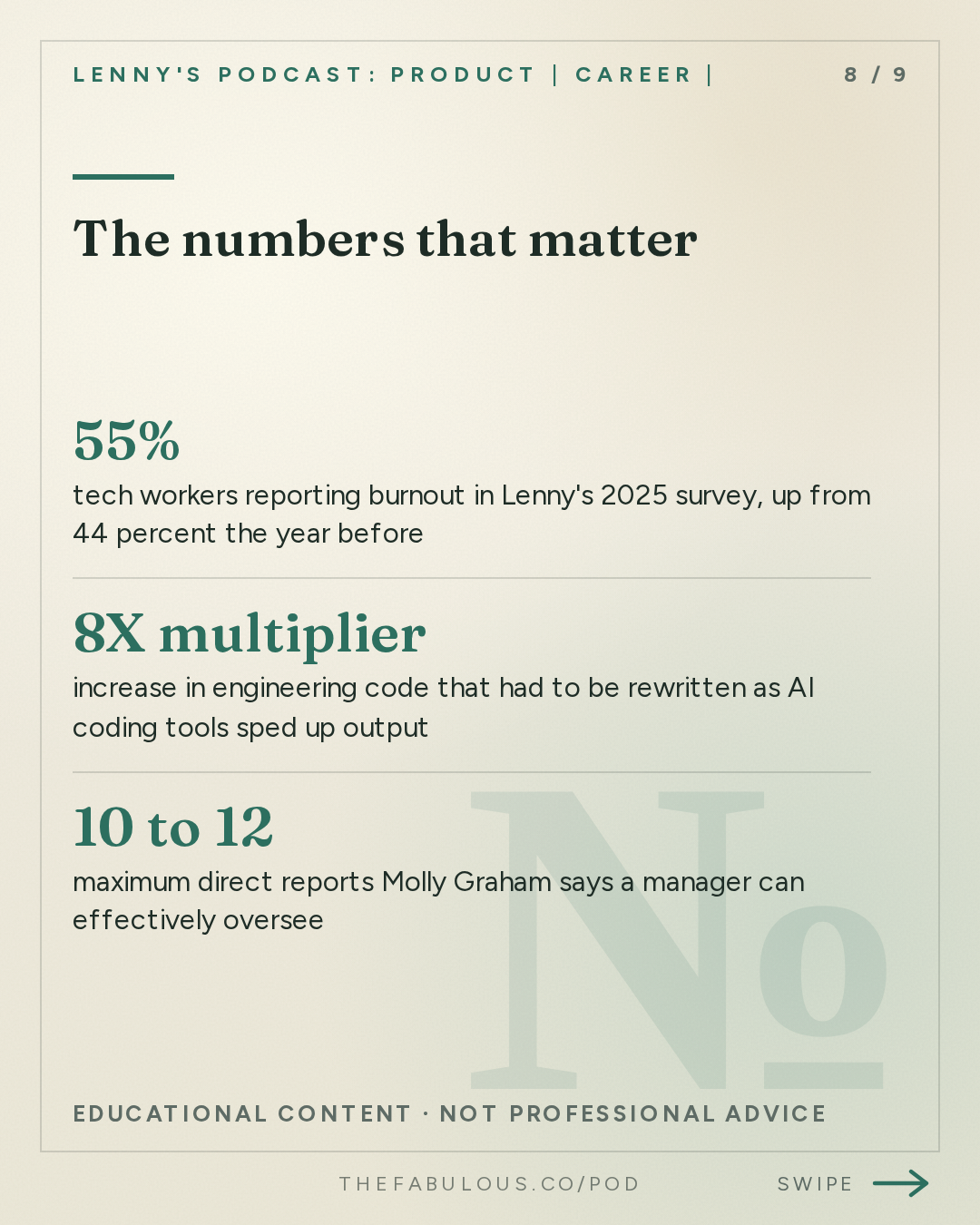
- 55% percent tech workers reporting burnout in Lenny's 2025 survey, up from 44 percent the year before
- 8X multiplier increase in engineering code that had to be rewritten as AI coding tools sped up output
- 10 to 12 maximum direct reports Molly Graham says a manager can effectively oversee
In their words
“Your main job in the face of rapid growth and change is to make yourself irrelevant, because it is the only way that you can be prepared for whatever is coming next.”
“The future will be defined by the people that learn, not the people that know.”
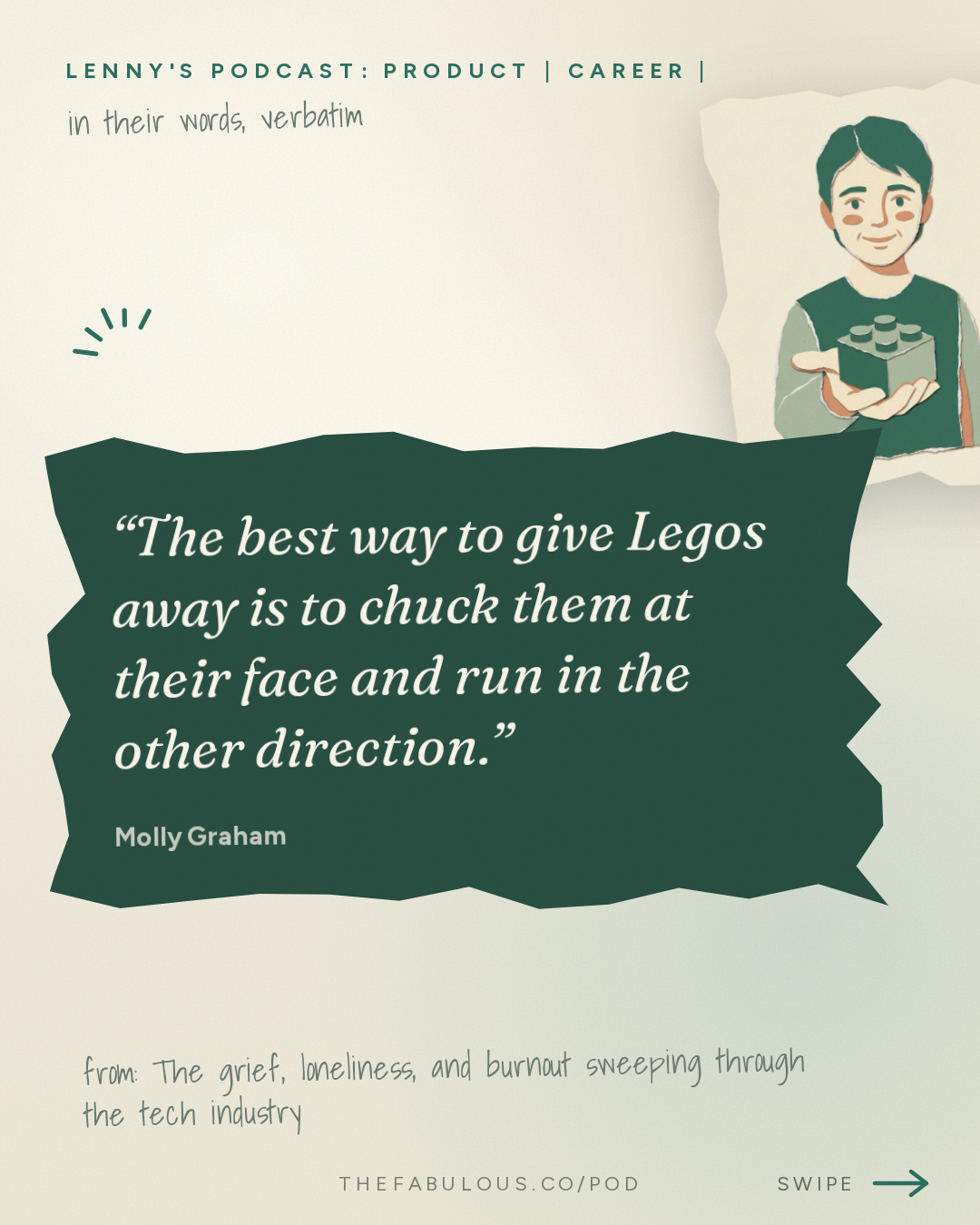
“The best way to give Legos away is to chuck them at their face and run in the other direction.”
Protocols
-
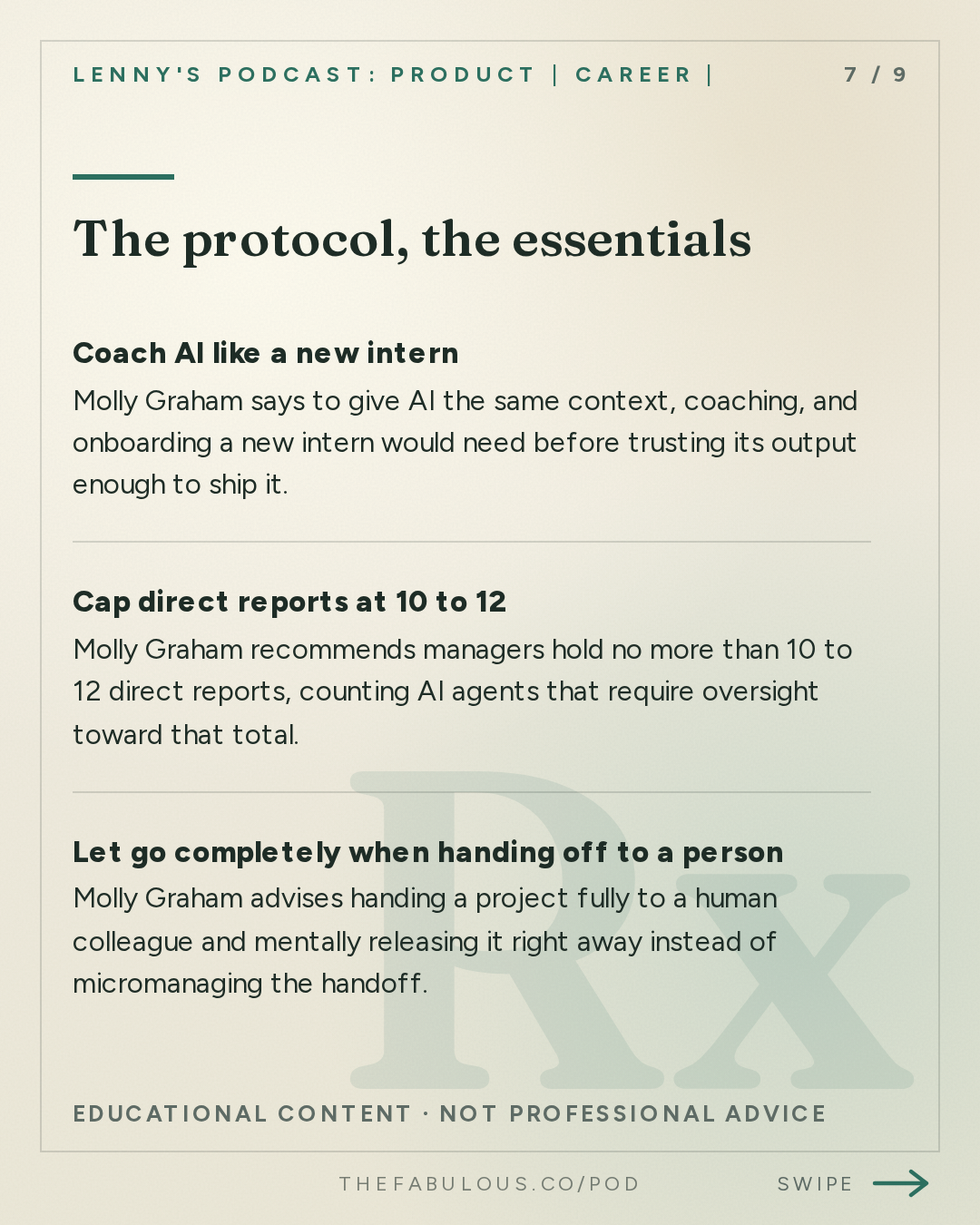
Coach AI like a new intern
Molly Graham says to give AI the same context, coaching, and onboarding a new intern would need before trusting its output enough to ship it.
Before each new AI-assisted task
-
Cap direct reports at 10 to 12
Molly Graham recommends managers hold no more than 10 to 12 direct reports, counting AI agents that require oversight toward that total.
Ongoing team design
-
Let go completely when handing off to a person
Molly Graham advises handing a project fully to a human colleague and mentally releasing it right away instead of micromanaging the handoff.
Each time responsibility changes hands between people
-
Keep judgment and vision for yourself
Molly Graham says humans should hold onto tasks that require judgment, deep trust, or a vision for where the work should go, and should never copy an AI-written strategy memo straight to their team.
Every strategic decision
Questions this episode answers
What is Molly Graham's give away your Legos advice?
It is career advice from Facebook and Google veteran Molly Graham, first published as a First Round Review essay 13 years ago, that says the way to grow during rapid company change is to hand off the projects and teams a person built rather than hold on to them (11:12).
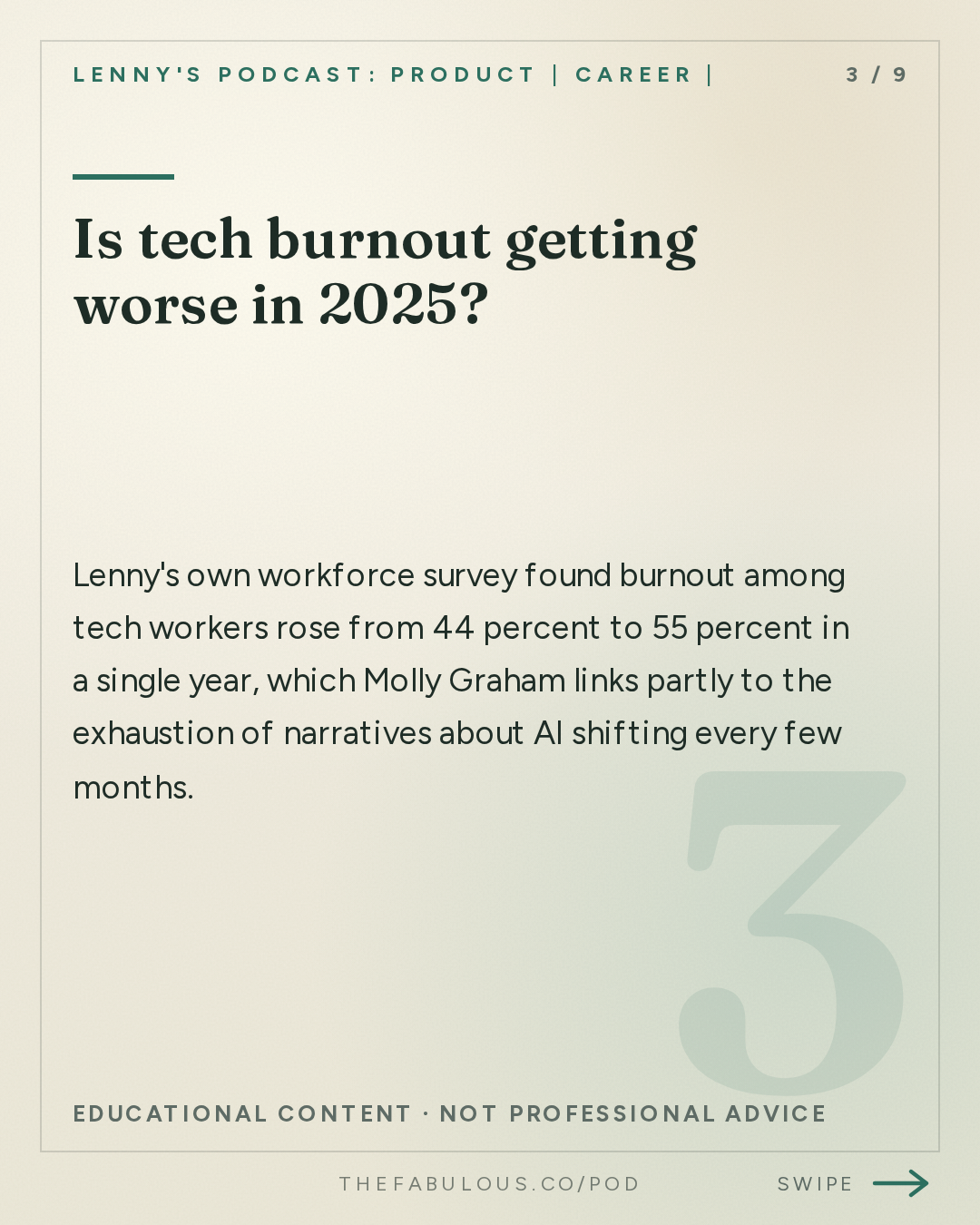
Is tech burnout getting worse in 2025?
Lenny's own workforce survey found burnout among tech workers rose from 44 percent to 55 percent in a single year, which Molly Graham links partly to the exhaustion of narratives about AI shifting every few months (30:03).
Should AI be treated like an employee when delegating tasks?
Molly Graham argues AI behaves like a lazy intern that needs the same coaching, context, and onboarding as a new hire, not like a senior colleague you hand a rough idea to and trust blindly (35:48).
What tasks should never be delegated to AI?
Graham says work requiring judgment, deep trust, or a vision for where a project should go should stay with humans, citing CEOs who copy an AI-written strategy memo without owning it as the failure mode to avoid (61:55).
How many people should one manager oversee, including AI agents?
Molly Graham puts the effective ceiling at 10 to 12 direct reports, and warns that counting AI agents toward that load can push managers past what they can reasonably hold in their head (47:51).
The full read, in cards
Go deeper
- Give Away Your Legos (First Round Review) — Molly Graham's original career essay on delegation during rapid company growth, one of the outlet's most read posts
- Lenny's tech workforce survey — tracked burnout and optimism among tech workers, found burnout rising from 44 percent to 55 percent year over year
- Engineering productivity report on AI coding — found AI made engineers faster but increased the share of code later rewritten by roughly 8 times
Mentioned
Molly Graham · Facebook · Google · Glue Club · Manoush Zomorodi · First Round Review · Chip Conley · OpenAI · Adam Grant · Cory Doctorow · Clay
More from this show and category
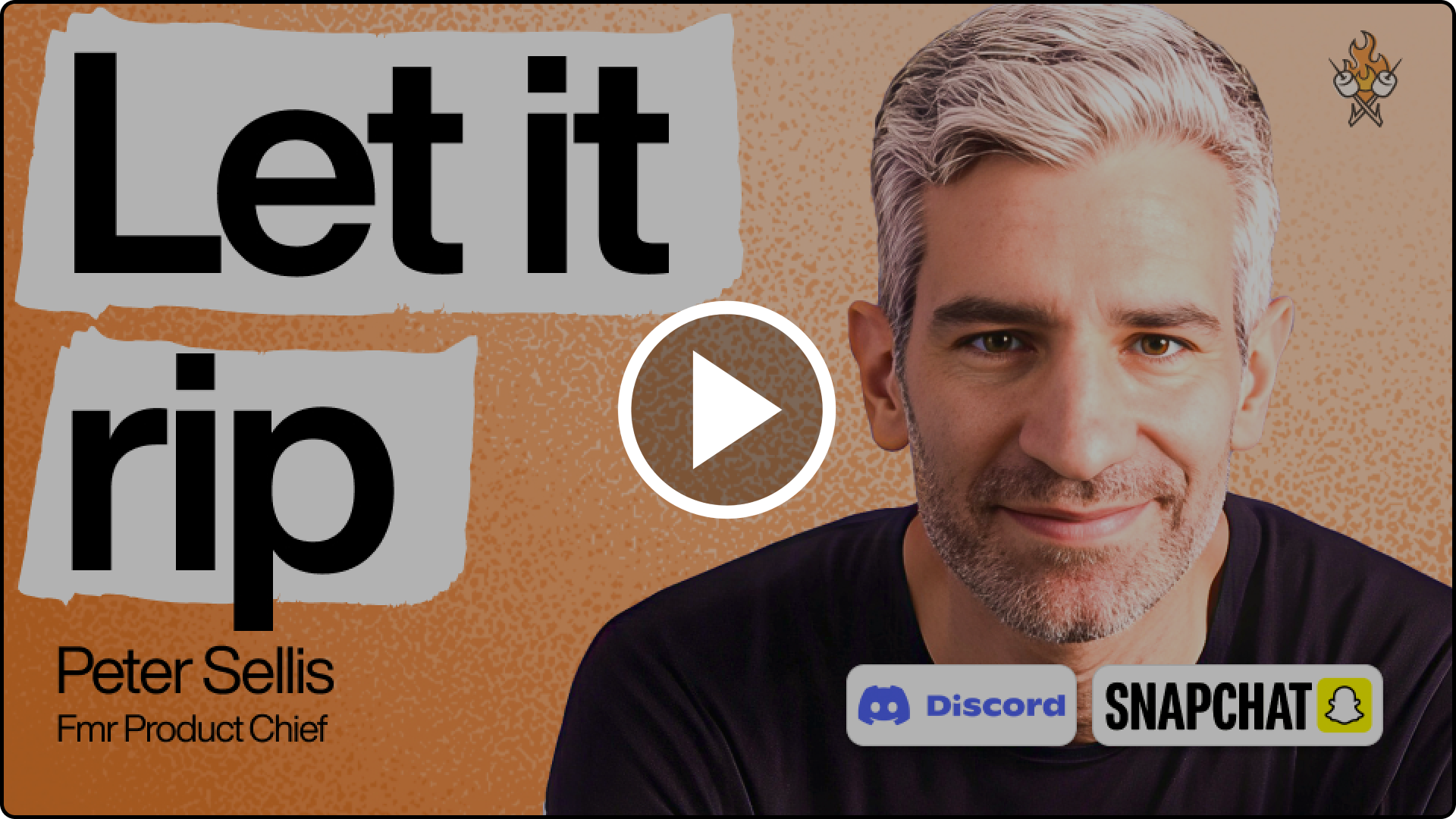
Peter Sellis on Why Most PMs Are Bad
Peter Sellis, former product chief at Snapchat and Discord, says most PMs are mediocre because top talent exits to become founders or executives. He also explains why Snap's camera-first, messaging-based product structurally resists advertising, and why growth usually comes from deepening core users' daily habits rather than chasing new ones.

How SpaceXAI Built GroqBot in One Month
GroqBot, a knowledge-work AI agent from SpaceXAI, went from first line of code to internal launch in one month (05:07). A small isolated team, manual onboarding of 200-300 early users (11:41), and giving each bot its own cloud computer instead of sharing the user's device (31:58) drove its rapid, widely praised launch.
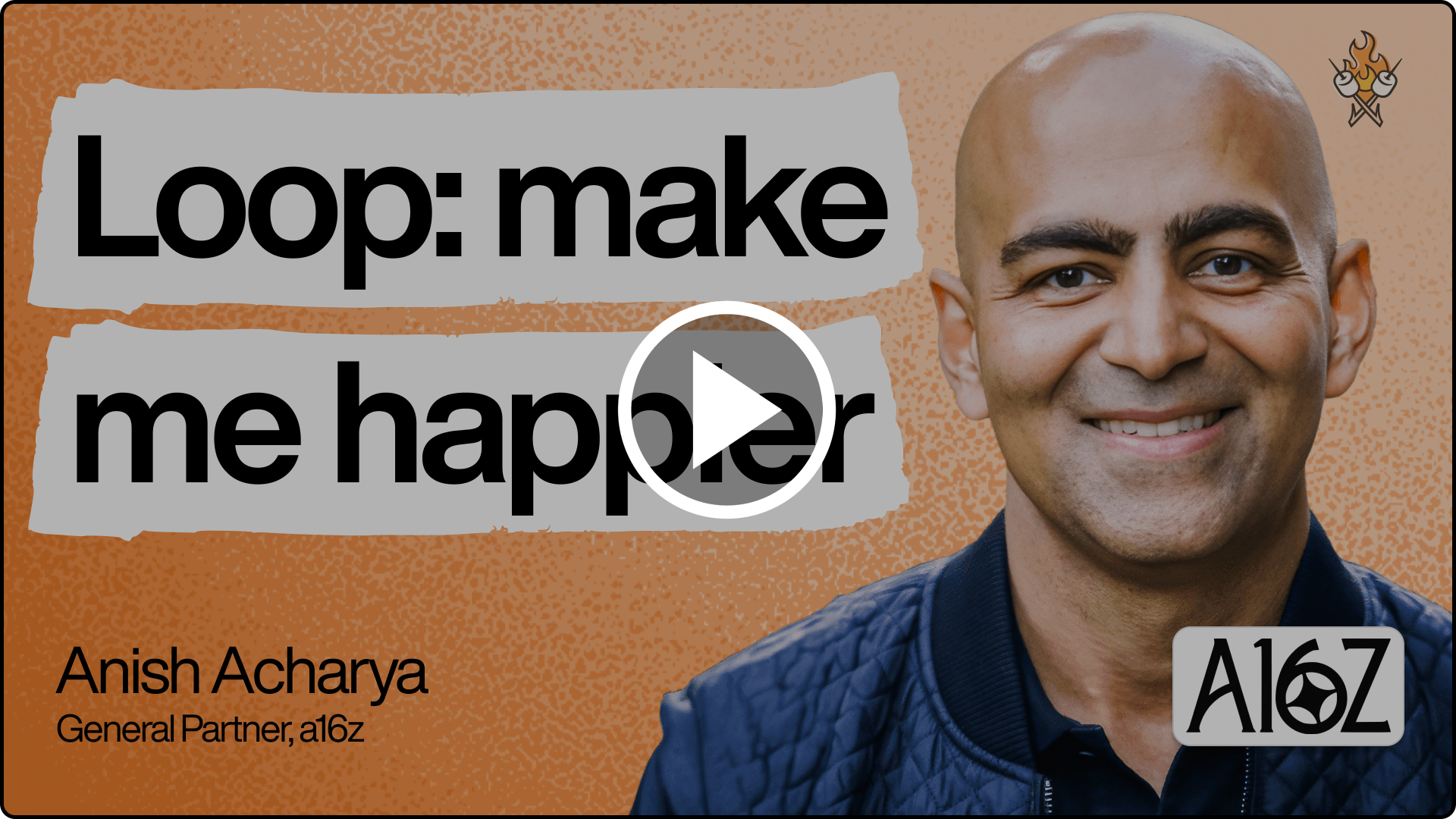
Anish Acharya on AI Loops and Company Design
Anish Acharya, general partner at venture firm a16z, argues that companies are turning into stacks of self-correcting AI loops, from bug fixes to sales, but that every loop still hits a plateau where only human judgment can point it toward the next opportunity (15:15).

Tara Seshan on OpenAI's AI Product Strategy
OpenAI's third AI era is the persistent coworker, after chat and agents. Product lead Tara Seshan says to build features for where AI models will be in two to three months, not today's limits or a year-out guess, and treats writing as thinking as something she never automates.
