
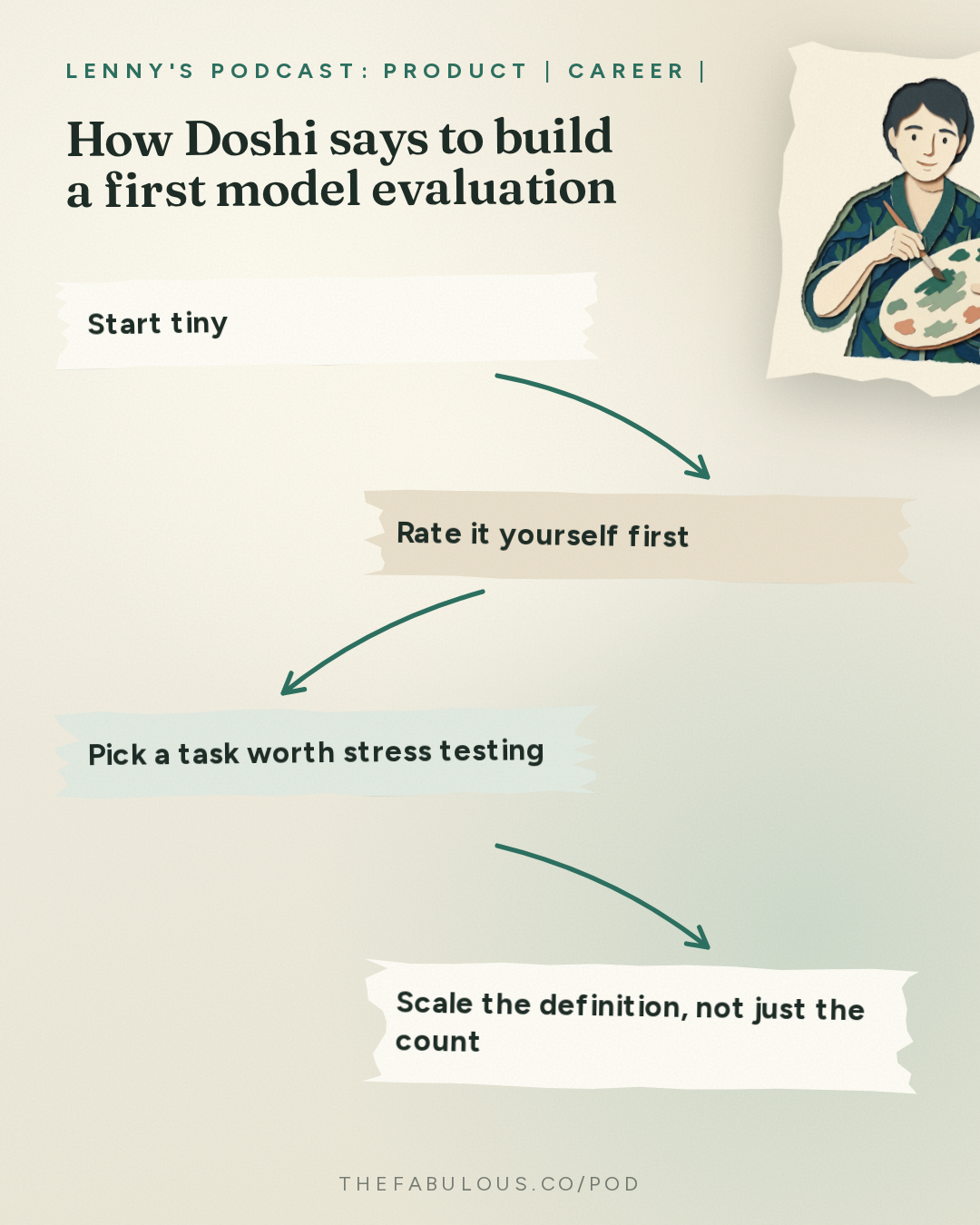
Tulsee Doshi on Why AI PMs Matter Again
Why PMs are suddenly valuable again | Tulsee Doshi (Head of Product, Gemini)
The brief
Google Gemini head of product Tulsee Doshi says a PM's job now is judging taste as AI makes building nearly free. She shares her 60/20/20 rule for building features ahead of a model's limits, explains how structured evals differ from gut-level vibes testing, and argues a model's personality is itself user experience.
Tulsee Doshi runs product for Google's frontier models, the family that includes Gemini, and she opens with an odd comparison. Training a large model, she says, is
"The model isn't predictable. It's kind of like Snape's potions class. So you can put all the ingredients in, but you also have to expect that there will be a little bit of magic." — Tulsee Doshi [00:00]You can set goals for a model, run evaluations, track metrics as a training run climbs (04:45), and still end up somewhere unplanned. Doshi's job, as she describes it, is not only to shape what goes into a model. It is to study what comes out the other side, notice where the model surprises her, and turn that surprise into something a user can actually use (03:36).
That idea, that a product manager's real material is an unpredictable system rather than a spec document, runs through everything else she says. It explains why Google is racing to prove it still belongs at what people call the frontier, the leading edge of model capability. Doshi points to Gemini 4 Argon as evidence the company is not conceding that ground (06:45), and she rejects the idea that Google should settle for being merely efficient rather than state of the art. "I actually think we do want to win the frontier conversation," she says, adding that Google's advantage is building across the whole stack, from hardware to consumer apps used by what she estimates are fourteen separate Google products with more than a billion users each (07:34).
On safety, her answer is practical rather than philosophical. One concrete mitigation her teams use is monitoring a model's chain of thought, the step by step reasoning a model produces, so engineers can catch and intervene when a model's actions drift from what it was directed to do (11:08). She also points to a partnership with the cybersecurity company Wiz, now part of Google, and describes a case study from Wiz's Stand for Good program in which the company identified and patched a vulnerability inside a hospital system (12:06). Her bigger claim is that optimism about AI safety is not a feeling, it is a discipline: "The path to optimism here is through thinking about it, and being very careful and very thoughtful and very intentional on the path to get there" (13:12).
The Return of Taste
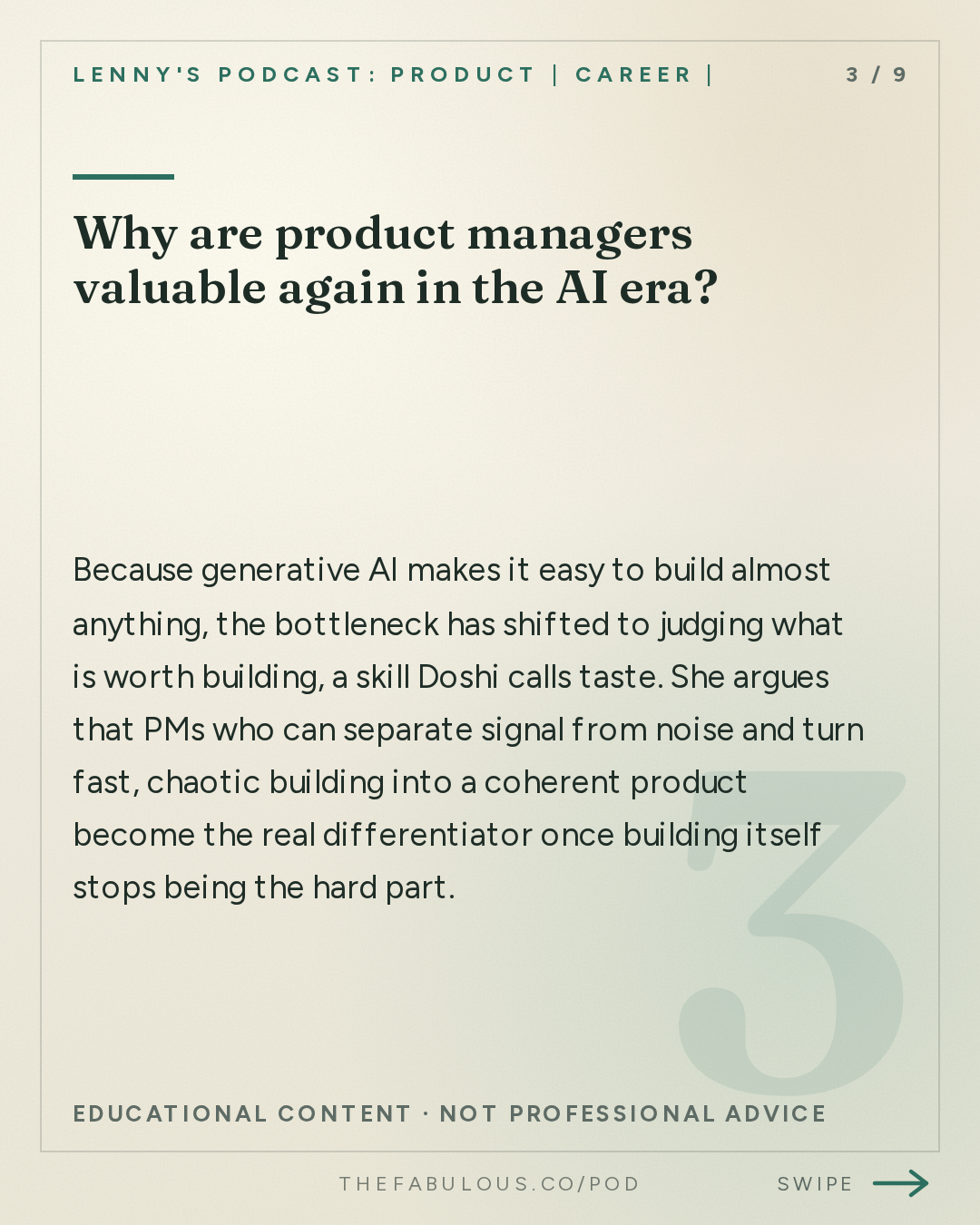
The most quotable part of the conversation is about product managers themselves. For a stretch of the generative AI boom, the industry joke was that PMs were obsolete, since anyone could prompt a model into building something. Doshi says that phase is over, and for a specific reason. When building is nearly free, the scarce skill becomes judgment: knowing what is worth building and what counts as genuinely good.
"When you can build anything, and you can build anything so easily, building something great actually is now a unique value add." — Tulsee Doshi [20:30]She calls this taste, and says it is exactly what a PM is supposed to supply: pulling signal from noise and turning the chaos of fast, easy building into something coherent (20:40).
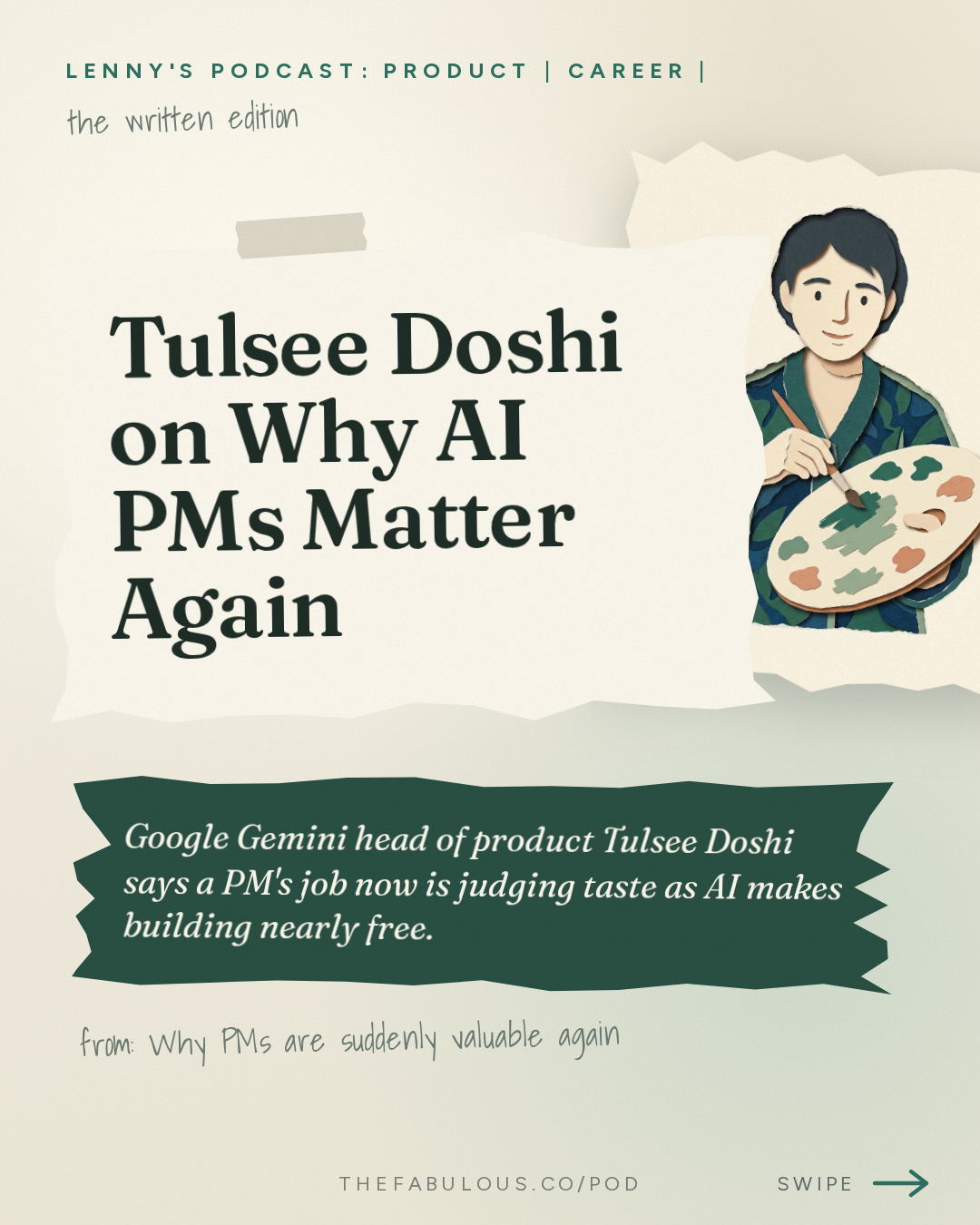
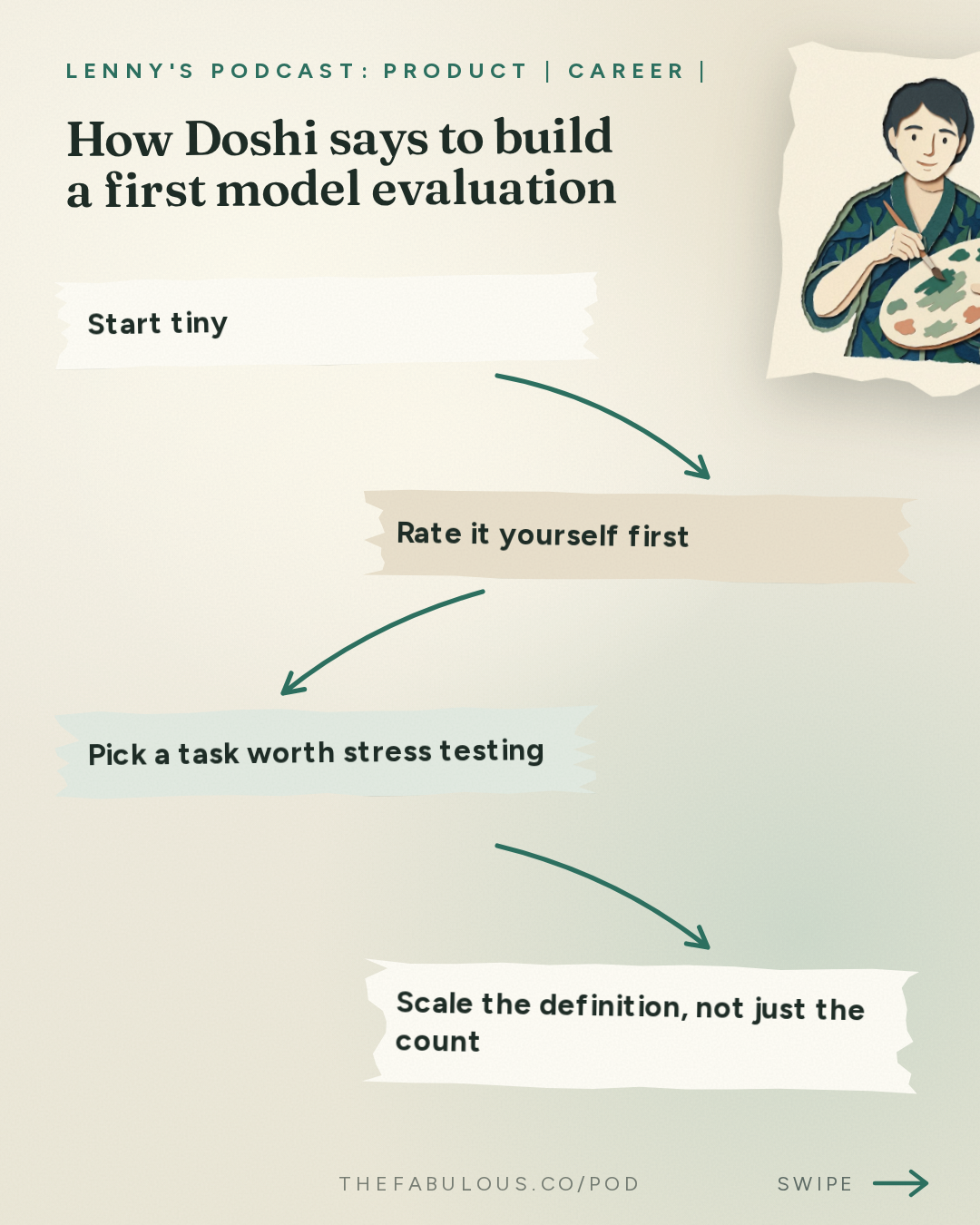
That shift changes what she looks for when hiring. She wants PMs who have personally developed a feel for how models behave, what she calls "vibes," by using them constantly and forming opinions (21:38). But she pairs that with a harder technical bar: PMs need to be comfortable building their own evaluations, commonly shortened to evals, which are structured tests that check how well a model performs a specific task. Her advice for anyone intimidated by that word is to start absurdly small. A useful first eval, she says, can be as few as twenty prompts that stress test one capability well enough to see a difference between two models (23:49). The trick to the vibes side is similar: pick a task that actually matters to you, whether that is financial analysis, creative writing, or image generation, because that is where a new model's improvements show up most clearly (25:01).
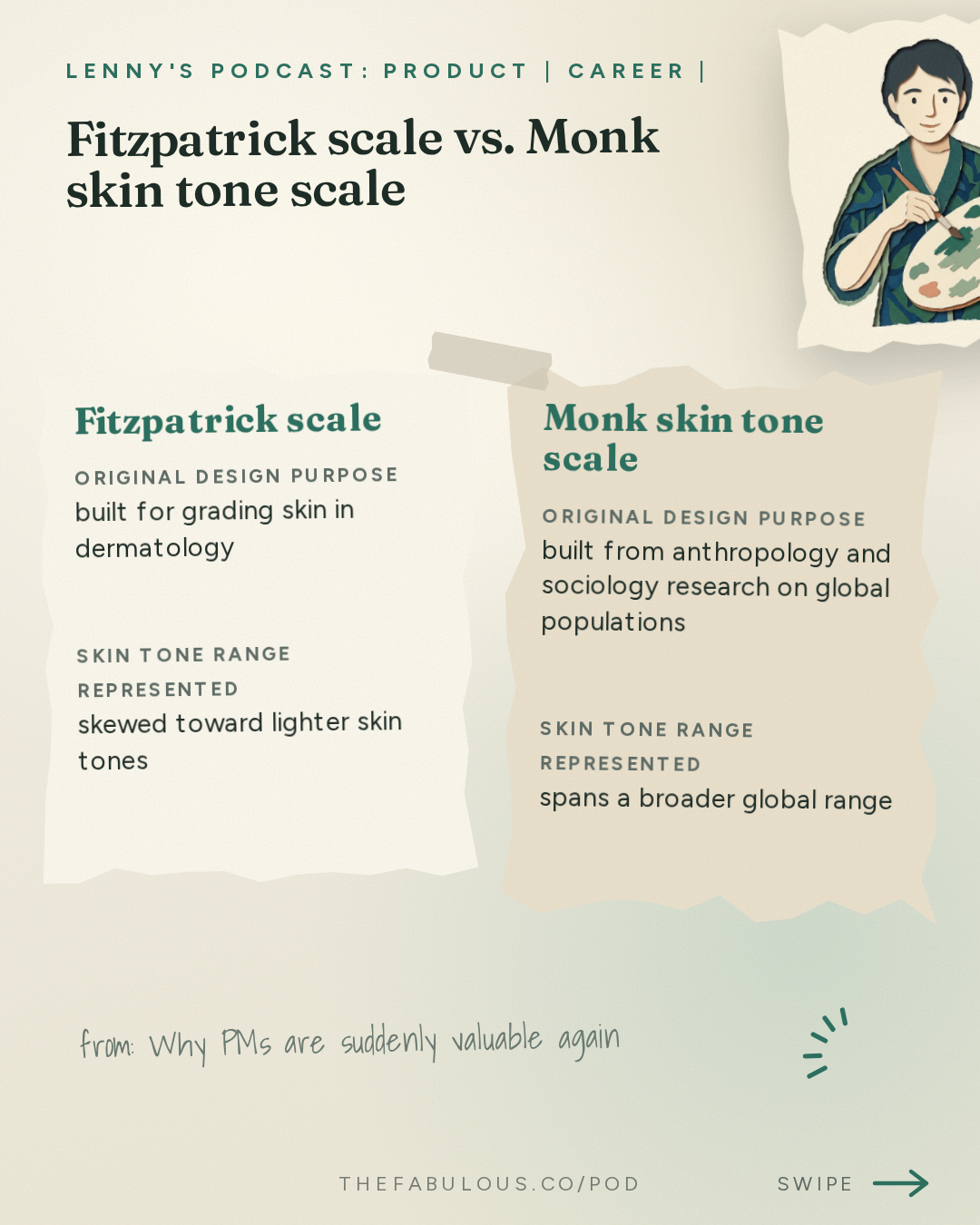
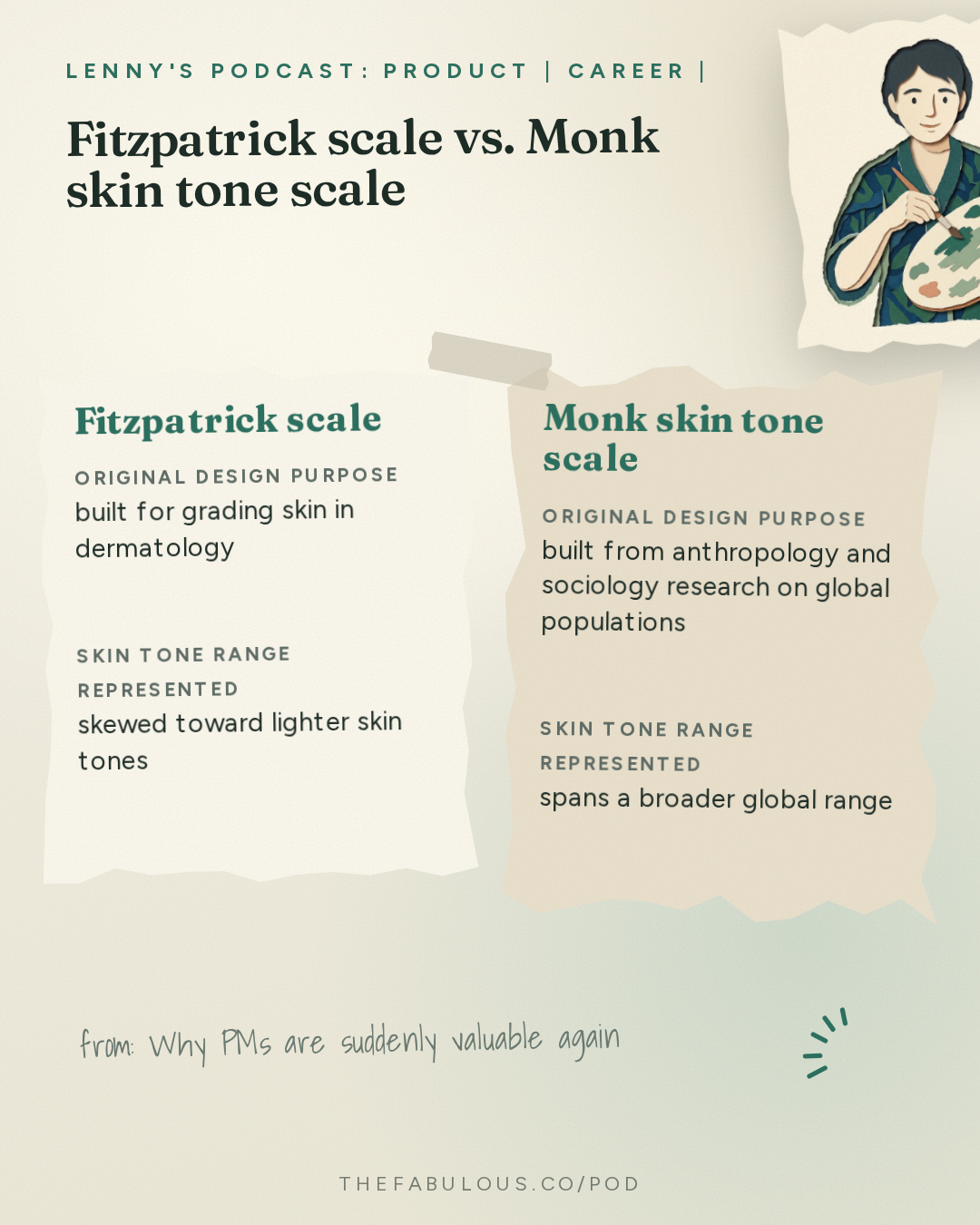
She illustrates why evals need constant updating with a story from her six years leading Google's responsible AI team. Early AI products judged skin tone representation using the Fitzpatrick scale, a six-category system (27:22). The scale had two problems. It was built for dermatology, not for representing a global population, and it skewed toward lighter skin tones even within that narrower purpose. Google eventually adopted a ten-tone scale developed by Harvard researcher Professor Monk through years of anthropological and sociological fieldwork, and used it to rework evaluations behind products including the Pixel Camera (27:46). The broader lesson she draws is that an evaluation is only as good as its weakest link, including the quality of whatever model is being used to judge the output (28:45).
Building for a Target That Keeps Moving
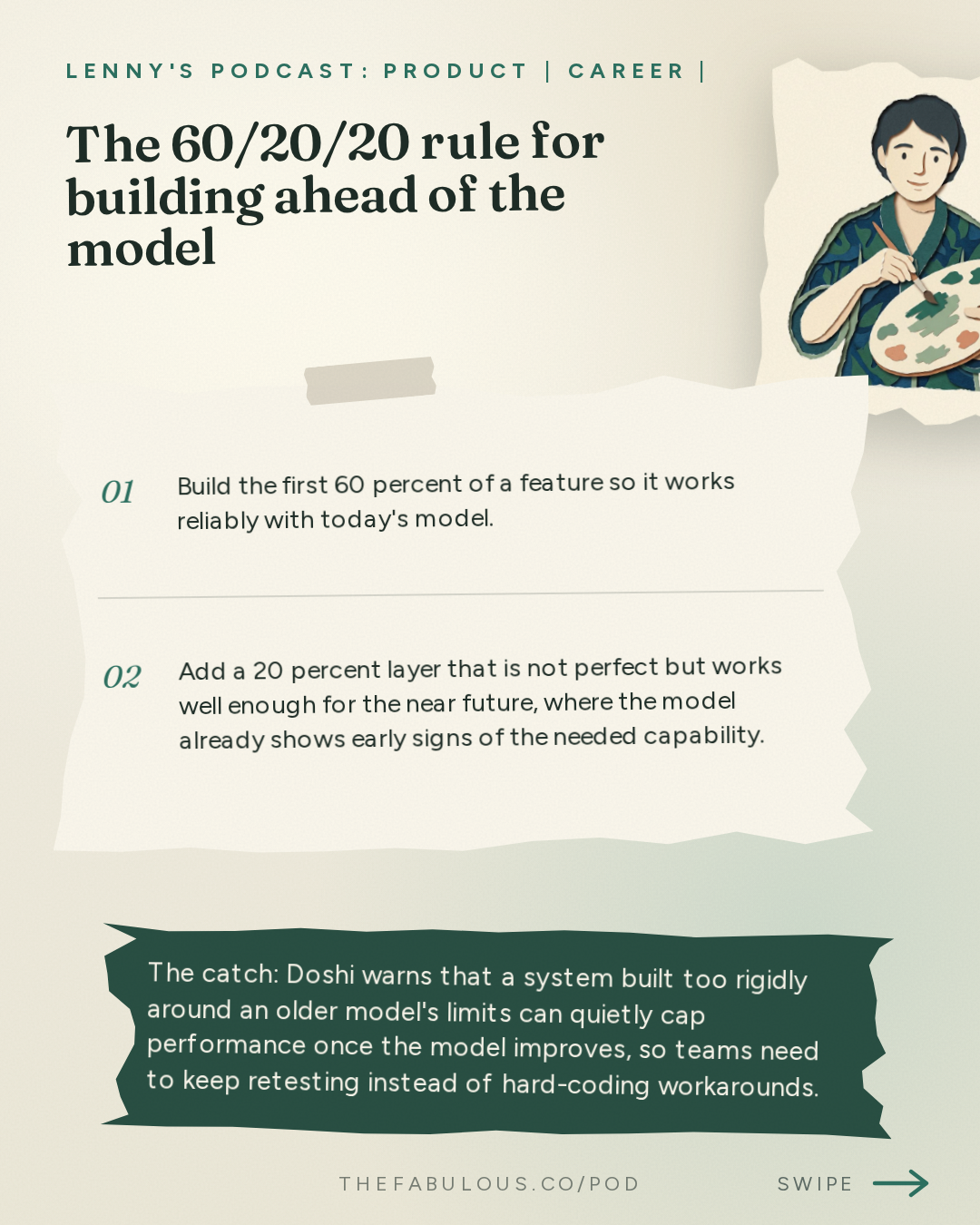
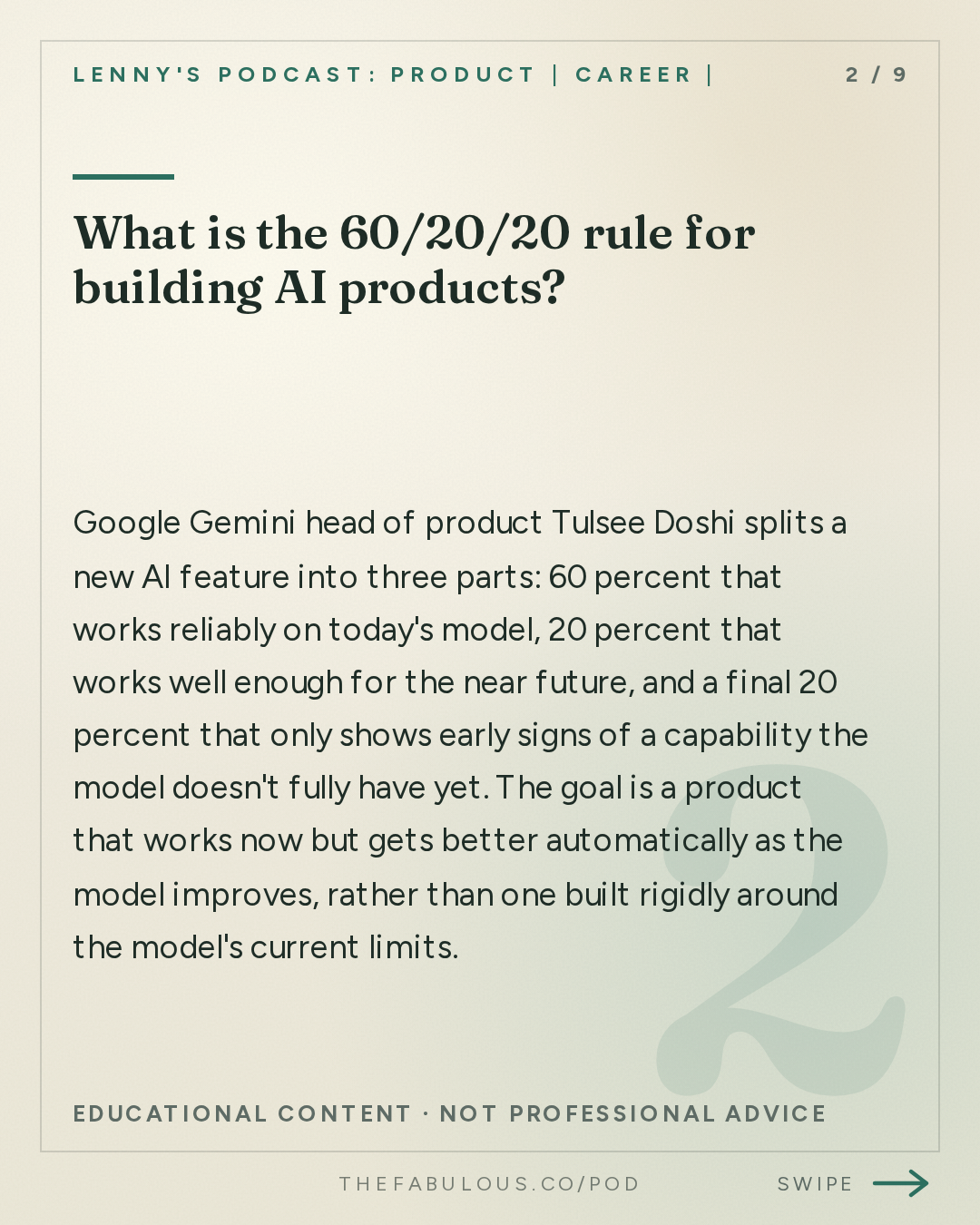
Because models improve every few weeks, Doshi argues that traditional product wisdom, build a minimum viable product that works, is incomplete advice for this environment. Her alternative is what she calls the 60/20/20 rule: build the first 60 percent of a feature so it works reliably today, add a 20 percent layer that works well enough for the near future, and reserve a final 20 percent for a capability the model does not fully have yet but shows early signs of (33:26). The payoff is a product that works now and gets better automatically as the underlying model improves, instead of one that has to be rebuilt every time a new model ships.
The risk, she warns, runs the other way. Teams sometimes build rigid systems around a model's current limits, and when the model improves, that rigid scaffolding actually holds the product back rather than helping it (35:47). The scaffolding she means is a harness: the system instructions, available tools, context, and skills that surround a model and define what it can act on (37:11). Her recommendation is to keep retesting the harness rather than assuming last quarter's workarounds still make sense.
None of this, she says, comes free of strain. Her team is working long hours, and she is candid that she has not solved the sustainability question yet. But she distinguishes between two different sources of burnout. Long hours on work you care about are exhausting but tolerable. Burnout, in her view, comes from churn, chaos, and what she calls grunt work, tasks that feel wasteful rather than meaningful (45:40). She sees a narrow opening for AI to help here, not by reducing hours but by removing the frustrating, repetitive parts of a job so people spend more time on the parts they actually chose the work for. One practical version of this shows up in how her team handles documents: she wants AI to supply the data, pulling dashboards, metrics, and user feedback into a draft, while the PM supplies the insight and judgment layered on top (49:01). The net effect, she argues, is that the PM's output has shifted from writing requirements down to providing what she calls heft, demonstrated through prototypes, evals, and data rather than prose (50:32).
Doshi closes the conversation somewhere unexpected: classical Indian dance, which she has performed since she was three years old, and a cultural festival in Portland she has helped organize for years. She describes dance as one of the few activities that empties her mind of everything else, and she credits a related habit, actively seeking serendipity by putting herself in uncomfortable, unfamiliar situations, as the closest thing she has to a life philosophy (54:33). It is a fitting way to end a conversation that keeps circling back to the same idea: in a field defined by unpredictable models and moving targets, the people who do well are not the ones chasing certainty. They are the ones who have built the discipline to stay calm while reading whatever the system hands back to them.
Ask this episode anything
Pod's AI answers from the episode itself, with the minute mark so you can hear it yourself.
Or start with one of these
Ask this episode
Pod's AI listens to the whole episode to answer, and points you to the minute it comes from.
The rest of this answer, and any question after it
Answers come from the episode itself, never from a summary of it.
ContinueKey takeaways
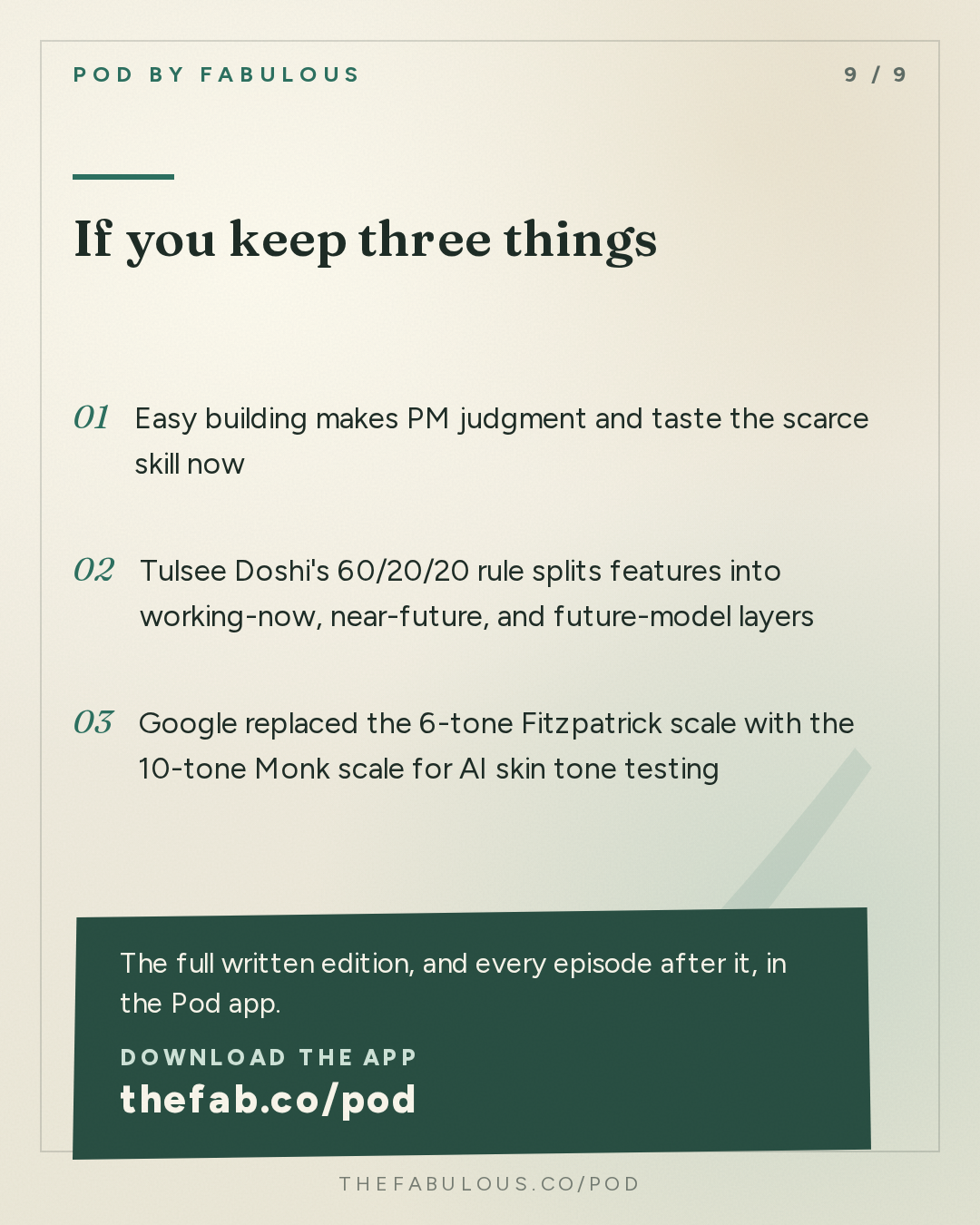
- Easy building makes PM judgment and taste the scarce skill now
- Tulsee Doshi's 60/20/20 rule splits features into working-now, near-future, and future-model layers
- Google replaced the 6-tone Fitzpatrick scale with the 10-tone Monk scale for AI skin tone testing
- Doshi says a first model evaluation can start with just 20 prompts testing one capability
- Doshi ties team burnout to chaos and grunt work rather than hours worked, and sees AI as a possible fix
The episode in cards
By the numbers
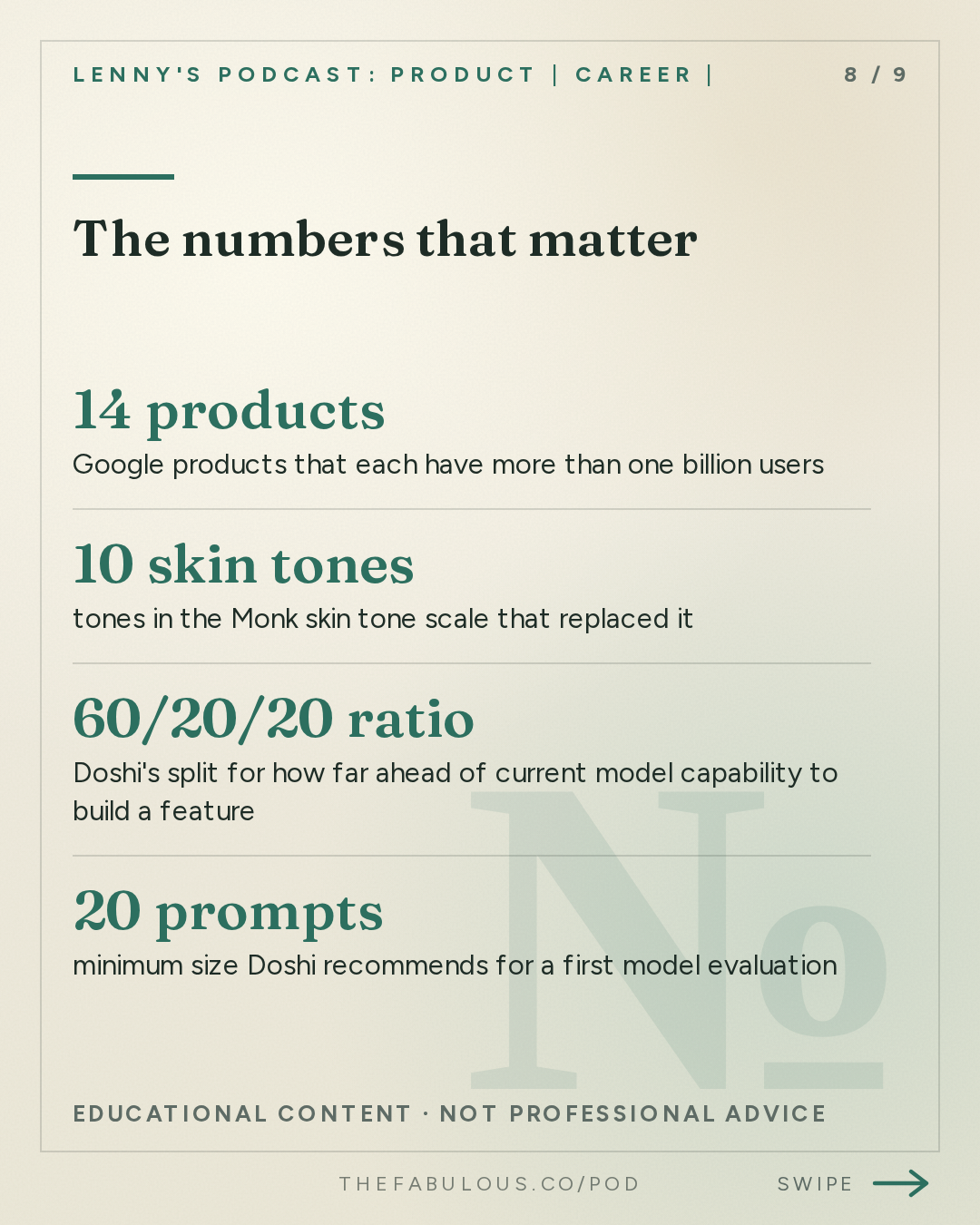
- 14 products Google products that each have more than one billion users
- 10 skin tones tones in the Monk skin tone scale that replaced it
- 60/20/20 ratio Doshi's split for how far ahead of current model capability to build a feature
- 20 prompts minimum size Doshi recommends for a first model evaluation
In their words
“The model isn't predictable. It's kind of like Snape's potions class. So you can put all the ingredients in, but you also have to expect that there will be a little bit of magic.”
“When you can build anything, and you can build anything so easily, building something great actually is now a, a unique value add”
“I want PMs who have an opinion, who are playing with these models every day. You ideally wanna stress test the model on things that you are excited about.”
“The path to optimism is through thinking about it, um, and being like very careful and very thoughtful and very intentional on the path to get there”
Protocols
-
Start an eval with a handful of prompts
Tulsee Doshi recommends beginning a model evaluation with as few as five to twenty prompts that stress test one specific capability, acting as the rater yourself before trying to scale the judgment up.
At the start of testing any new model or capability
-
Apply the 60/20/20 build rule
Doshi tells PMs to build the first 60 percent of a feature so it works reliably on today's model, add a 20 percent layer that works well enough for the near future, and reserve a final 20 percent for a capability the model only shows early signs of.
For every major feature or roadmap decision
-
Treat model personality as user experience
Doshi has her product team translate feedback on a model's tone, transparency, and communication style into rubrics that feed the model's reward training, so behavior gets engineered with the same rigor as a screen layout.
Ongoing collaboration with the model behavior research team
-
Let AI supply data, keep insight human
Doshi asks her team to let AI draft status documents using dashboards, metrics, and user feedback, while the PM provides the judgment and insight layered on top, since that separation is what keeps AI-written docs useful instead of becoming noise.
Especially in the weeks after a product launch
Questions this episode answers
What is the 60/20/20 rule for building AI products?
Google Gemini head of product Tulsee Doshi splits a new AI feature into three parts: 60 percent that works reliably on today's model, 20 percent that works well enough for the near future, and a final 20 percent that only shows early signs of a capability the model doesn't fully have yet (33:26). The goal is a product that works now but gets better automatically as the model improves, rather than one built rigidly around the model's current limits.
Why are product managers valuable again in the AI era?
Because generative AI makes it easy to build almost anything, the bottleneck has shifted to judging what is worth building, a skill Doshi calls taste (20:40). She argues that PMs who can separate signal from noise and turn fast, chaotic building into a coherent product become the real differentiator once building itself stops being the hard part (20:08).
What is the difference between evals and vibes in AI model testing?
An eval, short for evaluation, is a structured test, sometimes as small as five to twenty prompts, that checks how a model performs a specific task (23:49). Vibes is the informal, qualitative sense a PM builds by personally stress testing a model on tasks they care about, which Doshi says is just as important for noticing where a new model actually improves (21:38).
What was wrong with the Fitzpatrick scale for AI skin tone testing?
The Fitzpatrick scale measured only six skin tones and was originally built for dermatology, not for representing a global population, so it skewed toward lighter skin tones (27:22). Google replaced it with the ten-tone Monk skin tone scale, developed by Harvard researcher Ellis Monk from anthropology and sociology research, and used it to improve products including the Pixel Camera (27:46).
What causes burnout on AI product teams?
Doshi says burnout comes less from hours worked and more from churn, chaos, and what she calls grunt work that feels meaningless (45:40). She argues AI tools can reduce burnout if they remove the repetitive, frustrating parts of a job and free people to spend more time on the creative work they chose the job for in the first place.
What is a harness in AI development?
A harness is the wrapper around a model: its system instructions, the tools it can call, the context it receives, and the skills it has access to (37:11). Doshi says a harness needs regular retesting because one built rigidly around an older, weaker model can hold back a newer, better model instead of helping it (35:47).
The full read, in cards
Go deeper
- Monk Skin Tone Scale — ten-tone scale built by Harvard researcher Ellis Monk from anthropology and sociology research, adopted to replace Google's six-tone Fitzpatrick-based evaluations
- Flash teams research (Stanford) — Doshi's Stanford research with professor Michael Bernstein on assembling efficient crowdsourced teams, which she says now maps onto how AI agent swarms organize themselves
- Exhalation — Ted Chiang short story collection Doshi recommends for its story about keeping digital avatars alive after a platform shuts down
- Creativity, Inc. — Pixar memoir Doshi recommends for its thinking on building a culture that lets people fail and recover
Mentioned
Tulsee Doshi · Gemini · Google DeepMind · Wiz · Ellis Monk · Michael Bernstein · Exhalation · Creativity, Inc. · WhisperFlow · ACOTAR · Gemini 4 Argon · Eli Collins · Boris Cherny · Josh Woodward
More from this show and category

Hector Serrano's Whisperflow Growth Playbook
Hector Serrano joined Whisperflow at 19 and built a creator-pay model: a cut of ad spend, not a flat fee. The approach helped fuel the company's 30X revenue growth and $2B valuation (01:45). Serrano argues young, hungry hires beat polished resumes, and creative work should stay human, not AI-made (65:44).

Rob Snyder's Pull Framework for Product-Market Fit
Startup advisor Rob Snyder says product-market fit shows up when one specific person inside a company has an urgent, unavoidable project that no current option solves (04:36). His PULL framework (Project, Unavoidable, List of options, Limitations) replaces guesswork with a testable hypothesis, verified by cold outreach and five real sales calls (07:33, 45:13).

How AI Models Actually Think
Anthropic researcher Emmanuel Ameisen explains that language models are grown through training, not programmed line by line, so even their creators cannot read their internal logic directly. Interpretability research shows models form internal plans, share universal concepts across languages, and sometimes fixate on wrong answers when training data rewards them incorrectly (01:45, 15:31, 37:14).

Josh Woodward on Building an AI Labs Team
Google Labs head Josh Woodward argues every company now needs a frontier team that tests new AI models obsessively, judges early products by watching users' eyes rather than dashboards, and hires for an 'unlearning rate' as much as a learning one (32:13).
