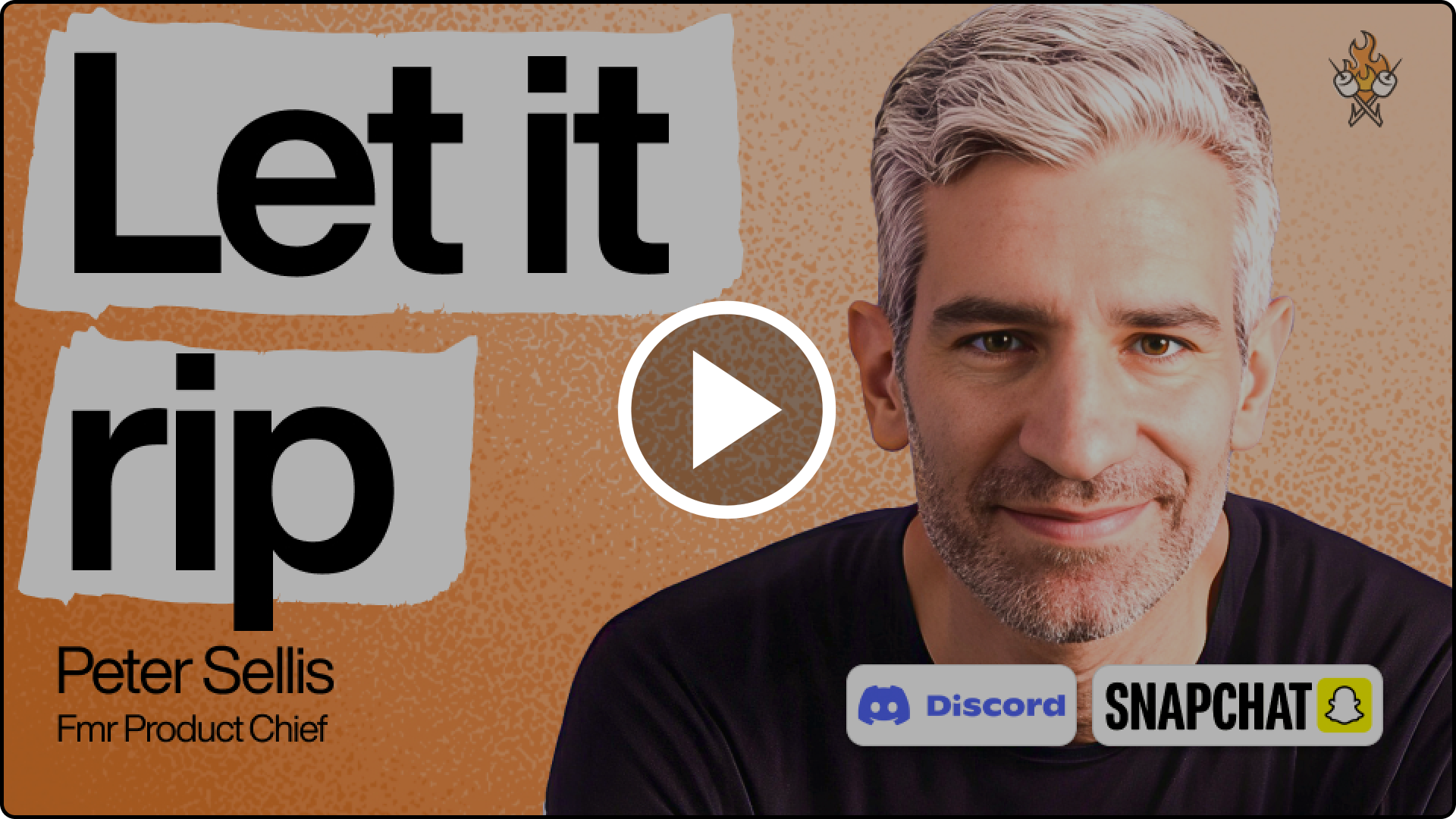
Peter Sellis on Why Most PMs Are Bad
90 minutes of unfiltered product advice from Snap and Discord’s product chief | Peter Sellis
The brief
Peter Sellis, former product chief at Snapchat and Discord, says most PMs are mediocre because top talent exits to become founders or executives. He also explains why Snap's camera-first, messaging-based product structurally resists advertising, and why growth usually comes from deepening core users' daily habits rather than chasing new ones.

Key takeaways
- Great PMs quietly leave the profession, dragging the median down (18:02)
- Snap's ad business struggles because its core action opens a camera, not a feed (23:50)
- Growth usually comes from raising core users' daily use, not chasing new users (51:37)
- SpaceX sunsets its best rocket, the Falcon 9, to force itself toward Starship and Mars (63:33)
- Great PMs hold three contradictions at once: confidence with humility, process with comfort in ambiguity, patience with urgency (76:39)
The episode in cards


Peter Sellis has a line he says he probably needs to workshop: he designs teams like a terrorist organization. He means it less literally than it sounds. What he admires, he explains, is that a good terrorist cell runs on two things: an ideological culture so clear that everyone can explain their own decisions, and an organizational structure so unambiguous that everyone knows who is trusted to make which call (07:42). Strip away the branding and it is a theory about why most companies move slower than they should.
Sellis, who was the first product manager at Snapchat and later head of product at Discord, thinks collaboration has a cost nobody wants to name. "Collaboration comes with incredible coordination costs, and coordination costs essentially assure that you're moving as slow as the slowest node in the system," he says (06:46). No executive ever tells a team to collaborate less, which is exactly why he treats it as a hidden tax. His fix is not to eliminate teamwork but to replace constant check-ins with shared belief and clear ownership, so a product manager can make the call a founder would have made a year or two earlier, without asking permission first.
That same appetite for clarity shapes his blunter claim: the typical product manager is bad. Not because the job attracts weak people, but because of math. If product management skill were spread evenly across the population, the people who actually become PMs sit at the far right edge of that distribution already. Lop off everyone else and what remains is not a bell curve, it is a power distribution, where the median sits well below the average (16:54). Two forces make it worse. During the low interest rate years, PM became one of the most lucrative jobs available to non-technical people, so anyone inside the profession had every reason to stay in it, skilled or not. Meanwhile the best PMs keep leaving, because the exact skills that make someone great at the job, translating ambiguity into a plan, are the same skills that make a good founder or executive. "The median product manager is actually probably pretty bad. The great product managers are exiting the system. They're becoming founders, they're becoming executives," Sellis says (18:02). His evidence that this is a talent-selection problem rather than a job-design problem: great engineers rarely complain about PMs, because they either bend a good one to their will or simply refuse to work with a bad one.
Why Snapchat never became the next Facebook
Sellis is candid that Snap's advertising business, which he helped build for seven years, never grew into the giant many expected, and he offers three structural reasons rather than excuses. First, Snap's audience skews young, and there is a real, measurable cliff in advertising CPMs, the price advertisers pay per thousand impressions, between ages 17 and 18 and again between 18 and 21, because tracking and targeting rules tighten sharply for minors (22:25). Harder-to-measure audiences make it harder to prove return on ad spend, so advertisers pay less for them. Second, almost every profitable ad product in the world opens onto a feed, a scrollable stream built to hold attention. Snapchat opens straight into the camera. That is what makes it the fastest way to capture and send a moment, but it also means there is no natural pause point in the core flow where an ad belongs (23:50). Third, at its core Snapchat is a messaging app, and no messaging app anywhere has cracked advertising the way feed products have.
None of this means Snap failed. It reached $4 billion in ad revenue faster than Twitter or Pinterest despite launching later than both (26:40), and it holds 70 to 100 percent penetration among people under 21 across Western countries as their default map, camera, and messaging app (25:45). Sellis's point is narrower: a creation-first, camera-first product was never going to monetize like a feed, no matter how many PMs worked on it.
The same instinct for restraint shows up in how Sellis talks about taste. He compares a great product founder to a museum curator: whatever is on display is a small, deliberate slice of a much larger collection sitting in storage. "If a museum has all of their collection on the walls, then the curator hasn't done anything," he says (36:44). He says he watched Snap founder Evan Spiegel say no to better ideas than he has seen almost any other consumer founder ship, and he now tests for that instinct in interviews by asking candidates about things they built, held in their hands, and chose never to release. He also flags this as a coming problem for AI-assisted design: AI is good at adding features and bad at cutting them, so the human job on a product team increasingly becomes deciding what does not belong.
What OpenAI is speedrunning
Sellis still believes, as he puts it, that ads are the closest thing the internet has to true product-market fit for monetization (40:49). Watching OpenAI build advertising into ChatGPT, he sees the company moving fast through infrastructure that Meta spent roughly a decade, 2010 to 2020, working out: an auction mechanism where the winning bid depends not just on who pays the most, but on how relevant and welcome that ad is to the specific user (41:40). His worry is less about the mechanism and more about the format, and he points to Amazon search results, where a shopper can scroll past sixteen ads before reaching the first organic result (43:43), as an example of a company quietly spending down user trust for short-term revenue. His term for the alternative is "long-term greedy": focus on driving real return for advertisers today, even when that means leaving revenue on the table, because tomorrow's ad revenue is causally tied to the ROI advertisers actually got today. "Ad revenue tomorrow is essentially causally related to the ROI you drive for advertisers today," he says (72:05).
Sellis applies the same discipline to growth. Most consumer products, he argues, grow by raising the ratio of daily active users to monthly active users among people who already want the product for its core purpose, not by chasing new users at the edges (51:37). At Discord, that meant ignoring the buzz around Midjourney, the AI image tool that briefly made Discord famous, and instead focusing entirely on people who already play multiplayer games with friends, a group with effectively 100 percent Discord penetration (54:58). The result, he says, was some of Discord's fastest growth since the pandemic, achieved by nudging existing users from using the app ten days a month to thirteen. He extends the same logic to people, not just products: rather than coaching struggling performers, he keeps handing his strongest people more responsibility until they start making mistakes, on the theory that confidence and momentum are self-reinforcing (49:13).
SpaceX gets cited as the clearest example of a company that protects itself against its own success. Sellis, whose wife works there, notes that SpaceX recently announced it will sunset the Falcon 9, the most cost-effective, most reusable rocket ever built, in favor of the larger Starship needed to reach Mars (63:33). Most companies cling to their best product. SpaceX publishes ten-year plans and then executes them in public, daring competitors to catch up (66:06). It is the same idea Sellis pushes with his own "Core Product Value" framework: a product needs both a plain-language phrase describing why people come back daily and a matching metric that engineers can build toward, because a phrase without a metric is not actionable and a metric without a phrase is meaningless to a team (74:00).
Near the end, Sellis argues that a great PM is really three contradictions held at once: confident enough to set direction, humble enough to give credit away; organized enough to build good process, comfortable enough with ambiguity to throw it out; patient enough to hold a two-year vision, urgent enough to move today (76:39). His spiciest aside is not about product at all. Asked for the most important career decision a PM ever makes, he skips strategy entirely: it is choosing a life partner, he says, because no amount of podcast listening replaces having someone who helps you think and grow (81:05).

By the numbers
- 17 years old age where ad tracking rules create a sharp cliff in advertising CPMs
- 16 ads number of sponsored results shown on Amazon search before the first organic result
- 100% penetration Discord's reach among people who intentionally play multiplayer games on PC
In their words
“Collaboration comes with incredible coordination costs, and coordination costs essentially assure that you're moving as slow as the slowest node, um, in the system”
“A good terrorist organization essentially has two things. One is it has this ideological culture that everyone understands why they are doing what they're doing, and then it has a very, very clear organizational structure.”
“If a museum has all of their collection on the walls, then the curator hasn't done anything.”
“Tomorrow for advertising is essentially causally related to the ROI you drive for advertisers today”
Protocols
-
Load your best people until they break
Peter Sellis says leaders should keep handing their strongest performers more responsibility and harder decisions, pushing until those people start making bad calls, rather than spending that time trying to lift up struggling performers. He adds the catch that a leader has to separately check on quieter team members, since giving someone less attention does not automatically mean they are failing.
Ongoing, per top performer
-
Design the team around ideology and clear decision rights
Sellis builds teams around two things: a culture clear enough that anyone can explain why they are doing what they are doing, and an organizational chart clear enough that everyone knows exactly who is trusted to make which call. He says the goal is to let a product manager make the decision a founder would have made a year or two earlier, without needing a meeting to check first.
Set once, reinforced constantly
-
Grow the core before chasing new users
Sellis says most consumer growth should come from raising the ratio of daily active users to monthly active users, meaning turning existing occasional users into daily ones, rather than acquiring new users at the margin. He warns this only works if the team resists the pull toward flashy adjacent use cases that do not show up in daily-use numbers, as Discord did by ignoring Midjourney's buzz and focusing on multiplayer gamers instead.
Ongoing, especially after a growth plateau
-
Define Core Product Value as both a phrase and a metric
Sellis says a product needs a short sentence describing why people return every day, such as 'the fastest way to share a moment with your best friends,' and a matching metric that data scientists and engineers can track against every part of that sentence. He notes the catch that the phrase alone is not actionable for a team and the metric alone is meaningless without the story, so both have to exist together and get taught to every new hire.
Defined once, taught continuously
Questions this episode answers
Why does Peter Sellis think most product managers are bad?
Peter Sellis, former head of product at Snapchat and Discord, argues that product management skill follows a power distribution rather than a normal one: the best PMs keep exiting the profession to become founders or executives, which drags the median PM quality down (18:02). He says great engineers rarely complain about this because they either control bad PMs or avoid working with them entirely (20:31).
Why has Snapchat struggled to monetize despite huge usage?
Sellis names three structural reasons: Snap's young user base falls on the wrong side of a sharp advertising CPM cliff at age 17 due to tracking rules (22:25), the app opens straight into the camera rather than a scrollable feed, leaving no natural spot for an ad (23:50), and at its core it is a messaging app, a category with no proven large-scale ad model (24:08).
What does DAU/MAU mean and why does Sellis focus on it for growth?
DAU/MAU is the ratio of daily active users to monthly active users, a basic measure of how often people return to a product. Sellis says most durable growth comes from raising this ratio among users who already want the core product, rather than acquiring new users who may not stick, citing Discord's 2024 focus on multiplayer gamers as an example (51:37).
Why is SpaceX sunsetting the Falcon 9?
According to Sellis, SpaceX is retiring the Falcon 9, the most cost-effective reusable rocket built to date, to force its own transition to the larger Starship needed for missions to Mars, rather than letting its best product create the innovator's dilemma (63:33). SpaceX also publishes ten-year plans publicly and then executes them (66:06).
What is Core Product Value (CPV) in product management?
Core Product Value is a framework Sellis used at Snap and Discord that pairs a plain-language phrase describing why users return daily with a matching metric engineers can track. He says the phrase alone is not actionable and the metric alone is meaningless without it, so a team needs both together (74:00).
The full read, in cards


Go deeper
- Einstein's Dreams — a novel by MIT physicist Alan Lightman that Sellis gives to consumer product managers to think about time and structure
- When Genius Failed — an account of the 1998 collapse of Long-Term Capital Management, recommended by Sellis
- How to Get Filthy Rich in Rising Asia — a novel Sellis frequently recommends
Mentioned
Peter Sellis · Nikita Bier · Evan Spiegel · Phil Jackson · Snapchat · Discord · SpaceX · OpenAI · Hex · Clair Obscur: Expedition 33
More from this show and category
How SpaceXAI Built GroqBot in One Month
GroqBot, a knowledge-work AI agent from SpaceXAI, went from first line of code to internal launch in one month (05:07). A small isolated team, manual onboarding of 200-300 early users (11:41), and giving each bot its own cloud computer instead of sharing the user's device (31:58) drove its rapid, widely praised launch.
Anish Acharya on AI Loops and Company Design
Anish Acharya, general partner at venture firm a16z, argues that companies are turning into stacks of self-correcting AI loops, from bug fixes to sales, but that every loop still hits a plateau where only human judgment can point it toward the next opportunity (15:15).
Tara Seshan on OpenAI's AI Product Strategy
OpenAI's third AI era is the persistent coworker, after chat and agents. Product lead Tara Seshan says to build features for where AI models will be in two to three months, not today's limits or a year-out guess, and treats writing as thinking as something she never automates.
How to Close $100K+ Enterprise Deals
Enterprise sales runs on fifteen real steps, not the five stages most CRMs track, and the actual product changing hands on every call is information. Jen Abel, co-founder of Jellyfish and GM of enterprise sales at State of Affairs, walks through targeting, demos, pilots, and procurement for deals over $100,000.