Tara Seshan on OpenAI's AI Product Strategy
AI’s third era: the rise of persistent AI coworkers | Tara Seshan (OpenAI’s product lead)
The brief
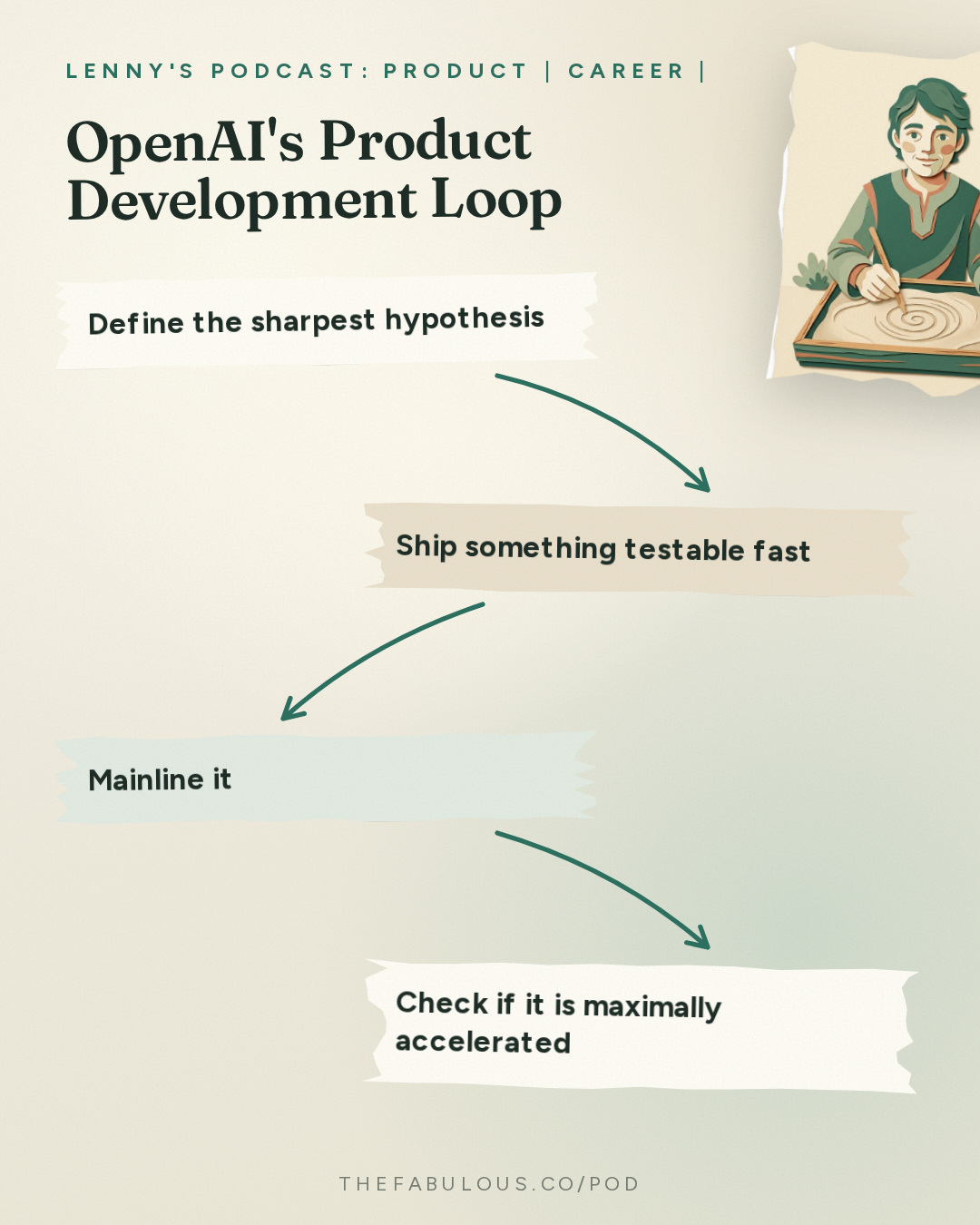
OpenAI's third AI era is the persistent coworker, after chat and agents. Product lead Tara Seshan says to build features for where AI models will be in two to three months, not today's limits or a year-out guess, and treats writing as thinking as something she never automates.
There is an old assumption about building things: put money in, get value out, the way a real estate developer buys land and collects rent. Tara Seshan, who leads product for ChatGPT Work and Codex at OpenAI, thinks software has never really worked that way, and it works even less that way now.
"Software is not like real estate. You don't, like, put money in and get value out. It is a little bit more like filmmaking, where you can put a lot of money into a film, but that doesn't guarantee that the film is successful or good." (Patrick Collison or John Collison, as quoted by Tara Seshan, 14:23)
Seshan has spent her career testing that idea. She was one of the first five product managers at payments company Stripe, later led product at climate-accounting startup Watershed, and spent time as an entrepreneur in residence at venture firm Sutter Hill Ventures before joining OpenAI about a year ago (02:24), a stretch of time she calls a lifetime by AI standards. She now leads product for both ChatGPT Work and Codex, OpenAI's coding agent.
Her framework for where the industry is headed is simple enough to fit on a napkin. The first era of AI products was chat: type a question, get an answer. The second era is agents, software that can carry out multistep tasks with limited supervision, most visibly in coding tools. The third era, which she thinks is arriving soon, is the persistent coworker (00:00).
"That third era that might come soon is how do you work with a persistent coworker who is able to get things done with you?" (Tara Seshan, 00:00)
What struck her most about OpenAI itself was not secrecy but the opposite. She expected a hidden strategy document, a master plan. Instead she found that almost every internal idea about how the model should behave becomes public product or public messaging within weeks (04:40). The company, she says, is founder-led in an unusual sense: nearly everyone functions as a founder of their own area, with very little top-down direction (03:12).
The Two-to-Three-Month Window
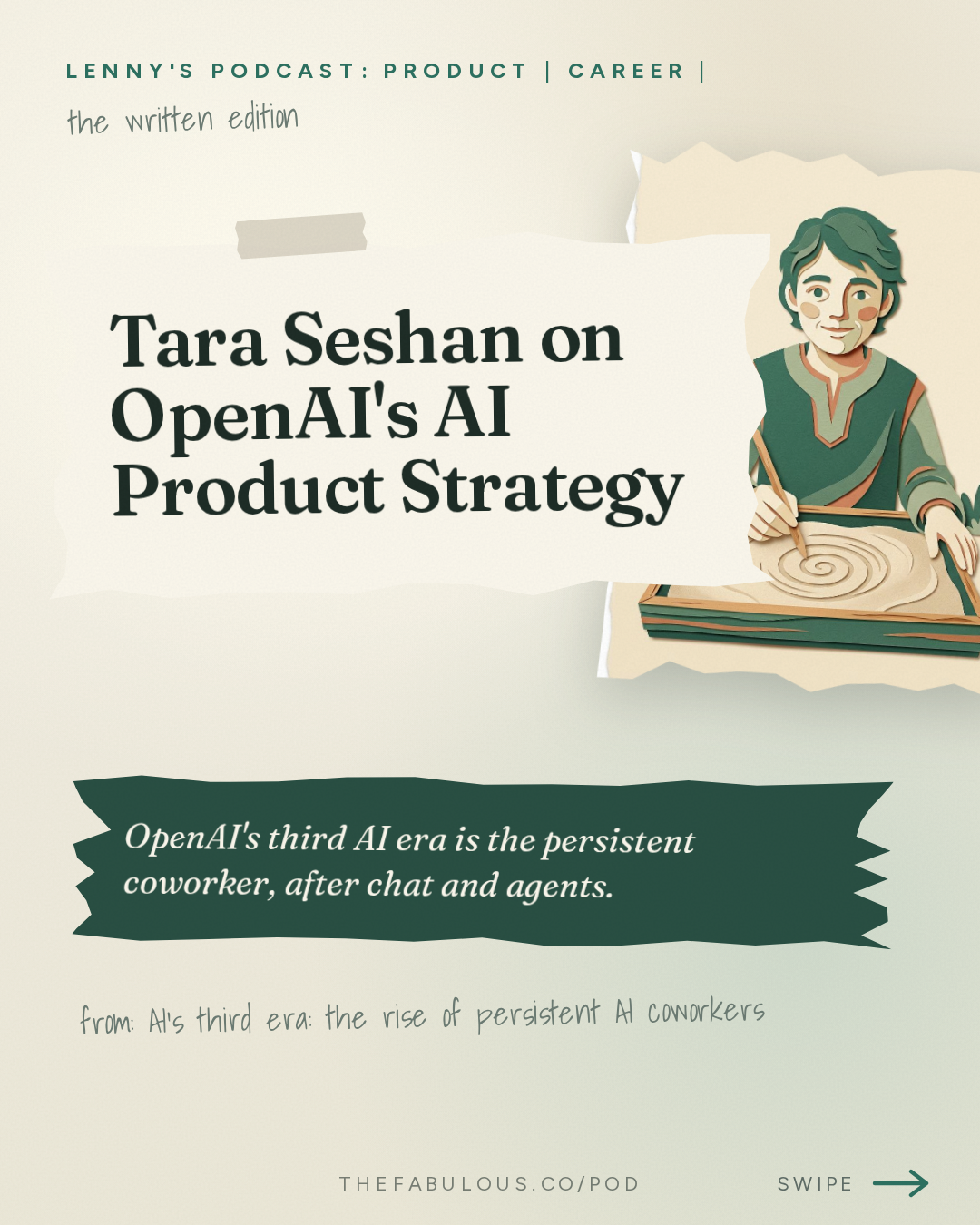
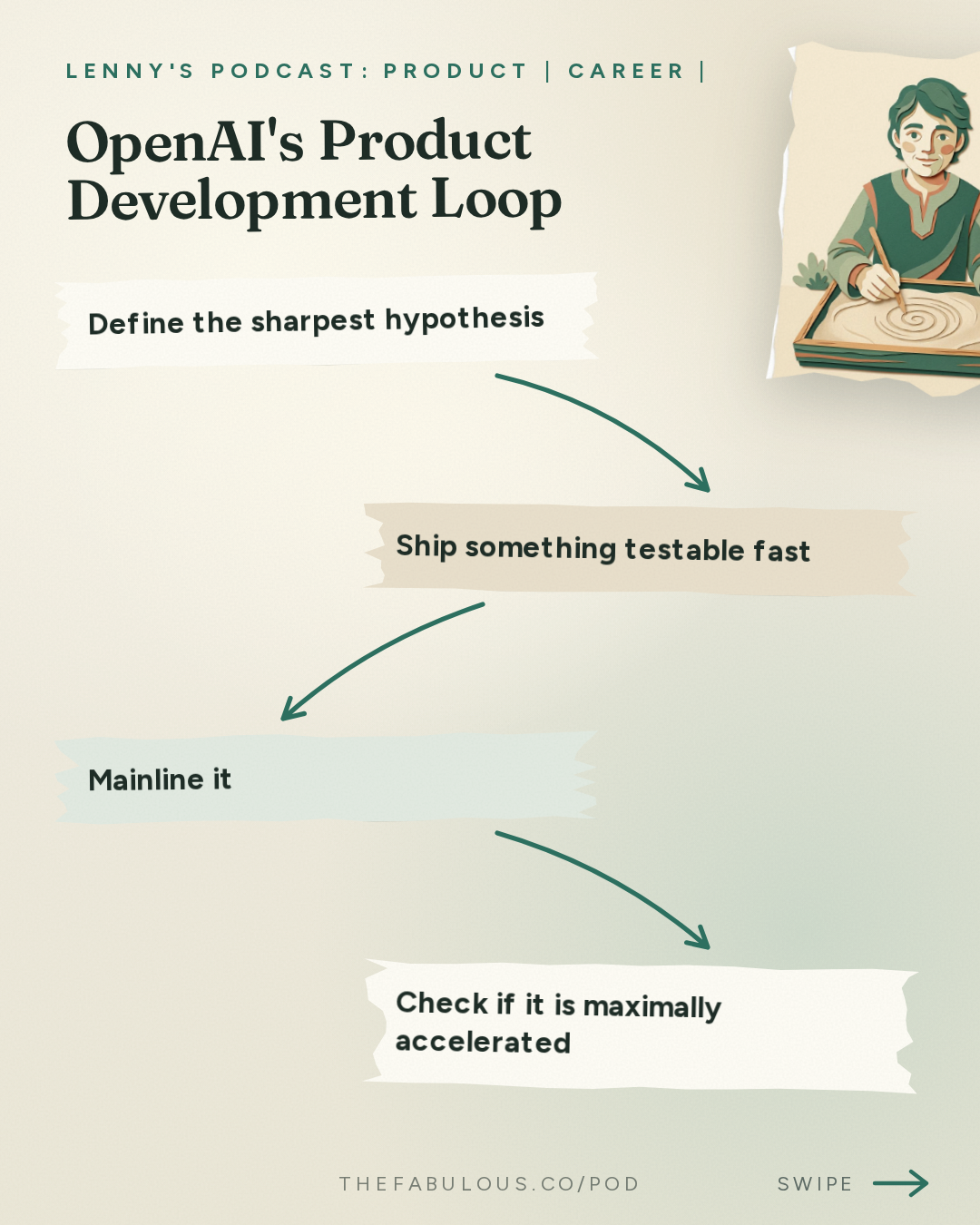
That founder-like autonomy comes with a discipline that took Seshan time to adjust to. At past companies, rigorous long-range planning was rewarded: write the strategy memo, reason from first principles, predict the market's next moves. At OpenAI, she says, being prolific and empirical matters more than being academic (07:41). Rather than a long reasoning document, the job is to find the single sharpest hypothesis and test it with users as fast as possible (08:58).
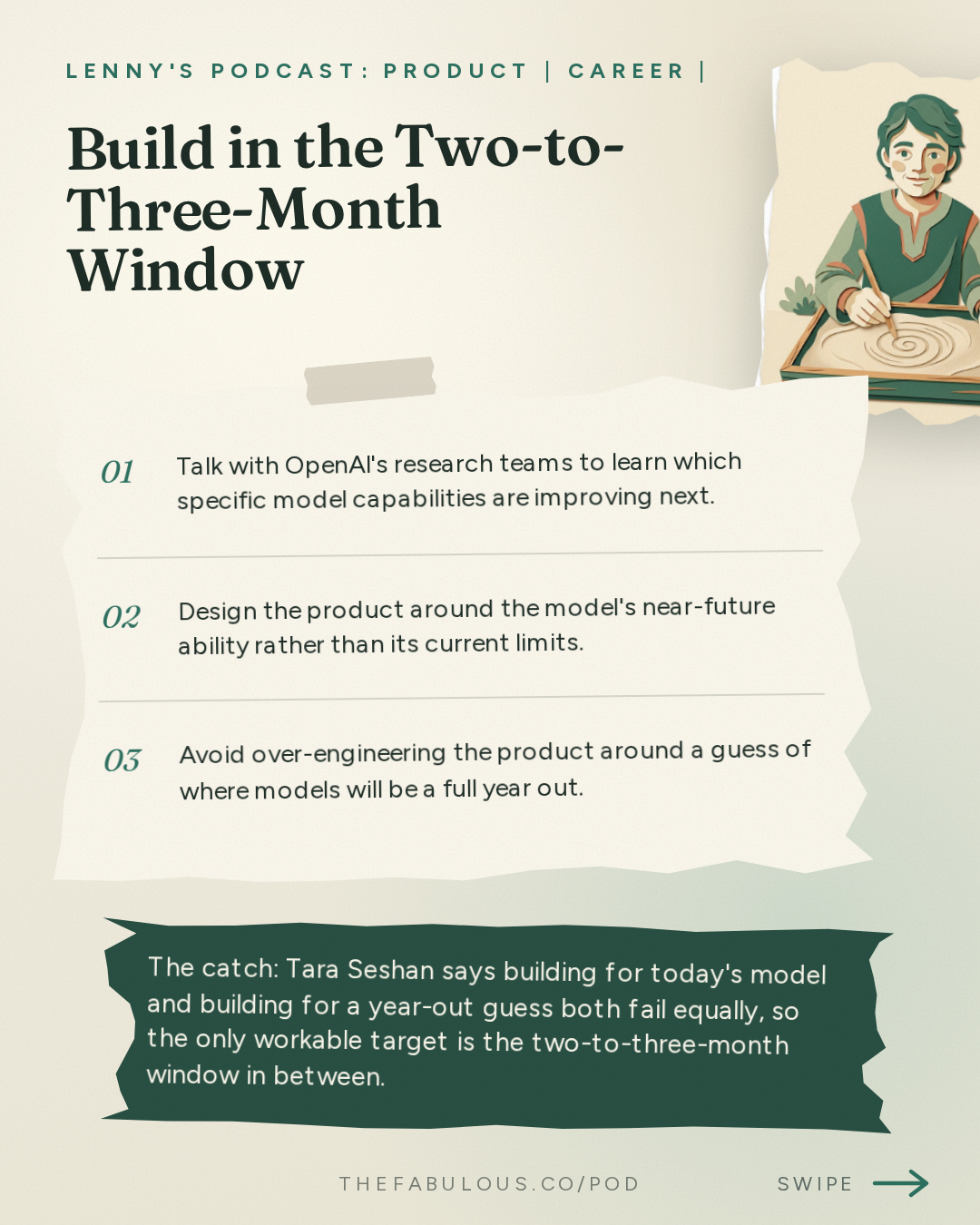
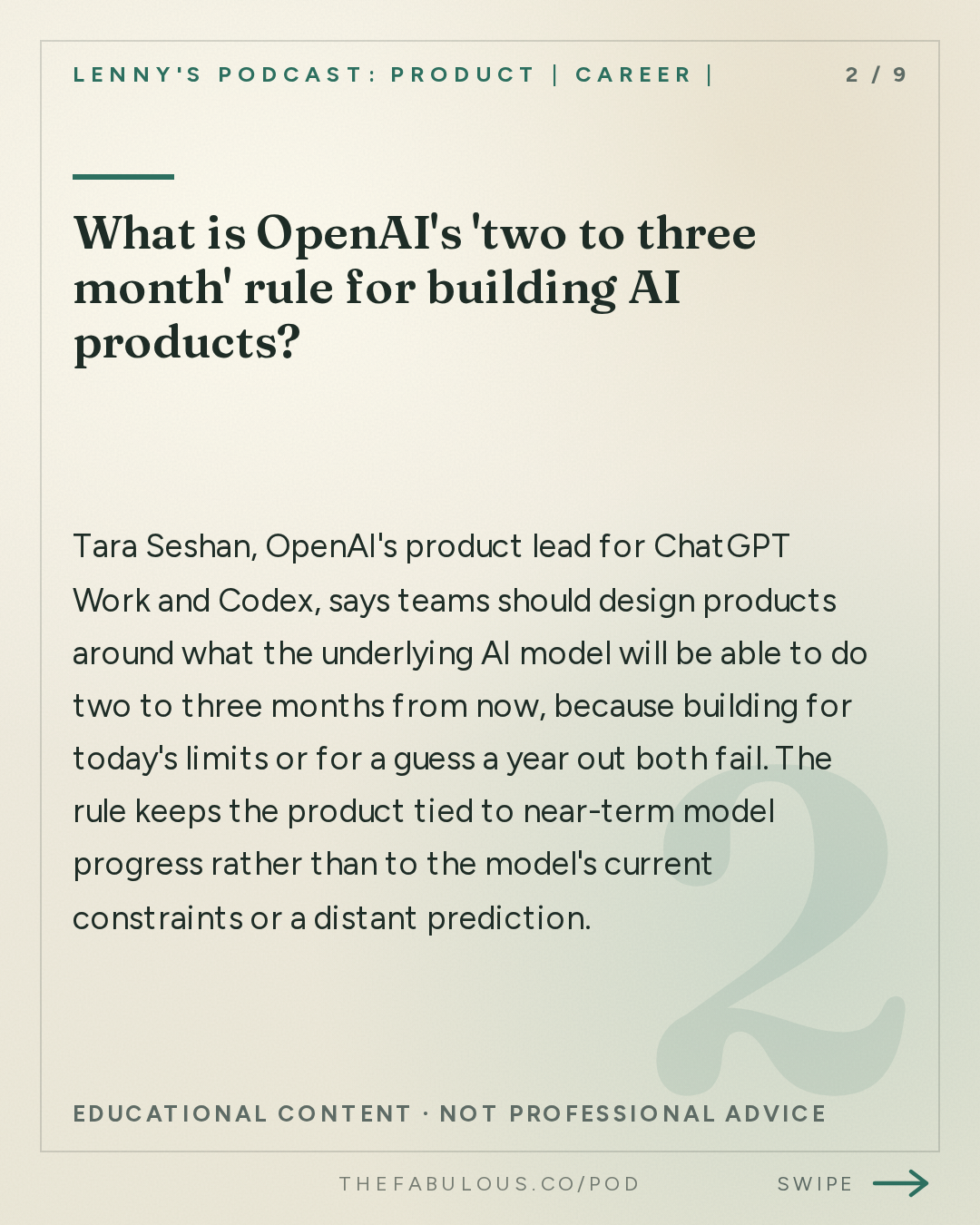
The clearest expression of that discipline is a rule she repeats often: build for where the underlying AI model will be two to three months from now, not for its current limits and not for a guess about where it will be in a year (27:39). Both extremes, she argues, produce a product that breaks the moment the model changes underneath it.
"You fail if you build for where the models are now. You fail if you build for where you think the models will be in a year. Both outcomes are equally wrong." (Tara Seshan, 27:39)
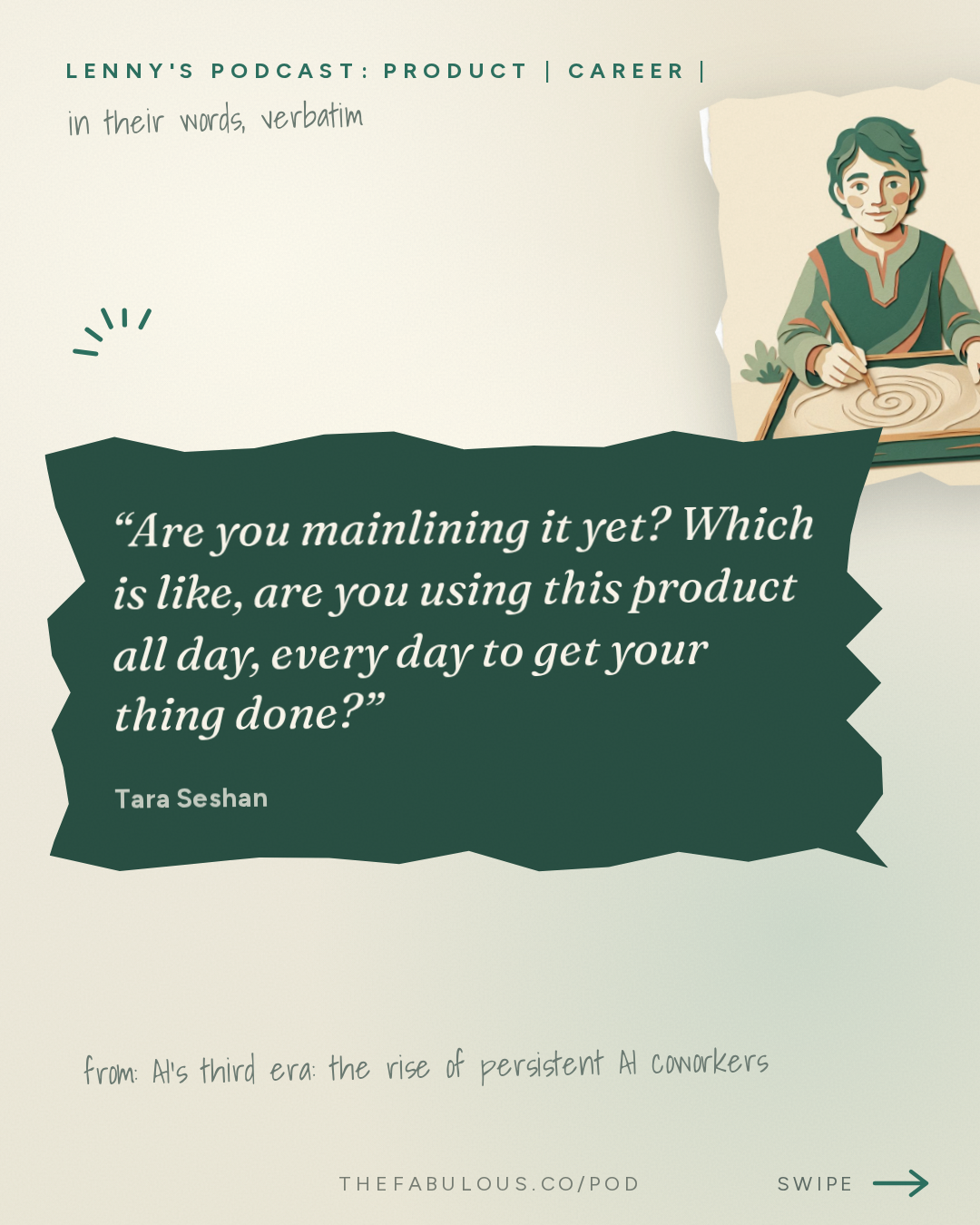
Two internal phrases keep that rule alive day to day. The first is whether a project is "maximally accelerated," meaning the team is moving as fast as the opportunity allows. The second, credited partly to her engineering manager Andrew Ambrosino, is whether people are "mainlining" the product: using it all day, every day, to get their own work done, so that friction surfaces before launch rather than after (25:39). It is dogfooding with higher stakes, since the product in question is often still deciding what it wants to be.
That urgency shows up in how ChatGPT is now organized around a toggle between "chat" mode and "work" mode, with Codex sitting alongside both (29:36). Under the hood, work mode runs on the same technology as Codex, just with a friendlier interface for people who do not think of themselves as developers (30:59). Seshan's stated goal is for that toggle to disappear entirely, so a user simply describes a task and the system picks the right approach (29:56). Getting there has meant accepting an old tradeoff in reverse: in the past, she says, polish was king, because shipping early made little difference to the outcome. Now, getting something transformative into people's hands early beats waiting for it to be perfect (36:21).
Writing as Thinking
If the two-to-three-month rule governs what OpenAI builds, a quieter rule governs how Seshan works. She separates her writing into two categories. Writing as reporting covers status updates and routine summaries, work she happily hands to an AI model. Writing as thinking is different: drafting a brief about why a team should pursue a certain strategy, then cutting and revising it until the idea is sharp. That kind of writing, she says, she will never automate (53:20).
"Writing as thinking is something I never will automate. You shouldn't replace your thinking with it." (Tara Seshan, 53:20)
A related habit came from a former manager: take a document to about 70 percent completion, then bring it to the people whose support is needed, and finish the last third together (57:40). A polished, complete draft, in her experience, invites less real feedback, because good collaborators want rough edges they can still shape.
The same instinct toward ambition shows up in how she thinks about the future of knowledge work. As AI agents take on more of the routine execution, she expects work to feel more like steering a ship than rowing it, with people spending their time on direction and judgment rather than on the mechanics of getting there (11:15). Part of the product manager's job, in her view, is to push people's sense of what is possible, sometimes by simply asking whether a plan could be ten times bigger or done in a fraction of the time (24:18, 24:37).
Her time at Sutter Hill Ventures, the venture firm behind companies including cloud-data company Snowflake, taught her a related lesson about ambition applied to marketing rather than product. She had assumed product-market fit was the hard problem and positioning was secondary. She now believes the opposite is often true in business software: the narrative, tested by pitching it to roughly a hundred people, can and should be refined before the product's final shape is locked in (63:12, 63:36).
"Product market fit is sure important, but actually I really underrated product marketing fit. The idea that the way you talk about the product and the way you market it can precede actually even building the product." (Tara Seshan, 63:12)
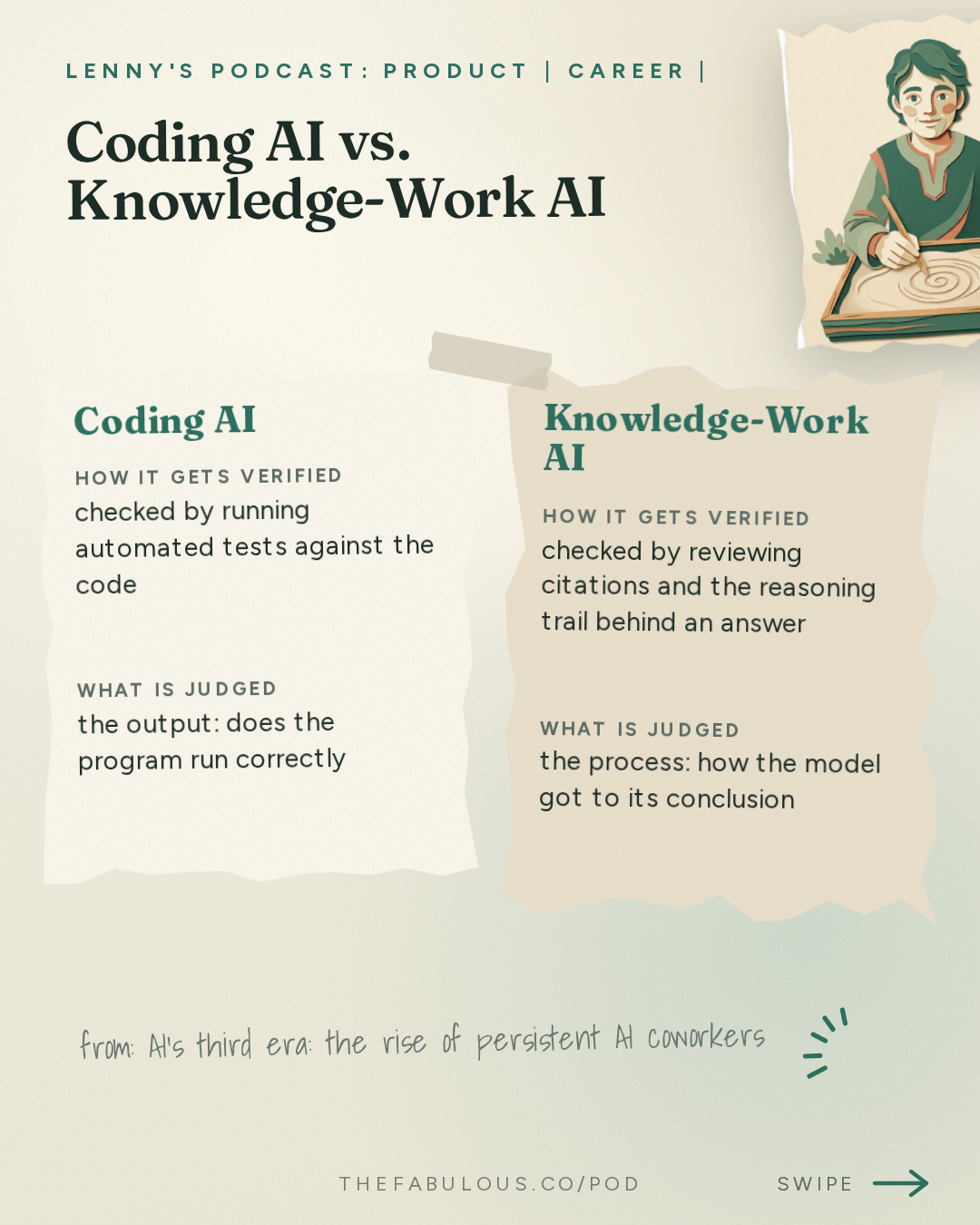
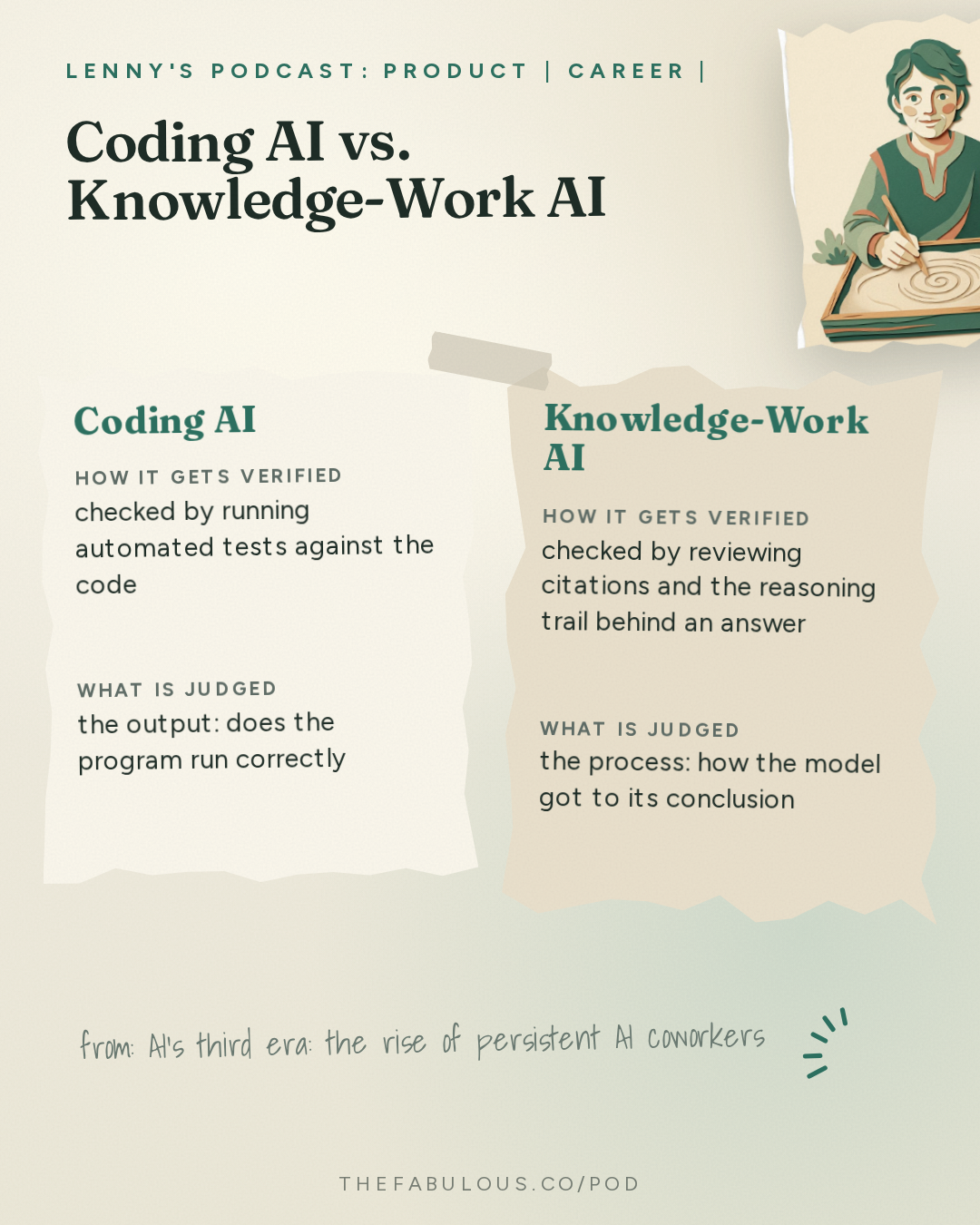
Toward the end of the conversation, Seshan draws a distinction that may outlast most of the specific tools discussed: coding AI and knowledge-work AI are not the same problem. A piece of generated code can be checked against automated tests; it either runs or it doesn't. A slide deck or a financial analysis cannot be judged that way. There is no test to run against a strategy memo, so the process that produced it, the citations, the visible reasoning, the steps along the way, has to be part of what gets checked (65:25).
That distinction is, in a way, a restatement of her filmmaking line from earlier. A budget does not guarantee a good film, and a working test suite does not guarantee a trustworthy answer. Somewhere in between the model's growing capability and the discipline of testing a sharp hypothesis, there is still a person deciding what the work should say, and whether it is any good. Seshan's bet, quietly repeated across the whole conversation, is that this part of the job will not get automated, even as almost everything around it does.
Ask this episode anything
Pod's AI answers from the episode itself, with the minute mark so you can hear it yourself.
Or start with one of these
Ask this episode
Pod's AI listens to the whole episode to answer, and points you to the minute it comes from.
The rest of this answer, and any question after it
Answers come from the episode itself, never from a summary of it.
ContinueKey takeaways
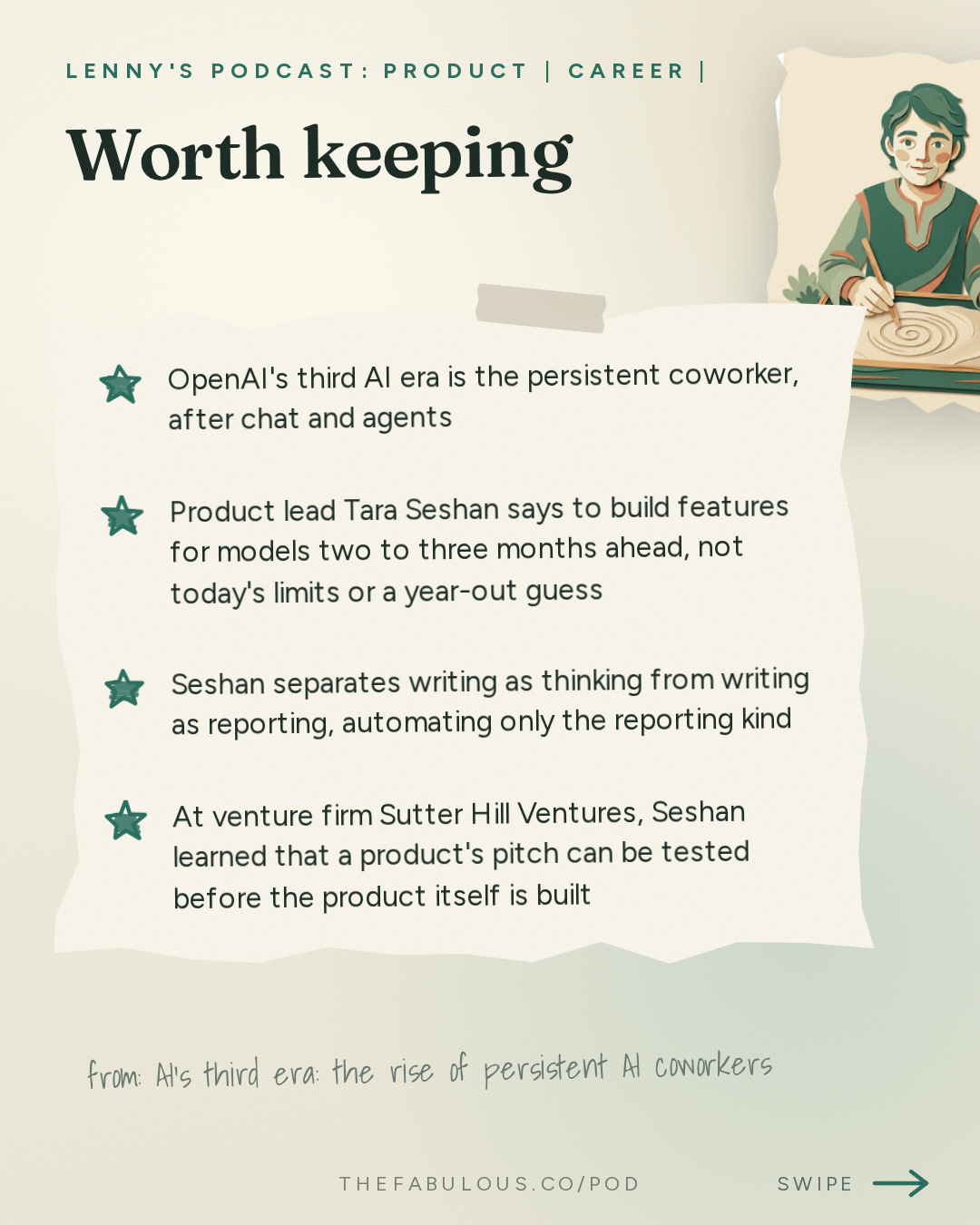
- OpenAI's third AI era is the persistent coworker, after chat and agents
- Product lead Tara Seshan says to build features for models two to three months ahead, not today's limits or a year-out guess
- Seshan separates writing as thinking from writing as reporting, automating only the reporting kind
- At venture firm Sutter Hill Ventures, Seshan learned that a product's pitch can be tested before the product itself is built
- Coding AI is checked by running tests, but knowledge-work AI needs visible reasoning and citations to earn trust
The episode in cards
By the numbers
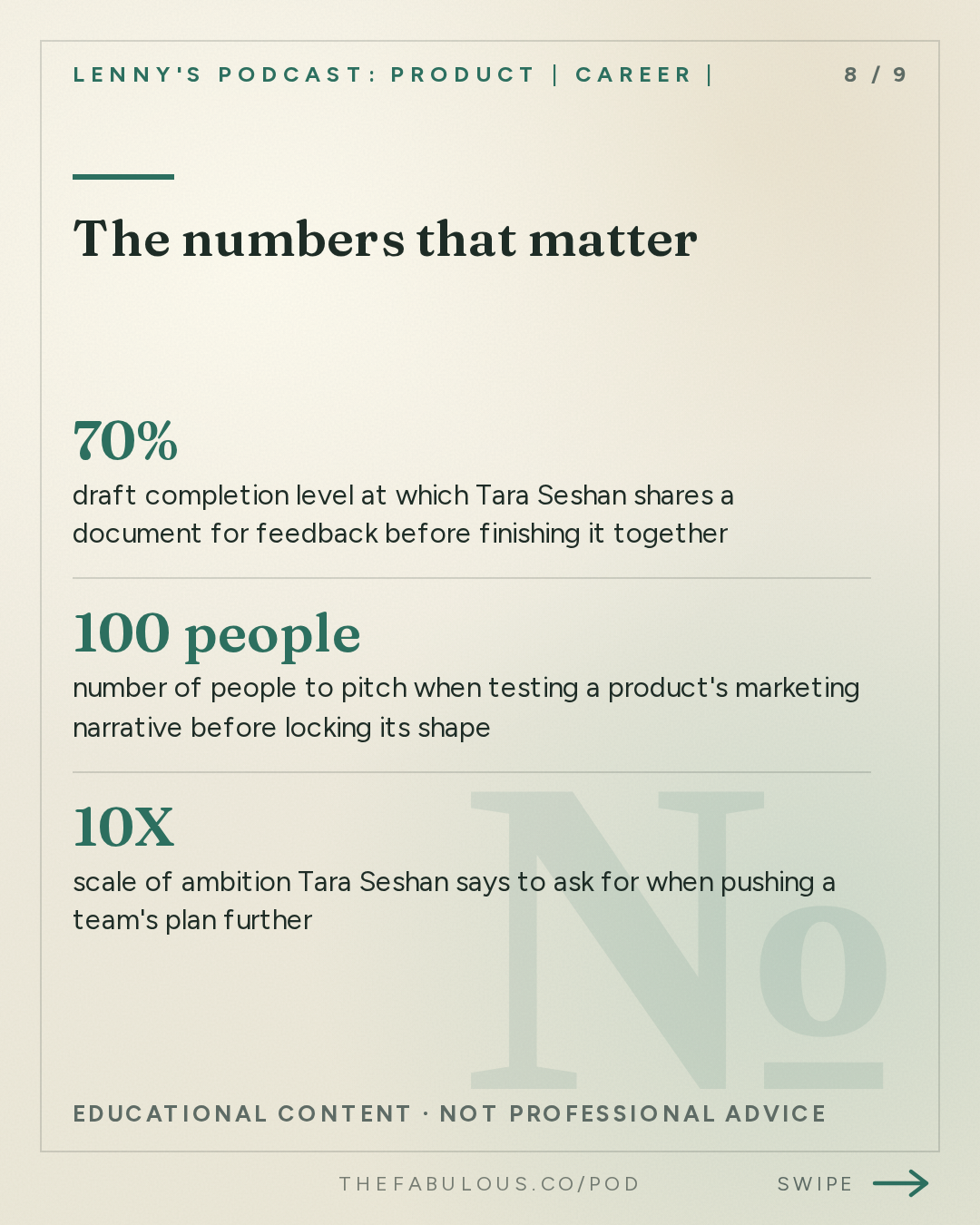
- 70% draft completion level at which Tara Seshan shares a document for feedback before finishing it together
- 100 people number of people to pitch when testing a product's marketing narrative before locking its shape
- 10X scale of ambition Tara Seshan says to ask for when pushing a team's plan further
In their words
“That third era that might come soon is how do you work with a persistent coworker who is able to get things done with you?”
“You fail if you build for where the models are now. You fail if you build for where you think the models will be in a year. Both outcomes are equally wrong.”
“Software is not like real estate. You don't, like, put money in and get value out. It is a little bit more like filmmaking, where you can put a lot of money into a film, but that doesn't guarantee that the film is successful or good.”
“Are you mainlining it yet? Which is like, are you using this product all day, every day to get your thing done?”
“Product market fit is sure important, but actually I really underrated product marketing fit. The idea that the way you talk about the product and the way you market it can precede actually even building the product”
Protocols
-
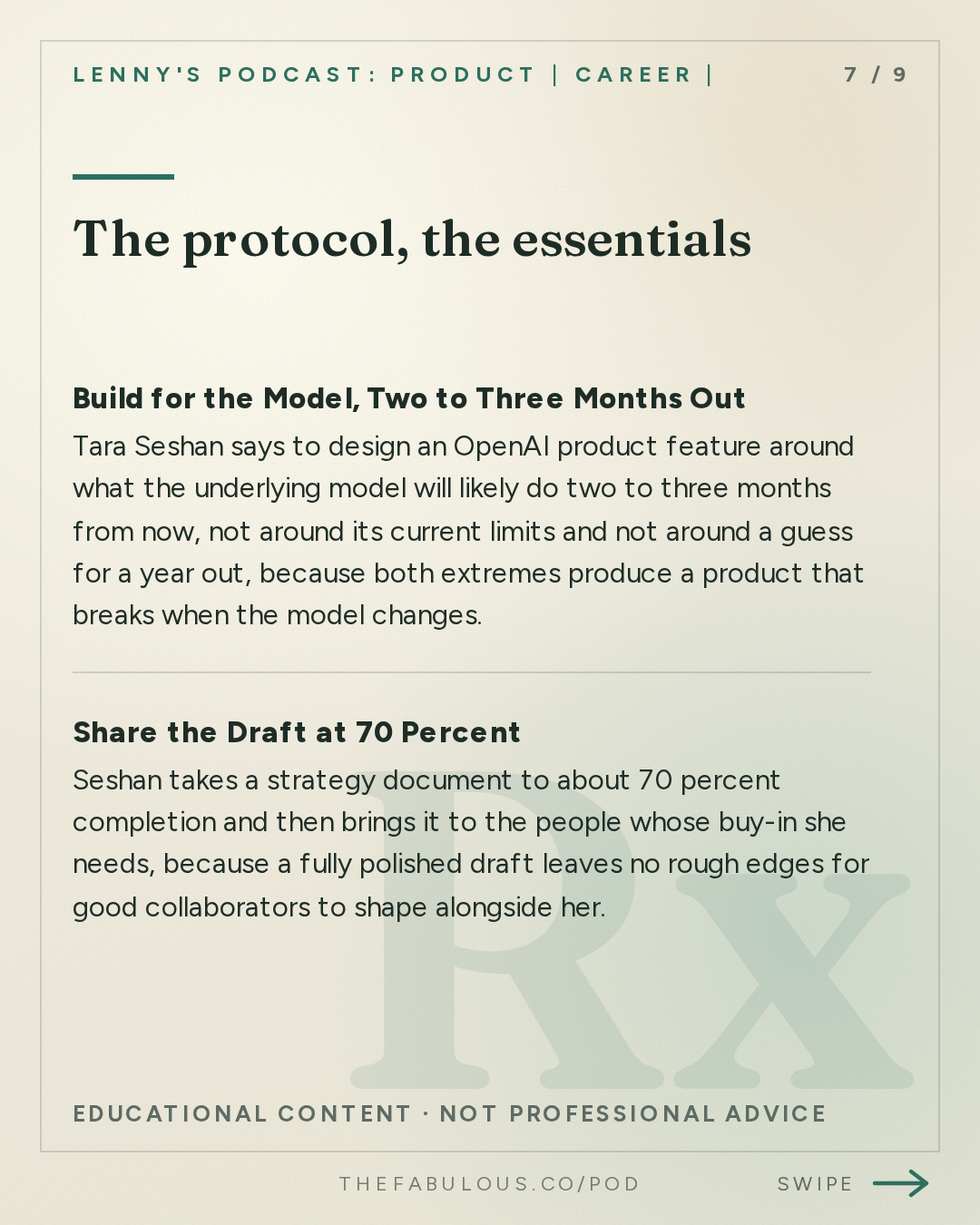
Build for the Model, Two to Three Months Out
Tara Seshan says to design an OpenAI product feature around what the underlying model will likely do two to three months from now, not around its current limits and not around a guess for a year out, because both extremes produce a product that breaks when the model changes.
at the start of every major product decision
-
Share the Draft at 70 Percent
Seshan takes a strategy document to about 70 percent completion and then brings it to the people whose buy-in she needs, because a fully polished draft leaves no rough edges for good collaborators to shape alongside her.
for every major brief or strategy document
-
Test the Pitch Before the Product
Seshan, drawing on her time at venture firm Sutter Hill Ventures, says B2B teams should pitch the product's narrative to around 100 people and refine that story first, and only lock the product's actual shape after the pitch lands.
before committing to a product's final shape
-
Write the Thinking Yourself, Automate the Reporting
Seshan writes every strategy brief herself from start to finish, using AI models only in the middle for research or summarizing, and she automates routine status reports entirely, because she believes outsourcing the drafting step is what erodes judgment over time.
every time she writes a brief
Questions this episode answers
What is OpenAI's 'two to three month' rule for building AI products?
Tara Seshan, OpenAI's product lead for ChatGPT Work and Codex, says teams should design products around what the underlying AI model will be able to do two to three months from now, because building for today's limits or for a guess a year out both fail (27:39). The rule keeps the product tied to near-term model progress rather than to the model's current constraints or a distant prediction.
What is the difference between writing as thinking and writing as reporting?
Seshan splits her writing into two kinds: writing as thinking, the drafting and editing that clarifies a new strategy or idea, and writing as reporting, routine status updates. She automates the reporting with AI models but never the thinking, because she believes drafting and revising by hand is what sharpens judgment (53:20).
What do OpenAI's internal phrases 'maximally accelerated' and 'mainlining' mean?
Employees ask whether a project is 'maximally accelerated,' meaning moving as fast as the opportunity allows, and whether they are 'mainlining' a product, meaning using it all day to surface real problems before launch (25:39). Seshan describes these as two of the phrases that drive product development at OpenAI, alongside a constant push toward higher ambition.
What is product marketing fit and why does it matter for B2B startups?
At venture firm Sutter Hill Ventures, known for incubating companies including cloud-data company Snowflake, Seshan learned that a product's pitch and positioning can be tested before the product itself is built. She says teams should pitch the narrative to around 100 people and refine it before locking the product's shape (63:12, 63:36).
How is AI for coding different from AI for knowledge work?
Coding AI is output-oriented: a generated program can be checked by running automated tests to see if it works. Knowledge-work AI is process-oriented, according to Seshan, because a finished slide deck or analysis cannot be verified just by looking at the final numbers, so the reasoning, citations, and steps along the way need to be visible for someone to trust the result (65:25).
What does 'steering versus rowing' mean for the future of work?
Seshan describes a shift where AI agents, software that can complete multistep tasks with limited supervision, take on more of the 'rowing,' the lower-level execution, while people spend more time 'steering,' setting direction and making judgment calls informed by data and intuition (11:15).
The full read, in cards
Go deeper
- Barbarian Days — William Finnegan's memoir on surfing, which Seshan cites for the idea of pursuing mastery without needing to be the best
- Anna Karenina — Leo Tolstoy novel Seshan rereads at different ages, using it as a metaphor for growth and shifting perspective
- The Power Broker — Robert Caro's biography of Robert Moses, which Seshan is currently reading
- The Work You Do, the Person You Are — Toni Morrison essay whose four-part reflection on work Seshan keeps pinned to her Twitter profile
Mentioned
Tara Seshan · OpenAI · Stripe · Sutter Hill Ventures · Mike Speiser · Patrick Collison · Codex · ChatGPT · Thiel Fellowship · Andrew Ambrosino · Kevin Weil · Ari Weinstein · Dylan Field · Toni Morrison · William Finnegan · Robert Caro
More from this show and category
How AI Models Actually Think
Anthropic researcher Emmanuel Ameisen explains that language models are grown through training, not programmed line by line, so even their creators cannot read their internal logic directly. Interpretability research shows models form internal plans, share universal concepts across languages, and sometimes fixate on wrong answers when training data rewards them incorrectly (01:45, 15:31, 37:14).
Josh Woodward on Building an AI Labs Team
Google Labs head Josh Woodward argues every company now needs a frontier team that tests new AI models obsessively, judges early products by watching users' eyes rather than dashboards, and hires for an 'unlearning rate' as much as a learning one (32:13).
OpenAI's Tibo Sottiaux on Dots and AI Agents
OpenAI's Head of ChatGPT Tibo Sottiaux says agents will soon take most actions on the internet, not humans. He describes Dots, OpenAI's persistent agent that remembers personal context, controls multiple devices, and learns from feedback, plus a plugin ecosystem with revenue sharing and 16 sign-in partners, as proof the industry is moving from manually built loops to self-learning systems (00:16, 11:58).
Molly Graham's Give Away Your Legos AI Advice
Molly Graham's decade-old advice to give away your career projects still works, but she now says some tasks, like judgment and vision, should never go to AI. Tech burnout jumped from 44% to 55% in a year, and she argues AI needs coaching like a lazy intern rather than blind trust, while good management matters more than ever.
