
What The Mind of Napoleon Teaches Founders
#432 The Mind of Napoleon
The brief
Napoleon Bonaparte's private writings, collected in the 1955 book The Mind of Napoleon, reveal a leader who planned obsessively then acted without hesitation. Drawing on the book's maxims, the episode extracts his rules for decision-making, propaganda, and building projects in useful stages, arguing they still work for founders today.
Napoleon Bonaparte once wrote to a correspondent that his wife could have died and it would not have delayed the execution of his plans by even a quarter of an hour (10:37). It is a monstrous sentence, and it is also, in its way, a thesis statement. Nothing, in Napoleon's own account of himself, was allowed to interrupt the machinery of his ambition. That machinery, and the letters, speeches, and private notes that reveal how it ran, are the subject of The Mind of Napoleon, a 1955 collection edited and translated by the historian J. Christopher Herold (01:57). The book has gone out of print, and a used copy now sells for $100 to $200 (02:17). It offers no narrative and no battles described from the outside. It is three hundred pages of Napoleon speaking, arranged by subject and by year, so a reader can watch a single idea, like ambition, luck, or the uses of history, recur and sometimes contradict itself across three decades.
The first thing that recurs is a definition. Napoleon insists that what looks like luck is really a skill.
"Luck is the ability to exploit accidents. The vulgar would call this luck, but in fact, it is the characteristic of genius." Napoleon Bonaparte, [02:50]
Genius, in this telling, does not predict the accident. It notices the accident and uses it. That claim only works if the noticing happens instantly, which is why the book returns so often to a second, harder rule: think slowly, act at once. "Hesitation is fatal," Napoleon writes. "Once an action is begun, it must be followed through with the utmost exertion of the will" (03:40). The two ideas fit together like a hinge. Slow down before the decision. Refuse to slow down after it.
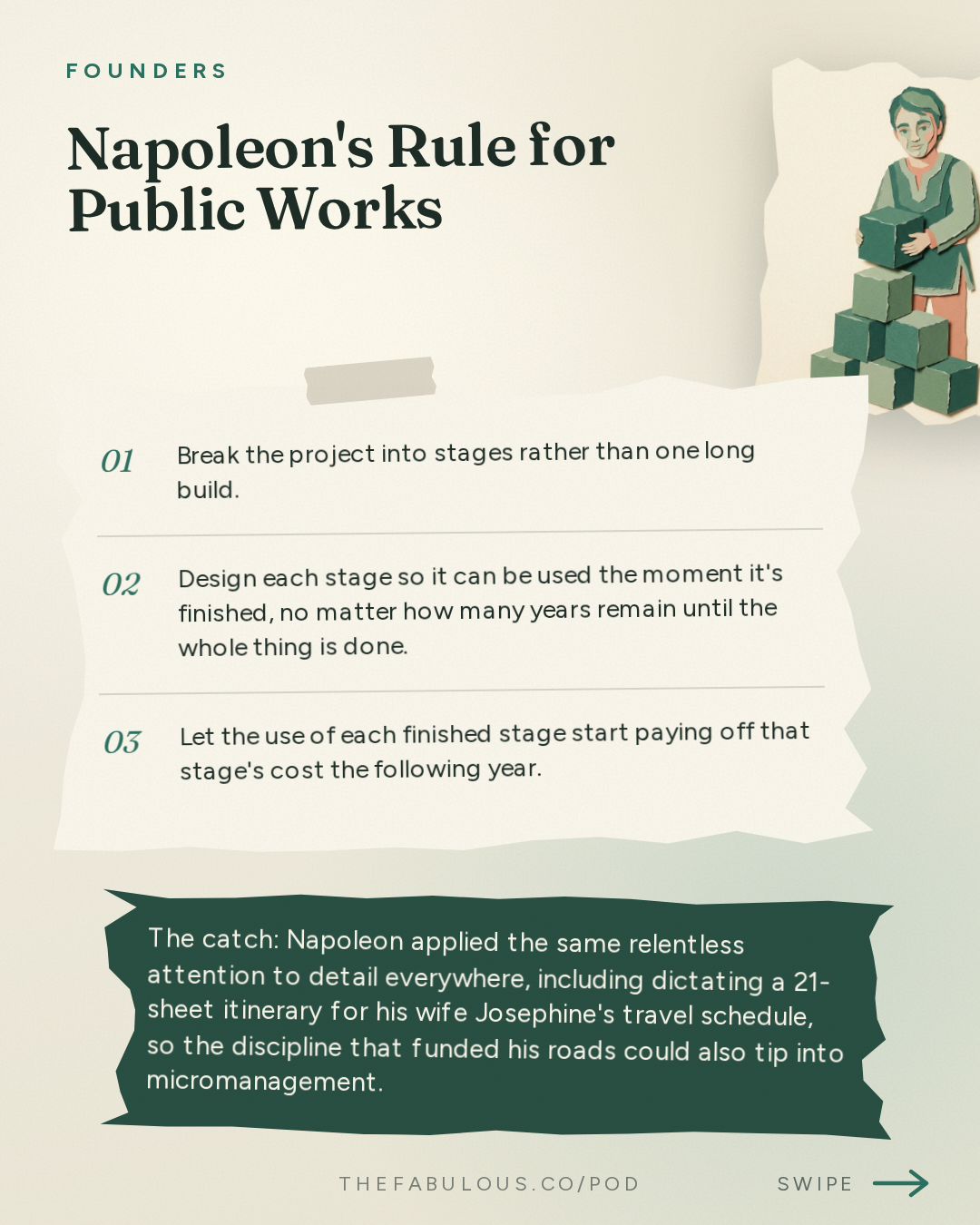
The same hinge shows up in how Napoleon approached big, expensive projects, the kind a modern founder might call infrastructure. He had public works built in stages, so that each stage could be used right away, no matter how many years remained until the whole thing was finished (04:45). A finished stretch of road or canal began paying for itself the moment it opened, even while the rest of the project was still under construction. It says something about Napoleon's temperament: he combined a distant, enormous ambition with an impatience for immediate usefulness. He wanted the world remade, and he wanted proof of progress by next year.
Two Levers
Napoleon's view of the people he governed was less romantic than his view of himself. He believed men rarely act until forced to, and that when they do act, only two forces move them.
"Men are moved by two levers only, fear and self-interest. Men are guided by nothing else than self-interest." Napoleon Bonaparte, [07:44]
It is a cold sentence, but it describes something anyone who has built a company or sold a product will recognize: people respond to what a thing does for them, not to a founder's claim of greatness. The episode draws a line from this to Charlie Munger, the longtime investing partner of Warren Buffett, whose writing in the book Poor Charlie's Almanack is described as showing "deep and realistic cynicism about human nature" (08:27). Napoleon and Munger arrive at the same low opinion of crowds from different centuries, and both turn that opinion into a working method rather than a complaint.
Where the cynicism stops is at the individual. Napoleon has almost no patience for committees, theorists, or what he calls "men of letters," and enormous patience for the single person willing to act. "In war, men are nothing. One man is everything," he says (06:15). It is an exaggeration, and Napoleon knows it is an exaggeration, but it points at a real belief: that history moves through a small number of people who refuse to wait for consensus.
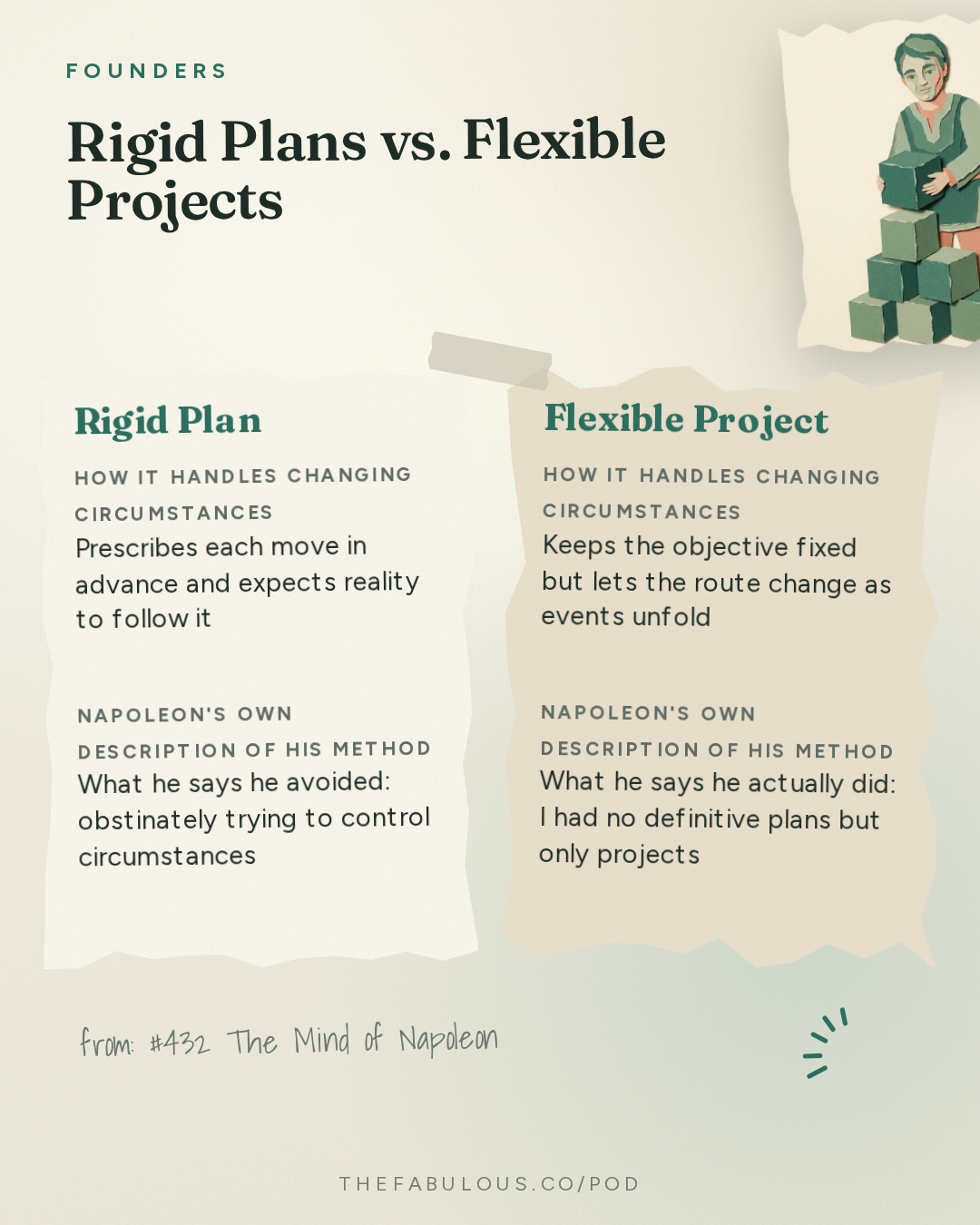
That belief shows up again in how Napoleon planned, or rather refused to plan in the conventional sense. He describes himself as someone who did not control circumstances so much as obey them, and who worked from loose intentions rather than fixed blueprints.
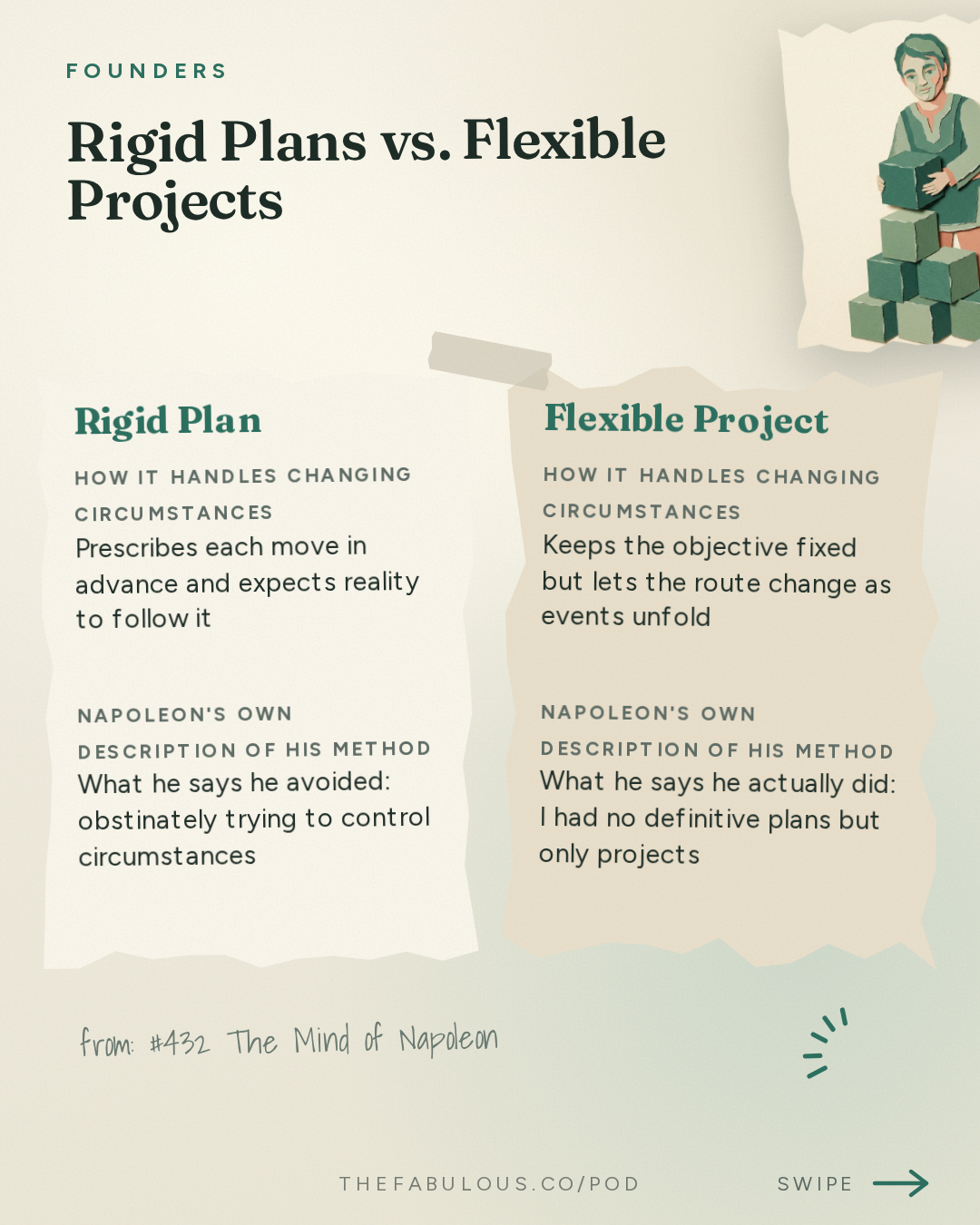
"I had no definitive plans but only projects." Napoleon Bonaparte, [18:39]
A plan, in this distinction, prescribes every move in advance. A project keeps the destination fixed and lets the route bend. The episode pairs this with a story about Henry Singleton, the engineer who founded the conglomerate Teledyne. Singleton was criticized in the business press for not having a formal business plan, and he replied that outside forces could not be predicted, so his real plan was to stay flexible and "steer the boat each day" (19:05). Two men, two centuries apart, arrive at the same objection to rigid planning: the world will not hold still long enough for a plan to survive contact with it.
Owning the Story
Napoleon did not just want to win. He wanted to be the one who explained the win, and he built the machinery to make sure of it. He dictated the army's official bulletins himself, and used them to inform the public, deny rumors, mislead the enemy, or stir enthusiasm, depending on what the moment required (30:30). He also read the newspapers before they reached him and, by his own account, skipped most of them, because, as he put it, they said only what he told them to say. He was his own minister of propaganda, and the lesson drawn from this is blunt: a founder who does not tell his own story will have it told badly by someone else.
The same private letters show how much effort sat behind the public calm. Napoleon describes himself as the most timid man alive while planning a campaign, someone who deliberately imagines every disaster the circumstances allow, and who suffers through that imagining in private.
"Once I have made up my mind, everything is forgotten except what leads to success." Napoleon Bonaparte, [44:13]
The serenity his officers saw was manufactured, not natural. The anxiety happened earlier, alone, on paper, and it stopped the instant a decision was made. That order, doubt first and fully, then commitment without residue, is close to the book's real argument about how ambitious people should use their own minds.
Napoleon is not, in the end, a simple hero of the collection. The book lets him contradict himself. In 1806 he argues against censoring books, on the grounds that no clerk should get to "tyrannize over the mind" (28:22). By 1810 he has established censorship of his own. He praises boldness in every general he studies, Alexander, Hannibal, Caesar, Frederick the Great, and says their combined history amounts to a treatise on the art of war (41:44), yet he also diagnoses Alexander's fatal flaw as an ambition that "ceases only when life ceases" (20:12), a description that fits Napoleon's own end almost exactly. The same appetite that built an empire also refused to stop eating once the empire was built.
That is what makes the book worth reading two centuries later, and why a podcast about business would spend an hour on a French emperor's private letters. Napoleon is less a model to copy than a specimen to study, a man who wrote down, in plain language, the machinery of extreme ambition, including the parts that eventually destroyed him. The energy that moved him from a Corsican artillery officer to the ruler of most of Europe is the same energy the book warns will not know when to stop. Read closely, his letters offer both instructions: how to act, and how not to notice when acting has become the whole of a life.
Ask this episode anything
Pod's AI answers from the episode itself, with the minute mark so you can hear it yourself.
Or start with one of these
Ask this episode
Pod's AI listens to the whole episode to answer, and points you to the minute it comes from.
The rest of this answer, and any question after it
Answers come from the episode itself, never from a summary of it.
ContinueKey takeaways
- Napoleon defined luck as the skill of exploiting accidents, not blind chance
- Napoleon treated hesitation as fatal, saying a decision once made must be executed with total commitment
- Napoleon preferred flexible projects over rigid plans, changing course whenever circumstances forced him to
- Napoleon built public works in stages so each stage paid for itself before the whole project finished
- Napoleon acted as his own minister of propaganda, dictating army bulletins to control the public narrative
The episode in cards
By the numbers
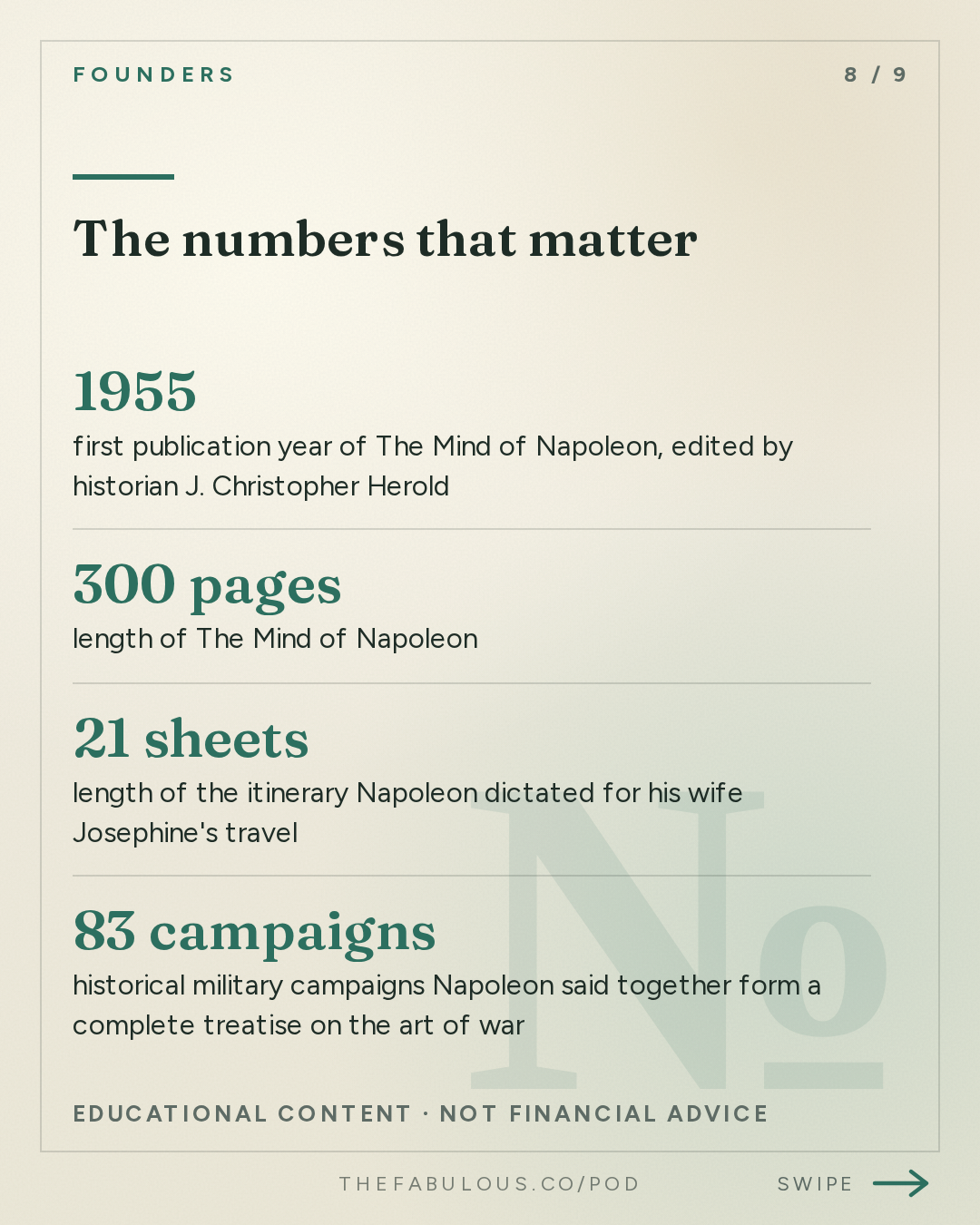
- 1955 first publication year of The Mind of Napoleon, edited by historian J. Christopher Herold
- 300 pages length of The Mind of Napoleon
- 21 sheets length of the itinerary Napoleon dictated for his wife Josephine's travel
- 83 campaigns historical military campaigns Napoleon said together form a complete treatise on the art of war
- 200 years time elapsed since Napoleon's era that the host says still makes his letters worth reading
In their words
“Luck is the ability to exploit accidents. The vulgar would call this luck, but in fact, it is the characteristic of genius.”
“"Men are moved by two levers only, fear and self-interest. Men are guided by nothing else than self-interest."”
“I had no definitive plans but only projects.”
“Once I have made up my mind, everything is forgotten except what leads to success.”
Protocols
-
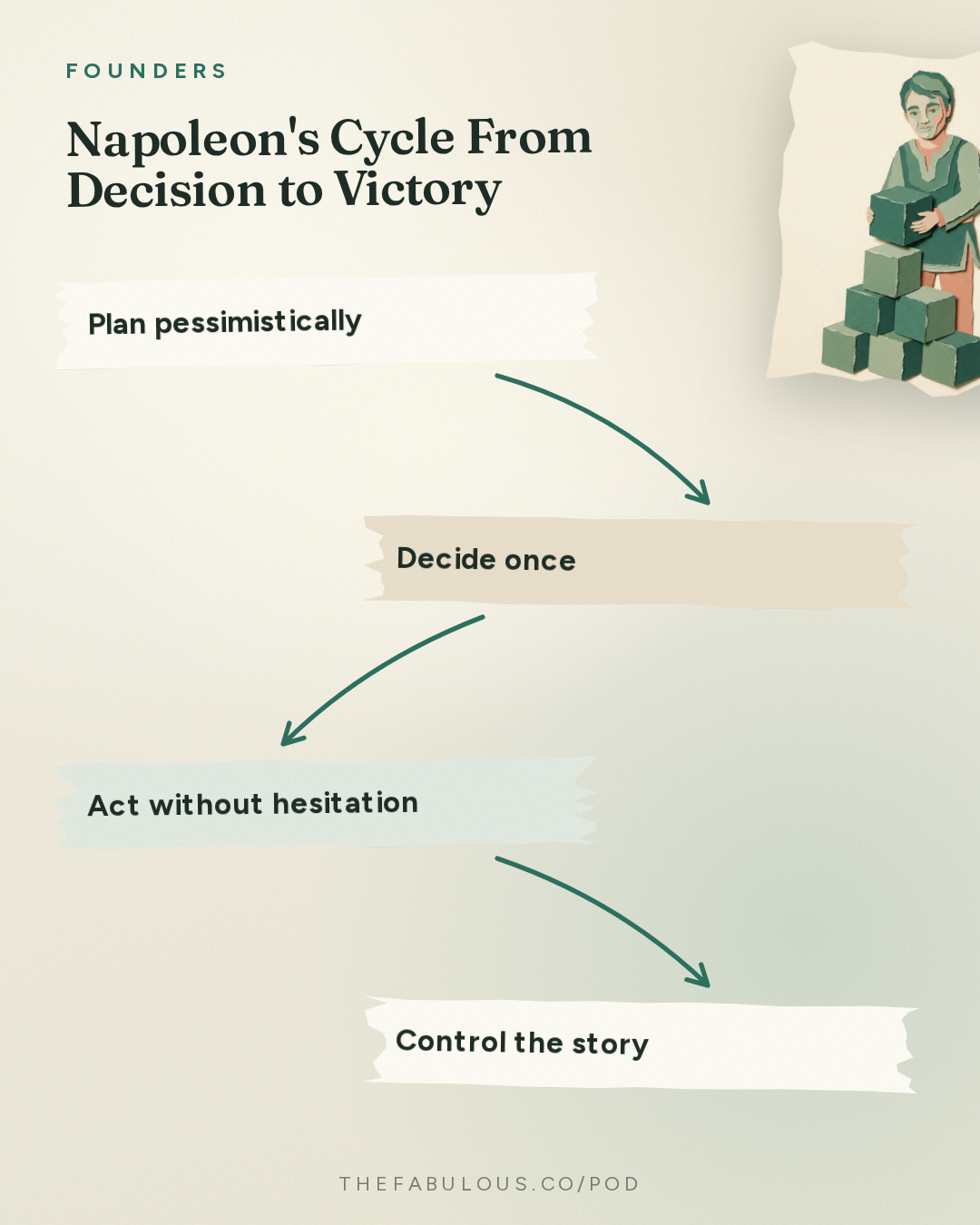
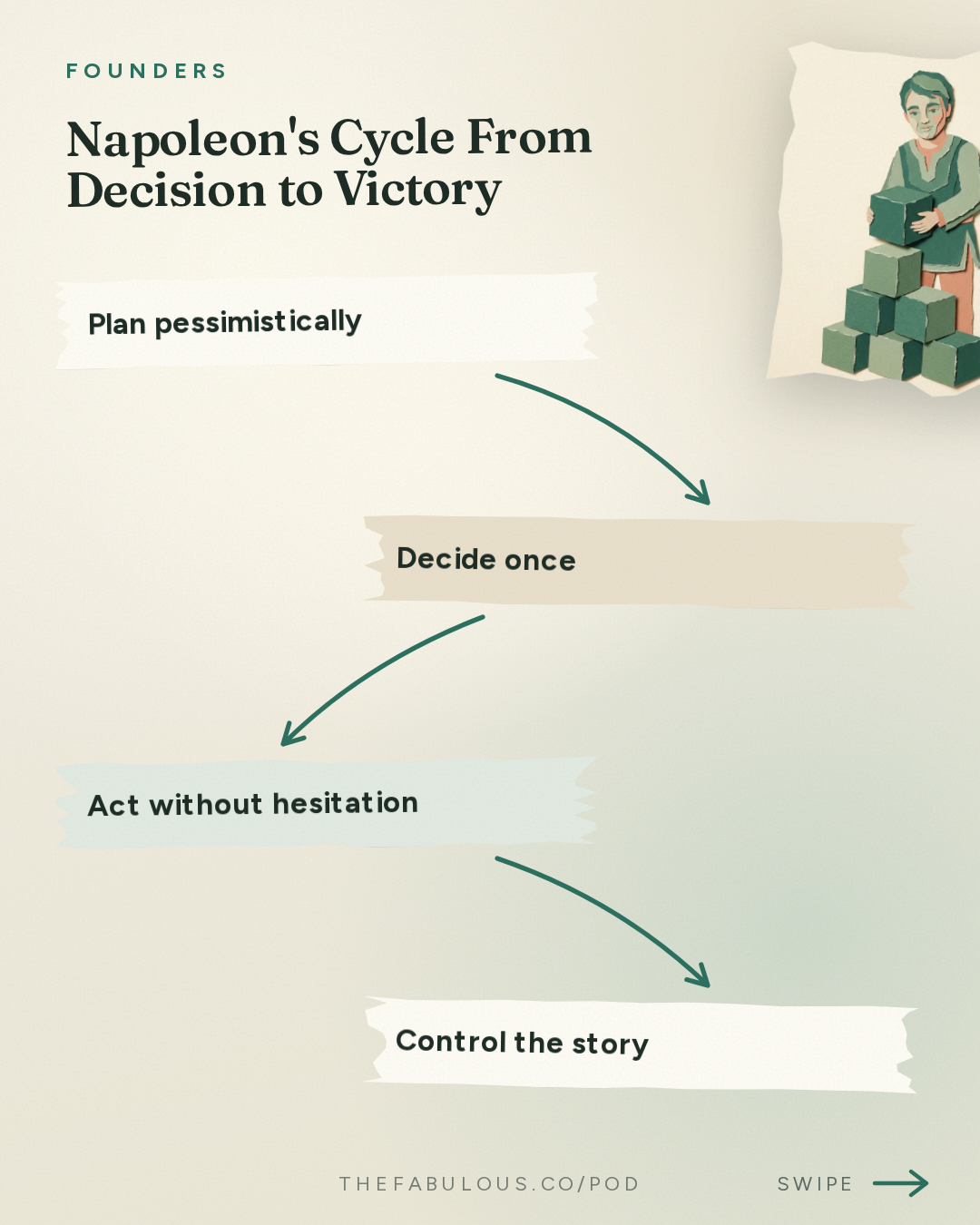
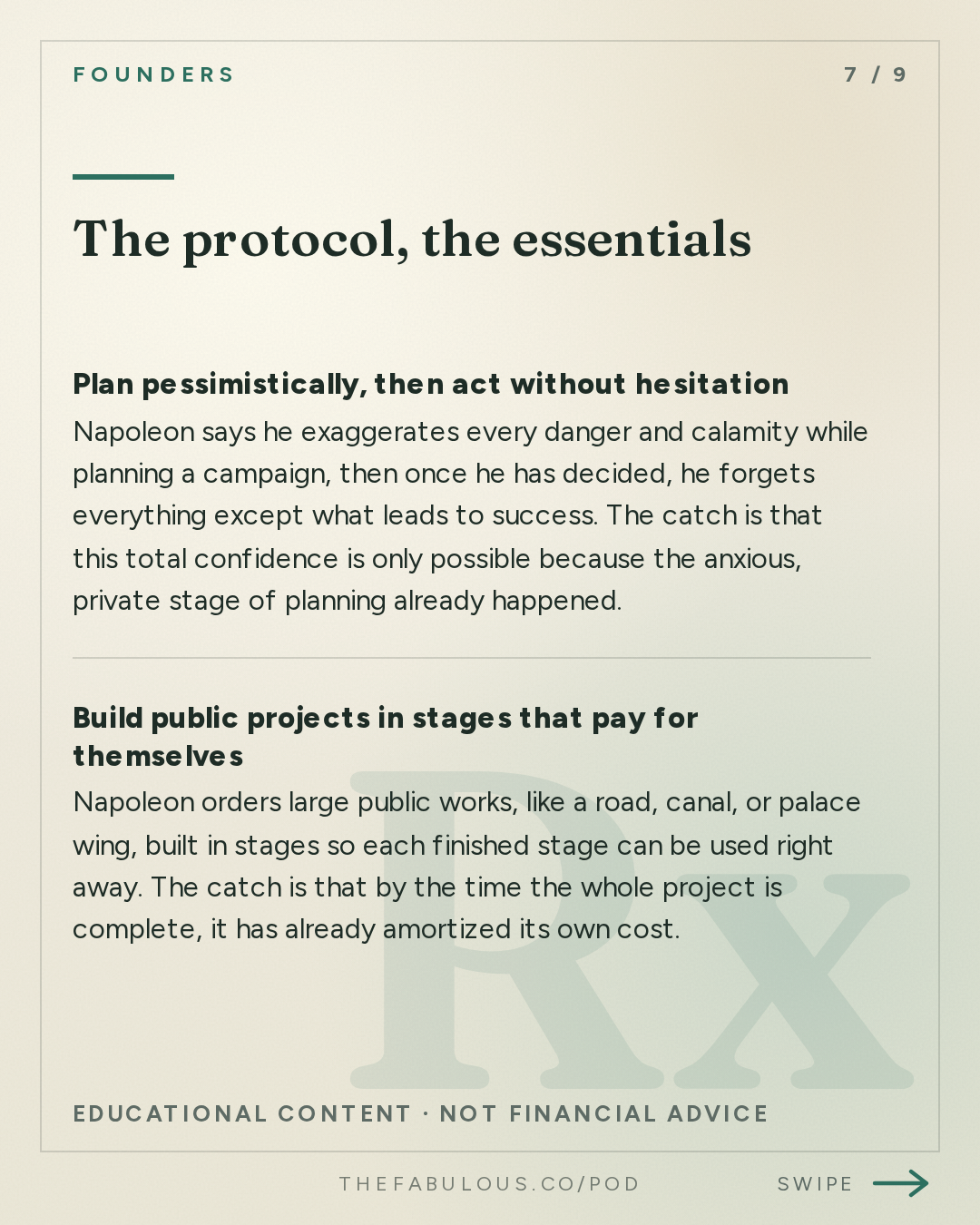
Plan pessimistically, then act without hesitation
Napoleon says he exaggerates every danger and calamity while planning a campaign, then once he has decided, he forgets everything except what leads to success. The catch is that this total confidence is only possible because the anxious, private stage of planning already happened.
Before and after every major decision
-
Build public projects in stages that pay for themselves
Napoleon orders large public works, like a road, canal, or palace wing, built in stages so each finished stage can be used right away. The catch is that by the time the whole project is complete, it has already amortized its own cost.
Applied to every major construction project
-
Treat plans as flexible projects, not fixed rules
Napoleon says he kept few firm ideas and instead obeyed circumstances, since outside forces kept forcing him to change his mind. The catch is that this can look like indecision from the outside, even though Napoleon frames it as strength.
Ongoing, revisited as circumstances shift
-
Act as your own minister of propaganda
Napoleon dictates every important army bulletin himself, using it to inform the public, counter rumors, mislead the enemy, or lift morale. The catch is that he also screens the newspapers before they reach him, so he controls both what goes out and what appears to come in.
Continuous, tied to every major event
Questions this episode answers
What is The Mind of Napoleon about?
It is a 1955 collection of Napoleon Bonaparte's letters and speeches, edited and translated by historian J. Christopher Herold, arranged by subject and year so readers can trace how his ideas on ambition, luck, and power developed over three decades (01:57). It runs 300 pages and is now out of print (02:17).
What did Napoleon mean when he said luck is the ability to exploit accidents?
Napoleon argued that what people call luck is really the skill of noticing and using an unplanned event, which he called the mark of genius rather than chance (02:50). He paired this with a rule that hesitation is fatal once an action has begun (03:40).
What did Napoleon mean by projects instead of plans?
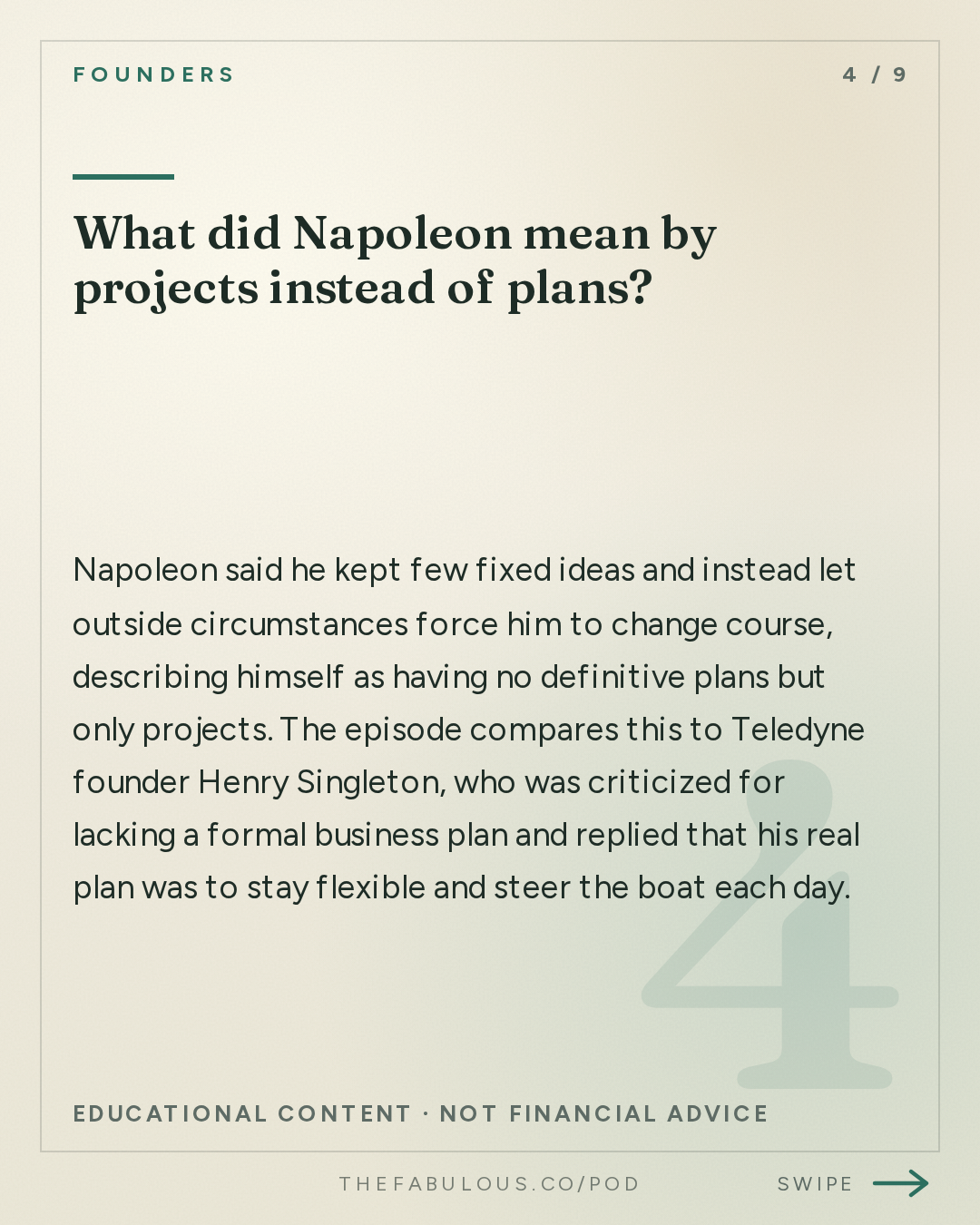
Napoleon said he kept few fixed ideas and instead let outside circumstances force him to change course, describing himself as having no definitive plans but only projects (18:39). The episode compares this to Teledyne founder Henry Singleton, who was criticized for lacking a formal business plan and replied that his real plan was to stay flexible and steer the boat each day (19:05).
How did Napoleon control public opinion?
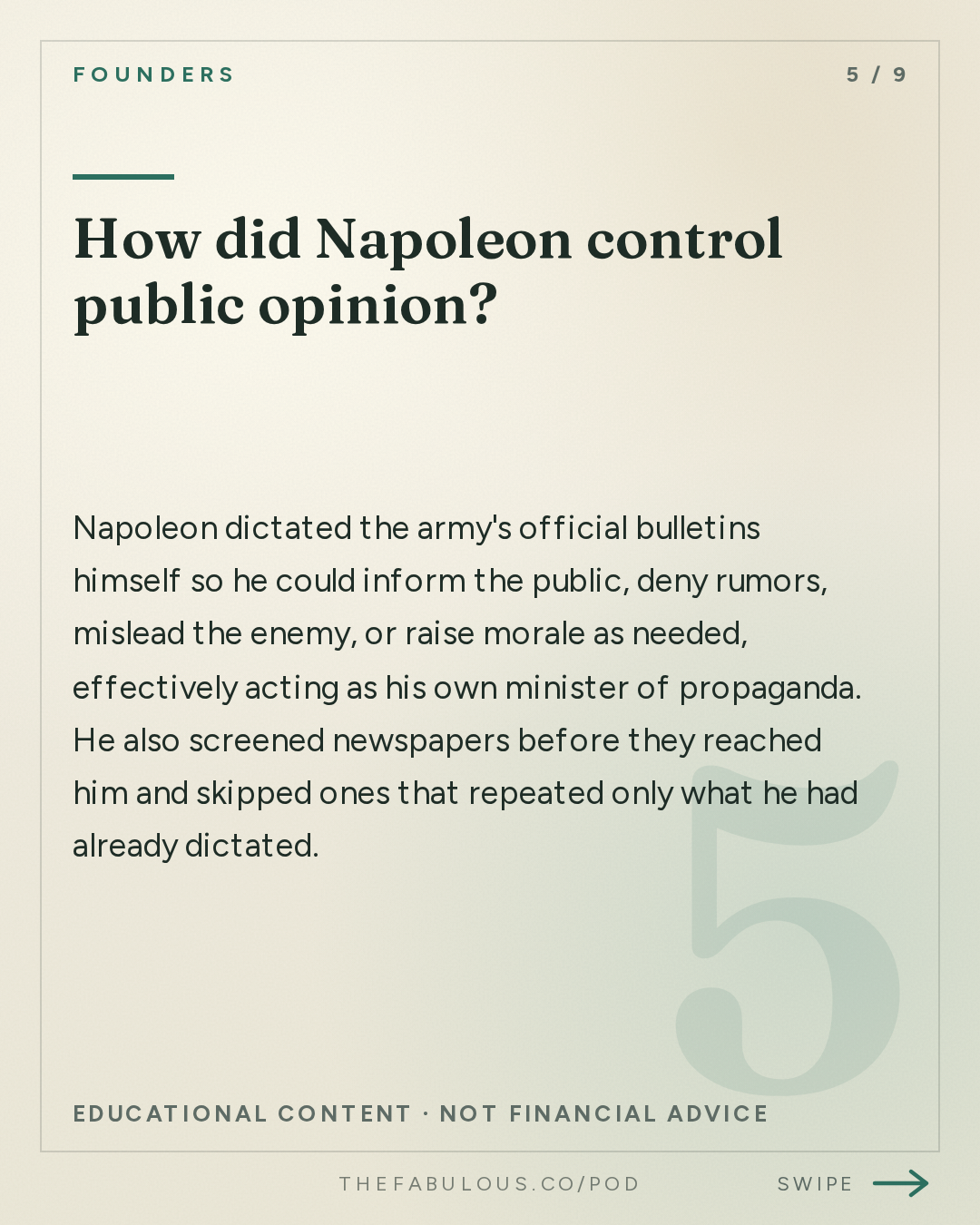
Napoleon dictated the army's official bulletins himself so he could inform the public, deny rumors, mislead the enemy, or raise morale as needed, effectively acting as his own minister of propaganda (30:30). He also screened newspapers before they reached him and skipped ones that repeated only what he had already dictated.
Did Napoleon contradict himself in the book?
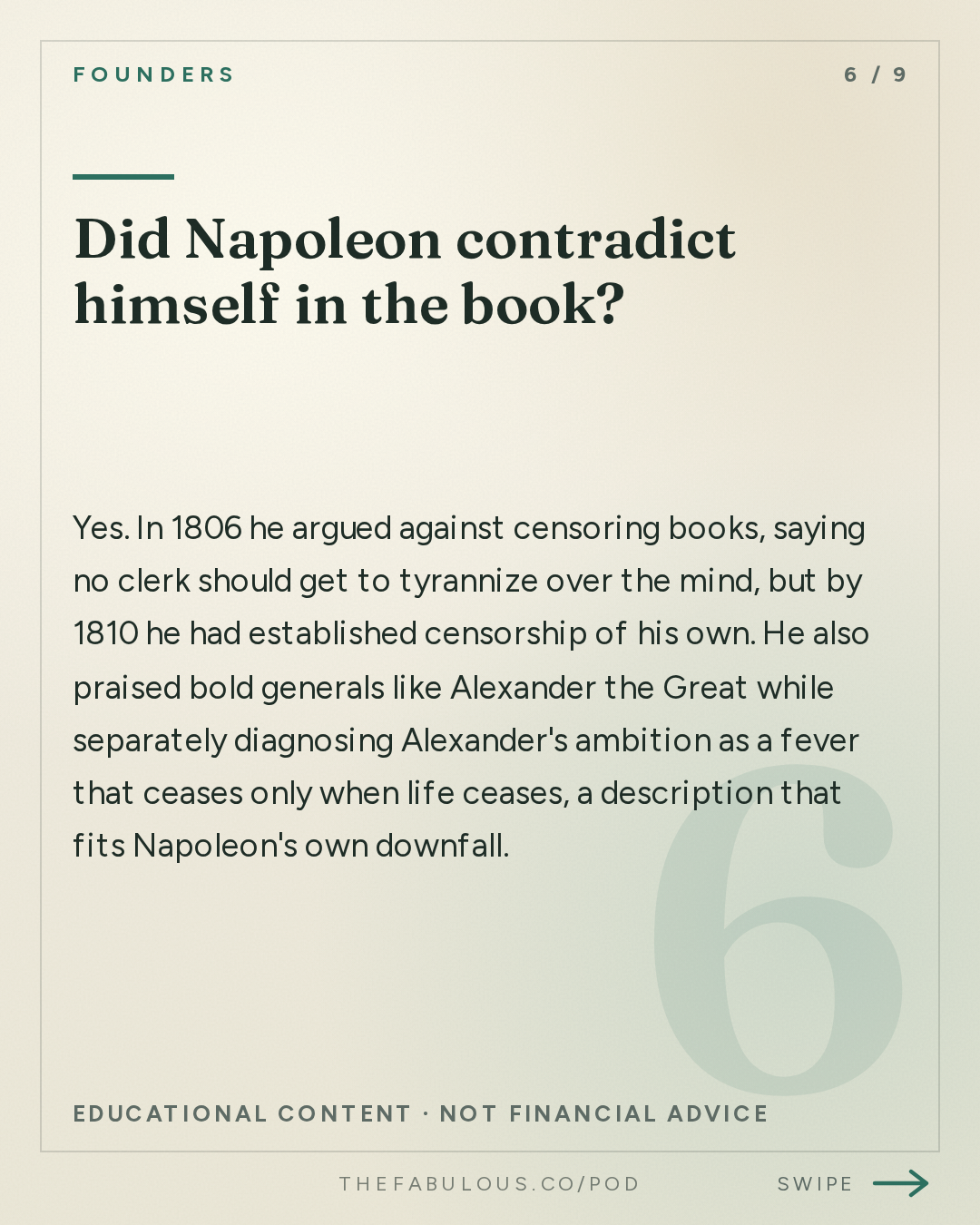
Yes. In 1806 he argued against censoring books, saying no clerk should get to tyrannize over the mind, but by 1810 he had established censorship of his own (28:22). He also praised bold generals like Alexander the Great while separately diagnosing Alexander's ambition as a fever that ceases only when life ceases, a description that fits Napoleon's own downfall (20:12).
The full read, in cards
Go deeper
- The Mind of Napoleon — a 1955 collection of Napoleon's letters and speeches edited and translated by J. Christopher Herold, the central text of the episode
- Poor Charlie's Almanack — collects investor Charlie Munger's talks and is used to compare Munger's cynicism about human nature to Napoleon's
- Steve Jobs — Walter Isaacson's biography, quoted for a passage on what drove Jobs to build a lasting legacy rather than chase wealth
Mentioned
J. Christopher Herold · Charlie Munger · George Washington · Steve Jobs · Henry Singleton · Alexander the Great · Julius Caesar · Frederick the Great · Henry Ford · Travis Kalanick · Poor Charlie's Almanack
More from this show and category
The Tycoons: How Carnegie and Rockefeller Built America
Charles R. Morris's book The Tycoons compares how Carnegie, Rockefeller, Gould, and Morgan each built the post-Civil War American economy. Carnegie cut costs and scaled steel, Rockefeller out-managed rivals in oil, Gould mastered railroad finance, and Morgan tried to impose order, together creating the infrastructure that let consumer brands like Procter & Gamble emerge.
Ari Emanuel's Roll the Calls, Summarized
Ari Emanuel's memoir Roll the Calls traces his rise from a dyslexic mailroom assistant to the billionaire founder of Endeavor. It shows how rage, relentless phone volume, and a 1994 near-fatal car accident drove him to found Endeavor, merge with William Morris, and buy the UFC and WWE before Endeavor was valued at $13 billion.
Jeremy Stern's Mark Zuckerberg Profile Explained
Mark Zuckerberg has modeled himself on Augustus Caesar for decades, fighting what journalist Jeremy Stern calls the dictator's dilemma. Stern's profile shows how Zuckerberg counters corporate isolation with raw data and MMA training, building a $1.6 trillion empire of 3.6 billion users while insisting he will never stop.
Sam Walton's Core Business Strategies
Sam Walton built Walmart on four simple habits: cost control, copying competitors, small-town focus, and constant willingness to change course. He lost his first store over a missing lease clause, learned to fly a plane to scale faster, and copied ideas from JC Penney and Sol Price on his way to becoming America's richest man.
