
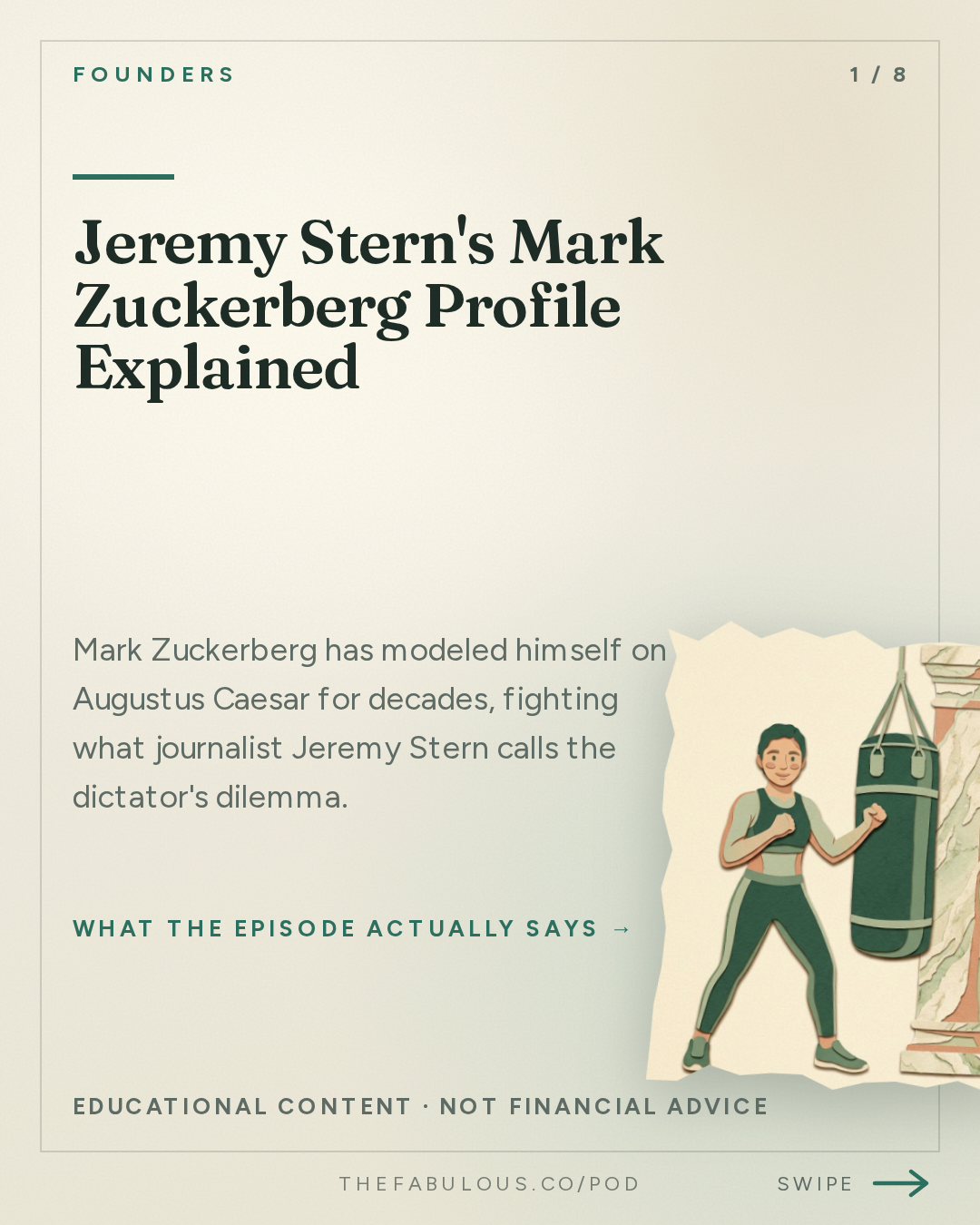
Jeremy Stern's Mark Zuckerberg Profile Explained
#435 Mark Zuckerberg's Empire
The brief
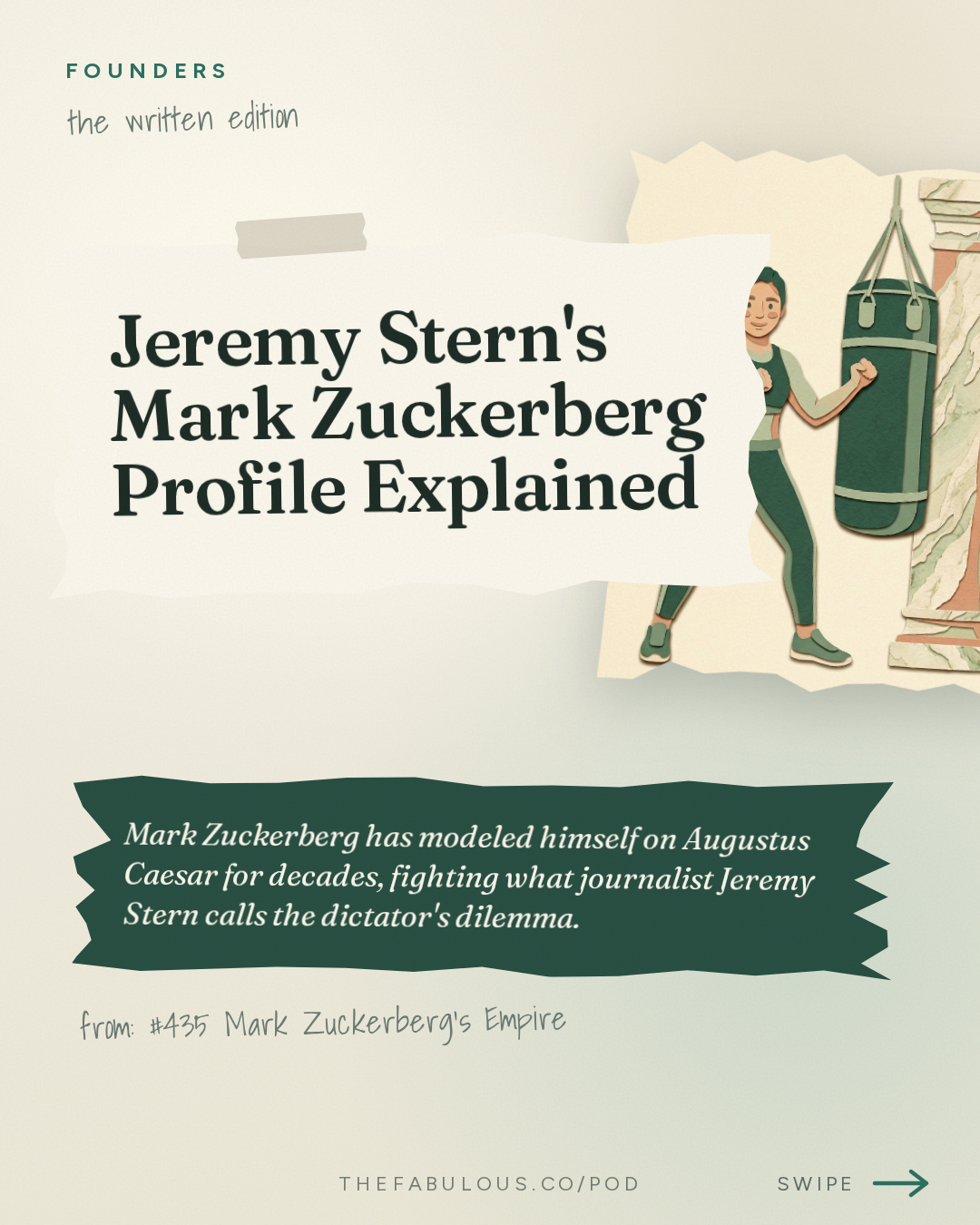
Mark Zuckerberg has modeled himself on Augustus Caesar for decades, fighting what journalist Jeremy Stern calls the dictator's dilemma. Stern's profile shows how Zuckerberg counters corporate isolation with raw data and MMA training, building a $1.6 trillion empire of 3.6 billion users while insisting he will never stop.
Ask this episode anything
Pod's AI answers from the episode itself, with the minute mark so you can hear it yourself.
Or start with one of these
Ask this episode
Pod's AI listens to the whole episode to answer, and points you to the minute it comes from.
The rest of this answer, and any question after it
Answers come from the episode itself, never from a summary of it.
Continue
Key takeaways
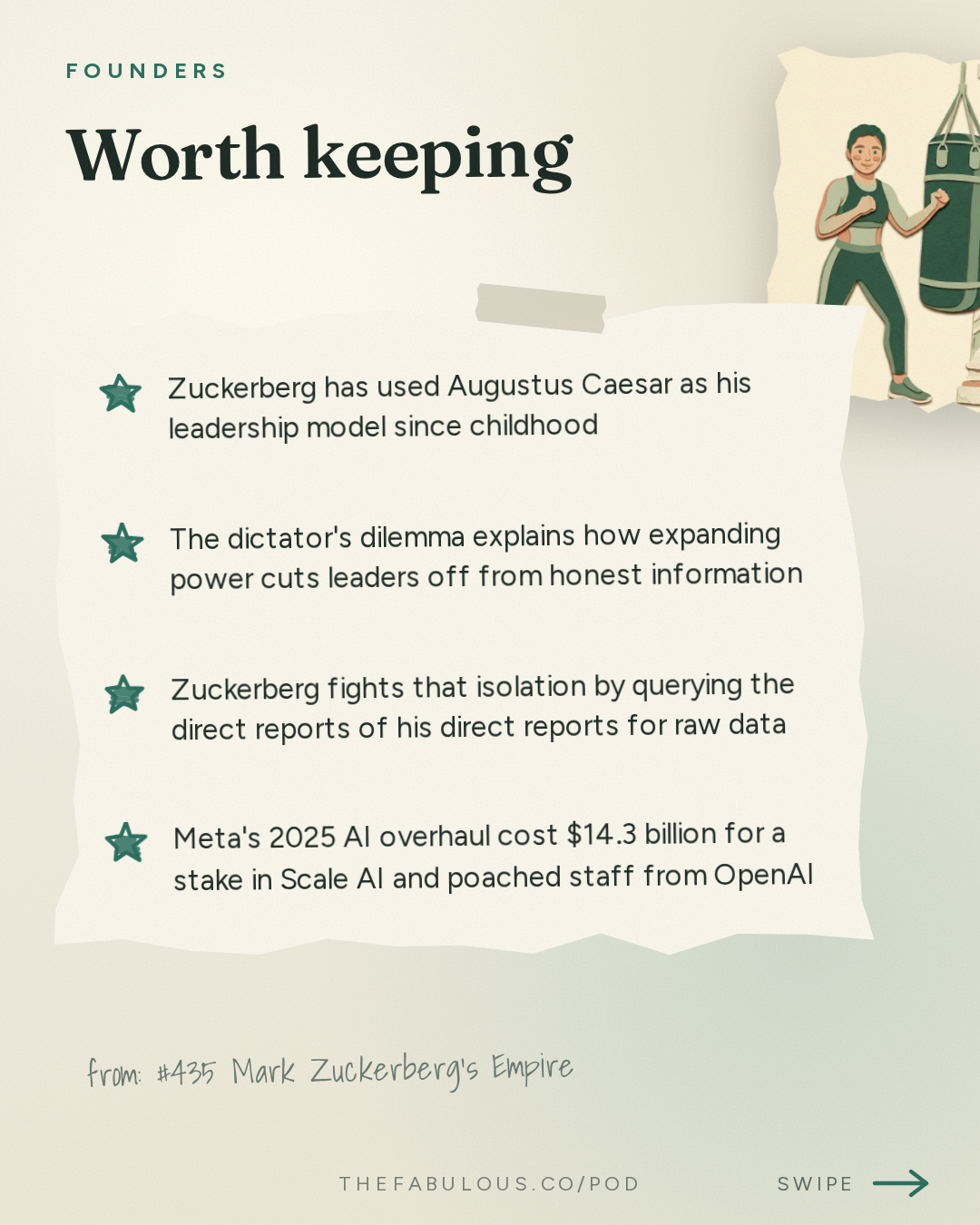
- Zuckerberg has used Augustus Caesar as his leadership model since childhood
- The dictator's dilemma explains how expanding power cuts leaders off from honest information
- Zuckerberg fights that isolation by querying the direct reports of his direct reports for raw data
- Meta's 2025 AI overhaul cost $14.3 billion for a stake in Scale AI and poached staff from OpenAI
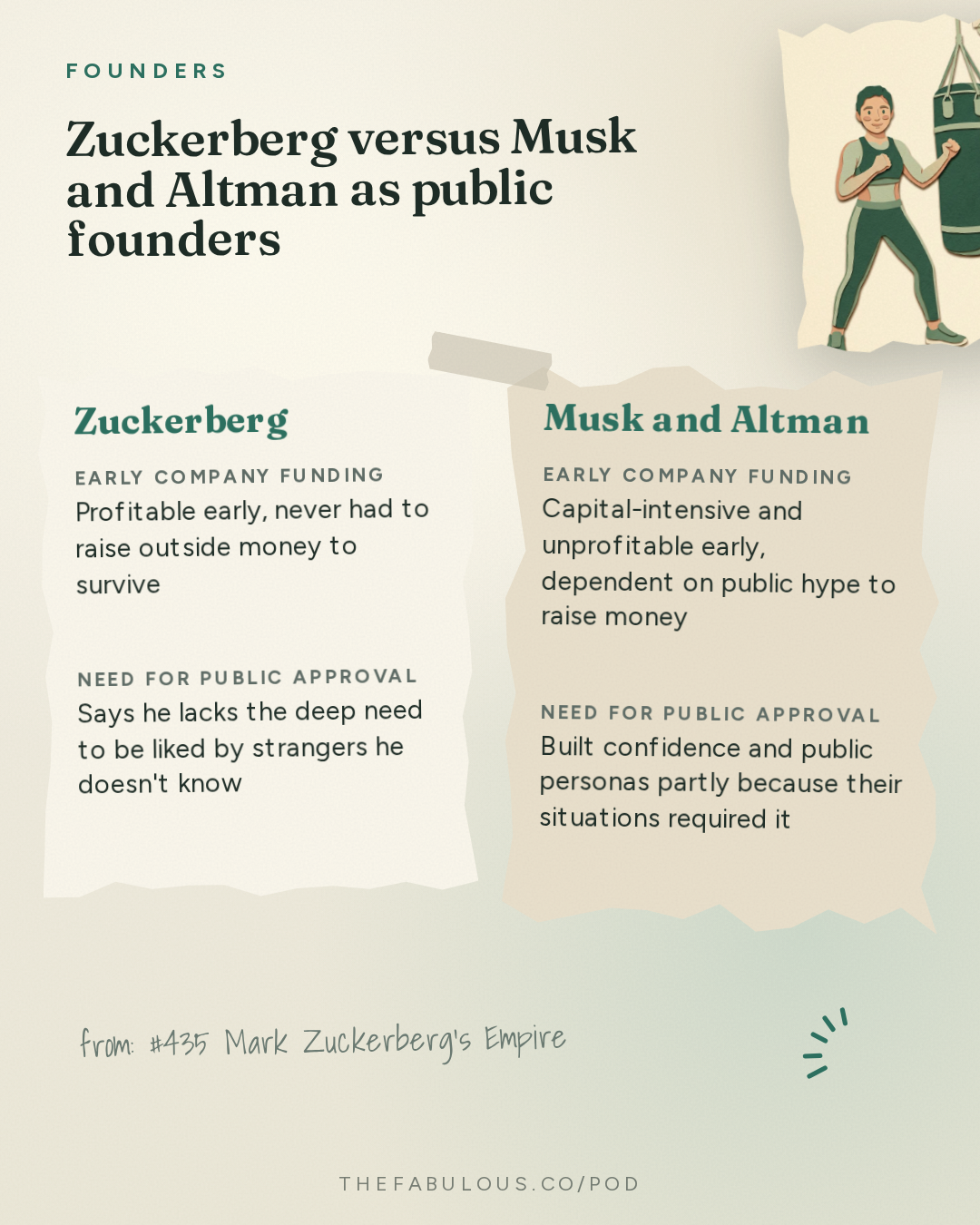
- Zuckerberg says he lacks the need to be liked by strangers, unlike Elon Musk and Sam Altman
The episode in cards
At forty-two, Mark Zuckerberg wakes up most mornings and lets someone try to hit him in the face. He trains in mixed martial arts three mornings a week, a habit that has him getting slammed to the mat by an NCAA wrestling champion between board meetings and congressional hearings (06:38). It sounds like a strange hobby for the man who runs a company worth $1.6 trillion (07:33). It is not. Journalist Jeremy Stern's profile of Zuckerberg, titled "Mark: A Journey to the Heart of History's Largest Non-Territorial Empire," argues that the fighting is a deliberate counterweight. Everywhere else in his life, Zuckerberg is insulated by staff, lawyers, and a company that cannot fire him. In the cage, if he makes the wrong move, he gets punched. His coach put it simply: "If you go left when you should have went right, you will get punched in the face" (14:15).
Stern's piece opens somewhere gentler: a living room, with Zuckerberg's parents. His father remembers a boy who, by age six, refused to accept a household rule without a full logical justification and a step-by-step account of its consequences (01:16). At twelve he built a computer game set in the Roman Empire, where the player conquers the world one territory at a time (02:00). A virus wiped it out, and he vowed through tears never to forget to back up his work again, and to make the rebuilt version faster (02:00). The Roman theme was not a phase. In high school he studied Latin. Years later he could still recite Jupiter's promise from the Aeneid, the founding poem of Rome: "For these, I set no bounds in space or time. I have given empire without end" (02:20). At Facebook's 2024 conference, he wore a shirt reading "Either a Caesar or nothing" (03:28). He named two of his children Maxima and August.
The fixation is specifically on Augustus, Rome's first emperor, who turned a crumbling republic into two centuries of peace through methods Zuckerberg does not flinch from calling harsh. "That didn't come for free," he has said. "He had to do certain things" (03:12). It is a useful key to how he thinks about running Meta: peace and scale are not gifts, they are built and defended, sometimes ruthlessly.
The problem every emperor shares
Stern's central idea borrows a name from political science: the dictator's dilemma. As a leader's power grows, he depends more on subordinates for information about his own domain, and those subordinates become less willing to tell him what he does not want to hear (08:15). Stalin's officers stopped warning him about the coming German invasion in 1941. Mao's provincial officials reported record harvests during a famine. Nokia's middle managers, afraid of their bosses, downplayed the 2007 iPhone (08:37). The pattern recurs wherever fear replaces candor.
Zuckerberg's advantage, according to nearly three dozen people Stern interviewed, is that he is paranoid about exactly this. He routinely calls the direct reports of his direct reports, and their subordinates too, to check raw numbers before his inner circle can soften them (10:44). He invites outside critics in to argue with him. He takes public blame for mistakes that were not entirely his. And unlike almost any other CEO of his stature, he cannot be voted out: Meta's ownership structure gives him majority control, which means, barring catastrophe, he could still be running the company in fifty years (07:04).
That permanence has a cost the profile does not shy from. Meta's capital spending this year will exceed the military budget of every country except the United States, China, and Russia (17:33). One in every 2.3 living humans uses a Meta product, more people than existed on Earth in 1965 (17:33). It is, by any measure, an empire, just one with no flag and no border, built entirely out of servers and habits.
Land he never owned
Founders obsess over owning the ground their business stands on. Zuckerberg never has. Facebook ruled the open desktop web, but when the smartphone arrived, he did not own the platform underneath it, and he nearly missed the shift entirely, scrambling during the 2012 IPO to rebuild the ad business around mobile (14:50). Apple's App Store made Facebook's mobile business possible, and Facebook's dominance helped make the App Store what it is, a mutual debt Stern calls being "made." Zuckerberg does not like being made. His attempts to escape it, a failed Facebook phone, a free-data deal in India, a cryptocurrency called Libra, a $2 billion bet on Oculus virtual reality that has since burned through roughly $90 billion (19:41), are all attempts to dig a tunnel out of someone else's territory. As he told an interviewer bluntly: "There have been too many things that I've tried to build and then have been told, 'Nah, you can't really build that' by the platform provider. At some level, I'm just like, 'Nah, fuck that'" (16:32).
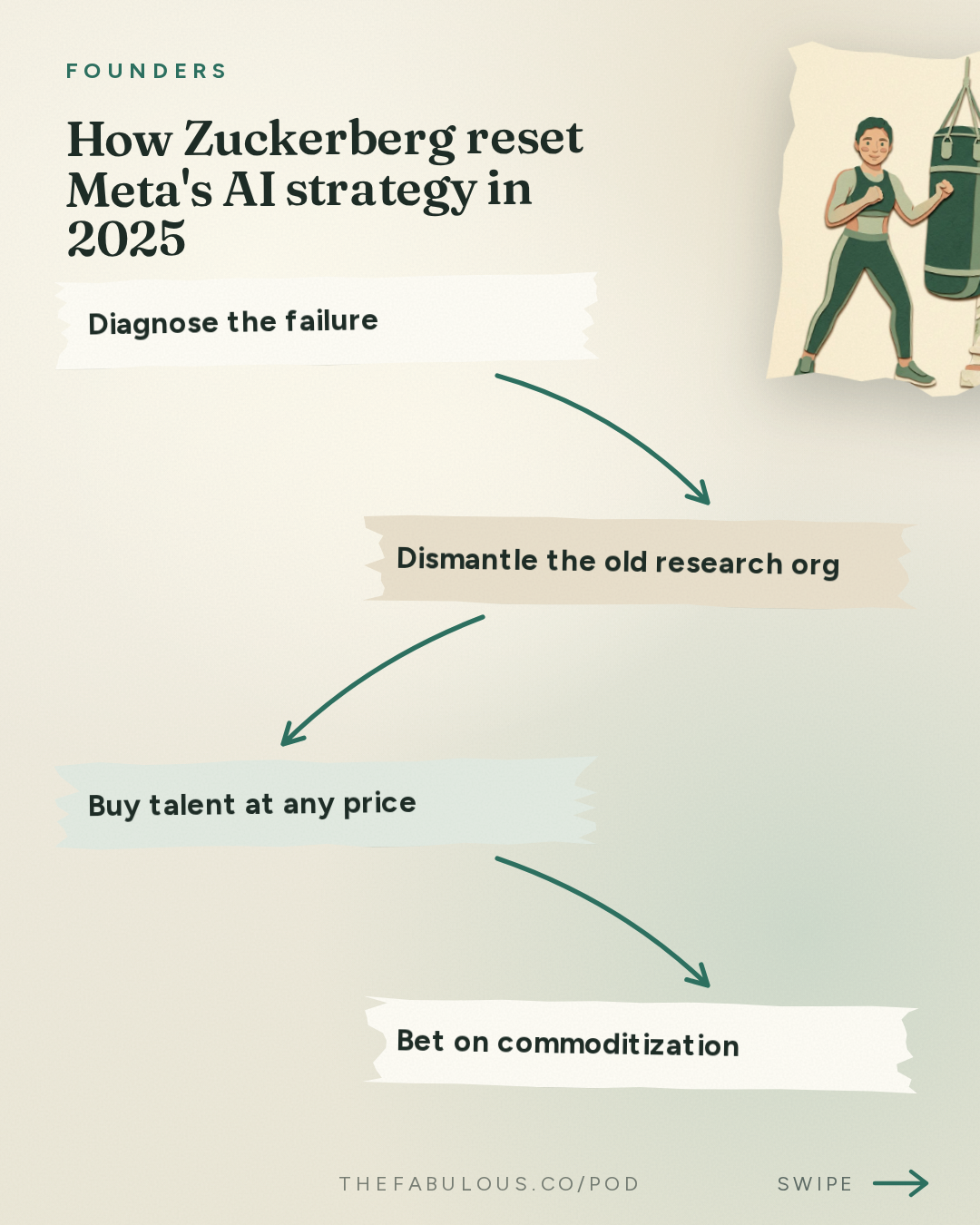
That instinct explains the smart glasses Meta now pushes hard, a device meant to be the native home for an AI that sees what its wearer sees and hears what they hear (19:41), and it explains the whiplash of 2025. When Meta's Llama 4 model launched behind the frontier in April, Zuckerberg used his very next board meeting to announce a leadership reset (27:26). Within eleven weeks he folded the old Facebook AI Research group into a new one, Meta Superintelligence Labs, paid $14.3 billion for a stake in Scale AI, installed its founder Alexander Wang as Meta's head of AI, and pulled dozens of researchers out of OpenAI, Anthropic, and Google DeepMind with pay packages worth hundreds of millions of dollars a head (28:14). One rival researcher who used to work at Meta summed it up: "Mark is the fucking Terminator... his source of advantage is he's never happy. He just doesn't fucking stop" (31:16).
This is, Stern notes, a familiar rhythm. Facebook has been declared dead roughly every few years: after the shaky 2012 IPO, after teenagers fled to Snapchat, during the 2017-2020 political crisis when the company lost $120 billion in market value in a single day and paid a $5 billion FTC privacy settlement (24:11), and again when TikTok and Apple's privacy changes threatened its ad business. Each time, Zuckerberg came back larger. The steel-man case for why he might win the current AI race is not that Meta has the best model. It is that he can afford to treat AI as a useful tool rather than a religion, and drive its cost toward zero using ad revenue and owned infrastructure, a bet where, as one competitor put it, "heads, he wins, tails, he wins" (30:35).
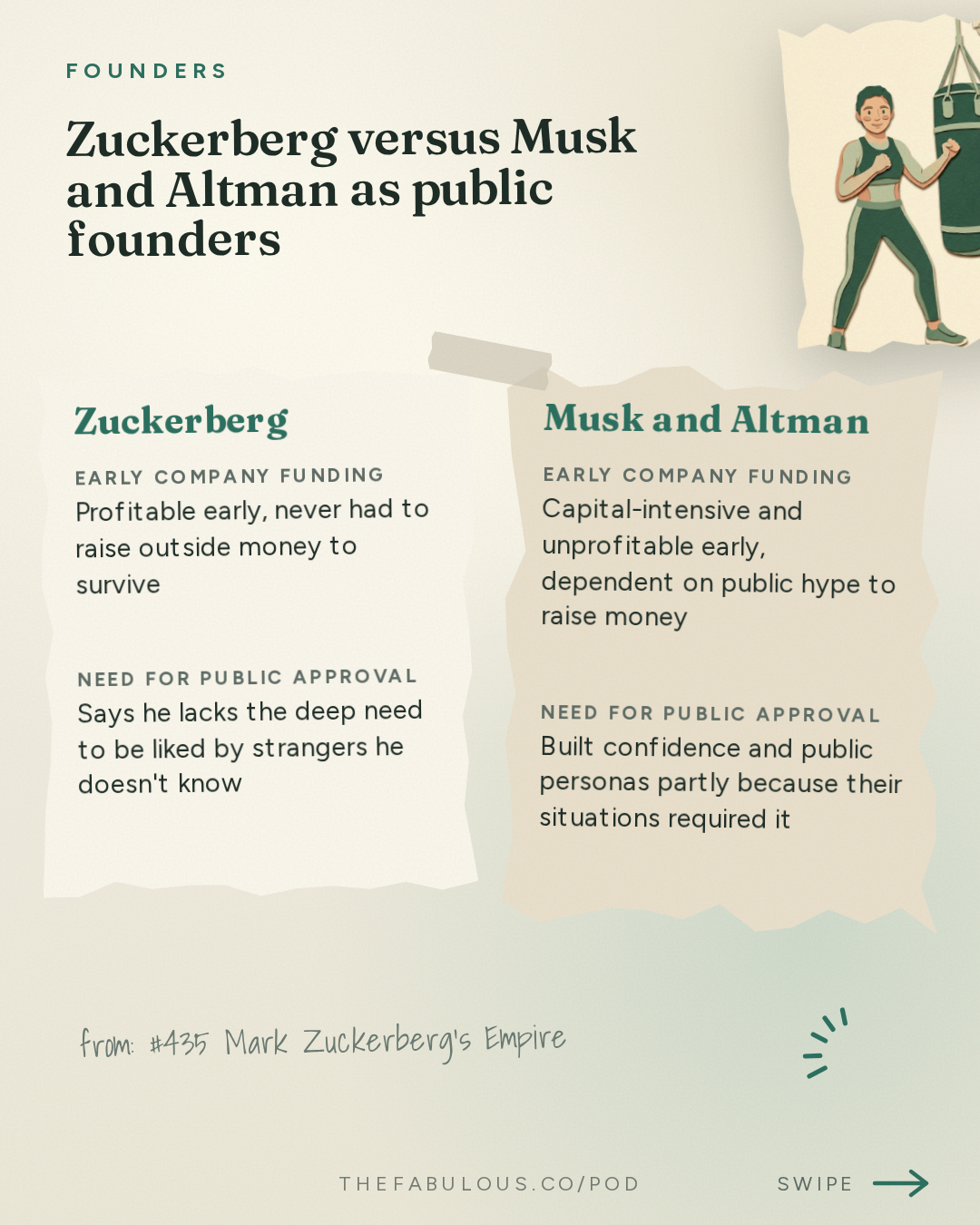
What separates him from peers like Elon Musk and Sam Altman, in Zuckerberg's own account, is that Meta was profitable early and he never had to raise outside money or sell his own myth to investors (34:15). He says he simply does not carry the need to be liked by strangers the way some public founders do:
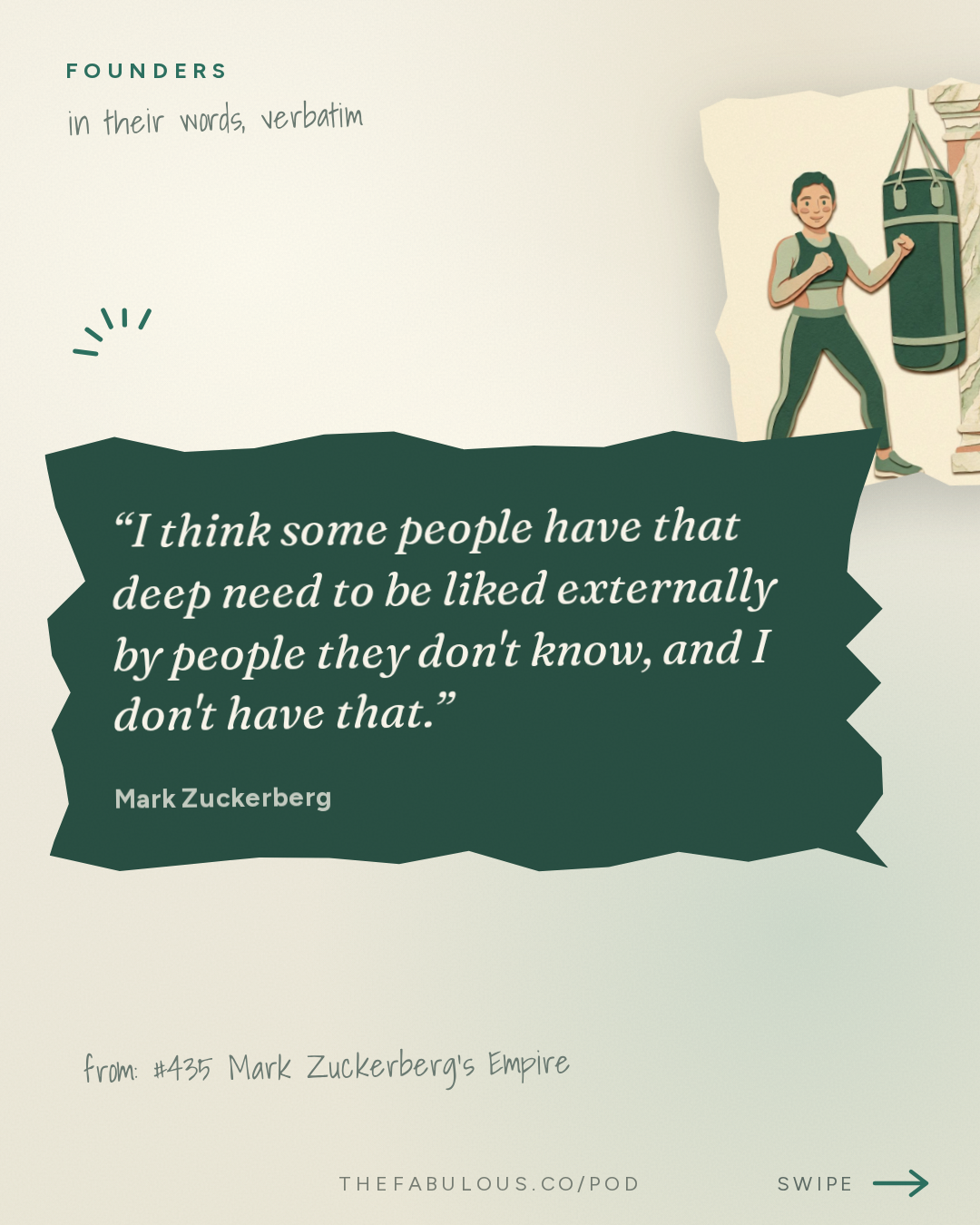
"I think some people have that deep need to be liked externally by people they don't know, and I don't have that." — Mark Zuckerberg (35:00)
Stern's own read is sharper: Musk's flaws are all visible, which somehow makes him harder to attack, while Zuckerberg's careful concealment makes him an easier target (35:27).
The profile ends not with Zuckerberg but with his wife, Priscilla Chan, in the family's home in Lake Tahoe. She shows Stern their daughter's laptop, full of a self-written novel, a podcast, vibe-coded apps, business plans, all built without prompting from her father. Around year eighteen or nineteen of the twenty-three years she has known Mark, Chan says, she asked Zuckerberg if they could be done, if they had earned a quieter chapter. He said no. Watching her daughter build things with no one telling her to, Chan finally understood him:
"You can't take this away from him. He wouldn't be him if he stopped." — Priscilla Chan (40:26)
It is the least imperial line in the whole profile, and somehow the truest one. Empires end. The urge to build one, in Zuckerberg's case, apparently does not.
In their words
“For these, I set no bounds in space or time. I have given empire without end.”
“Time after time, his arrogance just turns into truth.”
“I think some people have that deep need to be liked externally by people they don't know, and I don't have that.”
“He wouldn't be him if he stopped.”
Protocols
-
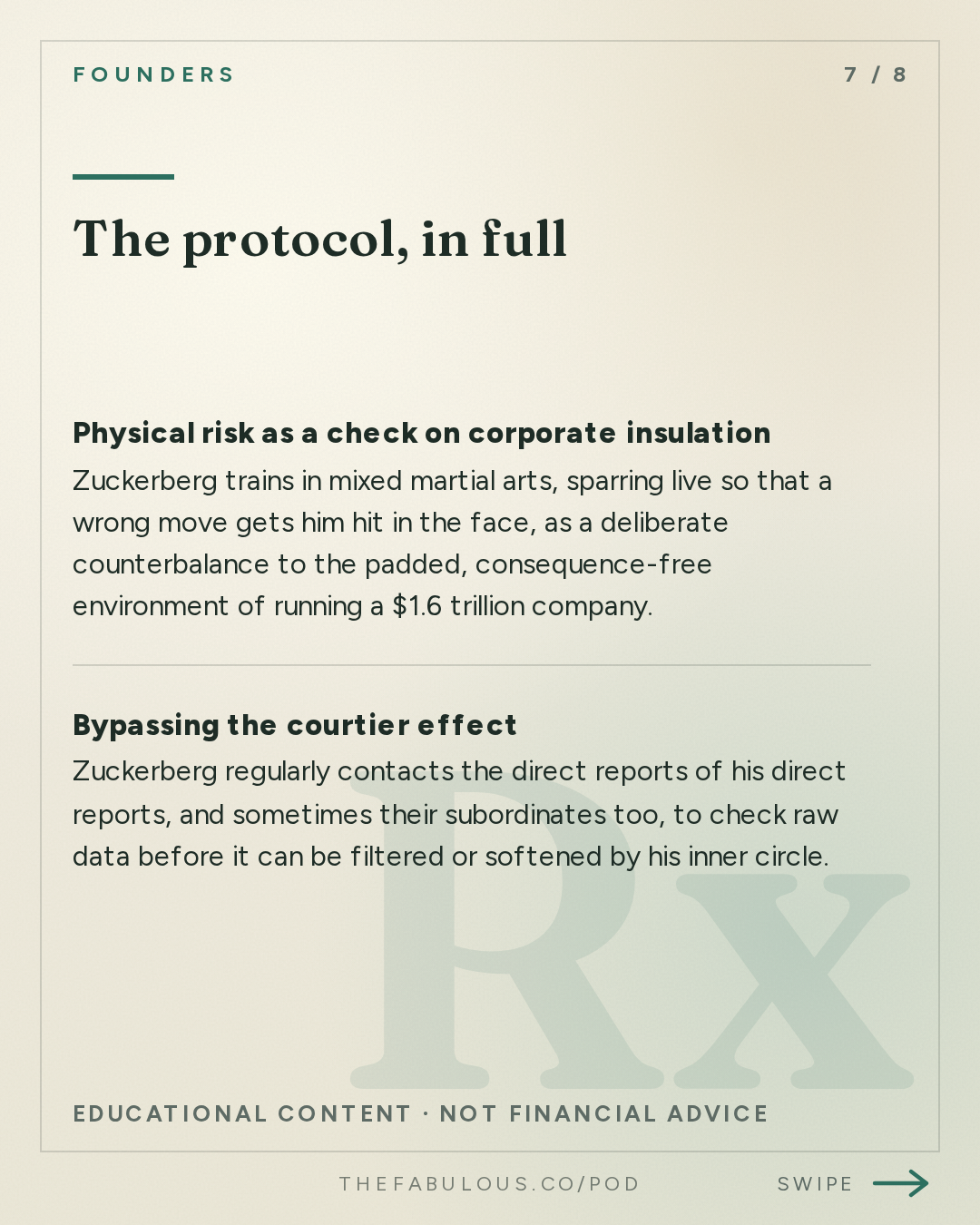
Physical risk as a check on corporate insulation
Zuckerberg trains in mixed martial arts, sparring live so that a wrong move gets him hit in the face, as a deliberate counterbalance to the padded, consequence-free environment of running a $1.6 trillion company.
Three mornings a week
-
Bypassing the courtier effect
Zuckerberg regularly contacts the direct reports of his direct reports, and sometimes their subordinates too, to check raw data before it can be filtered or softened by his inner circle.
Ongoing practice
Questions this episode answers
What is the dictator's dilemma in Jeremy Stern's Zuckerberg profile?
It describes how, as a leader's power expands, subordinates become less willing to tell him uncomfortable truths, leaving him increasingly isolated from reality (08:15). Stern cites Stalin's officers hiding warnings of a German invasion and Nokia managers downplaying the 2007 iPhone as historical examples (08:37).
Why is Mark Zuckerberg obsessed with Augustus Caesar?
At twelve he built a computer game about conquering the Roman Empire (02:00), and he still recites a Latin verse from the Aeneid about 'empire without end' (02:20). He wore a shirt reading 'Either a Caesar or nothing' at Meta's 2024 conference (03:28), and has said Augustus's harsh methods were necessary to secure two centuries of peace (03:12).
How does Zuckerberg try to avoid becoming isolated by his own staff?
He regularly contacts the direct reports of his direct reports to check raw data before his inner circle can filter it (10:44), and he trains in MMA three mornings a week, treating physical risk as a counterweight to a consequence-free corporate life (06:38).
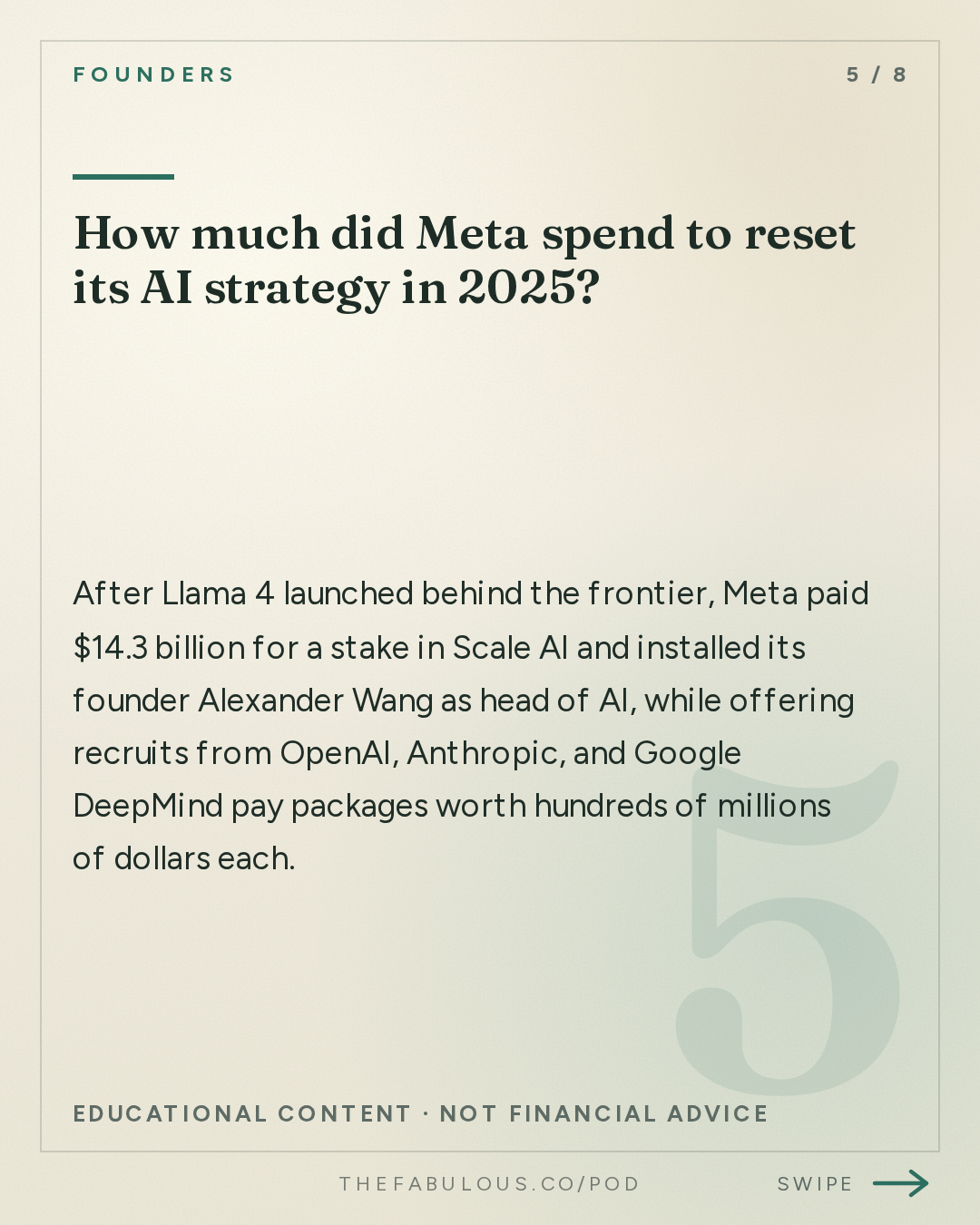
How much did Meta spend to reset its AI strategy in 2025?
After Llama 4 launched behind the frontier, Meta paid $14.3 billion for a stake in Scale AI and installed its founder Alexander Wang as head of AI, while offering recruits from OpenAI, Anthropic, and Google DeepMind pay packages worth hundreds of millions of dollars each (28:14).
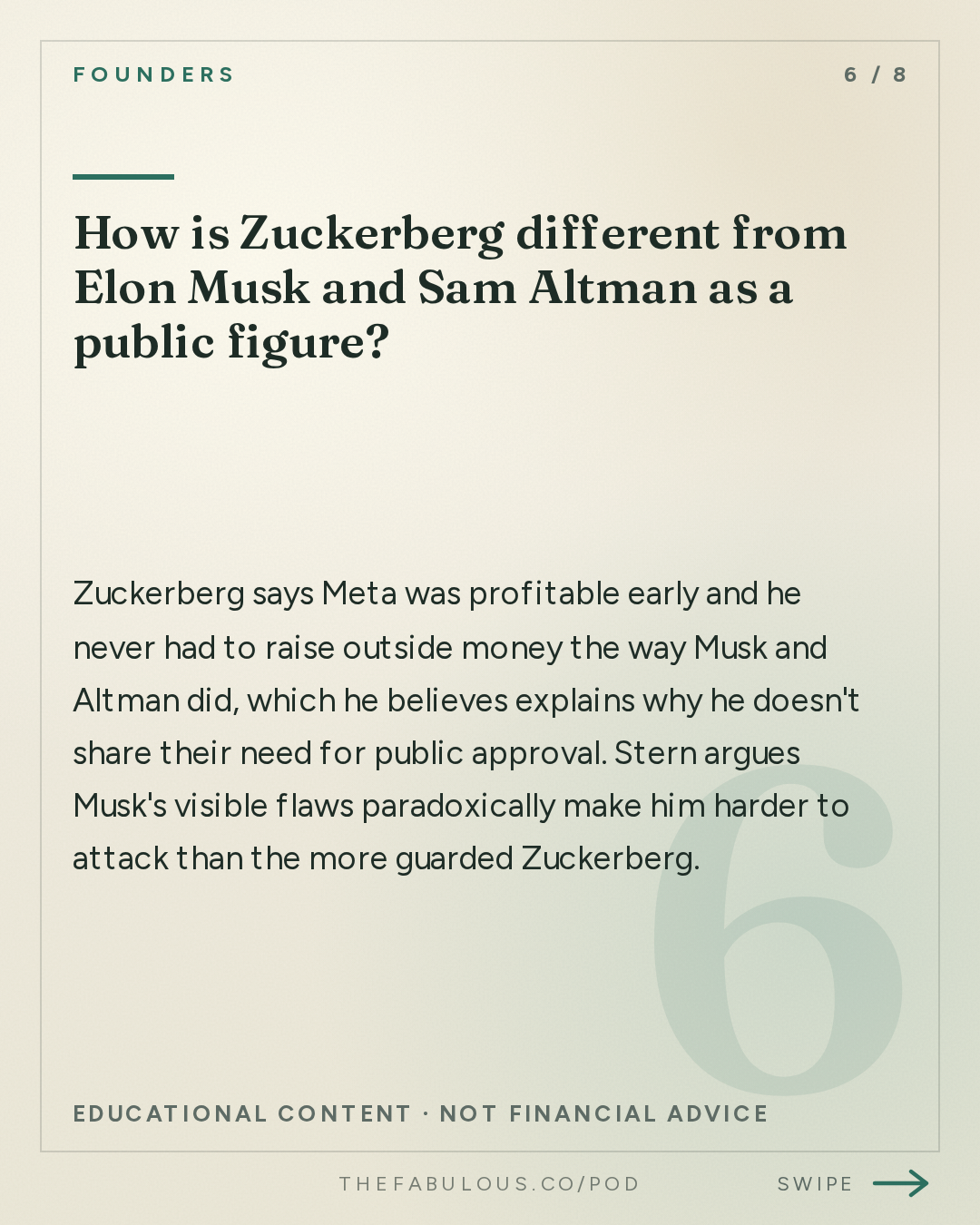
How is Zuckerberg different from Elon Musk and Sam Altman as a public figure?
Zuckerberg says Meta was profitable early and he never had to raise outside money the way Musk and Altman did, which he believes explains why he doesn't share their need for public approval (34:15). Stern argues Musk's visible flaws paradoxically make him harder to attack than the more guarded Zuckerberg (35:27).
The full read, in cards
Go deeper
- Mark: A Journey to the Heart of History's Largest Non-Territorial Empire — Jeremy Stern's long-form profile of Zuckerberg that the entire episode discusses
- The Aeneid — source of the Latin verse about 'empire without end' that Zuckerberg still recites
Mentioned
Mark Zuckerberg · Jeremy Stern · Augustus Caesar · Priscilla Chan · Elon Musk · Sam Altman · Alexander Wang · Yann LeCun · Meta · Apple · Scale AI · Llama · Aeneid
More from this show and category
Sam Walton's Core Business Strategies
Sam Walton built Walmart on four simple habits: cost control, copying competitors, small-town focus, and constant willingness to change course. He lost his first store over a missing lease clause, learned to fly a plane to scale faster, and copied ideas from JC Penney and Sol Price on his way to becoming America's richest man.
How Michael Bloomberg Built His Business Empire
Michael Bloomberg was fired from Salomon Brothers in 1981 with a $10 million severance, and he used it to build the Bloomberg Terminal into a data and media empire. Drawing on his memoir, Bloomberg by Bloomberg, the episode traces his sales training, his refusal to plan more than a few steps ahead, and his rule that business fights should never be fair.
What The Mind of Napoleon Teaches Founders
Napoleon Bonaparte's private writings, collected in the 1955 book The Mind of Napoleon, reveal a leader who planned obsessively then acted without hesitation. Drawing on the book's maxims, the episode extracts his rules for decision-making, propaganda, and building projects in useful stages, arguing they still work for founders today.
Henry Singleton's Teledyne Strategy Explained
Henry Singleton ran Teledyne from 1961 to 1990, compounding shareholder returns at 20.4% a year through radical capital allocation. He kept corporate staff under 50 people for 40,000 employees, repurchased 90% of Teledyne's shares between 1972 and 1984, and concentrated stock bets in five companies he knew well.
