
Eiichiro Oda's Work Ethic and Daily Schedule
#439 How Eiichiro Oda Works
The brief
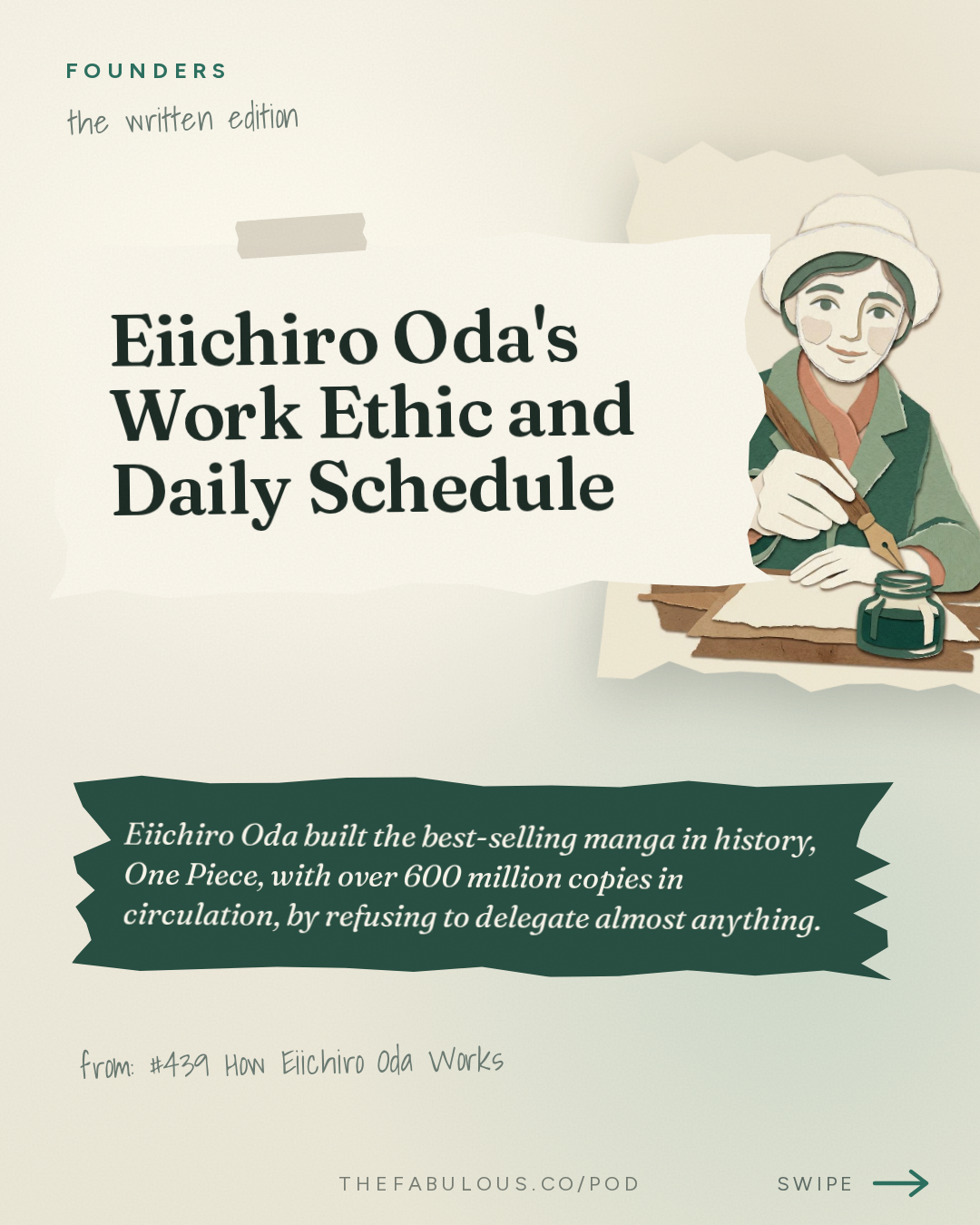
Eiichiro Oda built the best-selling manga in history, One Piece, with over 600 million copies in circulation, by refusing to delegate almost anything. For 15 years he slept three hours a night and drew every moving element himself. His method echoes Steve Jobs and Jeff Bezos: one imagined reader, a fixed ending, total personal control over every detail.
Eiichiro Oda once put a secret at the bottom of the ocean. To mark the six hundred millionth copy of his comic sold, he wrote down the truth about the treasure his pirates spend decades chasing, sealed part of it in a chest, and had it submerged on the seabed (19:31). Nobody will read it until the story ends. It is a theatrical gesture, but it says something true about the man. Oda has spent almost his entire adult life writing about freedom, treasure, and the open sea while living one of the most restrictive schedules of any working artist alive.
Oda is the creator of One Piece, a manga, which is simply the Japanese term for what English readers call a comic book or graphic novel. It is the best-selling comic series in history, with more than 600 million copies in circulation (00:24), and Guinness has given Oda a world record for the most copies published of the same series by a single author. He decided he wanted this job at age four, specifically so he would never have to get, in his own words, a real job (01:39). He began serializing One Piece in 1997, at 22. He is 51 now, and the story is still running.
What makes Oda worth studying is not the sales figures. It is the method behind them, and how closely that method matches the habits of entrepreneurs who have nothing to do with comics.
His instinct for differentiation goes back to his first days trying to break into Weekly Shonen Jump, the magazine that still publishes him. The market was saturated with heroes fighting demons to save the world, he has said, and he wanted to do something different (01:21). That is close to the central argument of Peter Thiel's book Zero to One: differentiated companies succeed and copies fail, because copies cannot escape competition (02:02). Oda made the same bet with a rubber-limbed pirate instead of another sword-swinging hero. He has also said it gets harder, not easier, to decide what to draw now that he has decades of experience, and the host noted that this tracks with music producer Jimmy Iovine's observation that information and experience can get in the way of making something simple (11:01). Knowing more, in other words, is not the same as seeing more clearly.
One reader, no committee
Oda has said, flatly, that he does not design One Piece for the world. It is basically impossible to create a series with the whole world in mind, he has said, so he does not even try (02:19). Instead he aims at a single imagined reader: himself, at fifteen.
"I only have one reader in my mind, myself as a 15-year-old. I have no idea how other people would feel, so I turn back to the 15-year-old me to make a judgment on what is awesome or not." Eiichiro Oda, [07:14]
This sounds narrow, but Oda's bet is that human desire is more universal than local. He has said that if Japanese children enjoy something, everyone else likely will too (02:37), and the sales numbers across dozens of countries suggest he was right.
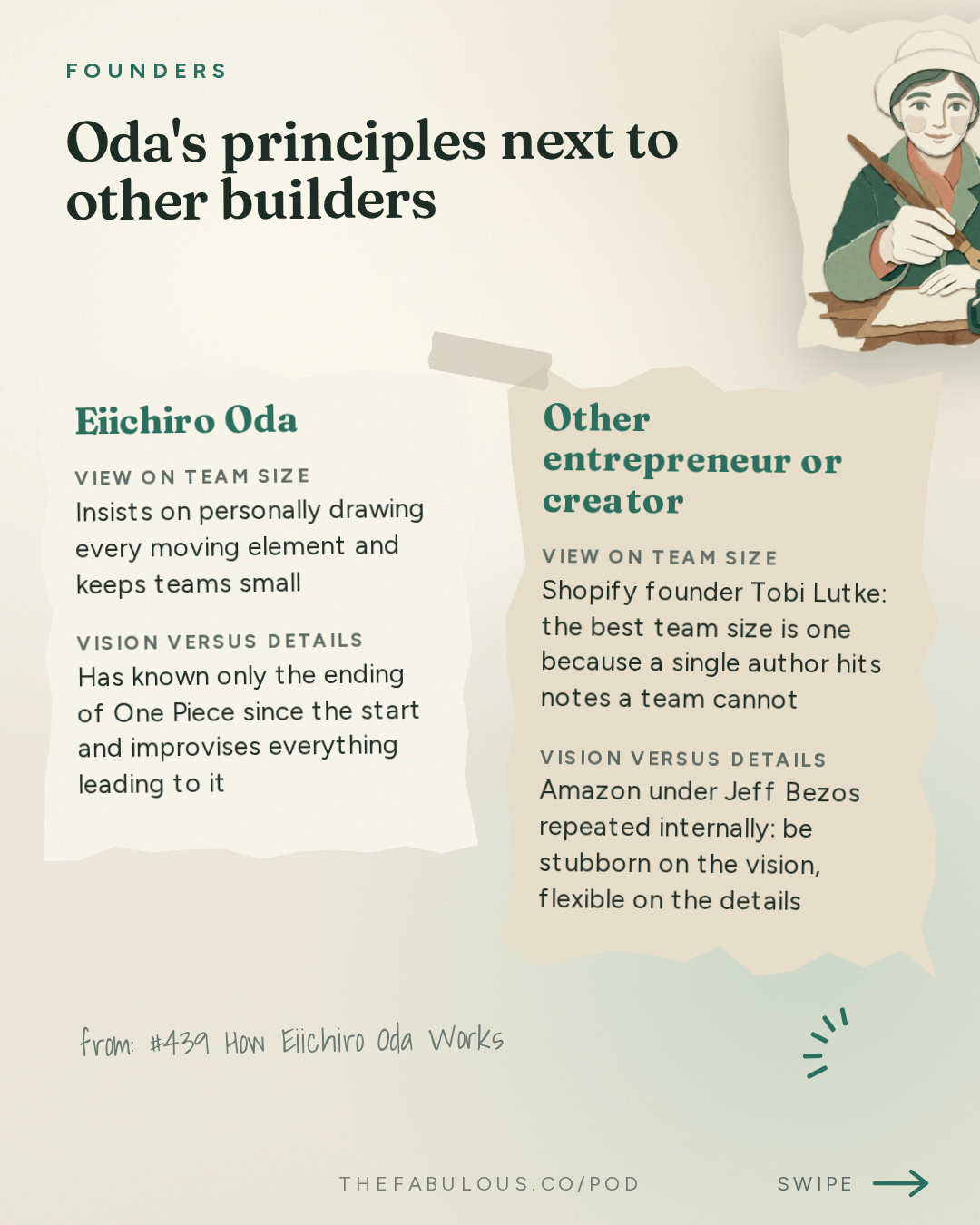
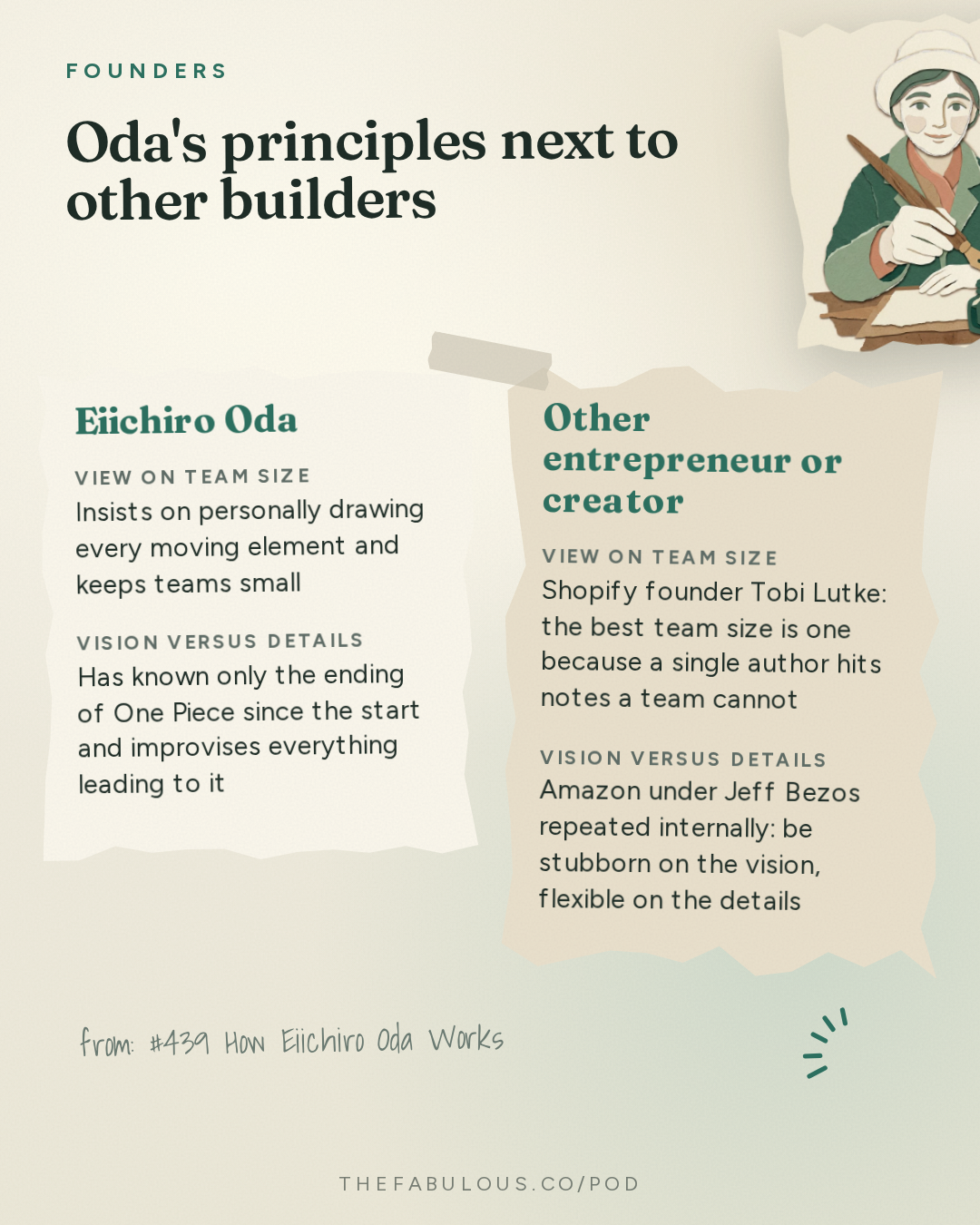
The same instinct shows up in his refusal to hand work to other people. He has said he tries to keep the fewest number of people possible touching the work, because too many hands leave him unsatisfied with the final product (04:51). Shopify founder Tobi Lutke has made a nearly identical argument about software, saying the best team size is one because a single author can hit high notes a team cannot reach (05:37). The book Insanely Simple, about Steve Jobs's design philosophy, states the same idea as a rule: the quality of work is inversely proportional to the number of people involved in a project (05:18).
Oda personally draws every element in One Piece that moves: every character, every crowd scene, and also the smoke, the clouds, and the ocean waves (16:02). His assistants handle only static backgrounds. He has explained that handing moving elements to someone else creates small inconsistencies in the art, inconsistencies most readers would never notice but that he will not accept. His need for control extends past the page. When Netflix adapted One Piece into a live-action series, he has said the streamer agreed not to release it until he was satisfied, and he read every script and acted, in his words, as a guard dog to keep the adaptation faithful (17:04).
Exhaustion as a method
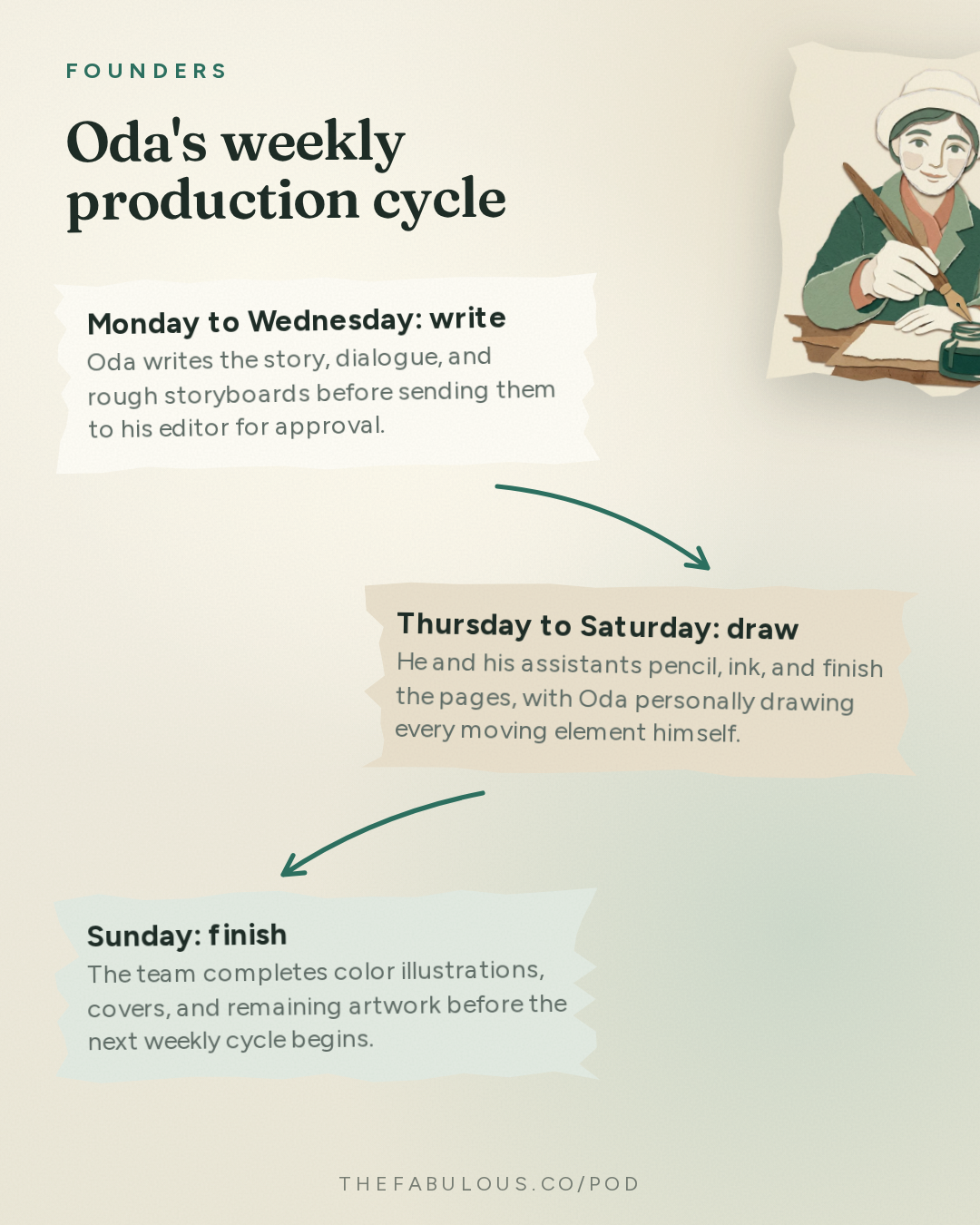
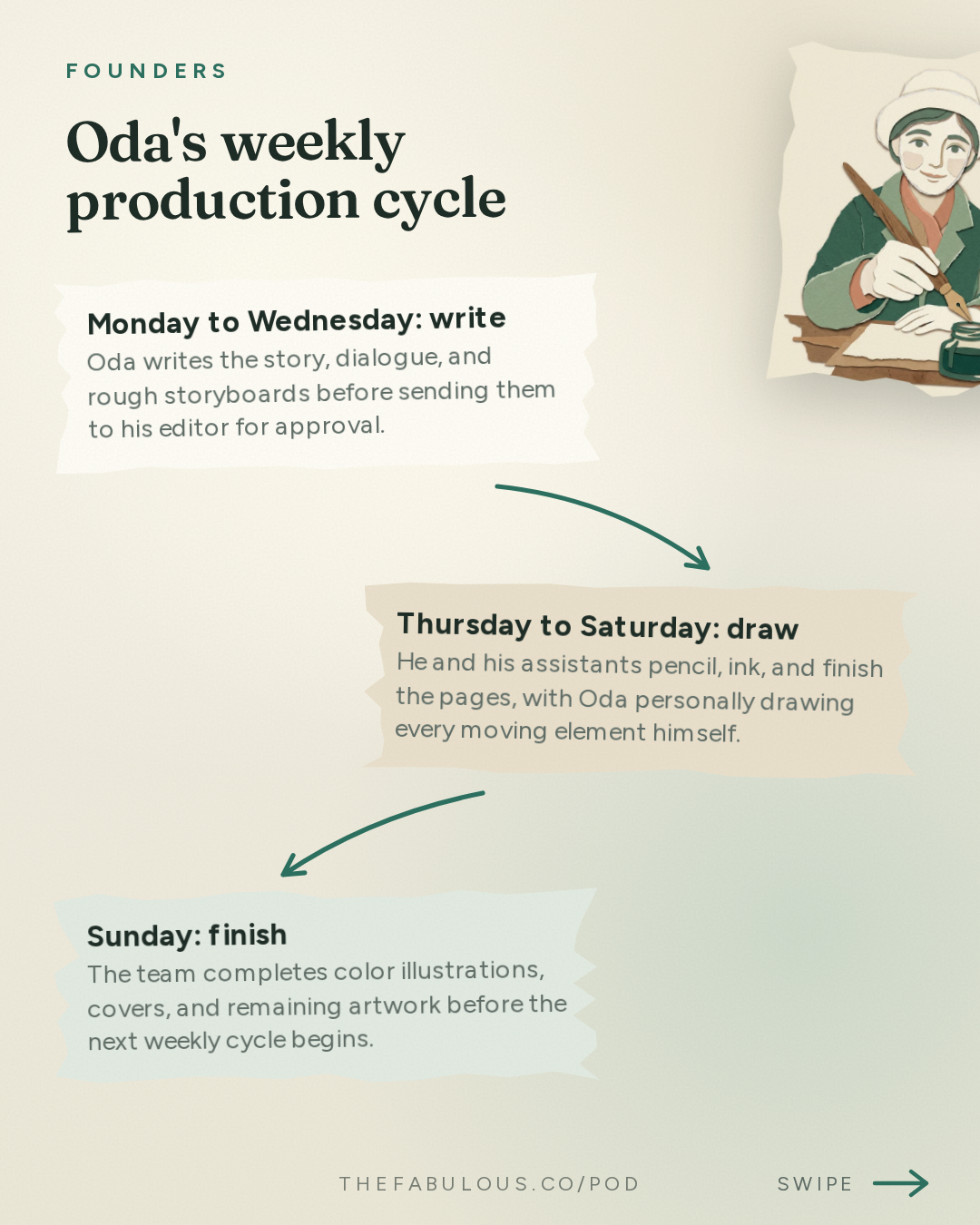
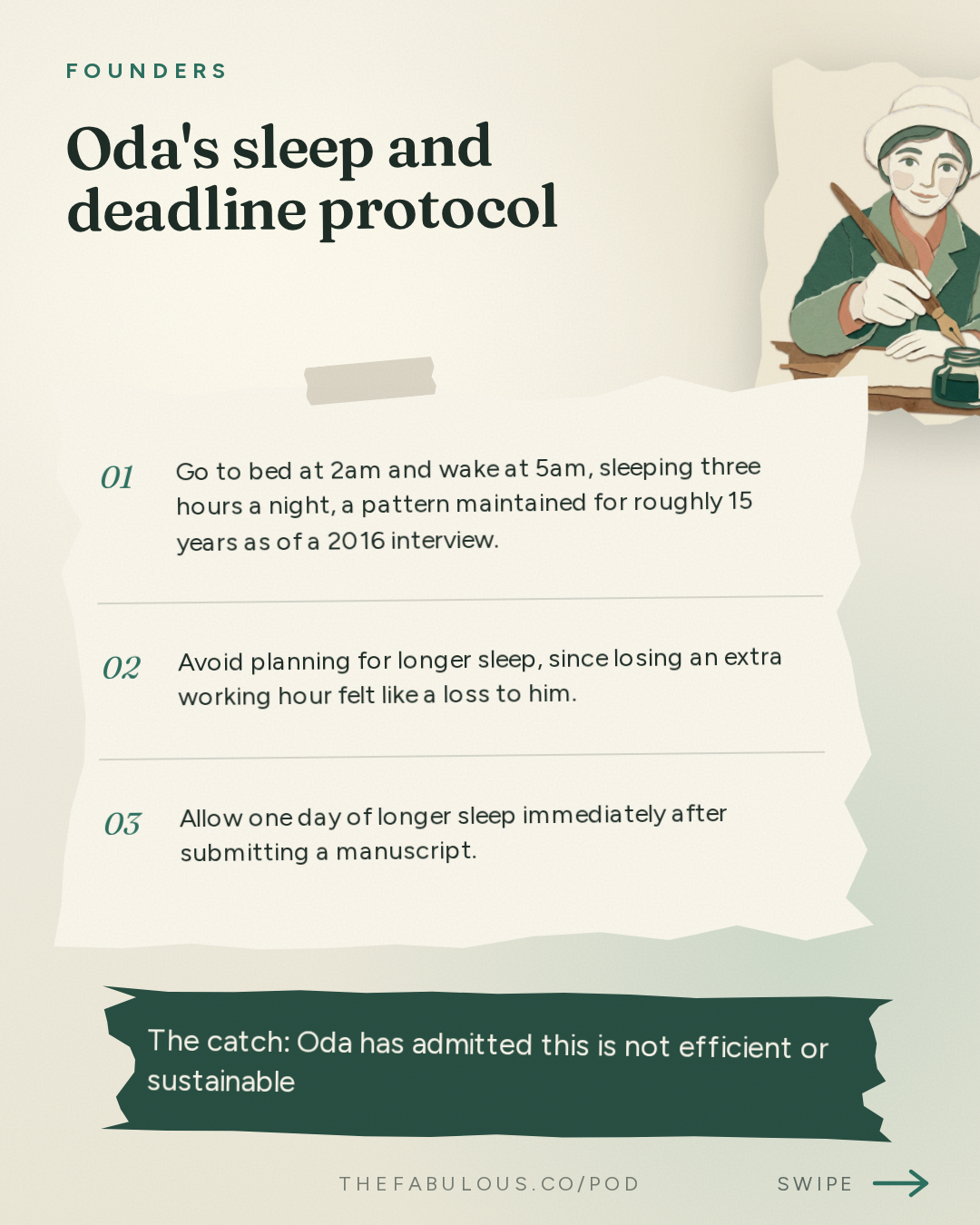
Oda's work schedule sounds less like a creative routine and more like an endurance event. For roughly 15 years before a 2016 interview, he went to bed at 2am and woke at 5am, sleeping three hours a night (06:59, 14:25). He said planning to sleep four hours made him dread the extra, wasted hour. Earlier in his career the pattern was stranger still: he slept about two hours every 48 hours, broken into 15-minute naps (14:25). A published account of his 2015 schedule had him writing story, dialogue, and storyboards Monday through Wednesday, drawing and finishing pages with assistants Thursday through Saturday, and completing color illustrations and covers on Sunday (14:49), a cycle that restarted every week.
He treats physical depletion as a creative tool, not an unfortunate side effect.
"The only way that I can think of a new idea is to think about it without sleeping or eating. That's the only way that I know, because humans can only come up with truly new ideas when they reach their limit." Eiichiro Oda, [06:39]
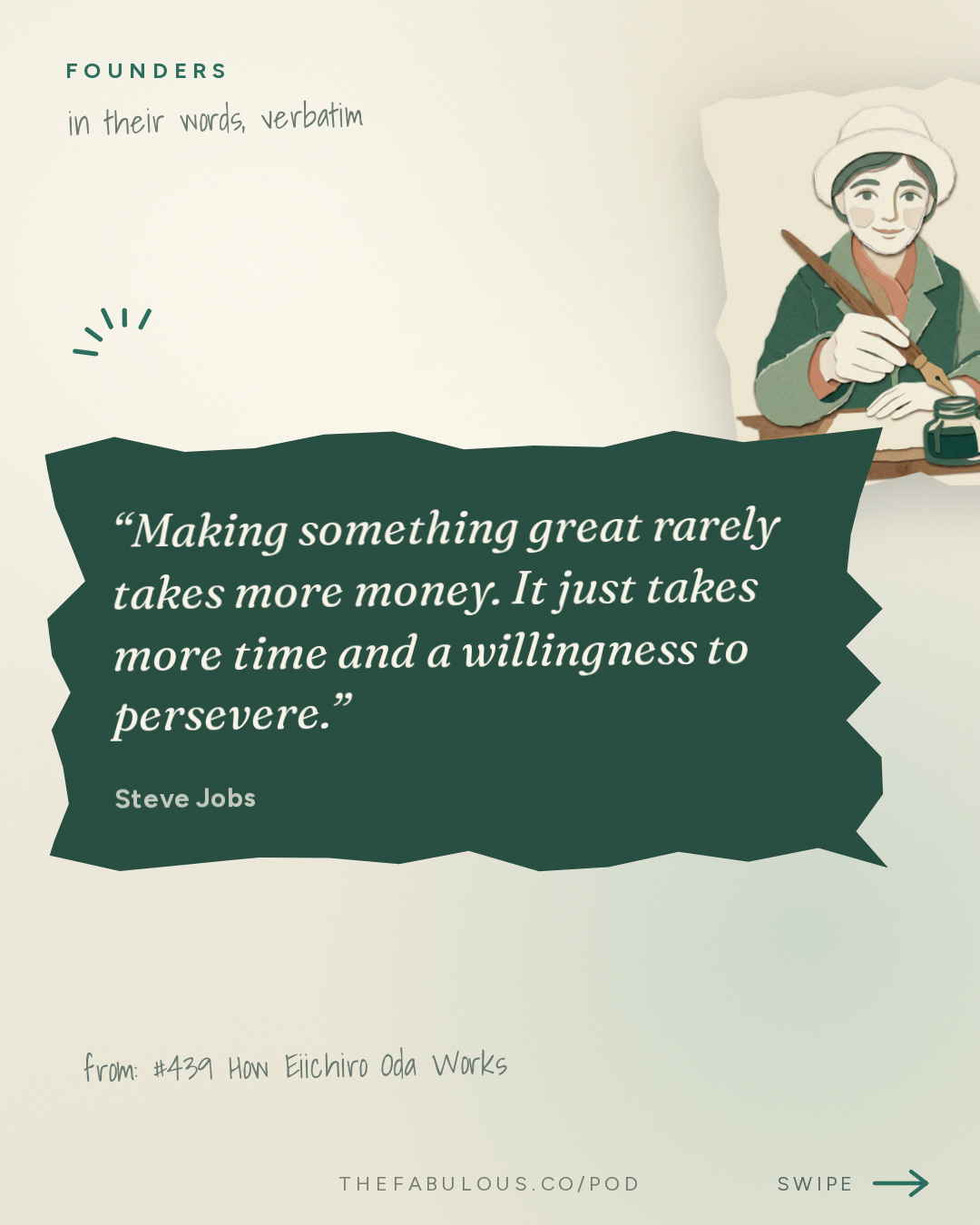
That standard has not softened with success. After more than a decade of running One Piece, Oda admitted he still had not found a way to finish his stories ahead of schedule, and he acknowledged that finishing earlier would give him more free time and an easier life (30:35). He concluded his personality simply would not allow it: he could not stop searching for a better idea just because the current one was already good enough (30:54). Comedian Jerry Seinfeld made almost the identical point in a Harvard Business Review interview, when asked if a consulting firm could have made his writing process more efficient: "If you're efficient, you're doing it the wrong way. The right way is the hard way. The show is successful because I micromanage it, every word, every line, every take, every edit, every casting" (30:18). Steve Jobs told journalist Michael Moritz something similar about Apple: making something great rarely takes more money, just more time and a willingness to persevere (08:29).
Oda's vision for the story itself has stayed fixed even as every detail around it improvises. He has said he has known only the ending of One Piece since the beginning, and has built everything leading up to it as he goes (08:51). That is close to the phrase Amazon repeated internally for decades under founder Jeff Bezos: be stubborn on the vision, flexible on the details (09:10).
None of this is free. Oda has said he was once willing to miss a parent's funeral rather than miss a weekly deadline, and he has told new editors to be prepared to die for One Piece (15:10). He sees his own family about once a week, partly because he finds family time so relaxing that it disrupts his working intensity (15:33). When he was hospitalized, he brought his drawing tools because not working made him anxious (20:48). None of this reads as balance. It reads as a man organized entirely around one compulsion, who nonetheless describes drawing manga as a pastime rather than a stressful occupation (20:12).
Financially, the compulsion has worked. Estimates put Oda's net worth between $250 million and $500 million, with annual income from One Piece in the range of $20 million to $40 million (19:10). He has said he wants younger manga artists to see exactly how wealthy a great manga creator can become, which is part of why he throws parties inside a house that looks less like a home and more like an amusement park, with arcade games, a miniature train, a dragon-themed bathroom, and a shark's head mounted above his toilet (18:43).
Behind the eccentricity sits an enormous, mostly unseen pile of preparation. Oda keeps 17 separate notebooks for a single story arc, plus additional notebooks cataloguing characters' abilities (21:53). Some of his most important characters were never in those notebooks at all. A group of nine rookie pirates, the Supernovas, were invented within a few hours after an editor said a storyline needed more excitement (22:34).
The trait that threads through every interview, across two decades, is tolerance for repetition, which looked at closely is really tolerance for depth. Staying with one problem, one weekly cycle, for close to thirty years let Oda see things a more distracted creator would miss. He says his dream, once the story ends, is to become a permanent traveler, sleeping somewhere new every night and visiting hot springs around the world (24:23). It is a small, plain wish from a man who spent thirty years at a desk writing about a sea he has mostly experienced through ink. The chest at the bottom of the ocean will have to wait for him to finish. So, it seems, will he.
Ask this episode anything
Pod's AI answers from the episode itself, with the minute mark so you can hear it yourself.
Or start with one of these
Ask this episode
Pod's AI listens to the whole episode to answer, and points you to the minute it comes from.
The rest of this answer, and any question after it
Answers come from the episode itself, never from a summary of it.
ContinueKey takeaways
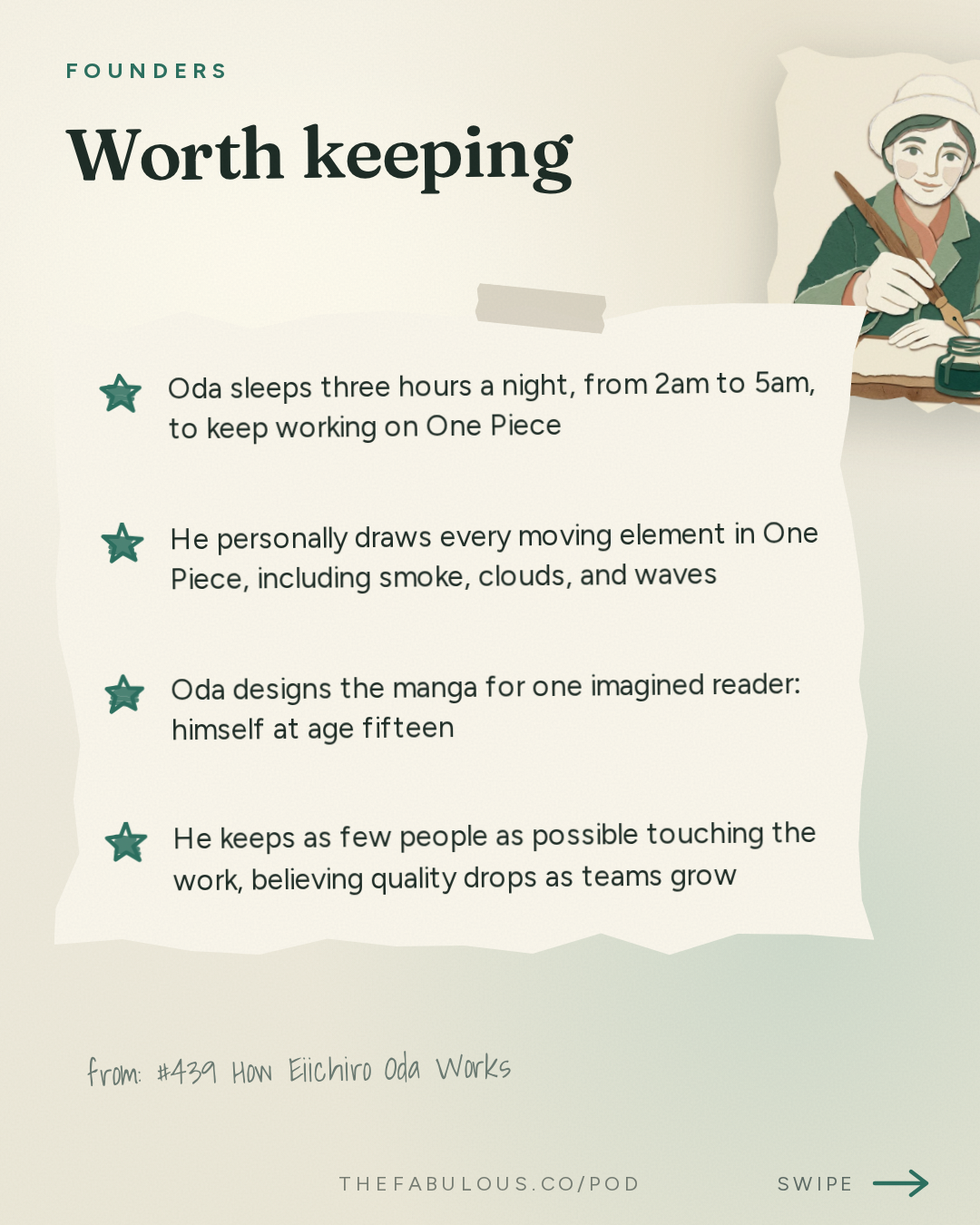
- Oda sleeps three hours a night, from 2am to 5am, to keep working on One Piece
- He personally draws every moving element in One Piece, including smoke, clouds, and waves
- Oda designs the manga for one imagined reader: himself at age fifteen
- He keeps as few people as possible touching the work, believing quality drops as teams grow
- His estimated net worth is $250 to $500 million, mostly from One Piece royalties
The episode in cards
By the numbers
- 15 years years Oda maintained his 2am to 5am sleep schedule, as of a 2016 interview
- 17 notebooks notebooks of material Oda keeps for a single One Piece story arc
In their words
“I only have one reader in my mind, myself as a 15-year-old.”
“The only way that I can think of a new idea is to think about it without sleeping or eating.”
“If you're efficient, you're doing it the wrong way. The right way is the hard way.”
“Making something great rarely takes more money. It just takes more time and a willingness to persevere.”
Protocols
-
Oda's weekly production cycle
Oda writes the story, dialogue, and rough storyboards Monday through Wednesday, then draws and finishes the pages with assistants Thursday through Saturday, then completes color illustrations and covers on Sunday, before the cycle restarts the following Monday.
weekly, documented in a published 2015 account of his schedule
-
Oda's anti-delegation rule for artwork
Oda personally draws every character, crowd scene, and moving natural element, including smoke, clouds, and ocean waves, and lets assistants handle only static backgrounds, because he says assigning moving elements to others creates small inconsistencies in the art.
every page, maintained across the series
-
Oda's deadline discipline
Oda keeps revising a story up to the last possible moment before a deadline rather than finishing early, because he says using every available minute is what giving maximum effort feels like to him, even though he has admitted finishing earlier would give him more free time.
every week, for over two decades
Questions this episode answers
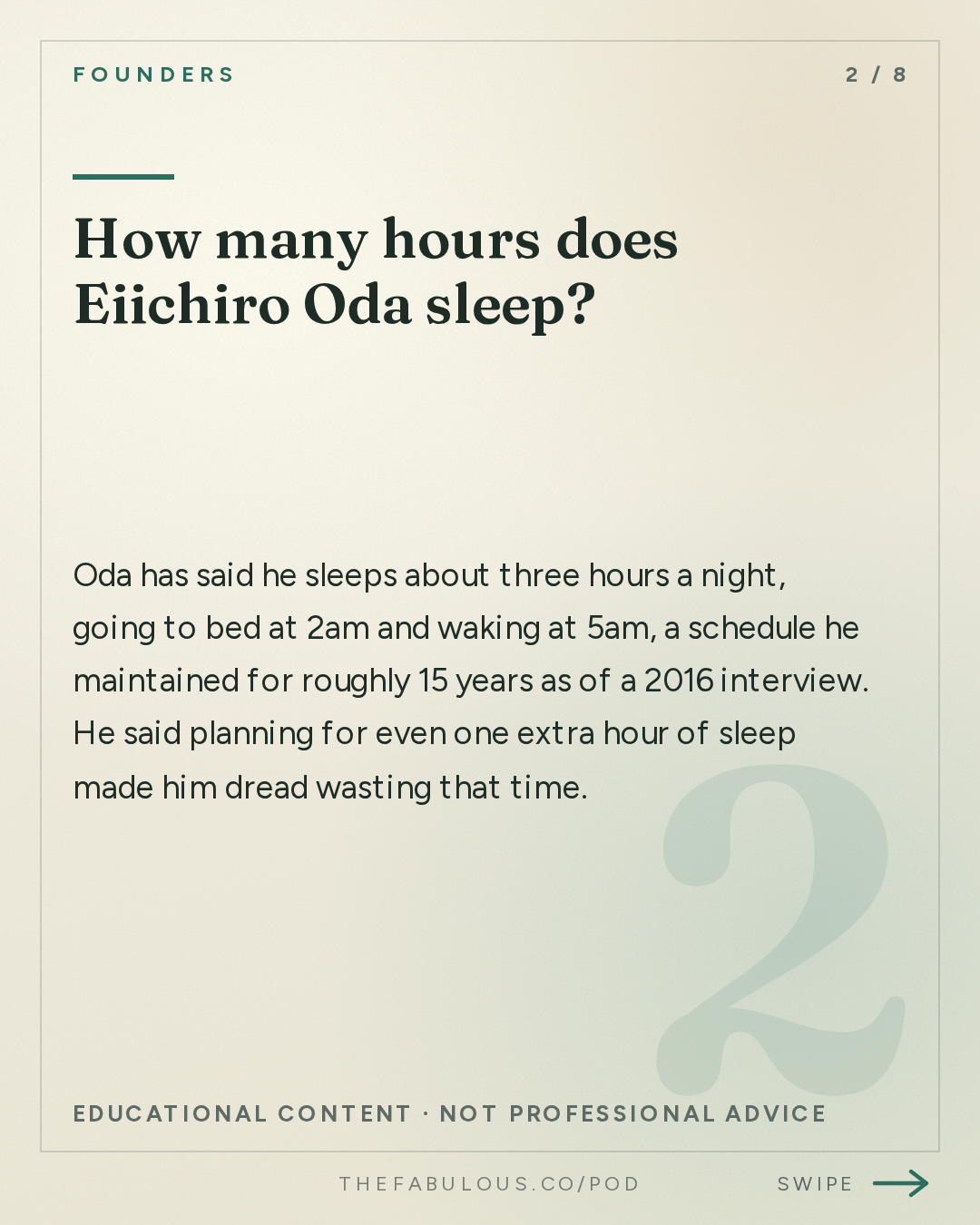
How many hours does Eiichiro Oda sleep?
Oda has said he sleeps about three hours a night, going to bed at 2am and waking at 5am, a schedule he maintained for roughly 15 years as of a 2016 interview (06:59, 14:25). He said planning for even one extra hour of sleep made him dread wasting that time.
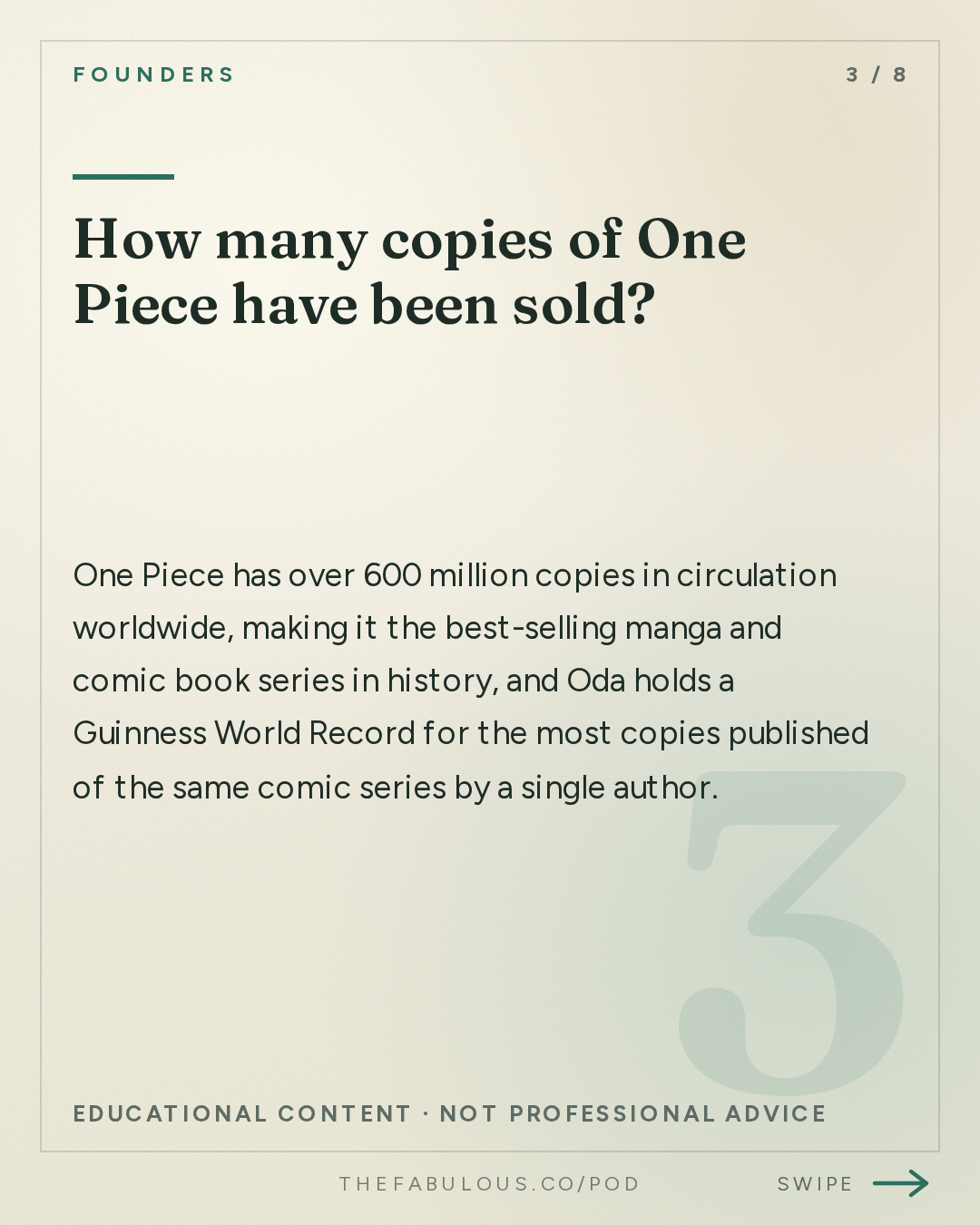
How many copies of One Piece have been sold?
One Piece has over 600 million copies in circulation worldwide, making it the best-selling manga and comic book series in history, and Oda holds a Guinness World Record for the most copies published of the same comic series by a single author (00:24).
Does Eiichiro Oda use assistants to draw One Piece?
Oda has assistants who handle backgrounds and supporting details, but he has historically insisted on personally drawing every moving or living element himself, including people, animals, crowds, smoke, clouds, and ocean waves, saying that assigning that work to others creates subtle inconsistencies in the art (16:02).
What is Eiichiro Oda's net worth?
Estimates put Oda's net worth between $250 million and $500 million, with annual income from One Piece estimated at $20 million to $40 million (19:10).
What is Oda's weekly schedule for drawing One Piece?
A published account of his 2015 production schedule describes writing story, dialogue, and rough storyboards Monday through Wednesday, drawing and finishing pages with assistants Thursday through Saturday, and completing color illustrations and covers on Sunday (14:49).
The full read, in cards
Go deeper
- Zero to One — Peter Thiel's argument that differentiated companies succeed while copies fail
- Insanely Simple — book on Steve Jobs's design philosophy stating that quality falls as team size grows
- Working Backwards — book on how Jeff Bezos ran Amazon, source of the phrase 'stubborn on vision, flexible on details'
- My Forty Years with Ford — memoir describing Henry Ford as an experimenter despite a fixed single-purpose goal
- Harvard Business Review interview with Jerry Seinfeld — Seinfeld explains why he micromanaged every detail of his show instead of seeking efficiency
Mentioned
Eiichiro Oda · One Piece · Eric Glyman · Weekly Shonen Jump · Akira Toriyama · Zero to One · Tobi Lutke · Steve Jobs · Jeff Bezos · Jerry Seinfeld
More from this show and category
James Garfield: Destiny of the Republic Summary
James Garfield rose from poverty to the presidency through relentless self-education, becoming college president by age 26. He was nominated by his party against his will in 1880 (17:50), then died 79 days after being shot in 1881, killed not by the bullet but by doctors who probed the wound with unsterilized fingers (30:21).
The Tycoons: How Carnegie and Rockefeller Built America
Charles R. Morris's book The Tycoons compares how Carnegie, Rockefeller, Gould, and Morgan each built the post-Civil War American economy. Carnegie cut costs and scaled steel, Rockefeller out-managed rivals in oil, Gould mastered railroad finance, and Morgan tried to impose order, together creating the infrastructure that let consumer brands like Procter & Gamble emerge.
Ari Emanuel's Roll the Calls, Summarized
Ari Emanuel's memoir Roll the Calls traces his rise from a dyslexic mailroom assistant to the billionaire founder of Endeavor. It shows how rage, relentless phone volume, and a 1994 near-fatal car accident drove him to found Endeavor, merge with William Morris, and buy the UFC and WWE before Endeavor was valued at $13 billion.
Jeremy Stern's Mark Zuckerberg Profile Explained
Mark Zuckerberg has modeled himself on Augustus Caesar for decades, fighting what journalist Jeremy Stern calls the dictator's dilemma. Stern's profile shows how Zuckerberg counters corporate isolation with raw data and MMA training, building a $1.6 trillion empire of 3.6 billion users while insisting he will never stop.
