
James Garfield: Destiny of the Republic Summary
#438 James Garfield's Extraordinary Rise
The brief
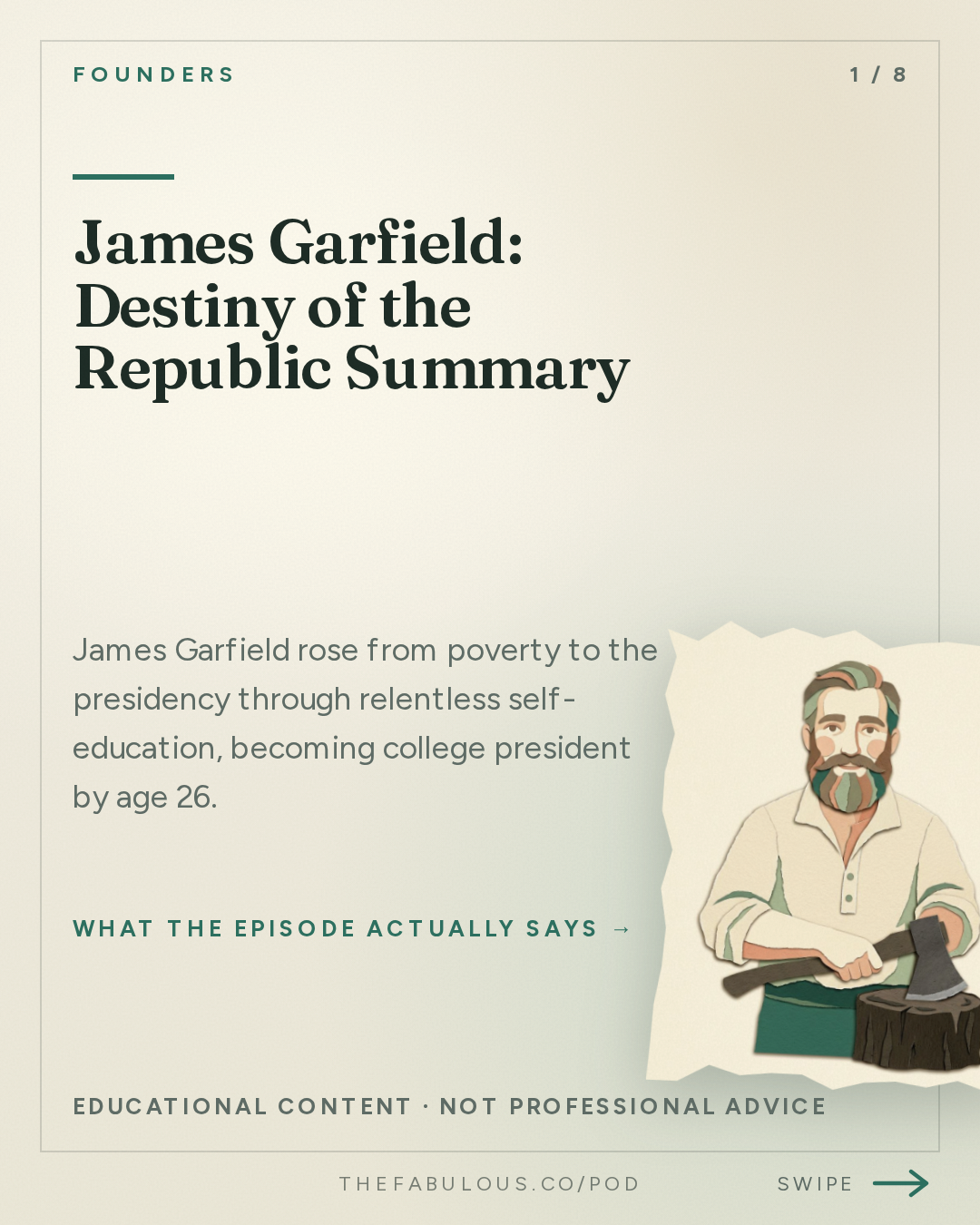
James Garfield rose from poverty to the presidency through relentless self-education, becoming college president by age 26. He was nominated by his party against his will in 1880 (17:50), then died 79 days after being shot in 1881, killed not by the bullet but by doctors who probed the wound with unsterilized fingers (30:21).
Before he was a congressman, a general, or a president, James Garfield rang a bell. Every morning at a small Ohio school he could not afford to attend as a student, he left the first lecture early, climbed the tower, and rang the bell that called everyone else to class. He had talked his way into the building by offering to sweep its floors, haul its wood, and light its fires (08:41). He had recently been pulled half-dead from a canal after contracting malaria, and was carrying seventeen dollars his mother and brother had scraped together while he was gone (07:15). That bell is as good a place as any to start, because it says what the rest of his life would prove: that Garfield's rise was not luck, and it was not charm. It was work, applied with a kind of fury, to the one lever he trusted.
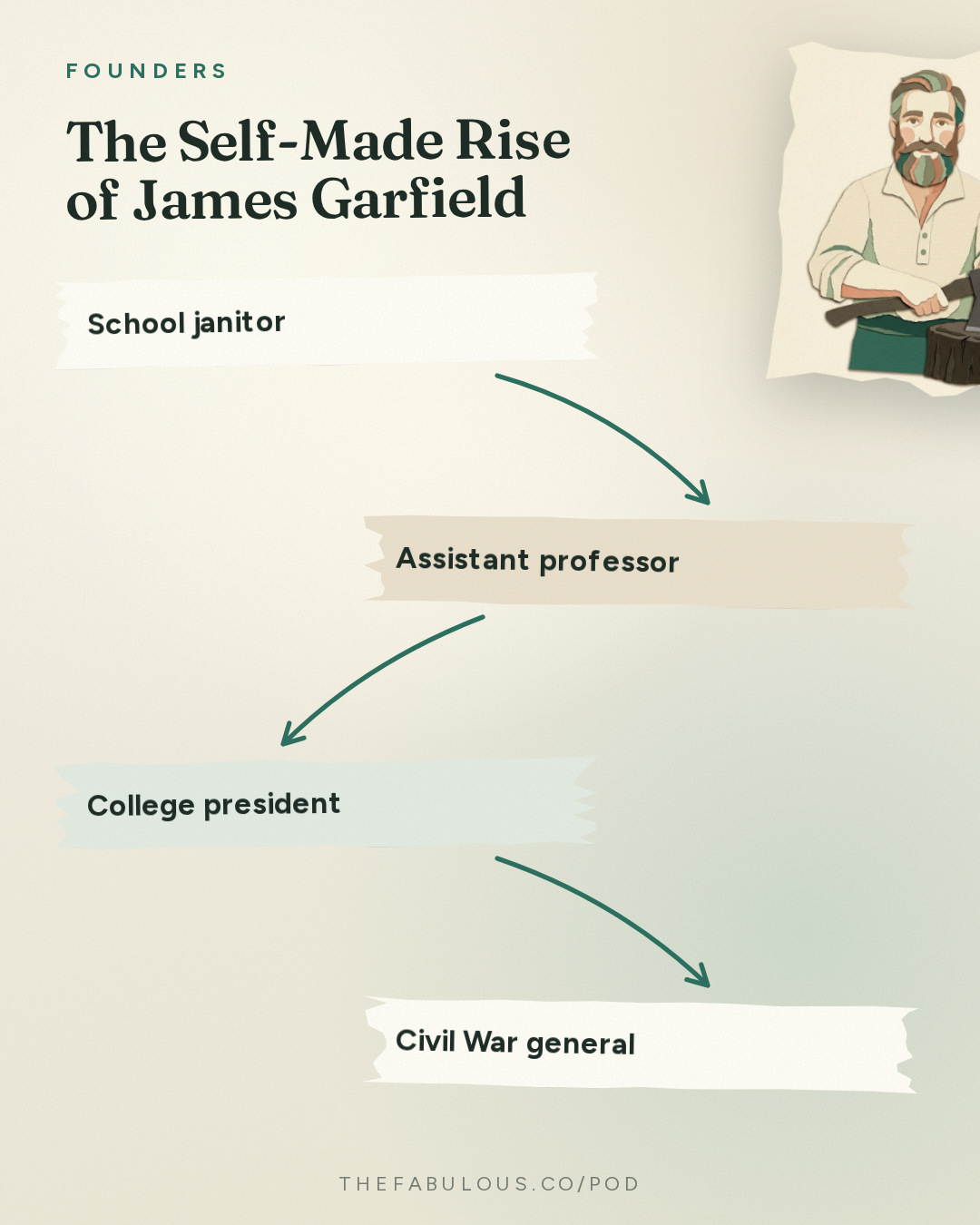
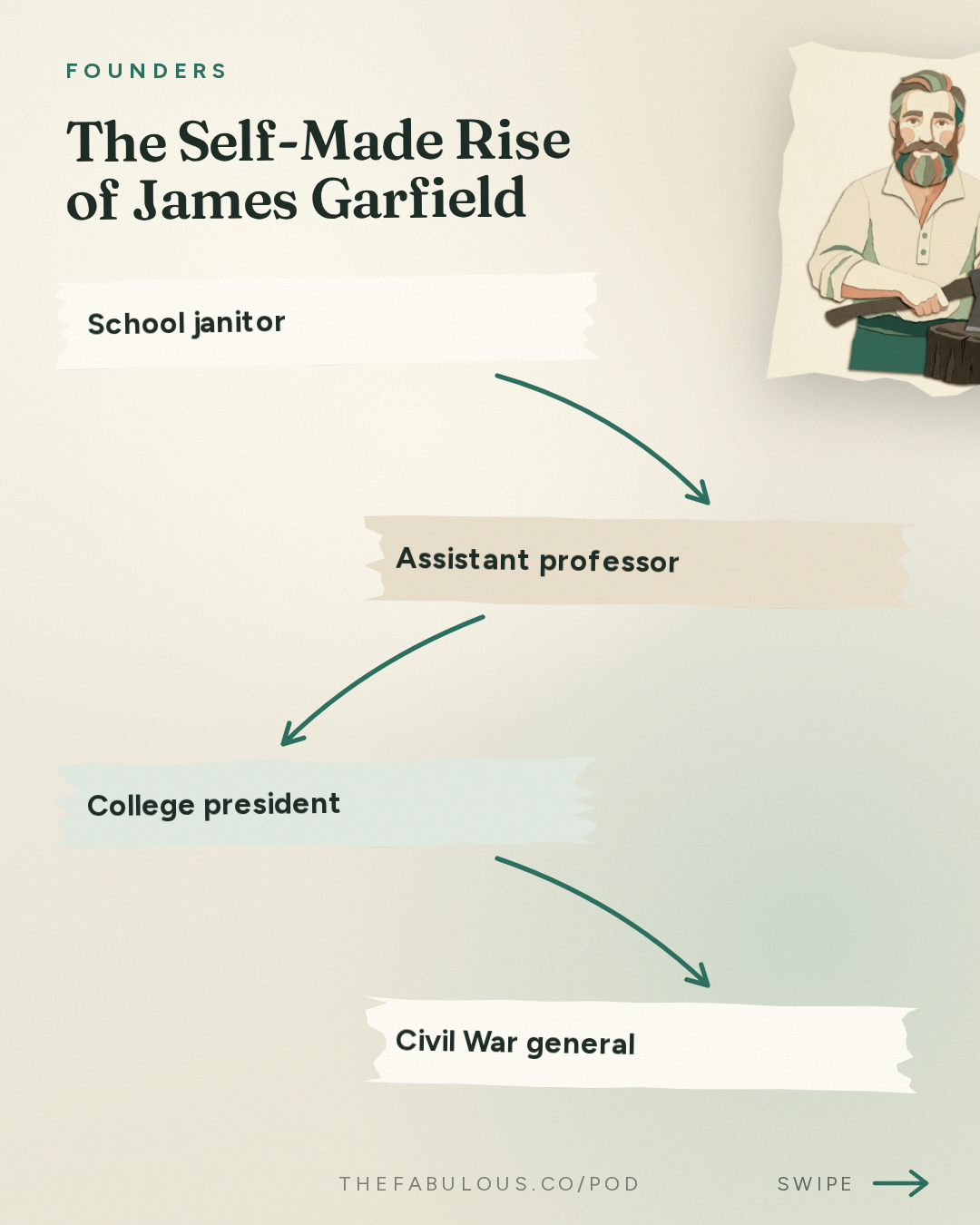
Garfield's biographer, Candice Millard, author of Destiny of the Republic, writes that for Garfield, "education was salvation." He had been born in a one-room log cabin with three windows and a dirt-chinked floor, fatherless before his second birthday, and he never romanticized any of it. "Let us never praise poverty," he said flatly (05:46). What he praised instead was the ladder out. Within a year of becoming the school's janitor, he was promoted to assistant professor, teaching the same literature and mathematics classes he had so recently been sweeping up after (09:52). He set himself a target of finishing ahead of 37 of the 42 students in his class at Williams College, and he hit it (11:01). By 26, he was president of the college he had once cleaned (11:25).
What makes Garfield's story stranger than the usual self-made tale is how little he wanted the rewards that followed. He drifted into politics almost by accident, won an Ohio Senate seat, then became a Civil War colonel who out-thought a larger Confederate force in Kentucky by splitting his own small regiment into three groups to fake overwhelming numbers (12:38). The ruse worked. The trick cost him something else, though. Walking a battlefield afterward, he mistook a field of dead soldiers for sleeping ones, and by his own account, "something went out of him that never came back" (13:23). He spent 17 years in Congress after that, watching colleagues destroyed by what he called "the evil effects of the presidential fever," and he resolved it would never seize him (15:37).
"I never meet a ragged boy in the street without feeling that I may owe him a salute, for I know not what possibilities may be buttoned up under his coat." — James Garfield [03:57]
It seized him anyway. At the 1880 Republican convention, Garfield rose to nominate a different candidate, John Sherman, and delivered the speech so well that the room began chanting his own name instead. He tried to stop it. "My God, I know it, and they will ruin me," he told a friend (17:03). He insisted, from the floor, that "no man has a right without the consent of the person voted for to announce that person's name and vote for him" (17:29). The convention did it anyway, handing him 399 votes, 20 more than he needed (17:50). He had never consented. He won the presidency the same way he had won the bell tower job: by being so visibly good at the thing in front of him that other people decided his fate for him.
The Doctor Who Knew, and the Doctors Who Didn't
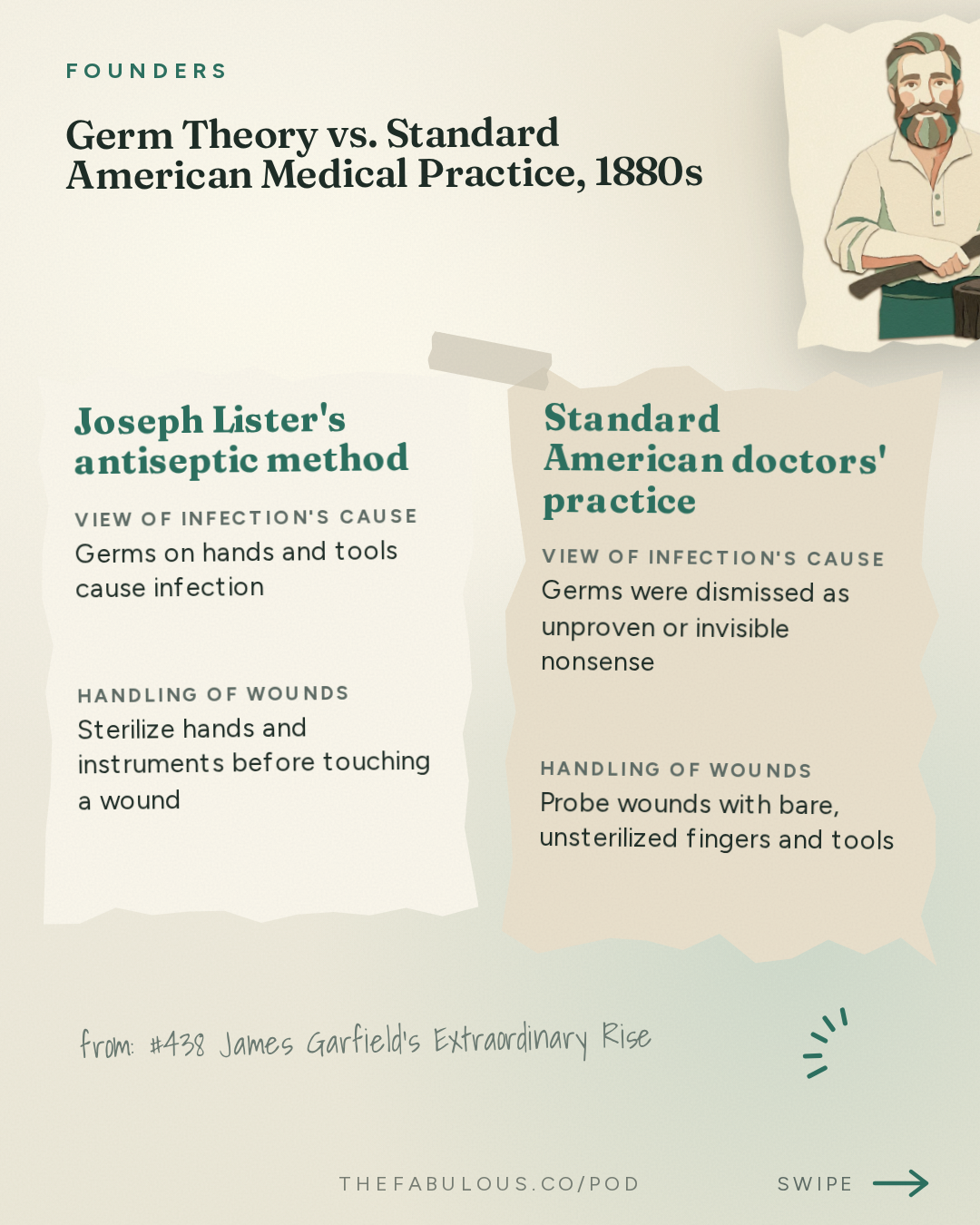
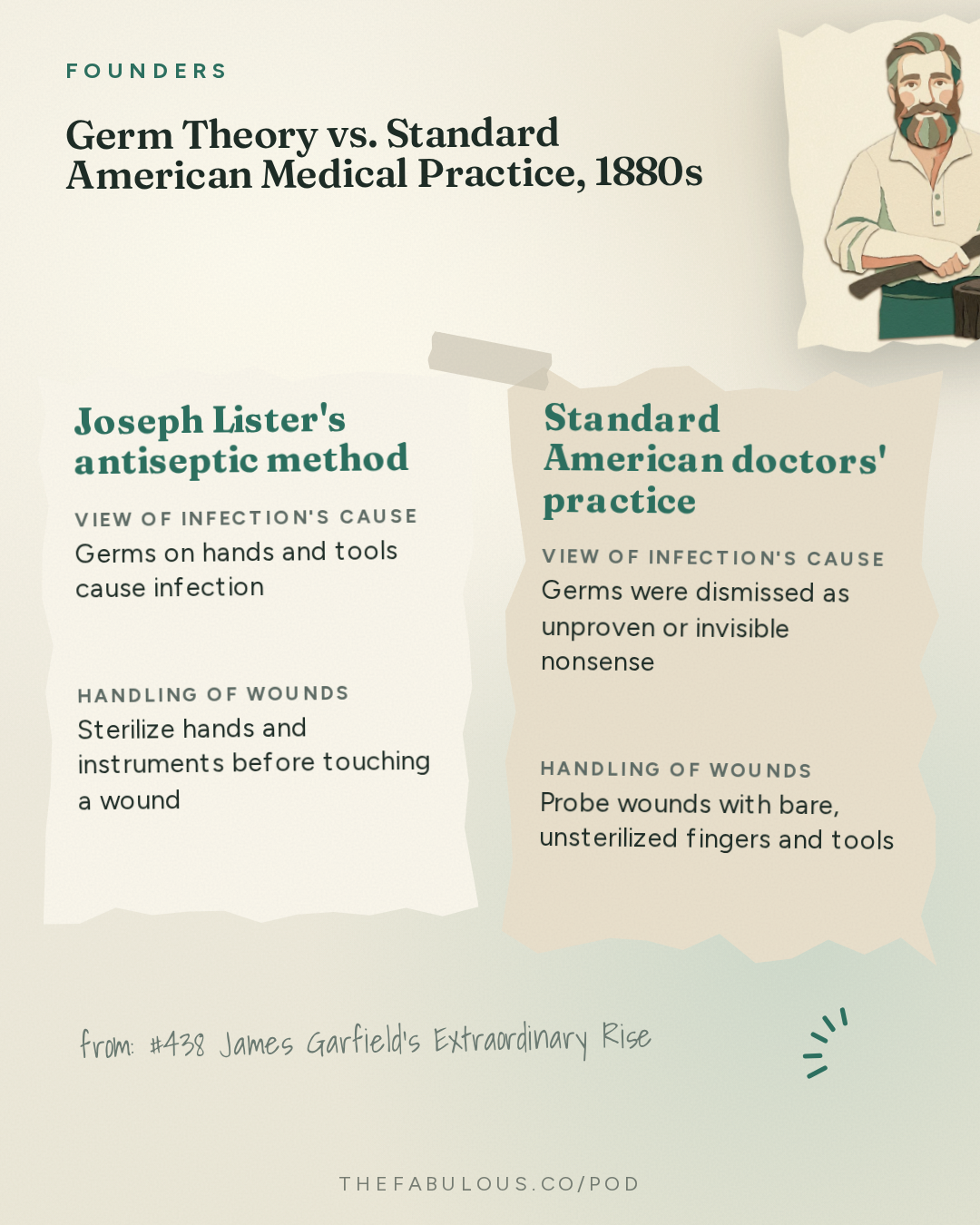
The second half of Garfield's story belongs to a British surgeon named Joseph Lister, who had spent years touring American medical halls trying to convince the country's most respected physicians of something that seems obvious now: that germs, invisible to the naked eye, caused infection, and that sterilizing hands and instruments saved lives. Millard reports that "almost none of them seriously considered putting his theory into practice" (27:50). One surgeon in the audience called the whole idea of antisepsis "not only absurd" but "a positive injury" (28:09). Among the skeptics sitting in that room was Dr. Frank Hamilton, a surgeon who preferred to leave wounds open to the air rather than sterilize them, and who would later hold Garfield's life in his unsterilized hands (28:57).
When a gunman shot Garfield in a Washington train station in July 1881, the wound itself was not fatal. The bullet had broken two ribs, grazed an artery, and missed his spine and vital organs entirely (29:22). Within five minutes, a doctor named Smith Townsend inserted an unsterilized finger into the wound, on the floor of the train station, one of the germiest places in the city (29:40). A second doctor, Bliss, dug for the bullet with ungloved probes and his own little finger, getting an instrument stuck between fractured rib fragments before he could pull it free (30:45). None of this found the bullet. All of it introduced the infection that actually killed him, 79 days later (30:21). Garfield died at 49, having spent his final weeks not fearing his own death so much as what it would do to his children (35:22).
"I wonder if all this fight against death is worth the little pinch of life I will get anyway." — James Garfield, to his wife [35:43]
The cruelty of the timing is what Millard keeps circling back to. A surgeon writing a few years after Garfield's death noted that the body had already done what the doctors refused to: it had sealed the bullet in a capsule of fibrous tissue, rendering it "entirely harmless" (33:25). Thousands of Civil War veterans were walking around at that very moment with bullets still lodged in them, including the man who had delivered Garfield's own assassin to jail, carrying a bullet in his brain for most of his life with no apparent harm (34:33). Left alone, Garfield almost certainly would have survived. Found fifteen years later, after X-rays existed, the bullet would have been located in days and the wound treated with antiseptic surgery; he might have been back on his feet within weeks (33:03). He had the misfortune of being shot in the narrow window after the technology for self-made success existed but before the technology for survival did.
What the Bullet Didn't Do
Garfield had sensed something like this coming. He wrote once that "great ideas travel slowly and for a time noiselessly, as the gods whose feet were shod with wool" (32:42), a line meant generally but that reads, in hindsight, like a diagnosis of his own death. Lister's idea had already crossed the ocean. It simply had not yet reached the men in the room with him.
Nothing about his death changed the country's habits quickly. Even after Lincoln and then Garfield were shot, Americans still found the idea of guarding a president too imperial, too close to monarchy, and Garfield had spent his presidency walking around Washington unprotected, trailed for months by the man who would kill him (25:30). Formal Secret Service protection for presidents did not exist until after William McKinley was shot in 1901, two decades later (36:46). Robert Todd Lincoln, Abraham Lincoln's son, stood near the president on that day too, having also been present, in one capacity or another, near Garfield's shooting, making him the only man present at three of the four presidential assassinations in American history (37:09).
What stays with a reader of Garfield's life is not the tragedy of the ending so much as the strangeness of the beginning. Here was a man who clawed his way out of a one-room cabin through sheer appetite for books, who kept a journal every night for 28 years, who did not want the single most powerful job in the country and said so, repeatedly, in writing, and got it anyway because he was too good at everything else to be ignored. He was killed not by a bullet but by a room full of educated men who refused to update what they believed. Garfield built his entire life on the premise that learning was the only honest path forward. It is a hard irony that the thing that ended it was other people's refusal to learn.
Ask this episode anything
Pod's AI answers from the episode itself, with the minute mark so you can hear it yourself.
Or start with one of these
Ask this episode
Pod's AI listens to the whole episode to answer, and points you to the minute it comes from.
The rest of this answer, and any question after it
Answers come from the episode itself, never from a summary of it.
ContinueKey takeaways
- James Garfield rose from janitor to college president by age 26
- Garfield won the 1880 Republican nomination with 399 votes despite never agreeing to run
- Doctors caused Garfield's fatal infection with unsterilized fingers, ignoring Joseph Lister's germ theory
- The bullet that struck Garfield was not fatal, a fibrous tissue capsule had already sealed it off safely
- Garfield kept a daily journal for 28 years, leaving direct quotes that trace his rise from poverty to the presidency
The episode in cards

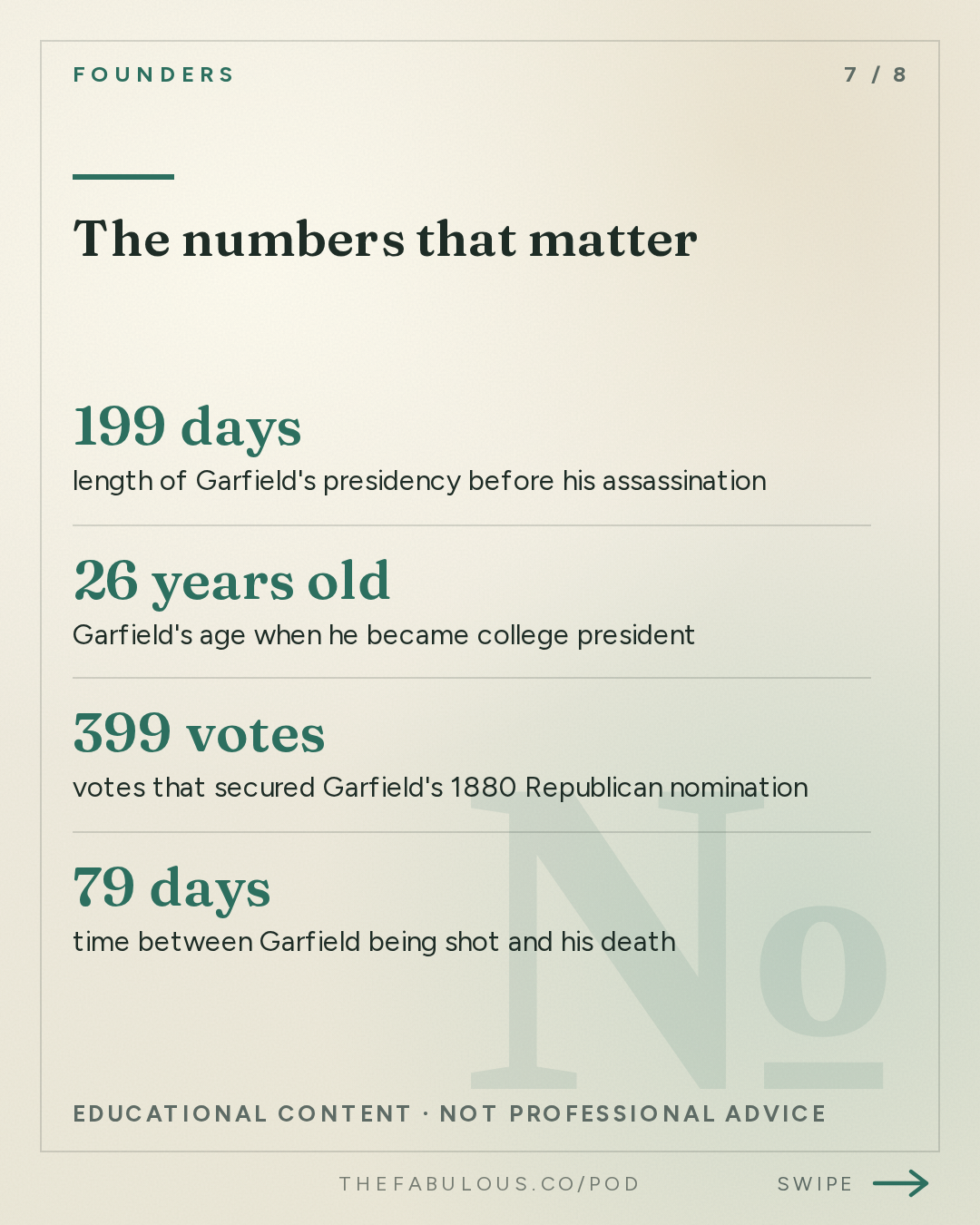
By the numbers
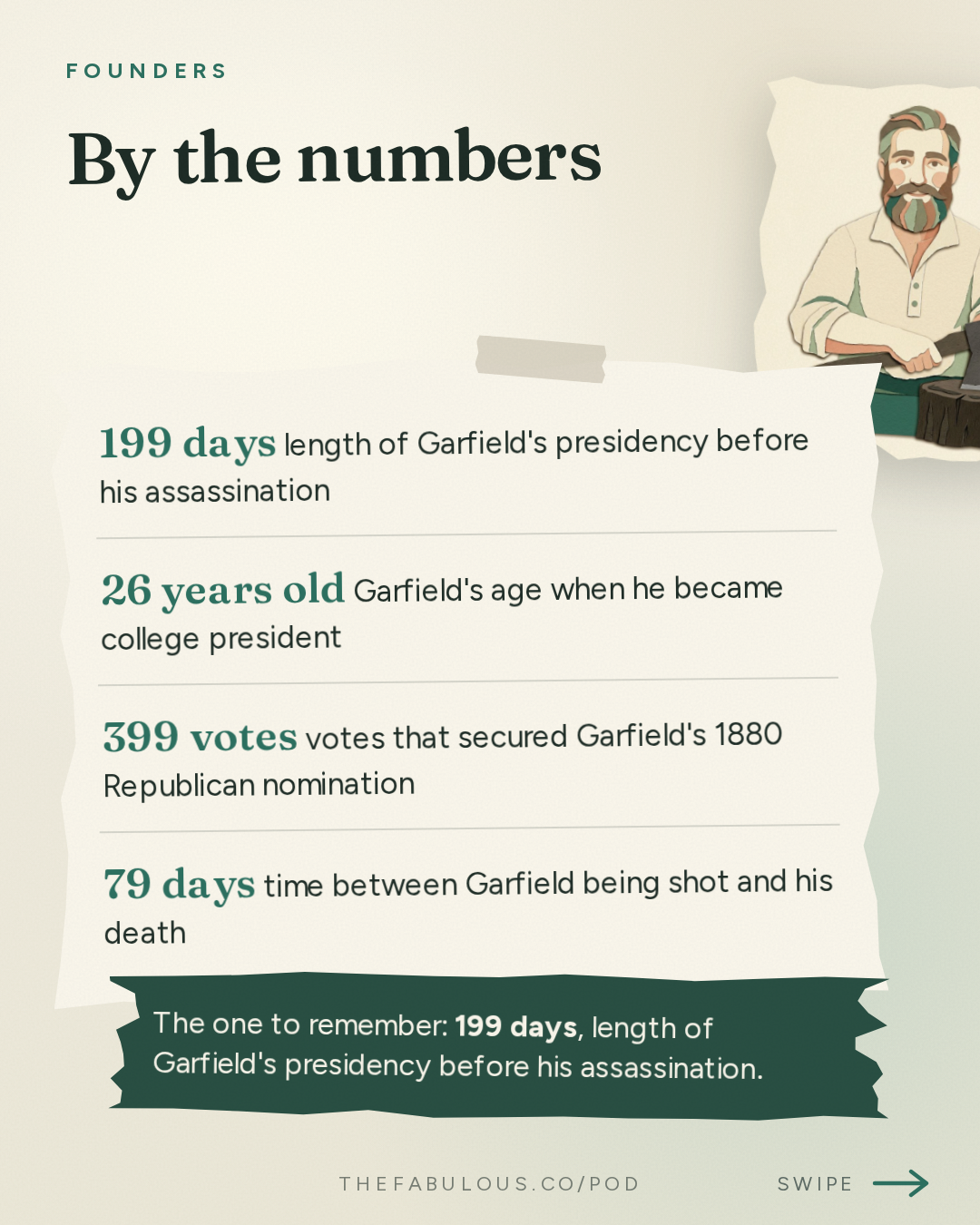
- 199 days length of Garfield's presidency before his assassination
- 26 years old Garfield's age when he became college president
- 399 votes votes that secured Garfield's 1880 Republican nomination
- 79 days time between Garfield being shot and his death
- 49 years old Garfield's age at death
In their words
“I never meet a ragged boy in the street without feeling that I may owe him a salute, for I know not what possibilities may be buttoned up under his coat.”
“Let us never praise poverty.”
“One night, if all this fight against death is worth the little pinch of life I will get anyway”
“My God, I know it, I know it, and they will ruin me.”
Questions this episode answers
How did James Garfield rise from poverty to the presidency?
Garfield paid for his first year of college by working as a school janitor, was promoted to assistant professor within a year, and became the college's president by age 26 (11:25). He later served 17 years in Congress before winning the 1880 Republican nomination with 399 votes, despite never agreeing to run (17:50).
What killed James Garfield, the bullet or infection?
The bullet itself was not fatal, it missed his spine and vital organs and had already been sealed off safely by a natural capsule of fibrous tissue (33:25). Garfield died 79 days after the shooting from an infection caused when doctors repeatedly probed the wound with unsterilized fingers and instruments (30:21).
Why did American doctors reject Joseph Lister's germ theory?
British surgeon Joseph Lister argued that invisible germs on hands and instruments caused infection, but most American physicians in the 1880s dismissed the idea because the danger could not be seen with the naked eye (27:50). One surgeon in his audience called antisepsis 'not only absurd' but 'a positive injury' (28:09).
Did James Garfield want to become president?
No. Garfield said he had 'so long and so often seen the evil effects of the presidential fever' on his colleagues that he was determined it would not seize him (15:37). He was nominated against his will at the 1880 convention after a nominating speech for another candidate caused the crowd to chant his name instead (17:29).
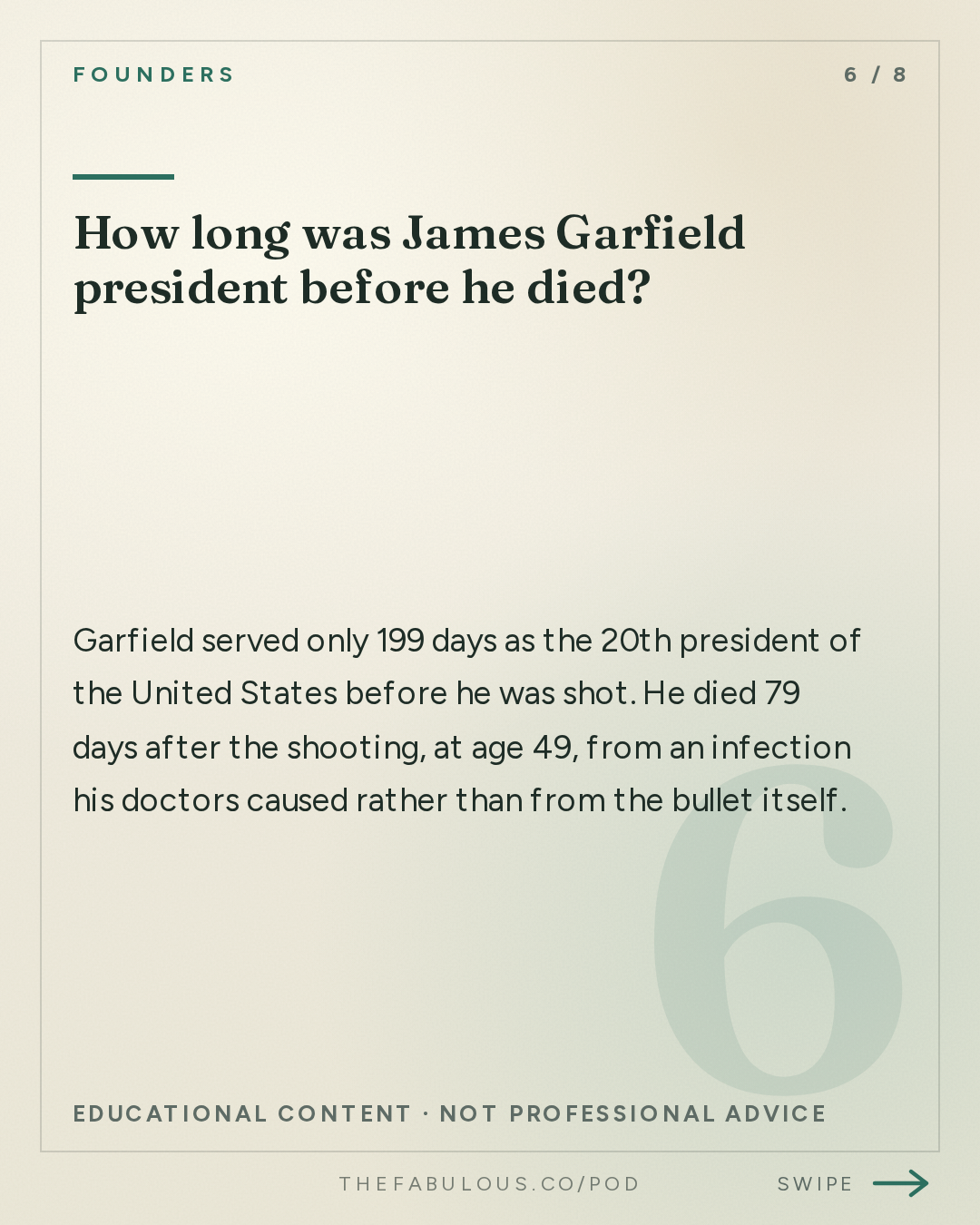
How long was James Garfield president before he died?
Garfield served only 199 days as the 20th president of the United States before he was shot (01:32). He died 79 days after the shooting, at age 49, from an infection his doctors caused rather than from the bullet itself (35:22).
The full read, in cards

Go deeper
- Destiny of the Republic: A Tale of Madness, Medicine and the Murder of a President — Candice Millard's biography of Garfield's rise, presidency, and death from medical malpractice, the main source for the episode
- New England Journal of Education — Published an original mathematical proof written by Garfield while he was a sitting congressman
Mentioned
James Garfield · Candice Millard · Destiny of the Republic · Joseph Lister · Abraham Lincoln · Alexander Graham Bell · Williams College · Robert Todd Lincoln
More from this show and category
The Tycoons: How Carnegie and Rockefeller Built America
Charles R. Morris's book The Tycoons compares how Carnegie, Rockefeller, Gould, and Morgan each built the post-Civil War American economy. Carnegie cut costs and scaled steel, Rockefeller out-managed rivals in oil, Gould mastered railroad finance, and Morgan tried to impose order, together creating the infrastructure that let consumer brands like Procter & Gamble emerge.
Ari Emanuel's Roll the Calls, Summarized
Ari Emanuel's memoir Roll the Calls traces his rise from a dyslexic mailroom assistant to the billionaire founder of Endeavor. It shows how rage, relentless phone volume, and a 1994 near-fatal car accident drove him to found Endeavor, merge with William Morris, and buy the UFC and WWE before Endeavor was valued at $13 billion.
Jeremy Stern's Mark Zuckerberg Profile Explained
Mark Zuckerberg has modeled himself on Augustus Caesar for decades, fighting what journalist Jeremy Stern calls the dictator's dilemma. Stern's profile shows how Zuckerberg counters corporate isolation with raw data and MMA training, building a $1.6 trillion empire of 3.6 billion users while insisting he will never stop.
Sam Walton's Core Business Strategies
Sam Walton built Walmart on four simple habits: cost control, copying competitors, small-town focus, and constant willingness to change course. He lost his first store over a missing lease clause, learned to fly a plane to scale faster, and copied ideas from JC Penney and Sol Price on his way to becoming America's richest man.
